
BAAM AI Blog
Intuit Acquires Mailchimp: Why The $12 Billion Deal Still Matters For Small Business Marketing
When Intuit acquires Mailchimp, it is easy to read the headline as a simple software deal: a finance company buys an email marketing company. But that misses the real move. Intuit was not just buying newsletters...

When Intuit acquires Mailchimp, it is easy to read the headline as a simple software deal: a finance company buys an email marketing company. But that misses the real move. Intuit was not just buying newsletters, templates, or automation workflows; it was buying a direct path into how small businesses attract, convert, retain, and understand customers.
The deal was announced in September 2021, with Intuit agreeing to acquire Mailchimp for approximately $12 billion in cash and stock. The acquisition officially closed on November 1, 2021, bringing Mailchimp into the same portfolio as QuickBooks, TurboTax, and Credit Karma through Intuit’s broader business platform strategy. That matters because QuickBooks already had the financial side of the business relationship, while Mailchimp had the marketing side.
For small and mid-market businesses, the strategic logic is obvious. Revenue growth does not come from accounting alone, and marketing performance does not improve when customer data sits in disconnected tools. The real opportunity was to connect customer behavior, purchase history, payments, segmentation, automation, and reporting into one operating system for growth.
this guide breaks down the acquisition in practical terms, not as corporate PR. We will look at why Intuit wanted Mailchimp, what the deal changed for the market, how the QuickBooks-Mailchimp connection works, and what professionals should learn from it when building their own customer growth systems. The point is not that every business should copy Intuit; the point is that every business should understand the strategy behind combining financial data with customer engagement.
This full article is structured as six connected parts. Each part builds on the previous one, so the analysis moves from the deal itself into the operating framework, then into implementation and long-term lessons. The section names below are the real section names used throughout the full article.
Why Intuit Acquired Mailchimp
The simple explanation is that Intuit wanted to help small businesses get customers, not just manage money after the sale. Intuit’s own acquisition announcement said that many small businesses struggle with customer acquisition and retention, while Mailchimp brought customer engagement, marketing automation, and commerce-oriented data capabilities into the picture. That makes the Mailchimp acquisition less about email and more about turning Intuit into a growth platform.
Mailchimp had already built a strong position with small businesses because it was approachable, product-led, and widely recognized by non-technical teams. It started as an email marketing tool, but by the time of the deal it had expanded into marketing automation, customer journeys, audience segmentation, landing pages, websites, and commerce integrations. Intuit saw a company that had earned trust with the same business audience QuickBooks already served.
The timing also mattered. By 2021, small businesses were under pressure to digitize faster, sell online, and retain customers without relying only on paid ads or manual follow-up. Intuit had the books, invoices, payroll, payments, and business data; Mailchimp had the customer communication layer. Together, they could offer something more valuable than either tool alone: a way to connect financial truth with marketing action.
Why It Matters
This acquisition matters because it shows where small business software has been moving for years. The old model was a collection of separate tools: one for accounting, one for email, one for CRM, one for ecommerce, one for reporting, and one spreadsheet trying to hold everything together. The new model is an integrated growth stack where business data flows directly into customer communication.
That is why Intuit’s ownership of Mailchimp is bigger than a brand acquisition. If QuickBooks knows who bought, what they bought, how often they buy, how much they spend, and whether they paid on time, that data can shape better marketing decisions. A business can segment high-value customers, re-engage inactive buyers, create post-purchase automations, and measure campaigns against actual revenue instead of vanity metrics.
The broader lesson is practical. Marketing gets stronger when it is connected to operational data, and operations become more valuable when they help drive revenue. That is the real reason the phrase “Intuit acquires Mailchimp” still deserves attention years after the transaction closed.
Framework Overview
The easiest way to understand the acquisition is to view it as a customer growth framework. Intuit already had a strong base in business operations through QuickBooks, while Mailchimp added the tools needed to communicate with customers and influence demand. The strategic bridge between them is data: using business activity to create more carefully customer engagement.
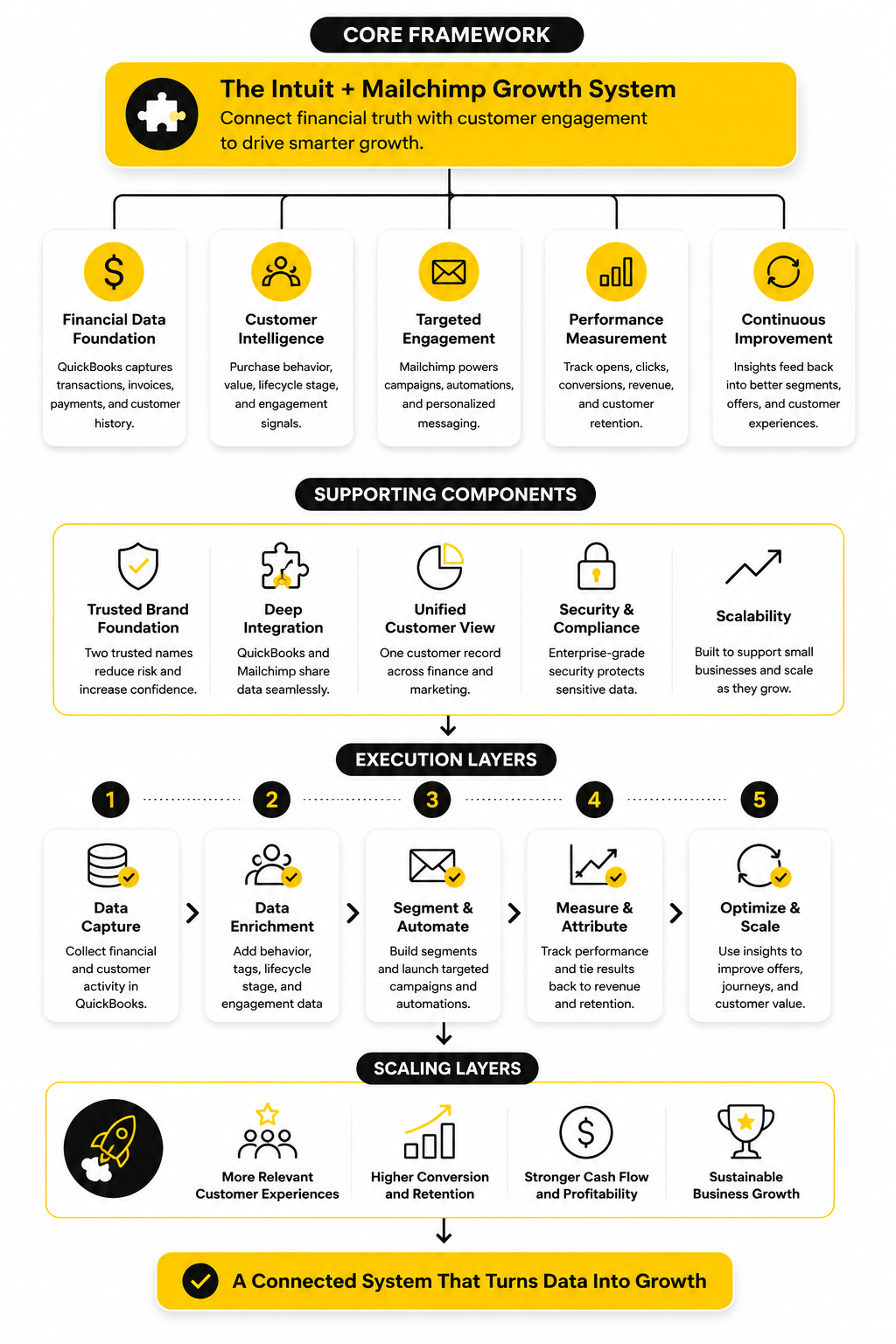
The framework has four layers. First, the business captures financial and customer data through transactions, invoices, payments, and purchase behavior. Second, that data becomes usable through profiles, segments, and insights. Third, the business acts on those insights through campaigns, automations, recommendations, and follow-up. Fourth, results flow back into the system so teams can see what actually affects revenue.
This is why the deal was not just about adding Mailchimp to Intuit’s product shelf. It was about building a loop. Data creates insight, insight drives communication, communication creates behavior, and behavior updates the data again.
The Strategic Logic Behind The Deal
The strongest reason Intuit acquires Mailchimp is not “email marketing.” It is distribution. Intuit already had deep relationships with businesses through QuickBooks, payments, payroll, and tax products, but those tools mostly helped after money moved through the business. Mailchimp gave Intuit a way to influence what happens before the sale: audience building, campaign execution, customer reactivation, and repeat purchase behavior.
That is a much bigger strategic move than it first appears. Accounting software is naturally sticky because businesses depend on accurate records, payroll, taxes, and cash flow visibility. Marketing software is naturally active because teams use it to create campaigns, test messages, and push revenue forward. When those two worlds connect, the platform moves from recordkeeping into growth execution.
This is why Intuit described the deal as a way to accelerate its goal of becoming the center of small business growth and expanding into the mid-market. The acquisition announcement positioned Mailchimp as a customer engagement and marketing platform that could work alongside QuickBooks to help businesses “grow and run” with more confidence. That phrase matters because it shows the ambition clearly: not just helping businesses manage operations, but helping them generate demand.
The Deal Was About Owning More Of The Business Workflow
A small business does not wake up thinking, “I need another SaaS category.” It thinks about cash flow, sales, customers, payroll, taxes, and whether this month is going to work. Intuit already owned a meaningful part of that operating rhythm through QuickBooks, but Mailchimp added another high-frequency workflow: communicating with customers.
That matters because workflow ownership creates leverage. If a business sends invoices in QuickBooks, tracks payments there, and then uses that purchase data to trigger a Mailchimp campaign, the platform becomes more useful with every action. The customer is no longer just buying separate tools; they are building a connected system that becomes harder to replace.
This is also where the acquisition becomes more defensive. Competitors in CRM, ecommerce, payments, and marketing automation all want to own the small business relationship. By bringing Mailchimp into the portfolio, Intuit protected its core position while expanding into a larger budget category: growth software.
The QuickBooks And Mailchimp Connection Changed The Value Proposition
The practical value of combining QuickBooks and Mailchimp is simple: financial data can make marketing more relevant. The current QuickBooks and Mailchimp integration says businesses can sync real-time QuickBooks data into Mailchimp, then use that data to build targeted campaigns and automations based on customer activity. That includes useful signals like what someone bought, how much they spent, and when a payment was received.
This is not theoretical. Mailchimp’s QuickBooks integration page says customers using the integration generate 63% higher average click-through rates than customers using Mailchimp alone. That does not mean every business will see the same lift, and it should not be treated like a guaranteed outcome. But it does support the strategic point: campaigns usually perform better when they are built on richer customer context.
For business owners, that is the part worth taking seriously. You do not need a huge data science team to make better marketing decisions. You need cleaner customer data, useful segments, and campaigns that match real behavior instead of generic assumptions.
The Acquisition Also Expanded Intuit’s Market
Before the deal, Intuit was already a major small business software company. After the deal, it had a stronger argument for becoming an all-in-one platform for running and growing a business. That distinction is important because “running” a business and “growing” a business are different jobs, but small businesses usually want both from fewer tools.
Mailchimp also gave Intuit a stronger position with businesses that may not start their journey inside accounting software. A founder, ecommerce operator, consultant, creator, local service provider, or agency might discover Mailchimp before they ever think seriously about bookkeeping systems. That creates a second front door into Intuit’s ecosystem.
The deal also made sense for mid-market expansion. As companies grow, their needs become more complex: segmentation, lifecycle automation, reporting, integrations, compliance, permissions, and customer data quality all become more important. Mailchimp gave Intuit more room to serve businesses that had outgrown basic marketing tools but were not ready for heavy enterprise systems.
Why The Price Made Strategic Sense
A $12 billion price tag sounds aggressive when you view Mailchimp as an email tool. It looks more rational when you view it as a customer engagement layer for millions of small and mid-market businesses. Intuit was not simply paying for software features; it was paying for brand trust, distribution, product adoption, customer data workflows, and a larger role in the small business growth stack.
The acquisition was also made at a time when software platforms were racing to consolidate more business functions into fewer systems. That market context matters. When every major platform wants to own the customer record, payments flow, marketing workflow, and analytics layer, a company like Mailchimp becomes strategically valuable.
Still, the deal was not risk-free. Big acquisitions only work when the buyer can integrate the product without damaging what users liked about it in the first place. Mailchimp’s strength came from being approachable and independent-feeling, so Intuit had to balance platform integration with product familiarity.
What This Means For Operators
The big takeaway is not that every business needs a giant software suite. The lesson is that disconnected tools create hidden costs. When finance, marketing, sales, and customer data live in separate places, teams spend more time importing, cleaning, guessing, and reconciling than actually improving the customer experience.
A practical operator should look at the Intuit-Mailchimp deal and ask one question: where does our customer data stop being useful? If purchase data never informs campaigns, there is wasted opportunity. If email engagement never connects to revenue, reporting is incomplete. If customer records are manually moved between tools, the system is already leaking time.
This is why the acquisition still matters. It points toward the kind of stack small businesses increasingly need: fewer disconnected apps, better customer context, and marketing systems tied closer to real business outcomes.
The Growth Platform Framework
The clearest way to understand why Intuit acquires Mailchimp is to stop thinking in software categories and start thinking in business motion. A small business needs to know who its customers are, what they bought, how valuable they are, when they are likely to buy again, and what message should reach them next. Intuit’s bet was that those answers become stronger when financial data and marketing data work together instead of living in separate systems.
This is the heart of the growth platform framework. QuickBooks holds operational signals like invoices, payments, sales activity, and customer records, while Mailchimp turns customer signals into campaigns, automations, and measurable follow-up. The connection becomes useful because it moves marketing away from vague audience lists and closer to real business behavior.
That is the shift professionals should care about. The acquisition was not only about making Mailchimp bigger or QuickBooks more feature-rich. It was about creating a loop where customer activity informs marketing, marketing creates more activity, and the platform keeps learning from both sides.
Start With The Customer Record
The customer record is the foundation of the framework. If the data is messy, duplicated, incomplete, or spread across too many disconnected tools, every campaign becomes weaker before it even starts. A business cannot personalize intelligently when it does not trust the basic record of who bought, what they bought, and where they are in the relationship.
This is why the QuickBooks and Mailchimp connection is so important. Mailchimp’s QuickBooks integration lets businesses sync financial and marketing data into the Mailchimp audience so campaigns can be based on customer activity rather than a static list. That means the marketing layer can use richer context, including purchase behavior, spending history, and payment-related signals.
The practical lesson is simple. Before building advanced automation, fix the customer record. Clean names, emails, tags, purchase data, permissions, and source information first, because every later step depends on that foundation.
Turn Business Activity Into Segments
Once the customer record is reliable, the next move is segmentation. This is where the system starts to become commercially useful. Instead of sending the same campaign to everyone, the business can group customers by value, activity, product interest, recency, lifecycle stage, or buying behavior.
That is exactly why the acquisition makes strategic sense. Financial behavior creates strong marketing signals because money is one of the clearest indicators of intent. A customer who bought recently, a customer who has not returned in six months, and a customer who consistently spends more than average should not receive the same message.
The goal is not to create hundreds of overcomplicated segments. The goal is to create a few useful groups that lead to better action. For most teams, that means starting with simple segments like new customers, repeat buyers, high-value customers, inactive customers, and leads who have not converted yet.
Build Campaigns Around Behavior
Good automation does not start with the email. It starts with the behavior that should trigger the message. That is where many teams get this wrong: they open a campaign builder first, then try to invent a reason to send something.
A stronger process starts with a real customer moment. Someone buys for the first time, misses a payment, requests a quote, completes a service, abandons a purchase path, or has not returned after a meaningful period. Each moment should lead to a useful next step, not just another generic newsletter.
This is where Mailchimp becomes more valuable inside Intuit’s ecosystem. QuickBooks data can support targeted multichannel campaigns and automations based on what customers bought, how much they spent, or the last payment received, which Mailchimp highlights in its QuickBooks integration overview. That is a practical execution layer, not just a reporting upgrade.
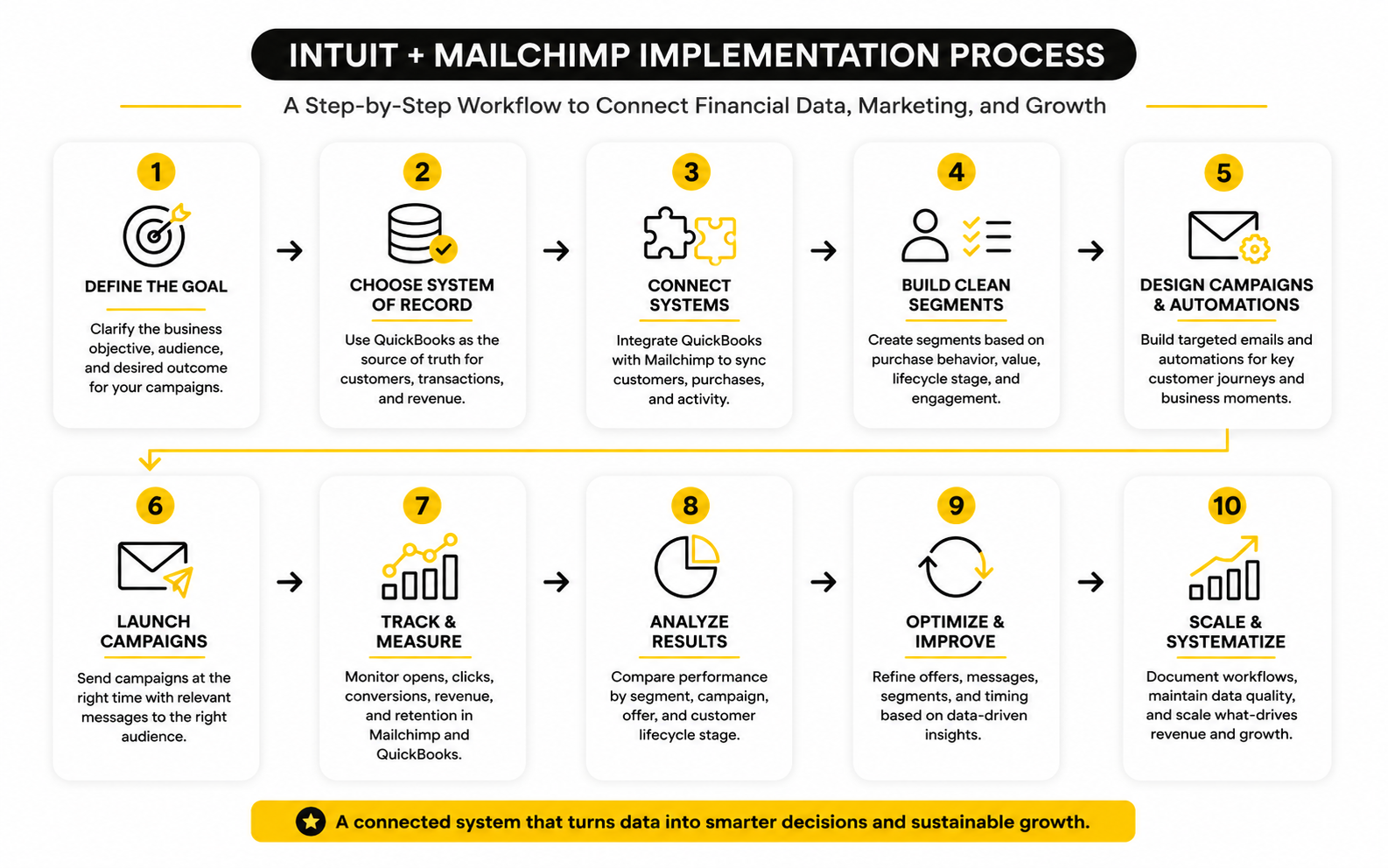
A Practical Execution Process
The implementation process should be simple enough for a small team to actually use. If it takes three months of planning before the first campaign goes live, the system is already too heavy. The better approach is to start with one customer journey, one clean data source, one useful segment, and one measurable outcome.
A realistic process looks like this:
That process is intentionally plain. The power is not in making the stack complicated. The power is in connecting real business data to a message that reaches the right customer at the right moment.
Measure Revenue, Not Just Engagement
Clicks and opens can be useful, but they are not the final scoreboard. The reason Intuit’s acquisition of Mailchimp matters is that it pushes marketing closer to financial outcomes. If a campaign generates attention but does not support sales, retention, cash flow, bookings, or customer lifetime value, the business still needs better execution.
This is where connected systems beat disconnected reporting. When finance and marketing data work together, teams can ask better questions. Which segments actually buy again? Which campaigns create profitable customers? Which offers attract low-quality leads? Which automations shorten the path from interest to payment?
The point is not to ignore marketing metrics. The point is to put them in context. Engagement tells you whether people reacted; revenue and customer behavior tell you whether the reaction mattered.
Keep The Framework Lean
A growth platform should reduce friction, not create a bloated machine that nobody wants to manage. That matters especially for small businesses, where the same person may be handling customers, operations, sales, invoices, and marketing in the same week. The system has to be useful without demanding enterprise-level maintenance.
That is why the best implementation starts with fewer moving parts. One clean integration, a handful of meaningful segments, and a few behavior-based automations will usually beat a complicated setup full of unused workflows. Intuit’s broader platform direction supports this same idea, with its 2025 annual reporting describing a vision for an all-in-one platform that helps small and mid-market businesses run and grow.
The operator’s job is to keep the system tied to business reality. If a workflow saves time, improves follow-up, increases repeat buying, or makes customer communication more relevant, it belongs. If it only adds complexity, it should be removed.
Core Components Of The Intuit And Mailchimp Model
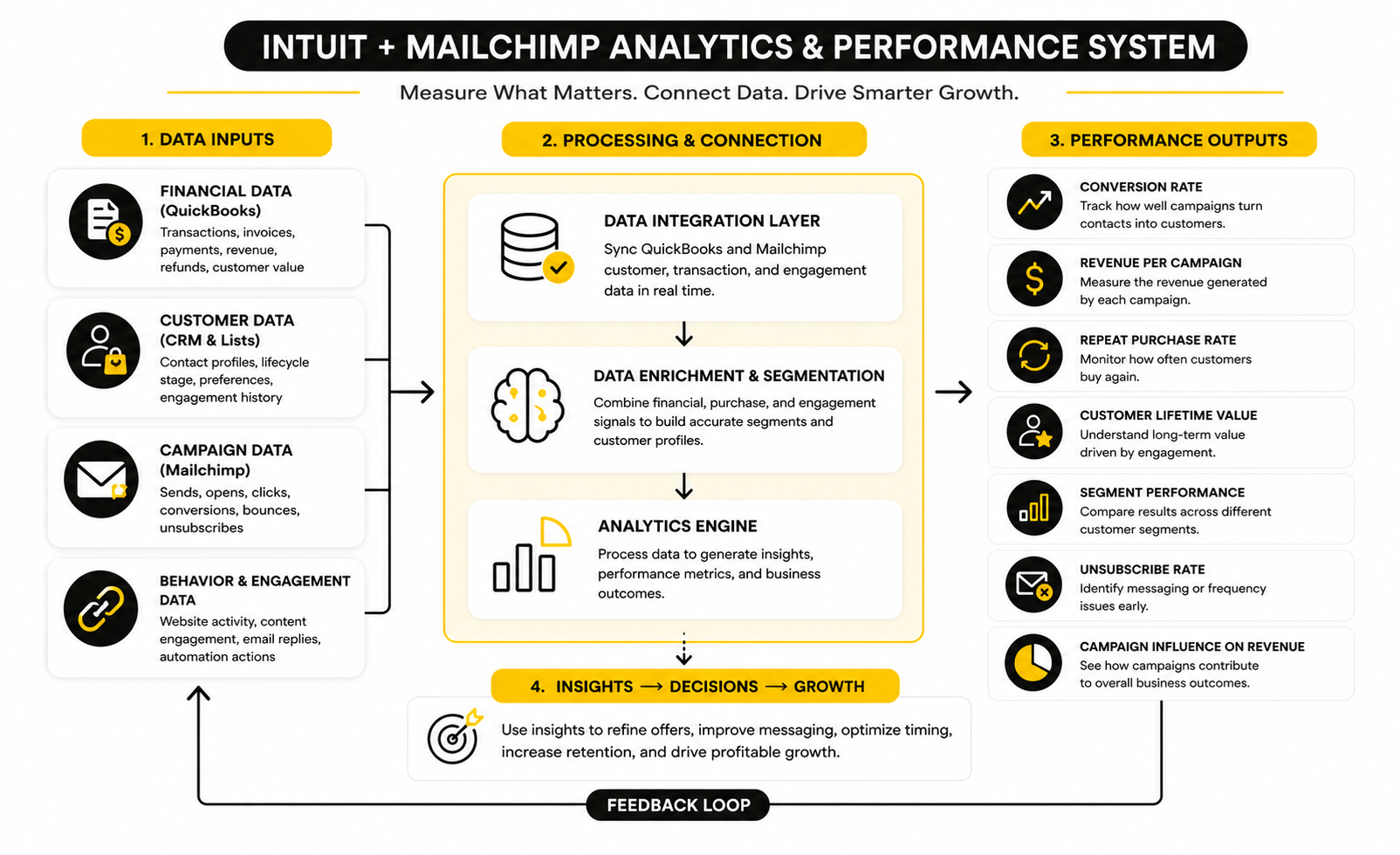
The measurement side of the model is where the acquisition becomes practical. When Intuit acquires Mailchimp, the strategic promise is not just better email templates or a bigger software bundle. The promise is that a business can connect customer communication to actual business outcomes instead of treating marketing analytics as a separate dashboard full of isolated numbers.
That difference matters because small businesses do not have unlimited time to interpret data. They need to know which customers are responding, which campaigns are creating value, which automations deserve more attention, and which numbers are just noise. The best analytics system should make the next decision easier.
The core components are straightforward: customer data, campaign engagement, transaction behavior, revenue impact, and retention signals. None of those numbers means much alone. Together, they help a business understand whether its marketing is actually moving people closer to purchase, repeat purchase, or a stronger relationship.
Statistics And Data
A useful analytics system starts with the right question. The question is not “What is our open rate?” The better question is “Which messages are creating profitable customer behavior?” That shift is important because modern email metrics can be misleading when they are viewed without context.
Mailchimp publishes email marketing benchmark guidance because teams need a baseline, but benchmarks should never become the goal. Mailchimp’s own benchmark resource emphasizes that click-through rates matter most when they lead to a desired action, such as a purchase, signup, or form submission. In other words, engagement only matters when it connects to the next step in the customer journey.
This is exactly why the QuickBooks connection changes the measurement conversation. Mailchimp says businesses using its QuickBooks integration generate 63% higher average click-through rates than customers using Mailchimp alone. That number matters because it supports a practical point: when campaigns use richer customer and purchase context, people are more likely to respond.
Why Clicks Need Business Context
A click is a signal, not a result. It tells you that the message created enough interest for someone to act, but it does not tell you whether the action produced revenue. A campaign can get a strong click-through rate and still fail if the wrong people clicked, the offer did not convert, or the follow-up experience broke after the email.
That is why the analytics layer should connect campaign behavior with financial behavior. If a segment of inactive customers clicks but does not buy, the business may have an offer problem. If high-value customers click and purchase quickly, the business may have found a segment worth prioritizing. If new customers open emails but never take the next step, the onboarding sequence may need to be clearer.
The lesson is simple: do not celebrate clicks in isolation. Use clicks as a diagnostic tool. They help identify where attention is forming, but revenue data tells you whether that attention became commercially useful.
The Metrics That Actually Matter
A small business does not need fifty marketing metrics. It needs a short list of numbers that connect attention, action, and money. The best measurement system is practical enough to review weekly and clear enough to guide decisions without turning every campaign into a reporting project.
The most useful metrics are:
Those metrics work because each one has a decision attached to it. If segment engagement is weak, improve targeting. If clicks are strong but conversions are weak, fix the landing page, offer, or follow-up. If revenue per campaign is high from one segment, build more campaigns around that segment.
How To Read Benchmarks Without Misusing Them
Benchmarks are useful for orientation, but they are dangerous when teams treat them like universal targets. Industry averages vary by sector, audience quality, offer type, buying cycle, geography, and list age. A local accounting firm, a ecommerce brand, a software company, and a nonprofit may all use email, but their performance patterns will not be identical.
This is why benchmark data should be used as a starting point, not a verdict. MailerLite’s 2025 benchmark data shows large differences by industry, with sectors such as ecommerce, retail, consulting, and nonprofits showing different open rate patterns across its customer base. That kind of data is useful because it reminds teams to compare themselves against similar businesses, not against a generic internet average.
The better approach is to build your own internal benchmark. Track your last 10 to 20 campaigns by segment, offer, send type, and business outcome. Once you know your own baseline, every new campaign can be judged against your reality instead of somebody else’s average.
What The Data Should Make You Do
Data is only valuable when it changes behavior. If a report does not lead to a decision, it is probably just decoration. This is where small businesses need to be strict, because analytics can easily become another form of procrastination.
Every measurement cycle should end with one of four actions. Keep what is working, improve what is underperforming, stop what is wasting attention, or test a specific alternative. That is it. The goal is not to admire dashboards; the goal is to make the next campaign more effective.
For example, if inactive customers respond to a win-back offer but do not purchase, test the offer and timing. If first-time buyers engage heavily with onboarding content, add a follow-up sequence that introduces the next logical product or service. If top spenders consistently click on early access campaigns, give that segment more exclusive communication and measure whether it lifts repeat revenue.
Where Measurement Breaks Down
Measurement usually breaks down when the systems are disconnected. One tool shows opens and clicks, another shows sales, another shows invoices, and nobody knows which campaign actually influenced the customer. That is exactly the gap the Intuit-Mailchimp strategy tries to close.
The second breakdown happens when teams rely too heavily on top-of-funnel metrics. Opens can be affected by privacy changes, inbox behavior, and tracking limitations, so they should be treated carefully. Clicks are usually more useful than opens, but they still need to be connected to conversions and revenue before they can guide serious decisions.
The third breakdown is messy attribution. A customer may see an email, click a retargeting ad, receive a sales call, and then pay an invoice two days later. The best small business measurement system does not need perfect attribution, but it does need consistent attribution rules so the team can compare campaigns fairly over time.
The Measurement Loop Professionals Should Build
The most useful analytics loop is simple: define the goal, pick the segment, send the campaign, measure the business result, and improve the next action. This keeps reporting tied to execution. It also prevents teams from drowning in numbers that do not change the next decision.
A professional implementation should review performance at three levels. First, campaign-level data shows whether a specific message worked. Second, segment-level data shows which customer groups are most responsive and profitable. Third, business-level data shows whether marketing is improving revenue, retention, cash flow, or pipeline quality.
That is the real meaning behind the acquisition. Intuit did not need Mailchimp just to show prettier charts. It needed Mailchimp because customer engagement data becomes more valuable when it can be connected to the financial system of record.
Professional Implementation For Small Business Teams
The practical question after Intuit acquires Mailchimp is not whether the deal was clever. It was. The better question is what a serious operator should do with the lesson. The acquisition points toward a bigger truth: small businesses need systems that connect customer data, communication, sales activity, and financial outcomes without creating a mess behind the scenes.
That does not mean every company should rush into a giant platform migration. It means teams should become more intentional about how their tools talk to each other. A simple, well-managed setup can outperform a bloated stack when the data is cleaner, the workflows are clearer, and the reporting actually supports decisions.
Professional implementation starts with restraint. The goal is not to automate everything. The goal is to automate the parts of the customer journey where timing, relevance, and consistency make a measurable difference.
Choose The System Of Record First
Every growth stack needs a source of truth. For many small businesses, that source of truth is the accounting or CRM system because it holds the cleanest record of customers, transactions, payments, and revenue. If that source of truth is unclear, every connected campaign becomes vulnerable to bad data.
This is where teams often make the wrong move. They buy a marketing tool, import a list, create tags manually, and then wonder why reporting becomes unreliable six months later. The better move is to define where customer identity lives, where revenue is recorded, and which system has authority when information conflicts.
The Intuit and Mailchimp model works best when QuickBooks holds financial reality and Mailchimp uses that reality to create more carefully communication. Other stacks can follow the same principle. Whether a team uses Mailchimp, GoHighLevel, Brevo, Moosend, or another platform, the rule is the same: know which system owns the truth before building automation around it.
Avoid The All-In-One Trap
An all-in-one platform can be powerful, but it can also create false confidence. Just because tools sit under one brand does not mean the business has a clean strategy. Integration helps, but it does not replace thinking.
The danger is assuming that connected software automatically creates connected customer experiences. It does not. A customer can still receive irrelevant campaigns, duplicate messages, poorly timed offers, and confusing follow-ups inside a fully integrated stack.
This is the tradeoff professionals need to manage. Consolidation can reduce friction, lower tool sprawl, and improve reporting, but it can also increase platform dependence. Before committing deeply to one ecosystem, a team should understand export options, data ownership, permission controls, integration limits, and what happens if pricing or product direction changes later.
Build Around Customer Journeys, Not Tool Features
Most software platforms sell features. Businesses need outcomes. That gap is where implementation often breaks.
A professional team should map the customer journey before touching the automation builder. What happens when someone becomes a lead? What happens after their first purchase? What happens when they go quiet? What happens when they become a high-value customer? Those questions matter more than whether a tool has twenty different campaign templates.
Once the journey is clear, the software decisions become easier. A landing page tool like Replo may help an ecommerce team improve campaign destinations, while ClickFunnels or Systeme.io may make more sense for teams building lead capture and sales funnels. The tool choice should follow the customer journey, not the other way around.
Create Rules For Data Hygiene
Data hygiene sounds boring until it starts costing money. Duplicate records, inconsistent tags, missing consent fields, old customer statuses, and broken integrations quietly weaken every campaign. The business may blame the email copy or the offer, but the real problem is often the underlying data.
Teams should create simple rules that everyone understands. Define naming conventions for tags and fields. Decide how inactive customers are labeled. Set a process for removing duplicates. Review permission status before sending campaigns. Keep product, purchase, and lifecycle fields consistent enough that segmentation remains trustworthy.
This is not admin work for the sake of admin work. It is revenue protection. Better data creates better targeting, better reporting, and fewer embarrassing customer experiences.
Decide What Should Be Automated
Automation is valuable when it protects important follow-up from being forgotten. It is not valuable when it turns the business into a machine that sends too much, too often, with too little relevance. That line matters.
The safest automations are tied to clear customer moments. Welcome sequences, quote follow-ups, first-purchase onboarding, post-service check-ins, renewal reminders, win-back campaigns, and review requests usually make sense because they match real stages in the relationship. They help the business stay consistent without pretending every customer needs a complicated journey.
The risky automations are the ones built because the tool can do them. Over-segmented journeys, excessive branching, aggressive upsells, and endless re-engagement campaigns can create more maintenance than value. Start with automations that solve obvious customer and revenue problems. Everything else can wait.
Protect The Customer Experience
The customer should never feel the complexity of the stack. They should receive clearer messages, better timing, and more relevant offers. If the technology makes communication feel colder, noisier, or more intrusive, the implementation has failed.
This is where professional judgment matters. A customer who just paid an invoice should not immediately receive a generic discount campaign that ignores their recent purchase. A high-value client should not be treated like a cold lead. A customer who unsubscribes from marketing should not be pushed into another promotional workflow through a different channel.
Respect is part of performance. Clean preferences, frequency control, and accurate segmentation are not just compliance details. They are how a business keeps trust while scaling communication.
Plan For Scaling Before It Hurts
A setup that works for 500 customers may break at 50,000. That does not mean a small business needs enterprise architecture from day one. It means the team should avoid choices that obviously create future pain.
Scaling issues usually appear in predictable places. Tags become unmanageable. Automations overlap. Reporting becomes inconsistent. Nobody knows who owns campaign quality. Integrations fail silently. The business starts sending more messages but learning less from them.
The fix is to add governance before the system becomes chaotic. Assign ownership for data quality, campaign approval, reporting review, and integration maintenance. Keep a simple change log for major automations. Review the stack quarterly and remove workflows that no longer serve a clear purpose.
Know When A Different Stack Makes Sense
The Intuit-Mailchimp ecosystem makes sense for many small businesses, especially when QuickBooks is already central to operations. But it is not automatically the best fit for every team. Some businesses need deeper CRM workflows, more sales pipeline control, stronger SMS automation, advanced ecommerce customization, or agency-style client management.
That is where alternative tools can be valid. GoHighLevel can fit agencies and service businesses that want CRM, funnels, messaging, appointments, and automation in one operating layer. ManyChat can make sense when conversational marketing across chat channels is central to the customer journey. Buffer can support teams that need a cleaner social publishing workflow around their campaigns.
The expert move is not loyalty to one platform. The expert move is matching the stack to the business model, customer journey, team capacity, and reporting needs. That is how the lesson from Intuit and Mailchimp becomes useful instead of theoretical.
Build For Decisions, Not Dashboards
The final implementation principle is brutally simple: every system should help the business make better decisions faster. If the stack produces dashboards nobody uses, the stack is failing. If the automation saves time but damages customer trust, the stack is failing. If reports look impressive but cannot explain revenue movement, the stack is failing.
A professional setup should answer practical questions. Which customers should we contact next? Which offer should we improve? Which segment deserves more investment? Which campaigns should we stop sending? Which workflow is creating measurable business value?
That is the real operator-level lesson behind the deal. When Intuit acquires Mailchimp, it shows that the future of small business software is not just more tools. It is better decision-making built into the everyday systems that run the business.
Risks, Lessons, And Frequently Asked Questions
The final lesson from the Intuit and Mailchimp deal is that platform strategy always comes with tradeoffs. A more connected system can create better data, stronger automation, and clearer reporting, but it can also increase dependency on one ecosystem. That is not automatically bad, but it does need to be understood before a business builds too much of its customer journey around any single platform.
When Intuit acquires Mailchimp, the upside is obvious: QuickBooks and Mailchimp can connect operational data with customer engagement. The risk is that businesses may assume integration alone solves strategy, messaging, data hygiene, attribution, and customer experience. It does not. Software can support a better growth system, but it cannot replace clear thinking.
The best way to view the acquisition is as a signal. Small business software is moving toward integrated ecosystems where finance, marketing, sales, and customer data work together. Operators who understand that shift can make more carefully tool decisions, build leaner systems, and avoid drowning in disconnected apps.
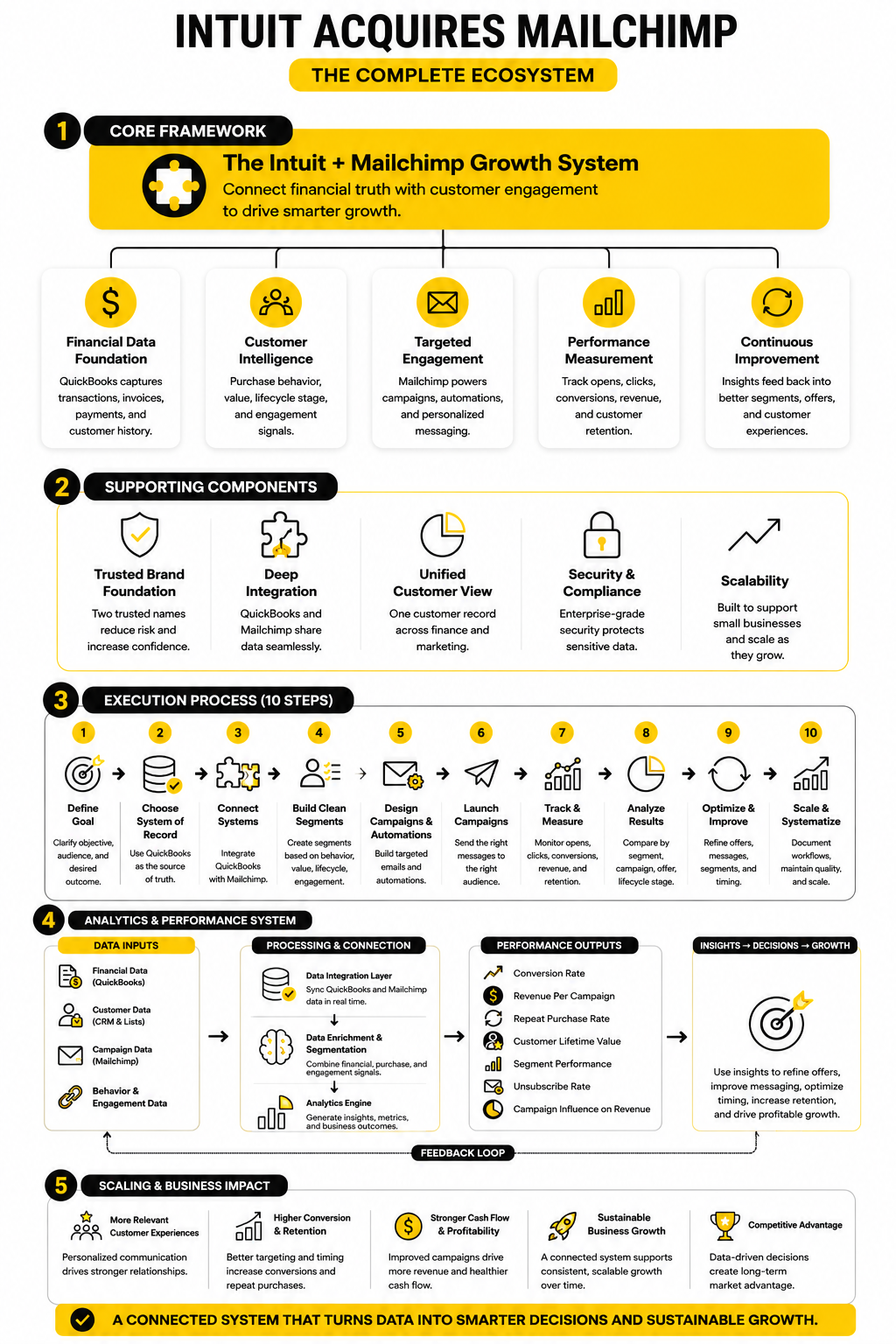
The Final System View
A strong small business growth system has five layers. It starts with a clear customer record, then adds behavioral signals, useful segmentation, timely communication, and revenue-based measurement. If those layers are weak, the business will struggle no matter which software brand sits underneath them.
This is where the Intuit-Mailchimp model becomes useful beyond the acquisition itself. It gives operators a practical way to think about their own stack. Do you know where customer truth lives? Can purchase data influence campaigns? Can campaign results be tied back to revenue? Can the team make better decisions without manually stitching reports together every week?
The answer does not have to be perfect. But it does need to improve over time. A business that keeps tightening the connection between customer data, marketing action, and financial outcomes will usually learn faster than one that treats every tool as a separate island.
Why did Intuit acquire Mailchimp?
Intuit acquired Mailchimp to expand beyond financial management and deeper into customer growth. QuickBooks already helped businesses manage money, invoices, payments, and operations, while Mailchimp helped businesses reach and retain customers through marketing campaigns and automation. The acquisition gave Intuit a stronger way to connect financial data with customer engagement.
When did Intuit acquire Mailchimp?
Intuit announced the Mailchimp acquisition in September 2021 and completed the deal on November 1, 2021. The transaction was valued at approximately $12 billion in cash and stock. That made it one of the most important small business software acquisitions of that period.
What was the main strategy behind the acquisition?
The main strategy was to create a stronger platform for small and mid-market businesses. Intuit wanted to combine QuickBooks purchase data with Mailchimp customer engagement data so businesses could get more useful insights and take more carefully action. That is why the deal should be viewed as a growth platform move, not just an email marketing acquisition.
How does Mailchimp fit with QuickBooks?
Mailchimp fits with QuickBooks by turning financial and customer activity into marketing action. A business can use QuickBooks data to identify useful customer groups, then use Mailchimp to send targeted campaigns or automations. Mailchimp says its QuickBooks integration helps businesses target segments like top spenders and customers who have not engaged recently, with customers using the integration generating 63% higher average click-through rates than Mailchimp-only customers.
Does the acquisition mean Mailchimp is only for QuickBooks users?
No. Mailchimp still serves businesses that do not use QuickBooks, and many teams use it as a standalone marketing platform. The strategic value is stronger when QuickBooks and Mailchimp work together, but the product is not limited to that setup. Businesses should choose based on their workflow, data needs, and customer journey.
What should small businesses learn from the deal?
Small businesses should learn that marketing becomes stronger when it connects to real customer and financial data. A generic email list is less useful than a segmented audience based on purchase history, lifecycle stage, customer value, and engagement. The lesson is not to buy more tools; the lesson is to connect the tools that matter.
Is an all-in-one platform always better?
No. An all-in-one platform can reduce friction, but it can also create lock-in and complexity if the business does not manage it carefully. The right stack depends on the team’s skills, growth model, customer journey, reporting needs, and budget. A focused setup with clean data often beats a large platform that nobody fully understands.
What are the biggest risks of connecting finance and marketing data?
The biggest risks are poor data hygiene, unclear permissions, over-automation, and weak governance. If customer records are messy or consent rules are ignored, campaigns can become inaccurate or intrusive. Teams should define data ownership, keep segments clean, and make sure every automation respects customer preferences.
What metrics matter most after connecting QuickBooks and Mailchimp?
The most useful metrics are not just opens and clicks. Businesses should look at conversion rate, revenue per campaign, repeat purchase rate, segment performance, customer lifetime value, unsubscribe patterns, and campaign influence on actual business outcomes. Clicks are useful, but revenue and retention tell the deeper story.
Did Intuit overpay for Mailchimp?
That depends on how the acquisition performs over the long term. A $12 billion price looks high if Mailchimp is judged only as an email tool, but it makes more strategic sense if Mailchimp helps Intuit own more of the small business growth workflow. The deal’s real value depends on integration quality, customer adoption, product execution, and Intuit’s ability to make the combined ecosystem more useful.
What does the acquisition mean for marketers?
For marketers, the acquisition shows that customer data, operations, and revenue reporting are becoming harder to separate. Marketers who understand segmentation, lifecycle automation, attribution, and business metrics will be more valuable than marketers who only know how to send campaigns. The future belongs to marketers who can connect message, audience, offer, and financial outcome.
What does the acquisition mean for agencies?
Agencies should treat the Intuit-Mailchimp deal as a signal that clients want fewer disconnected systems and clearer business results. Campaign delivery is no longer enough. Agencies need to help clients build cleaner data flows, better lifecycle journeys, more useful dashboards, and automations that support revenue instead of adding noise.
Should a business switch to Mailchimp because Intuit owns it?
Not automatically. A business should switch only if Mailchimp fits its customer journey, team workflow, integration needs, and reporting goals. If QuickBooks is already the financial source of truth, Mailchimp may be especially worth evaluating. But the best tool is the one the team can actually run well.
What is the biggest strategic takeaway from the deal?
The biggest takeaway is that customer growth and financial operations are becoming part of the same system. When marketing data and revenue data work together, teams can make better decisions and build more relevant customer experiences. That is why the Intuit-Mailchimp acquisition still matters.
Build a stronger local presence with BAAM AI
Turn your website, Google profile, social channels, and AI visibility into one growth engine
Most businesses do not need more random marketing activity. They need a consistent presence system that helps the right people find them, trust them, and take action. BAAM AI brings strategy, local SEO, website updates, Google Maps visibility, social content, AI-search readiness, media production, and reporting into one practical monthly engine.
If you want your marketing to keep working after the campaign ends, start with a free BAAM AI presence audit. See how your business shows up today and where the fastest visibility wins are at BAAM AI.