
BAAM AI Blog
Intuit Acquires Mailchimp: What The Deal Really Means For Small Business Marketing
When Intuit acquires Mailchimp, it is not just a big software company buying an email platform. It is a clear signal that small business growth is moving toward one connected system: money, customers, marketing...
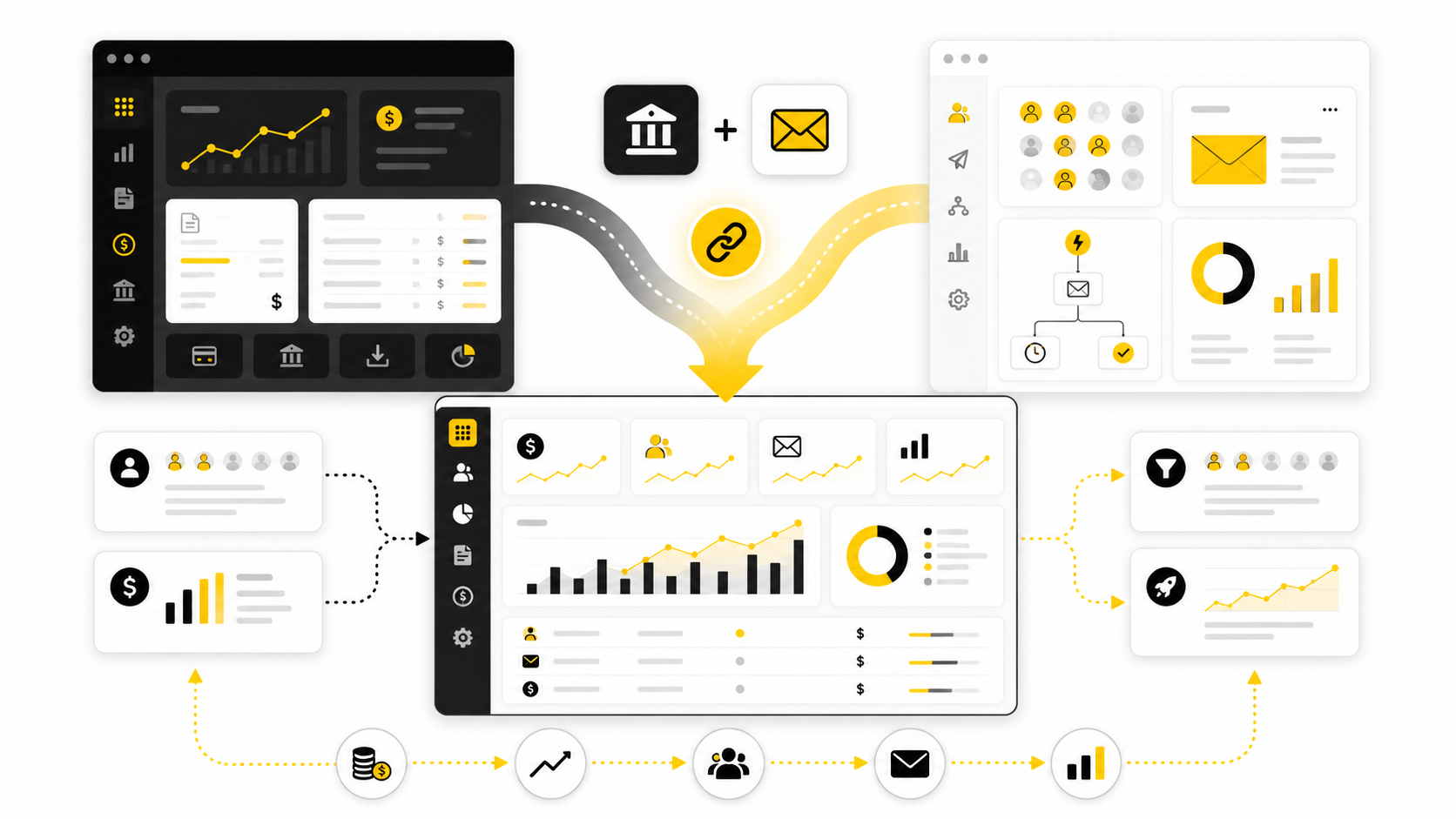
When Intuit acquires Mailchimp, it is not just a big software company buying an email platform. It is a clear signal that small business growth is moving toward one connected system: money, customers, marketing, sales, and automation all working from the same data. The deal gave Intuit a stronger path beyond tax and accounting, while giving Mailchimp a bigger role inside the daily operations of small and mid-market businesses.
The acquisition was announced as an approximately $12 billion cash-and-stock transaction and completed on November 1, 2021. That matters because Mailchimp was already one of the best-known marketing platforms for smaller businesses, while Intuit owned QuickBooks, one of the core systems those same businesses use to manage finances. Put those two together, and the strategic logic becomes obvious: Intuit wanted to help businesses not only run their back office, but also find, convert, and retain customers.
The real story is not “email marketing company gets acquired.” The real story is that customer data became too valuable to sit in one tool while revenue data sat in another. Intuit’s long-term play is to connect business operations with growth workflows, so owners can understand who their customers are, what they buy, how they engage, and what action to take next.
For marketers, founders, agencies, and SaaS operators, the Intuit-Mailchimp deal is a useful case study in where business software is going. Platforms are becoming less about isolated features and more about ecosystems. If you understand why Intuit acquired Mailchimp, you also understand why CRM, accounting, email, commerce, AI, and automation are being pulled into the same operating layer.
this guide is structured as one guide split into six parts. Each part builds on the previous one, so the full piece moves from the acquisition itself into the strategy, product implications, market impact, execution risks, and practical takeaways. The goal is not to repeat the announcement, but to explain what the deal changed and how businesses should think about it now.
The Deal And The Bigger Picture
Intuit’s acquisition of Mailchimp made sense because both companies were already serving the same broad audience from different angles. QuickBooks helped businesses understand money, invoices, cash flow, payroll, and accounting. Mailchimp helped businesses communicate with customers, segment audiences, automate campaigns, and improve repeat sales.
That overlap created a much bigger opportunity than a normal product expansion. If financial data can inform marketing, then campaigns become more practical and less generic. A business can move from “send this newsletter to everyone” toward “send the right offer to people who bought recently, spent more, stopped engaging, or look ready to buy again.”
This is why the deal should be read as a platform move, not just an email move. Intuit was not buying Mailchimp only for newsletters. It was buying a customer engagement layer that could sit beside QuickBooks and help business owners connect revenue activity with marketing action.
Why It Matters
The reason this acquisition still matters is simple: small businesses do not usually struggle because they lack tools. They struggle because their tools do not talk to each other well enough. Customer data sits in one place, financial data in another, sales activity somewhere else, and marketing decisions are often made from partial information.
Mailchimp gave Intuit a direct way to close part of that gap. The company later positioned the QuickBooks and Mailchimp connection around syncing customer and purchase data, with Mailchimp noting that customers using the QuickBooks integration generated higher average click-through rates than customers using Mailchimp alone. That kind of data-backed positioning explains why the acquisition was more than a brand portfolio move.
For the average business owner, the practical promise is better targeting with less manual work. Instead of exporting lists, cleaning spreadsheets, and guessing which audience segment matters, the system can use business data to guide campaigns. That is the kind of workflow shift that makes an acquisition strategically important long after the press release fades.
Framework Overview
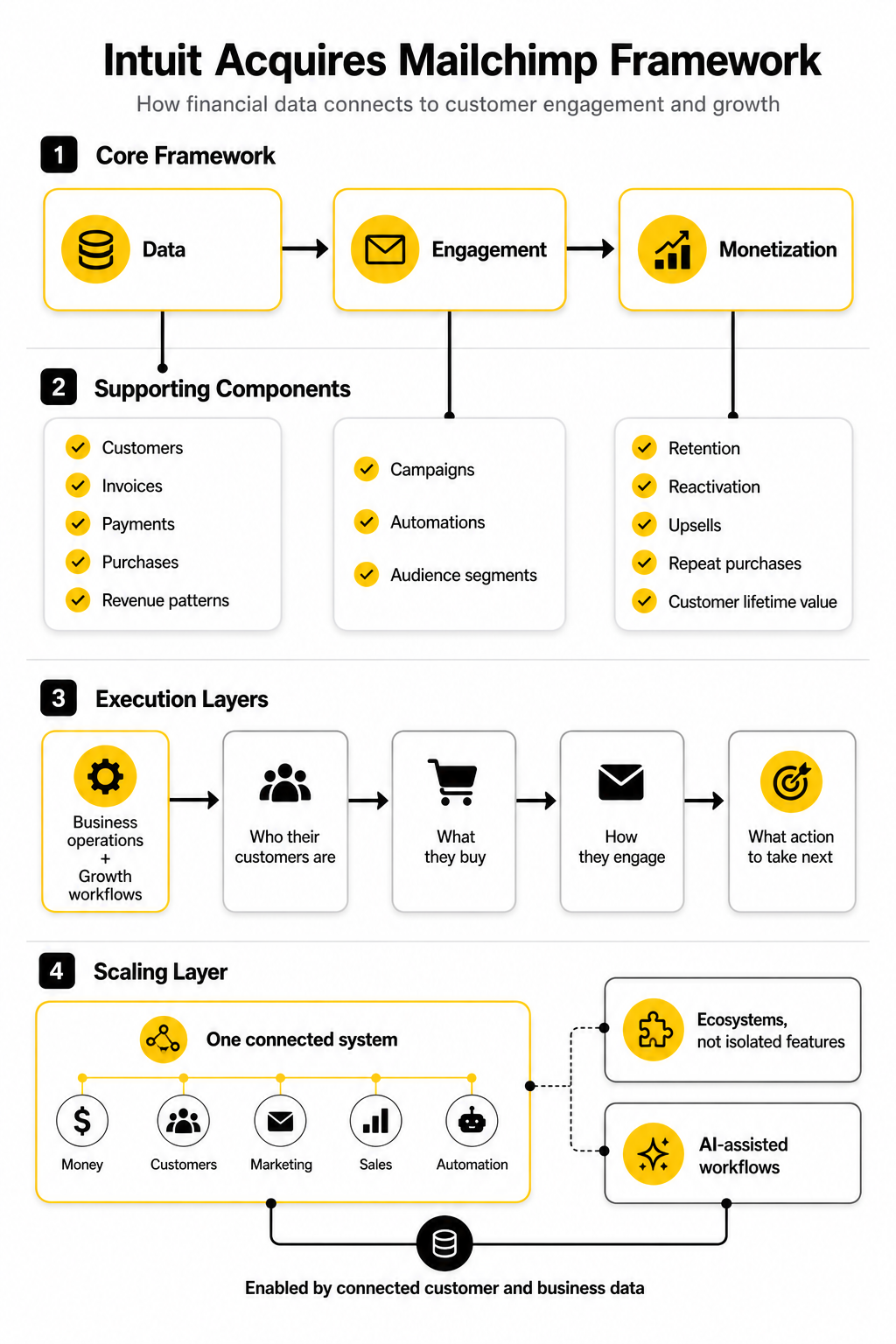
The cleanest way to understand the Intuit-Mailchimp acquisition is through a three-layer framework: data, engagement, and monetization. Data is the foundation because QuickBooks already holds valuable information about customers, invoices, payments, purchases, and revenue patterns. Engagement is the middle layer because Mailchimp turns customer information into campaigns, automations, and audience segments.
Monetization is the outcome. When those two layers work together, a business can use its own operational data to improve retention, reactivation, upsells, repeat purchases, and customer lifetime value. That is why Intuit’s move into marketing was not random; it was a logical extension of owning the financial operating system for millions of businesses.
This framework also explains why AI has become central to the story. Intuit’s recent positioning around Mailchimp emphasizes customer data, segmentation, automations, and AI-assisted workflows, including newer Mailchimp tools designed to help businesses better understand and use customer data. The acquisition gave Intuit a stronger base for that future because marketing AI is only useful when it has reliable customer and business context to work from.
Why Intuit Acquired Mailchimp
The clearest reason Intuit acquired Mailchimp is that Intuit wanted to own more of the small business growth cycle. QuickBooks already helped businesses understand their money, but money is only one side of the operating system. To become more valuable, Intuit needed to move closer to the customer relationships that create that money in the first place.
Mailchimp gave Intuit that missing front-office layer. It brought email marketing, audience segmentation, customer journeys, landing pages, marketing automation, and campaign performance into a company that already had deep financial and operational data. That combination made the acquisition much more strategic than simply adding another software product to the portfolio.
The official announcement framed the deal around two major priorities: becoming the center of small business growth and expanding into the mid-market. Intuit described Mailchimp as a way to accelerate those strategic “Big Bets,” especially because Mailchimp already served millions of users and had strong brand recognition among small businesses and growing companies through its marketing platform and audience tools in the $12 billion acquisition announcement.
Intuit Needed A Growth Engine Beyond Accounting
QuickBooks is powerful because it sits close to the financial truth of a business. It shows what came in, what went out, who paid, who owes money, and how the business is performing. But accounting software usually becomes useful after revenue activity has already happened.
Mailchimp sits earlier in the journey. It helps a business communicate with prospects and customers before the next sale, renewal, booking, donation, appointment, or purchase happens. That gave Intuit a way to move upstream from recordkeeping into revenue creation.
This matters because software companies want to become systems of action, not just systems of record. A system of record stores important information. A system of action helps users decide what to do next, and that is where marketing automation becomes valuable.
When Intuit acquires Mailchimp, it gets a direct path into campaigns, customer engagement, and retention. That means Intuit can help a business understand revenue patterns and then act on those patterns through targeted marketing. For a small business owner, that is more useful than having another dashboard that only explains what already happened.
Mailchimp Filled The Customer Data Gap
Before the acquisition, Intuit had a strong view of business finances through QuickBooks. What it did not have at the same scale was a marketing-native view of customer behavior. Mailchimp brought audience lists, campaign engagement, customer segments, automations, and ecommerce marketing signals into the picture.
That customer data gap matters because financial data alone does not explain the full relationship. A customer may have paid an invoice, but that does not show whether they opened a campaign, clicked an offer, joined a list, abandoned interest, or responded to a retention sequence. Mailchimp helped Intuit connect business outcomes with customer behavior.
The QuickBooks and Mailchimp integration shows the practical version of this strategy. Mailchimp’s integration page explains that businesses can organize customers using QuickBooks paid invoices and transaction receipts, including spend, location, and last purchase date, without manually entering contact and purchase data into marketing workflows through the QuickBooks integration. That is the kind of connection small businesses actually need because it removes manual work while making campaigns more relevant.
The value is not just synchronization. The value is context. If a customer’s financial relationship and marketing relationship can be understood together, the business can create more precise segments, more carefully follow-ups, and better customer journeys.
The Mid-Market Opportunity Was Too Big To Ignore
Small businesses were the obvious overlap, but the mid-market opportunity made the deal more ambitious. Intuit had already signaled that serving larger small businesses and mid-market companies was a strategic priority. Mailchimp helped because it was not only a beginner email tool; it had grown into a broader marketing platform with automation, customer journeys, ecommerce integrations, and analytics.
Mid-market businesses often have a different problem than very small teams. They do not just need a simple newsletter tool. They need cleaner data flows, better segmentation, more reliable automations, stronger reporting, and a way to coordinate marketing with finance, sales, and operations.
That is why this acquisition had platform logic. Intuit could use Mailchimp to serve companies that were becoming more complex but were not ready for heavyweight enterprise systems. Those businesses need more than accounting software, but they still want tools that feel practical, accessible, and connected.
The 2025 Intuit annual reporting language also points in this direction, describing the company’s vision around a global QuickBooks and Mailchimp platform for small and mid-market businesses and its goal to become an all-in-one platform that customers use to grow and run their business. That wording matters because it shows the acquisition was not treated as a side bet. It became part of the larger platform narrative.
The Acquisition Strengthened Intuit’s AI Strategy
The AI angle is important, but it should not be overcomplicated. AI becomes useful when it has good data and a clear job to do. Intuit already had business and financial data, while Mailchimp brought customer and marketing data.
That combination creates better inputs for automation. A system can recommend segments, suggest campaign timing, identify valuable customers, or help write and optimize messages only when it understands enough about the business and the audience. Without that context, AI becomes generic content generation, and generic content is not a strategy.
Intuit has continued positioning itself as an AI-driven expert platform across TurboTax, Credit Karma, QuickBooks, and Mailchimp. In its fiscal 2025 results, Intuit described itself as the global financial technology platform behind those brands and reported 16 percent full-year revenue growth. That broader AI-driven platform strategy is easier to understand when Mailchimp is viewed as the customer engagement layer, not just an email product.
For business owners, the important takeaway is practical. AI is most useful when it can connect what customers do, what customers buy, and what the business needs next. Mailchimp made Intuit stronger in that exact zone.
Mailchimp Gave Intuit A Stronger Competitive Position
The small business software market is crowded. Businesses can choose separate tools for accounting, CRM, email, SMS, funnels, scheduling, automation, payments, and reporting. The more fragmented the stack becomes, the harder it is for owners and teams to know what is actually working.
By adding Mailchimp, Intuit could compete with a broader value proposition. Instead of saying, “Use us to manage your books,” Intuit could move closer to, “Use us to run and grow your business.” That is a much bigger promise.
This also helps explain why platforms like GoHighLevel, ClickFunnels, Systeme.io, and Brevo matter in the broader conversation. They show the same market pressure from different angles: businesses want fewer disconnected tools and more systems that combine customer communication, automation, and revenue workflows. Intuit’s move with Mailchimp fits that same shift, but with accounting and financial data as its advantage.
That does not mean every business should use an all-in-one system. It means the market is clearly rewarding tools that reduce friction. The more a platform can connect customer activity to business outcomes, the more defensible it becomes.
The Strategic Logic Is Simple
The strategic logic behind the acquisition can be reduced to one sentence: Intuit wanted to help businesses grow, not just manage what growth produced. That is why Mailchimp was such a natural target. It gave Intuit a trusted marketing brand, a large customer base, and a practical way to turn business data into customer action.
This is also why the deal still matters years after it closed. The best software platforms are becoming operating systems for specific types of work. For small and mid-market businesses, the operating system is not just accounting, not just marketing, and not just CRM.
It is the connection between all of them. Intuit acquired Mailchimp because that connection is where the next layer of value lives.
The Framework Behind The Acquisition
The easiest way to understand the deal is to stop thinking about Mailchimp as “email software” and start thinking about it as a customer action layer. Intuit already had strong financial data through QuickBooks, but that data becomes more powerful when it can trigger marketing decisions. That is the core framework behind the acquisition: connect business activity to customer communication.
When Intuit acquires Mailchimp, the strategy becomes a loop. A customer buys, pays, books, renews, or goes quiet. That behavior creates data inside the business, and the system can use that data to recommend a marketing action instead of leaving the owner to figure it out manually.
This is why the acquisition fits the larger shift toward all-in-one business platforms. Intuit’s 2025 annual filing describes Mailchimp as offering marketing across email, social media, SMS, landing pages, ads, websites, and more from one place through the company’s small and mid-market business platform strategy in its 2025 Form 10-K. That is not just product language. It shows how Intuit wants Mailchimp to sit inside a broader operating system for growth.
From Financial Records To Marketing Action
The first layer of the framework is financial truth. QuickBooks knows who bought, who paid, what they bought, when they bought it, and how much revenue that activity created. That kind of information is extremely useful, but only if it turns into decisions a business can actually act on.
The second layer is customer communication. Mailchimp can take audience data and turn it into campaigns, segments, automations, forms, and customer journeys. That means financial activity does not have to stay trapped in reports.
The third layer is feedback. When a campaign runs, the business can see engagement, clicks, purchases, responses, and retention signals. Over time, that creates a better operating loop where customer behavior improves marketing decisions and marketing decisions improve revenue outcomes.
The Practical Operating Loop
The acquisition makes the most sense when viewed as a repeatable operating loop. It is not about sending more emails. It is about helping a business make better moves with the data it already has.
A simple version of the loop looks like this:
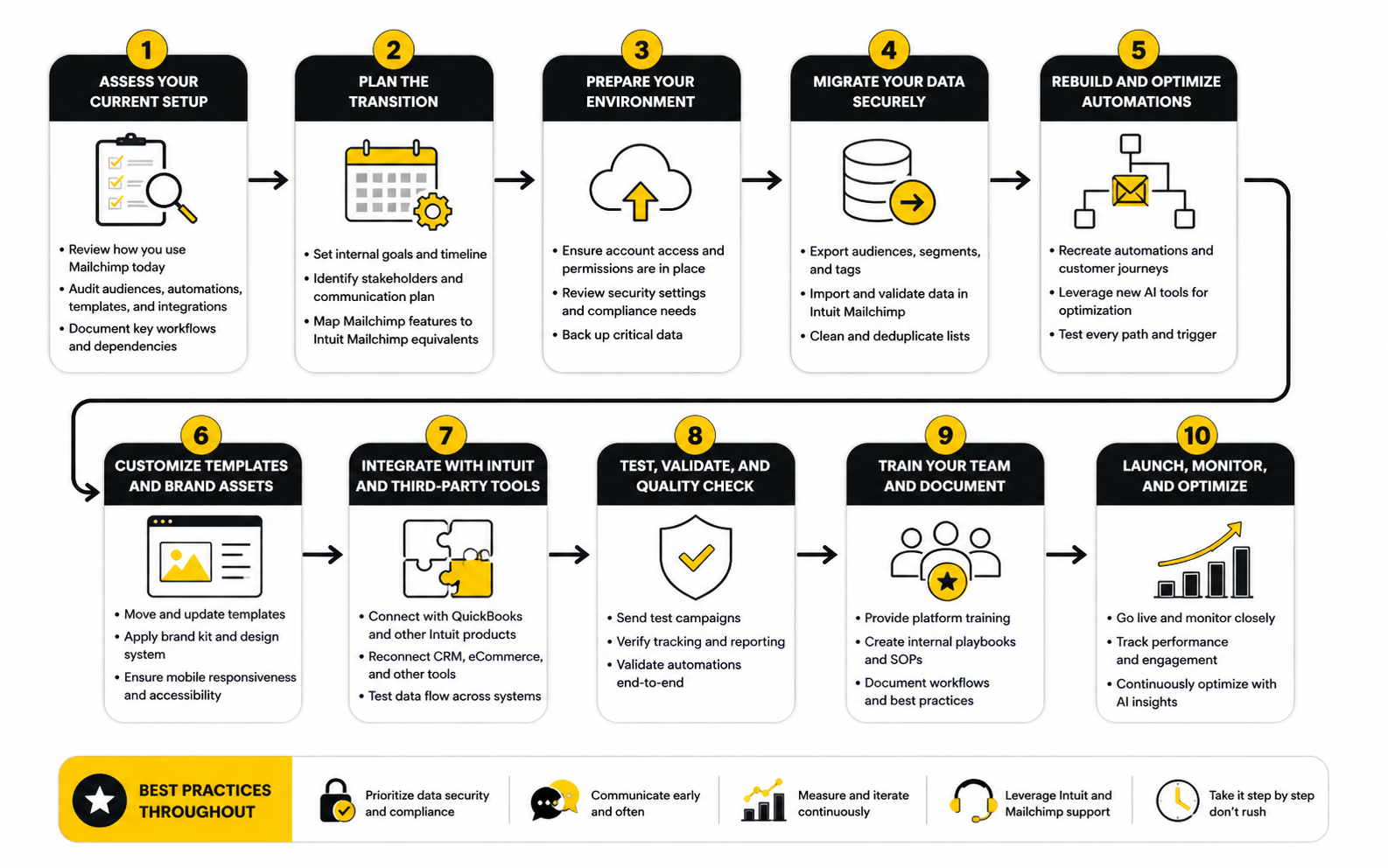
That loop is where the Intuit-Mailchimp strategy becomes tangible. Mailchimp’s QuickBooks integration is built around this exact idea, letting businesses use QuickBooks data to target segments such as top spenders or customers who have not engaged recently through the QuickBooks integration. The point is not just convenience, although saving time matters. The bigger point is that marketing becomes tied to actual customer and purchase behavior.
This is a much stronger process than building campaigns from disconnected lists. A disconnected list tells you who is subscribed. A connected business system can help show who buys, who spends more, who has gone quiet, and who may need a different message.
Why The Framework Works For Small Businesses
Small businesses usually do not have the time or staff to build complex data systems. They also cannot afford to waste weeks creating campaigns based on guesswork. They need practical systems that help them move faster without requiring a full operations team.
That is why this framework matters. It gives a small business a cleaner way to move from “what happened?” to “what should we do next?” The business owner does not need to become a data analyst just to send a better follow-up campaign.
QuickBooks also explains the operational value clearly: once QuickBooks Online and Mailchimp are connected, businesses can use synced QuickBooks data to segment audiences and create custom messaging to get new customers or re-engage existing ones through the QuickBooks Online connection guide. That is the exact bridge Intuit needed. It connects back-office activity with front-office growth.
The Role Of Customer Segmentation
Segmentation is the center of the framework because not every customer deserves the same message. A brand-new buyer, a loyal repeat customer, a high spender, and a dormant customer should not all receive the same campaign. Treating them the same is easy, but it leaves money on the table.
Mailchimp gives Intuit a structured way to make segmentation more accessible. Instead of asking a business owner to export customer data, clean it, upload it, and manually create groups, the platform can make those segments easier to build from connected data. That is where the deal becomes practical rather than theoretical.
This also explains why the phrase “intuit acquires mailchimp” should not be reduced to a transaction headline. The deeper value is that Intuit acquired a system for turning customer differences into marketing actions. Better segmentation leads to more relevant communication, and more relevant communication usually gives a business a better chance of keeping customers engaged.
The Role Of Automation
Automation is the next logical layer after segmentation. Once customers are grouped by behavior or value, the business can create workflows that respond to those differences. That could mean a welcome sequence, a reactivation campaign, a post-purchase follow-up, a review request, or a retention message.
The key is that automation should not feel random. It should be triggered by meaningful customer or business activity. When financial and marketing data are connected, those triggers become more useful because they reflect what the customer actually did.
This is where tools like GoHighLevel, ManyChat, and Brevo fit into the broader market conversation. They reflect the same demand for automated customer communication, but from different starting points. Intuit’s advantage is that Mailchimp can be paired with QuickBooks data, which gives the automation a stronger business context.
The Role Of AI In The Framework
AI makes this framework more valuable only when it improves decisions. It should help identify patterns, suggest segments, draft campaigns, recommend next steps, and make execution faster. It should not replace strategy with generic content.
Mailchimp’s AI positioning points in that direction. Its AI tools page describes upcoming capabilities around predicting which customers are most likely to convert and helping marketers target them with personalized marketing content through Mailchimp AI tools. That is directly aligned with the acquisition logic because prediction needs data, and Intuit has a strong reason to connect business data with marketing signals.
This is also why Intuit’s platform strategy keeps becoming more important. The more complete the customer and business context, the more useful AI can become. Without that context, AI is just a faster blank page.
The Execution Process For Businesses
For a business using this kind of connected system, the process should be simple and disciplined. Do not start with a giant automation map. Start with the customer behavior that matters most to revenue.
A practical process looks like this:
That process is boring in the best way. It avoids the trap of building complicated automation before the business understands what customers actually need. It also matches the real reason Intuit acquired Mailchimp: to help businesses turn data into action without making the process feel impossible.
Why The Framework Is Bigger Than Mailchimp
Mailchimp is the product inside the acquisition, but the framework is bigger than Mailchimp. Every serious business platform is trying to connect data, workflow, communication, and revenue. The winning systems will be the ones that help teams act faster with better context.
That is why Intuit’s move is still worth studying. It shows how valuable customer engagement becomes when it is connected to the financial core of a business. The acquisition was not just about adding marketing features; it was about building a more complete growth system.
For operators, the lesson is clear. Do not evaluate tools only by their feature lists. Evaluate them by how well they connect the data your business already creates to the actions your customers actually need.
Statistics And Data
The numbers behind the Intuit-Mailchimp strategy only matter if they change what a business does next. Open rates, click-through rates, revenue growth, synced contacts, customer segments, and automation performance are not vanity metrics when they are tied to decisions. They become the measurement layer that tells a team whether connected customer data is actually improving growth.
This is why the phrase “intuit acquires mailchimp” should not be treated as old M&A news. The acquisition created a stronger analytics story: Intuit could connect financial data, customer data, campaign data, and eventually AI-assisted recommendations. That gives businesses a better chance of measuring marketing by customer behavior and business outcomes instead of judging everything by surface-level campaign numbers.
The important point is not that one benchmark proves the acquisition worked. That would be too simplistic. The useful lesson is that connected systems create better measurement, and better measurement creates better decisions.
The 63 Percent Click-Through Signal
One of the most useful numbers attached to the Intuit-Mailchimp strategy is the performance lift around the QuickBooks integration. Mailchimp states that customers using the QuickBooks integration generate 63 percent higher average click-through rates than customers using Mailchimp alone. QuickBooks also presents a closely related figure, saying Mailchimp customers using the QuickBooks integration generate a 64 percent higher average email click-through rate than those who do not.
That number matters because click-through rate is closer to intent than open rate. Opens can be influenced by inbox behavior, privacy changes, subject lines, brand recognition, and curiosity. Clicks show that someone did more than notice the message; they took an action.
Still, the number should be interpreted carefully. It does not mean every business will automatically get a 63 or 64 percent lift by connecting two tools. It means that when customer and purchase data are used to make campaigns more relevant, the average engagement signal can improve meaningfully.
What That Data Should Actually Drive
The right action from that benchmark is not “send more email.” The right action is to improve the quality of targeting. If a business connects QuickBooks and Mailchimp but keeps sending the same generic campaign to everyone, it misses the point.
A better response is to build segments around actual behavior. That could mean top spenders, recent customers, dormant customers, customers with unpaid invoices, customers who bought a specific service, or customers who have not purchased in a certain period. Each segment should lead to a different message because the customer context is different.
The click-through lift is really a signal about relevance. When the system knows more about the customer relationship, the business can write more specific campaigns. Specific campaigns usually give people a clearer reason to act.
Benchmarks Are Useful, But Only With Context
Email benchmarks help teams understand whether performance is unusually weak, average, or strong. Mailchimp’s benchmark guidance frames KPIs such as open rates, click-through rates, and conversion rates as a way to compare campaign performance against industry averages and identify areas of strength or weakness through its email marketing benchmarks. That is useful, but only when benchmarks are treated as diagnostic tools rather than final goals.
A low open rate may point to weak subject lines, poor list quality, bad timing, or low brand trust. A decent open rate with a weak click-through rate usually points to a message problem, offer problem, or audience mismatch. A strong click-through rate with weak sales may point to a landing page, checkout, pricing, trust, or product-market issue.
This is why measurement needs a full path view. If a business only measures opens, it may optimize for curiosity instead of revenue. If it only measures purchases, it may miss early signs that audience quality or messaging is improving.
The Measurement System That Matters
A practical analytics system should connect campaign metrics to business outcomes. That is where the acquisition logic becomes more valuable. Mailchimp can show campaign engagement, while QuickBooks can show customer and transaction context.
A clean measurement system should track:
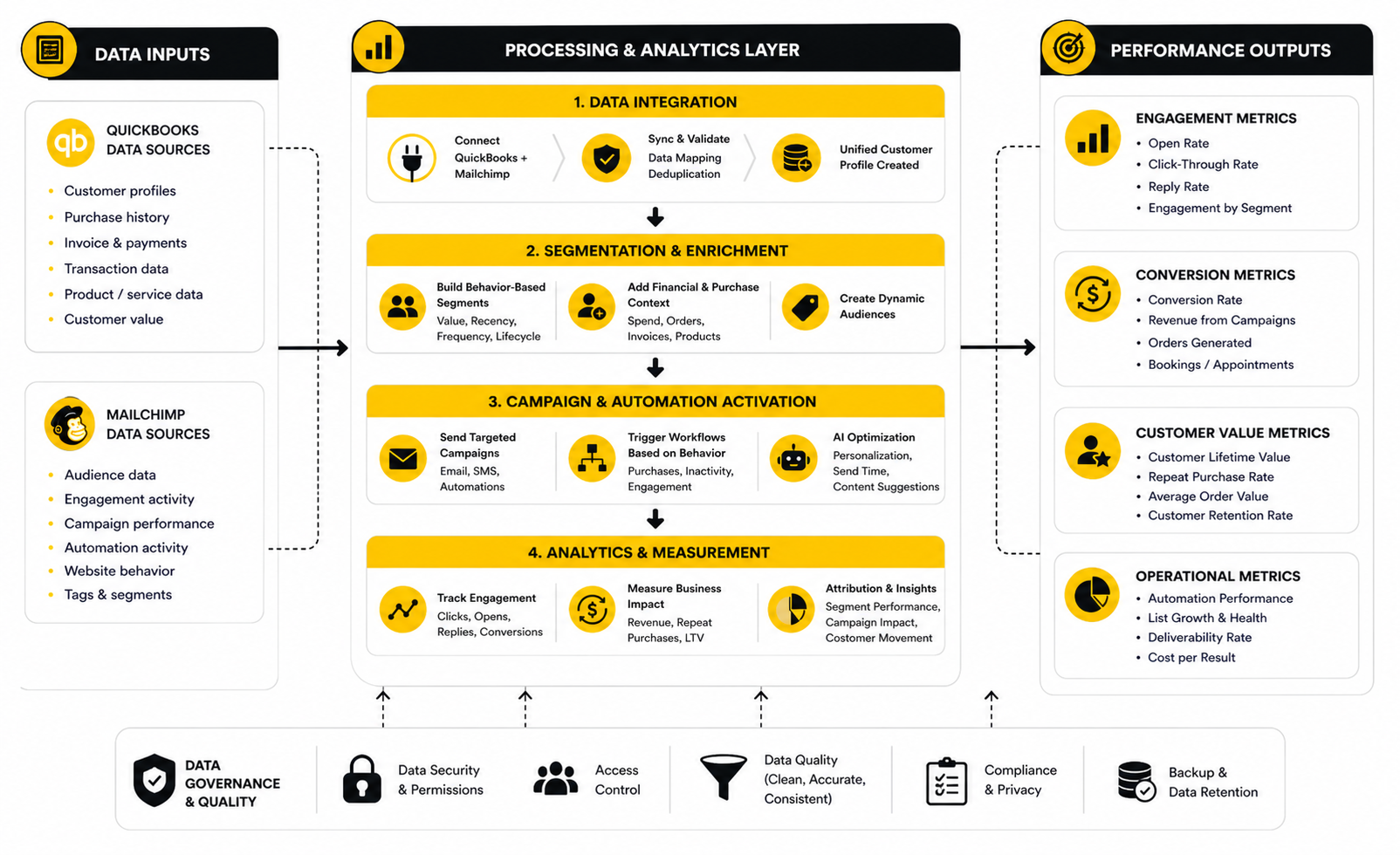
This is where connected data becomes more than a dashboard. It becomes an operating rhythm. A team can look at the numbers, identify the weak point, and decide whether to adjust the segment, message, offer, automation timing, or follow-up path.
The Metrics That Deserve More Attention
Most teams look at open rates first because they are easy to understand. That is fine, but it is not enough. A campaign can have a strong open rate and still fail if the message does not create action.
Click-through rate deserves more attention because it shows active interest. Conversion rate deserves even more attention because it shows whether the campaign created the intended business result. Repeat purchase rate, customer lifetime value, and reactivation rate are often more useful than basic email metrics because they connect marketing to business health.
For this reason, businesses using a connected QuickBooks and Mailchimp workflow should avoid measuring every campaign in isolation. The better question is whether marketing is improving customer movement over time. Are more first-time buyers becoming repeat buyers? Are inactive customers coming back? Are high-value customers receiving better follow-up before they disappear?
Segmentation Data Is The Real Advantage
Mailchimp’s QuickBooks Online integration page highlights that segmented campaigns have 23 percent higher open rates and 49 percent higher click-through rates on average. That is a useful benchmark because it points to the deeper reason segmentation works. People respond better when the message reflects their situation.
This is not complicated, but it is often ignored. A customer who recently purchased does not need the same message as someone who has not bought in eight months. A high-value client does not need the same offer as a first-time buyer.
The acquisition made segmentation more powerful because QuickBooks data can bring commercial context into Mailchimp. Instead of segmenting only by newsletter engagement, businesses can segment by purchase behavior, invoice history, customer value, and timing. That is where marketing becomes less generic and more profitable.
Data Quality Matters More Than Dashboard Volume
More reports do not automatically create better decisions. Bad data inside a beautiful dashboard is still bad data. If contacts are duplicated, customer records are incomplete, purchase data is not synced correctly, or segments are too broad, the analytics will push the team in the wrong direction.
This is why implementation and measurement have to work together. Before a business trusts the numbers, it should make sure the data pipeline is clean enough to support decisions. That means reviewing synced contacts, checking field mapping, confirming purchase history, and making sure inactive or unsubscribed contacts are handled correctly.
The best measurement systems are usually boring at the foundation. Clean data, clear segments, simple naming, consistent campaign tracking, and one primary goal per workflow. That is what makes the numbers useful.
What Intuit’s Own Numbers Suggest
Intuit’s broader financial results show why Mailchimp sits inside a much larger platform story. Intuit reported 13 percent revenue growth to $16.3 billion in fiscal 2024, then later reported 16 percent full-year revenue growth in fiscal 2025. Those results do not prove Mailchimp alone drove the growth, and they should not be read that way.
The more useful interpretation is that Intuit is building a broader financial technology platform across TurboTax, Credit Karma, QuickBooks, and Mailchimp. Mailchimp’s role is customer engagement. QuickBooks’ role is business operations and financial context.
That combination matters because platform value grows when each product strengthens the others. A standalone marketing tool can measure campaigns. A connected business platform can start measuring how campaigns relate to customers, purchases, cash flow, and retention.
The Data Also Shows Execution Risk
Not every number around Mailchimp is automatically positive. Intuit’s fiscal 2025 annual filing showed Online Services revenue increased by $669 million, or 19 percent, compared with fiscal 2024, with Mailchimp contributing $20 million of that increase. That matters because it reminds us that acquisitions are not magic buttons.
Integration takes time. Product positioning takes time. Customers need to understand why a connected QuickBooks and Mailchimp workflow is worth adopting, especially if they already have other tools in place.
This is the honest way to read the data. The strategic logic is strong, but execution still matters. Intuit has to keep making the connection between finance and marketing obvious, useful, and easy enough for busy businesses to adopt.
Turning Analytics Into Action
The practical move for businesses is to build a simple measurement cadence. Every campaign or automation should have one clear job. Every segment should have a reason to exist. Every report should lead to a decision.
A useful monthly review could ask:
This turns analytics into a growth process instead of a reporting ritual. The best teams do not stare at dashboards for the sake of it. They use the data to decide what to fix next.
What The Numbers Mean For The Acquisition
The data points around QuickBooks, Mailchimp, segmentation, and click-through performance all point in the same direction. The acquisition makes sense when customer communication becomes more valuable because it is connected to real business activity. That is the heart of the measurement story.
The numbers also show why businesses should not treat Mailchimp as just a newsletter tool. Its value increases when it is connected to purchase data, customer history, automation, and clear revenue goals. That is the deeper lesson behind the Intuit-Mailchimp deal.
When measurement is done properly, the acquisition becomes easier to understand. Intuit did not simply buy a way to send emails. It bought a way to make customer engagement measurable against the business outcomes that owners actually care about.
Professional Implementation For Teams And Agencies
The next layer is execution at a higher standard. Once a business understands the strategy, framework, and analytics, the real question becomes harder: how should teams actually build around the Intuit-Mailchimp ecosystem without creating a messy stack? This is where agencies, consultants, ecommerce teams, service businesses, and operators need to think beyond the basic integration.
When Intuit acquires Mailchimp, it gives businesses a stronger reason to connect finance and marketing, but the connection itself still needs discipline. A synced contact list is not a strategy. A campaign dashboard is not a growth system.
The professional move is to decide what role each platform should play before automations, segments, tags, and reports start multiplying. QuickBooks should remain the financial source of truth. Mailchimp should become the customer engagement layer. Other tools should only be added when they solve a specific workflow that the core system does not handle well enough.
The First Tradeoff Is Simplicity Versus Control
All-in-one platforms are attractive because they reduce friction. Fewer tools usually mean fewer broken handoffs, fewer duplicate records, fewer manual exports, and fewer arguments about which dashboard is right. For small teams, that can be a serious advantage.
The tradeoff is control. A more consolidated system may not give advanced operators every custom workflow they want. Teams that need complex attribution, custom data warehousing, advanced CRM rules, or multi-brand reporting may still need additional infrastructure around QuickBooks and Mailchimp.
This is not a reason to reject the ecosystem. It is a reason to be honest about the operating model. A lean business should usually prioritize speed and clarity, while a more mature team may need more control, cleaner governance, and deeper reporting architecture.
Agencies Need A Clear Client Architecture
Agencies should be especially careful because they often inherit messy client systems. One client may have QuickBooks, Mailchimp, a half-used CRM, multiple landing page tools, disconnected forms, old tags, duplicate lists, and three people who all believe they own the customer database. That is not unusual, but it is dangerous.
The first step is to define the client’s system of record. For financial data, QuickBooks usually owns that role. For campaign engagement, Mailchimp owns that role. For sales pipeline activity, a dedicated CRM may still be needed if the client has a long sales cycle, multiple sales reps, or complex deal stages.
This is where platforms like GoHighLevel, ClickFunnels, and Copper can still make sense in specific stacks. They should not be added because they are popular. They should be added when the client needs funnels, pipeline management, sales workflows, or agency-level operational control that QuickBooks and Mailchimp do not cover by themselves.
The Risk Of Tool Sprawl
Tool sprawl is one of the biggest hidden costs in small business marketing. It starts innocently. A business adds one form builder, one funnel tool, one automation tool, one chatbot, one scheduler, one CRM, and one reporting add-on.
Then the problems show up. Contacts are duplicated. Attribution becomes unclear. Customers receive overlapping messages. Reporting takes longer than campaign creation. Nobody knows whether a lead came from a form, a campaign, a paid ad, a referral, or an invoice follow-up.
That is why advanced implementation should start with fewer tools, not more. The question is not “What else can we connect?” The better question is “What should own this workflow?” When ownership is clear, scaling becomes much easier.
Data Governance Becomes Non-Negotiable
As soon as financial data and marketing data are connected, governance matters more. Customer names, email addresses, purchase history, invoice details, engagement signals, and segmentation logic all become part of the same operating system. That creates more opportunity, but it also raises the cost of sloppy setup.
Mailchimp’s privacy documentation explains that Mailchimp’s terms continue to govern Mailchimp services after integration with Intuit and that Mailchimp continues acting primarily as a service provider under the CCPA through its privacy FAQ. That kind of detail matters because businesses cannot treat connected customer data casually. The more connected the stack becomes, the more carefully teams need to manage permission, compliance, access, and retention.
At minimum, teams should define who can create audiences, who can export contacts, who can edit automations, who can connect apps, and who approves campaigns that use purchase or invoice data. This sounds basic, but it prevents serious problems. A powerful integration in the wrong hands can create confused reporting, poor customer experience, or compliance risk.
Scaling Requires Naming Rules And Ownership
Small teams can survive messy naming for a while. Bigger teams cannot. If campaigns, segments, tags, automations, audiences, landing pages, and reports do not follow a clear naming system, the stack becomes harder to manage every month.
A professional setup should use simple naming rules from the beginning. Campaign names should show the audience, goal, date, and channel. Segments should describe the customer behavior they represent. Automations should make their trigger and outcome obvious.
Ownership matters just as much. Someone needs to own financial data hygiene. Someone needs to own marketing audience quality. Someone needs to own campaign measurement. If everyone owns everything, nobody owns the problems that quietly damage performance.
Advanced Segmentation Should Stay Practical
Advanced segmentation does not mean creating dozens of tiny audiences that nobody knows how to use. It means creating segments that lead to better action. A segment is only useful if it changes the message, offer, timing, or follow-up.
For most businesses, the best advanced segments are based on customer value, recency, frequency, product or service category, lifecycle stage, and engagement. These are practical because they map directly to business decisions. A dormant high-value customer deserves a different workflow than a low-value subscriber who has never bought.
The QuickBooks and Mailchimp connection supports this direction because purchase and invoice history can enrich customer profiles and help businesses create more relevant communication through the QuickBooks and Mailchimp integration. The key is restraint. Use data to make marketing clearer, not more complicated.
Attribution Should Be Useful, Not Perfect
Many teams waste too much energy chasing perfect attribution. They want to know exactly which email, ad, touchpoint, channel, or automation created the sale. That is understandable, but it can become a trap.
In small business environments, attribution is often messy because customers talk to staff, read emails, visit websites, click ads, ask friends, ignore campaigns, return later, and buy through different paths. A connected system can improve visibility, but it will not turn human behavior into a perfectly clean spreadsheet. Do not expect it to.
The better goal is directional clarity. Which segments are improving? Which automations appear to support repeat purchases? Which campaigns create meaningful engagement from valuable customers? Which offers attract buyers who stay? Those answers are more useful than pretending every dollar can be attributed with surgical precision.
AI Should Be Governed Like A Workflow, Not A Toy
AI can help with campaign drafts, subject line ideas, segmentation suggestions, next-best-action recommendations, and reporting summaries. But professional teams should treat AI as part of the workflow, not as a magic layer. It should support decisions, not make unreviewed decisions with customer data.
Mailchimp’s AI tools are positioned around helping marketers create, personalize, and optimize campaigns through Mailchimp AI tools. That is useful, but teams still need judgment. AI may suggest a campaign, but a human should decide whether the timing, offer, tone, and customer context make sense.
The rule is simple. Let AI reduce manual effort, but do not let it blur accountability. The business is still responsible for customer experience, compliance, brand voice, and the final message that reaches the inbox.
Platform Dependence Is A Real Strategic Risk
The stronger a connected ecosystem becomes, the more tempting it is to run everything inside it. That can be efficient, but it also creates dependence. If pricing changes, product priorities shift, deliverability rules tighten, or an integration changes, the business may feel locked in.
This risk is not unique to Intuit or Mailchimp. It exists with every serious platform. The more important a tool becomes, the more the business needs a backup plan.
The practical answer is not to avoid platforms. That would be unrealistic. The practical answer is to keep ownership of core assets: clean customer data, documented workflows, exported reporting history, clear permissions, and a migration plan if the stack ever needs to change.
Mailchimp’s Growth Inside Intuit Still Has To Prove Itself
The acquisition logic is strong, but execution is still the hard part. Intuit’s fiscal 2025 reporting showed strong company-wide growth, but Mailchimp was not the main growth driver inside every reported segment. Market coverage around Intuit’s 2026 outlook also noted weaker Mailchimp performance as one factor behind investor concern through an August 2025 earnings report summary.
That does not make the acquisition a failure. It means the market is still watching whether Mailchimp can become a stronger growth engine inside Intuit’s broader platform. Integration, product adoption, pricing, competition, and customer education all matter.
For businesses, this is a reminder to separate strategic potential from guaranteed results. A good platform still needs good implementation. A strong acquisition thesis still needs customer adoption.
Expert Guidance For Building Around The Ecosystem
The best way to build around QuickBooks and Mailchimp is to keep the stack simple, measurable, and owned. Start with the customer journeys closest to revenue. Then add complexity only when the business has proven the first workflows work.
A strong implementation should follow these principles:
This is the professional layer that many businesses skip. They connect the tools, send campaigns, and look at dashboards, but they do not build an operating system around the work. That is the difference between using the acquisition’s promise and merely sitting near it.
What Advanced Teams Should Take From The Deal
The advanced lesson is that connected platforms create leverage and risk at the same time. They can reduce manual work, improve relevance, and connect marketing to business outcomes. They can also create dependence, governance issues, messy data, and overconfidence if the team does not manage them properly.
That is why the smartest response to the Intuit-Mailchimp deal is not blind enthusiasm or cynical dismissal. It is practical adoption. Use the connection where it improves customer action, reporting clarity, and operational speed.
When Intuit acquires Mailchimp, the market gets a clear signal: growth software is moving closer to financial data. The teams that win from that shift will not be the ones with the most tools. They will be the ones with the clearest system.
Risks, Takeaways, And FAQ
The final piece of the Intuit-Mailchimp story is balance. The strategic logic is strong, the data connection is useful, and the platform direction makes sense. But no acquisition automatically creates better marketing, cleaner operations, or higher revenue for every business that touches it.
When Intuit acquires Mailchimp, it creates a bigger ecosystem around small business growth. That ecosystem can help teams connect finance, customer data, automation, campaign performance, and AI-assisted workflows. It can also create new risks if businesses rely on the platform without clear ownership, clean data, and a practical measurement process.
The right takeaway is not “use everything Intuit offers” or “avoid platform consolidation.” The right takeaway is more practical: use connected systems where they make customer action clearer, faster, and more measurable. If the system does not improve decisions, it is just more software.
The Biggest Risks To Watch
The first risk is overestimating integration. Connecting QuickBooks and Mailchimp can improve customer context, but the integration does not automatically fix weak offers, poor messaging, bad list quality, or unclear positioning. A better system makes good strategy easier to execute; it does not replace strategy.
The second risk is data dependence. The more a business relies on one ecosystem, the more important it becomes to understand permissions, exports, reporting access, compliance, and migration options. Platform convenience is valuable, but ownership of customer data and workflow documentation still matters.
The third risk is treating AI as a shortcut. Intuit’s platform now leans heavily into AI across TurboTax, Credit Karma, QuickBooks, and Mailchimp, and Intuit reported 16 percent full-year revenue growth in fiscal 2025. That does not mean every AI-generated campaign will be good. AI should help teams act faster, but humans still need to own the offer, customer promise, compliance, and final message.
The Final System Businesses Should Build
The best version of this ecosystem is simple. QuickBooks holds the commercial truth. Mailchimp turns customer context into communication. Reporting shows whether the communication moved customers toward a meaningful business outcome.
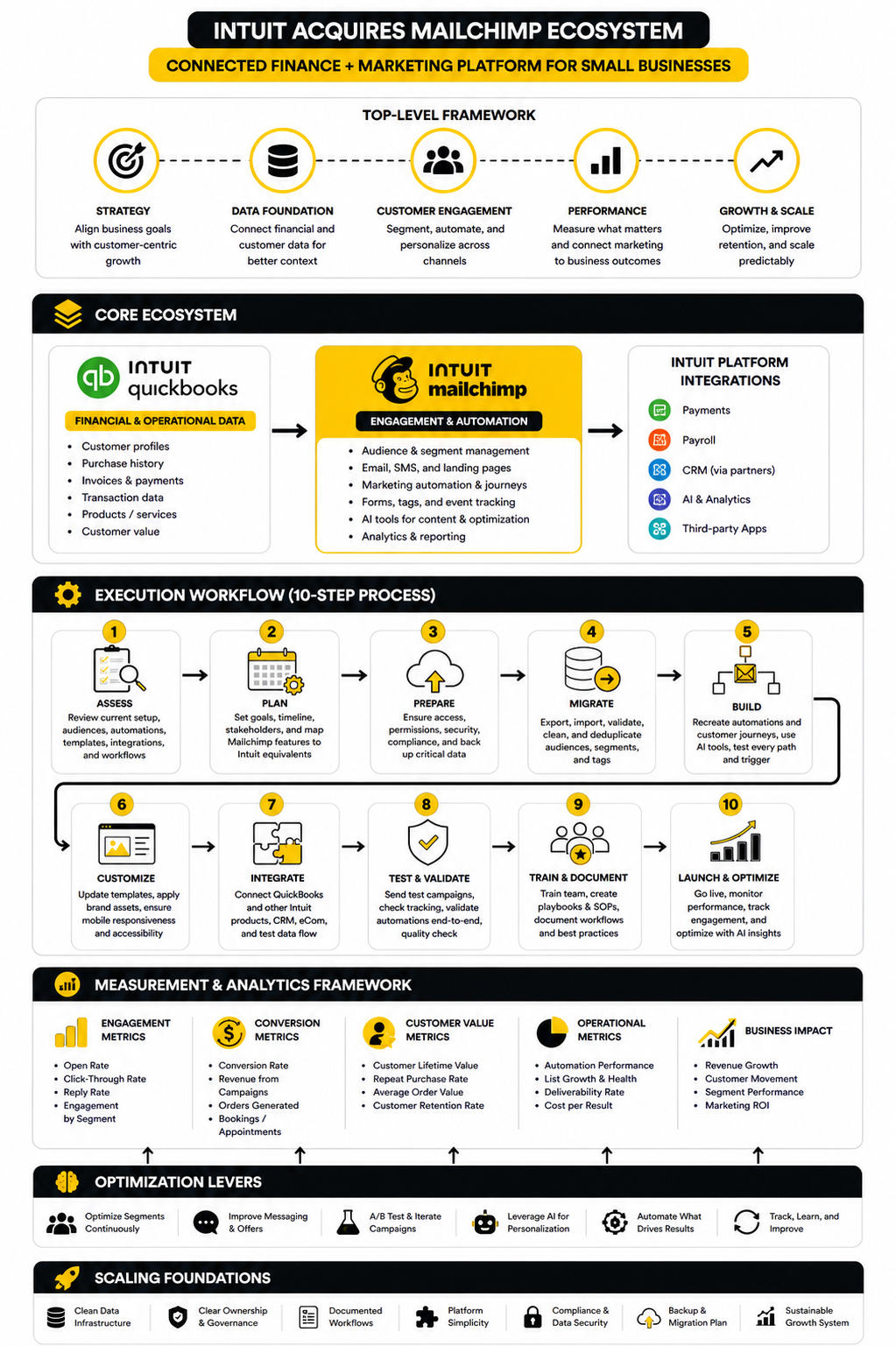
That final system should not feel like a maze. A business should know which data enters the system, which segment it creates, which message gets triggered, which customer action matters, and which number tells the team whether the workflow worked. If that chain is unclear, the system needs simplification before it needs more tools.
This is where the Intuit-Mailchimp acquisition becomes most useful as a business lesson. The companies that benefit from connected platforms are not always the ones with the biggest tech stack. They are the ones that use the stack to make better decisions with less friction.
Practical Takeaways
The most important takeaway is that Mailchimp’s value increases when it is connected to real customer behavior. Mailchimp states that customers using its QuickBooks integration generate 63 percent higher average click-through rates than customers using Mailchimp alone, while QuickBooks describes a similar 64 percent higher average email click-through rate for customers using the integration. The point is not to worship the benchmark. The point is to understand that relevance improves when campaigns are built from better data.
The second takeaway is that segmentation is not optional anymore. Generic campaigns are easier to send, but behavior-based communication is usually more useful to the customer and more valuable to the business. Teams should build segments around customer value, purchase timing, engagement, lifecycle stage, and service needs.
The third takeaway is that consolidation should reduce complexity, not hide it. If QuickBooks, Mailchimp, and any additional tools make the team faster and clearer, the stack is working. If they create duplicate contacts, confusing reports, unclear ownership, and overlapping automations, the stack is growing in the wrong direction.
What does it mean that Intuit acquired Mailchimp?
It means Intuit bought Mailchimp to expand beyond financial and accounting software into customer engagement and marketing automation. The deal gave Intuit a stronger way to help small and mid-market businesses not only manage money, but also reach, retain, and grow customer relationships. The acquisition was completed in 2021 after being announced as an approximately $12 billion cash-and-stock transaction.
Why did Intuit acquire Mailchimp?
Intuit acquired Mailchimp because it wanted a stronger growth platform for small and mid-market businesses. QuickBooks gives Intuit financial and operational context, while Mailchimp adds marketing, segmentation, automation, and customer engagement. Together, those products support a broader system for running and growing a business.
Was Mailchimp a good acquisition for Intuit?
Strategically, the deal makes sense because it connects financial data with marketing action. The harder question is execution, because acquisitions need product integration, customer adoption, and clear positioning to create long-term value. The acquisition should be judged by whether Intuit can keep making QuickBooks and Mailchimp more useful together, not just by the original deal size.
How does Mailchimp fit with QuickBooks?
Mailchimp fits with QuickBooks by turning customer and purchase data into marketing workflows. Businesses can use QuickBooks data such as purchase history, invoice activity, spend, and customer timing to create more relevant Mailchimp segments and campaigns. That connection helps marketing move closer to real business behavior instead of relying only on newsletter engagement.
What is the main benefit for small businesses?
The main benefit is less manual work and better customer targeting. A small business can use financial and customer data to send more relevant messages without constantly exporting lists or rebuilding spreadsheets. That is especially useful for reactivation campaigns, repeat purchase workflows, invoice follow-ups, review requests, and customer retention.
Does the Intuit-Mailchimp deal mean Mailchimp is no longer just an email tool?
Yes, Mailchimp is better understood as a customer engagement platform inside Intuit’s broader ecosystem. Email is still a major part of the product, but Mailchimp also supports segmentation, automation, landing pages, SMS, forms, analytics, and AI-assisted marketing workflows. The acquisition pushed Mailchimp further into the role of a growth layer for businesses.
What should businesses measure after connecting QuickBooks and Mailchimp?
Businesses should measure customer movement, not just campaign activity. Useful metrics include click-through rate, conversion rate, repeat purchase rate, reactivation rate, customer lifetime value, paid invoices, bookings, and revenue from specific customer segments. Opens and clicks are helpful, but they should lead to decisions about audience quality, message relevance, and business outcomes.
Is the QuickBooks and Mailchimp integration enough by itself?
The integration is useful, but it is not enough by itself. Businesses still need clear goals, clean data, strong offers, useful segments, and consistent measurement. A connected system makes execution easier, but it does not automatically create a working marketing strategy.
What are the biggest risks of using a connected Intuit-Mailchimp ecosystem?
The biggest risks are tool dependence, poor data hygiene, unclear ownership, compliance mistakes, and overreliance on automation. A business should know who owns financial data, who owns audience quality, who approves campaigns, and who reviews performance. Without that discipline, a connected platform can become just another messy system.
How should agencies think about the Intuit-Mailchimp ecosystem?
Agencies should treat it as a practical client architecture, not just a software integration. QuickBooks can be the financial source of truth, while Mailchimp can handle engagement and campaign workflows. Agencies should only add tools like GoHighLevel, ClickFunnels, Brevo, or ManyChat when those tools solve a specific workflow that the core stack does not handle.
Does AI make the acquisition more important?
Yes, because AI becomes more useful when it has better context. Mailchimp gives Intuit marketing and customer engagement data, while QuickBooks gives Intuit financial and operational data. When those inputs work together, AI can become more practical for segmentation, campaign planning, next-best actions, and reporting summaries.
What is the simplest action a business should take from this guide?
Start with one customer journey that is close to revenue. Choose a segment, connect the relevant data, write one clear campaign or automation, and measure one meaningful outcome. Do not build a giant automation system before proving that one workflow can move customers toward a real business result.
Build a stronger local presence with BAAM AI
Turn your website, Google profile, social channels, and AI visibility into one growth engine
Most businesses do not need more random marketing activity. They need a consistent presence system that helps the right people find them, trust them, and take action. BAAM AI brings strategy, local SEO, website updates, Google Maps visibility, social content, AI-search readiness, media production, and reporting into one practical monthly engine.
If you want your marketing to keep working after the campaign ends, start with a free BAAM AI presence audit. See how your business shows up today and where the fastest visibility wins are at BAAM AI.