
BAAM AI Blog
Internet Marketing System: A Practical Framework For Turning Attention Into Revenue
An internet marketing system is not a pile of tactics. It is not “post more,” “run ads,” “send emails,” or “build a funnel” as separate jobs. A real internet marketing system connects attention, trust, offers...
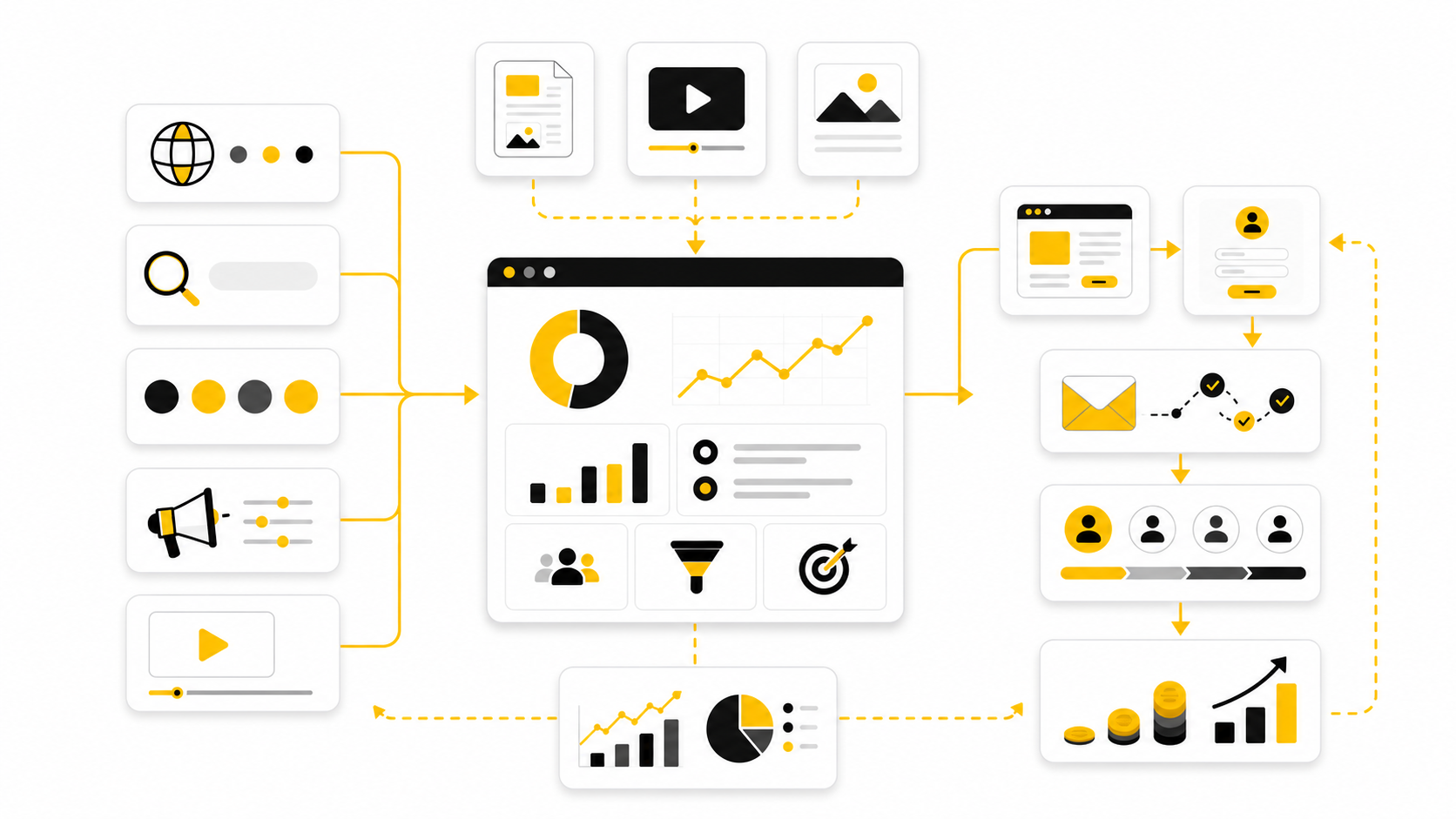
An internet marketing system is not a pile of tactics. It is not “post more,” “run ads,” “send emails,” or “build a funnel” as separate jobs. A real internet marketing system connects attention, trust, offers, conversion, follow-up, measurement, and improvement into one operating model.
That matters because online growth has become too expensive and too fragmented for random execution. U.S. digital advertising revenue reached $294.6 billion in 2025, while global ad spending was forecast to reach $1.17 trillion in 2025. More money is moving online, which means the brands with systems get leverage and the brands with disconnected activity get noise.
The mistake most businesses make is trying to fix growth by adding another channel. They try a new ad campaign, a new landing page, a new email tool, a new social platform, or a new AI workflow. Those can help, but only when they fit inside a system that knows what each piece is supposed to do.
this guide breaks down the internet marketing system as a practical business asset. The goal is not to make marketing more complicated. The goal is to make it easier to see what is working, what is missing, and what needs to be improved next.
Why An Internet Marketing System Matters
An internet marketing system matters because customers no longer move in a straight line. They see a post, search the brand, compare alternatives, read reviews, join an email list, leave the page, come back through retargeting, ask a friend, and then maybe buy. Google’s research on the “messy middle” shows that people move between exploration and evaluation before making a decision, which is exactly why a business needs more than one isolated marketing asset.
A system gives each touchpoint a job. Content creates awareness and trust. Landing pages turn interest into action. Email, SMS, chat, and CRM workflows turn abandoned attention into follow-up. Analytics show where the system leaks money, time, or opportunity.
This is also why personalization and data quality matter. McKinsey found that 71% of consumers expect personalized interactions, and 76% get frustrated when that does not happen. Personalization is not just using someone’s first name in an email; it is showing the right message to the right person based on where they are in the buying process.
The Framework Overview
A strong internet marketing system has four layers: traffic, conversion, follow-up, and optimization. Traffic brings the right people into the ecosystem. Conversion gives those people a clear next step. Follow-up keeps the conversation alive after the first visit. Optimization improves the whole machine based on real behavior instead of guesses.
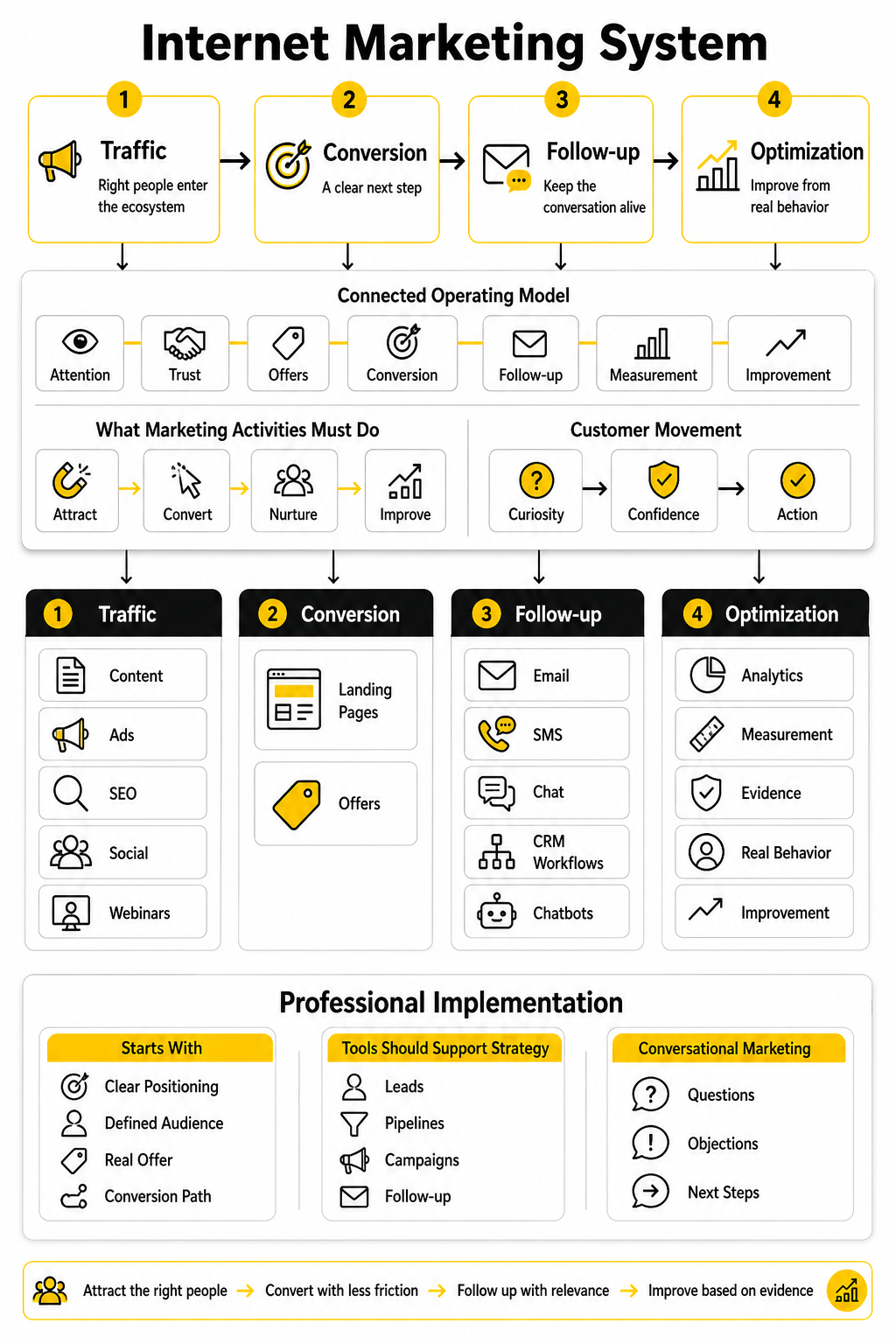
The point of this framework is simple: every marketing activity should either attract, convert, nurture, or improve. If an activity does none of those things, it is probably decoration. If an activity does one of those things but is not connected to the others, it may create motion without measurable growth.
This is where many businesses start to see the real problem. They do not have a traffic problem only. They may also have a weak offer, unclear positioning, poor landing page structure, slow follow-up, bad segmentation, or no reliable attribution. A system makes those problems visible.
The Core Idea Behind The System
The core idea is that attention alone is not enough. A business can get views, clicks, impressions, followers, and website visits without creating predictable revenue. The system has to move people from curiosity to confidence, then from confidence to action.
Email is a good example because it sits in the middle of the system. Litmus reports that 35% of companies see email ROI of 36:1 or more, but that result does not come from random newsletters. It comes from useful segmentation, clear offers, strong timing, deliverability, and consistent measurement.
The same logic applies to ads, SEO, social, webinars, landing pages, chatbots, and CRM automation. None of them are magic by themselves. The value appears when each piece supports the next step in the customer journey.
What Professional Implementation Really Means
Professional implementation means building the system so it can be managed, measured, and improved without chaos. That starts with clear positioning, a defined audience, a real offer, and a conversion path that does not confuse people. After that, the tools should support the strategy, not replace it.
For example, a CRM and automation platform such as GoHighLevel can help centralize leads, pipelines, campaigns, and follow-up when the business has a clear process to automate. A messaging tool such as ManyChat can support conversational marketing when the brand already knows what questions, objections, and next steps matter. The tool is useful only when it is attached to a strategy.
This is the standard the rest of the article will use. We are not looking at internet marketing as a checklist of hacks. We are building a system that can attract the right people, convert them with less friction, follow up with relevance, and improve based on evidence.
The Framework Overview
The internet marketing system works best when you stop seeing marketing as a list of channels and start seeing it as a sequence. A stranger becomes aware of the brand, finds a reason to care, takes a small action, receives follow-up, compares the offer, and eventually decides whether to buy. The system’s job is to make that movement easier, clearer, and more measurable.
That sequence can be simple or advanced, but it should never be random. A local service business, a course creator, a SaaS company, and an ecommerce brand may use different tools, but the underlying structure is similar. They all need a way to attract qualified attention, capture demand, build trust, convert buyers, and learn from the data.
This is why the framework matters. It gives you a practical way to diagnose the business instead of blaming the newest platform change, ad cost increase, or algorithm update. When something is not working, you can ask a better question: is the system failing at traffic, conversion, follow-up, retention, or measurement?
The Five Stages Of An Internet Marketing System
A complete internet marketing system has five stages. These stages are not theoretical. They are the basic operating flow behind most serious online acquisition machines, whether the business uses SEO, paid ads, partnerships, email, social media, webinars, content, or outbound.
Positioning comes first because the system needs a clear reason to exist. If the audience is vague, the offer is weak, or the promise sounds like everyone else, the rest of the system has to work too hard. No funnel, landing page, chatbot, or CRM can fully rescue unclear positioning.
Traffic comes next because the system needs inputs. These inputs can come from organic search, paid media, short-form content, referrals, affiliates, creators, email partnerships, community, or outbound. The goal is not just more traffic; the goal is the right traffic entering the right path.
Conversion turns attention into a measurable action. That action might be a purchase, booked call, quote request, demo signup, webinar registration, email opt-in, free trial, or application. A conversion path should reduce friction, answer objections, and make the next step feel obvious.
Follow-up is where many businesses quietly lose money. Someone visits, clicks, downloads, asks a question, abandons checkout, or books a call, and then the business treats that action like a one-time event. A serious system uses email, SMS, retargeting, CRM tasks, chat, and sales workflows to keep the conversation alive without becoming annoying.
Optimization is the feedback loop. It turns performance data into better decisions about copy, offers, creative, audiences, automation, pages, and sales process. Without optimization, the system becomes a set of assumptions that slowly gets worse.
Positioning Sets The Direction
Positioning answers the question the customer is already asking: why should I pay attention to this instead of everything else? That answer must be specific enough to guide the rest of the internet marketing system. If positioning is generic, every campaign downstream becomes harder to write, harder to target, and harder to measure.
Strong positioning defines the customer, the problem, the desired outcome, and the reason the offer is credible. It should show up in the headline, the landing page, the email sequence, the sales script, the content strategy, and the ad creative. When those pieces say different things, the customer feels the inconsistency even if they cannot explain it.
This is especially important now because people are exposed to more automated content, more AI-generated messaging, and more lookalike offers than ever. HubSpot’s 2025 marketing research emphasizes the shift toward more carefully, more human marketing in a year shaped heavily by AI and changing buyer expectations. That is a polite way of saying the market is getting louder, and vague messaging gets ignored.
Traffic Feeds The System
Traffic is the fuel, but not all fuel is equal. A thousand visitors from a random viral post may produce less value than fifty visitors from a high-intent search query. The system should separate visibility from demand, because visibility feels good but demand pays the bills.
There are three useful traffic categories to think about. The first is intent-based traffic, where people are already looking for a solution through search, comparison pages, marketplaces, review sites, and direct referrals. The second is interest-based traffic, where people discover the brand through content, ads, creators, social platforms, or communities. The third is relationship-based traffic, where trust is built through email, partnerships, events, webinars, and repeated exposure.
A good system does not depend on one traffic source forever. Platforms change, costs rise, ranking volatility happens, and audiences move. The more mature the system becomes, the more it should balance short-term acquisition with long-term owned assets such as an email list, CRM database, content library, partner network, and retargeting audiences.
Conversion Turns Attention Into Action
Conversion is not just a button color or a headline test. It is the process of helping the right person take the right next step with enough confidence. That means the page, offer, proof, call to action, and follow-up promise must work together.
A conversion path usually breaks when the visitor has unanswered questions. They may not understand the offer, trust the brand, believe the outcome, know what happens next, or feel enough urgency to act now. Good conversion assets reduce those doubts without overwhelming the visitor.
This is where funnel builders and landing page platforms can be useful, but only when the strategy is already clear. A tool such as ClickFunnels can help structure opt-ins, offers, checkout flows, and upsells. A platform such as Replo can help ecommerce teams build higher-converting Shopify landing pages when the brand needs more control over product storytelling.
Follow-Up Creates The Real Leverage
Most people do not buy the first time they see an offer. That is normal. The problem is that many businesses build marketing as if every visitor should convert immediately, then they complain when paid ads get expensive or organic traffic does not turn into revenue fast enough.
Follow-up gives the system a second, third, and fourth chance to create trust. It can educate the buyer, answer objections, share proof, remind them of the outcome, invite them back, or route them to a sales conversation. This is where email marketing, CRM automation, retargeting, chat automation, and pipeline management become more than “nice to have.”
The important word is relevance. Adobe’s 2025 customer engagement research found that 78% of customers want consistent brand experiences, which is exactly why disconnected follow-up feels broken. If someone downloads a buyer’s guide, abandons checkout, and then receives a generic newsletter two weeks later, the system is not really following up; it is just broadcasting.
Optimization Makes The System more carefully
Optimization is where the internet marketing system becomes an asset instead of a campaign. A campaign ends, but a system keeps learning. Every click, opt-in, reply, booked call, purchase, refund, objection, and support question can improve the next version of the system.
The key is to track decisions, not just numbers. Page views, impressions, and open rates can be useful, but they do not matter equally. The better questions are: which traffic sources produce qualified leads, which messages create sales conversations, which offers convert profitably, which segments retain longer, and which steps create drop-off?
This is where many teams get overwhelmed because they collect data without turning it into action. Salesforce’s marketing research highlights how marketers are working through AI, data, and personalization challenges based on insights from thousands of marketing leaders worldwide. The lesson is practical: more data is not automatically better; cleaner data connected to decisions is better.
How The Framework Fits Together
The five stages only work when they are connected. Positioning shapes the traffic strategy. Traffic determines what kind of conversion path is needed. Conversion creates the signal for follow-up. Follow-up creates more chances to convert. Optimization improves every stage based on what actually happens.
That connected view is what separates a real internet marketing system from a collection of tactics. A business can have a strong Instagram account, decent ads, a newsletter, a CRM, and a landing page and still have no real system. The pieces only become a system when each one has a defined role and a measurable relationship to the next step.
The next part will go deeper into the core components. That is where the system becomes more concrete: audience, offer, content, funnels, automation, CRM, analytics, and retention. Those components are the building blocks, but the framework is what tells you where each block belongs.
The Core Components Of The System
Once the framework is clear, the next job is implementation. This is where the internet marketing system stops being a diagram and becomes a working process. The goal is to build the few components that actually move a buyer forward, then connect them in the right order.
A good system does not need to start huge. In fact, it usually should not. The smartest version is often a simple path that can be launched, measured, and improved before the business adds more channels, more automations, and more offers.
The core components are:
Each component has a job. If one part is weak, the system can still run, but it will leak. If several parts are weak, the business usually starts blaming the wrong thing.
Start With The Audience And The Buying Situation
The first implementation step is not choosing software. It is defining who the system is for and what moment they are in. A person casually researching a problem needs a different message than someone comparing vendors or ready to book a call.
This matters because buyer intent changes everything. High-intent visitors need clarity, proof, and a strong next step. Early-stage visitors need education, trust, and a reason to stay connected.
A practical audience profile should answer three questions. What problem is the person trying to solve right now? What would make them trust this offer? What action makes sense at this stage of awareness? If those answers are vague, the rest of the system becomes guesswork.
Build The Offer Before The Funnel
The offer is the center of the internet marketing system. A funnel does not create demand by itself. It packages demand, directs attention, and removes friction, but the offer still has to be worth acting on.
A strong offer makes the outcome clear. It explains what the buyer gets, why it matters, how it works, and what makes the next step safe enough to take. This could be a consultation, free trial, quote request, product bundle, lead magnet, demo, webinar, paid entry offer, or full purchase.
The conversion goal should match the buyer’s commitment level. Asking a cold visitor to buy an expensive service immediately may be too much. Asking a high-intent prospect to download a generic PDF may be too weak. The right offer creates a realistic bridge between interest and action.
Choose One Primary Traffic Path First
A common mistake is trying to launch everywhere at once. That creates busy work and weak learning. It is usually better to choose one primary traffic path, connect it properly, and use the data to improve the system before expanding.
For a search-driven business, the path may begin with SEO content and comparison pages. For a creator or coach, it may begin with short-form content and email capture. For a local service company, it may begin with paid search, local SEO, and review-driven landing pages. For ecommerce, it may begin with paid social, influencer content, product pages, and cart recovery.
The point is not that one channel is always best. The point is that each traffic source brings a different type of visitor. The message, page, and follow-up should match the source instead of pretending every visitor behaves the same way.
Turn The Path Into A Step-By-Step Process
The execution process should be simple enough that the team can explain it without opening ten tools. If nobody can describe how a stranger becomes a lead, customer, or booked call, the system is not ready. Complexity is not the goal; clarity is.
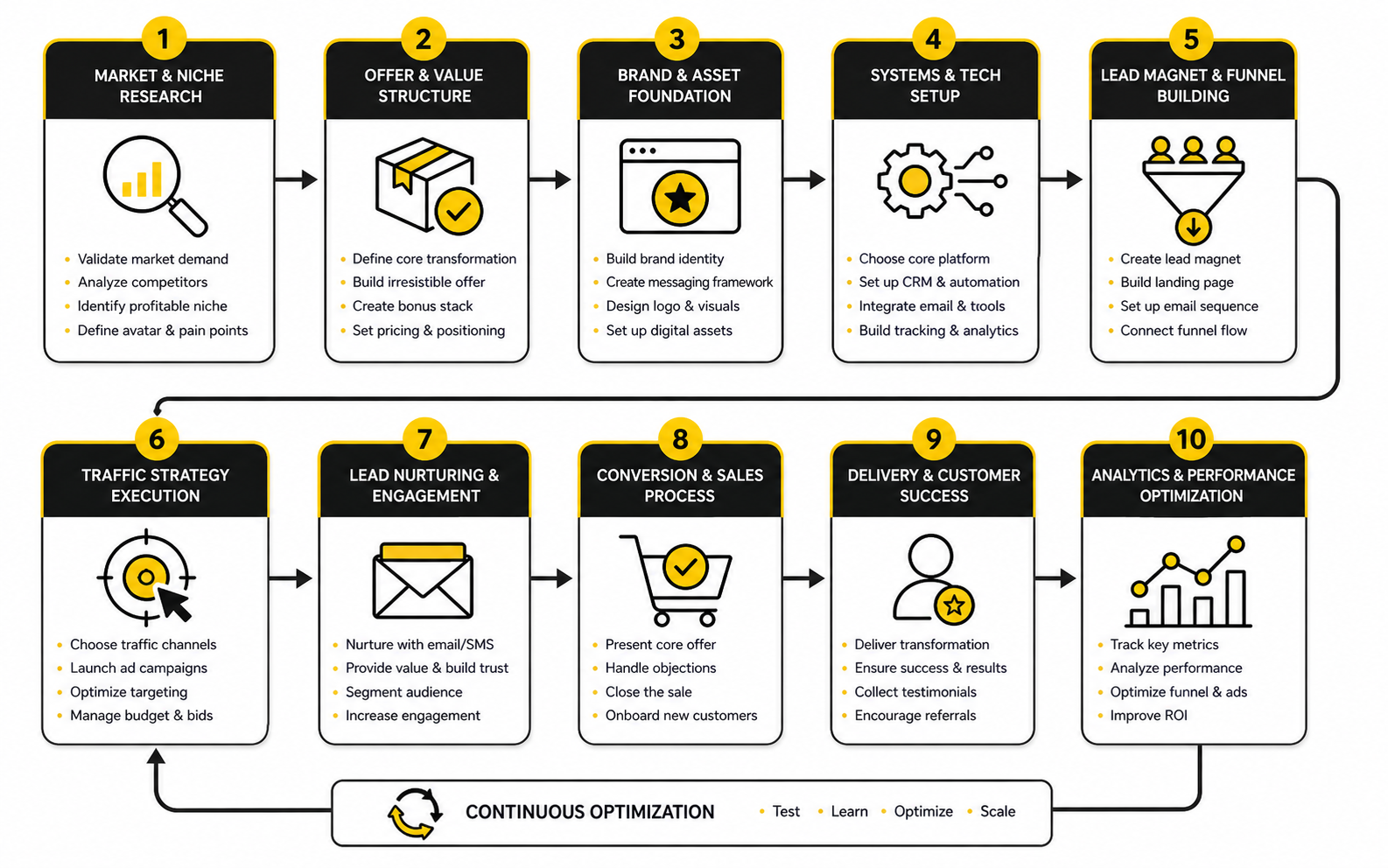
A practical first version can look like this:
That is not glamorous, but it works because it creates a clean learning loop. You can see where people arrive, where they act, where they drop off, and where follow-up needs to improve. Once that loop works, scaling becomes much more logical.
Build The Landing Page Around The Decision
The landing page should not be a digital brochure. It should help the visitor make one decision. That decision might be to buy, book, subscribe, apply, request a quote, or start a trial.
The page needs to answer the visitor’s natural questions in a sensible order. What is this? Who is it for? What outcome does it help me get? Why should I trust it? What happens after I take action? What should I do next?
This is why page structure matters more than decoration. A clean headline, relevant proof, clear benefits, objection handling, and a direct call to action usually beat a beautiful page with a vague message. For teams that need dedicated funnel pages, ClickFunnels can be useful when the priority is fast funnel creation, checkout flow, upsells, and campaign pages.
Capture Leads With A Real Reason To Opt In
Lead capture only works when the exchange feels fair. People are not excited to join another list for no reason. They opt in when the promise is specific, timely, and useful.
A useful opt-in can be a checklist, calculator, template, audit, quiz, buyer guide, training, discount, demo, or private consultation. The format matters less than the relevance. A simple guide that solves a painful buying question will outperform a polished but generic lead magnet.
The opt-in should also prepare the next step. If the goal is a sales call, the lead capture should qualify the person and create context for the call. If the goal is ecommerce revenue, the capture should support product education, abandoned checkout recovery, and timely reminders.
Connect Follow-Up Before Driving Traffic
Driving traffic before follow-up is connected is like filling a bucket with holes in it. Some people will convert immediately, but many will need more time. If there is no follow-up, the business pays to create attention and then lets that attention disappear.
Follow-up should be mapped to behavior. A new lead should not receive the same message as a checkout abandoner, a booked-call no-show, or a repeat buyer. Each person has already shown a different signal, so the system should respond differently.
This is where automation becomes genuinely useful. A platform like GoHighLevel can help connect forms, funnels, CRM stages, pipelines, email, SMS, calendars, and task automation in one place. For businesses that rely heavily on Instagram, Facebook Messenger, or WhatsApp conversations, ManyChat can help turn social engagement into structured conversations and opt-ins.
Use A CRM To Stop Losing Context
A CRM is not just a database. It is the memory of the internet marketing system. It shows who came in, what they did, what stage they are in, who needs follow-up, and which opportunities are close to revenue.
Without a CRM, the system usually depends on inboxes, spreadsheets, notifications, and memory. That may work for a tiny volume of leads, but it breaks quickly. Leads get missed, sales conversations lose context, and marketing cannot see which campaigns create real pipeline.
The CRM should be simple at first. Stages might include new lead, contacted, qualified, booked, proposal sent, won, lost, and nurture. The exact labels can change, but the principle is the same: every serious opportunity should have a clear status and a next action.
Measure The Few Numbers That Actually Matter
Measurement does not need to be complicated at the beginning. The first goal is to understand the main flow: visitors, opt-ins, calls booked, sales opportunities, purchases, revenue, and cost. If the system cannot measure those basics, advanced dashboards are just decoration.
The most useful metrics depend on the business model. A lead-generation business may care about cost per qualified lead, booked-call rate, show-up rate, close rate, and revenue per lead. An ecommerce business may care about conversion rate, average order value, repeat purchase rate, cart recovery, and contribution margin.
Cart abandonment is a good reminder that conversion leaks are normal and measurable. Baymard’s long-running benchmark puts the average documented ecommerce cart abandonment rate around 70.19% across 49 studies. That does not mean every store should panic, but it does mean the checkout and recovery process deserve serious attention.
Create A Weekly Optimization Rhythm
The system improves when review becomes a habit. A weekly review is enough for many small teams because it creates consistent learning without turning marketing into endless dashboard watching. The point is to find the weakest step and improve it deliberately.
A useful weekly review asks direct questions. Which traffic source created the best leads? Which page had the biggest drop-off? Which emails got replies or clicks? Which leads stalled in the pipeline? Which offer created the clearest buying signal?
Then the team chooses one or two changes. Not twenty. One or two. Tighten the headline, improve the call to action, add proof, change the opt-in, adjust targeting, rewrite the first follow-up email, or fix a slow response time. Small improvements compound when they are made consistently.
Keep The First Version Lean
The first version of an internet marketing system should prove the path before it tries to automate everything. Too much automation too early can hide weak positioning, a weak offer, or a broken conversion step. Automation should scale what works, not disguise what does not.
A lean system is easier to debug. If there is one audience, one offer, one traffic source, one page, one follow-up path, and one dashboard, performance problems are easier to find. Once that core path produces reliable signals, adding more assets makes sense.
This is the practical standard for implementation. Build the smallest system that can attract, convert, follow up, and teach you something. Then improve it until the numbers justify expanding the machine.
Statistics And Data
Data is not there to make the internet marketing system look sophisticated. It is there to show what is happening, where people are dropping off, and what the next improvement should be. If the numbers do not lead to a decision, they are not useful yet.
The mistake is treating benchmarks like grades. A conversion rate above an industry average does not automatically mean the system is healthy, and a rate below average does not automatically mean the system is broken. Benchmarks are starting points for interpretation, not final judgments.
The better question is always practical: what does this number tell us to fix next? A low click-through rate may point to weak messaging or poor audience fit. A high click-through rate with low conversion may point to a landing page problem. A strong opt-in rate with weak sales may point to poor qualification, weak follow-up, or a mismatch between the lead magnet and the paid offer.
What The Data Should Actually Measure
The internet marketing system should measure movement, not just activity. Activity numbers tell you what happened on a surface level. Movement numbers tell you whether people are getting closer to revenue.
A simple measurement path might track:
That list is not meant to become a bloated dashboard. It is meant to show the sequence. When you can see the sequence, you can find the leak.
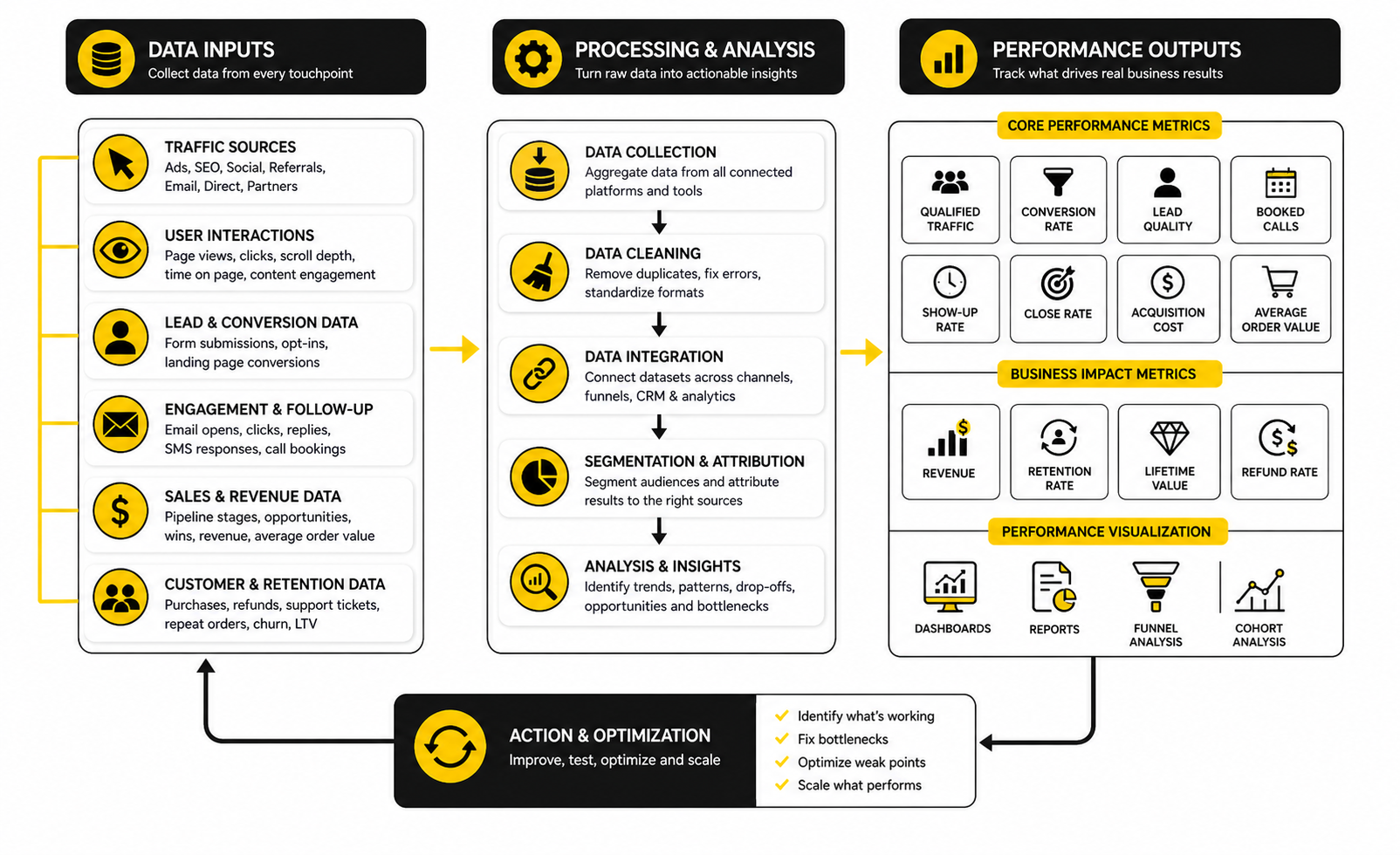
The best analytics setup makes the buying journey visible without pretending it is perfectly linear. A person may click an ad, leave, return through search, open an email, watch a video, and buy days later. Measurement should help the business understand the pattern well enough to improve decisions, even when attribution is imperfect.
Benchmarks Are Useful Only With Context
Benchmarks can help you see whether a number is wildly off, but they should not control the strategy. For example, WordStream’s 2025 search advertising benchmark analysis reviewed more than 16,000 campaigns running from April 2024 through March 2025 and found that average results vary heavily by industry, intent, and cost structure. That is why a law firm, home service company, ecommerce store, and SaaS business should not judge paid search performance with one universal number.
The same is true for ecommerce. A store with a 2% conversion rate may be doing well if it sells expensive products to cold traffic, while another store with the same rate may be underperforming if it sells low-priced impulse products to warm traffic. Smart Insights’ 2025 ecommerce conversion benchmark coverage points to different benchmark sources by sector and device because the “average” depends heavily on the market.
Email benchmarks need the same caution. MailerLite’s 2025 benchmark data covers more than 3.6 million campaigns from 181,000 approved accounts and reports median performance across industries and regions. That is useful for orientation, but the real question is whether your welcome sequence, nurture sequence, and sales sequence are moving people to the next step.
The Most Important Performance Signals
A working internet marketing system usually reveals itself through a few strong signals. You do not need to stare at every metric every day. You need to know which numbers prove the system is attracting the right people and helping them move forward.
The first signal is qualified traffic. This is not just sessions, impressions, or reach. Qualified traffic means the visitors are aligned with the problem, market, and offer.
The second signal is conversion intent. People are not only consuming content; they are clicking, subscribing, booking, starting trials, requesting quotes, adding products to cart, or replying. This shows that the message is creating action.
The third signal is follow-up response. If leads ignore every email, SMS, reminder, or sales message, the system may be attracting weak leads or sending weak follow-up. Engagement is not revenue, but it often shows whether the conversation still has life.
The fourth signal is pipeline quality. For service, B2B, and high-ticket offers, this matters more than raw lead volume. A campaign that produces fewer leads but more qualified opportunities may be far more valuable than a campaign that fills the CRM with people who never buy.
The fifth signal is profitability. Revenue alone is not enough. The system has to be measured against acquisition cost, fulfillment cost, refunds, churn, and margin.
How To Read Traffic Data
Traffic data tells you where attention is coming from, but it does not automatically tell you whether that attention is good. A traffic source can look successful because it brings volume, but weak if those visitors do not convert or return. Another source can look small but produce the highest-quality leads in the system.
For SEO traffic, look beyond page views. Track which pages attract buyers, which queries bring commercial intent, which posts create email subscribers, and which content assists conversions later. Informational traffic can be valuable, but only if the system has a way to capture and nurture it.
For paid traffic, connect cost to downstream quality. Click-through rate and cost per click are useful, but they are not enough. A cheaper click that creates bad leads is not cheaper in the real business.
For social traffic, separate reach from action. Sprout Social’s 2025 content benchmark research analyzed billions of messages across public profiles and emphasizes that brands need to compare performance by industry, audience behavior, and content type. That matters because social media can create awareness, trust, and retargeting audiences even when it does not convert immediately.
How To Read Conversion Data
Conversion data shows whether the page and offer are doing their job. But again, the number needs context. A 10% opt-in rate may be strong for cold traffic and weak for warm traffic coming from a trusted email list.
When conversion is low, do not immediately redesign everything. First check whether the traffic source matches the offer. Then check whether the headline is clear, the promise is specific, the call to action is visible, and the page answers the obvious objections.
For ecommerce, cart abandonment deserves special attention because it often happens after the buyer has already shown serious intent. Baymard’s long-running checkout research puts the average documented cart abandonment rate at 70.19% across 49 studies. That number matters because checkout friction, surprise costs, weak trust signals, and poor recovery flows can quietly drain revenue from traffic you already paid to acquire.
How To Read Email And Follow-Up Data
Email and follow-up data show whether the relationship is getting stronger or weaker after the first interaction. Open rates can be useful, but they are not the end goal. Clicks, replies, booked calls, purchases, and return visits tell a better story.
If open rates are weak, the issue may be sender reputation, list quality, subject lines, timing, or audience relevance. If opens are healthy but clicks are weak, the message may not create enough motivation. If clicks are strong but sales are weak, the problem may sit on the landing page, offer, checkout, call process, or pricing.
This is why follow-up should be tracked by sequence, not only by campaign. A welcome sequence has a different job than a sales sequence. A cart recovery sequence has a different job than a reactivation sequence. A system becomes easier to improve when each follow-up path has a clear purpose.
How To Read Sales And Pipeline Data
For businesses that sell through calls, demos, quotes, or proposals, the CRM is where the internet marketing system becomes serious. Marketing performance should not stop at the lead. It should follow the lead into qualification, conversation, proposal, close, and revenue.
A low booked-call rate may mean the offer is not compelling enough. A low show-up rate may mean the confirmation and reminder process is weak. A low close rate may mean poor lead quality, unclear expectations, weak sales process, or a mismatch between the marketing promise and the actual offer.
This is where a platform like GoHighLevel can help when the business needs forms, calendars, pipelines, reminders, automations, and reporting connected in one workflow. The tool is not the strategy, but it can make the handoff between marketing and sales much cleaner when the process is mapped correctly.
Attribution Is A Guide, Not The Truth
Attribution is useful, but it is not perfect. Buyers do not behave in a clean spreadsheet. They compare, delay, ask questions, use multiple devices, ignore tracking, and return through different channels.
That does not mean attribution is useless. It means the business should use attribution as a directional guide instead of pretending it explains every decision. First-click attribution can show what creates discovery. Last-click attribution can show what closes action. Multi-touch attribution can show the supporting role of content, retargeting, email, and brand demand.
The practical move is to combine attribution with business judgment. If a channel creates assisted conversions, improves sales conversations, and increases branded search, it may be more valuable than last-click numbers suggest. If a channel gets credit for conversions but produces weak customers, it may be less valuable than the dashboard claims.
The Weekly Measurement Routine
A good weekly review should be boring in the best possible way. Same numbers, same order, same questions. That consistency makes patterns easier to see.
Start with traffic quality. Which source produced the most useful visitors or leads? Then check conversion. Which page, offer, or call to action created the strongest movement? Then check follow-up. Which sequence produced clicks, replies, bookings, or purchases?
After that, look at the pipeline or revenue data. Which leads became real opportunities? Which opportunities stalled? Which channel produced customers with the best economics?
The final step is choosing one improvement. Not a complete rebuild. One improvement. Fix the weakest link, run the next test, and document what changed.
What Good Data Should Change
Good data should change decisions. It should change which traffic sources get budget, which pages get rebuilt, which offers get promoted, which emails get rewritten, which leads get prioritized, and which campaigns get paused. If the data does not change behavior, the team is collecting numbers for comfort.
This is especially important when AI tools, automation platforms, and multi-channel campaigns create more data than small teams can realistically process. Supermetrics’ 2025 marketing data report analyzed aggregated data from 6,000 businesses and surveyed more than 200 marketers, with the core problem being clear: marketers are not short on data; they are short on clean, useful, decision-ready data.
The internet marketing system should make that easier. It should show where attention comes from, where trust is built, where action happens, where money is lost, and where the next improvement belongs. That is the real value of measurement: not more reports, but better moves.
Professional Implementation And Scaling
Scaling an internet marketing system is not the same as doing more marketing. More ads, more posts, more emails, more funnels, and more automation can increase revenue, but they can also multiply confusion. If the core system is weak, scaling simply makes the leaks more expensive.
Professional implementation starts with restraint. You do not scale every campaign just because one metric looks good. You scale when the traffic quality, conversion path, follow-up process, sales handoff, customer economics, and fulfillment capacity are strong enough to handle more volume.
This is where the work becomes more strategic. The question is no longer “Can we get more leads?” The better question is “Can we get more of the right customers without breaking margin, trust, delivery, or operations?”
The First Scaling Tradeoff: Speed Versus Control
Every internet marketing system eventually faces a speed versus control decision. Paid media gives speed, but it can become expensive if conversion and retention are weak. Organic content gives compounding value, but it usually takes longer to produce predictable demand.
Neither path is automatically better. A business with strong cash flow, proven offers, and fast sales follow-up may use paid acquisition aggressively. A business with a complex sale, limited budget, or education-heavy market may need to build authority through search, email, partnerships, and long-form content before scaling spend.
The mistake is pretending all growth channels behave the same. Paid traffic tests demand quickly, but it also exposes weak pages, weak offers, and weak follow-up. Organic traffic builds trust over time, but it requires consistency and patience. A mature system usually combines both, but it should not rush into both before one path is working.
Do Not Automate Broken Processes
Automation is powerful when it supports a proven process. It is dangerous when it hides a broken one. A bad follow-up sequence does not become better because it runs automatically.
Before automating anything, map the human version first. What should happen when a lead comes in? Who needs to respond? What information is required? What message should the prospect receive? What should happen if they do not reply, miss a call, abandon checkout, or revisit the pricing page?
Once the human logic is clear, automation can remove delay and inconsistency. Platforms like GoHighLevel make sense when the business needs forms, calendars, pipelines, email, SMS, reminders, and sales workflows in one connected environment. But the platform should execute the process, not invent it.
Build Around First-Party Data
As the system matures, first-party data becomes one of the most valuable assets in the business. This includes email subscribers, CRM records, purchase history, form submissions, quiz answers, call notes, support interactions, product usage, and direct customer feedback. It is data the business earns through real relationships.
This matters because marketing measurement and personalization are becoming harder when a business depends too much on rented platforms and third-party signals. Privacy expectations, tracking limits, cookie changes, device fragmentation, and platform reporting gaps all make direct customer data more important. A first-party data strategy gives the business a more stable foundation for segmentation, follow-up, retargeting, and retention.
The practical move is simple: collect only data you can use responsibly. Do not ask twenty questions because your form builder allows it. Ask for the information that improves qualification, personalization, or service quality, then protect it and use it in ways that make the customer experience better.
Segment Before You Personalize
Personalization sounds advanced, but most businesses should start with segmentation. Segmentation means grouping people by meaningful differences. Personalization means adapting the experience based on those differences.
Useful segments might include new leads, high-intent prospects, abandoned checkout visitors, booked-call no-shows, repeat buyers, inactive subscribers, high-value customers, and people interested in a specific product category. These groups do not need the same message because they are not in the same situation.
This is where the internet marketing system starts to feel more intelligent. A new subscriber may need education. A cart abandoner may need reassurance or urgency. A returning buyer may need a complementary offer. A sales-qualified lead may need a direct reminder and proof. The system becomes stronger when it reacts to behavior instead of broadcasting the same message to everyone.
Watch For Tool Sprawl
Tool sprawl is one of the quietest risks in online marketing. A business adds one tool for pages, one for email, one for SMS, one for analytics, one for forms, one for scheduling, one for CRM, one for chat, one for social posting, and one for reporting. At first, each tool solves a small problem. Later, the stack becomes the problem.
The issue is not that multiple tools are bad. The issue is that disconnected tools create duplicated data, broken attribution, inconsistent follow-up, and messy reporting. The team spends more time managing the stack than improving the system.
A cleaner stack usually wins. That may mean using an all-in-one platform for speed and simplicity, or using specialized tools with strong integrations when the business needs more control. The right answer depends on the team, budget, technical ability, and growth stage.
Protect The Customer Experience While Scaling
Scaling should not make the customer experience worse. More volume can create slower response times, weaker support, less relevant communication, and more operational mistakes. That destroys trust faster than a better ad campaign can rebuild it.
Customer experience matters because marketing does not end at the conversion. A bad onboarding experience can increase refunds, churn, negative reviews, and support costs. A strong post-purchase experience can increase retention, referrals, testimonials, repeat purchases, and lifetime value.
Adobe’s customer engagement research found that 78% of customers want consistent brand experiences. That number matters because consistency is not just branding. It is whether the promise in the ad matches the page, the email, the sales call, the checkout, the onboarding, and the delivery.
Know When To Add More Channels
More channels should be added only when the system can absorb them. If the business cannot clearly measure one traffic source, adding three more will not create clarity. It will create noise.
A good reason to add a channel is that the current system has a proven offer, clear conversion path, working follow-up, and enough operational capacity. Another good reason is audience behavior. If the target buyer is clearly active on a channel and the brand has a realistic way to show up there with quality, expansion may make sense.
A bad reason is boredom. Switching channels because the current one feels slow often creates half-built systems everywhere. The better move is to improve the current path until the bottleneck is obvious, then expand deliberately.
Use AI Carefully, Not Lazily
AI can make an internet marketing system faster, but it can also make weak marketing louder. It can help with research, segmentation, content drafts, workflow ideas, customer support, analytics summaries, ad variations, and personalization. But it should not replace strategy, judgment, or real customer insight.
The biggest risk is generic output. If a business uses AI to create more average content, average emails, and average ads, it may increase volume while reducing trust. The market is already full of content that sounds polished but says nothing.
A better use of AI is to support sharper execution. Use it to analyze call transcripts, summarize objections, organize customer feedback, draft variations from real positioning, identify content gaps, and speed up repetitive tasks. The quality still depends on the inputs, the review process, and the person making the final decision.
Create Governance Before Complexity
Governance sounds boring, but it becomes important as the system grows. Someone needs to own the message, the offer, the data, the automations, the reporting, and the customer experience. Without ownership, the system slowly fills with outdated pages, broken links, stale emails, duplicated tags, and campaigns nobody fully understands.
A simple governance rhythm can prevent most of this. Review live offers monthly. Review automation workflows quarterly. Review tracking and dashboards before major campaigns. Review forms, tags, lists, and CRM stages whenever the sales process changes.
This is not bureaucracy. It is maintenance. Every internet marketing system needs maintenance because markets change, tools change, buyers change, and internal teams change.
The Advanced Risk: Optimizing For The Wrong Customer
One of the most expensive mistakes is optimizing for people who convert but do not become good customers. A campaign can look successful if it lowers cost per lead, but fail if those leads waste sales time, churn quickly, ask for refunds, or never buy again.
This is why scaling decisions should include quality metrics. Look at close rate, average order value, retention, refund rate, support load, repeat purchase rate, and lifetime value. A slightly higher acquisition cost may be acceptable if it brings customers who stay longer and buy more.
The internet marketing system should not chase cheap action. It should create profitable relationships. That is a different standard, and it is the standard that matters when the business wants durable growth.
Build Feedback Loops From Sales And Support
Sales and support teams hear the truth before dashboards do. They hear objections, confusion, complaints, buying triggers, competitor comparisons, pricing resistance, and delivery issues. That information should flow back into marketing.
If sales keeps answering the same question, the landing page may need to answer it earlier. If support keeps explaining the same setup issue, onboarding may need improvement. If customers keep praising one outcome, that language should appear in ads, emails, and sales pages.
This is how the system becomes sharper over time. Marketing should not operate in a separate room from the customer. The closer it gets to real conversations, the more useful the messaging becomes.
Scale What Is Proven, Not What Is Exciting
The boring part of scaling is that the best move is often obvious. Put more budget behind the campaign with the best qualified pipeline. Improve the page that already converts. Strengthen the email sequence that already creates replies. Expand the content cluster that already attracts buyers. Build around what the market has already validated.
The exciting move is usually chasing a new platform, new tactic, or new software. Sometimes that is right. Most of the time, it is a distraction from improving the proven path.
A professional internet marketing system creates discipline. It helps you say no to random opportunities and yes to the improvements that compound. That discipline is what keeps growth from turning into chaos.
Prepare The System For The Final Stage
At this point, the system has moved from basic structure to implementation, measurement, and scaling strategy. The remaining job is to bring everything together into a practical operating model. That means deciding what to track, what to improve, what to automate, and what to simplify.
The final part will close the loop with measurement, scaling priorities, and the questions most businesses ask when they start building this properly. It will also cover the common mistakes that make an internet marketing system harder than it needs to be. The goal is to leave you with a system you can actually run, not just admire.
Measurement, Scaling, And Final System
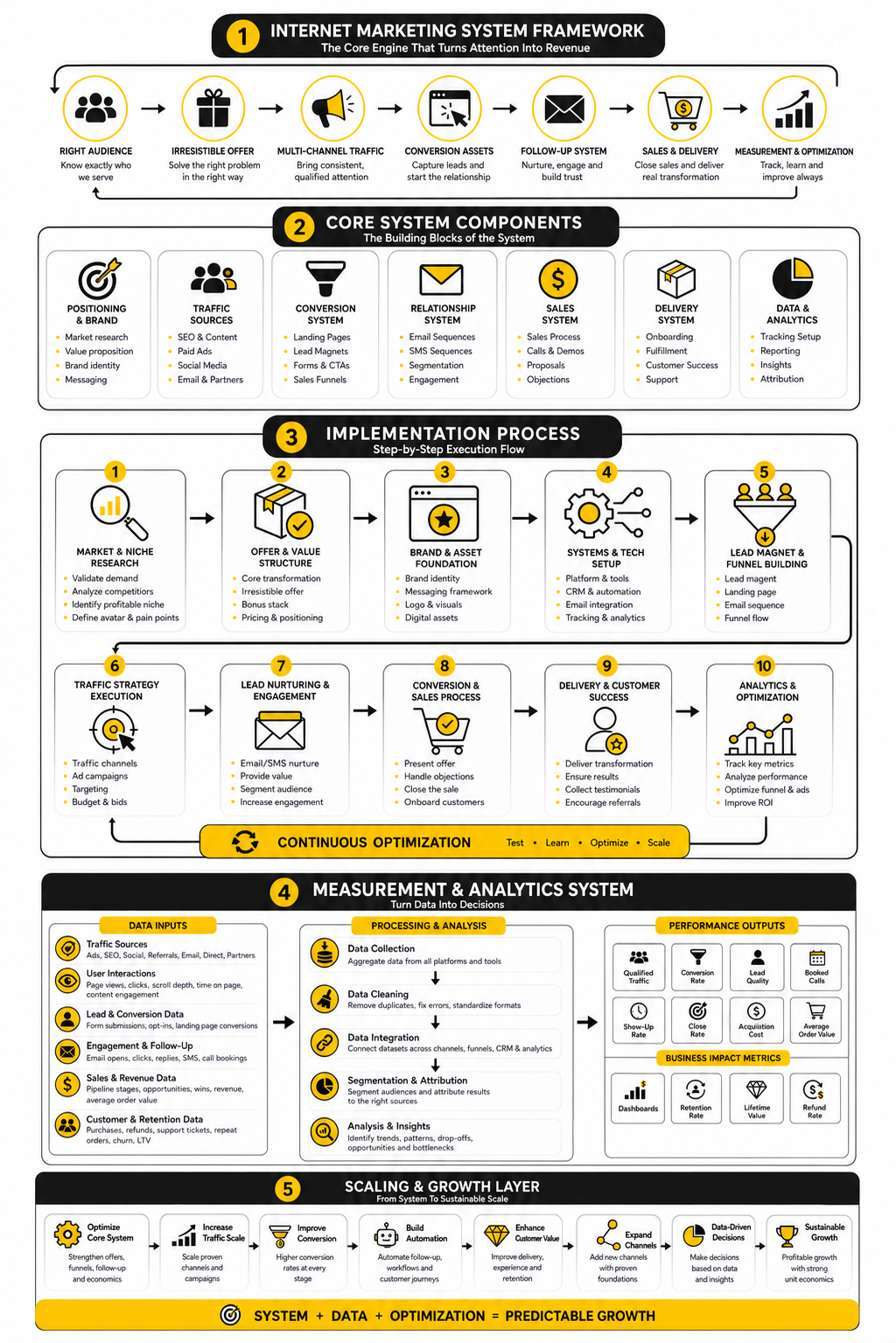
At this stage, the internet marketing system should be treated like a living business asset. It has inputs, conversion points, follow-up paths, sales or checkout outcomes, customer data, and feedback loops. The goal is not to make the system perfect; the goal is to make it clear enough to improve without guessing.
The final version should show how attention becomes revenue and how revenue becomes learning. That means every important action should have a next step, every qualified lead should have a status, every campaign should connect to a measurable outcome, and every customer interaction should teach the business something useful. When those pieces are connected, marketing becomes much easier to manage.
The system should also stay flexible. Channels change, buyers change, competitors change, and tools change. A strong system can adapt because it is built around principles: clear positioning, useful offers, relevant traffic, strong conversion paths, thoughtful follow-up, clean data, and consistent optimization.
The Final Operating Model
The final operating model is simple: attract the right people, help them understand the offer, give them a clear next step, follow up based on behavior, measure the result, and improve the weakest part. That sounds basic, but most businesses do not actually run this way. They run campaigns, check dashboards, and hope the pieces connect.
A professional internet marketing system removes that uncertainty. It gives the team a shared view of what should happen from first touch to revenue. It also makes responsibilities clearer because each stage has an owner, a metric, and a practical improvement path.
This is where the system becomes more than marketing. It affects sales, support, product, operations, retention, and hiring. The better the system gets, the easier it becomes to see what kind of traffic to buy, what content to publish, what offer to improve, what automation to simplify, and what customer segment deserves more attention.
What To Improve First
The first improvement should usually be the biggest leak closest to revenue. If people are adding products to cart but not buying, fix checkout and recovery before creating more top-of-funnel content. If qualified leads are booking calls but not showing up, fix reminders, confirmation messaging, and pre-call expectations before increasing ad spend.
If the system has no clear traffic source, start there. If it has traffic but no leads, improve the offer and landing page. If it has leads but no sales, improve qualification, follow-up, and the sales process. The sequence matters because fixing the wrong problem wastes time.
Do not try to optimize everything at once. One clean improvement per week can beat a chaotic rebuild every quarter. Consistent, focused improvement is how the internet marketing system gets stronger without becoming overwhelming.
Common Mistakes That Make The System Harder
The first mistake is building around tools instead of buyers. Software can help, but the buyer journey comes first. If the system does not reflect how people actually discover, compare, trust, and buy, even the best tools will feel clunky.
The second mistake is confusing automation with strategy. Automation can speed up follow-up, routing, reminders, segmentation, and reporting. It cannot fix a weak offer, unclear positioning, poor targeting, or a bad customer experience.
The third mistake is scaling before the economics are clear. More traffic is not always the answer. If the conversion path, sales process, margin, or retention is weak, scaling can turn a small problem into a larger and more expensive one.
When To Bring In Help
You should bring in help when the system has too many moving parts for the current team to manage well. That might mean strategy, funnel building, CRM setup, email automation, paid media, analytics, SEO, copywriting, conversion optimization, or sales process improvement. The need usually becomes obvious when the business has momentum but the system feels messy.
Outside help is most valuable when the business already has a clear offer and some real market signal. A professional can then improve the structure, tracking, messaging, automation, and execution faster than a team trying to figure everything out from scratch. If there is no offer-market fit yet, the priority should be research, positioning, and offer testing before building a complex system.
The best professionals do not just add tactics. They simplify the path, remove friction, and make the system easier to run. That is the standard to look for.
What Is An Internet Marketing System?
An internet marketing system is a connected process for attracting, converting, following up with, and retaining customers online. It includes traffic sources, landing pages, offers, email or SMS follow-up, CRM workflows, analytics, and optimization routines. The key difference is that the pieces work together instead of operating as disconnected tactics.
Why Is An Internet Marketing System Better Than Random Marketing Tactics?
Random tactics can create short-term activity, but they usually do not create predictable growth. A system shows how each tactic contributes to the buyer journey and revenue. That makes it easier to diagnose problems, improve weak points, and scale what is already working.
What Should I Build First?
Start with the audience, problem, offer, and conversion goal. Then build one simple path that sends one traffic source to one clear offer with one follow-up sequence. Once that path produces useful data, you can improve it and add more channels.
How Many Tools Do I Need?
You need fewer tools than most people think. At minimum, you need a way to publish pages, capture leads, follow up, manage contacts, and measure results. An all-in-one platform can be useful for simplicity, while specialized tools can make sense when the business needs deeper control.
Is Paid Advertising Required?
Paid advertising is not required, but it can speed up learning when the offer and conversion path are ready. Paid traffic gives faster feedback because you can control volume and targeting more directly. If the offer is unclear or the page is weak, paid ads will simply reveal that problem faster.
Is SEO Still Important In An Internet Marketing System?
SEO can be extremely valuable because it captures people who are actively researching problems, comparisons, and solutions. It also creates long-term assets that can keep bringing qualified visitors after the content is published. The key is connecting SEO traffic to lead capture, offers, follow-up, and measurable business outcomes.
How Does Email Fit Into The System?
Email is one of the strongest follow-up channels because it gives the business a direct way to continue the relationship after the first visit. It can educate leads, recover abandoned intent, support sales, onboard customers, and drive repeat purchases. The best results usually come from behavior-based sequences instead of generic newsletters.
What Metrics Matter Most?
The most important metrics are the ones that show movement toward revenue. That usually includes qualified traffic, conversion rate, lead quality, booked calls, show-up rate, close rate, acquisition cost, average order value, retention, and lifetime value. Vanity metrics can be useful for context, but they should not control strategy.
How Often Should I Review The System?
A weekly review is enough for most small and mid-sized teams. The review should look at traffic quality, conversion points, follow-up performance, pipeline movement, and revenue impact. Then the team should choose one or two improvements instead of trying to change everything at once.
When Should I Add Automation?
Add automation after the manual process is clear. If you do not know what should happen when a lead comes in, automation will only make the confusion faster. Once the logic is clear, automation can reduce delays, improve consistency, and keep opportunities from falling through the cracks.
What Is The Biggest Risk When Scaling?
The biggest risk is scaling a system that is not economically or operationally ready. More leads can expose weak qualification, slow follow-up, poor onboarding, low margins, and customer experience problems. Scale only after the system shows that it can handle more volume without damaging profit or trust.
Can AI Help Build An Internet Marketing System?
AI can help with research, content drafts, workflow planning, customer feedback analysis, segmentation ideas, and reporting summaries. It should support the strategy, not replace it. The best use of AI is to make strong thinking faster, not to mass-produce generic marketing.
How Do I Know If My System Is Working?
Your system is working when the right people are entering it, taking meaningful actions, receiving relevant follow-up, and turning into profitable customers. It does not need to be perfect, but it should produce clear signals that guide improvement. If you cannot tell where leads come from, what they do next, and how they become revenue, the system still needs work.
What Is The Simplest Version For A Small Business?
The simplest version is one audience, one offer, one landing page, one traffic source, one follow-up sequence, and one basic dashboard. That is enough to create a real learning loop. Once that loop works, the business can add more content, channels, automations, and offers with much less risk.
Build a stronger local presence with BAAM AI
Turn your website, Google profile, social channels, and AI visibility into one growth engine
Most businesses do not need more random marketing activity. They need a consistent presence system that helps the right people find them, trust them, and take action. BAAM AI brings strategy, local SEO, website updates, Google Maps visibility, social content, AI-search readiness, media production, and reporting into one practical monthly engine.
If you want your marketing to keep working after the campaign ends, start with a free BAAM AI presence audit. See how your business shows up today and where the fastest visibility wins are at BAAM AI.