
BAAM AI Blog
Internet Marketing PPC: A Practical Framework For Profitable Paid Campaigns
Internet marketing PPC looks simple from the outside: choose keywords, write ads, set a budget, and wait for leads or sales. In reality, the difference between a profitable campaign and a money pit usually comes down...
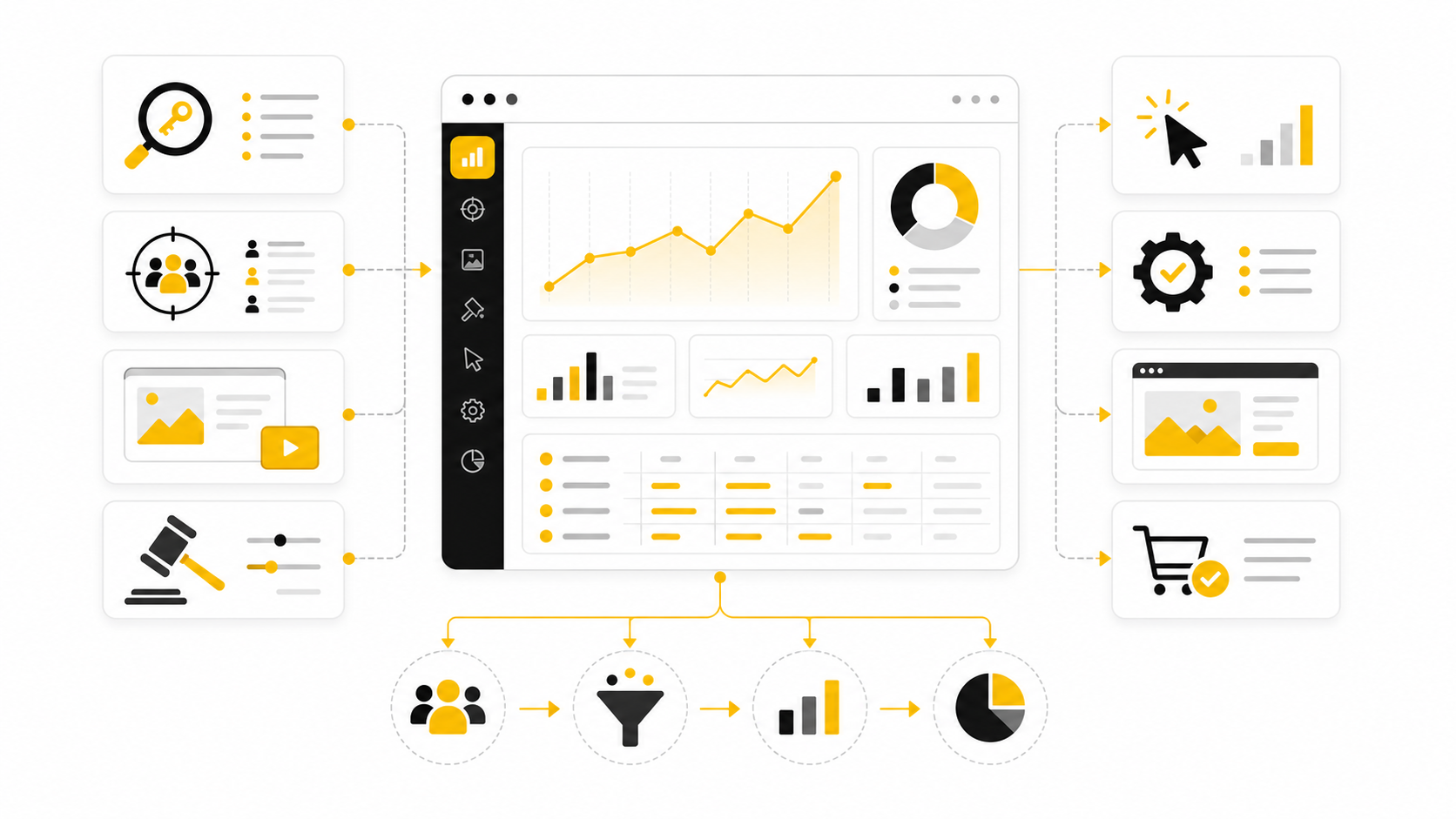
Internet marketing PPC looks simple from the outside: choose keywords, write ads, set a budget, and wait for leads or sales. In reality, the difference between a profitable campaign and a money pit usually comes down to the structure behind it. PPC rewards speed, but it punishes vague offers, weak tracking, messy landing pages, and campaigns built around guesses instead of economics.
That is why this guide treats PPC as a business system, not just an ad platform skill. Google Ads, Microsoft Ads, paid social, retargeting, landing pages, CRM follow-up, and reporting all matter, but none of them work in isolation. The goal is not to get cheaper clicks for the sake of cheaper clicks; the goal is to buy attention at a price that still leaves room for profit.
The market is still big enough to justify serious effort. U.S. internet advertising revenue reached a record $294.6 billion in 2025, and search remained one of the largest performance channels, with $114.2 billion in search ad revenue. At the same time, competition keeps pushing advertisers to become sharper, because benchmark data from thousands of campaigns shows that costs, conversion rates, and lead quality vary heavily by industry and execution quality, not just budget size.
This full article is split into six parts:
Why Internet Marketing PPC Still Matters
PPC matters because it lets a business reach people at the moment they are showing intent. Someone searching for a solution, comparing providers, or looking for pricing is not the same as someone passively scrolling past content. That intent is the reason paid search has stayed durable even as platforms, privacy rules, and AI-driven discovery keep changing.
The practical advantage is control. SEO can compound beautifully, but it takes time and is vulnerable to ranking shifts. Organic social can create demand, but reach is inconsistent. Internet marketing PPC gives you a faster feedback loop: you can test a message, measure response, adjust targeting, and know whether the market is reacting within days instead of months.
That does not mean PPC is automatically profitable. A campaign can have a strong click-through rate and still lose money if the offer is weak, the landing page is confusing, or the sales process leaks leads. Google’s own guidance around ad quality focuses on expected click-through rate, ad relevance, and landing page experience, which is a useful reminder that PPC performance is shaped by the full user experience, not only by bidding settings or keyword lists.
The reason this matters now is simple: more automation means less tolerance for sloppy strategy. Smart bidding and AI-assisted campaign types can help find conversions, but they need clean signals, clear goals, and enough conversion data to optimize toward the right outcome. If the account tells the algorithm that every form fill is equal, the algorithm may bring more form fills, not necessarily more customers.
The PPC Profit Framework
The safest way to think about PPC is as a chain. The chain starts with the market, continues through the offer, campaign structure, ad message, landing page, tracking, follow-up, and sales conversion, and ends with profit. When one link is weak, the account may still generate activity, but the business will feel the problem in rising costs, inconsistent lead quality, or poor return on ad spend.
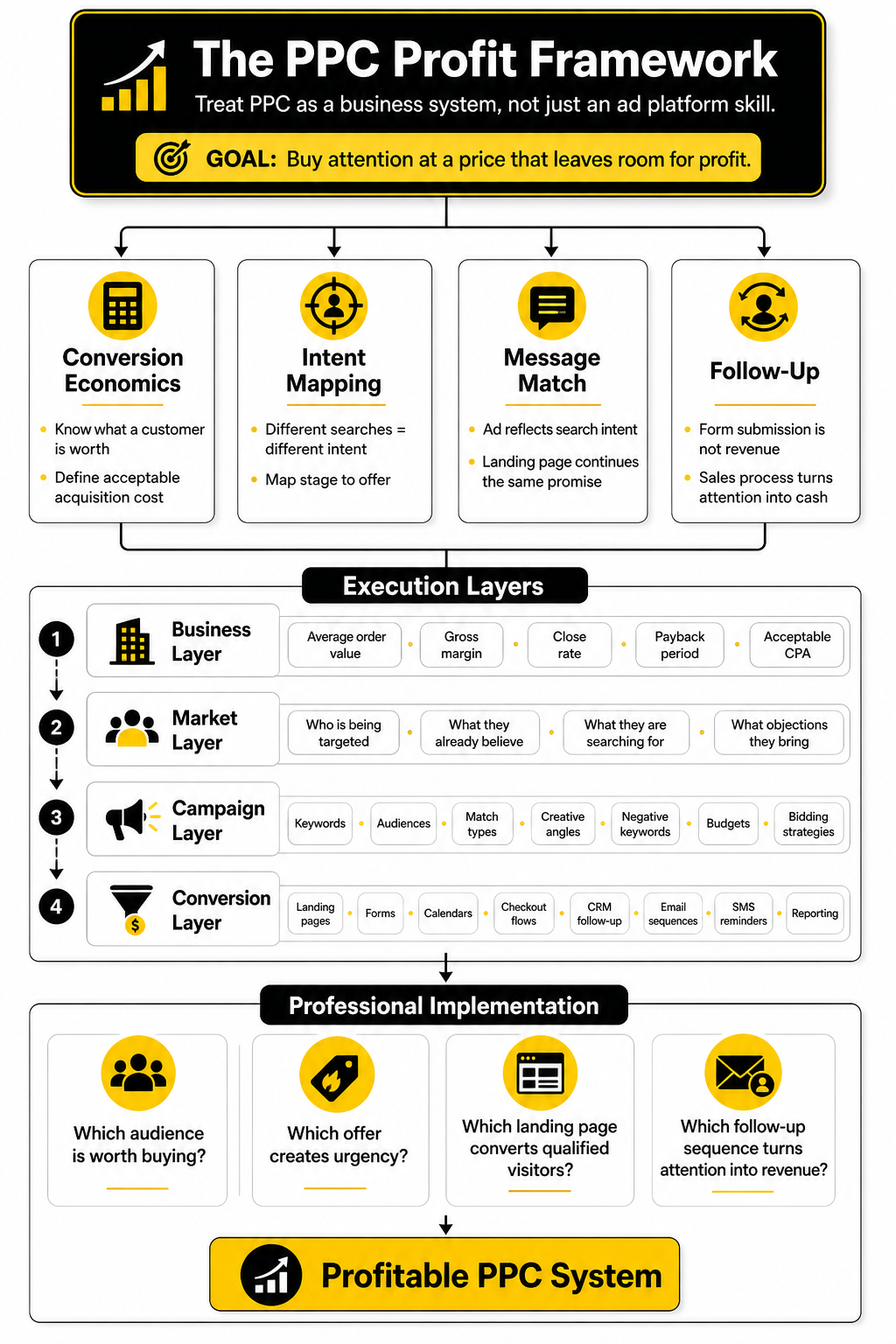
A useful internet marketing PPC framework has four layers. First, the business layer defines the numbers: average order value, gross margin, close rate, payback period, and acceptable cost per acquisition. Second, the market layer clarifies who is being targeted, what they already believe, what they are searching for, and what objections they bring with them.
The third layer is the campaign layer. This is where keywords, audiences, match types, creative angles, negative keywords, budgets, and bidding strategies turn business logic into media buying. The fourth layer is the conversion layer, where landing pages, forms, calendars, checkout flows, CRM follow-up, email sequences, SMS reminders, and reporting either protect the ad spend or waste it.
For example, a service business using PPC to generate consultations needs more than a campaign that gets clicks. It needs a landing page that makes the offer obvious, a form or calendar that removes friction, and a follow-up system that contacts leads quickly. Tools like GoHighLevel, ClickFunnels, Replo, and ManyChat can fit naturally in that system when they support the customer journey instead of becoming another disconnected tool.
Core Components Of A Profitable PPC System
A profitable PPC system starts with clear conversion economics. Before choosing keywords or writing ads, you need to know what a customer is worth and how much you can afford to spend to acquire one. Without that number, optimization becomes emotional because every cost feels high and every click feels risky.
The next component is intent mapping. Not every search term deserves the same bid, landing page, or offer. Someone searching “what is PPC” is in a very different stage from someone searching “best PPC agency for ecommerce” or “Google Ads management pricing,” and treating those searches the same usually leads to diluted performance.
The third component is message match. The ad should reflect the search intent, and the landing page should continue the same promise without forcing the visitor to reinterpret what they clicked. This is not just a copywriting preference; Google’s Quality Score documentation treats ad relevance and landing page experience as core diagnostic components of search campaign quality.
The fourth component is follow-up. Many PPC campaigns do not fail because the ads are terrible; they fail because leads are contacted too slowly, sales teams lack context, or the business stops measuring after the first conversion event. A form submission is not revenue, and a booked call is not revenue either until the sales process proves it can turn paid demand into cash.
Professional Implementation Starts With Discipline
Professional PPC implementation is not about launching as many campaigns as possible. It is about making every campaign answer a specific business question. Which audience is worth buying? Which offer creates urgency? Which landing page converts qualified visitors? Which follow-up sequence turns attention into revenue?
This is where many accounts get messy. They mix brand and non-brand traffic, combine high-intent and low-intent keywords, send multiple audiences to the same generic page, and then wonder why the numbers are hard to interpret. Clean structure makes optimization easier because it shows you what is actually working and what is merely hiding inside blended averages.
Part 2 continues with the first major section, Why Internet Marketing PPC Still Matters, and goes deeper into where PPC fits inside a modern internet marketing strategy. It will cover the real role of paid traffic, the difference between demand capture and demand creation, and why PPC becomes more powerful when it is connected to content, landing pages, email, CRM, and sales follow-up.
Why Internet Marketing PPC Still Matters
PPC still matters because it sits close to commercial intent. When someone searches for a product, service, comparison, location, price, or solution, they are not just consuming content. They are actively trying to move forward, and a well-built campaign can meet them at that exact moment.
That is the core difference between paid search and most interruption-based advertising. Social ads can create demand, video ads can shape preference, and content can educate the market, but internet marketing PPC is often where existing demand becomes measurable. It gives you a direct way to test whether people are ready to click, compare, book, buy, or request more information.
The channel is not shrinking into irrelevance either. U.S. digital advertising revenue reached $294.6 billion in 2025, while search generated $114.2 billion of that total. That does not mean every advertiser should blindly spend more, but it does prove that paid intent remains one of the largest engines in digital marketing.
PPC Turns Market Demand Into Measurable Action
The biggest advantage of PPC is that it turns vague market interest into measurable behavior. You can see which keywords attract serious prospects, which ads earn clicks, which landing pages convert, and which campaigns produce customers instead of just traffic. That level of feedback is incredibly valuable when you are trying to understand what the market actually wants.
This is where PPC becomes more than a traffic source. It becomes a research tool. If a campaign gets clicks but no conversions, the problem may be the landing page, offer, price, targeting, search intent, or lead qualification process. If a campaign converts well but sales are weak, the issue may be lead quality, follow-up speed, sales scripting, or the gap between the promise and the actual offer.
That is why experienced marketers do not judge internet marketing PPC only by cost per click. A cheap click from the wrong person is expensive. A costly click from someone ready to buy may be profitable. The real question is whether the campaign attracts the right intent at a cost the business can afford.
Paid Traffic Gives You Speed, But Not Immunity
PPC gives you speed, and that speed is powerful. You can launch a campaign, test an offer, and start collecting data far faster than you can build organic rankings from scratch. For a new offer, a new landing page, or a new market, that feedback loop can save months of guessing.
But speed is not the same as safety. A campaign can spend money quickly before the business has proven the offer, tracking, landing page, and sales process. That is why paid traffic should never be treated like a magic fix for weak positioning. It amplifies what already exists.
If the message is clear, the offer is relevant, and the follow-up is disciplined, PPC can accelerate growth. If those pieces are weak, PPC simply exposes the weakness faster. That can be painful, but it is also useful because the numbers force you to confront reality.
Search Intent Is Still One Of The Cleanest Signals In Marketing
Search intent is valuable because it is declared behavior. A person typing “emergency plumber near me,” “best CRM for agencies,” or “PPC management pricing” is giving you a direct clue about what they need and how close they may be to action. That is cleaner than trying to infer intent from broad demographic data alone.
This does not mean every keyword is equally valuable. Informational searches, comparison searches, brand searches, local searches, and purchase-ready searches all behave differently. A strong PPC strategy respects those differences instead of forcing every visitor into the same funnel.
For example, someone researching “what is PPC advertising” may need education before they are ready to buy. Someone searching “Google Ads consultant for ecommerce” is much closer to evaluating vendors. Both users can matter, but they need different ads, different landing pages, and different expectations around conversion timing.
PPC Works Best When It Connects With The Full Marketing System
PPC is strongest when it is connected to the rest of the business. The ad brings the visitor in, but the landing page, offer, checkout, calendar, CRM, email sequence, SMS follow-up, retargeting, and sales process decide whether that click becomes revenue. Treating PPC as a standalone activity is one of the fastest ways to waste money.
This is especially true for service businesses, agencies, coaches, consultants, SaaS companies, and high-ticket offers. The first conversion often does not happen at the first click, and the sale may require multiple touches. A clean CRM and follow-up system, such as GoHighLevel, can make sense when the business needs to track leads, automate reminders, and keep sales conversations from slipping through the cracks.
For ecommerce and direct-response offers, the connection between ads and landing pages is just as important. A product page may work for warm traffic, but cold PPC traffic often needs sharper message match, clearer proof, stronger objections handling, and fewer distractions. That is where focused builders like ClickFunnels or Replo can fit if the goal is to build conversion-focused pages instead of sending paid traffic to a generic website.
PPC Clarifies The Difference Between Demand Capture And Demand Creation
A lot of PPC confusion comes from mixing demand capture with demand creation. Demand capture means reaching people who already know they have a problem and are actively looking for a solution. Demand creation means educating people who may have the problem but are not yet searching for the offer directly.
Search campaigns are usually better at demand capture. They work well when people already search for your category, competitors, symptoms, use cases, or pricing. The stronger the existing intent, the easier it is to build campaigns around profitable keywords and clear landing pages.
Demand creation usually needs broader channels and a different expectation. Paid social, video, creator content, email, and content distribution can warm up the market before search ever happens. This matters because a PPC account often performs better when the brand is not relying on search alone to do all the education.
Benchmarks Are Useful, But Your Economics Matter More
Benchmarks can help you understand whether your numbers are wildly outside market norms. For example, 2025 search advertising benchmark data shows that average conversion rates and costs vary heavily by industry, with reported average Google Ads conversion rates around 7.52% across industries. That is useful context, but it should never become the main target.
Your business model matters more than the average. A company with high margins, strong retention, and a good sales team can afford a higher cost per lead than a company with low margins and weak follow-up. Two advertisers can have the same cost per click and completely different outcomes because their economics are different.
This is why serious PPC planning starts with allowable acquisition cost. You need to know what a customer is worth, what percentage of leads become customers, and how quickly the business can recover the spend. Without those numbers, campaign decisions become emotional instead of strategic.
Automation Has Raised The Bar For Strategy
Modern PPC platforms are increasingly automated. Smart bidding, responsive search ads, Performance Max, broad match, audience signals, and AI-assisted creative tools can all help campaigns find patterns that manual management might miss. But automation does not remove the need for strategy.
Google’s Smart Bidding documentation makes clear that bidding systems use conversion data to predict which ad interactions are likely to lead to conversions. That means the quality of your conversion tracking directly affects the quality of the optimization. If you feed the system weak signals, it may optimize toward weak outcomes.
This is where many advertisers get burned. They track every lead as equal, ignore offline sales quality, and then wonder why the algorithm brings more low-value conversions. Automation can be powerful, but it needs clean goals, meaningful conversion events, and enough business discipline to tell the platform what actually matters.
PPC Makes Weak Offers Obvious
A weak offer can hide in organic marketing for a long time. You may publish content, post on social media, or send emails without ever knowing exactly how much demand exists. PPC removes that comfort because every click has a cost and every weak conversion path becomes visible.
This is uncomfortable, but it is also one of the best reasons to use PPC. If people click the ad but do not convert, the offer may not be strong enough or the page may not answer the right questions. If people convert but do not buy, the lead magnet, sales process, or qualification criteria may be attracting the wrong audience.
That feedback is not failure. It is information. The mistake is to keep increasing budget before fixing the reason the campaign is underperforming.
PPC Supports SEO, Content, And Brand Building
PPC and SEO should not be treated like enemies. SEO builds long-term visibility and authority, while PPC gives faster testing and controlled placement. Together, they can help a business understand which keywords convert before investing heavily in long-form content or organic campaigns.
Paid search data can reveal which phrases have buying intent, which objections appear in search terms, and which offers generate action. That insight can shape landing pages, blog posts, comparison pages, service pages, and sales enablement content. In a practical marketing system, PPC often becomes the testing lab that informs the rest of the strategy.
The same applies to brand building. When people have already seen your content, ads, emails, videos, or social proof, they are more likely to recognize you when they search later. PPC captures that moment more effectively when the rest of the marketing system has already built trust.
The Real Role Of PPC Is Controlled Growth
The real role of internet marketing PPC is controlled growth. You are not trying to buy random traffic. You are trying to buy qualified attention at a price that makes business sense, then improve the system until the same spend produces better outcomes.
That requires patience and pressure at the same time. Patience because campaigns need enough data to produce reliable decisions. Pressure because every dollar spent should teach you something useful about intent, messaging, conversion, or economics.
Part 3 moves into Market, Offer, and Conversion Economics, because that is where profitable PPC really begins. Before campaign structure, keywords, or ads matter, the business needs to define who it wants, what it can afford to pay, and what offer is strong enough to turn paid attention into measurable revenue.
Market, Offer, and Conversion Economics
Profitable internet marketing PPC starts before the first campaign is built. It starts with the market you are entering, the offer you are making, and the numbers that decide whether a click can ever become profitable. If those pieces are unclear, campaign management becomes a guessing game with a credit card attached.
The first question is not “What keywords should we bid on?” The first question is “Who are we willing to pay to reach, and what action is worth paying for?” That shift matters because PPC does not reward businesses for getting attention; it rewards businesses that can turn paid attention into measurable revenue.
This is also where a lot of advertisers make the wrong move. They study benchmarks, copy competitor ads, and launch quickly, but they never calculate the maximum cost per lead or cost per acquisition the business can support. Benchmarks are useful context, especially when 2025 search data shows costs and conversion rates moving differently by industry, but your own economics are the decision-maker.
Start With The Customer Value
Before you set a budget, define what a customer is worth. That means looking at average order value, gross margin, repeat purchase rate, lifetime value, refund rate, sales close rate, and the amount of time it takes to recover acquisition cost. PPC becomes much easier to manage when you know the difference between a lead that looks cheap and a customer that is actually profitable.
For a simple ecommerce offer, the math may be direct. If the average order value is $120 and the gross margin is 60%, there is $72 of gross profit before ad spend, fulfillment complexity, payment fees, and overhead. That does not mean you can spend $72 to acquire a customer, but it gives you a starting point for deciding what a reasonable first-purchase acquisition cost might be.
For a service business, the calculation usually depends more on close rate and deal value. If a lead costs $80 but one in five leads becomes a $2,000 client, the lead cost may be excellent. If the same $80 lead never answers the phone or cannot afford the service, it is not a lead problem only; it is a targeting, offer, qualification, or follow-up problem.
Define The Conversion That Actually Matters
Not every conversion should be treated equally. A newsletter signup, phone call, booked consultation, quote request, demo request, checkout, and purchase are all different levels of intent. If the PPC account optimizes toward the wrong event, the campaign may look healthier in the dashboard than it is in the bank account.
This is especially important now because automated bidding depends on conversion data. Google’s Smart Bidding systems use campaign conversion data to predict which interactions are more likely to produce conversions, so the quality of the signal matters. If you tell the platform that every form fill is equally valuable, it may learn how to generate more form fills rather than more qualified buyers.
A better approach is to separate primary and secondary conversions. Primary conversions should reflect meaningful business outcomes, such as purchases, qualified leads, booked calls, or sales-qualified opportunities. Secondary conversions can still be useful for diagnosis, but they should not confuse the algorithm or the reporting conversation.
Map The Buyer Journey Before You Map The Campaign
A good PPC campaign reflects how buyers actually make decisions. Some buyers are problem-aware, some are solution-aware, and some are already comparing vendors. Each stage needs different language because the user’s level of awareness changes what they expect to see after clicking.
Problem-aware visitors may respond to symptoms, frustrations, or outcomes. Solution-aware visitors usually need education, proof, and a reason to trust your approach. Vendor-aware visitors need comparison points, pricing clarity, objections handled, and a clear next step.
This is why sending every keyword to the same generic page rarely works well. The page may technically mention the service, but it does not meet the intent behind the click. In internet marketing PPC, the closer the campaign matches the buyer’s mental state, the less work the visitor has to do to understand why the offer fits.
Build The Offer Before Building The Account
The offer is the bridge between the click and the conversion. It is not just the product or service. It is the promise, the packaging, the risk reversal, the urgency, the proof, the next step, and the reason someone should act now instead of closing the tab.
For lead generation, the offer might be a free audit, estimate, strategy call, quote, consultation, calculator, demo, or diagnostic. For ecommerce, it might be a bundle, limited-time discount, quiz result, free shipping threshold, starter kit, or product comparison page. For SaaS, it might be a free trial, live demo, sandbox account, migration plan, or use-case landing page.
The offer needs to match the temperature of the traffic. Cold visitors usually need more context and lower friction. High-intent searchers may be ready for a quote, consultation, or purchase, but only if the page makes the value clear quickly. This is where funnel tools like ClickFunnels, Systeme.io, and Replo can be useful when the business needs dedicated conversion paths instead of relying on a broad website page.
Turn The Economics Into Guardrails
Once the customer value and offer are clear, turn the numbers into PPC guardrails. Guardrails stop you from reacting emotionally to early data and help you decide what is worth testing, pausing, or scaling. They also make conversations with clients, founders, or sales teams much more practical.
The basic guardrails should include:
These numbers do not need to be perfect at the beginning. They need to be honest enough to guide decisions. As data comes in, the guardrails should become more accurate because the campaign is no longer operating on assumptions alone.
The Implementation Process
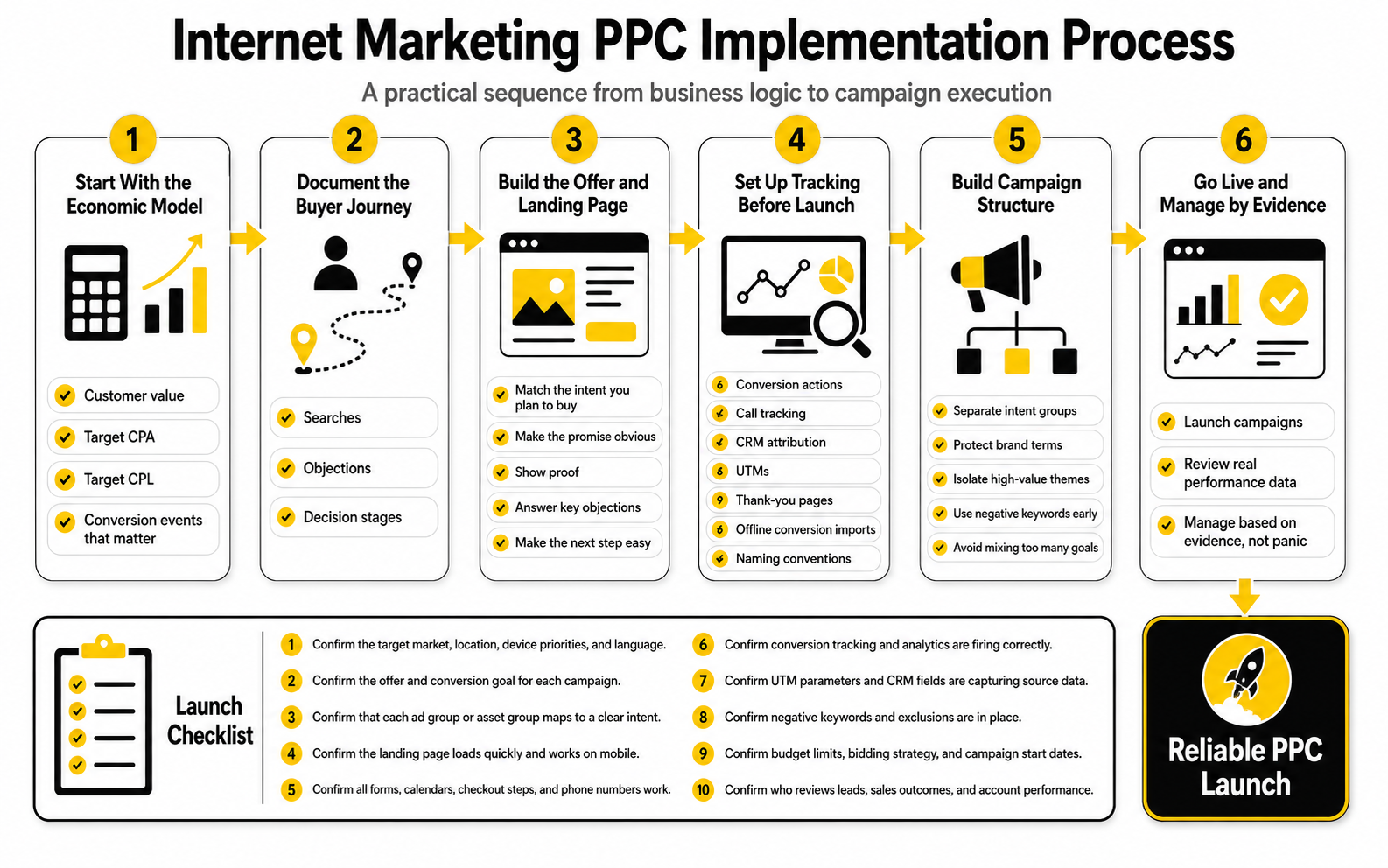
A practical PPC implementation process should move from business logic to campaign execution in a clear sequence. If you skip the early steps, the account may still launch, but the data will be harder to trust. The goal is to build a system where every click, conversion, and sales outcome teaches you something useful.
Start with the economic model. Define customer value, target cost per acquisition, target cost per lead, and the conversion events that matter. Then document the buyer journey so you know which searches, objections, and decision stages the campaign needs to cover.
Next, build the offer and landing page around the intent you plan to buy. Do not write ads first and hope the page catches up later. The landing page should make the promise obvious, show proof, answer the most important objections, and make the next step easy.
After that, set up tracking before the campaign goes live. This includes conversion actions, call tracking where relevant, CRM attribution, UTMs, thank-you pages, offline conversion imports if the sales cycle requires them, and clear naming conventions. A CRM such as GoHighLevel or Copper can help when the business needs to connect ad clicks to lead status, pipeline movement, and closed deals.
Then build the campaign structure. Separate intent groups, protect brand terms, isolate high-value themes, use negative keywords early, and avoid mixing too many goals inside one campaign. Once the campaigns are live, manage them based on evidence rather than panic.
Use A Simple Launch Checklist
A launch checklist sounds basic, but it prevents expensive mistakes. Many PPC problems are not advanced strategy problems. They are simple execution gaps: broken forms, missing conversion tags, weak mobile layouts, wrong locations, unclear offers, poor exclusions, or ads pointing to the wrong page.
A clean launch checklist should cover:
This is not bureaucracy. It is protection. Paid traffic makes mistakes expensive because a broken form or misconfigured conversion action can quietly waste budget while the dashboard looks active.
Match The Landing Page To The Economics
The landing page should be built around the action that makes the economics work. If the business needs qualified consultations, the page should not be optimized only for the easiest possible form fill. If the business needs profitable orders, the page should not focus only on discount-driven buyers who never return.
Speed and usability matter because every extra point of friction makes paid traffic less efficient. Google’s research on mobile page speed has repeatedly shown that slower mobile experiences create measurable risk for engagement and conversion. Even if the exact impact varies by industry, the principle is obvious: paying for clicks and then sending them to a slow, confusing page is self-sabotage.
The page also needs message continuity. If the ad promises a specific solution, the headline should reflect that solution. If the keyword implies urgency, the page should show the fastest next step. If the user is comparing options, the page should make the comparison easier instead of hiding the details they came to evaluate.
Create A Feedback Loop With Sales
PPC teams should not optimize in isolation from sales. The ad account can show clicks, costs, and conversion events, but the sales team sees objections, budget fit, urgency, decision-maker quality, and whether leads understand the offer. Without that feedback, the campaign may keep generating technically valid leads that are commercially weak.
A good feedback loop does not need to be complicated. Leads should be tagged by source, reviewed by quality, and connected to pipeline stages. The team should know which campaigns produce booked calls, which calls show up, which opportunities close, and which keywords or offers tend to attract poor-fit prospects.
This is where follow-up automation can protect the economics. Missed calls, slow replies, and unstructured follow-up can destroy an otherwise strong PPC campaign. Tools like GoHighLevel, Brevo, and ManyChat can support this when they are used to improve response speed and lead nurturing, not just to add more software.
Know When The Market Is Too Small Or Too Expensive
Not every offer is ready for PPC. Sometimes the search volume is too low, the cost per click is too high, the close rate is too weak, or the market does not understand the category yet. That does not mean the business is bad, but it may mean paid search is not the best first channel.
If the market is too small, broader content, partnerships, outbound, creator campaigns, or paid social may be needed to create demand before search can capture it. If the market is too expensive, the business may need a stronger offer, better retention, higher pricing, better qualification, or a more focused niche. If the conversion rate is too low, the landing page and follow-up system need work before budget increases.
This is an important discipline in internet marketing PPC: do not force the channel to do a job it cannot do profitably yet. PPC is powerful when there is clear intent and a business model that can support paid acquisition. When those conditions are missing, the more carefully move is to fix the economics before scaling the spend.
Document The First Testing Plan
The first testing plan should be boring and clear. It should define what you are testing, why it matters, what success looks like, and what decision you will make based on the result. Without that, every performance review becomes a debate instead of a decision.
A strong first testing plan might compare two offer angles, two landing page structures, or two high-intent keyword groups. It should avoid testing too many variables at once because the account will not produce clean learning. The point is not to prove everything immediately; the point is to find the first reliable path toward profitable acquisition.
Part 4 moves into Campaign Architecture and Keyword Strategy, where the economics become account structure. That is where you decide how to group intent, how to handle match types, how to use negatives, how to separate brand and non-brand demand, and how to build campaigns that make performance easier to understand instead of harder.
Campaign Architecture and Keyword Strategy
Once the economics are clear, campaign structure becomes much easier. You are no longer building campaigns around random keyword lists; you are organizing paid intent around business value. That is the difference between an internet marketing PPC account that produces useful decisions and one that produces noise.
Campaign architecture should make performance easier to understand. If high-intent keywords, brand searches, competitor searches, remarketing audiences, and broad exploratory traffic are all mixed together, the account may still generate conversions, but you will not know what actually caused them. Clean structure gives you leverage because it separates the signals that deserve different budgets, bids, landing pages, and expectations.
The same applies to keyword strategy. A keyword is not just a phrase with search volume. It is a clue about the buyer’s stage, urgency, awareness, budget, and likely next action. When you read keywords that way, PPC becomes less about chasing traffic and more about buying the right moments.
Separate Intent Before You Separate Campaigns
The first step is to group search intent. Brand searches should be treated differently from non-brand searches because the user already knows the company. Competitor searches should be treated differently again because the visitor is comparing alternatives and may need a sharper reason to switch.
High-intent commercial searches deserve their own structure. Keywords that include pricing, quotes, near-me modifiers, best, agency, consultant, software, service, demo, or trial usually signal stronger buying intent than broad educational searches. That does not automatically make them profitable, but it does mean they should not be buried inside a campaign full of weaker intent.
Informational searches can still have value, but they need a different role. They may feed retargeting, email capture, education, or content journeys rather than direct sales. If you expect every informational click to behave like a purchase-ready visitor, the data will disappoint you.
Match Types Need A Job
Match types are not good or bad by themselves. Exact match, phrase match, and broad match each have a job, and the job should match the maturity of the account. The problem starts when advertisers use broad match to compensate for weak research or use exact match so tightly that the campaign cannot learn.
Exact match is useful when you already know the query matters. It gives you more control and cleaner measurement, especially around high-intent terms. Phrase match can help capture close variations while still keeping the campaign relatively focused.
Broad match can work when the account has strong conversion tracking, enough data, disciplined negatives, and a bidding strategy that understands the real goal. Without those pieces, broad match can spend into irrelevant searches quickly. This is why broad match should be treated like an expansion tool, not a substitute for strategy.
Negative Keywords Protect The Budget
Negative keywords are one of the simplest ways to improve PPC efficiency. They stop ads from showing on searches that look related on the surface but do not fit the offer. In practice, this can protect budget from job seekers, freebie hunters, students, DIY researchers, irrelevant locations, low-intent information queries, and products or services the business does not sell.
This matters because wasted spend rarely appears as one dramatic mistake. It usually leaks out through hundreds or thousands of small irrelevant impressions and clicks. If those searches are not reviewed, the campaign may look active while quietly drifting away from profitable intent.
Negative keyword work should happen before launch and continue after launch. The pre-launch list prevents obvious waste. The search terms report then reveals real user behavior, which is where the best exclusions usually come from.
Statistics and Data
Statistics are useful only when they help you make a better decision. A benchmark should not become a target by default, and a platform average should never replace your own unit economics. The point of PPC data is to answer practical questions: where is money being wasted, where is intent strongest, where is the funnel leaking, and where can budget scale safely?
The broader market shows why PPC deserves serious measurement discipline. U.S. internet advertising revenue reached $294.6 billion in 2025, with search still representing one of the largest performance channels. That size creates opportunity, but it also creates competition because more advertisers are bidding for measurable demand.
Benchmark data can help frame expectations. The 2025 Google Ads benchmark reports from WordStream and LocaliQ show wide differences across industries in click-through rate, cost per click, conversion rate, and cost per lead. That is the key lesson: averages are not the game; your category, funnel, offer, and economics decide what good performance actually means.
The Metrics That Actually Matter
A PPC dashboard can show dozens of metrics, but not all of them deserve equal attention. Impressions show visibility, click-through rate shows whether the ad earns attention, cost per click shows the price of traffic, conversion rate shows how well the page and offer convert, and cost per conversion shows whether the funnel is moving in the right direction. Those are useful, but they are still incomplete.
The business metrics matter more. Qualified lead rate, sales accepted lead rate, show-up rate, close rate, average deal value, gross margin, customer lifetime value, refund rate, and payback period decide whether the campaign is healthy. A campaign with a low cost per lead can still be terrible if the leads never buy.
This is why internet marketing PPC should connect ad platform data to CRM and revenue data whenever possible. The ad account tells you what happened before the conversion. The CRM tells you whether the conversion was worth paying for.
Click-Through Rate Is A Signal, Not A Trophy
Click-through rate matters because it shows whether the ad is relevant enough to earn attention. A low click-through rate can mean the ad is weak, the keyword is too broad, the offer is unclear, or the audience does not feel the message matches their search. It is a useful diagnostic signal.
But click-through rate is not a trophy. An ad can get a high CTR by making a broad, aggressive, or curiosity-driven promise that attracts the wrong people. If those clicks do not convert into qualified leads or customers, the high CTR is not helping the business.
The better question is whether CTR improves alongside conversion quality. If CTR rises and qualified conversions rise, the message is probably getting sharper. If CTR rises but lead quality drops, the ad may be creating curiosity without commercial fit.
Cost Per Click Needs Context
Cost per click is one of the most misunderstood PPC metrics. A high CPC is not automatically bad, and a low CPC is not automatically good. The value depends on what happens after the click.
A $20 click can be profitable if it reaches a buyer for a high-margin offer. A $1 click can be wasteful if it attracts people who will never buy. This is why campaign evaluation should compare CPC against conversion rate, lead quality, close rate, and customer value.
When CPC rises, the first move should not always be cutting bids. Sometimes the right response is improving ad relevance, tightening intent, increasing landing page conversion rate, or raising the value of the offer. Lowering bids can reduce cost, but it can also reduce access to the best auctions if done blindly.
Conversion Rate Shows Friction And Fit
Conversion rate tells you how effectively the page and offer turn visitors into the next action. If the campaign is driving relevant traffic but the conversion rate is weak, the page may be unclear, slow, too generic, missing proof, or asking for too much too soon. It may also mean the offer does not match the intent.
Google’s Quality Score documentation treats expected click-through rate, ad relevance, and landing page experience as the three diagnostic components for search campaigns, which is a useful way to think about performance quality. The ad cannot do all the work. The landing page has to continue the same promise and make the next step feel obvious.
Conversion rate should also be judged by funnel stage. A demo request page, emergency service page, ecommerce checkout, free guide page, and quote form should not be expected to convert at the same rate. The more commitment you ask for, the more trust and clarity the page needs to create.
Cost Per Lead Can Be Misleading
Cost per lead is useful, but it can also mislead you badly. If Campaign A produces leads at $40 and Campaign B produces leads at $120, Campaign A looks better at first glance. But if Campaign B produces buyers and Campaign A produces unqualified inquiries, Campaign B may be the real winner.
This is why lead quality needs to be tracked separately. At minimum, leads should be reviewed by source, campaign, keyword theme, landing page, offer, and sales outcome. The more expensive the product or service, the more important this becomes.
A strong PPC operation should know which campaigns produce junk leads, which produce serious buyers, and which produce slow-burn opportunities. Without that distinction, the account will optimize toward volume instead of value. That is dangerous.
Return On Ad Spend And CPA Need Margin
Return on ad spend can be useful for ecommerce and direct purchase campaigns, but it does not tell the whole story. A 3x ROAS may be excellent for a high-margin digital product and weak for a low-margin physical product with shipping, returns, and operational costs. The number only makes sense when margin is included.
Cost per acquisition has the same issue. A $100 CPA might be too high for a one-time $150 purchase and extremely profitable for a client worth $3,000 over six months. The metric is only useful when tied to customer value.
This is where PPC becomes a finance conversation, not just a marketing conversation. The account manager, founder, sales team, and finance team should agree on what profitable acquisition means. Otherwise, everyone will interpret the same numbers differently.
The Analytics System Should Follow The Buyer Journey
The analytics system should show the full path from impression to revenue. That means tracking the ad click, landing page visit, form fill, call, booking, sales conversation, opportunity, purchase, repeat purchase, and revenue where possible. If the data stops at the first form fill, the campaign is being optimized with partial information.
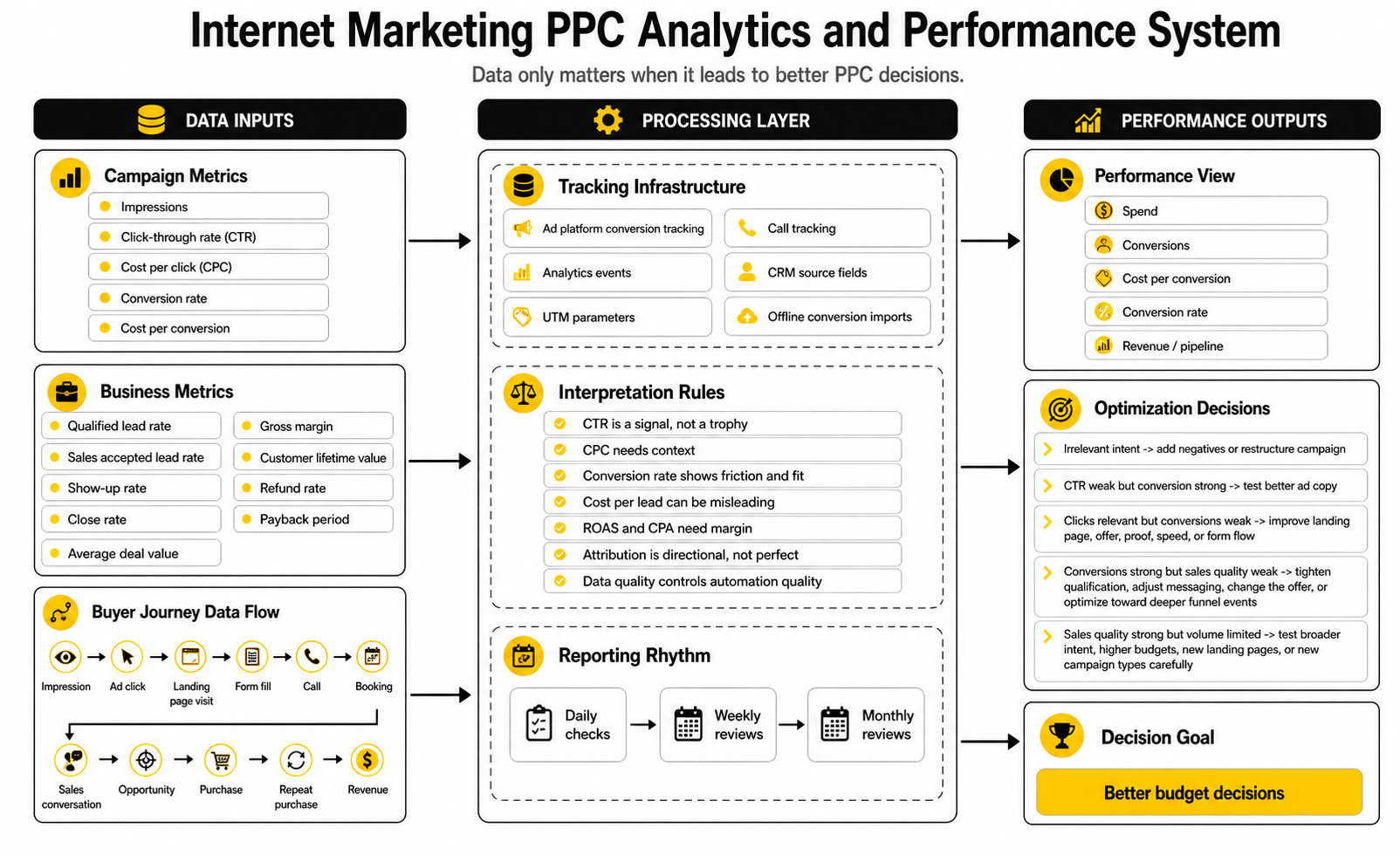
A practical analytics setup should include ad platform conversion tracking, analytics events, UTM parameters, call tracking where relevant, CRM source fields, and offline conversion imports for sales that happen after the initial lead. This is not about making reporting complicated. It is about making sure the platform and the business are both learning from the same reality.
For service businesses and agencies, a CRM such as GoHighLevel can help connect PPC leads to pipeline stages, follow-up activity, and booked appointments. For email-driven nurturing, tools like Brevo or Moosend can support follow-up when the sales cycle needs more than one touch.
Benchmarks Should Trigger Questions
Benchmarks should not trigger panic. They should trigger questions. If your CPC is higher than the industry average, ask whether your keywords are more competitive, your location is more expensive, your offer is higher value, or your Quality Score signals need work.
If your conversion rate is lower than the benchmark, ask whether the traffic is relevant, the page matches the search intent, the offer is strong enough, and the form or checkout flow is too demanding. If your cost per lead is higher, ask whether the leads are better, whether the close rate is higher, and whether the customer value supports the cost.
This is the disciplined way to use data. You do not copy the average. You use the average to find what deserves investigation.
Attribution Is Directional, Not Perfect
Attribution is useful, but it is not perfect. People click ads, search again later, visit from another device, talk to sales, read reviews, open emails, and come back through brand search. No single dashboard can capture all of that cleanly.
That does not mean attribution is useless. It means you should use it with judgment. Platform-reported conversions, analytics data, CRM data, and sales feedback should be compared together instead of treated as one absolute truth.
For internet marketing PPC, the goal is not perfect attribution. The goal is enough clarity to make better budget decisions. If the same campaigns consistently produce qualified pipeline and revenue, they deserve more trust than campaigns that only look good inside the ad platform.
Data Quality Controls Automation Quality
Automation depends on the data you feed it. Google’s Smart Bidding documentation explains that automated bidding uses conversion data to predict which interactions are likely to lead to conversions. That makes clean tracking and meaningful conversion actions essential.
If the account tracks weak conversions, the bidding system may optimize for weak conversions. If every lead is treated equally, the platform has no reason to prefer the lead that becomes a customer over the lead that wastes the sales team’s time. This is one of the most important measurement lessons in modern PPC.
The fix is to send better signals. Track qualified leads, booked appointments, purchases, revenue values, offline conversions, and customer quality where possible. The better the signal, the better chance automation has to support the business goal.
A Practical PPC Reporting Rhythm
Reporting should be regular enough to catch problems but not so reactive that every small fluctuation creates panic. Daily checks are useful for spend, tracking, disapprovals, broken pages, and obvious anomalies. Weekly reviews are better for search terms, budget pacing, early conversion patterns, and lead quality.
Monthly reviews should focus on business outcomes. Which campaigns produced qualified pipeline? Which landing pages improved? Which keyword themes deserve more budget? Which tests taught something useful?
A simple reporting rhythm keeps the team focused on decisions instead of dashboard watching. The best PPC reports do not just say what happened. They say what should change next.
What The Data Should Make You Do
Good data should lead to action. If search terms show irrelevant intent, add negatives or restructure the campaign. If CTR is weak but conversion rate is strong, test better ad copy without abandoning the keyword too quickly.
If clicks are relevant but conversions are weak, improve the landing page, offer, proof, speed, or form flow. If conversions are strong but sales quality is weak, tighten qualification, adjust messaging, change the offer, or optimize toward deeper funnel events. If sales quality is strong but volume is limited, test broader intent, higher budgets, new landing pages, or new campaign types carefully.
That is the real purpose of PPC analytics. Not decoration. Not vanity reporting. Decisions.
Measurement Sets Up Better Creative And Landing Pages
Once measurement is working, creative decisions become sharper. You can see which messages attract attention, which promises convert, which objections block action, and which landing pages turn paid traffic into real opportunities. That makes the next stage of optimization far more practical.
Part 5 moves into Ads, Landing Pages, Tracking, and Automation, where the data turns into execution improvements. This is where ad copy, landing page structure, conversion tracking, CRM workflows, and follow-up systems start working together as one paid acquisition machine.
Ads, Landing Pages, Tracking, and Automation
At this stage, the account structure and measurement system are in place. Now the work shifts from “Can we launch?” to “Can we improve the whole machine?” This is where internet marketing PPC becomes more advanced because every improvement has tradeoffs.
Better ad copy can increase click-through rate, but it can also attract the wrong people if the promise is too broad. A shorter landing page can reduce friction, but it can also remove the proof needed for a high-consideration offer. Automation can help scale, but it can also amplify bad signals if the account is feeding the platform low-quality conversion data.
The goal is not to make every part of the system more aggressive. The goal is to make every part more aligned. The ad, landing page, conversion event, CRM workflow, sales process, and reporting should all push toward the same commercial outcome.
Ad Copy Should Filter As Much As It Persuades
Most advertisers think ad copy exists only to win the click. That is only half true. Good PPC ad copy should attract the right people and gently repel the wrong people before they cost you money.
This is especially important in competitive markets where curiosity clicks can get expensive fast. If your offer is premium, the ad should not pretend it is the cheapest option. If your service is for established businesses, the ad should not sound like it was built for beginners with no budget.
Strong ad copy usually makes the promise clear, qualifies the audience, reflects the search intent, and sets a realistic expectation for the landing page. It does not need to be clever. It needs to be specific enough that the right person thinks, “This is probably for me.”
Responsive Search Ads Need Strong Inputs
Responsive search ads can test different headline and description combinations, but they are not magic. They can only work with the assets you give them. If every headline says the same thing in slightly different words, the system has very little meaningful variation to test.
A better approach is to write assets around different angles. One headline can focus on the outcome, another on the audience, another on the offer, another on proof, another on urgency, and another on the key differentiator. This gives the platform useful combinations instead of a pile of repetitive copy.
You still need human judgment. Asset performance labels and combination data can show what the system prefers, but they do not always explain why an asset works or whether it attracts the best customers. Review the data, but also read the ads like a buyer would.
Landing Pages Should Remove Doubt In The Right Order
A landing page is not just a prettier destination for traffic. It is the sales argument that continues after the click. If the page does not answer the visitor’s next question quickly, the campaign pays for attention and then loses it.
The order matters. First, the visitor needs to know they are in the right place. Then they need to understand the outcome, the mechanism, the proof, the next step, and the reason to trust the offer. If those pieces are scattered or hidden, conversion rates suffer even when the traffic quality is good.
For lower-friction offers, a simple page can work well. For higher-ticket services, B2B demos, complex ecommerce products, or anything involving risk, the page usually needs more context. Tools like ClickFunnels, Systeme.io, and Replo can help when you need dedicated pages built around one clear conversion path.
The First Screen Has To Earn The Scroll
The first screen of the landing page carries a lot of weight. Visitors should immediately understand what is being offered, who it is for, why it matters, and what action to take next. If they have to work too hard to decode the page, you are adding friction after paying for the click.
This does not mean cramming everything above the fold. It means the first screen should create enough clarity and confidence for the visitor to continue. A vague headline, generic stock-style promise, hidden CTA, or weak mobile layout can damage performance before the rest of the page has a chance.
The practical test is simple. Can someone land on the page for five seconds and explain the offer back to you? If not, the page is probably making paid traffic do too much work.
Proof Should Match The Risk Of The Decision
The more risk the buyer feels, the more proof the page needs. A low-cost impulse purchase may only need product reviews and clear shipping details. A high-ticket service or software demo may need testimonials, case evidence, process clarity, security signals, pricing context, or a strong explanation of what happens after the form is submitted.
Proof should also match the claim. If the page promises speed, show how the process works. If it promises better lead quality, explain the qualification method. If it promises easier implementation, show what onboarding looks like.
Weak proof is worse than no proof when it feels generic. Real testimonials, recognizable customer types, specific outcomes, and clear process details build more trust than vague claims. The goal is not to decorate the page; it is to reduce the buyer’s perceived risk.
Forms And Calendars Should Balance Volume With Quality
A shorter form usually increases conversion volume. A longer form usually improves qualification, but it can reduce submissions. The right choice depends on what the business values more at that stage: more leads, better leads, or faster sales conversations.
For high-intent PPC traffic, asking for too little information can create downstream problems. Sales teams may waste time chasing people who are not a fit. For colder traffic, asking for too much information too early can kill momentum before trust exists.
Calendars have the same tradeoff. Booking directly can reduce friction and speed up the sales process, but it can also fill the calendar with poor-fit calls if the offer and qualification are weak. A tool like Cal.com can be useful when booking is part of the conversion path, but the page still has to pre-frame who should book and why.
Tracking Should Be Built For Optimization, Not Decoration
Tracking is not there so a report looks professional. It exists so the account can make better decisions. If the conversion setup only tracks surface-level actions, the campaign will optimize toward surface-level outcomes.
For ecommerce, that usually means purchase value, product performance, repeat purchase behavior, and margin-aware reporting where possible. For lead generation, it means qualified leads, booked appointments, show-ups, opportunities, closed deals, and revenue. The deeper the sales cycle, the more dangerous it is to optimize only for the first form submission.
This is where offline conversion tracking and CRM integration become important. When the ad platform can learn which leads became qualified opportunities or customers, automation has a better chance of finding more of the right people. Without that feedback loop, scaling can simply produce more of whatever the first conversion event rewards.
Automation Should Be Given Boundaries
Automation is powerful when it has the right goal, clean data, enough volume, and clear constraints. It is risky when it is asked to solve unclear strategy. Smart bidding, broad match, Performance Max, and automated assets can all help, but they should not replace basic commercial thinking.
The biggest mistake is handing automation a vague conversion goal. If every lead is marked as equally valuable, the system may chase the easiest leads instead of the best leads. If purchase value is inaccurate, the system may scale products or customers that look profitable but are not.
Boundaries matter. Use budgets, campaign structure, exclusions, audience signals, conversion values, landing page control, and regular quality reviews to keep automation aligned with the business. The point is not to fight the machine; it is to train it properly.
Performance Max Needs A Clear Role
Performance Max can be useful, but it needs a specific role in the account. It can help expand across Google inventory, support ecommerce feeds, find incremental conversions, and reach people beyond traditional search campaigns. But it can also blur visibility if the account does not separate brand demand, remarketing, prospecting, and feed performance carefully.
For ecommerce, feed quality becomes critical. Product titles, images, pricing, availability, category structure, promotions, and merchant data can all affect performance. If the feed is weak, the campaign may struggle no matter how well the budget is set.
For lead generation, Performance Max requires even more caution. Lead quality should be reviewed closely, and the conversion goals should reflect meaningful business outcomes. If the campaign is optimized only for easy form fills, it may scale volume while damaging sales efficiency.
Retargeting Should Continue The Conversation
Retargeting is often treated as a cheap way to chase visitors around the internet. That is a lazy approach. Good retargeting continues the conversation based on what the visitor already did or did not do.
Someone who visited a pricing page needs a different message from someone who read an educational page. Someone who started checkout needs a different message from someone who watched a video or clicked a broad search ad. The closer the retargeting message matches the previous behavior, the more natural it feels.
Retargeting should also have frequency control and creative variety. If the same ad follows someone too aggressively, it can create fatigue or annoyance. The goal is to bring qualified people back with a useful reason, not to pressure everyone equally.
Lead Nurturing Protects Expensive Clicks
Not every paid visitor is ready to buy immediately. That does not make the click worthless. It means the business needs a follow-up system that can turn early interest into later revenue.
Email, SMS, chat, retargeting, and sales reminders can all support that process. The key is relevance. A lead who requested a quote needs different follow-up from someone who downloaded a guide or abandoned a checkout.
For businesses that rely on speed-to-lead, missed follow-up is brutally expensive. A CRM and automation platform like GoHighLevel can help manage pipelines, reminders, SMS, email, and appointment workflows. For email-heavy nurturing, Brevo and Moosend can fit when the goal is structured follow-up rather than one-off broadcasts.
Creative Testing Should Have A Hypothesis
Creative testing should not be random. Each test should answer a specific question. Does the audience respond better to speed, price clarity, authority, convenience, risk reversal, specialization, or a stronger outcome?
This applies to search ads, display assets, landing page headlines, video hooks, product images, and retargeting creative. If the test has no hypothesis, the result will be hard to interpret. You may see one version win, but you will not know what the win teaches you.
A practical creative testing rhythm focuses on one major idea at a time. Test the promise, then the proof, then the offer, then the CTA, then the format. That creates learning the business can reuse across ads, landing pages, email, and sales scripts.
Scaling Creates New Problems
A campaign that works at $100 per day may not behave the same at $1,000 per day. Scaling changes the auction pressure, audience mix, search query mix, creative fatigue, sales workload, and follow-up requirements. More budget exposes the weak parts of the system.
This is why scaling should be staged. Increase budget gradually when the economics are stable, the conversion data is trustworthy, and the sales team can handle the added volume. If the lead response system is already strained, more spend may reduce quality simply because the business cannot process demand properly.
Scaling also requires new layers of testing. Once the obvious high-intent keywords are maximized, growth may require broader match types, new landing pages, additional offers, retargeting sequences, creative expansion, or new channels. The further you move from the highest-intent traffic, the more the funnel has to educate and qualify.
Watch For Platform Convenience Traps
Ad platforms are designed to make spending easier. That is not evil, but it is reality. Many default recommendations can be useful in the right context and dangerous in the wrong one.
The trap is accepting every recommendation without asking whether it fits your economics. More reach, broader targeting, automated assets, expanded networks, and higher budgets can all increase activity. Activity is not the same as profitable growth.
A professional PPC manager treats recommendations as inputs, not instructions. The decision should come back to intent, conversion quality, margin, tracking confidence, and business capacity. If the change supports those, test it. If it only makes the account spend more, be careful.
Risk Management Is Part Of PPC Strategy
PPC risk is not only about losing money on bad clicks. It includes tracking failures, policy disapprovals, landing page downtime, sudden CPC increases, competitor moves, poor lead handling, attribution gaps, and overdependence on one campaign type. The more a business relies on paid acquisition, the more seriously it needs to manage these risks.
Basic risk controls include daily spend monitoring, conversion tracking alerts, landing page checks, payment method backups, clear naming conventions, documented campaign logic, and regular lead quality reviews. These are not glamorous, but they prevent expensive surprises.
The best internet marketing PPC systems are resilient. They do not depend on one keyword, one ad, one campaign, one landing page, or one platform setting. They build enough visibility and control to adapt when performance shifts.
Expert PPC Is Really Cross-Functional
At an expert level, PPC is not just media buying. It touches positioning, offer strategy, landing page design, analytics, sales operations, CRM hygiene, pricing, retention, and finance. That is why isolated PPC management often hits a ceiling.
The best results usually happen when marketing and sales share feedback. PPC shows what people search and click. Landing pages show what people respond to. Sales calls show what people believe, fear, misunderstand, and compare.
When those insights are connected, the whole business gets more carefully. Ads become sharper, pages become clearer, offers become stronger, and sales conversations become easier. That is the real leverage.
The System Should Improve Every Month
A good PPC system should not look the same forever. The keywords should get cleaner, the ads should get sharper, the landing pages should convert better, the CRM data should become more useful, and the reporting should move closer to revenue. If the account is only being maintained, it is probably leaving money on the table.
This does not mean changing everything constantly. Random changes create noise. The goal is steady improvement based on evidence.
Part 6 closes with Optimization, Reporting, Scaling, and FAQs, where the focus shifts to how to manage the system over time. That final section will cover what to optimize first, when to scale, when to pause, how to report PPC performance clearly, and the most common questions businesses ask before investing more seriously in paid acquisition.
Optimization, Reporting, and Scaling
Optimization is where PPC either becomes a serious growth system or turns into endless button-clicking. The difference is discipline. You are not optimizing because the dashboard changed yesterday; you are optimizing because the data shows a real opportunity, leak, or constraint.
Good optimization starts with a hierarchy. Fix tracking before bidding. Fix intent before creative. Fix the landing page before blaming the platform. Fix lead quality before scaling volume. That order matters because internet marketing PPC is a connected system, and improving the wrong piece first can make the numbers look better while the business outcome gets worse.
The best operators do not ask, “What can we change?” They ask, “What is the biggest constraint right now?” Sometimes the constraint is traffic quality. Sometimes it is conversion rate. Sometimes it is sales response speed, offer strength, budget allocation, or automation quality. Once you identify the constraint, the next action becomes much clearer.
What To Optimize First
Start with the areas closest to waste. Search terms, negative keywords, location performance, device performance, broken tracking, disapproved ads, budget pacing, and landing page functionality should be reviewed before deeper creative testing. These checks prevent obvious losses from hiding inside bigger strategic conversations.
Then move to intent and conversion quality. If one campaign produces cheaper leads but weaker opportunities, it should not automatically receive more budget. If another campaign produces fewer leads but better customers, it may deserve more support even if its surface metrics look less attractive.
After that, optimize messaging and landing pages. Ads should become more specific, pages should remove confusion, and offers should match the visitor’s stage of awareness. Small improvements in conversion rate can change the economics dramatically when the traffic is expensive.
When To Pause, Hold, Or Scale
Pausing too early is a common mistake. PPC needs enough data to separate a real pattern from normal noise. If a campaign has only a handful of clicks or conversions, a dramatic change may create more confusion than clarity.
Holding is often the right move when the signal is promising but incomplete. If the search terms look relevant, the click-through rate is improving, and early conversions seem qualified, give the test enough room to prove itself. Not every campaign needs immediate surgery.
Scaling should happen when the account has stable economics, clean tracking, reliable conversion quality, and enough operational capacity to handle more demand. The 2025 benchmark reports from WordStream and LocaliQ are useful for context because they show how widely performance varies by industry, but your own lead-to-sale data is what should decide whether budget increases make sense.
Reporting Should Lead To Decisions
A PPC report should not be a screenshot collection. It should explain what happened, why it likely happened, what it means, and what should happen next. If a report does not create decisions, it is not really reporting; it is documentation.
The most useful reporting layers are simple. Start with spend, conversions, cost per conversion, conversion rate, and revenue or pipeline where available. Then separate results by campaign intent, landing page, device, location, audience, and keyword theme.
The final layer should be interpretation. Which campaigns deserve more budget? Which need fixes? Which tests are inconclusive? Which insights should sales, content, or product teams know about? That is where PPC reporting becomes valuable beyond the ad account.
The Final PPC Ecosystem
A mature PPC system has more than campaigns. It has a clear offer, landing pages built for specific intent, accurate tracking, meaningful conversion goals, CRM feedback, sales follow-up, retargeting, reporting, and a testing rhythm. Each part should make the others stronger.
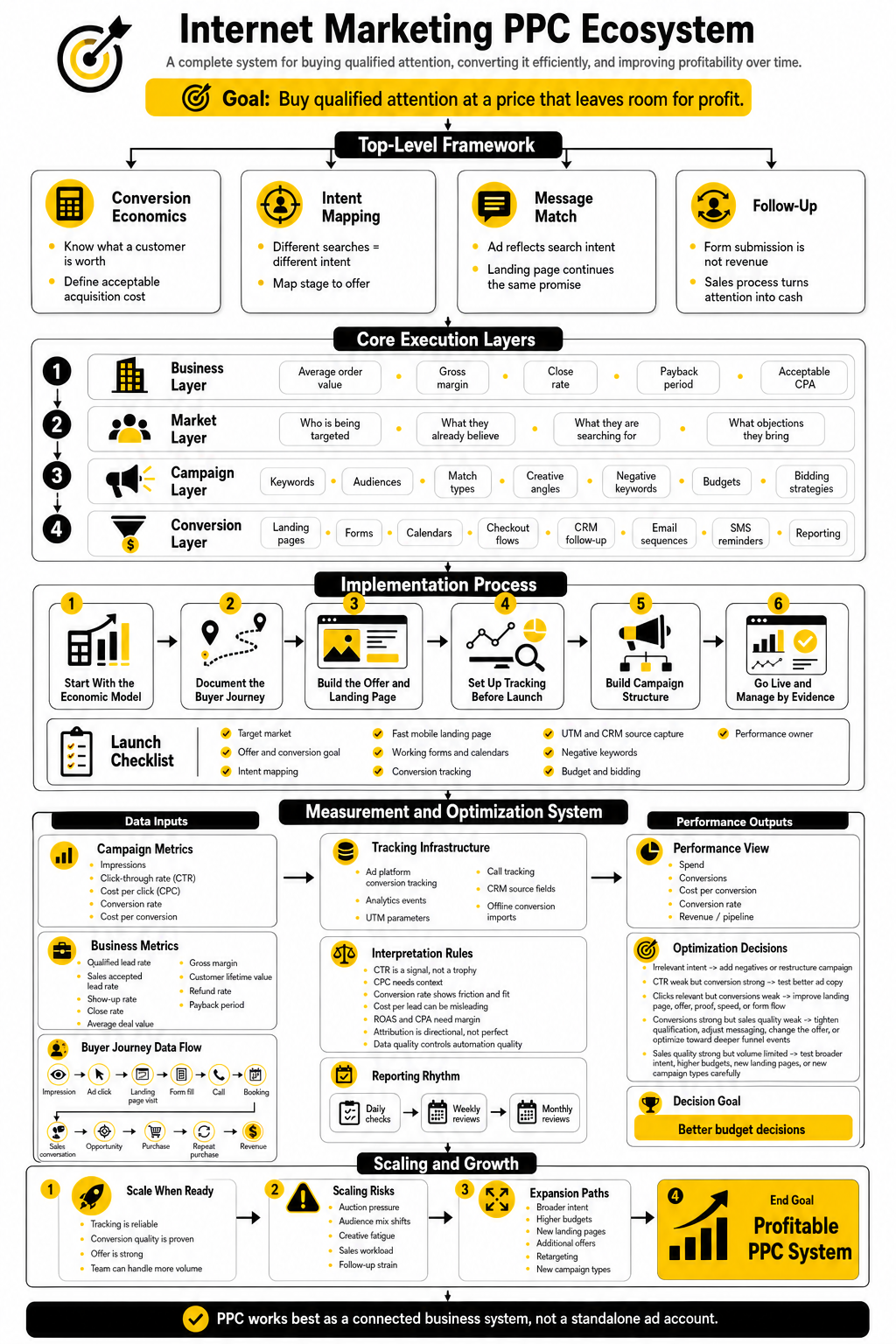
This ecosystem is what separates sustainable growth from random wins. A good campaign can get attention, but the system decides whether that attention becomes revenue. When the system is weak, the business keeps asking for cheaper clicks. When the system is strong, the business asks better questions: which segment should we scale, which offer has the best margin, and which conversion path creates the highest-quality customers?
That is the practical endgame of internet marketing PPC. You are not trying to master every platform feature. You are building a repeatable process for buying qualified attention, converting it efficiently, and improving the economics over time.
What Is Internet Marketing PPC?
Internet marketing PPC is paid advertising where a business pays when someone clicks an ad, usually through platforms like Google Ads, Microsoft Ads, paid social networks, or other digital ad systems. In practice, PPC is not just the click itself. It includes the keyword strategy, audience targeting, ad copy, landing page, tracking, follow-up, and reporting behind the campaign.
The most common PPC format is paid search, where ads appear when people search for specific terms. That makes it powerful because the user is often showing intent directly. For many businesses, PPC becomes the fastest way to test demand and generate measurable traffic.
Is PPC Still Worth It In 2026?
PPC can still be worth it when the business has clear economics, a strong offer, and a conversion system that can turn paid traffic into revenue. Digital advertising remains a massive market, with U.S. internet advertising revenue reaching $294.6 billion in 2025. That scale shows businesses are still investing heavily in measurable digital channels.
But PPC is not worth it for every offer at every stage. If your margins are too thin, tracking is broken, the landing page is weak, or the sales process cannot handle leads, paid traffic may expose those problems quickly. PPC works best when the business is ready to measure and improve the full funnel.
How Much Should A Beginner Spend On PPC?
A beginner should spend enough to collect meaningful data without risking money the business cannot afford to lose. The right starting budget depends on the cost per click in the market, the expected conversion rate, the value of a customer, and how quickly the business can act on the data. A local service campaign may need a very different budget from a national SaaS or ecommerce campaign.
The better question is not “What is the cheapest budget?” The better question is “How much data do we need to make a useful decision?” If the budget is too small for the market, the campaign may run for weeks without producing enough clicks or conversions to learn anything.
What Is A Good Conversion Rate For PPC?
A good PPC conversion rate depends on the industry, offer, traffic temperature, and conversion action. A quote request, purchase, demo booking, free guide download, phone call, and consultation request should not be judged by the same standard. The commitment level is different, so the conversion rate will be different.
Benchmark reports from LocaliQ show that conversion rates vary heavily by industry, which is exactly why averages should be used carefully. Your goal is to beat your own economics first. If the campaign produces profitable customers at a sustainable cost, the conversion rate is doing its job.
What Is More Important, CPC Or CPA?
CPA is usually more important than CPC because cost per acquisition is closer to the business outcome. CPC only tells you how expensive the click is. CPA tells you how much it costs to generate the conversion you care about.
That said, CPA can also be misleading if the conversion being tracked is weak. A low CPA for unqualified leads is not a win. The strongest PPC analysis connects CPC, conversion rate, CPA, lead quality, close rate, and customer value.
Should I Use Google Ads Or Microsoft Ads?
Google Ads usually offers broader reach because Google has the larger search market. Microsoft Ads can still be valuable, especially for certain B2B, professional, older, desktop-heavy, or cost-sensitive audiences. The right choice depends on where your buyers search and whether the platform can deliver profitable intent.
Many businesses start with Google Ads because of volume, then test Microsoft Ads once the offer, landing page, and tracking are proven. That is a practical sequence because it reduces the chance of spreading effort too thin. If Microsoft Ads produces qualified traffic at a lower cost, it can become a useful part of the acquisition mix.
Should PPC Campaigns Use Dedicated Landing Pages?
Yes, in most serious PPC campaigns, dedicated landing pages are better than sending paid traffic to a generic homepage. A homepage has many jobs. A PPC landing page has one job: continue the promise from the ad and guide the visitor toward the next action.
Dedicated pages are especially useful when different keywords reflect different intent. A visitor searching for pricing needs different information from someone searching for a local provider or a comparison. Focused pages built with tools like ClickFunnels, Systeme.io, or Replo can help keep that path clean.
How Long Does PPC Take To Work?
PPC can generate clicks immediately, but profitable learning usually takes longer. The campaign needs enough data to understand which keywords, ads, pages, and audiences produce meaningful conversions. Early results should be treated as signals, not final judgments.
The timeline depends on budget, search volume, conversion volume, and sales cycle length. Ecommerce campaigns may learn faster when purchases happen quickly. B2B or high-ticket campaigns may need more time because the real result happens after a sales process.
What Is The Biggest PPC Mistake?
The biggest PPC mistake is optimizing for the wrong outcome. Many campaigns chase cheaper clicks, higher click-through rates, or more form fills without checking whether those actions turn into revenue. That creates a dangerous gap between dashboard performance and business performance.
A strong campaign starts with the real business goal and works backward. If the goal is profitable customers, then tracking, bidding, landing pages, and follow-up should all support that goal. Anything else is just activity.
How Does Automation Change PPC Strategy?
Automation makes strategy more important, not less important. Smart bidding and AI-driven campaign types can process more signals than a human can manage manually, but they still depend on the goals and data you provide. Google’s Smart Bidding guidance explains that automated bidding uses conversion data to optimize toward conversions or conversion value.
That means bad conversion data can create bad optimization. If the system is trained on low-quality leads, it may find more low-quality leads. The strategic job is to give automation clean goals, strong signals, and boundaries that reflect the business model.
How Should PPC And SEO Work Together?
PPC and SEO work best when they share insight. PPC can quickly test which keywords, offers, and messages convert. SEO can then use that learning to prioritize content, service pages, comparison pages, and long-term organic visibility.
SEO also supports PPC by building trust before the click or after the first visit. A buyer may see an ad, search the brand, read reviews, compare content, and return later. Treating PPC and SEO as separate silos makes that journey harder to understand.
When Should A Business Scale PPC Spend?
A business should scale PPC spend when tracking is reliable, conversion quality is proven, the offer is strong, and the sales or fulfillment team can handle more volume. Scaling before those conditions exist usually creates more noise and waste. More budget does not fix a weak system.
The safest scaling path is gradual. Increase budgets in stages, watch lead quality, monitor conversion costs, and check whether sales outcomes stay healthy. If performance weakens as spend grows, the account may need new keyword groups, better creative, stronger landing pages, or broader funnel support before the next budget increase.
What Tools Help Manage A PPC Funnel?
The best tool depends on the bottleneck. If the issue is landing pages, a dedicated funnel or page builder may help. If the issue is lead follow-up, CRM and automation matter more. If the issue is appointment booking, calendar tools may reduce friction.
For service businesses, GoHighLevel can support CRM, pipeline, appointment, and follow-up workflows. For email nurturing, Brevo or Moosend can help keep leads warm after the first click.
Can PPC Work Without A Big Brand?
Yes, PPC can work without a big brand, but the campaign has to build trust faster. Unknown brands need clear positioning, strong proof, relevant landing pages, and a low-friction next step. The visitor has less context, so the page and offer must carry more of the trust-building work.
Brand recognition can improve performance, but it is not the only path. Smaller brands can win by targeting sharper intent, specializing more clearly, and building pages that answer buyer questions better than generic competitors. In internet marketing PPC, relevance can beat size when the execution is tight.
Build a stronger local presence with BAAM AI
Turn your website, Google profile, social channels, and AI visibility into one growth engine
Most businesses do not need more random marketing activity. They need a consistent presence system that helps the right people find them, trust them, and take action. BAAM AI brings strategy, local SEO, website updates, Google Maps visibility, social content, AI-search readiness, media production, and reporting into one practical monthly engine.
If you want your marketing to keep working after the campaign ends, start with a free BAAM AI presence audit. See how your business shows up today and where the fastest visibility wins are at BAAM AI.