
BAAM AI Blog
Internet Marketing For Contractors: A Practical Growth Framework
Internet marketing for contractors is not about posting randomly, buying a few leads, or hoping your website “looks professional enough.” It is about building a reliable system that helps the right people find you...
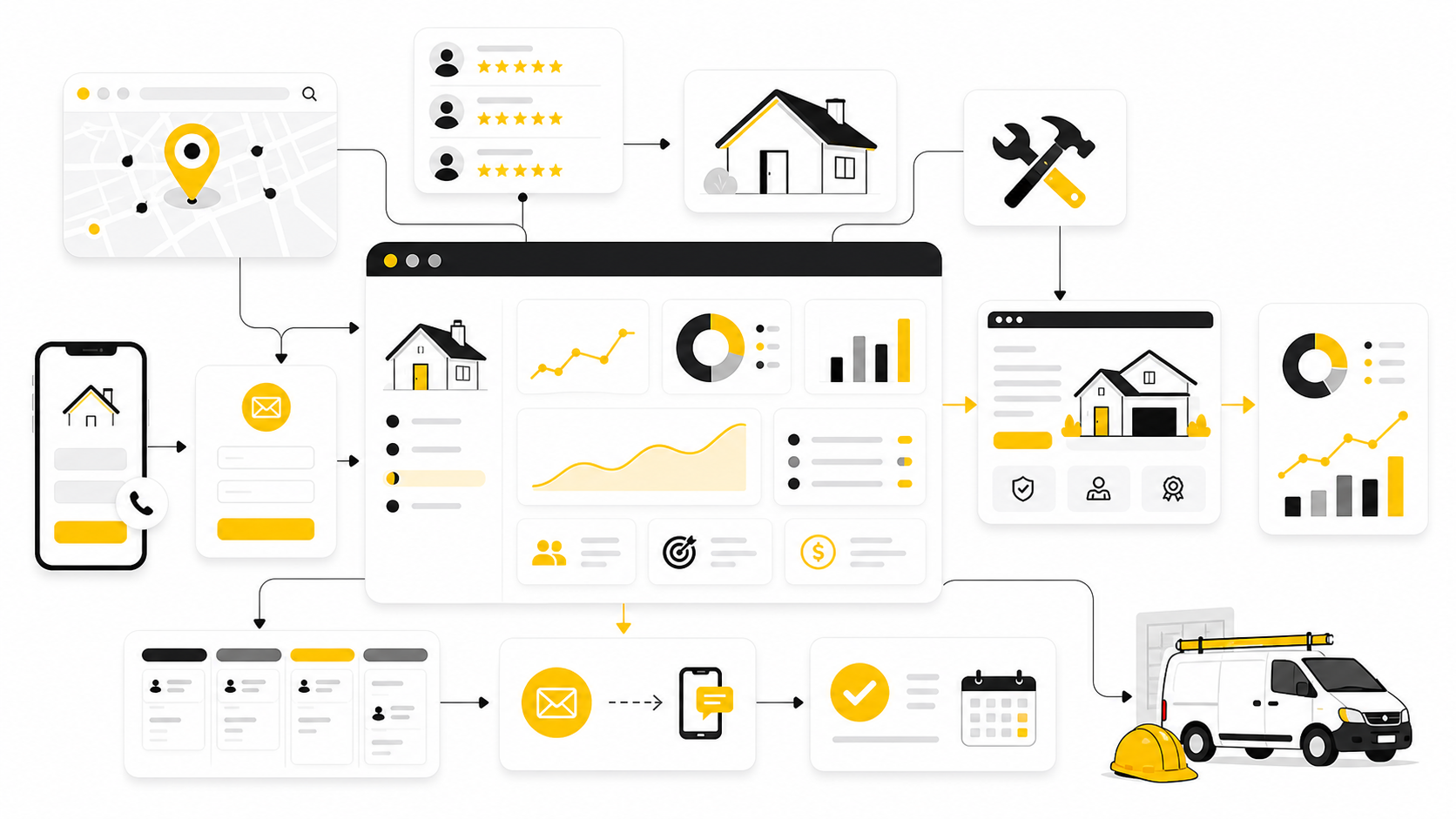
Internet marketing for contractors is not about posting randomly, buying a few leads, or hoping your website “looks professional enough.” It is about building a reliable system that helps the right people find you, trust you, contact you, and choose you before they choose another contractor.
That matters because most contractor buyers do not make decisions in one clean step. A homeowner might search Google after spotting a roof leak, compare reviews during lunch, check your project photos at night, ask a spouse for input, and then call the contractor who feels the safest. A commercial property manager might need proof of licensing, insurance, response time, previous work, and a clear next step before they ever fill out a form.
The contractors who win online usually do not win because they use one magic channel. They win because their website, Google Business Profile, reviews, local SEO, paid ads, follow-up, and sales process work together. When those pieces are disconnected, internet marketing becomes expensive noise. When they are connected, it becomes a predictable pipeline.
this guide breaks down internet marketing for contractors into six practical parts. Each part builds on the previous one, so the full strategy feels like one operating system instead of a pile of random tactics.
Why Internet Marketing Matters For Contractors
Contractors sell trust before they sell labor. That is true whether the job is a bathroom remodel, HVAC replacement, roofing project, electrical repair, concrete pour, landscaping contract, or commercial buildout. People are not just comparing prices. They are comparing risk.
Online visibility now shapes that trust long before a prospect speaks to you. BrightLocal’s 2025 consumer review research found that 89% of consumers were more likely to choose a business that responds to all reviews, which matters because reviews are no longer just social proof; they are part of the buying experience itself through local business review behavior. If your reviews are weak, unanswered, outdated, or buried, the prospect may never reach the point where your craftsmanship can speak for itself.
Search intent is also extremely high in contractor categories. Someone searching for “emergency plumber near me,” “roof repair contractor,” or “licensed electrician in my area” is not casually browsing. They usually have a problem, a deadline, or a project they are actively trying to solve. That is why contractor marketing has to be built around availability, proof, speed, and clarity.
The mistake many contractors make is treating internet marketing as decoration. They update the logo, post a few before-and-after photos, run ads for a month, and then judge the entire internet based on whether the phone rang enough. That is not a strategy. A real strategy connects demand, proof, conversion, follow-up, and measurement.
The Contractor Growth Framework
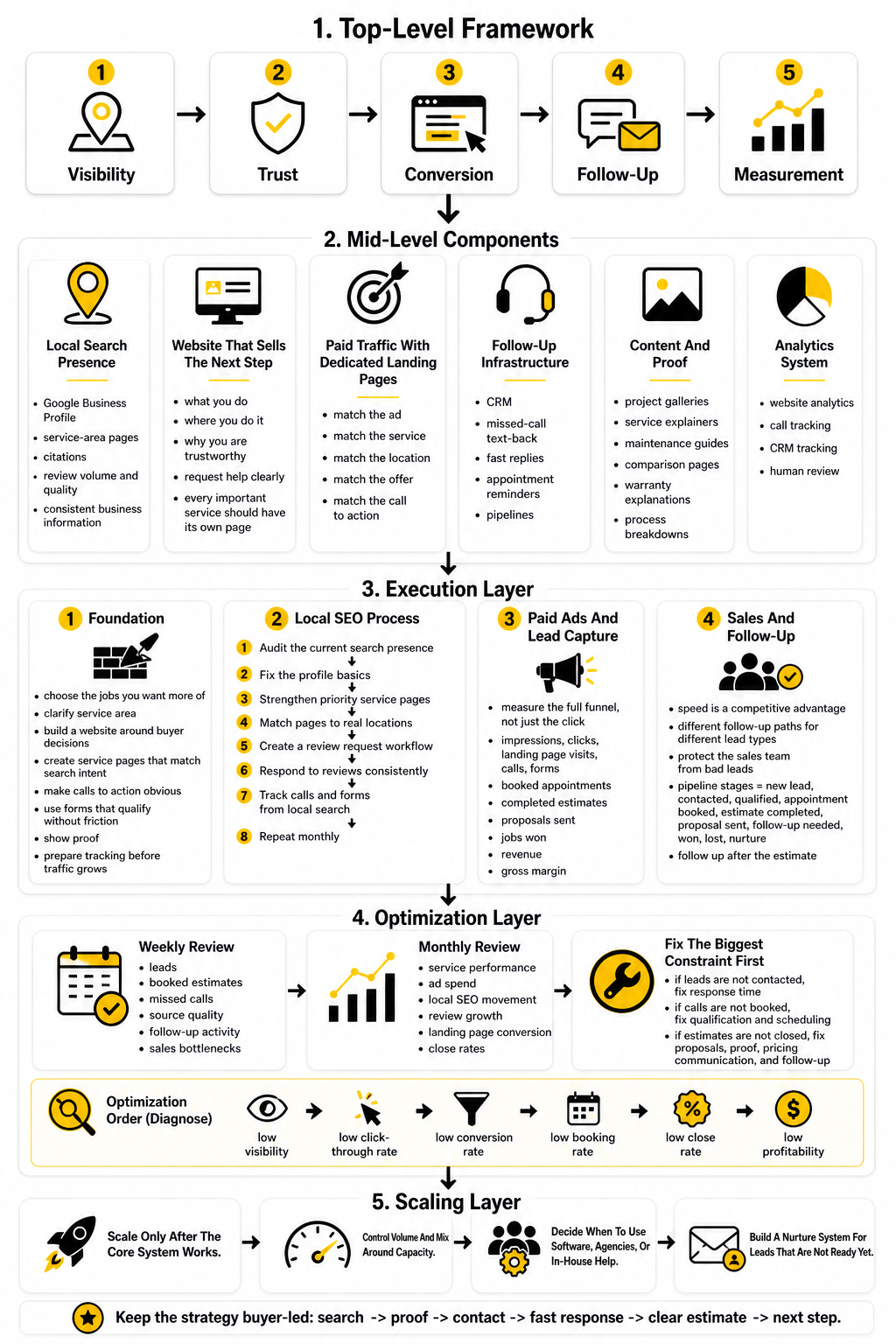
A strong contractor marketing system has four jobs. First, it has to make you discoverable when people search for the services you actually want to sell. Second, it has to make you credible enough that prospects do not immediately bounce to another contractor. Third, it has to make contacting you easy. Fourth, it has to make follow-up fast enough that leads do not go cold.
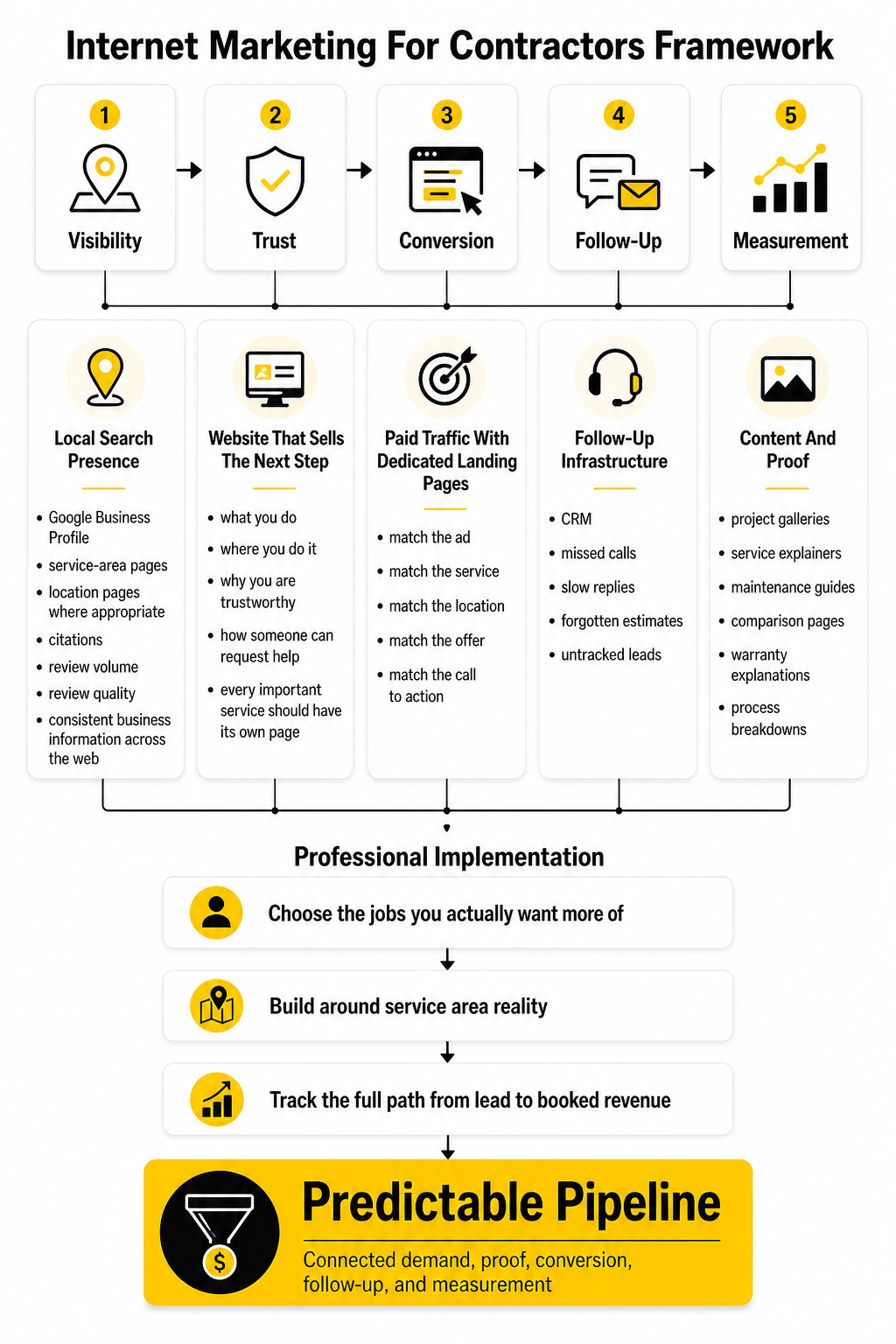
The framework looks simple on purpose:
Most contractor marketing problems happen because one of those layers is missing. A contractor might get traffic but no leads because the website does not convert. Another might get leads but lose jobs because nobody follows up quickly. Another might have good referrals but weak Google visibility, which makes the business too dependent on word of mouth.
This is why internet marketing for contractors should never be managed as isolated tasks. SEO affects paid ads because better service pages improve message clarity. Reviews affect conversions because prospects use them to reduce perceived risk. Follow-up affects ad profitability because a lead you do not contact quickly is not a real opportunity.
Core Components Of Internet Marketing For Contractors
The first core component is local search presence. This includes your Google Business Profile, service-area pages, location pages where appropriate, citations, review volume, review quality, and the consistency of your business information across the web. For contractors, local search is often the highest-intent channel because it captures people who already know they need help.
The second component is a website that sells the next step. A contractor website does not need to be clever. It needs to explain what you do, where you do it, why you are trustworthy, what proof you have, and how someone can request help. Every important service should have its own page because a person looking for “kitchen remodeling” needs different proof than someone looking for “deck repair.”
The third component is paid traffic with dedicated landing pages. Sending every ad click to the homepage usually wastes money because the page is too broad. A better approach is to match the ad, service, location, offer, and call to action on one focused page. Tools such as ClickFunnels, systeme.io, or Replo can help build focused pages when the goal is speed, testing, and lead capture.
The fourth component is follow-up infrastructure. This is where many contractors lose money without seeing it. Missed calls, slow replies, forgotten estimates, and untracked leads quietly destroy marketing performance. A CRM and automation platform such as GoHighLevel can be useful when contractors want one place to manage forms, calls, SMS, email follow-up, pipelines, and appointment reminders.
The fifth component is content and proof. Contractors do not need to become influencers, but they do need assets that answer buyer questions. Project galleries, service explainers, maintenance guides, comparison pages, warranty explanations, and process breakdowns all help prospects feel less uncertain. The goal is not content for content’s sake. The goal is to remove friction before the sales conversation.
Professional Implementation Starts With Focus
Professional internet marketing for contractors starts by choosing the jobs you actually want more of. That sounds obvious, but many campaigns fail because they market every service equally. If roofing replacements are more profitable than small repairs, the website, ads, photos, reviews, and follow-up should reflect that priority. If commercial work is the goal, the proof and messaging need to be different from homeowner marketing.
The next step is building around service area reality. A contractor serving one city, three counties, or a whole metro area should not use the same structure. Local SEO pages, ad targeting, review requests, and project proof should match where the business can actually win jobs. Marketing a location you cannot serve well creates bad leads, wasted spend, and operational stress.
Finally, professional implementation means tracking the full path from lead to booked revenue. Cost per lead is useful, but it is not enough. A $40 lead that never answers is worse than a $120 lead that turns into a profitable project. The real question is which channels produce qualified conversations, booked estimates, closed jobs, and repeatable revenue.
Building A Contractor Marketing Foundation That Converts
Before you spend more money on ads, SEO, social media, or automation, the foundation has to be clear. Internet marketing for contractors works best when every channel sends people toward the same promise, the same proof, and the same next step. If your website says one thing, your Google profile says another, your ads push a third offer, and your sales team explains the business differently on the phone, prospects feel friction even if they cannot name it.
The foundation is not complicated, but it does need discipline. You need to know which jobs you want, which locations you serve, which problems you solve best, and why a buyer should trust you over the contractor listed above or below you. That clarity makes everything easier: service pages, ads, calls, estimates, reviews, follow-up, and even hiring.
A strong foundation also protects your budget. Without it, marketing spend leaks everywhere. You get clicks from the wrong towns, leads for low-value jobs, calls from people who are not a fit, and form submissions that never turn into revenue. With it, every marketing decision becomes easier to judge because you know what the system is supposed to produce.
Define The Jobs You Actually Want
The first question is not “How do we get more leads?” The better question is “Which leads are worth building the business around?” A contractor who wants more full roof replacements should not build the same marketing system as a contractor who wants small repair calls, insurance restoration work, or commercial maintenance contracts.
Start by separating your services into three groups. The first group is your highest-value work, where the margins, capacity, and team experience all make sense. The second group is useful filler work that can keep crews busy but should not dominate your marketing. The third group is work you technically can do but should not actively promote because it creates scheduling headaches, weak margins, or poor-fit customers.
This matters because buyers respond to specificity. A page about “home improvement services” is weaker than a page about “basement finishing,” “storm damage roof repair,” or “commercial HVAC maintenance.” When someone has a specific problem, they want to see that you solve that specific problem all the time.
Clarify Your Service Area
Service area strategy is one of the easiest places to waste money. Many contractors want to rank everywhere, run ads everywhere, and take leads from every nearby city. That sounds like growth, but it often creates long drive times, weak close rates, and messy scheduling.
A better approach is to define your primary, secondary, and test markets. Your primary market is where you already have proof, crews, reviews, and operational strength. Your secondary market is where you can profitably take work but may need more local proof. Your test market is where you are exploring demand, but you should not let it drain budget from places where you already win.
This structure helps your website and campaigns feel more relevant. Google’s own local ranking guidance explains that local visibility is shaped by relevance, distance, and prominence through Google Business Profile local ranking factors. You cannot control every part of that equation, but you can make your business information, service pages, project proof, and review strategy much more aligned with the areas you actually serve.
Build A Website Around Buyer Decisions
A contractor website should not be treated like an online brochure. It should answer the questions prospects ask before they contact you. What do you do? Where do you work? Are you licensed and insured? Have you handled projects like mine? What happens after I request an estimate?
Most contractor websites lose leads because they are too vague. They use broad claims like “quality workmanship” and “trusted professionals,” but they do not show enough evidence. A stronger website uses service-specific pages, real project photos, clear process steps, review highlights, warranty information, financing details when relevant, and obvious calls to action.
Mobile experience is especially important because many contractor searches happen in urgent or practical moments. Someone with a leaking pipe, broken furnace, damaged roof, or failed electrical panel is not calmly reading a long homepage on a desktop. They need fast answers, tap-to-call buttons, short forms, service-area clarity, and proof that you are a safe choice.
Create Service Pages That Match Search Intent
Each major service deserves its own page. This is not just for SEO. It is for the buyer. A homeowner considering a bathroom remodel has different concerns than someone comparing emergency plumbing companies, and a property manager looking for commercial concrete repair needs different proof than a homeowner wanting a patio.
A good service page should explain the problem, the situations you handle, the signs a customer may need help, your process, your service area, and the next step. It should also include proof that matches the service. For example, a roofing page should show roof-specific reviews and project photos, not generic testimonials from unrelated work.
The goal is to make the page feel like the natural answer to the search. If someone searches for a specific contractor service in a specific area, the page should immediately confirm that they are in the right place. That is how internet marketing for contractors becomes more than visibility. It becomes persuasion.
Make Your Calls To Action Obvious
Many contractor websites hide the next step. The phone number is small, the form is buried, and the button says something weak like “Submit.” That may seem minor, but small friction points matter when a prospect is comparing multiple companies at once.
Your calls to action should match the way people buy. Some visitors want to call now. Some want to request an estimate. Some want to book a time. Some want to ask a question before committing. Give them clear options, but do not overload the page with too many choices.
A strong contractor call to action is direct and specific. “Request A Roof Inspection,” “Schedule An HVAC Estimate,” “Get A Bathroom Remodel Quote,” or “Call For Emergency Service” is stronger than a generic “Contact Us.” The more closely the call to action matches the visitor’s intent, the easier it is for them to move forward.
Use Forms That Qualify Without Creating Friction
Lead forms should collect enough information to help you respond properly, but not so much that people abandon the page. A basic form usually needs name, phone, email, service type, location, and a short project description. For higher-ticket work, it can make sense to ask about timeline, property type, budget range, or whether the person owns the property.
The key is to avoid turning the form into an interrogation. People do not want to complete a 20-field application just to ask about a fence, roof, remodel, or repair. If you need more detail, collect it after the first conversion through a phone call, follow-up form, or booking flow.
Tools such as Fillout can be useful when you want cleaner quote request forms, conditional questions, and better lead routing without rebuilding your whole site. For contractors, the practical win is simple: make it easy for serious prospects to raise their hand while filtering out enough bad-fit requests to protect your time.
Show Proof Before You Ask For Trust
Contractor marketing depends heavily on proof because the buyer is taking a risk. They are letting someone into their home, trusting them with a major repair, or handing over a large deposit before the final result exists. That means your marketing should reduce anxiety at every step.
Proof can include reviews, project photos, before-and-after galleries, licenses, insurance notes, manufacturer certifications, financing options, warranty details, association memberships, and clear process explanations. Not every contractor will have all of these, and that is fine. The point is to show enough evidence that a reasonable buyer feels comfortable taking the next step.
Reviews deserve special attention because they influence both trust and conversion. BrightLocal’s 2025 research found that consumers continue to use online reviews as a key part of local business evaluation through local consumer review behavior. For contractors, that means reviews should not sit quietly on one testimonial page. They should appear near service pages, quote forms, project galleries, and any place where a buyer may hesitate.
Prepare Your Tracking Before Traffic Grows
Tracking is not something to add after the campaign “starts working.” It should be part of the foundation. If you cannot see where calls, forms, booked appointments, and closed jobs come from, you will end up judging marketing by gut feeling.
At minimum, contractors should track form submissions, phone calls, booked estimates, lead source, service requested, location, close rate, and job value. That does not require a complicated dashboard on day one. It does require consistent data capture, because messy tracking makes good marketing look bad and bad marketing look acceptable.
This is where a CRM becomes more than a sales tool. A system like GoHighLevel can help contractors connect landing pages, forms, calls, text follow-up, pipelines, and appointment reminders in one place. The real value is not the software itself. The value is knowing which leads turn into revenue and which parts of your marketing system need fixing.
Keep The Foundation Simple Enough To Use
The best contractor marketing foundation is not the most complicated one. It is the one your team can actually use every day. If your office manager, estimator, salesperson, or owner cannot understand where leads go and what happens next, the system is too fragile.
Start with a clear service focus, a defined service area, strong service pages, obvious calls to action, useful forms, visible proof, and basic tracking. Once those pieces are working, every advanced tactic becomes easier. SEO has better pages to rank. Paid ads have better places to send traffic. Follow-up automation has cleaner leads to manage.
This is the part many contractors skip because it does not feel exciting. But it is the difference between buying traffic and building an asset. The contractors who take the time to build the foundation usually get more from every channel they add later.
Local SEO, Google Business Profile, And Review Strategy
Once the foundation is clear, the next job is making the business easier to find in the places where contractor buyers already look. For most contractors, that means local search first. Not because SEO is trendy, but because local search captures people who are actively trying to solve a real problem in a real service area.
This part of internet marketing for contractors is not just about rankings. It is about being visible, believable, and easy to contact when the buyer is ready. A strong local presence can make a contractor feel established before the first phone call happens, while a weak presence can make even a skilled contractor look risky.
Local SEO works best when your Google Business Profile, website pages, reviews, photos, service areas, and business information all tell the same story. If those pieces contradict each other, the market gets confused. If they support each other, you become easier to understand and easier to choose.
Start With The Google Business Profile
Your Google Business Profile is often the first serious impression a prospect gets. They may see it before they visit your website, before they read your service pages, and before they know anything about your company. That means it should be treated like a core sales asset, not a quick directory listing.
The profile should use the correct business name, primary category, secondary categories, phone number, website, hours, service areas, services, photos, and business description. Google’s local ranking guidance explains that local results are shaped by relevance, distance, and prominence, which makes complete and accurate profile information a practical advantage through Google’s local ranking guidance. You cannot force Google to rank you first, but you can remove the obvious weaknesses that make your business harder to match with the right searches.
For contractors, category selection matters a lot. A general category may be too broad if your profitable work is specific, while a narrow category may limit your visibility if it does not reflect the main service buyers search for. The profile should match the real business, the real service mix, and the jobs you want more of.
Make Your Business Information Consistent
Local SEO becomes harder when your business information is inconsistent across the web. If your company name, address, phone number, website, or hours vary between directories, social profiles, review platforms, and your own site, it creates unnecessary confusion. Prospects notice that confusion, and search systems can struggle with it too.
The basic cleanup process is simple. Choose the official version of your business name, phone number, website URL, address or service-area setup, and hours. Then make that information consistent across the places where customers are likely to find you.
This includes your website footer, contact page, Google Business Profile, Facebook page, Yelp profile where relevant, Bing Places, industry directories, local chamber pages, supplier or manufacturer directories, and any lead platforms you actively use. Do not obsess over every obscure directory on the internet. Focus first on the sources that real customers and search engines are most likely to trust.
Build Location And Service Relevance
A contractor website needs to make service relevance obvious. If you want to rank for roofing, remodeling, HVAC, plumbing, electrical, landscaping, concrete, painting, or restoration work in a specific area, your website should clearly support that. Thin pages with a city name swapped in are not enough.
A useful service page explains the service in plain language, shows the type of projects you handle, clarifies the area you serve, and answers the questions a buyer would naturally ask before contacting you. Google’s Search Essentials focus on making pages accessible, crawlable, and useful through Google Search Essentials, but the practical contractor version is even simpler: make the page genuinely helpful for the person searching.
Location pages should only exist when they add real value. A page for a city where you have actual project history, reviews, photos, crew availability, or service-specific details can be useful. A page that exists only to chase rankings usually feels empty, and empty pages do not build trust.
Turn Reviews Into A Repeatable System
Reviews should not be left to chance. Happy customers are often busy, distracted, or unsure where to leave feedback. If you do not ask at the right time, in the right way, many positive experiences disappear without becoming public proof.
A repeatable review system starts by identifying the best request moment. For many contractors, that is after the job is completed, the customer has seen the result, and any final cleanup or punch-list item has been handled. Asking too early can feel pushy. Asking too late loses momentum.
The request should be simple, direct, and easy to act on. Send a short message, include the correct review link, and make the customer feel that their feedback helps local homeowners or property managers make a confident decision. BrightLocal’s 2025 review research shows that review behavior still plays a major role in how people evaluate local businesses through consumer review behavior, so this is not a vanity exercise. It is sales infrastructure.
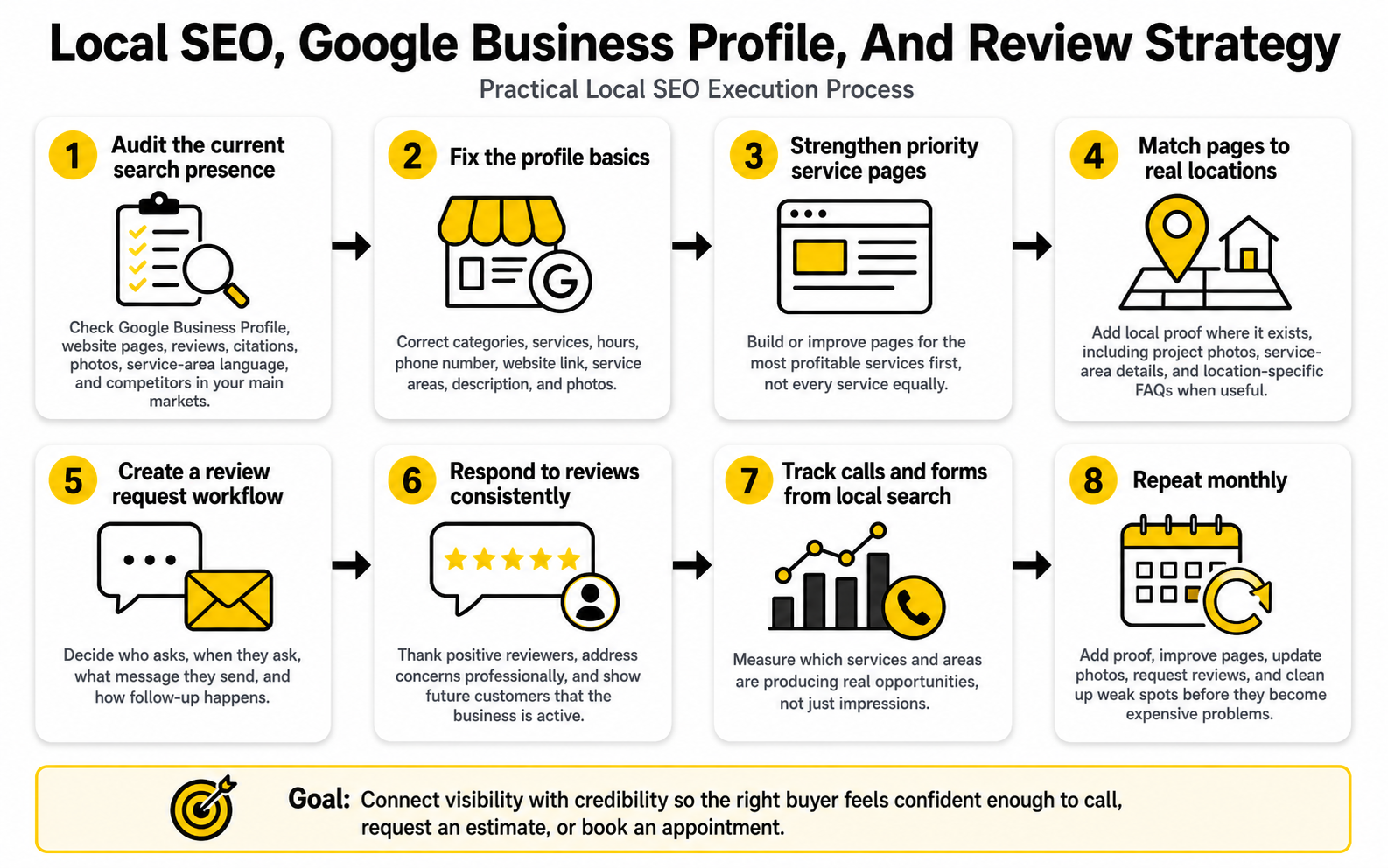
Use A Practical Local SEO Execution Process
The easiest way to implement local SEO is to stop treating it as a mystery and turn it into a process. You do not need fifty tactics at once. You need the right actions in the right order, repeated consistently.
This process works because it connects visibility with credibility. Ranking higher is useful, but it is not the whole game. The real goal is to make the right buyer feel confident enough to call, request an estimate, or book an appointment.
Add Photos That Prove Real Work
Photos are one of the most underused assets in contractor marketing. Buyers want to see the kind of work you actually do, not just stock images or generic team shots. Real project photos help prospects picture the outcome and judge whether your company handles work like theirs.
The best photos are specific. Show completed projects, before-and-after angles, crews working safely, branded vehicles, jobsite details, materials, and finished results. A remodeling contractor should show kitchens, bathrooms, basements, additions, and detail work. A roofing contractor should show roof types, damage repairs, replacements, gutters, flashing, and cleanup.
Photos should also support the services you want to sell. If your profile and website are full of small repair photos but you want larger replacement projects, your proof is misaligned. Use images to shape demand, not just document whatever happened last week.
Respond To Reviews Like Future Customers Are Reading
Review responses are not only for the person who left the review. They are also for the next prospect who is deciding whether to trust you. A professional response shows that the company pays attention, communicates clearly, and takes the customer experience seriously.
Positive review responses should feel human, but not overly long. Mention the service when natural, thank the customer, and reinforce the kind of experience you want future buyers to notice. Avoid copy-paste responses that make every customer sound interchangeable.
Negative reviews need more care. Do not argue, blame, or reveal private details. A calm response that acknowledges the concern, offers a path to resolve it, and keeps the tone professional can reduce damage and sometimes even strengthen trust. People know that no contractor is perfect. They want to see how you handle pressure.
Build Local Content Around Real Buyer Questions
Local content should not be filler. It should answer the questions prospects ask before they hire a contractor. That could include pricing factors, timelines, permits, material choices, warning signs, maintenance advice, project preparation, warranty details, or what to expect during an estimate.
For example, a roofing contractor might create content around storm damage inspections, roof replacement timelines, insurance documentation, shingle options, and signs of ventilation problems. A remodeling contractor might cover design timelines, budget planning, permits, material delays, and how to live in the home during construction. These topics work because they meet buyers where they are already uncertain.
The best content also supports sales conversations. If your estimator answers the same five questions every week, those questions probably deserve a page, guide, or section on the website. That makes the website more useful and helps prospects arrive better educated before they speak with your team.
Keep Local SEO Connected To Operations
Local SEO is not only a marketing department job. Operations affects it every day. If crews arrive late, communication is weak, estimates are unclear, or cleanup is poor, those issues eventually show up in reviews, referrals, and close rates.
That is why the best contractor marketing systems connect local visibility with customer experience. The marketing team can help generate demand, but the business has to deliver on the promise. Fast callbacks, clean job sites, clear estimates, polite crews, and finished work all become part of the online reputation engine.
This is also where tracking becomes important again. If one service area generates plenty of leads but poor close rates, the problem may not be SEO. It may be pricing, distance, crew availability, competition, or the type of customer attracted by that location. Good internet marketing for contractors does not stop at traffic. It follows the lead until the business knows what actually happened.
Paid Ads, Landing Pages, And Lead Capture
By this point, the contractor marketing system has the basics in place: clear services, defined locations, a useful website, local search visibility, and review proof. Paid ads come next because they can speed up demand, but only if the rest of the system is ready to handle that demand. Buying clicks before the offer, page, tracking, and follow-up are fixed is one of the fastest ways to waste money.
Paid traffic is not magic. It is pressure. It puts more people into the system and reveals where the system is strong or weak. If the landing page is vague, ads expose it. If the phone is not answered, ads expose it. If the estimate process is slow, ads expose it. That is why internet marketing for contractors needs measurement before scale.
The goal is not to get the cheapest lead possible. Cheap leads can be terrible. The real goal is to get profitable opportunities from the right services, in the right locations, with enough tracking to know what is actually working.
Statistics And Data
The numbers matter because contractor marketing is full of false confidence. A campaign can look successful because clicks are up, while booked jobs are flat. Another campaign can look expensive because the cost per lead is high, but it may produce the jobs with the best margins.
Search advertising is competitive in home services, and benchmarks prove why tracking has to go deeper than surface metrics. WordStream’s 2025 Google Ads benchmark report shows that search advertising costs have continued rising across many industries, while LocaliQ’s home services benchmark analysis reports that home services search campaigns are still attracting strong intent through 2025 search ad benchmarks. That means contractors should not panic just because clicks are not cheap. They should ask whether those clicks are turning into qualified conversations and booked revenue.
Cost per lead also varies dramatically by trade. PipelineON’s 2025 home service benchmark data puts overall home services cost per lead around $90.92, while categories such as construction and contractors, doors and windows, and roofing can be much higher through home service marketing benchmarks. This is why one contractor’s “expensive lead” may be another contractor’s bargain. A $200 roofing lead can be profitable if it turns into a replacement job, while a $40 lead can be useless if it is outside the service area or impossible to close.
Measure The Full Funnel, Not Just The Click
A contractor funnel has more steps than most dashboards show by default. A prospect may click an ad, visit a landing page, call from a mobile device, speak to the office, book an estimate, receive a quote, compare two competitors, and only then make a decision. If you only measure the click and the form fill, you are missing the part where the money is won or lost.
The basic funnel should track impressions, clicks, landing page visits, calls, forms, booked appointments, completed estimates, proposals sent, jobs won, revenue, and gross margin where possible. That may sound like a lot, but it is the difference between “marketing feels slow” and “this campaign produces kitchen remodel estimates at a profitable close rate.” Data should make decisions calmer, not more complicated.
This is especially important for phone calls. Many contractor leads still happen by phone, especially urgent services such as HVAC, plumbing, roofing leaks, electrical repairs, restoration, and locksmith work. If calls are not tracked, a campaign can look weak in analytics while quietly generating revenue through the phone.
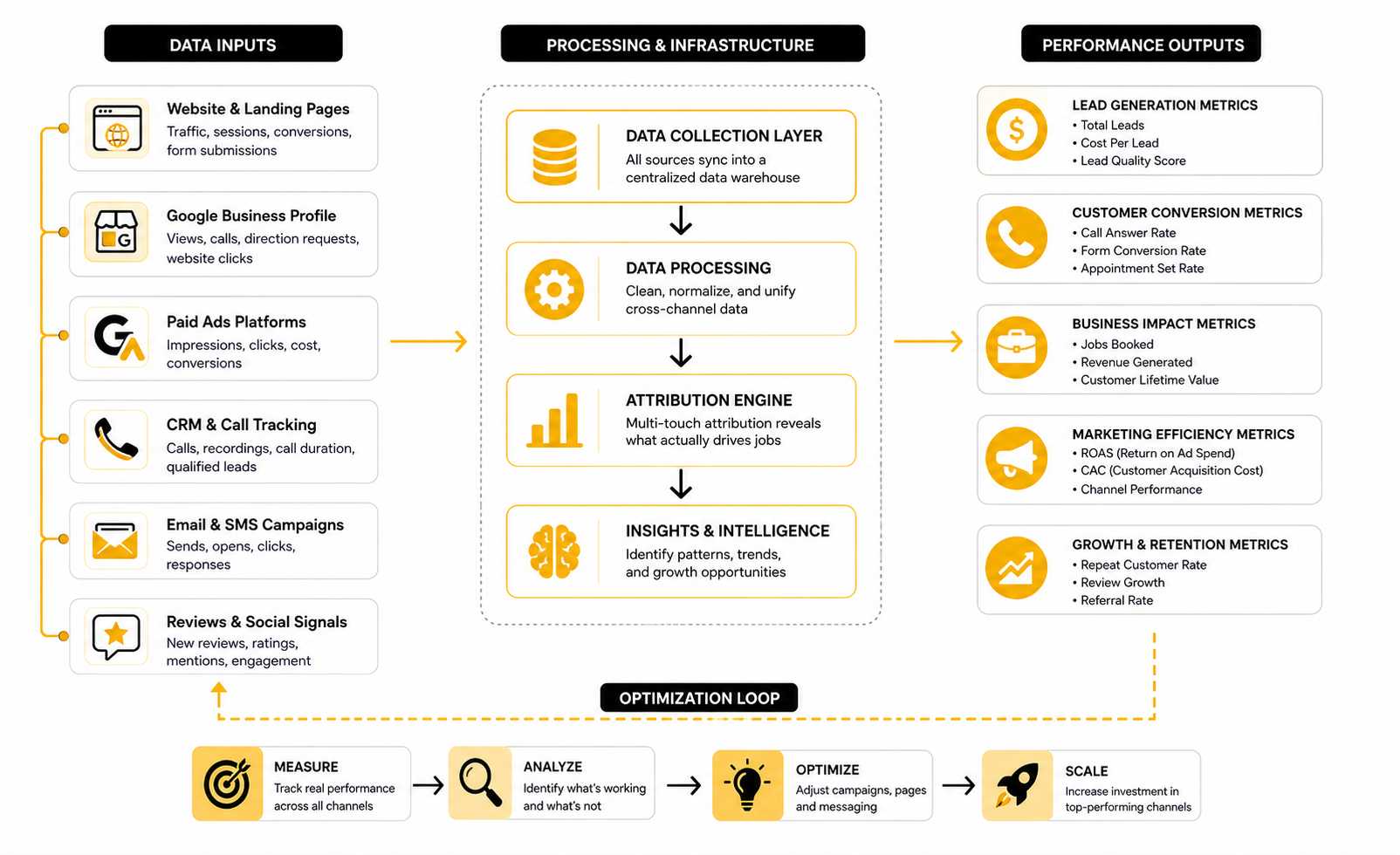
Build A Simple Analytics System
The analytics system does not need to be fancy. It needs to answer practical questions. Which services are creating leads? Which locations are producing booked estimates? Which channels are bringing real customers instead of junk inquiries? Which campaigns are getting calls but not sales?
Start with four layers. The first layer is website analytics, usually through GA4, where form submissions, click-to-call actions, booking clicks, and key page visits can be measured. The second layer is call tracking, so phone leads can be tied back to ads, local search, organic pages, or other campaigns. The third layer is CRM tracking, where leads become appointments, estimates, proposals, wins, losses, and revenue. The fourth layer is human review, because numbers need context from the people answering calls and selling jobs.
For lead capture and routing, tools such as GoHighLevel can help contractors connect forms, calls, SMS follow-up, pipeline stages, and appointment reminders. For dedicated landing pages, ClickFunnels, systeme.io, or Replo can make it easier to test service-specific pages without waiting months for a full website rebuild. The tool is not the strategy, but clean tracking is much easier when the tool stack is not fighting you.
Know Which Metrics Actually Matter
Not every metric deserves the same attention. Impressions tell you how often your ad or listing appears, but they do not prove demand is profitable. Click-through rate can show whether the message is relevant, but it does not prove the lead is qualified. Conversion rate matters, but it can be misleading if the form attracts low-quality inquiries.
The most useful contractor metrics are closer to revenue. Track cost per qualified lead, cost per booked appointment, cost per completed estimate, close rate, average job value, revenue by source, and time to first response. These numbers show whether marketing is creating business or just activity.
Lead response time deserves special attention because many contractor leads are time-sensitive. Client Growth Engine’s home services response benchmarks describe top performers responding in under five minutes, while average response times can stretch much longer through lead response time benchmarks. Whether the exact number varies by market or trade, the lesson is clear: speed matters when the buyer is comparing multiple contractors.
Interpret Benchmarks Without Copying Them Blindly
Benchmarks are useful, but they are not commandments. A bathroom remodeler, emergency plumber, roofing company, commercial electrician, and concrete contractor can all have completely different economics. Their cost per click, cost per lead, sales cycle, close rate, and average job value will not behave the same way.
Use benchmarks as a diagnostic tool. If your cost per lead is much higher than similar businesses, inspect targeting, keywords, landing page relevance, offer strength, and lead quality. If your conversion rate is lower than expected, review page speed, mobile layout, form friction, trust signals, call tracking, and whether the page matches the ad.
Do not make decisions from one metric in isolation. A high cost per lead may be acceptable if the leads are qualified and close into profitable jobs. A low cost per lead may be dangerous if the campaign attracts bargain shoppers, renters who cannot approve work, wrong-location requests, or tiny jobs that interrupt better projects.
Read Landing Page Data Like A Contractor
Landing page analytics should tell you where prospects hesitate. If plenty of people visit the page but few contact you, the page may not be clear enough, trustworthy enough, or specific enough. If mobile users perform worse than desktop users, the layout, buttons, page speed, or form may be causing friction.
Look at the message match first. The keyword, ad, headline, service, location, offer, proof, and call to action should all line up. If someone clicks an ad for “roof replacement estimate in Austin,” the landing page should not feel like a generic contractor homepage.
Then look at proof placement. Reviews, project photos, licensing signals, financing details, warranties, and process explanations should appear before the buyer is forced to make a decision. A landing page should not make prospects hunt for reasons to trust you.
Track Lead Quality, Not Just Lead Volume
Lead quality is where contractor marketing becomes honest. A form submission is not automatically a good lead. A call is not automatically a real opportunity. A booked estimate is not automatically profitable.
Every lead should be categorized in a simple way. Good categories include qualified, unqualified, wrong service, wrong location, price shopper, no response, duplicate, spam, booked, quoted, won, and lost. Over time, these labels show which channels are bringing real opportunities and which ones are just filling the inbox.
This also helps you improve campaigns without guessing. If many leads are outside the service area, fix targeting and page copy. If many leads want a service you do not prioritize, adjust keywords and negative keywords. If many qualified leads do not book, review speed to lead, phone scripts, availability, and estimate scheduling.
Connect Paid Ads To Real Revenue
Paid ads should be judged by revenue, not ego metrics. The cleanest version is simple: how much did you spend, how many qualified leads came in, how many booked estimates happened, how many jobs closed, and how much gross profit came from those jobs? That gives you a real view of performance.
This does not mean every campaign must be profitable instantly. Some campaigns need testing time, especially in competitive markets. But testing should still have structure. Change one major thing at a time, document what changed, and compare results against the same stage of the funnel.
Contractors should also separate emergency, repair, replacement, maintenance, and project-based campaigns when possible. These lead types behave differently. Emergency campaigns may convert quickly but create operational pressure. Larger project campaigns may close slower but create more revenue per job. Measurement should respect those differences.
Use Data To Decide What To Fix Next
Good measurement should produce action. If impressions are low, the issue may be budget, targeting, keyword coverage, or local visibility. If clicks are low, the message may be weak. If page visits are strong but leads are weak, the landing page may need work. If leads are strong but booked jobs are weak, the follow-up or sales process is the bottleneck.
This is the practical order:
This is how internet marketing for contractors becomes manageable. You stop asking whether “marketing works” as one vague question. You ask where the system is leaking and fix the next constraint.
Follow-Up, Automation, And Sales Systems
The next layer is where many contractor marketing systems either become profitable or fall apart. Leads are not revenue. Calls are not revenue. Form submissions are not revenue. Revenue happens when a qualified person gets contacted, gets helped, gets scheduled, gets quoted, and chooses your company.
This is why follow-up deserves its own place in internet marketing for contractors. The business can have strong local SEO, sharp ads, good landing pages, and useful tracking, but still lose money if nobody responds quickly or consistently. The leak is not always in the campaign. Sometimes the leak is in the handoff from marketing to sales.
Contractors who scale well usually treat follow-up like operations, not like admin work. They define the process, assign ownership, automate what can be automated, and review the numbers regularly. That is not glamorous, but it is where the profit often hides.
Speed Is A Competitive Advantage
A contractor lead has a short attention span because the buyer usually has options. They may request quotes from three companies, call whoever appears first on Google, or ask a neighbor while waiting for a reply. If your team responds slowly, the lead may still look “new” in your CRM, but the opportunity may already be gone.
Home services leads are especially time-sensitive, with benchmark data showing customers often expect a response within 15 minutes while average response times can stretch much longer through home services response time benchmarks. The action point is simple: do not build a marketing machine that creates leads faster than your team can answer them. That only creates frustration and waste.
Speed does not mean sounding desperate. It means being organized. The best first response confirms the request, reassures the prospect, asks for the missing details, and moves them toward the next step while the problem is still fresh in their mind.
Use Automation Without Making The Business Feel Robotic
Automation should support the human sales process, not replace it. A homeowner or property manager does not want to feel trapped in a generic sequence after requesting a serious estimate. They want a fast answer, a clear next step, and confidence that a real company is paying attention.
A practical follow-up system can include instant form confirmation, missed-call text-back, appointment reminders, estimate follow-ups, review requests, and reactivation campaigns for old leads. These are not gimmicks. They are basic communication habits made consistent.
A platform like GoHighLevel can be useful here because it brings forms, calls, SMS, email, calendars, pipelines, and automation into one workflow. For contractors, the point is not to automate every conversation. The point is to make sure no serious lead disappears because someone got busy on a jobsite, missed a call, or forgot to follow up after sending an estimate.
Build Different Follow-Up Paths For Different Lead Types
Not every lead should receive the same follow-up. An emergency plumbing call, a roof replacement inquiry, a kitchen remodel request, and a commercial maintenance lead have different urgency, value, and decision cycles. Treating them the same makes the process feel clumsy.
Emergency and repair leads need immediate contact, simple qualification, and fast scheduling. Larger project leads need more education, proof, expectation setting, and sometimes multiple touches before a consultation or estimate. Commercial leads may require documentation, insurance details, references, procurement steps, or a more formal proposal process.
The best system tags leads by service, source, location, urgency, and stage. That lets the business send more relevant messages and measure performance more honestly. A slow-closing remodel lead is not necessarily bad. It just should not be judged by the same timeline as an emergency HVAC lead.
Protect The Sales Team From Bad Leads
Scaling contractor marketing is not only about generating more demand. It is also about protecting the team from demand that should never reach the estimator. Bad leads create hidden costs because they waste phone time, drive time, quoting time, and mental energy.
This is where qualification matters. A form can ask for service type, location, timeline, property ownership, project description, and photos when useful. A phone script can confirm whether the job fits the company’s service area, minimum project size, licensing scope, schedule, and availability. The goal is not to make prospects jump through hoops. The goal is to keep the team focused on opportunities the business can actually win.
Be careful, though. Over-qualification can kill good leads. If the form is too long, the questions feel invasive, or the first conversation sounds like a gatekeeping exercise, serious buyers may leave. The right balance is enough qualification to protect your team without making the buyer feel punished for contacting you.
Create A Sales Pipeline That Matches Reality
A contractor CRM should reflect the way jobs actually move. If the pipeline stages are vague, people stop using them. If the stages are too complicated, the system becomes a chore. The pipeline should make the next action obvious.
A simple contractor pipeline might include new lead, contacted, qualified, appointment booked, estimate completed, proposal sent, follow-up needed, won, lost, and nurture. More complex businesses may add stages for site visit scheduled, design consultation, insurance review, financing pending, contract sent, deposit received, production scheduled, and project completed.
The important part is ownership. Every active lead should have a next step, a responsible person, and a follow-up date. Without those three things, the CRM becomes a graveyard of names instead of a sales system.
Follow Up After The Estimate
Many contractors follow up hard before the estimate and then disappear after sending the quote. That is backwards. The estimate stage is where the buyer is comparing risk, price, timing, professionalism, and confidence. This is exactly when follow-up matters.
A good post-estimate follow-up should not sound needy. It should help the buyer make a decision. You can clarify scope, answer questions, explain materials, confirm timing, address objections, and remind them what happens next if they move forward.
This is also where content helps sales. A short page explaining your warranty, process, financing options, project timeline, or preparation checklist can support the estimator without forcing them to repeat the same explanation every time. The best sales systems make the buyer feel guided, not chased.
Watch The Risks Of Scaling Too Fast
More leads are not always better. If the business cannot answer calls, schedule estimates, complete work, or maintain quality, more marketing can damage the brand. Scaling demand before scaling capacity creates bad reviews, rushed jobs, unhappy crews, and weaker close rates.
This is especially dangerous in seasonal trades. HVAC, roofing, landscaping, pest control, pool services, and exterior remodeling can all have periods where demand spikes quickly. If campaigns are not adjusted around crew capacity, weather, lead times, and service priorities, marketing can create pressure the operation cannot handle.
The solution is not to stop marketing. The solution is to control the volume and mix. Shift budget toward the services you can fulfill, pause campaigns when capacity is maxed, extend booking timelines honestly, and use waitlists or nurture sequences when demand exceeds availability.
Decide When To Use Software, Agencies, Or In-House Help
There is no single right setup for every contractor. A smaller local contractor may only need a clean website, Google Business Profile discipline, basic call tracking, a simple CRM, and a few focused campaigns. A larger contractor with multiple crews, service lines, and locations may need dedicated marketing management, stronger reporting, and more advanced automation.
Software is useful when the team has someone responsible for using it. Agencies are useful when they understand contractor economics and report beyond clicks and leads. In-house marketers are useful when the business has enough volume and complexity to justify daily attention. The wrong choice is usually buying tools, hiring vendors, or adding staff without clear ownership.
This is where tradeoffs matter. An agency can bring expertise, but it still needs fast feedback from the business. Software can organize the process, but it will not fix weak offers or poor call handling by itself. In-house help can improve speed, but only if leadership gives them clear goals and access to the numbers that matter.
Build A Nurture System For Leads That Are Not Ready Yet
Not every good lead buys immediately. Some homeowners are planning months ahead. Some property managers need budget approval. Some prospects are comparing options, waiting on insurance, or trying to understand the scope before they commit.
A nurture system keeps the business useful without being annoying. It can include project planning tips, maintenance reminders, seasonal checklists, financing information, warranty explanations, and follow-up around unfinished estimates. Email tools such as Brevo or Moosend can help manage simple campaigns when email becomes part of the follow-up mix.
The key is relevance. A homeowner who asked about a roof replacement should not receive generic company updates forever. They should receive information that helps them understand roof age, materials, inspection timing, financing, warranties, and what to expect during installation.
Use Social And Messaging Channels Carefully
Social media can support contractor marketing, but it should not distract from higher-intent channels. Before spending hours chasing reach, make sure the business is already handling search visibility, reviews, landing pages, tracking, and follow-up. Social works best as proof, not as the entire growth strategy.
That said, social proof can be powerful when it shows real work. Short project updates, before-and-after posts, crew highlights, maintenance tips, and finished-job walkthroughs can make the company feel active and trustworthy. Scheduling tools such as Buffer can help keep posts consistent without turning content into a daily distraction.
Messaging channels can also help when the buyer expects quick answers. A tool like ManyChat may fit businesses that actively use Facebook, Instagram, or chat-based lead flows. Just keep the experience clean. The buyer should always know how to reach a real person when the job is serious.
Make The System Easier To Manage As It Grows
The more channels you add, the easier it is for the system to become messy. Ads, SEO, reviews, forms, phone calls, emails, SMS, calendars, estimates, and proposals can quickly turn into scattered activity. Complexity is fine only when it creates control. Random complexity creates waste.
A growing contractor should review the system weekly at first. Look at new leads, qualified leads, booked estimates, no-shows, proposals sent, closed jobs, lost reasons, response times, and source performance. The meeting does not need to be long. It needs to be honest.
Over time, the goal is to make internet marketing for contractors feel less like chasing leads and more like managing a pipeline. That means the business knows what it wants to sell, where it wants to sell it, how leads are captured, who follows up, what gets measured, and when to scale or slow down. That is the difference between marketing activity and a real growth system.
Professional Implementation, Measurement, And FAQs
At this stage, the system is no longer a collection of tactics. It is an ecosystem. The website, local SEO, Google Business Profile, reviews, landing pages, ads, forms, phone calls, CRM, follow-up, estimates, and reporting all influence each other.
That is why professional implementation matters. A contractor can have the right tools and still get poor results if the process is scattered. The real advantage comes from making every part of the system support the next part, so prospects move from search to trust to contact to booked work with less friction.
Internet marketing for contractors becomes much easier to manage when the business stops chasing random activity and starts managing the full customer journey. Every channel should have a job. Every lead should have a next step. Every number should help the owner make a better decision.
Turn The Marketing System Into An Operating Rhythm
The best contractor marketing systems run on rhythm. There is a weekly review of leads, booked estimates, missed calls, source quality, follow-up activity, and sales bottlenecks. There is a monthly review of service performance, ad spend, local SEO movement, review growth, landing page conversion, and close rates.
This rhythm keeps small problems from becoming expensive problems. If missed calls are rising, the team can fix response coverage before ads get blamed. If one service page gets traffic but no leads, the page can be improved before more budget is pushed into the same weak path.
The point is not to create another meeting for the sake of it. The point is to make growth visible. When the business sees the same numbers every week, patterns become obvious and decisions become less emotional.
Decide What To Improve First
Not every weakness deserves immediate attention. A contractor with poor follow-up should not obsess over advanced SEO. A contractor with no service pages should not start testing complex retargeting. A contractor with weak reviews should not expect paid ads to carry all the trust.
The smart order is simple. Fix the biggest constraint closest to revenue first. If leads are coming in but not getting contacted, fix response time. If calls are answered but not booked, fix qualification and scheduling. If estimates are delivered but not closed, fix proposals, proof, pricing communication, and follow-up.
Only after the core system works should you scale aggressively. More budget amplifies what already exists. If the system is clean, scale creates growth. If the system is messy, scale creates more mess.
Keep The Strategy Buyer-Led
Contractor marketing works best when it is built around how people actually choose contractors. Buyers want proof, clarity, speed, confidence, and a simple next step. They do not care how many tools are in your stack or how clever the campaign sounds internally.
This is why the strongest systems feel simple from the outside. The prospect searches, finds a relevant business, sees proof, understands the offer, contacts the company, receives a fast response, gets a clear estimate, and knows what happens next. That is the whole game.
The technical details matter, but they should serve that buyer journey. SEO, ads, automation, analytics, and CRM workflows are only valuable when they make the buying process easier and the business more profitable.
What Is Internet Marketing For Contractors?
Internet marketing for contractors is the process of using online channels to attract, convert, follow up with, and close customers for contractor services. It includes your website, Google Business Profile, local SEO, reviews, paid ads, landing pages, social proof, email, SMS, CRM systems, and analytics. The goal is not just more traffic. The goal is more qualified jobs from the services and locations that actually matter to the business.
Why Is Internet Marketing Important For Contractors?
Contractor buyers often compare businesses online before they call, even when the job started from a referral. They check reviews, project photos, service pages, location relevance, and how easy it is to contact the company. BrightLocal’s review research shows that local reviews remain a major part of consumer decision-making through local consumer review behavior. If your online presence is weak, prospects may never give you the chance to explain why you are the better choice.
What Is The Best Internet Marketing Channel For Contractors?
There is no single best channel for every contractor, but local search is usually the strongest starting point. Google Business Profile, local SEO, service pages, and reviews capture people who are already looking for help in a specific area. Paid search can also work well when the service has strong buying intent and the landing page is built to convert. The best channel is the one that produces qualified conversations, booked estimates, and profitable jobs, not just clicks.
How Much Should Contractors Spend On Internet Marketing?
The right budget depends on trade, location, competition, average job value, capacity, and growth goals. A contractor selling high-value roof replacements, remodels, or commercial projects can usually justify a higher cost per lead than a contractor focused on small repair calls. WordStream’s 2025 ad benchmark data shows that search advertising costs have continued rising across many categories through Google Ads benchmark trends, so the better question is not “How cheap can we get leads?” The better question is “Which spend creates profitable booked work?”
How Long Does Internet Marketing Take To Work For Contractors?
Paid ads can create leads quickly if the offer, targeting, landing page, and follow-up are ready. Local SEO usually takes longer because rankings, reviews, content strength, and prominence build over time. A practical contractor should think in two tracks: paid campaigns for faster demand and organic/local work for long-term stability. The danger is expecting SEO to behave like ads or expecting ads to fix a weak sales process.
Do Contractors Need A Website If They Already Have A Google Business Profile?
Yes. A Google Business Profile can help prospects find you, but the website gives you more room to explain services, show proof, answer questions, and convert leads. Google’s own local ranking guidance highlights relevance, distance, and prominence through local ranking guidance, and a strong website can support relevance and trust around your services. The profile may create the first impression. The website often helps close the confidence gap.
What Should A Contractor Website Include?
A contractor website should include clear service pages, service-area information, phone and form contact options, reviews, project photos, licensing or insurance signals, process explanations, warranty details where relevant, and clear calls to action. The site should also work well on mobile because many prospects search while dealing with an urgent or practical problem. A good website does not try to impress people with clever language. It makes the buyer feel safe enough to take the next step.
Are Paid Ads Worth It For Contractors?
Paid ads can be worth it when the economics make sense. They work best for services with strong intent, clear value, defined locations, and fast follow-up. LocaliQ’s 2025 home services ad benchmarks show that home services search campaigns continue to attract active demand through home services search advertising benchmarks, but benchmarks should be interpreted carefully. A campaign is only worth scaling if it produces qualified leads, booked appointments, and profitable jobs.
Why Do Contractor Leads Fail To Turn Into Jobs?
Leads fail for many reasons, and not all of them are marketing problems. The lead may be outside the service area, too small, too price-sensitive, not ready, or looking for a service you do not prioritize. The business may also respond too slowly, miss calls, send unclear estimates, fail to follow up, or lack enough proof to win trust. This is why tracking lead quality and sales stages matters. Without that visibility, every problem gets blamed on marketing.
How Should Contractors Ask For Reviews?
Contractors should ask for reviews when the customer has experienced the finished result and any final issues have been handled. The request should be short, personal, and easy to complete with a direct review link. It should also be part of a repeatable process, not something the team remembers only when business is slow. Reviews are too important to leave to chance.
What Metrics Should Contractors Track?
Contractors should track calls, forms, booked appointments, completed estimates, proposals, close rate, average job value, revenue by source, cost per qualified lead, cost per booked estimate, and speed to first response. Impressions, clicks, and website visits are useful, but they are not enough. The most useful numbers show whether marketing is producing real opportunities and profitable work. If a metric does not help you make a better decision, it should not dominate the dashboard.
Should Contractors Use Automation?
Yes, but only when automation improves the customer experience. Instant confirmations, missed-call text-back, appointment reminders, estimate follow-ups, review requests, and old-lead reactivation can all be useful. Automation should never make a serious buyer feel ignored or trapped in a generic sequence. Tools such as GoHighLevel can help organize the process, but the strategy still needs human judgment and clear ownership.
Is Social Media Important For Contractors?
Social media can help, especially for showing project proof, finished work, crews, before-and-after photos, and helpful maintenance tips. But it should not distract from higher-intent channels like local search, reviews, paid search, and conversion-focused landing pages. For most contractors, social media is best used as trust support rather than the entire marketing strategy. Consistency matters, but relevance matters more.
When Should A Contractor Hire Marketing Help?
A contractor should consider professional marketing help when the business has capacity to grow, clear service priorities, and enough revenue potential to justify outside support. It also makes sense when the owner is guessing at data, wasting ad budget, missing follow-up, or trying to manage too many disconnected tools. The right help should understand contractor economics, not just traffic. They should care about booked work, close rates, and revenue, not only impressions and clicks.
What Is The Biggest Mistake Contractors Make With Internet Marketing?
The biggest mistake is treating marketing as separate from operations. A campaign can bring in leads, but the business still has to answer quickly, qualify properly, estimate clearly, follow up consistently, and deliver good work. If those pieces are weak, more traffic will not fix the business. It will only reveal the weak spots faster.
Build a stronger local presence with BAAM AI
Turn your website, Google profile, social channels, and AI visibility into one growth engine
Most businesses do not need more random marketing activity. They need a consistent presence system that helps the right people find them, trust them, and take action. BAAM AI brings strategy, local SEO, website updates, Google Maps visibility, social content, AI-search readiness, media production, and reporting into one practical monthly engine.
If you want your marketing to keep working after the campaign ends, start with a free BAAM AI presence audit. See how your business shows up today and where the fastest visibility wins are at BAAM AI.