
BAAM AI Blog
Internet Marketing Consultant Near Me: How To Choose The Right Local Growth Partner
Searching for an internet marketing consultant near me usually means one thing: you do not just want marketing theory. You want someone who understands your market, your customers, your competition, and the practical...
Searching for an internet marketing consultant near me usually means one thing: you do not just want marketing theory. You want someone who understands your market, your customers, your competition, and the practical steps required to turn attention into leads, bookings, sales, and repeat customers.
That matters because local buying behavior has become brutally direct. People search, compare, scan reviews, check your website, look at your social profiles, and decide whether you are worth contacting. In BrightLocal’s consumer search research, 70% of general online searches happen on Google, which means a weak local presence can quietly cost you opportunities every day.
The tricky part is that “internet marketing consultant” can mean almost anything. One person may focus on SEO, another on paid ads, another on funnels, another on CRM automation, and another on content strategy. The right consultant is not the one with the flashiest pitch; it is the one who can diagnose your current bottleneck and build a practical growth system around it.
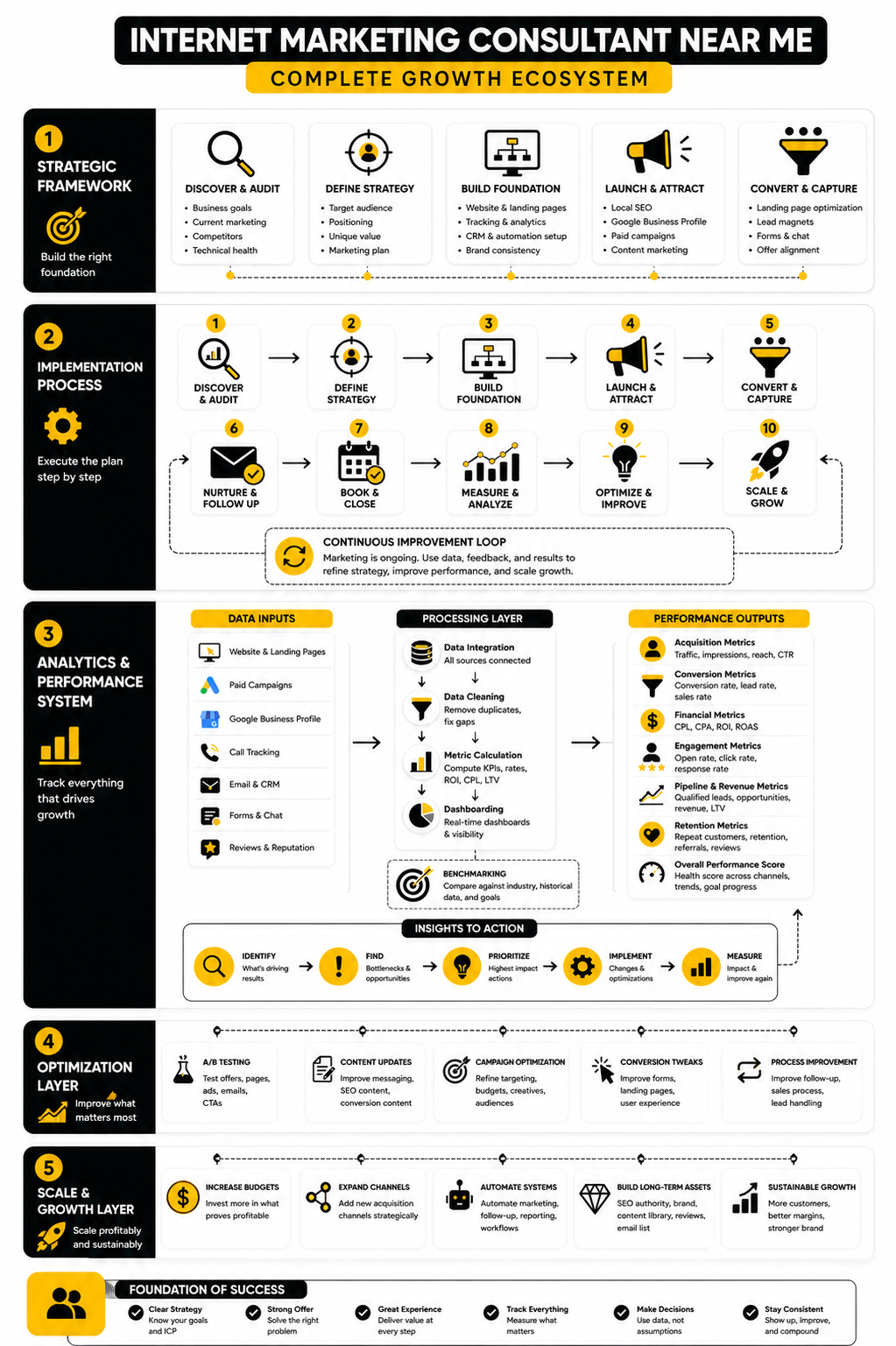
this guide is split into six parts so you can evaluate a local internet marketing consultant without getting lost in vague advice. Each section builds on the last, moving from the search intent behind the keyword to the actual decision process you should use before hiring anyone. The goal is simple: help you choose a consultant who can improve visibility, leads, conversion, and retention instead of selling random tactics.
Why Local Internet Marketing Consulting Matters
A local consultant can be useful when your business depends on a specific service area, physical location, regional reputation, or local buyer intent. Someone searching for a nearby provider is often closer to action than someone casually browsing. Google and Ipsos’ local search research found that people who perform local searches often visit nearby businesses quickly and buy at higher rates, which is exactly why local marketing cannot be treated as an afterthought.
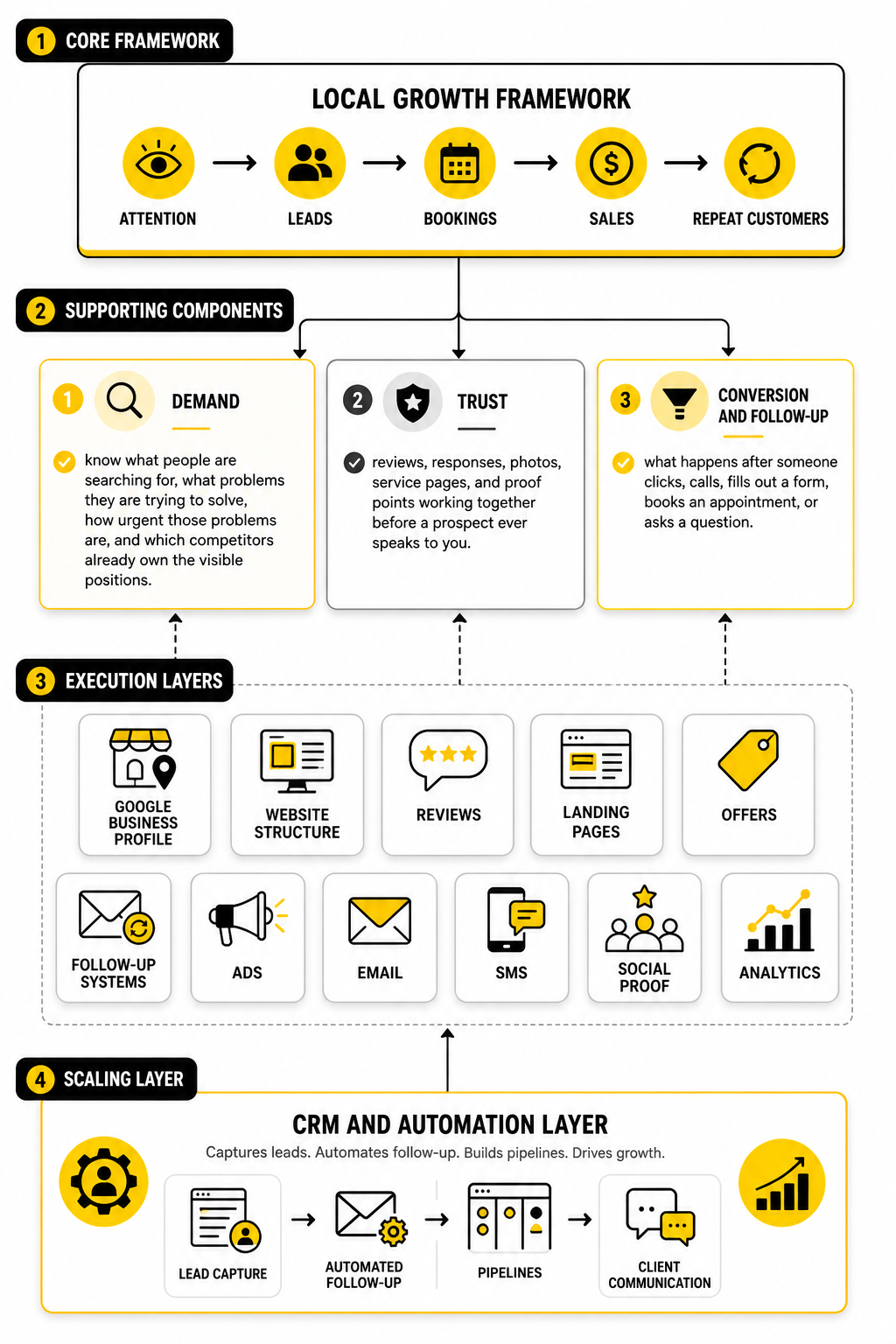
But local marketing is not just about ranking for “near me” keywords. It includes your Google Business Profile, website structure, reviews, landing pages, offers, follow-up systems, ads, email, SMS, social proof, and analytics. If those pieces are disconnected, you may get traffic without leads, leads without sales, or sales without repeat business.
This is where a good internet marketing consultant earns their money. They should help you see the full system instead of pushing one favorite channel. For many local businesses, that system eventually needs a CRM and automation layer, which is why platforms like GoHighLevel often come up when consultants discuss lead capture, follow-up, pipelines, and client communication.
The Local Growth Framework
A strong local marketing framework starts with demand. You need to know what people are searching for, what problems they are trying to solve, how urgent those problems are, and which competitors already own the visible positions. Without that research, every campaign becomes guesswork dressed up as strategy.
The second layer is trust. BrightLocal’s review research shows that local consumers still rely heavily on reviews when evaluating businesses, and the 2025 Local Consumer Review Survey makes it clear that reputation is not separate from marketing anymore. Your reviews, responses, photos, service pages, and proof points all work together before a prospect ever speaks to you.
The third layer is conversion and follow-up. This is where many businesses lose money because they focus only on visibility. A consultant should look at what happens after someone clicks, calls, fills out a form, books an appointment, or asks a question, because the fastest gains often come from fixing the path from interest to action.
Core Components A Consultant Should Understand
A serious internet marketing consultant should understand local SEO, paid traffic, content, conversion strategy, tracking, and customer follow-up. They do not need to personally execute every technical task, but they do need enough range to know how each part affects the others. If they only talk about rankings, or only talk about ads, or only talk about social media, they may miss the real constraint in your business.
Local SEO usually covers Google Business Profile optimization, service pages, location relevance, reviews, citations, internal linking, and technical website health. Paid traffic can include Google Ads, Meta ads, retargeting, and landing page testing. Conversion work may involve forms, booking flows, offers, call tracking, email sequences, SMS follow-up, and funnel pages built with tools like ClickFunnels or Systeme.io.
The real point is not the tool stack. The point is whether the consultant can connect the pieces into a measurable system. You should be able to understand what they are improving, why it matters, how progress will be tracked, and what decisions will be made when the data changes.
What An Internet Marketing Consultant Actually Does
An internet marketing consultant is not just a person who “does online marketing.” At least, not if they are worth hiring. Their real job is to look at how your business attracts attention, earns trust, captures leads, converts prospects, and follows up after the first interaction.
That is why searching for an internet marketing consultant near me should not stop at finding someone local. Proximity is useful, especially when your market is local, but the bigger question is whether they can diagnose the full growth path. A consultant should help you understand where money is leaking before they recommend another campaign.
The best ones are part strategist, part analyst, part operator, and part translator. They take messy marketing data and turn it into clear decisions. They also help you avoid the expensive trap of buying disconnected services that look productive but do not move revenue.
Strategy Before Tactics
A consultant should start with strategy because tactics without context create noise. Running ads, posting content, building landing pages, or improving SEO can all be useful, but none of those actions matter equally for every business. The right move depends on your market, offer, budget, competition, sales process, and current visibility.
This is where many small businesses get burned. They hire someone to “do SEO” when the real problem is a weak offer, poor conversion path, bad tracking, or slow follow-up. They hire someone to run ads when their website cannot turn visitors into leads. They pay for social media content when the business still does not have a clear local positioning angle.
A good consultant slows this down. They should identify the bottleneck first, then match the strategy to that bottleneck. When Google’s own local search research shows that local searchers are often ready to act quickly, the consultant’s job is not just to generate traffic; it is to make sure your business is ready when that high-intent searcher arrives through local search.
Audit Your Current Marketing System
The first practical job is usually an audit. This should cover your website, Google Business Profile, reviews, search visibility, paid traffic, analytics, lead capture, follow-up, and sales handoff. The consultant is looking for friction, missing assets, unclear messaging, and weak measurement.
A useful audit does not drown you in screenshots and jargon. It should answer simple business questions. Can people find you? Do they trust you? Can they understand what you offer? Can they contact you easily? Do you know which channels create real opportunities?
The review layer matters more than many business owners want to admit. BrightLocal’s 2025 research continues to show that reviews shape how people evaluate local companies, which means reputation is part of the conversion system, not a separate “nice to have” task. If your consultant ignores reviews while talking about visibility, they are missing a major part of how local buyers choose businesses through online reviews.
Build A Clear Local Visibility Plan
Once the audit shows what is broken, the consultant should create a visibility plan. This is where local SEO, content, listings, ads, and social proof start working together. The plan should be specific enough that you know what will be improved first and why.
For local SEO, that may mean improving service pages, creating location-relevant content, cleaning up citations, strengthening internal links, and optimizing your Google Business Profile. For paid traffic, it may mean using search ads for urgent intent while SEO compounds over time. For content, it may mean answering the exact questions buyers ask before they call.
The important thing is sequencing. Not everything should happen at once. A consultant who understands local growth will prioritize the few moves that can create the highest leverage instead of handing you a giant task list that nobody will execute.
Improve Conversion, Not Just Traffic
Traffic is only useful when it has somewhere clear to go. A consultant should review your calls to action, landing pages, forms, booking flow, phone tracking, lead magnets, and offer clarity. If visitors arrive and hesitate, the marketing system is still weak.
This is where funnel thinking helps. A local service business may need simple quote-request pages, appointment booking, email follow-up, and reminders. A coaching, consulting, ecommerce, or education business may need a more structured funnel built around offers, upsells, and automated nurturing with tools like ClickFunnels or Systeme.io.
But the tool is not the strategy. A consultant should be able to explain the path from visitor to lead to sale in plain language. If they cannot explain that path simply, they probably do not understand it deeply enough.
Set Up Tracking And Reporting That Actually Helps
Reporting should make decisions easier. It should not be a monthly PDF full of vanity metrics. A consultant should help you track the numbers that connect marketing activity to business outcomes.
That usually includes calls, forms, bookings, qualified leads, close rates, cost per lead, cost per acquisition, revenue influenced, review growth, organic visibility, and campaign performance. Some businesses also need CRM pipeline reporting so they can see where leads are getting stuck. This is where an all-in-one system like GoHighLevel can make sense for consultants and local businesses that want lead capture, pipelines, automations, booking, SMS, and reporting in one place.
Good reporting creates accountability on both sides. The consultant can see what is working, and you can see whether the work is creating useful movement. That matters because marketing should not feel like a mystery bill you pay every month.
Strengthen Follow-Up And Customer Communication
Many local businesses do not have a traffic problem first. They have a follow-up problem. Leads come in, someone responds late, nobody nurtures the undecided prospect, and the business slowly loses opportunities it already paid to generate.
A consultant should look at speed-to-lead, missed-call handling, email sequences, SMS reminders, booking confirmations, review requests, reactivation campaigns, and customer retention. These are not glamorous, but they are often where profit improves fastest. When nearly every competitor is chasing more attention, better follow-up can become a serious advantage.
This is also where marketing and operations meet. A consultant may recommend automation, but they should not automate chaos. First, the process needs to be clear; then tools like Brevo, ManyChat, or a CRM can support the process instead of covering up the mess.
Give You A Practical Execution Roadmap
The final job is turning the strategy into a roadmap. This should include priorities, responsibilities, timelines, measurement points, and the first set of decisions that will happen after data comes in. Without that, the engagement can drift into vague “optimization” forever.
A strong roadmap usually separates quick fixes from longer-term assets. Quick fixes may include tracking repairs, profile updates, offer clarity, form improvements, or missed-call follow-up. Longer-term assets may include better service pages, local content, review systems, sales automation, paid search structure, and stronger reporting.
This is the difference between a consultant and a task vendor. A task vendor completes assignments. A consultant helps you decide which assignments matter, in what order, and how they connect to growth.
The Core Components Of A Strong Local Marketing System
By this point, the consultant should have moved beyond opinions and into structure. A local marketing system is not one campaign, one landing page, one ad account, or one profile update. It is the connected path that takes a person from “I need help” to “this business looks right” to “I am ready to contact them.”
That is the part many businesses miss when they search for an internet marketing consultant near me. They are often looking for someone to fix visibility, but the real opportunity may sit deeper in the system. Visibility matters, but it only becomes valuable when the rest of the path is built to capture and convert demand.
A strong system usually has five connected components: positioning, search visibility, conversion assets, follow-up, and measurement. Each piece has a job. If one piece is weak, the whole system feels harder than it should.
Start With Positioning And Offer Clarity
Before a consultant touches traffic, they should make sure your market can understand what you do quickly. That means your website, profiles, ads, and content need to explain who you help, what problem you solve, where you serve customers, and why someone should choose you. This sounds basic, but it is where many local businesses quietly lose people.
The offer also needs to match the buyer’s level of urgency. A person searching for emergency plumbing has different expectations than someone comparing wedding photographers, accountants, med spas, dentists, coaches, or renovation companies. The consultant should shape the message around the decision people are actually trying to make.
This is not about clever branding. It is about reducing hesitation. When a prospect lands on your page, they should not have to work hard to figure out whether you serve their area, solve their problem, and can be trusted.
Build Search Visibility Around Real Buyer Intent
Local search visibility should be built around the way people actually look for help. That includes service keywords, location modifiers, “near me” searches, comparison terms, problem-based searches, and brand searches. A consultant should map these different search intents instead of treating all keywords the same.
The practical work may include improving service pages, tightening title tags, strengthening internal links, adding useful local content, updating your Google Business Profile, and making sure important business details are consistent. Technical improvements also matter because search engines need to crawl and understand the site cleanly. Google’s own documentation around local business information and structured data makes it clear that business hours, location details, departments, and other page details should be presented in a way search systems can understand.
The best consultants do not chase rankings in isolation. They care about whether the right pages are visible for the right searches and whether those pages produce real inquiries. Ranking for a broad keyword that never brings qualified leads is not a win.
Turn Attention Into Action
Once people can find you, the next question is whether they act. Your website and landing pages should guide visitors toward a clear next step, whether that is calling, booking, requesting a quote, starting a chat, downloading a guide, or asking a question. This is where design, copy, offer structure, and trust signals work together.
A consultant should review every major conversion point. Are the calls to action clear? Are forms too long? Is the phone number easy to find on mobile? Are reviews and proof points visible before the decision point? Is the page focused on one primary action, or is it asking the visitor to think too much?
For businesses that need structured funnels, tools like ClickFunnels, Systeme.io, or Replo can be useful when the goal is to create focused pages for offers, campaigns, products, or appointment flows. But again, the page builder is not magic. The offer, message, page structure, and follow-up decide whether the funnel works.
Make Follow-Up Fast And Consistent
Follow-up is where a lot of “marketing problems” are actually sales process problems. A business can spend heavily on search ads, SEO, content, and social media, then lose leads because nobody replies quickly or the next step is unclear. That is painful because the business already paid to create the opportunity.
A consultant should map what happens after every inquiry. That includes phone calls, form submissions, chat messages, booking requests, missed calls, email replies, SMS reminders, and review requests. The goal is to make sure no serious lead falls into a gap.
Automation can help, but only when the process is already clear. A system like GoHighLevel can support pipelines, calendars, email, SMS, missed-call text-back, and campaign follow-up in one place. Email platforms like Brevo or Moosend can also make sense when email nurturing is a bigger part of the customer journey.
The Implementation Process Should Be Step By Step
Professional implementation should feel organized, not chaotic. The consultant should not disappear for a month and come back with random deliverables. You should know what is being fixed, what is being built, what is being tested, and what decision comes next.
A practical process usually starts with cleanup. That means tracking, access, analytics, website issues, profile details, broken forms, weak calls to action, and obvious trust gaps. Once the basics are stable, the consultant can build stronger assets and campaigns with less waste.
Then the work moves into execution cycles. Each cycle should have a clear goal, a small number of actions, and a review point. This keeps the engagement focused on progress instead of activity.
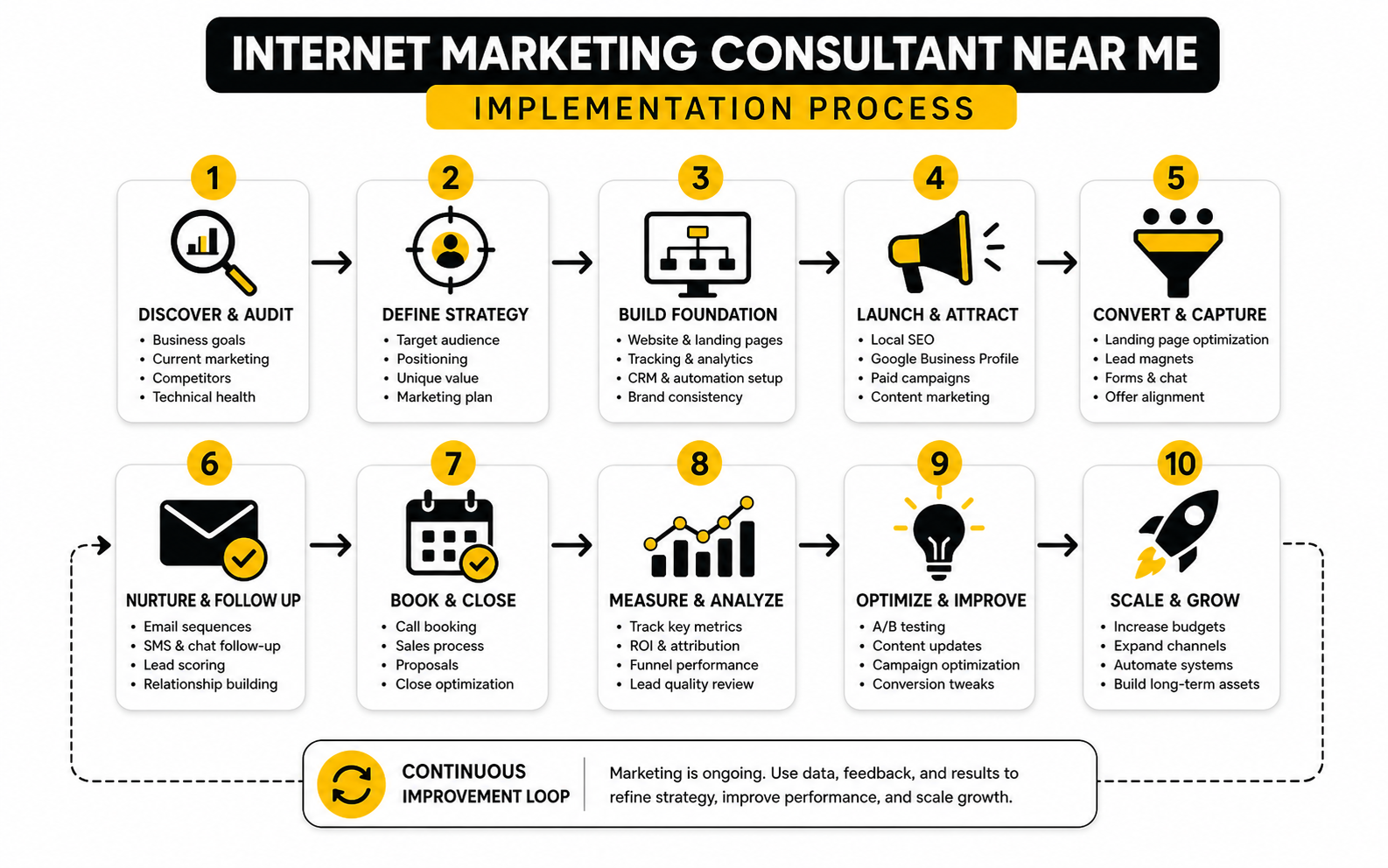
A Practical Execution Sequence
The sequence matters because doing the right things in the wrong order creates friction. If tracking is broken, you cannot trust the data. If the offer is unclear, traffic will underperform. If follow-up is slow, more leads will not solve the real problem.
A clean implementation plan often looks like this:
This is how a consultant turns a vague marketing engagement into a working operating rhythm. It also protects you from paying for busywork. When every action belongs to a sequence, it becomes much easier to see whether the strategy is moving in the right direction.
Content And Social Should Support The Buying Journey
Content is not just blog posts. For a local business, content includes service pages, comparison pages, FAQs, case proof, short videos, social posts, emails, booking pages, review responses, and even the way offers are explained. A consultant should help you use content to answer buying questions before prospects contact you.
Social media can support this, but it should not become random posting for the sake of looking active. A good content plan should show proof, explain problems, answer objections, demonstrate expertise, and keep the business visible between buying moments. Tools like Buffer or Flick Social can help organize publishing, but the strategy still has to come first.
The consultant should also know when content is not the immediate bottleneck. Sometimes the business needs better landing pages, stronger follow-up, cleaner reporting, or a sharper offer before publishing more. Practical marketing is not about doing everything; it is about doing the next most useful thing.
Measurement Keeps The System Honest
Measurement is what separates professional implementation from guesswork. You should not be left wondering whether marketing is working. The consultant should define the scoreboard early and keep it tied to business outcomes.
That scoreboard should not only show impressions, clicks, rankings, or followers. Those numbers can be useful, but they are not the finish line. The real questions are whether the business is getting better leads, converting more of them, lowering waste, improving follow-up, and learning which channels deserve more investment.
This is where a consultant becomes more valuable over time. Once the basics are implemented, the data starts showing where the next constraint sits. That is how the work compounds instead of turning into another monthly marketing expense.
Statistics And Data That Actually Matter
Measurement is where a consultant proves whether the strategy is working. Not by showing a pretty dashboard. Not by bragging about impressions. By connecting marketing activity to business outcomes you can actually use.
This is especially important when you search for an internet marketing consultant near me, because local marketing can look successful on the surface while still failing commercially. A campaign can get clicks without qualified leads. A page can rank without converting. A Google Business Profile can get views while calls stay flat.
The numbers only matter when they help you make a decision. Should you invest more in SEO? Should you pause a campaign? Should you rewrite an offer? Should you fix follow-up before buying more traffic? That is what data is for.
Start With The Business Outcome
The first benchmark is not traffic. It is the result the business needs. For one company, that may be booked appointments. For another, it may be quote requests, phone calls, form submissions, showroom visits, consultations, ecommerce orders, or repeat purchases.
A consultant should define the primary conversion before they talk about channel performance. If the business wants more qualified sales conversations, then reporting should not stop at sessions, clicks, or rankings. It should show how many real opportunities were created and how those opportunities moved through the sales process.
This is why generic benchmarks can be useful, but only as context. WordStream’s 2025 Google Ads benchmark report shows that search advertising costs and conversion rates vary widely by industry, which means a “good” cost per lead in one category can be completely unrealistic in another. The practical takeaway from Google Ads benchmarks by industry is simple: compare performance against your market, but judge success against your margins.
The Local Metrics Worth Tracking
A local marketing dashboard should be simple enough to use and deep enough to guide decisions. If the dashboard has 40 metrics and nobody knows what to do next, it is not a dashboard. It is decoration.
The useful metrics usually sit in five groups:
The consultant should not treat all of these equally. Early in the engagement, visibility and conversion issues may need more attention. Later, sales quality, lifetime value, and retention may become the bigger levers.
Why Benchmarks Can Mislead You
Benchmarks are helpful when they give context, but dangerous when they replace thinking. A 4% landing page conversion rate may be strong for one offer and weak for another. A high cost per lead may be perfectly acceptable if the average customer value is high.
This is where experienced consultants are different from spreadsheet operators. They do not panic because one metric looks expensive. They ask whether the lead is qualified, whether the close rate is strong, whether the customer value supports the acquisition cost, and whether the campaign can scale.
Ruler Analytics’ 2025 conversion benchmark research makes this clear by showing how conversion rates shift across industries and marketing sources. The useful lesson from conversion rates by industry and source is not that every business should chase the same number. It is that your own performance needs to be interpreted by channel, intent, industry, and sales process.
Build A Measurement System Before Scaling
A consultant should help you build the measurement system before pushing harder on traffic. This means analytics, call tracking, form tracking, CRM stages, campaign tagging, conversion events, and reporting rules need to be set up properly. If those basics are wrong, every decision after that becomes weaker.
For local businesses, the biggest problem is often attribution confusion. A customer might search on Google, read reviews, visit the website, click a retargeting ad, call from the Google Business Profile, and finally book after a follow-up text. If the reporting only credits the final click, the business may cut the wrong channel.
The solution is not perfect attribution. Perfect attribution is usually a fantasy. The goal is useful attribution: enough clarity to see which channels create demand, which ones capture demand, which ones assist conversion, and where prospects get stuck.
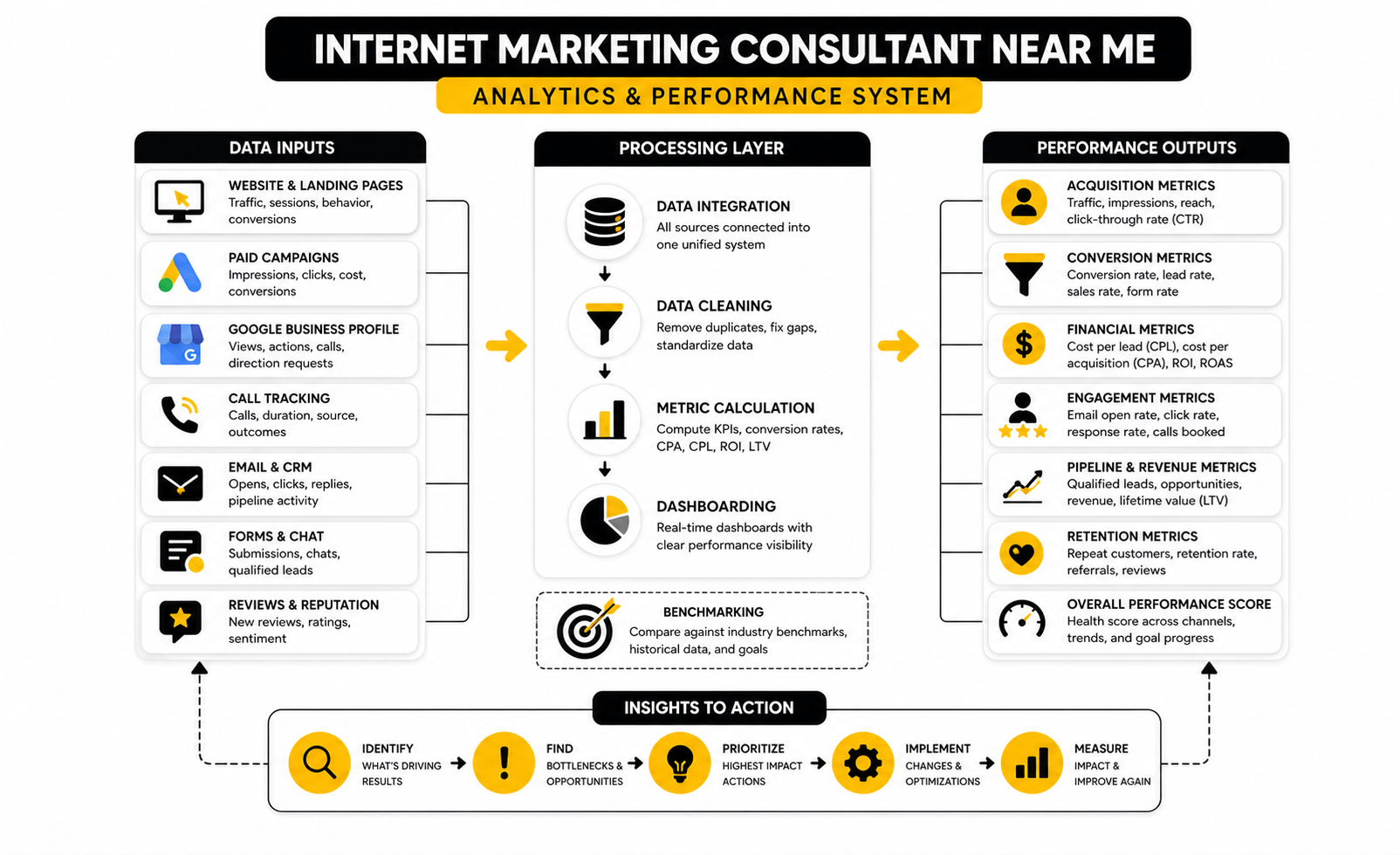
What A Consultant Should Report Every Month
Monthly reporting should tell a clear story. What changed? Why did it change? What did we learn? What are we doing next? If a report cannot answer those questions, it is not helping the business owner.
A useful monthly report should include:
This is where tools matter, but only because they support the process. A CRM like GoHighLevel can be useful when the business needs pipeline visibility, campaign tracking, booking data, SMS follow-up, and lead source reporting in one place. For email-heavy businesses, platforms like Brevo or Moosend can help measure nurturing, segmentation, and engagement.
Read Search Data By Intent
Search data is not just about volume. Intent matters more. A person searching “best accountant near me” is not behaving the same way as someone searching “what does an accountant do.”
A consultant should separate search data into categories. High-intent service searches usually deserve strong service pages and clear calls to action. Research searches may need educational content. Brand searches need reputation protection, clear reviews, and strong proof. Competitor and comparison searches may need sharper positioning.
This matters because the same traffic number can mean different things. One hundred visitors from urgent local searches may be more valuable than one thousand visitors from broad informational content. Good measurement helps you see the difference instead of treating all traffic as equal.
Measure Trust Signals, Not Just Traffic Sources
Local buyers do not make decisions from clicks alone. They look at reviews, photos, business details, response quality, website clarity, and proof that the company is active and reliable. That means trust signals should be part of the measurement conversation.
BrightLocal’s review research continues to show that reviews influence how consumers judge local businesses, and the latest survey reinforces how important review quality, recency, and response behavior are in the decision process. The practical point from the Local Consumer Review Survey is not “get more reviews” in a lazy way. It is that reputation needs to be managed as part of the conversion system.
A consultant should track review volume, rating trends, review recency, response consistency, and common themes in customer feedback. Those themes can improve ads, landing pages, service pages, sales scripts, and follow-up messages. Reviews are not just social proof; they are market research sitting in public.
Watch For Performance Signals That Reveal Bottlenecks
The best data often points to a bottleneck. If impressions are rising but clicks are flat, the problem may be titles, offers, positioning, or local relevance. If clicks are rising but leads are flat, the problem may be page conversion, trust, mobile experience, or call-to-action clarity.
If leads are rising but sales are flat, the issue may be lead quality, slow response, poor qualification, weak sales process, or bad follow-up. If sales are improving but profit is not, the business may need better pricing, higher-value offers, improved retention, or lower acquisition waste. Each signal points to a different action.
This is why a consultant should never report numbers in isolation. The value is in the interpretation. Data should lead to a decision, and the decision should lead to the next implementation cycle.
Use Data To Improve The Next Move
The point of analytics is not to feel smart. It is to make the next move better. A consultant should use data to decide what to keep, what to cut, what to test, and what to build next.
That may mean doubling down on a service page that converts well, rewriting a landing page that attracts clicks but loses visitors, changing ad targeting, tightening the offer, improving speed-to-lead, or creating a new follow-up sequence. It may also mean doing less. Sometimes the smartest move is to stop spending on a channel that looks busy but creates poor opportunities.
This is where marketing becomes calmer. You stop guessing. You stop reacting to every tiny fluctuation. You start improving the system based on evidence, one useful decision at a time.
How To Compare Consultants Near You
By now, the question is not whether marketing needs structure. It does. The real question is who you trust to build and improve that structure with you. This is where hiring an internet marketing consultant near me becomes less about geography and more about judgment.
A local consultant may understand your service area, competitors, and customer behavior better than someone working from a generic template. That can be useful, especially if your business depends on reputation, location intent, referrals, and repeat local visibility. But being nearby is not enough; the consultant still needs a clear process, honest measurement, and the discipline to avoid selling tactics before diagnosing the problem.
You are not hiring someone to “do marketing.” You are hiring someone to make better growth decisions with you. That distinction matters because a consultant who thinks strategically will protect your budget, your time, and your brand.
Choose A Specialist For The Bottleneck You Actually Have
Not every consultant should be hired for the same reason. Some are strongest in local SEO. Some are better at paid search. Some understand funnels, automation, email, CRM systems, or conversion strategy. A few can connect all of those pieces well, but many cannot.
The smart move is to match the consultant to your current constraint. If your business has no search visibility, a conversion specialist alone will not fix the top of the funnel. If you already get traffic but leads are weak, more SEO content may not be the first priority. If you get leads but sales are inconsistent, the real bottleneck may be follow-up, qualification, sales process, or offer clarity.
This is why your first conversation should feel like a diagnosis, not a pitch. A strong consultant will ask about margins, sales cycle, lead quality, current channels, close rates, service area, and operational capacity. A weak consultant will jump straight to a package.
Understand The Tradeoff Between Local Knowledge And Channel Expertise
Local knowledge helps when the consultant understands your market, competitors, neighborhoods, seasonal demand, and regional buying behavior. They may know how people compare providers in your area and which trust signals matter locally. That can shorten the learning curve.
Channel expertise helps when the consultant deeply understands a specific growth lever. For example, paid search requires skill with match types, intent, landing pages, bidding, budget control, and conversion tracking. Local SEO requires knowledge of service pages, Google Business Profile signals, reputation, technical site health, and local relevance.
The best hire depends on what you need next. A local generalist can be valuable when your system is messy and needs coordination. A channel specialist may be better when the strategy is clear but one high-value channel needs expert execution.
Watch For The Red Flags Early
Bad consulting usually shows up before the contract is signed. The warning signs are not always dramatic. Sometimes they sound polished, confident, and harmless.
Be careful when someone guarantees rankings, promises instant results, avoids talking about your economics, or cannot explain how their work connects to qualified leads. Be careful when they focus only on impressions, traffic, followers, or vague “brand awareness” while avoiding sales outcomes. Be careful when every problem somehow requires the exact same package.
You should also watch how they handle data. If a consultant cannot explain what they would track and why, they are probably not ready to manage performance. Search advertising benchmarks from WordStream and LocaliQ show wide variation in cost and conversion performance by industry, which makes fixed promises even more suspicious in real-world campaigns like 2025 Google Ads benchmarks and search advertising benchmarks.
Ask Better Questions Before You Hire
The quality of your questions will improve the quality of the consultant you attract. Do not only ask, “How much do you charge?” or “Can you get me more leads?” Those questions matter, but they are not enough.
Ask questions that reveal how the consultant thinks:
The last question is especially useful. A good consultant knows when they are not the right fit. A bad one treats every prospect as a sale.
Be Clear About Budget, Capacity, And Timing
Marketing does not happen in a vacuum. Your budget matters, but so does your ability to respond to leads, deliver the service, collect reviews, approve content, answer consultant questions, and make operational changes. If the business cannot support the strategy, even good marketing can underperform.
A consultant should help you think through capacity before scaling demand. More leads are not always good if your team cannot respond quickly, qualify properly, or deliver a strong customer experience. In that case, scaling traffic can expose operational problems instead of solving growth.
Timing matters too. Paid search can produce signals faster, but it can also waste money quickly if tracking and landing pages are weak. SEO and reputation work usually compound more slowly, but they can become durable assets. The right plan often blends short-term demand capture with long-term authority building.
Decide What Should Be Done In-House Versus Outsourced
A consultant does not need to do everything. In fact, the best setup may involve the consultant leading strategy while your internal team handles parts of execution. This can reduce cost and keep important knowledge inside the business.
For example, your team may be best positioned to collect customer photos, request reviews, answer service questions, record short videos, or approve local messaging. The consultant may be better suited for strategy, keyword mapping, analytics, paid campaigns, funnel structure, automation, and performance interpretation. The right split depends on skill, speed, and accountability.
Be honest about what your team will actually do. If internal execution always gets delayed, outsourcing may be cheaper than pretending. If your team is capable and consistent, a consultant can become a force multiplier instead of a full-service replacement.
Choose Tools Based On Workflow, Not Hype
Software should support the growth system, not become the strategy. A consultant may recommend a CRM, landing page builder, email platform, social scheduler, analytics tool, or AI assistant. That is fine, but every tool should have a clear job.
If your issue is lead response and pipeline visibility, GoHighLevel may be a practical choice because it can bring forms, calendars, automations, SMS, and pipeline management closer together. If your issue is offer pages or funnel testing, ClickFunnels, Systeme.io, or Replo may make sense depending on your business model.
For content and communication workflows, tools like Buffer, ManyChat, Chatbase, or Fillout can help when there is a clear use case. Do not buy tools because a consultant has a favorite stack. Buy them because they remove friction from a process that already makes sense.
Think About Scaling Before You Scale
Scaling is not just spending more. It is increasing volume without breaking the economics or the customer experience. That means the consultant should know which parts of the system can handle more demand and which parts will fail under pressure.
Before scaling, look at lead quality, close rate, response speed, delivery capacity, customer satisfaction, review flow, and profit per customer. If those numbers are unstable, more traffic can create more chaos. If they are strong, scaling becomes much safer.
This is also where advanced measurement matters. Ruler Analytics’ 2025 conversion benchmark data shows how much performance can vary by source and industry, which reinforces a simple point from conversion rates by industry and marketing source: scale the channels that produce profitable customers, not just cheap leads.
Protect Your Brand While You Grow
A consultant should help you grow without making your business look desperate, generic, or spammy. This matters in local markets because reputation travels fast. Pushy claims, fake urgency, low-quality AI content, aggressive review tactics, or misleading ads can damage trust.
Review strategy is a good example. You want more reviews, but you also want them collected ethically, responded to professionally, and used to improve the customer experience. BrightLocal’s ongoing local consumer research shows that reviews remain a major part of how consumers judge local businesses, which makes reputation management a growth function, not just a public relations task through the Local Consumer Review Survey.
Brand protection also means keeping your messaging consistent. Your ads, landing pages, Google profile, website, emails, and sales conversations should all feel like the same business. When the message changes from channel to channel, buyers feel friction even if they cannot explain why.
Structure The Engagement Around Decisions
The best consulting relationships have a rhythm. There is an audit, a roadmap, execution cycles, reporting, interpretation, and new decisions. Everyone knows what is being worked on and what success looks like.
That rhythm protects both sides. You are not guessing whether the consultant is busy. The consultant is not chasing random requests every week. The work stays connected to measurable priorities.
Before hiring, ask how the engagement will be managed. You should understand the meeting cadence, reporting format, communication channels, access requirements, approval process, and decision points. If the consultant cannot explain how the work will run, the work will probably feel messy later.
Final Hiring Checklist
The right consultant should make your marketing feel clearer, not more confusing. Before you hire anyone, step back and look at the full system: positioning, visibility, conversion, follow-up, measurement, and decision-making. If the consultant cannot explain how those pieces connect, they are probably selling services instead of solving the growth problem.
A strong hiring decision usually comes down to fit. You want someone who understands your market, respects your economics, communicates clearly, and can show how their work will be judged. That does not always mean hiring the biggest agency or the cheapest freelancer; it means hiring the person or team most likely to improve the next bottleneck.
Use this checklist before signing anything:
What does an internet marketing consultant near me actually do?
An internet marketing consultant helps you improve how your business attracts, converts, and retains customers online. For a local business, that can include local SEO, Google Business Profile optimization, paid ads, landing pages, email follow-up, review strategy, CRM setup, analytics, and conversion improvement. The best consultant does not just “do marketing”; they help you find the highest-impact constraint and fix it in the right order.
Is it better to hire a local consultant or a remote specialist?
A local consultant can be valuable when your business depends heavily on local search behavior, regional competition, community reputation, and service-area knowledge. A remote specialist can be better when you need deep expertise in a specific channel like Google Ads, SEO, funnels, CRM automation, or conversion rate optimization. The best choice depends on the bottleneck you need solved, not just where the consultant is located.
How much should I expect to pay for internet marketing consulting?
Pricing depends on the scope, market, experience level, and whether the consultant is advising, implementing, or managing campaigns. A simple audit may be a one-time project, while ongoing consulting and execution can become a monthly retainer. The more important question is whether the work can realistically improve revenue, reduce waste, or create a system that compounds over time.
What should I prepare before speaking with a consultant?
You should prepare your current website, Google Business Profile, analytics access if available, ad account access if relevant, CRM or lead tracking data, and a rough idea of your average customer value. You should also know what you want more of: calls, bookings, quote requests, purchases, reviews, repeat customers, or qualified sales conversations. A consultant can help refine the goal, but they need real business context to give useful advice.
How long does it take to see results?
Some fixes can show movement quickly, especially tracking repairs, landing page improvements, missed-call follow-up, and campaign cleanup. SEO, reputation building, content, and organic authority usually take longer because they depend on consistency, competition, and trust signals. A good consultant should separate quick wins from long-term assets so expectations stay realistic.
What is the difference between a consultant and an agency?
A consultant usually focuses on diagnosis, strategy, decision-making, and guidance, although many also help with implementation. An agency often provides a broader execution team across content, ads, SEO, design, development, and reporting. Either can work, but the key is whether you get clear thinking, accountable execution, and honest interpretation of the data.
Should a consultant manage my ads?
A consultant should manage your ads only if paid traffic is the right lever for your business and the tracking is strong enough to judge results. Ads can reveal demand quickly, but they can also waste money when offers, landing pages, or follow-up systems are weak. Before increasing spend, the consultant should confirm that leads can be captured, tracked, qualified, and converted.
Do I need a CRM before hiring a consultant?
You do not always need a CRM before hiring a consultant, but you do need a way to track leads and outcomes. If inquiries are coming through calls, forms, chats, emails, and social messages, a CRM can make the system much easier to manage. Tools like GoHighLevel or Copper can be useful when the business needs better pipeline visibility and follow-up discipline.
What are the biggest mistakes businesses make when hiring a consultant?
The biggest mistake is hiring for activity instead of outcomes. Many businesses pay for posts, clicks, reports, or technical tasks without understanding how those actions connect to qualified leads and revenue. Another common mistake is choosing the cheapest option, then spending months with unclear strategy, weak communication, and no useful measurement.
How do I know if a consultant is overpromising?
Be careful with anyone who guarantees rankings, promises instant leads without seeing your numbers, or claims one tactic will solve everything. Real marketing depends on your market, offer, competition, budget, conversion path, follow-up speed, and sales process. A trustworthy consultant will explain risks, assumptions, and tradeoffs instead of pretending growth is automatic.
Should my consultant help with content?
Yes, but content should support the buying journey instead of existing just to fill a calendar. For local businesses, useful content can include service pages, comparison pages, location pages, FAQs, short videos, case proof, email sequences, and review-driven messaging. The consultant should know when content is the right next move and when conversion, tracking, or follow-up deserves attention first.
What tools should an internet marketing consultant recommend?
The tools should match the workflow. A funnel builder like ClickFunnels or Systeme.io can help when campaigns need focused offer pages and follow-up. A communication tool like Brevo, Moosend, or ManyChat can help when nurturing, reminders, or conversations are part of the sales path.
What should monthly reporting include?
Monthly reporting should include the business goal, the work completed, the main numbers, what changed, what the data means, and what happens next. It should not only show impressions, clicks, rankings, or followers unless those numbers are tied to a useful interpretation. A good report should make decisions easier and show whether the marketing system is becoming stronger.
Can one consultant handle SEO, ads, funnels, automation, and analytics?
Some can, but many cannot do all of those well. A good generalist can often diagnose the full system and coordinate the right priorities, while specialists may be needed for deeper execution in competitive channels. The important thing is honesty; the consultant should be clear about what they do personally, what they outsource, and where another expert would be better.
When should I not hire an internet marketing consultant?
You may not be ready if you do not know your offer, cannot handle more leads, have no budget for implementation, or are unwilling to make operational changes. A consultant can guide the system, but they cannot fix a business that refuses to respond to leads, serve customers well, or track outcomes. In that case, it may be more carefully to fix the basics first and bring in consulting when the business can actually use the support.
Build a stronger local presence with BAAM AI
Turn your website, Google profile, social channels, and AI visibility into one growth engine
Most businesses do not need more random marketing activity. They need a consistent presence system that helps the right people find them, trust them, and take action. BAAM AI brings strategy, local SEO, website updates, Google Maps visibility, social content, AI-search readiness, media production, and reporting into one practical monthly engine.
If you want your marketing to keep working after the campaign ends, start with a free BAAM AI presence audit. See how your business shows up today and where the fastest visibility wins are at BAAM AI.