
BAAM AI Blog
Internet Marketing Advertising: A Practical Framework For Building Campaigns That Actually Convert
Internet marketing advertising is the practice of using paid digital channels to attract, persuade, and convert people online. It includes search ads, social ads, display ads, video ads, creator campaigns...
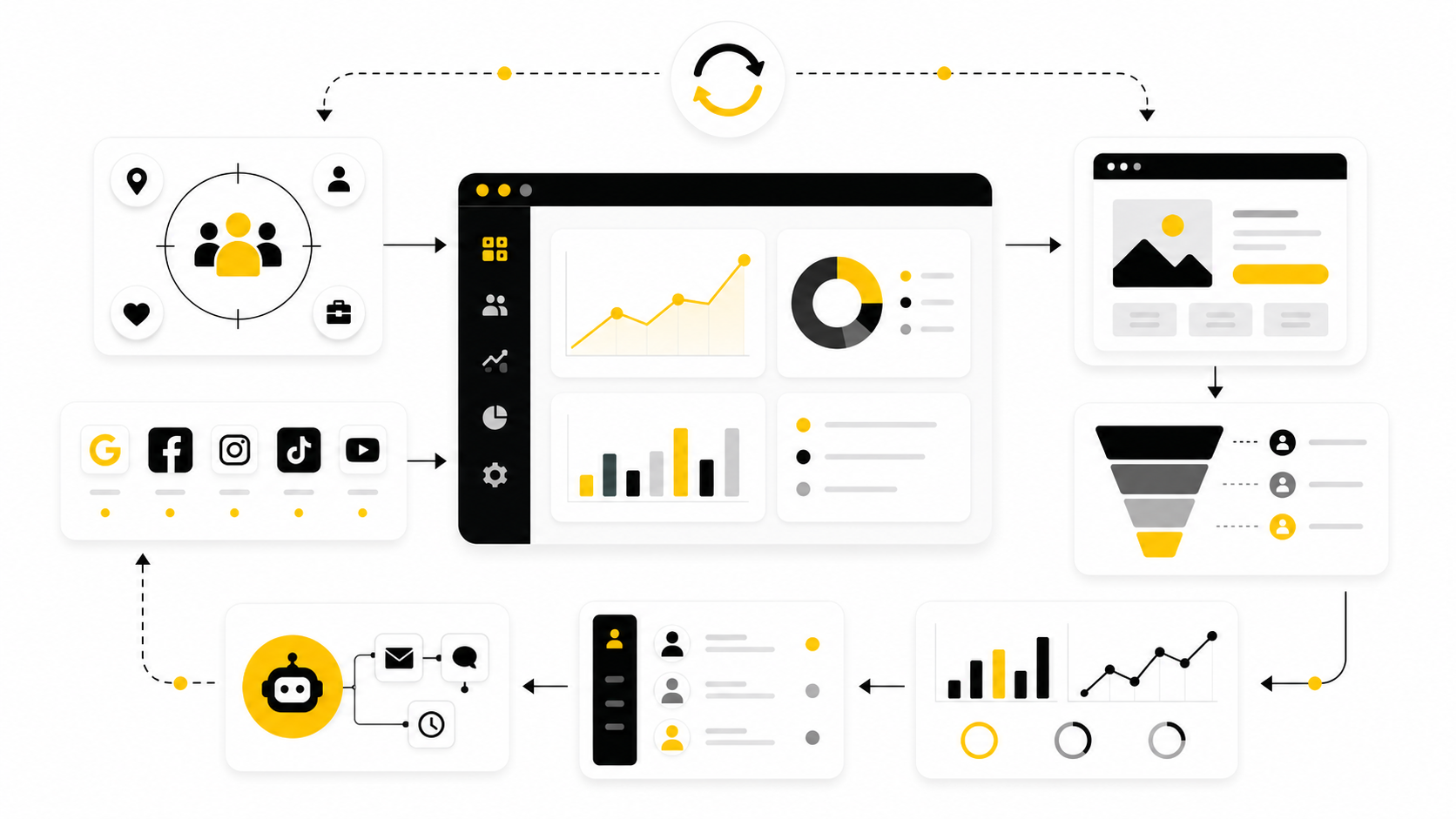
Internet marketing advertising is the practice of using paid digital channels to attract, persuade, and convert people online. It includes search ads, social ads, display ads, video ads, creator campaigns, retargeting, email-driven funnels, landing pages, tracking, automation, and the measurement systems that connect ad spend to revenue. Done well, it is not just “running ads”; it is a structured growth system that turns attention into measurable business outcomes.
The reason this matters is simple: the internet is where buying decisions now begin, accelerate, and often finish. At the start of 2025, there were 5.56 billion internet users worldwide, and digital advertising kept expanding because brands followed that attention. In the United States alone, internet advertising revenue reached nearly $300 billion in 2025, which shows how central online channels have become to modern customer acquisition.
But here is the catch: more spend does not automatically mean better results. Internet marketing advertising has become more automated, more competitive, and more expensive to run badly. The winners are not the brands that simply boost posts or copy competitors; they are the brands that understand their market, build clear offers, match the right message to the right channel, and measure what actually moves revenue.
Why Internet Marketing Advertising Matters Now
Internet marketing advertising matters because buyer behavior has become fragmented. A customer might discover a brand through a short-form video, compare options through search, read reviews on a marketplace, click a retargeting ad, join an email list, and finally buy after seeing a follow-up message. That journey is not linear, so the advertising system cannot be linear either.
This is why digital channels keep taking a larger share of total advertising budgets. WPP Media projected that digital advertising would represent 73.2% of global ad revenue in 2025, while IAB reported strong U.S. growth across internet advertising as video, social, AI-supported buying, and performance channels continued to expand. The market is sending a clear signal: brands want advertising that can be targeted, tested, adjusted, and tied to outcomes.
The practical lesson is that internet marketing advertising is no longer optional for most businesses. Even brands that rely on referrals, sales teams, retail partners, or offline visibility still need digital proof, digital follow-up, and digital conversion paths. People may hear about you somewhere else, but they usually check you online before they trust you.
The Internet Marketing Advertising Framework
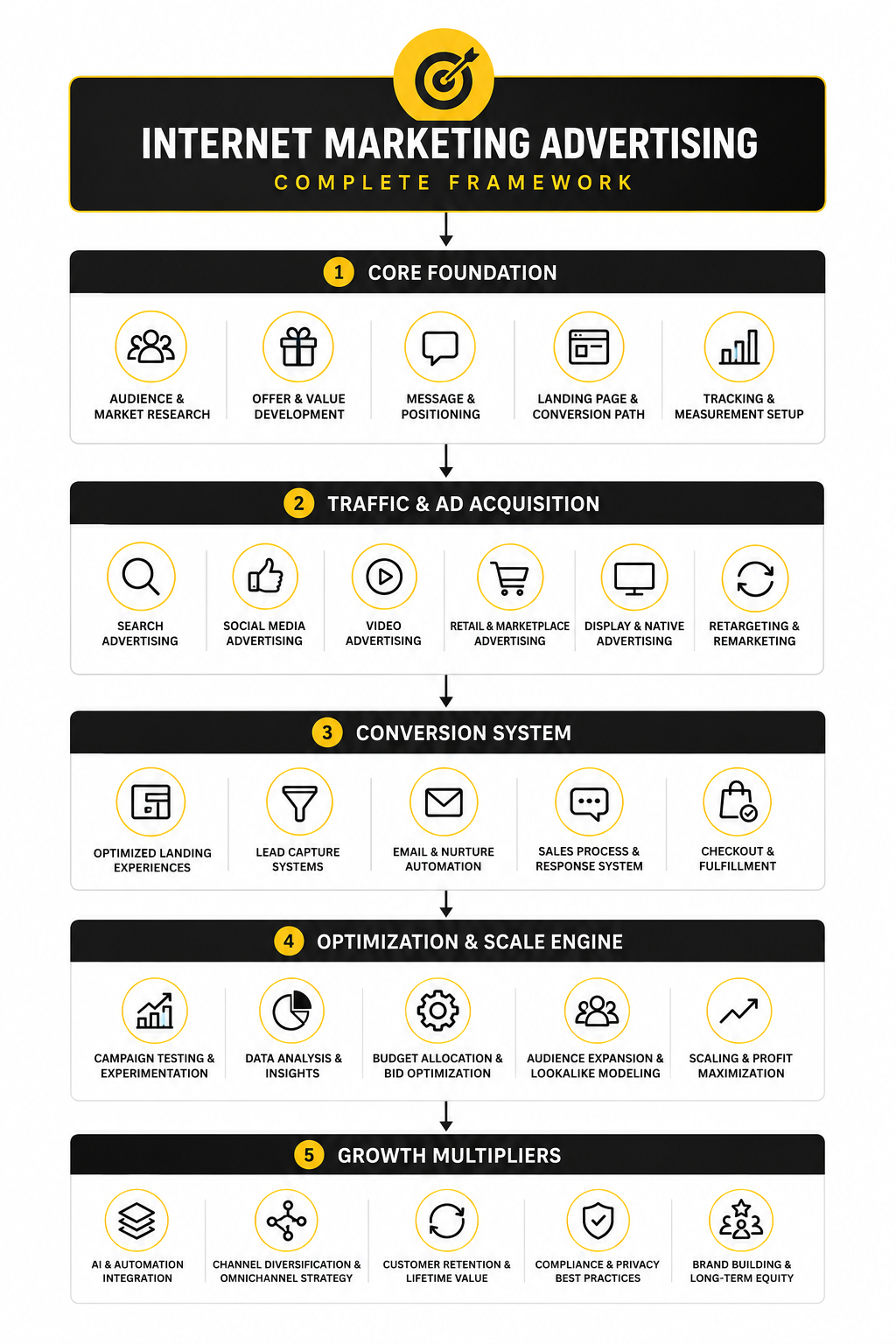
The most useful way to think about internet marketing advertising is as a connected framework, not a pile of separate tactics. Search ads, social ads, landing pages, email automation, CRM follow-up, and analytics all do different jobs, but they should work toward the same commercial goal. When they are disconnected, you get clicks without clarity, leads without follow-up, and reports that look busy without proving growth.
A simple framework starts with the market, then moves into the offer, message, channel, conversion path, follow-up, and measurement. Each layer depends on the one before it. If the offer is weak, better targeting will not save it; if the landing page is confusing, more traffic just creates more waste; if tracking is broken, scaling becomes guesswork.
This is also where tools can help, but only after the strategy is clear. A business that needs lead capture, pipeline tracking, appointment booking, and automated follow-up may benefit from an all-in-one platform like GoHighLevel. A brand that relies heavily on Messenger, Instagram DM, or WhatsApp-style conversations may use ManyChat to turn ad engagement into automated conversations, lead qualification, and follow-up flows.
Market
The market layer answers the most important question: who are you trying to reach, and what problem are they already trying to solve? Good internet marketing advertising does not start with ad creative; it starts with demand. You need to know what people search for, what they compare, what objections slow them down, and what triggers them to act now instead of later.
This layer also prevents lazy targeting. “Business owners,” “moms,” “fitness people,” or “ecommerce brands” are not useful audiences by themselves. A real market definition includes the buyer’s situation, pain, urgency, awareness level, decision criteria, and likely buying path.
Offer
The offer is the reason someone should take action. It can be a product, consultation, free trial, demo, discount, webinar, quote request, checklist, audit, or direct purchase. The key is that the offer must match the temperature of the audience.
Cold audiences usually need more context, trust, and education before they convert. Warm audiences may respond to proof, comparison, urgency, or a direct next step. Hot audiences need friction removed, which means clear pricing, strong calls to action, simple forms, and fast follow-up.
Message
The message turns the offer into something the buyer immediately understands. It should make the value clear, address the main objection, and give the user a reason to keep moving. This is where many campaigns fail because they talk about features before the audience believes the outcome matters.
Strong messaging is specific without becoming complicated. It connects the problem, desired result, proof, and next action in a way that feels natural. In internet marketing advertising, clarity usually beats cleverness because the user is distracted, skeptical, and one swipe away from leaving.
Channel
The channel determines how the message gets delivered. Search advertising captures existing intent, while social advertising can create demand before someone actively searches. Video, display, creator campaigns, email retargeting, and marketplace ads each play different roles in the journey.
Choosing the channel should depend on buyer intent, product complexity, sales cycle, creative resources, and measurement quality. A local service business may prioritize search and lead forms. A consumer brand may need social video, creator content, landing pages, and email flows working together.
Conversion Path
The conversion path is what happens after the click. This includes the landing page, form, checkout, calendar, quiz, chatbot, email capture, or sales page. If this step is weak, the campaign may look like a traffic problem when it is actually a conversion problem.
A good conversion path keeps the promise made in the ad. The headline should match the ad angle, the page should answer the next logical question, and the call to action should feel obvious. For ecommerce brands that need faster landing page testing, a dedicated landing page builder like Replo can be useful when the goal is to launch and iterate high-converting pages without waiting on a full development cycle.
Follow-Up
Follow-up is where a lot of profit is made or lost. Most people do not buy the first time they click, and many leads are not ready the moment they submit a form. Without follow-up, paid traffic becomes unnecessarily expensive because every campaign has to force immediate conversion.
This is why email, SMS, retargeting, CRM stages, appointment reminders, and sales notifications matter. They turn one ad click into a sequence of touchpoints. Tools like Brevo or Moosend can fit naturally here when email nurturing is a meaningful part of the advertising system.
Measurement
Measurement is the feedback loop that tells you what to improve. It should connect spend, impressions, clicks, leads, sales, revenue, retention, and profit wherever possible. If measurement stops at clicks or platform-reported conversions, the business may optimize for activity instead of outcomes.
This matters even more as privacy rules, platform automation, and AI-based campaign types change how advertisers control targeting. Google introduced AI Max for Search campaigns to expand reach through AI-driven matching and creative enhancements, while Meta has continued investing in machine-learning systems such as Andromeda to improve ad retrieval and personalization. The direction is clear: platforms are taking on more campaign execution, which makes your strategy, data quality, creative inputs, and business-level measurement even more important.
Core Components Of A High-Performing Advertising System
A strong internet marketing advertising system is not built from one winning ad. It is built from components that reinforce each other: research, positioning, creative, media buying, landing pages, follow-up, tracking, and optimization. When those pieces are aligned, the business can learn faster, reduce waste, and scale with more confidence.
The mistake is treating each component like a separate task. A media buyer cannot fix a weak offer forever. A designer cannot make unclear positioning convert forever. A great landing page cannot rescue traffic from the wrong audience forever. The system works when every piece has a clear job and every job connects to revenue.
Audience Research
Audience research is the foundation because advertising only works when it reflects what buyers already care about. You are looking for the language people use, the objections they repeat, the alternatives they compare, and the events that push them to act. This is not guesswork; it comes from search data, sales calls, reviews, comments, surveys, customer interviews, CRM notes, and competitor analysis.
The best research often feels obvious after you find it. You notice that customers do not describe the problem the way your internal team does. You see that the feature you keep promoting is less important than speed, trust, risk reduction, status, convenience, or certainty.
This matters because most internet marketing advertising fails before the campaign ever launches. The ads are written around what the company wants to say instead of what the customer needs to hear. Good research fixes that by making the buyer’s real decision process visible.
Positioning
Positioning explains why your offer should win in the mind of a specific buyer. It is not a slogan, and it is not a long brand manifesto. It is the practical answer to this question: why should this person choose you instead of doing nothing, delaying the decision, or choosing someone else?
Good positioning narrows the message. It defines who the offer is for, what outcome it helps them achieve, why it is different, and what proof supports the claim. Without that clarity, internet marketing advertising becomes expensive because every ad has to work harder to explain basic relevance.
Positioning also protects you from copying competitors. If five brands in the same space all promise “growth,” “automation,” or “better results,” the buyer hears noise. The brand that wins is usually the one that makes the buying decision feel simpler.
Creative Strategy
Creative strategy is where research and positioning become ads people actually notice. It covers the hook, angle, format, visual style, proof, call to action, and emotional trigger behind each ad. In modern campaigns, creative is not decoration; it is one of the biggest performance levers.
This is especially true as platforms rely more heavily on machine learning. When targeting becomes broader and automated systems decide who sees what, the creative carries more of the segmentation work. The ad itself signals who it is for, what problem it solves, and why the viewer should care.
Strong creative strategy usually includes multiple angles instead of tiny variations of the same idea. One angle may focus on pain, another on speed, another on comparison, another on proof, and another on a specific use case. That gives the campaign more ways to find profitable demand.
Paid Search
Paid search is one of the cleanest forms of internet marketing advertising because it captures people who are already looking for something. A search user often has a problem, a question, or a buying intent before the ad appears. That makes search powerful for lead generation, local services, ecommerce, software, and high-intent comparison terms.
The strength of paid search is intent. Someone searching for “emergency plumber near me,” “best CRM for agencies,” or “running shoes for flat feet” is giving you a direct signal. The weakness is that search can become expensive when competition is high, landing pages are weak, or campaigns chase broad keywords without enough commercial relevance.
Search campaigns need disciplined structure. Brand terms, competitor terms, problem-aware terms, product-aware terms, and bottom-of-funnel buying terms should not all be treated the same. Each group needs matching copy, landing pages, bidding logic, and measurement.
Paid Social
Paid social is different because it usually interrupts rather than responds to intent. People are scrolling, watching, commenting, or messaging, not necessarily searching for a solution at that moment. That means the ad has to earn attention before it can earn the click.
This is why paid social depends so heavily on hooks, creative volume, audience insight, and offer clarity. The platform can find pockets of interest, but the ad still has to stop the scroll and make the next step feel worthwhile. For teams managing frequent social publishing alongside paid campaigns, a scheduling and planning tool like Buffer can help keep organic and paid messaging more consistent.
Paid social also gives brands a useful testing ground. You can test angles, visuals, objections, and offers quickly, then use the winners across landing pages, emails, sales scripts, and retargeting. That is where the channel becomes more than traffic; it becomes a market feedback engine.
Video Advertising
Video advertising has become central because it can demonstrate value faster than text alone. It can show the product, explain the problem, introduce a founder, display proof, or make a complex offer easier to understand. The format works across social platforms, YouTube, connected TV, landing pages, and retargeting sequences.
Recent market data supports the shift. IAB reported that U.S. digital video advertising grew 25.4% year over year in 2025, making it one of the strongest growth areas in internet advertising. Dentsu’s 2026 forecast also pointed to online video as one of the faster-growing digital channels, alongside retail media and social advertising.
The practical point is not that every business needs cinematic production. Most businesses need clear, useful video assets that answer real buyer questions. A strong founder video, product walkthrough, customer proof clip, demo, or objection-handling ad can outperform polished content that says nothing specific.
Landing Pages And Funnels
A landing page is where attention becomes action. It should continue the conversation started by the ad, remove friction, and make the next step obvious. If the page feels disconnected from the ad, the user loses confidence quickly.
Funnels go one step further by shaping the whole path from click to conversion. That might include a quiz, opt-in page, webinar registration, checkout, upsell, appointment page, nurture sequence, or sales follow-up. For creators, coaches, consultants, and direct-response offers, a funnel platform like ClickFunnels can fit when the goal is to build structured conversion paths without stitching together too many separate tools.
The best funnels are not complicated for the sake of looking advanced. They are simple where the buyer needs speed and detailed where the buyer needs reassurance. Every step should either increase trust, qualify intent, or move the person closer to a decision.
Email And Lifecycle Marketing
Email turns paid traffic into a longer-term asset. When someone joins your list, books a call, starts a trial, abandons checkout, or downloads a resource, the relationship should not depend only on another ad impression. Email lets you educate, follow up, segment, and bring people back when they are ready.
This is important because not every buyer converts immediately. Some need a few days to compare options. Others need internal approval, more proof, a reminder, or a better-timed offer. Lifecycle marketing handles those gaps without forcing your ad budget to do all the work.
A healthy email system includes welcome sequences, lead nurture, promotional campaigns, abandoned-cart flows, reactivation campaigns, and customer onboarding. It also needs restraint. The goal is to stay useful and relevant, not blast people until they unsubscribe.
CRM And Sales Follow-Up
For lead generation, the CRM is where advertising performance becomes sales performance. A lead is not valuable just because a form was submitted. It becomes valuable when it is contacted quickly, qualified properly, followed up with consistently, and tracked through the pipeline.
This is where many campaigns quietly leak revenue. The ad platform may report conversions, but the sales team may respond too slowly, miss calls, forget follow-ups, or fail to update lead status. When that happens, the campaign gets blamed even though the real problem is operational.
A practical CRM setup should show where every lead came from, what they requested, who owns the follow-up, what stage they are in, and what revenue eventually closed. For service businesses and agencies, platforms like GoHighLevel are often used because they combine lead capture, CRM, pipelines, booking, messaging, automation, and reporting in one place.
Analytics And Attribution
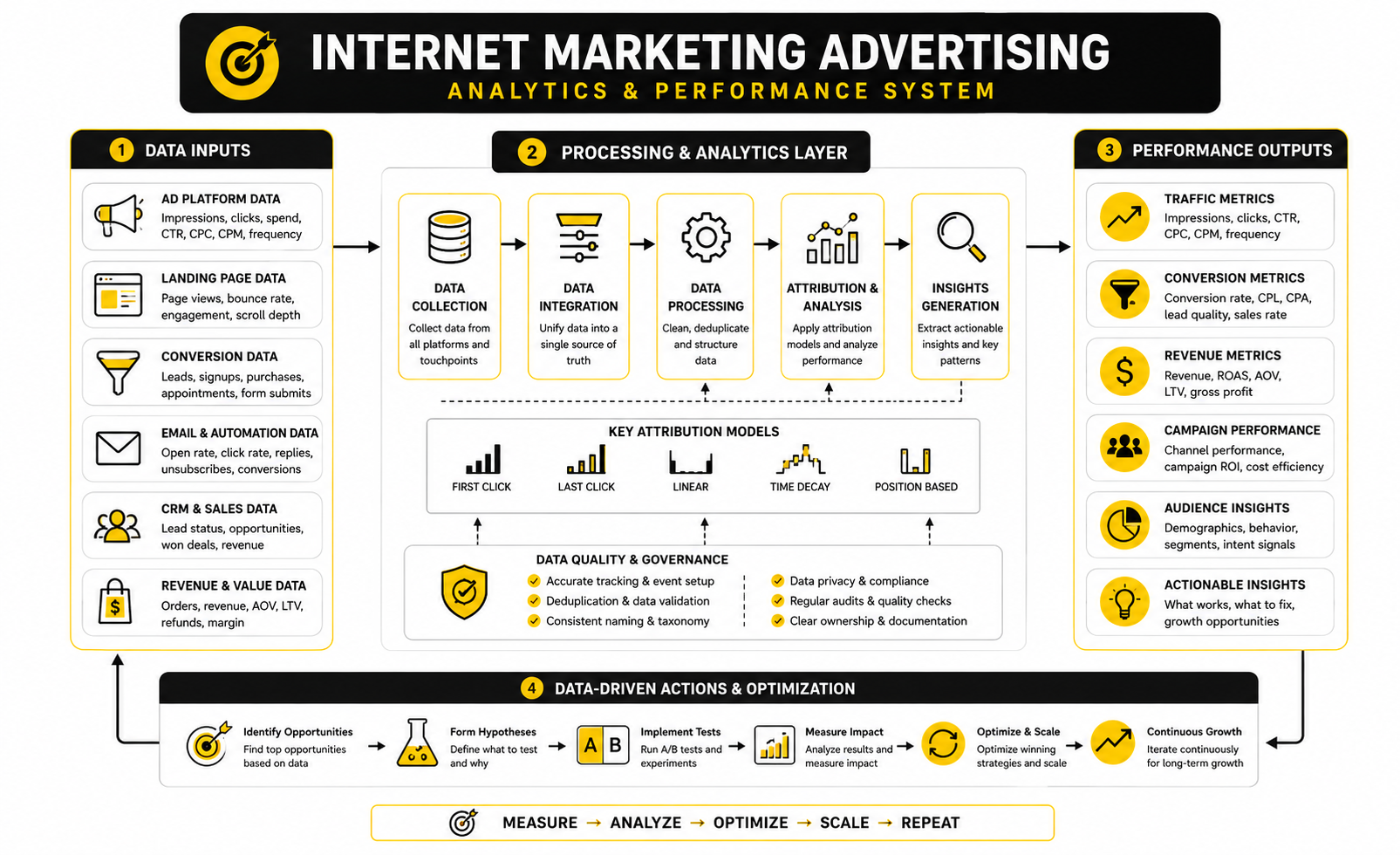
Analytics tells you what happened; attribution tries to explain what influenced it. Both are useful, but neither should be treated like perfect truth. Modern buyers move across devices, browsers, platforms, and sessions, while privacy changes have made tracking less complete than it used to be.
That means you need several layers of measurement. Platform data can help with tactical optimization. Website analytics can show behavior after the click. CRM and revenue data can show lead quality, close rates, and customer value. Together, these sources give a more realistic view than any one dashboard alone.
The main goal is decision quality. You want to know which campaigns deserve more budget, which offers need work, which channels bring profitable customers, and which metrics are just noise. Internet marketing advertising becomes much easier to scale when reporting is designed around business decisions instead of vanity metrics.
Professional Implementation: From Strategy To Launch
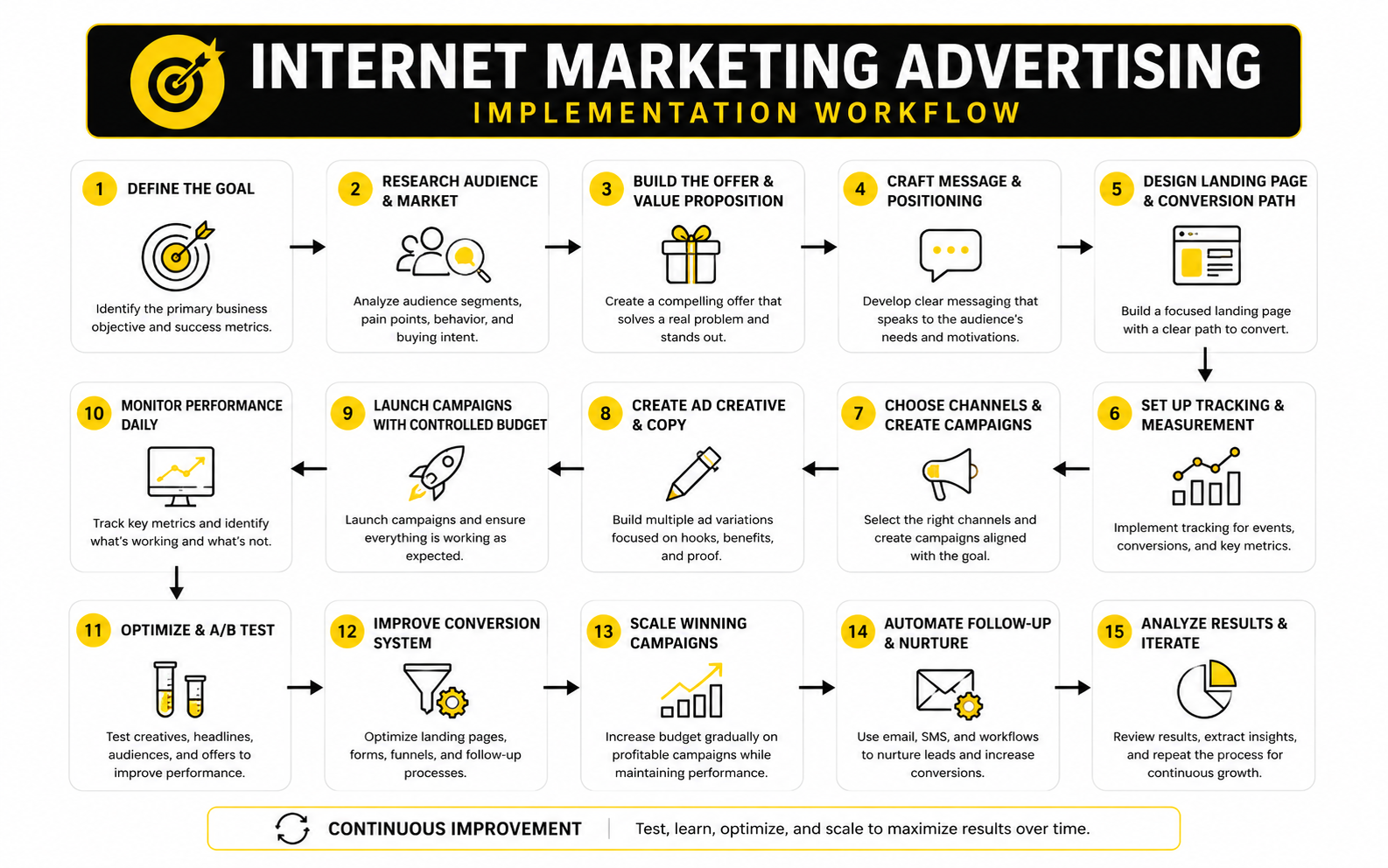
Professional implementation is where internet marketing advertising becomes real. Strategy matters, but the campaign only improves when the team turns the strategy into assets, tracking, pages, automation, budgets, and a launch process that can be inspected. This is the point where vague ideas have to become specific decisions.
A proper implementation process reduces chaos. It makes sure the ad promise matches the landing page, the offer matches the audience, the tracking matches the business model, and the follow-up matches the buyer’s urgency. Without this step-by-step discipline, teams usually launch too fast, miss obvious gaps, and then spend the next month trying to understand why the numbers do not make sense.
Step 1: Define The Commercial Goal
The first step is not choosing Meta, Google, TikTok, YouTube, or any other platform. The first step is defining the business outcome the campaign is supposed to create. That might be booked calls, qualified demos, ecommerce purchases, trial starts, webinar registrations, quote requests, store visits, or pipeline value.
This needs to be specific because different goals require different campaign structures. A campaign built for cheap leads is not the same as a campaign built for high-quality sales opportunities. A campaign built for first purchases is not the same as a campaign built for repeat revenue.
The commercial goal also gives the team a decision filter. If an idea does not help the campaign reach the goal, it can wait. This sounds basic, but it prevents a lot of wasted work.
Step 2: Clarify The Offer And Action
Once the goal is clear, the offer needs to be sharpened. The offer should make the next action feel logical and low-friction for the right person. A cold audience may need a guide, quiz, audit, trial, sample, or short demo before they are ready for a sales conversation.
The action should also match the buyer’s level of intent. If someone is actively searching for a solution, a direct quote request or demo may work well. If someone is discovering the problem for the first time on social, the same action may feel too aggressive.
This is where funnel design becomes practical. A direct-response funnel in ClickFunnels, a lighter build in Systeme.io, or an ecommerce landing page in Replo can all work, but the tool is secondary. The real job is making the next step obvious enough that the right buyer does not have to think too hard.
Step 3: Build The Campaign Brief
A campaign brief keeps everyone aligned before production starts. It should define the audience, offer, main promise, objections, proof points, channels, creative angles, landing page requirements, tracking events, launch budget, and success criteria. It does not need to be fancy, but it does need to be clear.
This brief is especially important when several people touch the campaign. The strategist, copywriter, designer, media buyer, developer, sales team, and founder may all have different assumptions. The brief turns those assumptions into one shared plan.
A good brief also prevents random creative requests. Instead of saying “make five ads,” the team can say “make two pain-led ads, two proof-led ads, two comparison ads, and one direct offer ad.” That difference matters because it creates useful tests instead of cosmetic variations.
Step 4: Map The Buyer Journey
The buyer journey shows what happens before, during, and after the click. It should include the first touchpoint, the ad, the landing page, the conversion action, the thank-you page, the confirmation message, the follow-up sequence, and the sales or checkout process. This map reveals friction before the budget starts moving.
For lead generation, the journey might go from ad to landing page, then form submission, then calendar booking, then SMS reminder, then sales call, then pipeline follow-up. For ecommerce, it might go from ad to product page, then cart, checkout, post-purchase email, review request, and repeat-purchase campaign. The shape changes, but the principle stays the same.
This is also where automation earns its place. A platform like GoHighLevel can help when the journey requires forms, booking, CRM stages, missed-call text back, pipeline automation, reminders, and sales follow-up in one connected workflow. That kind of setup is not just convenient; it can protect revenue that would otherwise leak after the lead is generated.
Step 5: Create The Landing Page
The landing page should make the ad feel instantly familiar. The headline should reflect the promise or angle from the ad, the first section should explain the value quickly, and the rest of the page should answer the questions a serious buyer would naturally ask. If the page feels like a generic website page, it usually asks the visitor to do too much work.
A strong landing page normally includes a clear promise, relevant proof, concise benefits, objection handling, a simple call to action, and enough context to support the decision. The page should not bury the offer under brand fluff. It should help the visitor decide whether the next step is right for them.
For internet marketing advertising, page speed and message match matter because attention is fragile. If the page loads slowly, looks inconsistent, or introduces a different offer than the ad, conversion rates suffer. The click is not the win; the page still has to earn the action.
Step 6: Prepare Creative Assets
Creative production should start from angles, not formats. The team should decide what beliefs the campaign needs to create or change, then build assets that support those beliefs. A static image, short video, carousel, testimonial clip, founder message, product demo, or comparison ad can all work when the underlying angle is strong.
This is where teams should produce enough variation to learn something. Testing five versions of the same hook with slightly different colors is not a real creative test. Testing different motivations, objections, use cases, and proof points gives the platform and the team better information.
Creative also needs to fit the channel. A search ad needs relevance and intent match. A short-form video needs a fast hook and a reason to keep watching. A retargeting ad needs to remind, reassure, or answer the objection that stopped the user from converting earlier.
Step 7: Set Up Tracking And Events
Tracking should be planned before launch, not patched afterward. At minimum, the team needs to know which events matter, where they fire, and how they connect back to revenue. Common events include page views, form submissions, purchases, booked appointments, trial starts, qualified leads, and closed sales.
Platform automation makes this even more important. Google’s AI Max for Search campaigns uses AI-driven targeting and creative enhancements such as broader search term matching, text customization, and final URL expansion, which means advertisers need reliable conversion signals to guide optimization. Meta’s Andromeda system also reflects the same broader shift toward machine-learning-driven ad retrieval and personalization, where creative diversity and clean feedback signals matter more than manual audience tinkering.
The key is not to track everything just because you can. The key is to track the actions that help you make better decisions. If a metric does not influence budget, creative, offer, or follow-up decisions, it is probably not a priority.
Step 8: Connect Follow-Up Systems
Follow-up should be ready before the first lead arrives. That includes confirmation emails, SMS reminders, sales notifications, CRM stages, nurture sequences, retargeting audiences, and internal handoff rules. Every minute of delay can reduce the chance that a lead turns into a real conversation.
For conversational campaigns, ManyChat can be useful when comments, DMs, Messenger, Instagram, or WhatsApp-style flows are part of the conversion path. For form-based nurture, platforms like Brevo or Moosend can support structured email sequences.
The follow-up system should feel helpful, not desperate. It should confirm the action, set expectations, answer common questions, and guide the person toward the next step. Done well, follow-up increases conversion without making the brand feel pushy.
Step 9: Launch With A Controlled Budget
The first launch should be controlled, not timid. You need enough budget to generate meaningful data, but not so much that mistakes become expensive. The goal of the first phase is to validate tracking, identify obvious issues, and see which audiences, terms, ads, and pages show early signs of promise.
A controlled launch also gives the team space to inspect the full experience. Are the ads approved? Are the links correct? Are events firing? Are leads entering the CRM? Are notifications reaching the right person? Are sales notes being captured?
This is the boring work that saves money. Most campaign disasters are not mysterious. They usually come from broken forms, weak message match, missing tracking, slow follow-up, poor qualification, or unclear reporting.
Step 10: Review Early Signals Before Scaling
Early performance should be judged carefully. A campaign can look weak on day one and improve after the platform learns, but it can also look promising while attracting low-quality leads. The first review should separate technical issues, traffic quality, creative engagement, landing page conversion, and downstream revenue signals.
This is why the team should avoid making emotional decisions too quickly. Killing every ad after a few clicks teaches you nothing. Ignoring clear warning signs because you want the campaign to work is just as bad.
The right approach is calm and structured. Fix broken pieces first, then compare meaningful patterns, then decide what deserves more budget. Internet marketing advertising rewards teams that learn faster than they panic.
Statistics And Data
The data side of internet marketing advertising should not feel like a spreadsheet nobody wants to open. It should answer practical questions: are we reaching the right people, are they responding, are they converting, are they becoming customers, and are those customers worth the money we spent to acquire them? If the data does not help you make a better decision, it is probably just decoration.
This is where a lot of advertisers get distracted. They stare at click-through rate, cost per click, impressions, or platform-reported conversions without asking what those numbers mean for revenue. A low cost per click can be useful, but it can also mean you are attracting low-intent traffic that never buys. A high cost per lead can look scary, but it may be profitable if those leads close at a strong rate and produce high customer lifetime value.
The market itself is not slowing down. U.S. internet advertising revenue reached nearly $300 billion in 2025, while digital advertising was projected to represent 73.2% of global ad revenue in 2025. Those numbers matter because they show two things at the same time: the opportunity is massive, and the competition for attention is brutal.
What The Big Market Numbers Actually Mean
Big advertising statistics are useful only when they change how you think. When digital takes most of the advertising market, it does not mean every business should throw more money into ads immediately. It means online channels are now the default competitive arena, so your tracking, creative, offers, and follow-up have to be strong enough to compete there.
Social media ad revenue in the U.S. reached $117.7 billion in 2025, with strong growth tied to creator content, commerce integration, targeting, measurement, and attribution improvements. That does not mean every business should chase viral content. It means buyers are spending more time in environments where ads blend with entertainment, recommendations, conversations, and creator trust.
Digital video also deserves attention because it is no longer just a brand-awareness format. U.S. digital video advertising grew 25.4% year over year in 2025, which points to a broader shift toward formats that can educate, demonstrate, and persuade quickly. For a practical advertiser, the takeaway is clear: if your product needs explanation, proof, or emotional context, video should probably be part of the testing plan.
The Metrics That Matter Most
A useful measurement system starts with the buyer journey, not the ad platform dashboard. You want to see how people move from impression to click, from click to page engagement, from page engagement to lead or sale, and from lead or sale to actual revenue. Each step tells you something different.
Top-of-funnel metrics show whether the market is noticing the message. Click-through rate, thumb-stop rate, video hold rate, search impression share, and engagement can help you understand whether the creative or keyword strategy is getting attention. These numbers are not final proof of success, but they can reveal whether the campaign has enough relevance to deserve deeper analysis.
Middle-of-funnel metrics show whether the landing experience is doing its job. Landing page conversion rate, form completion rate, checkout progress, quiz completion, booked-call rate, and email opt-in rate all point to offer clarity and friction. If traffic is relevant but people do not act, the problem is usually the page, the offer, the proof, or the perceived risk.
Bottom-of-funnel metrics show whether the campaign is commercially healthy. Cost per qualified lead, cost per acquisition, return on ad spend, lead-to-sale rate, average order value, customer lifetime value, payback period, and contribution margin are the numbers that decide whether scaling makes sense. This is where internet marketing advertising becomes a business system instead of a traffic game.
How To Read Performance Signals
Performance signals should be interpreted in layers. A campaign with low click-through rate may have a weak hook, poor message-market fit, bad creative formatting, or a mismatch between the audience and offer. But you should not diagnose it from one number alone.
For example, if click-through rate is strong but conversion rate is weak, the ad may be creating curiosity without enough buying intent. If conversion rate is strong but lead quality is poor, the offer may be too broad or the form may be too easy. If leads are qualified but sales are weak, the issue may sit in speed-to-lead, sales process, pricing, trust, or follow-up.
This is why the best advertisers avoid emotional reporting. They do not say “the ads are bad” just because sales are slow. They break the journey into stages, find the weakest stage, and fix that stage first.
Benchmarks Are Useful, But Dangerous
Benchmarks can help you spot obvious problems, but they should not become your strategy. A benchmark might tell you whether your conversion rate or cost per click is unusually high or low for a channel. It cannot tell you whether your economics work, whether your offer is positioned correctly, or whether your sales team is following up well.
This matters because two businesses can have the same cost per lead and completely different outcomes. One may lose money because the leads are unqualified and the product has low margin. The other may scale aggressively because the leads convert into high-value customers with strong retention.
Use benchmarks as a starting point, not a verdict. If your numbers are far outside the normal range, investigate. But once you have enough internal data, your own account history becomes more valuable than generic industry averages.
CPA, ROAS, And Payback Period
Cost per acquisition shows how much you spend to acquire a customer. Return on ad spend shows how much revenue comes back for every unit of ad spend. Payback period shows how long it takes to recover the acquisition cost.
These metrics are connected, but they are not interchangeable. ROAS can look strong while profit is weak if margins are thin, fulfillment costs are high, or refunds are common. CPA can look expensive while the campaign is still healthy if the customer lifetime value is high and payback is acceptable.
Payback period is especially useful because cash flow is real. A campaign that becomes profitable after twelve months may be fine for a funded company but painful for a small business. A campaign that pays back within thirty days gives you more room to test, scale, and survive mistakes.
Attribution Is Not The Same As Truth
Attribution is a model, not reality. It tries to assign credit to marketing touchpoints, but it cannot fully capture how people actually decide. A buyer might see a creator video, click a search ad days later, visit the website from a direct URL, read reviews, join an email list, and finally convert after a retargeting ad.
That is why platform-reported results should be treated as useful but incomplete. Google, Meta, TikTok, email platforms, analytics tools, and CRMs each see different parts of the journey. None of them sees everything perfectly.
A stronger approach combines platform data with website analytics, CRM data, sales feedback, and profit reporting. A tool like GoHighLevel can help lead-generation businesses connect ad leads to pipeline stages and closed deals, while ecommerce teams may need a tighter connection between ad platforms, store analytics, landing page data, and email revenue. The point is not to build the prettiest dashboard; the point is to make better budget decisions.
How AI Changes Measurement
AI-driven campaign systems make measurement more important, not less. Google reported that advertisers activating AI Max for Search campaigns typically saw 14% more conversions or conversion value at a similar CPA or ROAS, with higher typical uplift for campaigns still focused mostly on exact and phrase keywords. That is useful context, but it does not remove the advertiser’s responsibility to feed the system clean conversion data.
Meta’s Andromeda work shows the same direction from another angle. Meta described Andromeda as a personalized ads retrieval engine designed to improve efficiency and advertiser performance through advanced machine learning in the ad retrieval stage. In practical terms, this means creative variety, signal quality, and conversion feedback become more important because the platform has more influence over who sees which ad.
The action step is straightforward: clean up the inputs. Make sure conversion events are meaningful, offline sales are imported when possible, low-quality leads are not treated the same as qualified opportunities, and creative tests are structured enough for the algorithm to learn. If the system is optimizing toward the wrong signal, it will simply get better at producing the wrong result.
Reporting That Drives Action
A good advertising report should tell you what happened, why it likely happened, and what will change next. It should not be a screenshot dump from every platform. The reader should be able to understand performance without needing to decode twenty disconnected metrics.
The report should separate traffic quality, creative performance, landing page performance, lead or order quality, revenue impact, and next actions. That structure keeps the team from blaming the wrong part of the system. It also makes it easier to see whether the next move should be a new creative angle, a landing page change, a budget shift, a follow-up fix, or a better offer.
A simple reporting rhythm works best for most teams. Daily checks catch broken links, disapproved ads, budget issues, and tracking problems. Weekly reviews identify patterns in creative, audiences, keywords, and conversion paths. Monthly reviews decide bigger moves around budget, channel mix, offer strategy, and scaling.
The Numbers To Watch Before Scaling
Scaling should happen when the data shows repeatable demand, not when one ad has a lucky day. You want to see consistent conversion volume, stable acquisition cost, acceptable lead or customer quality, and enough margin to absorb volatility. If the campaign only works when everything is perfect, it is not ready to scale.
Before increasing spend, check whether the system can handle more volume. Can the sales team respond quickly? Can fulfillment keep quality high? Can the landing page handle more traffic? Can the CRM, email system, or checkout process support the added demand?
This is where discipline matters. The best move is not always “spend more.” Sometimes the best move is improving the offer, tightening qualification, adding better proof, shortening the follow-up window, or building stronger retargeting. Internet marketing advertising scales best when the numbers show where the next dollar has the highest chance of coming back with friends.
Optimization, Measurement, And Scaling
Optimization is not random tweaking. It is the disciplined process of finding the constraint in the advertising system, improving it, and then checking whether the improvement actually changed the business result. In internet marketing advertising, this is where experienced teams separate themselves from teams that just keep launching more ads and hoping one of them saves the month.
The deeper you get into optimization, the more obvious one thing becomes: every improvement has a tradeoff. More leads can reduce quality. More automation can reduce control. More creative volume can weaken brand consistency. More channels can increase reach while making measurement harder. Scaling is not just about doing more; it is about knowing which tradeoffs are worth accepting.
Creative Fatigue
Creative fatigue happens when an audience has seen the same ad too many times and stops responding. The early signs can show up as rising CPMs, falling click-through rates, weaker hook retention, lower conversion rates, or comments that suggest people have already seen the message. It is not always dramatic, but it quietly makes good campaigns more expensive.
The fix is not simply changing colors or swapping one headline for another. The stronger move is building a creative pipeline around different buyer motivations, objections, proof points, and stages of awareness. That gives the campaign fresh ways to persuade instead of just refreshing the wrapper around the same message.
Creative fatigue is also a planning issue. If a business relies on one winning ad for too long, it eventually becomes vulnerable. Strong advertisers treat creative production as an ongoing operating system, not a last-minute rescue mission.
Audience Saturation
Audience saturation happens when the campaign has already reached the easiest buyers in a defined segment. Performance starts to weaken because the remaining audience is colder, less urgent, less qualified, or already exposed to the offer. This is common when advertisers scale narrow campaigns too aggressively.
The solution is not always broader targeting. Sometimes the answer is a new offer, a different entry point, stronger retargeting, better qualification, or a more specific message for a new segment. Scaling requires asking whether the campaign has a traffic problem, a conversion problem, or a market-size problem.
This is where channel strategy becomes important. Search may capture existing demand, but it can hit limits when there are only so many high-intent searches. Social, creator content, video, and educational funnels can create or develop demand, but they usually need more patience and stronger creative.
Budget Scaling
Budget scaling should happen in stages. A campaign that works at a small budget may not perform the same way when spend doubles or triples. The platform has to find more impressions, the audience mix changes, and the campaign may start reaching people who are less ready to buy.
A smart scaling process protects the learning. Increase budgets gradually when performance is stable, expand winning creative angles before pushing spend too hard, and watch downstream quality rather than only platform-reported results. If the CRM shows that lead quality is dropping while the ad platform looks happy, trust the business data.
There is also a cash-flow reality here. A campaign can be profitable on paper and still create pressure if the payback period is too long. Before scaling spend, make sure the business can absorb the gap between paying for attention today and collecting revenue later.
Channel Expansion
Channel expansion should follow proof, not boredom. Many businesses jump into new platforms because performance got harder on the current one, but they never fixed the core offer, message, or conversion path. When that happens, the same problem simply follows them into a new channel.
A better approach is to expand when you know what is already working. If a certain pain-led message works in search and retargeting, it may become a social video angle. If a product demo performs well on a landing page, it may become a YouTube ad. If customer questions keep repeating in sales calls, they may become retargeting content or email sequences.
Retail media is another channel worth watching for ecommerce and consumer brands. U.S. retail media spend was forecast to reach $58.79 billion in 2025 and $69.33 billion in 2026, which matters because retail networks combine purchase-intent environments with shopper data. The opportunity is real, but the tradeoff is complexity: brands need to understand margin, incrementality, marketplace dynamics, and whether retail media is creating new demand or just taking credit for sales that would have happened anyway.
Automation And Control
Advertising platforms are moving toward more automation. AI-assisted systems can help with bidding, placements, audience expansion, asset combinations, and performance prediction. That can be useful, especially when campaigns have enough reliable conversion data for the system to learn from.
The danger is treating automation like strategy. Automated campaigns still need strong offers, useful creative inputs, clean tracking, realistic conversion goals, and business-level review. If the system is fed weak creative and shallow conversion signals, it may optimize efficiently toward poor outcomes.
The practical balance is simple. Let automation handle what it is good at, but keep human control over positioning, customer insight, offer design, creative direction, economics, and the definition of a valuable conversion. That is where the money is.
Privacy And First-Party Data
Privacy changes have made first-party data more valuable. Advertisers cannot assume that every touchpoint will be tracked perfectly or that every platform will provide a complete picture of the customer journey. Signal loss pushes teams to build stronger owned systems.
First-party data includes email subscribers, CRM records, purchase history, lead status, customer preferences, quiz answers, booked calls, support conversations, and product usage data. This data helps with segmentation, lookalike modeling, lifecycle marketing, exclusion audiences, and better measurement. It also gives the business more resilience when platform rules or tracking conditions change.
The key is collecting data with a clear value exchange. People are more willing to share information when the next step is useful, relevant, and transparent. A clean quiz, calculator, consultation flow, waitlist, or preference-based email signup can help the business learn more while giving the user a better experience.
Incrementality
Incrementality asks the uncomfortable question: did the advertising create results that would not have happened otherwise? This matters because attribution can give too much credit to channels that appear near the end of the buying journey. Retargeting, branded search, and email can look extremely profitable while partly capturing people who were already likely to convert.
This does not mean those channels are bad. It means you need to understand their real contribution. A channel can be valuable for closing demand, but that is different from creating demand.
Incrementality can be tested through holdout groups, geo tests, audience exclusions, conversion lift studies, media mix modeling, and careful budget experiments. The method depends on budget, data volume, and business model. The mindset is the important part: do not just ask what got credit; ask what changed behavior.
The Risk Of Over-Optimization
Over-optimization happens when advertisers chase short-term metrics so aggressively that they damage long-term growth. They cut awareness because it does not convert immediately. They narrow targeting until the campaign has no room to scale. They write louder claims to lift clicks, then wonder why lead quality drops.
This is especially dangerous in internet marketing advertising because dashboards reward immediate feedback. If you only optimize for the cheapest action today, the system may find people who are easy to convert but not valuable. That can create impressive reports and weak business results.
A healthier approach balances short-term performance with long-term demand creation. You still need profitable campaigns. But you also need trust, differentiation, creative learning, customer insight, and a brand people remember before they are ready to buy.
Tool Stack Decisions
A tool stack should support the strategy, not replace it. Some businesses need a simple landing page, email tool, and ad account. Others need CRM automation, multi-step funnels, booking, SMS, attribution, sales pipelines, chat automation, and customer support workflows.
The right tool decision depends on the business model. A service business with booked calls may benefit from GoHighLevel because the lead journey often includes forms, calendars, reminders, pipelines, and follow-up automation. A funnel-heavy business may use ClickFunnels or Systeme.io when the priority is building structured sales paths quickly.
There is one rule I would not ignore: avoid stacking tools just because they are popular. Every extra tool adds cost, maintenance, integration risk, and reporting complexity. Use what helps you launch faster, follow up better, measure cleaner, or convert more of the traffic you already paid for.
When To Pause, Pivot, Or Scale
Knowing when to pause is a professional skill. If tracking is broken, the offer is unclear, the sales team cannot follow up, or the landing page has obvious friction, more spend will only make the problem more expensive. Pausing to fix the system is not failure; it is discipline.
Knowing when to pivot is different. A pivot is useful when the campaign has produced enough evidence that the message, audience, channel, or offer is not connecting. That does not mean abandoning the business idea after a few bad days. It means changing the part of the strategy that the data has clearly challenged.
Scaling comes last. Scale when the campaign has stable conversion volume, acceptable acquisition costs, strong lead or customer quality, and a follow-up system that can handle more demand. That is the order. Anything else is just gambling with a nicer dashboard.
Common Mistakes, Practical Tools, And Final FAQs
The biggest mistake in internet marketing advertising is thinking the campaign begins and ends inside the ad account. It does not. The ad account is only one part of a larger system that includes the offer, page, tracking, automation, sales process, customer experience, and retention.
By this point, the pattern should be clear. Good advertising is not a magic button. It is a connected ecosystem where every part either increases trust, reduces friction, improves learning, or moves the buyer closer to a useful decision.
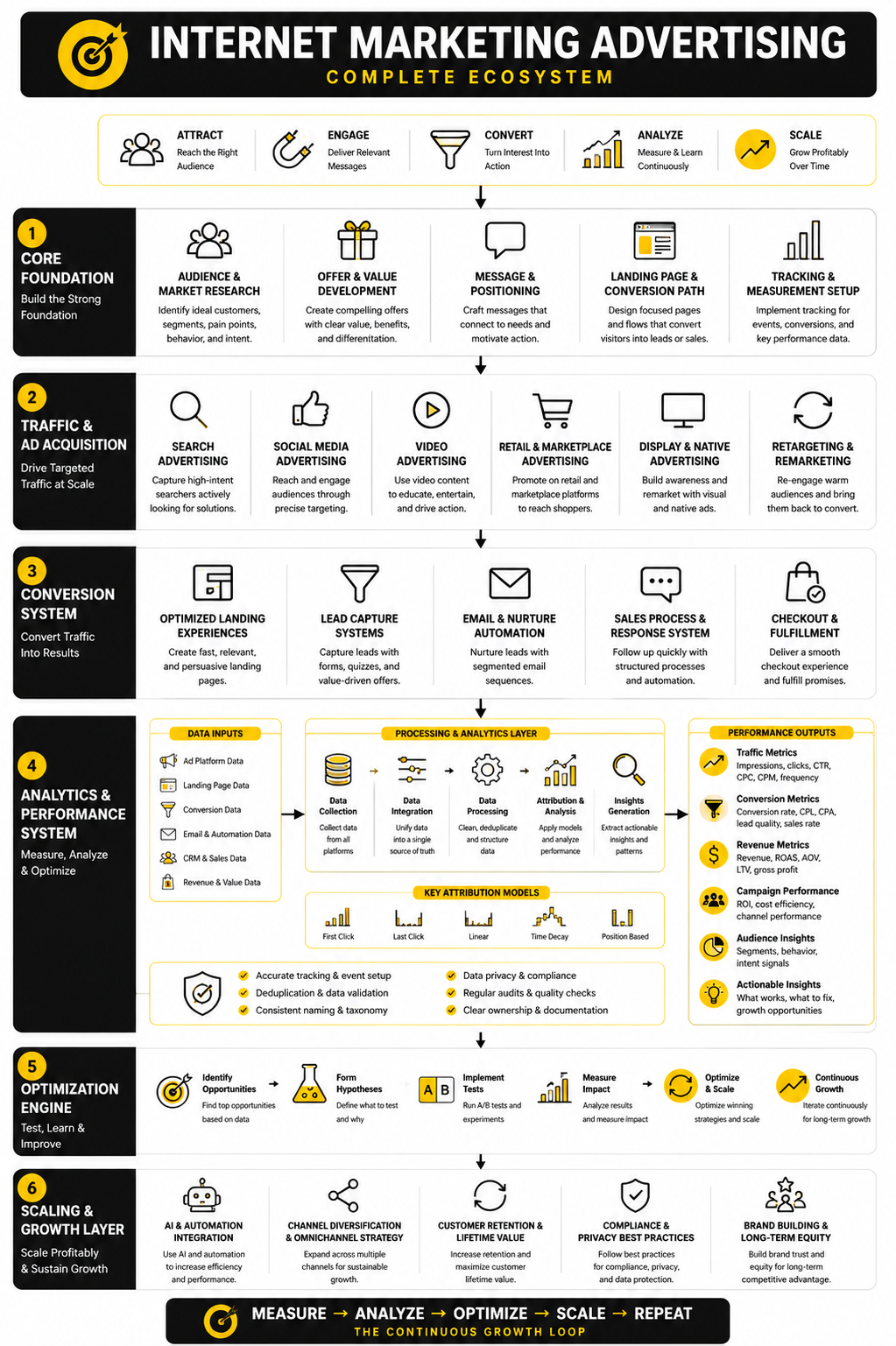
The Final System Check
Before a campaign deserves serious budget, every part of the system should be checked. The offer should be clear, the message should match the market, the creative should test different angles, the page should convert, the tracking should work, and the follow-up should happen without delay. If one of those pieces is weak, more spend usually makes the weakness louder.
This is why professionals build systems before they scale. They do not just ask, “Which ad won?” They ask which audience responded, which promise created intent, which page section reduced doubt, which leads became customers, and which follow-up step created revenue.
A useful final check looks like this:
Practical Tools For The Advertising Ecosystem
Tools are useful when they remove friction from the system. They are not useful when they create a messy stack nobody maintains. The right setup depends on the campaign model, the team, the budget, and the speed at which the business needs to launch.
For service businesses, agencies, consultants, and local companies, GoHighLevel can make sense because it brings forms, funnels, calendars, CRM pipelines, messaging, automation, and follow-up into one workflow. For funnel-driven offers, ClickFunnels and Systeme.io can help teams build sales paths without overcomplicating the tech side.
For ecommerce landing pages, Replo can help brands test more focused post-click experiences. For email follow-up, Brevo and Moosend can support nurture, segmentation, and campaign automation. For social planning around paid and organic content, Buffer can help keep publishing more organized.
The Professional Standard
The professional standard is not perfection. It is clarity, consistency, and honest measurement. A serious advertiser knows what they are testing, why they are testing it, and what decision the result will support.
That mindset matters because advertising platforms will keep changing. AI systems will keep taking over more execution, privacy rules will keep reshaping tracking, and buyers will keep moving across more channels before they convert. The businesses that win will not be the ones chasing every trick; they will be the ones building adaptable systems.
Internet marketing advertising works best when it respects both sides of the exchange. The business needs profitable growth. The customer needs relevance, clarity, and trust. When the system serves both, advertising becomes a growth engine instead of a monthly gamble.
What Is Internet Marketing Advertising?
Internet marketing advertising is the use of paid online channels to promote offers, attract traffic, generate leads, and drive sales. It can include search ads, social ads, video ads, display campaigns, retargeting, sponsored content, funnel advertising, and automated follow-up. The goal is not just visibility; the goal is measurable action that supports the business.
How Is Internet Marketing Advertising Different From Digital Marketing?
Digital marketing includes both paid and unpaid online activity, such as SEO, content marketing, email, social media, partnerships, analytics, and conversion optimization. Internet marketing advertising focuses specifically on paid promotion and the systems that turn paid traffic into results. The two overlap, but advertising usually has a more direct budget, targeting, testing, and performance measurement layer.
Which Channel Is Best For Internet Marketing Advertising?
There is no universal best channel. Search is strong when people already have intent, while social is strong when you need to create demand, test angles, or reach people before they search. Video, email, retargeting, and retail media can all matter depending on the offer, sales cycle, audience, and economics.
How Much Budget Do You Need To Start?
The right budget depends on the cost of traffic, conversion rate, offer value, and how quickly you need useful data. A local service business may start with a smaller controlled test, while a competitive ecommerce or software campaign may need more budget to collect enough conversion signals. The mistake is spending too little to learn anything or too much before the system is ready.
What Is The Most Important Metric To Track?
The most important metric is the one closest to profitable revenue. For ecommerce, that may be contribution-margin-adjusted customer acquisition cost, not just ROAS. For lead generation, it may be cost per qualified opportunity or cost per closed customer, not just cost per lead.
Why Do Campaigns Get Clicks But No Sales?
Clicks without sales usually point to a mismatch somewhere after attention is earned. The ad may be attracting curiosity instead of intent, the landing page may not match the promise, the offer may feel weak, or the checkout or form may create too much friction. It can also happen when targeting is broad and the creative is not qualifying the right buyer.
How Long Should You Run A Campaign Before Judging It?
A campaign should be judged after it has enough data to support a decision. That usually means enough impressions, clicks, conversions, and downstream feedback to see patterns instead of noise. Technical problems should be fixed immediately, but strategic conclusions should not be based on a handful of clicks.
What Is A Good Conversion Rate?
A good conversion rate depends on the channel, offer, price point, audience intent, and conversion action. A free guide, quote form, booked call, trial signup, and direct purchase should not be compared as if they are the same thing. Your own historical performance is usually more useful than a generic benchmark once you have enough data.
Should Small Businesses Use AI Advertising Tools?
Small businesses can benefit from AI advertising tools when the basics are already in place. AI can help with bidding, targeting expansion, creative variation, and performance discovery, but it cannot fix a weak offer or unclear positioning. The best use of AI is to support a clear strategy, not replace one.
Is Retargeting Still Worth It?
Retargeting is still useful, but it should not be treated as a complete growth strategy. It works best when it answers objections, reminds interested visitors, and helps people return to a decision they already considered. The risk is overvaluing retargeting because attribution models may give it too much credit for demand created elsewhere.
How Do You Know When To Scale Ads?
You scale when performance is stable, the economics work, and the business can handle more demand. That means acquisition costs are acceptable, lead or customer quality is strong, tracking is reliable, and follow-up or fulfillment will not break under higher volume. Scaling too early usually turns small problems into expensive problems.
What Is The Most Common Beginner Mistake?
The most common beginner mistake is launching ads before the offer, page, tracking, and follow-up are ready. Beginners often think the platform will solve the problem if they choose the right campaign objective. In reality, the campaign only performs as well as the system behind it.
Do You Need A Funnel For Internet Marketing Advertising?
You need a clear conversion path, but it does not always need to be a complicated funnel. Some offers convert well through a simple landing page, form, or checkout. Others need a quiz, webinar, sales page, email sequence, booking flow, or multi-step nurture path before the buyer is ready.
How Important Is Creative Testing?
Creative testing is extremely important because the creative shapes who pays attention, what they believe, and whether they take the next step. Testing should compare different angles, hooks, objections, proof points, and formats. Tiny cosmetic changes are less useful than tests that reveal what actually motivates buyers.
Can Internet Marketing Advertising Work Without A Big Brand?
Yes, but smaller brands need to be sharper. They usually need a clearer offer, stronger proof, better targeting, faster follow-up, and more direct messaging. A big brand can sometimes rely on familiarity, but a smaller brand has to earn trust quickly.
Build a stronger local presence with BAAM AI
Turn your website, Google profile, social channels, and AI visibility into one growth engine
Most businesses do not need more random marketing activity. They need a consistent presence system that helps the right people find them, trust them, and take action. BAAM AI brings strategy, local SEO, website updates, Google Maps visibility, social content, AI-search readiness, media production, and reporting into one practical monthly engine.
If you want your marketing to keep working after the campaign ends, start with a free BAAM AI presence audit. See how your business shows up today and where the fastest visibility wins are at BAAM AI.