
BAAM AI Blog
Insight Marketing: How To Turn Customer Truth Into Better Campaigns
Insight marketing is the discipline of finding the real reason customers think, choose, hesitate, buy, and stay loyal, then using that truth to shape strategy, messaging, offers, channels, and follow-up. It is not...
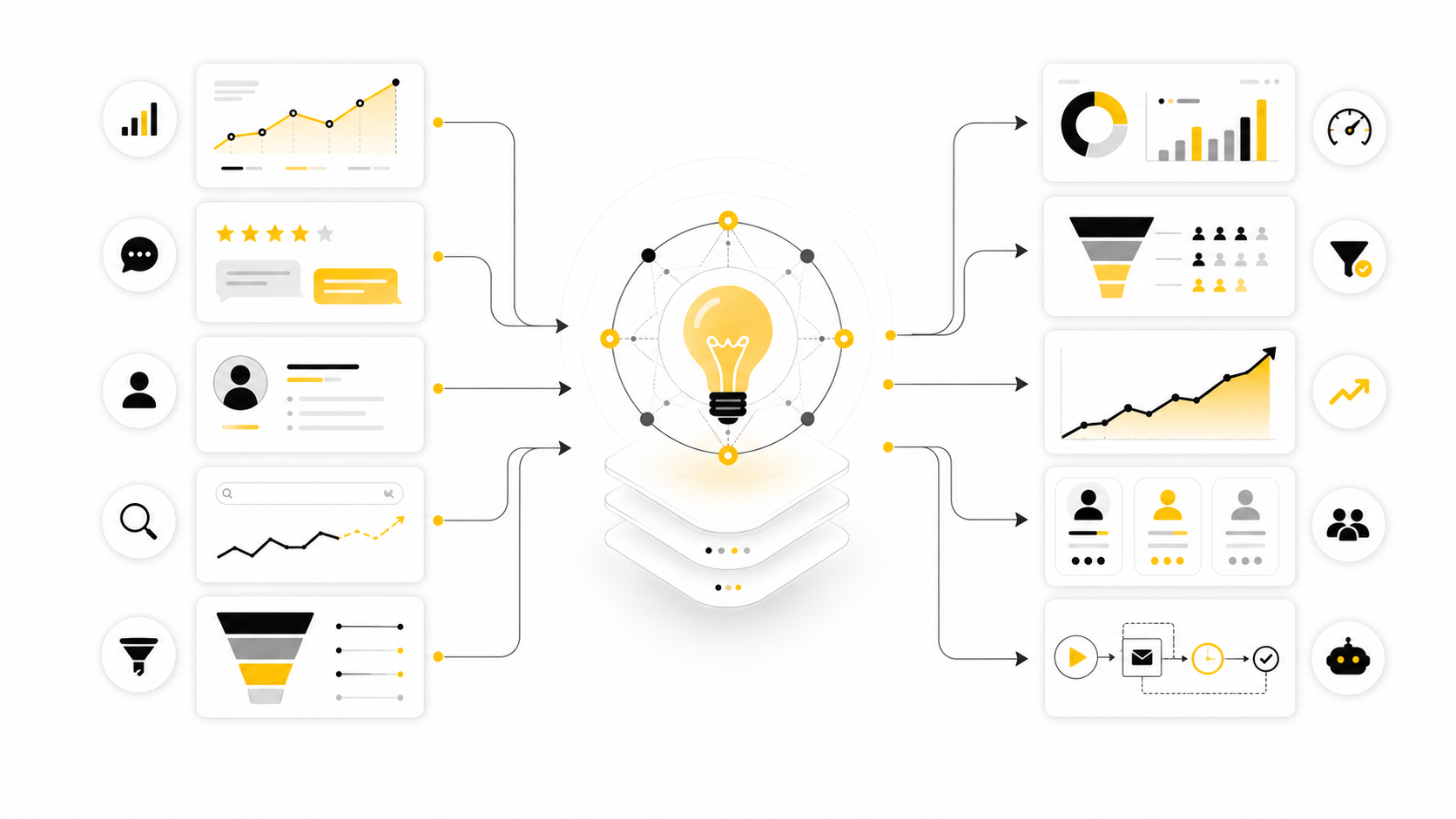
Insight marketing is the discipline of finding the real reason customers think, choose, hesitate, buy, and stay loyal, then using that truth to shape strategy, messaging, offers, channels, and follow-up. It is not the same as collecting random data, checking dashboard numbers, or copying what competitors are doing. Data tells you what happened; insight explains why it happened and what you should do next.
That distinction matters because modern marketing is noisier, more automated, and more competitive than ever. McKinsey’s 2025 consumer research covered more than 25,000 consumers across 18 markets, and the big picture is clear: customer behavior keeps shifting across value, trust, channels, and expectations. If your marketing is based on old assumptions, you are not just slightly off; you are building campaigns on weak ground.
Insight marketing gives you a practical way to reduce that guesswork. It connects customer research, first-party data, behavioral analytics, sales conversations, customer feedback, and market context into decisions your team can actually use. The goal is simple: understand the customer clearly enough that your marketing feels relevant before you spend more money trying to make it louder.
this guide is structured as one guide split into six parts, so each part builds on the last instead of repeating the same ideas. Part 1 sets the foundation, defines insight marketing, and introduces the framework that will guide the rest of the article. The later parts move from research and analysis into implementation, measurement, and practical operating systems.
What Insight Marketing Really Means
Insight marketing starts with a useful customer truth, not a marketing tactic. A useful customer truth explains a tension, motivation, belief, fear, unmet need, behavior pattern, or decision trigger that changes how you should communicate. Without that layer, teams often mistake activity for strategy: more content, more ads, more automations, more tests, but no sharper understanding.
A simple way to think about it is this: insight marketing turns observation into interpretation, and interpretation into action. “People are abandoning the checkout page” is an observation. “People want the product, but the delivery promise and risk reversal are not strong enough to justify acting now” is closer to an insight because it points toward a decision.
The strongest insights usually sit between multiple sources. Customer interviews may reveal the emotional language people use, analytics may show where intent drops, and sales calls may expose the objections that never appear in a survey. When those signals point in the same direction, marketing becomes less about guessing and more about responding to reality.
Why It Matters
The old marketing playbook relied heavily on broad targeting, borrowed audiences, and campaign-level optimization. That playbook is weaker now because privacy expectations, platform changes, AI-generated content, and fragmented customer journeys have made surface-level targeting less reliable. Adobe’s 2025 digital trends research highlights a major operational problem for brands: fragmented data blocks real-time, one-to-one personalization.
That is exactly where insight marketing becomes valuable. It helps teams understand which customer signals are meaningful, which are noise, and which should influence the next campaign decision. Instead of personalizing for the sake of personalization, you personalize around a clearer understanding of what the customer is trying to accomplish.
This matters even more as AI enters the marketing workflow. Salesforce’s latest State of Marketing research is based on insights from nearly 4,500 marketers worldwide and focuses heavily on AI, data, personalization, and loyalty. AI can help teams move faster, but speed without insight just scales weak assumptions faster.
Framework Overview
Insight marketing works best when it follows a repeatable framework. The point is not to turn creative work into a rigid checklist. The point is to create a reliable path from customer evidence to sharper marketing decisions.
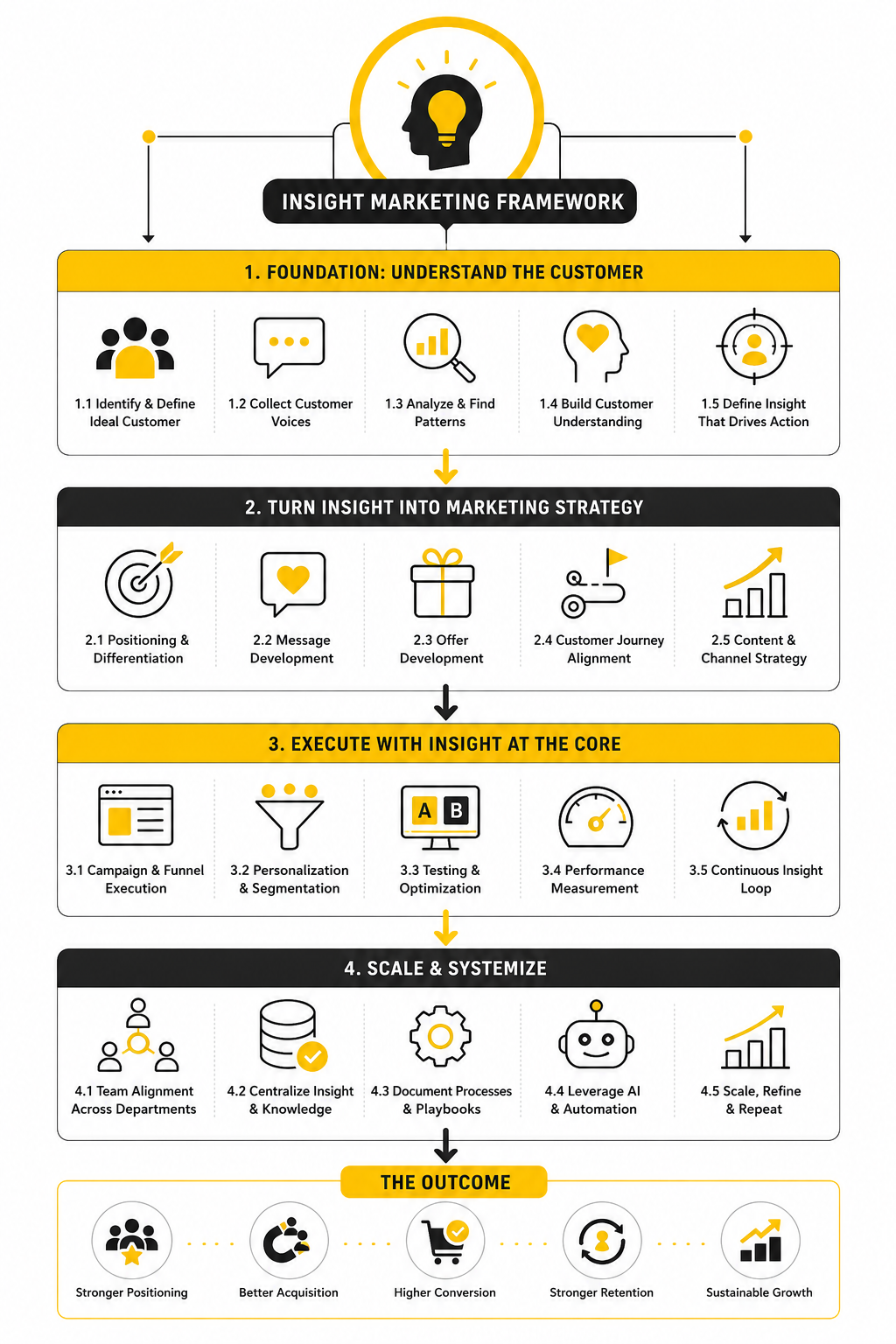
The framework used here has four layers: discover, interpret, translate, and activate. Discover means collecting signals from customers, competitors, analytics, sales, support, and the broader market. Interpret means finding the pattern behind those signals, not just reporting what the dashboard says.
Translate is where many teams fail. A customer insight is only useful when it becomes a clearer promise, stronger offer, better segmentation, sharper creative angle, or more relevant customer journey. Activate means putting that insight into campaigns, funnels, content, lifecycle messaging, sales enablement, and measurement so it affects real business outcomes.
The Four Layers Of Insight Marketing
The first layer is discovery, where you gather raw customer and market signals. This includes interviews, surveys, CRM notes, support tickets, product reviews, social listening, search behavior, analytics data, and sales objections. The goal is not to collect everything; the goal is to collect enough high-quality evidence to see what customers are really responding to.
The second layer is interpretation, where you turn evidence into meaning. This is where you ask why a behavior is happening, what belief is driving it, what friction is blocking action, and what motivation is strong enough to move the customer forward. Cambridge defines insight as a clear, deep understanding of a complicated problem or situation, which is a useful standard because marketing insight should make a messy customer problem easier to act on.
The third layer is translation, where the insight becomes marketing strategy. This can change your positioning, offer structure, content topics, ad angles, email sequences, landing page copy, lead magnets, onboarding, or retention campaigns. The insight is not finished until it has changed something visible in the customer experience.
The fourth layer is activation, where the strategy is tested in the real market. You launch the message, compare performance, listen to customer response, and use the results to refine the insight. This is where insight marketing becomes a loop rather than a one-time research project.
How This Guide Will Approach Insight Marketing
This guide will treat insight marketing as a practical operating system, not a vague branding concept. The focus will stay on how professionals find customer truth, validate it, and apply it to campaigns that need to perform. That means the later sections will cover both strategic thinking and execution details.
The next part will explain why insight marketing has become more important as customer journeys get harder to read. It will look at trust, personalization, first-party data, AI, customer expectations, and the danger of optimizing campaigns without understanding the people behind the numbers. The point will be to show why insight is not a “nice to have” anymore.
After that, the article will break down the core components, research methods, implementation process, and measurement system. By the end, you should have a clear way to build campaigns around what customers actually care about. That is where insight marketing becomes powerful: it helps you stop shouting into the market and start saying the thing your best customers were already waiting to hear.
Why Insight Marketing Matters More Than Ever
Insight marketing matters because customers are harder to understand from surface-level behavior alone. A click, view, open, or abandoned cart can tell you something happened, but it rarely tells you the full reason behind the action. When teams optimize only around those visible signals, they often improve tiny parts of the funnel while missing the bigger reason people are hesitating.
The market has also become more crowded with similar offers, similar content, and similar AI-assisted messaging. That means “good enough” marketing is easier to produce, but harder to trust. The brands that win are not always the loudest; they are the ones that understand the customer’s situation clearly enough to say something more relevant.
This is why insight marketing has moved from a research function into a growth function. It affects positioning, acquisition, conversion, retention, lifecycle messaging, customer experience, and product feedback. When the insight is strong, every part of the customer journey gets sharper.
Customer Behavior Is Moving Faster Than Campaign Planning
Most teams still plan campaigns in cycles, but customers change their behavior continuously. They compare more options, read more reviews, switch channels quickly, and expect brands to recognize context without making the experience feel invasive. McKinsey’s 2025 consumer research shows how buying behavior is being reshaped by value pressure, demographic shifts, wellness priorities, and changing loyalty patterns across global markets.
That creates a real problem for marketers. A campaign built around last year’s assumptions can still look polished while being strategically outdated. The message may be well-written, the creative may look professional, and the funnel may technically work, but the core customer motivation may have already moved.
Insight marketing helps close that gap. Instead of treating strategy as something fixed at the beginning of a campaign, it keeps customer understanding active throughout the process. That gives teams a better chance of adjusting the promise, offer, content, and timing before performance drops hard enough to force a painful reset.
Data Alone Does Not Create Understanding
Marketing teams have more data than ever, but more data does not automatically create better decisions. Dashboards can show which email had a higher click rate, which page converted better, or which ad set spent more efficiently. They do not automatically explain the customer belief that made one message feel safer, clearer, or more urgent than another.
This is where many teams confuse reporting with insight. Reporting organizes what happened. Insight explains what the pattern means and what action should follow from it.
That difference matters because data can become a distraction when it is not connected to customer reality. A campaign can have strong engagement and still attract the wrong audience. A landing page can improve conversion while lowering lead quality. Insight marketing forces the team to ask better questions before celebrating the number.
Personalization Is Only Useful When It Is Based On Real Insight
Personalization has become one of the biggest promises in modern marketing, but weak personalization can feel mechanical. Using someone’s first name, showing a recently viewed product, or changing a subject line is not the same as understanding their intent. Customers do not reward personalization because it is technically advanced; they respond when it makes the experience feel easier, more relevant, and more respectful.
Adobe’s 2025 digital trends research highlights the pressure brands face as AI raises expectations for customer engagement while many organizations still struggle with data, analytics, and internal alignment. That gap is important. If your data foundation is messy and your customer understanding is shallow, personalization can scale confusion instead of relevance.
Insight marketing gives personalization a better foundation. It helps you identify which customer differences actually matter, which messages should change, and which moments deserve a more tailored experience. The goal is not to personalize everything; the goal is to personalize the parts of the journey where customer context changes the decision.
Trust Has Become A Conversion Variable
Trust is no longer just a brand value that sits on an about page. It is part of the conversion process. Customers want speed and convenience, but they also want to know what a brand does with their data, whether the promise is credible, and whether the offer is worth the risk.
This creates a practical challenge for marketers. The more brands use automation, AI, tracking, and personalization, the more important it becomes to make the experience feel transparent and useful. If the customer senses that the brand is using data to push harder instead of help better, performance can suffer even when the technology is advanced.
Insight marketing helps teams understand where trust is being built or lost. That might show up in pricing confusion, weak social proof, unclear guarantees, vague product claims, poor onboarding, or support friction. Once you see where trust breaks, you can fix the customer experience instead of simply adding more persuasion.
AI Makes Insight More Important, Not Less
AI can produce more copy, more campaign variations, more audience segments, and more content ideas at a speed humans cannot match manually. That is useful, but it also creates a new problem: volume can hide weak thinking. If the strategy is unclear, AI helps you create more versions of unclear strategy.
Salesforce’s State of Marketing research is built around input from nearly 4,500 marketers and focuses heavily on AI, data, personalization, and loyalty. The important takeaway for insight marketing is simple: AI works best when it is guided by strong customer understanding. Without that, teams risk generating campaigns that are efficient to produce but easy for customers to ignore.
The practical move is to use AI as an accelerator, not a substitute for insight. Let it help summarize interviews, find patterns in feedback, draft variations, and test messaging angles. But the human job remains critical: deciding what the customer truth really is and whether the campaign is built around it.
Better Insights Make Funnels More Efficient
A funnel is only as strong as the assumptions behind it. If the lead magnet solves the wrong problem, the landing page speaks to the wrong motivation, or the follow-up sequence handles the wrong objection, the funnel will leak no matter how polished it looks. Insight marketing improves funnels by making each step more aligned with the customer’s actual decision process.
This matters across simple and complex funnels. A creator selling a low-ticket digital product still needs to know what makes someone trust the offer. A B2B company with a long sales cycle still needs to know which internal objections slow the deal down.
Tools can help you build and automate the system, but they cannot decide the customer truth for you. A platform like GoHighLevel can support CRM, automation, follow-up, and campaign execution, while a funnel builder like ClickFunnels can help structure the sales journey. The strategy still has to come from insight, because the best-built funnel will not fix a message that misses the real buying trigger.
Insight Marketing Protects You From Copycat Strategy
When teams do not understand their customers deeply, they usually default to copying competitors. They copy landing page structures, ad angles, email sequences, pricing tactics, lead magnets, and social content formats. Sometimes that produces a temporary lift, but it rarely creates a durable advantage.
The problem is that you can see a competitor’s output, but not the insight behind it. You do not know their audience quality, customer economics, retention problems, margin structure, sales process, or internal goals. Copying the visible tactic without understanding the hidden context is risky.
Insight marketing gives you a better path. You can still study competitors, but you use that research to understand category patterns, customer expectations, and gaps in the market. Then you build from your own customer evidence instead of blindly borrowing someone else’s playbook.
Insight Turns Marketing Into A Learning System
The biggest advantage of insight marketing is not one campaign win. It is the creation of a system that gets more carefully over time. Every campaign becomes a chance to learn what customers respond to, what they resist, what they misunderstand, and what makes them move forward.
That learning compounds. Sales conversations improve landing page copy. Support tickets reveal onboarding problems. Survey responses sharpen segmentation. Review mining exposes the language customers use when they finally understand the value.
This is where insight marketing becomes a serious competitive edge. You stop treating campaigns as isolated bets and start treating them as evidence. Over time, that creates a marketing system that is harder to copy because it is built from your customers, your market, and your own learning loop.
The Core Components Of A Strong Insight Marketing System
A strong insight marketing system is built from four working parts: inputs, interpretation, decisions, and feedback. Inputs give you the raw material, interpretation turns that material into meaning, decisions apply the meaning to marketing, and feedback tells you whether the insight was actually useful. When one of those parts is missing, the system becomes either too theoretical or too reactive.
This is why insight marketing should not live only inside a strategy document. It needs to show up in how your team reviews campaigns, writes copy, builds funnels, scores leads, handles objections, and improves customer journeys. The insight has to move from “interesting finding” to “changed behavior.”
The best version is simple enough to use every week. You do not need a massive research department to start. You need a clear process for collecting signals, finding patterns, turning those patterns into marketing decisions, and learning from the results.
Start With Better Customer Signals
The first component is the quality of your customer signals. If your inputs are weak, your insights will be weak too. A team that only looks at ad metrics will usually miss what customers are saying in sales calls, reviews, onboarding conversations, support tickets, cancellation reasons, and direct replies.
Good signals come from both behavior and language. Behavioral signals show what people do, such as clicking, comparing, subscribing, abandoning, upgrading, or canceling. Language signals show how people explain their own problem, what words they use, what they believe, and what they are afraid might happen if they make the wrong choice.
You want both because each one corrects the other. Behavior without language can be easy to misread. Language without behavior can become too soft. Together, they give you a more honest view of the customer.
Organize Signals Around The Customer Decision
Once you collect signals, the next job is to organize them around the customer’s decision process. Do not dump everything into one messy research folder and call it insight. Sort what you learn by the moments where the customer is deciding whether to pay attention, trust you, compare alternatives, take action, or stay engaged.
That structure makes the research more usable. A review that reveals why customers switched from a competitor belongs in a different place than a support ticket showing confusion after purchase. A sales objection about pricing should not be treated the same as an onboarding complaint about implementation.
This is where insight marketing becomes practical. You are not just collecting “voice of customer” material because it sounds professional. You are mapping evidence to the moments where marketing has to do a specific job.
Build An Insight Repository Your Team Will Actually Use
An insight repository is a shared place where customer evidence becomes easy to find, compare, and apply. It can be a spreadsheet, CRM notes, a research database, a tagged workspace, or a lightweight internal document. The format matters less than the habit.
The repository should not become a graveyard of screenshots and survey exports. Each entry should connect the signal to a possible marketing use. For example, a repeated objection may become a landing page section, a comparison email, a sales enablement note, or a retargeting angle.
Keep it simple at first. Tag insights by customer segment, journey stage, objection, motivation, product use case, and source. If your team already uses a CRM and automation platform, a tool like GoHighLevel can help keep customer conversations, follow-up, pipeline context, and campaign activity closer together instead of spreading the work across disconnected tools.
Turn Patterns Into Clear Insight Statements
A real insight statement should be specific enough to guide action. It should not sound like “customers want value” or “people care about trust.” Those are too broad to change anything.
A stronger insight statement connects the customer, the situation, the tension, and the marketing implication. For example: “First-time buyers are not rejecting the price; they are unsure whether they can get results without help, so the offer needs stronger onboarding proof and clearer first-step guidance.” That kind of statement gives the team something useful to build from.
This is the moment where insight marketing becomes a strategy tool. You are no longer just discussing data. You are deciding what the customer needs to believe, feel, understand, or trust before the next step makes sense.
Translate Each Insight Into A Marketing Decision
Insights only matter when they change a decision. That decision might involve positioning, creative, landing page copy, email timing, offer structure, lead qualification, onboarding, or retention messaging. If nothing changes, you have not implemented the insight.
A practical translation step should answer three questions. What does this insight tell us to say differently? What does it tell us to show differently? What does it tell us to remove, simplify, or clarify?
This is where tools can support execution, but the insight still has to lead. If the insight points to a clearer funnel sequence, ClickFunnels can help structure the path from attention to conversion. If the insight points to better landing page testing for ecommerce or product-led campaigns, Replo can help teams move faster while still keeping the message grounded in customer truth.
The Insight Marketing Execution Process
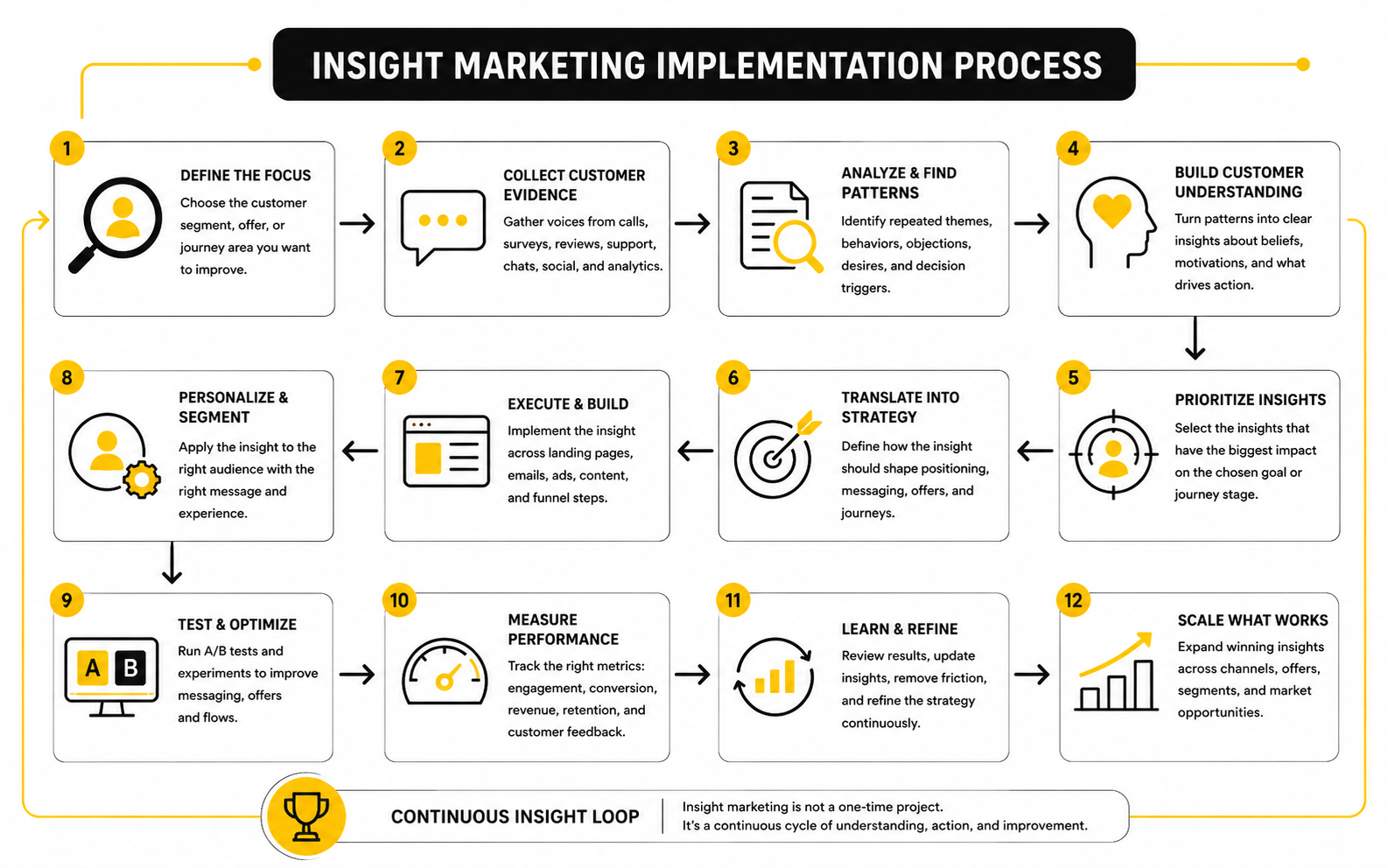
The execution process should be clear enough that your team can repeat it without overthinking. You are building a loop, not a one-time workshop. The goal is to make insight marketing part of how campaigns are planned, launched, reviewed, and improved.
Apply Insights Where They Can Create Leverage
Not every insight deserves the same level of effort. Some insights should shape a headline. Others should reshape a whole offer, campaign, or customer journey. The skill is knowing where the insight can create the most leverage.
High-leverage insights usually affect a decision bottleneck. If many people show interest but do not convert, the insight may belong on the sales page, checkout flow, webinar, or comparison sequence. If people buy but do not stay, the insight may belong in onboarding, support, expectation-setting, or lifecycle communication.
This is why implementation should start with friction. Look for the place where the customer is closest to action but still hesitates. That is often where one strong insight can produce a bigger improvement than ten random creative tests.
Connect Insight Marketing To Automation
Automation becomes much more powerful when it is based on real customer context. A generic email sequence sends the same message to everyone because it is easier to manage. An insight-driven sequence changes the message based on what the customer is trying to solve, what they have already done, and what is most likely blocking action.
This does not mean you need to overcomplicate every workflow. Start with simple branches based on meaningful behavior. Did the person visit a pricing page? Did they download a comparison guide? Did they reply with a specific objection? Did they attend a webinar but skip the offer?
For email and lifecycle campaigns, platforms like Brevo, Moosend, and Systeme.io can help turn those insights into follow-up flows. The important part is not the automation itself. The important part is that the automation responds to a real customer signal.
Keep Sales, Support, And Marketing In The Same Loop
Insight marketing breaks down when marketing works in isolation. Sales hears objections that never appear in dashboards. Support sees confusion that never appears in ad reports. Customer success knows which promises create satisfaction and which promises create disappointment.
A practical insight process should include those teams regularly. Marketing should ask sales what prospects are misunderstanding, ask support what customers struggle with after purchase, and ask success what makes customers stay. Those answers often reveal stronger messaging opportunities than another competitor swipe file.
This loop also prevents overpromising. If marketing learns from support and retention data, the message becomes more accurate. That improves trust because the campaign attracts customers who are better matched to the offer.
Use Content To Test Insight Before Scaling Spend
Content is one of the easiest ways to test an insight before committing larger ad budgets or funnel rebuilds. A strong article, email, short-form post, video, or webinar segment can show whether the angle resonates. You are looking for signs that the audience feels understood, not just entertained.
The most useful content tests are built around a specific tension. For example, you might test whether customers care more about speed, control, certainty, status, simplicity, risk reduction, or support. The response can help you decide which angle deserves more serious campaign investment.
This makes content more strategic. Instead of publishing because the calendar says so, you publish to learn. Over time, your best-performing content becomes a research asset as much as a traffic asset.
Build A Simple Insight Review Rhythm
A strong insight marketing system needs a review rhythm. Without one, insights appear randomly and disappear quickly. A weekly or biweekly review can be enough for most teams if the process is focused.
The review should cover what changed in performance, what customers said, what objections appeared, what content resonated, and what should be tested next. Keep it practical. The goal is not to create a beautiful report; the goal is to make the next marketing decision better.
This rhythm also keeps teams honest. If a campaign performs well, the team should ask why. If it performs poorly, the team should ask what assumption failed. That habit turns every campaign into a source of learning instead of just a pass-or-fail event.
Statistics And Data
Measurement is where insight marketing becomes accountable. A good insight should not stay in a workshop, research file, or messaging document. It should improve how people move through the customer journey, and the data should help you see whether that improvement is real.
The mistake is treating statistics like decoration. Random benchmarks can make a strategy sound more carefully, but they do not tell you what to do. Useful measurement connects a number to a customer behavior, then connects that behavior to an action your team can take.
That is the standard for this section. The goal is not to collect impressive marketing numbers. The goal is to understand which numbers matter, what they mean, and how they should shape your next decision.
Measure The Customer Journey, Not Just The Campaign
Most marketing reports are too campaign-centered. They show impressions, clicks, cost per click, open rates, conversion rates, and revenue, but they often fail to explain the customer journey behind those numbers. That creates a dangerous gap because a campaign can look efficient while still attracting the wrong people or setting the wrong expectations.
Insight marketing needs measurement across the full journey. That means looking at awareness, engagement, lead quality, conversion, onboarding, retention, expansion, referrals, and customer feedback. If you only measure the first conversion, you may optimize for the cheapest action instead of the best customer.
This is especially important when acquisition costs rise or customer expectations change. HubSpot’s 2026 marketing statistics resource highlights how marketers continue tracking traffic, conversions, search visibility, and content performance because these metrics help teams understand where demand is coming from and how efficiently it turns into action through the funnel. Those numbers matter most when they are connected to the customer’s intent, not treated as isolated scoreboard items.
The Four Measurement Layers That Matter
A practical insight marketing analytics system has four layers: attention, intent, conversion, and value. Each layer answers a different question. Together, they show whether your marketing is only getting noticed or actually creating better customers.
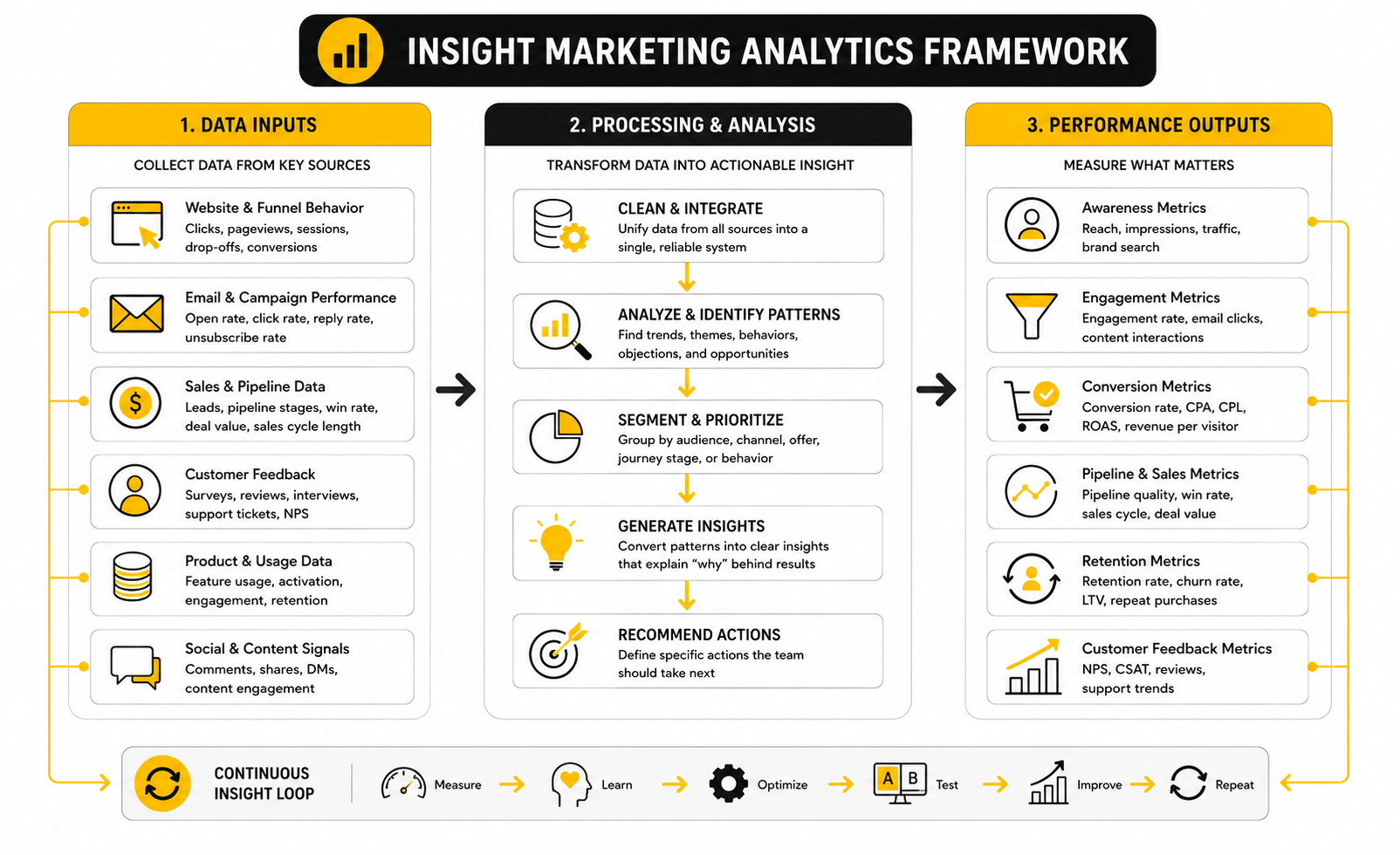
The first layer is attention. This includes reach, impressions, views, traffic, watch time, search visibility, and social engagement. These numbers tell you whether the market is noticing your message, but they do not prove the message is commercially strong.
The second layer is intent. This includes pricing page visits, lead magnet downloads, demo requests, comparison page views, webinar attendance, product page depth, reply rates, and return visits. These signals matter because they show that someone is not just consuming content; they are actively considering a decision.
The third layer is conversion. This includes opt-in rate, checkout conversion, booked calls, sales-qualified leads, trial starts, purchases, and close rate. Conversion numbers show whether the insight is helping people move forward, but they still need to be judged against lead quality and customer fit.
The fourth layer is value. This includes average order value, customer acquisition cost, payback period, retention, repeat purchase rate, expansion revenue, churn, referral rate, and lifetime value. This is where insight marketing proves whether it is improving the business, not just making campaigns look better.
What Benchmarks Can And Cannot Tell You
Benchmarks are useful, but only when you treat them as context instead of targets. A benchmark can tell you whether your numbers are unusually low or unusually strong compared with a broader market. It cannot tell you whether your specific audience, offer, price point, sales cycle, or retention model is healthy.
For example, an email open rate benchmark may be helpful for spotting a deliverability or subject-line problem. But the more important insight is what happens after the open. If people open but do not click, the promise may be interesting but the offer may feel weak, unclear, or poorly timed.
The same applies to conversion rates. A low conversion rate might mean the page is unclear, the traffic is unqualified, the offer is not compelling, or the customer needs more proof before acting. A high conversion rate might look good, but if those customers churn quickly or never become profitable, the insight behind the campaign is still incomplete.
Use Statistics To Diagnose Friction
The best use of analytics is diagnosis. You are looking for the point where customer momentum slows down. That is usually where the next insight is hiding.
If traffic is strong but engagement is weak, the message may be attracting curiosity without relevance. If engagement is strong but lead conversion is weak, the next step may feel too risky or too vague. If leads convert but sales quality is poor, the marketing promise may be pulling in people who are interested but not ready, not qualified, or not aligned with the offer.
This is where data and customer language need to work together. The number shows where the friction is. Customer feedback, sales notes, support conversations, and direct replies help explain why the friction exists.
Track Performance Signals By Customer Segment
Average numbers can hide the truth. A campaign may look average overall while performing extremely well for one customer segment and poorly for another. If you only read the blended number, you miss the insight.
Segmented measurement helps you see which audience is actually responding. You can break performance down by source, use case, industry, company size, buyer role, awareness level, returning visitors, new visitors, customer status, or behavior pattern. The right segmentation depends on the business model, but the principle is the same: measure people in meaningful groups.
This matters because insight marketing is rarely universal. One segment may need proof, another may need speed, and another may need a stronger financial case. When you measure by segment, you can stop forcing one message to do every job.
Read Email Metrics As Behavior, Not Vanity
Email is one of the clearest places to measure customer intent because people either ignore, open, click, reply, buy, unsubscribe, or stay engaged. Each action gives you a signal. The key is interpreting that signal correctly.
MoEngage’s 2025 email benchmark research found that behavior-based email personalization can produce dramatically stronger conversion performance than non-personalized email, with reported lifts ranging from 2.8x to 300.7x depending on context. The useful lesson is not that every brand should chase a huge lift. The useful lesson is that timing and behavior matter because they make the message more connected to what the customer is doing now.
For insight marketing, email metrics should answer practical questions. Which pain point earns the click? Which objection triggers a reply? Which segment responds to proof, urgency, education, comparison, or a stronger guarantee? Those answers should feed back into ads, landing pages, sales scripts, and onboarding.
Measure Content By Its Strategic Job
Content should not be judged only by traffic. Some content is meant to attract new people, some is meant to educate prospects, some is meant to handle objections, and some is meant to help customers succeed after purchase. Each job needs a different measurement lens.
The Content Marketing Institute’s 2025 B2B research shows marketers expecting increased investment in video, thought leadership, AI-assisted content optimization, paid advertising, webinars, communities, and other formats. That matters because content is no longer just a publishing activity; it is part of how brands create trust, educate buyers, and support the buying process.
So the measurement question should be specific. Did the comparison article help people choose? Did the case study improve sales conversations? Did the onboarding guide reduce support friction? Did the webinar create qualified pipeline instead of just registrations?
Connect Analytics To Customer Research
Analytics tells you what changed, but research helps explain the reason. If a landing page conversion rate improves, you still need to understand what made the improvement happen. Was it the headline, the proof, the offer clarity, the pricing explanation, the reduced friction, or the stronger match between traffic and message?
This is why insight marketing should combine quantitative and qualitative feedback. Quantitative data shows scale and direction. Qualitative data shows language, motivation, hesitation, confusion, and belief.
A simple review habit helps here. When performance changes, capture the likely customer reason behind the change. Then compare that reason against actual customer comments, replies, sales calls, or support notes before treating it as a reliable insight.
Use Leading And Lagging Indicators
Not every useful metric shows revenue immediately. Some signals appear earlier in the journey and help you predict whether an insight is gaining traction. These are leading indicators.
Leading indicators include higher qualified engagement, stronger reply quality, more return visits, better webinar attendance, more pricing page visits, higher demo intent, lower confusion in support conversations, or more direct mentions of the message you are testing. They do not prove success alone, but they show whether the market is leaning in.
Lagging indicators include revenue, close rate, retention, churn, customer lifetime value, and profitability. These are the numbers that confirm whether the insight created durable business value. Strong insight marketing uses both because waiting only for revenue can slow learning, while relying only on early engagement can create false confidence.
Avoid Misreading Correlation As Insight
One of the easiest mistakes in marketing analytics is assuming that because two things moved together, one caused the other. A new headline may launch at the same time as a better traffic source, a discount, a seasonal spike, or a sales push. If you do not separate those factors, you may credit the wrong thing.
This matters because false insights are expensive. A team might double down on a message that did not actually cause the lift. Worse, they may remove a part of the journey that was quietly doing important work.
The fix is not perfection. The fix is discipline. Use controlled tests when possible, compare similar segments, watch for external changes, and avoid making big strategic decisions from one data point.
Turn Metrics Into Decisions
Every metric in an insight marketing system should lead to a possible decision. If a number cannot influence a decision, it probably does not deserve much attention. Reporting should make the next move clearer, not just make the dashboard fuller.
A practical decision flow can be simple:
This is how analytics becomes useful. The data does not make the decision for you. It gives you a sharper way to decide.
Build A Dashboard Around Insight, Not Noise
Most dashboards are too crowded. They include every available metric because every platform makes metrics easy to display. That does not mean every metric deserves attention.
An insight marketing dashboard should show the few numbers that reveal whether customer understanding is improving performance. It should include journey-stage metrics, segment-level performance, qualitative themes, active hypotheses, current tests, and the decision each test is meant to support. That makes the dashboard a working tool instead of a reporting ritual.
For teams using a CRM, funnel builder, or automation platform, this is where integration matters. A system like GoHighLevel can help connect pipeline activity, follow-up, customer conversations, and campaign reporting in one place. The tool is not the strategy, but the right setup makes it easier to see whether the strategy is working.
The Data Should Make Your Next Move Obvious
The best measurement system reduces confusion. After reviewing the numbers, the team should know what to test, what to stop, what to scale, and what to investigate. If the report creates more noise than clarity, the measurement system needs to be simplified.
Insight marketing works because it treats data as evidence, not decoration. You are not collecting numbers to prove that marketing is busy. You are using numbers to understand customers more clearly and make better decisions.
That is the point where statistics become powerful. They stop being random proof points and start becoming a practical map. The map shows where attention is growing, where intent is forming, where trust is breaking, where conversion is happening, and where the business value is actually being created.
Professional Implementation Across Campaigns, Funnels, And Teams
At this stage, insight marketing stops being a research process and becomes an operating model. The question is no longer “How do we find insights?” The question becomes “How do we make sure the right insight shapes the right decision at the right time?”
That is where more advanced teams separate themselves. They do not just collect customer evidence and run tests. They build a system where insight influences positioning, budget allocation, creative strategy, lifecycle marketing, sales enablement, product feedback, and retention.
This is also where the tradeoffs become real. More data can create more complexity. More automation can create more distance from the customer. More personalization can improve relevance, but it can also feel invasive if the brand does not understand the customer’s boundaries.
Do Not Scale A Weak Insight
Scaling too early is one of the fastest ways to waste budget. A campaign can show early promise because the audience is small, warm, or unusually responsive. That does not mean the insight is strong enough to carry a bigger media spend, a full funnel rebuild, or a company-wide positioning shift.
Before scaling, the insight should survive a few checks. It should work across more than one creative format, more than one message variation, and more than one traffic source when possible. It should also attract customers who fit the business, not just people who are easy to convert.
This matters because insight marketing is not about chasing the first winning angle. It is about finding the customer truth that can support sustainable growth. If the insight only works under narrow conditions, treat it as a useful campaign angle, not a strategic foundation.
Balance Speed With Depth
Fast execution is valuable, but shallow understanding gets expensive. Teams often want quick insights because campaign timelines are tight and leadership wants movement. That pressure is normal, but it can push marketers into making confident decisions from thin evidence.
The practical answer is not to slow everything down. The answer is to match the research depth to the risk of the decision. A subject line test does not need the same research process as a repositioning project, a new offer, or a major funnel change.
Use lightweight research for low-risk decisions and deeper research for high-risk decisions. That keeps the team moving without pretending every insight has the same level of certainty. Smart insight marketing is not slow; it is appropriately careful.
Protect The Customer Signal From Internal Bias
Internal bias can quietly destroy good insight work. Sales may overvalue objections from the loudest prospects. Leadership may prefer insights that support the strategy they already wanted. Marketing may favor data that makes a campaign look successful.
This is why the source of the signal matters. You need to know whether an insight came from actual customers, qualified prospects, unqualified leads, internal opinion, competitor analysis, or platform data. Those sources are not equal.
A simple rule helps: separate evidence from interpretation. Evidence is what customers did or said. Interpretation is what the team thinks it means. Keeping those two things separate makes the discussion cleaner and reduces the chance of turning assumptions into strategy.
Treat AI As A Research Assistant, Not The Judge
AI is extremely useful for insight marketing when it is used well. It can summarize interview transcripts, cluster survey responses, organize support tickets, identify repeated language, compare review themes, and generate message variations based on real customer input. That can save time and help teams see patterns faster.
But AI should not be the final judge of what the insight means. It does not own the business context, customer relationship, competitive pressure, brand risk, or strategic tradeoff. It can identify possible patterns, but your team still has to decide which patterns are meaningful.
This matters even more as AI-generated marketing becomes more common. Forrester’s 2025 customer experience research found that 21% of brands declined, 6% improved, and 73% remained unchanged in its global CX rankings. Better tools alone are not automatically creating better customer experiences; the strategic use of those tools is what matters.
Avoid Over-Personalization
Personalization should make the customer journey feel easier, not watched. There is a line between relevance and discomfort. When brands cross that line, the customer may understand that the experience is personalized, but still feel less trust because the use of data feels too aggressive.
The safest approach is to personalize around helpful context. Use behavior to improve timing, reduce repetition, show relevant next steps, or avoid pushing the wrong offer. Do not personalize in a way that makes the customer wonder how much you know or why you know it.
Insight marketing helps here because it focuses on customer intent, not just customer identity. The better question is not “How much can we personalize?” The better question is “What would make this decision easier for this customer right now?”
Build Different Insight Systems For Different Business Models
A local service business, ecommerce brand, SaaS company, agency, creator business, and enterprise sales team do not need the same insight system. The customer journey, purchase risk, data volume, decision cycle, and retention model are different. Copying another company’s measurement setup can create more confusion than clarity.
A service business may need stronger insight from call tracking, reviews, lead quality, and follow-up outcomes. An ecommerce brand may need product page behavior, repeat purchase patterns, offer testing, review mining, and post-purchase feedback. A B2B company may need sales call analysis, buying committee objections, demo conversion, pipeline velocity, and churn reasons.
This is why insight marketing should be designed around the decision customers actually make. The system should match the business model instead of forcing every company into the same dashboard, funnel, or research workflow. The right insight system feels practical because it reflects how the business really grows.
Make Insight Useful For Creative Teams
Creative teams need insight that gives direction without killing originality. “Customers care about trust” is too vague. “First-time buyers are afraid the setup will be harder than promised, so the creative should show the first successful step, not just the final outcome” is much more useful.
That kind of insight gives writers, designers, video editors, and media buyers something to work with. It points to the tension, the belief that needs to change, and the proof that may help. It does not dictate every word or visual.
Good insight marketing protects creativity from randomness. It gives creative teams a sharper target. The work can still be bold, emotional, funny, direct, or premium, but it is anchored in a real customer truth instead of a brainstorm that sounded good in a meeting.
Make Insight Useful For Sales Teams
Sales teams need insight that improves conversations. They do not need a long research report that sits unread. They need clear notes on what prospects believe, what slows deals down, what proof matters, which objections are rising, and which messages are creating better-qualified opportunities.
This is where marketing and sales alignment becomes practical. Marketing can share the messages that are creating intent. Sales can report whether those messages are creating the right expectations. Both teams can then adjust the funnel so the customer journey feels consistent from first touch to close.
A CRM-focused setup can help when the team actually uses it to capture real customer context. Platforms like Copper can support relationship tracking for teams that need visibility across leads, deals, and conversations. The important part is making sure the system captures decision-making signals, not just contact records.
Use Insight To Improve Retention, Not Just Acquisition
Many teams use insight marketing mainly to get more leads or sales. That is useful, but incomplete. Some of the best insights appear after purchase, when customers experience the real product, service, onboarding, support, and outcomes.
Retention insights often reveal gaps that acquisition data hides. Customers may buy because the promise is strong, then churn because the first steps are unclear. They may love the product but fail to build the habit. They may understand the value, but not get enough internal support to keep using it.
That feedback should shape marketing before the sale. If customers need more guidance to succeed, the funnel should set better expectations and highlight the support path. If customers stay because of one specific feature, workflow, or emotional payoff, acquisition messaging should make that value clearer earlier.
Watch For Insight Decay
Customer insights expire. Not all at once, and not on a fixed schedule, but they do decay. Markets change, competitors adjust, platforms shift, customer budgets tighten, new objections appear, and once-fresh messages become familiar.
This is why insight marketing needs ongoing review. A message that worked six months ago may still be directionally true, but weaker because the market has adapted. A strong objection may fade after product improvements. A new customer segment may emerge and change the center of gravity.
The warning signs are usually visible. Engagement drops, conversion weakens, sales objections change, support questions shift, or customers start using different language. When that happens, do not just refresh the creative. Recheck the insight behind the creative.
Decide What Not To Measure
Advanced measurement is not about tracking everything. It is about knowing what not to track. Too many metrics create false importance and slow decisions.
Every metric should earn its place by helping the team make a decision. If nobody would change the message, budget, offer, audience, or journey based on a number, that number should not dominate the report. It may still be useful for diagnostics, but it should not drive strategy.
This is especially important when marketing budgets are under pressure. Gartner’s 2025 CMO Spend Survey found marketing budgets remained flat at 7.7% of overall company revenue. When budget is constrained, teams need clearer priorities, not bigger dashboards.
Build A Decision Log
A decision log is one of the simplest expert-level tools in insight marketing. It records the insight, the evidence behind it, the decision made, the asset or journey point changed, the expected result, and what happened after launch. This prevents teams from forgetting why they made a change.
Without a decision log, teams often repeat the same debates. Someone asks why the landing page says something, why the sequence changed, why a segment was prioritized, or why an offer was repositioned. The answer gets lost because the decision lived in a meeting, not in the operating system.
The log does not need to be complicated. It just needs to preserve the link between insight and action. Over time, it becomes a record of what the team has learned about the customer.
Scale With Playbooks, Not Random Documentation
As teams grow, insight marketing needs repeatable playbooks. A playbook explains how to collect customer evidence, how to write insight statements, how to prioritize tests, how to brief creative, how to review results, and how to update messaging. It turns the process into something new team members can follow.
Random documentation does not do this. A folder full of research notes, screenshots, meeting recordings, and campaign reports may contain useful information, but it does not guide action. A playbook should tell the team what to do next.
Keep the playbook alive. Update it when new objections appear, when a segment changes, when a message stops working, or when a better insight replaces an old one. The goal is not to freeze the strategy. The goal is to make learning easier to apply.
Know When An Insight Is Strategic
Not every insight deserves executive attention. Some insights are tactical and should improve a specific asset. Others are strategic and should influence positioning, product, pricing, sales, or the customer experience.
A strategic insight usually has three traits. It explains behavior across multiple touchpoints. It changes how the company should speak, sell, deliver, or support. It remains useful beyond one campaign.
When you find that kind of insight, treat it differently. Bring it into planning conversations, product discussions, sales enablement, and customer success reviews. That is where insight marketing moves beyond campaign optimization and becomes part of how the business thinks.
The Biggest Risk Is Mistaking Activity For Learning
The most dangerous version of insight marketing looks busy but does not learn. The team runs surveys, reviews dashboards, tests headlines, publishes content, and holds meetings, but the customer understanding does not get sharper. Activity increases, but decision quality stays the same.
The fix is to judge the system by learning velocity. Are you identifying better customer tensions? Are campaigns becoming easier to brief? Are sales conversations becoming more aligned with marketing promises? Are retention problems showing up earlier? Are decisions getting faster because the team has stronger evidence?
That is the expert standard. Insight marketing is not successful because the team collected more information. It is successful when the business makes better decisions because it understands the customer more clearly.
Measurement, Optimization, Tools, And FAQ
The final layer of insight marketing is turning everything into a working ecosystem. You need customer signals, research habits, campaign execution, analytics, team feedback, and decision-making rules all connected. When those pieces work together, insight becomes part of how marketing operates instead of something the team remembers only when performance drops.
The goal is not to create a complicated machine. The goal is to create a clear system where customer understanding moves quickly into action. That means the right tools should support the workflow, not replace the thinking.
A strong insight marketing ecosystem has five practical parts: customer data, qualitative feedback, campaign execution, performance measurement, and team learning. Each part needs a place to live, a person responsible for maintaining it, and a rhythm for reviewing what it reveals. Without that rhythm, even good tools become expensive storage.
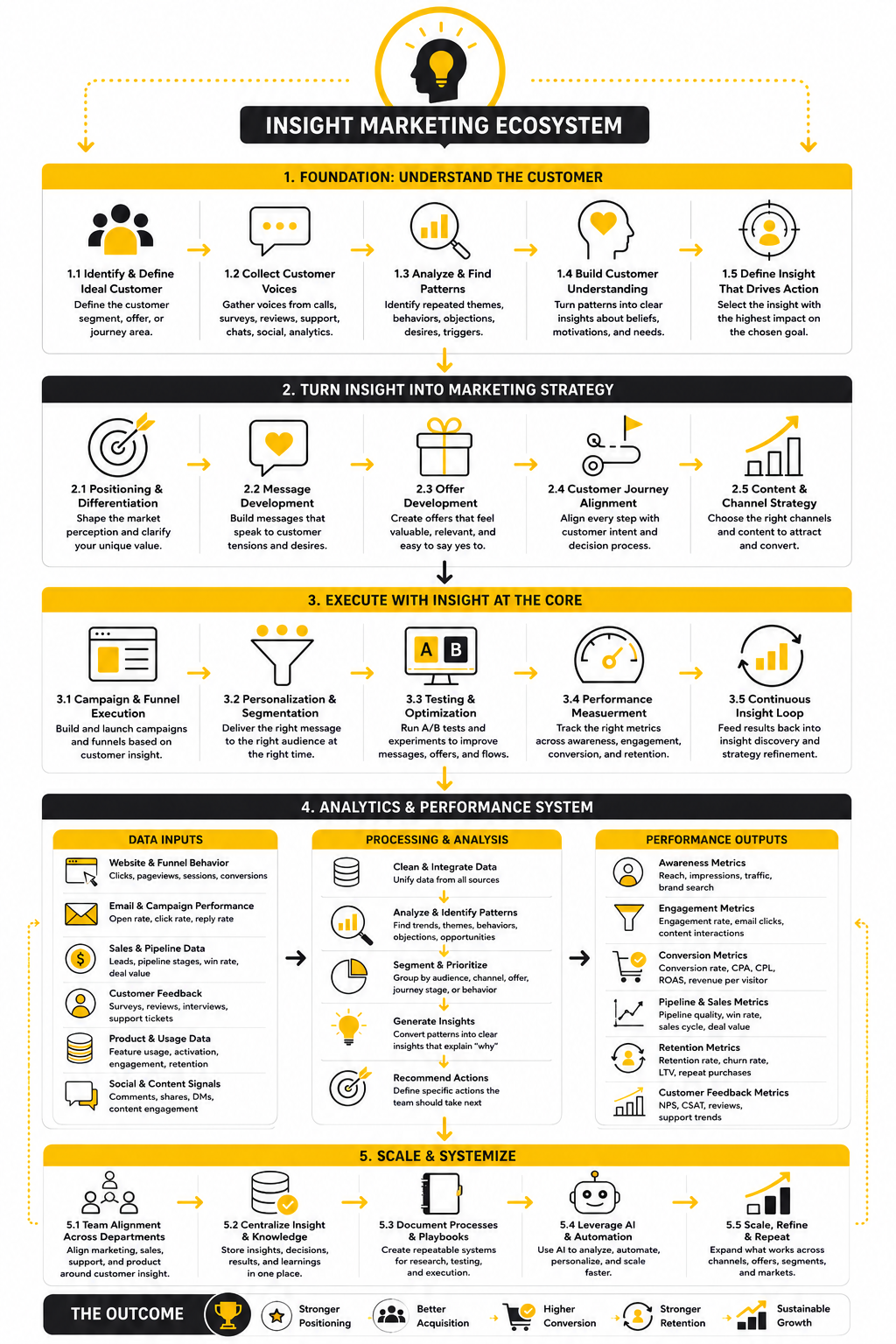
Build The Final Insight Marketing Ecosystem
The final system should make insight easy to find and hard to ignore. When a campaign is being planned, the team should be able to see relevant customer language, past test results, known objections, top-performing messages, and current funnel friction. That makes strategy faster because the team is not starting from a blank page every time.
The ecosystem should also connect marketing activity to real business outcomes. Awareness metrics, email engagement, landing page behavior, pipeline quality, retention, and customer feedback should not live in completely separate worlds. When they are separated, teams optimize isolated touchpoints instead of improving the full customer journey.
This is where marketers need to be honest about their stack. A simple setup that the team actually uses is better than a powerful setup that nobody maintains. Tools like GoHighLevel, Brevo, Moosend, and Systeme.io can support different parts of the journey, but the system only works when the team keeps insight at the center.
Choose Tools By Customer Workflow, Not Hype
The best tool for insight marketing is the one that helps your team understand and respond to customers faster. That might be a CRM, email platform, survey tool, funnel builder, landing page builder, analytics platform, AI assistant, social scheduler, form tool, or research workspace. The category matters less than the job it performs in the customer journey.
If the main problem is poor follow-up, prioritize CRM and automation. If the main problem is weak landing page conversion, prioritize faster testing and better page iteration. If the main problem is unclear customer language, prioritize feedback collection, call analysis, review mining, and better research workflows.
This is where teams should avoid buying tools as a substitute for clarity. A tool can automate a weak message, publish weak content faster, or route unqualified leads more efficiently. Insight marketing works when the tool amplifies a strong customer understanding, not when it hides the absence of one.
Use AI To Compress The Work, Not Skip The Work
AI can make insight marketing faster by helping with summarization, clustering, analysis, drafting, repurposing, and testing. It can scan large volumes of customer feedback, group themes, compare objections, and help create message variations based on real input. That is genuinely useful when the source material is strong.
But AI should not invent the customer truth for you. If the data is biased, incomplete, outdated, or disconnected from real buyers, the output will look polished while still being wrong. That is the dangerous part because polished wrong answers are easy to believe.
The right workflow is simple. Feed AI real customer evidence, use it to find possible patterns, then validate those patterns against performance data and human judgment. That keeps AI in the role where it is strongest: accelerating analysis and execution without becoming the final authority.
Keep The System Lightweight Enough To Maintain
A system that is too heavy will collapse. If every campaign requires a long research document, complex tagging structure, multi-hour review, and too many approval steps, the team will eventually bypass the process. Good insight marketing should make decisions easier, not slower.
Start with the few habits that create the most leverage. Capture customer language. Review performance by journey stage. Document the insight behind major changes. Share learning across marketing, sales, and support.
Then build from there. Once the basics are consistent, add more advanced segmentation, dashboards, automations, and testing workflows. The order matters because a simple habit done consistently beats a sophisticated system used occasionally.
What Is Insight Marketing?
Insight marketing is the process of using real customer understanding to guide marketing decisions. It goes beyond tracking metrics because it tries to explain why customers behave the way they do. The goal is to turn customer truth into better messaging, offers, campaigns, funnels, and retention systems.
How Is Insight Marketing Different From Market Research?
Market research is often the process of collecting information about customers, competitors, markets, or trends. Insight marketing uses that information to make specific marketing decisions. Research can tell you what people said or did, while insight marketing turns that evidence into action.
Why Is Insight Marketing Important?
Insight marketing is important because customers are exposed to more choices, more content, and more automated messaging than ever. Generic marketing is easier to ignore because it does not feel connected to the customer’s real problem. When you understand the customer clearly, your campaigns become more relevant, more trusted, and easier to act on.
What Makes A Good Customer Insight?
A good customer insight explains a meaningful behavior, belief, tension, fear, desire, or decision trigger. It should be specific enough to change what your team says, shows, offers, or measures. If an insight does not lead to a practical marketing decision, it is probably still just an observation.
What Data Should I Use For Insight Marketing?
Use a mix of quantitative and qualitative data. Quantitative data includes analytics, conversion rates, email performance, funnel behavior, sales metrics, retention numbers, and customer lifetime value. Qualitative data includes interviews, surveys, sales calls, support tickets, reviews, direct replies, and customer conversations.
Can Small Businesses Use Insight Marketing?
Yes, and small businesses often have an advantage because they are closer to the customer. A founder, freelancer, agency, or local business can learn a lot from calls, reviews, objections, emails, and direct messages. The system does not need to be complex; it just needs to turn those signals into better decisions.
How Often Should Insights Be Reviewed?
Insights should be reviewed whenever campaigns are planned, launched, and evaluated. For most teams, a weekly or biweekly review is enough to keep learning active without creating unnecessary meetings. Larger teams or fast-moving campaigns may need a tighter rhythm, especially when spend is high or customer behavior is changing quickly.
What Is The Biggest Mistake In Insight Marketing?
The biggest mistake is confusing data with understanding. A dashboard can show what happened, but it does not automatically explain why it happened. Insight marketing requires interpretation, customer context, and action, not just reporting.
How Do You Know If An Insight Is Working?
An insight is working when it improves the customer journey and business outcome it was meant to influence. That might show up as stronger engagement, better-qualified leads, higher conversion, shorter sales cycles, stronger retention, fewer support issues, or clearer customer feedback. The key is to measure the result against the decision the insight was supposed to improve.
Should AI Be Used For Insight Marketing?
AI can be very useful for insight marketing when it is grounded in real customer evidence. It can summarize interviews, organize feedback, find repeated themes, draft message variations, and speed up campaign testing. It should not replace human judgment because the team still needs to decide which patterns are strategically meaningful.
What Tools Are Best For Insight Marketing?
The best tools depend on the workflow you need to improve. A CRM helps with customer and sales signals, an email platform helps with lifecycle behavior, a funnel builder helps with conversion testing, and analytics tools help measure performance. The tool stack should support the insight process instead of becoming the process.
How Does Insight Marketing Improve Funnels?
Insight marketing improves funnels by making each step more connected to the customer’s actual decision. It can clarify the headline, strengthen the offer, improve proof, reduce friction, answer objections, and make follow-up more relevant. A funnel performs better when it is built around what customers need to believe before they move forward.
How Does Insight Marketing Help With Content?
Insight marketing helps content become more strategic. Instead of publishing random topics, you create content around customer questions, objections, beliefs, and buying triggers. That makes content useful for acquisition, education, trust-building, conversion, onboarding, and retention.
How Do I Start With Insight Marketing?
Start by collecting customer language from the places where customers already speak honestly. Look at reviews, sales calls, support tickets, survey replies, email responses, social comments, and search behavior. Then identify repeated patterns and choose one customer journey point where applying that insight could improve performance.
Build a stronger local presence with BAAM AI
Turn your website, Google profile, social channels, and AI visibility into one growth engine
Most businesses do not need more random marketing activity. They need a consistent presence system that helps the right people find them, trust them, and take action. BAAM AI brings strategy, local SEO, website updates, Google Maps visibility, social content, AI-search readiness, media production, and reporting into one practical monthly engine.
If you want your marketing to keep working after the campaign ends, start with a free BAAM AI presence audit. See how your business shows up today and where the fastest visibility wins are at BAAM AI.