
BAAM AI Blog
Innovative Social Media Campaigns: A Practical Framework for Brands That Want Attention Without Looking Desperate
Innovative social media campaigns are not built by copying whatever went viral last Tuesday. They work because the brand understands the audience, the platform, the cultural moment, and the business goal before...
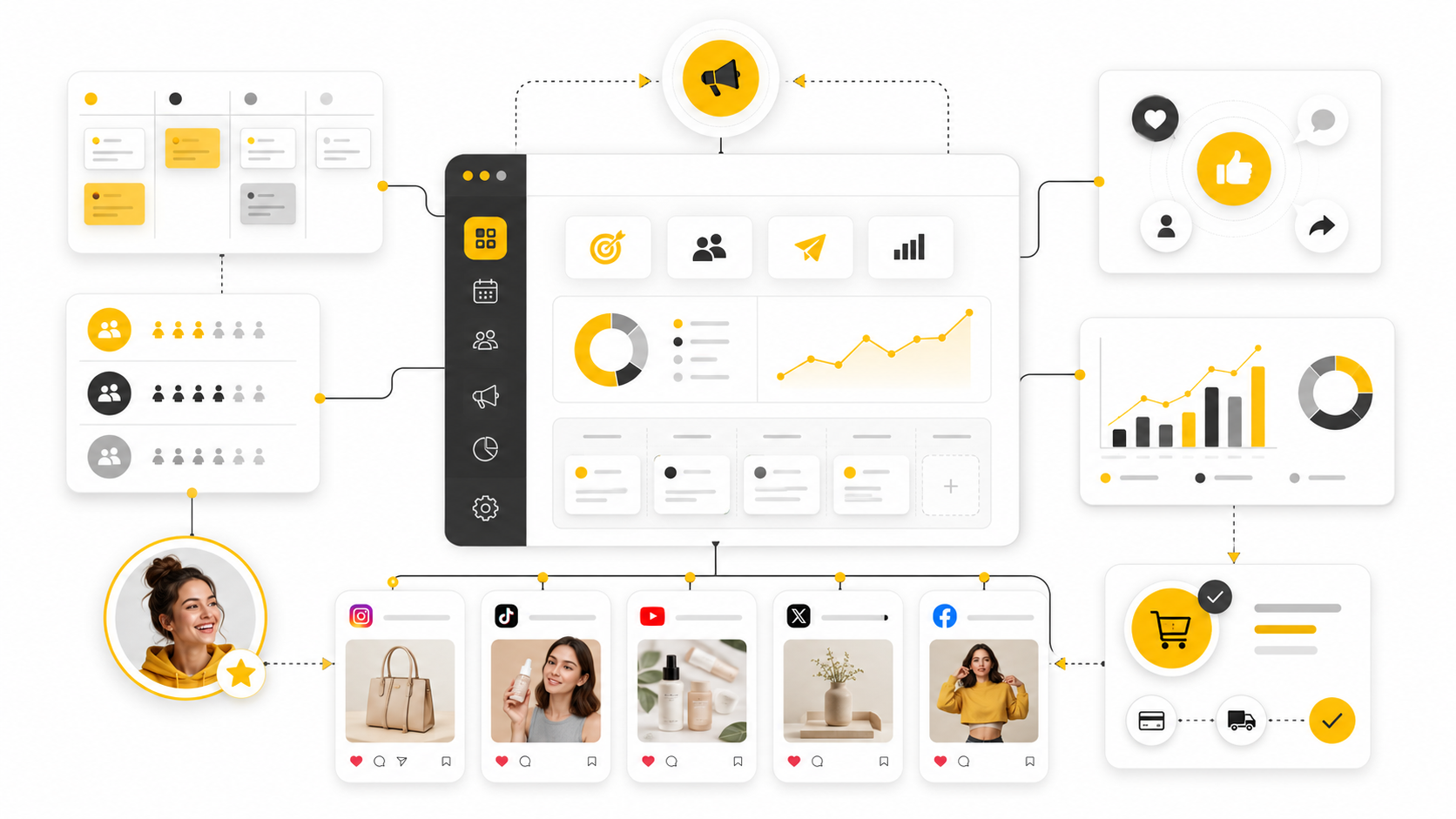
Innovative social media campaigns are not built by copying whatever went viral last Tuesday. They work because the brand understands the audience, the platform, the cultural moment, and the business goal before anyone opens a content calendar. That is the part most teams skip, and it is usually why “creative” campaigns end up feeling random.
The brands winning on social right now are not just posting more. They are designing campaigns with a clear reason to exist. They know what the audience should feel, what action should happen next, and how each post, creator, reply, landing page, automation, or offer supports the bigger move.
this guide breaks down how to think about innovative social media campaigns like a strategist, not a trend-chaser. The goal is simple: build campaigns that feel fresh, earn attention, and still connect back to measurable growth.
Why Innovative Social Media Campaigns Matter Now
Social media has become the public layer of the customer journey. People discover brands there, compare them there, complain there, buy from there, and decide whether a company feels worth trusting there. That means social campaigns can no longer be treated as decoration around the “real” marketing strategy.
The problem is that most feeds are overloaded. Audiences scroll past polished brand content every day because it looks like everything else. Innovative social media campaigns cut through that sameness by giving people something more useful, more entertaining, more participatory, or more emotionally relevant than another product announcement.
This does not mean every brand needs to be chaotic, funny, or edgy. Innovation can be as simple as a more carefully community mechanic, a sharper creator collaboration, a more useful interactive tool, or a campaign that connects social engagement to a proper follow-up journey. For example, a brand using ManyChat to turn comments and DMs into helpful automated conversations can make a social campaign feel more responsive without forcing the team to manually handle every interaction.
The key is intent. A campaign is not innovative because it uses a new platform feature. It is innovative when the format, message, and distribution model solve a real attention problem better than the usual approach.
The Campaign Framework: From Insight to Outcome
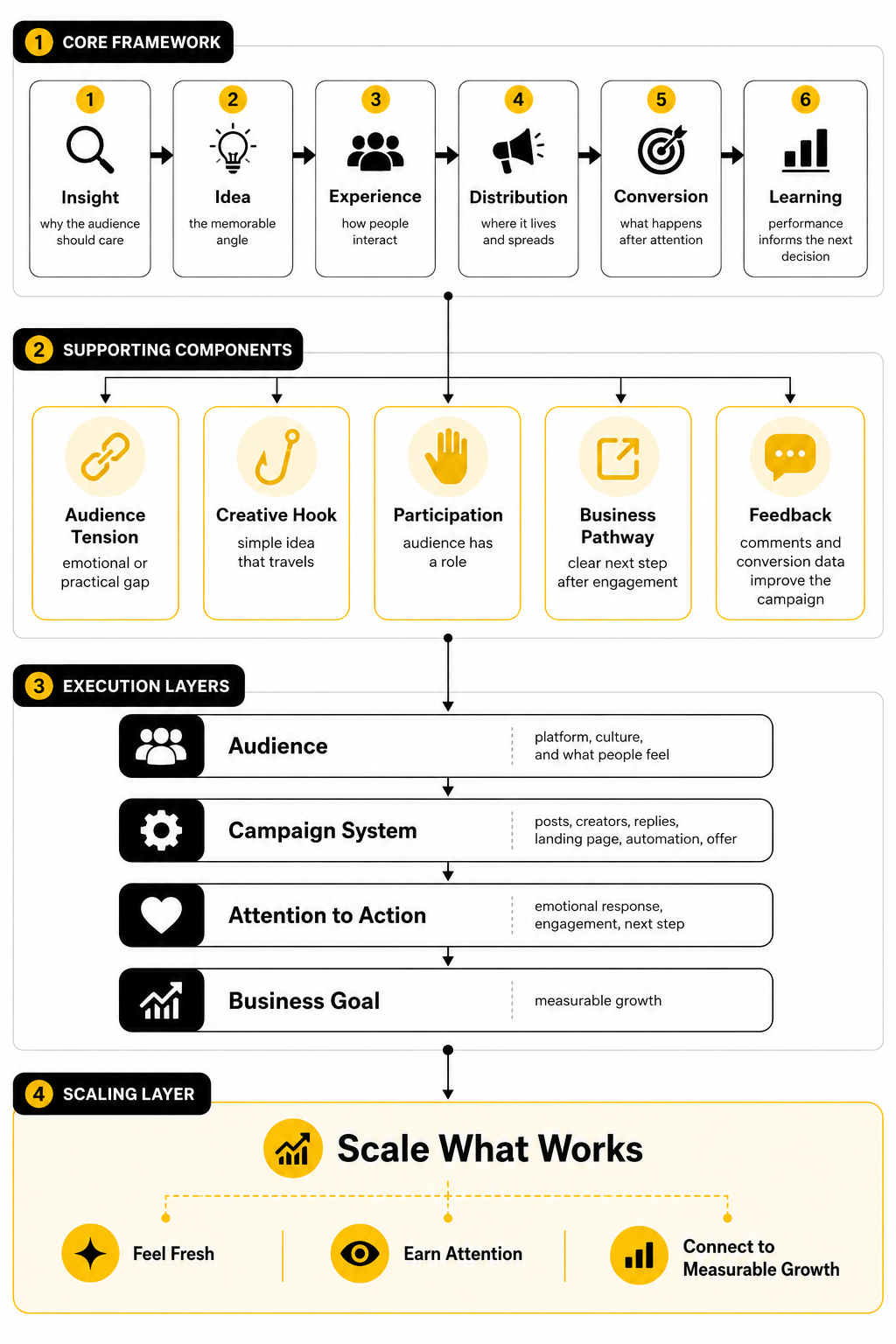
Innovative campaigns need structure because creativity without structure is expensive guessing. A strong campaign starts with an audience insight, turns that insight into a creative idea, then translates the idea into platform-native content and a clear next step. Without that chain, even a clever post can become a dead end.
The framework is simple: insight, idea, experience, distribution, conversion, and learning. The insight explains why the audience should care. The idea gives the campaign a memorable angle. The experience defines how people interact with it, whether through comments, shares, creator content, challenges, live events, lead magnets, quizzes, or direct messages.
Distribution decides where the campaign should live and how it should spread. Conversion defines what happens after attention is earned. Learning closes the loop by turning campaign performance into the next strategic decision instead of another isolated report.
Core Components of an Innovative Campaign
The first component is a sharp audience tension. This is the emotional or practical gap your campaign can speak to. It might be confusion, boredom, frustration, aspiration, skepticism, identity, urgency, or curiosity. Weak campaigns talk about the brand first; strong campaigns start with what the audience already feels.
The second component is a creative hook that can travel. A hook is not just a headline. It is the reason someone stops, understands, and feels compelled to engage. The best hooks are simple enough to explain in one sentence but flexible enough to support several pieces of content.
The third component is participation. Social media rewards campaigns that give people a role, not just a message to consume. That role might be voting, commenting, remixing, submitting, reacting, testing themselves, sharing a result, joining a challenge, or asking for a personalized recommendation.
The fourth component is a business pathway. Attention is useful only when the campaign gives people somewhere logical to go next. That might be a landing page built with Replo, a funnel in ClickFunnels, a lightweight offer in Systeme.io, or a CRM workflow inside GoHighLevel. The tool matters less than the logic: once people engage, the next step should feel obvious.
The fifth component is feedback. Innovative social media campaigns rarely arrive perfect. They improve because the team watches comments, saves, shares, replies, click behavior, creator feedback, customer questions, and conversion data. The campaign becomes stronger when social listening is treated as strategy input, not just community management.
Creative Formats That Make Campaigns Feel Fresh
Innovative social media campaigns usually feel fresh because the format does some of the persuasion before the copy even starts. A static announcement asks people to care. A good format gives them a reason to care, react, compare, test, contribute, or share.
This is why format strategy matters. Social media is not one environment anymore; it is a bundle of feeds, search behaviors, private messages, creator networks, recommendation engines, comment sections, short-form video loops, live shopping moments, and community spaces. A campaign that works across those environments needs more than “make five posts and boost the best one.”
The best approach is to choose the format based on the job. If the campaign needs trust, use proof-led content and creators who can explain the product in their own voice. If it needs reach, build around a simple participation mechanic. If it needs conversion, make the path from social interaction to offer painfully easy.
Interactive Campaigns
Interactive campaigns work because they turn passive attention into a small action. That action can be a comment, vote, quiz answer, DM keyword, poll response, story reply, or user submission. The action does not need to be complicated; in fact, simple usually wins.
The mistake is making interaction feel like unpaid labor. Nobody wants to “join the conversation” just because a brand asked them to. People interact when the campaign gives them a payoff: a useful recommendation, a public opinion moment, a funny result, a chance to be featured, or a stronger sense of belonging.
This is where social automation can support the experience without making it feel robotic. A comment-to-DM flow in ManyChat can deliver a checklist, product finder, discount, webinar link, or personalized next step after someone engages. That keeps the campaign moving while the interest is still warm.
Creator-Led Campaigns
Creator-led campaigns are not innovative just because a creator is involved. A creator becomes useful when they bring context, trust, storytelling ability, or access to a specific community the brand cannot reach as naturally on its own. That is the difference between renting attention and building relevance.
For many brands, smaller creators can be more strategic than celebrity partnerships. Deloitte’s 2025 social research found that social-first brands prioritize micro and mid-tier creators far more often than lower-maturity brands, and that stronger creator strategies are tied to higher social ROI. The practical lesson is clear: relevance beats fame when the goal is action, not just visibility.
Good creator briefs leave room for the creator’s voice. Bad briefs turn creators into actors reading brand copy. Innovative social media campaigns usually give creators a clear strategic role, then let them package the idea in the language their audience already trusts.
Community-Led Campaigns
Community-led campaigns are powerful because they are not built around a single broadcast moment. They create a reason for people to keep showing up, contributing, and recognizing each other. That can happen in comments, groups, Discord servers, newsletters, customer communities, live sessions, or recurring content formats.
This matters because social media is now deeply connected to customer experience, not just awareness. HubSpot’s 2025 social media report found that 78% of marketers agree social media will be consumers’ preferred customer service channel this year. When people already expect brands to respond on social, campaigns that invite participation also need a real plan for replies, escalation, and follow-up.
A community-led campaign should never feel like a brand pretending to be everyone’s friend. It should create a useful shared space around a problem, identity, goal, or moment. That could mean customer stories, expert Q&A, public challenges, behind-the-scenes decision-making, or a repeatable series that gives the audience a reason to return.
Social Search Campaigns
Social platforms are also search engines now, especially for younger buyers researching products, places, tutorials, and opinions. That changes how campaigns should be built. A campaign asset should not only look good in the feed; it should also be findable when someone searches for the problem later.
This means your creative needs searchable language, not just clever language. Use the words customers actually type, say, and ask in comments. Innovative social media campaigns can still be entertaining, but the strongest ones also leave behind a library of useful answers.
This is where planning tools can help keep the system organized. A scheduling and publishing workflow in Buffer can help teams coordinate campaign assets across channels, while research from DataReportal shows that the typical adult internet user discovers brands through an average of 5.8 different sources. The point is not to post everywhere for the sake of it; the point is to build a campaign that can be discovered from multiple angles.
Conversion-Focused Campaigns
A campaign can earn attention and still fail if the next step is unclear. The moment someone clicks, comments, replies, or taps, the campaign has created momentum. Losing that momentum with a generic homepage or confusing offer is painful because the hard part already happened.
Conversion-focused campaigns connect the social idea to a specific landing experience. That might be a waitlist, consultation form, product bundle, challenge signup, webinar, free tool, quiz, or limited-time offer. The destination should feel like the natural continuation of the campaign, not a separate marketing asset bolted on at the end.
For ecommerce and direct-response campaigns, a focused page built with Replo or a funnel built in ClickFunnels can keep the message tight from first impression to action. For service businesses and agencies, GoHighLevel can connect campaign leads to CRM, follow-up, booking, and pipeline management. The campaign feels more innovative when the whole journey is designed, not just the top-of-feed creative.
Professional Implementation Across Channels
Professional implementation starts with one uncomfortable truth: every platform has its own behavior. A TikTok idea dropped onto LinkedIn without adaptation usually feels off. A LinkedIn thought-leadership post copied into Instagram captions usually feels heavy. A campaign has to stay strategically consistent while changing shape for each environment.
That does not mean the team needs a completely different campaign for every platform. It means the central idea should be strong enough to survive translation. The hook, proof, offer, and audience tension stay consistent, while the format, pacing, visual language, and call to action adapt to the channel.
This is also where many brands lose discipline. They confuse “multi-channel” with “duplicate everywhere.” Innovative social media campaigns use each channel for a specific role, then connect those roles into one campaign system.
Assign a Job to Each Channel
Every channel in the campaign should have a job. TikTok might create discovery. Instagram might build familiarity and social proof. LinkedIn might add authority. YouTube Shorts might extend search visibility. Email might handle deeper persuasion after the first interaction.
When the jobs are clear, the content becomes easier to judge. You stop asking whether every post directly sold something and start asking whether it performed its assigned role. That is a much more carefully way to manage a campaign because not every asset should be measured by the same metric.
A simple channel map can prevent chaos. List the campaign objective, the audience segment, the platform role, the content format, the CTA, and the follow-up path. This makes the campaign easier to brief, easier to execute, and easier to improve without turning every review meeting into personal opinion.
Build a Campaign Rhythm
A strong campaign has rhythm. It does not drop one big announcement and disappear. It builds attention, deepens interest, invites participation, handles objections, shows proof, and gives people several chances to take action.
The rhythm should match the buying cycle. A low-ticket impulse offer may only need a short burst of curiosity, proof, and urgency. A B2B or high-ticket offer needs more education, authority, trust-building, and follow-up before the CTA feels natural.
This is where a campaign calendar matters, but only if it is strategic. Do not fill dates with random posts. Build the sequence around what the audience needs to believe before they take the next step.
Turn the Campaign Idea Into an Execution System
Once the campaign direction is clear, the real work starts. This is where innovative social media campaigns either become a focused growth asset or collapse into a messy pile of posts, approvals, and last-minute edits. The difference is not talent; it is process.
A strong execution system turns the campaign idea into repeatable decisions. The team should know what is being created, why each asset exists, who owns it, how it will be approved, where it will be published, and what happens after people engage. Without that structure, even a brilliant creative concept becomes hard to manage.
This does not mean killing spontaneity. Social media still needs speed, judgment, and room to react. The point is to build a campaign system that gives the team enough structure to move fast without turning every post into a separate debate.
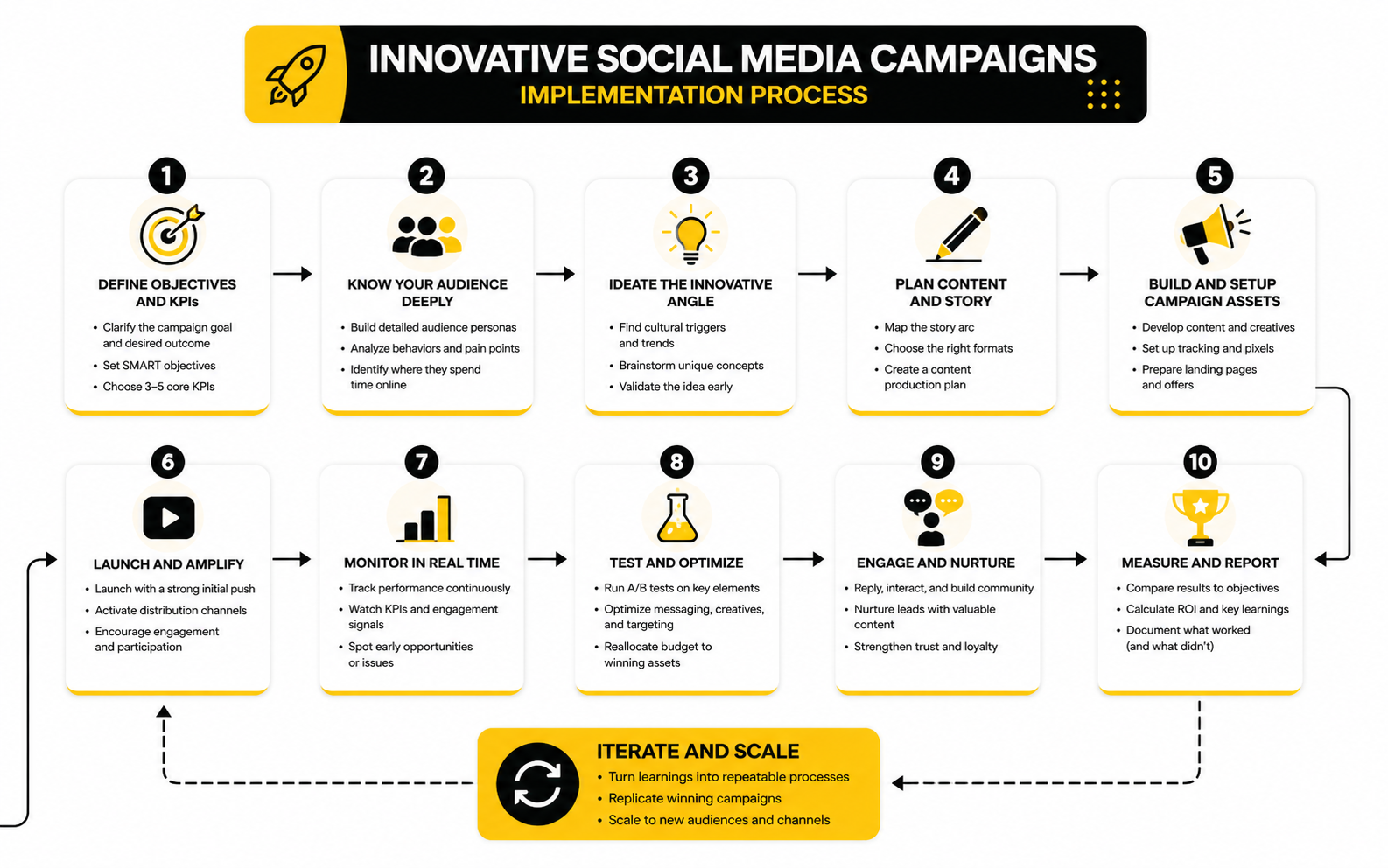
Step 1: Define the Campaign Objective
Start with one primary objective. Not five. Not “awareness, engagement, leads, sales, community, and brand love.” One main objective gives the campaign a center of gravity.
The objective should be tied to a real business outcome. If the goal is awareness, define what kind of awareness matters and which audience needs to notice you. If the goal is lead generation, define the offer, qualification path, and follow-up system before the first post goes live.
This matters because the objective shapes every creative decision. A campaign built to increase product trials will look different from one built to recruit creators, grow a waitlist, launch a new feature, or reposition the brand. When the objective is vague, the campaign gets judged by whatever metric looks good afterward.
Step 2: Build the Audience Insight
The audience insight is the emotional engine of the campaign. It explains what the audience already believes, wants, fears, misunderstands, or struggles with before your brand enters the conversation. Innovative social media campaigns usually work because they meet people inside a real tension, not because they shout louder.
A useful insight should be specific enough to shape creative. “Our audience wants to save time” is too broad. “Our audience is tired of marketing tools that promise automation but still create more manual work” is sharper because it gives the campaign something to push against.
This is where social listening, customer calls, sales notes, reviews, support tickets, comment sections, and competitor analysis become useful. The best ideas are often hiding in the language customers already use. If your campaign copy sounds like your audience could have said it first, you are usually closer to the truth.
Step 3: Choose the Campaign Mechanic
The campaign mechanic is how people participate. It might be a challenge, quiz, comment trigger, creator prompt, giveaway, live event, remix format, checklist download, public vote, before-and-after reveal, or limited-time offer. The mechanic gives the campaign its movement.
Do not choose a mechanic just because it is popular. Choose it because it fits the audience behavior and the business goal. A comment-to-DM campaign makes sense when the offer is simple and immediate, while a creator education series makes more sense when the product needs explanation.
If the campaign depends on DMs, lead capture, or fast follow-up, set that up before launch. A simple automation in ManyChat can deliver the promised asset, ask a qualifying question, and route people into the next step. That is much cleaner than asking people to comment and then leaving them waiting.
Step 4: Map the Content Sequence
A campaign sequence should move people through stages. First, earn attention. Then make the problem feel relevant. Then show the mechanism behind the solution. Then add proof. Then invite action. This is basic, but many teams still publish campaign assets in a random order.
Think of the sequence as a conversation. The first post should not carry the entire sales argument. It should create enough interest for the next asset to make sense. Each piece should have a role, and the full campaign should feel like it is building toward something.
A practical sequence might include:
Step 5: Create the Conversion Path
The conversion path is where social attention becomes business value. It is the page, form, funnel, booking flow, checkout, webinar, free trial, or CRM workflow that receives people after they engage. This part needs to be built with the same care as the creative.
The biggest mistake is sending campaign traffic to a generic homepage. A homepage has too many options and too little context. If someone comes from a campaign about one specific promise, the destination should continue that promise immediately.
For product campaigns, a focused landing page in Replo can keep the message aligned from social creative to product action. For sales funnels, ClickFunnels can help structure the path from opt-in to offer. For service businesses, agencies, and local brands, GoHighLevel can connect the campaign to pipelines, follow-up, appointment booking, and client communication.
Step 6: Assign Roles Before Launch
Campaigns slow down when ownership is unclear. Someone should own strategy, someone should own creative production, someone should own publishing, someone should own community management, and someone should own performance review. In small teams, one person may cover several roles, but the responsibilities still need to be explicit.
Approvals also need rules. Decide what requires approval, who gives it, and how fast feedback must happen. If every caption, creator edit, reply, and design change needs full team approval, the campaign will move too slowly for social media.
This is especially important when creators are involved. Creator content needs brand safety, but it also needs breathing room. Give creators the message, guardrails, offer, and required disclosures, then avoid polishing their content until it loses the reason you hired them.
Step 7: Prepare the Response System
A campaign does not end when the post goes live. In many cases, that is when the most valuable work begins. Comments, DMs, replies, objections, questions, and shares reveal what the audience actually thinks.
Before launch, prepare response guidelines. The team should know how to answer common questions, when to move someone into DMs, when to escalate support issues, and how to respond to criticism without sounding defensive. This keeps the campaign professional when attention increases.
For lead-focused campaigns, connect the response system to email, SMS, CRM, or booking workflows. Tools like Brevo or Moosend can support follow-up when email is part of the journey. The important thing is that no warm interaction gets wasted because nobody planned what should happen next.
Step 8: Launch in Controlled Waves
Do not launch every asset at once unless the campaign truly needs a single big moment. Most campaigns benefit from controlled waves because early audience signals can improve later content. The first wave tests the hook, the second wave sharpens the message, and the third wave pushes the strongest angle harder.
This gives the team room to learn without restarting from zero. If one creator angle outperforms the others, build more around it. If one objection keeps appearing in comments, turn it into content. If one CTA gets clicks but poor conversions, fix the destination before spending more.
Innovative social media campaigns look polished from the outside, but inside they should behave like a learning system. Launch, read the market, adjust, and push again. That is how campaigns become more carefully instead of just louder.
Step 9: Document What Worked
After the campaign, do not just make a performance report. Build a reusable learning asset. Document the strongest hooks, best-performing formats, common objections, creator notes, conversion bottlenecks, audience language, and follow-up opportunities.
This is how one campaign makes the next campaign better. The team should not have to rediscover the same lessons every quarter. A simple post-campaign review can turn scattered performance data into a sharper creative and strategic playbook.
The final question is not only “Did this campaign work?” The better question is “What did this campaign teach us that we can use again?” That mindset is what separates professional social execution from constant content improvisation.
Statistics and Data
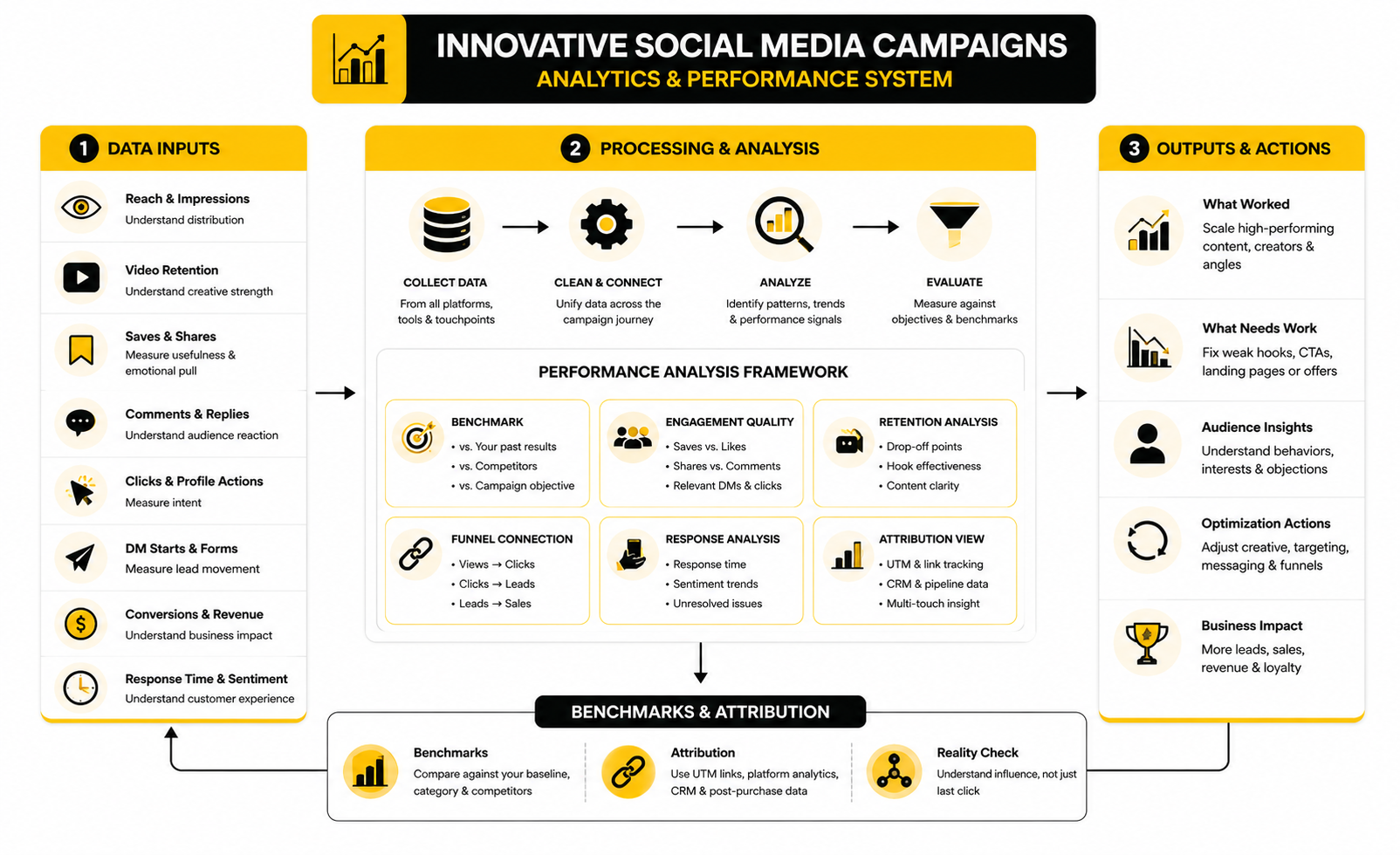
Measurement is where innovative social media campaigns become more than a creative opinion contest. Without data, the loudest person in the room usually wins. With data, the campaign can be judged by what the audience actually did, what changed in the business, and what should happen next.
The mistake is treating analytics like a scoreboard instead of a diagnostic system. A scoreboard says, “This post got 40,000 views.” A diagnostic system asks, “Did those views come from the right audience, did they create meaningful engagement, did they move people into the next step, and what should we change before the next wave?”
That distinction matters because social media metrics are easy to misread. High reach can hide weak relevance. High engagement can come from controversy that does not help the brand. Strong clicks can still fail if the landing page does not convert. The numbers only become useful when they are connected to the campaign’s job.
Start With the Right Benchmark
Benchmarks are useful, but only when they are used correctly. They should give context, not become the goal. A campaign should not chase a generic engagement rate if the real objective is qualified leads, booked calls, trial starts, customer retention, or product education.
Industry data can still help teams avoid unrealistic expectations. Rival IQ’s 2025 Social Media Industry Benchmark Report shows that engagement patterns vary heavily by platform and industry, which means a “good” result for one category may be weak in another. That is why campaign reporting should compare performance against three layers: your past results, your direct competitors, and the specific objective of the campaign.
The best benchmark is usually your own baseline. If your usual Instagram Reel reaches 8,000 people and your campaign Reel reaches 40,000 people with better saves, comments, and profile actions, that is a meaningful signal. If it reaches 400,000 people but brings the wrong audience and no follow-up activity, the number looks impressive but does not prove much.
Measure the Full Campaign Journey
Innovative social media campaigns should be measured as journeys, not isolated posts. The first post may create discovery. The second may explain the idea. A creator asset may add trust. A comment-to-DM flow may capture interest. A landing page may convert the demand.
If you only measure the top of the journey, you overvalue reach. If you only measure the bottom, you undervalue the content that created belief before the conversion happened. The useful view is the full chain from attention to action.
A simple campaign measurement system should track:
Read Engagement Quality, Not Just Engagement Volume
Engagement is not one metric. A like, save, share, comment, follow, DM, and click all mean different things. Treating them as equal creates bad decisions.
A save often suggests the content was useful enough to revisit. A share suggests the audience saw social currency in passing it along. A comment can show involvement, confusion, objection, excitement, or disagreement. A click shows curiosity, but the quality of that curiosity depends on what happens after the click.
This is why engagement quality matters. A campaign with fewer total engagements but more saves, qualified DMs, and relevant questions may be stronger than a campaign with many shallow reactions. If the goal is growth, do not celebrate noise before checking whether the noise came from people who could realistically become customers.
Watch Retention Before You Blame the Algorithm
For video-led campaigns, retention tells you whether the creative is holding attention. If people leave in the first few seconds, the problem is usually the hook, pacing, visual opening, or mismatch between promise and delivery. Blaming the algorithm too early is lazy.
HubSpot’s 2025 social video research found that marketers continue to treat short-form video as one of the highest-ROI formats, but that does not mean any short video works. The format creates opportunity. The first seconds, structure, clarity, and payoff decide whether people stay.
The action from retention data should be practical. If drop-off is immediate, rewrite the opening. If people stay but do not click, strengthen the transition to the offer. If retention is high but shares are low, the content may be informative without being distinctive. Each pattern tells you where to fix the campaign.
Separate Creative Signals From Funnel Signals
One of the biggest measurement mistakes is blaming creative for a funnel problem. A post can generate strong intent, but the landing page, form, checkout, booking flow, or follow-up can still lose people. That does not mean the social campaign failed.
Look at the handoff points. If clicks are strong but conversions are weak, inspect the destination. If DMs start but people do not continue, inspect the automation or offer clarity. If leads come in but sales do not move, inspect qualification, follow-up speed, and sales alignment.
For campaigns with a dedicated landing page, the message should match the social promise immediately. A page built with Replo or a funnel in ClickFunnels should continue the same hook, proof, and next step people saw in the campaign. If the campaign says one thing and the page says another, analytics will show interest at the top and confusion at the bottom.
Track Response Speed and Social Care
Social campaigns create conversations, and conversations create expectations. That is especially important when the campaign invites comments, questions, DMs, support requests, or public feedback. The more attention you earn, the more prepared your response system needs to be.
Sprout Social’s 2025 Index is based on surveys of more than 4,000 consumers and 1,200 marketers, and its findings point to a clear reality: people expect brands to be responsive, useful, and present on social. That means campaign measurement should include response time, unresolved questions, sentiment, escalation volume, and the quality of replies, not just content metrics.
This is not soft data. Slow or weak responses can damage trust right when the campaign is creating demand. If a campaign produces hundreds of comments but the brand ignores buying questions, the team is leaving revenue and credibility on the table.
Use Attribution Without Pretending It Is Perfect
Attribution is useful, but it is not magic. Social media often influences people before they click, and not every useful touchpoint gets tracked cleanly. Someone may see three posts, watch a creator video, search the brand later, read reviews, and convert from a direct visit.
That does not mean you should ignore attribution. Use UTM links, platform analytics, CRM tracking, landing page data, checkout data, and post-purchase questions where possible. Just avoid pretending one dashboard can explain the entire customer journey perfectly.
For service businesses and agencies, GoHighLevel can help connect campaign leads to pipelines, follow-up sequences, booking activity, and sales outcomes. For ecommerce or creator-led funnels, keep campaign-specific links and pages separate enough that you can read performance clearly. The goal is not perfect attribution; the goal is better decisions.
Decide What Each Metric Should Trigger
Data is only useful if it changes behavior. Before launch, decide what the team will do when certain signals appear. Otherwise, everyone will stare at the dashboard and still argue from instinct.
If reach is low but engagement quality is strong, the campaign may need better distribution, creator support, paid amplification, or reposting in a stronger format. If reach is high but saves and clicks are weak, the hook may be broad but the value is not clear enough. If clicks are high but conversions are low, the offer, page, or follow-up path needs attention.
A simple action map helps:
Look for Patterns Across Assets
Do not judge a campaign from one viral post or one underperforming asset. Look for patterns across formats, hooks, creators, audiences, and CTAs. Patterns reveal strategy. Individual posts often reveal noise.
Maybe educational posts drive saves, but creator posts drive clicks. Maybe short videos create reach, while carousels explain the offer better. Maybe one audience segment asks better buying questions than another. Those patterns are more valuable than a single top-line engagement number.
This is where reporting should become a creative planning tool. The next campaign should start with what the data already taught you. Innovative social media campaigns get stronger when every launch leaves behind sharper insights, not just screenshots of the best-performing post.
Advanced Strategy: What Separates Smart Campaigns From Expensive Noise
The more a campaign grows, the more discipline it needs. Small campaigns can survive on instinct because the risk is limited. Larger innovative social media campaigns need sharper tradeoffs, clearer ownership, and stronger brand judgment because more people, money, creators, channels, and expectations are involved.
This is where experienced teams stop asking, “What can we post?” and start asking, “What are we willing to be known for?” That question forces a brand to choose a position instead of chasing every trend. It also protects the campaign from becoming a collection of disconnected creative experiments.
The goal is not to make the campaign safer. Safe campaigns often disappear. The goal is to take the right risks on purpose, with enough structure to scale what works and enough judgment to avoid damaging trust.
Choose Distinctiveness Over Random Novelty
New is not the same as distinctive. A new format can still feel forgettable if the idea underneath it is weak. A familiar format can feel fresh if the insight, timing, voice, and execution are strong.
Distinctiveness means people can recognize the campaign as yours, even before they see the logo. That might come from the voice, visual system, recurring structure, creator mix, community ritual, product demonstration style, or point of view. The strongest campaigns do not just borrow attention from trends; they build memory around the brand.
This is especially important when platforms reward imitation. Once a format works, dozens of brands copy it quickly. If your campaign depends only on the format, it gets commoditized fast. If it depends on a sharper brand idea, the format becomes a vehicle instead of the whole strategy.
Balance Speed With Brand Safety
Social media rewards speed, but speed without judgment creates problems. A brand can move quickly and still protect itself if the team has clear decision rules before the campaign launches. Without those rules, every reactive post becomes a risk debate.
Brand safety is not just about avoiding offensive content. It also includes creator fit, disclosure compliance, claims accuracy, customer privacy, platform rules, and whether the campaign tone matches the seriousness of the topic. This matters even more when AI-generated content, creator partnerships, or user submissions are involved.
The practical move is to create boundaries before the campaign is live. Define what the brand will not joke about, what claims need legal review, what creator behavior would trigger a pause, and what customer information should never appear in public content. Those guardrails help teams move faster because they remove uncertainty.
Avoid Letting AI Flatten the Campaign
AI can help with ideation, repurposing, research, summarization, and workflow speed. It can also make campaigns sound painfully generic when the team uses it as a substitute for taste. That is the danger: AI can produce more content, but more content is not the same as a stronger campaign.
The brands that use AI well keep humans in charge of insight, judgment, humor, taste, and final creative direction. They use AI to accelerate the mechanical parts while protecting the parts that make the campaign feel alive. The audience can usually sense the difference between useful creative support and copy that feels assembled from the internet.
This is also a trust issue. Sprout Social’s 2025 research highlights how much consumers now expect brands to act responsibly and earn trust in social spaces, especially as misinformation and synthetic content become harder to ignore. If AI is part of the production process, the campaign still needs a human standard for truth, clarity, and brand fit.
Scale Creators Without Losing Authenticity
Creator programs often break when they scale. The first few partnerships feel natural because the team chooses carefully and collaborates closely. Then the campaign grows, the briefs get stricter, the approvals get heavier, and suddenly every creator sounds like the same brand script.
That defeats the point. Creators are valuable because they understand their audience’s language, pace, doubts, and humor. If the brand removes that context, it turns creator marketing into expensive distribution.
To scale creator-led campaigns properly, separate the non-negotiables from the flexible parts. The offer, disclosure, product claims, usage rights, and key message can be fixed. The hook, story, examples, editing rhythm, and delivery should leave room for the creator’s own style. That balance protects the brand without killing the trust you are trying to borrow.
Build a Modular Campaign System
Scaling gets easier when the campaign is modular. Instead of building every asset from scratch, create reusable blocks: hooks, proof points, objection responses, creator prompts, landing page sections, DM scripts, short video structures, email follow-ups, and retargeting angles. This gives the team a system without making the campaign feel templated.
A modular approach also makes testing cleaner. You can change the hook without changing the offer. You can test a creator angle without rebuilding the landing page. You can adjust the CTA without rewriting the whole campaign.
This is where connected tools help. A campaign team might use Buffer to coordinate publishing, ManyChat to manage comment and DM flows, Fillout to collect structured responses, and GoHighLevel to manage lead follow-up. The tool stack should make the campaign easier to operate, not add another layer of confusion.
Know When Not to Innovate
Not every campaign needs a big creative swing. Sometimes the smartest move is a clean offer, clear proof, strong targeting, and consistent follow-up. Innovation should serve the objective, not become a performance for other marketers.
This is especially true when trust is fragile. If the product is complex, expensive, regulated, or tied to a serious personal outcome, novelty can backfire. The campaign may need clarity more than surprise.
A good rule is simple: innovate around the obstacle. If the obstacle is attention, experiment with format. If the obstacle is trust, strengthen proof. If the obstacle is understanding, improve education. If the obstacle is conversion, simplify the path. Do not add creativity where the customer needs confidence.
Protect the Campaign From Internal Dilution
Many campaigns start strong and get weaker through internal compromise. One team adds a secondary objective. Another team asks for more product points. Someone wants the CEO quote included. Someone else wants the campaign to appeal to everyone.
That is how sharp ideas become mush. The campaign ends up saying too much, to too many people, in a way that nobody remembers. This is not a creative problem; it is a decision-making problem.
Protect the campaign with a clear strategic filter. Every asset should answer three questions: who is this for, what should they feel or understand, and what should they do next? If an idea cannot answer those questions, it probably does not belong in the campaign.
Prepare for the Second-Order Effects
Successful campaigns create side effects. More DMs. More support questions. More sales conversations. More creator inquiries. More public scrutiny. More pressure on the website, booking flow, or fulfillment team.
This is good, but only if the business is ready. A campaign that creates demand the company cannot handle can damage the customer experience. People remember the gap between the promise and the delivery.
Before scaling, check the operational reality. Can the team respond fast enough? Can the landing page handle the traffic? Can sales follow up properly? Can support answer campaign-specific questions? Can fulfillment handle the offer? Innovative social media campaigns should not just create attention; they should create attention the business is ready to convert and serve.
Build the Campaign Ecosystem
The strongest innovative social media campaigns do not end as soon as the last scheduled post goes live. They create an ecosystem of content, conversations, search visibility, creator proof, retargeting audiences, email follow-up, sales context, and customer insight. That ecosystem is where the long-term value lives.
Think of the campaign as a system with four layers. The first layer earns attention through creative content. The second layer captures intent through clicks, comments, DMs, forms, quizzes, or signups. The third layer converts that intent through landing pages, offers, calls, demos, checkout flows, or follow-up sequences. The fourth layer learns from the whole journey and feeds better insight into the next campaign.
This is how a campaign becomes an asset instead of a short burst of noise. The posts may fade from the feed, but the learnings, audiences, proof points, and content patterns keep working. When each campaign improves the next one, social media stops feeling like a treadmill.
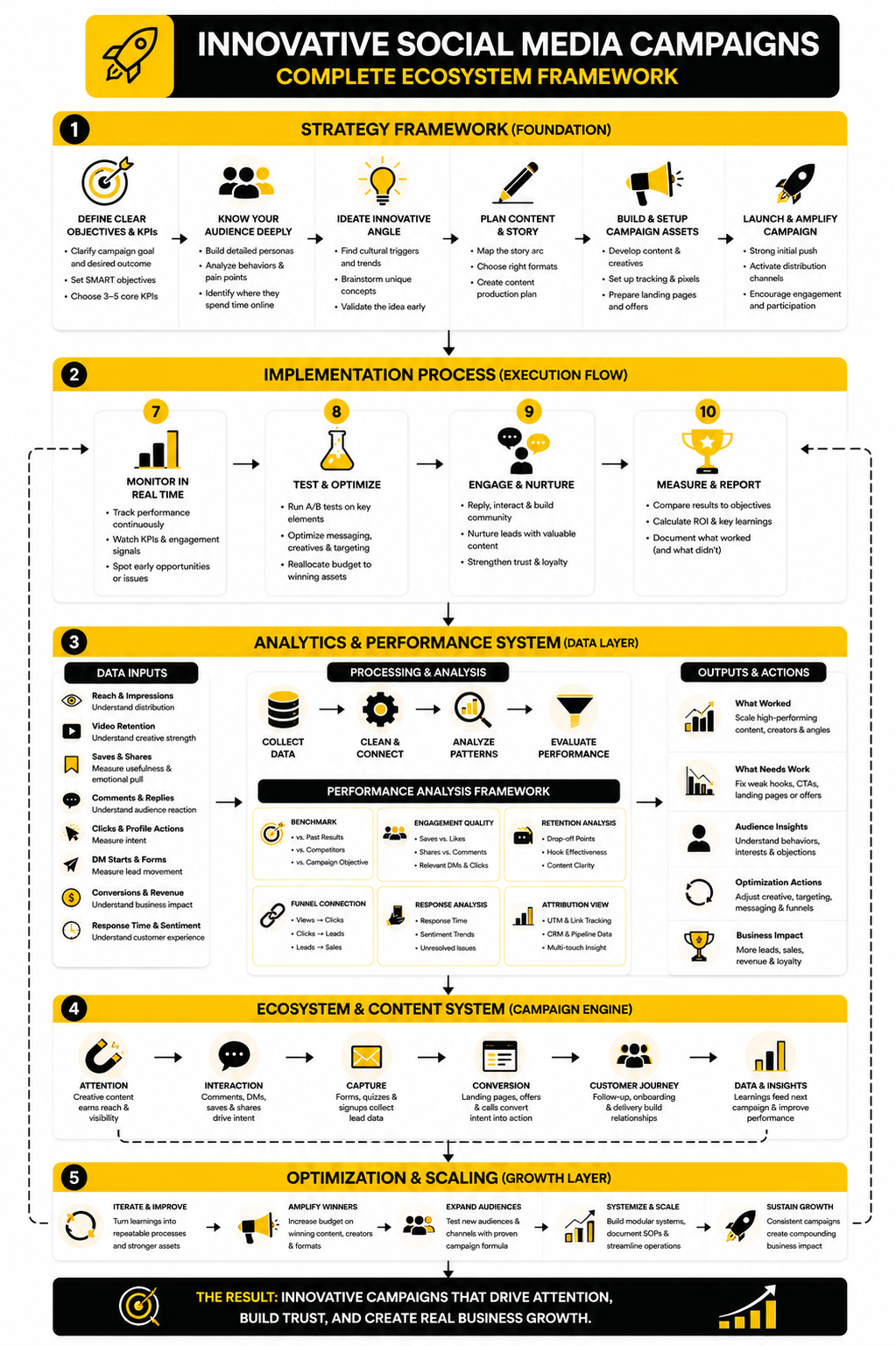
A mature campaign ecosystem also helps teams avoid overreacting to individual posts. One asset may underperform while the overall campaign still moves the right people forward. Another post may go viral while contributing almost nothing to pipeline, sales, or trust. The ecosystem view keeps the team focused on how the parts work together.
This matters because social behavior is fragmented. DataReportal’s 2025 social media research shows that adults use social platforms for multiple reasons at once, from keeping in touch and entertainment to brand discovery, news, research, and community. That means a single campaign touchpoint rarely carries the entire journey. People need repeated signals before they act.
The practical move is to design the ecosystem before launch. Know what happens when someone watches, saves, comments, clicks, replies, subscribes, books, buys, or ignores the campaign entirely. When every meaningful action has a next step, the campaign becomes easier to scale and much harder to waste.
What makes a social media campaign innovative?
An innovative social media campaign uses a fresh strategy, format, interaction, channel mix, or customer journey to solve a real attention or conversion problem. It is not innovative just because it uses a trend, new platform feature, or flashy creative style. The campaign should feel relevant to the audience and useful to the business at the same time.
The strongest campaigns usually connect insight, participation, creative execution, and follow-up. They make people want to engage because the idea feels timely, useful, entertaining, or personally relevant. If the campaign only looks creative but does not move people toward a clear outcome, it is probably just content with better packaging.
How do you come up with ideas for innovative social media campaigns?
Start with audience research, not brainstorming. Look at customer questions, reviews, comment sections, competitor content, sales objections, support tickets, creator feedback, and social search behavior. The best ideas often come from a tension the audience already feels but has not seen expressed clearly.
Then turn that tension into a simple campaign angle. Ask what people should feel, say, share, or do after seeing the campaign. Once that is clear, choose the format that best fits the idea instead of forcing the idea into a trend.
What is the most important part of a campaign strategy?
The most important part is the connection between the campaign objective and the audience insight. If the objective is vague, the campaign will be hard to measure. If the insight is weak, the campaign will be hard to care about.
A campaign needs both. The objective keeps the team honest about business impact. The insight keeps the creative grounded in what the audience actually thinks, wants, fears, or needs. When those two are aligned, execution becomes much easier.
How many platforms should a campaign use?
Use only the platforms that have a clear role in the campaign. More platforms do not automatically mean more impact. A small campaign across two well-chosen channels can outperform a scattered campaign across six.
The better question is what each channel is supposed to do. One platform may create discovery, another may build trust, another may support retargeting, and another may convert warm demand. If you cannot explain the role of a platform, it probably does not belong in the campaign plan.
How should brands measure innovative social media campaigns?
Measure the campaign journey, not just individual posts. Track reach, retention, engagement quality, clicks, DMs, form submissions, conversion rate, revenue, sentiment, and response speed based on the campaign’s objective. The point is to understand how attention turns into action.
Benchmarks can help, but your own baseline is usually more useful. Rival IQ’s 2025 benchmark research shows that engagement rates vary widely by platform and industry, so a generic number can mislead the team. Compare performance against your past campaigns, your category, and the job each asset was meant to do.
What metrics matter most for social media campaign performance?
The most important metrics depend on the campaign goal. For awareness, reach, video retention, profile actions, and share rate may matter most. For lead generation, clicks, DM starts, form submissions, cost per lead, qualification rate, and follow-up conversion matter more.
Do not treat all engagement as equal. A save usually means something different from a like. A relevant buying question in the comments can be more valuable than hundreds of shallow reactions. The best metric is the one that tells you what action to take next.
How do creator partnerships fit into innovative social media campaigns?
Creator partnerships work best when the creator adds trust, context, cultural fluency, or audience access the brand does not naturally have. The creator should not just repeat brand copy. They should translate the campaign idea into content their audience would actually watch and believe.
The brief should protect the essentials while leaving creative room. Lock the offer, claims, disclosures, key message, and brand safety rules. Give flexibility on hooks, storytelling, examples, pacing, and delivery. That is how you scale creator content without making it feel fake.
What are the biggest risks with innovative social media campaigns?
The biggest risks are unclear strategy, trend-chasing, weak follow-up, poor response planning, brand safety issues, creator misalignment, and measuring the wrong things. Most campaign failures are not caused by one bad post. They happen because the system around the campaign was not thought through.
Another risk is novelty for its own sake. If the audience needs clarity, trust, or proof, an overly clever format can hurt more than it helps. Innovation should remove friction, not add confusion.
How can small teams run better campaigns without a big budget?
Small teams should focus on sharp positioning, simple mechanics, and tight execution. You do not need a huge budget to create a useful challenge, strong short-form series, comment-to-DM flow, creator collaboration, or focused landing page. You need a clear idea and a clean path from engagement to action.
Use fewer assets, but make each one work harder. Repurpose the strongest idea into multiple formats, test hooks quickly, and build follow-up before launch. A lean campaign with good timing and strong relevance can beat a bigger campaign that feels generic.
Should AI be used in social media campaigns?
AI can be useful for research, outline development, content variation, repurposing, workflow support, and summarizing campaign learnings. It should not replace human insight, taste, judgment, or final creative direction. The audience does not reward content just because it was easier to produce.
Use AI to speed up the parts that slow the team down, then add the human layer that makes the campaign feel specific. That includes real audience language, sharp examples, product truth, brand voice, and platform judgment. AI can help the process, but it cannot care about the customer for you.
How long should a social media campaign run?
A campaign should run long enough to build recognition, test signals, optimize the strongest angles, and give people more than one chance to act. For a simple offer, that may be one to three weeks. For a product launch, repositioning effort, or creator-led campaign, it may run for several months in waves.
The key is rhythm. A campaign should not dump all assets at once unless there is a strong reason for a single launch moment. Controlled waves let the team learn from early performance and improve later execution.
What tools help execute social media campaigns professionally?
The right tools depend on the campaign system. Publishing tools like Buffer can help organize scheduling and channel coordination. Automation tools like ManyChat can support comment-to-DM flows and fast follow-up when interaction is part of the campaign.
For conversion paths, ClickFunnels, Systeme.io, or Replo can help turn attention into action. For lead management and follow-up, GoHighLevel can connect social demand to CRM workflows, booking, pipeline tracking, and customer communication.
How do you know when a campaign is ready to scale?
A campaign is ready to scale when the signal is consistent, not accidental. You should see the right audience engaging, strong retention or click behavior, clear conversion movement, manageable response volume, and a follow-up system that can handle more demand. One viral post is not enough evidence.
Scaling should also depend on operational readiness. If the team cannot answer DMs, sales cannot follow up, the landing page is weak, or fulfillment is stretched, scaling can create problems faster than growth. Fix the system before adding pressure.
Build a stronger local presence with BAAM AI
Turn your website, Google profile, social channels, and AI visibility into one growth engine
Most businesses do not need more random marketing activity. They need a consistent presence system that helps the right people find them, trust them, and take action. BAAM AI brings strategy, local SEO, website updates, Google Maps visibility, social content, AI-search readiness, media production, and reporting into one practical monthly engine.
If you want your marketing to keep working after the campaign ends, start with a free BAAM AI presence audit. See how your business shows up today and where the fastest visibility wins are at BAAM AI.