
BAAM AI Blog
Improve Social Media Marketing: A Practical Framework For Better Content, Stronger Trust, And Measurable Growth
Social media marketing is not broken, but a lot of social media marketing systems are. Many brands are still treating social platforms like free billboard space, then wondering why reach is inconsistent, engagement...
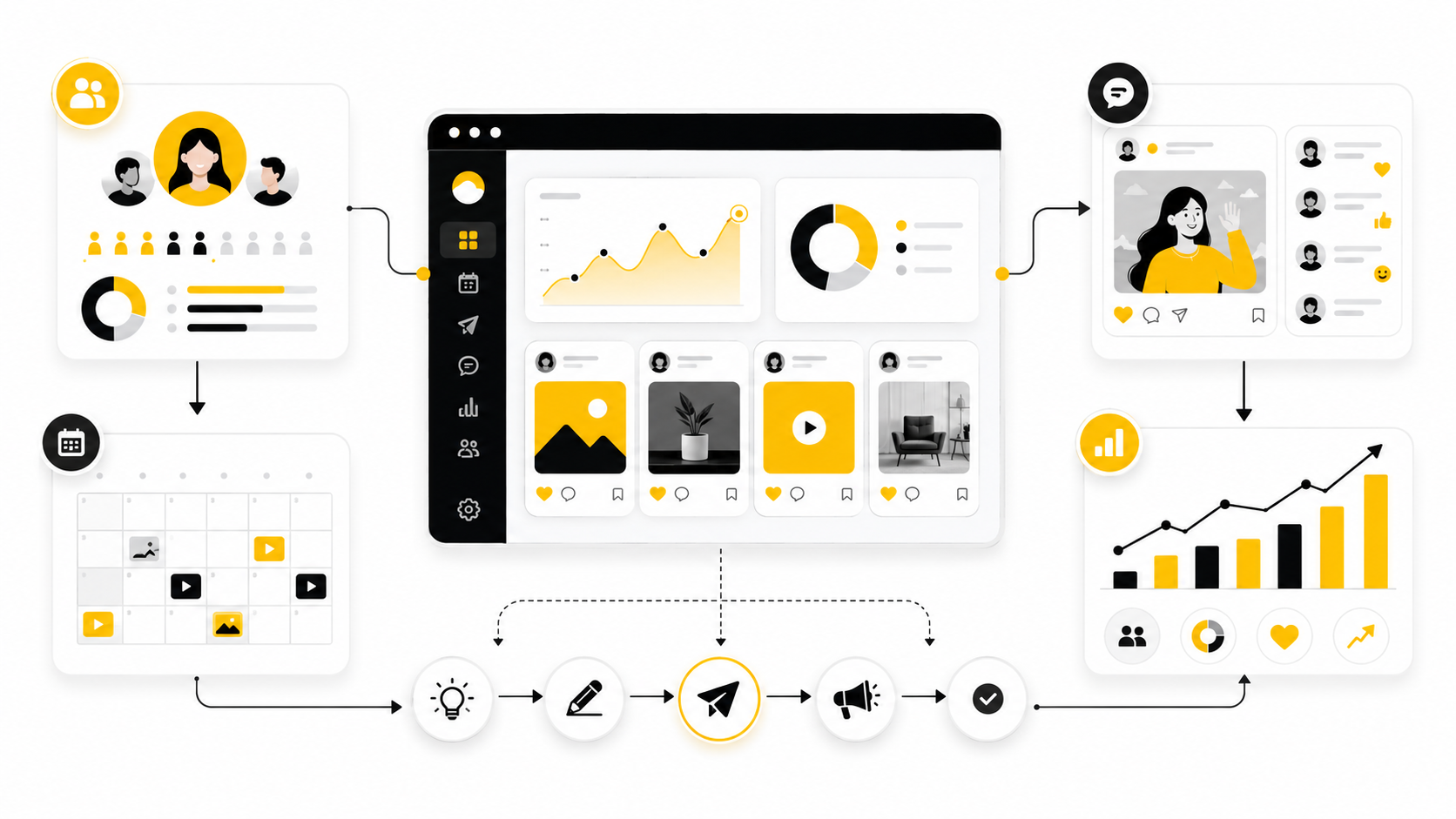
Social media marketing is not broken, but a lot of social media marketing systems are. Many brands are still treating social platforms like free billboard space, then wondering why reach is inconsistent, engagement feels shallow, and leads do not convert. To improve social media marketing now, the work has to move beyond posting more often and toward building a repeatable system that connects audience insight, content quality, distribution, engagement, and revenue measurement.
That matters because social media is still where attention, discovery, trust, and buying intent overlap. Global social media users passed 5 billion in 2025, and people continue to spend a meaningful part of their day on social platforms, even as usage patterns shift and audiences become more selective about what they engage with, follow, and buy from DataReportal’s Digital 2025 Global Overview Report. The opportunity is still massive, but the margin for lazy execution is much smaller.
The better question is not, “How do we post more?” The better question is, “How do we build a social media marketing engine that earns attention, compounds trust, and proves what is working?” this guide breaks that down into a six-part framework you can actually use, whether you are running social for a small business, a personal brand, an ecommerce store, a SaaS company, or an agency managing multiple clients.
Why Social Media Marketing Needs A Better System
Social media has become more competitive because every brand, creator, founder, freelancer, and media company is fighting inside the same feeds. Algorithms reward content that keeps people interested, but audiences reward brands that feel useful, relevant, and human. That means the strongest social media teams do not win by chasing every trend; they win by understanding what their audience already cares about and showing up with a clear point of view.
The business case is also stronger than many teams realize. Social media is not just a visibility channel anymore; it influences search behavior, customer service expectations, brand perception, creator partnerships, and direct commerce. US social commerce sales were projected to reach $87.02 billion in 2025, with continued growth expected beyond that, which shows why improving social media marketing now affects more than top-of-funnel awareness EMARKETER’s social commerce forecast.
The problem is that many brands still measure social media too narrowly. A post that does not generate immediate sales can still shape demand, answer objections, increase recall, feed retargeting audiences, support sales conversations, and reduce friction before someone converts. But if your system only tracks likes, follower count, and last-click revenue, you will miss the bigger picture and make weaker decisions.
The Social Media Marketing Framework
A strong framework makes social media easier to manage because it gives every post a job. Some posts attract new people, some deepen trust, some create conversation, some handle objections, and some move people toward a clear next step. When those roles are intentional, your content calendar stops looking random and starts working like a connected marketing system.
The framework here has four practical layers: audience clarity, content architecture, distribution rhythm, and performance feedback. Audience clarity defines who you are speaking to and what they need to believe before they act. Content architecture turns that insight into repeatable formats, while distribution rhythm ensures the right ideas are published consistently across the platforms where your audience already spends time.
Performance feedback is what keeps the system honest. You are not trying to guess forever; you are trying to learn faster than competitors who are still posting from habit. Tools can help here, especially when the workflow includes scheduling, inbox management, analytics, automation, and lead capture through platforms like Buffer, ManyChat, or GoHighLevel, but tools only work when the strategy underneath them is clear.
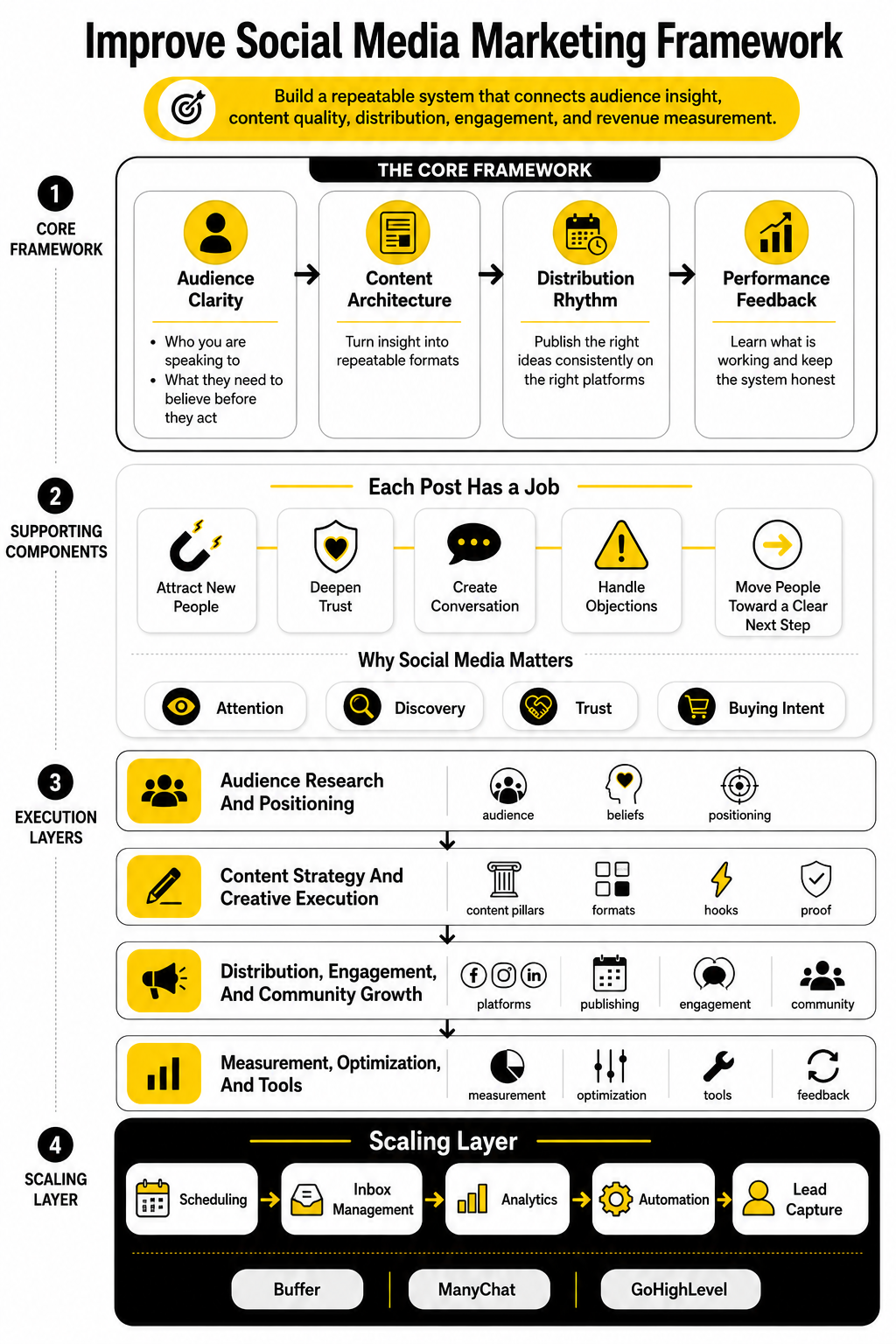
The next section will start with audience research and positioning because social media improvement begins before content creation. A weak audience definition creates generic posts, generic posts create weak engagement, and weak engagement makes every platform feel harder than it needs to be. Strong positioning gives your content sharper angles and makes your brand easier to remember.
After that, the article will move into content strategy and creative execution. This is where the framework becomes practical: content pillars, formats, hooks, storytelling, short-form video, carousels, educational posts, proof content, and conversion-focused calls to action. The goal is not to copy what everyone else is doing; the goal is to create a system that makes your best ideas easier to produce and easier for your audience to understand.
The final parts will cover distribution, engagement, community growth, measurement, optimization, tools, and FAQs. That is where social media turns from a content habit into a business asset. Once you know what to say, where to say it, how to respond, and how to measure progress, you can improve social media marketing without relying on luck, viral spikes, or endless platform hacks.
Audience Research And Positioning
Before you create more content, tighten who the content is for. This is where many teams try to skip ahead, and it shows. If you want to improve social media marketing in a way that actually changes results, you need sharper audience insight than age range, job title, and a vague pain point.
Audience research should answer practical questions. What does this person want to achieve? What are they already trying? What frustrates them about the current options? What language do they use when they describe the problem? The closer your content gets to the real words, worries, goals, and objections of your audience, the less you need to rely on gimmicks to get attention.
This matters because social media behavior is not evenly distributed across platforms or demographics. In the US, YouTube and Facebook still reach broad adult audiences, while Instagram, TikTok, Reddit, Snapchat, and WhatsApp show stronger differences by age, gender, ethnicity, and other audience groups Pew Research Center’s 2025 social media use research. That does not mean you should blindly choose the biggest platform. It means your platform strategy should follow the people you are trying to reach, not the platforms that feel trendy this month.
Start With The Buying Situation
A good audience profile is not just a description of a person. It is a description of a buying situation. Someone looking for a same-day emergency plumber, a founder comparing CRM tools, and a fitness coach trying to build a creator-led offer all behave differently, even if they all use Instagram or YouTube.
Start by mapping the moment that makes someone care. Maybe they are tired of inconsistent leads. Maybe their content gets engagement but no sales. Maybe they have a product that customers love, but nobody understands the difference until a sales call happens. That moment tells you what your content needs to address first.
This is also where social content becomes more strategic. Instead of creating posts around broad topics, create posts around moments of urgency, confusion, comparison, doubt, and desire. Those moments are usually where attention becomes commercially useful.
Separate Audience From Market
Your market is the broad category you operate in. Your audience is the specific group of people you can consistently help, attract, and convert. Mixing those two together creates content that sounds technically correct but emotionally flat.
For example, “small business owners” is a market label, not a useful audience insight. A local salon owner trying to fill weekday appointments does not think like a B2B consultant trying to book strategy calls, even though both may technically be small business owners. Their pain points, proof needs, content preferences, and purchase triggers are different.
The sharper your audience definition becomes, the easier your social media decisions get. Your hooks become more specific, your examples become more relevant, your offers feel more natural, and your comments section becomes a source of research instead of just a place to collect likes. That is how positioning starts to pull its weight.
Listen Before You Plan
The fastest way to improve weak content is to stop inventing topics in isolation. Look at sales calls, customer support tickets, product reviews, competitor comments, community discussions, search queries, and direct messages. These sources show you what your audience already says when they are not trying to sound impressive.
You can collect this manually, but simple research workflows help. A short customer survey built with a tool like Fillout can reveal what buyers were struggling with before they found you, what nearly stopped them from buying, and what finally made them trust the offer. Those answers often become stronger social posts than anything pulled from a generic content calendar.
Do not only listen for pain points. Listen for beliefs. People buy when they believe the problem matters, believe your approach makes sense, believe the outcome is realistic, and believe the risk is manageable. Your content has to build those beliefs before a call to action can perform.
Positioning Your Brand For Social Media
Positioning is the reason someone should pay attention to you instead of the next account in the feed. It is not just a tagline or a bio line. It is the clear relationship between who you help, what problem you solve, why your approach is different, and what outcome people can expect if they keep listening.
Strong positioning makes your content easier to recognize. When your audience sees a post, they should be able to tell what you stand for without needing a long explanation. That does not mean every post repeats the same phrase; it means the ideas, tone, examples, and point of view all reinforce the same strategic direction.
Weak positioning creates scattered content. One week the brand is educational, the next week it is trying to be funny, then it copies a competitor trend, then it posts a product pitch with no context. The feed may look active, but the audience does not know what to remember.
Build Around A Clear Point Of View
A point of view is not about being controversial for attention. It is about giving your audience a useful lens for seeing the problem differently. The best social media brands do this consistently because a clear point of view turns generic advice into memorable content.
For a brand trying to improve social media marketing, a useful point of view might be that social should be treated as a customer insight system, not just a publishing channel. Another might be that content should be planned around buyer beliefs, not just content pillars. Another might be that community response is part of marketing, not a low-level support task.
The key is to choose a point of view you can defend across formats. If it only works as one clever post, it is not positioning. If it can shape your educational content, proof content, lead magnets, sales pages, and customer conversations, it is much stronger.
Match Platform Choice To Audience Intent
Not every platform should have the same job. YouTube may support education, search, and long-term discoverability. TikTok and Instagram Reels may help with fast discovery and personality-led reach. LinkedIn may work better for B2B authority, founder visibility, hiring, and partnership conversations. Facebook may still matter for local businesses, groups, older demographics, and paid retargeting.
The mistake is assuming one platform is universally “best.” The better move is to ask what your audience is doing on each platform. Are they researching, scrolling for entertainment, comparing vendors, asking peers for recommendations, joining communities, or looking for quick answers? Your content format should match that behavior.
Brand discovery also happens through multiple sources, not one clean path. The typical adult internet user discovers brands and products through an average of 5.8 different sources, which makes social media stronger when it connects with search, email, creators, websites, ads, and direct conversations DataReportal’s 2025 brand discovery analysis. In other words, social should not sit alone. It should support the full buyer journey.
Define What You Want To Be Known For
You do not need to be known for everything. In fact, trying to be known for too many things usually makes your content forgettable. Pick a small set of ideas your audience should associate with your brand, then build depth around them.
A simple way to do this is to define three memory anchors. One anchor can be the main problem you solve. One can be the method or belief that makes your approach different. One can be the outcome people want after working with you or buying from you. These anchors keep your content focused without making every post sound identical.
This also helps teams make better creative decisions. When a trend appears, you can ask whether it reinforces one of your memory anchors. When a post idea feels clever but disconnected, you can cut it. That discipline is boring in the best possible way, because it keeps your brand from becoming noise.
Turning Research Into Content Direction
Research only matters if it changes what you publish. Do not let audience work become a document nobody uses. Turn it into clear content decisions your team can apply every week.
Start by translating research into themes. If buyers keep asking whether social media can generate leads without a huge ad budget, that becomes a theme. If customers say they feel overwhelmed by platform changes, that becomes a theme. If prospects compare your service to hiring an in-house marketer, that becomes a theme too.
Then turn those themes into repeatable formats. A theme can become a myth-busting post, a short video, a checklist, a carousel, a founder opinion, a customer objection post, a comparison, or a simple “what to do next” tutorial. This is how you make social media easier to execute without making it repetitive.
Create A Message Map
A message map connects audience problems to content angles. It keeps your posts from drifting into random advice and helps every idea support a larger business goal. You do not need a complicated template to make it work.
Use a simple structure:
This structure is especially useful because social media often works by changing beliefs one post at a time. A person may not buy after one carousel or one video, but they may start to see the problem differently. Do that consistently, and your content starts creating warmer demand before the sales conversation begins.
Prioritize Problems With Commercial Weight
Not every audience problem deserves equal content attention. Some problems create engagement but do not create buying intent. Others may look less viral but attract the exact people who are closer to action.
For example, a post about “why your posts are not getting likes” might attract broad attention. A post about “why your content gets engagement but your booked calls stay flat” speaks to a more commercially serious problem. Both can be useful, but they do different jobs.
This is where practical judgment matters. To improve social media marketing, you need a mix of reach-building content and intent-building content. Reach gets new people into your world. Intent-building content helps the right people understand why your offer matters now.
Content Strategy And Creative Execution
Once positioning is clear, the next job is turning it into content people can actually consume. This is where social media marketing becomes practical. You move from “we need to post more” to “we know what ideas we need to communicate, which formats suit those ideas, and how each post supports the buyer journey.”
The strongest content strategies are not built around random platform trends. They are built around repeatable themes, specific audience beliefs, and formats your team can produce consistently without burning out. That is how you improve social media marketing without depending on a single viral post to save the month.
The goal is simple: create content that earns attention, builds trust, and makes the next step feel obvious. Some posts should make people discover you. Some should make them understand you. Some should make them believe you. Some should make them act.
Build Content Pillars Around Buyer Beliefs
Content pillars are useful, but only when they are specific. Too many brands choose pillars like “education,” “behind the scenes,” “tips,” and “promotion,” which sounds organized but does not actually guide better content. A stronger pillar is tied to what your audience needs to believe before they buy.
For example, if your audience believes social media only works for brands with big budgets, one pillar can focus on practical organic growth systems. If they believe content is only about creativity, another pillar can show how research, offers, and distribution affect performance. If they believe automation makes marketing feel robotic, a pillar can explain how smart automation supports faster replies and better follow-up without removing the human touch.
This approach keeps your content connected to sales psychology without making every post a pitch. You are educating, but you are educating toward a business-relevant shift in belief. That is a big difference.
Choose Formats Based On The Job
Different formats do different jobs. A short-form video can create fast discovery, a carousel can explain a framework, a text post can sharpen a point of view, a live session can build trust, and a direct message flow can move interested people into a more serious conversation. The format should serve the message, not the other way around.
Short-form video deserves serious attention because it remains one of the most common formats marketers use for reach and engagement. In HubSpot’s 2025 survey of more than 1,100 social media marketers, short-form video remained a major focus because marketers continue to connect it with strong ROI and audience growth HubSpot’s 2025 Social Media Marketing Report. But short-form video is not magic. A weak idea in a vertical video is still a weak idea.
Carousels, longer videos, newsletters, communities, and landing pages still matter because people need different levels of depth before they trust you. A 20-second clip may introduce the problem, but a longer breakdown may explain the solution. A good social strategy gives people both.
The Content Production Process
A simple process beats a complicated content calendar nobody follows. You need a workflow that helps you find ideas, shape them, create assets, publish consistently, and learn from performance. The more repeatable this becomes, the easier it is to improve social media marketing month after month.
Start with one weekly planning session. Review audience questions, sales objections, comments, competitor themes, product priorities, and current performance. Then choose the ideas that deserve to become content, instead of forcing your team to create from a blank page every day.
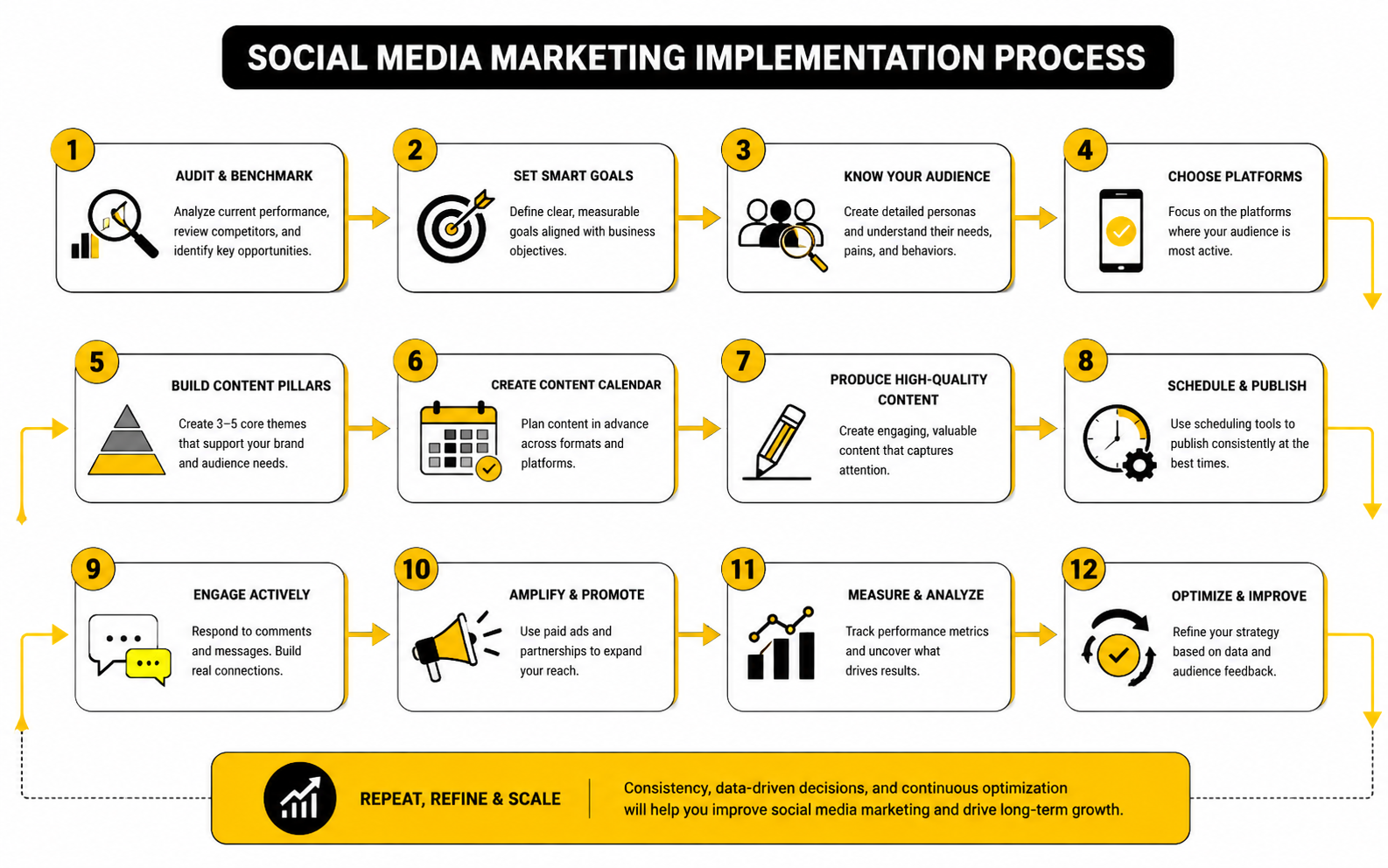
A strong execution process usually looks like this:
This process keeps creativity grounded. You are still making human content, but you are not relying on random inspiration. That matters when you need consistent output across several platforms.
Start With The Hook, But Do Not Stop There
Hooks matter because people decide quickly whether a post is worth their attention. But a strong hook cannot carry weak content. If the opening line creates curiosity and the rest of the post says nothing useful, people will learn not to trust your content.
A good hook should do one of four things. It should name a specific problem, challenge a common belief, promise a useful outcome, or open a loop that the content genuinely closes. The best hooks feel direct because they speak to something the audience already recognizes.
For example, “Your content problem is not posting frequency” is stronger than “5 tips to post better.” It creates tension, points at a specific misconception, and gives the audience a reason to keep reading. But the post then needs to deliver the real explanation, or the hook becomes clickbait.
Make One Clear Point Per Post
One of the fastest ways to improve social media marketing is to make each post easier to understand. Many posts fail because they try to teach five ideas at once. The audience gets a crowded message, then leaves without remembering anything.
One post should usually have one core point. You can support it with examples, steps, proof, or a short story, but the post should not wander. This is especially important for short-form video, where too many ideas create confusion fast.
A useful test is simple: after reading or watching the post, could someone explain the main takeaway in one sentence? If not, tighten it. Social media does not reward complexity that feels messy; it rewards clarity that feels valuable.
Create Content For The Full Buyer Journey
Social media content should not all sit at the same level of awareness. Some people are just realizing they have a problem. Some are comparing approaches. Some already trust you and need one final reason to act. If every post speaks to the same stage, you leave money on the table.
Top-of-funnel content should attract the right people by naming problems, sharing relatable insights, and creating useful moments of discovery. Middle-of-funnel content should explain your method, address objections, compare options, and show why your approach makes sense. Bottom-of-funnel content should make the next step clear with proof, offers, demonstrations, and direct calls to action.
This is where many brands get unbalanced. They either entertain endlessly and never convert, or they pitch constantly and never build trust. The better system does both, but in the right proportion for your audience and offer.
Use Proof Without Making It Awkward
Proof content does not have to mean aggressive testimonials every day. It can be a before-and-after explanation, a customer quote, a process breakdown, a behind-the-scenes decision, a product demonstration, a data point, or a clear explanation of why your method works. The point is to reduce uncertainty.
People are cautious because social platforms are crowded with big promises. If your content only says what you can do, it blends in. If it shows how the outcome happens, what changed, what was avoided, or why a specific decision mattered, it becomes more believable.
Proof is especially powerful when it is specific. “We help brands grow” is weak. “We rebuilt the content workflow so the team could turn customer questions into weekly posts, email topics, and sales enablement assets” is stronger because it explains the mechanism.
Repurpose Ideas, Not Just Assets
Repurposing is not copying the same caption everywhere. It is taking one strong idea and adapting it to the way people consume content on different platforms. A LinkedIn post may need a sharper business argument, while an Instagram carousel may need a visual step-by-step breakdown, and a short video may need a tighter emotional hook.
This is why one strong research insight can become multiple useful pieces of content. A customer objection can become a Reel, a carousel, a sales page section, a newsletter topic, and a DM automation prompt. The idea stays consistent, but the expression changes.
Tools can help manage this workflow, especially when the team needs to plan, schedule, and review content across channels. A platform like Buffer can support scheduling and content organization, while a tool like Flick Social can help with social planning and hashtag research when that fits the platform strategy. The tool is not the strategy, but the right tool can reduce friction.
Creative Quality And Brand Consistency
Creative quality matters more when feeds are crowded. That does not mean every post needs expensive production. It means your content needs to feel intentional, easy to consume, and clearly connected to the brand people should remember.
Consistency is not about making every post look identical. It is about using consistent ideas, tone, visual cues, and expectations so people recognize your brand faster over time. This is especially important when your audience may see one post today, another next week, and a third one months later.
Industry benchmarks also show why creative quality needs to be taken seriously. Rival IQ’s 2025 benchmark report found engagement rates fell across major platforms, including Facebook, Instagram, TikTok, and X, which makes average content easier to ignore and strong content more important Rival IQ’s 2025 Social Media Industry Benchmark Report. When attention is harder to earn, clarity and relevance become competitive advantages.
Write Like A Human, Edit Like A Strategist
Good social content should sound like a person wrote it. That means fewer empty claims, fewer buzzwords, and fewer sentences that could belong to any brand in the market. People respond to direct language because it feels easier to trust.
But writing like a human does not mean publishing every first draft. Editing is where you remove vague lines, sharpen the hook, simplify the structure, and make the next step clearer. The best posts often look effortless because someone did the hard work of removing everything unnecessary.
A practical editing pass should ask four questions. Is the point clear? Is the audience specific? Is there a real reason to care? Is the next step obvious? If the answer is no, the post is not ready.
Design For Consumption Speed
People scroll quickly, so visual structure matters. Use short paragraphs, strong first lines, readable captions, clear contrast, and simple visuals. If someone has to work too hard to understand the post, they usually will not.
For video, this means the first few seconds need to make the topic clear. For carousels, the first slide should create enough interest to continue. For text posts, the opening line should pull the reader into a specific thought, not warm up slowly.
This is also where brand templates can help, as long as they do not make everything feel stale. Templates should speed up production and improve recognition. They should not trap the brand in repetitive layouts that make every idea feel the same.
Calls To Action That Fit The Content
A call to action should feel like the next natural step, not an interruption. If a post teaches a quick tactic, the CTA might invite people to save it. If a post addresses a deeper problem, the CTA might point to a guide, audit, consultation, quiz, or email sequence. If a post creates buying intent, the CTA can be more direct.
The mistake is using the same CTA everywhere. “Book a call” can work when someone is ready, but it may feel too aggressive when the content is still educational. “Comment below” can create engagement, but it may not move serious prospects forward unless the comment triggers a useful follow-up.
For example, a brand using Instagram or Messenger to generate leads may connect a post to a simple automated conversation through ManyChat. That can work well when the automation gives people something they genuinely asked for, such as a checklist, guide, offer details, or next-step resource. It fails when it feels like a trick to shove people into a sales sequence.
Match The CTA To Intent
Low-intent content should usually ask for a low-friction action. Save this, share this, follow for more, read the full guide, or comment with a keyword when the promised resource is genuinely relevant. These actions help keep the relationship moving without pretending the person is ready to buy.
Medium-intent content can invite people into a deeper asset. That might be a newsletter, webinar, product comparison, calculator, checklist, or case-study-style breakdown. The goal is to move from casual attention into owned attention, where follow-up becomes more reliable.
High-intent content can ask for the sale, demo, consultation, trial, or checkout. If your social content has already handled the problem, belief shift, proof, and next step, the direct CTA does not feel pushy. It feels useful.
Build Landing Pages That Continue The Message
Social media does not end at the click. If someone taps through and lands on a page that feels disconnected from the post, conversion drops. The landing page needs to continue the same promise, language, and offer logic that earned the click in the first place.
This matters for ecommerce, lead generation, events, SaaS trials, newsletters, and service businesses. A post can create the desire, but the page has to remove friction. The page should answer the obvious questions: what is this, who is it for, why should I care, what happens next, and why should I trust it?
For teams that need to build campaign-specific landing pages faster, a tool like Replo can support ecommerce page creation, while ClickFunnels or Systeme.io can fit brands that need funnel pages, lead magnets, and offer flows. The important thing is not which page builder you use. The important thing is that the post, page, offer, and follow-up all feel like one coherent journey.
Distribution, Engagement, And Community Growth
Publishing is only the starting point. A post cannot perform if it never reaches the right people, and reach alone does not mean much if nobody trusts the brand after seeing it. Distribution and engagement are where your content starts behaving like a real marketing system instead of a collection of disconnected posts.
This is also where many teams lose momentum. They create decent content, publish it once, wait for the algorithm to do all the work, and then move on too quickly. If you want to improve social media marketing in a practical way, you need to think about what happens before, during, and after each post goes live.
Distribution includes platform choice, timing, repurposing, paid amplification, creator partnerships, employee advocacy, email promotion, community sharing, and direct conversations. Engagement includes comments, replies, DMs, saves, shares, clicks, watch time, and the quality of conversations that happen because of the content. Both matter because social media growth is rarely just a publishing problem.
Treat Engagement As Market Feedback
Engagement is not just a vanity signal. It is feedback from the market, and it can tell you what your audience understands, what they resist, what they want more of, and what language actually lands. A thoughtful comment can be more useful than a hundred passive likes because it gives you a clue about what people are thinking.
That does not mean every engagement metric has the same value. A like is easy. A save suggests the content had practical value. A share suggests the content made someone look helpful, smart, entertained, or emotionally aligned. A comment may show interest, disagreement, confusion, or intent, depending on what the person actually says.
This is why engagement analysis should include both numbers and interpretation. Do not only ask, “Did this post get more comments?” Ask, “What kind of comments did it get, from whom, and what should we do with that information?” That shift turns social media from a performance scoreboard into a learning channel.
Build Reply Systems, Not Just Posting Systems
A strong publishing system can still fail if the brand ignores the conversations it creates. People notice when brands post constantly but respond slowly, vaguely, or not at all. On social media, the comment section and inbox are often part of the customer experience.
This matters because customers increasingly expect brands to be responsive across social channels. Sprout Social’s 2025 research found that marketing leaders are under pressure to prove social impact across customer care, brand trust, and revenue, not just content performance Sprout Social’s 2025 Impact of Social Media Report. That makes the response workflow part of the strategy, not an afterthought.
A simple reply system should define who answers comments, who handles DMs, what gets escalated, what questions need saved responses, and when a conversation should move to email, booking, checkout, or support. If the content creates demand but the follow-up is messy, the business loses opportunities it already worked to create.
Statistics And Data
Social media data is useful only when it changes your decisions. Random stats can make a report look serious, but they do not automatically improve performance. The goal is to understand what the numbers reveal about attention, trust, intent, conversion, and retention.
The first number to respect is attention. People still spend a major part of the day on social platforms, but that time is not expanding endlessly. The typical internet user spends 2 hours and 21 minutes per day using social media, which is lower than two years earlier, so brands are competing in a crowded environment where attention is both massive and more selective DataReportal’s 2025 state of social media report. The action is clear: stop measuring effort by post volume alone and start measuring whether each post earns meaningful attention.
The second number to respect is engagement decline. Rival IQ’s 2025 benchmark report found engagement rates fell across Facebook, Instagram, TikTok, and X, with the steepest drops on X and TikTok Rival IQ’s 2025 Social Media Industry Benchmark Report. That does not mean social media is dead. It means average content has less room to coast, and brands need sharper creative, stronger audience fit, and better distribution.
The third number to respect is commercial behavior. US social commerce sales were expected to reach $87.02 billion in 2025, up 21.5% year over year, showing that social is not only a place for awareness but also a growing transaction environment EMARKETER’s 2025 social commerce forecast. The action is not to turn every post into a checkout pitch. The action is to make the path from attention to trust to purchase smoother.
Separate Metrics By Funnel Stage
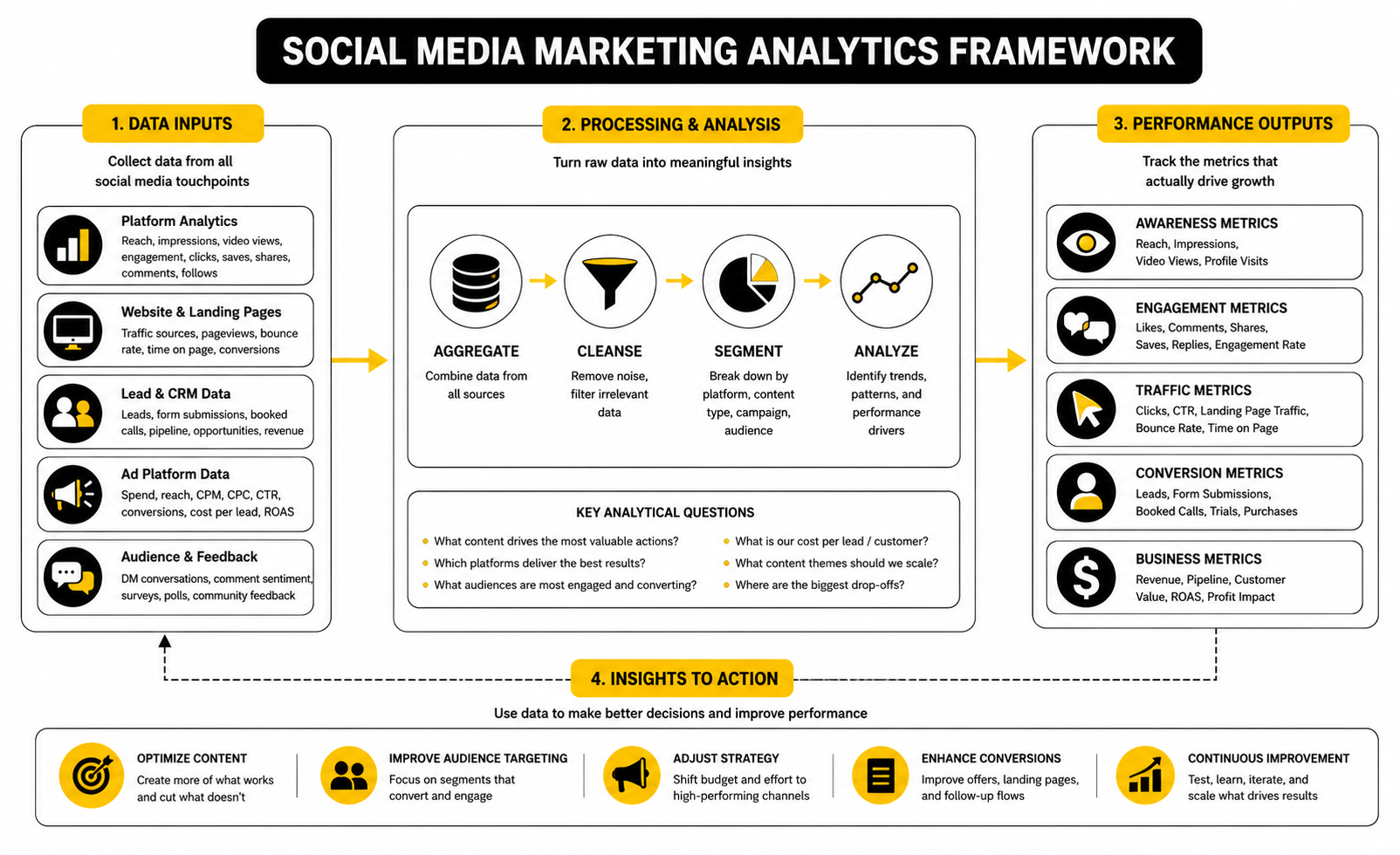
The biggest measurement mistake is putting every metric in one bucket. Reach, engagement, leads, revenue, retention, and sentiment do not answer the same question. If you treat them as interchangeable, you will either overvalue shallow attention or undervalue content that supports buying decisions.
Top-of-funnel metrics show whether people are discovering and noticing you. These include reach, impressions, profile visits, new followers, video views, view-through rate, and share rate. They help you understand whether your topic, hook, format, and distribution are strong enough to create attention.
Middle-of-funnel metrics show whether people are building trust. These include saves, meaningful comments, repeat engagement, link clicks, email signups, resource requests, webinar registrations, content replies, and DM conversations. These signals usually matter more than raw likes because they show a deeper level of interest.
Bottom-of-funnel metrics show whether social is creating business outcomes. These include qualified leads, booked calls, trial starts, checkout starts, purchases, pipeline influenced, revenue attributed, customer acquisition cost, and conversion rate. These are harder to measure perfectly, but they are too important to ignore.
Read Benchmarks Carefully
Benchmarks are useful, but they are not commandments. An industry benchmark tells you what is typical across a category, not what your specific brand should accept. Your own historical performance is often more useful than a broad average because it reflects your audience, offer, creative quality, posting rhythm, and distribution mix.
Sprout Social separates benchmarks into industry benchmarks, competitive benchmarks, and personal benchmarks, which is a helpful way to avoid overreacting to generic numbers Sprout Social’s 2025 benchmark guidance. Industry benchmarks show the wider playing field. Competitive benchmarks show how similar accounts perform. Personal benchmarks show whether your system is improving.
Use all three, but weight them differently. If your account is early, personal benchmarks may matter most because you need directional improvement. If your market is mature, competitive benchmarks can show where you are underperforming. If leadership needs context, industry benchmarks can help set realistic expectations.
What The Main Metrics Actually Mean
Reach tells you how many people had the chance to see the content, but it does not prove they cared. Impressions show total views, but they can include repeat exposure. Views can be useful, especially for video, but a three-second view and a completed watch do not carry the same meaning.
Engagement rate can show whether content encouraged action, but it can also be distorted by audience size, platform behavior, and post type. A smaller account may show a higher engagement rate because its audience is more concentrated. A larger account may produce more business value with a lower engagement rate because the absolute number of qualified viewers is bigger.
Clicks are closer to intent, but even clicks need context. A high click-through rate with a poor landing page conversion rate may signal curiosity without trust, or it may mean the page does not match the promise of the post. A lower click-through rate with a higher lead quality may be better if the content pre-qualifies people before they arrive.
Measure Attention Quality
Not all attention is useful. A controversial post may create comments but damage trust. A funny trend may get views but attract people who will never buy. A broad educational post may perform well but bring in an audience that is too beginner for your offer.
Attention quality is about whether the right people are paying attention for the right reasons. You can measure this through comment quality, follower quality, profile visits from target accounts, saves from relevant audiences, DM intent, lead source quality, and sales conversations influenced by content. This requires judgment, not just dashboards.
This is where social listening and CRM notes become valuable. If a prospect says they followed your content for three months before booking a call, that is useful attribution even if the final click came from email or direct search. Social media often shapes demand before it captures it.
Measure Conversion Path Friction
When social traffic does not convert, do not immediately blame the platform. Look at the full path. The post may create interest, but the profile may be unclear, the link may be buried, the landing page may be slow, the offer may be vague, or the follow-up may be delayed.
A clean conversion path should make the next step obvious. If someone watches a video, visits the profile, clicks a link, and lands on a page, each step should reinforce the same promise. Any mismatch creates friction.
This is especially important for campaigns that rely on paid amplification or creator partnerships. If you pay to create attention but the landing experience is weak, the campaign may look like a traffic problem when it is really a conversion problem. Tools like ClickFunnels or Systeme.io can help teams build clearer campaign paths, but the message still has to match the content that created the click.
Building A Practical Analytics System
A practical analytics system does not need to be complicated. It needs to be consistent, honest, and tied to decisions. The goal is to know what to keep, what to stop, what to improve, and what to test next.
Start with a weekly review. Look at the top posts by reach, saves, shares, comments, clicks, leads, and revenue influence. Do not just rank them; ask why they worked. Was it the topic, format, hook, timing, platform, audience pain point, proof angle, or CTA?
Then run a monthly review. This should connect social performance to broader business goals, including audience growth, email list growth, lead quality, pipeline, sales, retention, and customer feedback. Weekly reviews help you adjust execution. Monthly reviews help you adjust strategy.
Use A Simple Scorecard
A scorecard keeps the team focused. It should be small enough to review regularly and specific enough to guide action. Too many dashboards become noise, and noise does not improve decisions.
A useful social media scorecard can include:
The learning category is underrated. If social media teaches you what buyers care about, what they misunderstand, and what they repeat, it is helping the whole business. That insight can improve ads, emails, sales pages, product positioning, and customer onboarding.
Track Content By Purpose
A post should be measured against its job. If a post was designed for reach, judge it by discovery metrics. If it was designed to build trust, judge it by saves, replies, depth of comments, and downstream engagement. If it was designed to convert, judge it by clicks, leads, sales, or qualified conversations.
This prevents bad conclusions. A conversion post may get fewer likes because it speaks to a narrower, higher-intent audience. A broad awareness post may get more reach but fewer leads because it is not designed to sell directly. Both can be successful if they do the job they were created to do.
Tagging content by purpose also helps you see gaps. If your calendar is full of awareness content but leads are weak, you may need more objection-handling and offer content. If you have many sales posts but reach is flat, you may need more discovery content. Measurement should show the imbalance.
Turning Data Into Better Decisions
Data should create action. If a metric rises or falls and nothing changes, the team is not using analytics properly. Every review should end with a decision about what to repeat, refine, test, or remove.
If saves are high but clicks are low, the content may be useful but the next step may be unclear. If reach is high but follower quality is poor, the topic may be too broad. If comments are strong but leads are weak, the audience may need a clearer bridge from conversation to offer. If clicks are strong but conversions are weak, the landing page or offer may need work.
This is how analytics helps you improve social media marketing without guessing. The numbers point to where the system is leaking. Your job is to interpret the signal, fix the bottleneck, and keep the learning loop moving.
Avoid Vanity Metric Traps
Vanity metrics are not always useless. Followers, likes, and views can matter when they are connected to the right audience and a clear business goal. They become a trap when they make a weak strategy look successful.
A million views from the wrong audience can create very little business value. A smaller post that brings in qualified conversations may be more valuable. This is why the question is not “Did this perform?” but “Did this perform for the reason we needed it to?”
Be careful with any metric that can be inflated without improving the business. Giveaway followers, engagement bait, shallow trends, and controversy can make dashboards look better while lowering audience quality. Good measurement protects you from that.
Use Attribution Without Pretending It Is Perfect
Social attribution is messy. People see a post, ignore it, see another one, search the brand, read reviews, join an email list, return later, and then buy from a different channel. A clean last-click report will miss much of that influence.
That does not mean you should give up on attribution. Use UTM links, platform analytics, CRM source fields, post-purchase surveys, lead forms, and sales call notes. Each method has limitations, but together they give you a more realistic picture.
For service businesses, agencies, coaches, and local companies, a CRM like GoHighLevel can help connect forms, conversations, appointments, and follow-up in one place. For ecommerce and direct-response campaigns, landing page data, email performance, and checkout behavior matter just as much as platform metrics. The point is to build enough visibility to make better decisions, not to chase perfect attribution that never arrives.
Advanced Strategy And Scaling Decisions
Once the foundation is working, the hard part is no longer knowing what to post. The hard part is deciding what to scale, what to protect, and what to stop doing before it becomes a drag on the brand. This is where social media marketing becomes more strategic, because growth creates new tradeoffs.
A small team can often move fast because the content is close to the founder, customer, or creator. A larger team can produce more, test more, and manage more channels, but it can also become slower, safer, and more generic. The goal is not to scale volume for its own sake. The goal is to scale what is already creating qualified attention, trust, and business value.
This is why mature brands need operating principles, not just content calendars. You need rules for what deserves amplification, what requires legal review, what can be automated, what should stay human, and what is not worth chasing. Without those rules, scaling turns into noise.
Decide What Should Stay Human
Automation can save time, but it should not remove judgment from the parts of social media where judgment matters most. Strategy, positioning, creative direction, customer empathy, community response, and final approvals still need human thinking. AI can help draft, summarize, repurpose, and analyze, but it should not decide what your brand believes.
This matters more now because audiences are becoming more aware of synthetic content. TikTok has moved to give users more control over AI-generated content in their feeds, while also expanding labeling and watermarking efforts for AI-made media The Guardian’s report on TikTok AI content controls. The signal is obvious: transparency around AI content is becoming more important, not less.
Use AI where it reduces friction without weakening trust. Let it turn a webinar transcript into content ideas, summarize customer feedback, draft caption variations, or organize research. But keep humans responsible for taste, truth, cultural context, and anything that affects brand credibility.
Avoid The Content Factory Trap
The content factory trap happens when a team becomes very good at producing posts that nobody cares about. The workflow looks impressive, the calendar is full, the dashboard has activity, and the brand feels busy. But the content starts sounding like everyone else because the system rewards output more than insight.
This usually happens when leaders ask for more volume before asking whether the message is strong enough. More posts do not fix weak positioning. More videos do not fix unclear offers. More channels do not fix a brand that has nothing specific to say.
A healthier scaling model starts with proven content patterns. Identify the topics, angles, formats, and CTAs that consistently attract the right people. Then scale those patterns carefully with better creative, stronger distribution, and more consistent follow-up.
Strategic Tradeoffs That Matter
Improving social media is not just about adding tactics. It is also about choosing what not to do. Every platform, format, trend, creator partnership, and campaign takes time, budget, and attention from something else.
The best teams make tradeoffs deliberately. They know when to prioritize reach over conversion, when to prioritize depth over frequency, when to use paid distribution, when to invest in creators, and when to keep a channel small because it serves a narrow but valuable audience. That level of discipline is a competitive advantage.
Social media becomes messy when every idea is treated as equally important. It is not. Some ideas create noise, some create learning, some create revenue, and some create long-term brand memory. Your strategy should know the difference.
Reach Versus Relevance
Reach feels good because big numbers are easy to celebrate. But reach without relevance creates a weak audience. You may get views, followers, and engagement, but the people arriving may not understand the offer, fit the market, or have any real buying potential.
Relevance usually grows slower, but it produces stronger conversations. A post that reaches fewer people but attracts decision-makers, serious buyers, or high-fit customers can be more valuable than a post that goes broad and disappears. This is especially true for B2B, high-ticket services, local businesses, niche ecommerce, and expert-led brands.
The smart move is not choosing one forever. Use reach content to expand the top of the audience, and use relevance content to deepen trust with the people who matter most. The balance depends on your stage, offer, market, and current bottleneck.
Consistency Versus Experimentation
Consistency builds recognition. Experimentation creates learning. You need both, but too much of either can hurt.
If you only stay consistent, your content may become predictable and stale. If you only experiment, your audience may never learn what to remember about you. The best system protects a stable core while leaving room for controlled tests.
A practical split is to keep most content tied to proven pillars and use a smaller portion for experiments. Test new hooks, formats, collaborations, editing styles, platform features, and CTA paths. But do not let experiments pull the brand away from its positioning every week.
Organic Versus Paid Distribution
Organic social is powerful because it can build trust before the sale. Paid social is powerful because it can put the right message in front of the right people faster. The mistake is treating them as separate worlds.
Organic content can show which messages resonate before you spend money. Paid distribution can extend the reach of content that already has proof of interest. Together, they create a better feedback loop than either channel alone.
If a post creates strong saves, shares, qualified comments, and profile visits, it may be worth amplifying. If a post performs poorly organically because the message is unclear, paying to show it to more people usually just scales the problem. Paid media works best when it amplifies clarity, not confusion.
Creator Partnerships And Social Proof
Creator partnerships can help brands borrow trust, enter new communities, and create content that feels more native to the platform. But creator marketing only works when the fit is real. A mismatched creator can generate reach while damaging credibility.
The influencer marketing industry was projected to reach $32.55 billion in 2025, which shows how central creators have become to modern social strategy EUIPO’s 2025 report on influencers and intellectual property. But bigger budgets also create bigger risks. Brands need better selection, clearer contracts, stronger disclosure practices, and more thoughtful creative briefs.
The best creator partnerships feel like a natural extension of what the creator already talks about. The worst ones feel like a script dropped into someone else’s audience. People can tell the difference.
Choose Creators By Trust, Not Just Audience Size
Follower count is a weak shortcut. A smaller creator with a loyal, specific audience can outperform a larger account with shallow attention. What matters is whether the creator has credibility with the people you want to reach.
Look at comment quality, audience fit, content consistency, past partnerships, tone, values, and the creator’s ability to explain your category naturally. If the creator needs to force the product into their content, the fit is probably not strong enough. If the creator can explain the problem better than your brand can, pay attention.
This is where niche creators often shine
Tools, Automation, And Scaling The System
Once the strategy is working manually, the next move is not to automate everything. The next move is to automate the parts that create consistency without removing judgment. That distinction matters because a brand can become faster and worse at the same time if it automates weak messaging, generic content, or careless follow-up.
A good social media stack should support planning, publishing, engagement, analytics, lead capture, and follow-up. It should not replace the strategic thinking behind audience research, creative direction, offer positioning, or community response. The best tools remove friction so the team has more time for the work that actually needs human taste.
For scheduling and content workflow, Buffer can help keep publishing organized across channels. For automated conversations and comment-to-DM flows, ManyChat can help move interested people from a post into a more useful conversation. For agencies, local businesses, and service providers that need CRM, appointment booking, automations, and pipeline visibility in one place, GoHighLevel can make the follow-up system easier to manage.
Scale What Is Already Working
Scaling social media is not about multiplying output blindly. If the core message is weak, scaling only spreads the weakness faster. Before increasing posting frequency, ad spend, creator partnerships, or automation, make sure the content is already creating the right kind of attention and the right kind of conversations.
The safest things to scale are proven content themes, proven offers, proven hooks, proven landing pages, and proven follow-up sequences. If one educational angle consistently brings qualified leads, turn it into a video series, carousel sequence, newsletter topic, webinar, landing page, and sales enablement asset. That is more carefully than chasing a new idea every week just because the calendar looks empty.
Scaling also requires clearer ownership. Someone needs to own strategy, someone needs to own creative production, someone needs to own community response, and someone needs to own reporting. In a small business, one person may wear several of those hats, but the responsibilities still need to be clear.
Protect The Brand While Moving Faster
Speed is useful, but speed without brand control gets messy fast. The more people involved in social media, the easier it becomes for tone, claims, visuals, and offers to drift. A simple brand operating system prevents that without slowing everyone down.
Create a living social media playbook. It should include the audience definition, positioning statement, core messages, content pillars, approved claims, visual guidelines, response rules, CTA rules, and escalation steps. This gives writers, designers, editors, creators, support reps, and leadership the same source of truth.
This is especially important when using AI-assisted workflows. AI can help draft captions, summarize research, organize ideas, repurpose content, and speed up first drafts, but it should not be trusted to understand nuance, evidence, compliance, or brand voice without review. Use AI as leverage, not as the final decision-maker.
Advanced Tradeoffs That Matter
Every serious social media strategy involves tradeoffs. You cannot optimize for everything at once. A brand that wants maximum reach may need different content than a brand that wants fewer but better qualified sales conversations.
This is where the strategy needs maturity. If leadership only asks for more followers, the team may drift toward broad content that attracts the wrong audience. If the team only posts conversion content, the brand may stop reaching new people. The job is to balance discovery, trust, and action based on the stage of the business.
The right mix changes over time. A new brand may need more visibility and proof. A mature brand may need better segmentation and conversion paths. A service business with limited capacity may care more about lead quality than lead volume.
Organic Versus Paid Social
Organic social is useful for trust, community, audience learning, and long-term brand equity. Paid social is useful for controlled distribution, faster testing, retargeting, and scaling offers that already convert. They work best together, not as enemies.
The mistake is using paid media to force weak organic messages into the market. If an idea does not resonate organically at all, paid spend may only make the problem more expensive. On the other hand, if an organic post proves that a topic, hook, or offer creates strong intent, paid amplification can help it reach more of the right people.
A practical approach is to use organic content as a testing ground. Watch which angles earn saves, shares, profile visits, clicks, and qualified comments. Then promote the strongest assets, build retargeting audiences, and send traffic to a landing page that continues the same message.
Creator Partnerships Versus Brand-Owned Content
Creator partnerships can expand trust faster because people already have relationships with the creators they follow. But creator marketing works best when the partnership feels natural, the audience matches, and the creator has enough freedom to communicate in their own voice. If the brand over-controls the message, the content often loses the trust it was meant to borrow.
Brand-owned content gives you more control and compounds over time. Your own posts, videos, emails, community, website, and resources build a media asset you are not renting from someone else. The downside is that it usually takes longer to grow from scratch.
A strong strategy can use both. Creator partnerships can introduce the brand to new audiences, while owned content deepens trust after people discover you. That only works if the brand has a clear follow-up path after the creator sends attention your way.
Automation Versus Human Connection
Automation is powerful when it helps people get what they asked for faster. It is damaging when it pretends to be personal while clearly ignoring context. The difference is obvious to customers, even if the dashboard looks efficient.
Use automation for delivery, routing, reminders, segmentation, and simple next steps. Use human judgment for sensitive questions, objections, sales conversations, complaints, partnerships, and high-value opportunities. That balance keeps the system scalable without making the brand feel cold.
For example, a comment keyword can trigger a resource through ManyChat, but the follow-up should still respect the person’s intent. If they asked for a checklist, give them the checklist before trying to sell. Trust is easier to keep than it is to rebuild.
The Final Social Media Marketing System
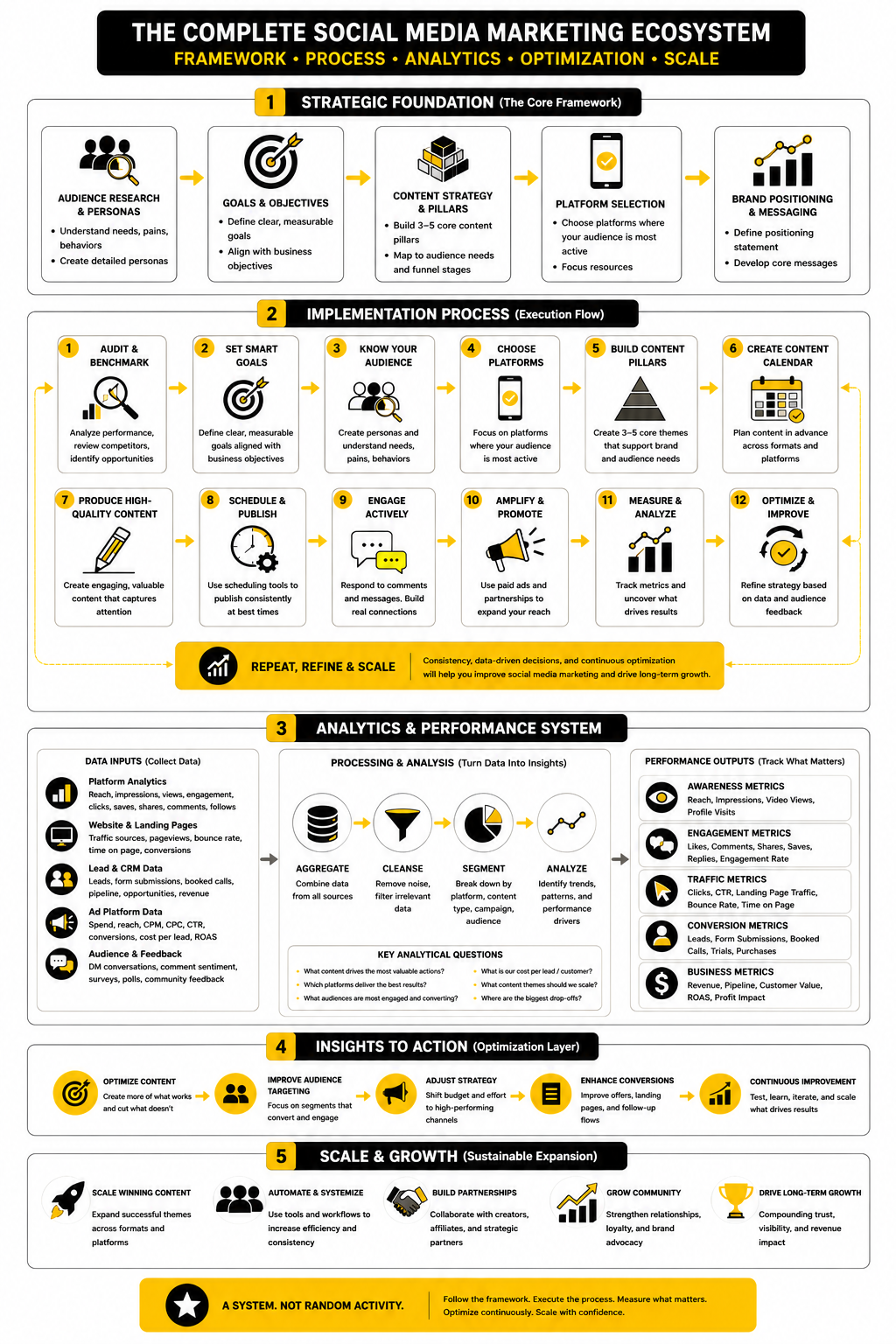
At this point, the full system should be clear. You start with audience research and positioning, turn that into content themes and formats, distribute the content with purpose, engage like the conversation matters, measure the right signals, and scale what is working. That is the practical path to improve social media marketing without relying on luck.
The system works because every part supports the next one. Research improves messaging. Messaging improves content. Content creates attention. Engagement creates insight. Analytics reveal bottlenecks. Tools and automation help the machine run more smoothly.
The best teams keep the system simple enough to use and serious enough to measure. They do not treat social media as random posting, and they do not treat it as a magic sales machine. They treat it as a visible, measurable, human channel that earns trust one useful interaction at a time.
How Can I Improve Social Media Marketing Quickly?
Start by fixing the clarity problem first. Make sure your audience, offer, message, and next step are obvious before you worry about advanced tactics. A sharper message usually improves content faster than posting more often.
Then review your last 30 posts and group them by purpose. Identify which posts were meant for reach, trust, engagement, traffic, or conversion. If most of them have no clear purpose, your first improvement is creating a better content mix.
Finally, look for one bottleneck. If reach is weak, improve hooks and distribution. If clicks are weak, improve CTAs. If conversions are weak, improve the landing page, offer, proof, or follow-up.
What Metrics Matter Most For Social Media Marketing?
The most useful metrics depend on the job of the content. Reach, impressions, and video views help you understand discovery. Saves, shares, meaningful comments, and replies help you understand trust and usefulness.
Clicks, leads, booked calls, trial starts, and purchases show whether social activity is creating business movement. These metrics should not be treated separately from content quality, audience fit, and offer clarity. A low-volume campaign can still be valuable if it brings the right people into the right next step.
The best approach is to use a small scorecard. Track awareness, engagement, traffic, leads, revenue, and learning. That gives you a better picture than obsessing over likes alone.
How Often Should A Brand Post On Social Media?
There is no perfect posting frequency for every brand. A small team publishing three excellent posts per week may outperform a larger team publishing twice a day with weak ideas. Consistency matters, but quality and relevance matter more.
Start with a rhythm your team can maintain without lowering standards. For many brands, that might mean three to five strong posts per week on one or two core platforms. Once the process is stable, increase volume only when the content still stays useful.
The real question is not only how often you post. The better question is whether your audience hears from you often enough to remember you, trust you, and know what to do next. Frequency should serve that goal.
Which Social Media Platform Is Best For Marketing?
The best platform is the one where your audience already spends time with the right intent. LinkedIn may be strongest for B2B authority and professional trust. Instagram, TikTok, YouTube, Facebook, Pinterest, Reddit, and X can all work depending on the audience, format, offer, and buying behavior.
Do not choose a platform just because it is popular. Choose it because it fits your audience, your content strengths, and your business model. A service business selling high-ticket consulting has different platform needs than a beauty brand selling low-cost products.
A practical strategy usually starts with one primary platform and one support platform. Win where you have the clearest audience fit first. Expansion becomes easier once the message and workflow are already working.
What Content Should I Post To Get More Leads?
Post content that connects problems to next steps. Educational posts create awareness, but lead-focused content needs to address urgency, objections, proof, and the cost of inaction. People do not become leads just because they learned something; they become leads when they believe the next step is relevant.
Use content that explains mistakes, compares options, breaks down processes, answers buying questions, and shows proof. Then connect that content to a clear CTA, such as a guide, audit, consultation, demo, checklist, webinar, or offer page. The CTA should match the intent of the post.
Avoid turning every post into a pitch. Lead generation works better when trust is already being built through useful content. The strongest social media systems earn attention first, then guide the right people toward action.
How Do I Know If My Social Media Strategy Is Working?
Your strategy is working if the right people are noticing, engaging, clicking, asking better questions, joining your list, booking calls, buying, or moving deeper into your customer journey. A strategy can also be working if sales conversations improve because prospects already understand your point of view before they speak to you. Social media influence is not always captured perfectly in one dashboard.
Look at trends over time instead of judging single posts emotionally. One post may underperform because of timing, format, topic, or platform behavior. A pattern across several weeks gives you better evidence.
Also listen to qualitative feedback. If prospects mention your posts on calls, customers share your content, or your DMs become more relevant, that matters. Not every valuable signal is a clean number.
Should I Use AI To Create Social Media Content?
Yes, but use it carefully. AI can help with research organization, first drafts, repurposing, outlines, hooks, content variations, and summarizing customer feedback. It can save time, especially when the team already has a clear strategy and strong editorial judgment.
Do not let AI replace your point of view. Generic AI content often sounds polished but empty, and audiences can feel when a brand has nothing specific to say. The strongest AI-assisted content still depends on original insight, customer knowledge, proof, and human editing.
Use AI to speed up the workflow, not to outsource the thinking. The brand should still own the message, claims, examples, tone, and final judgment. That is how you get efficiency without losing credibility.
How Do I Turn Followers Into Customers?
Followers become customers when there is a clear bridge between content and offer. They need to understand the problem, trust your approach, believe the outcome is realistic, and know what step to take. If any of those pieces are missing, follower growth may not turn into revenue.
Use content to build belief over time. Then create simple paths into email, DMs, booking pages, product pages, webinars, trials, or consultations. Tools like GoHighLevel, ClickFunnels, or Systeme.io can help build those paths, but the offer still has to be strong.
The biggest mistake is assuming followers automatically mean buyers. Followers are potential attention, not guaranteed demand. Your content and follow-up system have to turn that attention into trust and action.
What Is The Biggest Mistake Brands Make On Social Media?
The biggest mistake is posting without a system. Brands publish because the calendar says they should, not because each post has a clear audience, purpose, message, and next step. That creates activity without momentum.
Another common mistake is chasing trends that do not fit the brand. A trend can create reach, but reach is not useful if it confuses the audience or attracts the wrong people. Social media should make the brand easier to understand, not harder.
The fix is discipline. Know who you are speaking to, what you want to be known for, and how each piece of content supports the business. That is not complicated, but it does require consistency.
How Long Does It Take To Improve Social Media Marketing Results?
Some improvements can happen quickly when the issue is obvious. Better hooks, clearer CTAs, stronger content structure, and more relevant topics can improve engagement and clicks within weeks. Larger business outcomes usually take longer because trust, audience quality, and conversion paths need time to compound.
The timeline depends on your starting point. A brand with an existing audience and weak messaging may improve faster than a brand starting from zero. A brand with a strong offer and poor follow-up may see results faster by fixing the conversion system.
The key is to measure progress in stages. First improve clarity and consistency. Then improve engagement quality. Then improve traffic, leads, and revenue. That keeps the team focused instead of expecting every post to do everything immediately.
Can Small Businesses Compete With Bigger Brands On Social Media?
Yes, but not by trying to look like bigger brands. Small businesses can compete by being more specific, more responsive, more personal, and closer to the customer. Big brands often have reach, but small businesses can have sharper relevance.
A local business, niche service provider, or founder-led company can create content that feels more human than polished corporate messaging. That is an advantage if the business uses real customer questions, practical advice, behind-the-scenes insight, and clear offers. The audience does not always need the biggest brand; they need the brand that feels most relevant and trustworthy.
Small teams should focus on fewer platforms and better execution. Pick the channels that matter most, create a repeatable workflow, and respond seriously to the people who engage. That is how a smaller brand builds momentum without wasting energy.
What Should I Do If My Engagement Is Dropping?
First, check whether the drop is platform-wide, account-specific, or content-specific. Engagement can fall because of algorithm changes, audience fatigue, weaker hooks, less relevant topics, inconsistent posting, or too much repetitive content. Do not panic after one bad post.
Review which topics and formats used to work, then compare them with what you are publishing now. If your recent content is broader, safer, more promotional, or less specific, that may explain the drop. Audiences usually respond when content feels timely, useful, and clearly written for them.
Then test one variable at a time. Try stronger opening lines, more specific topics, better visual structure, clearer CTAs, or more conversation-driven posts. The goal is not to chase engagement for its own sake; the goal is to rebuild useful interaction with the right audience.
Build a stronger local presence with BAAM AI
Turn your website, Google profile, social channels, and AI visibility into one growth engine
Most businesses do not need more random marketing activity. They need a consistent presence system that helps the right people find them, trust them, and take action. BAAM AI brings strategy, local SEO, website updates, Google Maps visibility, social content, AI-search readiness, media production, and reporting into one practical monthly engine.
If you want your marketing to keep working after the campaign ends, start with a free BAAM AI presence audit. See how your business shows up today and where the fastest visibility wins are at BAAM AI.