
BAAM AI Blog
I Need A Copywriter: How To Know What Kind Of Writer You Actually Need
“I need a copywriter” sounds simple until you try to hire one.

“I need a copywriter” sounds simple until you try to hire one.
Then the question gets bigger. Do you need someone to write a landing page, fix your website, sharpen your emails, map a funnel, rewrite ads, clarify your offer, or make your brand sound less generic? A good copywriter can help with all of that, but not every copywriter is built for the same job.
That distinction matters because copy is not just “words for marketing.” It is the bridge between what you sell and what your buyer understands, believes, and acts on. When the copy is weak, the offer feels confusing. When the copy is strong, the right person can see the value faster and make a decision with less friction.
The mistake most businesses make is hiring a copywriter too late or too vaguely. They wait until the website is almost done, the funnel is already built, or the campaign is ready to launch. Then they ask someone to “make it sound better,” when the real problem is often positioning, message strategy, offer clarity, or conversion flow.
this guide will help you figure out what kind of copywriter you need, what they should actually do, how to judge quality, and how to hire without wasting money. It is written for founders, marketers, coaches, agencies, ecommerce brands, SaaS teams, and local businesses that know the words matter but do not want to guess their way through the process.
Why Hiring A Copywriter Matters More Than Most Businesses Think
Copywriting affects more than your headlines. It shapes how people understand your offer, how quickly they trust you, and whether they feel confident enough to take the next step. If someone lands on your page and has to work too hard to figure out what you do, who it is for, and why it matters now, you are losing people before the sales conversation even begins.
That is why “I need a copywriter” is usually a signal of a deeper business need. You may need clearer positioning, stronger differentiation, better funnel logic, more persuasive email sequences, or a sharper sales page. The copywriter’s job is not to decorate the message; it is to make the message work.
This is also why cheap copy often becomes expensive. A low-cost writer may fill the page with polished sentences, but polished sentences are not the same as persuasive strategy. The real value comes from a copywriter who can understand the customer, diagnose the buying friction, and turn the offer into language that feels specific, credible, and worth acting on.
The Copywriter Hiring Framework
Before you hire, you need a framework. Otherwise, every copywriter looks roughly the same because they all say they write websites, emails, landing pages, ads, and funnels. The more carefully move is to match the writer to the business problem first, then match the deliverable second.
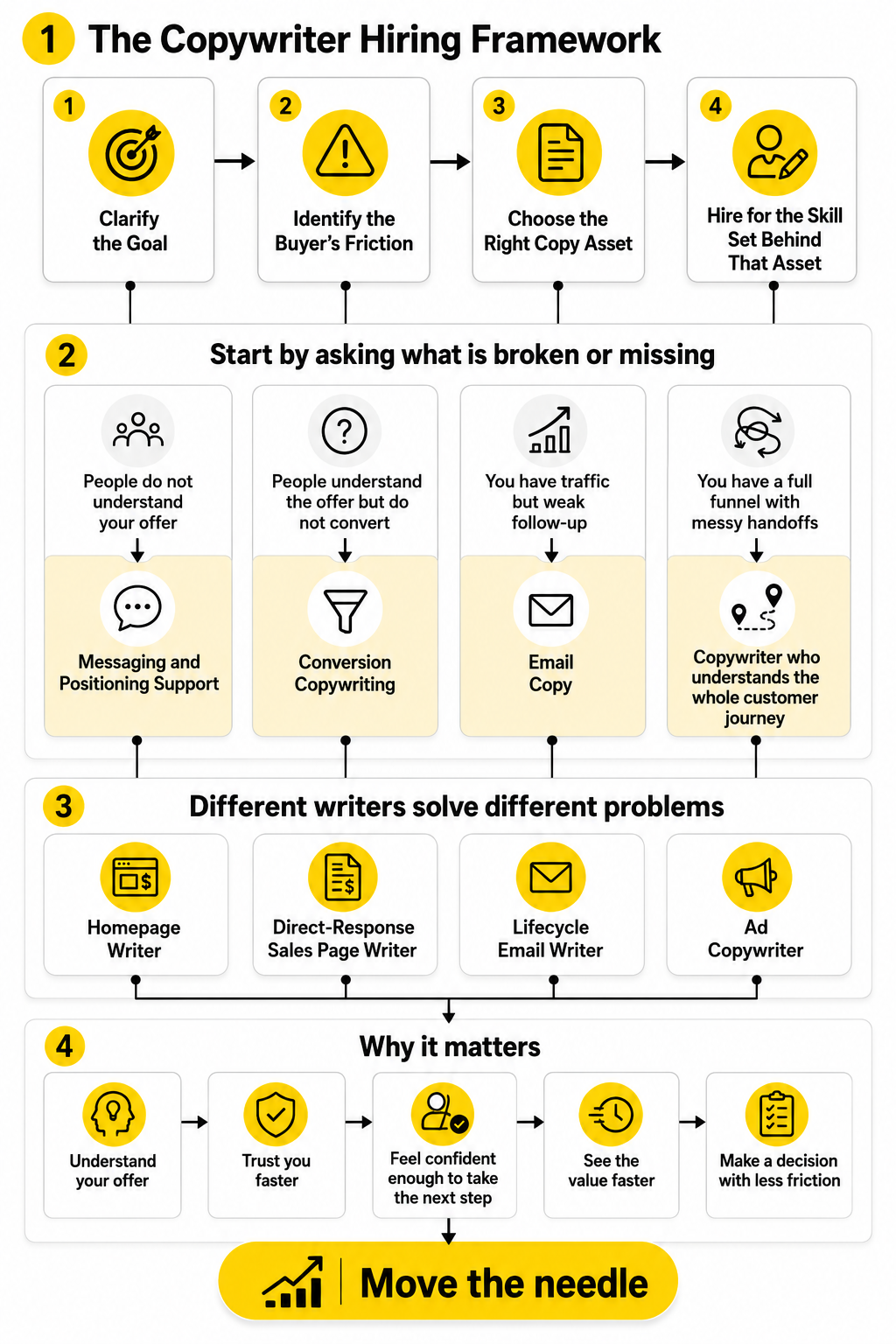
Start by asking what is broken or missing. If people do not understand your offer, you need messaging and positioning support. If people understand the offer but do not convert, you may need conversion copywriting. If you have traffic but weak follow-up, you may need email copy. If you have a full funnel with messy handoffs, you may need someone who understands the whole customer journey.
The framework is simple: clarify the goal, identify the buyer’s friction, choose the right copy asset, then hire for the skill set behind that asset. A homepage writer, a direct-response sales page writer, a lifecycle email writer, and an ad copywriter can all be excellent, but they solve different problems. The better you define the problem, the easier it becomes to hire someone who can actually move the needle.
The Core Types Of Copywriters And What They Actually Do
Once you understand the problem, the next step is choosing the right kind of copywriter. This is where most people get stuck, because “copywriter” is a broad label. Someone can be brilliant at writing punchy ad copy and still be the wrong person to rebuild your sales page.
When you say, “I need a copywriter,” you are really saying, “I need someone who can help a buyer move from confused or unconvinced to clear and ready.” The type of writer you hire depends on where that movement needs to happen. Your website, emails, ads, funnels, product pages, and sales materials all do different jobs.
The best way to avoid a bad hire is to stop hiring by job title alone. Hire by use case. Look at the asset that needs improvement, the stage of the customer journey it supports, and the outcome you expect from the copy.
Website Copywriters
A website copywriter helps turn your website into a clear explanation of your business. Their job is not just to write a nice homepage. Their job is to make sure a visitor understands what you do, who it is for, why it is different, and what to do next.
This matters because your website often carries the first real sales conversation before anyone on your team gets involved. A visitor may arrive from search, social, referrals, paid ads, or a podcast mention, and they will make quick judgments based on clarity. If the homepage sounds vague, clever, or self-focused, the visitor has to do too much work.
A strong website copywriter will usually care about positioning, page hierarchy, calls to action, objections, proof, and navigation flow. They will not only ask what you want to say. They will ask what the buyer needs to believe before taking the next step.
Landing Page And Funnel Copywriters
A landing page copywriter is more focused than a general website writer. They write pages built around one offer, one audience, and one action. That action might be booking a call, joining a webinar, starting a trial, downloading a lead magnet, or buying a product.
This kind of copywriter is useful when you are running paid traffic or building a campaign with a clear conversion goal. The page cannot ramble. It has to grab attention, frame the problem, make the offer feel relevant, handle objections, build trust, and ask for action without sounding desperate.
If your funnel is the bigger issue, you may need someone who can think beyond one page. Tools like ClickFunnels, Systeme.io, and GoHighLevel can help you build the funnel, but the copy still has to carry the logic. A funnel with weak messaging is just a sequence of pages that moves people toward indifference.
Email Copywriters
Email copywriters help you turn attention into trust over time. This includes welcome sequences, launch emails, nurture campaigns, abandoned cart emails, reactivation emails, newsletters, and sales follow-ups. Good email copy does not just announce things; it builds a relationship and creates momentum.
This is where many businesses leave serious money on the table. They collect leads, send a few random updates, and then wonder why people do not buy. The problem is usually not that the audience is cold forever; it is that the follow-up does not guide them anywhere.
A strong email copywriter understands timing, segmentation, subject lines, story structure, offer framing, and buyer intent. They also know when to sell directly and when to educate, reassure, or reframe the problem. Platforms like Brevo, Moosend, and GoHighLevel can support the automation side, but the real leverage comes from what the emails make people think, feel, and do.
Ad Copywriters
Ad copywriters work in a tighter space. They have fewer words, less attention, and more pressure to make the message instantly relevant. Their job is to stop the right person, make the problem or desire feel clear, and create enough curiosity or urgency for the click.
This is not the same as writing a full sales page. Ad copy usually has to test angles quickly, because different audiences respond to different hooks. One angle might focus on pain, another on aspiration, another on speed, another on risk reduction, and another on a strong offer.
A good ad copywriter thinks in campaigns, not just individual lines. They understand that the ad, landing page, offer, and follow-up must match. If the ad promises one thing and the page delivers another, the click becomes expensive noise.
Sales Page Copywriters
Sales page copywriters specialize in long-form persuasion. They are useful when the offer is complex, expensive, new, high-commitment, or objection-heavy. A good sales page does not simply describe the product; it walks the buyer through the decision.
This type of copy usually needs deep research. The writer has to understand the market, the buyer’s current pain, the desired outcome, the competing alternatives, the objections, the proof, and the emotional stakes. That is why strong sales page copy often costs more than simple website copy.
When someone says, “I need a copywriter for my launch,” this is often the kind of writer they mean. The page must make the offer feel inevitable, not forced. It has to help the buyer see why this solution, why this format, why this price, and why now.
Ecommerce Copywriters
Ecommerce copywriters focus on product pages, collection pages, product descriptions, ads, emails, upsells, and retention campaigns. Their work is especially important when products are similar to competitors or when customers need help understanding the value beyond features. A product page that only lists specifications is rarely enough.
The strongest ecommerce copy explains why the product matters in real life. It connects features to outcomes, removes purchase anxiety, clarifies use cases, and makes comparison easier. It also supports the visual experience instead of competing with it.
This is where copy and page design work closely together. If you are building ecommerce landing pages or product experiences, a platform like Replo can help with page execution, but the copy still needs a buyer-first strategy. Pretty pages do not fix unclear reasons to buy.
SEO Copywriters
SEO copywriters help you rank for search terms while still writing for humans. That second part matters. Nobody wants to read an article that sounds like it was assembled around keywords instead of written to solve a problem.
A good SEO copywriter understands search intent. They know the difference between someone looking for a definition, a comparison, a tool, a service provider, a tutorial, or a buying decision. The copy should match that intent instead of forcing every reader into the same sales pitch.
This kind of writer is useful when you want long-term traffic from search. But traffic alone is not the win. The article still has to build trust, guide the reader, and connect naturally to the next step in your business.
Brand Copywriters
Brand copywriters help define how your business sounds. They work on voice, messaging, taglines, campaigns, brand narratives, manifestos, and high-level communication. This is useful when your company feels inconsistent, generic, or hard to remember.
Brand copy is not always directly measurable in the same way as an ad or landing page. That does not make it soft. Clear brand language helps your team write better pages, emails, decks, ads, and social content because everyone is finally pulling from the same message.
You need a brand copywriter when your business has outgrown improvised language. Maybe your product has changed. Maybe your audience has matured. Maybe your competitors are copying the same claims and you need a sharper point of view.
Social Media Copywriters
Social media copywriters write posts, captions, hooks, short-form scripts, threads, carousels, and campaign messaging. Their job is to package ideas in a way that earns attention without damaging trust. That balance is harder than it looks.
A weak social writer chases engagement for its own sake. A strong one understands the brand, the audience, the platform, and the business goal behind the content. They know when to be direct, when to teach, when to challenge, and when to invite action.
This type of copywriter can be especially useful if your team already has ideas but struggles to turn them into consistent output. Tools like Buffer and Flick Social can help organize publishing, but the copywriter gives the content its edge. Scheduling average posts does not make them stronger.
Conversion Copywriters
Conversion copywriters sit closest to revenue. They focus on improving the percentage of people who take a desired action, usually through research-backed messaging and structured testing. They are often the right choice when you already have traffic but the results are underwhelming.
This kind of writer will usually look at analytics, heatmaps, customer interviews, reviews, surveys, sales calls, support tickets, and competitor pages. They are looking for friction. The page may be confusing, the proof may be weak, the offer may feel risky, or the call to action may arrive before the buyer is ready.
A conversion copywriter is not just there to “write better.” They are there to diagnose why people hesitate. That makes them valuable when small improvements can have a meaningful financial impact.
AI-Assisted Copywriters
AI has changed copywriting, but it has not removed the need for judgment. Many businesses now use AI to draft, summarize research, generate variations, and speed up production. That can be useful, but it does not replace strategy, taste, customer insight, or accountability.
An AI-assisted copywriter uses tools without outsourcing the thinking. They can move faster, but they still know what to question, what to cut, what to verify, and what needs a human point of view. That difference is massive.
If you are considering AI tools inside your marketing workflow, platforms like GoHighLevel AI, Chatbase, and Wispr Flow can support parts of the process. Just do not confuse faster output with stronger messaging. More words are not the same as better copy.
How To Match The Copywriter To The Job
The easiest way to choose is to name the business outcome first. Do you want more booked calls, more trial signups, more email revenue, better paid ad performance, clearer positioning, stronger launch results, or a website that finally explains your value properly? That outcome points to the kind of writer you need.
Then look at the stage of the customer journey. Awareness copy helps people recognize a problem. Consideration copy helps them compare options. Decision copy helps them act with confidence. Retention copy helps them stay, use, buy again, or refer.
This is why the sentence “I need a copywriter” should always be followed by “for what outcome?” Without that answer, you may hire a talented person for the wrong problem. With that answer, the hiring process becomes much simpler.
When You Need A Strategist, Not Just A Writer
Sometimes the writing is not the biggest gap. The bigger gap is strategy. If your offer is unclear, your audience is too broad, or your funnel has no logical path, even the best copywriter will be limited.
A strategic copywriter will push back before writing. They may question the promise, the audience, the page structure, the proof, the lead magnet, the offer stack, or the call to action. That can feel uncomfortable, but it is usually a good sign.
You do not want someone who simply takes a messy brief and makes it sound nicer. You want someone who can see why the message is not working. The best copy often starts with better thinking before a single headline is written.
How Professional Copywriters Build High-Converting Messaging
The implementation stage is where copywriting stops being abstract. This is where a professional copywriter turns scattered ideas, customer language, product details, objections, proof, and business goals into a message that can actually be used. It is not magic, and it is definitely not just opening a blank document and trying to sound clever.
Good copy is built in layers. First comes understanding. Then comes structure. Then comes writing, editing, testing, and refinement. If a copywriter skips the early thinking and jumps straight into headlines, you are usually paying for guesswork.
This matters even more when the page, email, or funnel has a commercial job to do. People often leave web pages quickly when the value is not clear, while pages with a clear value proposition can hold attention much longer, as shown in Nielsen Norman Group’s research on how long users stay on web pages. That is the practical reason copywriting has to start with clarity, not decoration.
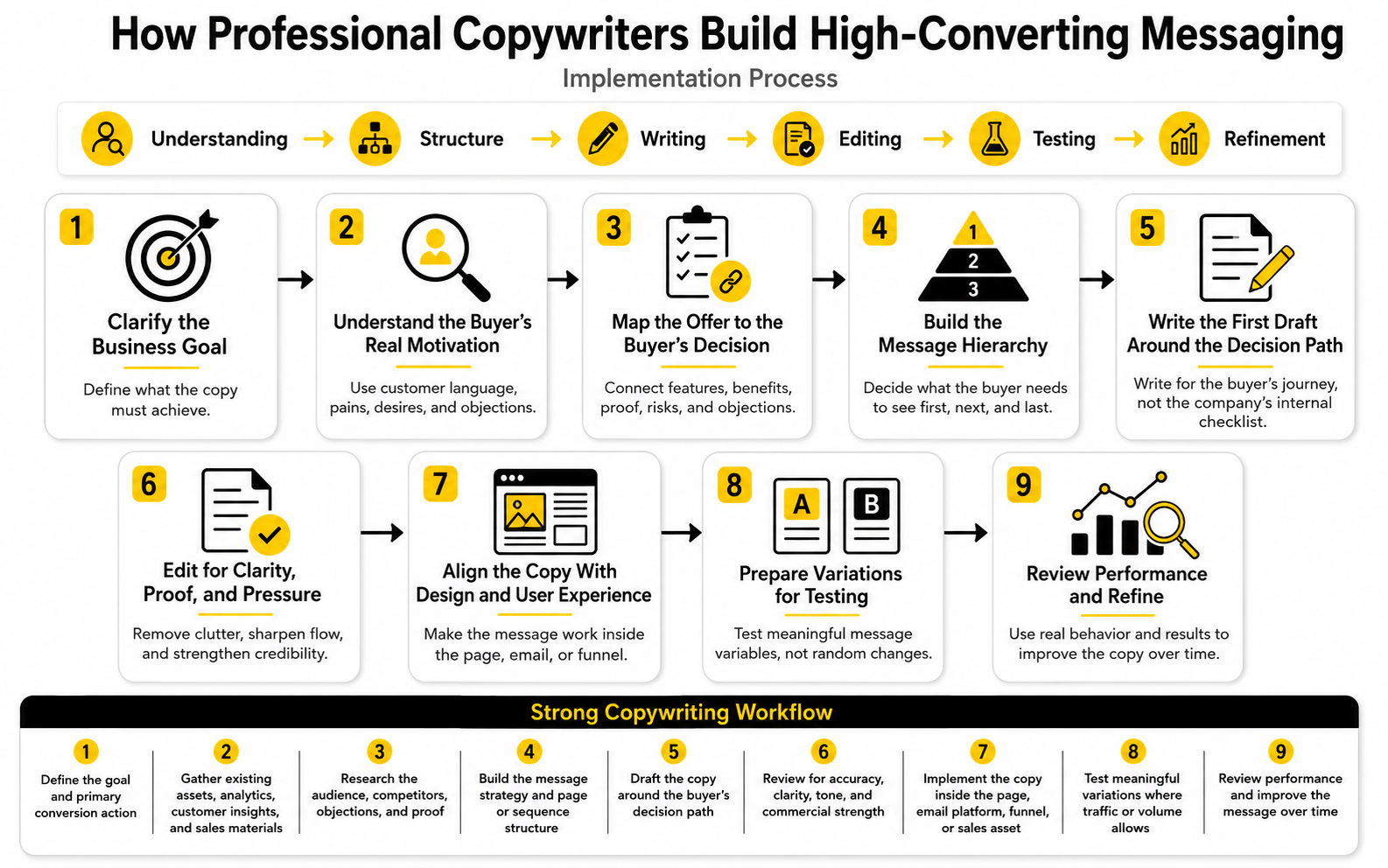
Step 1: Clarify The Business Goal
A professional copywriter starts by defining what the copy must achieve. More traffic is not the same as more leads. More leads are not the same as better-fit leads. More clicks are not the same as more customers.
This is where the sentence “I need a copywriter” becomes more useful when it turns into a specific goal. You might need more booked calls from a landing page, more trial activations from an onboarding sequence, more repeat purchases from email, or better sales conversations after people visit your website. Each goal changes the copy strategy.
The goal also affects how success should be measured. A homepage may need to improve clarity and route visitors to the right next step. A sales page may need to increase purchases. A nurture sequence may need to warm up leads before they speak with sales. If the goal is vague, the copywriter is forced to optimize for taste instead of outcome.
Step 2: Understand The Buyer’s Real Motivation
The next step is buyer research. This is where weak copy and strong copy start to separate. Weak copy talks about the product from the seller’s point of view, while strong copy speaks to the buyer’s current problem, desired outcome, hesitation, and decision criteria.
A copywriter should look for the words customers already use. These can come from reviews, surveys, sales calls, support tickets, onboarding notes, CRM records, live chat transcripts, community discussions, and customer interviews. The point is not to copy customers blindly; the point is to understand what they actually care about before writing.
This step prevents generic messaging. Instead of saying “save time and grow faster,” the copy can address the specific moment where the buyer feels the pain. Specificity builds trust because it signals that you understand the situation, not just the category.
Step 3: Map The Offer To The Buyer’s Decision
Once the copywriter understands the buyer, they need to map the offer properly. This means connecting features, benefits, proof, risks, objections, and outcomes into a logical decision path. Buyers rarely move from problem to purchase in one emotional jump.
A good copywriter asks what the buyer must believe before they can say yes. They may need to believe the problem is urgent, the solution is credible, the process is realistic, the price is justified, and the risk is manageable. If any of those beliefs are missing, the copy will feel incomplete.
This is especially important for funnels and sales pages. A tool like ClickFunnels, Systeme.io, or GoHighLevel can give you the structure to publish pages and automate follow-up, but the buyer still needs a reason to keep moving. The copywriter’s job is to make that movement feel natural.
Step 4: Build The Message Hierarchy
Message hierarchy is the order of importance. It decides what the buyer sees first, what gets explained next, and what proof appears before the call to action. This is where copywriting becomes architecture.
The top of the page or email must usually answer the fastest questions first. What is this? Who is it for? Why should I care? What happens if I keep reading or click? If those answers are buried, the reader has to work too hard.
This is why a professional copywriter does not treat every sentence equally. Some lines carry the core promise. Some reduce anxiety. Some explain the mechanism. Some build proof. Some move the reader to the next section. The hierarchy keeps the message from becoming a pile of good points with no momentum.
Step 5: Write The First Draft Around The Decision Path
The first draft should follow the buyer’s decision path, not the company’s internal checklist. That means the copy may not start with your founding story, your full feature list, or your preferred terminology. It should start where the buyer is mentally standing.
For a landing page, that may mean leading with the urgent problem and the outcome. For a website, it may mean creating a clear promise and routing different visitor types quickly. For an email sequence, it may mean starting with belief-building before asking for a sale.
This is where experience matters. A skilled copywriter knows when to be concise and when to slow down. They know when a claim needs proof, when a benefit needs a concrete example, and when a call to action is premature. The draft is not just words; it is a guided sales conversation.
Step 6: Edit For Clarity, Proof, And Pressure
Editing is where copy gets sharper. The first pass usually removes clutter. The second pass improves flow. The third pass strengthens proof, specificity, and the emotional logic of the piece.
A good copywriter looks for vague claims and replaces them with clearer language. They remove inflated phrases that sound impressive but do not help the buyer decide. They also check whether the copy creates the right amount of pressure without becoming pushy.
This part matters because buyers are skeptical. They have seen big promises before. If your copy says something strong, it should either be obvious from the context, backed by proof, or framed carefully enough to feel believable.
Step 7: Align The Copy With Design And User Experience
Copy does not live alone. It appears inside a page, email, ad, checkout flow, form, pop-up, or sales deck. If the design fights the message, the copy loses power.
For ecommerce, this is especially obvious. Baymard has tracked cart and checkout usability for years and reports an average cart abandonment rate above 70% in its cart and checkout usability research. Not all of that is copy, of course, but copy plays a role in reducing confusion, explaining costs, clarifying delivery, setting expectations, and making the next step feel safe.
That is why implementation should include collaboration between copy, design, and technical setup. If you are building ecommerce pages, Replo can help turn the structure into a live page. If you are building forms, quizzes, or intake flows, Fillout can support the capture step. But the words still need to make the action feel obvious and worthwhile.
Step 8: Prepare Variations For Testing
A professional process should leave room for testing. This does not mean randomly testing button colors because someone on the team has an opinion. It means testing meaningful message variables that could change buyer behavior.
Useful tests often involve the main promise, headline angle, call to action, offer framing, proof placement, objection handling, lead magnet positioning, or email subject line. The goal is to learn what the market responds to, not to prove that the writer was right on the first attempt. That mindset is important.
For email, this can be especially practical. Subject lines, preview text, segmentation, and sequence timing can all affect performance. Platforms like Brevo, Moosend, and ManyChat can help you run and automate those touchpoints, but the test still needs a strategic reason behind it.
Step 9: Review Performance And Refine
The work is not finished when the copy goes live. Real implementation includes looking at what happens after publishing. Are people clicking? Are they scrolling? Are they dropping off before the form? Are sales calls better qualified? Are replies more specific?
A copywriter may not control every metric, but they should care about signals. For a landing page, that might include conversion rate, bounce behavior, scroll depth, form starts, and booked calls. For email, it might include opens, clicks, replies, purchases, unsubscribes, and the quality of leads generated.
This is where copy becomes an asset instead of a one-time file. You learn what works, keep the strongest messages, and cut what does not earn its place. The best copywriting process is not precious. It is practical.
What A Strong Copywriting Workflow Looks Like
A good workflow keeps the project from becoming chaotic. It gives the copywriter enough context to do the job properly, while giving the business enough structure to review work intelligently. Without that workflow, feedback turns into opinions and the project slows down.
A practical workflow usually looks like this:
This process is simple, but it forces discipline. It stops the business from treating copy as a cosmetic task at the end. More importantly, it helps the copywriter build from evidence instead of assumptions.
Statistics And Data
Data matters when you hire a copywriter because copy should not be judged only by how it sounds. It should be judged by what it helps people understand, what friction it removes, and what action it creates. Taste still matters, but taste alone is a weak measurement system.
The wrong way to use statistics is to grab random benchmarks and panic because your numbers are lower. The right way is to use data as a diagnostic tool. A benchmark can tell you where to look, but your buyer, offer, traffic source, price point, market maturity, and funnel stage explain what the number actually means.
So when you say, “I need a copywriter,” the more carefully next question is not “What is a good conversion rate?” The better question is “Where is the message failing in the buyer journey?” That is the question data can help answer.
The Metrics That Actually Matter
A copywriter does not need to obsess over every metric in your dashboard. They need to understand the numbers that reveal message clarity, buyer intent, friction, and trust. Those are the areas copy can influence most directly.
For a website or landing page, the useful signals often include conversion rate, bounce behavior, scroll depth, button clicks, form starts, form completions, booked calls, checkout starts, and qualified leads. For email, the useful signals include click rate, reply quality, purchases, unsubscribes, and how different segments behave. For ads, the useful signals include click-through rate, cost per click, lead quality, and whether the landing page continues the same promise the ad started.
Do not treat these numbers as isolated facts. A high click-through rate with poor lead quality may mean the hook is too broad. A decent landing page conversion rate with weak sales calls may mean the copy is attracting curiosity instead of commitment. A low email click rate may mean the offer is weak, the audience is poorly segmented, or the message is asking for action before enough belief has been built.
Benchmarks Are Starting Points, Not Final Answers
Benchmarks are useful because they give you a rough sense of reality. They stop you from guessing in a vacuum. But they should not become the only standard for judging copy.
For example, Unbounce’s conversion benchmark research found a 6.6% median conversion rate across industries and a 3.8% median conversion rate for SaaS landing pages in its landing page dataset, which is useful context if you are evaluating a lead generation page or trial signup page. Those numbers do not mean every SaaS page below 3.8% has bad copy, and they do not mean every page above 3.8% has good copy. They mean you have a reference point that should be interpreted alongside traffic quality, offer strength, audience awareness, and the action being requested.
Ecommerce has a different measurement problem. Baymard’s long-running cart research puts the average documented cart abandonment rate at roughly 70%, which means many buyers show intent and still leave before completing the purchase. That does not automatically mean the product page copy is bad. It may point to shipping costs, account creation, trust issues, unclear delivery details, weak returns language, payment friction, or a checkout flow that creates anxiety at the worst possible moment.
Email benchmarks need the same caution. Mailchimp’s industry benchmark data shows that open and click performance varies widely by sector, while MailerLite’s 2025 benchmark summary reported an average email click rate around 2.09% and a click-to-open rate around 6.81%. Those numbers are helpful, but privacy changes and inbox behavior make open rates less reliable than they used to be. Clicks, replies, purchases, and booked calls usually tell you more about whether the copy is creating real movement.
What Website Data Tells You About Copy
Website data helps you see where visitors lose confidence. If people land on a page and leave quickly, the first job is not to rewrite every paragraph. The first job is to inspect the top of the page.
The top section must make the value obvious fast. Nielsen Norman Group’s research on web behavior found that users often leave pages within 10 to 20 seconds, while pages with a clear value proposition can hold attention longer. That is why the hero section is not the place for vague brand poetry. It has to make the reader feel, “Yes, this is relevant to me.”
If visitors scroll but do not click, the issue may be different. The page might be interesting but not persuasive. That can point to weak proof, unclear next steps, missing objections, a low-trust offer, or a call to action that does not match the reader’s level of readiness.
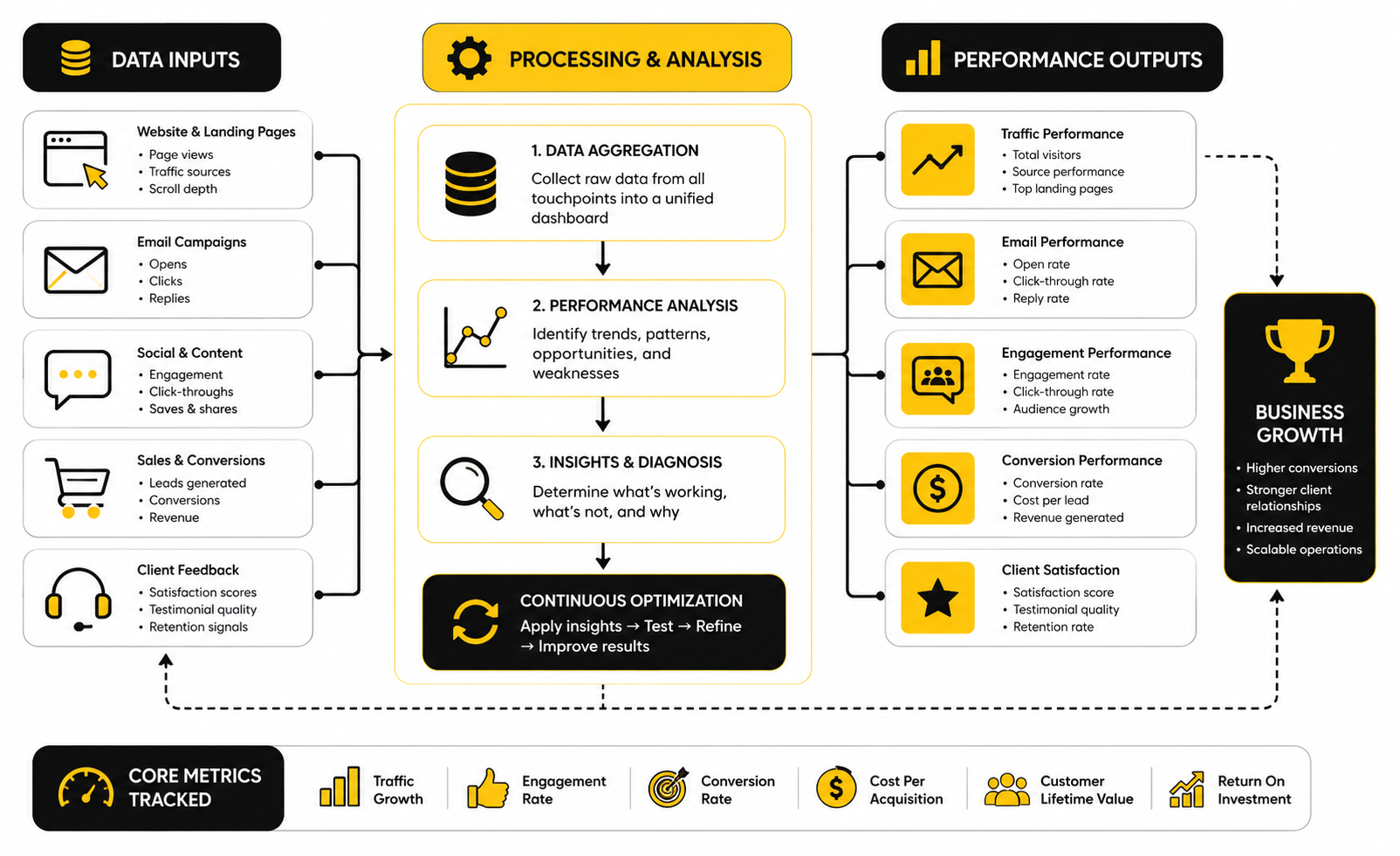
How To Build A Simple Copy Measurement System
You do not need a complicated analytics setup to make better copy decisions. You need a clean system that connects copy changes to business outcomes. The system should show what people saw, what they did next, and where they dropped off.
A practical copy measurement system looks like this:
This gives the copywriter a real feedback loop. If a new landing page gets more form fills but fewer qualified calls, the copy may be creating broader appeal without enough filtering. If an email gets fewer clicks but more purchases, the copy may be doing a better job of pre-qualifying intent. The number alone does not tell the whole story; the pattern does.
How To Interpret Conversion Rate
Conversion rate is useful, but it is often misunderstood. A page that converts at 12% is not automatically better than a page that converts at 3%. The quality of the action matters.
A free checklist will usually convert higher than a paid consultation. A low-risk trial may convert higher than a demo request. A warm email audience may convert higher than cold paid traffic. That is why comparison only works when the audience, offer, traffic source, and action are similar enough to make the comparison fair.
When conversion rate is low, the copywriter should look for mismatch. Is the ad promising something the page does not continue? Is the headline too clever? Is the offer unclear? Is the proof too thin? Is the form asking for too much too soon? These are copy and positioning questions, not just analytics questions.
How To Interpret Bounce Rate And Scroll Depth
Bounce behavior can signal a relevance problem, but it does not always mean the page failed. Some pages answer the reader’s question quickly. Some pages attract the wrong traffic. Some pages are built for a simple next step that may happen without deep scrolling.
Scroll depth helps add context. If people barely scroll, the opening section may not be doing its job. If people scroll deeply but do not act, the page may be engaging without creating enough urgency, trust, or clarity around the next step.
This is where copywriting becomes practical. You are not changing words because someone prefers a different tone. You are changing the message because the behavior shows a specific point of friction.
How To Interpret Email Performance
Email performance should be read in layers. Open rate can show whether the sender, subject line, and audience relationship are strong enough to earn attention. Click rate shows whether the message created enough interest for action. Replies, purchases, booked calls, and unsubscribe behavior show whether the message was relevant and well-timed.
A low open rate may be a subject line problem, but it can also be a list quality problem. A low click rate may be a weak call to action, but it can also mean the email did not build enough belief before asking for the click. A high unsubscribe rate may mean the copy is too aggressive, but it can also mean the campaign is finally filtering people who were never going to buy.
This is why a good email copywriter will not only ask for open rates. They will ask about segments, source of subscribers, previous offers, purchase behavior, and what happened after the click. The email is only one part of the buying path.
How To Interpret Ad And Funnel Data
Ad data tells you whether the message earns attention from the right people. Funnel data tells you whether that attention turns into action. You need both, because a strong ad can still send people into a weak page.
If ads get clicks but the landing page does not convert, the first suspect is message match. The reader clicked because they expected one thing, then arrived and felt a disconnect. That disconnect can be caused by a different promise, a different audience angle, a weaker offer, or copy that takes too long to get to the point.
Funnels built in tools like ClickFunnels, Systeme.io, or GoHighLevel should be measured by stage, not as one blob. Look at ad click, landing page conversion, form completion, appointment booking, show-up rate, close rate, and follow-up performance. When you know which stage is leaking, the copywriter can work on the right message instead of rewriting everything blindly.
The Difference Between Volume And Quality
More leads are not always better. This is one of the most important lessons in copy measurement. If the copy attracts people who are curious but not serious, your numbers may look better while your sales team gets worse conversations.
That is why lead quality should be measured alongside lead volume. For service businesses, this might mean tracking booked calls, show-up rate, fit, close rate, and average deal size. For ecommerce, it might mean tracking conversion rate, average order value, repeat purchases, refund rate, and support issues. For SaaS, it might mean tracking activation, product usage, expansion, and churn.
A stronger copywriter can sometimes reduce bad-fit conversions while improving revenue. That may look strange if you only care about raw opt-ins. But in a real business, the goal is not more names in a database. The goal is more of the right buyers taking the right action.
What Data Cannot Tell You By Itself
Data can show where something is happening, but it does not always explain why. Analytics may show that people abandon a form halfway through. It will not automatically tell you whether the form feels too invasive, the offer feels too vague, the page lacks proof, or the buyer is not ready.
That is why quantitative data should be paired with qualitative research. Customer interviews, surveys, sales call notes, support conversations, reviews, and chat logs can reveal the language behind the numbers. If five buyers mention the same hesitation, that is often more useful than another dashboard screenshot.
This is also why copywriters who understand research are more valuable than writers who only produce drafts. They can connect what people do with what people say. That connection is where stronger messaging comes from.
What To Share With A Copywriter Before They Start
A copywriter can do better work when they can see the current reality. You do not need to have perfect analytics, but you should share whatever gives them a clearer picture. Hiding messy data only makes the project harder.
Useful materials include:
This information helps the copywriter avoid generic assumptions. It also makes feedback more objective. Instead of debating whether a headline “sounds better,” you can ask whether it addresses the buyer’s real concern and supports the next measurable action.
The Best Data Leads To Better Decisions
The point of measurement is not to make copywriting cold or mechanical. The point is to make decisions with less ego. When you can see what people do and understand why they do it, you can improve the message with confidence.
This is where hiring a copywriter becomes a growth decision, not a content task. You are not just buying words. You are buying a clearer path from attention to trust to action.
So if your instinct is “I need a copywriter,” bring the numbers into the conversation early. The right writer will not be intimidated by them. They will use them to find the real problem faster.
How To Choose, Brief, And Work With The Right Copywriter
At this stage, the question is no longer whether copy matters. It does. The real question is how to work with a copywriter in a way that produces better thinking, cleaner execution, and stronger results. This is where many businesses accidentally create their own copy problem.
They hire someone with a vague goal, give them a thin brief, send scattered feedback from five people, and expect the final draft to fix everything. That is not a copywriting process. That is a guessing game with invoices attached.
If you are thinking, “I need a copywriter,” treat the hire like a strategic project, not a content order. The quality of the outcome depends on the writer, but it also depends on what you give them, how you review their work, and whether your business is ready to make decisions.
Start With The Business Problem, Not The Deliverable
Most people start by saying, “I need a landing page,” “I need emails,” or “I need website copy.” That is a normal place to start, but it is not enough. A deliverable tells the copywriter what to produce, not what the copy needs to solve.
A better brief starts with the business problem. Maybe your website gets traffic but does not create enough qualified calls. Maybe your email list is growing but not buying. Maybe your ads are getting clicks, but the funnel is leaking after the first page. Maybe your offer is strong, but people keep misunderstanding what makes it different.
Once the problem is clear, the deliverable becomes easier to define. You may discover that you do not need a full website rewrite. You may need a sharper homepage, a stronger services page, and a better lead capture sequence. That distinction can save money and produce better results.
Decide Whether You Need Execution Or Strategy
Some copywriters are excellent executors. Give them a clear offer, strong research, a defined audience, and a proven structure, and they can turn it into strong copy. That is valuable when your strategy is already solid.
Other copywriters are more strategic. They help shape the offer, clarify positioning, challenge assumptions, map the funnel, and decide what needs to be said before writing the final copy. That is valuable when the business problem is not fully diagnosed yet.
Do not hire an execution-only writer and expect them to fix your positioning. Do not hire a high-level strategist if all you need is clean production copy for a well-defined campaign. Both can be good hires, but only if the job matches the gap.
Know The Tradeoff Between Speed, Depth, And Cost
Copywriting has a real triangle: speed, depth, and cost. You can usually optimize for two, but not all three. Fast and cheap usually means shallow. Deep and fast usually costs more. Deep and affordable usually requires more time and a tighter scope.
This is not a moral issue. It is just how serious thinking works. Research, interviews, positioning, message hierarchy, drafting, revision, and implementation all take attention. When you compress the timeline too much, something gets sacrificed.
That does not mean every project needs a long, expensive engagement. A simple email rewrite does not need the same depth as a complete funnel rebuild. But if the copy is tied to a major launch, paid traffic, investor-facing positioning, or a high-ticket offer, do not treat it like a quick task. The risk of weak copy is bigger than the fee.
Look For Evidence Of Thinking, Not Just Nice Writing
A portfolio can tell you whether someone writes well, but it does not always show how they think. Pretty copy is not enough. You want to see whether the writer understands audience awareness, offer framing, objections, proof, and conversion logic.
When reviewing samples, look for structure. Does the page lead the reader somewhere, or does it just sound polished? Does the copy make the offer easier to understand? Does it handle hesitation? Does it speak to a specific buyer, or could it belong to almost any company in the category?
You can also ask the writer to explain one project in plain language. What was the problem? What did they change? What research shaped the message? What tradeoffs did they make? A serious copywriter should be able to explain the thinking without hiding behind jargon.
Give Them A Brief That Is Actually Useful
A weak brief creates weak work. A useful brief gives the copywriter context, constraints, and direction without dictating every sentence. It should make the business easier to understand and the buyer easier to picture.
A strong copy brief usually includes:
The “with reasons” part matters. Saying “make it punchier” is not useful. Saying “this feels too formal for our buyers because they usually come from founder-led social content” is useful. Good feedback gives the writer a decision-making filter.
Do Not Hide The Messy Parts
A copywriter can only solve the problems they can see. If your offer has weak proof, say that. If your sales team hears the same objection every week, share it. If customers churn because expectations are unclear, bring that into the project early.
Messy information is not embarrassing. It is useful. The copywriter can turn it into clearer qualification, better expectation-setting, stronger objection handling, or a more honest promise. But they cannot do that if you only show them the polished version of the business.
This is especially important when you are scaling. The copy that worked when the founder sold manually may not work when traffic gets colder, the team grows, or the offer reaches a broader market. Scaling exposes message gaps fast.
Protect The Buyer’s Language
One advanced mistake is editing the copy until it sounds like the company instead of the customer. Internal teams often replace simple buyer language with polished corporate phrasing. It feels more “professional,” but it usually becomes less persuasive.
A good copywriter will fight for the buyer’s language when it matters. That does not mean the copy should sound sloppy. It means the wording should reflect how real buyers describe their problems, priorities, and desired outcomes.
This becomes even more important with AI-assisted workflows. AI can produce clean sentences quickly, but it often smooths away the sharp, specific language that makes copy feel true. Tools like GoHighLevel AI, Chatbase, and Wispr Flow can speed up research, drafting, and internal workflows, but human judgment still needs to protect what makes the message credible.
Build A Review Process Before The First Draft
The review process can make or destroy a copy project. If every stakeholder comments from personal taste, the draft gets pulled in five directions. The final version becomes safer, flatter, and less effective.
Before the first draft arrives, decide who gives feedback and what they are responsible for. One person should own the final decision. Others can review for accuracy, compliance, product details, sales objections, or brand fit. That keeps the feedback useful instead of chaotic.
The best review question is not “Do I like this?” The better question is “Will this help the right buyer understand the value and take the next step?” That one shift removes a lot of unnecessary debate.
Understand What Revisions Are For
Revisions are not a sign that the copywriter failed. They are part of making the copy accurate, sharper, and more aligned with the business. But revisions should improve the work, not turn the project into endless preference editing.
Useful revision feedback is specific. It points to a problem and explains why it matters. For example, “This section overstates the result because we cannot guarantee that outcome” is useful. “This does not pop” is not.
A professional copywriter should also be willing to push back. If a requested change weakens the message, they should explain why. You are not hiring a typist. You are hiring someone to make the copy stronger.
Avoid The Biggest Hiring Red Flags
Not every copywriter who sounds confident is the right fit. Some red flags show up before the project even starts. Pay attention to them.
Be careful if a copywriter promises guaranteed revenue results without controlling traffic, offer, pricing, sales process, product quality, or follow-up. Be careful if they do not ask questions before quoting a complex project. Be careful if they only talk about word count instead of outcomes.
Also be careful if they dismiss research. Strong copy does not come from vibes alone. If the writer has no interest in customers, objections, competitors, proof, analytics, or funnel context, they may produce something that reads nicely but does not solve the real problem.
Know When To Hire Freelance, In-House, Or Agency
A freelance copywriter is often best when you need specialized expertise, a defined project, or senior thinking without a full-time hire. This works well for sales pages, website rewrites, launch campaigns, email sequences, positioning projects, and funnel optimization. The key is having enough internal ownership to implement and review the work properly.
An in-house copywriter makes sense when copy needs are constant and deeply connected to daily operations. They can learn the product, audience, brand, sales team, and internal context over time. The tradeoff is that one in-house writer may not cover every specialty at an expert level.
An agency can make sense when the project requires strategy, copy, design, development, ads, automation, and analytics under one roof. That can be useful for full funnel builds or larger campaigns. The risk is paying for coordination and layers when what you really needed was one sharp specialist.
Plan For Scaling Before The Copy Breaks
Copy that works at one stage may break at the next stage. Founder-led businesses often start with personal trust. The founder explains the offer live, answers objections directly, and closes through relationship. That can hide weak written messaging for a while.
When the business scales, the copy has to do more of that work without the founder present. Your website has to explain faster. Your emails have to nurture better. Your ads need sharper angles. Your onboarding needs clearer expectations. Your sales collateral needs to make the same argument consistently.
This is where message systems become important. You do not just need one good landing page. You need reusable positioning, proof points, objection responses, offer language, customer language, and calls to action that your team can apply across channels.
Create A Copy Asset Library
A copy asset library helps your business stop reinventing the message every week. It gives your team a shared source of truth. This is especially useful when multiple people are writing ads, emails, social posts, landing pages, sales decks, and customer communications.
A useful copy asset library might include:
This is not busywork. It prevents drift. When your team has a strong message library, every campaign starts faster and stays more consistent.
Use Automation Without Automating The Soul Out Of The Message
Automation is powerful, but it magnifies whatever message you put into it. If the copy is clear, automation helps you follow up faster and more consistently. If the copy is weak, automation helps you send weak messages at scale.
That is why platforms like GoHighLevel, ManyChat, Brevo, and Moosend should support the strategy, not replace it. The sequence still needs empathy, timing, segmentation, and a reason for each message to exist.
The danger is building a huge automated machine before the message is proven. Start with the core path first. Make the offer clear, make the follow-up useful, watch the data, then scale what works.
Protect Trust As The Business Grows
Strong copy does not mean saying the biggest thing you can get away with. It means making the strongest honest case for the offer. That line matters.
When businesses get aggressive with copy, they often create short-term lift and long-term trust problems. Overpromising leads to refunds, churn, bad reviews, weaker referrals, and a sales team that has to reset expectations. That is not good marketing. That is borrowing from the future.
A serious copywriter understands the balance. They know how to make the offer desirable without making claims the product cannot support. They know how to create urgency without fake pressure. They know how to sell clearly without making the reader feel manipulated.
When The Copywriter Should Challenge You
The best copywriters are not always easy to manage because they do not simply agree with every assumption. They may challenge the audience, the offer, the lead magnet, the guarantee, the pricing logic, the page order, or the call to action. That is part of the value.
They should challenge you when the promise is too vague. They should challenge you when the proof is too weak. They should challenge you when the offer asks for too much commitment too soon. They should challenge you when the copy is being edited to please internal stakeholders instead of the buyer.
This is a good thing. If you only want someone to make your existing ideas sound smoother, hire a writer. If you want the message to perform better, hire someone who can think with you.
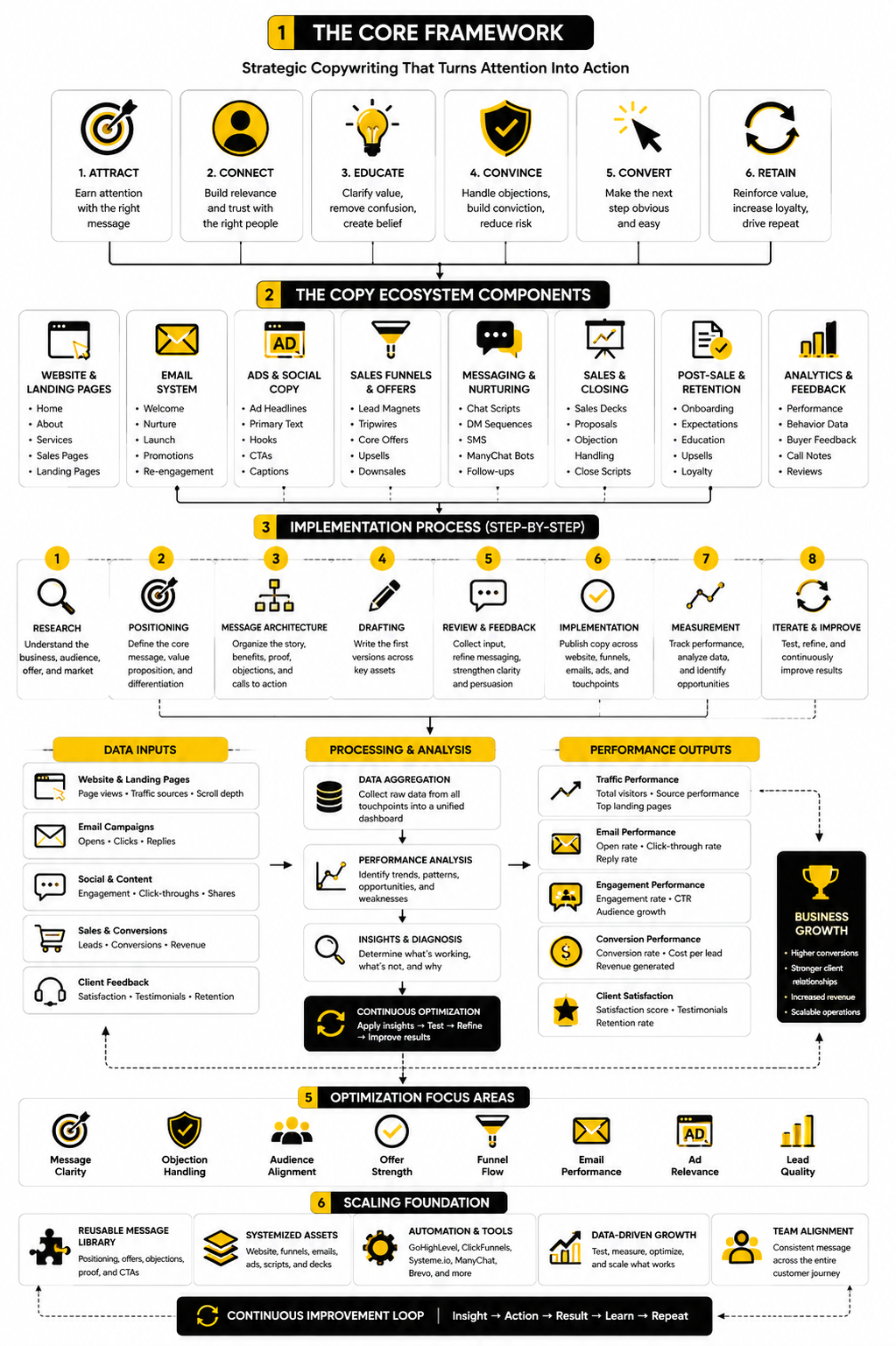
The final stage is not just hiring a writer and hoping the words perform. It is building a copy ecosystem that supports the whole business. Your homepage, landing pages, emails, ads, sales decks, forms, chat flows, onboarding messages, and follow-up sequences should all feel like they came from the same strategic brain.
That consistency matters because buyers rarely convert from one touchpoint. They see a post, click an ad, skim a landing page, ignore an email, come back later, ask a question, compare alternatives, and finally decide. If every touchpoint uses different language, the buyer has to keep re-learning what you do.
A copywriter can help create that system, but only if the business treats messaging as an asset. The goal is not to keep rewriting from scratch. The goal is to build a message foundation that your team can reuse, test, and improve across every channel.
What does a copywriter actually do?
A copywriter writes marketing and sales messaging designed to move a reader toward a specific action. That action might be booking a call, joining a list, buying a product, starting a trial, replying to an email, or understanding an offer more clearly. The best copywriters do more than write clean sentences; they research the buyer, organize the message, handle objections, and make the next step feel natural.
How do I know if I need a copywriter?
You probably need a copywriter if people are seeing your offer but not taking the next step. That could mean your website is unclear, your emails are not converting, your ads are getting clicks without sales, or your sales team keeps explaining the same things manually. When you catch yourself saying “I need a copywriter,” look for the specific point where buyers are confused, hesitant, or dropping off.
What kind of copywriter should I hire first?
Hire based on the business problem, not the job title. If your website does not explain your value clearly, start with a website or messaging copywriter. If your paid traffic is not converting, look for a landing page or conversion copywriter. If your list is quiet and underused, an email copywriter may give you the fastest practical lift.
What is the difference between a copywriter and a content writer?
A copywriter usually writes to drive action, while a content writer usually writes to educate, inform, or attract an audience over time. There is overlap, especially in SEO articles, newsletters, and thought leadership. The difference is the primary job of the piece: copy pushes a decision, while content builds attention, authority, and trust.
How much should I expect to pay for a copywriter?
Copywriter pricing depends on scope, experience, research depth, strategic involvement, and business impact. A simple email or small page edit may be relatively affordable, while a full website rewrite, sales page, launch sequence, or funnel strategy can cost much more. Do not compare prices by word count alone because the real value is in the thinking, research, positioning, and conversion logic behind the words.
Should I hire a freelance copywriter, agency, or in-house writer?
A freelance copywriter is often best for a defined project that needs specialist skill. An agency can make sense when you also need design, development, ads, automation, and analytics under one roof. An in-house copywriter is usually better when the business has constant messaging needs and wants someone deeply embedded in the product, audience, and team.
What should I give a copywriter before they start?
Give them the business goal, audience details, offer information, current assets, customer research, analytics, objections, testimonials, sales call notes, and any brand voice guidance you already have. The more useful context they have, the less they have to guess. A good copywriter will still ask questions, but a strong brief helps them get to better ideas faster.
Can AI replace a copywriter?
AI can help with drafting, summarizing, brainstorming, and speeding up production, but it does not replace strategic judgment. It does not automatically understand your buyer, your positioning, your proof, your risk, your ethics, or your market nuance. A skilled copywriter can use AI as leverage, but the final message still needs human taste, research, and accountability.
How long does a copywriting project take?
The timeline depends on the complexity of the project. A small email sequence or page refresh may be quick, while a serious website, sales page, or funnel project needs research, structure, drafting, revision, and implementation support. The deeper the strategy, the more time the copywriter needs to understand the buyer and make the message strong.
How do I judge whether copy is good?
Good copy is clear, specific, credible, and connected to a business goal. It should help the right buyer understand the offer faster, feel the relevance, trust the promise, and know what to do next. Do not judge it only by whether it sounds clever; judge it by whether it removes friction and supports action.
What are the biggest mistakes people make when hiring a copywriter?
The biggest mistake is hiring without defining the real problem. Other common mistakes include giving a weak brief, choosing only by price, asking for strategy from an execution-only writer, collecting feedback from too many people, and editing the copy until it sounds safe but forgettable. The copywriter can only do their best work when the project has direction.
Do I need a copywriter if I already have a designer?
Yes, if the message itself is unclear. A designer can make the page look professional, but design cannot fully compensate for weak positioning, vague promises, missing proof, or confusing calls to action. The strongest pages usually come from copy and design working together, not one trying to rescue the other.
Should a copywriter help with funnels and automation?
A copywriter should at least understand the funnel context, even if they are not the person building the automation. The copy needs to match the buyer’s journey across the landing page, form, email sequence, booking flow, sales call, and follow-up. Tools like GoHighLevel, ClickFunnels, Systeme.io, ManyChat, and Brevo can run the system, but the copy decides whether the system feels persuasive or just automated.
What should I ask a copywriter before hiring them?
Ask what kind of copy they specialize in, how they research buyers, what they need from you, how they structure a project, and how they handle feedback. Ask them to explain the thinking behind one relevant sample. You are listening for clarity, curiosity, strategic judgment, and whether they understand the difference between writing words and solving a sales problem.
Can a copywriter improve my SEO?
Yes, if they understand search intent and write for humans, not just keywords. SEO copy should help the right reader find you, understand the topic, trust your perspective, and move toward the next logical step. Keyword use matters, but keyword stuffing makes the page worse for readers and usually weaker as a business asset.
How do I know if the copywriter is a good fit for my brand voice?
Look for whether they can adapt without becoming generic. A strong copywriter should ask for examples, explain tone choices, and show that they understand how your buyers speak. Brand voice is not just personality; it is the way your business earns trust while staying recognizable.
What happens after the copy goes live?
After the copy goes live, you should watch the performance signals that match the goal. That might include conversion rate, booked calls, sales quality, email clicks, replies, checkout completion, trial activation, or lead quality. The best copy becomes stronger after it meets the market because the data and buyer responses show what needs to be refined.
Is it worth hiring a copywriter for a small business?
Yes, especially if your website, emails, or sales pages are already getting attention but not enough action. Small businesses often need clarity more than volume. A good copywriter can help make the offer easier to understand, reduce repetitive sales explanations, and create assets that keep working after the project is finished.
What is the first step if I need a copywriter right now?
Write down the exact business outcome you want before contacting anyone. Do not start with “I need better words.” Start with “I need more qualified calls from this page,” “I need my email list to convert,” or “I need my offer explained clearly.” That one move makes the hiring process sharper immediately.
Build a stronger local presence with BAAM AI
Turn your website, Google profile, social channels, and AI visibility into one growth engine
Most businesses do not need more random marketing activity. They need a consistent presence system that helps the right people find them, trust them, and take action. BAAM AI brings strategy, local SEO, website updates, Google Maps visibility, social content, AI-search readiness, media production, and reporting into one practical monthly engine.
If you want your marketing to keep working after the campaign ends, start with a free BAAM AI presence audit. See how your business shows up today and where the fastest visibility wins are at BAAM AI.