
BAAM AI Blog
HubSpot Social Media Strategy: A Practical Framework for Turning Social Content Into Pipeline
A HubSpot social media strategy is not just a posting calendar. It is a connected system for planning content, publishing consistently, measuring what actually creates business results, and using those insights to...
Affiliate disclosure: this article may include compensated links. Recommendations should still be evaluated against your use case, budget, and current provider terms.
Should you choose HubSpot?
HubSpot is worth considering when the use case, budget, and implementation effort match what you actually need to do next.
teams that want a practical tool decision without reading another generic feature list
Check HubSpotA HubSpot social media strategy is not just a posting calendar. It is a connected system for planning content, publishing consistently, measuring what actually creates business results, and using those insights to improve the next round of campaigns.
That matters because social media is no longer a soft brand channel that sits outside revenue conversations. HubSpot’s own social media management product emphasizes reporting on visits, leads, and customers generated from social activity, which is exactly where serious teams need to focus if they want social to earn budget instead of merely consume it through HubSpot’s social media management software.
The challenge is that most teams still treat social as a content treadmill. They post because the calendar says so, react to platform trends too late, and report on engagement without connecting it to lifecycle stage, campaign performance, sales context, or customer data. A better approach uses HubSpot as the operating layer: strategy first, content second, automation third, reporting always.
this guide is split into six connected parts so the strategy builds in the right order. We will start with the big picture, then move into the practical framework, implementation workflow, measurement system, optimization process, and final decision guidance. Each section is designed to help you build a HubSpot social media strategy that is useful inside a real marketing team, not just impressive in a slide deck.
Why a HubSpot Social Media Strategy Matters
Social media has become too important to manage casually. HubSpot’s 2025 social media research was based on input from more than 1,100 social media professionals, and the report focuses heavily on AI-assisted content, video-first engagement, social commerce, and changing audience behavior through the 2025 Social Media Trends Report. That tells you something simple: the channel is moving fast, and scattered posting is not a strategy.
The deeper issue is accountability. Social teams are often asked to prove value, but they are given workflows that only measure surface-level activity. HubSpot helps close that gap because social publishing, campaign association, CRM data, and reporting can sit closer together instead of being scattered across disconnected tools.
This is where the keyword “HubSpot social media strategy” needs to be understood properly. It is not a trick for getting more reach from every post. It is a practical way to connect audience insight, content planning, campaign execution, and revenue reporting inside one repeatable system.
The HubSpot Social Media Strategy Framework
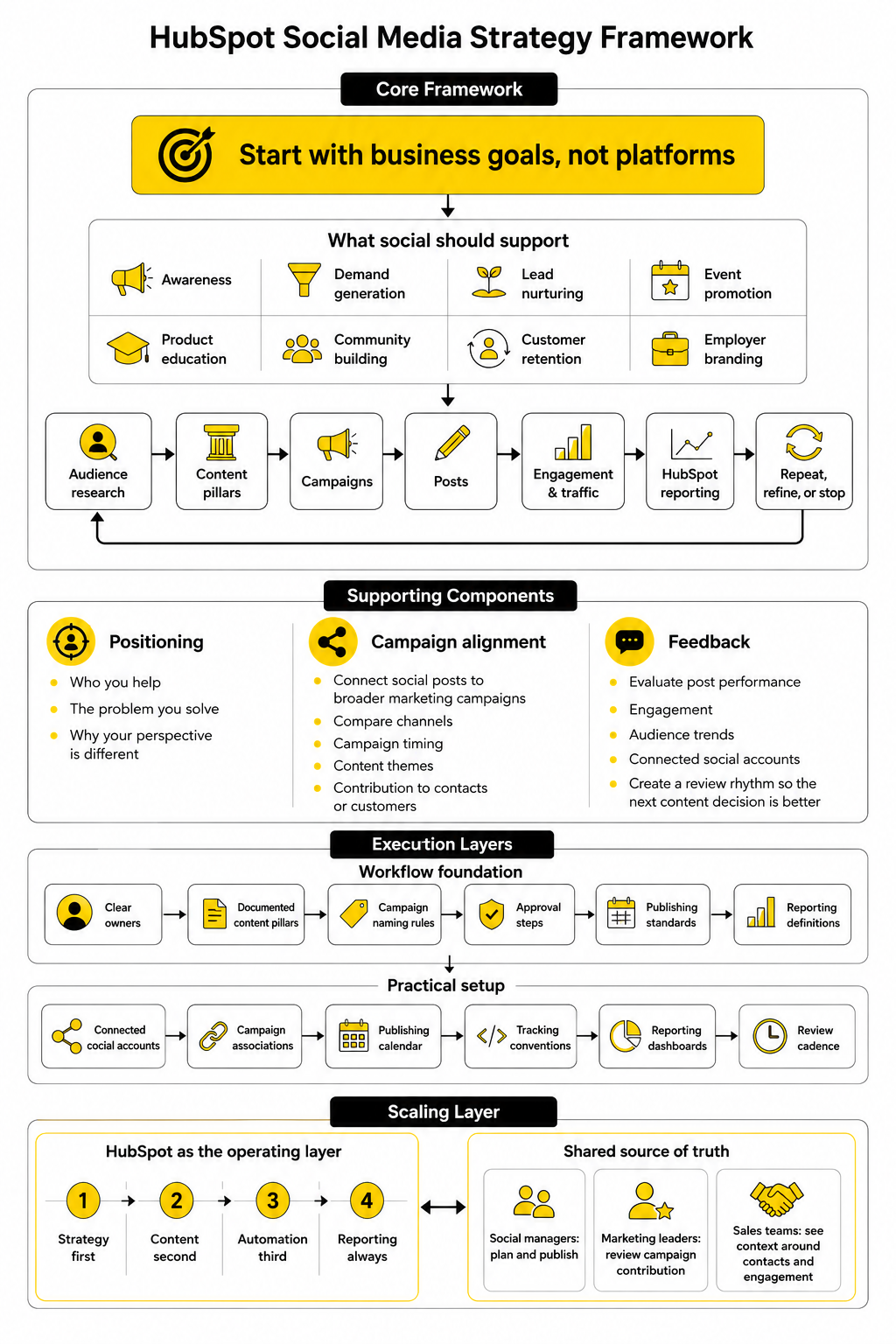
A useful framework starts with business goals, not platforms. Before choosing whether LinkedIn, Instagram, Facebook, X, TikTok, or YouTube should get priority, the team needs to define what social is supposed to support: awareness, demand generation, lead nurturing, event promotion, product education, community building, customer retention, or employer branding. Without that decision, every metric starts to look equally important, which usually means none of them are useful.
The framework also needs to respect how social behavior has changed. Sprout Social’s 2025 Index is based on surveys of more than 4,000 consumers and 1,200 marketers, showing that social is now central to how people interact with brands, not just a place where brands distribute announcements through the 2025 Sprout Social Index. That makes the strategy more than a publishing plan; it has to include listening, response, trust, content quality, and measurement.
In HubSpot, the cleanest way to think about the framework is as a loop. Audience research informs content pillars, content pillars shape campaigns, campaigns create posts, posts generate engagement and traffic, and HubSpot reporting helps the team decide what to repeat, refine, or stop.
Core Components of a Strong HubSpot Social System
The first component is positioning. Your social content should make it obvious who you help, what problem you solve, and why your perspective is different. Without that, even consistent publishing can become noise because the audience cannot connect the content to a clear reason to remember you.
The second component is campaign alignment. HubSpot is strongest when social posts are connected to broader marketing campaigns rather than published as isolated updates. That lets teams compare channels, campaign timing, content themes, and contribution to contacts or customers instead of treating each post as a disconnected performance event.
The third component is feedback. HubSpot’s social reporting tools are built to evaluate post performance, engagement, audience trends, and connected social accounts through the HubSpot social reports documentation. The point is not to stare at dashboards once a month; the point is to build a review rhythm where the next content decision is better than the last one.
Professional Implementation in HubSpot
Professional implementation starts by turning the strategy into a workflow that people can actually follow. That means clear owners, documented content pillars, campaign naming rules, approval steps, publishing standards, and reporting definitions. If those pieces are vague, HubSpot becomes a place where tasks happen, not a system that improves performance.
The practical setup should include connected social accounts, campaign associations, a publishing calendar, tracking conventions, reporting dashboards, and a review cadence. HubSpot’s own strategy guidance defines a social media strategy as a plan that outlines an organization’s goals for social media through its social media strategy guide. That sounds basic, but it is exactly where many teams go wrong: they start with content ideas before they have agreed on goals.
Once the system is in place, HubSpot becomes useful because it gives the team a shared source of truth. Social managers can plan and publish. Marketing leaders can review campaign contribution. Sales teams can see context around contacts and engagement. The strategy becomes much easier to defend because it is connected to evidence, not opinions.
Start With the Business Outcome
A HubSpot social media strategy should begin with one uncomfortable question: what should social media actually change for the business? If the answer is “more engagement,” the strategy is still too vague. Engagement can be useful, but it only becomes meaningful when it supports a real outcome such as qualified traffic, lead generation, sales enablement, customer education, community growth, or retention.
This is where HubSpot gives the strategy more structure than a normal content calendar. You can connect social posts to campaigns, landing pages, forms, contacts, lifecycle stages, and reports instead of judging performance only inside each platform. HubSpot’s reporting tools are designed to connect social activity with website visits, contacts, and customers through its social reports documentation, which makes the channel easier to defend in business terms.
The key is to choose the outcome before choosing the content format. A brand awareness campaign may need short videos, founder posts, educational carousels, and creator collaborations. A lead generation campaign may need stronger offers, landing pages, forms, retargeting audiences, and follow-up workflows. Same platforms, completely different strategy.
Define the Audience Before the Platform
Most weak social strategies start with platforms too early. The team asks, “Should we be on LinkedIn, Instagram, TikTok, Facebook, or YouTube?” before they have answered, “Who are we trying to reach, what do they care about, and what would make them trust us?” That order matters because platform selection should follow audience behavior, not internal preference.
A practical HubSpot social media strategy uses CRM data to sharpen that decision. Look at your best-fit customers, highest-value segments, most common objections, sales call notes, form submissions, email engagement, and content conversion paths. Those clues show you what your audience already responds to, which is more useful than guessing from generic platform advice.
This also keeps the content grounded. If your best customers are operations leaders comparing software, your social content should probably educate, clarify tradeoffs, and reduce buying risk. If your audience is creators, ecommerce founders, or local service businesses, the content may need to be more visual, faster, and more direct. The goal is not to sound active everywhere; the goal is to become recognizable where the right people already pay attention.
Build Content Pillars That Support Buying Decisions
Content pillars are often treated like cute categories. That is a mistake. In a serious HubSpot social media strategy, content pillars should map to the questions, objections, beliefs, and triggers that influence whether someone eventually becomes a lead, customer, advocate, or repeat buyer.
A simple structure works best. Use one pillar for education, one for proof, one for point-of-view content, one for product or service context, and one for community or customer insight. That gives the team enough variety without turning the calendar into a random collection of ideas.
The strongest pillars also connect naturally to HubSpot campaigns. For example, a product education pillar can support a demo campaign, a proof pillar can support case-study promotion, and a point-of-view pillar can support demand creation before people are ready to buy. HubSpot’s campaign tools let teams group assets and measure related marketing activity in one place through campaign performance tracking, which is exactly what you need when social is part of a larger marketing motion.
Separate Always-On Content From Campaign Content
Always-on content and campaign content should not be managed the same way. Always-on content builds consistency, trust, and market presence over time. Campaign content pushes a specific initiative, offer, event, product launch, webinar, report, or sales motion during a defined period.
This distinction makes planning much cleaner. Your always-on content can cover recurring themes such as customer pain points, practical tips, industry commentary, internal expertise, objection handling, and brand personality. Campaign content can then sit on top of that foundation without making the entire social presence feel like a constant promotion.
HubSpot works well here because campaign content can be attached to specific campaigns while always-on publishing still supports the broader brand. That lets the team review both layers separately. If campaign posts drive leads but always-on content drives saves, comments, profile visits, and returning traffic, both may be doing their job.
Create a Channel Role for Every Platform
Every platform should have a job. LinkedIn may be your thought leadership and B2B demand channel. Instagram may be your visual trust and community channel. YouTube may be your long-form education channel. Facebook may support groups, local audiences, or retargeting. TikTok may help test fast creative ideas and reach new audiences before they search for you.
This does not mean every business needs every platform. It means every active platform needs a reason to exist. If you cannot explain what role a channel plays, who it reaches, and how success will be measured, it is probably stealing time from a channel that matters more.
This is especially important because social teams are under pressure to chase trends. HubSpot’s 2025 social research highlights AI-powered content creation, social commerce, and video-first engagement as major shifts in how people interact with brands through the 2025 Social Media Trends Report. Those trends are useful, but they should not override strategy. A trend only matters if it helps the right audience move closer to the right business outcome.
Turn Social Posts Into a Connected Journey
A single post rarely does the whole job. Someone may see a post today, visit the website next week, download a guide later, open three emails, talk to sales, and only then become a customer. That is why a HubSpot social media strategy should think in journeys, not isolated posts.
The journey should be intentional. Awareness content earns attention. Educational content builds trust. Proof content reduces doubt. Offer content creates a next step. Follow-up workflows continue the conversation after someone clicks, submits a form, registers for an event, or enters the CRM.
This is where HubSpot can become much more valuable than a standalone scheduler. Social content can point into landing pages, forms, email nurturing, lists, workflows, and sales context. If the team also uses a dedicated social scheduling tool like Buffer, the important thing is still the same: publishing should feed a measurable customer journey, not just fill a queue.
Professional Implementation in HubSpot
Implementation is where the strategy either becomes real or quietly dies. A good plan can still fail if the team does not turn it into repeatable steps, clear ownership, and simple operating rules. HubSpot helps, but only if the setup reflects how the team actually works.
The goal is not to make HubSpot look tidy for its own sake. The goal is to create a system where planning, publishing, campaign tracking, and performance review are connected. When that happens, the social team stops relying on memory, scattered spreadsheets, and last-minute Slack messages.
Set Up the Social Foundation
Start by connecting the right social accounts, assigning permissions, and deciding who can create, review, approve, and publish posts. HubSpot supports connected social accounts for Facebook, Instagram, LinkedIn, TikTok, X, and YouTube, which gives most teams enough coverage to manage core publishing and tracking from one place. This setup step matters because a messy permissions structure creates delays, duplicate work, and avoidable publishing mistakes.
Next, define the default accounts and access rules. Not everyone needs publishing access. Some people need draft access, some need review access, and a smaller group should control final scheduling. That is not bureaucracy; it is quality control.
You should also decide how social activity will be organized across brands, regions, products, or campaigns. If the company has multiple business units or markets, this decision needs to happen early. Otherwise, reporting becomes painful later because posts, campaigns, and audiences are mixed together in ways that are hard to untangle.
Create a Campaign Naming System
Campaign naming sounds boring until the reporting breaks. If one person creates “Q2 Webinar,” another creates “Webinar Q2,” and someone else creates “June Demand Gen Push,” the team may be running one campaign in practice but three campaigns inside HubSpot. That makes performance analysis weaker than it needs to be.
Use a simple naming format that everyone understands. A practical structure could include the year, quarter, audience, offer, and campaign type. For example, a team might use “2026 Q2 B2B Demo Request LinkedIn Campaign” or “2026 Q3 Customer Education Product Launch.”
The exact format matters less than consistency. HubSpot campaigns are built to group related marketing assets so teams can manage and report on a single campaign across channels, including social posts and ads. When the naming system is clean, campaign reporting becomes much easier to trust.
Build the Execution Workflow
A HubSpot social media strategy needs a workflow that moves from idea to measurement without friction. This is the part where the execution process becomes tangible. Every post should have a reason, an owner, a campaign connection when relevant, a target audience, and a next step.
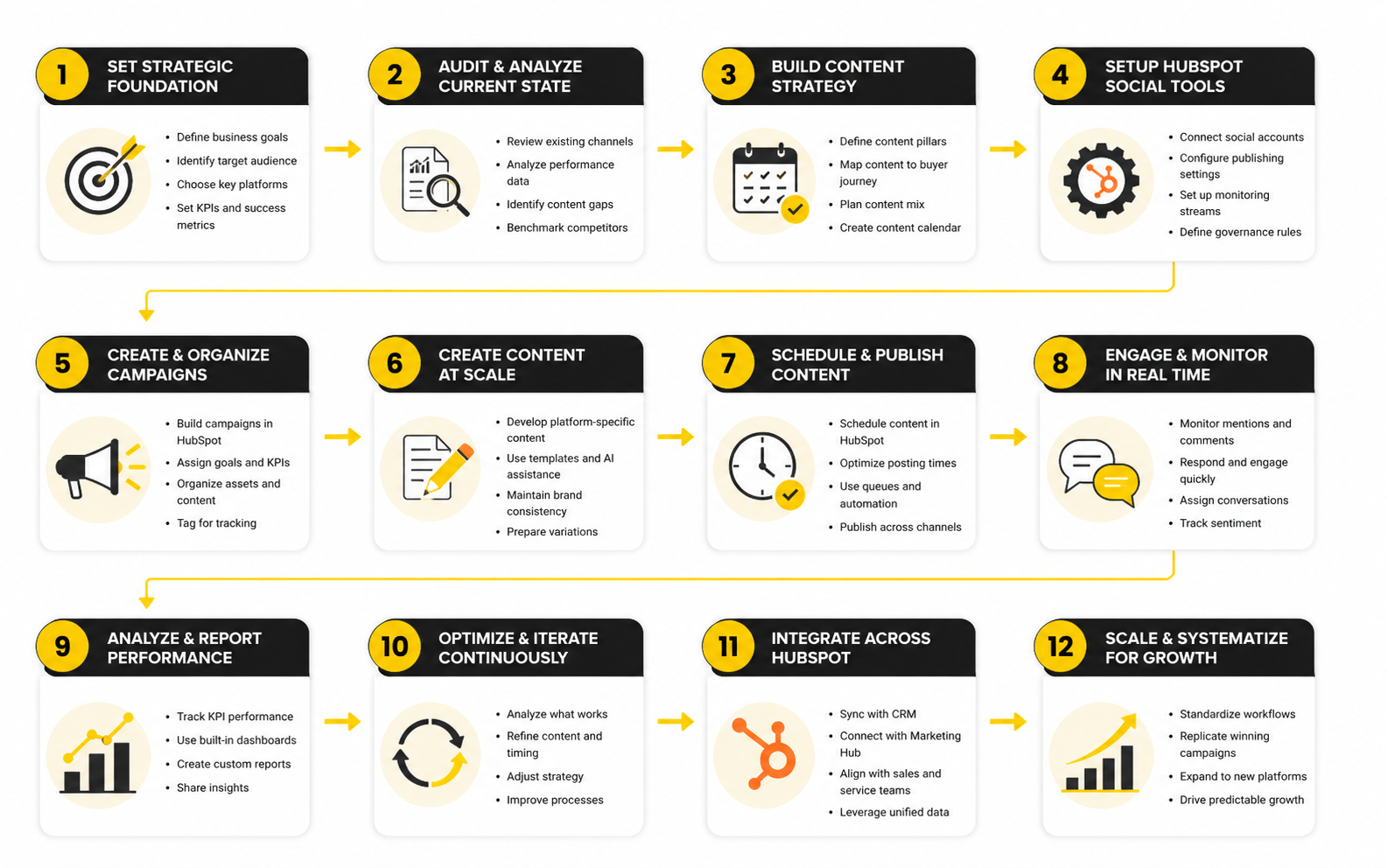
A simple workflow can look like this:
This workflow keeps the team focused on intent. It prevents the classic problem where everyone is busy creating content, but nobody can clearly explain why a specific post exists. That one change alone can make the strategy sharper.
Adapt Posts for Each Network
HubSpot lets teams draft social posts across multiple selected accounts and then customize the content for each network before scheduling. That matters because copying the same caption everywhere is usually lazy execution. The idea can stay consistent, but the format, hook, length, visual, and call to action should match the platform.
LinkedIn posts often need a stronger business angle and a clearer point of view. Instagram may need a tighter visual concept, a more natural caption, and a stronger first line. TikTok and YouTube Shorts need sharper pacing and a reason to keep watching. X needs compression, clarity, and speed.
This is also where many teams misuse automation. Automation should remove repetitive work, not remove judgment. If a post needs a different structure to make sense on another platform, take the extra minute and adapt it.
Use a Publishing Calendar Without Letting It Control the Strategy
A publishing calendar is useful because it creates visibility. The team can see what is going out, where there are gaps, and whether the content mix is balanced. HubSpot’s custom social publishing schedule is designed to help teams schedule posts around expected engagement windows, which is useful when consistency starts becoming difficult.
But the calendar should not become the strategy. If the team’s main goal is simply to fill Tuesday, Wednesday, and Thursday, quality will drop. The calendar is a tool for execution, not a substitute for clear thinking.
A better approach is to plan in weekly or monthly batches while keeping enough flexibility to respond to timely topics. That gives the team structure without making the brand sound robotic. Social media moves quickly, so the process needs discipline and room to breathe.
Connect Social Posts to Landing Pages and Follow-Up
Publishing is not the end of the process. If a social post sends people to a landing page, that page needs to match the promise in the post. If the post promotes a webinar, guide, checklist, demo, trial, or product page, the next step should feel obvious.
This is where HubSpot’s broader marketing tools become important. Social can create the first click, but landing pages, forms, lists, emails, workflows, and CRM records carry the journey forward. If that path is broken, the social post may still look successful in engagement reports while failing commercially.
For teams building a more complete funnel outside HubSpot, a dedicated funnel builder like ClickFunnels can make sense when the priority is fast landing page and offer testing. The important part is not the tool itself. The important part is that every social campaign has a clear destination, a clear conversion point, and a clear follow-up path.
Document the Approval Process
Approval should protect the brand without slowing everything to a crawl. A simple approval process usually works better than a complicated one. Define who reviews messaging, who checks product accuracy, who approves legal or compliance-sensitive content, and who gives final publishing approval.
This becomes more important as more people contribute to social content. Founders, sales teams, customer success teams, product marketers, and executives can all provide useful ideas, but their input needs structure. Otherwise, social managers become traffic controllers instead of strategic operators.
Create a short checklist that every post must pass before publishing. The checklist should cover audience fit, campaign fit, factual accuracy, brand voice, visual quality, link accuracy, and call-to-action clarity. It is not glamorous, but it prevents expensive mistakes.
Build a Weekly Operating Rhythm
The best HubSpot social media strategy is not built once. It is run every week. A weekly rhythm keeps the team aligned and stops the strategy from becoming a document nobody opens.
Use one short planning session to review upcoming campaigns, content priorities, and platform needs. Use one production window to draft, adapt, and schedule posts. Use one review session to look at what worked, what underperformed, and what should change.
This rhythm is simple, but it creates momentum. The team knows when ideas are reviewed, when content is produced, when posts are approved, and when results are discussed. That is how social media becomes a professional marketing system instead of a permanent scramble.
Measuring Performance and Improving the Strategy
A HubSpot social media strategy only works if the measurement system is clear enough to change decisions. The goal is not to collect every possible metric. The goal is to understand which posts, campaigns, platforms, and audience signals are helping the business move forward.
This is where many teams get stuck. They report likes, impressions, and follower growth because those numbers are easy to find, but they do not always explain whether social is creating meaningful demand. HubSpot is useful because social performance can be reviewed alongside campaign data, traffic, contacts, and downstream conversion activity through HubSpot’s social reporting tools.
Statistics and Data
Social media is still growing as a business channel, but the reason is not just reach. HubSpot’s 2025 social trends research highlights AI-powered content creation, social commerce, video-first engagement, and changing brand-audience relationships through the 2025 Social Media Trends Report. Those shifts matter because social is now part discovery channel, part trust channel, part support channel, and part conversion path.
The 2025 Sprout Social Index was built from surveys of more than 4,000 consumers and 1,200 marketers, which makes one thing very clear: social is now central to how people evaluate and interact with brands through the 2025 Sprout Social Index. That does not mean every brand should chase every trend. It means social data should be interpreted as customer behavior data, not just content performance data.
HubSpot’s own 2025 report also points to a practical reality: marketers are using AI to create faster, but audiences still respond to authenticity, relevance, and useful content. That is why measurement cannot only ask, “Did this post perform?” It also needs to ask, “Did this post attract the right people, support the right campaign, and create a useful next step?”
Separate Activity Metrics From Business Metrics
Activity metrics tell you what happened on the platform. These include impressions, reach, likes, comments, shares, saves, clicks, video views, watch time, and follower growth. They are not useless, but they are incomplete.
Business metrics tell you whether social is supporting a commercial outcome. These include website sessions, new contacts, form submissions, demo requests, webinar registrations, lifecycle-stage movement, influenced pipeline, customer acquisition, and retention-related engagement. These are harder to track, but they are much more useful for decision-making.
A strong HubSpot social media strategy uses both layers. Activity metrics help you improve creative and distribution. Business metrics help you decide whether the strategy deserves more budget, more team capacity, or a different direction.
Build a Measurement System Inside HubSpot
The simplest measurement system has three levels. First, review post-level performance to understand which hooks, formats, topics, and platforms are creating engagement. Second, review campaign-level performance to see whether social is supporting a specific initiative. Third, review CRM and conversion data to understand whether social activity is connected to contacts, leads, opportunities, or customers.
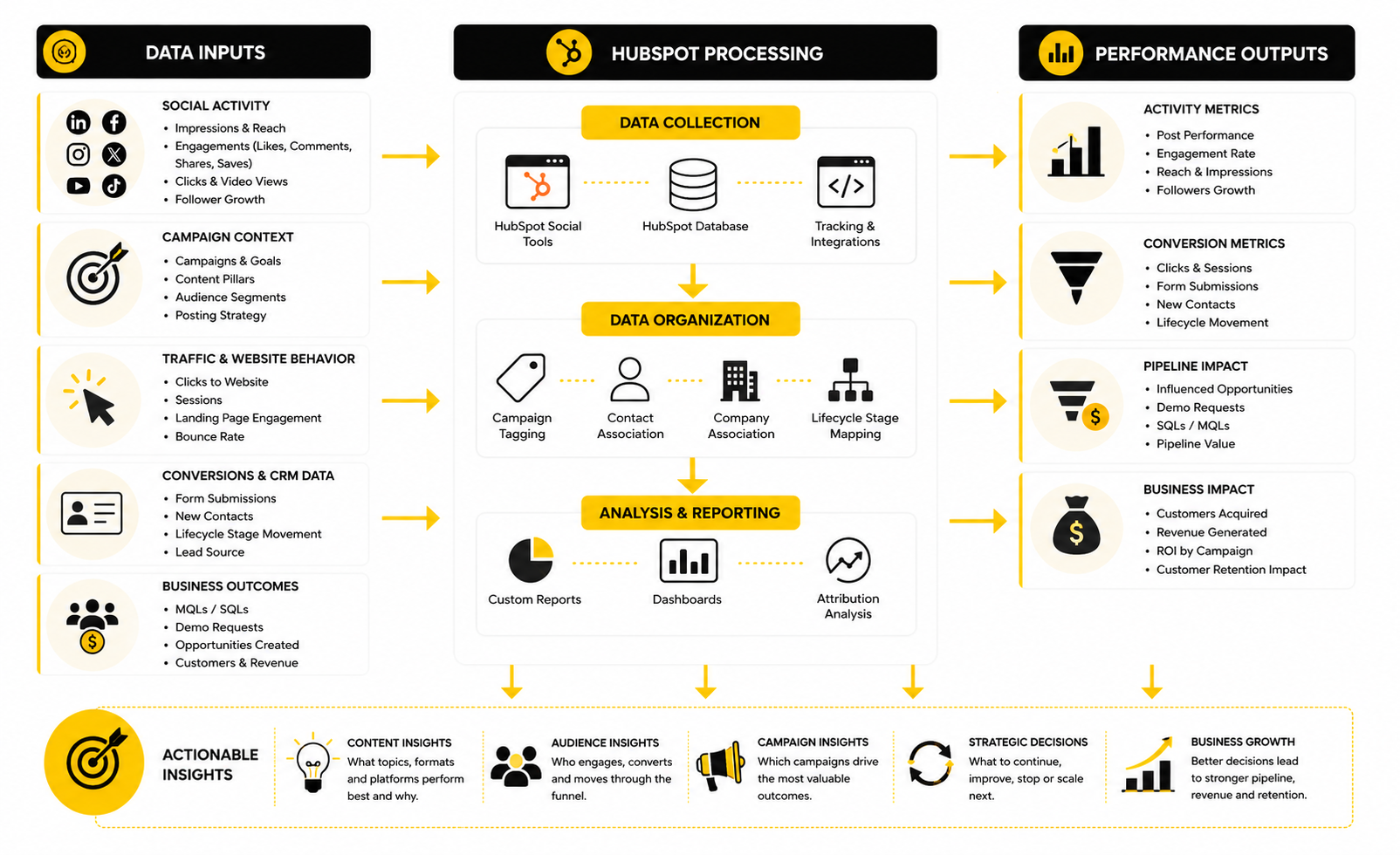
This structure prevents bad analysis. A post can perform well on engagement and still fail to drive the intended action. A post can have modest engagement and still bring in a valuable lead. Without the three-level view, teams often overvalue viral posts and undervalue posts that quietly support buying decisions.
HubSpot’s custom report builder can be used to analyze social posts, activities, and channels with more specific reporting configurations through social post reporting in the custom report builder. That matters when the default view is not enough. Serious teams eventually need reports that match their own funnel, not just the platform’s default metrics.
Track the Right Metrics for Each Goal
The right metric depends on the job the content was supposed to do. Awareness content should not be judged the same way as lead generation content. Community content should not be judged the same way as a launch campaign.
For awareness, look at reach, impressions, profile visits, follower growth quality, video retention, and share rate. For engagement, look at comments, saves, meaningful replies, shares, and repeat interaction from relevant accounts. For traffic, look at clicks, sessions, landing page engagement, and bounce behavior.
For conversion, focus on contacts created, form submissions, meeting bookings, offer downloads, trial starts, demo requests, and lifecycle movement. If your social campaign drives people into email nurture, the measurement should continue after the click. Tools like Brevo can support email follow-up, but the bigger principle is simple: social should not be measured as if the journey ends at the post.
Use Benchmarks Carefully
Benchmarks are useful for orientation, not judgment. They can help you see whether a channel is wildly underperforming or whether a format deserves more testing. But benchmarks can also mislead you because audience size, industry, brand maturity, posting frequency, content quality, paid support, and platform mix all change the numbers.
This is why internal benchmarks are often more useful than generic averages. Compare LinkedIn thought leadership posts against your previous LinkedIn thought leadership posts. Compare campaign posts against campaign posts. Compare video retention across similar video formats, not against a random industry average from a different audience.
External benchmarks still have value when they reveal broad behavior shifts. Hootsuite’s 2025 trends report focuses heavily on agility, creative experimentation, AI, and the pressure to prove business impact through the 2025 Social Media Trends Report. Use that kind of data to understand the market, then use your own HubSpot data to make decisions.
Read Performance Signals Like a Marketer, Not a Spreadsheet
Numbers need interpretation. A high-impression post with weak engagement may mean the hook attracted attention but the content did not deliver enough value. A low-reach post with strong comments from ideal customers may be more valuable than it looks. A post with average engagement but strong click-to-contact conversion may deserve more promotion.
This is why the review process should include both quantitative and qualitative analysis. Read the comments. Look at who engaged. Check whether the right accounts are clicking. Review which objections, questions, or phrases appear repeatedly.
The best social teams treat performance data as audience research. If one topic consistently gets saves, it may deserve a guide, webinar, or email sequence. If one objection keeps appearing in comments, it may deserve sales enablement content. If one platform drives low engagement but strong demo requests, it may need better creative, not abandonment.
Measure Content Quality With Pattern Recognition
One post rarely proves anything. Patterns prove things. If three posts on the same topic outperform the average, that topic probably deserves more attention. If short founder commentary repeatedly beats polished brand graphics, the audience is telling you something.
This is especially important with video. A video with high views but poor retention may have a strong opening and weak substance. A video with lower reach but strong completion may be a better candidate for repurposing, paid support, or follow-up content. The metric only becomes useful when it leads to a specific action.
A practical review should look for patterns across topic, hook, format, platform, audience, CTA, posting time, and campaign context. Do not just ask what won. Ask why it won, whether the result is repeatable, and what the next test should be.
Connect Social Reporting to Revenue Conversations
Social media does not always create revenue directly, and pretending it does can make reporting less credible. Sometimes social creates the first touch. Sometimes it warms the audience before search. Sometimes it supports sales conversations. Sometimes it helps customers understand the product after they buy.
HubSpot can help show those connections when campaigns, tracking, CRM records, and reports are set up properly. The value is not just attribution. The value is context.
When marketing leaders review social performance, the discussion should move beyond “Which post got the most likes?” A better discussion is: which audience is responding, which message is gaining traction, which campaigns are creating contacts, which social assets sales can use, and which content themes deserve more investment. That is how measurement turns into strategy instead of reporting theater.
Advanced Strategy Considerations
Once the basics are working, the next challenge is control. A HubSpot social media strategy becomes harder to manage as more campaigns, contributors, tools, markets, and audiences get involved. What worked for one person posting three times a week can break quickly when the team starts publishing across multiple channels with different goals.
This is where strategy becomes less about content volume and more about decision quality. You need to know what to standardize, what to customize, what to automate, and what should always stay human. That balance is what separates a professional social system from a busy one.
Decide What Should Be Centralized
Centralization is useful when consistency matters. Brand positioning, campaign naming, reporting definitions, compliance rules, approval standards, and core messaging should not change from person to person. If every team invents its own version, the strategy becomes harder to measure and the brand becomes harder to recognize.
HubSpot should usually be the central place for campaign structure, asset organization, performance reporting, and CRM connection. That does not mean every creative decision needs to happen inside HubSpot. It means HubSpot should hold the logic of the strategy so the team can understand what was published, why it existed, and how it performed.
The mistake is trying to centralize creativity too much. Local teams, subject-matter experts, founders, salespeople, and customer-facing staff often understand the audience in ways a central marketing team cannot fully replicate. Keep the system centralized, but leave room for real voices.
Decide What Should Be Customized
Customization matters because every audience does not need the same message. A founder evaluating HubSpot may care about pipeline visibility. A social media manager may care about faster publishing and reporting. A sales leader may care about context on leads and accounts.
That means the same campaign can require different angles. One post can explain the business case. Another can show the workflow. Another can handle objections. Another can give sales or customer success a useful asset to share directly.
The same idea applies by platform. LinkedIn may need more industry context, Instagram may need stronger visual storytelling, and short-form video may need sharper hooks. A HubSpot social media strategy should protect the core message while allowing the delivery to change.
Use AI Without Making the Brand Sound Disposable
AI can help with social media, but it should not become the voice of the brand. It can help brainstorm angles, summarize research, repurpose long-form content, draft variations, identify patterns, and speed up production. Used well, it reduces blank-page time and gives the team more room to think.
The risk is sameness. If every post sounds polished, vague, and emotionally neutral, the audience can feel it immediately. Social content needs judgment, lived experience, tension, specificity, and a point of view.
A practical rule is simple: use AI for structure and acceleration, not for final taste. The final post should still sound like someone at the company knows the customer, understands the market, and has something real to say. Tools such as GoHighLevel AI can support automation and content workflows, but the strategy still needs a human editor with standards.
Protect Trust as the Strategy Scales
Trust is easy to lose when social publishing becomes too automated. Scheduled posts can go out during sensitive moments. AI-generated content can make claims that are too broad. Trend-chasing can make a serious brand look unserious.
This is why governance matters. The team should know which topics require review, which claims need proof, which customer stories need permission, and which content types are too risky for fast publishing. These rules do not need to be heavy, but they do need to exist.
A strong HubSpot social media strategy also needs a pause process. If a campaign becomes irrelevant, a platform controversy affects the brand, or a scheduled post suddenly feels wrong because of external events, someone needs the authority to stop it. Speed is useful, but judgment is more important.
Plan for Sales and Customer Success Use
Social content should not only live on public profiles. Some of the best posts can be repurposed into sales messages, follow-up emails, onboarding notes, objection-handling assets, and customer education. This is where social becomes more valuable than the original post metrics suggest.
For example, a post that explains a common buying mistake can become a sales enablement snippet. A short product workflow can become part of onboarding. A strong customer insight can become an email topic or webinar angle.
HubSpot makes this easier because marketing activity, contacts, companies, and sales context can sit close together. The team should regularly ask which social assets helped explain the product, reduce friction, or support conversations after the first click. That mindset turns social from a broadcast channel into a reusable knowledge engine.
Know When to Add Specialist Tools
HubSpot can cover a lot, but no tool should be expected to do everything perfectly for every team. As the strategy matures, you may need specialist tools for scheduling depth, creator collaboration, social listening, landing page testing, chat automation, or analytics. The point is not to collect tools. The point is to remove bottlenecks that are slowing down the strategy.
For example, a lean team may use Buffer for lightweight scheduling alongside HubSpot’s CRM and campaign reporting. A team that relies heavily on Instagram or Messenger conversations may use ManyChat to turn social engagement into automated follow-up flows. A conversion-focused team may use Systeme.io when they need simple funnels, email sequences, and offer pages without overcomplicating the stack.
The tradeoff is complexity. Every added tool creates another place where data, ownership, and process can drift. Before adding anything, define what problem the tool solves, who owns it, and how it connects back to HubSpot reporting.
Avoid Scaling Content Before Scaling Insight
More content is not always the answer. If the team cannot explain which topics work, which audience segments respond, which campaigns create qualified action, and which formats deserve more investment, publishing more will only create more noise. Volume should come after insight, not before it.
The better path is controlled scaling. Increase output around proven themes. Repurpose strong ideas into different formats. Turn high-performing posts into email topics, webinar sections, landing page copy, or sales assets. Stop expanding weak content just because the calendar has empty slots.
This matters because social teams often feel pressure to look busy. Busy is not the goal. A professional HubSpot social media strategy should make the team more focused, not just more active.
Manage the Tradeoff Between Brand and Performance
Brand content and performance content need each other. Brand content builds memory, trust, preference, and familiarity. Performance content creates direct action, captures demand, and gives the team measurable conversion points.
If the strategy becomes only brand content, leadership may struggle to see business impact. If it becomes only performance content, the audience may feel like every post is asking for something. The balance depends on the business model, sales cycle, audience maturity, and campaign goals.
A practical split is to keep a strong always-on layer for trust and recognition, then run focused performance campaigns around specific offers. That keeps the brand present without turning every post into a pitch. It also gives HubSpot clearer campaign data because direct-response activity is separated from broader market-building work.
Build a Review System for Strategic Decisions
Weekly reviews are useful for execution, but strategic reviews need a different rhythm. Every month or quarter, the team should step back and ask bigger questions. Are the right audiences responding? Are the strongest content pillars still aligned with business priorities? Are social campaigns helping the broader funnel?
This review should not be a dashboard walkthrough. It should be a decision meeting. The output should include what to continue, what to stop, what to test, what to repurpose, and what needs better tracking.
Keep the review focused. Too much data creates fog. The best strategic reviews turn performance into action, and action into a sharper next cycle.
Common Mistakes, Best Practices, and Final Guidance
The final step is making the strategy durable. A HubSpot social media strategy should survive new campaigns, new team members, new platform trends, and new business priorities without falling apart. That only happens when the team understands the common mistakes and builds the right operating habits around them.
The biggest mistake is confusing consistency with volume. Posting more often can help if the message is clear, the audience is right, and the content supports a real business goal. But publishing more weak content usually creates more work, not more growth.
Another common mistake is treating HubSpot as only a publishing tool. HubSpot is more useful when social posts are connected to campaigns, landing pages, forms, lifecycle stages, and reporting. If the team only uses it to schedule posts, they miss the larger advantage of building a connected marketing system.
Keep the Strategy Focused
A focused strategy is easier to execute and easier to measure. Instead of trying to win every platform at once, choose the channels that match the audience and the business goal. Then build enough repetition around the right topics so people start to recognize the brand’s point of view.
The same discipline applies to content pillars. If every week brings a new random theme, the audience never learns what the brand stands for. A strong strategy repeats the important ideas in fresh ways instead of constantly chasing novelty.
Focus also protects the team from trend fatigue. New formats, platform updates, and AI tools will keep arriving. The question is not whether something is trendy; the question is whether it helps the right audience take the next right step.
Build the Final Social Media Ecosystem
At this stage, the strategy should look like an ecosystem, not a checklist. Audience insight informs content. Content supports campaigns. Campaigns connect to conversion paths. Reporting improves the next decision.
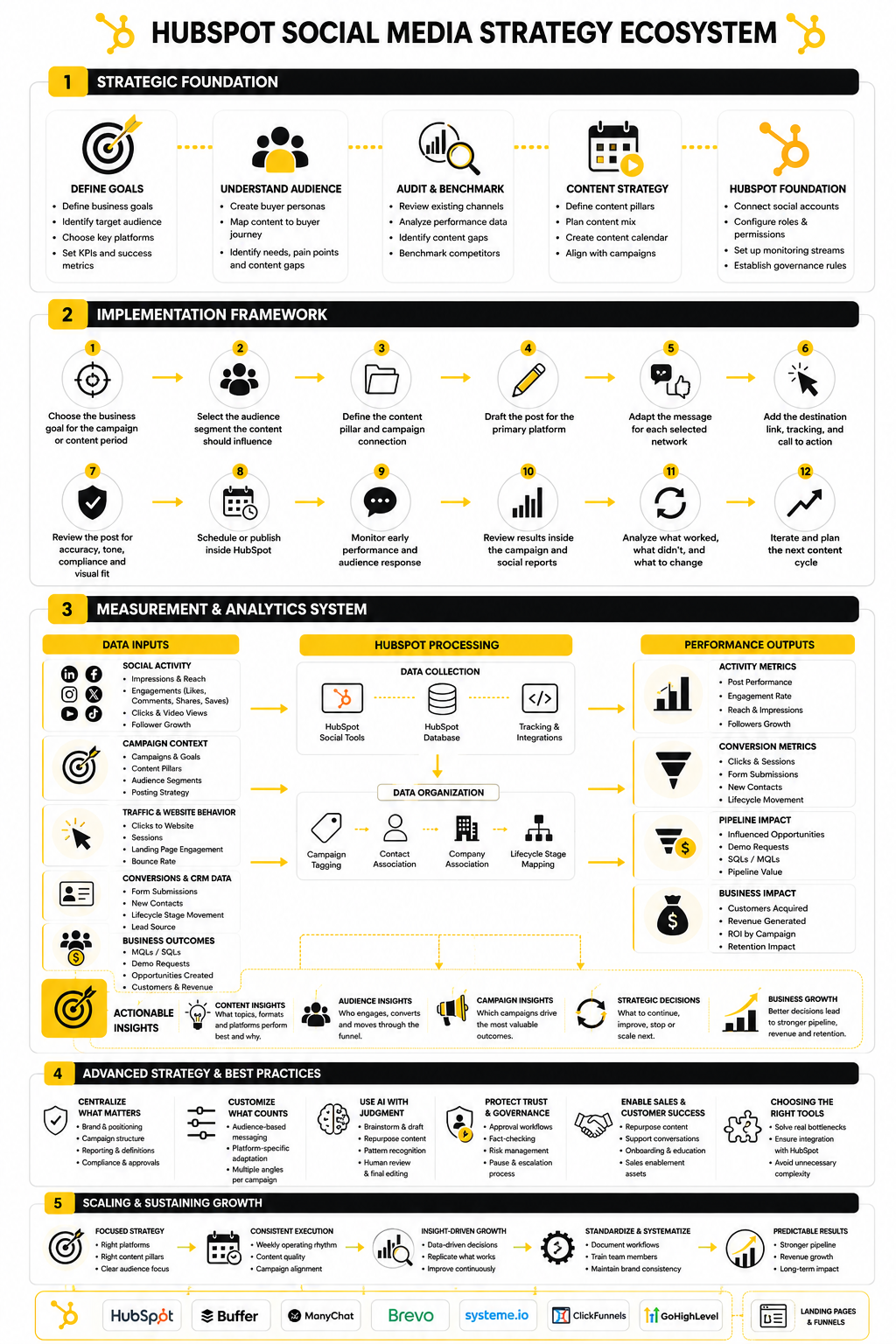
This is the real value of using HubSpot for social media strategy. The platform gives the team a way to connect content activity with broader marketing and CRM context. That connection is what helps social become more than a brand awareness channel.
The finished system should make decisions easier. The team should know what to publish, why it matters, how it connects to a campaign, what metric proves progress, and what action to take from the result. When those pieces are clear, social media becomes calmer, sharper, and much easier to scale.
A good FAQ should answer the practical questions that come up once a team starts using the strategy. These are not abstract questions about social media theory. They are the questions marketers, founders, and operators ask when they need HubSpot to support real execution.
Use these answers as decision support, not rigid rules. The right answer still depends on your audience, offer, sales cycle, team size, and current HubSpot setup. But the principles below will help you avoid the most common mistakes.
A HubSpot social media strategy is a plan for using social content, campaigns, publishing, reporting, and CRM data together. It defines who you are trying to reach, what content you will publish, how posts connect to business goals, and how performance will be measured. The point is not just to post from HubSpot; the point is to use HubSpot to connect social media with the rest of your marketing system.
HubSpot is useful for teams that want social publishing connected to campaigns, contacts, website activity, and reporting. Its social tools support connected account management, publishing, monitoring, and performance analysis through HubSpot social reports. It is especially strong when social media needs to support lead generation, campaign tracking, and CRM visibility.
It can replace a dedicated tool for many teams, especially when the priority is connected marketing execution rather than deep social-only workflows. Some teams may still use specialist tools for advanced scheduling, collaboration, social listening, or platform-specific features. If you use a tool like Buffer, keep HubSpot as the source of truth for campaign tracking and CRM-connected reporting.
There is no universal posting frequency that works for every business. A better rule is to publish as often as you can maintain relevance, quality, and consistency. Start with a manageable schedule, review performance by platform and content pillar, then increase volume only when the data shows that the content is helping the right audience.
Choose platforms based on audience behavior and business goals. LinkedIn is often strong for B2B thought leadership, professional services, SaaS, and demand generation. Instagram, TikTok, YouTube, Facebook, and X can all make sense, but each one needs a clear role instead of being added just because competitors are there.
The most useful metrics depend on the goal of the content. Awareness content should be measured by reach, impressions, audience growth quality, video retention, and profile activity. Conversion-focused content should be reviewed through clicks, sessions, form submissions, contacts created, demo requests, lifecycle movement, and campaign contribution.
Start by connecting social posts to campaigns and using clear destination links. Then make sure landing pages, forms, lists, workflows, and CRM properties are set up properly so the post does not exist in isolation. HubSpot’s campaign and reporting tools help teams review how social activity contributes to broader campaign performance through campaign analysis features.
AI can help with brainstorming, repurposing, summarizing research, drafting variations, and speeding up production. It should not replace judgment, customer insight, or final editing. The best results usually come when AI helps the team move faster while a human keeps the voice specific, credible, and useful.
Use real customer questions, sales objections, product context, founder opinions, and specific market observations. Generic content usually happens when the team writes for “everyone” instead of a clear audience with a clear problem. A strong HubSpot social media strategy should make the content more specific because it is informed by CRM data, campaign goals, and actual customer behavior.
Start with one or two priority platforms, three to five content pillars, and one simple weekly operating rhythm. Connect the social posts to campaigns only when there is a clear campaign reason, and keep the reporting simple at first. Once the team can publish consistently and learn from the data, add more complexity only where it solves a real bottleneck.
The biggest risk is scaling activity faster than insight. More posts, more channels, more campaigns, and more contributors can create noise if the strategy is not clear. Before scaling, make sure the team understands which audiences, messages, formats, and conversion paths are actually working.
The strategy is working when the team can make better decisions from the data. That means social content is reaching the right audience, supporting campaigns, creating useful engagement, driving qualified traffic, and contributing to measurable next steps. It also means the team knows what to repeat, what to improve, and what to stop.
Build a stronger local presence with BAAM AI
Turn your website, Google profile, social channels, and AI visibility into one growth engine
Most businesses do not need more random marketing activity. They need a consistent presence system that helps the right people find them, trust them, and take action. BAAM AI brings strategy, local SEO, website updates, Google Maps visibility, social content, AI-search readiness, media production, and reporting into one practical monthly engine.
If you want your marketing to keep working after the campaign ends, start with a free BAAM AI presence audit. See how your business shows up today and where the fastest visibility wins are at BAAM AI.