
BAAM AI Blog
HubSpot Copywriting: A Practical Framework For Turning CRM Data Into Better Marketing Messages
HubSpot copywriting is not just “writing emails in HubSpot.” It is the discipline of turning CRM data, buyer context, lifecycle stages, offers, and automation logic into messages that feel timely, useful, and human.
Affiliate disclosure: this article may include compensated links. Recommendations should still be evaluated against your use case, budget, and current provider terms.
Should you choose HubSpot?
HubSpot is worth considering when the use case, budget, and implementation effort match what you actually need to do next.
teams that want a practical tool decision without reading another generic feature list
Check HubSpotHubSpot copywriting is not just “writing emails in HubSpot.” It is the discipline of turning CRM data, buyer context, lifecycle stages, offers, and automation logic into messages that feel timely, useful, and human.
That matters because the old way of writing generic campaigns is getting weaker. Buyers now compare more options, consume more content before talking to sales, and expect brands to understand where they are in the journey. HubSpot’s own positioning around its customer platform is built around uniting marketing, sales, service, and CRM data so teams can create more connected customer experiences through one system, not scattered tools.
Good HubSpot copywriting sits between strategy and execution. It shapes landing pages, emails, workflows, lead magnets, sales enablement, ads, chat flows, forms, CTAs, nurture sequences, and lifecycle campaigns. The writing has to sell, but it also has to respect the logic of the platform: segmentation, personalization tokens, triggers, lead scoring, lists, properties, and reporting.
The big mistake is treating HubSpot like a place to paste finished copy. That is backwards. The best copy is designed around how HubSpot actually works: who the person is, what they did, what they need next, and what action moves them forward without making the experience feel robotic.
Why HubSpot Copywriting Matters
HubSpot copywriting matters because your message is only as strong as the customer context behind it. A welcome email, demo follow-up, abandoned form reminder, and re-engagement sequence should not sound like the same campaign with different subject lines. Each one has a different job, a different reader mindset, and a different level of intent.
This is where HubSpot becomes powerful. Its CRM, marketing automation, content tools, and reporting can help teams connect behavior with messaging, but the platform does not automatically make the copy persuasive. You still need positioning, offer clarity, emotional relevance, conversion logic, and a strong reason for the reader to act now.
The pressure is also rising because content volume has exploded. HubSpot’s 2026 marketing data says over 92% of marketers plan on or already use SEO optimization for traditional and AI-powered search engines, while nearly 30% report decreased search traffic as buyers shift toward AI tools. That means copy cannot rely only on ranking, traffic, or automation volume. It has to be sharper when the right person finally lands in your funnel.
The HubSpot Copywriting Framework
The simplest way to think about HubSpot copywriting is this: write for the customer journey, then map the message to the HubSpot object that delivers it. A lifecycle-stage email is not the same as a sales page. A lead magnet landing page is not the same as a bottom-of-funnel demo page. A workflow email triggered by behavior should not read like a newsletter blast.
The framework starts with the reader, not the tool. You define the segment, the intent level, the problem, the desired outcome, the objection, and the next best action. Only after that should you decide whether the message belongs in an email, landing page, form, CTA, chatbot, sales sequence, or workflow.
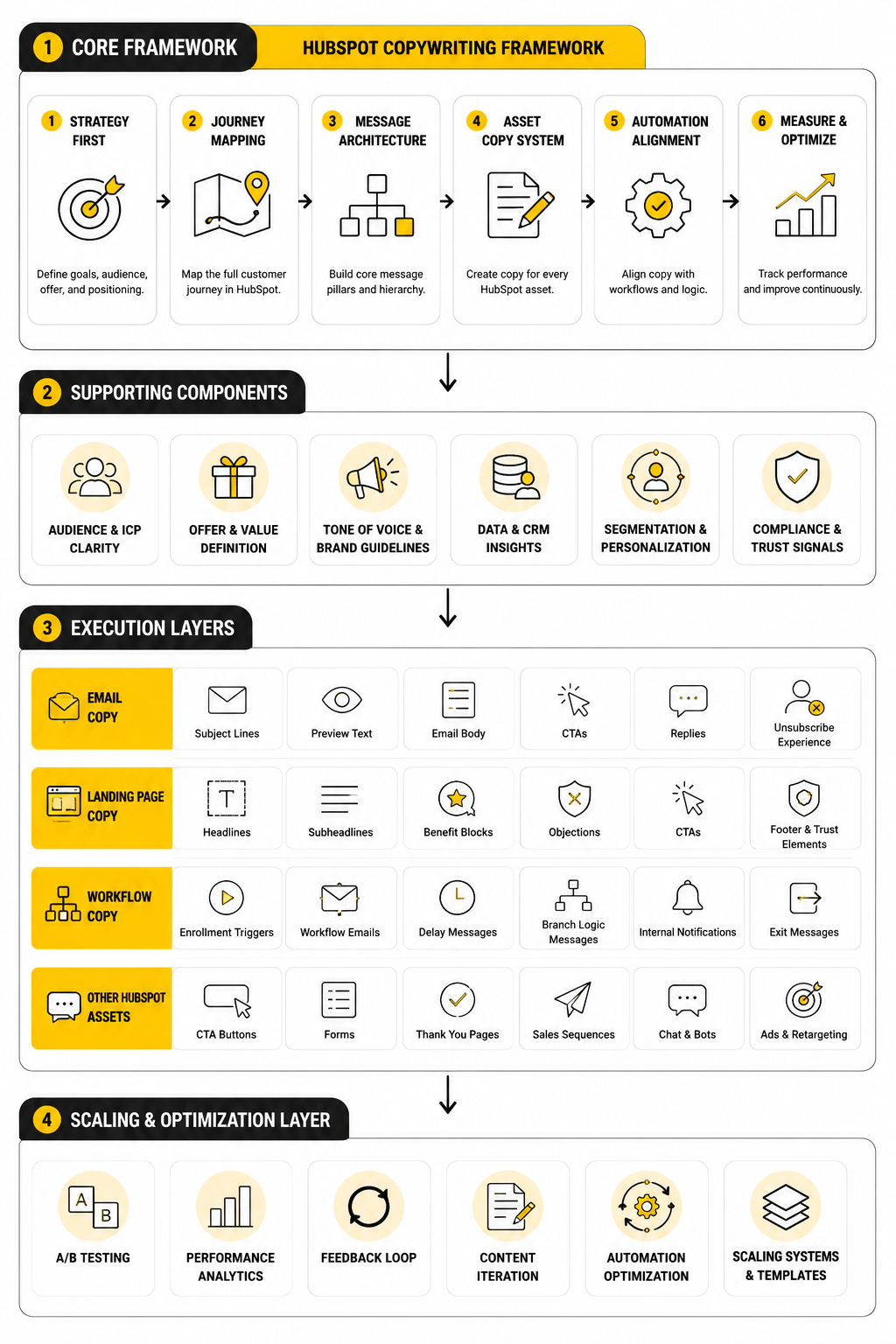
The framework works best when every piece of copy answers four practical questions. First, what does this person already know? Second, what do they need to believe before they act? Third, what friction could stop them? Fourth, what should happen next inside HubSpot once they click, reply, submit, book, or ignore the message?
Core Components Of High-Converting HubSpot Copy
High-converting HubSpot copy is built from clear positioning, relevant segmentation, specific offers, strong CTAs, and useful follow-up logic. None of these elements can carry the campaign alone. A great subject line cannot save a vague offer, and a smart workflow cannot fix copy that does not match the buyer’s actual problem.
Segmentation is especially important because HubSpot gives you many ways to separate contacts by behavior, source, lifecycle stage, list membership, form submissions, page views, deal stage, and custom properties. But segmentation only helps when the copy changes meaningfully. Swapping a first name token into the same generic message is not personalization; it is decoration.
The strongest campaigns usually combine practical relevance with emotional clarity. The reader should quickly understand why this message is for them, why it arrived now, what problem it helps them solve, and what they gain by taking the next step. That is the difference between using HubSpot as a sending tool and using HubSpot as a revenue system.
Writing For HubSpot Emails, Landing Pages, And Workflows
Once the strategy is clear, HubSpot copywriting becomes much more practical. You are no longer asking, “What should this campaign say?” You are asking, “What does this person need to read at this exact moment so the next step feels obvious?” That shift changes the quality of the copy immediately.
HubSpot gives you several places to deliver that message, but each one has a different job. Emails move people through a sequence. Landing pages concentrate attention around one offer. Workflows connect behavior with timing, so the copy arrives when it has the best chance of feeling relevant.
The mistake is writing every asset in the same voice, with the same urgency, and the same CTA. A person downloading a checklist does not need the same level of pressure as someone visiting a pricing page three times in one week. Strong HubSpot copy respects intent instead of forcing everyone into the same sales conversation.
Email Copy That Feels Timely Instead Of Automated
HubSpot email copy should feel like a useful follow-up, not a scheduled interruption. That means the opening line has to connect to the reason the person is receiving the email. If they downloaded a resource, attended a webinar, abandoned a form, joined a list, or booked a call, the copy should acknowledge that context without sounding creepy.
Subject lines matter, but the body does the real work. The email needs one clear idea, one primary action, and a natural reason to click. When teams try to squeeze three offers, five links, and a full product pitch into one nurture email, they make the reader do too much work.
Personalization also needs restraint. Research on customer expectations shows that buyers increasingly value individualized experiences, but they are also more protective of their data. That is why HubSpot copywriting should use behavioral context to be helpful, not to show off how much information the company has collected.
Landing Page Copy Built Around One Decision
A HubSpot landing page has one job: help the right person make one decision. That decision might be downloading a guide, registering for a webinar, booking a demo, joining a waitlist, or requesting a quote. The more decisions you add, the weaker the page usually becomes.
The headline should make the offer instantly clear. The subheading should explain why it matters now. The body copy should reduce friction by showing who the offer is for, what the person gets, why it is useful, and what happens after they submit the form.
This is where many teams overcomplicate things. They write landing pages like brochures, not conversion assets. A strong HubSpot landing page does not need to explain the entire company; it needs to make the current offer feel relevant, credible, and easy to act on.
Workflow Copy That Matches Behavior
Workflow copy is where HubSpot copywriting becomes more than surface-level writing. The copy has to match the trigger, the delay, the branch, and the lifecycle stage. A workflow that sends the right email at the wrong time still creates friction.
The best workflow copy starts with a behavioral signal. Someone visited a key page, submitted a form, clicked a CTA, opened a sales email, changed deal stage, or became inactive. Each of those actions tells you something, but not everything, so the copy should respond with useful context rather than making wild assumptions.
This is important because automated messaging can either create trust or destroy it. If someone has only read one beginner-level blog post, a hard demo push may feel premature. If someone has compared pricing, read case studies, and returned to the demo page, a soft educational nurture may be too weak.
Sales Sequence Copy That Supports The Rep
HubSpot sales sequences need a different writing style from marketing workflows. They should sound more direct, more personal, and more specific because they usually come from an individual rep. The reader knows it is a sales conversation, so pretending otherwise makes the message weaker.
Good sequence copy gives the rep a reason to reach out. That reason could be a previous form submission, a company-level fit, a relevant pain point, a known trigger, or a clear next step after a meeting. The copy should help the rep sound prepared, not generic.
The strongest sequences are usually short, focused, and easy to reply to. One sharp question often beats a long explanation. If the goal is to start a conversation, the copy should not read like a full landing page squeezed into an email.
Chat, Forms, And CTAs Need Copy Too
HubSpot copywriting also includes the small pieces most teams rush through. Form labels, thank-you messages, CTA buttons, chat prompts, confirmation emails, and meeting-booking copy all affect how the experience feels. These microcopy moments can either reduce anxiety or add confusion.
A form should make the exchange feel fair. If you ask for too much information too early, the copy around the form needs to justify why those fields matter. If you only need an email address, do not create friction with unnecessary fields just because the CRM has empty properties.
CTAs should be specific enough to set expectations. “Submit” is technically accurate, but it rarely adds confidence. “Get the checklist,” “Book the demo,” or “Send me the guide” tells the person what happens next, which is exactly what conversion-focused copy should do.
Professional Implementation In Real Campaigns
Professional HubSpot copywriting starts before the first headline is written. The real work is deciding what the campaign should accomplish, who it should move, and what HubSpot needs to track so the team can see whether the message is working. If those decisions are vague, the copy will become vague too.
This is why implementation has to combine copy, CRM structure, campaign logic, and reporting. A writer can create strong messaging, but if the lifecycle stages are messy, the lists are poorly defined, or the workflow branches do not match the buyer journey, the campaign will still feel random. In HubSpot, copy is never isolated from the system delivering it.
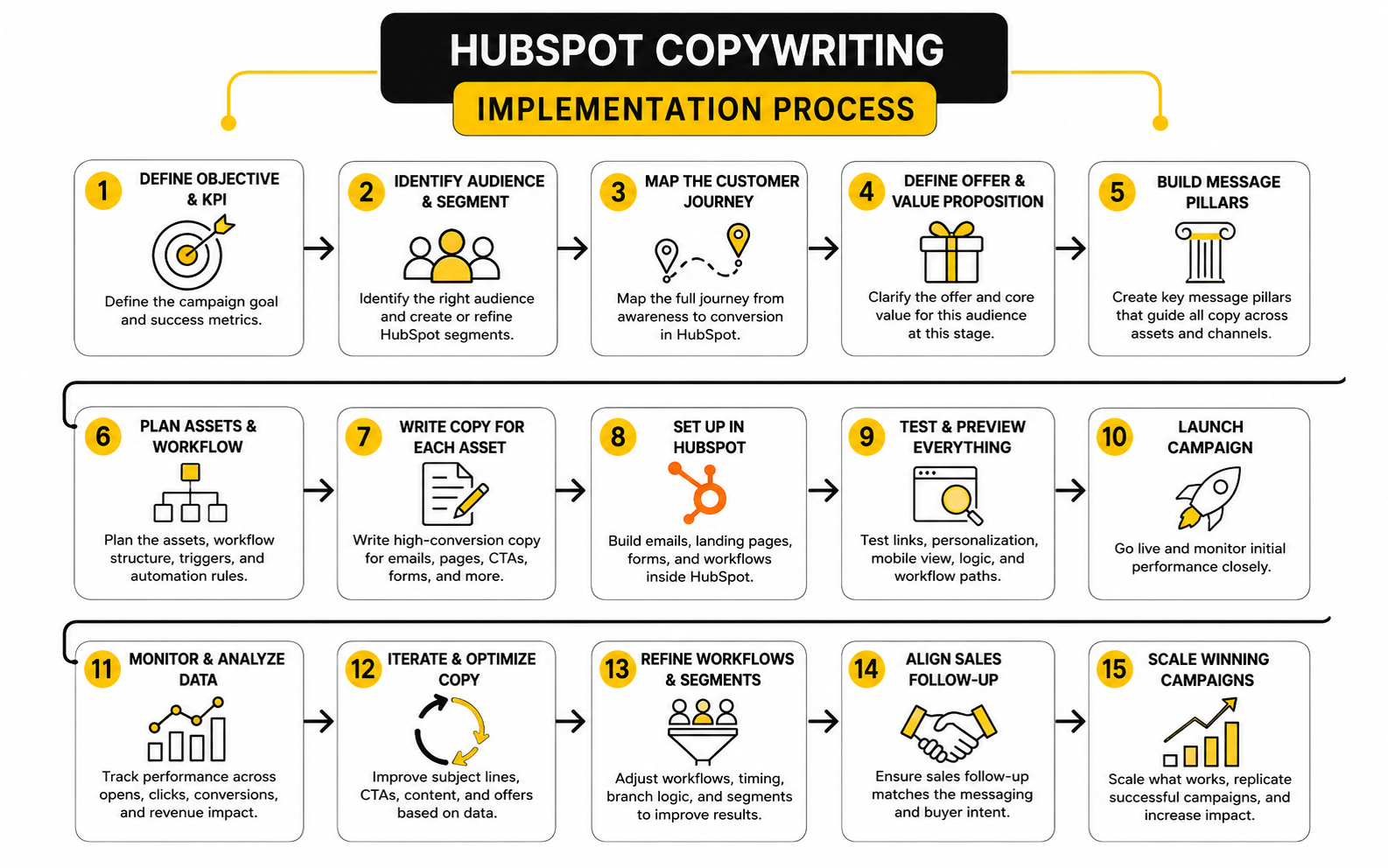
A practical implementation process keeps the team from turning every campaign into a pile of disconnected assets. It gives the writer enough context to be specific, gives the marketer enough structure to build clean automation, and gives sales enough clarity to follow up without guessing what the lead has already seen.
Start With The Campaign Goal
Every campaign needs one primary goal. Not five goals. One. The goal might be generating qualified demo requests, warming up cold leads, converting trial users, reviving inactive contacts, improving webinar attendance, or moving sales-qualified leads toward a booked call.
Once the goal is clear, the copy gets easier because every sentence can be judged against the same question: does this help the reader take the next step? If the answer is no, cut it. HubSpot copywriting becomes much sharper when the campaign has a measurable business outcome instead of a vague content objective.
The goal also decides which HubSpot assets matter most. A lead-generation campaign may need a landing page, form, thank-you page, follow-up workflow, and sales notification. A re-engagement campaign may need segmentation, suppression rules, email variants, and a clear unsubscribe-safe message that respects the contact’s current level of interest.
Map The Audience Before Writing
The next step is audience mapping. This is not just choosing a broad persona like “marketing manager” or “founder.” You need to know what segment the contact belongs to, what they already did, what they likely care about, and what would make the next step feel useful instead of forced.
HubSpot gives you several ways to make that audience map practical. You can use lifecycle stages, list membership, form submissions, page activity, source data, company properties, deal information, or custom fields. The point is not to use every signal. The point is to use the signals that actually change the message.
A simple audience map should answer these questions:
Build The Message Sequence
Once the audience map is clear, the message sequence can be built in a logical order. Start with the destination asset first, usually the landing page, booking page, offer page, or conversion point. Then write the emails, CTAs, ads, chat prompts, and follow-ups that lead people there.
This prevents a common problem: writing a strong email that sends people to a weak page. If the landing page does not complete the promise made in the email, the campaign loses trust at the exact moment when the reader is ready to act. The copy has to feel like one continuous conversation.
A basic HubSpot sequence often works like this:
Connect Copy To CRM Properties
This is where implementation gets serious. If the campaign depends on personalization, routing, scoring, or reporting, the right HubSpot properties must exist before the copy goes live. Otherwise, the message may reference data that is incomplete, inconsistent, or unavailable.
For example, a copy block that changes based on industry only works if industry data is reliable. A lifecycle-specific nurture only works if lifecycle stages are maintained properly. A sales handoff email only works if the contact owner, deal stage, and relevant activity are visible to the person following up.
Do not write personalization that the CRM cannot support. It creates broken tokens, awkward fallback text, and messages that feel less personal than a plain email. Better to write one clean message than ten “personalized” variants built on unreliable data.
Write Fallbacks Like A Professional
Fallback copy is one of the most overlooked parts of HubSpot copywriting. When a personalization token is empty, the fallback determines whether the message still reads naturally. A weak fallback makes the automation obvious in the worst way.
The safest fallback is usually neutral and human. If the company name is missing, the sentence should still make sense. If the first name is missing, the greeting should not look broken. If a custom property is incomplete, the copy should gracefully return to a broader version of the message.
This matters because CRM data is never perfect. People mistype forms, integrations sync imperfectly, fields go stale, and contacts enter the database from different sources. Professional implementation assumes imperfect data and writes around it instead of pretending every record will be clean.
QA The Campaign Before Launch
Before launch, review the campaign like a customer and like an operator. The customer view checks whether the message feels clear, useful, and consistent from first touch to final action. The operator view checks whether the workflow, lists, suppression rules, notifications, and reporting behave correctly.
This is where many teams rush, and it costs them. A typo is annoying, but a broken branch, wrong list, missing suppression rule, or confusing CTA can damage trust and waste traffic. HubSpot makes it easy to build fast, but fast still needs quality control.
A practical QA pass should check:
Launch Small, Then Improve
The first version of a campaign should be strong, but it should not be treated like a final artifact. HubSpot gives you enough reporting to learn from real behavior, so use it. Launch to a defined audience, watch the meaningful signals, and improve the copy based on where people hesitate.
This does not mean changing everything after one weak email. It means looking for patterns. If people open but do not click, the promise or CTA may be weak. If people click but do not convert, the landing page may not complete the argument. If qualified leads convert but sales struggles to continue the conversation, the handoff copy may be thin.
That is the real advantage of HubSpot copywriting. The work does not stop when the words go live. The system gives you feedback, and the copy should get sharper every time the campaign runs.
Measurement, Analytics, And What The Numbers Actually Mean
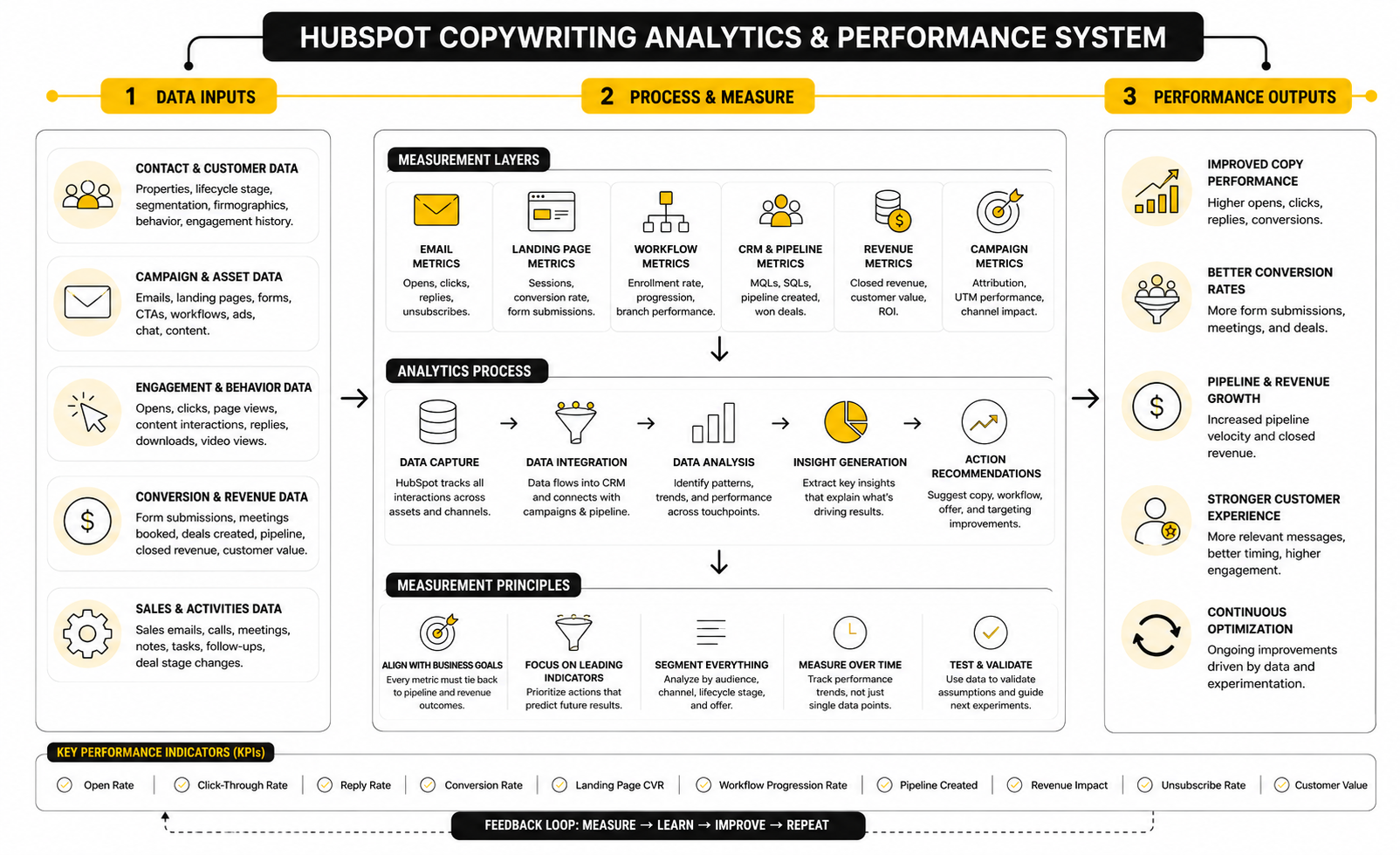
Measurement is where HubSpot copywriting stops being opinion-based. You can like a headline, dislike a CTA, or feel confident about an email sequence, but the data shows whether real people are moving. The goal is not to collect every number HubSpot can show you. The goal is to understand which numbers explain momentum, friction, and revenue impact.
The most useful analytics connect copy performance to buyer behavior. Opens, clicks, page views, form submissions, meeting bookings, deal creation, pipeline value, and closed revenue all tell different parts of the story. If you treat them as equal, you will optimize the wrong thing.
This matters because HubSpot makes surface-level reporting very easy. You can quickly see that one email had a stronger open rate or that one landing page got more submissions. But professional measurement asks a better question: did that asset attract the right people and move them closer to becoming customers?
Email Metrics Are Signals, Not The Whole Story
Email open rates can help you understand subject line strength, sender trust, timing, and list quality, but they should not be treated as the final score. Privacy changes, inbox behavior, and automated preloading can make opens less reliable than they used to be. A campaign with a lower open rate but stronger qualified replies or conversions may be far more valuable than one that gets curiosity opens from the wrong people.
Click-through rate is usually more useful because it shows whether the promise in the email created enough motivation to act. Mailchimp’s benchmark data places the average email open rate around 34.23% across its analyzed campaigns, but that number only becomes meaningful when compared against your own audience, industry, list source, and campaign type. A cold reactivation email, customer onboarding email, and high-intent demo follow-up should not be judged by the same expectation.
The action is simple: separate engagement metrics from business metrics. Use opens to diagnose attention. Use clicks to diagnose message relevance. Use replies, bookings, form submissions, and pipeline movement to judge whether the copy is doing meaningful work.
Landing Page Data Shows Where The Argument Breaks
Landing page analytics help you see whether the page is completing the promise made by the traffic source. If people click from an email but do not convert, the issue may not be the email. It may be the page headline, offer framing, form friction, proof, page speed, or mismatch between the CTA and the actual page experience.
Conversion benchmarks are useful only when they are treated as reference points, not laws. Unbounce analyzed 41,000 landing pages, 464 million pageviews, and 57 million conversions and reported a median conversion rate of 6.6% across industries. That does not mean every HubSpot landing page should hit 6.6%. It means your page should be evaluated against intent, traffic quality, offer type, and the level of commitment required.
A newsletter signup, gated template, webinar registration, and demo request all ask for different levels of trust. If a low-friction resource page converts poorly, the offer may be weak or unclear. If a high-friction demo page converts at a modest rate but creates strong sales opportunities, the page may be doing exactly what it should.
Workflow Analytics Reveal Timing Problems
Workflow data is especially useful because it shows how people behave over time. A single email metric can be misleading, but a workflow pattern can reveal where the sequence loses momentum. If contacts drop off after the first email, the sequence may be too aggressive, too vague, or disconnected from the trigger that put them into the workflow.
Look at progression, not just isolated performance. Did the contact move from subscriber to lead? Did a lead become sales qualified? Did the workflow create meetings, replies, or deal movement? HubSpot copywriting should be measured by whether the sequence helps people advance, not whether every individual message wins a vanity metric.
Timing is often the hidden issue. A message sent too soon can feel pushy, while a message sent too late can miss the moment of intent. If engagement is weak across a workflow, review the trigger, delay, branch logic, and message angle before rewriting everything.
CRM Data Makes Copy More Accountable
The biggest advantage of writing inside HubSpot is that copy can be connected to CRM outcomes. You can see whether specific campaigns influenced contacts, companies, deals, and revenue. That gives you a more honest view than judging copy by clicks alone.
HubSpot’s marketing statistics report says 87% of marketers using HubSpot felt their marketing strategies were effective in 2024, compared with 52% of marketers who did not have a CRM. The takeaway is not that software magically fixes strategy. The takeaway is that connected data gives teams a better chance of seeing what is working, what is leaking, and where copy needs to support the next step.
This is where attribution needs discipline. Do not claim one email “created” a sale just because it was part of the path. Look at influenced contacts, assisted conversions, deal progression, source quality, sales notes, and the actual timeline of interactions. The data should make your decisions sharper, not give you a convenient story.
The Metrics That Matter Most
A clean HubSpot reporting setup should separate attention, engagement, conversion, and revenue signals. Each layer answers a different question. When those layers are mixed together, teams start celebrating numbers that do not actually move the business.
The most useful measurement stack looks like this:
This structure keeps the team honest. If attention is strong but engagement is weak, the hook may be better than the substance. If engagement is strong but conversion is weak, the offer or CTA may need work. If conversion is strong but revenue is weak, the copy may be attracting the wrong people.
Benchmarks Should Start The Conversation, Not End It
Benchmarks are useful when you need context, but they become dangerous when they replace judgment. A campaign can beat an average benchmark and still fail commercially. Another campaign can underperform a generic benchmark and still produce excellent revenue because it reaches a smaller, higher-value audience.
The better approach is to build internal benchmarks by campaign type. Track your own welcome sequences, webinar campaigns, demo pages, sales sequences, customer onboarding emails, reactivation workflows, and content upgrades separately. Over time, your own data becomes more useful than broad industry averages.
This is especially true for HubSpot copywriting because the same copy can perform differently depending on the list, lifecycle stage, offer, source, and sales follow-up. The question is not “Is this good compared with the internet?” The better question is “Is this improving the journey for the people we actually want to convert?”
What To Do When The Data Looks Bad
Bad data is useful when you know how to read it. Low opens usually point to the subject line, sender, list quality, timing, or deliverability. Low clicks usually point to weak relevance, unclear value, poor CTA copy, or a mismatch between the reader’s intent and the offer.
Low landing page conversions require a different diagnosis. The headline may not match the traffic source. The form may ask for too much too early. The offer may sound generic. The page may lack proof, clarity, or a strong explanation of what happens after submission.
The worst response is random optimization. Do not change subject lines, CTAs, page structure, workflow timing, and audience targeting all at once unless the campaign is clearly broken. Change one meaningful variable, give the test enough data, and keep a simple record of what changed so the next decision is based on learning instead of guesswork.
Advanced Tradeoffs In HubSpot Copywriting
At a basic level, HubSpot copywriting is about writing better emails, pages, workflows, and CTAs. At a higher level, it is about managing tradeoffs. The more advanced your HubSpot setup becomes, the easier it is to overbuild the system, over-personalize the message, and over-automate moments that would be better handled by a person.
This is where mature teams separate themselves. They do not just ask, “Can we automate this?” They ask, “Should this be automated, and will the customer experience get better if we do?” That question protects the brand from turning a powerful CRM into a very efficient way to annoy people.
The best HubSpot copywriting systems stay practical. They use data where it improves relevance, automation where it improves timing, and human follow-up where judgment matters. That balance is not always easy, but it is where most of the performance gains come from.
Personalization Can Help Or Hurt
Personalization is useful when it makes the message more relevant. It becomes risky when it feels invasive, inaccurate, or gimmicky. A first-name token does not make weak copy strong, and a dynamic industry line does not help if the rest of the email still sounds generic.
The real question is whether the personalization changes the reader’s experience in a meaningful way. If a contact’s lifecycle stage, product interest, company size, or recent behavior helps you write a more useful message, use it. If the data only exists so the email can look “custom,” skip it.
Bad personalization creates a trust problem. A wrong company name, broken token, irrelevant recommendation, or overly specific behavioral reference reminds the reader that they are inside a database. Good personalization does the opposite: it makes the next step feel natural because the message fits the moment.
Automation Should Not Replace Judgment
HubSpot makes it tempting to automate everything. You can trigger emails, assign tasks, update properties, change lifecycle stages, rotate leads, score contacts, notify sales, and branch workflows based on behavior. That is powerful, but power without judgment creates noise.
Some moments should stay human. A high-value lead asking a pricing question, a customer showing expansion intent, or a deal stuck near close may deserve a personal message instead of another nurture email. HubSpot copywriting should support these handoffs, not bury them under more automation.
A good rule is simple: automate predictable education, reminders, and routing. Keep judgment-heavy moments close to sales, success, or leadership. The copy should make the system feel responsive, not mechanical.
Scaling Requires Message Governance
As HubSpot usage grows, copy can get messy fast. Different teams create emails, pages, snippets, sequences, forms, and workflows. Over time, the brand voice fragments, CTAs compete with each other, and old campaigns keep running long after the strategy has changed.
This is why scaling requires message governance. Someone needs to own the core promises, approved claims, CTA language, lifecycle definitions, offer positioning, and naming conventions. Without that, HubSpot becomes a warehouse of old messages that no one fully trusts.
Governance does not mean making the process slow. It means creating enough structure so the team can move faster without creating contradictions. A shared copy library, reusable CTA language, approved proof points, and clear campaign naming rules can prevent a lot of future cleanup.
Data Quality Is A Copy Problem
Most teams treat data quality as an operations issue. It is also a copy issue. If the CRM data is unreliable, the copy has to become more generic because the writer cannot safely reference the details that would make the message more relevant.
This shows up in small but damaging ways. Industry-specific copy fails when the industry field is inconsistent. Lifecycle-based nurture breaks when contacts are assigned the wrong stage. Sales follow-up gets awkward when source data, form submissions, or recent activity are missing.
The fix is not to write around bad data forever. The fix is to improve the fields that matter most for messaging. Clean source data, lifecycle stages, intent signals, offer history, and contact ownership will usually improve HubSpot copywriting more than adding another clever email variation.
AI Can Speed Up Drafting, But It Cannot Own The Strategy
AI can help with HubSpot copywriting, especially for first drafts, variations, subject line ideas, repurposing, and workflow message options. It can also help summarize inputs and turn campaign strategy into usable copy faster. Used well, it removes blank-page friction.
But AI should not decide the offer, audience, positioning, compliance boundaries, or sales strategy on its own. Those decisions require business context. They also require judgment about what the customer actually needs to believe before moving forward.
The best use of AI is as a production assistant, not a strategy replacement. Give it strong inputs, then edit with discipline. The human still needs to check accuracy, tone, claims, specificity, and whether the copy fits the actual HubSpot workflow.
Compliance And Consent Shape The Message
Advanced HubSpot copywriting also has to respect consent, privacy, and market expectations. Email rules, data protection standards, unsubscribe requirements, and regional privacy expectations affect what you can send, who you can send it to, and how direct the message should be. This is not the exciting part of copywriting, but it matters.
Consent should shape the tone. A customer onboarding email can be direct because the relationship is active. A cold reactivation email should be more careful because the contact may not remember the brand clearly. A sales sequence should not pretend to be a personal relationship when the person has never spoken to the rep.
The practical move is to write with clarity and respect. Make the reason for the message obvious. Avoid manipulative urgency. Give people a clean path to act, ignore, or opt out. Long-term trust beats short-term pressure.
The Risk Of Over-Nurturing
Nurture sequences are useful, but too much nurture can weaken intent. If someone is ready to book a demo, they do not need six more educational emails before seeing the offer. If someone is early in the journey, a hard pitch every two days will probably push them away.
The problem is usually a mismatch between intent and pressure. High-intent behavior deserves clearer conversion copy. Low-intent behavior deserves useful education and lighter CTAs. HubSpot gives you the data to separate those paths, but the copy has to respect the difference.
This is why advanced teams build multiple routes instead of one giant nurture track. They create paths for education, evaluation, reactivation, sales acceleration, onboarding, and expansion. Each path has a different message because each reader is in a different mental state.
Sales And Marketing Need One Language
HubSpot copywriting breaks down when marketing and sales describe the offer differently. Marketing says one thing on the landing page. Sales says another thing on the call. The follow-up email introduces a third angle. The buyer feels the inconsistency even if they cannot name it.
A shared message system solves this. Marketing copy, sales sequences, call notes, proposal language, onboarding emails, and customer success messaging should all pull from the same core positioning. The words can change by context, but the promise should stay consistent.
This is especially important in B2B. Buyers often interact with multiple assets and multiple people before making a decision. If every touchpoint reinforces the same clear argument, trust builds faster. If every touchpoint feels disconnected, the deal gets harder than it needs to be.
When To Use HubSpot And When To Add Other Tools
HubSpot can handle a lot, but not every team uses it as the only system. Some businesses pair HubSpot with funnel builders, SMS tools, scheduling platforms, chat tools, enrichment tools, or specialized landing page software. That can work, but only if the customer experience stays clean.
For example, a team using GoHighLevel for agency-style funnels or client campaign infrastructure still needs clear copy logic across every step. A creator or lean business using Systeme.io for simple funnels still needs the same discipline around offer clarity and follow-up. A team building conversion-focused pages in ClickFunnels still needs the message to connect back to CRM reality.
The tool stack should not create a fragmented journey. If HubSpot is the CRM source of truth, then external tools should pass useful data back into the system. Otherwise, the copy becomes harder to personalize, the reporting becomes weaker, and the team loses visibility into what actually moved the buyer.
The Expert-Level Standard
The expert-level standard is not “more automation.” It is more relevance with less confusion. The reader should feel like the brand understands the problem, offers a clear next step, and follows up in a way that makes sense.
That requires a clean strategy, reliable data, useful segmentation, sharp copy, and measured restraint. HubSpot gives you the infrastructure, but the thinking still has to come from the team. The platform can deliver the message; it cannot decide what is worth saying.
Great HubSpot copywriting feels almost invisible when it works. The buyer does not think, “What a clever workflow.” They think, “This is exactly what I needed next.” That is the bar.
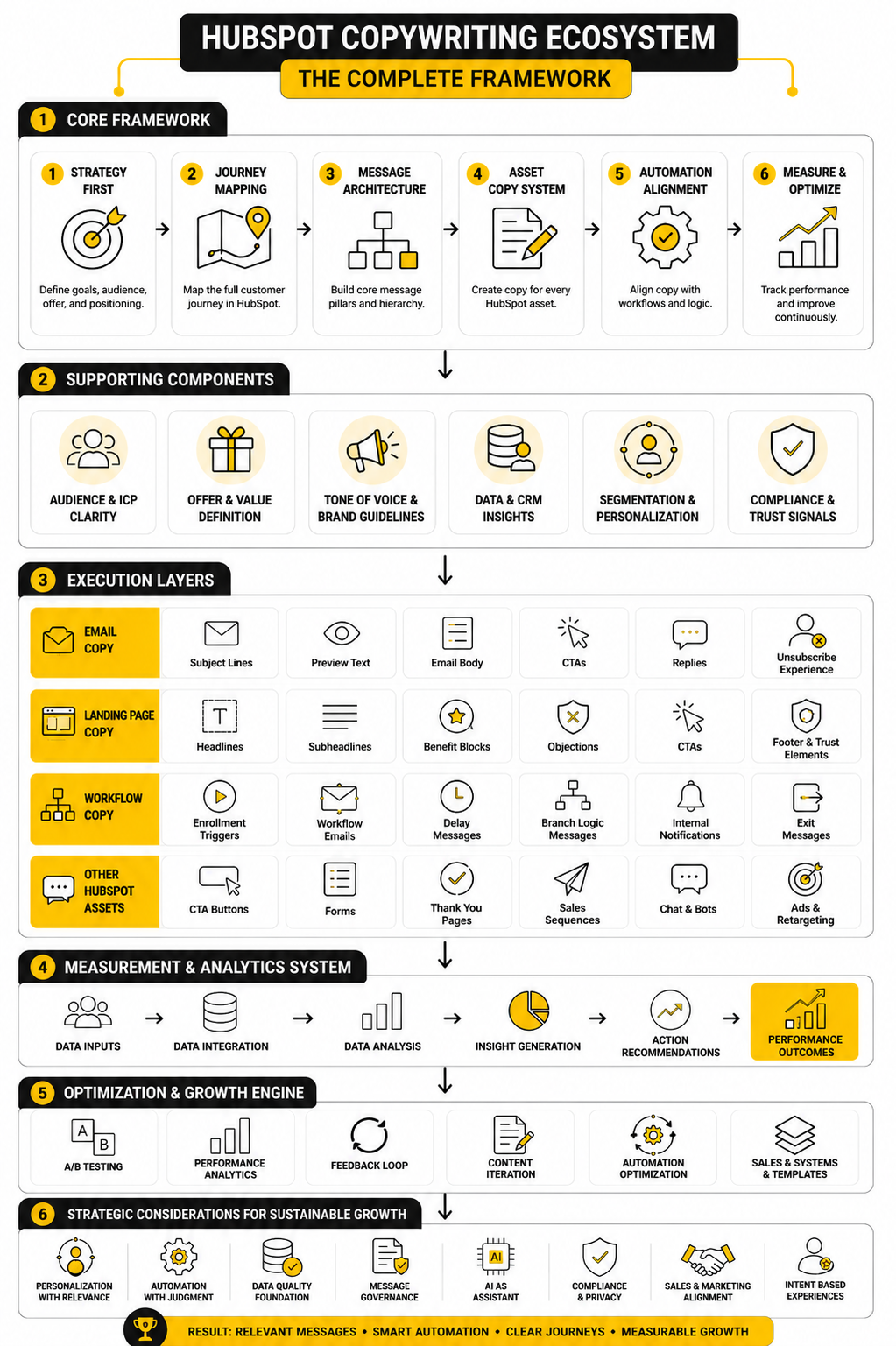
What Is HubSpot Copywriting?
HubSpot copywriting is the process of writing conversion-focused messages for assets built, delivered, tracked, or supported inside HubSpot. That includes emails, landing pages, workflows, forms, CTAs, sales sequences, chat prompts, thank-you pages, and follow-up messages. The difference from general copywriting is that the copy has to work with CRM data, automation rules, lifecycle stages, and reporting.
Good HubSpot copywriting does not start with a blank page. It starts with the customer record, the trigger, the segment, and the next action you want the reader to take. The more context you have, the more useful and specific the message can become.
Why Is HubSpot Copywriting Different From Normal Copywriting?
Normal copywriting often focuses on one asset at a time, such as a sales page, ad, email, or landing page. HubSpot copywriting has to think across the full customer journey because one message often triggers another action inside the CRM. A landing page may update a property, start a workflow, notify sales, change a lifecycle stage, and influence future follow-up.
That makes the writing more operational. The words still need to persuade, but they also need to fit the logic of the system. A great HubSpot copywriter understands both the message and what happens after the click.
What Should A HubSpot Copywriter Understand?
A HubSpot copywriter should understand positioning, offers, segmentation, email strategy, landing page structure, workflow logic, lifecycle stages, CTAs, and CRM data quality. They do not need to be a full HubSpot admin, but they should know enough to avoid writing copy the system cannot support. That includes knowing when personalization tokens, smart content, lists, and workflow branches are useful.
They should also understand buyer intent. Someone reading a beginner resource needs a different message from someone who keeps returning to a pricing or demo page. The copywriter’s job is to match the message to that level of intent.
How Do You Start A HubSpot Copywriting Campaign?
Start by defining the campaign goal and the audience segment. Then identify the trigger, the conversion point, the offer, the key objection, and the next step. Once those pieces are clear, you can write the landing page, emails, CTAs, workflow messages, and sales follow-up as one connected experience.
Do not start by writing the first email. That usually leads to disconnected copy. Start with the decision you want the person to make, then build the path that makes that decision feel natural.
How Many Emails Should A HubSpot Workflow Have?
There is no perfect number. A simple lead magnet follow-up may only need two or three emails, while a longer evaluation journey may need more touches across several weeks. The right number depends on intent, offer complexity, sales cycle length, and how much education the buyer needs before taking action.
The better question is whether each email has a distinct job. One email might deliver the resource, another might explain the core problem, another might handle an objection, and another might invite the reader to book a call. If two emails say the same thing with slightly different wording, remove one.
What Metrics Matter Most For HubSpot Copywriting?
The most useful metrics depend on the asset. For emails, look at opens, clicks, replies, unsubscribes, and downstream conversions. For landing pages, look at conversion rate, traffic source, form completion, offer quality, and whether submissions become qualified leads.
For workflows, look at progression. Did contacts move to the next lifecycle stage, book meetings, create deals, or become customers? HubSpot copywriting should not be judged only by engagement. It should be judged by whether the message helps the right people move forward.
How Should Personalization Be Used In HubSpot Copy?
Personalization should make the message more relevant, not more decorative. Using someone’s first name is fine, but it rarely changes the substance of the copy. Stronger personalization uses meaningful context, such as lifecycle stage, product interest, content downloaded, company type, or recent behavior.
The key is restraint. If the data is unreliable, do not build the message around it. A clean generic sentence is better than a broken or awkward personalized one.
What Is The Biggest Mistake In HubSpot Copywriting?
The biggest mistake is writing copy without understanding the journey. Teams often write one email, one landing page, or one workflow message in isolation, then wonder why the campaign feels inconsistent. The reader experiences the whole path, not the individual asset.
Another major mistake is over-automation. Just because HubSpot can send another email does not mean it should. The copy should make the journey feel easier, clearer, and more relevant, not heavier.
Can AI Help With HubSpot Copywriting?
Yes, AI can help with first drafts, subject line variations, nurture ideas, landing page sections, CTA alternatives, and repurposing existing campaign copy. It is especially useful when the strategy is already clear and the inputs are specific. Weak inputs usually create generic outputs.
AI should not own the strategy. A human still needs to decide the audience, offer, claims, tone, compliance limits, and conversion path. Use AI to speed up production, then edit with judgment.
Is HubSpot Better Than Other Funnel Or Automation Tools?
HubSpot is strongest when CRM data, marketing automation, sales activity, and reporting need to work together. Other tools can be useful for specific use cases, especially simple funnels, creator offers, agency campaigns, or fast landing page testing. The right choice depends on the business model and how much customer data needs to connect across the journey.
Tools like GoHighLevel, Systeme.io, and ClickFunnels can make sense in specific funnel environments. The important thing is not the tool name. The important thing is whether the copy, data, automation, and follow-up create one coherent experience.
How Do You Make HubSpot Copy Sound Less Robotic?
Write from the reader’s situation, not from the workflow step. Instead of saying something that sounds like a system notification, explain why the message is useful now. A human tone comes from relevance, clarity, and restraint.
Shorter sentences often help, but tone is not only about sentence length. The copy should sound like someone who understands the problem and respects the reader’s time. Avoid exaggerated urgency, empty personalization, and generic marketing language.
How Often Should HubSpot Copy Be Updated?
Update HubSpot copy whenever the offer, audience, product positioning, sales process, or data shows a meaningful performance issue. Some evergreen workflows can run for months with minor improvements. Other campaigns need updates quickly because the offer, market, or buyer objections change.
The smart approach is to review key assets on a schedule. High-traffic landing pages, active workflows, sales sequences, and conversion-focused emails deserve regular review. Old copy running quietly in the background can create more damage than most teams realize.
What Makes HubSpot Copywriting Actually Convert?
Conversion comes from the match between audience, timing, offer, message, and next step. The copy has to meet the reader where they are and make the action feel worth taking. Strong words help, but strong relevance matters more.
The best HubSpot copywriting is clear, specific, and connected to the system around it. It does not rely on hype. It uses CRM context, buyer intent, and clean follow-up logic to make the next step obvious.
Build a stronger local presence with BAAM AI
Turn your website, Google profile, social channels, and AI visibility into one growth engine
Most businesses do not need more random marketing activity. They need a consistent presence system that helps the right people find them, trust them, and take action. BAAM AI brings strategy, local SEO, website updates, Google Maps visibility, social content, AI-search readiness, media production, and reporting into one practical monthly engine.
If you want your marketing to keep working after the campaign ends, start with a free BAAM AI presence audit. See how your business shows up today and where the fastest visibility wins are at BAAM AI.