
BAAM AI Blog
How to Pick an SMMA Niche That Can Actually Pay You
Choosing an SMMA niche is not about picking the industry that sounds the coolest. It is about finding a market where businesses already understand the value of leads, booked calls, repeat purchases, or customer...
How to Pick an SMMA Niche That Can Actually Pay You
Choosing an SMMA niche is not about picking the industry that sounds the coolest. It is about finding a market where businesses already understand the value of leads, booked calls, repeat purchases, or customer retention. If a business cannot clearly connect marketing activity to revenue, your offer becomes harder to sell and even harder to retain.
A strong niche usually has three things working at the same time. The business has enough margin to pay you, the owner feels real pain when leads slow down, and the buying journey can be influenced by social media content, ads, reviews, DMs, or follow-up systems. That is why “restaurants” can be a tough broad niche, while “high-ticket med spas selling recurring treatment plans” can be much more interesting.
The bigger social media trend supports this, but it does not make every niche good. Global social media use is massive, with the Digital 2025 Global Overview Report showing social platforms as a core part of everyday online behavior. The opportunity is not “everyone is on social media,” though. The opportunity is finding businesses where social attention can turn into measurable sales conversations.
Start With the Money Flow
The first filter is simple: follow the money. A good SMMA niche should have customers who are worth enough to justify paid acquisition, content production, automation, or appointment setting. If a client makes $40 from a customer, your work has to be incredibly cheap to make sense. If a client makes $2,000, $5,000, or $15,000 from a customer, there is room for a real agency fee.
This is why niches like dentists, cosmetic clinics, legal services, real estate, B2B services, home improvement, financial services, private education, and high-ticket coaching often attract agency owners. The economics are more forgiving. One converted client can cover your monthly fee, which makes the sales conversation much easier.
You still need to be careful with broad labels. “Healthcare” is not a niche. “Dental implants for private dental practices” is much clearer. The U.S. Bureau of Labor Statistics projects continued demand for dentists, but that alone does not prove every dental practice is a good prospect. You still need to check whether the specific practice has capacity, margin, a clear offer, and a reason to care about growth now.
Look for Pain That Shows Up Every Month
A profitable SMMA niche usually has recurring pain. The owner is not casually thinking, “Maybe we should post more.” They are thinking, “We need more booked appointments,” “Our pipeline is unpredictable,” “Our competitors are everywhere,” or “We are wasting leads because nobody follows up fast enough.”
That kind of pain gives your offer urgency. It also helps you avoid selling vague social media management. Instead of promising posts, you can promise a system: better positioning, better lead capture, better follow-up, better booking, and clearer reporting.
This is where many beginners get stuck. They pick an industry because it looks popular, then pitch generic content calendars. A better approach is to ask what problem the business owner already loses sleep over. For example, a law firm may care less about pretty Instagram posts and more about qualified consultations, intake speed, reviews, and trust-building content. Clio’s Legal Trends Report is useful context because it shows how law firms think about operations, efficiency, and client acquisition, not just marketing.
Choose a Niche Where Social Media Influences Trust
Some purchases happen fast. Others require trust before a person ever books a call. The best SMMA niche for you often sits in the second category because content and social proof can do real work before the sales conversation begins.
Think about a patient choosing a cosmetic dentist, a homeowner choosing a roofer, a founder choosing a B2B consultant, or a buyer choosing a real estate agent. These decisions involve risk. People want proof, examples, education, reviews, authority, and a reason to believe the provider is safe.
That gives your agency more angles to work with. You can build educational content, retargeting campaigns, lead magnets, review campaigns, DM flows, and appointment reminders. Social media is not just a posting channel in these niches. It becomes part of the trust-building system.
Avoid Niches Where the Client Cannot Track Value
Some niches look fun but become a nightmare because the client cannot tell whether your work is helping. If the owner does not know their average customer value, close rate, margins, or booking numbers, every monthly invoice becomes a debate. You end up defending likes, impressions, and reach because there is no cleaner metric to discuss.
That does not mean you should only work with sophisticated companies. It means you should prefer niches where the path from lead to revenue can be tracked reasonably well. Appointment-based businesses are often easier because you can measure leads, booked calls, show-up rate, close rate, and revenue per customer.
This is also where software matters. A simple pipeline inside GoHighLevel can help an agency show what happened after a lead came in, especially when the client currently manages everything through scattered spreadsheets, inboxes, and missed calls. The tool does not make a bad offer good. It simply gives you a cleaner way to prove the value of a good offer.
Check Competition Before You Commit
Competition is not automatically bad. In fact, a competitive SMMA niche often means businesses are already buying marketing help. That is much better than trying to educate an industry that has no budget, no urgency, and no belief in social media.
The question is whether you can position yourself differently. If every agency says, “We help dentists get more patients,” that is not enough. You need a sharper angle, such as helping implant dentists reactivate old leads, helping orthodontists improve consultation show-up rates, or helping med spas sell memberships through short-form content and automated follow-up.
The 2025 Sprout Social Index reinforces a useful point here: consumers and marketers both treat social media as a serious business channel, not just a place for brand awareness. That means your niche positioning should be tied to business outcomes. The more specific your outcome, the easier it is for a prospect to understand why you are different.
Score a Niche Before You Build an Offer
Before you build your website, write cold emails, or create a full service package, score the niche. This keeps you from falling in love with an idea that has weak economics. You do not need a complicated spreadsheet at first, but you do need a clear checklist.
Use these filters:
A niche that scores well on most of these is worth testing. A niche that scores poorly is probably not worth months of effort, no matter how trendy it sounds. This is where discipline matters.
Good SMMA Niche Categories to Consider
There is no single best SMMA niche for everyone. Your background, skills, network, confidence, and service model all matter. Still, some categories tend to be stronger starting points because the economics and pain points are easier to understand.
Local high-ticket services are a practical option because the buyer journey is clear. Dental implants, orthodontics, roofing, HVAC, remodeling, landscaping, pest control, and cosmetic clinics all depend on a steady flow of leads. These businesses often care about calls, quote requests, booked appointments, and reviews.
Professional services can also work well when you understand trust-based selling. Law firms, accountants, consultants, financial advisors, and insurance agencies need credibility before conversion. The challenge is that compliance, positioning, and lead quality matter more, so lazy ad campaigns usually fail.
Real estate and property-related niches are attractive because visibility and trust are huge. The National Association of Realtors profile highlights show how central online research is in the home buying and selling journey. For agents, brokers, mortgage professionals, and property managers, social content can support authority, local expertise, and lead nurture.
Ecommerce and creator-led brands can be powerful if you understand creative testing, landing pages, email, and conversion rate optimization. These clients may need more than social posts. They often need better funnels, better product pages, better offers, and better retention campaigns. For landing pages, tools like Replo can fit naturally when the client is already selling through Shopify and needs faster page testing.
Coaches, course creators, and info businesses can pay well, but they require caution. Some have strong offers, proof, and sales systems. Others are still figuring out their market and expect the agency to rescue a weak product. If you work in this space, make sure the client already has demand, testimonials, and a clear sales process before you promise growth.
Niches Beginners Should Treat Carefully
Some niches are not impossible, but they are harder than they look. Low-ticket local businesses often struggle to pay meaningful retainers unless you bring a very specific system. Restaurants, cafes, small boutiques, and early-stage personal brands can need social media badly while still lacking the budget to make your agency profitable.
Regulated niches also require more care. Finance, healthcare, legal, supplements, and some real estate offers can involve advertising restrictions, disclosure requirements, or platform policy issues. These can still be excellent niches, but you need to understand the rules before you run campaigns or make claims.
Trendy niches deserve the most skepticism. If everyone on YouTube suddenly says one niche is “untapped,” assume it will be crowded soon. The better move is to understand the business model underneath the trend. A boring niche with urgent demand and strong economics usually beats a flashy niche with weak buying intent.
Turn the Niche Into a Specific Offer
Once you have chosen a promising SMMA niche, the next move is not building a logo, buying a domain, or posting “agency owner” content on LinkedIn. The next move is turning that niche into a specific offer a business owner can understand in ten seconds. If your offer sounds like “social media management,” you are making the sales process harder than it needs to be.
A clear offer connects your service to one painful business outcome. A med spa does not wake up wanting “content.” It wants more booked consultations for profitable treatments, better lead follow-up, more rebookings, and more trust before people walk through the door. A roofer does not want “brand awareness” in the abstract. It wants quote requests, storm-season demand, review volume, and a pipeline that does not disappear when referrals slow down.
The simplest offer formula is this: we help this specific business get this specific result using this specific mechanism. For example, “We help cosmetic dental clinics generate more implant consultations using short-form video, retargeting, and automated follow-up.” That is much stronger than “We help dentists grow online.” It tells the prospect who it is for, what it does, and why your process is not just random posting.
Map the Buyer Journey Before You Sell Anything
Every strong SMMA niche has a buyer journey. People do not magically see one post and become perfect customers. They notice a problem, search for options, compare providers, check proof, ask questions, delay the decision, and eventually take action when the offer feels safe enough.
Your job is to map that journey before you build the campaign. If you skip this, you end up creating content that looks nice but does not move people forward. Good implementation starts with the customer’s actual decision process, not the agency’s favorite tactic.
For most local and professional service niches, the journey has a few predictable stages. Someone becomes problem-aware, then provider-aware, then trust-aware, then action-ready. Your content, ads, landing pages, DMs, email follow-up, and booking system should support those stages instead of treating every lead like they are ready to buy today.
Build the First 30-Day Implementation Plan
The first 30 days should be simple, focused, and measurable. Do not try to launch ten channels, five funnels, three ad campaigns, and a full rebrand at once. That creates noise, delays results, and makes you look less strategic.
Start by choosing one primary conversion goal. For a clinic, that may be booked consultations. For a home service business, it may be quote requests. For a B2B consultant, it may be qualified discovery calls. Once the goal is clear, everything else becomes easier to prioritize.
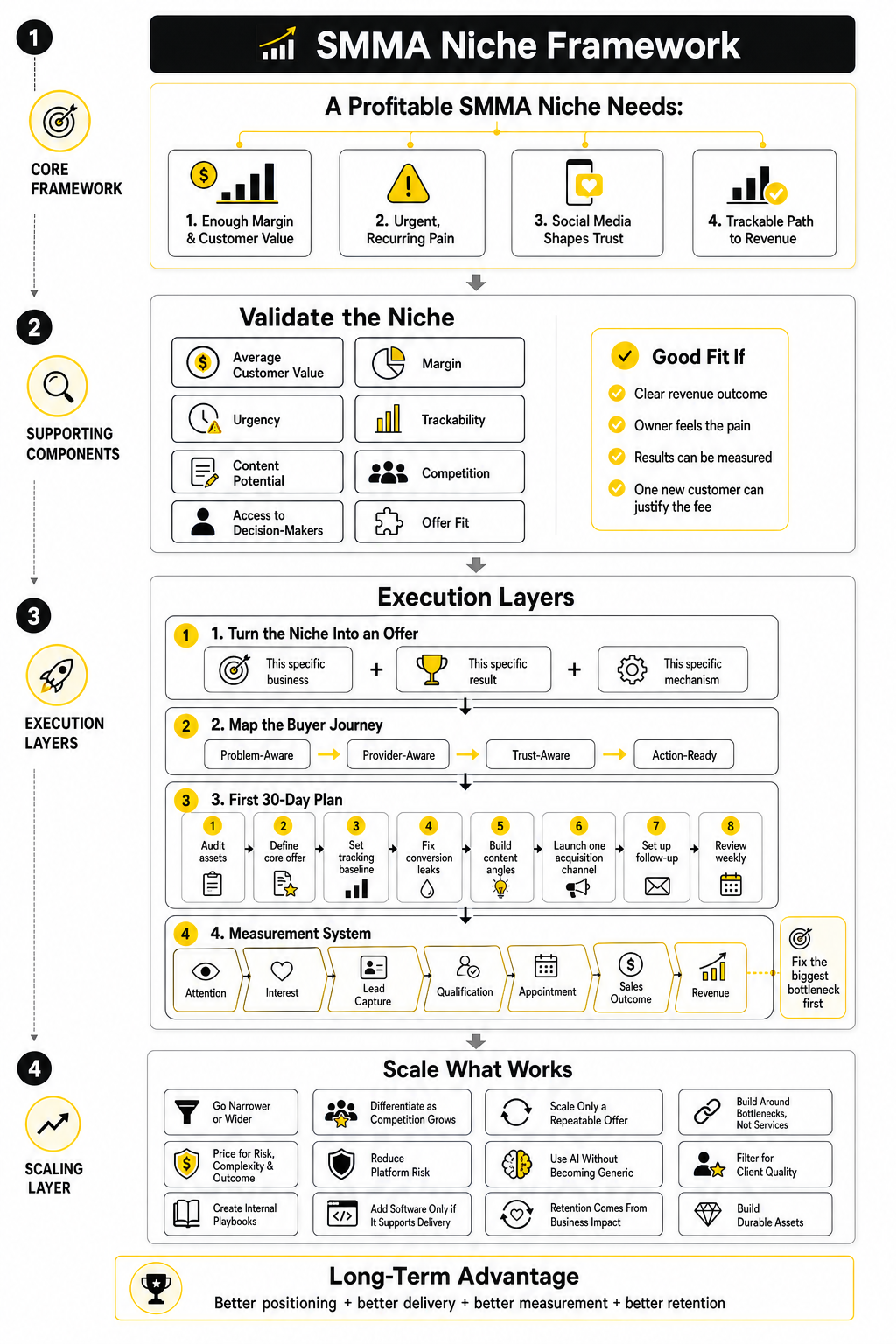
A practical first-month plan can look like this:
This process is not glamorous, but it works because it respects the business model. You are not selling content for content’s sake. You are building a revenue path that can be improved every week.
Fix the Follow-Up System Early
Lead generation gets all the attention, but follow-up often decides whether an SMMA campaign makes money. If a business takes two days to reply, misses calls, sends weak messages, or forgets to nurture old leads, your ads and content will look worse than they really are. This is why implementation has to include the back end, not just the front end.
A good follow-up system should be fast, clear, and human. The lead should know what happens next, how to book, who will contact them, and why acting now makes sense. For appointment-based businesses, a simple pipeline in GoHighLevel can help you track new leads, booked appointments, no-shows, won deals, and lost opportunities without guessing.
Do not overcomplicate this with a 27-step automation on day one. Start with the basics: instant confirmation, missed-call text-back, booking reminder, no-show follow-up, and reactivation for leads who never booked. If the client cannot handle those basics, more traffic will only expose the same leak faster.
Create Content Around Buying Questions
Content should answer the questions buyers already have in their heads. This is especially important in any SMMA niche where trust, price, risk, or timing affects the decision. People want to know what the service costs, how it works, how long it takes, what can go wrong, who it is for, and how to choose the right provider.
That gives you a much better content strategy than “post three times per week.” You can build content around objections, comparisons, outcomes, behind-the-scenes explanations, client education, and decision support. The goal is not to go viral every time. The goal is to make the right buyer feel more confident taking the next step.
Short-form video can work well here because it makes the business feel more real. Social platforms continue to reward native, useful, human content, and the 2025 Sprout Social Index shows how seriously brands and consumers now treat social as part of the relationship between a business and its audience. For an agency, that means the content plan should not be random entertainment. It should make the client easier to trust and easier to contact.
Choose One Main Channel First
A beginner mistake is trying to sell every channel at once. Instagram, TikTok, Facebook, LinkedIn, YouTube Shorts, email, paid ads, SEO, SMS, newsletters, funnels, and chatbots all sound useful. But if you launch everything at the same time, you will struggle to know what is actually working.
Pick one main acquisition channel based on the niche and the buyer. Local services may start with Meta ads and retargeting because visual proof, location targeting, and lead forms can work well when the offer is clear. B2B services may start with LinkedIn content and outbound because the buyer is easier to identify by role, company, and pain point. Ecommerce brands may need paid social creative testing, landing page improvements, and email capture from the beginning.
The point is not that one channel is always best. The point is that focus creates learning. Once one channel is producing usable data, you can add a second channel with more confidence.
Use Simple Automation Without Making the Brand Feel Robotic
Automation is useful when it removes friction. It becomes a problem when it makes the client sound cold, spammy, or disconnected from the buyer. In a trust-heavy SMMA niche, the follow-up should still feel like a real business is paying attention.
For Instagram and Messenger-based lead capture, ManyChat can be useful when the campaign involves comments, DMs, lead magnets, or quick qualification. For email campaigns, Brevo can fit when a client needs practical email follow-up without building a huge tech stack. The tool is secondary, though. The message, timing, and offer matter more.
A simple automation stack should support the sales process, not replace it. Use automation to reply faster, route leads, remind prospects, collect details, and revive old opportunities. Keep human touchpoints for questions, pricing conversations, consultations, and anything that requires judgment.
Build a Weekly Optimization Rhythm
Implementation is not a one-time setup. The first version of the campaign will usually be imperfect, and that is normal. What matters is whether you review the right numbers and improve the system every week.
A useful weekly review should separate attention metrics from business metrics. Views, likes, comments, and clicks can show whether the market is responding, but they do not prove revenue. Leads, booked appointments, show-up rate, sales conversations, close rate, and customer value tell you whether the campaign is actually working.
The weekly rhythm can stay simple:
This is where your agency becomes valuable. Anyone can post content. Fewer people can diagnose why leads are not converting, tighten the system, and explain the next move clearly.
Package the Process So Clients Can Understand It
Clients do not need to see every internal task, but they do need to understand your process. A clear process makes your offer feel safer. It also helps you avoid endless custom work because the client can see that you have a method.
Package your process into simple phases. For example: audit, strategy, setup, launch, optimize, scale. Each phase should have a clear purpose and a clear deliverable. That makes the service easier to sell and easier to manage.
This also helps you price with more confidence. You are not charging for “some posts and ads.” You are charging for a growth system built around a specific SMMA niche, a specific buyer journey, and a specific revenue outcome. That positioning is much stronger than acting like a freelancer who waits for the client to tell you what to post.
Statistics and Data
Data matters in an SMMA niche only when it helps you make better decisions. Random benchmarks can make you feel smart while still leaving you with no clue what to fix next. The goal is not to collect impressive numbers for a client report. The goal is to understand what is happening between attention, trust, leads, booked appointments, sales conversations, and revenue.
This is where many agency owners get measurement wrong. They report reach when the client cares about calls. They celebrate clicks when the landing page is leaking. They obsess over cost per lead when the real problem is that nobody follows up fast enough. A useful analytics system tells you where the money path is working, where it is breaking, and what to improve next.
Social media is big enough to justify serious attention, but size alone does not prove performance. The Digital 2025 social media report shows how deeply social platforms sit inside daily internet behavior, yet that only gives you the playing field. Your job is to turn that attention into measurable business outcomes for one specific niche.
Start With Baseline Numbers
Before you launch a campaign, collect the baseline. This protects you from guessing later. It also helps the client see whether your work is improving the system or simply adding activity.
The baseline should include the numbers that already exist inside the business. How many leads came in last month? How many became booked appointments? How many showed up? How many bought? What was the average customer value? How much revenue came from those customers? Even rough numbers are better than no numbers, as long as everyone understands they are starting estimates.
For a service-based SMMA niche, your baseline might include:
The point is not to make the client feel judged. The point is to create a before-and-after picture. Without a baseline, every campaign review becomes opinion. With a baseline, the conversation becomes much more practical.
Separate Attention Metrics From Revenue Metrics
Attention metrics are not useless. They just need to stay in their lane. Reach, impressions, views, watch time, saves, shares, comments, and engagement rate can show whether your message is getting noticed. They do not automatically show whether the campaign is making money.
Revenue metrics sit closer to the client’s bank account. Leads, qualified leads, booked calls, show-up rate, close rate, cost per booked appointment, sales value, and return on ad spend tell you whether the attention is turning into business. A smart agency watches both layers instead of pretending one layer tells the whole story.
This is especially important when comparing niches. A viral video for a low-ticket business may produce thousands of views and almost no profit. A simple educational post for a high-ticket clinic may generate fewer views but create one serious consultation worth thousands. In a strong SMMA niche, quality of attention often matters more than volume.
Use Benchmarks Carefully
Benchmarks are useful when they give you context, not when they become excuses. If a campaign has a low click-through rate compared with the market, that may point to weak creative, poor targeting, unclear positioning, or a mismatch between the offer and the audience. If engagement is above average but leads are weak, the content may be entertaining the wrong people.
Industry benchmark reports can help you sanity-check performance. For example, Rival IQ’s social media benchmark research compares engagement patterns across major platforms and industries, while Sprout Social’s benchmark analysis looks at how brands can compare performance by industry, competitors, and their own historical results. Those sources are useful because they remind you that “good” performance depends on platform, niche, content type, audience intent, and business model.
But do not manage a client account by benchmark alone. A dental implant campaign and a fashion ecommerce campaign should not be judged the same way. A local roofing company and a creator-led SaaS brand do not have the same buyer journey. Benchmarks help you ask better questions; they do not replace thinking.
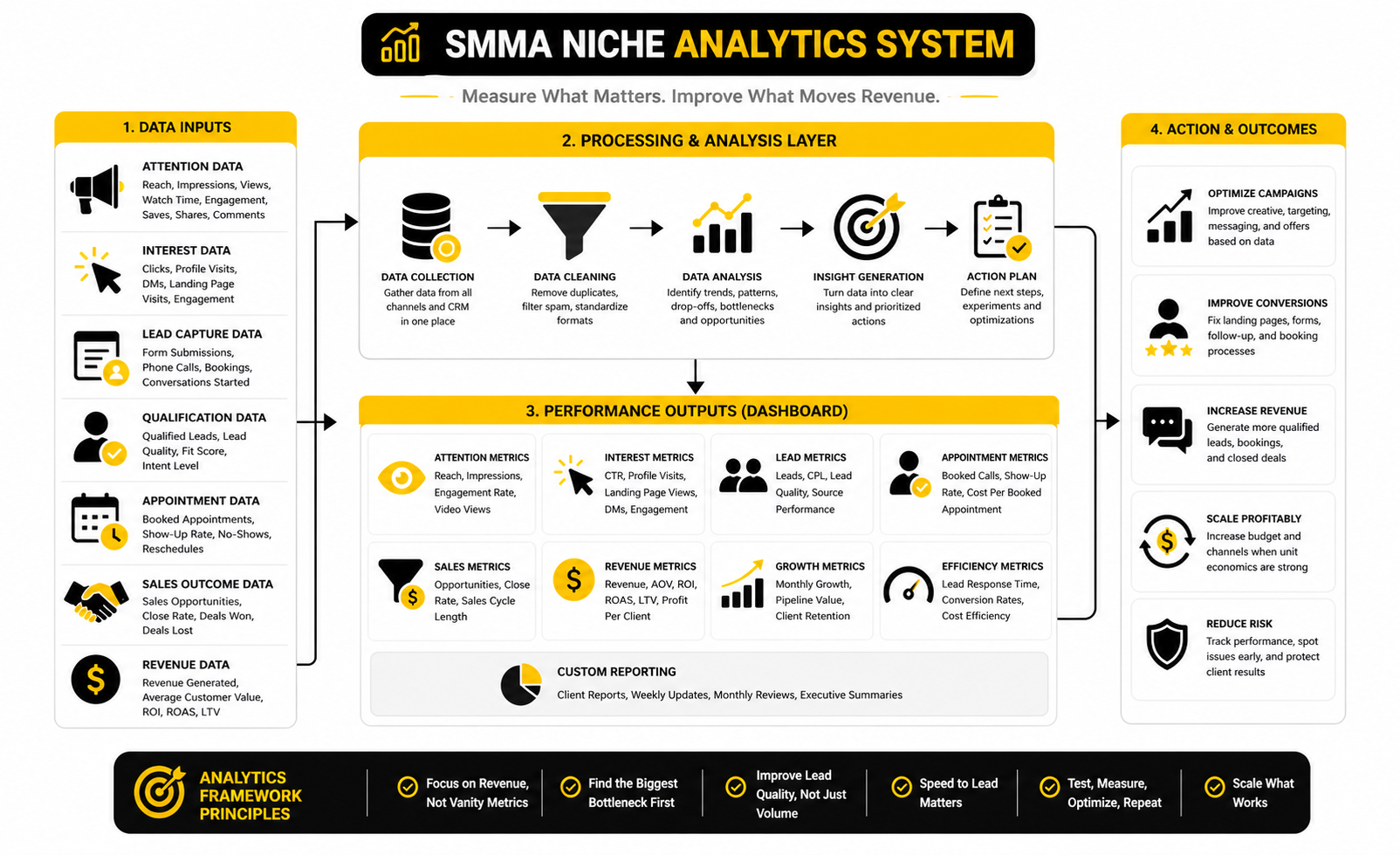
Build a Simple Analytics System
The best analytics system is the one your agency and client will actually use every week. It should be clear enough that a busy business owner can understand it without needing a marketing degree. If the reporting is too complicated, it usually gets ignored.
Start with one dashboard or scorecard that follows the buyer journey from first touch to revenue. For many appointment-based businesses, that means tracking traffic, leads, booked appointments, show-ups, sales opportunities, closed deals, and revenue. If you use GoHighLevel, the pipeline can help connect lead capture, follow-up, appointment status, and deal stages in one place.
A simple reporting flow can look like this:
This structure keeps everyone honest. If attention is low, you may need better creative or distribution. If interest is high but leads are low, the call-to-action or landing page may be weak. If leads are high but sales are low, the issue may be qualification, follow-up, offer fit, or sales handling.
Know Which Metric to Fix First
Do not try to fix everything at once. That is how agencies create chaos. Find the biggest constraint in the system and improve that first.
If the campaign is not getting enough impressions, distribution is the problem. You may need more posting volume, better hooks, stronger paid targeting, or a channel that better fits the niche. If impressions are solid but engagement is weak, the message may not be sharp enough. If engagement is strong but leads are weak, the content may need clearer buying intent or a stronger next step.
If leads are coming in but not booking, fix the conversion path. That could mean a better form, a clearer booking page, faster replies, stronger reminders, or a more direct offer. If bookings are happening but sales are weak, review lead quality, pricing expectations, consultation scripts, and the client’s sales process. The data should tell you where to look next.
Measure Lead Quality, Not Just Lead Volume
Lead volume is seductive. It makes reports look good. But if the leads are broke, unqualified, outside the service area, not serious, or looking for something the client does not sell, the campaign is not healthy.
This is why every SMMA niche needs a lead quality definition. A qualified lead for a med spa may need to be local, interested in a profitable treatment, willing to book a consultation, and financially able to move forward. A qualified lead for a B2B consultant may need to have the right company size, role, problem, budget, and timing. Without that definition, you are just counting names in a spreadsheet.
Ask the client to grade leads every week. Keep it simple: good fit, maybe fit, poor fit. Then look for patterns. If poor-fit leads are coming from one ad angle, one offer, or one content topic, adjust the message. Better data should make the campaign more selective, not just louder.
Watch Speed to Lead
Speed matters because intent decays. Someone who fills out a form or sends a message is warm right now. Wait too long, and they may forget, compare competitors, lose interest, or solve the problem another way.
This matters even more in competitive local niches. If three clinics, roofers, lawyers, or consultants all receive the same inquiry, the fastest useful response has a real advantage. That does not mean spamming people with robotic messages. It means confirming the request quickly, making the next step obvious, and reducing friction while the buyer still cares.
Your reporting should track response time wherever possible. If a campaign produces leads but the client replies late, the campaign may look worse than it is. Fixing speed to lead can sometimes improve results faster than changing the ads.
Track Content by Intent Level
Not every piece of content has the same job. Some content builds awareness. Some builds trust. Some handles objections. Some pushes action. If you judge every post only by likes, you will misunderstand what is working.
For an SMMA niche with a longer buying journey, categorize content by intent level. Awareness content may answer broad questions and reach colder audiences. Trust content may show proof, process, expertise, reviews, or behind-the-scenes context. Conversion content should make the offer, next step, or reason to act very clear.
This helps you interpret results properly. A trust-building video may not create many immediate leads, but it can improve conversion when prospects check the profile before booking. A direct offer post may get fewer likes because it speaks to buyers instead of browsers. That is not failure. That is segmentation.
Read Paid Ad Data Like a Diagnosis
Paid ads give you faster feedback, but only if you know what the numbers mean. A low click-through rate usually means the creative, hook, offer, or audience is not compelling enough. A high click-through rate with poor lead conversion usually means the landing page, form, promise, or audience expectation is off. A low cost per lead with terrible sales quality usually means your offer is attracting the wrong people.
Meta ad benchmarks can give useful context for traffic, lead, and conversion campaigns, and WordStream’s 2025 Facebook ads benchmarks break down performance by industry. Use that kind of data to spot obvious underperformance, but never forget the client’s economics. A $90 lead can be excellent if the client sells a $6,000 service. A $12 lead can be terrible if none of those leads can buy.
The real question is not “Is this lead cheap?” The real question is “Can this lead become profitable after follow-up, sales, fulfillment, and margin?” That is the question mature agency owners ask.
Report in Business Language
Clients do not want a data dump. They want to know what happened, what it means, and what you are doing next. A good report should make the decision path obvious.
Instead of saying, “Reach increased by 34 percent and CTR dropped,” explain the implication. Did the new creative reach more people but attract weaker intent? Did the broader audience lower efficiency? Did the hook get attention without enough buyer qualification? The number is only useful when it leads to an action.
A simple client update can follow this structure:
That final point matters. Sometimes the agency cannot fix the bottleneck alone. If the client is slow to call leads, refuses to update the offer, ignores sales feedback, or does not report closed deals, your data will always be incomplete. Say that clearly and professionally.
Use Data to Decide When to Scale
Scaling should come after proof, not before it. If the offer is converting, lead quality is strong, follow-up is working, and the client can handle more volume, then increasing budget or adding channels makes sense. If the system is leaking, scaling only makes the leak more expensive.
The safest scaling path is gradual. Increase spend when the core economics are stable. Add new creative angles before the current ones fatigue. Expand channels only after one channel has produced useful learning. Build more automation only after the manual process is understood.
This is how you avoid the common agency trap: chasing more traffic when the real problem is conversion. A serious SMMA niche strategy uses data to protect profit. It does not use data as decoration for a monthly PDF.
Advanced Strategy: When a Niche Starts Working
Once your SMMA niche starts producing leads, the game changes. At the beginning, the main question is, “Can we get attention and turn it into conversations?” Later, the question becomes, “Can we keep results stable while increasing volume, protecting margins, and making delivery less dependent on the founder?”
That second phase is where many agencies break. They find one niche, land a few clients, get decent results, and then assume scaling means selling the same thing to everyone as fast as possible. It sounds logical, but it can create messy onboarding, weak fulfillment, poor reporting, and unhappy clients who expected a more mature system.
Scaling a niche is not just more outreach. It is better positioning, cleaner operations, sharper qualification, stronger retention, and more disciplined decision-making. The agency owner has to stop thinking like a freelancer who “does marketing” and start thinking like a specialist who owns a repeatable growth process.
Decide Whether to Go Narrower or Wider
When a niche starts working, you have two options. You can go narrower and become more specialized, or you can go wider and serve adjacent markets. Both can work, but they create very different agencies.
Going narrower usually improves your sales message. If you serve only cosmetic dentists, your content, case studies, scripts, landing pages, reporting, and objections become more specific. Prospects feel like you understand their world, and your delivery gets faster because the same problems repeat across accounts.
Going wider can increase your market size, but it can also weaken your edge. If you move from cosmetic dentists to all healthcare, or from roofers to all home services, you may reach more prospects but lose some precision. The tradeoff is simple: narrower positioning usually improves conversion, while wider positioning gives you more volume if your systems can handle the variation.
The safest move is to expand sideways only when the underlying business model is similar. Dental implants and orthodontics may share enough appointment-based structure to make sense. Roofing and HVAC may share local lead generation patterns, emergency demand, review importance, and quote-based sales. But jumping from med spas to SaaS because both “need social media” is usually not strategic. That is just chasing opportunity without a system.
Protect Yourself From Niche Saturation
A profitable SMMA niche attracts competition. That is normal. Once enough agencies see that a market has margin, urgency, and measurable outcomes, they start pitching the same businesses with similar promises.
The answer is not panic. The answer is differentiation. If every agency promises “more leads,” you need to become more specific about the kind of leads, the conversion path, the follow-up system, the sales bottleneck, or the market segment you understand best.
You can differentiate through:
This matters because the market is getting more selective. Marketing budgets are not unlimited, and Gartner’s 2025 CMO Spend Survey shows budgets have been under pressure, with marketing budgets holding around 7.7 percent of company revenue. Even though many SMMA clients are smaller than enterprise CMOs, the same mindset applies. Businesses want clearer proof that marketing spend is productive.
Do Not Scale a Weak Offer
Scaling exposes the truth. If your offer is unclear with one client, it becomes chaos with ten. If your onboarding is messy with two clients, it becomes a delivery nightmare with twenty. If your reporting is vague now, churn will hit harder once clients start comparing your invoices to actual revenue.
Before you scale, ask a brutal question: is the offer genuinely repeatable? A repeatable offer has a clear buyer, clear problem, clear deliverable, clear success metric, and clear delivery process. If every client requires a totally different strategy, tech stack, content workflow, and sales process, you do not have a scalable offer yet. You have custom consulting disguised as an agency package.
That is not always bad. Custom consulting can be profitable. But you need to price it correctly and avoid pretending it is a productized service. A productized SMMA niche offer should have enough consistency that your team can deliver it without reinventing the business every month.
Build Delivery Around Bottlenecks, Not Services
Most agencies package services. Better agencies package bottleneck removal. That difference matters because clients do not actually care whether you call it content, ads, automation, funnels, email, or CRM. They care about the constraint stopping growth.
For one client, the bottleneck may be not enough qualified traffic. For another, it may be poor conversion on the landing page. For another, it may be missed calls, weak follow-up, no-show appointments, or a sales team that does not know how to handle leads. If you only sell “social media posts,” you are boxed into a tiny part of the growth system.
A stronger niche agency can still package its work clearly, but the package should be built around the likely bottlenecks in that market. A home service offer may include local proof content, lead forms, review assets, call tracking, and quote follow-up. A clinic offer may include educational video, consultation campaigns, booking reminders, reactivation, and objection-handling content. The service stack should match the revenue path.
Price for Risk, Complexity, and Outcome
Pricing should not be based only on how long the work takes. That is beginner thinking. Pricing should reflect the client’s potential upside, the complexity of delivery, the level of risk you absorb, and the depth of expertise required.
A simple content management package for a small local business should not be priced like a full acquisition system for a high-ticket clinic. One is mostly production and consistency. The other may involve offer strategy, creative testing, landing pages, automation, CRM setup, reporting, sales feedback, and ongoing optimization. Those are not the same product.
Performance-based pricing can look attractive, but be careful. If you do not control the client’s sales process, response speed, pricing, offer quality, fulfillment, or close rate, you may end up carrying risk you cannot manage. A hybrid model can work better: a solid base fee plus upside tied to qualified appointments, closed revenue, or another metric both sides can verify.
Watch Platform Risk
A strong SMMA niche should not depend entirely on one platform. If your entire client result depends on one ad account, one algorithm, one content format, or one tracking method, you are more fragile than you think. Platforms change. Costs move. Targeting options shift. Accounts get restricted. Creative fatigue happens.
This does not mean you need to run every channel. It means you should build assets the client can keep using even if one channel slows down. Email lists, SMS lists, CRM pipelines, customer reviews, landing pages, sales scripts, content libraries, and first-party lead data all make the system more durable.
Privacy and tracking changes also make this more important. Google’s documentation on Consent Mode and Meta’s guidance on Conversions API both point to the same reality: serious marketers need cleaner data flows and more resilient measurement. For an SMMA agency, that means you cannot rely only on platform dashboards and screenshots. You need a practical data setup that connects marketing activity to business outcomes.
Handle AI Without Becoming Generic
AI can make agencies faster, but it can also make them sound identical. That is the danger. If every agency uses the same tools to create the same hooks, captions, scripts, and ad variations, the market gets flooded with average content that feels mass-produced.
The opportunity is not using AI to replace strategy. The opportunity is using AI to speed up research, organize customer objections, draft first-pass content ideas, summarize sales calls, repurpose proven messages, and improve internal workflow. The human judgment still matters most: which angle is true, which promise is credible, which objection is important, and which idea fits the niche.
Marketing teams are clearly moving toward AI-assisted workflows, and HubSpot’s 2025 marketing resources highlight AI, video-first content, and personalization as major themes. But for a niche agency, the winning move is not “we use AI.” Everyone will say that. The winning move is “we understand this market deeply, and we use better systems to move faster without making your brand sound fake.”
Build a Client Quality Filter
Not every client in a good SMMA niche is a good client. This is one of the most expensive lessons agency owners learn. A niche can be profitable on paper while individual prospects are underfunded, disorganized, unrealistic, slow to respond, or unwilling to follow the process.
Your client filter should be clear before the sales call. Look for businesses with a proven offer, enough margin, capacity to handle more demand, decent fulfillment, decision-maker access, and willingness to track results. Be cautious with prospects who want guaranteed revenue without sharing sales numbers, demand instant results without fixing follow-up, or blame every previous agency while refusing to explain what happened.
A simple qualification checklist can save months of stress:
You do not need perfect clients. But you do need clients who give the campaign a fair chance to work. A weak client can make a strong niche look broken.
Create Internal Playbooks
If you want to scale, you need playbooks. Not theory. Not vague SOPs nobody reads. Real playbooks that help someone else deliver the work without constantly asking you what to do.
A niche playbook should include the onboarding questions, audit checklist, buyer personas, common objections, content angles, ad angles, landing page structure, follow-up templates, reporting format, and weekly optimization process. It should also include what not to do. Mistakes repeat until you write them down and remove them from the system.
This is where specialization pays off. The more focused your SMMA niche, the more useful your playbook becomes. You are not building from scratch every time. You are improving one system across multiple clients.
Know When to Add Software or SaaS
Many agency owners eventually consider adding software, dashboards, templates, or SaaS-style recurring revenue. This can be smart, but only if it supports the core offer. Software should make the client more successful or make delivery more efficient. It should not be a distraction you add because recurring revenue sounds nice.
For example, a niche agency serving appointment-based businesses may package CRM, pipeline tracking, missed-call text-back, reminders, and review requests through GoHighLevel. That can make sense because it supports the campaign and improves retention. A creator or funnel-focused agency may use ClickFunnels when the offer needs fast funnel deployment and simple sales pages.
But do not sell software as a substitute for strategy. A bad offer inside a good funnel is still a bad offer. A weak follow-up message inside an expensive CRM is still weak follow-up. The tool should support the system, not become the system.
Retention Comes From Business Impact
Clients stay when they believe your work is tied to business impact. They do not stay because your Canva graphics are neat. They do not stay because your monthly report has a lot of charts. They stay because the relationship gives them clarity, momentum, and revenue opportunities they did not have before.
Retention improves when the client understands what you are doing and why. This means you need to communicate strategy, not just tasks. Show what you tested, what you learned, what you changed, and what comes next. Make the client feel guided.
The 2025 Sprout Social Index is useful here because it frames social media as a serious business function across consumer relationships, brand perception, and marketing performance. That is the level you want clients to see. Social is not a random content treadmill. In the right niche, it is part of demand generation, trust-building, service experience, and customer retention.
Prepare for the Hard Conversations
Advanced agency work includes uncomfortable conversations. Sometimes the ads are not the problem. Sometimes the client’s offer is weak. Sometimes the sales team is slow. Sometimes the price is misaligned with the market. Sometimes the business has poor reviews, inconsistent service, or no real differentiation.
You need enough confidence to say this clearly. Not aggressively. Not arrogantly. Just directly. If you avoid the truth to keep the client comfortable, the data will eventually expose the problem anyway.
This is also why niche expertise matters. When you understand the market, you can challenge clients with context. You can explain why a certain offer is not compelling, why the booking flow creates friction, why competitors look more trustworthy, or why lead quality is dropping. That is expert-level work. It is also what separates a real specialist from someone who only knows how to schedule posts.
Build for Durability, Not Just Fast Wins
Fast wins are useful, especially early in a client relationship. But a serious SMMA niche strategy should build durable assets over time. Otherwise, you are always one bad month away from losing trust.
Durable assets include better positioning, stronger proof, a cleaner CRM, a growing retargeting audience, a tested content library, improved follow-up, better reviews, stronger landing pages, and clearer sales feedback. These assets compound. They make future campaigns easier and reduce dependence on one lucky ad or viral post.
That is the real advantage of choosing the right niche. You are not just chasing clients. You are building a repeatable system in a market where the same problems keep appearing. Over time, your insight gets sharper, your delivery gets faster, and your offer becomes harder for generalist agencies to copy.
Bring the Whole SMMA Niche System Together
At this point, the pattern should be clear. A strong SMMA niche is not just a market you sell to. It is a system of positioning, offer design, content, lead capture, follow-up, sales feedback, reporting, and retention.
That is why the best agency owners do not ask, “What niche is easiest?” They ask, “Where can I understand the buyer better than generalists, solve a painful revenue problem, and build a repeatable process?” That shift changes everything. You stop chasing random prospects and start building an agency around a market you can actually master.
The final version of your niche system should connect every piece of the business. Your outreach should match the pain. Your sales call should match the offer. Your onboarding should collect the right data. Your content should answer buying questions. Your follow-up should protect every lead. Your reporting should show what happened, what it means, and what changes next.
A complete SMMA niche system should include:
This is the real play. Not “pick a niche and post content.” Not “run ads and hope.” A serious SMMA niche strategy gives you focus, and focus gives you better sales conversations, better delivery, and better client results.
Final Checklist Before You Choose
Before you fully commit to a niche, slow down and run the final checks. You do not need perfect certainty, but you do need enough evidence to avoid wasting months on a weak market. A niche that looks exciting from the outside can still be a bad business if the clients lack budget, urgency, or operational discipline.
Use this checklist before building a full offer:
That last question matters more than beginners think. If you hate the market, you will avoid research. If you avoid research, your positioning stays shallow. If your positioning is shallow, stronger specialists eventually beat you.
Common Mistakes to Avoid
The first mistake is choosing a niche only because someone online said it is profitable. Advice can be useful, but your niche has to match your skills, network, service model, and tolerance for complexity. A high-ticket market is not automatically good if you do not understand the buyer or cannot deliver the outcome.
The second mistake is selling tactics instead of outcomes. “We post reels” is weak. “We help private clinics turn educational short-form content and automated follow-up into more booked consultations” is stronger. The same work feels more valuable when it is attached to a business result.
The third mistake is ignoring operations. A client with poor response speed, weak sales handling, no tracking, and no follow-up will make your campaign look worse than it is. That is why your SMMA niche process must include the back end. Marketing does not end when the lead arrives.
The fourth mistake is scaling too soon. If you do not have a repeatable offer, clear onboarding, useful reporting, and a way to diagnose bottlenecks, more clients will not fix the problem. More clients will simply make the problem louder.
What is an SMMA niche?
An SMMA niche is the specific market or type of business your social media marketing agency serves. Instead of offering generic marketing to everyone, you focus on a defined group with similar problems, buyers, offers, and sales processes. This makes your positioning clearer and your delivery easier to repeat.
Why does choosing a niche matter for an SMMA?
Choosing a niche matters because generalist agencies are harder to trust. A business owner is more likely to listen when your message speaks directly to their industry, customer journey, and revenue problem. A focused niche also helps you create better offers, stronger content, cleaner reports, and more relevant case studies.
What is the best SMMA niche for beginners?
The best SMMA niche for beginners is usually one with clear demand, measurable outcomes, reachable decision-makers, and enough customer value to support your fee. Local high-ticket services, appointment-based businesses, and professional services can be practical starting points when you understand the market. There is no universal best niche, because your skills and access matter too.
Should I choose a local or online SMMA niche?
A local niche can be easier to understand because the buyer journey often leads to calls, appointments, quotes, and reviews. An online niche can scale faster, but it may require stronger skills in funnels, creative testing, email, landing pages, and attribution. The better choice is the one where you can create measurable results and communicate value clearly.
How narrow should my SMMA niche be?
Your niche should be narrow enough that prospects feel understood, but not so narrow that you run out of reachable clients. “Healthcare” is too broad for most beginners. “Cosmetic dental clinics that want more implant consultations” is much clearer. You can always expand later once your process works.
How do I know if a niche can afford my agency?
Look at average customer value, margin, buying frequency, and how painful it is for the business to lose leads. A company that earns thousands from one new customer can usually justify a stronger marketing investment than a business that earns very little per transaction. You should also check whether businesses in that niche already spend on ads, SEO, content, or lead generation.
What metrics should I track for an SMMA niche?
Track the numbers that follow the buyer journey. That usually includes reach, profile visits, clicks, leads, qualified leads, booked appointments, show-up rate, close rate, customer value, and revenue. Social media activity matters, but the client ultimately cares about business outcomes.
Are social media benchmarks useful?
Social media benchmarks are useful for context, not for final judgment. Reports like the 2025 Sprout Social Index and DataReportal’s Digital 2025 social media research can help you understand platform behavior and market direction. But your client’s economics matter more than a broad industry average.
Can I run an SMMA without paid ads?
Yes, but the niche and offer must support it. Organic content, outbound, partnerships, referrals, SEO, email, and community-led growth can all work in the right context. Paid ads simply give faster feedback when the offer, tracking, and follow-up system are ready.
Should I use automation in my SMMA niche offer?
Automation can be very useful when it improves speed, consistency, and follow-up. Tools like GoHighLevel, ManyChat, and Brevo can support lead capture and follow-up. But automation should not make the brand feel robotic or replace real sales conversations.
How long should I test a niche before changing?
You should test long enough to gather real market feedback, not just emotional feedback. That means doing outreach, having sales conversations, reviewing objections, checking budgets, and testing a simple offer. If prospects understand the problem, have money, and show interest but your close rate is low, refine the offer before abandoning the niche.
What are signs that an SMMA niche is bad?
A weak niche usually has low customer value, unclear pain, poor margins, hard-to-reach decision-makers, low trust in marketing, or no clear way to track results. Another warning sign is when every client needs a completely different service. If you cannot build a repeatable process, the niche may be too broad or operationally messy.
What are signs that an SMMA niche is strong?
A strong niche has urgent demand, clear economics, reachable prospects, repeatable problems, and measurable outcomes. The business owner understands the value of more leads, bookings, sales, retention, or pipeline visibility. You can also create content and campaigns that answer real buying questions instead of forcing generic social media ideas.
Should I build a website before choosing my niche?
You do not need a perfect website before choosing your niche. You need market clarity first. A simple landing page or profile is enough if your offer is clear, your outreach is targeted, and your sales conversation is strong. Build the polished website after you know the niche and message are working.
Can I serve more than one SMMA niche?
You can, but it is usually better to start with one until your offer, delivery, and reporting are stable. Serving multiple niches too early creates scattered messaging and messy fulfillment. Once one niche works, you can expand into adjacent markets with similar buyer journeys and operational needs.
Build a stronger local presence with BAAM AI
Turn your website, Google profile, social channels, and AI visibility into one growth engine
Most businesses do not need more random marketing activity. They need a consistent presence system that helps the right people find them, trust them, and take action. BAAM AI brings strategy, local SEO, website updates, Google Maps visibility, social content, AI-search readiness, media production, and reporting into one practical monthly engine.
If you want your marketing to keep working after the campaign ends, start with a free BAAM AI presence audit. See how your business shows up today and where the fastest visibility wins are at BAAM AI.