
BAAM AI Blog
How To Increase Social Media Engagement With A Practical Growth Framework
Social media engagement is not just likes, comments, shares, saves, replies, clicks, reactions, and DMs. It is the visible proof that people care enough to respond instead of scrolling past. When you want to increase...

Social media engagement is not just likes, comments, shares, saves, replies, clicks, reactions, and DMs. It is the visible proof that people care enough to respond instead of scrolling past. When you want to increase social media engagement, the real goal is not to trick an algorithm for a few extra impressions. The goal is to create content, conversations, and community signals that make your audience more likely to participate again.
That matters because social platforms are more crowded, more automated, and more skeptical than they were a few years ago. The brands that win now are not always the ones posting the most; they are the ones giving people a reason to react, save, share, ask, vote, reply, or come back. Recent benchmark research from Sprout Social analyzed 3 billion messages across 1 million active public profiles and makes one thing clear: engagement is no longer a vanity metric when it is tied to content quality, customer care, and business outcomes.
this guide breaks engagement down into a practical system you can actually use. We will move from strategy to execution, then from measurement to improvement. The point is not to copy random viral posts. The point is to build a repeatable engagement engine that fits your audience, your offer, and your content capacity.
The full article is split into six parts so each stage builds naturally on the last one. Part 1 sets the foundation and gives you the framework. The later parts will go deeper into audience psychology, content creation, community systems, measurement, implementation, and FAQs without repeating the same advice.
Why Social Media Engagement Matters Now
Engagement matters because social platforms increasingly reward signals that suggest real audience interest. A passive view can still help reach, but a save, share, meaningful comment, profile visit, DM, or repeat interaction tells a much stronger story. If people interact with your content, the platform has more evidence that your post deserves more distribution.
Engagement also matters because trust is harder to earn. The 2025 Sprout Social Index was built from surveys of more than 4,000 consumers, 900 social practitioners, and 300 marketing leaders, and its core message is that social media now sits closer to brand reputation, customer care, and revenue than most teams used to admit. People are not only watching what brands post. They are watching how brands reply, whether they listen, and whether their content feels worth their time.
This is why shallow engagement tactics age badly. Asking “thoughts?” under every post, chasing trends that do not fit your brand, or posting generic AI content may create activity for a moment, but it does not build memory or trust. To increase social media engagement in a sustainable way, you need a system that improves relevance, creative quality, conversation, and follow-through at the same time.
The Engagement Growth Framework
The framework here has four layers: audience clarity, content design, interaction systems, and measurement loops. Audience clarity helps you understand what people already care about before you create. Content design turns that understanding into posts that are easier to notice, respond to, save, and share.
Interaction systems make sure engagement does not die after the post goes live. This includes comment replies, story prompts, DM flows, community questions, creator collaborations, and customer-care handoffs. Tools can help here, especially when you are managing replies and automations at scale; for example, ManyChat can support social DM automation when it is used to continue real conversations instead of replacing them.
Measurement loops keep the system honest. You are not looking for one magic post type; you are looking for patterns across hooks, formats, topics, posting times, comment quality, saves, shares, and follow-up actions. A social scheduling and analytics workflow using a tool like Buffer can help you stay consistent, but the tool is only useful when you review what the data is telling you and adjust your content accordingly.
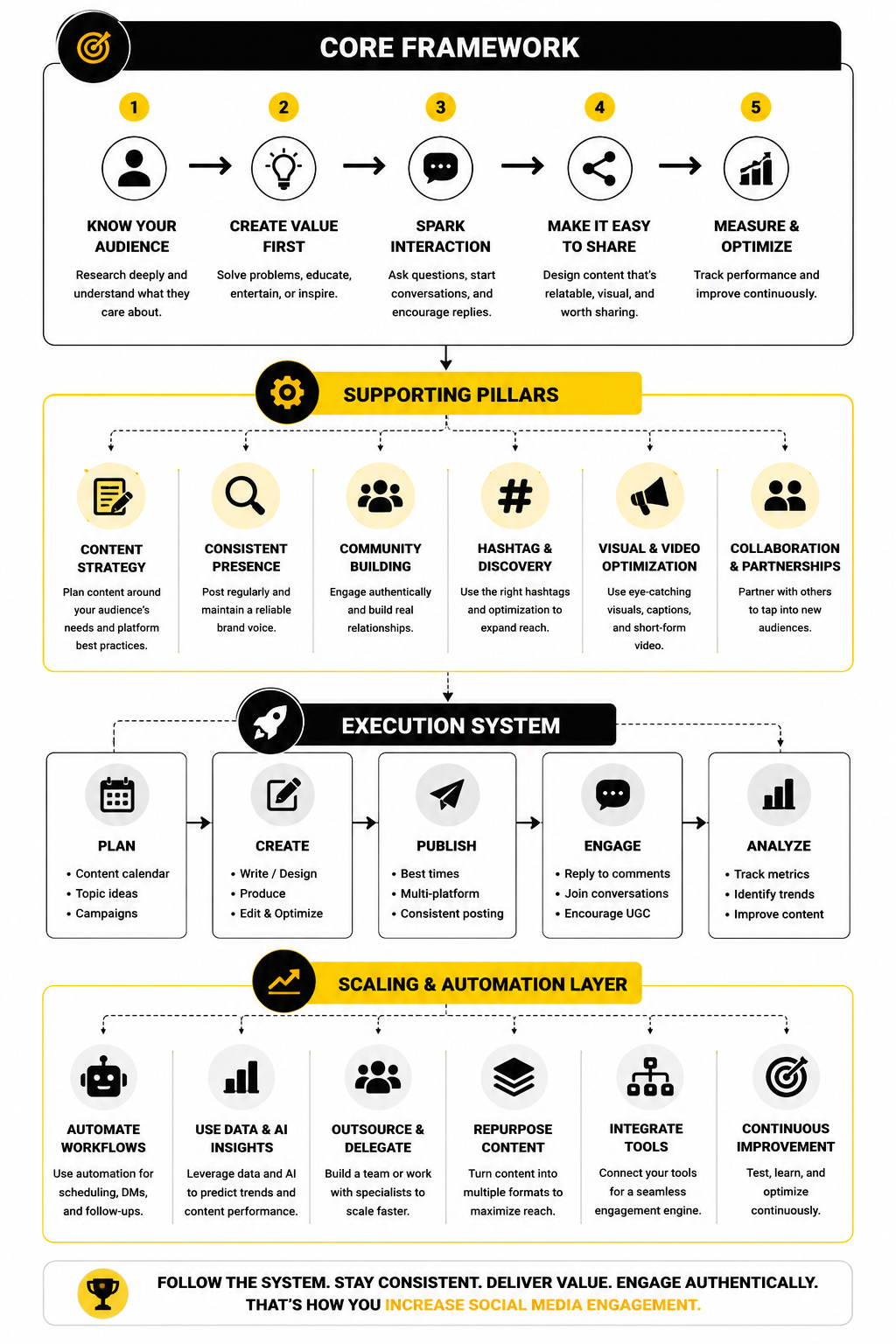
The important shift is simple: engagement is not something you “add” after the content is finished. It has to be designed into the post before you publish. The topic, hook, format, caption, CTA, visual, timing, and comment strategy all influence whether someone feels invited to participate or quietly moves on.
Audience Signals That Shape Engagement
Before you create more content, you need to understand what your audience is already telling you. Social media engagement is not random. People interact when a post matches a need, emotion, belief, curiosity gap, identity, problem, or timing moment they already care about.
That is why the first layer of the framework is audience clarity. If your audience wants practical tutorials and you keep posting broad inspiration, your engagement will probably feel weak even if the content looks polished. If your audience wants proof, examples, and specific steps, generic advice will not give them a strong enough reason to comment, save, or share.
Platform behavior supports this. Instagram explains that ranking uses signals such as activity, post information, creator relationship, and predicted actions like whether someone may spend time with a post, comment, like, share, or tap through to a profile in its official guide to Instagram algorithms and ranking. TikTok also describes recommendations as being shaped by user interactions, video information, and device or account settings in its explanation of the For You recommendation system. In plain English, your audience is training the feed with every watch, skip, reply, save, and share.
The Difference Between Visible And Hidden Signals
Visible signals are the ones everyone can see: likes, comments, shares, reposts, reactions, quote posts, saves when the platform displays them, and public replies. These signals are useful because they show which topics create enough emotion or value for someone to act publicly. They also help you spot content that attracts conversation, not just passive attention.
Hidden signals are just as important, and sometimes more important. Watch time, completion rate, profile taps, link clicks, sticker taps, DM replies, story exits, unfollows, muted posts, and repeat views tell you how people behave when nobody else is watching. A post with fewer comments but strong saves or click-throughs may be more valuable than a post with noisy reactions and no deeper action.
This is where many brands misread the room. They judge every post by likes, then accidentally stop making the content that helps people decide, trust, buy, or come back. To increase social media engagement in a serious way, you need to separate entertainment signals, trust signals, and conversion signals instead of treating every interaction as equal.
What People Engage With Most Often
People usually engage with content that gives them one of five things: usefulness, identity, emotion, novelty, or access. Useful content helps them solve a problem, make a decision, save time, avoid a mistake, or get a result. Identity-based content lets them say, “This is me,” “This is what I believe,” or “My people need to see this.”
Emotional content creates a stronger reaction, but that does not mean you need drama for the sake of drama. Emotion can be relief, surprise, validation, ambition, frustration, humor, pride, or urgency. Novelty works when the post shows something people have not seen framed that way before, while access works when people feel like they are getting behind-the-scenes insight, direct expertise, or a more honest answer than the polished version everyone else posts.
The strongest engagement often happens when two or more of these overlap. A tactical carousel that saves someone time is useful. A tactical carousel that also calls out a common frustration in their industry becomes useful and emotionally validating. That second version has a better chance of being saved, shared, and discussed because it gives people both value and language.
How To Find What Your Audience Actually Responds To
The fastest way to improve engagement is to stop guessing from inside your own head. Your audience has already left clues in comments, DMs, reviews, search behavior, community discussions, competitor posts, sales calls, support tickets, and your own analytics. Your job is to collect those clues and turn them into better content decisions.
Start by reviewing your last 30 to 90 days of posts. Do not only rank posts by reach. Rank them by meaningful actions: saves, shares, profile visits, comments with substance, replies, clicks, DMs, and posts that brought in qualified conversations. A post that reaches fewer people but creates strong buyer questions may be more strategically useful than a post that reaches a large cold audience and attracts low-intent reactions.
Then compare those posts against topic, format, hook, audience pain point, CTA, and timing. You are looking for patterns, not one-off miracles. If three posts about mistakes outperform three posts about trends, that tells you something. If short opinion posts get comments but step-by-step posts get saves, that tells you something too.
Build A Simple Engagement Research File
You do not need a complicated dashboard to begin. Create a simple research file with five columns: audience language, problem, desired outcome, content angle, and evidence. The evidence column matters because it forces you to capture where the idea came from instead of inventing content from vague assumptions.
Your best ideas will often come from exact phrases your audience already uses. Look for repeated questions in comments, objections in DMs, complaints in reviews, and phrases people use when they describe what they want. If ten people ask different versions of the same question, that is not a small detail; it is a content opportunity.
This research file also protects you from chasing every trend. A trend is useful only when it helps you express something your audience already cares about. If it does not connect to a real audience signal, it is probably just noise wearing a popular format.
Study Competitors Without Copying Them
Competitor research is useful when you study behavior, not when you copy posts. Look at which topics create long comment threads, which posts get shared into communities, which formats appear repeatedly, and which audience questions keep showing up. The goal is to understand demand, not steal creative.
Pay close attention to the gap between high-reach content and high-trust content. Some posts explode because they are controversial, funny, or emotionally charged, but they may not attract the audience you actually want. Other posts look smaller on the surface but generate sharper questions, stronger saves, and more serious buying intent.
A practical rule: copy the insight, not the execution. If a competitor’s best content works because it simplifies a confusing topic, your lesson is not to recreate their post. Your lesson is that the audience wants clarity, and you need to bring your own point of view, examples, and structure to that same need.
Turn Audience Signals Into Content Themes
Once you collect enough signals, group them into content themes. A theme is not a single post idea. It is a recurring audience need that can support many posts across different formats.
For example, a business audience might repeatedly respond to themes like mistakes to avoid, before-and-after breakdowns, simple templates, pricing objections, industry myths, tool comparisons, founder lessons, or customer decision criteria. A creator audience might respond to themes like consistency, content anxiety, algorithm confusion, monetization, editing workflow, or personal positioning. The theme depends on your audience, but the process stays the same.
Each theme should connect to a specific engagement behavior. Some themes are designed for comments because they invite opinion or experience. Others are designed for saves because they teach a process. Others are designed for shares because they express a belief or explain a problem people want others to understand.
Match The Content Format To The Engagement Goal
Not every format should do the same job. Short videos can be strong for reach, personality, education, and repeated exposure. Carousels can be useful for saves, structured explanations, and step-by-step frameworks. Stories can drive replies, polls, and low-friction participation. Live sessions and webinars can deepen trust because people get more context and direct access.
This is where many content plans become too flat. They choose formats based on what is popular instead of what the post needs to accomplish. A strong opinion may work better as a short text post or talking-head video. A detailed process may work better as a carousel, newsletter, or long-form post. A personal prompt may work better in Stories because the reply feels private and easy.
If you use tools, use them to support the workflow rather than replace the thinking. Flick Social can help with content planning and hashtag research, while Buffer can help schedule posts and review performance patterns. The real leverage comes from combining those tools with clear audience signals, not from filling a calendar just because empty slots make you uncomfortable.
Content Formats That Drive More Interaction
Once you know what your audience responds to, the next step is turning those signals into formats that make engagement easier. The format is not decoration. It shapes how quickly people understand the post, how much effort they need to engage, and what kind of action feels natural after they consume it.
Short videos are strong when you need attention, personality, speed, and emotional clarity. Carousels are strong when the idea needs structure, sequence, comparison, or a save-worthy breakdown. Stories are strong for quick replies, polls, behind-the-scenes context, and low-pressure participation. Long-form posts, live sessions, and newsletters are better when trust matters more than reach because they give people time to understand how you think.
The mistake is treating every format like a different wrapper for the same message. A short video should not simply read a carousel out loud. A carousel should not be a chopped-up blog post with tiny text. A story should not feel like a weaker feed post. Each format needs its own job inside your system if you want to increase social media engagement without burning yourself out.
Use Short Videos For Attention And Relatability
Short videos work best when the idea is easy to grasp quickly. The first few seconds matter because people decide almost instantly whether to keep watching or move on. TikTok explains that its recommendation system uses signals like user interactions, video information, and watch behavior, which means retention and relevance are not small details; they are part of the distribution game on the platform’s own recommendation system guide.
Use short videos for opinions, quick lessons, myths, mistakes, reactions, demonstrations, and personal observations that feel useful or relatable. A strong short video usually has one clear idea, one emotional angle, and one action you want from the viewer. Do not overload it with five points unless the format genuinely supports that pace.
The easiest structure is simple: open with the tension, explain the shift, then give the viewer one useful takeaway. That could be a mistake they should stop making, a decision rule they can use, or a better way to think about a problem. When the viewer feels seen and helped, engagement becomes much more natural.
Use Carousels For Saves And Structured Learning
Carousels are still valuable because they let people slow down. They work well for frameworks, checklists, mistakes, comparisons, swipe files, mini-guides, and before-and-after thinking. When someone saves a carousel, they are usually saying, “I want to use this later,” and that is a stronger signal than a casual like.
The first slide needs to promise a specific outcome or reveal a specific problem. The middle slides need to move the reader forward without repeating the same sentence in different words. The final slide should make the next action obvious, whether that is saving the post, commenting with a question, sharing it with a teammate, or clicking through to a deeper resource.
A good carousel should feel like a guided explanation, not a pile of tips. Each slide needs a reason to exist. If one slide does not create clarity, tension, proof, contrast, or action, cut it.
Use Stories For Fast Feedback
Stories are underrated because they often create private engagement instead of public engagement. Polls, sliders, question boxes, quizzes, link stickers, and simple reply prompts give people an easy way to participate without feeling exposed. That makes stories especially useful for research, nurturing, product feedback, and audience temperature checks.
The best story sequences feel casual but still have direction. Start with a relatable moment or question, add context, then invite a small response. Do not ask people to write an essay when one tap or one sentence would do.
Stories also help you understand what your audience is thinking before you turn the idea into a bigger post. If a poll gets a strong response, that topic may deserve a carousel, short video, live session, or email. If nobody reacts, that is useful too. It tells you the angle may not be sharp enough yet.
Hooks, Captions, CTAs, And Posting Rhythm
Now the process becomes more practical. The audience signal gives you the topic. The format gives the idea shape. The hook, caption, CTA, and posting rhythm determine whether the post is easy to enter, easy to understand, and easy to respond to.
This is where execution separates decent content from content that consistently earns interaction. You can have a strong idea and still lose people with a vague opening. You can have a great video and still get weak comments because the CTA asks for too much, too late, or too generically.
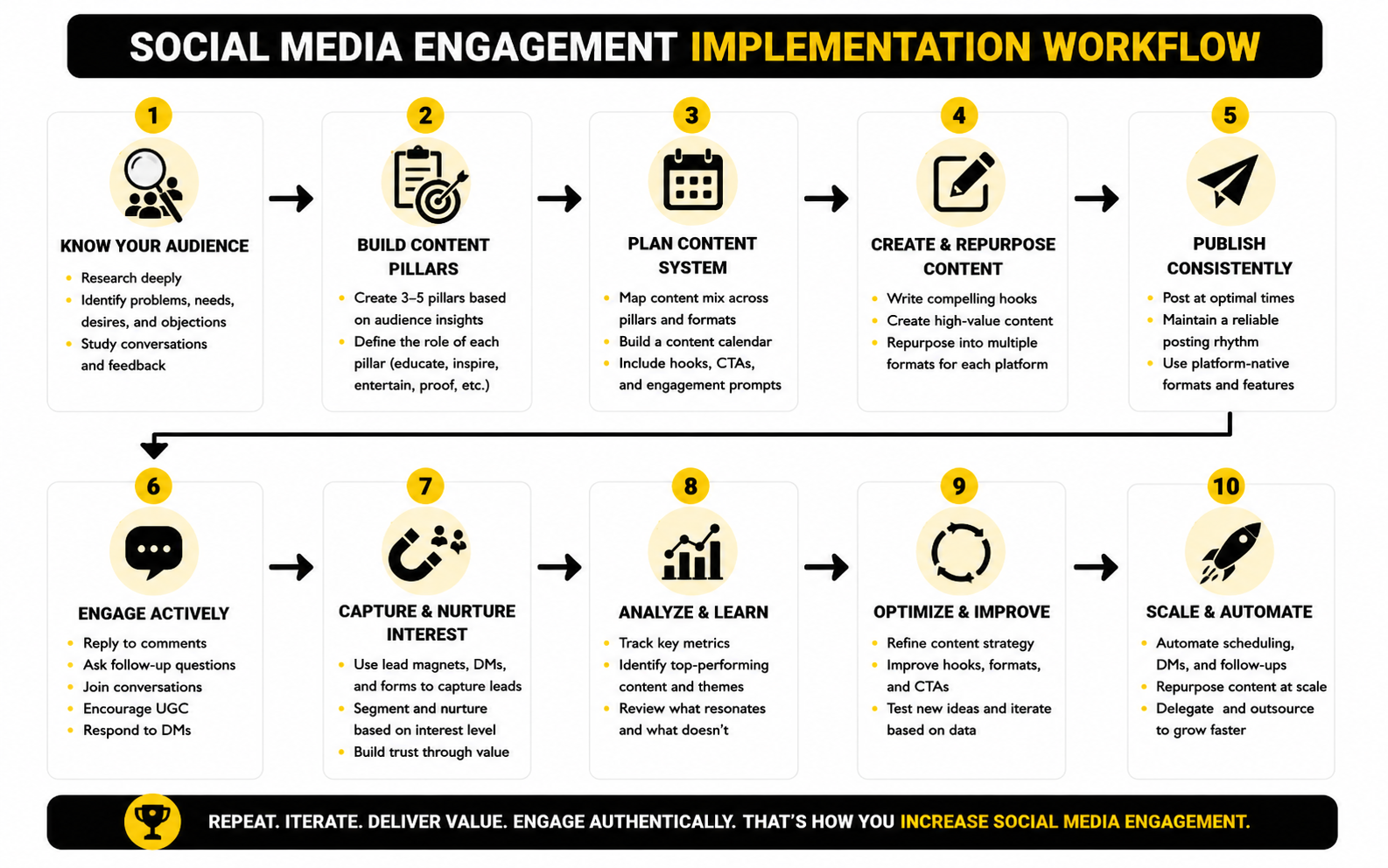
Use this process before publishing any engagement-focused post:
Write Hooks That Create A Reason To Stop
A hook is not just the first line. It is the reason someone stops scrolling and gives you attention. The strongest hooks create tension, curiosity, relevance, or immediate usefulness without sounding like clickbait.
Weak hooks are vague. They say things like “Social media tips you need to know” or “Here are some ways to grow online.” Stronger hooks are specific. They point to a real problem, a surprising truth, a mistake, a tradeoff, or a result the audience wants.
A practical hook should make the right person think, “This is for me.” That is the whole job. If your hook tries to attract everyone, it usually becomes too bland to move anyone.
Write Captions That Continue The Conversation
The caption should not repeat what the visual already said. It should add context, clarify the point, create a stronger emotional connection, or guide the reader toward action. If the post teaches a process, the caption can explain when to use it. If the post shares an opinion, the caption can explain why it matters.
Good captions feel like a human is speaking to one person. They do not need to be long, but they need to be useful. A short caption can work if the post already carries the main value, while a longer caption can work when the idea needs nuance or proof.
The first sentence of the caption matters because it often decides whether someone expands the text. Do not waste it on filler. Open with the tension, the result, or the reason the post exists.
Use CTAs That Match The Moment
A call to action should feel like the natural next step, not a desperate demand for engagement. “Comment below” is not automatically bad, but it is weak when the reader has no clear reason to comment. The CTA needs to match the type of post and the level of effort you are asking for.
For save-focused posts, ask people to save the checklist, framework, or process for later. For discussion posts, ask a specific question that people can answer from experience. For share-focused posts, frame the post around something people will want to send to a friend, client, teammate, or audience.
Avoid stacking too many CTAs in one post. When you ask someone to like, comment, share, save, click, follow, and DM you all at once, you create friction. Pick the action that matters most for that post and make it easy.
Build A Posting Rhythm You Can Actually Sustain
Consistency matters, but not the fake version where you post every day for three weeks and then disappear for two months. A strong posting rhythm is realistic, repeatable, and tied to your ability to create quality. It is better to publish three useful posts per week with strong follow-up than seven rushed posts with no interaction after they go live.
Your rhythm should include creation time, publishing time, and engagement time. That last part is critical. If you want comments, replies, and conversations, you need to be present when the post is fresh enough for people to respond.
A simple weekly rhythm might include one educational post, one opinion post, one proof or behind-the-scenes post, and one interactive story sequence. That gives your audience multiple ways to engage without making your content feel repetitive. If you need help staying organized, Buffer can support scheduling and review, while Flick Social can help with planning, ideation, and content workflow.
Repurpose Ideas Without Reposting The Same Thing
Repurposing is not copying and pasting the same content everywhere. It means taking one strong idea and adapting it to the way each platform and format works. The core insight can stay the same, but the hook, length, visual structure, CTA, and tone may need to change.
For example, one audience pain point can become a short video, a carousel, a story poll, a LinkedIn post, and a newsletter section. Each version should serve a different purpose. The video might create awareness, the carousel might earn saves, the story might collect feedback, and the long-form post might deepen trust.
This is how you get more mileage from your best ideas without watering them down. You are not trying to be everywhere with identical content. You are trying to meet your audience in the format where they are most likely to pay attention and respond.
Statistics And Data
Engagement data only matters when it changes what you do next. A number by itself does not tell you whether a post worked, whether your audience cared, or whether your content strategy is healthy. The same engagement rate can be excellent in one industry, average in another, and misleading if the post attracted the wrong people.
This is why benchmarks should be used as context, not commandments. Sprout Social’s 2025 content benchmark research analyzed more than 3 billion messages from over 1 million public social profiles and shows how much performance varies by platform, industry, and content type. Rival IQ’s 2025 benchmark report also studied millions of posts across 14 industries and 2,100 brands, which reinforces the same point: you cannot judge your results with one universal “good engagement rate.”
The goal is not to chase an abstract average. The goal is to understand whether your engagement is improving against your own baseline, whether you are competitive in your category, and whether the interactions are connected to the business outcome you actually want. If your engagement rises but your leads, conversations, trust, or customer retention do not improve, the data is telling you to look deeper.
What Engagement Rate Actually Tells You
Engagement rate helps you understand how much of your reached audience chose to interact. That makes it useful because it normalizes performance instead of only looking at raw likes or comments. A post with 500 interactions from 5,000 reached people is behaving very differently from a post with 500 interactions from 100,000 reached people.
The basic formula is simple: total engagements divided by reach, impressions, or followers, then multiplied by 100. Reach-based engagement is usually the most useful for post-level analysis because it measures how people reacted after actually seeing the content. Follower-based engagement can still help with broad benchmarking, but it can punish larger accounts and flatter smaller ones depending on distribution.
This matters when you want to increase social media engagement because the formula you choose affects the decisions you make. If you only use follower-based engagement, you may undervalue posts that reached far beyond your existing audience. If you only use raw engagement, you may overvalue large-reach posts that did not create much interaction relative to exposure.
Why Benchmarks Need Context
Benchmarks are helpful when they stop you from making emotional decisions. If your Instagram Reels engagement is lower than your carousels, that does not automatically mean Reels are failing. Reels may be doing the job of reaching new people, while carousels may be doing the job of getting saves from people who already trust you.
Hootsuite’s engagement benchmark guidance notes that a broadly “good” engagement rate often sits around 1% to 5%, depending on platform and industry. That range is useful as a rough orientation, but it is too broad to run a strategy from. A local service business, a B2B software company, a creator brand, and an ecommerce store should not interpret the same percentage in the same way.
Use benchmarks to ask better questions. Are you below your industry because the content is weak, because the audience is too broad, because posting is inconsistent, or because the platform is not the right fit for your offer? The number is not the answer. It is the starting point for diagnosis.
Measurement, Testing, And Optimization
A useful analytics system should answer three questions: what got attention, what earned interaction, and what moved people closer to trust or action. Most teams only answer the first question because reach and views are easy to see. But if you stop there, you can end up optimizing for attention without building a stronger audience.
The better approach is to group metrics by the role they play. Awareness metrics show whether the post entered enough feeds. Engagement metrics show whether people cared enough to respond. Depth metrics show whether the post created stronger interest, such as profile visits, DMs, link clicks, saves, repeat views, or qualified comments.
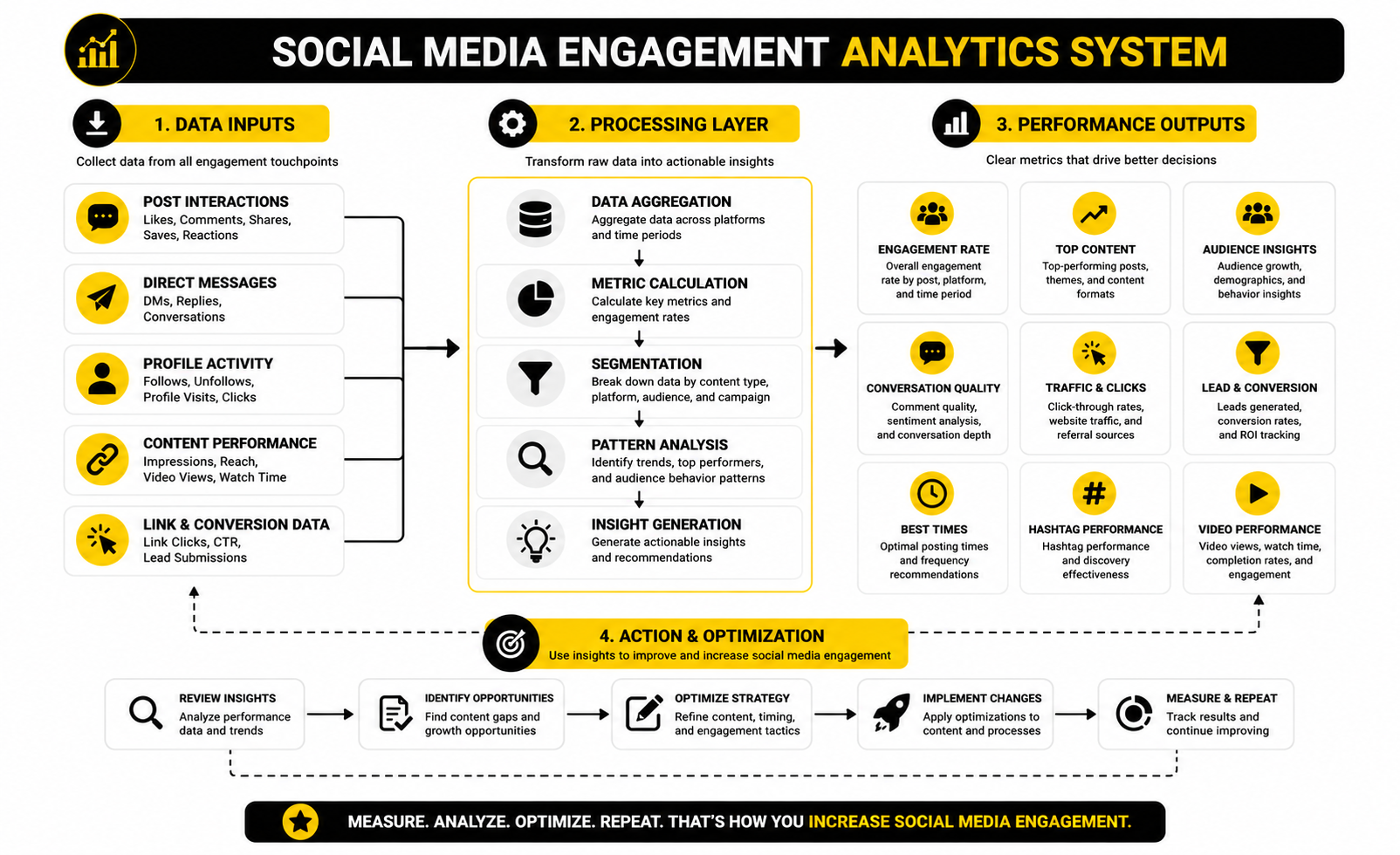
A clean measurement system does not need to be complicated. It needs to be consistent. Track the same core metrics every week, review them by content theme and format, then make one or two clear changes instead of rewriting your entire strategy every time one post underperforms.
Track Metrics By Content Job
Every post should have a job before it goes live. Some posts are designed for reach. Some are designed for saves. Some are designed for comments. Some are designed for DMs, clicks, trust, or community participation.
Once the job is clear, the metric becomes easier to interpret. A short video with high reach and low saves may still be successful if its job was discovery. A carousel with moderate reach and strong saves may still be successful if its job was education. A story with fewer views but a high reply rate may be successful if its job was feedback or relationship building.
This prevents one of the biggest analytics mistakes: judging all content by the same metric. You do not measure a thermometer, a map, and a calculator by asking which one is louder. Different tools do different jobs, and different posts should be measured the same way.
Separate Vanity Metrics From Useful Signals
Vanity metrics are not useless, but they become dangerous when they are the only thing you optimize. Likes can show lightweight approval. Views can show distribution. Follower growth can show audience expansion. But none of them automatically prove trust, intent, or business impact.
Useful signals show stronger behavior. Saves suggest the content may be practical enough to revisit. Shares suggest the content carries social value. Comments with detail suggest the topic sparked thought or emotion. DMs suggest the content created enough trust or curiosity for someone to move into a private conversation.
This distinction is critical. If your goal is to increase social media engagement that actually helps the business, you should care less about making every number bigger and more about making the right numbers stronger. A smaller post that creates five qualified sales conversations may be more valuable than a viral post full of low-intent reactions.
Read Comments For Quality, Not Just Quantity
Comment count is easy to measure, but comment quality is where the real insight lives. A post with 100 shallow comments may look strong in a report, but it may teach you less than a post with 15 detailed replies from your exact target audience. The best comments reveal objections, beliefs, questions, frustrations, buying triggers, and language you can use in future content.
Sort comments into categories. Look for questions people ask repeatedly, objections that show hesitation, personal stories that reveal emotion, and phrases that describe the problem better than your own marketing copy. These are not just engagement artifacts. They are research.
This is also why you should not ignore negative or skeptical comments automatically. Some are noise, but some reveal where your explanation was unclear, where your audience needs more proof, or where your positioning created the wrong expectation. Data is not always comfortable, but useful data rarely exists to flatter you.
Measure Saves, Shares, And DMs Differently
Saves, shares, and DMs are three of the strongest engagement signals because they usually require more intent than a like. A save means the content has future value. A share means the content has social value. A DM means the content created enough relevance for direct interaction.
Treat each one differently. If saves are strong, create more practical frameworks, checklists, templates, and decision guides. If shares are strong, study the belief, emotion, or identity behind the post. If DMs are strong, look for the trigger that made people feel safe or motivated enough to reach out.
Do not combine all engagement into one vague bucket and call it a day. The type of engagement tells you what the audience is doing with the content. That is the part that should shape your next move.
Building A Weekly Analytics Review
A weekly review is enough for most brands and creators. Daily checking often creates anxiety, especially because posts can behave differently over several days. Monthly reviews are useful for bigger trends, but they can be too slow if your content needs faster iteration.
Your weekly review should focus on patterns across posts, not isolated wins or losses. Look at the top three posts by reach, the top three by engagement rate, the top three by saves or shares, and the posts that created the best comments, DMs, or clicks. Then ask what they had in common.
A simple weekly review can follow this structure:
This process keeps you focused. You are not trying to explain every fluctuation. You are looking for practical signals that help you create better content with less guesswork.
Test One Variable At A Time
Testing becomes messy when you change too many things at once. If you change the topic, format, hook, posting time, CTA, and visual style in the same week, you will not know what caused the result. You may still learn something, but the lesson will be weaker.
Start with one variable. Test two hooks for the same topic. Test a carousel version against a short video version. Test a save-focused CTA against a comment-focused CTA. Test a practical angle against a contrarian angle.
The goal is not perfect scientific testing. Social media is too noisy for that. The goal is disciplined learning, where each test gives you a clearer next decision instead of another pile of opinions.
Create A Baseline Before You Change Everything
Before you overhaul your strategy, establish a baseline. Track your current averages for reach, engagement rate, saves, shares, comments, profile visits, DMs, clicks, and follower growth across the last 30 to 90 days. This gives you a realistic starting point.
Once the baseline is clear, set improvement targets by metric type. You may want to increase saves by improving educational content, increase comments by adding sharper opinion posts, or increase DMs by making your offers and prompts clearer. Each target should connect to a content behavior you can control.
This is how analytics becomes useful instead of overwhelming. You are not staring at numbers hoping they magically improve. You are using the numbers to decide what to create, what to refine, and what to stop doing.
Professional Implementation Workflow
At this stage, the question is not whether engagement matters. The question is how to build a workflow that keeps engagement quality high when your content volume grows, your audience gets more diverse, and your team has more moving parts. This is where most brands either become more disciplined or slowly turn social into a messy content treadmill.
A professional workflow has to protect three things at once: audience relevance, creative quality, and response speed. If you only protect relevance, you may have great ideas but inconsistent execution. If you only protect creative quality, you may publish beautiful content that does not start conversations. If you only protect speed, you may ship a lot of average posts and call it consistency.
The smartest approach is to separate strategy, creation, publishing, engagement, and review into clear stages. That does not mean the process has to become corporate or slow. It means each stage has a job, and everyone involved knows what a good decision looks like.
Build Around Content Pillars, Not Random Ideas
Content pillars are useful when they come from audience signals, not brainstorming sessions that sound impressive in a document. A pillar should represent a recurring problem, desire, belief, or decision your audience cares about. If the pillar does not connect to real questions, saves, shares, comments, DMs, or customer conversations, it is probably too abstract.
For a brand trying to increase social media engagement, each pillar should also have a clear engagement role. One pillar may be built for education and saves. Another may be built for opinions and comments. Another may be built for proof, trust, and sales conversations.
This prevents your content mix from becoming unbalanced. Without pillars, teams often overproduce the easiest content type and wonder why engagement becomes flat. With clear pillars, you can see whether you are giving people enough reasons to learn, react, trust, ask, and act.
Decide What Should Be Human And What Can Be Automated
Automation can support engagement, but it cannot replace judgment. This distinction matters more now because AI-assisted workflows are becoming normal across social teams. The risk is not using automation; the risk is using it in places where the audience expects taste, empathy, or a real point of view.
AI can help summarize research, organize comments, draft variations, repurpose ideas, and identify patterns faster. But the final opinion, story, positioning, customer response, and sensitive reply should still feel human. A 2025 experimental study on generative AI in social media found that AI tools can increase participation while also reducing perceived discussion quality and authenticity, which is exactly the tradeoff teams need to manage when scaling engagement through automation in social environments.
Use automation for routing and support, not for pretending to care at scale. For example, a DM automation tool like ManyChat can help deliver resources, segment interest, or trigger follow-up after someone comments a keyword. But if someone asks a nuanced question, complains, or shows buying intent, the handoff to a real person needs to be fast and obvious.
Create Response Rules Before You Need Them
Engagement creates exposure, and exposure creates edge cases. As your posts reach more people, you will get thoughtful questions, confused objections, angry comments, spam, support requests, partnership pitches, and people trying to pull you into arguments. If you do not define response rules early, your comment section will be run by mood.
Create clear rules for what gets answered publicly, what moves to DMs, what goes to support, what gets hidden, and what gets ignored. This is not about avoiding hard conversations. It is about making sure your brand responds with consistency instead of reacting emotionally in the moment.
A good response rule should protect the audience experience. Helpful criticism can become a great conversation. Bad-faith arguments usually do not deserve your energy. Support issues should be handled quickly, not buried under a funny reply.
Scaling Engagement Without Losing Trust
Scaling engagement is harder than getting a few good posts. Growth brings new expectations, more comments, more DMs, more content pressure, and more risk of sounding generic. The bigger your presence gets, the more important it becomes to keep the human texture that made people engage in the first place.
This is where many teams make the wrong tradeoff. They increase volume before they improve the system. More posts can help, but more weak posts can also train your audience to ignore you. Scaling should mean stronger inputs, clearer processes, better distribution, faster response loops, and sharper measurement, not just more content on the calendar.
The 2025 social landscape also makes trust harder to fake. Edelman’s brand trust research emphasizes that consumers expect brands to show up in culture and in people’s real worlds, not only through polished advertising messages in its 2025 special report on brand trust. That is a useful reminder: people do not engage deeply with brands that feel distant, scripted, or interchangeable.
Protect The Voice As More People Get Involved
When one person runs social, the voice is usually easier to control. When a team gets involved, the voice can drift. One person writes casual captions, another writes corporate replies, another overuses emojis, and another turns every comment into a sales pitch.
You need a voice guide that goes beyond “friendly and professional.” Define how the brand explains things, handles disagreement, uses humor, answers basic questions, responds to praise, and moves conversations toward the next step. Include examples of what to say and what not to say.
This is especially important if freelancers, agencies, AI tools, or multiple team members touch the content. The audience should feel like the brand has one clear personality, not five people fighting inside the same account. Consistency builds recognition, and recognition makes future engagement easier.
Balance Reach Content With Relationship Content
Reach content gets you discovered. Relationship content makes people remember you. You need both, but they should not be confused.
Reach content usually uses stronger hooks, broader pain points, trends, short-form formats, and fast emotional clarity. Relationship content is often more specific, more nuanced, more behind-the-scenes, more proof-driven, or more conversational. It may not always explode, but it helps the right people trust you more.
If every post is designed only for reach, your audience may grow without becoming more valuable. If every post is designed only for depth, you may build trust with a small group but struggle to expand. The balance depends on your stage, but the principle stays the same: reach opens the door, relationship keeps people in the room.
Know When Engagement Is The Wrong Goal
Not every post needs to maximize engagement. This sounds obvious, but it is one of the most important strategic tradeoffs. Some posts need to clarify positioning. Some need to announce something. Some need to answer a sales objection. Some need to serve existing customers. Those posts may not get the most comments, and that is fine.
A launch post, pricing explanation, technical update, or customer onboarding message may have a different job than a discussion post. If you force every post to chase comments, you can water down important communication. Engagement should support the business strategy, not hijack it.
This is why your content plan should include different success definitions. A post can be successful because it drives saves, starts sales conversations, reduces confusion, builds authority, supports a launch, or helps existing customers use your product better. The more mature your strategy becomes, the less you rely on one metric to judge everything.
Advanced Risks That Can Hurt Engagement
The fastest way to damage engagement is to train people that interacting with you is unrewarding. If comments are ignored, DMs feel robotic, questions receive vague replies, and content keeps repeating the same surface-level ideas, people stop participating. They may still follow you, but they become passive.
Another risk is over-optimization. When every post is engineered to trigger a reaction, the audience can feel it. The content starts sounding like a collection of hooks instead of a point of view. That may create short-term spikes, but it weakens long-term trust.
There is also a brand safety risk. Strong opinions can drive comments, but not every controversy is strategically useful. Before publishing polarizing content, ask whether the conversation it creates will attract the right audience, support your positioning, and still make sense a month later.
Avoid Engagement Bait
Engagement bait is content that asks for interaction without giving people a real reason to care. It may look like “comment YES,” “tag three friends,” “like if you agree,” or “only real fans will reply.” Sometimes these prompts work in the narrowest possible sense, but they often create low-quality signals and make the brand look desperate.
A better CTA gives people a reason to participate. Ask for their experience. Ask them to choose between two real options. Ask which mistake they see most often. Ask what part of the process they want explained next.
The difference is respect. Engagement bait treats the audience like a metric. Good engagement design treats them like people with opinions, problems, and context.
Do Not Confuse Speed With Strategy
Social moves fast, but that does not mean every trend deserves a response. Speed is useful when you have a clear point of view and the trend fits your audience. Speed becomes noise when you are reacting just because everyone else is.
Trend participation should pass three filters. Does it fit your audience? Does it fit your brand voice? Can you add something useful, funny, sharp, or original? If the answer is no, skipping the trend is not a missed opportunity. It is discipline.
The same applies to platform changes. New features can be useful because platforms often push adoption, but you should still test them against your goals. Use new formats when they help you create better interaction, not just because the button is new.
Prepare For Paid Amplification
Organic engagement is valuable, but organic reach is not fully under your control. As platforms mature, brands often need paid amplification to extend content that already proves it can perform. Recent reporting on influencer marketing notes that brands are increasingly putting budget behind creator content through platform amplification as organic distribution becomes harder to rely on in the creator economy.
The practical move is to use organic engagement as a testing layer. Publish content, identify posts with strong retention, saves, shares, comments, clicks, or DMs, then amplify the winners. This keeps paid spend closer to real audience behavior instead of guessing which creative deserves budget.
Do not boost every post. Boost posts that already show evidence of relevance. Paid distribution can scale a strong message, but it will not magically fix weak positioning, boring creative, or an audience mismatch.
Turning Engagement Into Business Outcomes
Engagement becomes more valuable when there is a clear path from interaction to relationship. That path might be a DM conversation, email signup, booked call, product page, webinar, community, lead magnet, or customer support flow. Without that path, engagement can feel good while leaking opportunity.
This does not mean every post should sell. It means your account should make the next step obvious when someone is ready. A person who comments on a tutorial may want the checklist. A person who replies to a story may want a recommendation. A person who asks about pricing should not be left digging through your bio.
For service businesses and agencies, a CRM and follow-up system can help turn social conversations into tracked opportunities. GoHighLevel can support this kind of pipeline when social engagement leads to calls, forms, SMS, email follow-up, or client nurturing. The key is to connect the dots without making every interaction feel like a hard sell.
Build Simple Conversion Paths
A conversion path does not have to be complicated. It needs to match the intent level of the interaction. Low-intent engagement may lead to a free resource, helpful post, or email list. Higher-intent engagement may lead to a product page, consultation, demo, or checkout.
For creators and small businesses, the simplest path is often content to DM, DM to resource, resource to email, email to offer. For ecommerce, it may be content to product education, product education to landing page, and landing page to purchase. For B2B, it may be content to conversation, conversation to audit, and audit to proposal.
If you need landing pages for campaigns, product drops, or social traffic, a builder like ClickFunnels can help create focused pages. If you want a lighter all-in-one funnel and email setup, Systeme.io can also fit simple social-to-email workflows. The tool matters less than the clarity of the path.
Use Social Proof Carefully
Social proof can increase trust, but only when it feels specific and believable. Screenshots, testimonials, customer quotes, creator collaborations, review snippets, and before-and-after proof can all support engagement. But vague claims like “everyone loves this” do very little.
Use proof to answer the question your audience is already asking. If they doubt the process works, show the process. If they doubt the result is realistic, show the context. If they doubt whether the offer fits them, show who it helped and why.
Never turn proof into bragging for its own sake. The best proof makes the reader feel more confident about their next decision. It should reduce uncertainty, not just make your brand look busy.
Keep The Loop Open
The strongest engagement systems keep listening after the conversion. Customer questions can become content. Support issues can become tutorials. Sales objections can become comparison posts. Positive outcomes can become proof.
This is how engagement compounds. The audience interacts, the brand learns, the content improves, the replies get sharper, and the next campaign starts from better insight. That loop is the real asset.
If you want to increase social media engagement long term, do not treat engagement as the finish line. Treat it as feedback. The brands that do this well get more carefully every week, while everyone else keeps guessing louder.
Recommended Tools For Engagement Systems
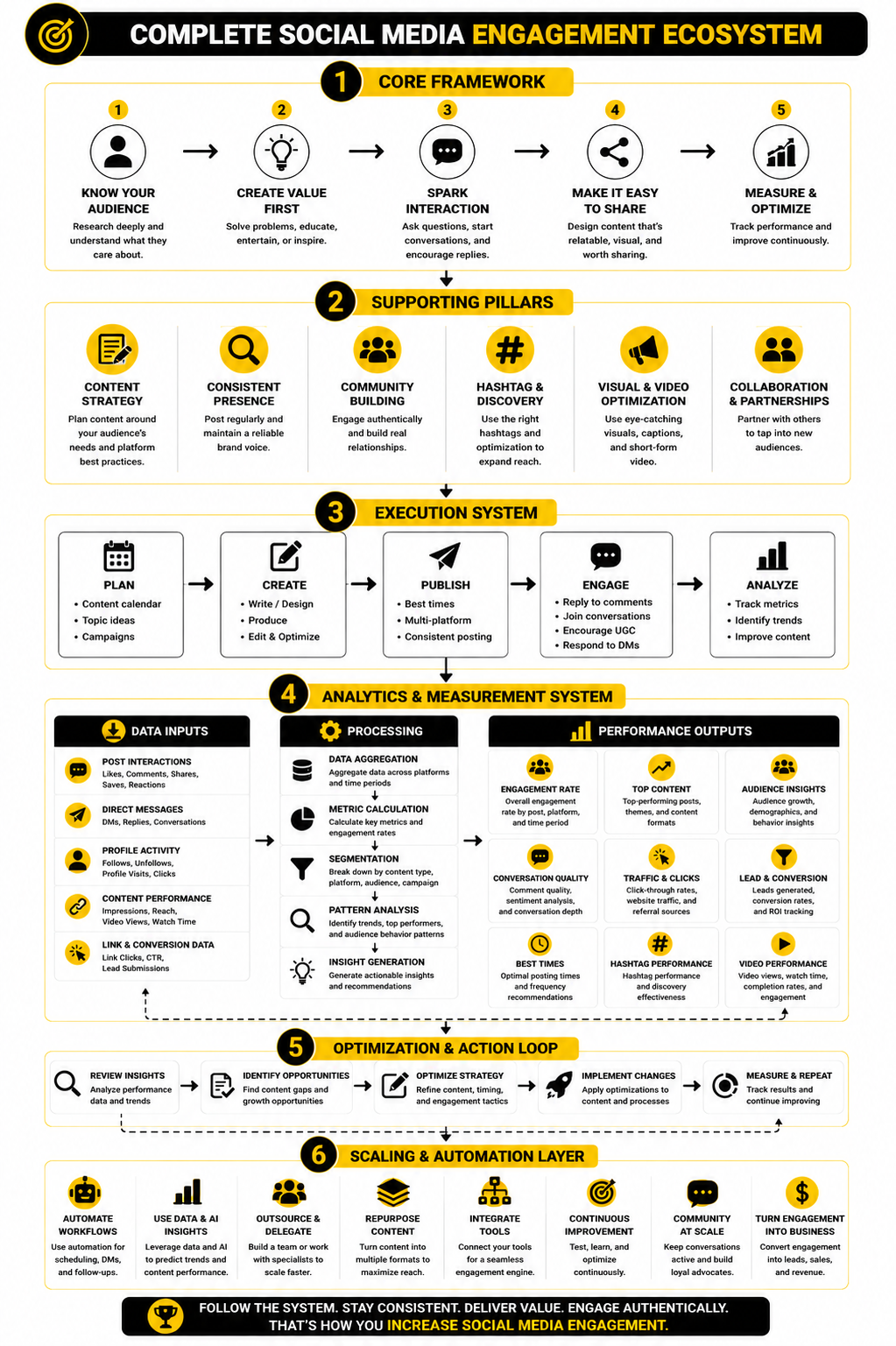
A stronger engagement system does not need a giant tech stack. It needs the right tools for the right moments: planning content, publishing consistently, managing conversations, capturing leads, following up, and learning from the results. The danger is buying tools before the process is clear.
Start with the workflow first. Decide how ideas are collected, how content is produced, how posts are scheduled, how comments and DMs are handled, how leads are captured, and how performance is reviewed. Then choose tools that remove friction from that workflow instead of adding another dashboard nobody checks.
For scheduling and content review, Buffer can help keep your publishing rhythm organized. For social content planning and hashtag research, Flick Social can support ideation and content preparation. For DM automation, ManyChat can help move interested people from public engagement into private follow-up when the flow is designed carefully.
Build The Ecosystem Around The Customer Journey
The final system should connect content to conversation, conversation to trust, and trust to a next step. That next step might be a free resource, a call, a product page, an email sequence, a webinar, or a community. The important part is that the path feels natural instead of forced.
If social engagement creates leads for a service business, a CRM and follow-up system matters. GoHighLevel can help connect forms, pipelines, calls, SMS, and email follow-up in one place. If your engagement strategy drives people into funnels, ClickFunnels or Systeme.io can support landing pages, offers, and email capture.
Use tools to shorten the distance between interest and action. A person who comments, replies, saves, or DMs is giving you a signal. Your system should help you respond while the interest is still warm, without making the audience feel like they stepped into a spam machine.
Keep The Stack Simple Enough To Maintain
A bloated stack quietly damages execution. When every task lives in a different tool, the team spends more time moving information than improving content. That creates delays, missed replies, inconsistent follow-up, and weak reporting.
A simple stack should cover four jobs. You need somewhere to plan content, somewhere to publish and review it, somewhere to manage conversations, and somewhere to capture and nurture leads. Anything beyond that should earn its place by saving time, improving quality, or creating clearer decisions.
This is also where documentation matters. Write down the workflow, the tool owner, the review cadence, and the handoff rules. If the system only works when one person remembers everything, it is not really a system yet.
How Do I Increase Social Media Engagement Fast?
The fastest way to increase social media engagement is to improve the relevance of your next few posts. Review your best-performing content, identify the topics that earned saves, shares, comments, DMs, or profile visits, then create more content around those same audience signals. Do not start by posting more; start by posting sharper.
You can also improve engagement quickly by writing stronger hooks, asking more specific questions, and being active in the comments after publishing. People are more likely to respond when the post gives them a clear reason to participate. A vague CTA usually creates vague results.
What Is A Good Social Media Engagement Rate?
A good engagement rate depends on the platform, industry, audience size, and calculation method. Hootsuite’s benchmark guidance places a broad good engagement range around 1% to 5%, but that should only be treated as a rough reference. A smaller expert account can have a much higher engagement rate than a large brand account and still produce fewer total business opportunities.
The better benchmark is your own 30 to 90 day baseline. If your saves, shares, comments, DMs, and qualified clicks are improving against your own history, you are moving in the right direction. External benchmarks help with context, but internal trend lines drive better decisions.
Which Platform Is Best For Engagement?
There is no single best platform for every brand. TikTok and Instagram can be strong for discovery and short-form video engagement, LinkedIn can be strong for professional conversations, YouTube can build deeper attention, and Facebook Groups can still work for community-based interaction. The right platform is the one where your audience already spends time and where your content format fits the way they engage.
Platform choice should follow audience behavior, not personal preference. If your buyers research complex services on LinkedIn, chasing TikTok trends may not be the best use of your energy. If your audience discovers products through creators and short videos, ignoring short-form platforms may slow your growth.
Do Hashtags Still Help Engagement?
Hashtags can help with categorization and discoverability, but they are not a magic engagement lever. A strong post with a clear audience, useful idea, and good creative will usually outperform a weak post with perfect hashtags. Hashtags should support the content, not carry it.
Use hashtags that describe the topic, audience, niche, or use case. Avoid stuffing posts with broad tags that attract the wrong people. Engagement improves when the right people see the post, not when the post reaches anyone who happens to browse a massive tag.
How Often Should I Post To Increase Social Media Engagement?
Post as often as you can maintain quality, consistency, and follow-up. For many small teams, three to five strong posts per week is better than daily content that feels rushed and receives no comment management. The right cadence depends on your resources and platform mix.
The key is to include engagement time in your schedule. Publishing is not the end of the job. If you want more comments, replies, and DMs, you need time to respond, ask follow-up questions, and turn reactions into conversations.
Why Is My Reach High But Engagement Low?
High reach with low engagement usually means the content entered a lot of feeds but did not create enough reason to act. The hook may have been strong enough to get attention, but the content may not have delivered enough value, emotion, identity, or clarity. It can also happen when the platform shows your post to a broader audience than usual and many of those people are not your ideal viewers.
Look at the type of reach before judging the result. If the post reached many non-followers, lower engagement may be normal. If it reached your core audience and still underperformed, the topic, format, or CTA may need work.
Why Do People Watch My Videos But Not Comment?
Watching requires less effort than commenting. A video can be entertaining or useful enough to watch but not specific enough to invite a response. Comments usually need a stronger emotional trigger, opinion prompt, personal question, or disagreement point.
To encourage more comments, give viewers something easy and meaningful to answer. Ask about their experience, their choice between two options, or the part of the problem they find hardest. Do not ask generic questions just because you feel like every post needs one.
Are Saves More Important Than Likes?
Saves are often more useful than likes when the content is educational, strategic, or practical. A save suggests that someone found the post valuable enough to revisit. A like may only show quick approval.
That does not mean likes are worthless. Likes can still show lightweight resonance, especially on posts built for awareness. But if your goal is to increase social media engagement that leads to trust and future action, saves, shares, comments, DMs, profile visits, and clicks usually deserve closer attention.
Should I Reply To Every Comment?
Reply to comments when your response adds value, encourages conversation, answers a question, or strengthens community. You do not need to force replies to spam, low-effort bait, or comments that clearly do not deserve more oxygen. The goal is quality conversation, not mechanical reply volume.
For thoughtful comments, reply like a person. Add context, ask a follow-up question, or point the person to a helpful next step. When your comment section feels alive and useful, more people become comfortable participating.
Can AI Help Increase Social Media Engagement?
AI can help you move faster, but it should not replace your judgment. It can summarize audience research, generate hook variations, organize content ideas, repurpose posts, and help draft replies. The final message still needs your taste, positioning, and understanding of the audience.
Use AI for leverage, not personality replacement. Audiences can often feel when a brand is publishing generic AI content with no clear point of view. The best use of AI is to support a sharper human strategy.
What Is The Biggest Mistake Brands Make With Engagement?
The biggest mistake is treating engagement as the goal instead of the signal. A comment, share, save, or DM tells you something about what the audience cares about. If you only celebrate the number and do not learn from the behavior, you miss the real value.
Another common mistake is chasing viral formats that attract the wrong people. Engagement from the wrong audience can make reports look better while making the business weaker. The best engagement comes from people who match your market, understand your value, and are more likely to trust you over time.
How Long Does It Take To Improve Social Media Engagement?
You can often improve individual posts quickly by sharpening the hook, topic, format, and CTA. But improving engagement as a system usually takes several weeks of consistent publishing, reviewing, and adjusting. You need enough data to see patterns instead of reacting to one post at a time.
A realistic improvement cycle is 30 to 90 days. That gives you enough time to test themes, compare formats, review comment quality, and refine your posting rhythm. The goal is not one spike. The goal is a stronger baseline.
What Metrics Should I Track Every Week?
Track reach, engagement rate, saves, shares, comments, DMs, profile visits, link clicks, follower growth, and post format. Also track qualitative notes like audience questions, objections, repeated phrases, and comment quality. Those notes often explain the numbers better than the dashboard does.
Keep the review simple. Identify what got attention, what earned meaningful interaction, and what moved people closer to trust or action. Then decide what to repeat, improve, or stop next week.
How Do I Turn Engagement Into Leads?
Give people a clear next step that matches their intent. A low-intent comment may lead to a helpful resource. A stronger DM may lead to a call, demo, product recommendation, or email follow-up. The smoother the path, the less opportunity you lose.
This is where your social content, DM process, landing pages, email system, and CRM need to work together. Engagement opens the door, but follow-up turns interest into pipeline. If the next step is confusing, people disappear even when the content worked.
Build a stronger local presence with BAAM AI
Turn your website, Google profile, social channels, and AI visibility into one growth engine
Most businesses do not need more random marketing activity. They need a consistent presence system that helps the right people find them, trust them, and take action. BAAM AI brings strategy, local SEO, website updates, Google Maps visibility, social content, AI-search readiness, media production, and reporting into one practical monthly engine.
If you want your marketing to keep working after the campaign ends, start with a free BAAM AI presence audit. See how your business shows up today and where the fastest visibility wins are at BAAM AI.