
BAAM AI Blog
How To Choose An SEO Digital Marketing Company That Actually Grows Revenue
Hiring an SEO digital marketing company should not feel like buying a mystery box. You are not just paying for rankings, blog posts, backlinks, dashboards, or monthly calls. You are paying for a growth system that...
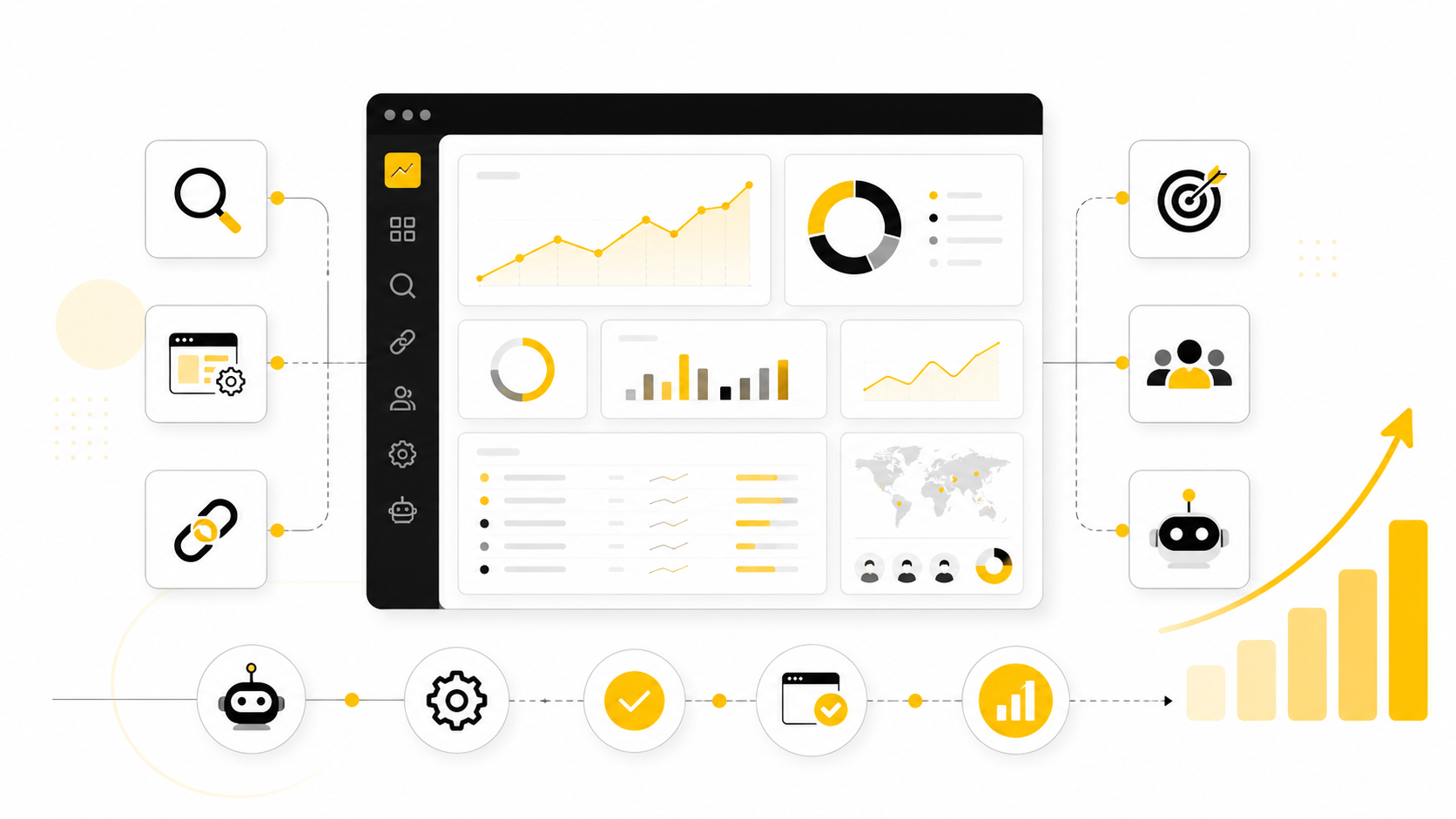
Hiring an SEO digital marketing company should not feel like buying a mystery box. You are not just paying for rankings, blog posts, backlinks, dashboards, or monthly calls. You are paying for a growth system that should help the right people find you, trust you, and eventually become customers.
That is why the choice matters so much. A weak agency can keep you busy with reports while nothing meaningful changes. A strong one connects search demand, content, technical SEO, conversion strategy, analytics, and commercial priorities into one clear plan.
The best SEO digital marketing company is not always the loudest one, the cheapest one, or the one promising the fastest traffic spike. It is the company that understands your market, can explain its strategy without hiding behind jargon, and knows how to turn visibility into measurable business outcomes.
Why the Right SEO Digital Marketing Company Matters
SEO is no longer just about ranking for a few keywords and waiting for leads to appear. Search behavior is more fragmented now, buyers compare brands across multiple channels, and trust is built through repeated useful interactions. A good SEO digital marketing company understands that organic search is one part of a larger customer journey, not a standalone tactic.
That matters because rankings without business context can become expensive vanity metrics. You can rank for keywords that bring the wrong visitors, publish content that never supports sales, or build traffic that does not convert. The right company should care about revenue quality, lead intent, customer acquisition cost, and the path from first search to final decision.
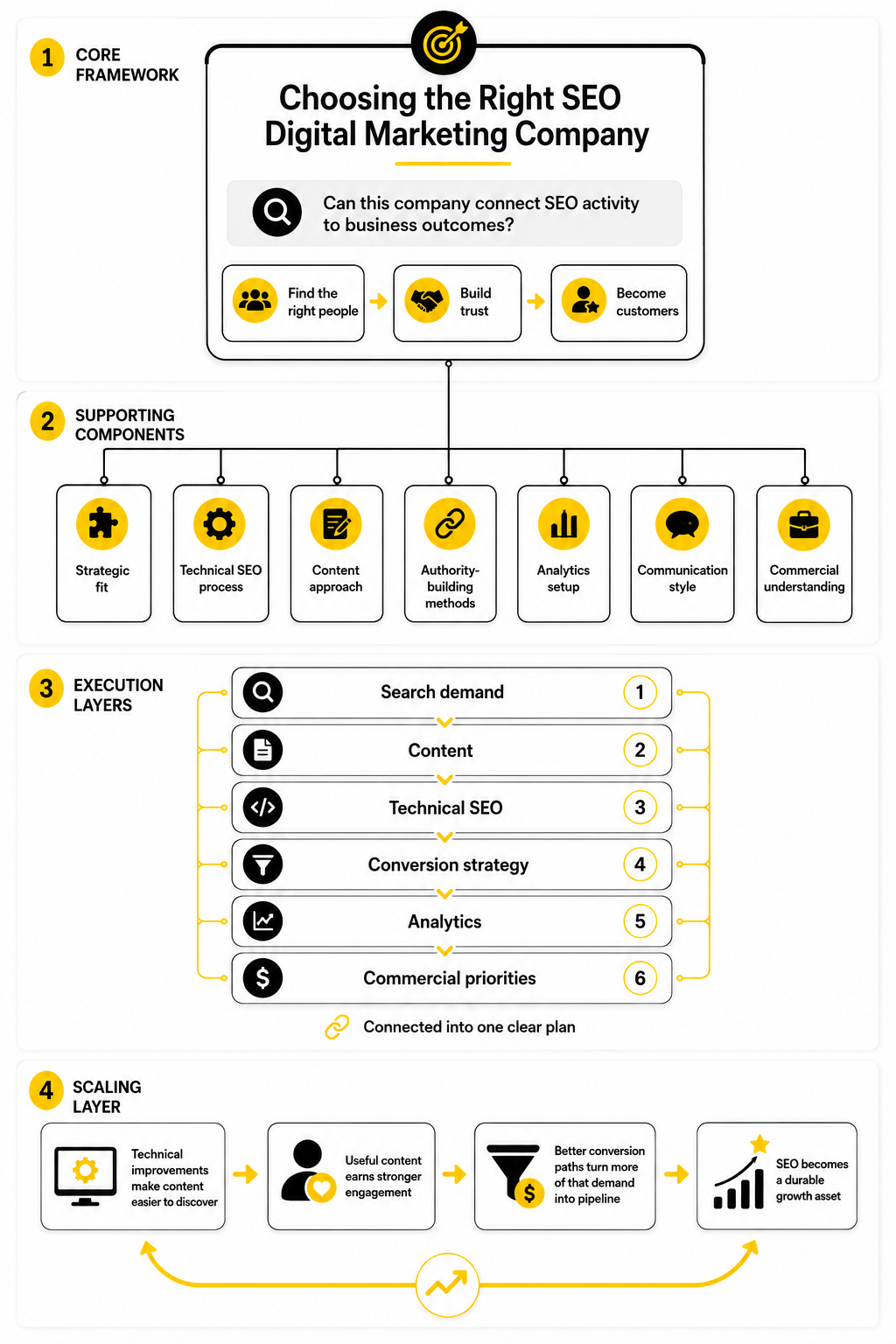
It also matters because SEO compounds when the foundation is built correctly. Technical improvements make content easier to discover, useful content earns stronger engagement, and better conversion paths turn more of that demand into pipeline. When these pieces work together, SEO becomes less of a monthly expense and more of a durable growth asset.
The Framework for Choosing the Right Partner
A practical evaluation starts with one simple question: can this company connect SEO activity to business outcomes? If the answer is vague, the relationship will probably become vague too. You want a partner that can explain what they will fix, what they will build, how they will measure progress, and why those actions matter for your specific market.
The framework is straightforward. First, look at strategic fit. Then review their technical SEO process, content approach, authority-building methods, analytics setup, communication style, and commercial understanding. Each area tells you whether you are dealing with a serious growth partner or a vendor selling generic deliverables.
This is especially important for businesses that need more than traffic. If your sales cycle is long, your product is complex, or your market is competitive, the SEO digital marketing company you choose must understand positioning, funnel stages, and buyer intent. Otherwise, you may get activity without momentum.
What this guide Will Help You Decide
By the end of this six-part guide, you should be able to judge an SEO digital marketing company with more confidence. You will know what services actually matter, which questions expose weak strategy, and how to separate real expertise from polished sales language. The goal is not to make you an SEO expert overnight, but to help you make a better hiring decision.
You will also see why SEO cannot be evaluated in isolation. A company may be good at keyword research but weak at conversion strategy. Another may create strong content but ignore technical barriers that stop pages from performing. The right partner needs enough range to see the whole system.
Most importantly, this guide will help you avoid passive agency relationships. You should never be left wondering what is happening, why it matters, or whether the work is moving the business forward. A professional SEO digital marketing company should make the strategy clearer, not more confusing.
What an SEO Digital Marketing Company Actually Does
A serious SEO digital marketing company does more than “optimize pages.” That phrase is too small for the work that actually moves a business forward. The real job is to help your website become easier to find, easier to trust, and easier to convert.
That work usually sits across four areas: technical SEO, content strategy, authority building, and performance tracking. Each area supports the others. If one is weak, the whole system starts leaking value.
This is also where many businesses misunderstand what they are buying. They think they are hiring someone to get rankings. In reality, they should be hiring a team that can diagnose the full organic growth engine and improve it piece by piece.
Technical SEO Makes the Website Search-Ready
Technical SEO is the foundation. If search engines cannot crawl, understand, or index your important pages, even strong content can underperform. Google’s own documentation describes SEO as work that helps search engines crawl, index, and understand your content, which is exactly where a professional partner should begin.
A good SEO digital marketing company will check how your site is structured, how fast key pages load, whether pages are indexable, and whether technical issues are blocking visibility. They should review internal linking, redirects, canonical tags, XML sitemaps, structured data, duplicate content risks, mobile usability, and page experience. None of this is glamorous, but it matters because technical friction quietly limits everything else.
This does not mean every business needs an enterprise-level technical audit every month. A small service business and a large ecommerce site have different needs. The point is that your agency should know which technical problems actually matter for your site and which ones are just noise.
Content Strategy Turns Search Intent Into Useful Pages
Content is where SEO becomes visible to customers. People search because they have problems, questions, comparisons, doubts, and buying intent. A strong SEO digital marketing company maps those searches to pages that help the reader move forward.
That means content strategy is not just a list of keywords. It includes topic selection, search intent analysis, page formats, content depth, internal linking, brand positioning, and conversion paths. Google’s guidance on helpful, reliable, people-first content makes the direction clear: content should serve the user first, not just the algorithm.
The best agencies know when to create a new page, when to improve an existing one, and when not to publish at all. More content is not automatically better. If the strategy is weak, publishing faster only creates a bigger cleanup job later.
On-Page SEO Connects Relevance With Clarity
On-page SEO is the process of making each important page clear, useful, and aligned with the searcher’s intent. This includes titles, headings, URLs, meta descriptions, internal links, image context, schema opportunities, and the actual structure of the page. Done well, it helps both search engines and readers understand why the page exists.
This is where keyword use needs discipline. The primary keyword should appear naturally, but the page should never sound like it was written for a robot. A good SEO digital marketing company will use related terms, real questions, and logical subtopics so the page feels complete without becoming bloated.
On-page SEO also needs commercial awareness. A page targeting early-stage research should not be treated the same way as a page targeting buyers who are comparing vendors. The agency should know where each page sits in the customer journey and shape the call to action accordingly.
Authority Building Helps Your Site Earn Trust
Authority building is often reduced to backlinks, but that is only part of the picture. Links still matter because they can signal that other websites trust or reference your content. But link building done badly can damage credibility, waste budget, and create long-term risk.
A professional SEO digital marketing company should focus on earning relevant mentions from credible sources, not chasing random links from weak websites. That can include digital PR, original research, partnerships, expert contributions, resource pages, and genuinely useful assets that people have a reason to reference. The goal is not just “more links.” The goal is stronger trust around the right topics.
This is where you need to be careful with cheap SEO packages. If an agency cannot explain where links come from, why they are relevant, and how they protect your brand, that is a problem. Authority building should feel like brand building with search benefits, not like a shortcut.
Analytics Shows Whether SEO Is Working
SEO without measurement becomes guesswork. A good agency should set up reporting that shows what is improving, what is stuck, and what needs to change. Google Search Console can show search impressions, clicks, average position, indexing signals, and query data through its Search Console reports, while analytics platforms help connect that traffic to behavior and conversions.
The important part is not having a pretty dashboard. The important part is knowing what decisions the data supports. If impressions are rising but conversions are flat, the issue may be intent, page quality, offer clarity, or the next step after the click.
This is why reporting should include both SEO metrics and business metrics. Rankings, traffic, and clicks matter, but they are not the finish line. Leads, qualified opportunities, sales, revenue influence, and customer acquisition efficiency are closer to the truth.
Digital Marketing Support Extends SEO Beyond Search
Many companies need more than SEO execution. They need the surrounding digital marketing system that turns organic traffic into pipeline. That may include landing pages, email follow-up, marketing automation, retargeting strategy, social distribution, conversion optimization, and CRM workflows.
For example, an agency serving local businesses or service providers may use a platform like GoHighLevel to connect forms, follow-up messages, pipelines, appointment booking, and lead nurturing. A content-heavy brand may use Buffer to distribute SEO content across social channels after publication. A business with email-driven nurturing may use a platform like Brevo to keep new leads engaged after they download, subscribe, or request more information.
The tool is not the strategy, though. This is important. A strong SEO digital marketing company chooses tools based on the funnel, the team, and the customer journey instead of forcing every client into the same stack.
Strategy Is What Holds the Work Together
The difference between a vendor and a partner is strategy. A vendor completes tasks. A partner understands the commercial goal and builds the SEO plan around it.
That strategy should answer practical questions. Which audience matters most right now? Which topics can realistically win? Which pages have the highest upside? Which technical issues are blocking growth? Which conversions should be improved before scaling traffic?
When an SEO digital marketing company can answer those questions clearly, the work starts to feel focused. You are no longer buying isolated deliverables. You are building a system where technical fixes, content, authority, analytics, and conversion improvements all support the same business outcome.
The Core Components of a Strong SEO and Digital Marketing Strategy
Once the role of an SEO digital marketing company is clear, the next question is execution. What should the actual process look like? Not the sales deck version. The working version.
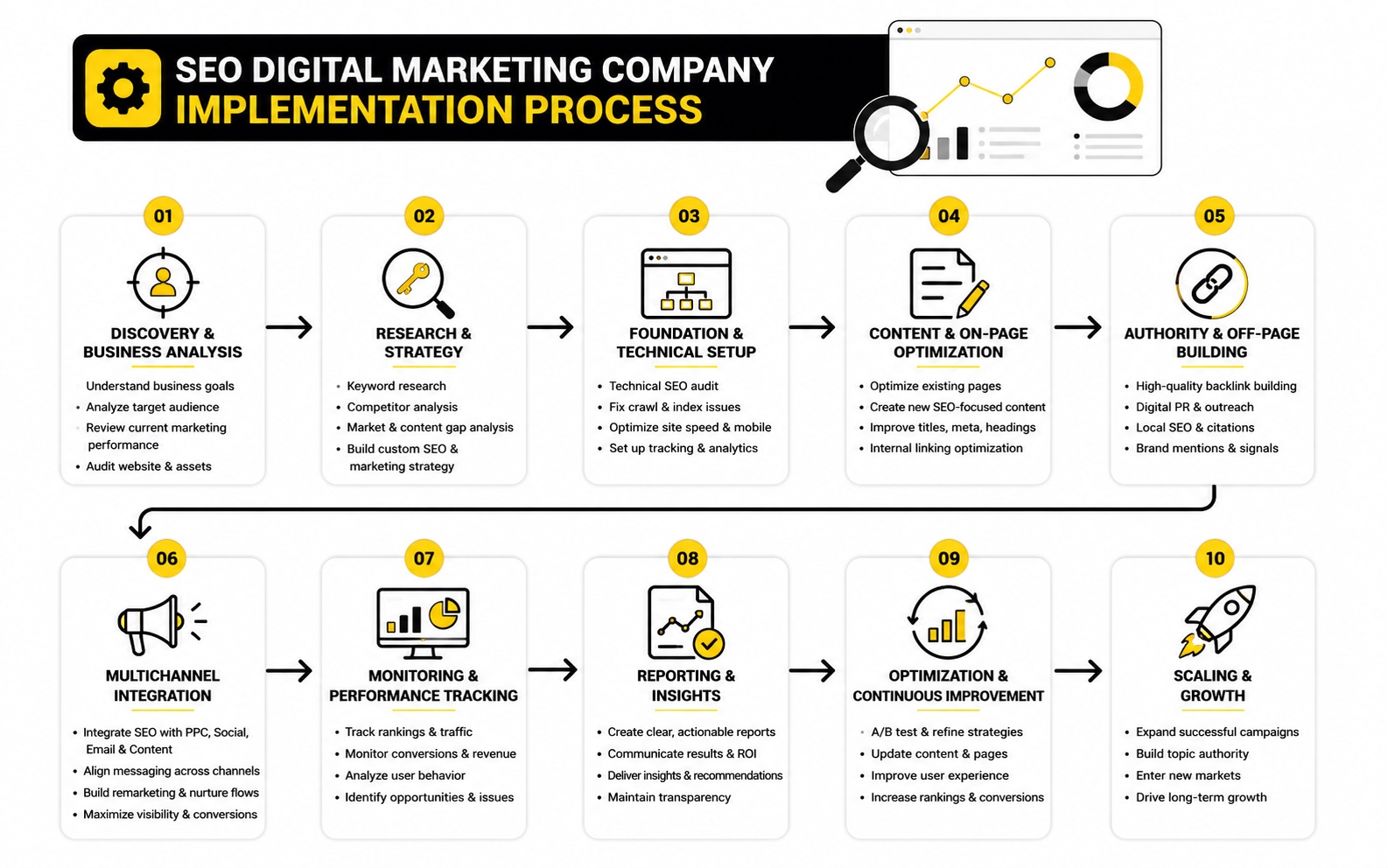
A strong strategy is usually built in layers. You start with diagnosis, then prioritize the biggest constraints, then build content and conversion assets around real demand. After that, you measure, improve, and repeat.
That sounds simple, but the discipline is in the order. If an agency jumps straight into publishing content before understanding the site, the market, the offer, and the buyer journey, they are guessing. Good implementation is not random activity. It is a controlled growth process.
Step 1: Diagnose the Current Situation
The first step is always diagnosis. A professional SEO digital marketing company should begin by understanding where the business is now, what is already working, and where growth is being blocked. This includes the website, analytics, content library, search visibility, competitors, conversion paths, and commercial goals.
A proper diagnosis should separate symptoms from causes. Low traffic might be caused by weak content, poor indexing, lack of authority, technical problems, bad keyword targeting, or a market where demand is smaller than expected. Treating all of those the same way is lazy.
This phase should produce a clear picture of the opportunity. Which pages can be improved quickly? Which content gaps matter most? Which technical issues are holding back performance? Which competitors are winning because they have stronger pages, better authority, or a clearer offer?
Step 2: Set Commercial Priorities Before SEO Priorities
SEO priorities should come after business priorities. That is non-negotiable. If the goal is more qualified sales calls, the strategy should not be built around informational traffic that never reaches the pipeline.
This is where a good agency asks sharper questions. Which products or services matter most? Which customers are most profitable? Which locations, industries, or use cases deserve focus? Which offers convert best once people actually land on the site?
Once those answers are clear, SEO becomes more focused. The company can prioritize keywords, pages, and campaigns that support real business outcomes instead of chasing traffic for its own sake. That is how you avoid the classic mistake of growing sessions while revenue stays flat.
Step 3: Map Search Intent Across the Funnel
Search intent is the bridge between keyword research and actual strategy. People do not search in a straight line. They search when they are confused, comparing, validating, budgeting, troubleshooting, or ready to act.
A strong SEO digital marketing company will group keywords by intent, not just by volume. Some searches need educational content. Some need comparison pages. Some need service pages, local landing pages, case studies, pricing explanations, or product-led pages.
This matters because the wrong page type can kill performance. A blog post may rank for an informational query but fail completely for a buyer-ready query. A sales page may feel too aggressive for someone still learning the basics. Matching intent to page format is one of the simplest ways to make SEO feel less like guesswork.
Step 4: Build the Execution Roadmap
After diagnosis and prioritization, the agency should build a roadmap. This is where the process becomes tangible. You should be able to see what will happen first, what comes next, and how each action supports the broader strategy.
A practical roadmap usually includes:
This roadmap should not be overloaded with everything at once. A bloated plan looks impressive but often creates slow execution. The best roadmap is focused, sequenced, and realistic enough that the team can actually ship the work.
Step 5: Improve Existing Assets Before Creating More
One of the smartest things an SEO digital marketing company can do is improve what already exists. Many websites have pages that are close to working but under-optimized, outdated, poorly structured, or disconnected from the rest of the site. Fixing those pages can often create faster movement than publishing a large batch of new content.
This can include rewriting titles, improving introductions, adding missing sections, strengthening internal links, clarifying calls to action, refreshing outdated information, and making the page more useful for the searcher. It can also mean consolidating thin pages that compete with each other. More pages do not always mean more growth.
This step is practical because it respects the assets you already paid to create. A good agency does not treat your website like a blank canvas unless it truly needs to. It looks for leverage first.
Step 6: Create New Content With a Clear Job
New content should have a job before it is written. It should attract a specific type of visitor, answer a specific search intent, support a specific stage of the funnel, or strengthen topical authority around an important commercial area. If nobody can explain the job of a page, the page probably should not be created yet.
This is where many content programs go wrong. They publish because the calendar says it is time to publish. A better process starts with the buyer, the search intent, the competitive gap, and the next step you want the reader to take.
The page also needs a natural role inside the website. It should link to related resources, support relevant service or product pages, and help the reader continue their journey. Content that sits alone rarely carries its full weight.
Step 7: Connect SEO With Conversion Paths
Traffic is only valuable if the next step is clear. A professional SEO digital marketing company should look at what happens after someone lands on the site. Can they understand the offer quickly? Can they request a quote, book a call, compare options, subscribe, download, or take the next logical step without friction?
For service businesses, this may mean stronger contact forms, booking flows, or follow-up automation. Tools like GoHighLevel can help connect landing pages, forms, pipelines, and automated follow-up when the business needs a more complete lead management system. For businesses that rely heavily on landing pages and funnels, ClickFunnels or Systeme.io may fit when the priority is turning campaigns into simple conversion flows.
The key is not the tool itself. The key is making sure organic traffic does not arrive at a dead end. If the SEO strategy brings the right visitor to the right page, the conversion path needs to help that visitor act.
Step 8: Measure What Actually Changes
Measurement should show progress, but it should also guide decisions. A good agency tracks visibility, rankings, clicks, engagement, conversions, assisted revenue, indexed pages, page improvements, and technical health. The point is not to drown you in numbers. The point is to see what is changing and what needs attention.
This also helps avoid emotional decision-making. SEO often moves unevenly. Some pages improve quickly, some take longer, and some need a different angle after real data comes in. Without measurement, every dip feels like a crisis and every spike feels like a victory.
The better approach is consistent review. What was shipped? What improved? What did not move? What should be tested next? That rhythm is what turns SEO from a one-time project into a growth system.
Step 9: Keep Improving the System
SEO implementation does not end when the first roadmap is complete. Markets change, competitors update pages, search results shift, and customer expectations evolve. The strategy needs maintenance, but more importantly, it needs learning.
A strong SEO digital marketing company will use performance data to refine the next round of work. Winning pages can be expanded, weak pages can be rebuilt, and new opportunities can be added as the site gains authority. This is where compounding starts to show up.
The process is not magic. It is diagnosis, prioritization, execution, measurement, and improvement. When those steps are handled with discipline, SEO becomes much more predictable and far less mysterious.
Statistics and Data
Data is where an SEO digital marketing company proves whether the strategy is actually working. Not with vague claims. Not with a dashboard full of colorful charts. With numbers that explain what changed, why it changed, and what should happen next.
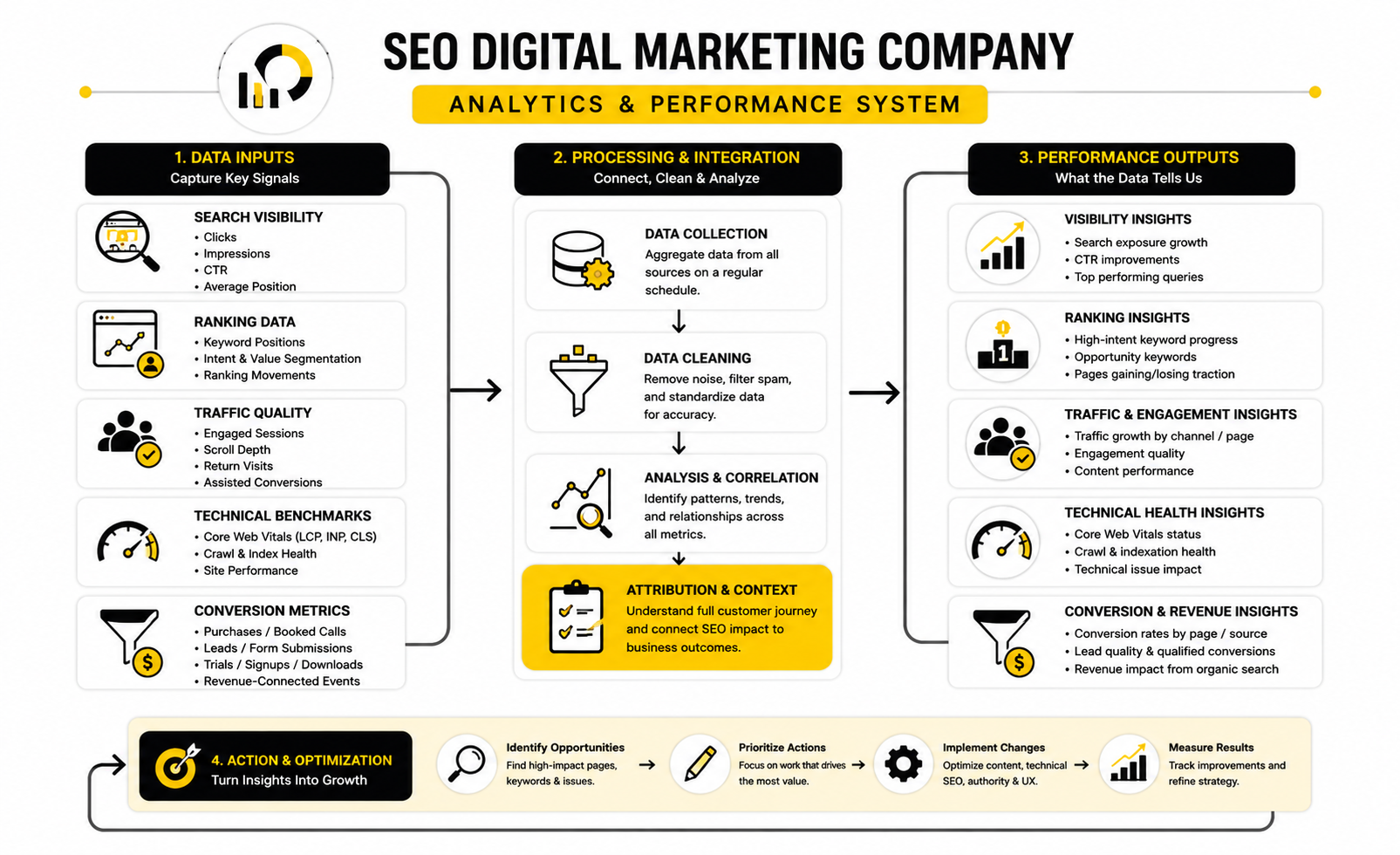
The useful numbers usually fall into a few groups: visibility, traffic quality, technical health, engagement, conversions, and revenue influence. Each group answers a different question. If you only look at one of them, you can easily misread the whole campaign.
That is the trap. More impressions can look exciting, but they may not produce more clicks. More clicks can look like growth, but they may not produce better leads. More leads can look like success, but they may not turn into customers if the intent is weak or the follow-up is broken.
Visibility Metrics Show Whether Search Demand Is Opening Up
Visibility metrics show whether your site is appearing more often for relevant searches. In Google Search Console, the Performance report tracks clicks, impressions, average CTR, and average position, which makes it one of the most useful starting points for SEO measurement. These numbers help you see whether the market is starting to see your pages.
Impressions matter because they show search exposure. If impressions rise for relevant queries, your content is beginning to enter more search results. But impressions alone do not mean people are choosing you.
That is where CTR and clicks come in. If impressions are rising but CTR is weak, the page may need a better title, clearer positioning, stronger relevance, or a more compelling angle. A smart SEO digital marketing company will not celebrate impressions in isolation. They will ask what those impressions are doing for the business.
Ranking Data Needs Context
Rankings are useful, but they are not the whole truth. A keyword moving from position 18 to position 9 can be meaningful, even if it has not created a major traffic increase yet. A keyword holding position 1 may be less valuable than it looks if the query has low buying intent.
This is why ranking reports should be grouped by intent and business value. Brand terms, informational terms, commercial comparison terms, service terms, and local terms should not be judged the same way. They play different roles in the journey.
The best agency reports do not just say, “Here are your keyword movements.” They explain what those movements mean. Did a service page get closer to the top results? Did a high-intent comparison page start gaining traction? Did a blog post begin supporting internal links to a money page? That context is what makes ranking data useful.
Traffic Quality Matters More Than Traffic Volume
Traffic volume is easy to understand, which is why it gets too much attention. More visitors feels good. But if those visitors are not aligned with your offer, the campaign can look successful while the sales team sees no improvement.
Traffic quality is measured through behavior and outcomes. Useful signals include engaged sessions, scroll depth, return visits, assisted conversions, form starts, booked calls, demo requests, quote requests, and revenue-connected events. These signals show whether organic visitors are doing anything meaningful after they arrive.
This is where the agency needs to think like a marketer, not just an SEO technician. If traffic is growing but conversion quality is weak, the answer may not be “publish more.” The answer may be better intent targeting, stronger landing pages, clearer calls to action, or better lead qualification.
The Analytics System Should Connect Search To Revenue
A proper analytics system connects the search journey to business outcomes. At a basic level, that means Search Console for search visibility, analytics for user behavior, and CRM or sales tracking for lead quality. Without that connection, the SEO digital marketing company is only seeing part of the picture.
Google Analytics 4 uses events and key events to help track important user actions, and its attribution tools help marketers understand how channels contribute to conversions across the journey through conversion and attribution settings. That matters because organic search often assists conversions before the final click. Someone may discover you through a blog post, return through a brand search, and convert later from a direct visit.
If the agency only reports last-click conversions, SEO can be undervalued. If they only report traffic, SEO can be overvalued. The correct approach is to look at the full path and decide which pages, queries, and campaigns are helping buyers move closer to action.
Technical Benchmarks Show Hidden Friction
Technical benchmarks help identify problems that users may feel before marketers notice them. Core Web Vitals measure user experience signals such as loading performance, interactivity, and visual stability through LCP, INP, and CLS. These metrics do not replace content quality, but they do help reveal whether the site experience is getting in the way.
A slow or unstable page can hurt trust, especially on mobile. Visitors may not complain. They simply leave, hesitate, or choose a competitor that feels easier to use.
A good SEO digital marketing company should use technical data to prioritize fixes based on impact. Not every warning deserves urgent attention. The real question is whether the issue affects important pages, high-value visitors, crawling, indexing, or conversions.
Conversion Metrics Reveal The Real Commercial Impact
Conversion metrics are where SEO starts becoming a business conversation. A conversion might be a purchase, booked call, lead form submission, quote request, trial signup, newsletter signup, or content download. The right conversion depends on the business model.
The mistake is treating every conversion as equal. A newsletter signup is not the same as a qualified demo request. A contact form from the wrong market is not the same as a high-intent inquiry from a profitable customer segment.
That is why conversion tracking should be tied to lead quality wherever possible. If a page drives fewer leads but better customers, it may be more valuable than a page that produces a high number of weak inquiries. A serious agency will help you understand that difference.
Benchmarks Should Guide Decisions, Not Become Excuses
Benchmarks are useful when they create perspective. Organic search produced 33% of overall website traffic across seven key industries in 2024, which shows why SEO still deserves serious attention in a broader marketing mix. But that does not mean every business should expect the same share of traffic.
Your benchmark depends on your industry, brand awareness, content maturity, competition, budget, website history, and sales cycle. A new website in a competitive market should not be judged the same way as an established domain with years of content and authority. Context matters.
The best use of benchmarks is not to copy someone else’s number. The best use is to ask better questions. Are we improving against our own baseline? Are we gaining visibility in commercially valuable areas? Are the right pages contributing more over time?
Reporting Should Turn Numbers Into Decisions
A report should never leave you thinking, “So what?” Every metric should have a reason for being there. If it does not help explain performance or guide action, it probably does not need to be in the report.
A strong monthly report should usually explain:
This keeps the relationship practical. You are not just receiving numbers. You are seeing the logic behind the next round of decisions.
The Best Data Creates Better Priorities
Data is not there to make the agency look busy. It is there to make prioritization sharper. If a page has strong impressions but weak CTR, improve the title and positioning. If a page has traffic but weak conversions, improve the offer and call to action. If a page has high intent but poor rankings, strengthen content, internal links, and authority.
This is where SEO becomes more predictable. The team is no longer guessing what to do next. They are using search data, user behavior, and commercial outcomes to decide where the next hour or dollar should go.
That is exactly what you want from an SEO digital marketing company. Not random activity. Not vanity reporting. A measurement system that shows what matters, explains what it means, and turns the next step into a clear decision.
Professional Implementation, Reporting, and Growth Systems
At this stage, the question is no longer whether SEO matters. It does. The sharper question is whether the SEO digital marketing company can operate like a growth partner instead of a task factory.
That difference becomes obvious when the work gets more complex. Early wins may come from fixing obvious technical issues, improving existing pages, or cleaning up weak content. But scaling organic growth requires better decision-making, tighter prioritization, and a clear understanding of tradeoffs.
This is where experience matters. A beginner can follow a checklist. A strong partner knows when the checklist is not enough.
The Tradeoff Between Speed and Quality
Every SEO campaign has a speed problem. You want results quickly, but the work that lasts usually takes more thinking, better execution, and cleaner systems. Push too fast and you risk publishing shallow pages, building weak links, or making technical changes that create new problems.
A good SEO digital marketing company should know where speed helps and where it hurts. Fast technical fixes can be smart when they remove obvious crawl or indexation problems. Fast content updates can be useful when a page already has demand and only needs a clearer structure, stronger intent match, or better internal links.
But speed becomes dangerous when it replaces judgment. Google’s spam policies warn against practices such as scaled content abuse and link spam, which is exactly why mass-producing low-value pages or chasing cheap links is not a serious growth strategy. You want momentum, not shortcuts that create cleanup work later.
Scaling Content Without Losing Trust
Scaling content is one of the hardest parts of SEO. Publishing more pages can help a site cover more topics, answer more questions, and build topical depth. But scale only works when quality control gets stronger at the same time.
This is especially important now because search systems are designed to reward content that is useful, reliable, and created for people rather than content made only to manipulate rankings through people-first content standards. That does not mean every page needs to be a masterpiece. It means every page needs a reason to exist.
An agency should have a clear editorial process before increasing production. That process should include topic validation, search intent checks, expert review when needed, internal linking, content refresh plans, and conversion alignment. Without those controls, scaling content becomes scaling clutter.
When Automation Helps and When It Hurts
Automation can make an SEO program more efficient. It can help with reporting, crawling, keyword clustering, content briefs, internal workflows, lead follow-up, and repetitive QA. Used well, automation gives the team more time for strategy and execution.
Used badly, automation creates generic work at a higher speed. That is the problem. A tool can collect data, suggest patterns, or help organize a process, but it cannot replace judgment about your market, your customer, and your offer.
The safest way to think about automation is simple: automate the repeatable parts, keep humans responsible for strategy and quality. A platform like Firecrawl can support data collection and website extraction workflows, while Chatbase may help businesses turn site knowledge into customer-facing chat experiences. Those tools can support the system, but they should not become the system.
Managing Risk In Competitive Niches
Competitive SEO brings risk because the margin for weak decisions is smaller. In easy markets, average work may still produce movement. In hard markets, average work disappears.
The biggest risks usually come from poor prioritization, thin content, messy site architecture, weak conversion paths, and low-quality authority building. These issues compound quietly. By the time the business notices, months of budget may already be gone.
A capable SEO digital marketing company should be honest about this. If your niche is competitive, they should not promise effortless rankings. They should explain the level of investment, the likely timeline, the strongest opportunities, and the constraints that need to be solved before growth becomes realistic.
Balancing SEO With Paid, Social, and Email
SEO should not sit in a silo. Organic search often works better when the rest of the marketing system supports it. Paid campaigns can test messaging quickly, social distribution can increase content visibility, and email can nurture visitors who are not ready to buy yet.
This does not mean every business needs every channel at once. It means the agency should understand how channels influence each other. A strong article can support sales conversations, email sequences, retargeting audiences, LinkedIn posts, and internal enablement.
This is why the surrounding stack matters. Buffer can help distribute content consistently after publication, ManyChat can support conversational follow-up in social messaging environments, and Brevo can help turn new subscribers or leads into ongoing relationships. The important thing is that each tool has a clear role in the customer journey.
Avoiding The Agency Dependency Trap
One underrated risk is becoming too dependent on the agency. If the SEO digital marketing company owns all the knowledge, all the reporting, all the strategy, and all the access, the client becomes stuck. That is not a healthy partnership.
A better agency makes the business more carefully over time. They explain decisions, document key work, share access properly, and help internal teams understand what matters. You should not need to become an SEO specialist, but you should understand the strategy well enough to make informed decisions.
This also protects the business if the relationship changes later. You should know what was done, why it was done, where the assets are, which pages matter most, and what the next priorities are. Good implementation leaves a trail. Bad implementation leaves confusion.
Choosing Between Specialist and Full-Service Support
There is no single perfect agency model. A specialist SEO firm may be stronger in technical audits, content strategy, or organic search execution. A broader digital marketing agency may be better when you need SEO connected with paid media, funnels, email, automation, and sales systems.
The right choice depends on your bottleneck. If your site has serious crawl, indexation, architecture, or content quality problems, a specialist may be the better first move. If your traffic is already growing but leads are not converting, you may need a partner with stronger conversion and funnel skills.
Be careful with agencies that claim to be excellent at everything without showing depth anywhere. Full-service can be valuable, but only when each service is actually managed well. Otherwise, you are just buying a bigger menu.
Budget Should Match The Size Of The Opportunity
SEO budget should be tied to the size of the opportunity and the difficulty of the market. A small local business, a national service company, a SaaS brand, and an ecommerce store do not need the same level of investment. Their search landscapes, content requirements, technical needs, and revenue potential are different.
The wrong budget creates the wrong expectations. Spend too little in a competitive space and the work may never reach enough intensity to matter. Spend aggressively without a clear strategy and you may simply waste money faster.
A good SEO digital marketing company should help you think through this honestly. What is the potential upside? How competitive is the space? What assets already exist? How much work is needed before growth is realistic? Those answers should shape the budget more than a generic package ever could.
The Best Partnerships Are Built On Clear Ownership
SEO works better when responsibilities are clear. The agency may handle strategy, research, audits, content briefs, reporting, and recommendations. But the client may still need to approve pages, provide subject-matter input, give access to analytics, connect sales feedback, and help remove internal blockers.
When ownership is vague, progress slows down. The agency waits on approvals. The client waits on updates. Nobody knows who is responsible for implementation, and the roadmap starts slipping.
A professional relationship avoids that early. It defines who owns technical changes, who edits content, who publishes, who reviews performance, who manages tools, and who makes final decisions. That clarity may not sound exciting, but it is often the difference between a strategy that ships and a strategy that sits in a spreadsheet.
Expert Guidance Should Make The Next Move Obvious
The best agencies reduce confusion. They do not make SEO feel bigger and more mysterious than it needs to be. They take a complex system and turn it into a clear sequence of priorities.
That is the expert-level standard. Not endless tasks. Not inflated reports. Not vague promises about “building authority” without specifics.
A strong SEO digital marketing company should be able to tell you what matters now, what can wait, what is risky, what is worth testing, and what decision the data supports. When you get that kind of clarity, you are no longer just buying SEO services. You are building a more carefully growth system.
Red Flags, Final Checklist, and FAQ
By now, the pattern should be clear. A good SEO digital marketing company does not sell noise. It builds a system that connects search visibility, useful content, technical performance, authority, conversion paths, and reporting.
The final step is knowing what to avoid and how to make the buying decision with confidence. This matters because agency sales can sound polished even when the actual delivery is weak. You need a practical filter before you sign anything.
The goal is not to find a perfect company. That does not exist. The goal is to find a partner with enough skill, honesty, process, and commercial awareness to help your business grow without wasting months on disconnected activity.
Red Flags To Watch Before You Hire
Be cautious if an agency guarantees specific rankings. No serious SEO digital marketing company controls Google, competitors, search behavior, or algorithm changes. They can control the quality of the work, the process, the strategy, and the pace of improvement, but they cannot honestly guarantee position one by a fixed date.
Another red flag is vague deliverables. If the proposal says “SEO optimization” but does not explain what will be audited, improved, created, measured, or reported, you are buying fog. You should know what work will happen and why it matters.
You should also be careful with agencies that talk only about traffic. Traffic is useful, but it is not the business outcome. If they do not ask about lead quality, sales cycles, margins, offers, conversion rates, or your highest-value customers, they may optimize for numbers that look good while your revenue stays flat.
Questions That Reveal How Good The Agency Really Is
The right questions make weak strategies obvious. You do not need to interrogate the agency aggressively. You just need to ask practical questions that force them to explain their thinking.
Good questions include:
The last question is especially useful. Strong agencies can talk about risks honestly. Weak agencies avoid risk because they want the sale more than they want the right fit.
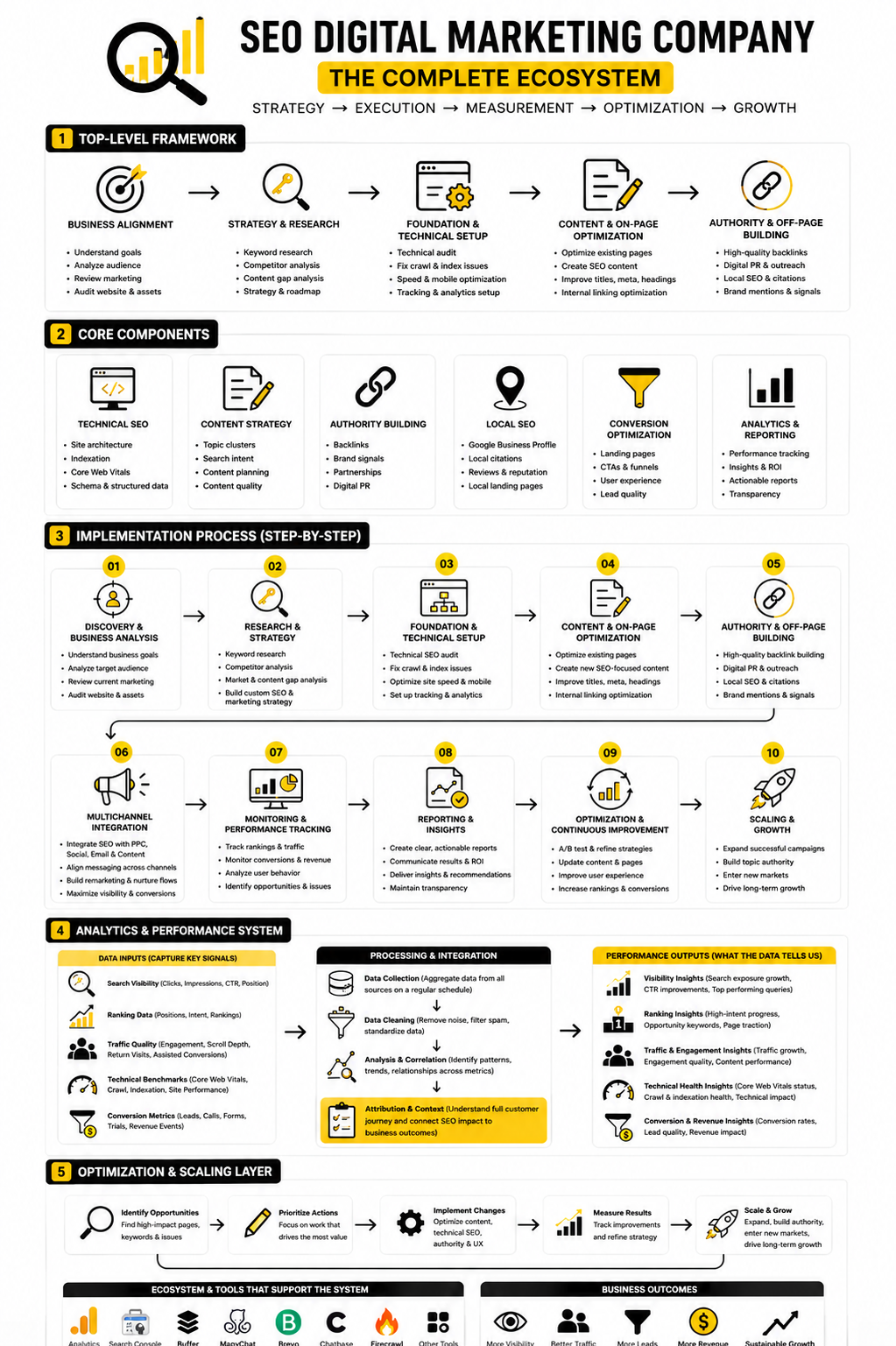
The Final Decision Framework
Choosing an SEO digital marketing company becomes easier when you judge the whole system instead of one shiny promise. You are not just choosing a vendor. You are choosing how your organic growth will be diagnosed, prioritized, executed, measured, and improved.
A strong partner should be clear in five areas. They should understand your business model, know how to find and prioritize search opportunities, have a practical implementation process, report on meaningful performance signals, and communicate in a way that makes decisions easier.
That is the standard. If an agency can explain the strategy clearly before you hire them, they are more likely to execute clearly after you hire them. If everything feels vague during the sales process, it will usually feel even vaguer once the contract starts.
Final Hiring Checklist
Use this checklist before signing with any SEO digital marketing company. It will not catch everything, but it will prevent the most common mistakes. If the company cannot satisfy most of these points, slow down.
The best choice is usually the company that feels both strategic and grounded. Not flashy. Not evasive. Clear, practical, and focused on the work that actually moves the business.
What does an SEO digital marketing company do?
An SEO digital marketing company helps businesses improve organic visibility, attract better visitors, and turn that traffic into leads or customers. The work can include technical SEO, content strategy, on-page optimization, authority building, analytics, conversion improvements, and broader digital marketing support. The best companies do not treat SEO as an isolated task because organic search performs better when it is connected to the full customer journey.
How do I know if I need an SEO agency or a freelancer?
Choose a freelancer if your needs are narrow, your budget is limited, and you already know what work needs to be done. Choose an agency if you need strategy, technical support, content planning, reporting, implementation coordination, and multiple skill sets working together. The more complex your site, market, and sales funnel are, the more valuable a structured team becomes.
How long does SEO take to work?
SEO usually takes time because search engines need to crawl, process, and evaluate changes while competitors continue improving their own sites. Some improvements can show up quickly, especially technical fixes or updates to existing pages with search demand. Bigger growth usually comes from consistent execution over months, not one isolated push.
What should the first month with an SEO company include?
The first month should usually include discovery, analytics review, technical checks, keyword and intent research, competitor review, content evaluation, and a prioritized roadmap. It should not be only meetings and vague setup. By the end of the first month, you should understand what the company found, what they will prioritize, and why those priorities matter.
Should an SEO digital marketing company create content for me?
Yes, if content is part of the growth strategy and the company has a strong quality process. Content should be based on search intent, customer needs, competitive gaps, and business value. If the agency only produces generic blog posts without understanding your offer or audience, that content can become a liability instead of an asset.
Is link building still important?
Authority still matters, but link building needs to be handled carefully. The goal is not to collect random links from weak websites. The goal is to earn relevant mentions, references, partnerships, and editorial links that strengthen trust around the topics your business wants to own.
What metrics should I expect in SEO reporting?
A useful report should include visibility, clicks, impressions, rankings, traffic quality, conversions, technical health, completed work, and next-step recommendations. It should also explain what the numbers mean. A dashboard without interpretation is not reporting. It is decoration.
How much should I pay for SEO services?
The right budget depends on your market, goals, website condition, competition, and revenue opportunity. A local business with a focused service area needs a different investment than a national brand, SaaS company, ecommerce store, or multi-location business. Be careful with prices that seem too low for the level of competition because underfunded SEO often creates slow, weak execution.
Can SEO work without paid ads?
Yes, SEO can work without paid ads, but paid campaigns can sometimes support the overall strategy. Paid traffic can test offers, headlines, landing pages, and conversion paths faster than SEO alone. SEO is usually stronger when the business uses insights from multiple channels instead of treating every channel as a separate island.
What is the biggest mistake businesses make when hiring an SEO company?
The biggest mistake is hiring based on promises instead of process. A polished pitch can hide weak execution. Before hiring, you need to understand how the company diagnoses problems, chooses priorities, measures outcomes, communicates progress, and connects SEO to actual business goals.
Should I hire a local SEO company or a remote one?
A local company can be helpful if your business depends heavily on local search, local relationships, or in-person collaboration. A remote SEO digital marketing company can be just as effective if they understand your market, communicate clearly, and have a strong process. Location matters less than expertise, execution quality, and strategic fit.
What makes one SEO company better than another?
The better company usually has clearer thinking. They understand the business model, prioritize work based on impact, explain tradeoffs honestly, and measure the things that actually matter. They also know when not to do something, which is just as important as knowing what to do.
Can I switch SEO companies if I am not happy?
Yes, but make sure you keep access to your website, analytics, Search Console, content files, reports, and any work produced during the engagement. A professional agency should not trap you by controlling essential assets. If you switch, start with a careful review so the new partner understands what was done, what worked, and what needs to be fixed.
Build a stronger local presence with BAAM AI
Turn your website, Google profile, social channels, and AI visibility into one growth engine
Most businesses do not need more random marketing activity. They need a consistent presence system that helps the right people find them, trust them, and take action. BAAM AI brings strategy, local SEO, website updates, Google Maps visibility, social content, AI-search readiness, media production, and reporting into one practical monthly engine.
If you want your marketing to keep working after the campaign ends, start with a free BAAM AI presence audit. See how your business shows up today and where the fastest visibility wins are at BAAM AI.