
BAAM AI Blog
How Social Media and Mobile Marketing Work Together to Drive Growth
Social media and mobile marketing are two pillars of modern digital outreach that, when aligned, amplify brand visibility, engagement, and conversions in ways no other channels can match. As more people spend...
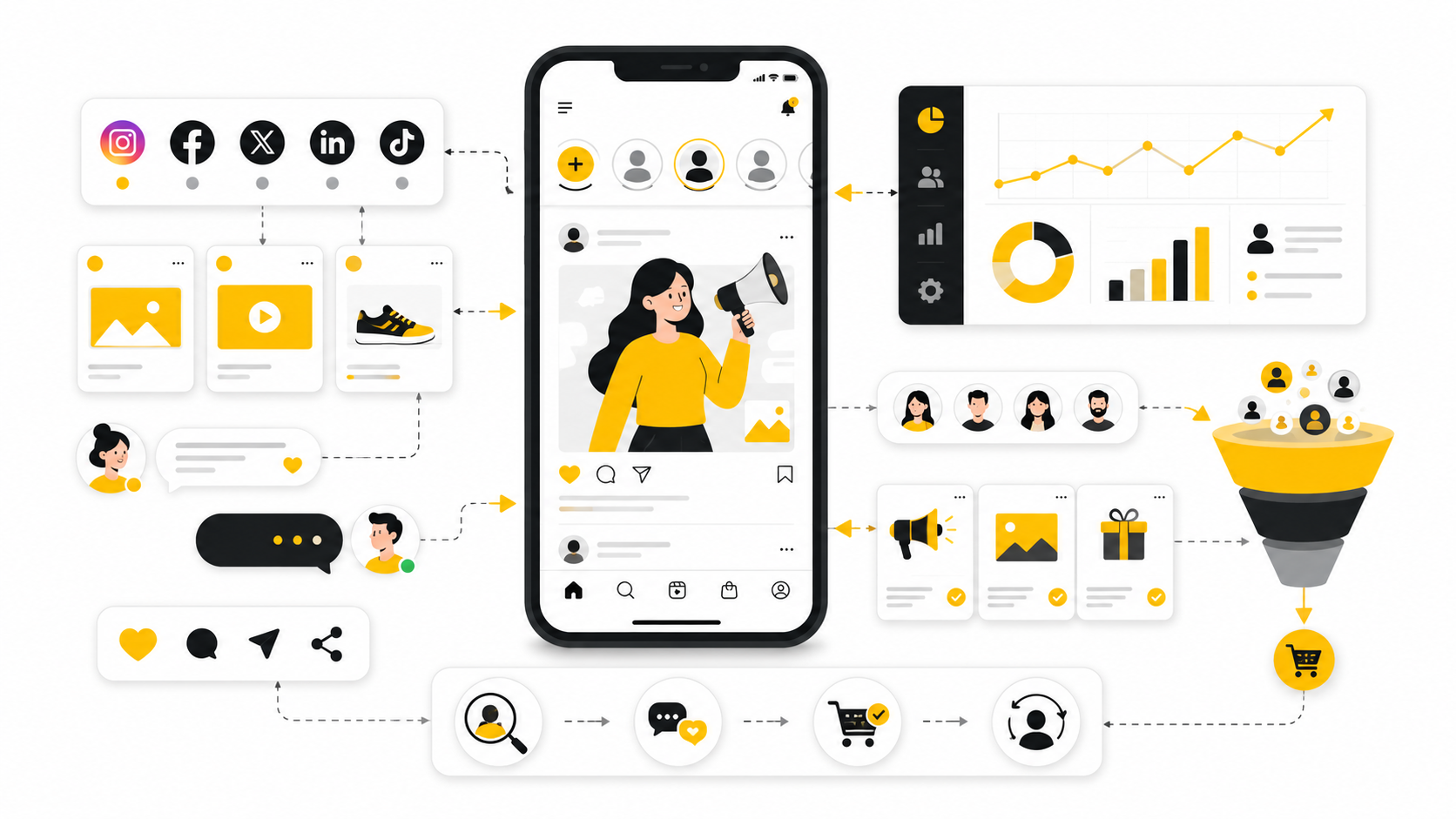
Social media and mobile marketing are two pillars of modern digital outreach that, when aligned, amplify brand visibility, engagement, and conversions in ways no other channels can match. As more people spend increasing portions of their day on smartphones and social platforms, understanding how these forces interact is critical for any growth‑oriented business.
Here’s how this guide will break down the topic:
Why Social Media and Mobile Marketing Matter Today
In 2026, more than 5.6 billion people use social media worldwide, and many hop between nearly seven platforms each month, making social media indispensable for brand discovery and engagement. Mobile devices aren’t just convenient - they are now the primary surface for most digital engagement, with around 75 % of global e‑commerce traffic originating from mobile and nearly all social sessions occurring on phones.
That synergy means social media and mobile marketing are not separate tactics; they are intertwined channels that shape how consumers discover, interact with, and buy from brands. When marketers master both together, they build unmatched reach and relevance.
Key Trends Shaping Mobile and Social Marketing
Marketers should pay attention to how user behavior changes the competitive landscape:
These trends emphasize that content, design, and timing must all be optimized for the social + mobile context if brands aim to retain attention and drive action.
Core Components of Social Media and Mobile Strategies
Building an effective strategy requires clarity on both sides of the equation:
These components underline that social media and mobile marketing strategies must be planned jointly, not in isolation, to be truly effective.
Integrating Social Media with Mobile Marketing Tactics
Effective integration goes beyond posting ads on mobile social apps:
The goal is to create a smooth customer experience that moves someone from discovery on social to action on mobile without friction.
Measuring Impact and ROI
To understand whether your social + mobile efforts pay off, focus on metrics that speak to both engagement and outcomes:
With data flowing from both social platforms and mobile behavior tracking, marketers can pinpoint which tactics drive real business results and adjust strategies more confidently.
Future Opportunities and Challenges
Looking ahead, mobile and social marketing will be shaped by personalization, privacy, and platform innovation. As users spend more time on mobile and expect tailored experiences, brands that deliver relevant, responsive, and mobile‑native content will continue to outpace competitors.
However, this shift also raises challenges around data privacy, measurement complexity, and creative fatigue. The brands that navigate those challenges while keeping the user experience at the center will build the full potential of social media and mobile marketing combined.
In the next part, we’ll explore how to implement these strategies in real campaigns with practical steps and frameworks marketers can apply today.
Integrating Social Media With Mobile Marketing Tactics
Now that you’ve seen how social media and mobile marketing each work on their own, it’s time to weave them together into practical, actionable tactics you can implement in real campaigns. The key is to design strategies where social engagement naturally feeds mobile engagement - and vice versa - so every touchpoint moves someone closer to a meaningful action.
Design Content for Mobile‑First Social Engagement
Content that performs well on social platforms must be optimized for mobile screens and behavior. Vertical formats, like short‑form videos and stories, are now the norm because they match how people scroll and interact on phones. Short‑form video feeds such as Instagram Reels, TikTok, and YouTube Shorts dominate attention and drive discovery more than static posts. Brands that use these mobile‑native formats see higher engagement and retention than those sticking with traditional landscape content.
Beyond formats, social content must be responsive and easy to act on. That means clear calls to action that make sense on a tiny screen - “tap to shop,” “swipe up to learn more,” or “send us a DM” - so people can engage without thinking. It also means remembering that people rarely click long links on mobile; micro‑landing pages or fast‑loading bio links are essential to keep friction low.
Streamline Journeys With Deep Linking and In‑App Actions
One of the biggest losses in digital marketing happens when someone clicks a social ad and lands on a generic homepage with no direction. Deep linking solves that by taking users directly from a social ad into the exact screen in an app or mobile site where the intended action happens. Deep links eliminate extra steps and dramatically increase conversion potential by reducing friction in the journey.
Similarly, social platforms increasingly support in‑app actions - like shopping tags, appointment bookings, or direct messages - that keep people inside the mobile environment longer and make conversion easier. When mobile design meets social features, users spend less time detaching from the experience and more time completing valuable actions.
Use Social and Mobile Data to Personalize and Automate
Personalization is no longer optional in mobile and social marketing. Today’s audiences expect messages that feel relevant to where they are and what they just did. Mobile behavior - like opening an app, viewing a product, or abandoning a cart - can inform what a user sees on social feeds, and social engagement can be used to trigger personalized mobile messages such as push notifications or SMS. This coordinated use of data dramatically increases relevance and engagement.
For example, triggered campaigns that send push notifications after a social interaction - such as watching a product demo video - can reignite attention and guide users back into an app or mobile shopping experience. When timed well and personalized, these automated flows make people feel understood, not chased.
Encourage Sharing and Social Proof From Mobile Touchpoints
Social proof - reviews, shares, user‑generated content - remains one of the most powerful drivers of trust and discovery. Mobile devices make this easier because people are always carrying their cameras and feeds with them. Encouraging users to share screenshots of purchases, unboxings, or mobile experiences on social media turns your existing customers into brand advocates.
Adding social sharing buttons within mobile apps and mobile sites lowers the barrier for users to post content about your brand. You can also incentivize sharing with referral rewards or in‑app bonuses, turning mobile users into active participants in your social outreach.
Coordinate Paid Social With Mobile‑First Experiences
Paid social campaigns should not be siloed from the broader mobile experience. When you design ads, think about how they fit into the entire mobile journey - from discovery to conversion to retention. Social ads need to be visually engaging, optimized for phones, and tied to mobile experiences that match the creative’s promise.
For campaigns that include paid user acquisition tactics, such as mobile app install ads or mobile‑optimized carousels, use both social network targeting and mobile‑focused optimisation to reduce wasted spend and increase quality interactions. Mobile‑centric performance goals - like app installs, content interactions, or low‑friction purchases - ensure that paid social delivers measurable results.
Build Feedback Loops for Continuous Improvement
Finally, integration means ongoing measurement and refinement. Track metrics across both social and mobile channels - such as engagement rates, click‑through rates, mobile conversions, and retention - to see where users drop off and where they convert. Feed those insights back into creative and targeting decisions so that your campaigns evolve with audience behavior rather than fall behind it.
By blending social media and mobile marketing tactics in these ways, you create a cohesive system where every piece supports the next, and every interaction is designed to move someone closer to a valuable outcome.
Practical Steps to Implement Social Media and Mobile Marketing
After understanding the strategy and integration principles for social media and mobile marketing, the next breakthrough comes when you turn theory into action and follow a step‑by‑step implementation process that can be executed, measured, and optimized. This is where the framework gets real, and where many teams succeed or stall.
Below you’ll find a roadmap that combines social media campaign execution with mobile‑centric actions so you deliver coordinated, high‑impact results.
Step‑by‑Step Execution Overview
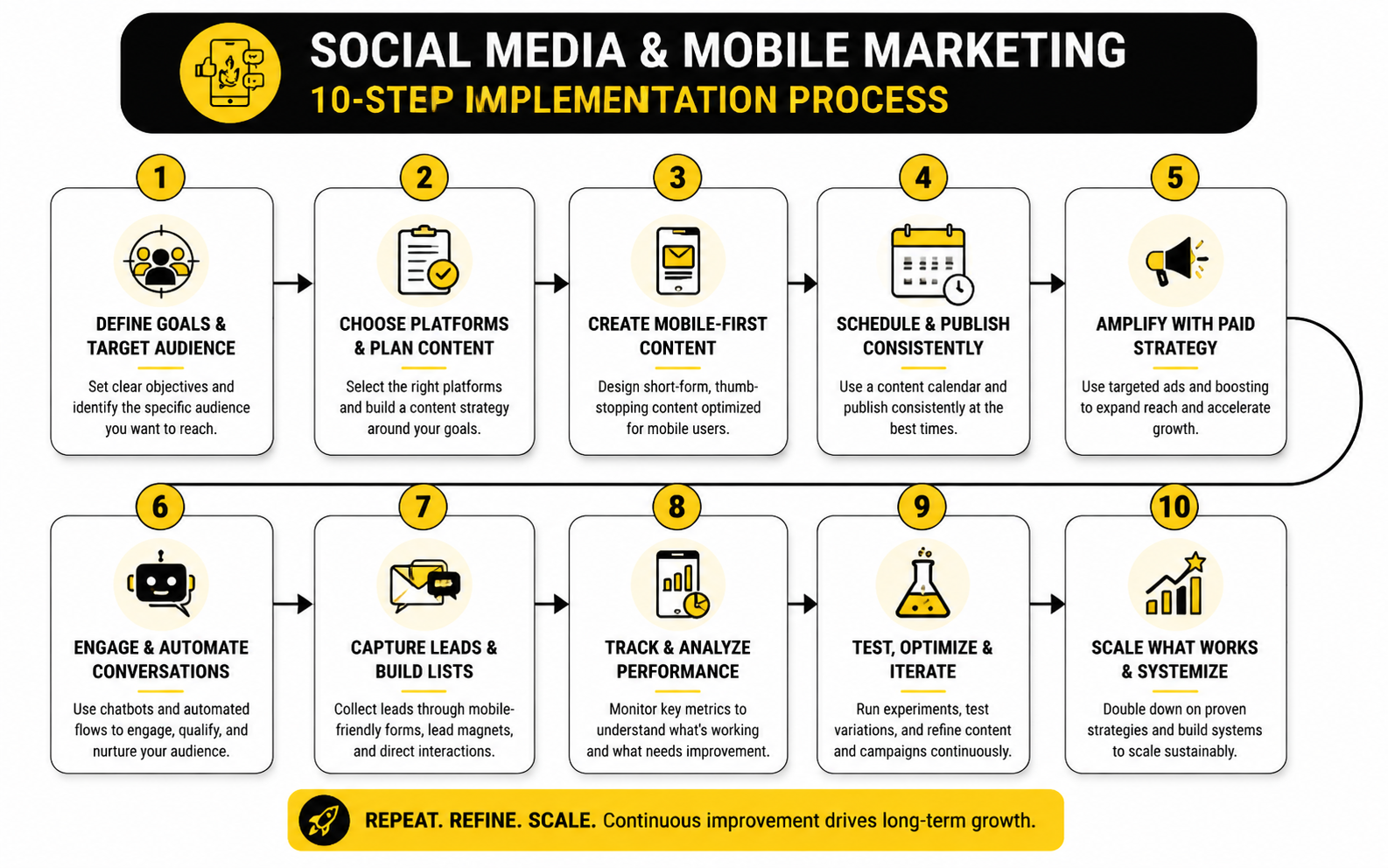
The implementation process follows a sequence that ensures clarity of purpose, alignment across teams, consistent execution, and measurable results:
1. Define Clear Goals and Metrics
Start every implementation with specific, measurable goals that align with both social media and mobile performance. These should be tied to business outcomes - for example, increasing mobile‑based purchases from social traffic or improving app engagement from organic social posts. Use SMART criteria (Specific, Measurable, Achievable, Relevant, Time‑bound) so every stakeholder knows what success looks like.
Decide on key performance indicators (KPIs) early - such as click‑through rates for social ads, conversion rates on mobile landing pages, or retention metrics within your mobile app - so you can track progress throughout the campaign.
2. Conduct Audience and Channel Research
Before spending any budget or crafting content, research who your audience really is and where they spend their time on mobile and social platforms. This includes reviewing analytics to see which social channels perform best and which mobile behaviours indicate high purchase intent.
Segment your audience by behaviour, demographics, and device usage. This allows you to tailor messages and experiences based on how different groups interact with content on social versus on mobile.
3. Build the Creative and Technical Assets
With defined goals and audience insights, begin creating the assets that will live across social and mobile touchpoints:
Getting the technical foundation right before launch ensures you capture meaningful data for optimization.
4. Launch in Phases With Monitoring
Deploy your campaign across chosen social platforms and mobile channels in phased waves rather than a one‑time blast. Monitoring from day one - especially in the first 72 hours - reveals early performance signals and allows you to optimize creative, targeting, and budgets quickly. Real‑time monitoring tools help track engagement, clicks, and mobile conversions so your team can react promptly.
5. Optimize Based on Data
Once live, treat your campaign as a living project, not a set‑and‑forget experiment. Use engagement metrics from social platforms (likes, comments, shares, saves), mobile behaviour (app opens, scroll depth, conversions) and your own internal analytics to make decisions. If a particular creative format resonates better on mobile or a certain post gets more shares, reallocate budget and creative effort accordingly. A/B testing different messages and mobile landing pages helps improve conversion rates incrementally.
6. Report, Learn, and Iterate
After the campaign concludes, compile results across both social and mobile channels. Look for patterns - perhaps certain segments responded better on mobile after social interaction, or a particular format yielded higher retention. Share these insights with your team and document what worked and what didn’t so future campaigns start from a stronger baseline.
Keeping a feedback loop allows you to refine your implementation process each time, driving efficiency and impact over the long term.
By following these structured steps - from clear goal setting to iterative optimization - you’ll transform your social media and mobile marketing efforts into repeatable, measurable campaigns that deliver real business value.
Measurement, Analytics, and What the Data Means
To make social media and mobile marketing genuinely effective, you must understand what your data is telling you - and what it isn’t. Raw numbers like likes, installs, or impressions are interesting, but they don’t tell you whether your campaigns are achieving business outcomes unless they’re tied to meaningful benchmarks and interpreted in context.
Why Measurement Matters in Social Media and Mobile Marketing
Metrics are not just “nice to have” numbers; they are the signals that guide decisions about creative strategies, audience targeting, budgets, and optimization. Without clearly defined data, teams can’t answer questions like:
For example, while social media platforms generate billions of users and massive daily engagement, insights into how those engagements convert into app installs or mobile commerce revenue tell you whether your investment is driving real business value.
Core Metrics You Should Be Tracking
Rather than chasing every data point available, focus on a set of key performance indicators (KPIs) that reflect both social media and mobile results:
Where Benchmarks Help You Interpret Data
Benchmarks give your data context. A 2 % engagement rate might be solid on LinkedIn but underwhelming on TikTok, where engagement often far exceeds that figure. Benchmark comparisons should be platform‑specific and aligned with your audience segments so you know when performance is actually strong or weak.
Benchmarks also help you make decisions:
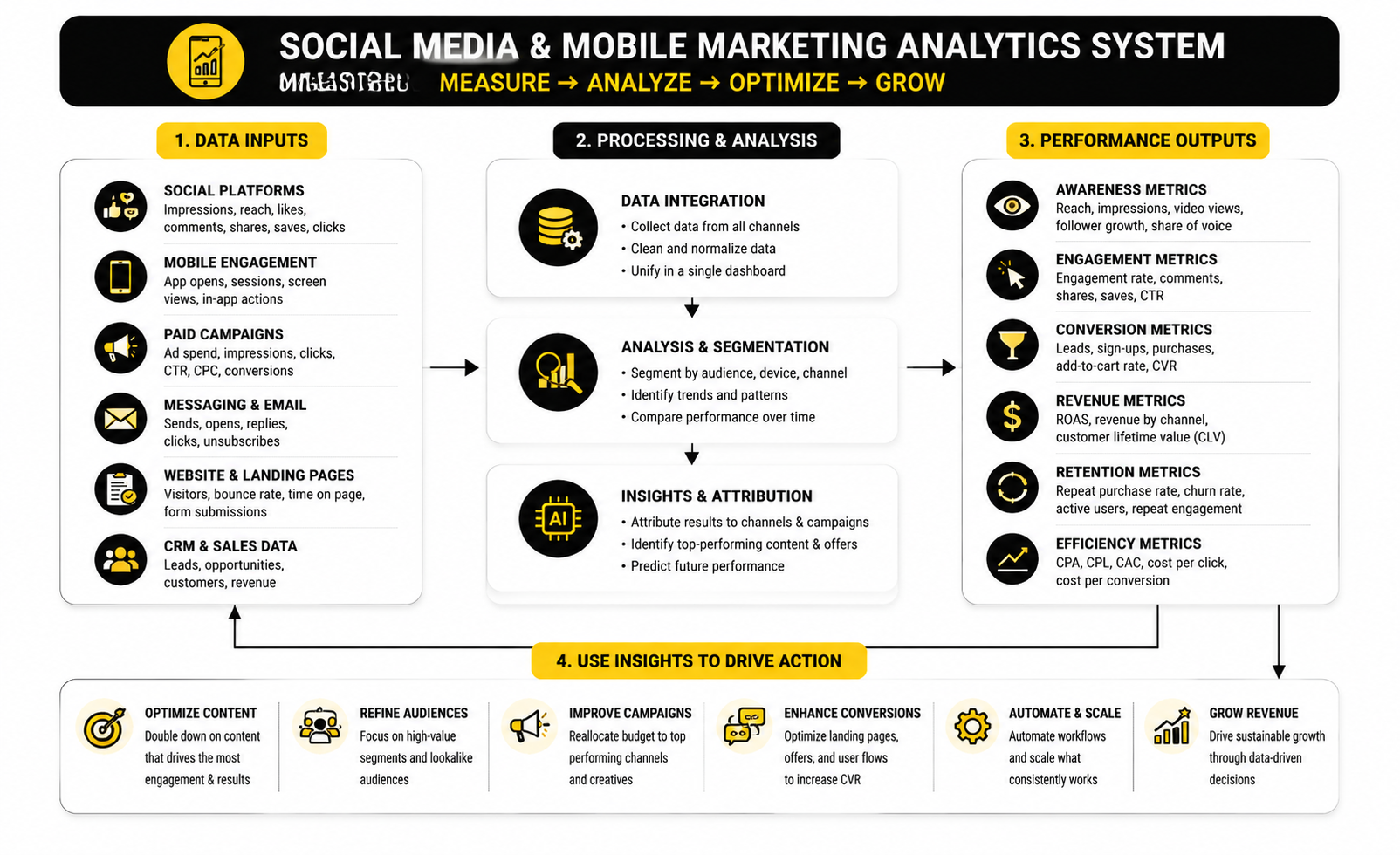
Without these reference points, you’re evaluating performance in a vacuum - and that’s a recipe for wasted budget and missed opportunities.
How to Interpret What the Numbers Actually Mean
Understanding the story behind the numbers means shifting from “how many?” to “so what?”. Here’s how to do that:
What Action Data Should Drive
Metrics should prompt action, not just reporting. For example:
By measuring thoughtfully, interpreting trends, and benchmarking wisely, social media and mobile marketing teams turn data into decisions - and decisions into growth.
Advanced Considerations for Scaling and Strategy
Once you’ve established a baseline process and started generating measurable results with social media and mobile marketing, the next step is to think beyond the basics and look at the strategic trade‑offs, risks, and scaling considerations that separate tactical wins from sustained growth.
Balancing Reach, Relevance, and Cost
As campaigns scale, you’ll encounter decisions about where to allocate budget and attention among channels. For example, broader social reach on networks like Facebook or TikTok can drive awareness quickly, but may be less efficient at converting high‑intent mobile audiences than targeted Instagram or LinkedIn segments.
Understanding the trade‑off between reach (how many people see your message) and relevance (how well those people are predisposed to act) is essential. Broad reach can be cost‑effective for brand awareness, but if it doesn’t translate into mobile engagement or conversions, it’s not delivering bottom‑line value. Over time, use analytics to refine your targeting criteria so you’re investing more in audiences that consistently drive mobile actions.
This is why cross‑channel attribution is vital: it helps you understand which social touchpoints are genuinely contributing to mobile conversion events, and which are merely adding vanity metrics.
Managing Privacy and Data Regulations
Privacy policies and regulatory frameworks - such as GDPR in Europe or similar rules in other regions - increasingly affect how marketers track and target users across social and mobile channels. Apple’s App Tracking Transparency (ATT) changes, for example, impacted the ability of apps to track users for ad personalization without explicit consent.
These constraints mean that your social media and mobile marketing setups must respect user privacy while still gathering performance data that helps refine campaigns. Using consent‑based tracking and first‑party data collection is no longer optional; it’s a risk management strategy that protects campaign continuity and brand trust.
Marketers who adapt by building reliable first‑party data systems - such as email lists or in‑app behaviour signals - will be better positioned to maintain personalization at scale, even as third‑party identifiers become less reliable.
Avoiding Creative Fatigue at Scale
Creative fatigue happens when audiences see the same content too often, reducing engagement and increasing costs over time. This is a common challenge when scaling social media and mobile marketing, especially as frequency increases with larger budget allocations.
To counter this:
Optimized creative rotation ensures that your campaigns stay fresh and continue to compel mobile users to engage and convert, rather than tuning your messages out.
Organizational Readiness and Team Alignment
Scaling marketing efforts often hits friction not because of technology or budgets, but because of organizational silos. Social media teams may focus on engagement metrics, while mobile marketing teams optimize retention or conversions. Without shared goals and unified measurement frameworks, these efforts can work at cross‑purposes.
To avoid this, establish shared KPIs that both teams own and optimize together. This could be metrics like mobile revenue sourced from social campaigns, or retention rates for users acquired through targeted social ads. Shared ownership keeps both sides accountable and aligned on outcomes that matter.
Investing in Future‑Ready Skills and Tools
Social media and mobile marketing technologies evolve rapidly. What worked last year may not work this year, especially with platform algorithm changes and new mobile behaviours emerging.
Investing in up‑to‑date tools and skills is part of strategic scaling:
Platforms that enable integrated campaign planning and execution - whether through automation, experimentation frameworks, or cross‑channel dashboards - become strategic assets rather than just tools.
Anticipating Platform Shifts and Emerging Behaviours
Finally, advanced practitioners pay attention to where platforms and user habits are heading. Short‑form video now dominates many feeds, and in‑app commerce features are blurring the line between browsing and buying. Staying ahead of these trends gives brands a competitive edge.
For example, when social platforms start offering new mobile‑native features (like social commerce carts or augmented reality try‑ons), early adopters often capture attention and engagement before competitors pivot.
Thinking strategically about these advanced factors - from privacy to scaling trade‑offs and team alignment - elevates your social media and mobile marketing from a series of campaigns to a cohesive growth engine that can adapt, evolve, and perform consistently as audience behaviours and platform capabilities change.
Frequently Asked Questions About Social Media and Mobile Marketing
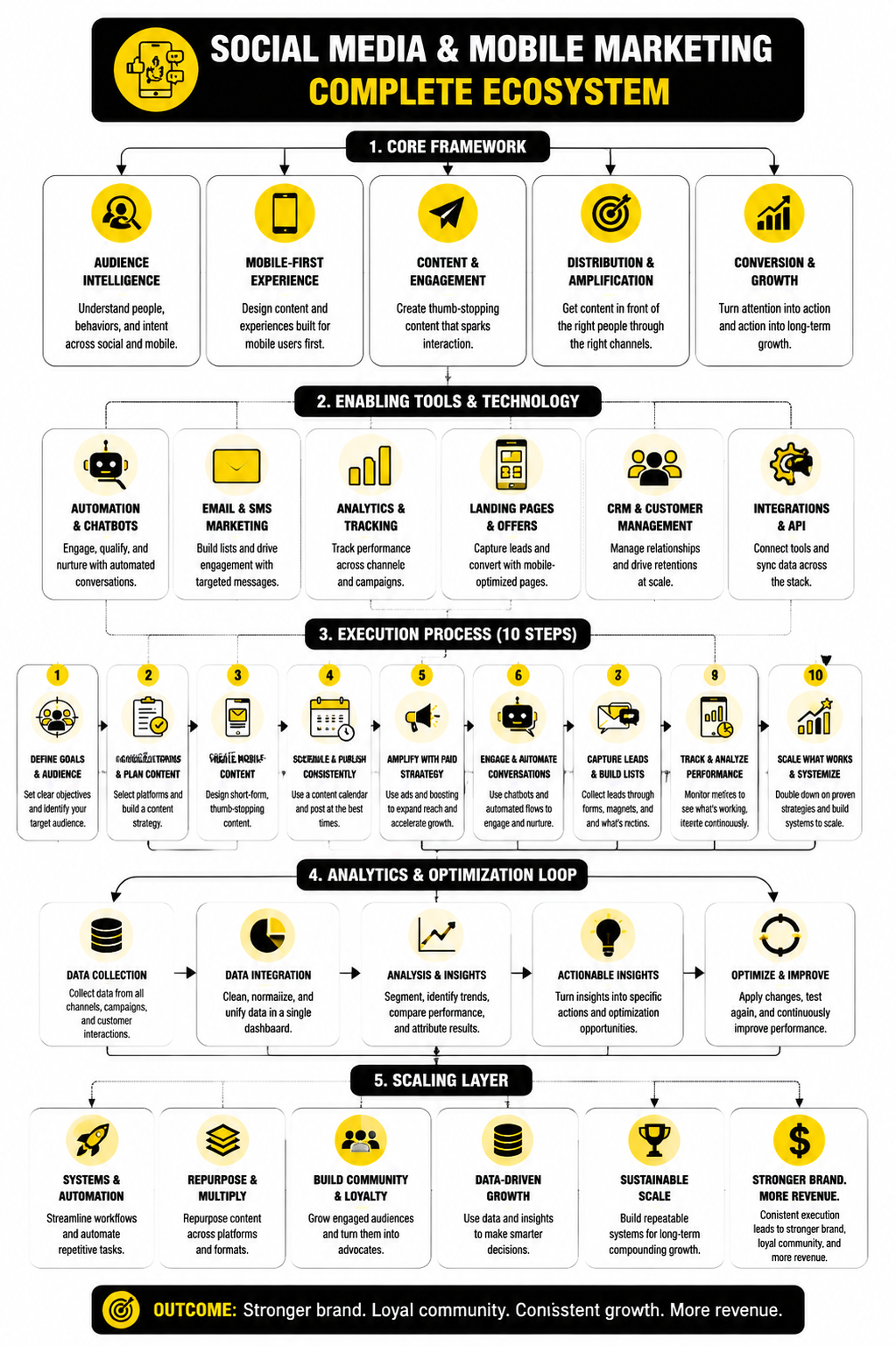
1. What is the difference between social media and mobile marketing?
Social media marketing focuses on engaging audiences through social platforms like TikTok, Instagram, and LinkedIn, while mobile marketing encompasses all marketing activities optimized for smartphones - including apps, SMS, push notifications, and mobile‑optimized sites. The two overlap when social campaigns are designed specifically for mobile user behavior.
2. Do I need both social media and mobile marketing to be successful?
Yes. Social media drives discovery and engagement, and mobile marketing ensures that engagement turns into action on devices where most users live. Combining them creates a smooth journey from awareness to conversion.
3. How do I measure success in social media and mobile marketing?
Success is measured against KPIs that reflect your goals - engagement rates, mobile conversions, app installs, retention metrics, and ROI. Tracking tools and analytics must tie social interactions to mobile outcomes to evaluate performance accurately.
4. What platforms are best for social media and mobile marketing?
The “best” platforms depend on your audience. Younger demographics may gravitate toward TikTok and Snapchat, while professionals might be more active on LinkedIn. What matters is choosing platforms where your target users are active and tailoring content for mobile consumption.
5. Is social media advertising necessary for mobile marketing success?
Paid social can accelerate reach and targeted acquisition, especially for mobile‑focused goals like app installs or e‑commerce purchases. However, organic social content and mobile optimization are equally important for long‑term sustainability.
6. How often should I refresh creative content?
Creative fatigue sets in quickly, especially on social feeds. Refresh your visuals and messaging regularly, test different formats, and rotate ads to maintain relevance and prevent audience burnout.
7. Can small businesses compete with larger brands in social and mobile marketing?
Absolutely. Small businesses can leverage niche targeting, authentic content, and mobile‑first creativity to engage audiences effectively. Smart use of analytics and agility often gives smaller teams an edge.
8. How do privacy changes affect my campaigns?
Privacy policies and platform tracking restrictions change how you collect and use data. Prioritize first‑party data, consent‑based targeting, and transparent practices so you can maintain personalization without relying solely on third‑party identifiers.
9. What’s the role of analytics in improving campaigns?
Analytics shows what’s working and what’s not, guiding decisions on creative, budget allocation, audience targeting, and mobile experience optimization. Without analytics, you’re operating blind.
10. How do I align social media and mobile teams for better results?
Create shared goals and KPIs that both teams own. Use unified dashboards and regular cross‑functional reviews to ensure social content, mobile experiences, and performance data all align toward the same business outcomes.
Build a stronger local presence with BAAM AI
Turn your website, Google profile, social channels, and AI visibility into one growth engine
Most businesses do not need more random marketing activity. They need a consistent presence system that helps the right people find them, trust them, and take action. BAAM AI brings strategy, local SEO, website updates, Google Maps visibility, social content, AI-search readiness, media production, and reporting into one practical monthly engine.
If you want your marketing to keep working after the campaign ends, start with a free BAAM AI presence audit. See how your business shows up today and where the fastest visibility wins are at BAAM AI.