
BAAM AI Blog
Grow With Google Digital Marketing: A Practical Guide To Building Marketable Skills
Grow with Google digital marketing training is useful because it sits in the middle of three things people actually need: practical marketing skills, recognizable credentials, and a clearer path into entry-level...
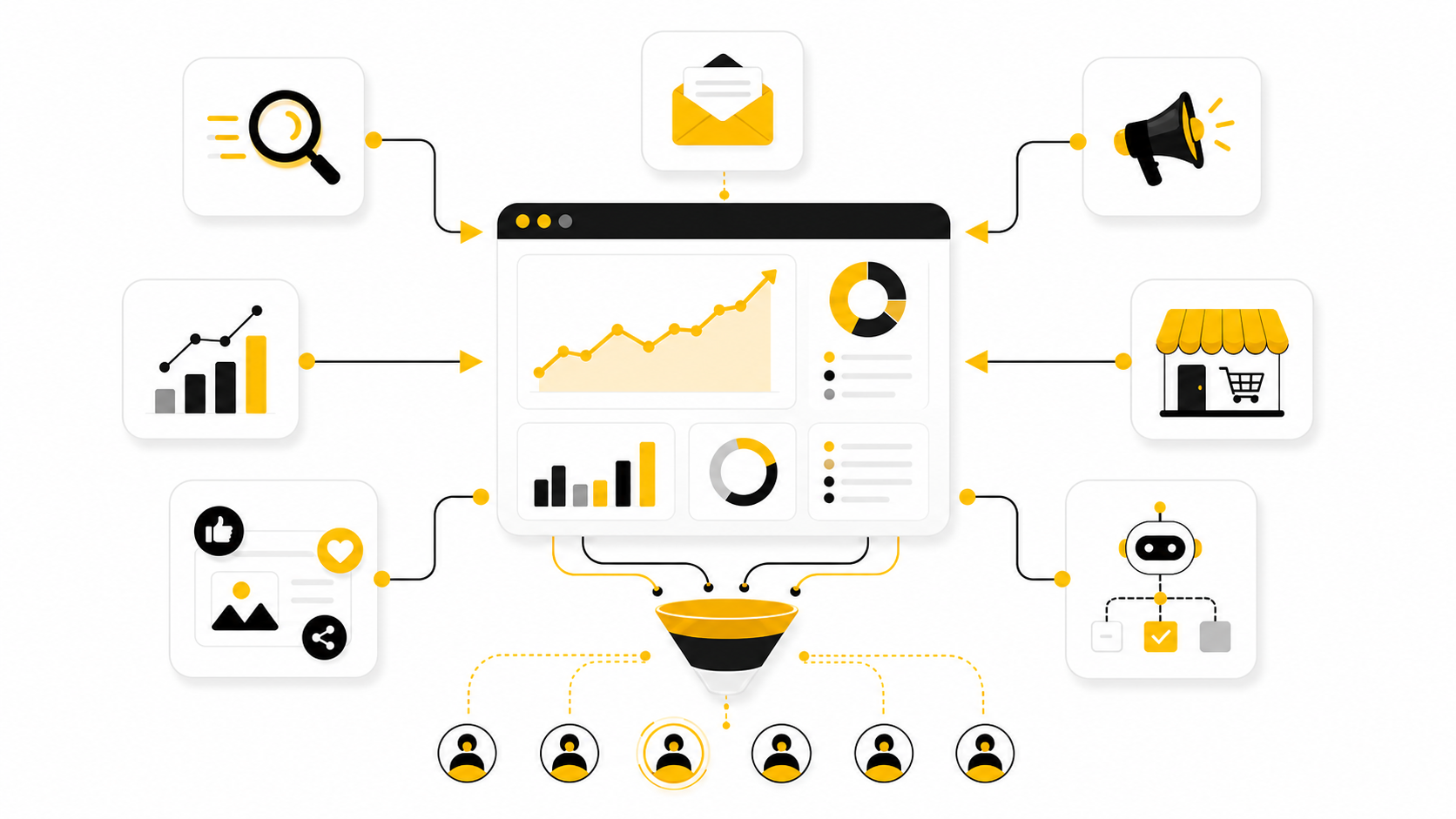
Grow with Google digital marketing training is useful because it sits in the middle of three things people actually need: practical marketing skills, recognizable credentials, and a clearer path into entry-level digital roles. The Google Digital Marketing & E-commerce Certificate is built around work that shows up in real jobs, including search, email, social media, analytics, online stores, customer loyalty, and AI-supported marketing workflows. That matters because digital marketing is no longer one narrow skill; it is a stack of decisions that connect audience research, content, campaigns, measurement, and revenue.
The most important thing to understand upfront is that this is not just a “learn Google Ads” path. The certificate covers the wider operating system of modern marketing: how people discover brands, how businesses attract and engage them, how campaigns get measured, and how e-commerce turns attention into sales. Google describes the program as beginner-friendly, self-paced, and designed for people with no prior experience, with completion often framed around six months at about 10 hours per week through the Google Digital Marketing & E-commerce Certificate.
This guide will treat the program as a practical career and business skill framework, not just a course review. That means we will look at what the training includes, why the skills matter, how to turn lessons into portfolio assets, and how to use the certificate without assuming it will magically replace experience. The goal is simple: help you decide whether Grow with Google digital marketing training fits your next move, then show you how to get more value from it than the average learner.
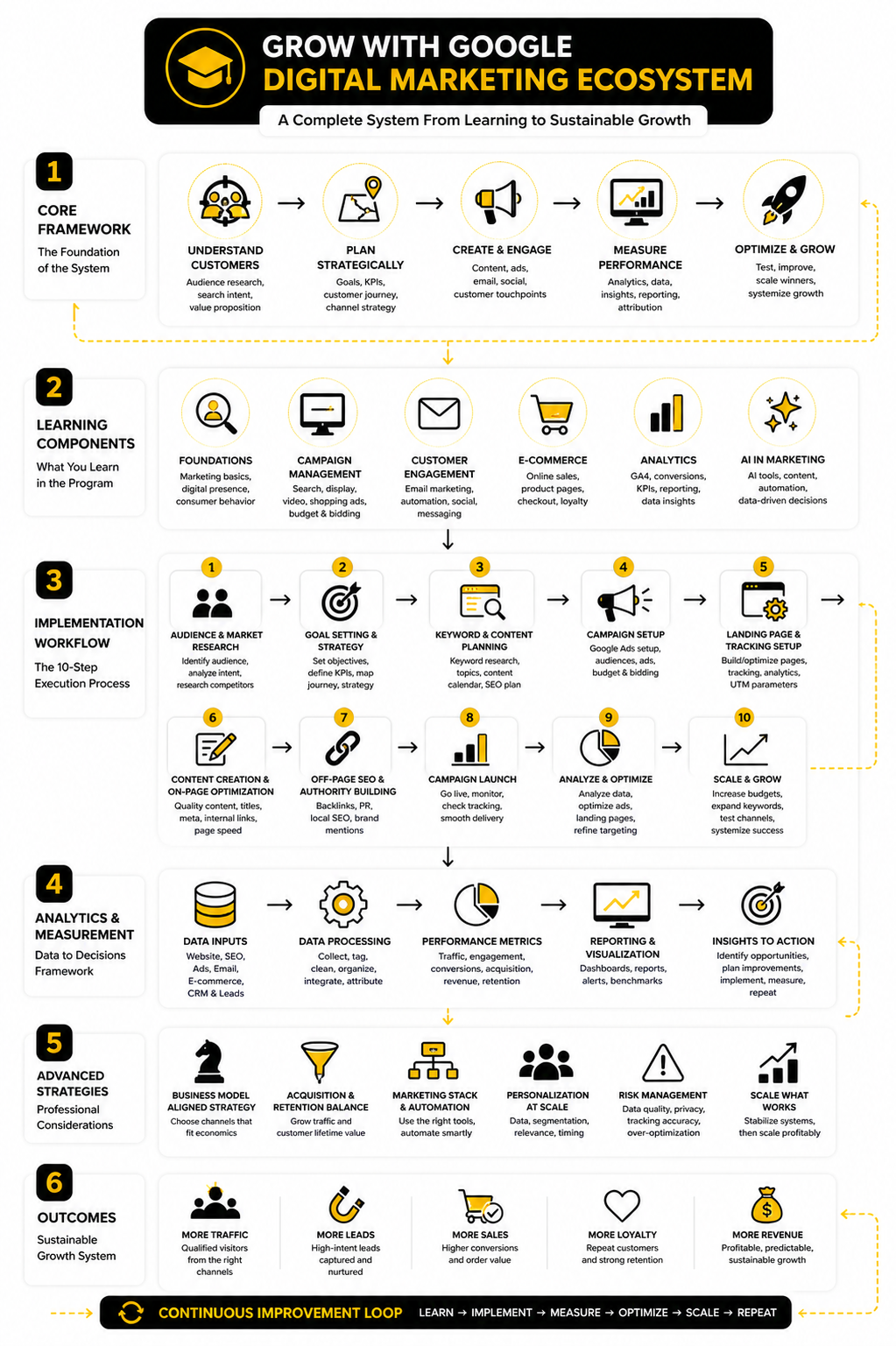
The full article is split into six parts so each section can build on the previous one without rushing the topic. Part 1 sets the context, defines the structure, and explains why the program matters before we get into the details. The remaining parts move from skill breakdown to implementation, portfolio work, tool choices, and final decision-making.
Why Grow With Google Digital Marketing Matters Now
The reason this topic deserves a serious look is that digital marketing has become a practical business language. Even if someone never becomes a full-time marketer, they still benefit from understanding funnels, content, search visibility, email, analytics, and online customer behavior. Those are the skills behind campaigns, landing pages, product launches, newsletters, paid ads, creator funnels, local business growth, and e-commerce stores.
The certificate is also positioned around real entry-level roles rather than abstract theory. Google lists career paths such as marketing coordinator, e-commerce associate, paid search specialist, email marketing specialist, media planner, and digital marketing specialist, which gives learners a clearer idea of where the training can lead. The same official program page notes that digital marketing and e-commerce roles connect online channels like search, social media, email, display advertising, online stores, product listings, customer loyalty, and performance measurement.
Still, the value is not the certificate alone. The value comes from using the curriculum as a structure for building proof of skill. A hiring manager, client, or business owner will care more about whether you can research an audience, plan a campaign, create useful content, measure results, and improve the next version.
Framework Overview
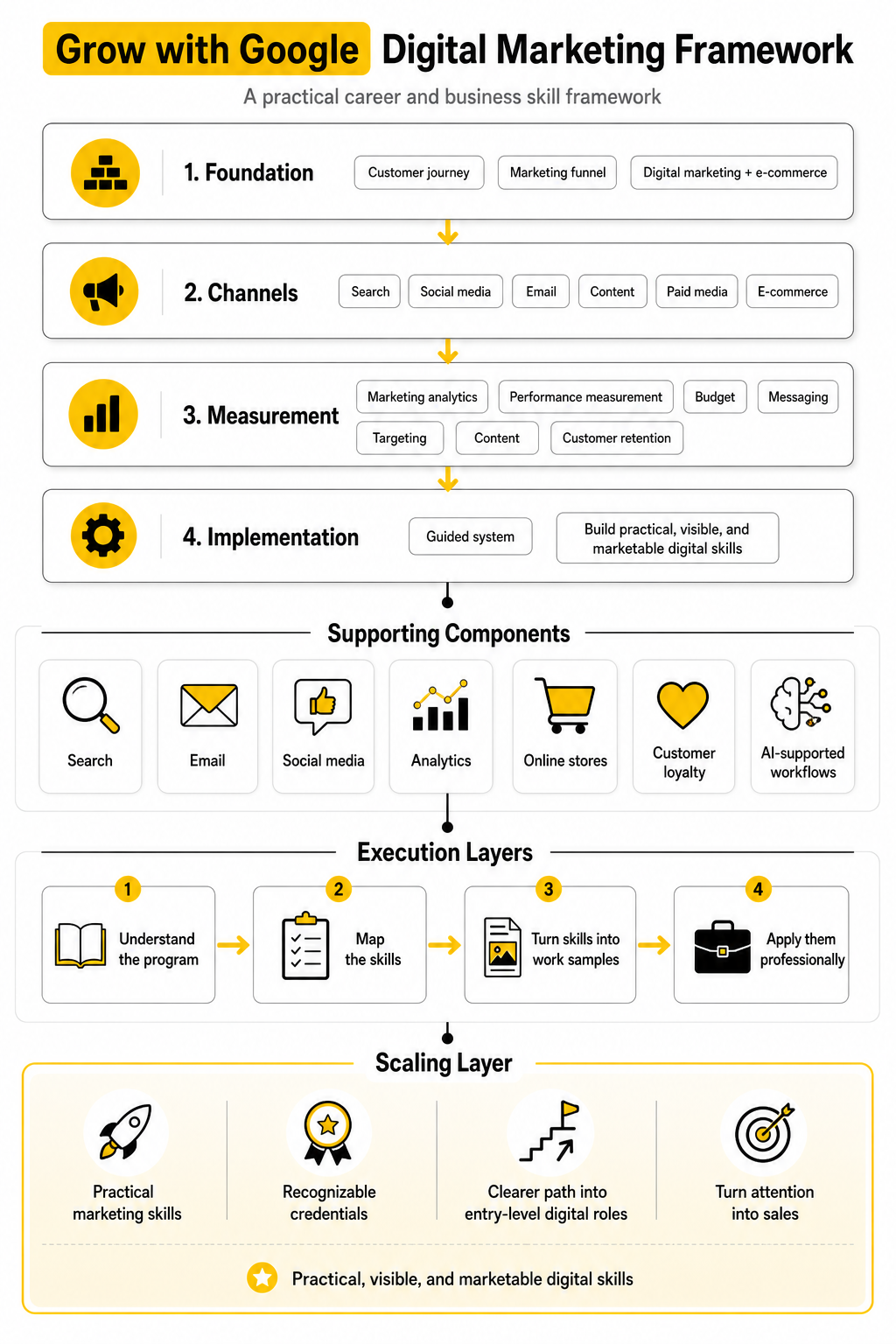
The best way to approach Grow with Google digital marketing is as a framework with four layers: foundation, channels, measurement, and implementation. The foundation layer helps you understand the customer journey, the marketing funnel, and the relationship between digital marketing and e-commerce. Without that layer, every tactic feels random, and random marketing is expensive even when the tools are free.
The channel layer is where you learn how search, social media, email, content, paid media, and e-commerce touch different stages of the buyer journey. This matters because a person searching for a product category behaves differently from someone opening a newsletter, watching a short video, or comparing products in an online store. A good digital marketer does not treat every channel the same; they match the message, format, and metric to the job that channel is supposed to do.
The measurement layer is what separates professional marketing from guessing. Google’s certificate includes marketing analytics and performance measurement because modern campaigns need feedback loops, not just creative ideas. Once you understand what each metric can and cannot tell you, you can make better decisions about budget, messaging, targeting, content, and customer retention.
How This Guide Will Use The Framework
The rest of the article will follow the same logic: first understand the program, then map the skills, then turn those skills into work samples, and finally decide how to apply them professionally. This structure keeps the guide practical because the certificate is only useful if it changes what you can do. Learning the vocabulary is a start, but implementation is where the skill becomes visible.
In Part 2, we will break down what the Google Digital Marketing & E-commerce Certificate actually covers and how the course sequence fits together. That section will be especially useful if you are comparing the program with other training options or trying to understand whether it is too basic, too broad, or the right starting point. We will also separate the core curriculum from the extra value you can create by building projects alongside the lessons.
By the end of the full article, you should have a clear view of whether this path is right for you and how to use it without wasting momentum. The smart approach is not to collect another certificate and hope something happens. The smart approach is to use Grow with Google digital marketing training as a guided system for building practical, visible, and marketable digital skills.
What The Google Digital Marketing & E-commerce Certificate Covers
The Google Digital Marketing & E-commerce Certificate is structured as an entry-level program, which is important because it does not assume you already understand campaigns, analytics, online stores, or paid media. The current program is presented as an 8-course series on Coursera, with Google listing it as beginner-friendly, flexible, and designed to help learners build job-ready skills without a degree or prior experience. The official Coursera page also lists more than 1.3 million enrolled learners, a 4.8 rating, and a suggested pace of six months at 10 hours per week, which gives you a realistic sense of the program’s scale and expected workload through the Google Digital Marketing & E-commerce Professional Certificate.
What makes the program useful is not that every lesson is advanced. It is useful because it gives beginners a complete map of the field instead of throwing them straight into random tactics. You move from customer journeys and marketing funnels into channel execution, analytics, e-commerce operations, retention, and AI-supported workflows, which is exactly the kind of sequence a new marketer needs before they can make smart decisions.
That said, you should treat the certificate as a structured foundation, not as a replacement for real campaign experience. The lessons can teach the language, tools, and process, but the market rewards people who can apply those ideas under constraints. Budget limits, messy data, weak offers, unclear audiences, and poor landing pages are where digital marketing becomes real.
The Course Sequence In Plain English
The first course introduces the basic operating system of digital marketing and e-commerce. It covers what digital marketers and e-commerce professionals do, how entry-level roles work, how the customer journey is shaped, and why the marketing funnel matters. Google’s own course description says learners work through concepts like journey maps, marketing strategy, and the roles digital marketing and e-commerce play inside an organization through the Foundations of Digital Marketing and E-commerce course.
After that foundation, the program moves into attracting and engaging customers through digital channels. This is where the training starts to connect search, paid media, social media, email, and content with actual business outcomes. The point is not to memorize channel names; the point is to understand why someone might find a brand through search, compare it through social proof, return through email, and finally buy through an online store.
The later courses shift toward measurement, e-commerce management, customer loyalty, and career readiness. That matters because beginners often over-focus on acquisition and ignore what happens after the first click. A serious marketer needs to understand what gets measured, what can be improved, how online stores convert interest into purchases, and why retention often matters more than chasing new traffic forever.
The Main Skills You Should Expect To Build
The most valuable skill in the program is strategic thinking at a beginner-friendly level. You learn how marketing goals connect to audiences, channels, messaging, and performance data. That is basic, but it is also the difference between “posting content” and building an actual marketing system.
You should also expect practical exposure to core digital channels. The Coursera program page lists skills such as campaign management, e-commerce, email marketing, media planning, online advertising, paid media, loyalty programs, data storytelling, and marketing analytics. Those skills are broad, but that breadth is useful because most entry-level marketers are expected to understand how several moving parts work together, not just one isolated tool.
The e-commerce side is especially important because it connects marketing activity to transaction behavior. Learning how products are presented, how online stores are managed, how performance is reviewed, and how customer loyalty is improved helps you think beyond traffic. Traffic is only useful when it supports a clear business model.
Where AI Fits Into The Program
Google now positions AI as part of the certificate experience, not as a separate futuristic add-on. The official Grow with Google page says the program teaches learners to manage campaigns, attract and engage customers, sell products online, and use AI effectively in marketing through the Google Digital Marketing & E-commerce Certificate. That is the right framing because AI is becoming part of everyday marketing work, but it still needs human direction.
The practical value of AI in this context is speed and support. It can help with market research, campaign drafts, email ideas, content outlines, product descriptions, and performance summaries. But it does not replace positioning, judgment, taste, customer understanding, or the responsibility to check whether the output is accurate.
This is where beginners need to be careful. AI can make weak strategy look polished, which is dangerous. If the offer is unclear, the audience is too broad, or the message does not match buyer intent, faster content production will not fix the real problem.
What The Certificate Does Well
The certificate does a strong job of giving learners a guided path through a field that can otherwise feel chaotic. Digital marketing has too many entry points: SEO, paid ads, analytics, social media, email, landing pages, funnels, e-commerce, content, automation, and now AI. A structured program helps you stop bouncing between disconnected tutorials and start seeing how the pieces fit together.
It also gives beginners the vocabulary they need to talk about marketing more professionally. Terms like funnel, customer journey, KPI, segmentation, campaign performance, attribution, retention, and loyalty are not just buzzwords when you understand how they affect decisions. That vocabulary helps in interviews, client conversations, team meetings, and your own project planning.
The other strength is accessibility. A beginner can start without needing a marketing degree, a portfolio, or software experience. That makes grow with google digital marketing training a practical first step for career switchers, small business owners, students, freelancers, and anyone who wants a structured route into the field.
What The Certificate Does Not Automatically Give You
The certificate does not automatically make you job-ready in the strongest sense of the phrase. It can help you understand the work, speak the language, and practice structured tasks, but employers and clients still want evidence. That evidence usually comes from portfolio projects, campaign breakdowns, analytics reports, mock strategy documents, landing page reviews, content calendars, and real or simulated performance analysis.
It also will not make you a specialist overnight. You may finish with a better understanding of many areas, but you will still need deeper practice if you want to become excellent at paid search, SEO, email automation, conversion optimization, analytics, or e-commerce merchandising. Breadth is the beginning; specialization comes from repeated implementation.
This is why the smartest way to use the certificate is to build while you study. Do not wait until the end to create proof. For every major section, turn the lesson into a small asset: a customer journey map, a campaign brief, an email sequence, a measurement plan, a product page critique, or a simple retention strategy.
How To Think About The Certificate As A Learning System
The best mindset is to treat the certificate like a guided apprenticeship with missing real-world pressure. The guidance is valuable because it keeps you moving in the right order. The missing pressure is your responsibility to add through projects, deadlines, public work, or client-style constraints.
A simple way to do this is to create one running project while completing the program. Pick a real business category, a product type, or your own future service offer, then apply each course to that same subject. This gives your work continuity and helps you finish with a connected portfolio instead of scattered assignments.
For example, your running project could include a customer persona, funnel map, search strategy, social content plan, email campaign, basic analytics dashboard, e-commerce store review, and retention plan. That kind of portfolio is much stronger than saying you completed the lessons. It shows that you can turn grow with google digital marketing concepts into structured marketing work.
Who Will Get The Most Value From This Part Of The Program
Career beginners will probably get the most immediate value because the certificate explains the field from the ground up. If you are switching from retail, admin, customer service, hospitality, sales, or another non-marketing role, the structure can help you connect your existing experience to digital work. Customer understanding, communication, organization, and commercial awareness all transfer well when you learn the marketing system around them.
Small business owners can also benefit because the program explains why digital marketing is not just “posting more.” It helps you think about customer intent, channel fit, store experience, email follow-up, and performance measurement. That alone can prevent a lot of wasted effort.
Freelancers and agency beginners can use the program as a base, but they need to go further. If your goal is to sell services, you need deliverables, case-style work, tool fluency, and a clear offer. The certificate can give you the map, but your marketable edge will come from how well you implement the map.
The Core Skills You Need To Take Seriously
The real value of grow with google digital marketing training is not that it introduces a long list of marketing terms. The value is that it gives you a repeatable way to think through how digital campaigns work from first contact to final conversion. If you treat the program like a checklist of videos, you will finish with surface-level knowledge, but if you treat it like an operating system, you can turn each lesson into a practical marketing process.
The core skills are not equal in importance. Some are foundational because every other decision depends on them, while others become more useful once you already understand the audience, the offer, and the funnel. That order matters because beginners often jump straight into tools before they understand what the tool is supposed to solve.
This part focuses on the process layer: how to move from learning concepts to making real marketing decisions. You do not need to master every channel at once, but you do need to understand how the major pieces connect. That is what separates a useful marketer from someone who only knows how to follow platform tutorials.
Start With The Customer Journey
The customer journey is the first skill to take seriously because every campaign depends on what the customer already knows, wants, doubts, and needs next. Google’s foundation course places the customer journey and marketing funnel near the beginning of the curriculum, which is the right sequence because channel tactics make more sense once you understand the stages people move through before buying through the Foundations of Digital Marketing and E-commerce course. A person who has never heard of a brand needs a different message from someone comparing two products or waiting for a reason to come back.
A practical customer journey should answer a few basic questions. What problem does the buyer believe they have? What trigger makes them start looking? What proof do they need before they trust the offer? These questions sound simple, but they shape the content, landing page, email sequence, ad angle, and follow-up strategy.
This is where many beginners get marketing wrong. They create content around what the business wants to say instead of what the customer needs to understand. Strong digital marketing begins with the buyer’s reality, not the brand’s wishlist.
Translate The Funnel Into Real Decisions
The funnel is only useful when it changes what you do. Awareness content should help people recognize a problem or discover a useful idea. Consideration content should help them compare options, understand trade-offs, and reduce uncertainty. Conversion content should make the next step clear, credible, and low-friction.
This is why grow with google digital marketing skills need to be practiced as decisions, not definitions. If someone is at the awareness stage, a hard sales page may feel too aggressive. If someone is ready to buy, a vague educational post may waste the moment. Good marketers match the message to the stage.
The same logic applies to measurement. Awareness may be judged by reach, search visibility, engagement quality, or new visitors. Conversion may be judged by form fills, purchases, booked calls, email signups, or revenue. If you use the wrong metric for the wrong stage, you will optimize the wrong behavior.
Build A Simple Execution Process
Once you understand the journey and funnel, execution becomes more tangible. You can stop asking “What should I post?” and start asking “What does the customer need at this stage, and which channel can deliver it best?” That shift is huge because it turns marketing from random activity into a structured process.
A simple execution process can look like this:
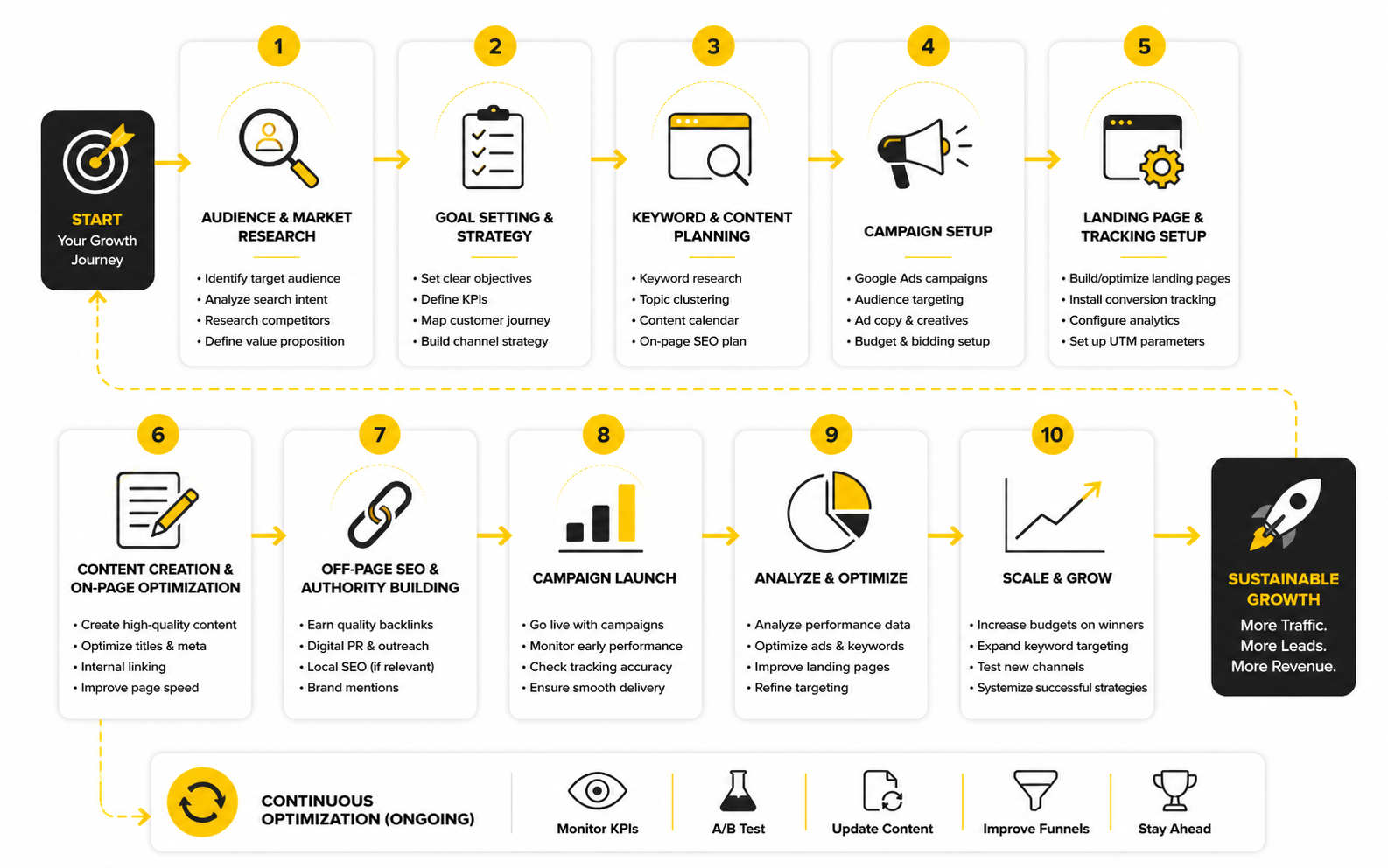
This process is intentionally simple. Beginners do not need a complicated 40-step framework before they have built anything. They need a clean loop they can repeat until the relationship between strategy, execution, and measurement becomes natural.
Learn Search As A Demand Signal
Search is one of the most important skills because it shows you what people are already looking for. When someone types a query into Google, they are revealing intent in a way that social engagement often does not. That does not mean search is always better than social, but it does mean search can help you understand demand, language, problems, and comparison behavior.
The certificate includes digital channels like search and email as part of attracting and engaging customers through the Google Digital Marketing & E-commerce Professional Certificate. For practical implementation, search should be treated as both a traffic channel and a research tool. The keywords people use can help you write better headlines, product pages, ads, FAQs, email subject lines, and landing page sections.
The key is to look beyond volume. A small keyword with strong purchase intent may be more useful than a broad keyword with vague curiosity. That is why professional marketers care about intent, not just traffic.
Treat Content As A Conversion Asset
Content is not just blog posts, social captions, or videos. Content is every piece of communication that helps a customer move from confusion to clarity. That includes product descriptions, comparison pages, case studies, landing page copy, email sequences, onboarding messages, and even checkout explanations.
This is important because many beginners treat content as a visibility game only. Visibility matters, but visibility without a next step usually turns into noise. A useful content asset should help the reader make progress, whether that means understanding a problem, choosing a solution, joining a list, booking a call, or buying a product.
When you study grow with google digital marketing concepts, keep asking what each content piece is supposed to do. Is it attracting a new audience? Building trust? Handling objections? Explaining value? Recovering abandoned interest? The answer will determine the format, tone, length, and call to action.
Understand Email As A Relationship Channel
Email remains one of the most practical digital marketing skills because it lets a business continue the conversation after the first visit. A visitor may not be ready to buy today, but they may be ready to learn, compare, save, or return later. Email gives you a controlled way to build that relationship without depending entirely on algorithms.
The certificate includes email marketing and customer engagement as part of its broader skill set through the Coursera program page. In real implementation, this means learning how to plan welcome emails, promotional campaigns, newsletters, customer education, abandoned cart messages, and retention sequences. Each one has a different job.
A good email strategy is not just “send more emails.” It is about sending the right message at the right moment with a clear reason to care. That requires segmentation, timing, useful content, and respect for the subscriber’s attention.
Connect E-commerce Work To Buyer Confidence
E-commerce is where marketing gets judged by behavior. A store may have traffic, but if the product page is unclear, the offer is weak, shipping details are hidden, or trust signals are missing, that traffic will not convert well. This is why the certificate’s e-commerce component matters: it forces learners to think about what happens after someone clicks.
Product pages need more than nice visuals. They need clear positioning, helpful descriptions, strong product information, credible reviews or proof where available, transparent pricing, and an easy path to checkout. The buyer should not have to work hard to understand what the product is, who it is for, and why it is worth choosing.
This skill also connects directly to retention. Once someone buys, the experience does not end. Order communication, fulfillment, post-purchase emails, loyalty offers, and customer support all shape whether that customer returns or recommends the brand.
Measure What Actually Matters
Measurement is where digital marketing becomes professional. Without measurement, you are guessing. With the wrong measurement, you may be confidently improving the wrong thing.
The certificate emphasizes marketing analytics and presenting insights, which is useful because data only matters when it supports better decisions. A dashboard full of numbers is not the same as insight. Insight means you can explain what happened, why it may have happened, and what should change next.
A practical beginner measurement plan should focus on a small set of meaningful metrics. For example, a landing page project might track visitors, conversion rate, leads, cost per lead, and lead quality. An email project might track open rate, click rate, unsubscribe rate, conversions, and revenue per campaign. The goal is not to track everything; the goal is to track the few things that help you improve.
Use AI Without Letting It Replace Judgment
AI can make implementation faster, but it can also make bad marketing faster. Google now highlights AI training inside the certificate, including market research, strategy support, campaign decisions, email generation, and website copy variations for A/B testing through the official Grow with Google certificate page. That is useful, but only if you stay in control of the thinking.
AI can help you draft, summarize, brainstorm, compare, and organize. It can speed up campaign planning, content outlines, audience research, and reporting notes. But it cannot fully understand your customer, your positioning, your business constraints, or your ethical responsibility to be accurate.
The practical rule is simple: use AI as an assistant, not as the strategist. Let it help you produce options, then use human judgment to choose, verify, refine, and align the work with the actual business goal. This matters more than people want to admit.
Turn Each Skill Into A Repeatable Habit
The best learners do not finish a course and then wonder what to do next. They turn each core skill into a habit they can repeat. That is how knowledge becomes capability.
After a lesson on customer journeys, build one. After a lesson on search, map keyword intent. After a lesson on email, draft a short sequence. After a lesson on analytics, write a one-page performance summary. The point is not perfection; the point is practice with visible output.
This is the bridge into the next part of the article. Once you understand the core skills and the execution process, the next move is to turn them into portfolio assets. That is where grow with google digital marketing training becomes more than something you completed and starts becoming proof of what you can actually do.
Statistics And Data
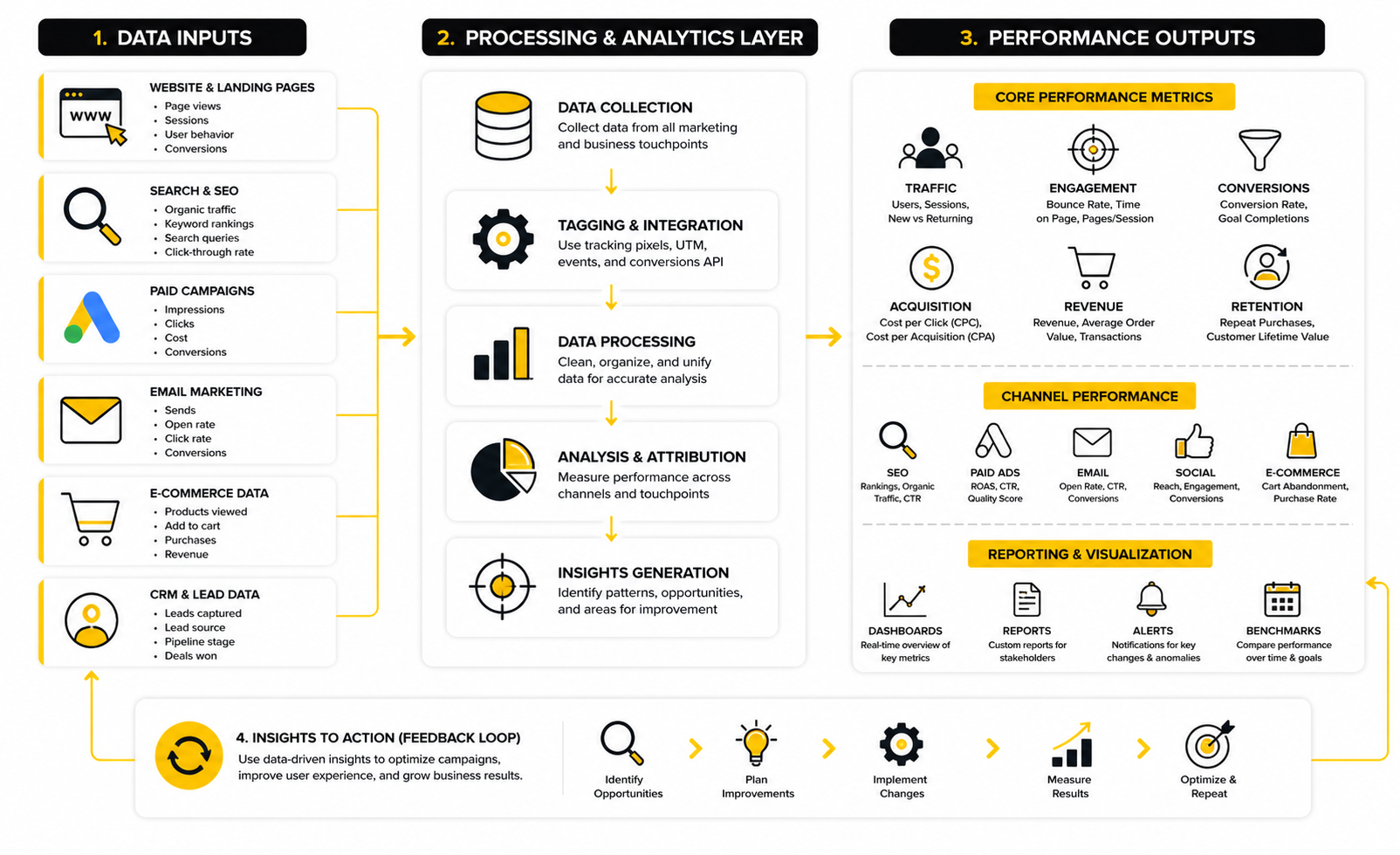
Measurement is where grow with google digital marketing training becomes practical instead of theoretical. A beginner can learn campaign language quickly, but the real test is whether they can look at performance data and decide what to do next. That does not mean staring at every metric in a dashboard; it means choosing the few numbers that reveal whether the customer journey is working.
The mistake is treating statistics like decorations. A benchmark only matters when it helps you interpret your own performance with more context. If your email click rate is low, your next move depends on whether the problem is the audience, the subject line, the offer, the timing, the landing page, or the mismatch between expectation and destination.
Good measurement is not about proving that marketing “did something.” It is about finding the next useful action. That mindset is exactly what turns analytics from a reporting task into a growth skill.
The Metrics That Actually Matter
Most marketing dashboards contain more numbers than a beginner can use. That is why the first skill is separating activity metrics from decision metrics. Impressions, views, likes, clicks, sessions, open rates, conversions, revenue, and retention all matter in different contexts, but they do not all answer the same question.
A clean measurement system should follow the funnel. At the top, you are looking for visibility, reach, search impressions, video views, or new visitors. In the middle, you care about engagement quality, returning visitors, email clicks, product views, comparison behavior, and add-to-cart activity. At the bottom, you care about leads, purchases, booked calls, customer acquisition cost, conversion rate, average order value, and revenue.
The key is to connect every metric to a decision. If a number does not help you decide whether to change the audience, message, channel, offer, page, or follow-up, it is probably not a priority metric yet. You can still track it, but do not let it drive the strategy.
Build The Analytics System Before Judging The Campaign
A campaign can look bad simply because measurement is broken. That is common with beginners because tracking is often added after the campaign launches, when it should have been part of the setup. Google’s GA4 documentation recommends using structured e-commerce events like product views, cart actions, checkout steps, purchases, and refunds so performance data can populate reports correctly through Google Analytics e-commerce measurement.
This matters because digital marketing decisions depend on the quality of the event data. If purchases are tracked but add-to-cart events are missing, you cannot diagnose where the buying journey breaks. If lead forms are tracked but traffic sources are unclear, you cannot tell which channel is producing useful demand.
Before judging results, confirm that the analytics system can answer the core business questions. What traffic source brought the visitor? What action did they take? Where did they drop off? What result did the campaign create? Without that foundation, performance analysis becomes guesswork with charts.
Benchmarks Are Context, Not Goals
Benchmarks are useful because they stop you from interpreting performance in a vacuum. They can tell you whether your numbers are obviously weak, unusually strong, or somewhere in the expected range for the channel and business model. But benchmarks should not become lazy goals.
For example, IRP Commerce reported that average e-commerce conversion rate in its market data decreased from 1.77% to 1.64% in March 2026 compared with March 2025, while revenue per session increased from £1.41 to £1.60 through the IRP Commerce e-commerce market data. That combination matters because conversion rate alone would make the market look worse, while revenue per session suggests the commercial picture is more nuanced.
This is the right way to read data. A lower conversion rate might be bad, but it might also appear alongside higher order values, better traffic quality, stronger margins, or different product mix. One metric rarely tells the full story.
Email Metrics Need A Second Layer
Email marketing is a good example of why surface metrics can mislead you. Open rate can be useful for directional learning, but it is affected by inbox behavior, privacy changes, subject lines, sender reputation, timing, and audience expectations. Clicks and conversions are usually closer to business value, but even those need context.
Recent benchmark reports still show email as a serious performance channel, but the useful lesson is not “copy the average.” The 2025 MoEngage email benchmark report highlights how triggered and personalized campaigns can outperform one-off sends, especially when brands use behavior-based timing rather than reactive blasts through the 2025 Email Benchmarks Report. That points to an action: improve segmentation and timing before simply sending more campaigns.
For a beginner using grow with google digital marketing training, the practical email dashboard should be simple. Track list growth, open rate, click rate, unsubscribe rate, conversion rate, revenue or lead value, and performance by segment. Then ask whether each email gave the subscriber a clear reason to take the next step.
Social Metrics Need Discipline
Social media can create a lot of visible activity without creating much business movement. That does not make social media useless. It means you need to know whether the content is meant to build reach, spark engagement, drive traffic, create trust, support launches, or assist retargeting.
The 2025 Rival IQ social media benchmark report found that TikTok engagement rates still outpaced Instagram, Facebook, and X for the brands analyzed, even though TikTok engagement had declined again through the 2025 Social Media Industry Benchmark Report. That matters because platform averages can change, and a channel that looks strong in one year may become harder the next. A serious marketer watches trend direction, not just today’s headline metric.
Social metrics should be interpreted by intent. Saves, shares, comments, profile visits, link clicks, and assisted conversions tell different stories. If the goal is awareness, reach and qualified engagement may matter most; if the goal is sales, you need to connect social activity to traffic quality, retargeting pools, leads, or purchases.
Search Data Shows Demand And Intent
Search data is powerful because it reveals what people are trying to solve. A social post may interrupt someone during a scroll, but a search query often shows active intent. That is why search metrics can help you understand both acquisition and customer language.
In practical terms, search performance should be read across impressions, clicks, click-through rate, average position, landing page engagement, and conversion behavior. A page with high impressions and weak clicks may need a better title, clearer angle, or stronger match to intent. A page with strong clicks but weak conversions may have a landing page, offer, or trust problem.
Search data also helps you avoid building content around internal language. Customers do not always describe problems the way businesses describe solutions. When you use search data properly, it helps you write in the customer’s language instead of the company’s language.
E-commerce Data Should Reveal Friction
E-commerce analytics should tell you where the buying journey loses momentum. Product views, add-to-cart rate, checkout starts, payment steps, purchases, refunds, average order value, and repeat purchase behavior all reveal different types of friction. The job is not to admire the dashboard; the job is to remove the bottleneck.
Google’s recommended GA4 events include actions such as view item, add to cart, view cart, begin checkout, add shipping info, add payment info, purchase, and refund through GA4 recommended events. That sequence matters because it mirrors the real buying path. If you only track final purchases, you miss the steps where customers hesitate.
This is where a marketer becomes useful to an e-commerce business. If product views are high but cart actions are low, improve product clarity, images, price communication, proof, or offer strength. If carts are strong but checkout completion is weak, inspect shipping cost, payment trust, account creation, delivery timing, and checkout friction.
AI Makes Measurement Faster, But Not Automatically Better
AI can help summarize reports, spot patterns, draft hypotheses, and turn analytics notes into clearer recommendations. Google includes AI as part of its current digital marketing and e-commerce certificate positioning, with the program focused on campaign management, customer engagement, selling online, and effective AI use through the Grow with Google certificate page. That is useful because marketers increasingly need to move from raw data to action quickly.
But AI is not a substitute for measurement judgment. If the tracking setup is wrong, AI will summarize bad data. If the business goal is unclear, AI may optimize toward a metric that looks impressive but does not matter commercially.
The practical way to use AI is to ask it for possible explanations, not final truth. Let it help you compare segments, draft a testing plan, or summarize what changed week over week. Then verify the data, check the business context, and decide which action is worth taking.
Turn Data Into A Testing Loop
The best use of analytics is a testing loop. You start with a business question, define the metric, launch the asset, read the result, form a hypothesis, make one meaningful change, and measure again. That process is slower than guessing, but it creates learning that compounds.
A simple testing loop can look like this:
This is the kind of habit that makes grow with google digital marketing training more valuable in the real world. You are not just learning what metrics mean; you are learning how to use them to improve a campaign. That is the difference between reporting and performance marketing.
What Good Performance Analysis Sounds Like
A weak analysis says, “The campaign got 1,000 clicks.” A stronger analysis says, “The campaign generated 1,000 clicks, but the landing page conversion rate was below our target, and most drop-off happened before the form submission.” The second version gives the team something to fix.
A useful performance summary should explain what happened, why it likely happened, and what to do next. It should avoid overclaiming when the data is thin. It should also separate facts from hypotheses, because not every pattern is proof.
This is a skill worth practicing early. After every project, write a short performance note with three sections: result, interpretation, and next action. That habit will make your portfolio stronger, your client work clearer, and your marketing decisions much more grounded.
Professional Implementation For Freelancers, Teams, And Small Businesses
At this stage, grow with google digital marketing training should stop feeling like a course and start becoming a decision-making system. The earlier parts covered the curriculum, the core skills, and the measurement layer. Now the question becomes more serious: how do you use those skills when money, time, client expectations, team capacity, and business risk are involved?
Professional implementation is different from learning because the work has consequences. A campaign that looks good in a course assignment can still fail when the offer is weak, tracking is incomplete, sales follow-up is slow, or the audience is poorly defined. That is why advanced digital marketing is less about knowing more tactics and more about making better tradeoffs.
The smartest marketers do not try to do everything at once. They choose the few actions most likely to move the business forward, then they build systems around those actions. That is where the certificate becomes useful as a foundation, but your judgment becomes the real asset.
Start With The Business Model, Not The Channel
A beginner often asks, “Should we use SEO, ads, email, or social media?” A professional asks, “What business model are we trying to grow, and which channel fits the economics?” That distinction matters because the same tactic can be brilliant for one business and wasteful for another.
An e-commerce store with repeat purchases can justify a different acquisition strategy than a one-time service business. A local service provider with high-ticket jobs may care more about qualified leads and booked calls than broad social reach. A low-margin product needs much tighter control over acquisition costs than a premium offer with strong lifetime value.
This is why digital marketing skills must connect to commercial reality. The IAB reported that U.S. internet advertising revenue reached $258.6 billion in 2024, growing 14.9% year over year, with growth fueled by digital video, retail media, search, and social through the 2024 Internet Advertising Revenue Report. That number proves digital channels are still attracting serious spend, but it does not mean every business should spend in the same place.
Choose A Primary Growth Constraint
Before scaling anything, identify the main constraint. Some businesses do not have a traffic problem; they have a conversion problem. Others do not have a conversion problem; they have an offer, retention, or follow-up problem.
This is where many teams waste money. They push more traffic into a funnel that is already leaking. More clicks will not fix unclear positioning, weak proof, poor checkout experience, slow lead response, or email sequences that never build trust.
A useful diagnostic starts with one question: where is momentum breaking? If people do not discover the brand, focus on acquisition. If they visit but do not engage, improve message match and content quality. If they engage but do not convert, fix the offer, page, proof, or next step. If they buy once and disappear, work on retention.
Balance Acquisition And Retention
Acquisition gets attention because it feels active. Ads launch, content goes live, traffic moves, and dashboards update. Retention is quieter, but for many businesses it is where profitability improves.
The advanced move is to stop treating acquisition and retention as separate worlds. A campaign should not only bring people in; it should set expectations that the post-click experience can actually fulfill. If the ad promises speed, the page must make speed believable. If the content promises expertise, the email follow-up must continue that standard.
This is especially important in e-commerce. A sale is not the end of the journey; it is the start of the next commercial opportunity. Post-purchase education, delivery communication, replenishment reminders, loyalty flows, and customer feedback loops can all increase the value of the traffic you already paid to acquire.
Build A Practical Marketing Stack
Tools matter, but tool obsession is a trap. A clean marketing stack should help you publish, capture demand, follow up, measure performance, and improve the customer journey. It should not create so much complexity that the team spends more time maintaining software than improving marketing.
For a freelancer or small business, the minimum stack usually includes a website or landing page builder, analytics, email marketing, scheduling or content planning, form capture, and a simple CRM. If you are building client funnels, a platform like ClickFunnels can make sense when speed, offer testing, and landing page flow matter more than managing a full website. If you need email, CRM, automations, pipeline management, and follow-up in one place, GoHighLevel fits better for service businesses, agencies, and appointment-driven funnels.
For leaner setups, Systeme.io can be a practical option when you want funnels, email, courses, and basic automation without stacking too many tools. For social publishing workflows, Buffer is useful when consistency and planning are the bottleneck. The tool choice should follow the growth constraint, not your excitement about features.
Know When Automation Helps And When It Hurts
Automation is powerful when the process is already clear. It can help with lead follow-up, abandoned cart recovery, onboarding, newsletter delivery, appointment reminders, segmentation, and reporting. It becomes dangerous when you automate a weak message, a broken offer, or an unclear customer journey.
This matters because many people finish beginner training and immediately want complex workflows. The better path is to start with one important journey and make it work manually or semi-manually first. Once you know the message, timing, and conversion point, then automation becomes leverage.
AI adds the same tradeoff. Google’s certificate now includes AI-supported marketing tasks such as strategy, market research, campaign work, and copy variations through the Google Digital Marketing & E-commerce Certificate. That is useful, but the marketer still has to decide what is true, what is persuasive, what is ethical, and what is worth testing.
Treat Personalization As A System, Not A Trick
Personalization is often misunderstood as adding someone’s first name to an email. Real personalization means using customer behavior, intent, lifecycle stage, and context to make the experience more relevant. That requires better data, better segmentation, better content, and better measurement.
McKinsey’s work on personalization emphasizes the need for better data, decisioning, design, distribution, and measurement, with rigorous incrementality testing and standardized metrics through its analysis of personalized marketing at scale. The practical lesson is simple: personalization is not magic. It is an operating discipline.
For a small business, this can start very simply. Separate new leads from existing customers. Separate buyers from non-buyers. Separate high-intent actions from casual engagement. Then write messages that match what those people have actually done.
Manage The Risk Of Over-Optimization
Data can improve marketing, but it can also make teams narrow-minded. If every decision is based only on short-term conversion metrics, you may underinvest in brand, trust, education, community, and long-term demand creation. Not everything valuable converts immediately.
This is one of the biggest strategic tradeoffs in digital marketing. Performance campaigns are easier to measure, but brand-building often shapes whether performance campaigns work in the first place. A person is more likely to click, trust, subscribe, or buy when they have already seen consistent proof that the brand understands their problem.
The answer is not to ignore conversion data. The answer is to balance short-term and long-term signals. Track leads, sales, revenue, and cost, but also watch branded search, direct traffic, repeat visitors, email list quality, content engagement, review quality, and customer retention.
Scale Only After The Foundation Works
Scaling is not just spending more money. Scaling means the system can handle more demand without breaking. That includes the offer, landing page, tracking, fulfillment, customer support, sales process, email follow-up, reporting, and team capacity.
If the foundation is weak, scaling exposes the weakness faster. More leads can overwhelm a slow sales process. More orders can expose fulfillment problems. More ad spend can make tracking errors more expensive. More content can dilute the brand if the message is not clear.
A simple scaling rule is this: stabilize before you amplify. Make sure the core funnel converts, the data is trustworthy, the customer experience is acceptable, and the team knows what to do when volume increases. Then increase reach, budget, content output, or automation carefully.
Build Portfolio Proof Around Business Decisions
If you are using grow with google digital marketing training for your career, your portfolio should not look like a folder of random assignments. It should show that you can make business decisions. That means each project should explain the goal, the audience, the channel choice, the execution, the metrics, and the recommended next action.
A strong portfolio asset might be a funnel audit, an email campaign plan, a search intent map, a landing page teardown, an e-commerce product page optimization plan, or a campaign performance summary. Each one should show how you think, not just what you made. Employers and clients need to see your reasoning.
Do not pretend results you do not have. If you are working with simulated data or a mock project, label it clearly. You can still demonstrate skill by showing the structure of your analysis, the quality of your recommendations, and the discipline of your process.
Work Like A Strategist, Even At Entry Level
Entry-level does not mean passive. It means you are still building experience, but you can already think clearly, ask better questions, and document your decisions. That alone separates you from most beginners.
A strategist does not blindly execute tasks. A strategist asks what the goal is, who the audience is, what success means, what constraint matters most, and what the next test should be. You can practice that mindset even before you have a senior title.
This is the deeper value of the certificate when used properly. It gives you the vocabulary and framework, but your professional edge comes from applying the framework with judgment. The closer you get to real business constraints, the more valuable your grow with google digital marketing skills become.
Final Evaluation And Best Use Cases
By this point, the practical answer is clear: grow with google digital marketing training is most valuable when you use it as a structured launchpad, not as a finish line. It gives beginners a reliable map of the field, introduces the main channels, explains the customer journey, and connects marketing work to e-commerce and analytics. That foundation is useful, but the real career value comes from turning the lessons into visible proof of skill.
The certificate makes the most sense for people who need structure. If you are switching careers, building your first marketing portfolio, helping a small business, or trying to understand how digital channels connect, it can save you from random learning. Instead of jumping between SEO videos, email tutorials, AI prompts, and ad platform walkthroughs, you get a sequence that explains how the system fits together.
The tradeoff is depth. The program gives broad exposure, but it does not make you an expert in every channel. That is not a flaw if you understand the role of the certificate: use it to build the base, then pick a specialty where you can go deeper.
Who Should Take It
The certificate is a strong fit for complete beginners who want a structured entry point into digital marketing and e-commerce. Google positions the program as beginner-friendly, self-paced, and focused on campaign management, customer engagement, online selling, and AI-supported marketing through the Google Digital Marketing & E-commerce Certificate. That makes it especially useful if you need a guided path before you start choosing tools or applying for roles.
Career switchers can get real value from it because it gives them the language employers expect. If you already have experience in sales, retail, customer support, operations, hospitality, or admin, you probably understand customers better than you think. The certificate helps you translate that experience into digital marketing terms.
Small business owners can also benefit, but they should treat the training differently from job seekers. The goal is not to collect a credential. The goal is to understand which parts of the customer journey are weak and which marketing actions are worth prioritizing.
Who Should Skip It Or Use It Carefully
Advanced marketers may find the program too broad if they already know campaign strategy, analytics, e-commerce funnels, and channel execution. That does not mean it has no value, but experienced professionals should not expect it to replace specialist training. If you already run paid campaigns, analyze GA4 reports, build automation systems, or manage e-commerce growth, you may be better served by deeper channel-specific work.
People looking for instant income should also be careful. A certificate can support a job search or freelance pitch, but it does not create demand by itself. You still need outreach, a portfolio, positioning, interview practice, and a clear service offer if you want paid work.
The biggest mistake is treating the certificate like a shortcut. Digital marketing rewards people who can think, test, communicate, and improve. The credential helps, but the work behind it matters more.
The Final System To Build Around The Certificate
The smartest way to use grow with google digital marketing training is to build a complete working system around it. That system should include learning, implementation, measurement, portfolio building, and opportunity creation. When those pieces work together, the certificate becomes part of a larger growth engine.
Start with the curriculum, but do not stop at watching lessons. Create a project for every major skill area: a customer journey map, funnel plan, search intent brief, email sequence, content calendar, product page audit, analytics summary, and optimization roadmap. These assets show how you think, and that is what clients and employers need to see.
Then connect the work to real opportunities. The U.S. Bureau of Labor Statistics projects market research analyst employment to grow 7% from 2024 to 2034, with about 87,200 openings per year, which shows that data-driven customer and market understanding remains a durable business need through the BLS Occupational Outlook Handbook. Digital advertising also continues to attract major budgets, with IAB and PwC reporting U.S. internet advertising revenue of $294.6 billion in 2025, up 13.9% year over year, through the IAB 2025 digital ad revenue release.
Is Grow With Google Digital Marketing Worth It?
Yes, it can be worth it if you are a beginner and you use it to build practical proof, not just to earn a certificate. The program gives you a structured path through digital marketing, e-commerce, analytics, customer engagement, and AI-supported workflows. The value increases when you turn each module into portfolio assets that show how you think and execute.
Is The Google Digital Marketing & E-commerce Certificate Beginner-Friendly?
Yes, the certificate is designed for beginners and does not require a degree or prior experience. The current Coursera listing describes it as self-paced and built for job-ready skill development through the Google Digital Marketing & E-commerce Professional Certificate. That makes it a practical starting point if you want structure before specializing.
How Long Does The Certificate Take?
Google commonly frames the certificate around completion in about six months at under 10 hours per week. The exact timeline depends on your pace, schedule, and whether you build projects alongside the lessons. If you want real career value, moving slightly slower and creating portfolio assets is usually more carefully than rushing through the content.
Does The Certificate Teach AI For Marketing?
Yes, the current program includes AI training as part of the digital marketing and e-commerce learning path. Google describes the certificate as covering AI use for marketing work, including campaign support, customer engagement, and selling products online through the official Grow with Google certificate page. The important point is to use AI as support, not as a replacement for strategy and judgment.
Can This Certificate Help Me Get A Marketing Job?
It can help, but it should not be your only proof. Employers may respect the structure and brand recognition, but they still want evidence that you can apply the skills. A stronger job search combines the certificate with a portfolio, clear project examples, interview stories, and a focused role target.
What Jobs Can This Training Support?
The training can support entry-level paths such as digital marketing assistant, marketing coordinator, e-commerce associate, email marketing assistant, paid search assistant, content marketing assistant, and social media coordinator. It can also help small business owners understand the work they may later delegate. The best fit depends on which projects you build during and after the program.
Is Grow With Google Digital Marketing Enough For Freelancing?
Not by itself. Freelancing requires positioning, client acquisition, pricing, delivery systems, reporting, communication, and proof that you can solve business problems. The certificate can give you the foundation, but your freelance offer needs to be much more specific than “I do digital marketing.”
Should I Learn SEO, Ads, Email, Or Analytics First?
Start with the customer journey and funnel, then choose the channel that matches your goal. If you want organic discovery, SEO and content make sense. If you want direct response and faster testing, paid ads and landing pages may be better. If you want retention and relationship-building, email and automation should come earlier.
What Is The Biggest Mistake Beginners Make?
The biggest mistake is learning tactics without building a system. Beginners often jump from social media to SEO to ads to AI tools without understanding the audience, offer, funnel stage, or metric that matters. That creates activity, but not necessarily progress.
How Should I Build A Portfolio From The Certificate?
Create one connected project that follows the full marketing process. Build a customer persona, journey map, channel plan, search intent brief, content plan, email sequence, landing page critique, analytics report, and testing roadmap. Make it clear whether the work is based on a real business, a volunteer project, your own project, or a clearly labeled simulation.
Does The Certificate Cover E-commerce Properly?
Yes, it includes e-commerce as a core part of the program, not just as a side topic. That matters because online selling connects marketing to product pages, checkout behavior, customer loyalty, and revenue. You should still deepen your skills with hands-on store analysis, product page optimization, retention flows, and analytics practice.
How Should Small Businesses Use This Training?
Small businesses should use it to understand where their marketing system is weak. The goal is to diagnose whether the problem is awareness, conversion, retention, measurement, or follow-up. Once the bottleneck is clear, it becomes much easier to choose the right channel, tool, or contractor.
What Tools Should I Use After Learning The Basics?
Choose tools based on the business problem, not hype. For landing pages and funnel testing, ClickFunnels can be useful when speed and offer flow matter. For agencies, service businesses, CRM, follow-up, and automation, GoHighLevel can make sense when you need multiple growth functions in one place.
What Should I Do After Finishing The Certificate?
Pick one specialty and go deeper. You could focus on email marketing, SEO, paid search, e-commerce optimization, analytics, funnel building, or marketing operations. The certificate gives you the map, but specialization gives you a sharper market position.
Build a stronger local presence with BAAM AI
Turn your website, Google profile, social channels, and AI visibility into one growth engine
Most businesses do not need more random marketing activity. They need a consistent presence system that helps the right people find them, trust them, and take action. BAAM AI brings strategy, local SEO, website updates, Google Maps visibility, social content, AI-search readiness, media production, and reporting into one practical monthly engine.
If you want your marketing to keep working after the campaign ends, start with a free BAAM AI presence audit. See how your business shows up today and where the fastest visibility wins are at BAAM AI.