
BAAM AI Blog
Google Marketing Platform Partners: A Practical Guide To Choosing The Right Expert
Google Marketing Platform partners exist because enterprise marketing tools are only useful when the strategy, data, media buying, tagging, measurement, and reporting actually work together. Google positions Google...
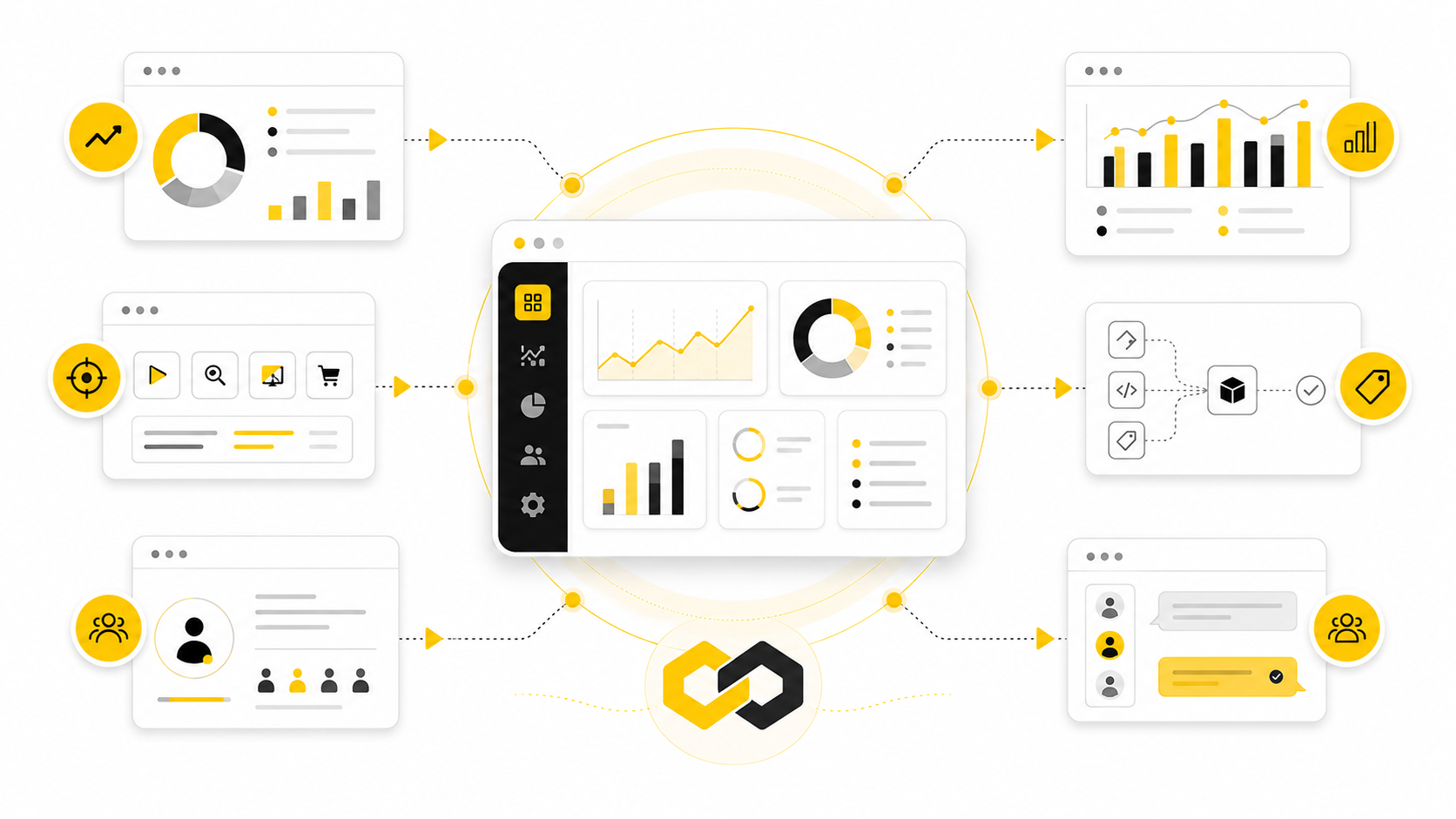
Google Marketing Platform partners exist because enterprise marketing tools are only useful when the strategy, data, media buying, tagging, measurement, and reporting actually work together. Google positions Google Marketing Platform as a unified advertising and analytics platform for more carefully marketing measurement and better results, with enterprise products such as Campaign Manager 360, Display & Video 360, Search Ads 360, Analytics 360, and Tag Manager 360 sitting at the center of that stack. That sounds clean on paper, but in the real world, most teams do not struggle because they lack tools. They struggle because the tools are misconfigured, underused, poorly governed, or disconnected from business decisions.
The right partner can change that. A strong Google Marketing Platform partner helps translate a complex platform into a working operating system for acquisition, measurement, optimization, and executive reporting. Google’s own partner materials describe these partners as companies that can support single projects or longer-term partnerships, with certified companies and sales partners available through the official Google Marketing Platform partner directory.
This matters more now because marketing teams are being asked to do two things at once: grow efficiently and prove what actually caused that growth. Privacy expectations, consent requirements, modeled conversions, server-side tagging, first-party data, and platform automation have made “just launch campaigns” a weak approach. Even Google’s recent product updates show how much the platform keeps changing, from measurement methodology changes in Campaign Manager 360 and Display & Video 360 to newer AI-assisted workflows across Google Marketing Platform products.
A good partner is not just a vendor who knows where the buttons are. The right partner should help you decide what should be measured, how the data should be trusted, which teams own which workflows, and how the platform should evolve as your business grows. That is the lens this guide uses throughout: not “who has a badge,” but “who can help you get better marketing decisions from a very powerful ecosystem.”
Why Google Marketing Platform Partners Matter
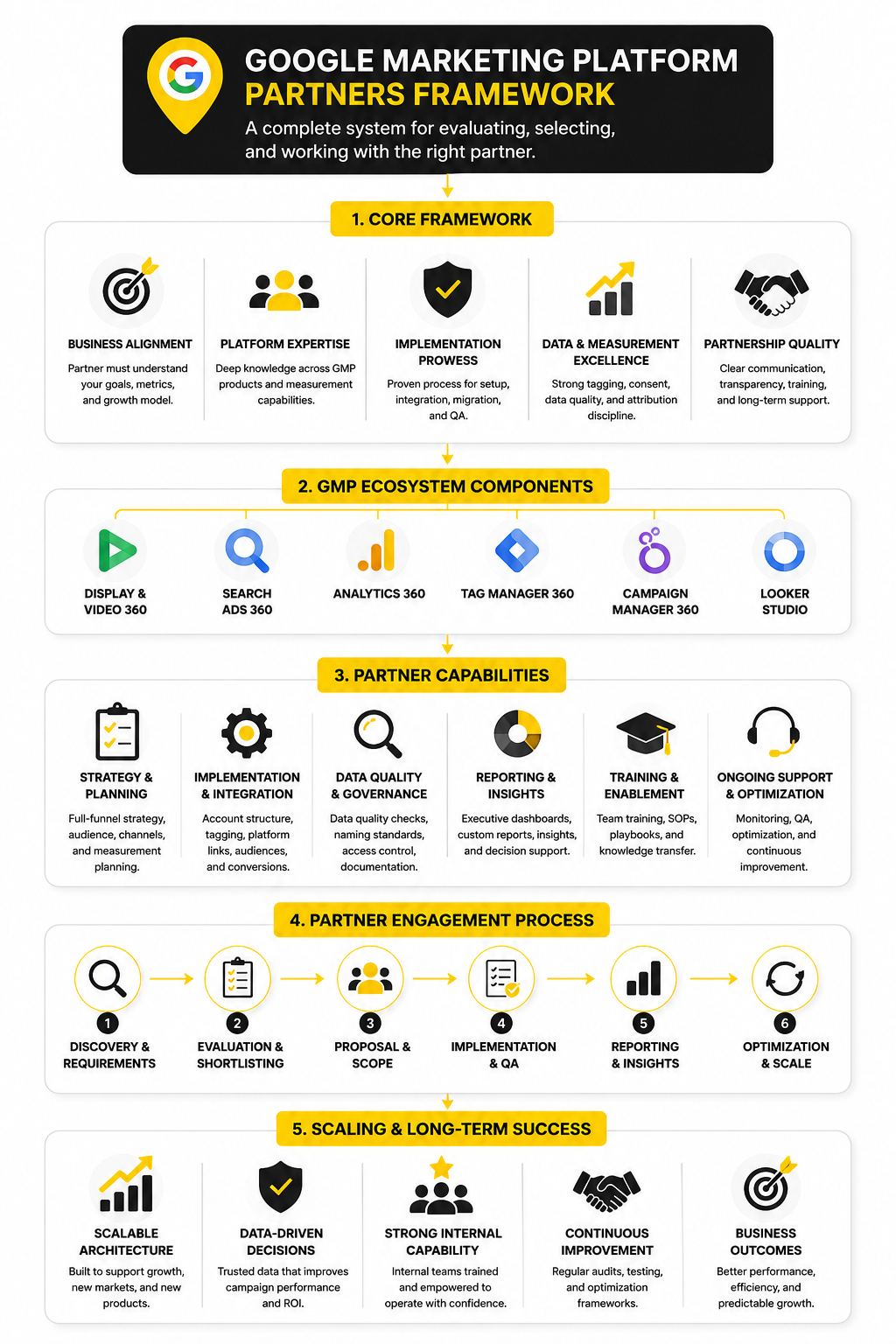
Google Marketing Platform is powerful because it connects advertising, analytics, tagging, audience strategy, and campaign measurement across multiple enterprise products. Display & Video 360 is built for end-to-end campaign management across channels such as display, video, TV, audio, and more, while Campaign Manager 360 centralizes ad serving, campaign management, verification, and measurement. Search Ads 360 then adds enterprise search management, and Analytics 360 supports more advanced measurement needs for larger organizations.
The challenge is that these products rarely create value in isolation. A media team can run campaigns in Display & Video 360, but if Floodlight activities are messy, consent behavior is unclear, or reporting definitions are inconsistent, the optimization loop becomes unreliable. A partner’s job is to make the full system coherent, not simply to manage one product interface.
That is why choosing from Google Marketing Platform partners should start with your operating problem, not the partner’s sales deck. If your issue is measurement trust, you need a partner with deep analytics, tagging, governance, and attribution experience. If your issue is inefficient media buying, you need stronger expertise in Display & Video 360, Campaign Manager 360, inventory strategy, audience design, and creative testing.
Framework Overview
The simplest way to evaluate Google Marketing Platform partners is to look at four things: fit, proof, governance, and commercial reality. Fit means the partner has solved problems similar to yours, with the same level of complexity, market coverage, and internal stakeholder pressure. Proof means they can show credible evidence of capability through certifications, documented processes, client references, and clear diagnostic thinking.
Governance is the part many teams underestimate. A partner may be technically strong but still create chaos if they do not document naming conventions, access controls, QA steps, change logs, data definitions, and reporting ownership. In enterprise marketing, weak governance becomes expensive because every mistake spreads across campaigns, dashboards, budgets, and decisions.
Commercial reality is just as important. Some partners are best for short technical projects, some are better for retained media operations, and some are built for transformation work across analytics, cloud, CRM, and marketing teams. The right choice depends on whether you need a specialist, an implementation team, a managed-service partner, or a strategic advisor who can help your internal team mature over time.
Core Components Of This Guide
The next part will start with why Google Marketing Platform partners matter from a business perspective, especially when marketing teams are under pressure to connect spend with outcomes. It will look at the gap between owning platform access and actually operating the platform well. That distinction is important because many companies buy enterprise tools before they have the internal systems to use them properly.
After that, the guide will break down the partner ecosystem in plain English. Google distinguishes between certified companies and sales partners in its Google Marketing Platform Partners help documentation, and the broader Google Partners program uses requirements around performance, spend, and certifications for Google Ads partners. These labels are useful, but they are not enough on their own, so the article will explain what to check beyond the badge.
Then we will move into the selection framework and the implementation model. That is where the article becomes more tactical: discovery questions, red flags, scope design, measurement audits, migration planning, governance, reporting cadence, and handoff quality. By the end, you should have a practical way to compare Google Marketing Platform partners without getting distracted by vague claims, shiny dashboards, or generic promises.
Why The Right Partner Changes The Outcome
Most companies do not look for google marketing platform partners because everything is going perfectly. They usually start looking when reporting is confusing, campaign performance is hard to explain, internal teams disagree on attribution, or nobody fully trusts the numbers in the dashboard. That is the real problem: not access to the platform, but confidence in how the platform is being used.
Google Marketing Platform is built for serious marketing operations. It can connect media buying, ad serving, search management, analytics, tagging, audiences, and reporting into one ecosystem. But when the setup is fragmented, each tool becomes another place where errors can hide.
That is why the partner decision is bigger than technical support. A partner can help you turn platform access into a working marketing system. Done well, that system gives your team cleaner data, faster decisions, more disciplined campaigns, and a clearer connection between spend and business outcomes.
The Platform Is Powerful, But It Is Not Self-Managing
Google Marketing Platform products are designed to work together, but they still need careful implementation. Campaign Manager 360 can sit at the center of ad serving and measurement. Display & Video 360 can manage programmatic media buying. Search Ads 360 can coordinate paid search activity at scale. Analytics 360 and Tag Manager 360 can support deeper measurement and tagging workflows.
The issue is that every connection point creates responsibility. Floodlight configuration, advertiser linking, conversion definitions, audience rules, consent behavior, naming conventions, access levels, QA processes, and reporting logic all need to be handled properly. If one layer is weak, the entire decision-making process gets weaker.
This is where experienced google marketing platform partners earn their place. They do not just ask, “What campaigns do you want to run?” They ask what the business needs to learn, which metrics actually matter, where the data comes from, who owns each decision, and how performance will be reviewed after launch.
Bad Implementation Creates Expensive Noise
A poorly implemented platform does not always fail loudly. That is what makes it dangerous. Campaigns may still run, dashboards may still update, and reports may still look professional, but the underlying data can be incomplete, duplicated, delayed, or misread.
That kind of noise creates bad decisions. A team might shift budget toward a campaign that looks efficient only because conversions are being counted differently. Another team might pause a channel that appears weak because assisted value is not being captured properly. Leadership may see a clean executive dashboard without realizing the source data is not ready for strategic decisions.
The cost is not only wasted media spend. It is wasted attention. When teams spend every performance meeting debating whether the numbers are right, they have less energy left for improving creative, audience strategy, landing pages, offers, and customer experience.
The Privacy Shift Made Partner Quality More Important
Measurement used to be easier when more user-level signals were available by default. That world is fading. Consent choices, browser restrictions, platform policy changes, regional privacy requirements, and modeled measurement now shape how marketing data is collected and interpreted.
Google’s own consent mode documentation explains that consent mode adjusts tag behavior based on user consent choices and can support conversion and behavioral modeling when direct observation is limited. That creates a very practical partner requirement: your setup needs people who understand both technical implementation and the business meaning of modeled data. A surface-level setup is not enough anymore.
This is especially important for teams advertising in regions with stricter consent expectations. A partner should be able to review your consent management setup, tag behavior, analytics configuration, and campaign measurement assumptions together. If they treat privacy, analytics, and media buying as separate conversations, that is a warning sign.
A Partner Should Improve The Operating System, Not Just The Tools
The best google marketing platform partners improve how your team works. They help define naming conventions that make reports readable. They set up QA routines so launches do not depend on guesswork. They create documentation that new team members can actually use.
That operational layer matters because marketing platforms change constantly. Features evolve, workflows shift, and measurement rules need review. A partner who only completes a one-time setup without improving your internal operating rhythm leaves you dependent and exposed.
A strong partner should make your team more carefully over time. That does not mean you will never need outside help again. It means your internal team should understand the logic behind the setup, the reason behind the reporting structure, and the process for making changes without breaking the system.
The Right Partner Connects Media, Data, And Business Goals
A media-only view is too narrow. A data-only view is also too narrow. Google Marketing Platform sits between campaign execution and business measurement, so the right partner needs to understand both sides.
For example, a Display & Video 360 specialist may know how to structure deals, audiences, frequency, and bidding. But if they cannot explain how performance will be measured through Campaign Manager 360, Analytics 360, or offline business data, the optimization strategy may stay shallow. On the other side, an analytics specialist may build a beautiful measurement framework but fail to account for how buyers actually manage campaigns day to day.
The strongest partner conversations connect these pieces. What are we trying to grow? Which actions prove progress? Which platform signals are reliable? Which signals are directional? Which decisions will be made weekly, monthly, and quarterly? That is the level where Google Marketing Platform becomes useful instead of merely complex.
When A Partner Is Worth Paying For
A partner is worth paying for when the cost of confusion is higher than the cost of expertise. That usually happens when media spend is meaningful, reporting feeds important decisions, or multiple teams depend on the same marketing data. At that point, weak implementation is not a small inconvenience. It becomes a business risk.
You do not need the biggest partner in the directory by default. You need the partner whose strengths match your current bottleneck. If your campaigns are already strong but measurement is weak, prioritize analytics and tagging depth. If your measurement foundation is solid but media execution is messy, prioritize platform buying expertise and campaign governance.
The practical test is simple. After a few conversations, you should feel clearer, not more confused. A serious partner will diagnose before prescribing, explain tradeoffs plainly, and show how their work will improve decisions inside your business.
The Partner Ecosystem: Certified Companies, Sales Partners, And Specialists
The Google Marketing Platform partner ecosystem is not one single type of provider. Some companies focus on implementation, some focus on product resale, some manage campaigns, and some operate more like strategic transformation partners. This matters because the wrong partner category can create friction even when the people are technically capable.
Google describes the program as including Certified Companies and Sales Partners in its Google Marketing Platform Partners documentation. Certified Companies are recognized for product expertise, while Sales Partners also work with Google to help sell Google Marketing Platform products. That distinction is useful, but it should be treated as a starting point, not the whole evaluation.
The practical question is simple: what kind of help do you actually need? If you need licensing support, commercials, and platform access, a Sales Partner may be relevant. If you already have access but your setup is messy, you may need a certified implementation specialist, analytics partner, media operations team, or technical consultancy.
Certified Companies
Certified Companies are usually a good fit when you need product-specific expertise. They may specialize in Analytics 360, Campaign Manager 360, Display & Video 360, Search Ads 360, Tag Manager, Looker Studio, or a mix of those products. Their value is usually strongest when you already know which part of the ecosystem needs attention.
That does not mean every certified company is right for every project. A partner can be excellent at Analytics 360 implementation and still be the wrong choice for complex programmatic buying. Another partner may be strong in Display & Video 360 but weaker when the project requires server-side tagging, consent behavior, or executive reporting design.
When evaluating google marketing platform partners in this category, ask where they are deepest. You want specifics, not a broad “we do everything” answer. The best firms can explain their strongest products, their common project types, and the situations where they would not be the best fit.
Sales Partners
Sales Partners can help when your company needs support with access, licensing, procurement, or broader platform adoption. That can be valuable because enterprise marketing tools often involve commercial complexity before implementation even begins. A good Sales Partner can make the buying process smoother and help you understand which products belong in your stack.
But commercial support should not be confused with operational excellence. Some Sales Partners also have strong implementation and consulting teams. Others may be better at licensing than hands-on transformation work.
The key is to separate the buying conversation from the delivery conversation. Who will actually do the audit? Who will configure the platform? Who will review measurement quality? Who will train your team? If the people selling the engagement are not the people delivering it, you need to meet the delivery team before signing.
Specialist Partners
Specialist partners are often the best choice when your problem is narrow but important. For example, you may need help with Floodlight architecture, server-side Google Tag Manager, consent mode, offline conversion imports, API reporting, Looker Studio dashboards, or Search Ads 360 migration planning. These are not small details. They are the plumbing behind serious marketing decisions.
Specialists can move faster because they have seen the same technical problem many times. They usually bring stronger checklists, sharper QA routines, and fewer generic workshops. That is useful when your internal team already knows the business context and mainly needs expert execution.
The tradeoff is that specialists may not cover the full operating model. A tagging expert may not solve campaign governance. A dashboard expert may not fix media buying strategy. This is why the best setup is sometimes a lead partner supported by narrow specialists for high-risk work.
The Selection Framework: Fit, Proof, Governance, And Commercial Reality
Choosing between google marketing platform partners should feel like hiring for a business-critical role. You are not just buying hours. You are trusting someone with campaign data, measurement logic, platform structure, and decisions that influence real spend.
The four-part framework from earlier keeps the decision grounded: fit, proof, governance, and commercial reality. It protects you from choosing based on reputation alone. It also helps you compare a large agency, a boutique specialist, and a certified reseller without pretending they are the same kind of provider.
This is where you should slow down. The partner who sounds most confident in the sales call is not always the partner who will create the cleanest implementation. The right partner should make the problem clearer before they try to sell you the solution.
Fit
Fit starts with your current bottleneck. Are you trying to clean up measurement, improve media execution, migrate accounts, connect offline data, manage consent, build dashboards, or train an internal team? Each goal points to a different partner profile.
You also need to look at company size and complexity. A global advertiser with multiple brands, agencies, markets, and consent requirements needs a different partner than a single-market company running a focused paid media program. The more stakeholders involved, the more important documentation, governance, and change management become.
A useful partner will ask detailed questions before proposing a scope. They will want to understand your stack, spend level, current reporting pain, internal skills, data quality, and decision cadence. If they jump straight to a package without diagnosing the situation, they may be selling what they have rather than what you need.
Proof
Proof should go beyond logos and badges. Certifications matter, but they do not prove that a partner can solve your exact problem. You want evidence that they understand the work at the level where mistakes actually happen.
Ask for examples of deliverables, not confidential client data. A serious partner should be able to show anonymized audit structures, implementation plans, QA checklists, dashboard planning methods, governance templates, or training outlines. That tells you far more than a vague claim about being “data-driven.”
You should also listen for how they explain tradeoffs. Strong partners do not pretend every problem has a perfect solution. They can explain what is observable, what is modeled, what is directional, what requires business context, and what needs technical validation before anyone should trust the numbers.
Governance
Governance is where many partner relationships either become valuable or quietly fall apart. Without governance, every platform change becomes risky. Nobody knows who approved a tag, why a conversion was renamed, whether an audience is still valid, or which report leadership should trust.
Good governance includes clear naming rules, access control, QA steps, change logs, data definitions, ownership, and review cycles. It also includes documentation that real people can use, not a forgotten folder full of outdated screenshots. This is especially important when Campaign Manager 360, Display & Video 360, Search Ads 360, Analytics 360, and Tag Manager are connected.
Your partner should have a governance opinion. They should not wait for your team to invent every process from scratch. If they cannot explain how they prevent errors, manage changes, and keep the setup understandable over time, the implementation may look fine on launch day and become messy six months later.
Commercial Reality
Commercial reality means the engagement model has to match the work. A fixed-scope audit is different from a migration. A one-time tagging cleanup is different from retained media operations. A strategic measurement transformation is different from product licensing support.
Before you compare prices, compare what is actually included. Does the proposal include discovery, documentation, implementation, QA, training, post-launch support, and reporting review? Does it include senior people, or only senior oversight? Does it include enough time for stakeholder alignment, or only technical execution?
The cheapest partner is not always cheaper in the end. If a weak implementation creates reporting disputes, campaign delays, rework, or poor optimization decisions, the hidden cost can be much higher than the original fee. A good commercial structure makes the work accountable without pretending complex platform projects are simple.
Professional Implementation: From Audit To Operating Rhythm
A strong implementation does not begin with clicking around inside the platform. It begins with understanding the business goal, the current setup, and the decisions the platform must support. That is the difference between a technical task list and a professional implementation process.
The process should also be visible. Your team should know what is being reviewed, what will change, what risks exist, and how success will be judged. Good google marketing platform partners make implementation feel structured rather than mysterious.
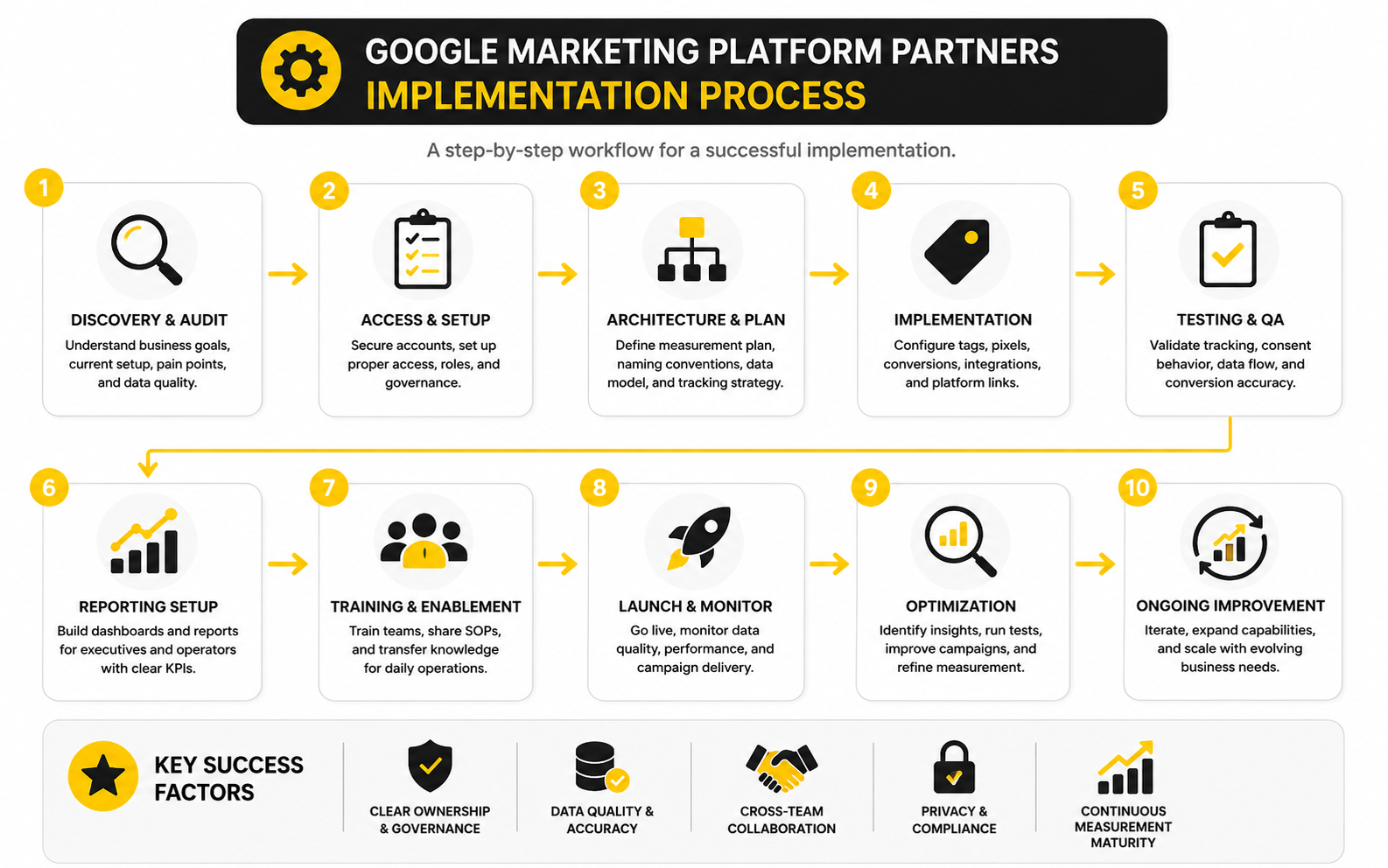
This is where the work becomes tangible. The exact steps will vary by company, but the underlying flow should be easy to understand.
Step 1: Discovery And Access Review
Discovery should clarify the business model, customer journey, campaign structure, reporting expectations, and internal ownership. The partner needs to know which conversions matter, which markets or brands are in scope, which teams use the data, and which decisions depend on the platform. Without that context, technical recommendations can become disconnected from business reality.
Access review is part of the same step. The partner should inspect who has access to each product, what permission levels exist, and whether old agencies, former employees, or unnecessary users still have privileges. Access control is boring until it becomes a risk.
This step should end with a clear map of the current environment. That includes the relevant products, account structures, integrations, key users, reporting outputs, and known pain points. If the partner cannot explain the current state clearly, they are not ready to redesign it.
Step 2: Measurement And Tagging Audit
The measurement audit checks whether your conversion logic matches how the business actually creates value. That means reviewing Floodlight activities, conversion definitions, event structure, custom variables, attribution settings, deduplication logic, and the relationship between platform data and business data. This is one of the highest-leverage parts of the process.
Tagging review should include Google Tag Manager, consent behavior, site events, app events where relevant, and any server-side setup. Google’s consent mode documentation makes it clear that consent signals affect how tags behave, so implementation cannot be treated as a minor legal checkbox. It directly influences measurement quality.
The output should not be a vague list of issues. It should separate critical problems from nice-to-have improvements. Your team needs to know what is breaking trust, what is limiting optimization, what is creating compliance risk, and what can wait.
Step 3: Platform Architecture And Naming Standards
Architecture is where the partner designs how the platform should be organized. This may include advertiser structure, Floodlight configuration, campaign taxonomy, audience organization, placement naming, reporting dimensions, integrations, and workspace rules. The goal is to create a setup that is scalable, readable, and hard to misuse.
Naming standards are more important than they look. A weak naming system makes reporting painful and slows down every analysis. A strong naming system lets teams understand market, product, campaign objective, channel, audience, creative, test type, and timing without decoding chaos.
This step should involve the people who will use the system every week. Media buyers, analytics teams, marketing leaders, and reporting owners may all need a say. The partner should guide the standard, but the standard has to work for the business.
Step 4: Implementation And QA
Implementation is where the approved plan becomes real. This can include account restructuring, Floodlight updates, tag deployment, audience setup, reporting changes, product linking, dashboard rebuilds, or migration work. The partner should work from an agreed plan, not improvise inside live accounts.
QA is non-negotiable. Tags should be tested, conversions should be validated, naming should be checked, platform links should be confirmed, and reports should be reviewed before stakeholders rely on them. Google’s Campaign Manager 360 documentation around reporting and Floodlight behavior shows how reporting details can change over time, so QA needs to be a habit, not a one-off task.
A professional partner will document what changed and why. That record protects your team later when numbers move, campaigns change, or someone asks why a setup decision was made. Without documentation, implementation knowledge disappears into Slack messages and meeting memories.
Step 5: Reporting, Training, And Handoff
Reporting should translate platform data into decisions. That means dashboards and reports need clear definitions, useful segmentation, and a direct connection to business questions. A beautiful report that nobody trusts or uses is not an asset.
Training is where the partner turns implementation into capability. Your team should understand how the setup works, what not to change casually, how to request updates, and how to interpret the key reports. This reduces dependency and prevents accidental damage.
The handoff should include documentation, access notes, QA records, naming conventions, reporting definitions, open risks, and recommended next steps. This is the moment where you can tell whether the partner built a system or just completed tasks. A good handoff makes the next month easier, not more confusing.
Step 6: Optimization Rhythm
Implementation is not the finish line. Once campaigns and reports are running, the partner should help establish a rhythm for reviewing performance, data quality, test results, and platform changes. That rhythm keeps the system useful as your business and Google’s products evolve.
A practical rhythm might include weekly campaign checks, monthly measurement reviews, quarterly governance cleanup, and periodic platform audits. The point is not to create meetings for the sake of meetings. The point is to make sure the platform keeps supporting better decisions.
This is where the best google marketing platform partners become long-term leverage. They help your team spot issues earlier, test more cleanly, explain performance more confidently, and keep the setup aligned with how the business actually grows.
Statistics And Data That Actually Matter
Data should make decisions easier. If a dashboard creates more arguments than clarity, the problem is not that your team needs more charts. The problem is that the measurement system has not been designed around the decisions the business actually needs to make.
This is where google marketing platform partners can be extremely useful. A good partner does not dump every available metric into a report and call it analytics. They help define which numbers matter, how reliable those numbers are, and what action each signal should trigger.
The key is to separate measurement from reporting. Measurement is the system that collects, processes, models, and connects the data. Reporting is the layer that turns that data into something humans can interpret. If the measurement layer is weak, the reporting layer will only make the weakness look prettier.
Start With The Decision, Not The Dashboard
Before anyone builds a dashboard, your team should know what decision the dashboard is supposed to support. A media buyer needs different information from a CMO. A growth lead needs different information from a finance team. A regional manager needs different information from a global analytics owner.
This sounds obvious, but it is where many implementations go wrong. Teams often begin with platform metrics because they are easy to access. Impressions, clicks, conversions, cost, reach, frequency, CPA, ROAS, and revenue can all be useful, but none of them matter equally in every context.
A strong partner will force the conversation back to decisions. Are we trying to shift budget between channels? Are we trying to understand which campaigns drive incremental demand? Are we trying to improve conversion quality? Are we trying to prove media efficiency to leadership? The answer changes the analytics design.
Understand The Difference Between Observed, Modeled, And Imported Data
Modern marketing measurement is not one clean bucket of truth. Some data is directly observed, some is modeled, and some is imported from other systems. If your team treats all three as identical, your reporting will create false confidence.
Observed data is captured directly through tags, platform interactions, or logged events. Modeled data fills gaps when direct observation is limited, which is especially important when consent choices or browser restrictions reduce visibility. Imported data can come from CRM systems, offline sales, call centers, ecommerce platforms, or other business systems.
Google’s consent mode documentation explains that tags adjust behavior based on user consent choices, and Google’s consent mode modeling materials explain that conversion modeling can estimate missing conversion paths when direct observation is not possible. That matters because a reported conversion is not always the same kind of signal. A serious partner should label, explain, and govern these differences so nobody reads modeled data as if it were raw transaction data.
The Core Measurement System
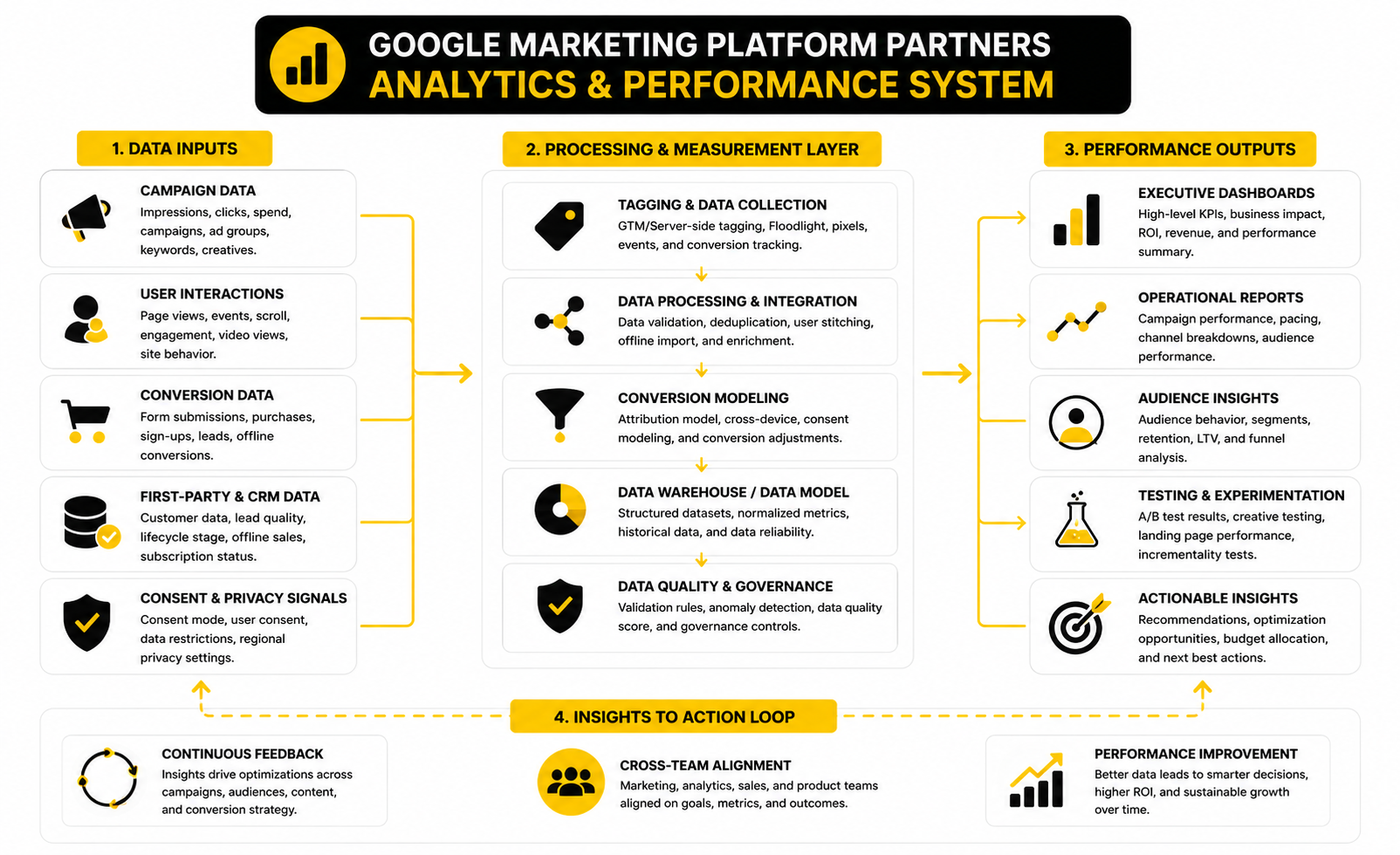
A practical measurement system should connect four layers. The first layer is collection: tags, consent signals, server-side events, Floodlight activities, platform integrations, and imported conversions. This is where many technical errors begin, so QA matters heavily.
The second layer is identity and matching. Enhanced conversions can supplement existing conversion measurement by sending hashed first-party data in a privacy-conscious way, which can improve conversion accuracy and support bidding when implemented correctly. The action here is not “turn everything on.” The action is to confirm what data is available, whether collection is consented, whether hashing and formatting are correct, and whether the signal is useful for your actual campaigns.
The third layer is attribution and modeling. Campaign Manager 360, Display & Video 360, Search Ads 360, and Analytics 360 can all influence how performance is interpreted. The partner’s job is to prevent your team from comparing numbers that were never designed to match perfectly.
The fourth layer is reporting and decision cadence. This is where dashboards, exports, recurring analysis, and executive summaries live. The best reports do not simply answer “what happened?” They help the team decide what to change next.
Benchmarks Are Useful, But They Are Not Strategy
Benchmarks can help you spot whether performance is unusual. They can also mislead you if you use them without context. A CPA benchmark means very little unless you understand the offer, market, funnel, conversion quality, sales cycle, margin, and media mix behind it.
This is why google marketing platform partners should be careful with benchmark conversations. A partner who promises that your Display & Video 360 CPA should match a generic industry average is oversimplifying the problem. A partner who uses benchmarks to frame hypotheses, pressure-test assumptions, and identify investigation areas is much more useful.
The best benchmark is often your own historical performance under cleaner measurement conditions. Once tracking is stable, naming is consistent, and conversion definitions are trusted, your internal trend lines become more valuable. External benchmarks can provide context, but internal baselines should drive most optimization decisions.
Performance Signals Worth Watching
Performance signals should be grouped by the kind of decision they support. Media delivery signals help you understand whether campaigns are reaching the intended audience efficiently. Conversion signals help you understand whether that attention is turning into valuable actions. Business signals help you understand whether those actions are creating revenue, pipeline, retention, or another real outcome.
Useful media delivery signals include reach, frequency, viewability, completion rate, impression share, inventory quality, pacing, and cost by audience or placement. These signals are not the final goal, but they explain whether the campaign is getting a fair chance to work. If delivery is broken, conversion analysis becomes less meaningful.
Useful conversion signals include conversion rate, CPA, ROAS, assisted conversions, time lag, deduplication behavior, and conversion quality. These metrics should be interpreted alongside the source of the data. A conversion imported from a CRM is not the same kind of signal as a lightweight onsite event, and your reporting should make that clear.
Quality Beats Volume In Conversion Measurement
More conversions do not automatically mean better measurement. If a platform is optimized toward weak events, duplicated events, or low-intent actions, the algorithm may become very good at finding the wrong behavior. This is one of the most expensive silent problems in performance marketing.
A strong partner will review the conversion hierarchy. They will ask which events are leading indicators, which events are primary optimization goals, and which events should only be used for analysis. This matters because bidding systems and reporting conversations both depend on the quality of the signal.
For example, a newsletter signup, demo request, qualified lead, closed deal, and repeat purchase should not be treated as interchangeable outcomes. They may all belong in the measurement system, but they should not all carry the same weight. The goal is to build a conversion structure that reflects business value, not just platform convenience.
Attribution Should Explain Tradeoffs, Not Create False Certainty
Attribution is useful when it helps your team make better budget and strategy decisions. It becomes dangerous when people treat it as a perfect explanation of reality. No attribution model can capture every human influence, every offline touchpoint, every brand effect, and every delayed decision with complete certainty.
This is why the partner’s communication style matters. Good google marketing platform partners explain what attribution can show, what it cannot show, and where incrementality testing or business context is needed. They do not hide uncertainty behind technical language.
In practice, attribution should be used to compare patterns, not worship single numbers. If one channel consistently appears earlier in the journey and another closes demand, that is a planning insight. If a campaign looks efficient only under one narrow model, that is a reason to investigate before shifting budget aggressively.
AI And Automation Make Clean Data More Important
Google Marketing Platform continues to move toward more automation, modeling, and AI-assisted workflows. That can be powerful, but it raises the cost of bad inputs. Automation does not fix a messy measurement foundation. It can amplify it.
Industry research around media and data keeps pointing in the same direction: advertisers are using more automation, but the pressure for trustworthy inputs and outcome-based measurement is increasing. The IAB State of Data 2025 report focuses heavily on AI’s role across the media campaign lifecycle, which makes one thing clear for practical teams: AI is only as useful as the data and governance around it.
This should change how you evaluate partners. You do not only want someone who knows how to activate platform features. You want someone who understands data quality, consent, measurement design, campaign operations, and the business risks of optimizing toward weak signals.
What Your Reports Should Make Obvious
A useful report should make the next action easier to see. It should show whether performance is improving, where spend is working, where measurement is uncertain, and what needs to be tested next. It should also make definitions clear enough that two teams do not interpret the same number in two different ways.
At minimum, reporting should separate delivery, engagement, conversion, revenue, and data-quality signals. This prevents teams from overreacting to one metric while ignoring the system around it. A campaign with strong engagement but weak conversion needs a different response than a campaign with poor delivery and strong conversion efficiency among the few users it reaches.
Your partner should also help define report ownership. Who maintains the dashboard? Who validates changes? Who explains discrepancies? Who decides when a metric becomes official? Without ownership, reporting turns into a shared asset that nobody actually controls.
How To Read Data Without Overreacting
Every marketing team needs a calm way to interpret performance changes. One bad day does not mean a campaign is broken. One strong week does not prove a strategy is scalable. The job is to understand patterns, confidence, context, and tradeoffs.
This is where review cadence matters. Daily checks are useful for pacing, delivery issues, and obvious technical problems. Weekly reviews are better for campaign-level optimization. Monthly and quarterly reviews are better for budget allocation, channel strategy, and broader measurement questions.
Good google marketing platform partners help create this rhythm. They teach the team which signals require immediate action and which signals require more data. That discipline prevents panic decisions and makes optimization more consistent.
The Data Questions A Partner Should Answer Clearly
Before trusting a partner with your measurement stack, ask how they would answer the hard questions. Their answers will tell you whether they think like operators or just platform users. You are looking for clarity, not jargon.
Strong answers should cover questions like:
These questions are not theoretical. They are the difference between a platform that guides decisions and a platform that creates noise. If a partner cannot answer them plainly, keep looking.
Advanced Tradeoffs When The Platform Starts To Scale
Once the foundation is clean, the conversation changes. You are no longer asking whether tags fire, reports load, or campaigns can be launched. You are asking whether the whole system can scale without becoming slow, fragile, or politically messy.
This is where google marketing platform partners need to think beyond implementation. A partner who is useful during setup may not always be useful during scale. Scaling requires sharper governance, clearer ownership, stronger experimentation, and better alignment between marketing, analytics, legal, finance, sales, and leadership.
The main risk is that success creates complexity. More markets, more campaigns, more products, more audiences, more reports, more stakeholders, and more automation can quietly turn a clean system into a confusing one. The best partners help you grow without letting the platform become a black box.
Central Control Versus Local Flexibility
Large organizations usually face the same tension: headquarters wants consistency, while local teams need flexibility. Both sides are right. Central teams need clean data, comparable reporting, and governance. Local teams need room to adapt to market conditions, language, creative, inventory, budgets, and sales realities.
A weak partner will choose one side too aggressively. If everything is centralized, local teams become slow and frustrated. If everything is local, reporting becomes inconsistent and leadership cannot compare performance across markets.
A strong partner helps design a controlled-flexible model. Core definitions, naming rules, access roles, conversion hierarchy, and executive reporting should be standardized. Campaign tactics, local testing, creative adaptation, and market-specific optimizations can remain flexible inside that structure.
In-House Team Versus Partner-Led Operations
Not every company should outsource the same amount of work. Some teams need a partner to operate the platform day to day. Others need a partner to set the system up, train the team, and stay available for complex support.
The right model depends on internal skill, hiring plans, media spend, speed requirements, and risk tolerance. If your team has strong marketers but limited technical depth, a partner-led measurement model may make sense. If your team has strong analysts and operators, the better partner role may be audit, governance, and advanced troubleshooting.
This decision should be made deliberately. Do not drift into dependency because nobody planned the handoff. Good google marketing platform partners should be willing to build your internal capability, even if they continue supporting you long term.
When To Use A Specialist Instead Of A Full-Service Partner
Full-service partners can be useful when you need one accountable team across strategy, implementation, media, analytics, and reporting. That can reduce coordination work and make ownership clearer. It can also be expensive or too broad if your problem is specific.
Specialists are better when the issue is narrow, technical, and high-risk. Server-side tagging, consent implementation, Floodlight cleanup, offline conversion imports, advanced reporting pipelines, or Search Ads 360 migration work may justify a specialist even if you already have a general agency. The point is not to collect more vendors. The point is to put expert attention where mistakes are costly.
The danger is fragmentation. If you bring in specialists, someone still needs to own the whole architecture. Without that ownership, each expert may optimize their piece while the overall system becomes harder to manage.
Automation Needs Guardrails
Automation is valuable when the inputs are clean and the goals are clear. It can help bidding systems react faster, support campaign optimization, and reduce manual work. But automation should not become an excuse to stop thinking.
The more automated your setup becomes, the more important your conversion quality becomes. If the system is optimizing toward weak events, duplicated conversions, or short-term signals that do not reflect business value, automation can scale the wrong behavior very efficiently. That is not progress. That is expensive momentum in the wrong direction.
This is why partners should review optimization goals regularly. They should know which conversions feed bidding, which events are used only for analysis, and which metrics leadership should not overreact to. Automation works best when humans define the right target and keep checking whether the target still makes sense.
Data Ownership And Vendor Risk
Your company should understand its own platform setup. That includes account structure, conversion definitions, tagging logic, access roles, reporting sources, and documentation. If all of that knowledge lives only with a partner, you do not really own the system.
Vendor risk becomes obvious when a partner relationship ends, a key consultant leaves, or a new agency takes over. If documentation is weak, the next team has to reverse-engineer decisions from platform settings and old reports. That creates delays, mistakes, and unnecessary rework.
A professional partner should reduce this risk from the beginning. They should document decisions, explain tradeoffs, train internal users, and keep access properly controlled. The goal is not to remove the partner from the picture. The goal is to make sure your business is never held hostage by hidden knowledge.
Legal, Privacy, And Consent Are Strategic Issues
Privacy is not just a legal checkbox anymore. It affects measurement, audience activation, reporting confidence, and optimization quality. If consent behavior changes what can be observed, then consent implementation directly affects marketing performance conversations.
This is why google marketing platform partners should be comfortable working with legal and privacy teams. They do not need to replace legal counsel, but they should understand how consent choices influence tags, modeled conversions, audience eligibility, and reporting gaps. A partner who treats privacy as someone else’s problem may create technical decisions that become business problems later.
The practical approach is to make privacy part of the operating model. Consent behavior should be documented. Tag behavior should be tested. Reporting should explain where data may be modeled or incomplete. Leadership should understand that privacy-aware measurement is not weaker by default, but it does require more discipline.
Multi-Product Complexity Can Hide Waste
Google Marketing Platform becomes more powerful as products connect, but each connection also creates more places for waste to hide. Campaign Manager 360, Display & Video 360, Search Ads 360, Analytics 360, and Tag Manager can work together beautifully. They can also become a maze if nobody owns the architecture.
Waste can show up as duplicated conversions, unused audiences, inconsistent naming, overlapping reports, unclear campaign ownership, or redundant workflows. None of these problems look dramatic on their own. Together, they slow the team down and make performance harder to improve.
A strong partner should periodically look for this kind of hidden waste. Not just once during implementation, but as part of ongoing platform hygiene. The question should always be: does this setup still serve the business, or are we maintaining complexity because nobody has challenged it?
Reporting For Leadership Versus Reporting For Operators
Leadership reporting and operator reporting should not be the same thing. Leaders need a clear view of business impact, risk, budget movement, and strategic tradeoffs. Operators need diagnostic detail, campaign-level signals, pacing, tests, and technical alerts.
When one dashboard tries to serve everyone, it usually serves nobody well. Executives get too much detail, and operators lose the granularity they need. The result is a report that looks comprehensive but fails to guide action.
Good google marketing platform partners separate these layers. They help build executive reporting that is simple enough to support decisions and operational reporting that is detailed enough to support optimization. The two should connect, but they should not be forced into the same view.
The Partner Should Challenge Your Assumptions
A partner who only agrees with you is not strategic. You are paying for judgment, not just execution. The right partner should challenge weak conversion goals, unclear reporting requests, unnecessary complexity, unrealistic timelines, and decisions that could damage long-term measurement quality.
This does not mean they should be difficult for the sake of it. It means they should protect the system from bad decisions. Sometimes the right answer is to simplify the dashboard, reduce the number of conversion goals, delay a launch until QA is complete, or tell leadership that a number is not reliable enough for budget decisions.
That kind of honesty is valuable. It may feel slower in the moment, but it prevents expensive confusion later. A partner who protects measurement integrity is often worth more than one who simply moves fast.
Scaling Requires A Maturity Roadmap
You do not need to solve every advanced problem at once. In fact, trying to do everything immediately can create more complexity than value. The better approach is to define a maturity roadmap.
A practical roadmap might move through stages like this:
This roadmap gives the partner relationship direction. It also helps your team avoid random improvement projects that never connect into a system. Each stage should make the next stage easier, cleaner, and more valuable.
Red Flags That Become More Dangerous At Scale
Some partner weaknesses are annoying during a small project but dangerous at scale. Poor documentation, vague ownership, weak QA, unclear pricing, and shallow analytics thinking may not break everything immediately. As complexity grows, those weaknesses become expensive.
Watch for partners who cannot explain their process clearly. Watch for teams that overpromise attribution certainty. Watch for proposals that skip training, governance, or post-launch review. Watch for partners who talk about platform features but avoid business outcomes.
The biggest red flag is a partner who makes you dependent without making you more carefully. You should come out of the relationship with a better system and a better understanding of that system. If every answer requires another paid call because nothing is documented or explained, the relationship is not healthy.
What Expert-Level Partner Support Looks Like
Expert support feels calm, structured, and practical. The partner can zoom into technical details without losing the business goal. They can explain uncertainty without sounding evasive. They can build systems that are sophisticated without becoming impossible to maintain.
They also know when not to add complexity. Not every company needs every advanced feature. Not every dashboard needs every metric. Not every campaign needs a complicated audience strategy. The best partners are confident enough to simplify.
That is the level to look for as you compare google marketing platform partners. You want technical depth, yes. But you also want judgment, documentation, communication, and a serious respect for how marketing decisions actually get made inside a business.
Final Evaluation Checklist
By this point, the main lesson should be clear: choosing between google marketing platform partners is not about finding the flashiest agency name. It is about finding the team that can help you build a reliable marketing operating system. The partner should understand the platform, but they should also understand decisions, ownership, risk, and business outcomes.
Before you commit, slow the process down enough to evaluate the things that will matter after the contract is signed. Sales calls are easy. Real implementation is where the truth shows up. Use this checklist to pressure-test whether a partner can actually support the work your team needs.
A serious partner should be able to explain:
The best answer is rarely the most complicated one. A strong partner should make the system easier to understand, easier to trust, and easier to improve. If a partner makes everything sound more mysterious, that is usually not expertise. That is a warning sign.
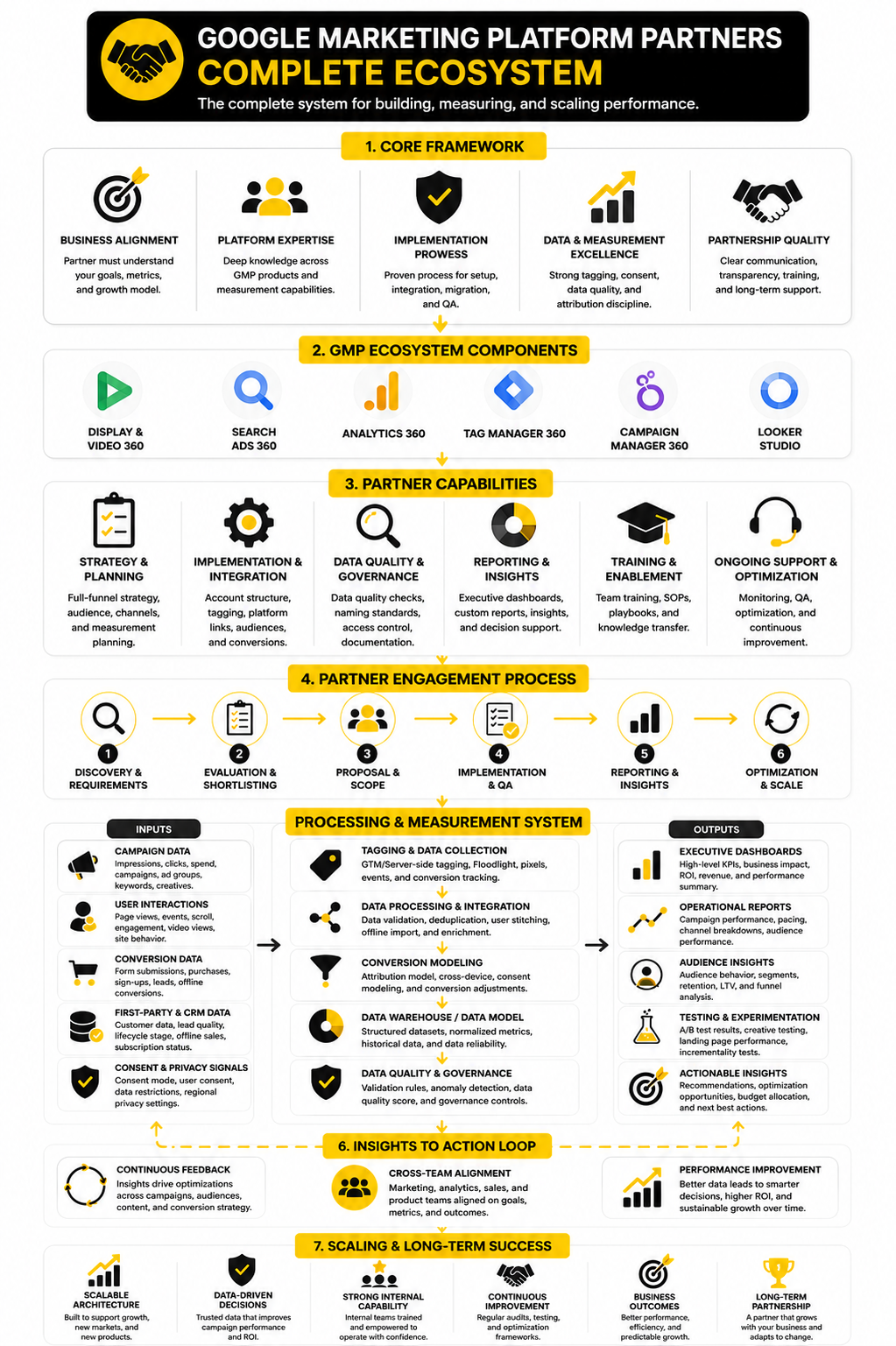
The Complete Partner System
A mature Google Marketing Platform setup works like an ecosystem. Campaigns create demand. Tags and integrations capture signals. Measurement logic turns those signals into usable data. Reports translate that data into decisions. Teams use those decisions to improve creative, budget allocation, audience strategy, landing pages, and customer experience.
Google marketing platform partners sit in the middle of that ecosystem when internal teams need outside expertise. Their job is not to own every decision forever. Their job is to strengthen the system so the business can make better decisions with more confidence.
That is the standard you should hold them to. Not “Can they set up the tool?” Not “Do they have a badge?” Not “Can they show a nice dashboard?” The real question is: can they help your team build a platform setup that stays useful when the business gets bigger, messier, and more ambitious?
When You Should Hire A Partner Now
You should look for a partner now if your team does not trust its marketing numbers. That lack of trust slows down decisions, creates internal arguments, and makes optimization feel like guesswork. When reporting confidence is low, the cost usually shows up in wasted meetings before it shows up in a spreadsheet.
You should also hire a partner if your media spend has outgrown your internal operating system. More campaigns, more markets, more products, and more stakeholders require stronger structure. Without it, complexity eats the gains you expected from scale.
A partner also makes sense when privacy, consent, first-party data, or offline conversion work becomes too technical for the current team. These areas affect measurement quality directly. Treating them casually can create long-term problems that are painful to unwind later.
When You Should Wait
You may not need a Google Marketing Platform partner immediately if your current problem is not actually a platform problem. Sometimes the issue is a weak offer, poor landing page, unclear positioning, slow sales follow-up, or limited creative testing. A platform expert can help diagnose measurement, but they cannot magically fix a broken customer journey.
You should also wait if nobody internally can own the relationship. Even the best partner needs a clear business owner, access to stakeholders, and timely feedback. Without that, the engagement becomes a series of disconnected tasks instead of a serious improvement project.
Waiting does not mean ignoring the issue. It means preparing properly. Clean up internal goals, define the business questions, identify decision owners, and gather current reporting pain points before asking partners for proposals.
The Final Decision Rule
The final decision rule is simple: choose the partner who improves clarity before they ask for commitment. They should help you understand the problem better during the sales process. They should ask sharp questions, explain tradeoffs plainly, and show how their process reduces risk.
Do not choose based only on size. Large partners can bring scale, but they may not always give you senior attention. Smaller specialists can bring depth, but they may not cover every operational need. The right choice depends on your bottleneck, internal capability, and how much ownership you want the partner to take.
The best google marketing platform partners leave you with a stronger system than the one they found. That system should have cleaner measurement, clearer reporting, stronger governance, better documentation, and a team that understands how to keep improving it. That is the outcome worth paying for.
What are Google Marketing Platform partners?
Google Marketing Platform partners are companies that help businesses use Google Marketing Platform products more effectively. They may support implementation, licensing, campaign operations, analytics, tagging, reporting, training, or long-term platform governance. The strongest partners connect the technical setup to real business decisions instead of only configuring tools.
What is the difference between a Certified Company and a Sales Partner?
A Certified Company is recognized for product expertise across parts of Google Marketing Platform. A Sales Partner can also help sell Google Marketing Platform products and may support licensing or procurement. In practice, you should still evaluate the delivery team, because the label alone does not prove that the partner is right for your specific project.
Do I need a partner if I already have access to Google Marketing Platform?
Access is not the same as capability. You may have the platform but still struggle with measurement quality, reporting trust, campaign governance, conversion definitions, or team training. A partner becomes valuable when the setup needs to become more reliable, scalable, and useful for decision-making.
Which Google Marketing Platform products do partners usually support?
Partners may support Campaign Manager 360, Display & Video 360, Search Ads 360, Analytics 360, Tag Manager 360, Looker Studio, and related measurement workflows. Some partners cover the full ecosystem, while others specialize in one or two areas. You should match the partner’s depth to the problem you actually need solved.
How do I choose between google marketing platform partners?
Start with your bottleneck. If measurement is weak, prioritize analytics, tagging, consent, and conversion expertise. If media execution is weak, prioritize campaign management, platform buying, audience strategy, and optimization experience. Then evaluate fit, proof, governance, and commercial structure before making a decision.
What should a partner audit before making recommendations?
A proper audit should review account structure, access permissions, conversion setup, Floodlight activities, tagging behavior, consent signals, platform links, naming conventions, reporting outputs, and documentation. The audit should separate critical issues from lower-priority improvements. That way, your team knows what needs immediate attention and what can wait.
How important is consent mode in partner selection?
Consent mode is important because it affects how tags behave and how conversion data may be modeled when direct observation is limited. A partner does not need to replace legal counsel, but they should understand how consent choices influence measurement, reporting, and optimization. If they treat consent as a minor technical checkbox, they are probably not the right partner for a serious setup.
Should I hire one full-service partner or multiple specialists?
One full-service partner can be useful when you need one accountable team across strategy, implementation, media, analytics, and reporting. Multiple specialists can work better when you have a narrow, high-risk problem such as server-side tagging, offline conversion imports, or a complex migration. If you use multiple partners, make sure one person or team owns the overall architecture.
What does a good implementation process look like?
A good implementation process starts with discovery, access review, and a measurement audit. Then it moves into architecture, naming standards, configuration, QA, reporting, training, and handoff. The process should be documented clearly so your team understands what changed, why it changed, and how to maintain it.
What are the biggest red flags when evaluating partners?
Major red flags include vague process descriptions, weak documentation, unclear delivery ownership, overpromising attribution certainty, skipping QA, ignoring consent behavior, and avoiding business outcome discussions. Another red flag is a partner who makes you dependent without making your internal team more carefully. You want expertise, not mystery.
How much should I rely on certifications?
Certifications are useful, but they are not enough. They show that the partner has met certain product expertise requirements, but they do not guarantee fit for your business model, data environment, or operating complexity. Use certifications as a filter, then judge the partner through their diagnostic ability, deliverables, references, and process quality.
What should leadership expect from a strong partner engagement?
Leadership should expect better decision quality, not just more reports. A strong engagement should improve confidence in marketing data, clarify which metrics matter, reduce reporting disputes, and make budget conversations more disciplined. It should also create a cleaner operating model for future campaigns.
How do partners help with performance improvement?
Partners help performance by improving the signals that campaigns and teams use to make decisions. That can include cleaner conversion tracking, better campaign structure, stronger reporting, more carefully optimization goals, and more reliable QA. The goal is not only to improve platform settings, but to improve the decisions those settings support.
Can a partner help connect offline sales or CRM data?
Yes, many advanced partners can help connect offline conversions, CRM data, lead quality signals, or sales outcomes into the measurement system. This is especially useful when online form fills are not the true business goal. The important part is making sure the imported data is accurate, timely, consent-aware, and useful for optimization.
How often should the platform setup be reviewed?
A serious setup should be reviewed regularly. Campaign pacing and delivery may need weekly checks, while measurement quality and reporting logic may need monthly or quarterly reviews. Larger architecture reviews should happen when the business adds markets, changes its funnel, launches new products, changes agencies, or shifts its measurement strategy.
Build a stronger local presence with BAAM AI
Turn your website, Google profile, social channels, and AI visibility into one growth engine
Most businesses do not need more random marketing activity. They need a consistent presence system that helps the right people find them, trust them, and take action. BAAM AI brings strategy, local SEO, website updates, Google Maps visibility, social content, AI-search readiness, media production, and reporting into one practical monthly engine.
If you want your marketing to keep working after the campaign ends, start with a free BAAM AI presence audit. See how your business shows up today and where the fastest visibility wins are at BAAM AI.