
BAAM AI Blog
Golden Step Marketing
is the discipline of turning scattered marketing activity into a clear, sequenced path from first attention to retained revenue. Instead of chasing random tactics, you build a system where each step has one job, one...
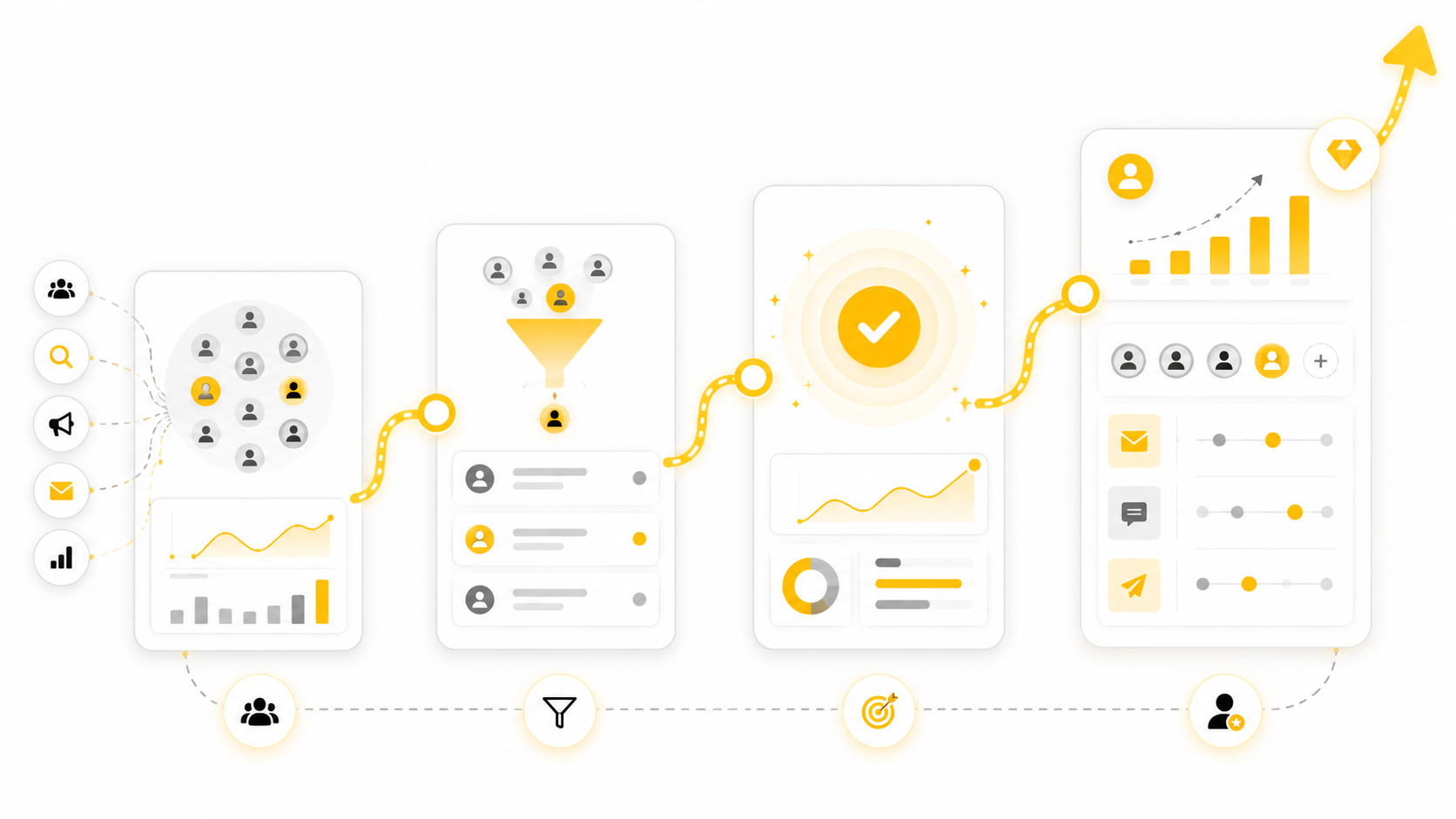
Golden step marketing is the discipline of turning scattered marketing activity into a clear, sequenced path from first attention to retained revenue. Instead of chasing random tactics, you build a system where each step has one job, one measurable outcome, and one logical next action for the prospect. That matters because most marketing problems are not really traffic problems; they are sequence problems.
A good campaign does not ask a cold visitor to make a high-trust decision too early. It earns the next click, the next reply, the next booking, the next purchase, and the next referral in the right order. That is the “golden step” idea: every stage should feel natural to the customer and commercially useful to the business.
this guide will treat golden step marketing as a practical framework, not a buzzword. We will look at how to structure the journey, what each step needs to do, which tools can support the process, and how professional teams implement it without making the system bloated. The goal is simple: build marketing that compounds instead of constantly starting from zero.
Why Golden Step Marketing Matters
Most businesses do not fail at marketing because they lack effort. They fail because their effort is spread across disconnected actions: a landing page here, an email sequence there, a few social posts, a paid ad test, and maybe a CRM nobody updates properly. Each piece may be useful on its own, but the business still leaks attention, trust, and revenue because the pieces do not move people forward in a controlled order.
Golden step marketing fixes that by forcing every marketing asset to answer one question: what is the next best step for this person? A cold visitor may need education before an offer. A warm lead may need proof before a call. A buyer may need onboarding before they are ready for an upsell, referral, or longer-term relationship.
This is why the framework is especially useful for service businesses, agencies, coaches, consultants, SaaS companies, and ecommerce brands with more than one buying touchpoint. The more complex the decision, the more important the sequence becomes. When the path is clear, marketing feels less like persuasion and more like guidance.
The Big Shift Behind the Framework
Marketing used to reward volume more generously. More content, more ads, more emails, and more landing pages often meant more opportunities. That still matters, but it is no longer enough because attention is fragmented and buyers are more skeptical of generic claims.
The modern buyer does research across search, social, communities, comparison pages, inboxes, and private recommendations before making a decision. They rarely move in a straight line, but your marketing system still needs to create a straight enough path that they know what to do next. Golden step marketing gives that scattered journey a practical structure.
This does not mean every prospect receives the exact same message. It means the business knows which step each person is most likely in and responds with the right asset, offer, or follow-up. That is where CRM, automation, segmentation, and conversion-focused pages become useful instead of becoming another pile of tools.
Framework Overview
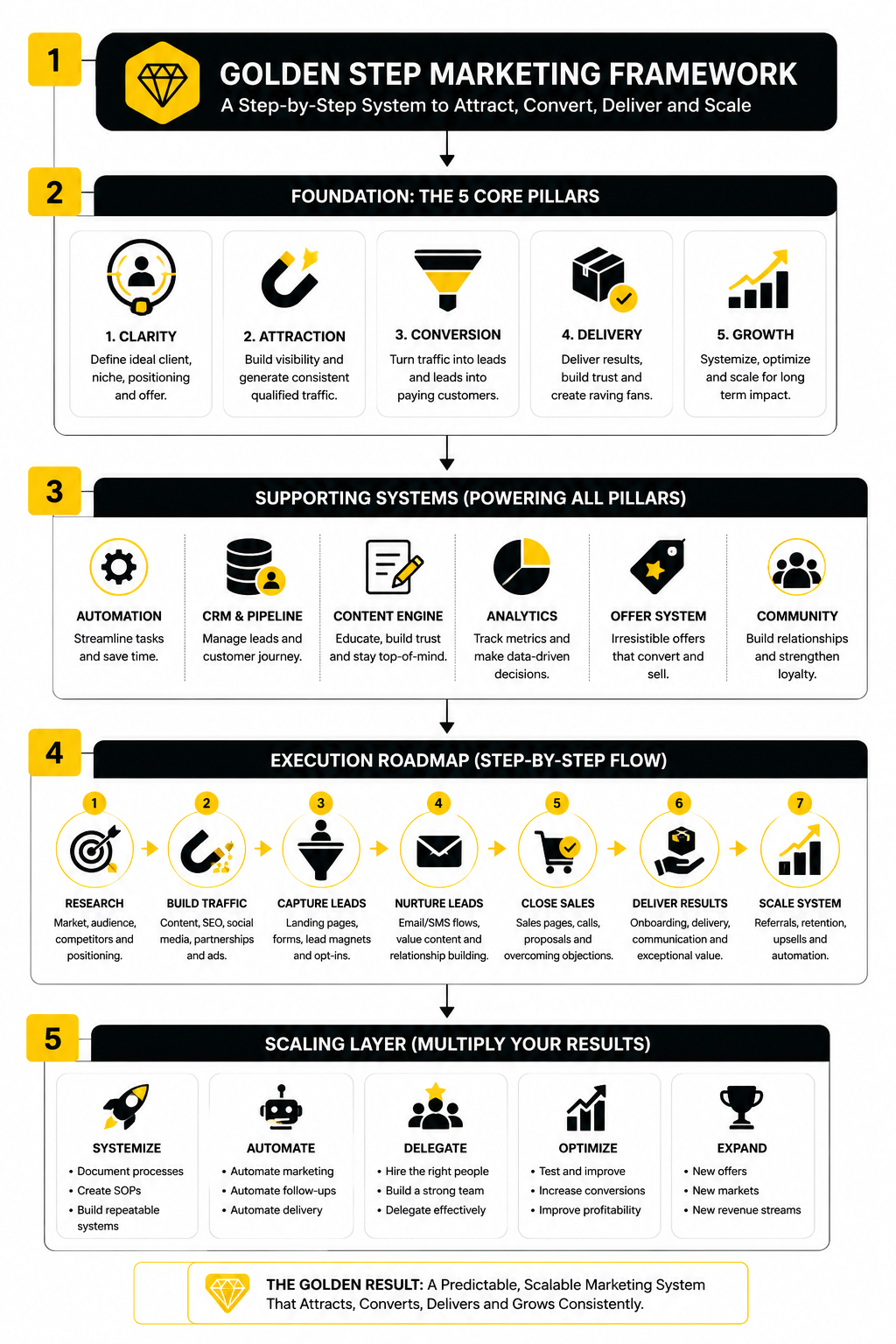
The golden step marketing framework has four simple layers: attention, trust, action, and expansion. Attention gets the right people into the journey. Trust helps them understand why the offer is relevant, credible, and worth considering.
Action turns interest into a measurable conversion, such as a booked call, checkout, demo request, trial, form submission, or message reply. Expansion keeps the relationship alive after the first conversion through onboarding, retention, upsells, referrals, reviews, and reactivation. Each layer has a different job, so each layer needs different content, automation, and measurement.
This is where tools can help, but only when the strategy comes first. A platform like GoHighLevel can support CRM, follow-up, funnels, automations, and client communication in one place. A funnel builder like ClickFunnels can be useful when the priority is building focused conversion paths without turning every campaign into a custom development project.
What Makes a Step “Golden”
A step becomes golden when it is both valuable to the customer and valuable to the business. If it only helps the business, it feels pushy. If it only helps the customer but creates no movement, it becomes content with no commercial direction.
A strong golden step usually does three things at once. It reduces confusion, increases trust, and makes the next action feel obvious. That could be a diagnostic quiz, a short buyer guide, a product comparison, a webinar, a calculator, a demo page, a checkout page, or a simple follow-up message that handles the most common hesitation.
The key is not complexity. The key is fit. A simple three-email follow-up can outperform an advanced automation if it matches the buyer’s real decision process, while a beautiful funnel can underperform if it asks for commitment before the prospect understands the value.
The Golden Step Marketing Framework
The framework starts with a simple idea: every marketing step should move the right person closer to the right decision. That sounds obvious, but it is exactly where many campaigns fall apart. They create attention, but they do not create momentum.
Golden step marketing works best when you stop thinking in isolated campaigns and start thinking in stages. A paid ad is not the strategy. A landing page is not the strategy. An email sequence is not the strategy. The strategy is the path that connects those pieces into one clear journey.
The framework has four practical stages: attract, qualify, convert, and expand. Each stage has a different job, so each stage needs different messaging, different assets, and different success metrics. When you mix those jobs together, your marketing gets noisy fast.
Step 1: Attract the Right Attention
The first step is not just getting more people to notice you. It is getting the right people to recognize that your message is relevant to them. This matters because broad attention can look good on dashboards while producing weak leads, low-quality calls, and poor conversion rates.
At this stage, your job is to create a strong enough signal that the right audience self-identifies. That can happen through search content, short-form social posts, paid ads, partnerships, comparison pages, lead magnets, or direct outreach. The channel matters less than the clarity of the promise.
A strong attraction step does not try to explain everything. It names the problem, shows the desired outcome, and gives the person a reason to take the next small action. In golden step marketing, attention is useful only when it leads somewhere specific.
Step 2: Qualify Interest Before You Push for Action
Once someone pays attention, the next mistake is asking for too much too quickly. A cold visitor may not be ready to book a call, start a trial, or buy today. They may first need to understand the problem better, compare options, or decide whether your approach fits their situation.
This is where qualification becomes important. You are not only deciding whether the lead is good for the business. You are also helping the prospect decide whether the offer is good for them. That is a healthier way to sell because it reduces pressure and increases trust.
Qualification can happen through forms, quizzes, surveys, calculators, booking questions, email behavior, page visits, chat conversations, or CRM tags. A tool like Fillout can help collect structured answers before a lead reaches your sales process. For conversational qualification, ManyChat can support message-based journeys when social DMs are part of the acquisition flow.
Step 3: Convert With a Focused Offer
Conversion becomes easier when the previous steps have done their job. By the time someone reaches the offer, they should understand the problem, trust the direction, and see why the next action makes sense. If the offer page has to do all the education from scratch, the journey is probably too weak before that point.
A focused offer should make the decision feel clean. It should explain who the offer is for, what outcome it helps create, what happens next, and why now is a sensible time to act. This is not about hype. It is about removing confusion.
For funnels, sales pages, checkout flows, and offer-specific campaigns, ClickFunnels can fit when the goal is speed and direct-response structure. For ecommerce brands that need more control over landing page design and testing, Replo can be useful for building dedicated pages without waiting on a full development cycle. The tool is not the magic. The clarity of the offer is.
Step 4: Expand the Relationship After the First Conversion
A lot of businesses treat conversion as the finish line. That is a costly mistake. The first purchase, call, trial, or signup is often the beginning of the most valuable part of the customer journey.
Expansion includes onboarding, activation, retention, upsells, referrals, reviews, reactivation, and long-term education. These steps are not random follow-ups. They are deliberate moments that help the customer get more value while helping the business increase lifetime value.
This is where golden step marketing becomes more powerful than a simple funnel. A funnel usually focuses on getting the conversion. A golden step system focuses on what should happen before, during, and after the conversion so the relationship keeps moving.
The Four Questions Behind Every Step
Every step in the framework should answer four questions before you build anything. These questions keep the strategy practical and stop you from creating assets just because a competitor has them. They also make the system easier to diagnose when performance drops.
These questions look simple, but they expose weak marketing quickly. If you cannot define who a step is for, the message will probably be generic. If you cannot define what belief needs to change, the content will probably educate without converting.
Matching the Step to the Buyer’s Awareness
Not every prospect enters the journey at the same level of awareness. Some people know they have a problem but do not know the solution. Some know the solution category but are still comparing providers. Some are almost ready and just need proof, pricing clarity, or a reason to act now.
This is why golden step marketing should not rely on one message for everyone. A cold audience may need problem education. A warm audience may need comparison content. A hot lead may need a direct offer and fast follow-up.
The easiest way to apply this is to map content and offers by awareness level. Early-stage prospects get helpful, low-pressure assets. Mid-stage prospects get proof, frameworks, and comparisons. Late-stage prospects get demos, consultations, trials, checkout pages, or booking links.
Building the System Around Momentum
The best marketing systems create a feeling of progress. Each step makes the next step easier. The prospect does not feel dragged through a funnel; they feel guided through a decision.
That is the difference between automation and real marketing architecture. Automation sends messages. Architecture creates movement. You need both, but the order matters.
A platform like GoHighLevel can support the operational side of this system with pipelines, automations, calendars, forms, messaging, and client follow-up. For leaner businesses that want a simpler all-in-one funnel and email setup, Systeme.io may fit better. The right choice depends on how complex the journey is, how many offers you manage, and how much control your team needs.
Where the Framework Usually Breaks
The framework usually breaks when the business skips steps. They drive paid traffic to an offer before the market understands the problem. They ask for sales calls before the lead is qualified. They automate follow-up before the message is clear.
Another common failure is overbuilding too early. Teams create complicated journeys with tags, branches, triggers, and delays before they have proven the basic path. That creates a system that looks advanced but is hard to manage and even harder to improve.
The better move is to build the minimum viable journey first. Start with one audience, one promise, one lead capture point, one conversion goal, and one follow-up sequence. Once that path works, expand it carefully.
Core Components of a Golden Step System
A golden step marketing system is not built from random tactics. It has a few core components that work together: a clear audience, a specific promise, a conversion path, a follow-up engine, and a measurement loop. If one of these is missing, the whole system becomes harder to scale.
The audience defines who the journey is for. The promise defines why they should care. The conversion path gives them a practical next action, while the follow-up engine keeps the relationship moving when they are not ready yet.
The measurement loop is what keeps the system honest. Without it, you end up guessing which step is working and which step is quietly leaking revenue. That is where many businesses get stuck, because they keep adding more activity instead of fixing the broken step.
The Audience Comes First
Before building pages, automations, ads, or content, you need to know who the system is designed to move. Not in a vague way like “business owners” or “people who want more sales.” That is too broad to guide real decisions.
A useful audience definition explains the person’s situation, pain, urgency, buying power, and decision context. It should make it easier to decide what to say, what to offer, what to ignore, and what proof matters most. If the audience definition does not help you make those choices, it is probably not specific enough.
This is especially important in golden step marketing because every step depends on the previous one. A weak audience definition creates weak attraction. Weak attraction creates messy qualification. Messy qualification creates low-quality conversions.
The Promise Needs to Be Practical
The promise is the reason someone takes the next step. It should be clear enough that the right person understands the benefit quickly, but grounded enough that it does not feel inflated. Big claims may get clicks, but they also create distrust when the rest of the journey cannot support them.
A practical promise connects the customer’s current problem to a believable next outcome. For example, a service business may promise a clearer lead follow-up system, not instant domination of the market. A SaaS product may promise faster setup or fewer manual tasks, not a magical end to every operational problem.
The stronger the promise, the easier the next step becomes. When the promise is vague, every page, email, ad, and sales call has to work harder. When the promise is specific, the system feels sharper from the first touchpoint.
The Conversion Path Must Be Obvious
A conversion path is the route from interest to action. It may include a landing page, form, calendar, checkout page, demo request, quiz, webinar registration, free trial, or direct message flow. The format depends on the offer, but the purpose is always the same: make the next action feel natural.
The mistake is giving people too many choices too early. A page with multiple competing buttons, vague calls to action, and unclear next steps creates hesitation. People do not always leave because they are uninterested; sometimes they leave because the path is confusing.
A focused conversion path should answer three questions quickly. What is this? Who is it for? What happens when I take the next step? If those answers are buried, the step is not golden yet.
Turning the Process Into a Real Workflow
This is where the strategy becomes tangible. You take the audience, promise, and conversion path, then turn them into a working sequence your team can actually build, manage, and improve. The goal is not to create the most advanced system on day one. The goal is to create the simplest journey that can produce measurable movement.
A practical workflow usually starts with mapping the first conversion goal. That goal might be a booked call, a checkout, a quote request, a lead form, a webinar signup, or a trial activation. Once that goal is clear, you build backward from it.
Every step before the goal should prepare the person for that action. Every step after the goal should help them complete the next meaningful stage. That is the heart of golden step marketing in execution.
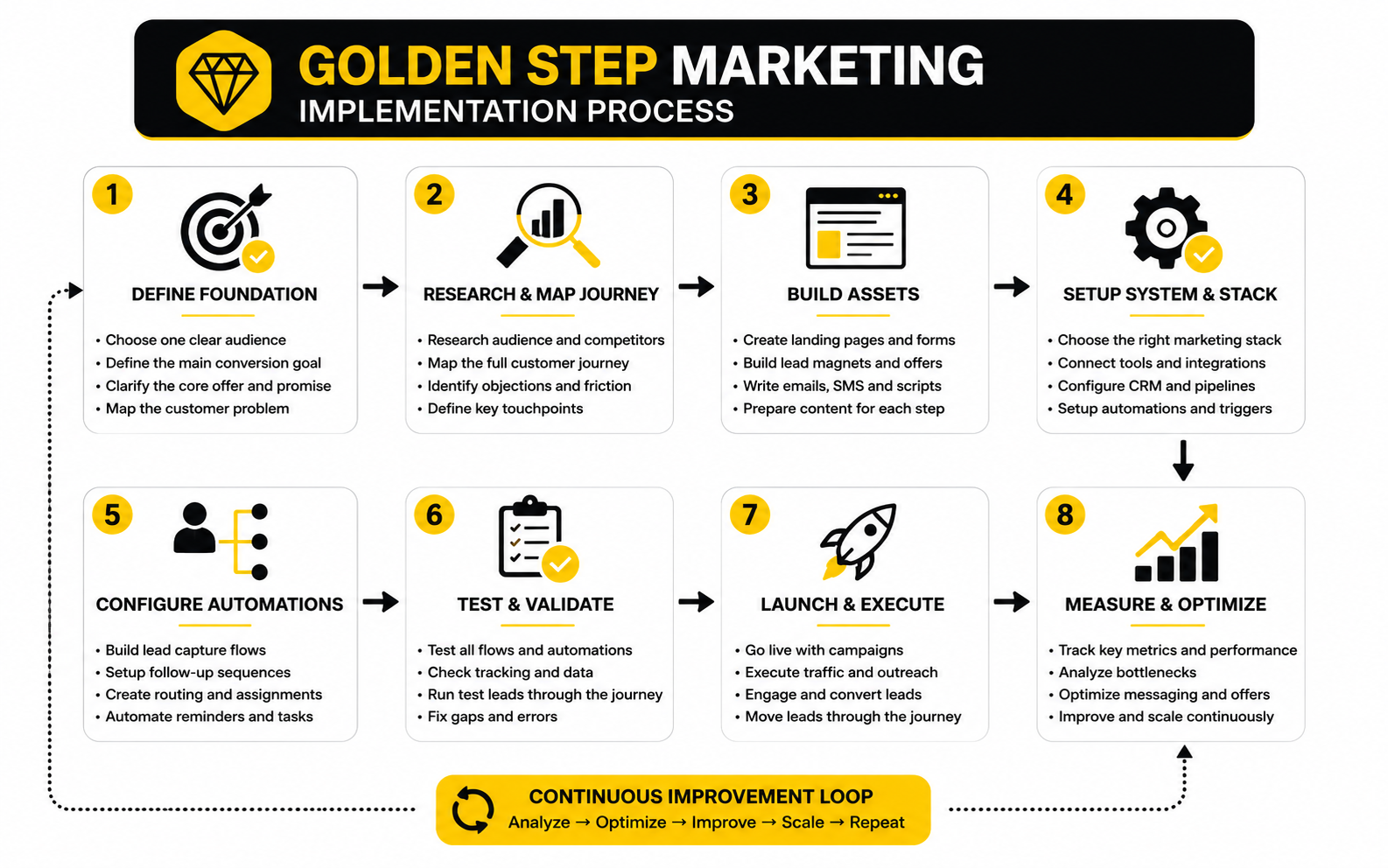
The Step-by-Step Implementation Process
The implementation process should be simple enough to use, but structured enough to expose problems. You do not need a giant strategy deck before you begin. You need a working path that can be reviewed step by step.
This process keeps the system grounded. It also stops teams from hiding behind activity. If a step is not moving people forward, you can see it and fix it.
The Follow-Up Engine
Most people do not convert the first time they interact with a business. That is normal. The problem is when the business has no structured follow-up, so every non-immediate buyer is treated like a lost opportunity.
A follow-up engine gives interested prospects a reason to keep moving. It can include educational emails, reminder messages, sales tasks, retargeting audiences, abandoned checkout flows, review requests, onboarding sequences, or reactivation campaigns. The best follow-up feels helpful because it matches the person’s stage rather than blasting the same message to everyone.
For a full CRM and automation setup, GoHighLevel can support pipelines, forms, booking, messaging, automations, and client follow-up in one place. For email-heavy campaigns, Brevo or Moosend can fit when the main need is email marketing, segmentation, and campaign automation.
The Measurement Loop
Measurement should not be an afterthought. It should be built into the system from the beginning, because every step needs a clear definition of success. Otherwise, you cannot tell whether the journey is improving or just getting busier.
The most useful metrics depend on the stage. Attention steps may track qualified traffic, engagement, or cost per relevant visitor. Qualification steps may track form completion, lead quality, booked calls, or reply rates. Conversion steps may track close rate, checkout completion, revenue, or sales cycle length.
The key is to avoid drowning in dashboards. Pick the few numbers that show whether each step is doing its job. Then review them consistently enough to catch friction before it becomes a major revenue leak.
The Content Layer
Content is what helps prospects move from one belief to the next. It can educate, compare, reassure, challenge assumptions, explain the process, or create urgency. In a golden step marketing system, content is not created just to fill a calendar.
Each content asset should have a job. A search article may attract people who are problem-aware. A comparison page may help solution-aware buyers evaluate options. A short email may answer one objection before a sales call.
This is why content planning should follow the journey, not the other way around. Instead of asking, “What should we post this week?” ask, “Which step needs more support?” That one shift makes content more useful and much easier to prioritize.
The Sales Handoff
If the journey includes sales calls, demos, proposals, or manual follow-up, the handoff between marketing and sales matters a lot. A lead should not arrive with no context. The sales team should know what the person clicked, submitted, asked, downloaded, booked, or ignored.
A strong handoff helps the conversation start at the right level. The salesperson does not need to repeat basic education if the prospect already consumed it. They can focus on fit, urgency, objections, and the real decision criteria.
This is also where qualification data becomes valuable. A good form, quiz, or booking flow can capture the details that make the sales conversation sharper. That means less guessing and more relevant conversations.
The Operating Rhythm
A golden step system needs an operating rhythm, not constant reinvention. The team should know when to review performance, which metrics matter, who owns each step, and how changes get made. Without that rhythm, even a well-built system slowly gets messy.
A simple weekly review is often enough in the early stage. Look at traffic quality, lead quality, conversion behavior, follow-up performance, and obvious bottlenecks. Then choose one improvement to make before the next review.
This is the part many teams underestimate. The system does not get better because it exists. It gets better because someone owns it, reviews it, and improves it with discipline.
Statistics and Data
Data matters in golden step marketing because it shows where the journey is strong, where it is weak, and where the next improvement should happen. The goal is not to collect random benchmarks and pretend they apply perfectly to every business. The goal is to understand what each number is telling you about buyer movement.
A low conversion rate does not always mean the offer is bad. It may mean the traffic is too broad, the page is unclear, the form asks too much, the follow-up is too slow, or the buyer needs one more trust-building step before taking action. The number is the signal, not the full diagnosis.
This is why measurement should follow the same structure as the customer journey. You measure attention, qualification, conversion, and expansion separately. When you do that, you stop treating marketing performance as one big mystery and start seeing the exact step that needs work.
The Numbers That Actually Matter
The most useful marketing metrics are the ones connected to a decision. If a metric does not help you decide what to improve, pause, scale, or remove, it is probably just dashboard decoration. That does not mean it is useless forever, but it should not drive the strategy.
For a golden step marketing system, the core numbers usually fall into five groups. You need traffic quality, lead quality, conversion behavior, follow-up performance, and customer value. Together, they show whether the journey is attracting the right people and moving them toward profitable outcomes.
The mistake is judging one step with the wrong metric. A top-of-funnel article should not be judged the same way as a checkout page. A booking form should not be judged the same way as a nurture email. Each step has its own job, so each step needs its own success signal.
Attention Metrics
Attention metrics show whether the right people are entering the journey. These include impressions, reach, search visibility, click-through rate, cost per click, landing page visits, scroll depth, time on page, and source quality. They are useful, but only when paired with what happens after the click.
A high click-through rate can look exciting, but it may be meaningless if the visitors do not qualify or convert. A lower-volume channel can be more valuable if it brings people who understand the problem and are closer to buying. That is why attention should be measured by relevance, not just volume.
For content and organic search, look beyond traffic totals. Review which pages bring qualified visitors, which queries match buying intent, and which topics lead people deeper into the journey. In golden step marketing, attention is only a win when it creates the next useful step.
Qualification Metrics
Qualification metrics show whether the journey is attracting people who fit the offer. These include form completion rate, quiz completion rate, booked-call rate, lead source quality, CRM stage movement, answer quality, reply rate, and disqualification rate. This layer is where a lot of hidden waste becomes visible.
If many people enter the system but few qualify, the problem may be the promise, audience targeting, offer positioning, or entry point. If people start a form but do not finish it, the form may be too long, too vague, or asking for sensitive information too early. If leads book calls but rarely show up, the confirmation and reminder steps may need work.
A structured form or quiz can make this easier to measure because it captures intent before the sales conversation begins. Fillout can fit this part of the journey when you need flexible forms, surveys, applications, or qualification flows. The key is to ask questions that improve the next step, not questions that create friction for no reason.
Conversion Metrics
Conversion metrics show whether qualified people are taking the action the business needs. These include opt-in rate, checkout completion, booked-call conversion, demo requests, trial starts, proposal acceptance, close rate, average order value, and revenue per lead. These numbers reveal whether the offer and decision step are doing their job.
Benchmarks can help you spot whether performance is wildly out of range, but they should not become a lazy target. Conversion rates vary heavily by industry, channel, price point, trust level, and buyer intent. A cold paid traffic funnel and a warm referral landing page should not be expected to perform the same way.
Use benchmarks as context, then compare against your own baseline. If a page converts at 3% this month and 5% next month after clearer positioning, that improvement matters more than a generic industry average. The most useful benchmark is often your previous version.
Follow-Up Metrics
Follow-up metrics show whether interested people are being moved forward after the first interaction. These include email open rate, click rate, reply rate, booking completion, missed-call recovery, abandoned checkout recovery, reactivation rate, and sales task completion. This is where many businesses quietly lose revenue because the prospect was interested but not ready.
Email still matters because it gives the business a direct channel for education, reminders, and relationship building. Recent email benchmark reporting continues to treat open rate, click-through rate, and conversion tracking as core owned-channel signals for understanding audience behavior and campaign performance through real-time email analytics. The action is not to obsess over one campaign result; it is to understand which follow-up messages create movement.
For email-heavy journeys, tools like Brevo and Moosend can support segmentation and campaign tracking. For businesses that need CRM, pipelines, calendars, and follow-up automation together, GoHighLevel is often the more complete operating layer.
Building the Analytics System
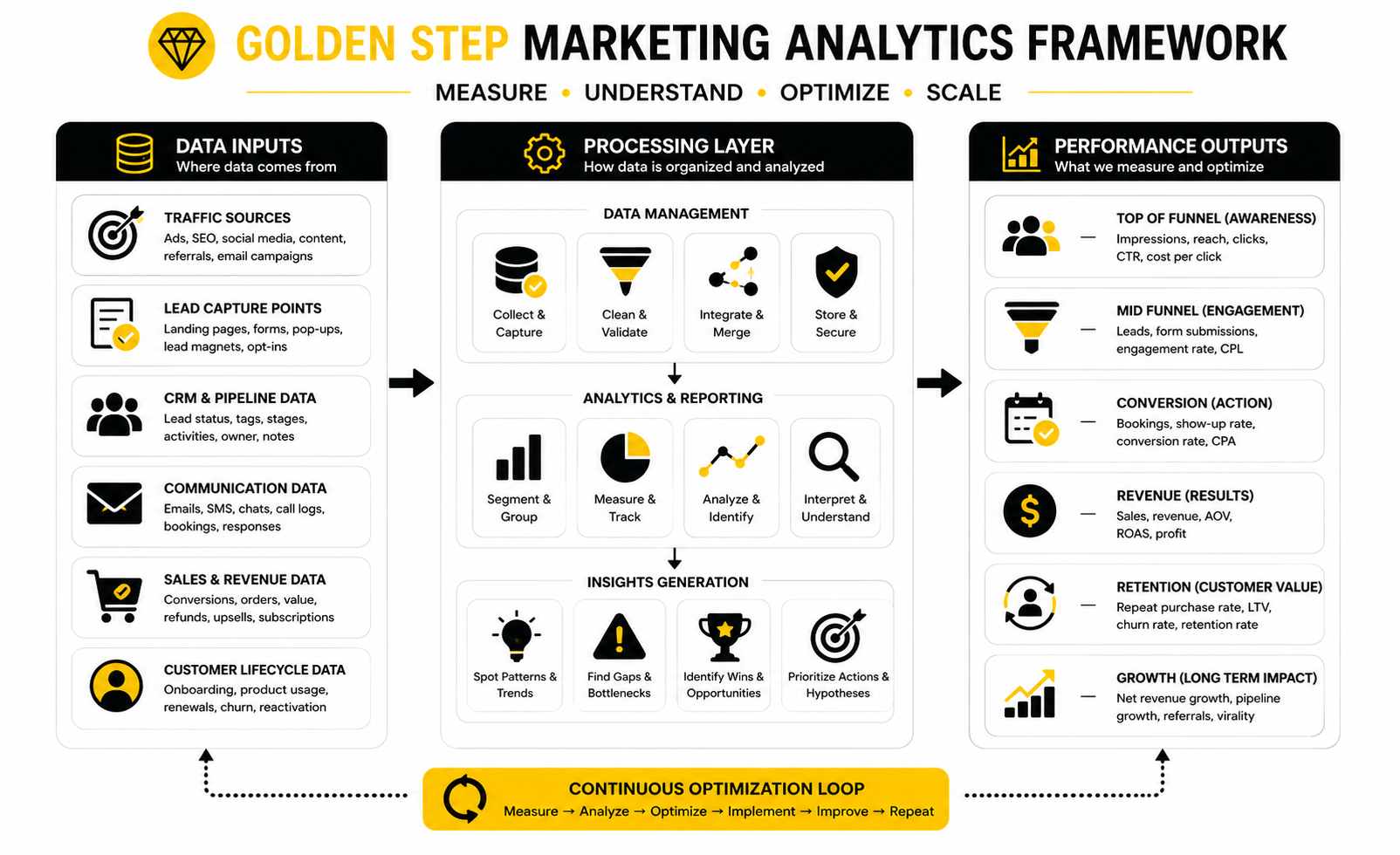
The analytics system should mirror the customer journey. Start with the main conversion goal, then map the measurable steps before and after it. This makes the reporting practical because every metric has a place in the journey.
A simple analytics map can look like this:
This structure gives the team a shared language. Instead of saying “marketing is not working,” you can say “paid traffic is producing clicks, but qualified form completions are weak.” That is a much better conversation because it points toward a real fix.
Benchmarks Are Directional, Not Absolute
Benchmarks are useful when they help you ask better questions. They are dangerous when they become universal rules. A 2% conversion rate can be strong for a high-ticket cold traffic offer and weak for a warm audience downloading a simple resource.
This is why every benchmark needs context. Channel matters. Buyer intent matters. Price matters. Trust matters. The amount of education required before the action also matters.
Use outside data to understand the range, then build internal benchmarks for your own system. Track performance by channel, audience, offer, campaign, and stage. Over time, your own data becomes more valuable than broad industry averages.
What Personalization Data Really Means
Personalization is not just using someone’s first name in an email. Real personalization means the message, offer, timing, and next step fit the person’s situation. That requires clean data and a clear journey structure.
Salesforce’s State of Marketing research found that 83% of marketers recognize the shift toward personalized, two-way messaging, while only one in four are satisfied with how they use data to power those moments. That gap matters because it shows the real problem: businesses want better customer journeys, but their data and execution systems often cannot support them yet.
For golden step marketing, the practical takeaway is simple. Do not personalize everything just because technology allows it. Personalize the moments where relevance changes the next action, such as lead routing, follow-up timing, offer selection, onboarding, and reactivation.
What AI Adoption Data Means for Measurement
AI is becoming part of the marketing workflow, but it should not replace measurement discipline. HubSpot reported that 74% of marketers were using at least one AI tool at work in 2024, up from 35% the previous year. That growth matters because AI can speed up content, segmentation, analysis, and testing, but speed without strategy just creates faster noise.
In a golden step system, AI is most useful when it improves a specific step. It can help summarize lead data, draft follow-up variations, identify content gaps, generate campaign ideas, or speed up reporting. The question is not “Are we using AI?” The better question is “Which step gets better because of it?”
AI tools should be judged by business movement, not novelty. If an AI-assisted workflow improves reply quality, shortens follow-up time, increases qualified bookings, or helps the team identify drop-off points faster, it is useful. If it only creates more assets nobody measures, it is just another distraction.
Reading Performance Signals Correctly
A performance signal is a clue. It points you toward a problem or opportunity, but it needs interpretation. The same number can mean different things depending on the stage.
For example, a high landing page bounce rate may mean the traffic is poor, the page loads slowly, the headline is unclear, or the visitor already got the answer and left. A low email click rate may mean the offer is weak, the audience is not ready, the subject attracted the wrong readers, or the call to action is buried. A high booked-call rate with a low close rate may mean the qualification step is too loose.
This is why the sequence matters. You do not fix numbers randomly. You trace the signal back to the step where the buyer lost momentum.
The Bottleneck Rule
The bottleneck rule is simple: improve the weakest meaningful step before adding more volume. More traffic will not fix a broken qualification process. More emails will not fix a vague offer. More automation will not fix a journey nobody wants to follow.
Start by finding the step with the biggest gap between intent and action. If many people visit the page but few opt in, fix the page or promise. If many leads opt in but few book, fix the bridge between interest and commitment. If many people book but few buy, fix qualification, proof, sales process, or offer fit.
This is where golden step marketing becomes very practical. You are not trying to improve everything at once. You are improving the step that creates the greatest downstream effect.
The Metrics Review Rhythm
A system needs a rhythm to stay useful. Monthly reporting is often too slow for active campaigns, while daily overanalysis can lead to panic decisions. For most businesses, a weekly review works well because it gives enough data to see patterns without losing momentum.
A weekly review should answer five questions. What changed? Which step improved? Which step got worse? What is the most likely reason? What single action should we take next? That is enough to keep the system moving without turning measurement into a full-time performance theater.
The review should also separate signal from noise. One bad day is not a trend. One strong email is not a complete strategy. Look for repeated patterns across stages, then act with focus.
Professional Implementation and Tool Stack
At this stage, golden step marketing moves from strategy into operating system. The question is no longer just “What should the customer do next?” The bigger question becomes “Can the business deliver that next step consistently, cleanly, and at scale?”
That is where many teams run into friction. The campaign looks good from the outside, but behind the scenes the CRM is messy, attribution is unclear, follow-up depends on manual memory, and nobody fully owns the customer journey. A golden step system cannot scale if the internal workflow is held together by improvisation.
Professional implementation is about turning the journey into a repeatable machine without stripping out the human judgment that makes marketing work. You need structure, but not bureaucracy. You need automation, but not robotic communication. You need data, but not dashboard obsession.
Choosing the Right Stack for the Journey
The right tool stack depends on the shape of the customer journey. A simple creator offer, a local service business, a high-ticket agency, and a multi-product ecommerce brand should not all use the same setup. The system should match the complexity of the offer, the sales cycle, and the team.
For service businesses and agencies, the stack often needs CRM, booking, forms, pipelines, email, SMS, and automation in one connected place. GoHighLevel can make sense here because the follow-up process is usually just as important as the landing page. When the team needs a central place to manage leads, conversations, appointments, and pipeline movement, an all-in-one operating layer reduces the risk of missed steps.
For funnel-first offers, course launches, workshops, lead magnets, and direct-response campaigns, ClickFunnels can fit when speed and conversion structure matter more than building a custom system from scratch. For lean businesses that want pages, email, automation, and selling tools in a simpler package, Systeme.io can be a practical starting point. The stack should remove friction, not become the project.
The Tradeoff Between Simplicity and Control
Every marketing stack sits on a tradeoff between simplicity and control. Simple tools are easier to launch and manage, but they may limit advanced customization. More flexible systems give you more control, but they also require stronger process discipline.
This matters because golden step marketing rewards clarity. A simple system with clean messaging, reliable follow-up, and strong ownership will usually beat an advanced system nobody understands. Complexity should be earned by performance, not added because it feels more professional.
A good rule is to start with the fewest tools required to manage the journey properly. Add complexity only when a real bottleneck demands it. If a new tool does not improve speed, visibility, personalization, conversion, retention, or team execution, it probably does not belong in the stack yet.
Advanced Segmentation Without Overcomplication
Segmentation is powerful when it changes what happens next. It becomes a problem when the team creates dozens of tags, lists, automations, and branches that nobody can explain later. More segmentation does not automatically mean better marketing.
Useful segmentation usually starts with a few high-impact differences. These might include lead source, offer interest, buyer stage, industry, budget range, urgency, customer status, or engagement level. Each segment should trigger a meaningful difference in message, timing, routing, or offer.
For example, a high-intent demo request should not receive the same follow-up as a cold lead magnet download. A repeat buyer should not be treated like a first-time visitor. A qualified lead who misses a call should receive a different recovery path than someone who never completed the booking form. That is practical segmentation.
When Automation Helps and When It Hurts
Automation helps when it protects consistency. It can send reminders, route leads, trigger follow-ups, assign tasks, update pipeline stages, deliver onboarding, and reactivate old contacts. Done well, it makes the customer journey feel smoother and makes the team more reliable.
Automation hurts when it replaces thinking. If the message is weak, automation sends weak messages faster. If the offer is unclear, automation pushes people toward an unclear decision. If the data is messy, automation creates messy outcomes at scale.
The best automation in golden step marketing feels almost invisible. The customer gets the right message at the right time. The team gets the right context before taking action. Nobody feels like they are being dragged through a machine.
The Human Layer Still Matters
Not every step should be automated. Some moments need human judgment, especially when the offer is high-value, consultative, emotional, or complex. A serious prospect may need a real conversation, not another automated sequence.
The human layer matters most around qualification, objection handling, proposal creation, onboarding, retention, and recovery. These are moments where tone, context, and judgment can change the outcome. Automation can support these moments, but it should not flatten them.
A strong system makes the human step better. It gives the team context, history, reminders, and next actions. It does not force the team to hunt through inboxes, spreadsheets, forms, and chat threads just to understand what happened.
Scaling Without Breaking the Journey
Scaling is not just increasing traffic. Scaling means more people can enter the system without the experience becoming worse. That requires stronger structure, clearer ownership, and better quality control.
The first scaling risk is volume pressure. More leads can expose weak follow-up, unclear qualification, slow sales response, or inconsistent onboarding. If the journey is fragile, scale does not create growth; it creates chaos.
The second scaling risk is message dilution. As more campaigns, offers, and channels get added, the core promise can become fuzzy. Golden step marketing protects against this by keeping every step tied to one clear audience, one clear job, and one clear next action.
The Role of Content at Scale
As the system grows, content becomes more than acquisition. It becomes a support layer for sales, onboarding, retention, reactivation, and referrals. That is where many businesses miss the opportunity.
A strong content library should answer the questions that slow people down. It should explain the process, compare options, handle objections, clarify expectations, and show what happens after someone takes action. This reduces friction across the entire journey.
For social distribution and scheduling, Buffer can help organize consistent publishing without turning content management into a daily scramble. For social-focused teams that need creative planning and workflow support, Flick Social can also fit. The point is not to post more for the sake of posting; the point is to support the journey with the right content at the right stage.
AI as a System Assistant, Not a Strategy Replacement
AI can help a golden step system move faster, but it should not define the strategy on its own. It can draft emails, summarize lead notes, generate page variations, analyze transcripts, suggest follow-up angles, or help the team repurpose content. Those are useful tasks when the strategic path is already clear.
The danger is using AI to produce more marketing without improving the journey. More copy, more posts, more emails, and more landing page variations do not automatically create better movement. They can simply create more noise.
Use AI where it reduces bottlenecks. If the team is slow to follow up, use AI to help draft response templates. If sales calls reveal repeated objections, use AI to summarize patterns. If content production is inconsistent, use AI to speed up first drafts while a human keeps the positioning sharp.
Data Quality Becomes a Growth Constraint
As the system becomes more advanced, data quality becomes one of the biggest constraints. Bad tags, duplicate contacts, unclear source tracking, missing lifecycle stages, and inconsistent pipeline updates make optimization harder. You cannot make smart decisions from messy inputs.
This does not mean every business needs enterprise-level data infrastructure. It means the basics need to be clean. Lead sources should be tracked consistently. Pipeline stages should have clear definitions. Forms should collect information that the team actually uses.
Data hygiene is not glamorous, but it compounds. Clean data improves segmentation, reporting, attribution, sales handoff, customer support, and reactivation. Messy data makes every part of the system slower and less trustworthy.
Attribution Is Useful, but Never Perfect
Attribution helps you understand which channels and steps influence revenue. It is valuable, but it is not perfect. Buyers move across devices, channels, conversations, referrals, and private decision moments that no dashboard fully captures.
This is why professional teams use attribution as a guide, not a religion. They look at source data, conversion paths, customer interviews, sales notes, and revenue patterns together. The goal is to make better decisions, not pretend the model sees everything.
In golden step marketing, attribution should answer practical questions. Which channels bring qualified people? Which assets help buyers move forward? Which follow-up paths recover stalled leads? Which customer segments produce the strongest lifetime value?
Managing Risk in the System
Every marketing system carries risk. There is compliance risk, deliverability risk, platform risk, tracking risk, reputation risk, and operational risk. Ignoring these risks can make short-term performance look good while creating long-term damage.
Email deliverability is a good example. Aggressive sending, weak list hygiene, poor consent practices, and irrelevant messaging can hurt inbox placement. The campaign may look active, but the audience stops seeing or trusting the messages. That is not growth.
Platform risk is another big one. If all attention comes from one ad account, one social platform, or one search ranking, the business is exposed. A stronger golden step system builds owned assets, direct relationships, email lists, CRM data, referral loops, and repeatable follow-up so growth is not fully dependent on one channel.
The Expert-Level Question
Beginners ask, “Which tactic should we use?” Operators ask, “Which step is broken?” Experts ask, “What must the customer believe, experience, or understand before the next step becomes obvious?”
That question changes everything. It forces you to think from the buyer’s perspective instead of the marketer’s checklist. It also keeps the system human, because real people do not move forward just because an automation says they should.
The best golden step marketing systems feel obvious from the outside and disciplined from the inside. The customer sees a clear path. The team sees a manageable workflow. The business sees compounding improvement because every step has a purpose.
Preparing the System for Long-Term Growth
Long-term growth requires documentation. The team should know how the journey works, what each step is supposed to do, which tools are involved, what gets measured, and who owns each part. Without documentation, the system depends too heavily on memory.
The documentation does not need to be complicated. A simple map of the journey, the main automations, the key metrics, the audience segments, the offers, and the review rhythm is enough to start. The goal is to make the system understandable enough that it can be improved without rebuilding it from scratch every time.
That is how golden step marketing becomes an asset. Not just a campaign. Not just a funnel. A real growth system the business can operate, measure, and refine over time.
Optimization, Common Mistakes, and FAQ
Optimization is where golden step marketing becomes a long-term advantage. The first version of the system should prove that the journey can work. The later versions should make the journey cleaner, faster, more profitable, and easier for the team to operate.
The mistake is treating optimization like random testing. Changing headlines, buttons, emails, and forms without a clear reason creates noise. Real optimization starts with a specific bottleneck, a clear hypothesis, and one measurable change.
At this stage, the business should already understand the journey from attention to expansion. Now the work is about refinement. You keep the structure stable enough to learn from it, but flexible enough to improve the steps that are holding back growth.
Common Mistakes That Weaken the System
The first common mistake is building too many paths before one path works. It feels productive because the business is launching campaigns, creating automations, and publishing content. But if the core journey is not proven, extra complexity just spreads the problem across more assets.
The second mistake is confusing automation with strategy. Automation can support the journey, but it cannot rescue weak positioning, unclear offers, poor qualification, or bad timing. If the message does not make sense manually, it will not magically improve when software sends it faster.
The third mistake is measuring only the obvious conversion. Revenue matters, but the steps before revenue explain why the result happened. When a team only looks at sales, it misses the earlier signals that show whether attention, trust, qualification, and follow-up are improving.
How to Improve the System Without Breaking It
Optimization should happen in controlled layers. Start with the clearest bottleneck, improve one meaningful element, then watch how the change affects the next step. This keeps the system stable enough to learn from.
For example, if a page gets qualified traffic but weak form completions, improve the promise, page structure, proof, or form friction before changing the entire funnel. If leads book calls but rarely buy, improve qualification, sales context, objection handling, or offer fit before buying more traffic. If buyers churn quickly, improve onboarding before spending more on acquisition.
The strongest golden step marketing systems are not the ones with the most moving parts. They are the ones where each part has a job, each job has a metric, and each metric has an owner. That is what makes improvement repeatable.
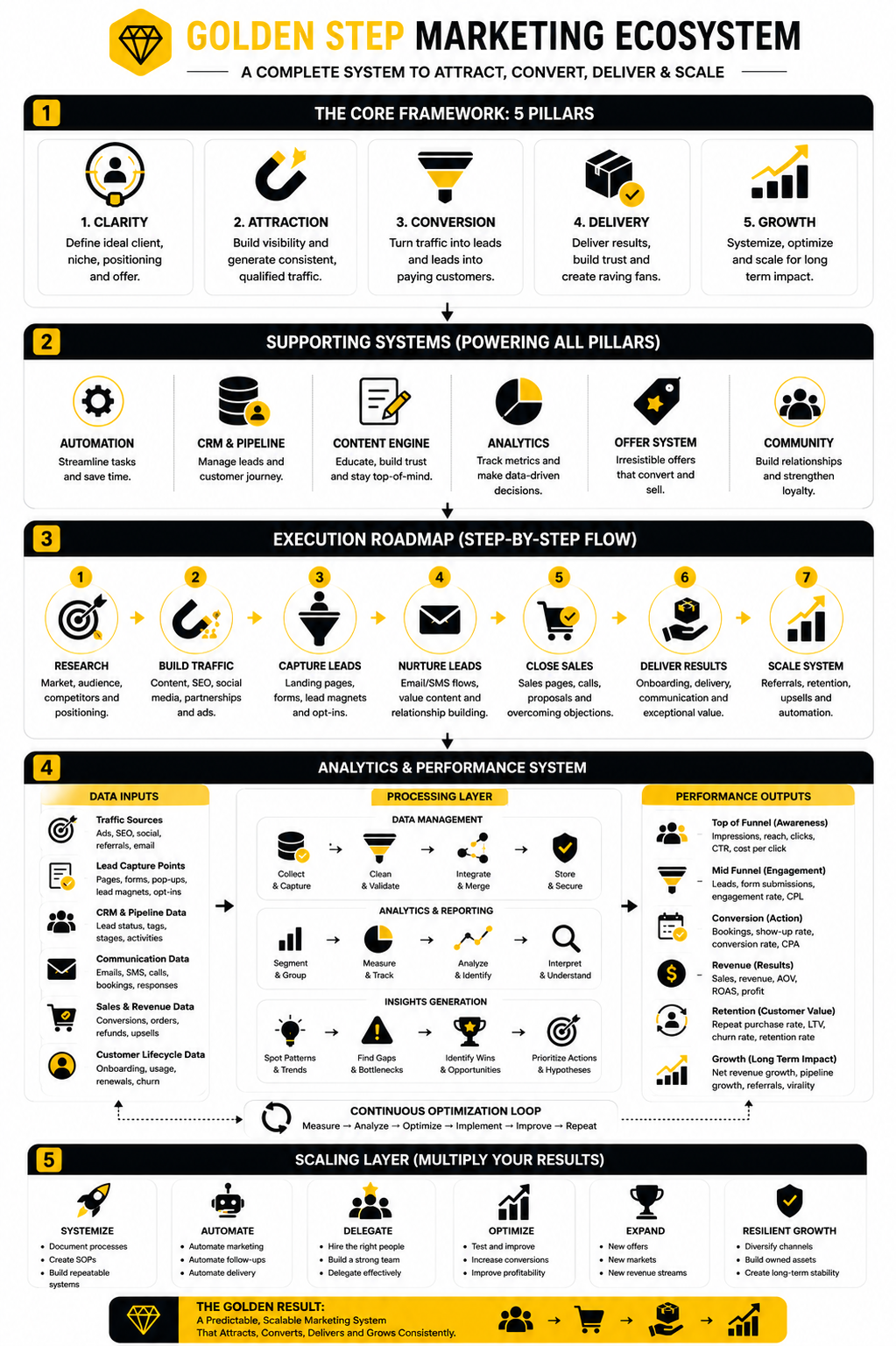
Building the Final Ecosystem
The final version of the system should feel like an ecosystem, not a campaign. Content attracts the right people. Pages and forms turn interest into structured intent. CRM and automation keep the journey moving. Sales and onboarding add the human layer where judgment matters.
The ecosystem should also protect the business from overdependence on one channel. Paid ads may bring speed, but owned email, search content, referral systems, customer education, and reactivation flows create resilience. That balance matters because channels change, costs rise, and platforms shift.
When golden step marketing is built well, the business does not need to restart every month. It keeps improving the same connected journey. That is the real win.
What is golden step marketing?
Golden step marketing is a structured approach to moving prospects through the right sequence of actions, from first attention to long-term customer value. Instead of treating ads, pages, emails, and sales calls as separate tactics, it connects them into one practical journey. Each step has one clear job and one logical next action.
Why is golden step marketing useful?
It is useful because most marketing underperforms when the customer journey is unclear. Businesses often get traffic, leads, or engagement but lose people because the next step is confusing or poorly timed. Golden step marketing makes the path easier to understand, easier to measure, and easier to improve.
Is golden step marketing the same as a funnel?
No, but a funnel can be part of it. A funnel usually focuses on moving someone toward a conversion, while golden step marketing looks at the full journey before, during, and after that conversion. It includes attraction, qualification, conversion, follow-up, onboarding, retention, referrals, and reactivation.
What is the first step in building a golden step marketing system?
The first step is choosing one clear audience and one main conversion goal. Without those two decisions, the journey becomes too broad and the messaging becomes weak. Once the audience and goal are clear, you can build the steps that guide people toward the right action.
What tools do you need for golden step marketing?
The tools depend on the journey, but most systems need a way to capture leads, manage contacts, send follow-up, track pipeline movement, and measure performance. A business might use GoHighLevel for CRM and automation, ClickFunnels for funnel building, Systeme.io for a leaner all-in-one setup, or Fillout for forms and qualification flows.
How do you know which marketing step is broken?
You find the broken step by measuring the journey in stages. If traffic is high but leads are weak, the issue may be attraction or positioning. If leads are strong but sales are weak, the issue may be qualification, offer fit, sales process, or follow-up.
What metrics matter most?
The most useful metrics are the ones tied to buyer movement. These include qualified traffic, form completion, booked-call rate, show-up rate, checkout completion, close rate, revenue per lead, customer lifetime value, retention, and reactivation. The best metric depends on which step you are trying to improve.
How much automation should a business use?
A business should automate repetitive steps that need consistency, such as reminders, lead routing, follow-up messages, onboarding tasks, and reactivation campaigns. It should not automate moments that require real judgment, especially in high-ticket or complex sales. The goal is to make the journey smoother, not colder.
Can golden step marketing work for small businesses?
Yes, and small businesses often benefit from it quickly because their current journey is usually easier to simplify. They do not need a huge stack or complicated automation to start. One clear audience, one focused offer, one strong page, one follow-up sequence, and one review rhythm can already create a stronger system.
Can golden step marketing work for agencies?
Yes, agencies can use golden step marketing for their own growth and for client campaigns. It is especially useful because agencies often manage multiple moving parts, including lead generation, qualification, sales calls, reporting, retention, and upsells. A clear step-by-step framework makes delivery easier to explain and improve.
How long does it take to build a golden step marketing system?
The first usable version can be built quickly when the offer, audience, and goal are clear. The deeper work comes from improving the journey after real people interact with it. A smart team starts with a simple version, measures where prospects drop off, and improves the system one bottleneck at a time.
What is the biggest mistake to avoid?
The biggest mistake is adding complexity before the basic journey works. More tools, more automations, more pages, and more campaigns will not fix unclear positioning or a weak offer. Build the simplest working path first, then scale what the data proves.
How should content fit into golden step marketing?
Content should support specific stages of the journey. Some content attracts problem-aware people, some helps prospects compare options, some handles objections, and some supports onboarding or retention. The question should not be “What should we post?” but “Which step needs more support?”
What role does AI play in golden step marketing?
AI can help with drafting, analysis, summarization, segmentation, testing ideas, and workflow speed. It should not replace the strategy behind the journey. AI is useful when it improves a specific step, but it becomes a distraction when it simply creates more content, more messages, and more noise.
How do you scale golden step marketing?
You scale it by strengthening the journey before increasing volume. That means clean data, clear ownership, reliable follow-up, strong qualification, and consistent reporting. Once the system can handle more people without breaking the experience, traffic and campaign expansion become much safer.
Build a stronger local presence with BAAM AI
Turn your website, Google profile, social channels, and AI visibility into one growth engine
Most businesses do not need more random marketing activity. They need a consistent presence system that helps the right people find them, trust them, and take action. BAAM AI brings strategy, local SEO, website updates, Google Maps visibility, social content, AI-search readiness, media production, and reporting into one practical monthly engine.
If you want your marketing to keep working after the campaign ends, start with a free BAAM AI presence audit. See how your business shows up today and where the fastest visibility wins are at BAAM AI.