
BAAM AI Blog
GDPR Email Marketing: A Practical Compliance Framework for Growth Teams
GDPR email marketing is not just about adding a checkbox to a form and hoping your list is safe. It is about proving that every person on your list was collected, stored, segmented, contacted, and unsubscribed in a...
Affiliate disclosure: this article may include compensated links. Recommendations should still be evaluated against your use case, budget, and current provider terms.
Should you choose this tool?
this tool is worth considering when the use case, budget, and implementation effort match what you actually need to do next.
teams that want a practical tool decision without reading another generic feature list
Check this toolGDPR email marketing is not just about adding a checkbox to a form and hoping your list is safe. It is about proving that every person on your list was collected, stored, segmented, contacted, and unsubscribed in a way that respects their rights. That sounds heavy at first, but once you break it into a system, it becomes much easier to manage.
The mistake many businesses make is treating GDPR as a legal obstacle instead of an operating standard. Good compliance forces better list quality, cleaner consent records, clearer messaging, and fewer random blasts to people who never asked to hear from you. In other words, the same discipline that protects you legally also improves your email marketing performance.
this guide will walk through GDPR email marketing as a practical framework, not a scary legal theory. You will see how the rules connect to real marketing decisions: lead magnets, checkout opt-ins, newsletters, customer emails, reactivation campaigns, automation platforms, CRM records, unsubscribe flows, and audit trails. The goal is simple: build email marketing that can grow without creating unnecessary risk.
Why GDPR Email Marketing Matters
GDPR matters because email is personal data in action. The moment you collect someone’s email address, connect it to behavior, tag it in a CRM, or send a promotional message, you are handling information that can identify a person. That means your marketing system needs a lawful basis, a clear purpose, and a way for people to exercise their rights.
This is also why “we bought a list” or “they might be interested” is not a strategy. GDPR email marketing pushes you to earn attention instead of assuming access. The better approach is to collect subscribers through clear forms, explain what they will receive, keep records of how they joined, and make opting out easy.
For growth teams, the real risk is not only a regulator. It is broken trust. A person who receives irrelevant or unexpected marketing does not think about your compliance policy; they think your brand is careless. That is why GDPR should sit inside your marketing operations, not in a forgotten legal folder.
The Compliance Framework at a Glance
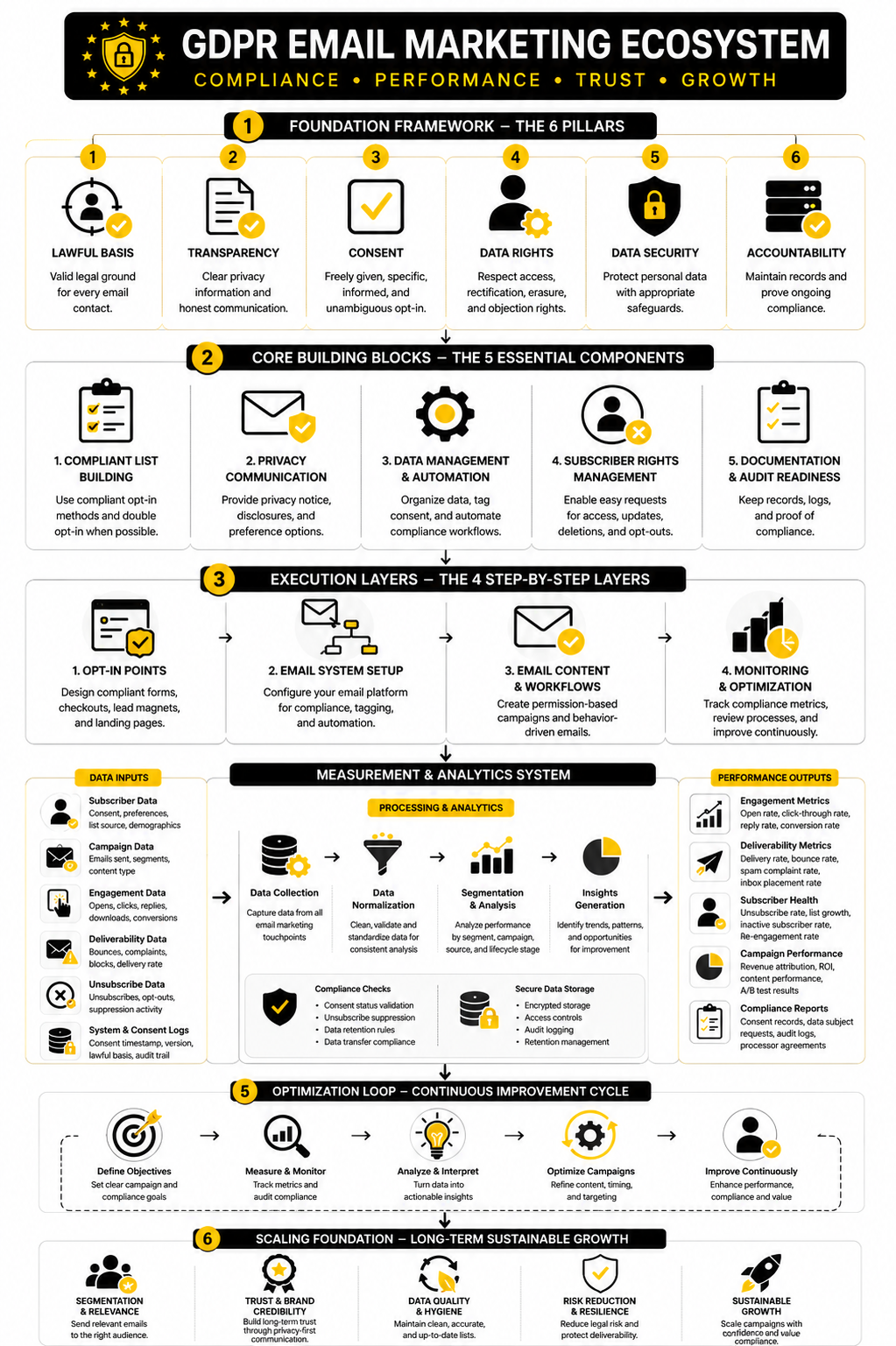
A strong GDPR email marketing framework has four layers: permission, purpose, proof, and preference. Permission means you have a valid reason to contact the person. Purpose means you only use their data for the reason you communicated when collecting it.
Proof means you can show where the contact came from, what they agreed to, when they agreed, and which version of the form or privacy language they saw. Preference means the subscriber can easily manage or withdraw from marketing without friction. These four layers are simple, but they reveal most weak spots in an email program very quickly.
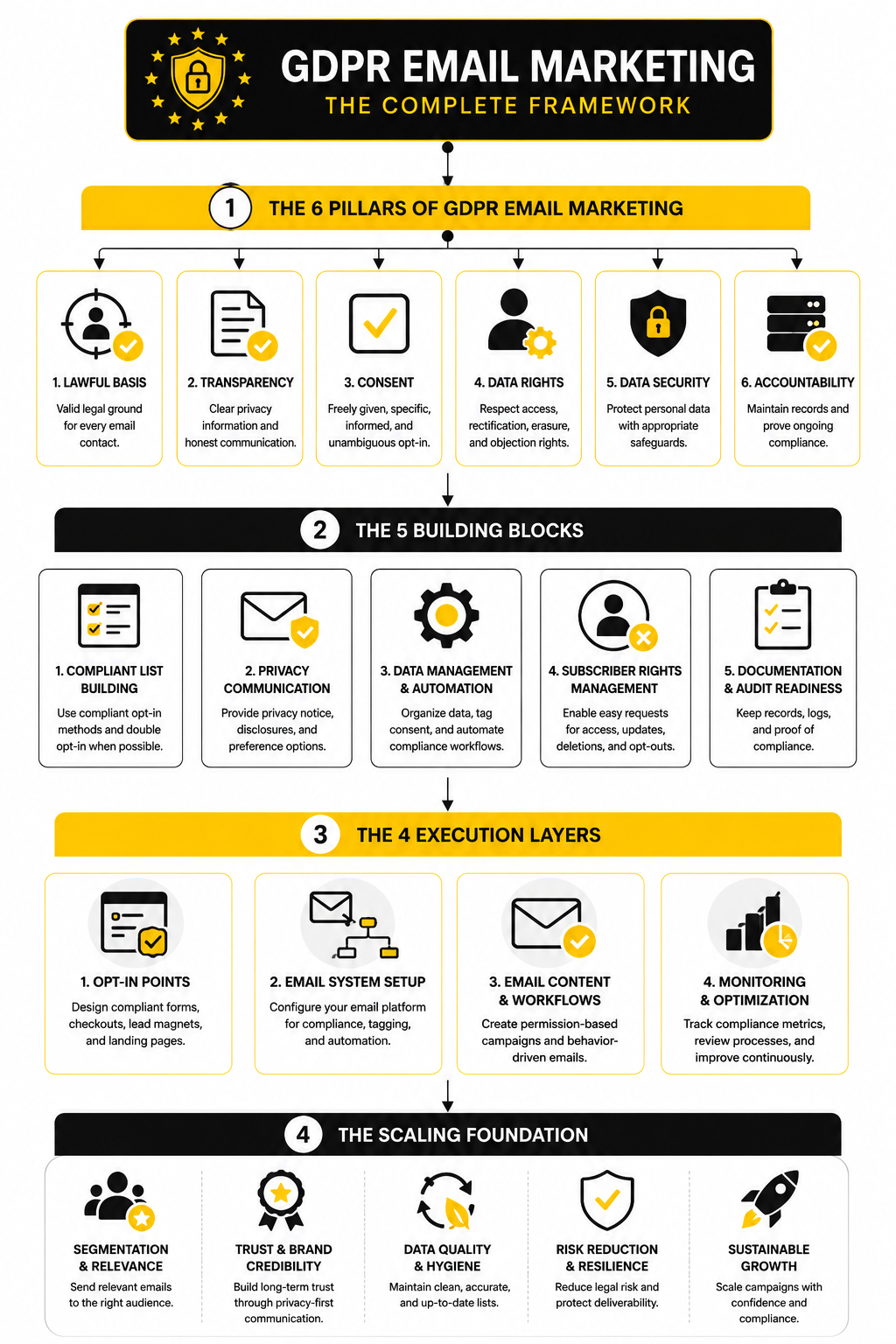
This framework also helps you choose the right tools. A platform such as Brevo or Moosend can support compliant email workflows when your forms, lists, segments, and unsubscribe settings are configured properly. For businesses running CRM pipelines, automations, and follow-up sequences in one place, GoHighLevel can also fit the workflow, but the tool itself does not make the strategy compliant.
Core Components of a GDPR Email Marketing System
A compliant email system starts before the first campaign is sent. It begins with the collection point: landing pages, embedded forms, checkout flows, webinar registrations, demo requests, lead magnets, and imported contacts. Each entry point should tell people what they are signing up for and avoid hiding marketing consent inside unrelated terms.
The next component is data organization. Your CRM or email platform should separate subscribers by source, consent status, customer status, geography, and communication preference. This matters because GDPR email marketing is not one universal rule applied blindly to every contact; the correct approach often depends on how the person joined your database and what relationship they have with your business.
The final component is evidence. You need enough records to show that your marketing process was deliberate, not improvised. That includes consent timestamps, form sources, opt-in language, unsubscribe history, suppression lists, and internal rules for who can upload or message contacts.
Professional Implementation Starts With Process
Professional GDPR email marketing is not created by a privacy policy alone. It is created by repeatable process. Your team needs clear rules for how contacts enter the system, who can send campaigns, what data gets synced between tools, and how unsubscribes are honored across every platform.
This is where many teams get messy. They connect a funnel builder, CRM, email platform, calendar tool, chatbot, and spreadsheet, then assume everything is aligned. If you use tools like ClickFunnels, Systeme.io, ManyChat, or Fillout, the important question is not whether the software has compliance features. The important question is whether your full workflow preserves consent, purpose, and unsubscribe choices from the first touch to the last email.
That is the standard the rest of this guide will build toward. First, we will clarify the lawful bases that usually matter for GDPR email marketing. Then we will translate consent, soft opt-in, and legitimate interest into practical campaign decisions that a real business can actually use.
Lawful Bases for Email Marketing
GDPR email marketing starts with one question: why are you allowed to process this person’s data for marketing in the first place? That question matters before design, copy, deliverability, segmentation, or automation. If the lawful basis is weak, the campaign is weak no matter how good the offer is.
Under GDPR, you need a lawful basis for processing personal data, and email marketing usually comes down to consent or legitimate interest. Consent is the cleaner route when you are asking someone to subscribe to a newsletter, receive promotional emails, download a lead magnet, join a webinar follow-up list, or enter a marketing automation sequence. Legitimate interest can sometimes support marketing-related processing, but it is not a magic fallback when consent is inconvenient.
This is where teams need to slow down. GDPR controls personal data processing, while local electronic marketing rules often control whether you can send the actual marketing email. In the UK, for example, electronic mail marketing is shaped by PECR as well as UK GDPR, and the ICO makes the core rule very clear: marketing emails to individuals usually need consent unless every soft opt-in condition is met.
Consent as the Cleanest Starting Point
Consent works best when it is obvious, specific, and easy to prove. A person should understand what they are signing up for before they submit the form. That means no pre-ticked boxes, no hidden consent inside broad terms, and no vague language like “we may contact you occasionally.”
For GDPR email marketing, strong consent language should explain the type of emails the person will receive. A newsletter signup, product updates list, webinar follow-up sequence, and promotional launch list are not automatically the same thing. If you plan to send sales emails after a free resource download, say that clearly near the form.
Consent also needs a clean exit. A subscriber should be able to withdraw consent as easily as they gave it. In practice, that means every marketing email needs a working unsubscribe link, and your backend systems need to honor that choice across connected tools, not just inside one campaign list.
Legitimate Interest Needs a Real Balancing Test
Legitimate interest can be useful, but it has to be handled carefully. You need a genuine interest, the processing must be necessary for that interest, and the person’s rights and freedoms must not override your business reason. That is not something you decide casually five minutes before sending a campaign.
A practical legitimate interest assessment should answer three questions. What exact marketing purpose are you pursuing? Why is this processing necessary for that purpose? Would the person reasonably expect this use of their data in the context of their relationship with your business?
This is especially important when behavior, profiling, enrichment, or advanced segmentation enters the picture. Sending a relevant update to an existing business contact is not the same risk profile as building a behavioral targeting sequence from multiple data sources. The more surprising, intrusive, or automated the processing becomes, the harder it is to rely on legitimate interest comfortably.
Contract and Service Emails Are Not the Same as Marketing
Not every email sent by a business is a marketing email. Receipts, password resets, delivery notices, appointment confirmations, account security alerts, and essential service updates usually serve an operational purpose. Those emails should not be treated the same way as newsletters, promotional launches, or upsell campaigns.
The problem starts when teams blend service content and promotional content in the same message. A receipt that quietly becomes a product pitch may still trigger marketing rules. A service update that includes unrelated cross-sells can create unnecessary compliance risk.
Keep the categories separate. Transactional emails should do the job the customer expects. Marketing emails should only go to people you can lawfully contact for marketing, with clear opt-out controls and proper records behind the scenes.
Consent, Soft Opt-In, and Legitimate Interest
Consent, soft opt-in, and legitimate interest are often discussed like they are interchangeable. They are not. Each one has a different role, and mixing them up is one of the fastest ways to create a messy GDPR email marketing program.
Consent is an affirmative permission model. Soft opt-in is a limited exception that may allow marketing to existing customers or people who showed interest in similar products or services, depending on the applicable national rules. Legitimate interest is a lawful basis for processing personal data, but it does not automatically override electronic marketing consent requirements.
That distinction matters because a campaign can fail even if part of the logic sounds reasonable. You might have a legitimate business reason to promote a service, but still need consent or a valid soft opt-in to send the email. You might have an email address from a past purchase, but still need to check whether the new campaign is genuinely similar to what the person bought or asked about.
How Soft Opt-In Works in Practice
Soft opt-in is not a free pass to email every customer forever. It is usually tied to a prior sale, negotiation, donation, or similar relationship, depending on the jurisdiction and organization type. The message also needs to promote similar products, services, or purposes, and the person must have had a clear chance to opt out when their details were collected.
The safest way to use soft opt-in is to define it narrowly. A customer who bought a running shoe may reasonably expect emails about running gear, care tips, or related offers. That does not automatically mean they expect unrelated financial products, partner promotions, or a completely different brand inside your group.
You also need to offer opt-out at collection and in every message. This is not just a footer detail. If the person was never given a real chance to say no, your soft opt-in argument becomes much weaker.
Why Purchased Lists Are a Bad Fit
Purchased email lists are usually a poor fit for GDPR email marketing because you did not collect the consent yourself and often cannot prove the person expected your specific brand to contact them. Even when a vendor claims the list is compliant, your business still carries responsibility for how you use the data. That is a bad place to be if the records are vague, old, or recycled across many buyers.
The commercial upside is usually weak too. Cold purchased lists tend to create low engagement, high complaints, deliverability damage, and brand distrust. Even if a campaign produces a few replies, the hidden cost can be long-term inbox reputation problems.
A better approach is to build first-party acquisition systems you can actually defend. Use clear lead forms, helpful content, transparent offers, and segmented follow-up. Tools like Fillout can help create cleaner collection points, while platforms like Brevo or Moosend can support list management when the consent logic is configured properly.
The Practical Decision Rule
When in doubt, ask what the person would honestly expect. If they clearly asked for your newsletter, send the newsletter they requested. If they bought from you and the message is closely related, check whether soft opt-in applies in your market and whether you captured the right opt-out records.
If the campaign depends on surprise, broad assumptions, old data, or a third-party list, stop. That is usually where compliance, trust, and performance all start moving in the wrong direction. GDPR email marketing works best when the subscriber relationship is clear before the first email is ever sent.
Core Components of a Compliant Email Program
Once the lawful basis is clear, GDPR email marketing becomes an operational build. You are no longer asking, “Can we email this person?” You are asking, “Can our system prove why we emailed this person, what they expected, and how they can control what happens next?”
That shift is important because compliance does not live inside one checkbox. It lives across forms, landing pages, CRM fields, email segments, automations, suppression lists, privacy notices, vendor settings, and internal approval rules. A campaign is only as strong as the weakest handoff between those pieces.
The practical goal is to make the compliant path the default path. Your team should not need to remember every legal detail before every send. The system should guide them toward clean collection, accurate segmentation, clear messaging, and reliable unsubscribe handling.
Map Every Collection Point
Start by listing every place where an email address enters your business. This usually includes newsletter forms, lead magnets, demo requests, checkout pages, webinar registrations, chatbot flows, booking forms, quiz funnels, contact forms, affiliate promotions, and manual imports. If a contact can enter your CRM from that source, it belongs on the map.
For each entry point, document what the person sees before submitting their email. The form should explain what they will receive, who is sending it, and whether the follow-up includes marketing. Consent requests should be prominent, separate from general terms, and easy to understand, which matches the direction of regulator guidance on electronic marketing consent from the ICO.
This is where small wording changes matter. “Get the checklist” is not the same as “Get the checklist and receive weekly marketing emails.” If you plan to send ongoing promotional messages, say that before the person signs up.
Build the Consent Record
A compliant consent record should tell the story of how the contact joined your list. At minimum, you want the source, timestamp, form name, consent language, IP address when appropriate, country or region when available, and the specific list or purpose the person joined. This is not bureaucracy for the sake of it; it is how you avoid guessing later.
Your CRM should make this information easy to find. If your team has to dig through five tools to understand why a subscriber is receiving emails, the process is too fragile. Platforms like GoHighLevel, Brevo, Moosend, and Copper can support cleaner records, but only when the fields and workflows are intentionally set up.
Do not overwrite the original source with the latest campaign touch. A person may click three emails, book a call, and buy later, but the original consent source still matters. Keep acquisition history separate from engagement history so your audit trail stays useful.
Segment by Permission, Not Just Interest
Most marketers segment by behavior, lead score, purchase history, or topic preference. That is useful, but it is not enough for GDPR email marketing. You also need permission-based segmentation so people only receive the categories of email they can lawfully receive.
A practical permission model might include newsletter subscribers, customers eligible for similar-product emails, event registrants, product update subscribers, sales-qualified leads, unsubscribed contacts, suppressed contacts, and contacts requiring review. These categories stop your team from treating every email address as campaign-ready inventory. That is a big deal.
This also protects performance. Sending fewer emails to the right people usually beats sending more emails to questionable lists. Cleaner segmentation improves relevance, reduces complaints, and makes your compliance position easier to explain.
Create a Step-by-Step Execution Process
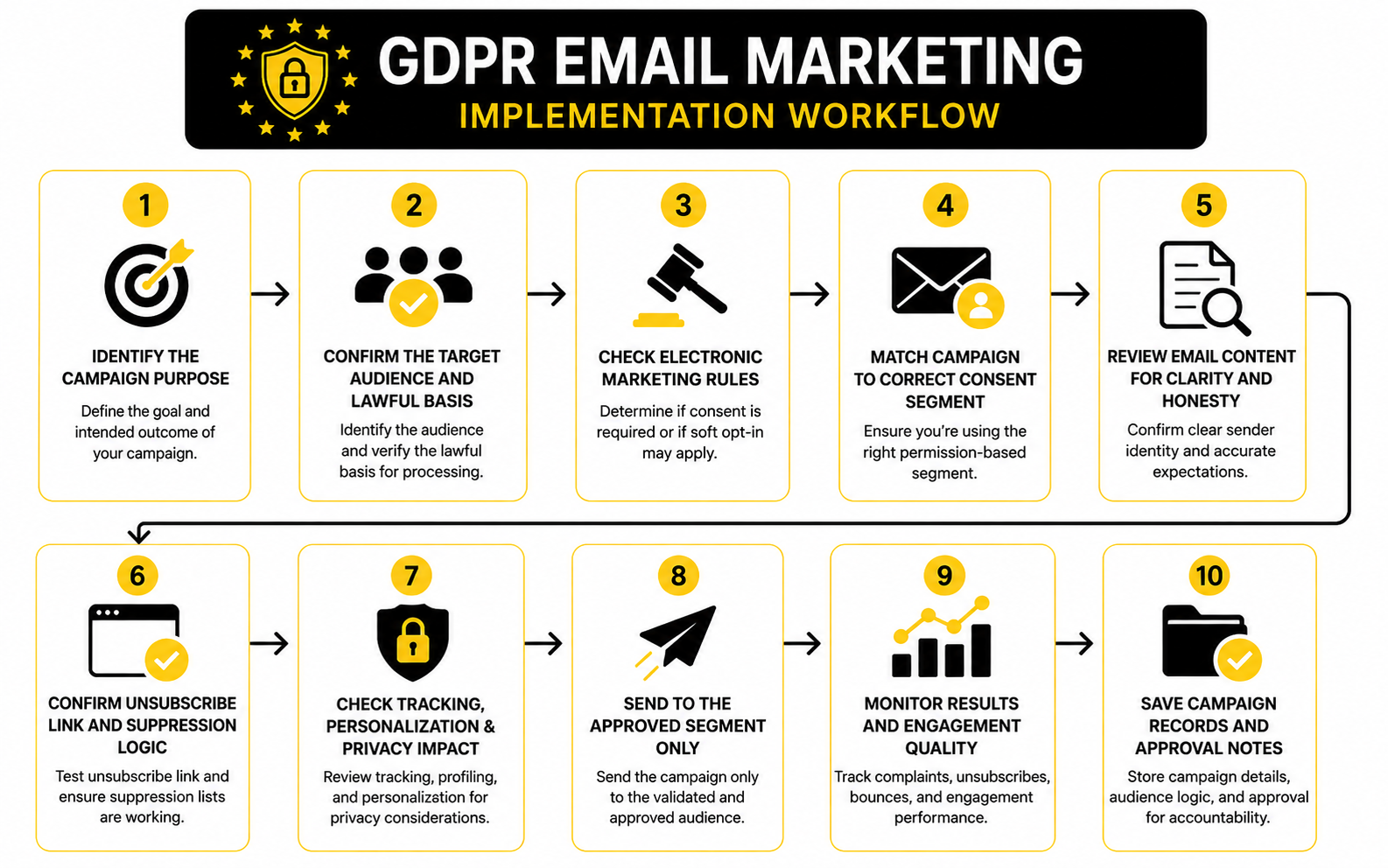
The execution process should be simple enough that a new team member can follow it without improvising. Complicated compliance processes break under campaign pressure. Simple ones get used.
A practical GDPR email marketing workflow can look like this:
This process does not slow good marketing down. It removes ambiguity. When your team knows exactly what must be checked before a send, campaigns move faster because people are not debating the same compliance questions every week.
Keep Preference Management Clean
A single unsubscribe link is the minimum, not the full strategy. A better setup gives people meaningful choices. Some subscribers may want product updates but not promotions, educational newsletters but not webinar reminders, or customer notices but not launch campaigns.
Preference centers are useful because they reduce unnecessary list loss. Instead of forcing someone to choose between everything and nothing, you let them choose what is relevant. That is better for the subscriber and better for your business.
The key is to keep the options honest. Do not offer preferences that your backend cannot enforce. If someone opts out of promotional emails, every connected tool that can send promotional emails needs to respect that decision.
Control Imports and Manual Uploads
Manual imports are one of the biggest weak spots in GDPR email marketing. A spreadsheet from a partner, a trade show export, an old CRM backup, or a sales rep’s personal contact list can quietly introduce risk into an otherwise clean system. Once those contacts enter your main database, they can be accidentally included in campaigns.
Set a rule that no list gets imported without source documentation. The person importing the list should be able to show where the contacts came from, what permission exists, what purpose applies, and whether any suppression data must be honored. If that information is missing, the list should not be treated as marketable.
This is not being overly cautious. It is basic hygiene. A strong email program protects the quality of the database because the database is the asset.
Statistics and Data
Measurement is where GDPR email marketing becomes visible. You can write clean consent language, build careful segments, and set up unsubscribe rules, but the numbers will tell you whether people actually trust the way you communicate. Good analytics should help you protect compliance, improve performance, and spot problems before they become expensive.
The mistake is treating email metrics like a vanity dashboard. Open rates, click rates, unsubscribes, complaints, bounces, conversions, and list growth all mean different things depending on your audience, lawful basis, campaign purpose, and acquisition source. A high open rate can still hide weak consent quality if complaints are rising, and a low unsubscribe rate can be meaningless if people are marking messages as spam instead.
Benchmarks are useful, but only as reference points. Recent email benchmark data shows average open rates often sitting around the low-40% range, while average click rates are much lower, around 2% in broad cross-industry reporting from MailerLite’s 2025 benchmark analysis. That gap matters because opens can be distorted by privacy features, image loading, and mailbox behavior, while clicks and conversions usually show stronger intent.
What the Main Metrics Actually Tell You
Open rate is a weak signal on its own. It can help you spot obvious subject-line problems or deliverability issues, but it should not be the metric that decides whether your GDPR email marketing strategy is healthy. Privacy protections and automated opens make it too noisy for serious decision-making.
Click rate is more useful because it shows active engagement. If people click, they understood the message, cared enough to act, and had some level of trust in the sender. A low click rate does not automatically mean your list is non-compliant, but it can suggest poor relevance, weak segmentation, unclear consent expectations, or a campaign that does not match why people joined.
Unsubscribe rate is not always bad. A normal level of unsubscribes means people are using the preference mechanism you gave them, which is much better than spam complaints. The real issue is sudden movement: if unsubscribes jump after a new campaign type, a new import source, or a broader segment, the audience may not have expected that message.
Complaints Are the Metric You Cannot Ignore
Spam complaints deserve special attention because they are a trust signal and a deliverability signal at the same time. When someone complains, they are not simply leaving your list. They are telling the mailbox provider that your message did not belong in their inbox.
That matters because mailbox providers use complaint behavior to judge future mail. Google and Yahoo’s bulk sender rules have pushed senders to keep spam complaint rates below 0.3%, with best practice aiming much lower, and those rules make list quality more operationally important than ever. For GDPR email marketing, a rising complaint rate should trigger a review of source quality, consent records, message expectations, and suppression handling.
Do not explain complaints away as “people forgot they subscribed.” That may happen sometimes, but it is not a strategy. If enough people forget, the signup promise, sender identity, email frequency, or content match is probably unclear.
Bounce Rates Reveal Database Hygiene
Bounces are not only a technical deliverability issue. They also say something about how your database is being maintained. A rising hard bounce rate can point to old data, weak acquisition sources, fake signups, bad imports, or contacts that should have been cleaned long ago.
Soft bounces need context. A temporary mailbox issue is normal, but repeated soft bounces should not stay active forever. If the address cannot reliably receive your messages, continuing to send to it creates noise in your performance data and can damage sender reputation.
Good GDPR email marketing should include list hygiene rules. Remove or suppress invalid addresses, investigate suspicious form sources, and avoid reviving old contacts unless you can clearly support the legal basis and audience expectation. Clean data is not just better for compliance; it is better for revenue because your reporting stops being polluted by dead records.
Build a Measurement System Around Decisions
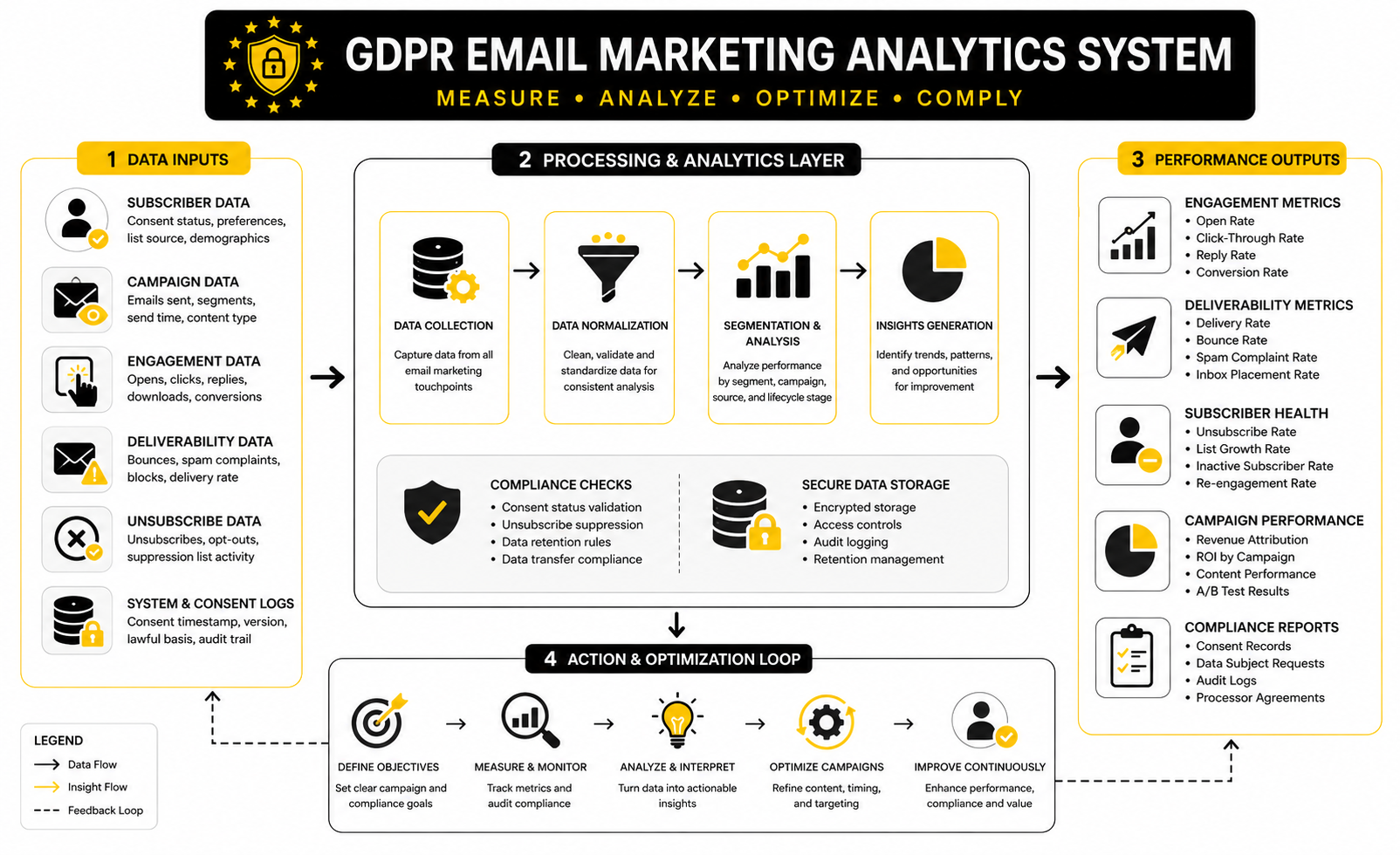
The best analytics setup answers one practical question: what should we do next? That means your dashboard should connect performance signals to action, not just display numbers. A report that shows open rate, click rate, unsubscribe rate, complaint rate, bounce rate, conversion rate, and revenue is useful only if the team knows what each movement means.
A simple decision system can work like this:
This is the point where analytics becomes operational. You are not staring at numbers after the campaign is already over. You are building a feedback loop that improves targeting, protects subscriber trust, and keeps your marketing team from repeating preventable mistakes.
Measure by Source, Not Just Campaign
Campaign-level reporting is useful, but source-level reporting is where the truth usually appears. A lead magnet, checkout opt-in, webinar registration, chatbot flow, and sales import may all feed the same CRM, but they rarely produce the same engagement quality. If you only look at the final campaign report, you miss which acquisition source is helping or hurting the list.
Track engagement and risk signals by source. Look at click rate, unsubscribe rate, complaint rate, bounce rate, and conversion rate for each collection point. A smaller source with strong engagement may be more valuable than a larger source that creates complaints and dead leads.
This also helps you make better spending decisions. If a funnel built in ClickFunnels produces high-quality subscribers, scale it carefully. If a form built in Fillout produces clean consent records and better segmentation, keep improving that path. The tool is not the point; the source quality is.
Use Benchmarks Without Copying Them Blindly
Benchmarks can help you spot whether a result is unusual, but they should never replace your own baseline. A B2B newsletter, ecommerce promotion, SaaS onboarding sequence, local service reminder, and webinar follow-up all have different expectations. Comparing them all to one average number will lead to bad decisions.
Build internal benchmarks by segment and campaign type. Measure newsletter performance against past newsletters, customer promotions against past customer promotions, and reactivation campaigns against past reactivation campaigns. That gives you a fairer view of whether performance is improving or declining.
The most useful benchmark is the one that combines performance and permission. A campaign that generates revenue while increasing complaints is not a clean win. A campaign that produces steady clicks, low complaints, clean unsubscribes, and clear attribution is much more valuable because it can scale without quietly damaging the list.
Professional Implementation, Audits, and FAQ
At a certain point, GDPR email marketing stops being a campaign checklist and becomes a governance problem. That sounds corporate, but it is actually practical. When your list is small, one person can remember where contacts came from; when your list grows, memory breaks and process has to take over.
This is where mature teams separate “we think this is fine” from “we can prove this is controlled.” They define ownership, document decisions, review vendors, test unsubscribe flows, and keep campaign approval standards consistent. None of this needs to be slow, but it does need to be real.
The deeper issue is scale. More traffic, more funnels, more automations, more sales reps, more tools, and more markets all create more ways for consent and preference data to drift. The businesses that handle this well are not the ones with the longest privacy policy. They are the ones with the cleanest operating rhythm.
Treat Consent as Infrastructure
Consent should not be treated like a field you add at the end of a form. It should be part of the infrastructure behind your marketing system. Every funnel, form, CRM pipeline, and automation should understand what permission exists and what that permission allows.
This matters most when tools are connected. A contact might enter through a form, move into a CRM, trigger a sales sequence, get tagged by behavior, receive a webinar reminder, and later join a customer newsletter. If consent data does not travel cleanly through that journey, your GDPR email marketing system becomes harder to defend.
The fix is to define standard fields and use them everywhere. You may need fields for source, consent status, consent purpose, consent timestamp, region, email preference, unsubscribe status, and lawful basis notes. Once those fields exist, automations can use them to include or exclude contacts without relying on guesswork.
Know When Automation Creates Extra Risk
Automation makes email marketing powerful, but it also multiplies mistakes. A bad manual campaign affects one send. A bad automation can affect every new lead for months before anyone notices.
The risk increases when workflows use behavioral triggers, lead scoring, profiling, dynamic segmentation, or AI-assisted personalization. These features can be useful, but they also process more data and can create more surprising experiences for the subscriber. The more personalized or predictive the campaign becomes, the more important transparency and purpose limitation become.
This does not mean you should avoid automation. It means you should design automation with guardrails. Platforms like GoHighLevel, Brevo, and Moosend can support useful automated flows, but the compliance quality depends on your setup, not the logo on the dashboard.
Be Careful With Tracking Pixels and Advanced Analytics
Email tracking deserves more attention than most marketers give it. Opens, device signals, location hints, link behavior, and engagement scoring can all become part of a person’s profile. In some jurisdictions, regulators have become more focused on tracking technologies inside emails, including pixels.
The practical takeaway is simple: do not collect analytics just because the platform makes it easy. Decide which tracking is necessary, explain it in your privacy information, and avoid using hidden measurement in ways that would surprise people. If you operate across multiple European markets, be especially careful because national ePrivacy rules and regulator expectations can differ.
This is also why click data is often a cleaner operational signal than open tracking. Clicks still involve personal data when tied to an individual, but they are based on an intentional action. Opens can be noisier, more passive, and more exposed to privacy debates, so they should not be the foundation of your entire measurement strategy.
Manage Vendors Like Part of the System
Your email platform, CRM, form builder, funnel software, chatbot, analytics tool, and enrichment provider can all affect compliance. If a vendor processes personal data for you, you need to understand what data they process, where it is stored, how transfers are handled, what security controls exist, and what contractual terms apply. This is not optional housekeeping.
The GDPR distinction between controller and processor matters here. Your business usually decides why the data is used for marketing, while vendors often process the data on your behalf. That means you need suitable processor terms and enough confidence that the vendor can support your obligations.
Do not add tools casually. Every new tool can create another data copy, another unsubscribe sync problem, another transfer issue, and another access-control risk. A lean, well-integrated stack is usually safer than a messy collection of disconnected tools.
Plan for International Data Transfers
Many marketing tools involve data moving outside the European Economic Area or being accessed from outside it. That does not automatically make the tool unusable, but it does mean transfers need to be handled properly. The European Data Protection Board explains that Chapter V of GDPR restricts transfers outside the EEA so the protection level for individuals is not undermined.
For marketing teams, this becomes very practical. You need to know whether your email platform, CRM, support tool, analytics provider, or automation software stores or accesses subscriber data in another country. You also need to know what transfer mechanism is being used, such as adequacy decisions or standard contractual clauses where appropriate.
This should be part of vendor review before the tool becomes embedded in your workflow. It is much harder to fix transfer issues after thousands of contacts, automations, and campaign records already depend on a platform. Build the review into procurement, not the cleanup phase.
Decide How Aggressive You Really Want to Be
There is a strategic tradeoff inside GDPR email marketing. You can push volume, stretch assumptions, and chase short-term revenue. Or you can build a permission-first list that grows more slowly but performs more predictably and carries less risk.
The second option is usually better for serious businesses. Cleaner consent creates cleaner data. Cleaner data creates better segmentation. Better segmentation creates stronger engagement, fewer complaints, and more reliable attribution.
The aggressive path can look tempting when a campaign deadline is close. But if the only way to hit the target is to message people who did not clearly ask for that kind of email, the target is probably wrong. Growth that depends on weak permission is fragile growth.
Build a Regular Audit Rhythm
Audits do not need to be dramatic. A quarterly review is enough for many teams, while larger or more regulated organizations may need more frequent checks. The point is to catch drift before it becomes normal.
A useful audit should review:
The best audits produce decisions, not just observations. If a form is unclear, rewrite it. If a segment is too broad, split it. If an automation is outdated, pause it. If a vendor creates unnecessary complexity, replace or remove it.
Prepare for Data Rights Requests
People have rights under GDPR, and your email marketing system needs to support them. A subscriber may ask for access, correction, deletion, restriction, objection, or information about how their data is used. If your records are scattered, responding becomes painful.
Your team should know where subscriber data lives. That includes the email platform, CRM, form tool, analytics system, chatbot, calendar tool, support desk, payment processor, and any exported spreadsheets. The hard part is not usually the main database; it is the forgotten copies.
A clean process should define who receives the request, who verifies it, which systems must be checked, how suppression is handled, and what gets documented. Deleting a contact without preserving necessary suppression data can create a new problem if that person is accidentally re-imported later. Sometimes suppression is the safer operational choice than total removal from every system.
Scaling Without Losing Control
Scaling GDPR email marketing means building systems that keep working when volume increases. More leads should not mean looser consent. More campaigns should not mean weaker review. More personalization should not mean less transparency.
The most scalable setup is boring in the best way. Standardized forms, consistent consent fields, approved campaign categories, reliable preference handling, documented vendor reviews, and clear reporting rules. That kind of structure gives marketers more freedom because they are not rebuilding the compliance logic every time.
This is where businesses gain real advantage. They can move fast because the rules are already built into the system. They can test offers, launch funnels, segment audiences, and improve lifecycle marketing without turning every campaign into a legal guessing game.
What is GDPR email marketing?
GDPR email marketing means using email to promote, educate, sell, or nurture leads while following GDPR rules for personal data. The email address itself is personal data when it can identify a person, and the way you collect, store, segment, track, and use it matters. A compliant program connects lawful basis, clear expectations, accurate records, and easy opt-out controls into one working system.
Do I always need consent to send marketing emails under GDPR?
Not always, but consent is often the safest and cleanest route. GDPR requires a lawful basis for processing personal data, while electronic marketing rules can add separate consent requirements depending on the country and audience. In practice, newsletters, lead magnets, promotional sequences, and cold consumer campaigns usually need very careful consent logic.
Is legitimate interest enough for GDPR email marketing?
Legitimate interest can sometimes support marketing-related processing, but it is not a shortcut around consent rules. You need a real purpose, a necessity test, and a balancing assessment that considers the person’s rights and expectations. If the email would surprise the recipient, rely on old data, or feel unrelated to the relationship they have with you, legitimate interest becomes much harder to defend.
What is soft opt-in?
Soft opt-in is a limited exception that may allow marketing emails to certain existing customers or interested contacts without fresh consent. It normally depends on strict conditions, such as collecting the email during a sale or negotiation, promoting similar products or services, giving a clear opt-out at collection, and including an opt-out in every message. It should be used narrowly, not as a broad excuse to email anyone who has ever interacted with the business.
Can I send GDPR-compliant cold emails?
Cold email is possible in some B2B contexts, but it is not automatically safe. You still need a lawful basis, a relevant and proportionate reason for contacting the person, clear sender identity, accurate data, and an easy way to object or opt out. You also need to check local electronic marketing rules because GDPR is only one part of the picture.
Are purchased email lists compliant?
Purchased lists are usually high risk. The problem is proof: you need to show that the person expected your specific business to contact them for the type of marketing you are sending. If the list vendor cannot provide strong, specific, recent consent records, the commercial upside is rarely worth the compliance and deliverability risk.
What should a GDPR-compliant signup form include?
A strong signup form should explain who is collecting the email, what the person will receive, how often they can reasonably expect communication, and whether the emails are promotional. Consent should not be hidden inside general terms or bundled with something unrelated. The form should also connect to a system that stores the source, timestamp, consent language, and preference status.
Do I need double opt-in for GDPR email marketing?
GDPR does not universally require double opt-in, but double opt-in can make proof stronger. It helps confirm that the email owner actually requested the subscription and can reduce fake signups or accidental entries. The tradeoff is that some people will not complete the confirmation step, so the decision should balance proof quality, list growth, and risk tolerance.
What should every marketing email include?
Every marketing email should clearly identify the sender, match the expectation set at signup, and include a simple unsubscribe option. It should also avoid misleading subject lines, hidden promotional intent, or confusing sender names. The message should feel like a natural continuation of the relationship, not a surprise interruption.
How long can I keep email subscribers under GDPR?
There is no universal retention period that fits every business. You should keep subscriber data only as long as it is necessary for the purpose you explained and the lawful basis you rely on. Inactive subscribers should be reviewed, re-permissioned where appropriate, suppressed, or removed under a documented retention policy.
How do unsubscribes work under GDPR email marketing?
Unsubscribes should be simple, fast, and respected across your full system. If someone opts out of marketing, that preference must apply to every tool that can send marketing emails, not just the platform where they clicked the link. You may still need to keep limited suppression data so the person is not accidentally added again later.
Can I track opens and clicks in marketing emails?
You can track engagement only when your privacy information, lawful basis, and local tracking rules support it. Clicks usually show more intentional engagement than opens, while open tracking can be noisy and more sensitive because pixels may collect data without obvious user action. The more carefully approach is to collect only the analytics you actually use and explain tracking clearly.
What is the biggest GDPR email marketing mistake?
The biggest mistake is treating compliance as a one-time form setting. Real compliance depends on the full journey: collection, consent records, segmentation, automation, tracking, unsubscribes, vendor management, and audits. If those pieces are disconnected, even a well-written form can fail in practice.
Which tools help with GDPR email marketing?
Tools can help, but they do not make a business compliant by themselves. Email platforms like Brevo and Moosend, automation systems like GoHighLevel, funnel builders like ClickFunnels, and form tools like Fillout can support cleaner workflows when configured properly. The real advantage comes from using these tools with clear fields, permission-based segments, reliable suppression logic, and documented processes.
How should a business start fixing its email compliance?
Start with the database, not the next campaign. Map every source, identify which contacts have clear consent or another lawful basis, separate marketable contacts from questionable records, and confirm unsubscribe handling across tools. Then rebuild forms, segments, automations, and reporting around permission instead of volume.
Build a stronger local presence with BAAM AI
Turn your website, Google profile, social channels, and AI visibility into one growth engine
Most businesses do not need more random marketing activity. They need a consistent presence system that helps the right people find them, trust them, and take action. BAAM AI brings strategy, local SEO, website updates, Google Maps visibility, social content, AI-search readiness, media production, and reporting into one practical monthly engine.
If you want your marketing to keep working after the campaign ends, start with a free BAAM AI presence audit. See how your business shows up today and where the fastest visibility wins are at BAAM AI.