
BAAM AI Blog
Freelance Fashion Copywriter: How To Build A Brand Voice That Sells Without Sounding Generic
A freelance fashion copywriter sits in a strange but valuable gap. Fashion brands do not just need “nice words” for product pages, emails, ads, lookbooks, landing pages, and social captions. They need copy that can...
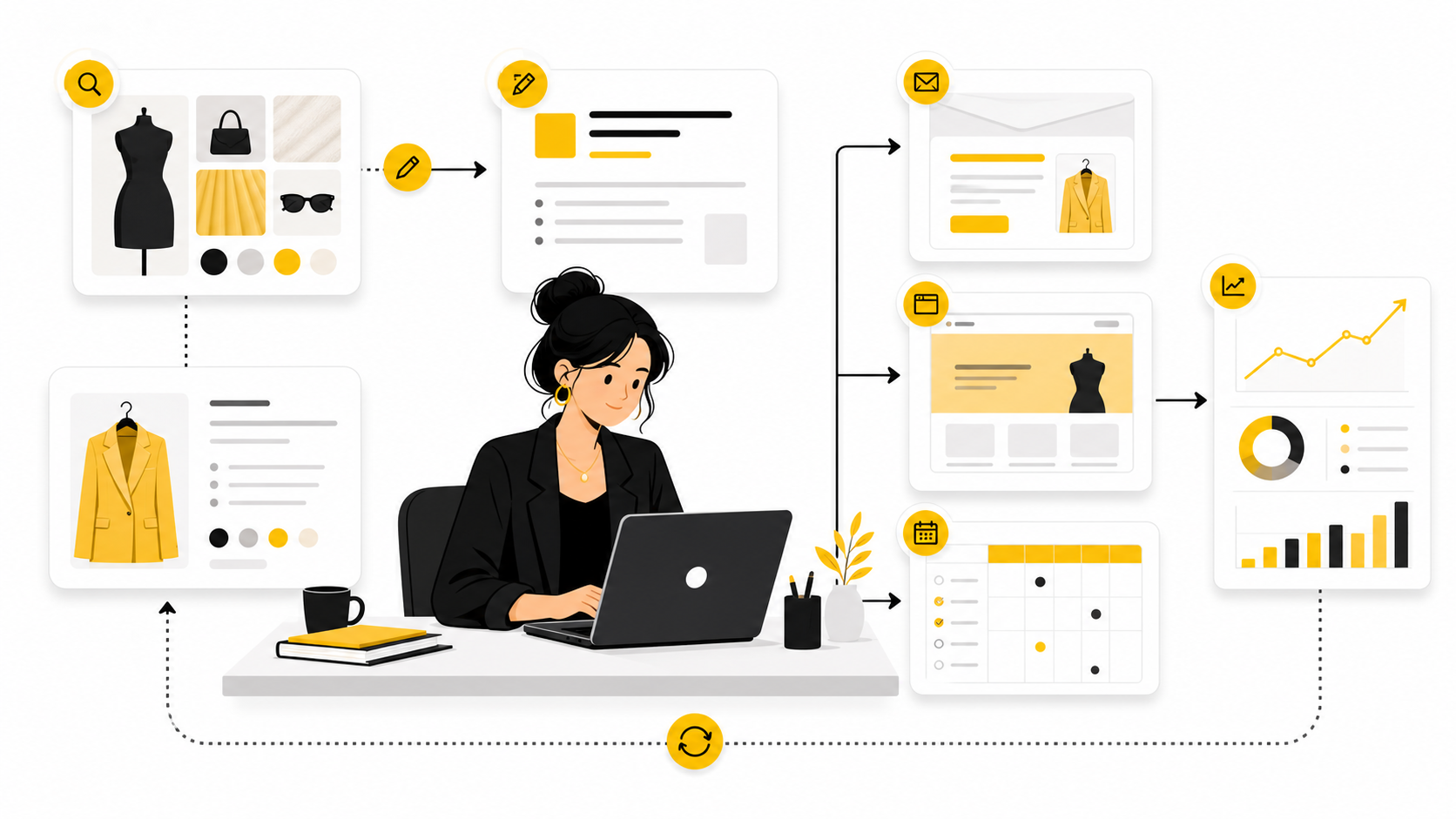
A freelance fashion copywriter sits in a strange but valuable gap. Fashion brands do not just need “nice words” for product pages, emails, ads, lookbooks, landing pages, and social captions. They need copy that can translate fabric, fit, mood, price, sustainability claims, styling context, and customer desire into language that helps someone decide.
That matters more now because fashion shoppers are harder to convince. The BoF–McKinsey State of Fashion 2025 report describes a market shaped by weaker consumer sentiment, shifting value expectations, and more pressure on brands to find growth in a difficult environment. At the same time, online retail keeps raising the standard for clear product communication, with Adobe’s digital retail data showing that ecommerce growth has been driven by real demand rather than just higher prices in recent shopping seasons through its Digital Economy Index.
That is exactly where strong copy earns its keep. A shopper cannot touch the garment through the screen, compare the drape in person, or ask a stylist what runs small. The copy has to do some of that work without overpromising, sounding fake, or flattening the brand into the same polished-but-empty voice every other label uses.
this guide is for two readers at once. If you want to become a freelance fashion copywriter, it will show you what the role actually involves beyond “writing about clothes.” If you are hiring one, it will help you understand what a good writer should bring to the table, how their work connects to revenue, and why cheap generic content usually costs more than it saves.
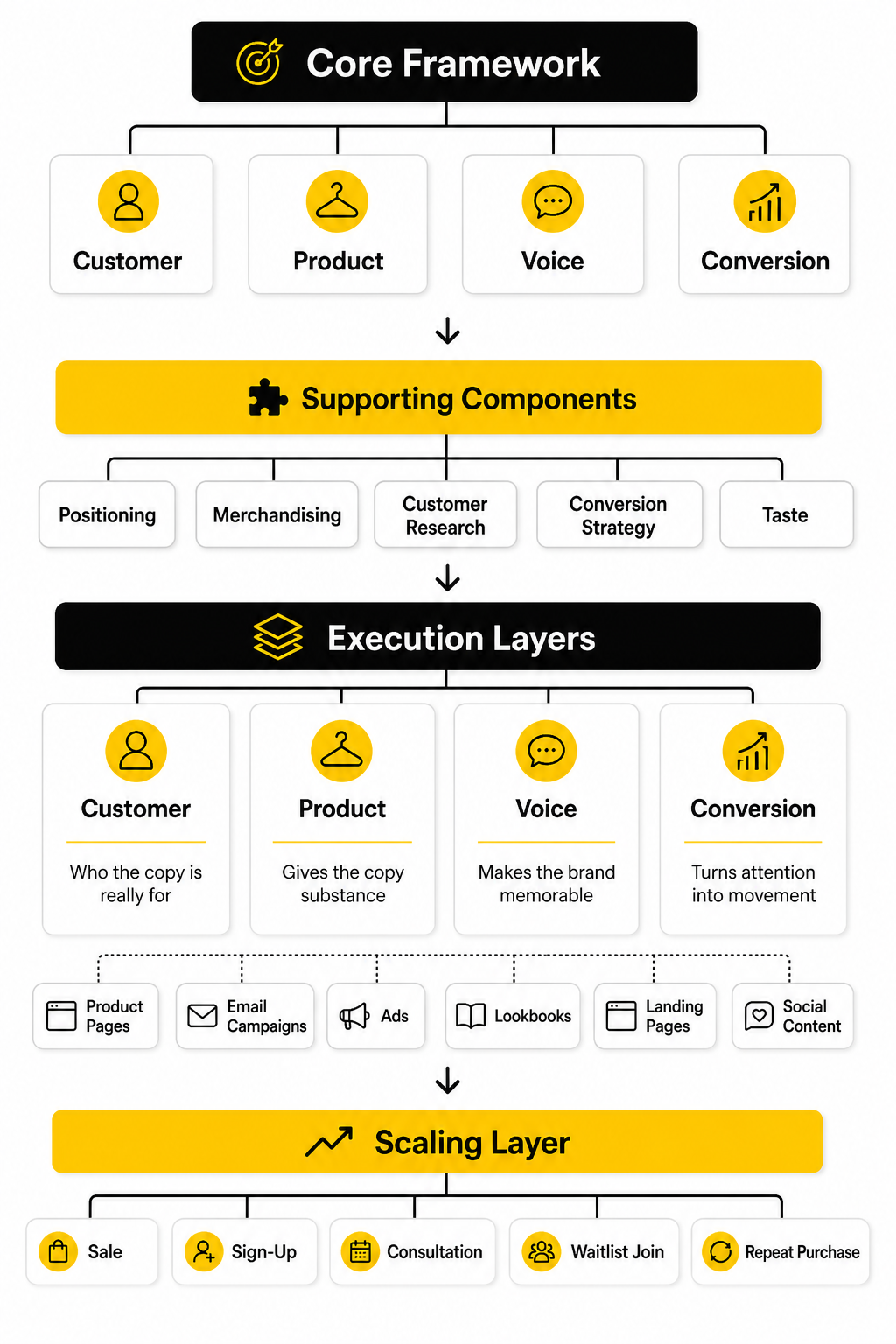
The most important idea is simple: fashion copy is not decoration. It is positioning, merchandising, customer research, conversion strategy, and taste compressed into words. A good freelance fashion copywriter knows how to make a product feel desirable while still giving the buyer the practical information they need to trust the purchase.
Freelance Fashion Copywriting in Today’s Market
Fashion has always sold identity, but modern ecommerce forces that identity to work harder. A product page has to explain fit, styling, materials, care, shipping confidence, and emotional appeal in a few short sections. That means copy is no longer just a finishing touch added after the photos are ready.
The pressure is especially obvious in categories where shoppers compare many similar products. A black blazer, white shirt, leather tote, linen dress, or pair of wide-leg trousers can look almost identical across ten tabs. The brand that explains the difference clearly has an advantage before price even enters the conversation.
This is also why AI-generated fashion copy often falls flat. It can produce smooth sentences, but smooth is not the same as specific. A freelance fashion copywriter has to notice what actually makes the garment matter: the cut, the occasion, the customer’s hesitation, the styling behavior, the brand’s point of view, and the reason this piece deserves attention now.
Why It Matters
Fashion buyers are more intentional, more skeptical, and more comparison-driven than they used to be. NIQ describes the shift as a move from cautious to intentional consumption in its Consumer Outlook: Guide to 2025, which is a useful lens for fashion brands because apparel is often discretionary. When people are choosing more carefully, vague copy gives them another reason to leave.
Good fashion copy reduces that friction. It answers the small questions that stop a buyer from clicking: Will this work for my body? Is the fabric structured or soft? Can I wear it beyond one occasion? Does the brand understand the lifestyle it is selling?
For freelancers, this creates a real opportunity. Upwork’s Future Workforce Index shows that companies continue to use skilled independent talent as part of how they work, and fashion brands are no exception. A freelance fashion copywriter who can combine taste with commercial thinking is not selling words by the hour; they are selling clarity, differentiation, and better customer decisions.
Framework Overview
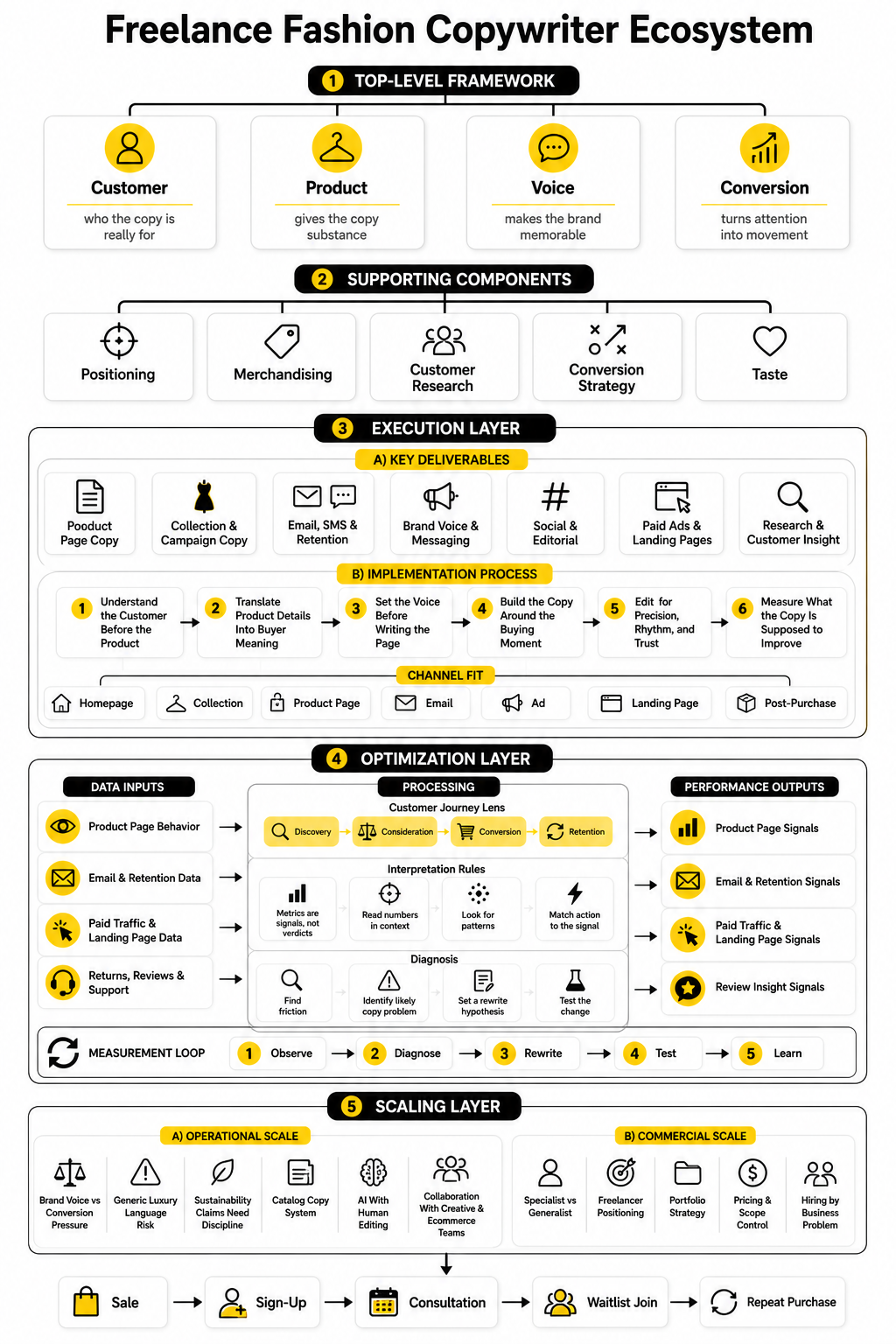
The strongest freelance fashion copywriting usually sits on four layers. First, the writer has to understand the customer well enough to know what they care about before the brand speaks. Second, they need to understand the product deeply enough to avoid empty adjectives and surface-level styling language.
Third, they need to shape the brand voice so the copy feels recognizable across product pages, email campaigns, collection launches, ads, and social content. Fourth, they need to write for action without making every line sound like a hard sell. This balance is what separates professional copy from pretty sentences.
A useful framework for the rest of this guide is: customer, product, voice, and conversion. Customer tells you who the copy is really for. Product gives the copy substance. Voice makes the brand memorable. Conversion turns attention into movement, whether that means a sale, sign-up, consultation, waitlist join, or repeat purchase.
What a Freelance Fashion Copywriter Actually Does
A freelance fashion copywriter does more than write product descriptions. The job is to turn a brand’s taste, customer insight, product details, and commercial goals into copy that helps people understand why a piece is worth buying. That can mean writing a sharp landing page for a capsule collection, tightening product copy across hundreds of SKUs, building an email launch sequence, or making a brand’s social captions sound less generic.
The best way to understand the role is to stop thinking of it as “fashion writing” and start thinking of it as sales communication with taste. Editorial language matters, but it has to serve a purpose. If the copy sounds beautiful but fails to answer the customer’s questions, it is not doing its job.
Fashion brands also need consistency. A customer might first see a brand in a paid ad, then visit a product page, join an email list, read a fit note, and later receive a restock message. A strong freelance fashion copywriter keeps that experience coherent so the brand does not sound luxury in one place, overly casual in another, and completely forgettable everywhere else.
Product Page Copy
Product page copy is one of the most important jobs for a freelance fashion copywriter because it sits closest to the sale. This is where the customer decides whether the item feels right, whether the price makes sense, and whether the brand has answered enough practical questions to earn trust. Strong copy supports the images instead of repeating what the images already show.
A good product description explains the piece with useful specificity. It should make the garment feel desirable, but it also needs to clarify material, structure, fit, weight, stretch, styling use, and occasion. Baymard’s apparel UX research found that 83% of apparel sites did not provide sufficient sizing information, which shows how often brands miss basic buyer needs on pages that are supposed to convert.
That does not mean every product page should become a technical manual. The copy still needs rhythm, restraint, and brand voice. The point is to give the shopper enough confidence to imagine the piece in their life without burying them in empty adjectives like effortless, elevated, timeless, and must-have.
What Product Copy Usually Includes
A freelance fashion copywriter may write or refine several elements on a product page. These elements look simple from the outside, but each one affects how the customer understands the item. When they work together, the page feels polished and useful instead of vague.
The best product copy usually starts with the buyer’s biggest question. For a tailored coat, that might be structure and warmth. For a dress, it might be fit, movement, and occasion. For denim, it is often rise, stretch, inseam, wash, and how the shape behaves after wear.
Collection and Campaign Copy
Collection copy gives a fashion launch its world. It explains the mood, the reason for the collection, and the thread connecting individual pieces. This is where a freelance fashion copywriter helps a brand move beyond a set of products and into a clearer story.
Campaign copy needs more energy than standard product copy. It may appear across launch emails, landing pages, paid ads, homepage banners, SMS messages, lookbooks, and social posts. The challenge is to keep the idea consistent without repeating the same line everywhere.
This is also where taste becomes commercial. A collection can have a strong visual direction and still feel confusing if the words do not frame it well. Good copy tells customers what they are entering, why it matters now, and which action makes sense next.
Common Campaign Deliverables
Campaign work is often fast, collaborative, and deadline-driven. The copywriter may work with founders, creative directors, ecommerce managers, performance marketers, photographers, and designers. That means the writing has to be good, but the process has to be clean too.
A practical writer will usually create options, not just one polished sentence. Fashion teams need room to compare tone, intensity, and commercial angle. One version might feel editorial, another more direct, and another more promotional for paid traffic or email.
Email, SMS, and Retention Copy
Fashion brands do not grow from one launch alone. They grow by bringing people back, building desire over time, and making existing customers feel understood. That is why email and retention copy are often a major part of the freelance fashion copywriter’s work.
Email copy can cover welcome flows, abandoned cart messages, product education, new arrivals, seasonal edits, back-in-stock alerts, post-purchase styling tips, and loyalty campaigns. The job is not to shout “buy now” every three days. The job is to create useful reasons for customers to pay attention.
Tools matter here, but they are not the strategy. A brand might use a platform like Brevo for email campaigns or ManyChat for automated customer conversations, but the copy still needs a clear point of view, smart segmentation, and a reason to exist in the customer’s inbox.
Brand Voice and Messaging
A freelance fashion copywriter often becomes useful before a single product description is written. Many brands have visuals, products, and a founder vision, but they do not have a repeatable way to sound like themselves. That creates inconsistency across the site, emails, ads, packaging, and customer support.
Brand voice work gives the team a shared language system. It defines what the brand sounds like, what it avoids, how it describes products, how emotional or direct it should be, and how it speaks to different customer moments. This is especially important for fashion because tiny tonal shifts change how premium, playful, minimal, sensual, technical, or accessible a brand feels.
Good voice work is practical, not abstract. A document that says “we are confident, modern, and authentic” is not enough. The team needs before-and-after examples, approved phrases, banned phrases, product naming guidance, email tone rules, and real copy patterns they can reuse.
What a Voice System Can Include
A voice system should make future writing easier. It should help an internal team brief freelancers faster, edit copy more consistently, and avoid the slow drift into generic fashion language. Done properly, it becomes a working tool rather than a decorative brand document.
This is one of the clearest differences between a beginner and a professional. A beginner asks, “What should I write?” A professional asks, “What does this brand need customers to understand, feel, and do repeatedly?”
Social and Editorial Copy
Social copy for fashion has to move fast without sounding careless. Captions, hooks, short-form video scripts, creator briefs, and content series all need a sharper point than “new collection just dropped.” A freelance fashion copywriter helps translate the brand’s world into formats people actually engage with.
Editorial copy sits slightly differently. It can include journal posts, styling guides, designer interviews, trend explainers, care guides, or seasonal shopping edits. These pieces are not always immediate conversion assets, but they can build authority, support SEO, and give the brand more depth than product pages alone.
The mistake is treating editorial content as filler. If a fashion brand publishes a styling guide, it should genuinely help the customer wear the product better. If it publishes a care guide, it should reduce uncertainty and support long-term product satisfaction. If it writes about a trend, it should connect that trend to the brand’s actual point of view instead of chasing search traffic blindly.
Paid Ad and Landing Page Copy
Paid traffic exposes weak copy quickly. If the ad promise is unclear, people scroll past. If the landing page does not match the ad, people bounce. If the product value is vague, the brand pays to attract attention it cannot convert.
A freelance fashion copywriter working on ads needs to understand both desire and constraint. Fashion advertising often needs a strong visual hook, but the copy still has to frame the offer, audience, product angle, or moment. That might mean testing different benefit angles, price anchors, social proof lines, styling hooks, or urgency messages.
Landing pages need even more structure. A launch page, waitlist page, or collection page should guide the reader from interest to confidence to action. For brands building dedicated campaign pages, a tool like Replo for ecommerce landing pages can help with page execution, but the message still has to be clear before design can make it look good.
Research and Customer Insight
The invisible part of fashion copywriting is research. Before writing, a good copywriter looks at customer reviews, return reasons, competitor positioning, product details, founder notes, sales data, search intent, social comments, and customer support questions. This is where the useful language often comes from.
Fashion customers tell brands what matters if the brand pays attention. They mention whether something runs small, whether the fabric feels heavier than expected, whether the color looks different in daylight, whether the piece gets compliments, or whether the styling photos helped them decide. Those details are gold for a freelance fashion copywriter.
Research also prevents lazy copy. Without it, every product becomes effortless, versatile, elevated, and essential. With it, the copy can say something real about how the piece fits, moves, layers, travels, photographs, washes, and earns its place in the customer’s wardrobe.
The Fashion Copywriting Framework
A freelance fashion copywriter needs a repeatable process because fashion copy can get subjective fast. One founder wants it more poetic, another wants it cleaner, and a marketing manager might want stronger conversion language by tomorrow morning. Without a framework, every revision becomes a taste debate.
The framework from Part 1 was customer, product, voice, and conversion. This part turns that into a working process. The goal is not to make the writing mechanical; the goal is to make the thinking solid enough that the final copy feels natural, specific, and commercially useful.
This matters because fashion shoppers do not move through a neat funnel anymore. They may discover a product through a creator video, compare it against resale options, check reviews, abandon the cart, come back through email, and buy only after seeing the item styled three different ways. A freelance fashion copywriter has to write for that messy reality, not for a perfect textbook journey.
Step 1: Understand the Customer Before the Product
The first step is not describing the garment. The first step is understanding the person who might buy it. That means looking at what they want from the category, what makes them hesitate, what they compare against, and what language they already use when talking about similar products.
For fashion brands, customer research often comes from places the team already has access to. Reviews, customer support tickets, returns feedback, social comments, creator content, post-purchase surveys, and search queries can show what buyers actually care about. Baymard’s apparel ecommerce research highlights how important it is for apparel sites to communicate fit and feel clearly, which is exactly the kind of buyer anxiety a copywriter should address before writing a polished description.
The copy gets better when the writer separates surface desire from purchase friction. A customer might want to look elegant, but they may hesitate because they are unsure about sizing, fabric weight, styling range, or whether the piece is worth the price. Strong copy speaks to both sides.
Customer Questions Worth Answering
A useful research pass should reveal the questions customers are already asking. These questions do not all belong in the same paragraph, but they should influence the copy structure. If the page ignores them, the customer has to guess, and guessing is bad for conversion.
This is where a freelance fashion copywriter starts sounding different from a generic content writer. They are not just asking, “What are the features?” They are asking, “What does the customer need to believe before this feature matters?”
Step 2: Translate Product Details Into Buyer Meaning
Fashion brands often hand copywriters product notes that are either too thin or too technical. “100% wool, relaxed fit, front pockets” is accurate, but it does not explain why the piece matters. On the other side, a long production document may include useful details but no clear hierarchy for the customer.
The writer’s job is to translate product facts into buyer meaning. A heavier fabric might mean structure, warmth, or durability. A bias cut might mean movement and drape. A hidden elastic waistband might mean comfort without changing the visual line of the garment.
This is where specificity beats hype. If a garment is machine washable, say it because that affects real life. If the knit is compact rather than airy, say it because it changes how the piece layers. If the jacket is designed to sit slightly off the shoulder, say it before the customer mistakes the intended fit for a sizing problem.
Product Details That Usually Matter
Not every product needs every detail, but the copywriter should know what to ask for. The more premium or technical the item is, the more important these details become. A customer spending more money expects more confidence before buying.
The best copy does not dump all of this into one block. It organizes the information so the shopper can absorb it quickly. The first line creates interest, the middle explains the value, and the supporting details remove uncertainty.
Step 3: Set the Voice Before Writing the Page
Voice is not something you sprinkle on at the end. It should shape the copy from the first draft. A minimalist wardrobe brand, a streetwear label, a bridal studio, a performance outerwear company, and a luxury resale platform should not sound like they are using the same template.
A freelance fashion copywriter should define the voice boundaries before producing final copy. How direct should the brand be? How sensory can the language get? Should the copy feel editorial, intimate, technical, playful, restrained, or bold? These choices affect every line.
This is especially important when multiple people edit the work. Without voice rules, feedback becomes personal preference. With voice rules, the team can judge whether the copy fits the brand instead of whether one person happens to like a phrase.
Voice Questions That Prevent Weak Revisions
A simple voice check can save hours of messy editing. It gives the writer and the brand a shared standard before draft review begins. It also protects the copy from becoming watered down by too many opinions.
The strongest brands usually have restraint. They do not try to sound luxurious, funny, sustainable, edgy, and friendly all at once. They choose a lane, then make that lane feel consistent.
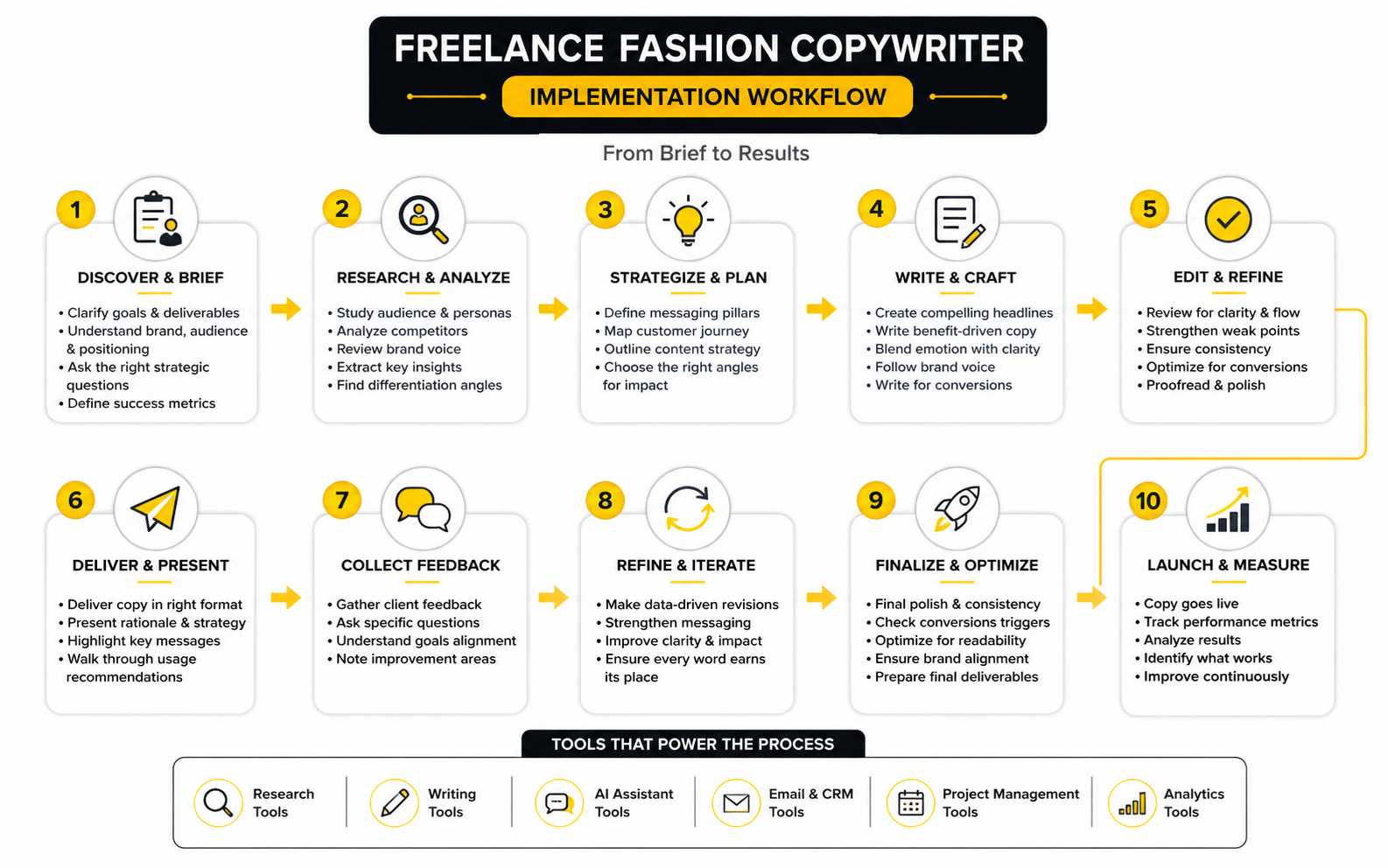
Step 4: Build the Copy Around the Buying Moment
Once the customer, product, and voice are clear, the copy has to match the buying moment. A homepage headline does not do the same job as a product description. An abandoned cart email does not need the same tone as a collection launch. A fit note should not sound like campaign poetry.
This is where the execution becomes tangible. The freelance fashion copywriter decides what the customer needs at that point in the journey and writes accordingly. Awareness copy should create interest, consideration copy should build confidence, and conversion copy should make the next action feel easy.
A common mistake is using the same emotional pitch everywhere. That gets tiring fast. The better approach is to vary the copy by context while keeping the brand voice consistent.
Matching Copy to the Channel
Each channel has a job. When the job is clear, the writing gets sharper. The copywriter can then decide what to emphasize, what to leave out, and how direct the call to action should be.
For brands that run multiple channels, this is also where systems help. A tool like Buffer can organize social publishing, while a customer communication stack like GoHighLevel can support follow-up campaigns for agencies or service-led fashion businesses. The tools are only useful when the message is already clear.
Step 5: Edit for Precision, Rhythm, and Trust
The first draft is rarely the final copy. Good editing removes filler, sharpens the product truth, and makes the copy easier to scan. It also catches claims that sound good but are not specific enough to trust.
A freelance fashion copywriter should be ruthless with vague phrases. Words like elevated, effortless, iconic, timeless, essential, and versatile can still be useful, but only when supported by detail. If every product is elevated and effortless, none of them are.
Trust matters here. Fashion brands need to be careful with sustainability language, performance claims, origin claims, and fit promises. If the brand cannot support a statement, the copy should not inflate it.
A Practical Editing Checklist
Editing works best when it moves through clear passes. Trying to fix strategy, voice, grammar, and conversion in one pass creates messy work. A professional process separates the layers.
That last point matters. Copy can look great in a Google Doc and feel too long on mobile. Since Adobe’s retail data continues to show how central digital shopping behavior is through its Digital Economy Index, ecommerce copy needs to be reviewed where customers will actually read it.
Step 6: Measure What the Copy Is Supposed to Improve
Copy should be judged against the job it was hired to do. If the goal was a stronger brand voice, the outcome might be consistency and faster internal approvals. If the goal was ecommerce performance, the team should look at page engagement, click-through rate, conversion rate, add-to-cart rate, return reasons, or email revenue.
A freelance fashion copywriter does not need to pretend every line can be tied perfectly to revenue. Fashion buying behavior is influenced by product, pricing, photography, traffic quality, brand strength, inventory, seasonality, and customer experience. But copy can still be measured through the signals it is closest to.
The best client relationships define those signals early. That keeps everyone realistic and focused. It also helps the writer improve future work instead of guessing which lines performed best.
Useful Copy Performance Signals
Different projects need different metrics. A product page rewrite should not be judged the same way as a brand voice guide. A launch email should not be judged the same way as an editorial styling guide.
The point is not to obsess over dashboards. The point is to connect writing to business reality. A freelance fashion copywriter who understands that connection becomes much easier to trust, hire, and keep.
Statistics and Data
Data helps a freelance fashion copywriter make better decisions, but only when the numbers are attached to a clear business question. Random benchmarks do not fix weak messaging. They simply give teams something to stare at while the real problem stays untouched.
The useful question is not, “Is this number good?” The better question is, “What does this number tell us about the customer’s next hesitation?” If a product page gets traffic but does not convert, the copy may not be explaining fit, value, material, styling, or trust clearly enough. If emails get opened but not clicked, the subject line did its job, but the body copy or offer did not create enough momentum.
Fashion copy should be measured in context. A luxury bridal studio, a streetwear drop, a sustainable basics brand, and a fast-moving accessories store will not share the same buying cycle. The data is there to guide judgment, not replace it.
What Fashion Copy Metrics Actually Measure
Most copy metrics are signals, not verdicts. A low add-to-cart rate can point to weak product copy, but it can also point to pricing, photography, sizing anxiety, low stock, poor traffic quality, or a product-market mismatch. That is why a freelance fashion copywriter should read numbers alongside page context, customer behavior, and merchandising details.
For product pages, the copy is usually closest to conversion confidence. It can clarify the fit, explain the fabric, frame the price, reduce uncertainty, and make the styling use obvious. Baymard’s apparel research found that 83% of apparel sites do not provide sufficient sizing information, which is a strong reminder that many conversion problems are not dramatic. They are basic information gaps.
For email, the copy has a different job. The subject line earns the open, the preview text supports the reason to open, the body builds desire or urgency, and the call to action moves the reader back to the site. Klaviyo’s benchmark resources for ecommerce brands track email open rates, click rates, order rates, and revenue per recipient through its email marketing benchmarks, but those numbers only become useful when you compare them by message type, segment, and intent.
The Core Analytics System
A clean analytics system starts with the customer journey. Do not throw every metric into one dashboard and pretend that is strategy. Separate discovery, consideration, conversion, and retention so the team knows where the copy is supposed to create movement.
Discovery copy should be judged by whether it earns attention from the right people. Consideration copy should be judged by whether it helps shoppers understand the product and keep moving. Conversion copy should be judged by whether it reduces hesitation near the sale. Retention copy should be judged by whether it brings customers back without training them to ignore the brand.
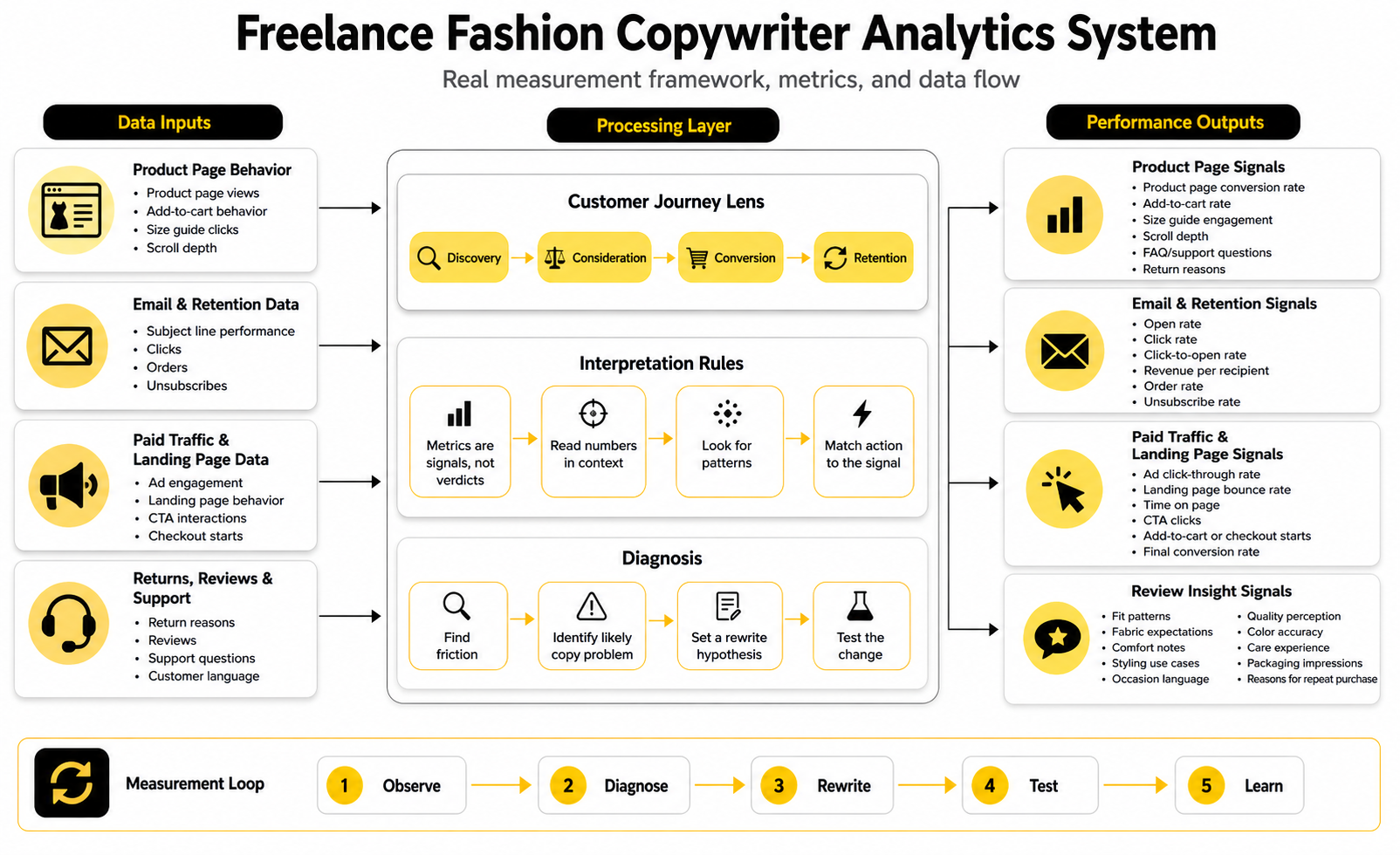
A freelance fashion copywriter does not need to own the entire analytics stack, but they should understand what the numbers imply. If a campaign has a strong click-through rate but weak product page conversion, the ad or email promise may be stronger than the page experience. If product page engagement is high but add-to-cart is low, the customer may be interested but still unsure. If returns mention fit confusion, the copy may need clearer sizing language before the purchase.
Product Page Benchmarks and What To Do With Them
Fashion ecommerce conversion rates vary widely because category, price point, traffic source, device mix, brand demand, discounting, and inventory all matter. Recent fashion ecommerce benchmark discussions often place average conversion around the low single digits, while Centra’s analysis of more than 500 fashion brands shows why vertical-specific benchmarks are more useful than generic ecommerce averages in its fashion conversion benchmark analysis. The practical takeaway is simple: compare against your own baseline first, then use market benchmarks as a sanity check.
For product copy, the most important performance question is where confidence breaks. A high product page view count with weak add-to-cart behavior can mean the product attracts interest but the page does not answer enough questions. In fashion, that often means unclear fit, vague fabric language, poor styling context, weak value explanation, or uncertainty around returns.
The action should match the signal. Do not rewrite every page because one metric looks low. Start with high-traffic product pages, bestsellers with underperforming conversion, products with repeated sizing questions, and items with return reasons linked to expectation gaps.
Product Page Signals To Watch
Product page analytics should help the writer find friction. The goal is not to make every description longer. The goal is to make the right information easier to trust.
The strongest copy improvements are usually boring in the best way. Clarify whether the knit is heavy or light. Say whether the trousers sit high on the waist. Explain if the dress is fitted through the hip. Tell the shopper if the jacket is designed for layering. These details do more than another vague line about timeless style.
Email and Retention Metrics
Email is where fashion brands can build repeat demand, but only if the copy respects the customer’s attention. A launch email, abandoned cart reminder, back-in-stock alert, editorial styling email, and post-purchase message should not all sound the same. Each one has a different job.
Open rate is useful, but it is not enough. It can show whether the subject line and sender relationship are working, but it does not prove the email persuaded anyone. Click rate shows whether the message created enough interest to move back to the site. Revenue per recipient and order rate show whether the audience, offer, timing, and product relevance came together.
This is why a freelance fashion copywriter should look at flows and campaigns separately. Automated flows often perform differently from one-off campaigns because the intent is stronger. Someone who abandoned a cart is not in the same state of mind as someone receiving a broad seasonal edit.
Email Metrics That Drive Better Copy
Email data should shape the next draft. If people open but do not click, the copy may need a clearer product angle, stronger visual hierarchy, better segmentation, or a more specific reason to act. If clicks are strong but orders are weak, the issue may be on the landing page, product page, pricing, availability, or offer match.
A practical stack matters when teams actually use the data. A platform like Brevo can help manage campaigns and automation, while Moosend can support brands that need email marketing workflows without overcomplicating execution. The tool should make testing easier, not become a substitute for sharper messaging.
Paid Traffic and Landing Page Data
Paid traffic is useful because it exposes message-market fit quickly. If a fashion ad gets impressions but few clicks, the hook may not be strong enough or the creative may not match the audience. If the ad gets clicks but the landing page fails, the copy likely created curiosity without enough confidence.
Landing page data should be interpreted by section. The headline tells you whether the page continues the promise from the ad or email. The product explanation tells you whether visitors understand what is being sold. Social proof, fit details, shipping reassurance, and calls to action tell you whether the page reduces risk.
Adobe’s ecommerce data shows the scale and competitiveness of online retail, with its Digital Economy Index built from more than one trillion visits to retail sites and 100 million SKUs. That matters because fashion brands are not competing only against similar labels. They are competing against every smooth, fast, clear digital buying experience the customer has had elsewhere.
Landing Page Signals To Watch
Landing page metrics should tell the team where the page loses momentum. A freelance fashion copywriter can then adjust the page structure instead of randomly changing headlines. This is how copy becomes a testing discipline rather than a guessing game.
For campaign-specific pages, a builder like Replo can help ecommerce teams launch faster, while a funnel tool like ClickFunnels may fit brands selling styling services, consultations, digital products, or fashion education offers. Either way, the page needs one clear promise, one clear audience, and one clear next action.
Returns, Reviews, and Support Tickets
Some of the best copy data never appears in a marketing dashboard. It appears in returns, reviews, and customer support messages. These sources show whether the customer got what they expected after reading the page.
If returns mention “smaller than expected,” the fit copy may need to be more direct. If reviews praise fabric quality, that language can be pulled into future product descriptions and campaign messaging. If support tickets repeatedly ask about length, opacity, warmth, or styling, those details should not be hidden in a dropdown or ignored completely.
This data is powerful because it connects pre-purchase communication with post-purchase reality. A freelance fashion copywriter who studies it can reduce uncertainty before checkout and make the product feel more accurately represented. That is good for the customer and good for the brand.
What Review Data Can Reveal
Reviews are not just social proof. They are customer language research. The words people use after buying often reveal what future buyers need to hear before buying.
The smartest move is to build a simple review-language bank. Group repeated phrases by product type, objection, benefit, and customer segment. Over time, this becomes a practical source of copy angles that sound human because they came from real customers.
How To Interpret Data Without Overreacting
One weak metric does not mean the copy failed. A single campaign can be affected by seasonality, list fatigue, poor segmentation, weak creative, pricing resistance, low stock, shipping deadlines, or a bad product-audience fit. Copy is important, but it is not magic.
The better approach is to look for patterns. If multiple product pages with unclear fit notes underperform, fix the fit copy. If emails with vague subject lines consistently get weaker opens, sharpen the hook. If landing pages with broad claims convert worse than pages with specific product benefits, make the value proposition more concrete.
This is where professional judgment matters. A freelance fashion copywriter should not promise a guaranteed conversion lift from a rewrite. They should promise a stronger process: better research, clearer messaging, cleaner tests, and more useful interpretation of what the customer does next.
The Measurement Loop
The measurement loop is simple: observe, diagnose, rewrite, test, and learn. First, look at the data to find friction. Then diagnose the likely copy problem without pretending it is the only possible cause. Rewrite with a specific hypothesis, test the change, and use the result to improve the next decision.
This loop keeps brands from treating copy as a one-time asset. Product pages, flows, campaign pages, and ads can all improve as more customer behavior comes in. The copy gets sharper because the brand keeps learning.
A freelance fashion copywriter who works this way becomes more than a vendor. They become a strategic partner who can connect brand language to customer behavior. That is the difference between writing attractive sentences and building a copy system that helps the fashion business sell with more clarity.
Professional Implementation for Brands and Freelancers
At this stage, the work becomes less about writing one strong page and more about building a copy system that can survive real business pressure. Fashion teams move quickly. Products change, campaigns shift, stock runs out, founders revise direction, and customer feedback arrives after the launch has already gone live.
That is why professional implementation matters. A freelance fashion copywriter needs to know how to work inside a brand’s actual operating rhythm, not just produce elegant drafts in isolation. The copy has to fit the launch calendar, the ecommerce setup, the creative direction, the review process, and the commercial priorities.
For brands, this is where hiring gets serious too. You are not just buying words. You are bringing in someone who can help your team make sharper decisions about what to say, what not to say, and how to turn product information into customer confidence.
The Strategic Tradeoff: Brand Voice vs Conversion Pressure
Fashion brands often feel pulled between two instincts. One side wants refined, brand-led language that protects the aesthetic. The other side wants direct conversion copy that gets people to click, add to cart, and buy.
The mistake is treating those as opposites. Good fashion copy can sell without sounding desperate. It can be clear without being flat, and it can be elegant without becoming vague.
A freelance fashion copywriter has to manage that tension carefully. If the copy becomes too performance-driven, the brand starts sounding like every discount-heavy ecommerce store. If it becomes too editorial, the customer may admire the tone but still not understand the product well enough to buy.
How To Balance Taste and Action
The balance comes from assigning each section of copy a job. The headline may carry the mood. The product description may explain the value. The fit notes may remove risk. The call to action may stay simple and direct.
This prevents the whole page from trying to do everything at once. It also gives editors a better way to review the work. Instead of asking whether the copy is “on brand” in a vague way, they can ask whether each section is doing the right job.
The best copy usually feels calm because the strategy underneath it is clear. It does not need to shout. It knows exactly what the customer needs next.
The Risk of Generic Luxury Language
Fashion copy has a cliché problem. Too many brands describe every product as elevated, effortless, timeless, refined, versatile, considered, essential, and modern. These words are not always wrong, but they become useless when they appear without proof.
Generic luxury language is dangerous because it creates the illusion of taste while saying almost nothing. A customer cannot use it to understand fit, material, styling, price, or quality. It also makes brands harder to distinguish from each other.
A freelance fashion copywriter should protect the brand from this drift. The better move is to keep the polish but anchor it in detail. “A refined everyday trouser” is weak on its own. “A high-rise wool trouser with a clean front, soft drape, and enough structure for office wear” gives the customer something real.
Better Alternatives to Empty Fashion Phrases
The goal is not to ban beautiful language. The goal is to make it earn its place. When a phrase sounds familiar, the writer should ask what specific product truth sits underneath it.
This is one of the fastest ways to improve fashion copy. Keep the feeling, but add the evidence. That is where credibility comes from.
Sustainability Claims Need Discipline
Sustainability language is one of the riskiest areas in fashion copy. Customers care about impact, but regulators are paying closer attention to environmental claims, and broad language can create trouble when it is not properly supported. The FTC’s Green Guides exist to help marketers avoid environmental claims that are not truthful and substantiated.
This affects copy directly. A freelance fashion copywriter should not casually call a garment sustainable, eco-friendly, conscious, responsible, circular, low-impact, or ethical unless the brand has evidence and the claim is specific enough to defend. In fashion, vague green language can quickly become a trust problem.
The practical solution is to write with precision. Instead of saying a dress is sustainable, say what can be verified: the certified material, the percentage of recycled fiber, the production location, the dyeing method, the repair program, the resale model, or the packaging change. Specific claims are less glamorous, but they are much stronger.
How To Write Safer Sustainability Copy
A brand does not need to hide responsible choices. It needs to describe them accurately. That means the copywriter should ask for documentation before turning production details into public claims.
This is not about making the copy boring. It is about making sure the brand does not trade long-term trust for one attractive phrase. In fashion, credibility compounds slowly and can disappear fast.
Scaling Copy Across Large Catalogs
Small brands often need depth. Large catalogs need consistency at speed. When a fashion business has hundreds or thousands of SKUs, the freelance fashion copywriter has to think in systems, templates, and repeatable rules.
That does not mean every product page should sound identical. It means the copy structure should be predictable enough that customers know where to find the information they need. Product descriptions, fit notes, material explanations, care instructions, and styling suggestions should follow a logic.
The danger at scale is copy fatigue. When a writer has to produce many descriptions, the language can become repetitive. The solution is to build a product-language library before the writing starts, with approved phrasing for recurring silhouettes, fabric types, fit categories, and styling contexts.
Building a Catalog Copy System
A catalog copy system gives the writer guardrails without killing creativity. It also helps brands onboard future writers, editors, merchandisers, and ecommerce assistants. This is how a one-time copy project turns into an asset.
For larger teams, the smartest move is to combine human judgment with operational efficiency. AI can help with first-pass organization, summarization, or variation generation, but the final copy still needs human editing for taste, accuracy, and brand nuance. This is especially true in fashion, where one wrong phrase can make a product feel cheaper, less specific, or less trustworthy.
Managing AI Without Losing the Brand
AI has changed the copywriting workflow, but it has not removed the need for a skilled freelance fashion copywriter. If anything, it has made taste more valuable. Anyone can generate a product description now, so the advantage moves to the person who can make the copy accurate, distinctive, and commercially sharp.
The risk is obvious. AI tends to produce smooth, generic fashion language unless it is guided by strong product details, customer insight, and brand rules. It can also invent claims, soften important fit details, or make every product sound equally impressive.
The better workflow is to use AI as an assistant, not the voice of the brand. Let it help organize raw product notes, create draft variations, or summarize review themes. Then let a human writer decide what is true, what matters, what should be cut, and what actually sounds like the brand.
Where AI Can Help
AI is most useful when the input is strong and the output is edited carefully. It should speed up the mechanical parts of the process, not replace strategic judgment. A freelance fashion copywriter who understands this can deliver faster without lowering quality.
The rule is simple: never publish AI output without verification. Check product facts, claims, measurements, tone, and any statement about materials, performance, sustainability, or origin. Fast copy is useful only if it is still correct.
Collaboration With Creative and Ecommerce Teams
Fashion copy rarely works alone. It sits beside photography, styling, merchandising, UX design, email design, paid media, inventory planning, and customer service. A freelance fashion copywriter needs to understand how those pieces affect the words.
If photography already shows the garment in motion, the copy may not need to over-explain movement. If the product imagery does not show lining, closure, or scale, the copy may need to compensate. If the brand has high return rates for certain categories, fit notes need more priority.
This is why the best writers ask practical questions early. What is the launch date? Which products are hero items? What are the margin priorities? Which pieces have limited stock? Which items have fit concerns? Which claims are approved? Which pages need to be live first?
A Better Review Process
A weak review process can ruin good copy. Too many stakeholders, unclear feedback, and last-minute rewrites often lead to watered-down language. The brand ends up with copy that is technically approved but strategically weaker.
A stronger review process separates feedback by role. The founder or creative director reviews voice and positioning. The ecommerce lead checks product accuracy and page usability. The performance marketer reviews offer clarity and testing angles. The copywriter then makes final edits without turning the draft into a committee document.
This is not bureaucracy. It is how brands protect speed and quality at the same time.
When To Hire a Specialist Instead of a Generalist
A generalist copywriter can help with many business tasks, but fashion has category-specific demands. The writer needs to understand fit language, product hierarchy, seasonal merchandising, visual taste, trend sensitivity, customer hesitation, and how fashion brands signal value. That does not always come naturally to someone who writes SaaS pages, B2B emails, or generic blog content.
A freelance fashion copywriter is especially useful when the brand depends on product storytelling. This includes ecommerce labels, luxury brands, sustainable fashion companies, bridal studios, jewelry brands, accessories brands, resale platforms, stylists, and fashion tech businesses. The more the product needs explanation, the more valuable the specialist becomes.
The clearest sign you need a specialist is when the copy looks polished but customers still seem confused. They ask the same sizing questions. They do not understand the difference between similar products. They miss the point of the collection. They return items because expectations were not set properly.
Situations Where a Specialist Is Worth It
Specialist help is not always necessary for every small task. But when the stakes are high, hiring someone who already understands the category saves time and protects the brand. It also reduces the amount of education the internal team has to provide.
This is where price should be judged against business impact. Cheap copy that needs heavy editing, causes confusion, or weakens brand perception is not cheap. It is just a hidden cost.
The Freelancer’s Positioning Advantage
For freelancers, the biggest strategic mistake is trying to look useful to everyone. Fashion brands do not need another vague writer who can “help with content.” They need someone who understands their category, their customer, and their commercial pressure.
A strong freelance fashion copywriter should position around a clear type of work. That might be ecommerce product copy, luxury brand voice, email retention, sustainable fashion messaging, launch campaigns, or fashion SEO. The narrower the positioning, the easier it is for the right client to recognize the fit.
This does not mean you can only do one thing forever. It means your market-facing message should make the buying decision easier. Brands hire faster when they can see exactly where you fit.
Positioning Questions for Freelancers
A good positioning decision should make your portfolio, outreach, and service pages sharper. It should also help you reject projects that dilute your value. Clarity is commercial.
If you are building your client pipeline, do not rely only on marketplaces. Use direct outreach, referrals, niche content, and a portfolio that shows thinking, not just finished copy. A simple CRM like Copper can help track brand conversations, while a scheduling tool like Cal.com can make discovery calls easier to manage.
Pricing and Scope Control
Pricing fashion copy is hard when the scope is unclear. A product page rewrite is not the same as a full catalog system. A campaign concept is not the same as writing every email, ad, landing page, and SMS variation attached to the launch.
Freelancers should avoid pricing only by word count. Word count ignores research, strategy, product complexity, revisions, meetings, channel adaptation, and the value of getting the message right. Brands should also avoid judging proposals by the cheapest rate when the work affects customer trust and sales.
The better approach is to price by deliverable, complexity, and business use. A voice guide that shapes the whole brand has different value than ten short product descriptions. A launch campaign with paid traffic behind it carries different pressure than a one-off journal article.
Scope Details To Define Early
Clear scope protects both sides. It prevents the brand from expecting unlimited strategy and prevents the freelancer from quietly absorbing unpaid work. Professional copy projects need boundaries.
The goal is not to be rigid. The goal is to make the work clean. Good scope creates better copy because everyone knows what success looks like before the first draft starts.
The Advanced Skill: Knowing What Not To Say
One of the most underrated skills in fashion copywriting is restraint. Not every product needs a dramatic story. Not every collection needs a manifesto. Not every email needs urgency. Not every page needs ten benefits.
A freelance fashion copywriter earns trust by knowing what to leave out. Too much copy can make a premium brand feel insecure. Too little copy can make an ecommerce page feel incomplete. The right amount depends on the product, price, customer awareness, and buying risk.
This is the expert-level shift. Beginners try to make every line impressive. Professionals make every line useful. That is the standard that should carry into the final part: how to hire, price, evaluate, and build a long-term copywriting practice around real value.
Pricing, Hiring, Portfolio Strategy, and FAQ
The final piece is turning everything into a practical decision. A brand needs to know when to hire, how to judge quality, and how to avoid paying for vague copy that still needs heavy internal repair. A freelancer needs to know how to package their skill, prove their thinking, and build a career that does not depend on random one-off requests.
A freelance fashion copywriter becomes valuable when they can connect three things: brand taste, customer confidence, and commercial action. Leave one out and the work gets weaker. Brand taste without clarity becomes vague. Conversion thinking without taste becomes pushy. Customer research without execution becomes unused insight.
This is the full system. Not just copy. Not just content. A working language engine for fashion brands that need to sell with more precision.
How Brands Should Hire a Freelance Fashion Copywriter
Hiring a freelance fashion copywriter should start with the business problem, not the deliverable. “We need product descriptions” is a start, but it is not enough. A better brief explains whether the brand needs clearer fit information, stronger collection storytelling, better email performance, a more consistent voice, or more persuasive landing pages.
The strongest candidates will ask questions before they quote. They will want to know the product category, customer profile, current conversion issues, available product notes, review data, revision process, and launch timeline. That is a good sign, not friction.
You should also look for fashion judgment. A writer does not need to have worked with every type of brand, but they should understand how language changes between luxury, resale, streetwear, bridal, activewear, accessories, and sustainable fashion. The wrong tone can make a premium product feel cheaper, and the wrong level of detail can make a practical product feel confusing.
What To Look For Before You Hire
A strong portfolio should show more than polished sentences. It should show how the writer thinks. Before-and-after samples, product page rewrites, launch emails, voice guidelines, and short explanations of the strategy behind the work are more useful than a pretty PDF full of isolated taglines.
Do not judge only by whether you personally like a line. Judge whether the copy would help your customer understand, trust, and want the product. That is the real test.
How Freelancers Should Build a Strong Portfolio
A portfolio for a freelance fashion copywriter should not look like a random collection of writing clips. It should make a client think, “This person understands my problem.” That means organizing samples by outcome, deliverable, or category rather than dumping everything onto one page.
If you do not have many client samples yet, create speculative work carefully. Pick a real type of fashion business, define the audience, explain the problem, and write the copy as if it had a commercial job. Do not invent fake results, fake clients, or fake case studies. Show your thinking honestly.
The portfolio should also make your niche obvious. If you want product page work, show product pages. If you want launch campaigns, show campaign systems. If you want brand voice projects, show voice principles, tone examples, and before-and-after rewrites.
Portfolio Pieces Worth Creating
A practical portfolio does not need to be huge. It needs to be relevant. Five strong samples with clear context are better than twenty vague pieces that do not show what you can do for a fashion brand.
Each sample should include a short note explaining the goal. What was the customer hesitation? What did the copy need to clarify? What tone were you aiming for? What would you measure if this went live?
How Much Should Fashion Copywriting Cost?
There is no single correct price because scope changes everything. Ten short product descriptions, a full brand voice guide, a launch campaign, and a conversion-focused ecommerce rewrite are completely different projects. Pricing should reflect research, strategy, complexity, usage, revisions, and business impact.
Freelancers should be careful with pure per-word pricing. It makes the work look like typing, not thinking. It also punishes concise writing, which is often exactly what good fashion copy requires.
Brands should compare proposals by clarity, not just cost. A cheap project with weak research, unclear scope, and endless revisions can cost more in team time than a higher-priced project handled by someone who understands the category. Upwork’s Future Workforce Index shows skilled independent talent remains a serious part of how companies access expertise, which is exactly how brands should think about this role.
Pricing Models That Usually Make Sense
The cleanest pricing model is usually project-based. It gives the brand a clear deliverable and gives the freelancer room to account for research, editing, and strategic thinking. Retainers can also work when the brand needs ongoing product launches, email campaigns, and seasonal updates.
The key is to define what is included. Research, meetings, SEO, revisions, analytics review, and post-launch edits should not be assumed unless they are part of the agreement.
When Copywriting Is Not the Real Problem
Sometimes copy is blamed for problems it cannot fix alone. If the product photography is weak, the pricing is misaligned, the site is slow, the sizing is inconsistent, or the traffic quality is poor, new copy may help but will not solve everything. A professional should be honest about that.
This does not make copy less important. It makes diagnosis more important. The copywriter should be able to say, “The product page needs clearer fit notes, but the photography also needs a back view and scale reference.” That kind of honesty is valuable.
Fashion ecommerce has many moving parts. Research on apparel returns continues to show how complex fit, expectations, and online buying behavior can be, including recent academic work on fashion ecommerce returns and their operational impact. Copy can reduce avoidable confusion, but it works best when the full customer experience supports the promise.
What does a freelance fashion copywriter do?
A freelance fashion copywriter writes strategic copy for fashion brands, ecommerce stores, designers, stylists, retailers, and fashion-related businesses. Their work can include product descriptions, collection pages, email campaigns, paid ads, landing pages, brand voice guides, lookbooks, social captions, and editorial content. The best ones combine taste, customer research, product understanding, and conversion thinking.
Is fashion copywriting different from regular copywriting?
Yes, because fashion copy has to translate visual and physical product qualities into language. The writer needs to understand fit, fabric, silhouette, styling, customer identity, seasonal context, and brand perception. A general copywriter may be strong, but fashion requires category fluency if the copy is going to feel specific and credible.
Do fashion brands really need a specialist copywriter?
Not always, but they usually benefit from one when the product needs explanation or the brand depends heavily on taste. A specialist can write with more precision around fabric, fit, styling, and merchandising. They can also avoid the generic fashion language that makes many brands sound interchangeable.
What should I include in a brief for a freelance fashion copywriter?
A strong brief should include the brand background, target customer, product details, launch goals, tone guidance, competitor references, current pain points, required deliverables, deadlines, and approval process. Product notes should include fabric, fit, care, measurements, styling intent, and any claims that need legal or compliance approval. The better the input, the stronger the copy.
How do I know if fashion copy is good?
Good fashion copy makes the product more desirable and easier to understand. It should sound like the brand, answer real buyer questions, and guide the reader toward the next action without sounding forced. If the copy is beautiful but vague, it is not finished.
What metrics should fashion brands track after updating copy?
Brands should track metrics connected to the copy’s job. Product page updates may be judged by add-to-cart rate, conversion rate, size guide engagement, support questions, and return reasons. Email copy may be judged by open rate, click rate, click-to-open rate, order rate, revenue per recipient, and unsubscribe rate.
Can AI replace a freelance fashion copywriter?
AI can help with drafts, summaries, variations, and research organization, but it does not replace taste, judgment, accuracy, and brand nuance. It can easily produce generic phrases or unsupported claims if the input is weak. A skilled freelance fashion copywriter can use AI as a workflow tool while still protecting the brand’s voice and credibility.
How should freelancers price fashion copywriting?
Freelancers should usually price by project, deliverable, complexity, and business value rather than only by word count. A product page batch, brand voice guide, email sequence, and launch campaign all require different levels of thinking. Clear scope, revision limits, and usage terms should be agreed before the work starts.
What should a fashion copywriting portfolio include?
A strong portfolio should include relevant samples such as product descriptions, collection copy, email campaigns, landing page sections, social captions, brand voice guidelines, and before-and-after rewrites. Each sample should include context so the client understands the goal behind the copy. Honest speculative samples are fine when they are clearly labeled and do not pretend to be real client work.
How can a beginner become a freelance fashion copywriter?
Start by learning ecommerce copywriting, fashion terminology, customer research, and brand voice development. Build a small portfolio around realistic fashion scenarios, then reach out to brands with specific suggestions instead of vague “I can help with content” messages. The fastest path is to specialize enough that clients immediately understand why you are relevant.
What are the biggest mistakes fashion copywriters make?
The biggest mistake is writing attractive but empty copy. Other common mistakes include overusing luxury clichés, ignoring fit and fabric details, making unsupported sustainability claims, writing the same tone for every channel, and failing to connect the copy to customer hesitation. Strong fashion copy is specific, useful, and controlled.
What should brands avoid when hiring a freelance fashion copywriter?
Brands should avoid hiring only on the cheapest rate, giving unclear briefs, involving too many reviewers, and expecting copy to fix problems caused by weak product photography or poor site experience. They should also avoid asking for broad sustainability or quality claims without evidence. A good copywriter can improve the message, but the brand still needs to provide accurate inputs.
Build a stronger local presence with BAAM AI
Turn your website, Google profile, social channels, and AI visibility into one growth engine
Most businesses do not need more random marketing activity. They need a consistent presence system that helps the right people find them, trust them, and take action. BAAM AI brings strategy, local SEO, website updates, Google Maps visibility, social content, AI-search readiness, media production, and reporting into one practical monthly engine.
If you want your marketing to keep working after the campaign ends, start with a free BAAM AI presence audit. See how your business shows up today and where the fastest visibility wins are at BAAM AI.