
BAAM AI Blog
Fitness Copywriter: The Practical Guide to Messaging That Sells Training, Coaching, and Wellness Offers
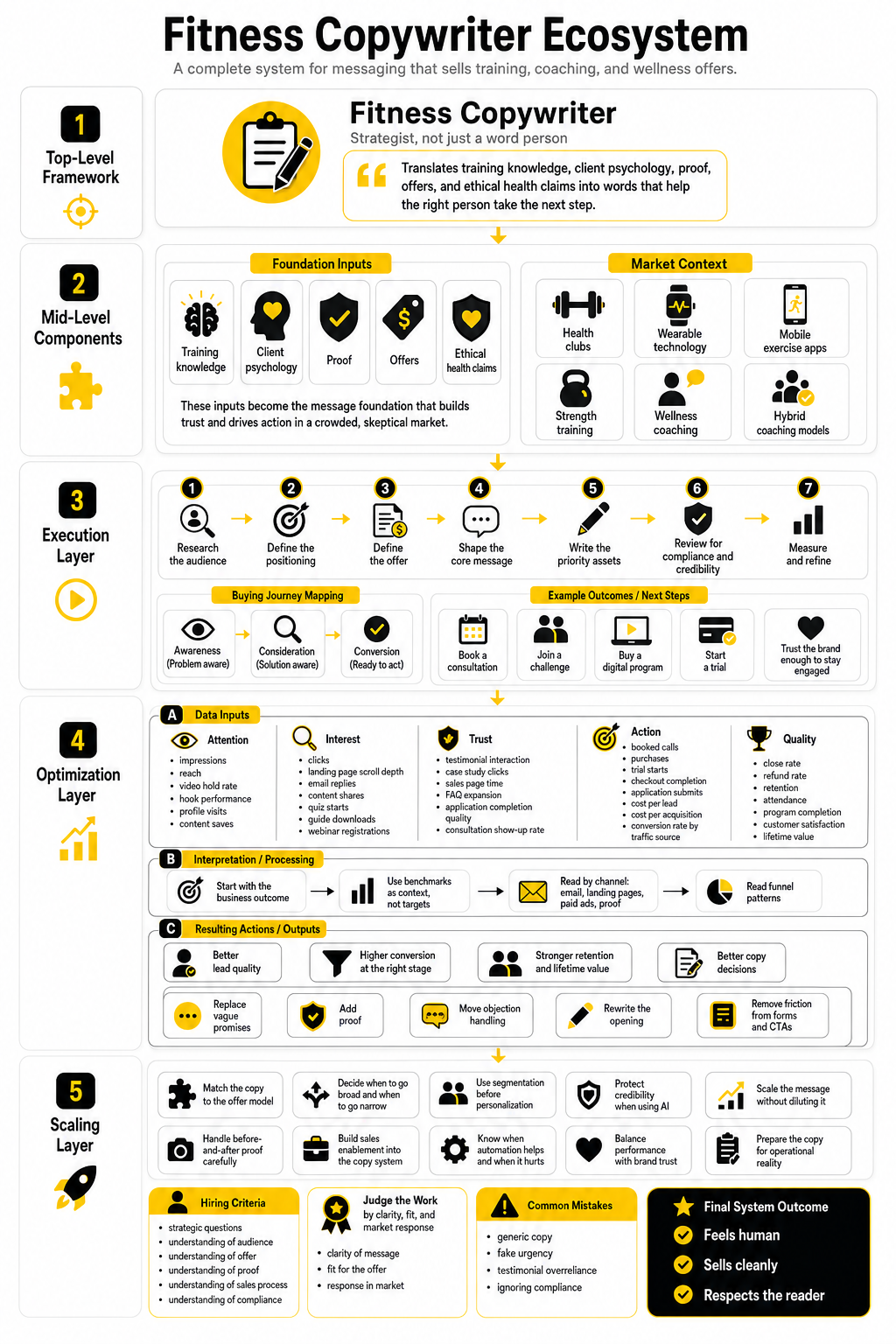
A fitness copywriter does more than write punchy gym ads, transformation captions, or sales pages for coaching programs. The job is to translate training knowledge, client psychology, proof, offers, and ethical...
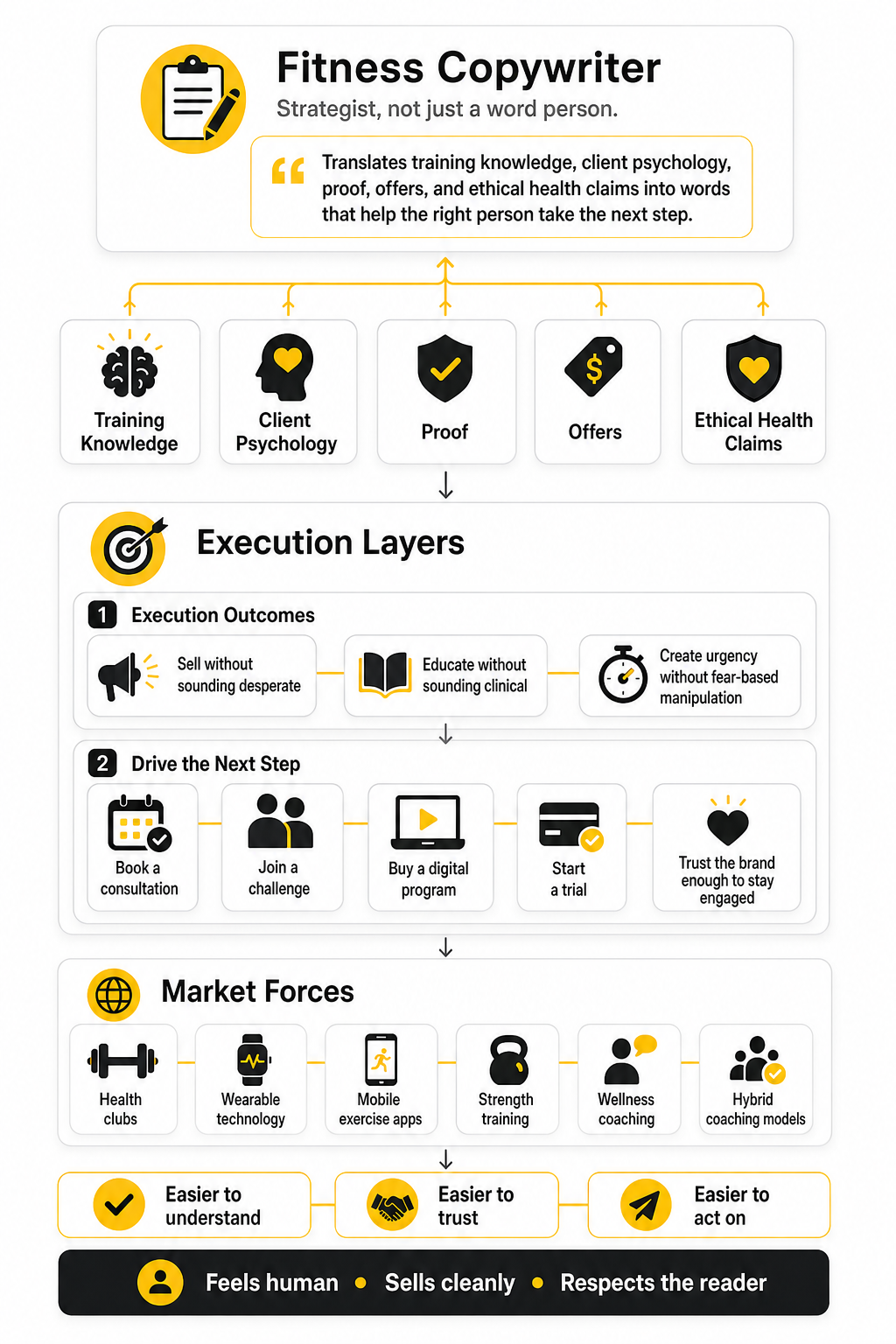
A fitness copywriter does more than write punchy gym ads, transformation captions, or sales pages for coaching programs. The job is to translate training knowledge, client psychology, proof, offers, and ethical health claims into words that help the right person take the next step. That could mean booking a consultation, joining a challenge, buying a digital program, starting a trial, or trusting a brand enough to stay engaged.
This matters because the fitness market is crowded, skeptical, and emotionally loaded. People want results, but they are also tired of exaggerated promises, generic motivation, and content that sounds like every other coach on Instagram. A good fitness copywriter has to sell without sounding desperate, educate without sounding clinical, and create urgency without crossing into fear-based manipulation.
The opportunity is real. The global fitness conversation keeps expanding as health clubs, wearable technology, mobile exercise apps, strength training, wellness coaching, and hybrid coaching models all fight for attention. At the same time, nearly one third of adults worldwide were not active enough in 2022, and only 47.2% of U.S. adults met aerobic physical activity guidelines in 2024. Better copy will not solve inactivity by itself, but clear messaging can make credible fitness offers easier to understand, trust, and act on.
The catch is that fitness copy is not normal direct response copy with dumbbells added. Health-related messaging carries more responsibility because claims need support, testimonials need context, and trust can be damaged fast. The FTC’s health claims guidance makes that clear: claims about health benefits and safety should be truthful, not misleading, and backed by science.
That is why this guide treats a fitness copywriter as a strategist, not just a word person. We will look at the market forces, the messaging framework, the core assets, the implementation process, and the measurement habits that separate professional fitness copy from surface-level content. The goal is practical: help fitness brands communicate in a way that feels human, sells cleanly, and respects the reader.
this guide is split into six parts so each section can build on the last without rushing the strategy. The structure starts with the business case, then moves into the framework, the actual copy assets, and the way professionals implement the work across channels. The final part will bring everything together with measurement, hiring criteria, and the FAQ.
Why Fitness Copywriting Matters
Fitness is easy to misunderstand from the outside. It looks like a market built on workouts, meal plans, memberships, apps, and coaching calls, but underneath all of that is trust. People are not just buying exercises; they are buying the belief that this specific brand, coach, or program can help them move from stuck to capable.
That is why a fitness copywriter has a different job from a general copywriter. The words need to sell, yes, but they also need to lower confusion, reduce skepticism, and make the offer feel safe enough to consider. In a space full of extreme claims and recycled motivation, clarity becomes a serious advantage.
The demand is not theoretical either. The 2025 Health & Fitness Association Global Report reported year-over-year growth in memberships, revenue, and facilities, which means more brands are competing for the same attention. When the market grows, the copy has to work harder because prospects have more options and less patience.
Fitness Buyers Are Skeptical For Good Reasons
Most fitness prospects have already tried something before. They may have joined a gym and stopped going, downloaded an app and ignored it, bought a meal plan that did not fit their life, or followed a coach whose advice felt too generic. So when they land on a sales page or read an ad, they are not starting from neutral.
This is where weak copy fails fast. Vague promises like “get in the best shape of your life” do not answer the real question in the buyer’s head, which is usually closer to “will this actually work for someone like me?” A skilled fitness copywriter knows how to address that skepticism directly without becoming defensive or overexplaining.
Trust also matters because fitness outcomes are personal. Weight, strength, confidence, pain, energy, aging, body image, and health history can all sit behind the buying decision. Copy that ignores those emotional layers often sounds polished but empty, while copy that respects them feels immediately more relevant.
The Market Is Crowded, But Most Messaging Sounds The Same
Scroll through fitness ads and you will see the same patterns everywhere. Coaches promise fat loss, gyms promote community, apps talk about convenience, and wellness brands lean on energy, balance, or confidence. None of those angles are wrong, but they become weak when every competitor says them in the same way.
That is why positioning is one of the most valuable parts of fitness copywriting. The job is not to invent a fake difference; it is to find the real difference and express it clearly. A strength coach for busy parents, a boutique studio for beginners, and a high-ticket transformation program should not sound interchangeable.
The trend data makes this even more important. ACSM’s 2024 fitness trends highlighted wearable technology, worksite health promotion, fitness programs for older adults, exercise for weight loss, mobile exercise apps, and exercise for mental health among major industry directions. That creates opportunity, but it also creates noise. When every brand is talking about personalization, technology, longevity, or mental wellness, copy has to make the specific promise sharper.
Better Copy Makes The Offer Easier To Understand
Many fitness offers do not underperform because the program is bad. They underperform because the buyer cannot quickly understand what is included, who it is for, what changes first, how support works, or why the price makes sense. Confusion is expensive.
A fitness copywriter turns the offer into a clean decision. That means explaining the problem in the buyer’s language, showing the mechanism behind the program, presenting proof with context, and removing the small doubts that stop action. The best copy makes the reader feel like the brand finally understands what they have been trying to solve.
This is especially important for hybrid and online fitness businesses. A local gym can rely on location, equipment, and in-person energy to do some of the selling. A digital coach, app, or remote transformation program has to create that confidence through messaging before the buyer ever experiences the product.
Ethical Claims Protect The Brand And The Buyer
Fitness copy has to be persuasive, but it cannot be reckless. Health-related claims are not the place for lazy exaggeration, cherry-picked testimonials, or dramatic before-and-after language with no context. The copy needs to make the offer attractive while staying grounded.
The FTC’s health products compliance guidance is useful here because it focuses on truthfulness, substantiation, and avoiding misleading claims. For a fitness brand, that means claims about weight loss, performance, recovery, pain, hormones, or health outcomes should be handled carefully. Strong copy does not need to pretend every client will get the same result.
This is not just about legal caution. Ethical copy builds long-term trust because it respects the reader’s intelligence. A fitness copywriter who can sell with specificity instead of hype becomes more valuable as the brand grows.
Copy Connects Motivation To Action
Most people already know movement matters. The hard part is turning that knowledge into consistent action when life is busy, motivation dips, and results take time. Copy helps by making the next step feel clear, realistic, and worth taking now.
The gap is huge. The World Health Organization reported that 31% of adults worldwide were insufficiently active in 2022, and the CDC found that 47.2% of U.S. adults met aerobic physical activity guidelines in 2024. Those numbers show why fitness messaging cannot rely only on inspiration. People need friction removed.
Good fitness copy does that by making the first action smaller and clearer. Instead of asking someone to overhaul their identity in one decision, it can invite them to book an assessment, answer a few questions, start a beginner plan, join a short challenge, or compare program fit. The easier the next step feels, the more likely the reader is to take it.
A Fitness Copywriter Helps Brands Sell Without Sounding Desperate
There is a fine line between urgency and pressure. Fitness brands need revenue, but buyers can smell panic when every message screams scarcity, discounts, or dramatic transformation. That kind of copy may create short-term clicks, but it often weakens brand trust.
A professional fitness copywriter builds urgency from relevance instead. The message shows why the problem matters now, why the current approach is not working, and why this offer is a logical next step. That feels very different from yelling “last chance” at someone who does not yet understand the value.
This matters even more for premium coaching, memberships, and wellness services where trust is part of the product. Higher-ticket buyers need confidence before commitment. When the copy is calm, specific, and useful, the sales process feels less like persuasion and more like a well-guided decision.
The Fitness Copywriter Framework
Once the brand understands why messaging matters, the next step is turning that understanding into a repeatable process. A fitness copywriter should not start by writing headlines. That is how brands end up with clever words attached to weak strategy.
The better approach is to build the copy from the inside out. First, define the buyer. Then clarify the offer. Then identify the proof, objections, mechanism, and channel strategy. Only after that should the copywriter start shaping ads, landing pages, emails, website sections, or sales scripts.
This framework is useful because fitness buyers rarely make decisions from one message alone. They may see a Reel, check the coach’s bio, read a sales page, scan testimonials, compare pricing, and sit with the decision for days. The copy has to stay consistent across every touchpoint so the offer feels credible instead of patched together.
Start With The Buyer’s Real Situation
Every strong fitness campaign starts with a specific person in a specific situation. “People who want to get fit” is not enough. A new mother returning to strength training, a busy executive dealing with low energy, a beginner intimidated by commercial gyms, and a former athlete trying to rebuild consistency all need different language.
The mistake is assuming demographics are the strategy. Age, income, and location can help, but they do not explain the emotional friction behind the decision. A fitness copywriter needs to understand what the buyer has already tried, what embarrassed them, what they believe will be hard, and what kind of support would feel realistic.
This is where interviews, intake forms, sales call notes, reviews, and comment sections become valuable. The best copy often comes from the customer’s own language, not from a brainstorming session. If prospects keep saying they “know what to do but can’t stay consistent,” the copy should not lead with advanced programming. It should lead with consistency, accountability, and a plan that survives real life.
Clarify The Offer Before Writing The Page
A weak offer cannot be saved by prettier words. If the program is confusing, the copy will become confusing too. The fitness copywriter has to know exactly what the buyer gets, how it works, when they receive support, what success looks like, and what makes the method different from the obvious alternatives.
This matters because many fitness brands sell bundles instead of outcomes. They list workouts, macros, check-ins, app access, community, templates, and video lessons, but they do not connect those features to a clear transformation. Features matter, but only when the reader understands why each one helps them move forward.
The offer should be simple enough to explain in one clean sentence. For example, a 12-week strength program for beginner women is easier to sell when the promise, audience, timeline, support model, and outcome are all obvious. Once that foundation is clear, the sales page can do its real job instead of trying to repair strategic gaps.
Build The Message Around A Believable Mechanism
Fitness buyers have heard enough promises. What they need is a reason to believe this approach is different. That reason is the mechanism: the specific method, system, philosophy, or process that explains how the offer creates results.
The mechanism does not need to be complicated. It could be progressive overload with beginner-friendly coaching, habit-based nutrition instead of strict meal plans, small-group accountability, form feedback, data-driven programming, or a structured onboarding assessment. The point is to show the reader how the result happens.
This is especially important because the broader market keeps moving toward technology, personalization, and hybrid fitness experiences. Wearable technology, mobile exercise apps, and exercise programs for older adults led ACSM’s 2025 trend list, which means buyers are increasingly exposed to tools and claims that promise more carefully training. A fitness copywriter needs to explain the method clearly enough that the brand does not sound like another generic “custom plan” offer.
Map The Copy To The Buying Journey
Good fitness copy meets the reader where they are. Someone who just discovered a coach on social media does not need the same message as someone comparing two high-ticket coaching programs. One person needs relevance; the other needs proof, risk reduction, and a clear reason to act.
That means the copywriter should map messages by stage. Awareness content should name the problem and shift perspective. Consideration content should explain the process, show proof, and handle doubts. Conversion copy should make the offer clear, answer practical questions, and guide the next step without friction.
This is where the work becomes tangible. A fitness copywriter can take one strategic idea and adapt it across the entire funnel so the buyer does not feel a jarring shift from content to sales. The tone can stay consistent while the message becomes more specific as the reader gets closer to action.
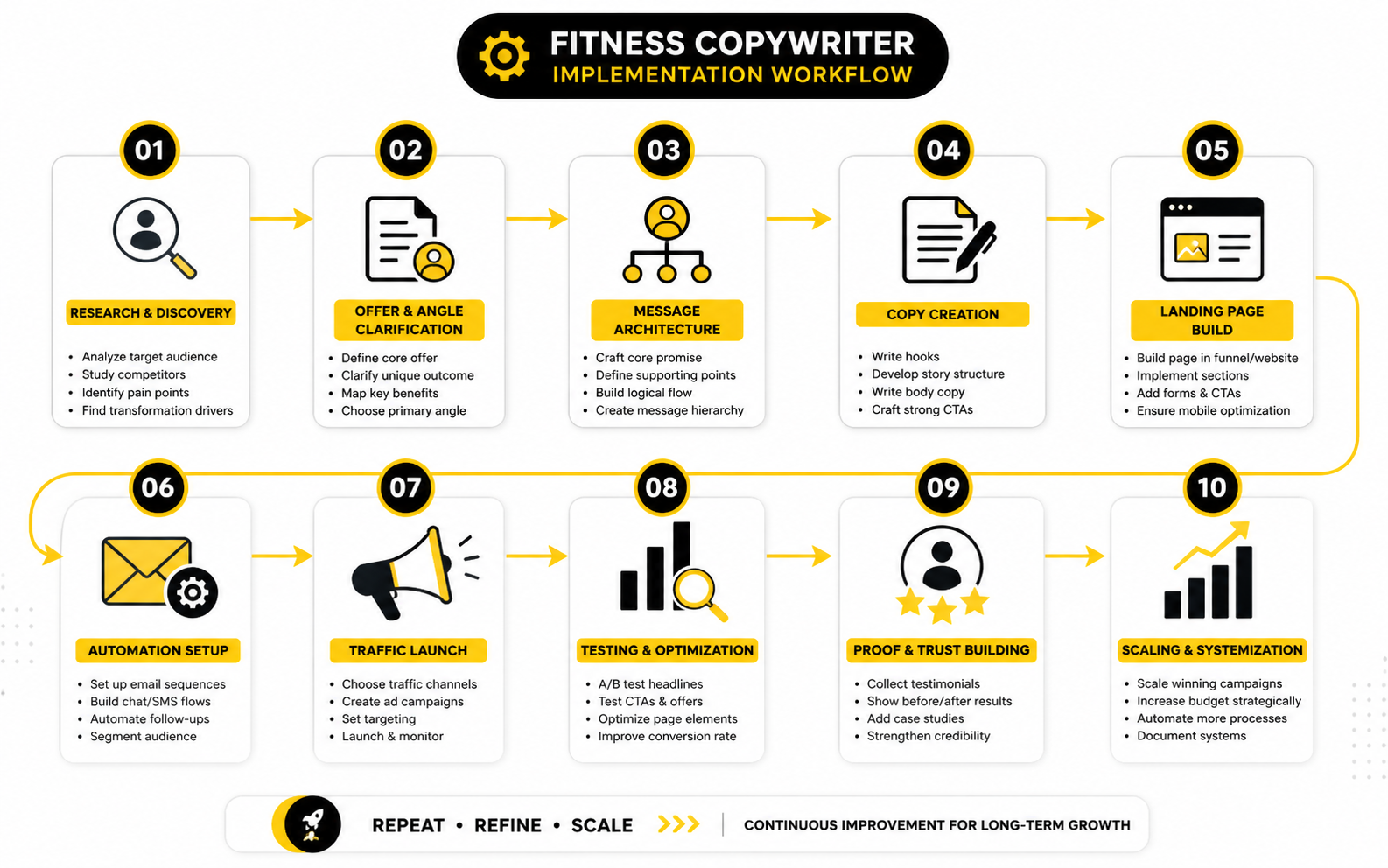
The process usually looks like this:
Gather customer language from reviews, surveys, intake forms, social comments, sales calls, support tickets, and competitor pages. Look for repeated frustrations, desired outcomes, objections, and phrases that sound emotionally specific. The goal is not to copy customers blindly, but to understand how they already describe the problem.
Decide who the offer is for, who it is not for, what category it belongs in, and why the brand’s approach is different. This should create a sharper angle than “online fitness coaching” or “personal training.” If the positioning is weak, every channel will feel harder to write.
List the deliverables, support, timeline, pricing logic, guarantee or risk reversal if available, onboarding flow, and expected buyer commitment. Then connect each feature to a buyer-facing benefit. This prevents the copy from becoming a boring list of inclusions.
Turn the positioning and offer into a clear promise, mechanism, proof angle, objection strategy, and call to action. This becomes the message spine for the campaign. Every asset should feel like it belongs to the same strategic argument.
Start with the copy closest to revenue, such as the sales page, application page, booking page, checkout flow, launch emails, or consultation script. Then adapt the message into ads, social posts, nurture emails, and retargeting copy. This keeps the campaign focused on conversion instead of content volume.
Check claims, testimonials, guarantees, before-and-after language, health references, and implied promises. The FTC’s health products guidance makes it clear that health-related claims need appropriate support, including claims communicated through advertising context or endorsements. Professional fitness copy should be persuasive without leaning on claims the brand cannot defend.
Track the actions that matter, such as landing page conversion rate, booked calls, show-up rate, email replies, checkout completion, trial starts, member retention, and lead quality. Then revise based on evidence instead of taste. The goal is not to write once and hope; it is to keep tightening the message until the market responds.
Match The Channel To The Decision
Not every fitness offer needs the same copy system. A low-ticket training plan may need a simple landing page, email follow-up, and social proof. A premium coaching program may need a deeper application page, nurture sequence, objection-handling emails, and a structured sales call flow.
The channel should match the level of commitment. The more expensive, personal, or outcome-driven the offer is, the more trust the copy must build before asking for action. A $19 workout plan can move fast, but a $3,000 coaching package needs more context, more proof, and a clearer explanation of fit.
This is why platforms matter, but they should not lead the strategy. Tools like GoHighLevel, ClickFunnels, Systeme.io, ManyChat, and Brevo can help fitness brands build pages, automations, messages, and follow-up systems. But the tool only amplifies the message you put into it. If the positioning is muddy, automation just spreads the mud faster.
Keep The Message Human Across Every Asset
The best fitness copy does not sound like a funnel template. It sounds like a coach who understands the reader’s life and knows exactly what step should come next. That is hard to fake because it requires the copywriter to understand both the business and the buyer.
This is why consistency matters. If the ad feels empathetic but the landing page turns aggressive, trust drops. If the sales page promises simplicity but the checkout flow is confusing, the buyer hesitates. If the emails talk about sustainable progress but the testimonials imply extreme results, the brand sends mixed signals.
A fitness copywriter’s job is to make the entire experience feel aligned. The words should help the buyer feel seen, informed, and confident enough to act. That is the framework in practice: research deeply, position clearly, explain the mechanism, prove responsibly, and guide the next step with zero unnecessary friction.
Statistics and Data
Measurement is where fitness copy stops being opinion and starts becoming a business asset. A fitness copywriter can have a strong instinct for hooks, objections, and calls to action, but the market gets the final vote. The numbers show whether the message is attracting the right people, creating enough trust, and moving prospects toward the next step.
The key is not to collect every metric. That creates dashboards nobody uses. The better approach is to track the few signals that reveal where the buyer journey is working, where it is leaking, and what the copy needs to fix next.
Fitness brands should be especially careful with benchmarks. A gym membership page, a high-ticket coaching application, a low-ticket workout plan, and a nutrition challenge can all produce very different numbers. Benchmarks give context, but the best comparison is always the brand’s own performance over time.
Start With The Business Outcome
The most important number is not the open rate, click-through rate, or social engagement rate. Those are useful, but they are not the business outcome. The real question is whether the copy is helping the brand generate qualified leads, booked calls, sales, trial starts, retained members, or profitable customers.
This matters because fitness marketing can look successful while quietly failing. A post can get attention from people who never buy. An email can get clicks from subscribers who are curious but not qualified. A landing page can convert leads at a high rate but send low-intent prospects into the sales process.
A fitness copywriter should connect copy performance to revenue quality, not vanity activity. That means looking beyond the first conversion and asking what happened afterward. Did the lead show up? Did the consultation close? Did the buyer stay? Did the campaign attract the kind of client the brand actually wants?
Use Benchmarks As Context, Not As Targets
Benchmarks are helpful when they stop a team from guessing. For example, if a fitness brand’s emails are getting a 12% open rate while the list is healthy and recent, that may point to a weak subject line, poor segmentation, deliverability issues, or an audience mismatch. But if the open rate is strong and sales are flat, the problem is probably deeper in the offer, page, or follow-up sequence.
Email benchmarks show why interpretation matters. MailerLite’s benchmark data lists health and fitness email open rates at 47.81%, while HubSpot’s benchmark roundup shows how much averages vary by platform, industry, and metric definition. A single number should never become the whole strategy.
Social metrics need the same caution. Dash Social’s 2025 fitness analysis found an average Instagram engagement rate of 0.54% for sports and fitness brands, but engagement alone does not tell you whether the audience wants the offer. A post that brings five qualified consult calls can be more valuable than a post that gets thousands of passive likes.
Track The Funnel In Stages
The cleanest way to measure fitness copy is to separate the funnel into stages. Each stage answers a different question. If the copywriter and brand mix everything together, they end up guessing which part of the message needs work.
Awareness metrics show whether the message earns attention from the right audience. Consideration metrics show whether the reader is interested enough to keep engaging. Conversion metrics show whether the offer, proof, and call to action are strong enough to move the buyer. Retention metrics show whether the promises made in the copy match the experience after purchase.
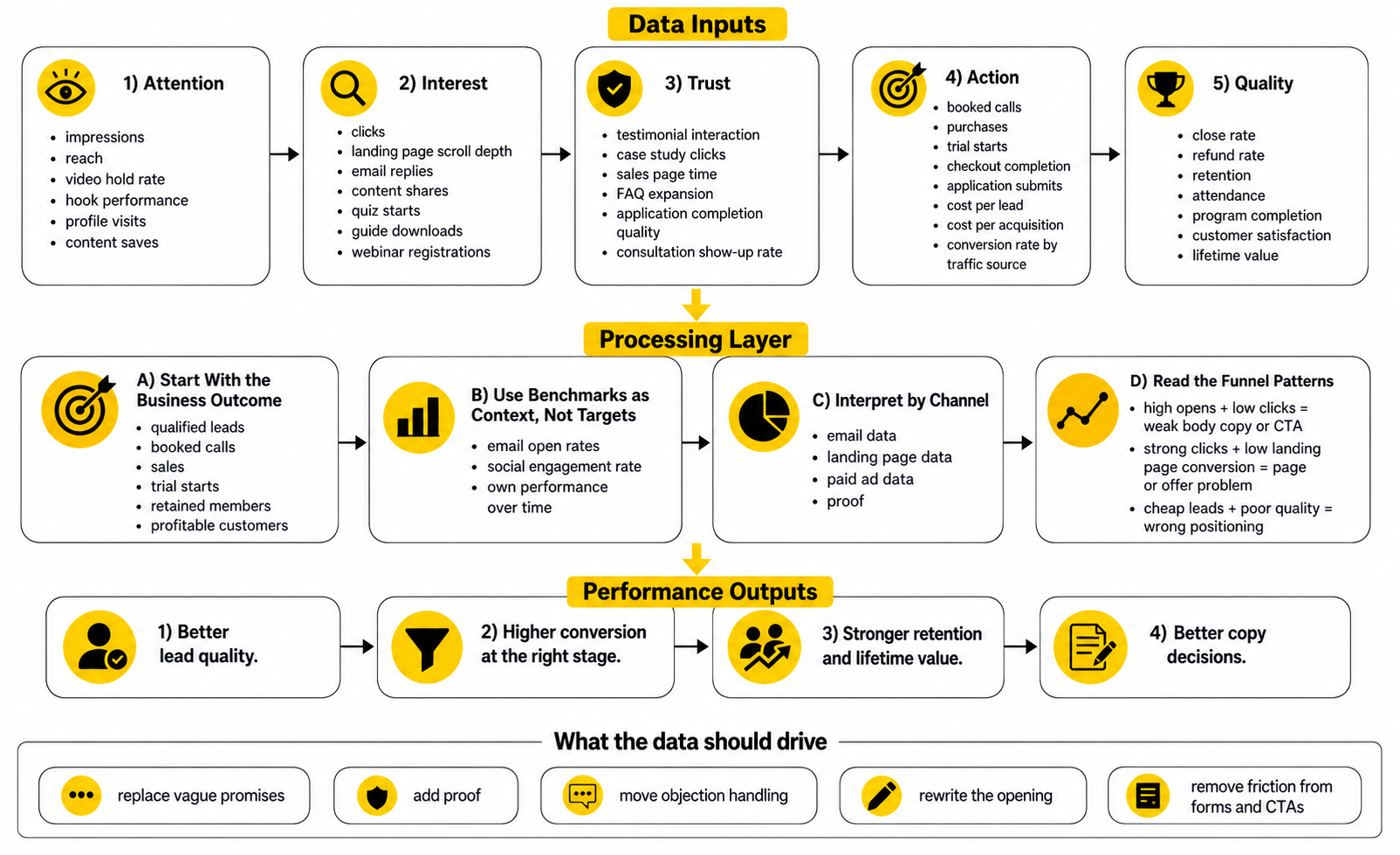
A practical analytics system can be simple:
Track impressions, reach, video hold rate, hook performance, profile visits, and content saves. These numbers show whether the topic and angle are strong enough to stop the right person. If attention is weak, the copy may need a clearer problem, stronger contrast, or a more specific audience angle.
Track clicks, landing page scroll depth, email replies, content shares, quiz starts, guide downloads, and webinar registrations. These numbers show whether the promise is relevant enough for the reader to spend more energy. If interest is weak, the message may be too broad or the next step may feel unclear.
Track testimonial interaction, case study clicks, sales page time, FAQ expansion, application completion quality, and consultation show-up rate. These numbers reveal whether the reader believes the brand can deliver. If trust is weak, the copy may need better proof, clearer expectations, or more transparent positioning.
Track booked calls, purchases, trial starts, checkout completion, application submits, cost per lead, cost per acquisition, and conversion rate by traffic source. These numbers show whether the copy can turn intent into movement. If action is weak, the problem may be the offer structure, the call to action, the price framing, or unresolved objections.
Track close rate, refund rate, retention, attendance, program completion, customer satisfaction, and lifetime value. These numbers protect the brand from optimizing for the wrong buyer. If quality is weak, the copy may be attracting people who are not ready, not qualified, or not aligned with the offer.
Read Email Data Like A Copywriter
Email is one of the easiest places to see how messaging performs because each step gives a signal. The subject line affects opens. The lead affects attention. The body copy affects belief. The call to action affects clicks. The landing page or booking page affects the final conversion.
But the numbers must be read together. A high open rate with low clicks usually means the subject line created curiosity but the email did not create enough desire or clarity. A lower open rate with strong sales may mean the email reached a smaller but more qualified segment. A high click rate with low purchases may mean the page or offer is not carrying the promise made in the email.
For fitness brands, segmentation often matters more than cleverness. Beginners, former clients, cold leads, active members, trial users, and high-ticket prospects should not always receive the same message. Tools like Brevo, Moosend, and GoHighLevel can help organize lists and automations, but the strategy still depends on saying the right thing to the right group.
Read Landing Page Data By Intent
Landing page data should be interpreted based on the type of page. A page for a free guide should convert differently from a page asking someone to apply for a premium coaching program. Treating those numbers the same leads to bad decisions.
For a low-friction page, low conversion may mean the promise is not clear, the form asks for too much, or the lead magnet does not feel useful. For a high-ticket application page, a lower conversion rate may be acceptable if the leads are better qualified and the sales team closes more of them. The goal is not always more leads. Sometimes the goal is fewer, better leads.
A fitness copywriter should look for behavior patterns. If people leave before the offer section, the top of the page is not building enough relevance. If they read the whole page but do not click, the objection handling or call to action may be weak. If they click but do not finish the form, the application step may feel too long, too vague, or too risky.
Read Paid Ad Data Without Panicking
Paid ads make copy problems visible quickly, but they can also create false panic. A campaign can fail because the hook is weak, the offer is unclear, the audience is wrong, the creative does not match the page, or the economics do not work. The ad copy is important, but it is not the only variable.
The first signal is usually click quality. If click-through rate is low, the angle may not be strong enough for the audience. If clicks are strong but landing page conversions are weak, the message may be overpromising in the ad or underexplaining on the page. If conversions are strong but customers are poor quality, the copy may be attracting bargain hunters, shortcut seekers, or people who are not ready for the program.
This is why message consistency matters. The ad, page, form, email follow-up, and sales call should feel like one argument. A tool like ClickFunnels, Systeme.io, or Replo can make funnel testing easier, but the real leverage comes from matching the promise to the buyer’s actual readiness.
Measure Proof, Not Just Promotion
Fitness brands often treat testimonials as decoration. That is a mistake. Proof is one of the most important parts of the buying decision, especially when the offer involves health, body composition, performance, confidence, or personal transformation.
The data to watch is not just whether a testimonial exists. Look at which proof gets clicked, which case studies support sales calls, which client outcomes reduce objections, and which claims create follow-up questions. A testimonial about losing weight may get attention, but a testimonial about staying consistent during a stressful work schedule may be more persuasive for a busy professional audience.
The copy should also keep proof responsible. The FTC’s guidance on endorsements makes it clear that testimonials and endorsements cannot be used to imply results that are not typical without proper context. For a fitness copywriter, that means proof should be specific, honest, and connected to the actual program experience instead of used as a shortcut around trust.
Turn Data Into Better Copy Decisions
Data only matters if it changes what the brand does next. If the analytics show people are clicking but not booking, revise the page or booking flow. If emails are opened but ignored, sharpen the body copy and call to action. If leads are cheap but unqualified, tighten the positioning and make the fit criteria clearer.
The best copy improvements are usually specific. Replace vague promises with concrete outcomes. Add proof where skepticism appears. Move the strongest objection handling closer to the call to action. Rewrite the opening section so the right buyer recognizes themselves faster. Remove friction from forms, buttons, and next-step instructions.
A fitness copywriter should not chase random lifts for the sake of looking busy. The goal is to learn what the market believes, doubts, ignores, and acts on. When the brand understands that, every new campaign gets sharper.
Professional Implementation Across Fitness Offers
Once the data is clear, the next challenge is execution at a higher level. This is where many fitness brands get stuck. They know the message needs to improve, they have some numbers to look at, and they may even have a decent funnel in place, but scaling the copy across offers, channels, and customer types creates new problems.
A fitness copywriter has to think beyond one sales page or one launch. The work becomes more strategic as the brand grows because every promise has consequences. The copy shapes who enters the business, what they expect, how they behave, and how much support the team needs to deliver the result.
That is why professional implementation is really about alignment. The offer, audience, proof, channel, sales process, and delivery experience need to support each other. When one part gets out of sync, the copy might still generate leads, but the business becomes harder to run.
Match The Copy To The Offer Model
Different fitness offers need different messaging depth. A low-ticket workout plan can sell with a simple promise, a clear preview, and a low-friction checkout. A premium transformation program needs more education, stronger proof, sharper qualification, and a better explanation of why the buyer should trust the process.
This is where lazy funnel copying breaks down. A template built for a $27 digital product will not automatically work for a $2,500 coaching offer. The buyer has more risk, more questions, and more emotional resistance. The copy has to slow down enough to build confidence without making the decision feel heavy.
A fitness copywriter should always ask what kind of commitment the offer requires. If the buyer has to change habits, show up live, track food, attend assessments, or speak with a coach, the copy must explain that commitment honestly. Selling the result while hiding the effort may improve short-term conversions, but it creates disappointed customers and weaker retention.
Decide When To Go Broad And When To Go Narrow
Broad messaging can help a fitness brand reach more people, but narrow messaging usually converts better. The tradeoff is simple. Broad copy creates more surface-level interest, while specific copy makes the right person feel personally addressed.
A local gym may need broader messaging because it serves many customer types in one area. An online coach with a specific method can usually afford to be narrower. A Pilates studio, strength coach, nutrition coach, running coach, or mobility expert should not all sound like “fitness for everyone.”
The strategic move is to separate brand-level messaging from campaign-level messaging. The brand can have a broad mission, but each campaign should speak to a specific situation, such as beginners who feel intimidated, busy professionals who need efficient training, or former athletes who want structure again. That gives the copy more emotional precision without trapping the whole business in one tiny niche.
Use Segmentation Before Personalization
Personalization sounds attractive, but many fitness brands try to personalize too early. They build complex automations before they have clear segments, enough data, or strong core messaging. The result is a messy system that sends slightly different versions of weak copy to everyone.
Segmentation is the cleaner first step. Group people by meaningful differences in intent, readiness, goals, and relationship to the brand. A new lead from a fat-loss guide should not receive the same sequence as a former client, a current trial member, or someone who has already booked a consultation.
The wellness market is moving toward more personalized expectations, especially among younger consumers. McKinsey’s 2025 wellness research describes a market where consumers differ widely by motivation, enthusiasm, and health behavior, with younger buyers playing an outsized role in wellness spending. That does not mean every fitness brand needs complicated AI personalization on day one. It means the copy should recognize that different buyers need different paths to trust.
Protect Credibility When Using AI
AI can help a fitness copywriter move faster, but it should not replace judgment. Fitness copy touches health-adjacent topics, personal goals, sensitive insecurities, and sometimes medical-adjacent claims. That makes careless AI output risky.
The biggest danger is confidence without evidence. AI can make unsupported claims sound polished, invent overly specific benefits, or turn a cautious offer into something that sounds medically stronger than it is. A professional workflow needs human review for claims, testimonials, audience sensitivity, and brand voice.
The smart use of AI is operational. It can help summarize customer research, organize objections, generate first-pass variations, repurpose approved messaging, or draft routine follow-up emails. But the final message still needs a human fitness copywriter who understands persuasion, ethics, and the actual delivery model behind the offer.
Scale The Message Without Diluting It
As fitness brands grow, more people touch the copy. The founder writes posts, the media buyer writes ad angles, the email marketer writes campaigns, the sales team handles calls, and the coaches talk to clients every day. Without a shared message system, everything slowly drifts.
That drift is expensive. Ads promise one thing, the sales page emphasizes another, and the onboarding experience introduces a third version of the offer. Buyers feel that inconsistency even if they cannot explain it. It makes the brand feel less confident.
The fix is a practical message library. This should include the core promise, audience descriptions, approved claims, proof points, objection responses, offer explanations, banned language, tone examples, and common calls to action. A message library is not bureaucracy. It keeps growth from turning the brand into a pile of disconnected campaigns.
Handle Before-And-After Proof Carefully
Before-and-after proof is powerful in fitness because it makes change visible. It can also become a credibility problem if it is used carelessly. The more dramatic the result, the more context the copy needs.
A responsible fitness copywriter should avoid implying that one client’s outcome is the standard result for everyone. The copy should make clear what the program involved, what support was provided, what the client did, and what a typical buyer should realistically expect. This is especially important when the claim touches weight loss, body composition, health markers, pain, or performance.
The FTC’s guidance on health-related advertising and endorsements makes this a serious issue, not a style preference. Testimonials, expert endorsements, and implied claims all need to be handled in a way that does not mislead the consumer. Clean copy can still be persuasive. It just has to earn belief instead of borrowing it from the most extreme result.
Build Sales Enablement Into The Copy System
For higher-ticket fitness offers, the copy does not stop at the application page. The sales call, follow-up message, consultation reminder, no-show sequence, and post-call recap all carry the same strategic load. If those pieces are weak, the campaign leaks revenue after the lead is already earned.
A fitness copywriter can support the sales process by turning common objections into clear assets. That might include a pre-call email that explains what to expect, a short page that clarifies program fit, a follow-up sequence for people who need time, or a post-call message that summarizes the decision. None of this needs to feel pushy.
The goal is to reduce uncertainty. The buyer should understand the next step, the cost of waiting, the commitment required, and the reason the program fits their situation. When sales enablement is done well, the conversation feels calmer because the copy has already handled many of the confusing parts.
Know When Automation Helps And When It Hurts
Automation is useful when the buyer journey is predictable. It can help fitness brands follow up faster, segment leads, remind prospects to book, deliver onboarding messages, and recover missed opportunities. That is why tools like GoHighLevel, ManyChat, ClickFunnels, and Systeme.io can be useful once the message is clear.
But automation becomes harmful when it replaces real thinking. If the buyer receives too many messages, generic reminders, or pressure-heavy follow-ups, the brand starts to feel mechanical. Fitness is personal. The copy has to respect that.
The best automated sequences feel like helpful guidance, not a trap. They remind the reader why they showed interest, answer the next likely question, and make it easy to act when ready. If the automation would annoy a good-fit buyer, the copy needs to be rewritten.
Balance Performance With Brand Trust
Performance marketing rewards fast feedback. Brand trust rewards consistency over time. Fitness brands need both, but the tension can be real.
A hard-hitting ad angle may generate cheap leads, but it can also attract the wrong people or weaken the brand’s reputation. A softer brand message may feel more aligned, but it may not create enough action. The job is not to choose one forever. The job is to test directness without sacrificing trust.
A strong fitness copywriter knows how to create urgency without humiliation, aspiration without fantasy, and specificity without overclaiming. That balance matters because the best fitness customers are not just transactions. They become members, referrals, repeat buyers, case studies, and long-term proof that the brand delivers.
Prepare The Copy For Operational Reality
Great copy should increase demand, but the business has to be able to handle that demand. If a campaign fills the calendar with unqualified calls, overwhelms coaches, or creates expectations the program cannot meet, the copy has created a new problem. More leads are not always better.
Before scaling, the brand should check the operational side. Can the team respond quickly? Can onboarding support the promise? Can coaches deliver the level of personalization described on the page? Can the offer handle more clients without lowering quality?
This is where expert-level copywriting becomes business strategy. The words should not only sell what sounds attractive. They should sell what the brand can consistently deliver. That is how copy becomes an asset instead of a liability.
Measurement, Hiring, and FAQ
A strong fitness copywriter does not just write better campaigns. They help build a messaging system the business can actually run. By this point, the work should connect audience research, offer clarity, funnel structure, ethical proof, performance data, and operational reality into one practical growth engine.
That system matters because fitness brands are selling into a market where demand is growing, but trust is not automatic. The 2025 Health & Fitness Association Global Report reported 6% year-over-year membership growth, 8% average revenue growth, and nearly 4% facility growth across comparable markets. More demand brings more competition, and more competition makes clear messaging more valuable.
The final step is knowing what to do with that message system. Brands need to decide when to hire, what to look for, how to judge the work, and how to avoid the common mistakes that make fitness copy sound either too generic or too aggressive. The goal is not perfect copy. The goal is copy that is clear, credible, measurable, and aligned with the offer being delivered.
What To Look For In A Fitness Copywriter
The best fitness copywriter is not just someone who likes training or knows how to write punchy hooks. They need to understand buying psychology, health-related claim sensitivity, funnel structure, and the realities of selling fitness outcomes. That combination is rare, which is why hiring based only on writing samples can be misleading.
Look for someone who asks strategic questions before writing. They should want to understand the audience, offer, proof, delivery model, sales process, past campaign data, objections, and compliance boundaries. If they jump straight into headlines without asking about the business, that is a warning sign.
Also look for someone who can write in different levels of intensity. Fitness copy sometimes needs energy, but it also needs restraint. A good copywriter can make a beginner feel safe, make a high-ticket buyer feel confident, and make a skeptical reader feel respected without turning the message into hype.
How To Judge The Work
Judging copy by whether the founder likes it is not enough. Preference matters, but the market response matters more. The copy should be judged by how clearly it explains the offer, how well it reflects the customer’s real language, and how effectively it moves the reader to the next step.
That does not mean every piece of copy needs to produce an instant sale. Awareness content, nurture emails, sales pages, ads, and onboarding messages all do different jobs. A fitness copywriter should be able to explain the purpose of each asset and what signal should be tracked after it goes live.
Good copy also creates fewer bad-fit conversations. If a sales team keeps talking to people who cannot afford the program, do not understand the commitment, or expected a shortcut, the copy may be attracting the wrong demand. Strong messaging should increase both conversion and fit.
Common Mistakes To Avoid
The first mistake is making the copy too generic. Phrases like “reach your goals,” “transform your body,” and “get stronger than ever” can work only when the rest of the message adds specificity. Without context, they sound like every other fitness brand online.
The second mistake is overusing urgency. Scarcity can be legitimate, especially for cohorts, limited coaching capacity, or launch windows. But fake urgency trains the audience not to trust the brand, and trust is harder to rebuild than attention.
The third mistake is treating testimonials as a substitute for strategy. Proof helps, but it cannot fix a vague offer or unclear audience. The copy still needs a sharp promise, a believable mechanism, and a clear next step.
The fourth mistake is ignoring compliance until the end. Health, weight loss, performance, recovery, and body composition claims should be reviewed before campaigns go live. The FTC’s health products compliance guidance emphasizes that health-related benefit and safety claims should be truthful, not misleading, and supported by appropriate evidence.
The Final System
A complete fitness copy system is not complicated, but it is disciplined. It starts with the buyer’s real situation, connects the offer to a clear outcome, explains the mechanism, supports the promise with responsible proof, and guides the reader toward one practical action. Then it measures what happens and improves from there.
The best systems also stay consistent across channels. The ad should not promise one thing, the landing page another, the sales call another, and the onboarding experience something else entirely. When every touchpoint supports the same argument, the buyer feels more confident.
This is where the work compounds. A clear message improves ads, emails, pages, sales calls, onboarding, referrals, and retention. That is why a strong fitness copywriter becomes more than a vendor. They become part of the growth infrastructure.
What does a fitness copywriter do?
A fitness copywriter writes and improves marketing copy for fitness, wellness, coaching, gym, health, and training brands. Their work can include sales pages, ads, websites, landing pages, emails, social captions, lead magnets, sales scripts, onboarding messages, and retention campaigns. The goal is to turn the brand’s offer into clear, persuasive, responsible messaging that helps the right buyer take action.
How is a fitness copywriter different from a general copywriter?
A general copywriter may understand persuasion, but a fitness copywriter needs to understand the specific trust issues inside fitness marketing. Fitness buyers often bring past failures, body image concerns, health fears, skepticism, and confusion into the decision. The copy has to sell while staying credible, sensitive, and grounded in what the offer can actually deliver.
Do fitness brands really need specialized copywriting?
Not every fitness brand needs a specialist immediately, but specialized copywriting becomes more valuable as the offer becomes more competitive, premium, or outcome-driven. A simple local class may only need clear basic messaging, while an online coaching program, transformation offer, or multi-location brand usually needs a sharper strategy. The more the business depends on digital trust, the more the copy matters.
What should a fitness copywriter know before writing?
They should understand the target audience, the offer structure, the pricing, the delivery model, the proof available, the common objections, and the main conversion goal. They should also review past campaign data when it exists. Without that context, the copy will usually sound polished but shallow.
What makes fitness copy convert better?
Fitness copy converts better when it is specific, believable, and easy to act on. The reader should quickly understand who the offer is for, what problem it solves, how the method works, what kind of support they receive, and what the next step is. Strong proof, clear positioning, and honest expectation-setting usually matter more than clever wording.
Can a fitness copywriter help with ads?
Yes, a fitness copywriter can help with ad angles, hooks, body copy, calls to action, creative briefs, landing page alignment, and retargeting messages. Ads work better when they are connected to the full funnel instead of written as isolated attention-grabbers. The ad should create the right expectation before the prospect reaches the page.
Can a fitness copywriter help with email marketing?
Yes, email is one of the strongest channels for fitness copy because it supports education, trust-building, segmentation, launches, reactivation, and sales follow-up. A copywriter can write welcome sequences, nurture campaigns, challenge emails, abandoned checkout emails, consultation follow-ups, and member retention messages. Tools like Brevo, Moosend, and GoHighLevel can support the system, but the message still has to be strong.
What metrics should fitness copywriting track?
The most useful metrics depend on the funnel, but common signals include booked calls, application quality, sales page conversion rate, checkout completion, email replies, click-through rate, show-up rate, close rate, trial starts, retention, refund rate, and lifetime value. Engagement metrics can help, but they should not be treated as the final goal. The best copy attracts people who are likely to buy, benefit, and stay.
How long does it take to see results from fitness copywriting?
Some changes can show results quickly, especially subject lines, ad hooks, calls to action, and landing page clarity. Bigger messaging changes may take longer because they affect positioning, traffic quality, sales conversations, and retention. The smartest approach is to measure one stage at a time so the brand knows what improved and why.
What should fitness brands avoid in their copy?
Fitness brands should avoid exaggerated health claims, fake urgency, vague transformation promises, unsupported before-and-after implications, and messaging that shames the reader. They should also avoid copying competitor funnels without understanding the strategy behind them. Fitness copy works best when it is direct, specific, and respectful.
Should fitness copy include before-and-after photos?
Before-and-after proof can be useful, but it needs context. The copy should not imply that one dramatic result is typical for every buyer unless the brand can support that claim properly. Responsible proof explains the program, the client’s effort, and the realistic range of outcomes instead of relying on shock value.
What is the best funnel for a fitness brand?
There is no single best funnel for every fitness brand. A low-ticket program may need a simple landing page and checkout flow, while a premium coaching offer may need an application page, email nurture, booking flow, sales call, and follow-up sequence. Platforms like ClickFunnels, Systeme.io, and Replo can help build the infrastructure, but the funnel should follow the buyer’s decision process.
How can a fitness copywriter support a personal trainer?
A fitness copywriter can help a personal trainer clarify their niche, improve their website, create stronger consultation pages, write lead magnets, build email follow-up, and turn client results into responsible proof. They can also help the trainer sound more professional without losing personality. That is especially useful when the trainer wants to move beyond referrals and build a more predictable pipeline.
How can a fitness copywriter support a gym or studio?
For gyms and studios, a fitness copywriter can improve membership pages, class descriptions, local landing pages, trial offers, email campaigns, seasonal promotions, referral campaigns, and new member onboarding. The copy should make the gym feel approachable, differentiated, and easy to join. Local fitness buyers often need practical clarity as much as inspiration.
Is AI enough for fitness copywriting?
AI can help with drafts, research organization, repurposing, and idea generation, but it is not enough on its own for serious fitness copywriting. The risk is that AI can create confident claims that are not properly supported or messaging that sounds generic. A human copywriter still needs to review the strategy, claims, tone, proof, and business fit.
Build a stronger local presence with BAAM AI
Turn your website, Google profile, social channels, and AI visibility into one growth engine
Most businesses do not need more random marketing activity. They need a consistent presence system that helps the right people find them, trust them, and take action. BAAM AI brings strategy, local SEO, website updates, Google Maps visibility, social content, AI-search readiness, media production, and reporting into one practical monthly engine.
If you want your marketing to keep working after the campaign ends, start with a free BAAM AI presence audit. See how your business shows up today and where the fastest visibility wins are at BAAM AI.