
BAAM AI Blog
Facebook Advertising Consultant: The Practical Guide To Strategy, Creative, Tracking, And Profitable Scaling
Hiring a facebook advertising consultant is not about finding someone who can “run ads.” That is the easy part. The real value is getting someone who can diagnose why the account is not producing profitable growth...

Hiring a facebook advertising consultant is not about finding someone who can “run ads.” That is the easy part. The real value is getting someone who can diagnose why the account is not producing profitable growth, rebuild the decision-making system behind the campaigns, and connect Meta ads to the offer, funnel, sales process, tracking setup, and customer economics.
That matters because Facebook advertising has become more automated, more competitive, and less forgiving. Meta reported that ad impressions across its Family of Apps increased while the average price per ad also rose in 2025, which means advertisers are not just competing on bids; they are competing on creative quality, conversion paths, offer clarity, and data discipline through a bigger auction environment documented in Meta’s full-year 2025 results. The broader market is moving the same way, with digital advertising revenue reaching nearly $300 billion in 2025 and social media advertising reaching $117.7 billion in the IAB Internet Advertising Revenue Report.
The mistake many businesses make is treating a consultant like a button-pusher. They expect a few campaign tweaks, a new audience stack, and maybe a better-looking ad. A serious consultant does something much more valuable: they identify the bottleneck between attention and revenue, then build a system that can keep improving after the first round of campaigns goes live.
This guide breaks that system down in a practical way. It is written for founders, marketing leads, ecommerce operators, agencies, coaches, local businesses, and service providers who want to understand what a Facebook advertising consultant should actually do. It will also help you avoid the expensive trap of hiring someone who knows the Ads Manager interface but does not understand growth.
Why A Facebook Advertising Consultant Matters
A good Facebook advertising consultant helps you make better commercial decisions, not just better campaign decisions. That distinction is important because weak ad performance is often a symptom of a deeper issue. The problem might be the offer, the landing page, the checkout flow, the lead follow-up process, the sales script, or the way success is being measured.
Meta’s own advertising ecosystem is now heavily shaped by automation, including Advantage+ campaign and creative tools that use AI to help match ads to people and optimize delivery in real time through products like Meta Advantage+. That does not remove the need for strategy. It actually raises the bar, because the machine needs strong inputs: clear conversion events, enough creative variation, clean tracking, realistic budgets, and a funnel that can turn traffic into revenue.
This is where consulting becomes different from basic media buying. A media buyer may focus mainly on campaign setup and optimization. A facebook advertising consultant should look at the full growth loop: who you are targeting, why the offer should matter, what promise the creative makes, what happens after the click, how leads are followed up, and whether the numbers support scaling.
The stakes are higher now because social ads are no longer a cheap shortcut. Benchmark reports such as WordStream’s 2025 Facebook ads benchmarks show wide differences in cost per click, click-through rate, conversion rate, and cost per lead by industry, which makes “average performance” a dangerous target if your margins, offer, or sales cycle are different from the businesses in the benchmark set. A consultant’s job is not to chase generic averages; it is to build a model that makes sense for your economics.
The Facebook Advertising Consultant Framework
A reliable consulting engagement should follow a framework, not a pile of random tactics. The framework should begin with diagnosis, move into strategy, continue through implementation, and then improve through controlled testing. Without that structure, the account becomes reactive: one week the problem is audiences, the next week it is creative, then tracking, then budget, then the algorithm.
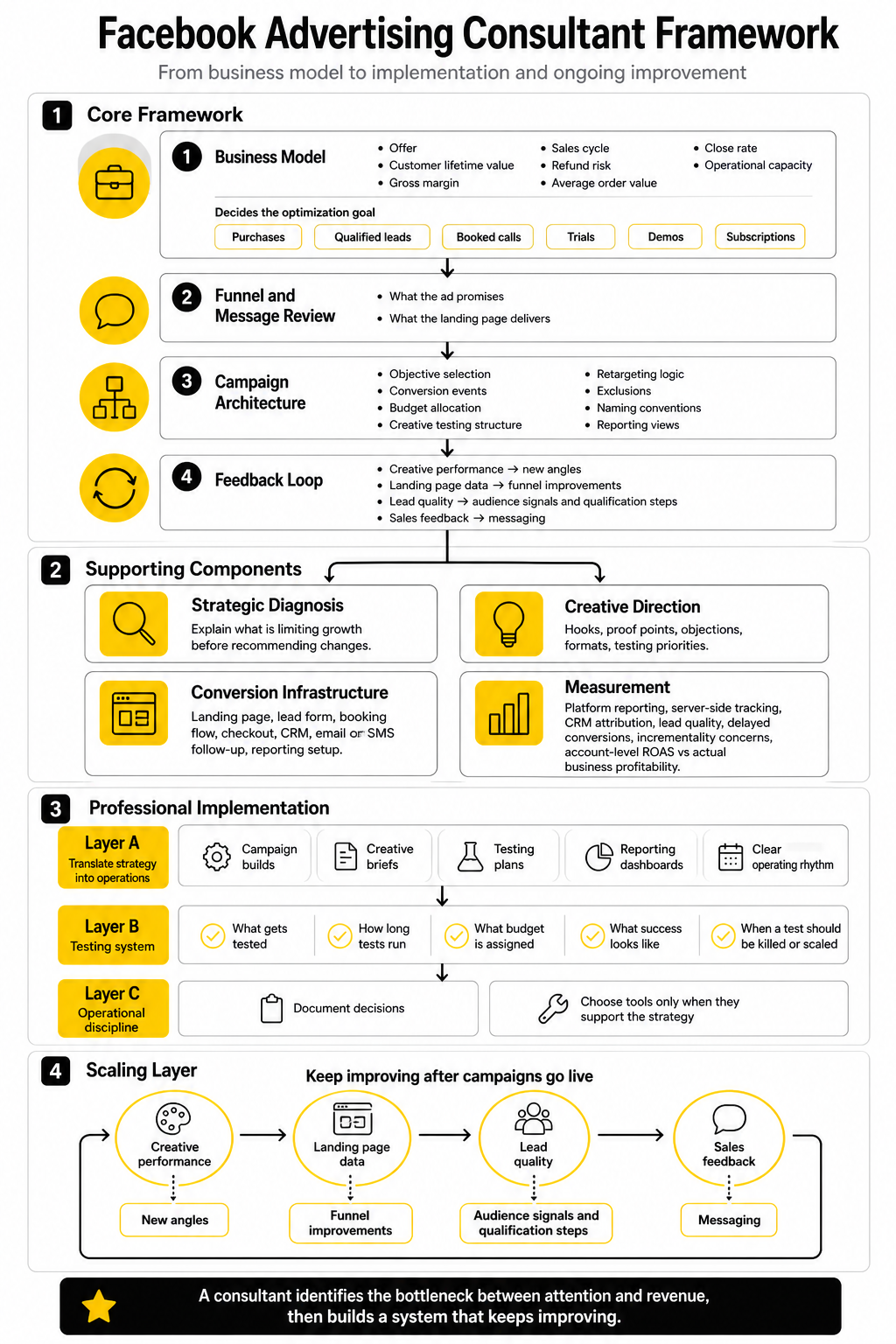
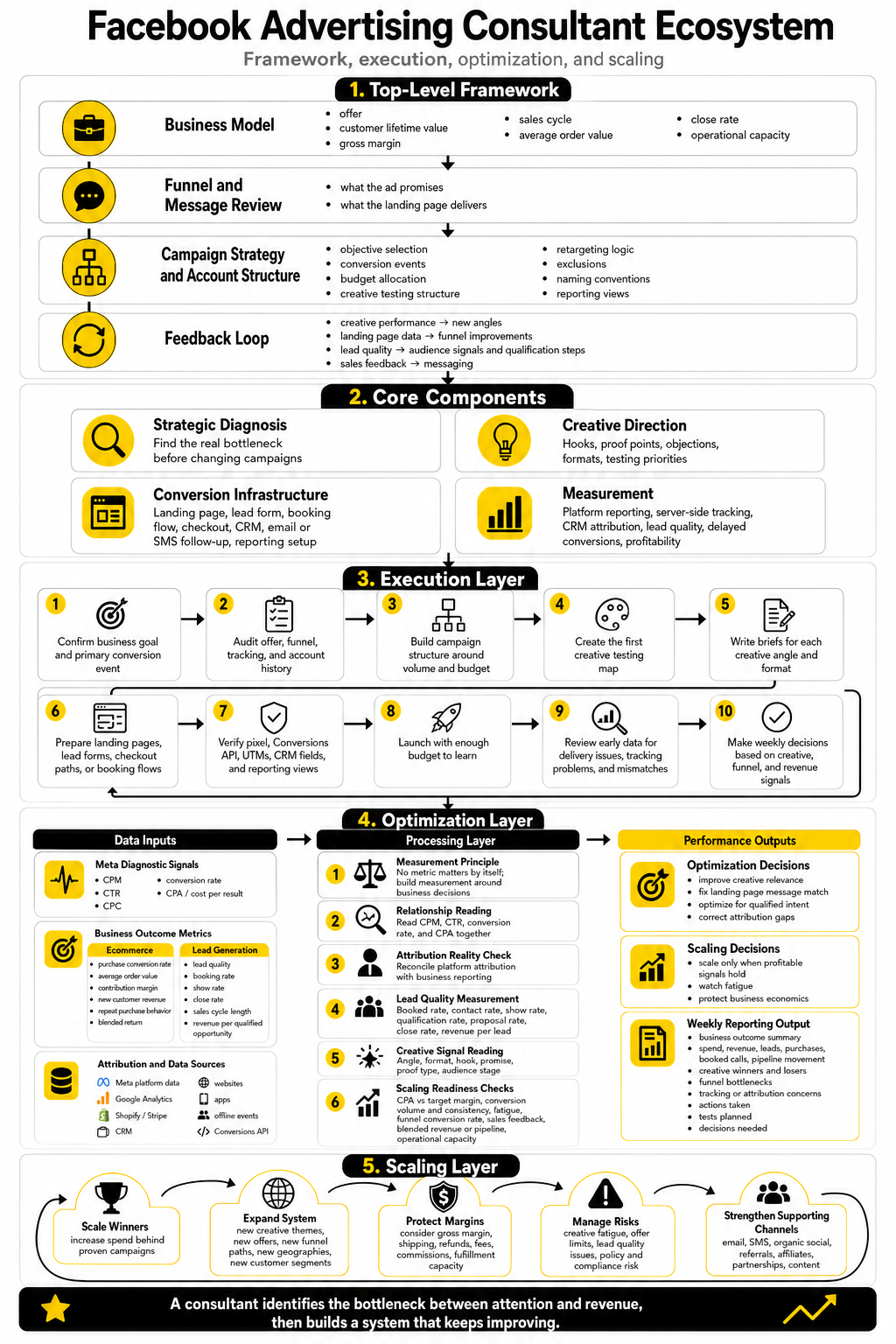
The framework starts with the business model. Before touching campaigns, the consultant needs to understand the offer, customer lifetime value, gross margin, sales cycle, refund risk, average order value, close rate, and operational capacity. This is how they decide whether the account should optimize for purchases, qualified leads, booked calls, trials, demos, subscriptions, or another measurable business outcome.
Next comes the funnel and message review. The consultant should look at what the ad promises and what the landing page delivers. If the ad creates curiosity but the page creates confusion, performance will suffer even if the campaign settings are technically correct.
Then comes campaign architecture. This includes objective selection, conversion events, budget allocation, creative testing structure, retargeting logic, exclusions, naming conventions, and reporting views. The goal is not to make the account complicated; the goal is to make it readable enough that decisions can be made quickly.
Finally, the framework needs a feedback loop. Creative performance should influence new angles. Landing page data should influence funnel improvements. Lead quality should influence audience signals and qualification steps. Sales feedback should influence messaging. That loop is where the consultant earns their fee.
Core Components Of A Strong Consulting Engagement
The first core component is strategic diagnosis. A consultant should be able to explain what is limiting growth before recommending what to change. If they jump straight into “we need more creatives” or “we need a new campaign structure” without reviewing the business context, they may be solving the wrong problem.
The second component is creative direction. Meta’s delivery system can help find buyers, but it cannot invent a compelling reason for people to care. The consultant should help define the hooks, proof points, objections, formats, and testing priorities that make creative production more focused.
The third component is conversion infrastructure. This includes the landing page, lead form, booking flow, checkout, CRM, email or SMS follow-up, and reporting setup. For example, a business using Messenger or Instagram DM automation may naturally consider ManyChat when the ad strategy depends on fast conversational follow-up rather than a traditional landing page.
The fourth component is measurement. You cannot scale responsibly if you do not trust the numbers. A consultant should understand platform reporting, server-side tracking, CRM attribution, lead quality, delayed conversions, incrementality concerns, and the difference between account-level ROAS and actual business profitability.
Professional Implementation
Professional implementation is where strategy becomes operational. This is the stage where the consultant turns the diagnosis into campaign builds, creative briefs, testing plans, reporting dashboards, and a clear operating rhythm. The work should feel organized, because messy implementation creates messy data.
The best consultants usually create simple systems that teams can actually use. They define what gets tested, how long tests run, what budget is assigned, what success looks like, and when a test should be killed or scaled. They also document decisions so the account does not depend on memory, vibes, or scattered Slack messages.
Implementation also requires choosing the right supporting tools without turning the business into a software junk drawer. A service business may need a CRM and follow-up engine such as GoHighLevel. An ecommerce brand may care more about landing page speed, offer testing, and post-click conversion paths. A consultant should recommend tools only when they support the strategy, not because the tool is trendy.
The next part will move deeper into the first real layer of the framework: diagnosing the market, offer, and funnel before spending more money on campaigns.
Market, Offer, And Funnel Diagnosis
Before a facebook advertising consultant touches campaign settings, they should understand the market you are trying to win. This means looking at the customer’s awareness level, buying urgency, alternatives, objections, price sensitivity, and the reason someone would act now instead of later. If that work gets skipped, the ads may generate activity, but the account will still feel unpredictable because the strategy is not grounded in buyer behavior.
The best consultants do not start with “which audience should we target?” They start with “why would this person care enough to click, trust enough to convert, and feel enough urgency to buy?” That question forces the strategy to move beyond surface-level demographics and into real demand.
This is especially important because Meta’s targeting system has become more automated. Tools such as Meta Advantage+ campaign setup can help apply AI across campaign delivery, but automation does not fix a weak offer. It can distribute your message more efficiently, but it cannot make an unclear promise suddenly compelling.
Understanding The Buyer Before Building Campaigns
A consultant should identify what the buyer already believes before the ad appears. Someone who has never heard of the problem needs a different message from someone comparing providers. Someone who has been burned by a bad agency, course, supplement, software tool, or local service needs proof and risk reduction before they need another bold claim.
This is where many accounts break. The business writes ads from its own point of view instead of the buyer’s point of view. The ad talks about features, credentials, discounts, or “limited-time offers,” while the customer is quietly asking whether this will actually solve the problem without creating a new one.
A strong facebook advertising consultant translates the buyer’s internal conversation into ad angles. They look for the tension behind the purchase: frustration, delay, wasted money, fear of choosing wrong, desire for status, need for speed, or pressure from a team. Once that tension is clear, creative testing becomes much sharper because every ad is built around a real reason to pay attention.
Diagnosing The Offer
The offer is not just the product. It is the full reason someone should say yes now. That includes the promise, price, guarantee, proof, urgency, delivery mechanism, bonuses, onboarding, and perceived risk.
A consultant should pressure-test the offer before increasing spend. If the offer is too broad, the ad has nothing specific to sell. If the offer is too complex, the landing page has to work too hard. If the offer is too similar to competitors, the business ends up paying more just to be considered.
This is where the consultant should ask uncomfortable but useful questions:
Those questions are not theoretical. They decide how much the business can afford to pay for attention. If the average order value is low, the funnel may need upsells, bundles, subscriptions, or repeat-purchase strategy. If the lead value is high but the close rate is weak, the problem may not be the ads at all.
Reviewing The Funnel Like A Consultant
A funnel review should follow the customer’s journey from first impression to final conversion. The consultant should look at the ad, landing page, form, checkout, calendar, email sequence, SMS flow, sales call, and CRM pipeline. Each step either increases confidence or creates friction.
For lead generation businesses, the gap after the form is often the expensive part. Leads come in, but follow-up is slow, inconsistent, or too generic. In that situation, better ads may only create more missed opportunities, which is why a CRM and automation platform such as GoHighLevel can make sense when the business needs faster lead routing, reminders, pipeline tracking, and follow-up workflows.
For ecommerce and direct-response offers, the landing page and checkout path matter more. The consultant should review page speed, message match, product proof, offer clarity, mobile layout, checkout friction, shipping expectations, and trust signals. If the page does not continue the promise made in the ad, the campaign will leak money no matter how good the targeting looks.
For creators, coaches, course sellers, and info-product businesses, the funnel may need a cleaner bridge between curiosity and commitment. A simple opt-in page, webinar page, challenge funnel, or application funnel can work well when the offer needs education before the sale. Tools like ClickFunnels or Systeme.io can fit when the priority is launching and testing funnel paths without turning every change into a development project.
Campaign Strategy And Account Structure
Once the market, offer, and funnel are clear, the consultant can design the campaign strategy. This is where many businesses expect magic, but the real goal is simple: create an account structure that produces clean learning. If the structure is too fragmented, every ad set gets too little data. If it is too broad without enough creative direction, the algorithm has freedom but weak inputs.
A facebook advertising consultant should choose campaign objectives based on business outcomes, not vanity metrics. Traffic campaigns may look cheap but often attract low-intent clicks. Engagement campaigns can be useful in specific situations, but they should not be mistaken for a sales system. If the business needs purchases, qualified leads, calls, trials, or demos, the campaign objective and conversion event should reflect that as closely as possible.
Meta’s own documentation around Conversions API highlights the role of server-side event sharing in measuring ad performance across the customer journey. That matters because the campaign structure is only as useful as the signal quality behind it. If the wrong event is being optimized, the system may get better at finding the wrong people.
Choosing The Right Campaign Objective
Objective selection should begin with the action that creates business value. For ecommerce, that usually means purchases, add-to-cart events, or checkout events depending on volume and account maturity. For service businesses, it may mean qualified leads, booked calls, or completed applications.
The consultant should avoid optimizing too high in the funnel unless there is a clear reason. Optimizing for landing page views when the real goal is booked appointments can create a false sense of progress. The cost per click may look attractive, but the sales team may still be left with weak leads.
That does not mean every campaign must optimize for the final sale from day one. Smaller accounts sometimes need a practical bridge event when purchase or qualified lead volume is too low. The key is to use that bridge intentionally and move closer to the true business outcome as data improves.
Keeping The Account Simple Enough To Learn
A clean account structure is usually better than a clever one. Too many campaigns, ad sets, exclusions, lookalikes, interests, and retargeting layers can make the account look sophisticated while making the data almost useless. The consultant should build a structure that makes performance easier to read, not harder.
In many modern Meta accounts, broader targeting with stronger creative testing is more useful than obsessing over tiny interest stacks. This does not mean targeting is irrelevant. It means the consultant should know when targeting is doing real strategic work and when it is just adding noise.
A practical structure might separate prospecting, retargeting, and retention where the economics justify it. It might also consolidate campaigns when volume is too low. The right setup depends on spend level, conversion volume, product range, sales cycle, and how much creative testing the team can realistically support.
Budget Allocation And Testing Discipline
Budget allocation should match the stage of the account. A new or unstable account needs learning budget, not reckless scaling. A proven account needs enough budget behind winners to test whether performance holds at higher volume.
A consultant should define what each budget is supposed to do. Some spend is for finding winning messages. Some spend is for scaling proven campaigns. Some spend is for retargeting people who already showed intent. Mixing those purposes together makes it harder to know whether the account is improving or just getting lucky.
Testing discipline is what keeps the budget from turning into chaos. Each test should have a clear hypothesis, enough spend to be meaningful, and a decision rule before it starts. If every underperforming ad gets replaced after one bad day, the account never learns. If every test runs forever, the account gets bloated and slow.
Creative Strategy Starts Before Production
Creative is not just design. It is the argument your ad makes in the feed. A consultant who understands creative strategy can help the business decide which angles deserve production before the team spends time filming, editing, designing, or writing.
This matters because Meta’s automation performs best when it has strong creative variety. The system can test combinations and delivery paths, but the raw material still comes from human insight. Weak hooks, vague benefits, generic testimonials, and recycled competitor angles will not become powerful just because the campaign is automated.
The consultant should turn the market diagnosis into a creative testing map. That map should include pain-point angles, outcome angles, proof angles, comparison angles, objection-handling angles, founder-led angles, demonstration angles, and urgency angles. The point is not to produce random volume. The point is to produce enough strategic variety that the account can discover what the market actually responds to.
Creative Strategy, Testing, And Messaging
Creative strategy becomes serious when the consultant stops asking, “What ads should we make?” and starts asking, “What belief must change before someone buys?” That one shift improves the entire process. It forces every hook, visual, headline, and call to action to serve a real commercial purpose.
A facebook advertising consultant should build creative around buying psychology, not random inspiration. Some ads need to make the problem feel urgent. Some need to demonstrate the product. Some need to reduce risk. Some need to show proof. Some need to create contrast between the old way and the better way.
Meta’s own creative tools now lean heavily into automated variation, with Advantage+ creative helping generate and enhance ad variations across image, video, and carousel formats. That is useful, but it does not replace strategic direction. The tool can create variations, but the consultant still needs to decide which messages are worth varying in the first place.
Building A Creative Testing Map
A creative testing map keeps production focused. Without one, the team makes ads based on whatever feels interesting that week. That usually leads to scattered tests, repeated angles, and no clear learning.
The map should separate creative ideas by purpose. A pain-led ad tests whether the market strongly recognizes the problem. A proof-led ad tests whether credibility is the missing ingredient. A comparison ad tests whether people need help understanding why this option is different. A demonstration ad tests whether showing the product or process creates more trust than explaining it.
A practical map might include:
The consultant should not treat every creative test as equal. Some tests are about finding a winning message. Others are about finding a winning format. Others are about improving conversion quality. If those goals are mixed together, the results become harder to interpret.
Writing Ads That Sound Like People
The best Facebook ads rarely sound like ads. They sound like someone clearly naming a problem, showing a better path, or making a useful promise. That does not mean the copy should be casual for the sake of it. It means the message should be easy to understand without sounding like it came from a template.
A consultant should help the business remove vague language. Words like “transform,” “build,” “improve,” and “scale” can work in the right context, but they often hide weak thinking. Strong copy usually names the problem more precisely and makes the next step feel obvious.
This is where customer language matters. Sales calls, reviews, support tickets, comments, surveys, and live chat logs often reveal the exact phrases customers use when they describe the problem. A consultant who mines that language can make ads feel more relevant without forcing the primary keyword or stuffing the copy with awkward phrases.
Matching Creative To Funnel Stage
Not every ad should sell in the same way. A cold audience may need a sharp hook and simple proof. A warm audience may need objection handling. A returning visitor may need urgency, reassurance, or a clearer offer.
This is why creative strategy should connect directly to funnel stage. Prospecting creative should earn attention and qualify interest. Retargeting creative should remove hesitation. Retention creative should increase repeat purchases, referrals, upgrades, or cross-sells.
A consultant should also understand when retargeting is too narrow to matter. Small accounts often build complex retargeting campaigns before they have enough traffic to support them. In that case, broader creative testing usually creates more value than building tiny audience segments that barely spend.
Tracking, Attribution, And Data Quality
Tracking is not glamorous, but it decides whether the account can be trusted. If the data is broken, every optimization decision becomes shaky. The consultant may think they are scaling winners when they are actually scaling noise.
A facebook advertising consultant should audit the pixel, events, domain verification, Aggregated Event Measurement, Conversions API, CRM data, UTMs, landing page analytics, and sales reporting. This does not mean every consultant has to be a full-stack developer. It does mean they should know what clean measurement looks like and when to bring in technical support.
Meta’s Conversions API documentation explains server-side event sharing as a way for advertisers to send marketing data from servers, websites, apps, CRMs, or offline sources to Meta. That matters because browser-only tracking can miss signals, duplicate events, or lose visibility as privacy controls and platform restrictions change.
The Tracking Audit
A tracking audit should begin with the events that matter most. For ecommerce, that may be ViewContent, AddToCart, InitiateCheckout, Purchase, and subscription or repeat-purchase signals where relevant. For lead generation, it may include Lead, CompleteRegistration, Schedule, QualifiedLead, Opportunity, or custom CRM milestones.
The consultant should confirm whether events are firing at the right time. A lead event should not fire when someone lands on a form. A purchase event should not fire before payment is completed. A booked call event should not fire when someone merely clicks the calendar button.
The audit should also check deduplication between browser and server events. If the same conversion is counted twice, performance can look better than reality. If conversions are undercounted, campaigns may struggle to optimize because Meta receives weaker feedback.
Attribution Without Self-Deception
Attribution should help decisions, not create fantasy. Meta may claim credit for conversions based on its attribution window, while analytics platforms, ecommerce dashboards, and CRM reports may tell a different story. The consultant’s job is to reconcile those views enough to make practical decisions.
This is where blended metrics become useful. For ecommerce, media efficiency ratio, contribution margin, new customer revenue, repeat purchase rate, and total store revenue can matter more than platform ROAS alone. For lead generation, booked calls, show rate, close rate, sales cycle length, and revenue per lead often matter more than cost per lead.
Benchmark data can be helpful, but it should never become the strategy. WordStream’s 2025 benchmark analysis covers CTR, CPC, conversion rate, and cost per lead across more than 1,000 Facebook campaigns, while LocaliQ’s 2025 benchmark report shows an average lead campaign conversion rate of 7.72% across industries. Those numbers can help frame expectations, but your own economics decide whether performance is good.
CRM And Offline Conversion Feedback
For service businesses, B2B companies, local businesses, agencies, and high-ticket offers, the conversion often happens after the Meta lead event. Someone fills out a form, books a call, speaks with sales, receives a proposal, follows up, and maybe buys days or weeks later. If Meta only sees the first lead, optimization can drift toward cheap leads instead of qualified buyers.
A consultant should close that loop wherever possible. That may involve passing qualified lead, booked appointment, opportunity, or closed-won data back into the reporting system. It may also involve cleaning up lead statuses inside the CRM so sales feedback becomes usable instead of anecdotal.
This is one reason a platform like GoHighLevel can be useful for businesses that need pipeline visibility, appointment tracking, automated follow-up, and sales-stage reporting in one place. The tool is not the strategy. But when the business depends on lead quality and follow-up speed, the consultant needs a way to see what happens after the form fill.
Professional Implementation And Tool Stack
Professional implementation is the difference between a good plan and a campaign system that actually runs. The consultant needs to turn strategy into assets, settings, workflows, naming conventions, tracking checks, reporting views, and a weekly decision cadence. This is where the process becomes tangible.
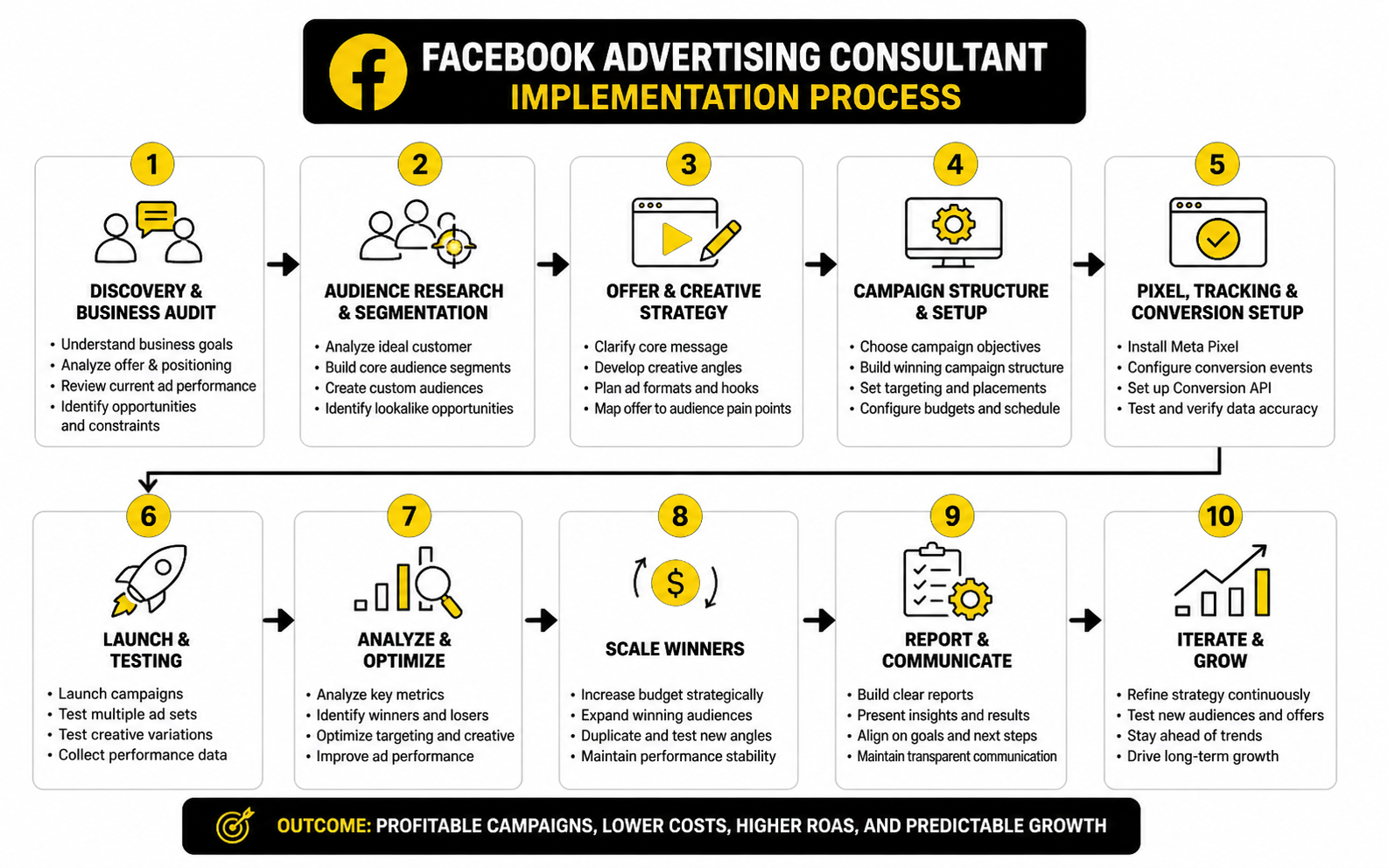
The implementation process should feel boring in the best possible way. Everyone should know what is being launched, why it is being launched, what result would count as success, and who owns each next step. If the process depends on scattered messages, undocumented decisions, and last-minute creative uploads, the account will eventually become messy.
A clean implementation process usually follows this sequence:
Tool Selection Should Follow The Strategy
A consultant should not recommend tools just to look sophisticated. Every tool should solve a specific bottleneck. If the bottleneck is creative production, the tool stack will look different from a business struggling with lead follow-up or funnel conversion.
For ecommerce landing page testing, a dedicated builder such as Replo can fit when the team needs more control over post-click pages without waiting on long development cycles. For list building and email follow-up, platforms such as Brevo or Moosend may make sense when the revenue path depends on nurturing people after the first conversion.
For appointment-led funnels, the booking experience matters because friction kills momentum. A scheduling tool like Cal.com can be useful when the campaign goal is to turn intent into a scheduled conversation quickly. For conversational campaigns, ManyChat can fit when Messenger or Instagram DM automation is part of the follow-up strategy.
The First 30 Days Of Implementation
The first 30 days should not be treated as a magic profit window. It is the period where the consultant validates assumptions, fixes tracking gaps, launches the first structured tests, and identifies which bottlenecks are real. Sometimes the bottleneck is obvious within a week. Sometimes it takes a few testing cycles to separate weak creative from weak funnel economics.
In the first week, the consultant should focus on access, audit, measurement, and planning. That includes reviewing account history, naming conventions, conversion events, landing pages, CRM stages, current creative, audience setup, and reporting gaps. It also includes making sure the team understands what is being measured and why.
In weeks two and three, the first structured campaign and creative tests should go live. The consultant should watch for delivery problems, event mismatches, poor message match, creative fatigue, low-quality leads, or strange conversion patterns. This is not the time for emotional daily changes unless something is clearly broken.
By week four, the consultant should be able to explain what has been learned. The answer may not be “we found the winning ad.” A better answer might be “proof-led creative is producing better lead quality,” “the landing page is losing mobile traffic,” “the offer needs stronger risk reversal,” or “Meta is optimizing toward cheap form fills instead of qualified opportunities.” That kind of clarity is valuable because it tells the business what to fix next.
Statistics And Data
Data should make a Facebook ads account easier to manage, not harder to understand. The problem is that most dashboards show too many numbers and not enough meaning. A facebook advertising consultant has to separate performance signals from noise so the business knows what to fix, what to scale, and what to ignore.
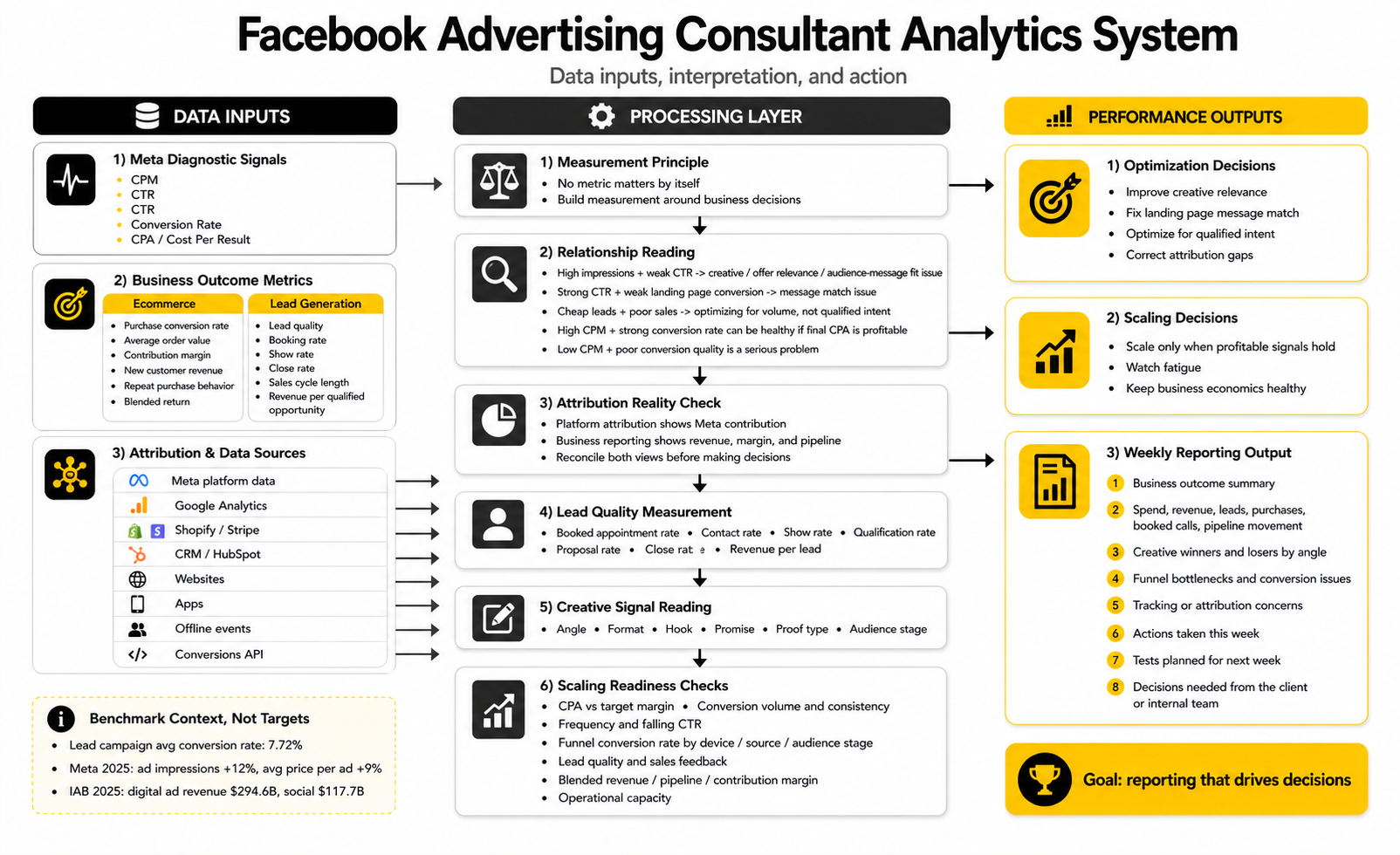
The first rule is simple: no metric matters by itself. A low cost per click can still produce terrible leads. A high click-through rate can still attract the wrong people. A strong platform ROAS can still hide weak margins, high refunds, low repeat purchase behavior, or a sales team that is quietly rejecting most of the leads.
This is why a consultant should build a measurement system around business decisions. The dashboard should not just answer “what happened?” It should answer “what should we do next?” That is the difference between reporting and management.
The Metrics That Actually Matter
The most important numbers depend on the business model. An ecommerce brand needs to understand purchase conversion rate, average order value, contribution margin, new customer revenue, repeat purchase behavior, and blended return across all paid channels. A lead generation business needs to understand lead quality, booking rate, show rate, close rate, sales cycle length, and revenue per qualified opportunity.
Meta-side metrics still matter, but they should be treated as diagnostic signals. CPM shows how expensive it is to enter the auction. CTR shows whether the creative earns enough attention. CPC shows the cost of that attention. Conversion rate shows whether the click path is doing its job. CPA or cost per result shows whether the action is being acquired within a viable range.
The mistake is using one number as the whole story. If CPM rises while CTR also rises and conversion rate improves, the account may still be healthy. If CPC drops because the ad is attracting low-intent curiosity clicks, performance may look better while the business gets worse. A consultant should interpret these relationships, not just paste screenshots into a report.
Benchmarks Are Context, Not Targets
Benchmarks are useful because they show what is normal in the market. They are dangerous because they can make teams chase averages that have nothing to do with their economics. A local dentist, a SaaS company, a Shopify brand, and a high-ticket coaching funnel should not evaluate Facebook ads with the same target CPA.
The 2025 benchmark data from WordStream shows that the average conversion rate for Facebook lead campaigns across industries was 7.72%, down from the previous year’s average. LocaliQ’s 2025 Facebook ads benchmark analysis reports the same 7.72% average lead campaign conversion rate, which is useful context for lead generation accounts but still not a final performance target.
The broader market also explains why efficiency pressure is increasing. Meta reported that ad impressions across its Family of Apps increased by 12% for full-year 2025 while the average price per ad increased by 9% in Meta’s full-year 2025 results. The IAB’s 2025 internet advertising report put total U.S. digital ad revenue near $294.6 billion, with social media advertising reaching $117.7 billion. More competition does not mean Facebook ads are dead. It means sloppy measurement gets expensive faster.
Reading The Funnel From The Numbers
A good consultant reads the funnel like a diagnostic map. If impressions are high but CTR is weak, the issue may be creative, offer relevance, or audience-message fit. If CTR is strong but landing page conversion is weak, the click promise and page experience may not match. If leads are cheap but sales are poor, the campaign may be optimizing toward volume instead of qualified intent.
This is where the data becomes practical. The consultant should not simply say, “CPL is up.” They should explain whether the increase came from auction pressure, weaker creative engagement, lower page conversion, tracking changes, or a shift in lead quality. Each cause requires a different action.
For example, a high CPM with a strong conversion rate may not be a problem if the final CPA is profitable. A low CPM with poor conversion quality may be a serious problem because the account is finding cheap attention from people who will never buy. The consultant’s job is to connect each number to the next decision.
Attribution Needs A Reality Check
Attribution is where many Facebook ads conversations become emotional. Meta may show conversions that Google Analytics, Shopify, Stripe, HubSpot, or a CRM does not attribute the same way. That does not automatically mean one platform is lying. It usually means each system is using different rules, windows, identifiers, and conversion logic.
A facebook advertising consultant should explain this clearly. Platform attribution is useful for understanding how Meta sees campaign contribution. Business reporting is useful for understanding whether revenue, margin, and pipeline are actually improving. Both views matter, but neither should be accepted blindly.
Meta’s Conversions API documentation is important here because server-side event sharing can improve the quality of conversion signals sent from websites, apps, CRMs, and offline systems. Meta also documents offline event sharing through Conversions API, which matters for businesses where revenue happens after a call, appointment, store visit, or sales process. Better data does not make attribution perfect, but it gives the consultant a more reliable foundation for optimization.
Lead Quality Beats Cheap Leads
Cheap leads are seductive because they make the dashboard look calm. The sales team knows the truth faster than the ads manager does. If leads do not answer, do not qualify, do not show up, or cannot afford the offer, the cost per lead is not a win.
A consultant should measure lead quality as close to revenue as possible. That can include booked appointment rate, contact rate, show rate, qualification rate, proposal rate, close rate, and revenue per lead. If the account only optimizes for the first form submission, Meta may learn how to find people who fill forms, not people who buy.
This is where CRM structure matters. A business using GoHighLevel can track pipeline stages, follow-up activity, appointments, and opportunities when the lead-to-sale process is central to profitability. The consultant still needs to interpret the data, but the system has to capture what happens after the click.
Creative Signals Tell You What The Market Believes
Creative performance is not just about which ad “won.” It tells you what the market believes, doubts, wants, and ignores. A strong hook with weak conversion can mean the topic is interesting but the offer is not convincing enough. A lower CTR with stronger sales can mean the ad is filtering better and attracting fewer but more serious buyers.
The consultant should read creative data by angle, format, hook, promise, proof type, and audience stage. One winning video does not mean “make more videos.” It may mean a specific objection was handled well, a specific demonstration created trust, or a specific outcome mattered more than the brand expected.
This is why creative reporting should include qualitative notes. The account needs to know which messages are creating qualified intent, not just which thumbnails got clicks. Over time, that learning should shape future ads, landing pages, emails, sales scripts, and offer positioning.
Budgeting, Optimization, And Scaling
Scaling should not mean increasing spend because one campaign had two good days. That is gambling dressed up as marketing. A consultant should scale when the account has enough evidence that performance is stable, tracking is clean, the funnel can handle more volume, and the business economics still work at a higher spend level.
There are two basic ways to scale: increase spend behind proven winners or expand the system with new creative, new offers, new funnel paths, new geographies, or new customer segments. The first is simpler, but it can hit fatigue quickly. The second is more durable, but it requires stronger process.
A serious facebook advertising consultant will usually watch these signals before scaling:
Scaling also requires emotional discipline. Some volatility is normal, especially when budgets change or new creative enters the account. The consultant should know when to let the system learn and when to intervene because the data points to a real issue.
Reporting That Drives Decisions
Reporting should be short enough that people actually read it and clear enough that decisions get made. A bloated report with 40 screenshots is not strategy. It is usually a sign that the consultant is trying to look busy instead of being useful.
A strong weekly report should explain what changed, why it likely changed, what was learned, what is being tested next, and what decision the business needs to make. It should include the key numbers, but the numbers should support the recommendation. The point is not to admire the dashboard. The point is to improve the account.
A practical reporting rhythm might include:
That rhythm keeps everyone aligned. The consultant is not just reporting performance after the fact. They are using the data to guide the next round of creative, funnel, budget, and sales decisions.
Advanced Strategy, Tradeoffs, And Scaling Risks
At this stage, the work becomes less about launching campaigns and more about managing tradeoffs. Every serious Facebook ads account eventually reaches the point where simple fixes stop being enough. The consultant has to decide whether the next growth lever is more budget, better creative, a stronger funnel, higher conversion quality, a different offer, or a wider acquisition strategy.
That is where experience matters. A beginner sees a rising CPA and panics. A strong facebook advertising consultant asks what changed underneath the number. Did auction costs rise, did creative fatigue set in, did the funnel conversion rate drop, did lead quality improve, did tracking change, or did the business simply reach the edge of its current offer-market fit?
The best decisions usually come from understanding the constraint. If the constraint is creative fatigue, more budget makes the problem worse. If the constraint is funnel conversion, new audiences will not fix the leak. If the constraint is sales follow-up, cheaper leads only create more wasted conversations.
Automation Creates Leverage, But It Also Reduces Control
Meta’s ad system is increasingly built around automation. Advantage+ tools can help with delivery, creative variation, audience expansion, and campaign simplification, and Meta’s own developer documentation describes Advantage+ creative as a way to automatically create multiple ad variations from supported formats. That can be powerful when the account has enough signal and enough strong creative inputs.
The tradeoff is that automation can make the account feel less transparent. You may not always know exactly why a certain audience pocket, placement, or creative variation receives more spend. That is not automatically bad. It just means the consultant needs stronger guardrails around measurement, creative strategy, and business outcomes.
The wrong reaction is to fight automation with unnecessary complexity. The better reaction is to control the inputs that still matter: offer, creative angles, conversion event quality, landing page experience, budget pacing, exclusion logic where needed, and downstream revenue feedback. That is where a consultant can still create a serious edge.
Scaling Requires More Than A Bigger Budget
Many businesses think scaling means increasing the budget by 20% every few days until something breaks. Sometimes that works for a while. But durable scaling usually needs a wider system, not just a higher daily spend.
The consultant should know which type of scale the account is ready for. Vertical scaling means putting more money behind what already works. Horizontal scaling means introducing new creative themes, new funnel paths, new products, new geographies, new customer segments, or new conversion mechanisms. Both can work, but they create different risks.
Vertical scaling can expose audience saturation and creative fatigue quickly. Horizontal scaling can create operational complexity and slower learning if too many variables are introduced at once. The consultant’s job is to choose the next move based on evidence, not ego.
The Margin Problem Most Advertisers Ignore
A campaign can look profitable inside Ads Manager and still be weak inside the business. This happens when the account focuses on revenue but ignores gross margin, shipping costs, refunds, payment fees, discounts, support load, sales commissions, and fulfillment capacity. Platform ROAS is only useful if it connects to real profit.
For ecommerce, the consultant should understand contribution margin before recommending aggressive scaling. A 3.0 ROAS may be excellent for a high-margin digital product and terrible for a low-margin physical product with expensive shipping. For lead generation, a low cost per lead may be worthless if the close rate or average deal size cannot support acquisition costs.
This is why the consultant should ask for real business numbers early. Not to be intrusive, but to avoid optimizing toward the wrong finish line. If the target CPA is built on hope instead of economics, the account will eventually collide with reality.
Creative Fatigue Is A System Problem
Creative fatigue is not just an ad problem. It is a production system problem. If the account depends on one winning ad, one founder video, one testimonial format, or one discount angle, performance will eventually decay.
The consultant should build a creative pipeline before fatigue becomes urgent. That pipeline should include new hooks, new proofs, new formats, new objections, new demonstrations, and new ways of framing the same offer. It should also include a process for turning performance data into the next round of production.
This is especially important because the auction keeps getting more competitive. Meta reported that full-year 2025 ad impressions rose 12% while the average price per ad rose 9% in its 2025 annual results. When attention gets more expensive, creative quality becomes a financial lever, not a branding accessory.
The Offer May Need To Change
Sometimes the painful truth is that the ads are fine and the offer is the ceiling. The market may not want the current promise enough. The price may feel wrong. The guarantee may not reduce enough risk. The bonus stack may distract instead of persuade. The onboarding path may create friction.
A good facebook advertising consultant should be willing to say this. Not every performance problem should be solved inside the ad account. In many cases, the next breakthrough comes from a clearer offer, a better entry product, a stronger bundle, a better lead magnet, a more useful webinar, or a more believable proof mechanism.
For businesses that sell through funnels, this is where fast page and offer iteration can matter. A tool such as ClickFunnels or Systeme.io can be useful when the team needs to test opt-ins, offers, upsells, or application flows without waiting weeks for development work. The important point is not the tool itself. The important point is that the offer and funnel must be testable.
Lead Quality Problems Need Sales Feedback
For service businesses, lead quality is often the make-or-break issue. The ads can generate leads all day, but the business still loses if the leads are unqualified, unreachable, unmotivated, or too early in the buying process. This is where the consultant needs feedback from sales, not just campaign metrics.
The sales team should report which leads were contacted, which booked, which showed up, which were qualified, which received an offer, and which closed. Without that feedback, the consultant is optimizing with half the map missing. Meta may see a conversion, but the business sees whether that conversion was worth anything.
This also means follow-up speed matters. If a lead waits hours or days before hearing from the business, the ad account may get blamed for a process problem. A CRM and automation setup such as GoHighLevel can help when the business needs faster routing, reminders, appointment workflows, and pipeline visibility.
Compliance And Policy Risk Cannot Be An Afterthought
Facebook advertising has rules, and ignoring them is not a growth strategy. Some industries face stricter requirements around claims, personal attributes, financial products, housing, employment, credit, health, politics, and sensitive topics. A consultant should know when an account needs careful copy, careful targeting, and careful landing page review before launch.
Policy risk is not only about ads getting rejected. Repeated violations can slow down launches, disrupt testing, limit account trust, or create business interruptions at the worst possible time. A consultant should build campaigns that can scale without depending on exaggerated claims, misleading urgency, or aggressive personal-attribute language.
This matters even more when businesses use AI tools to produce creative quickly. Faster production is useful, but faster production without review creates risk. The consultant should keep the creative process practical, but they should also make sure speed does not become sloppiness.
When To Expand Beyond Facebook Ads
Facebook ads can be a powerful acquisition channel, but they should not carry the entire business forever. A consultant should know when Meta is the right primary growth engine and when the business needs supporting channels. Email, SMS, search, organic social, referrals, affiliates, partnerships, content, retargeting, and sales enablement can all make Facebook ads more profitable.
The point is not to dilute focus. The point is to improve the economics around paid traffic. If email follow-up increases conversion rate, Facebook ads become easier to scale. If organic content creates trust before the click, paid creative can work harder. If a referral program increases lifetime value, the business can afford a higher acquisition cost.
For social scheduling and content distribution, a tool like Buffer can fit when the team wants a more consistent organic layer around paid campaigns. For email and customer communication, Brevo or Moosend can make sense when the real profit comes from nurturing, repeat purchases, or long sales cycles.
When A Consultant Should Say No
A serious consultant should not accept every account. Some businesses are not ready for paid traffic. The offer may be unproven, the margins may be too thin, the budget may be too small, the landing page may be unfinished, or the team may be unwilling to fix the real bottleneck.
That honesty protects both sides. If the business needs product-market fit work, sales process cleanup, better proof, or basic funnel infrastructure, running ads harder will not solve the issue. It will just reveal the issue faster and more expensively.
A good facebook advertising consultant should be confident enough to say, “This is not an ads problem yet.” That answer may be uncomfortable, but it is far more valuable than pretending a campaign structure can fix a business model problem.
How To Hire The Right Facebook Advertising Consultant
Hiring the right consultant is not about finding the loudest person with the biggest screenshots. It is about finding someone who can think clearly, diagnose honestly, and build a system that connects ad spend to business outcomes. A polished pitch means very little if the consultant cannot explain how they make decisions when performance moves up or down.
A strong facebook advertising consultant should be able to talk about strategy, creative, tracking, funnel conversion, budget pacing, and reporting without hiding behind jargon. They should also be comfortable saying what they do not handle. That is a good sign, not a weakness, because serious implementation often involves designers, copywriters, developers, CRM specialists, sales teams, and founders working together.
The best hiring process is practical. Give the consultant enough context to evaluate the business, then listen to the quality of their questions. If they ask only about budget and access, be careful. If they ask about margins, conversion events, sales process, creative capacity, offer history, lead quality, and reporting gaps, you are probably speaking with someone who understands the full machine.
Questions To Ask Before You Hire
The right questions reveal how the consultant thinks. You are not looking for perfect rehearsed answers. You are looking for clarity, judgment, and the ability to connect campaign decisions to business reality.
Ask questions like:
That last question matters. A consultant who is willing to turn down a bad-fit account is more trustworthy than someone who says every business is “one campaign away” from growth. Paid traffic is powerful, but it is not magic.
What A Strong Proposal Should Include
A professional proposal should be more than a price and a promise. It should explain what the consultant will audit, what they will build, what they will manage, how communication works, and how success will be measured. It should also clarify what is outside the scope so expectations do not become messy later.
The proposal should connect the work to your business model. An ecommerce proposal should not look identical to a lead generation proposal. A local service business with a phone sales process needs different reporting than a subscription brand with repeat purchases. A consultant who uses the same plan for every client is not consulting; they are applying a template.
Look for specifics around:
The proposal does not need to be long to be good. It needs to be clear. You should understand exactly what happens in the first month, what decisions will be made, and what the consultant needs from you to make the engagement work.
Red Flags To Avoid
Be careful with anyone who guarantees results without understanding your economics. Be careful with anyone who talks only about hacks, secret targeting, or hidden settings. Be careful with anyone who refuses to discuss tracking, creative, offer quality, landing pages, or the sales process.
Another red flag is overcomplication. Some consultants make accounts look advanced by adding too many campaigns, audiences, exclusions, and rules. Complexity can be useful when it solves a real problem, but unnecessary complexity usually creates confusion and weak data.
Also be careful with consultants who cannot explain poor performance calmly. Every ad account has rough periods. The question is whether the consultant can identify the likely cause, propose a practical next step, and communicate clearly without blame, panic, or vague optimism.
Common Mistakes To Avoid
The biggest mistake is hiring a consultant too late, after the business has already burned budget on scattered tests and broken tracking. A good consultant can still help, but cleanup takes time. It is better to build the system correctly before scaling spend.
Another mistake is expecting the consultant to fix everything alone. Facebook ads touch the offer, website, creative, analytics, CRM, email, sales, and fulfillment. If the rest of the team is slow, defensive, or unwilling to improve the funnel, the consultant’s impact will be limited.
The final mistake is treating ads as a replacement for strategy. Meta can help you reach people. It cannot make your offer compelling, your proof believable, your follow-up consistent, or your margins healthy. A consultant can guide those improvements, but the business still has to execute.
Mistake 1: Optimizing For Cheap Traffic
Cheap traffic feels good because the numbers look efficient at the top of the funnel. But cheap clicks do not pay invoices. If the traffic does not convert into qualified leads, purchases, booked calls, or repeat customers, the campaign is only buying activity.
A consultant should push the business away from vanity metrics when they distract from revenue. CPC and CTR matter, but only as diagnostic signals. The real question is whether the account is acquiring the right people at a cost the business can support.
Mistake 2: Changing Too Many Things At Once
Fast action is useful. Random action is not. If the team changes the campaign objective, budget, landing page, creative, offer, and tracking setup all at the same time, nobody knows what caused the result.
Good testing isolates the variable as much as practical. That does not mean the process has to move slowly. It means the consultant should know what is being tested and what decision the test is supposed to support.
Mistake 3: Ignoring The Post-Click Experience
The ad gets the click, but the funnel earns the conversion. If the landing page is slow, unclear, generic, or disconnected from the ad, performance will suffer. If the form asks too much too early, lead volume can drop. If it asks too little, lead quality can collapse.
A consultant should review the full post-click path before blaming the ad account. For some teams, that means improving a sales page. For others, it means rebuilding a lead form, application flow, booking page, or checkout path. When the funnel improves, the same ad spend often works harder.
Mistake 4: Treating AI As A Strategy
AI can help with creative variation, reporting, copy drafts, audience expansion, and operational speed. But AI does not replace positioning, judgment, or customer understanding. If the core offer is weak, faster production simply creates more weak assets.
Meta’s own Advantage+ creative tools can generate and enhance ad variations, which is useful when the strategy is clear. The consultant still needs to choose the right message, review the output, protect brand quality, and connect creative learnings back to the funnel.
Mistake 5: Forgetting Policy And Trust
Compliance is not a boring legal detail. It affects whether campaigns launch, whether ads stay live, and whether the account can scale without sudden disruption. Meta’s Advertising Standards explain the kinds of ad content allowed and prohibited across its technologies, and the platform also restricts ads that imply sensitive personal attributes.
A consultant should understand those rules before pushing aggressive copy into the account. This is especially important in finance, health, employment, housing, politics, personal improvement, and other sensitive categories. Strong advertising does not need misleading claims or uncomfortable personal callouts to work.
What does a facebook advertising consultant do?
A facebook advertising consultant helps a business plan, diagnose, launch, measure, and improve Facebook and Instagram advertising campaigns. The role usually goes beyond campaign setup because profitable ads depend on the offer, funnel, creative, tracking, budget, and sales process. A good consultant helps the business understand what is limiting growth and what should be fixed next.
How is a Facebook advertising consultant different from a media buyer?
A media buyer usually focuses on campaign execution inside Ads Manager. A consultant should look at the wider system, including market positioning, funnel conversion, creative strategy, attribution, CRM feedback, and business economics. Some people do both roles well, but the consulting layer is more strategic and diagnostic.
When should I hire a Facebook advertising consultant?
Hire a consultant when you are spending enough that mistakes are expensive, when performance is inconsistent, or when you need a clearer system before scaling. It also makes sense when you have traffic but weak conversion, cheap leads but poor sales, or unclear attribution. If the offer is completely unproven, you may need strategy and funnel validation before full ad management.
How much should I spend on Facebook ads before hiring a consultant?
There is no universal number because the right spend depends on your industry, offer, margin, and sales cycle. A business with a high-ticket offer may learn from a smaller number of qualified leads, while ecommerce often needs more conversion volume to make decisions. The better question is whether you can afford enough testing budget to learn without expecting every dollar to return immediately.
What should I prepare before working with a consultant?
Prepare your offer details, margins, average order value, customer lifetime value, sales process, landing pages, current ad account history, pixel and event setup, creative assets, and CRM or sales data. The consultant does not need everything to be perfect, but they do need honest visibility. The more complete the picture, the faster they can diagnose the real constraint.
Can a consultant guarantee Facebook ad results?
No serious consultant should guarantee profit without understanding the business, offer, funnel, margins, tracking, and market conditions. They can guarantee process, communication, testing discipline, and professional execution. Results depend on many variables, including creative quality, offer strength, competition, sales follow-up, budget, and customer demand.
What metrics should a consultant report on?
The consultant should report on the metrics that connect to business decisions. That may include spend, revenue, CPA, ROAS, CPM, CTR, CPC, conversion rate, lead quality, booked calls, show rate, close rate, average order value, contribution margin, and pipeline value. The report should explain what the numbers mean and what action they support.
How long does it take to know whether Facebook ads are working?
The first meaningful read usually comes after enough spend and conversion volume to identify patterns. Some issues appear quickly, such as broken tracking, poor landing page conversion, or weak delivery. Deeper questions, such as creative direction, lead quality, and scaling stability, usually need multiple testing cycles.
Should a consultant use broad targeting or detailed targeting?
The answer depends on the account, but modern Meta advertising often gives more weight to creative quality, conversion signals, and broad learning than tiny interest stacks. Detailed targeting can still be useful in certain situations, especially for niche offers or early testing. A consultant should choose targeting based on evidence, not habit.
Do I need Conversions API?
Most serious advertisers should consider it because cleaner event data helps Meta receive stronger conversion signals. Meta’s Conversions API documentation explains how server-side event sharing can send data from websites, apps, CRMs, and offline systems. It does not make attribution perfect, but it can improve signal quality when implemented correctly.
What tools should a Facebook advertising consultant use?
The tool stack should match the bottleneck. A lead generation business may need GoHighLevel for CRM, pipeline, appointments, and follow-up. A funnel-based business may use ClickFunnels or Systeme.io to test landing pages and offers. A conversational strategy may use ManyChat, while email-heavy funnels may use Brevo or Moosend for nurture and retention.
What is the biggest sign that a consultant knows what they are doing?
The biggest sign is that they diagnose before prescribing. They ask about the business model, margins, funnel, tracking, sales process, and creative capacity before promising a campaign structure. They can explain tradeoffs clearly and make recommendations that match your specific situation.
What should I avoid when hiring a consultant?
Avoid consultants who sell certainty before seeing the account. Avoid anyone who focuses only on secret targeting, hacks, or screenshots. Also avoid anyone who cannot explain how they measure lead quality, how they handle attribution gaps, or how they decide whether to scale or stop a test.
Build a stronger local presence with BAAM AI
Turn your website, Google profile, social channels, and AI visibility into one growth engine
Most businesses do not need more random marketing activity. They need a consistent presence system that helps the right people find them, trust them, and take action. BAAM AI brings strategy, local SEO, website updates, Google Maps visibility, social content, AI-search readiness, media production, and reporting into one practical monthly engine.
If you want your marketing to keep working after the campaign ends, start with a free BAAM AI presence audit. See how your business shows up today and where the fastest visibility wins are at BAAM AI.