
BAAM AI Blog
Email Segmentation: The Practical Guide To Sending Better Emails
Email segmentation is the process of dividing your email list into smaller, more meaningful groups so each subscriber receives messages that fit their interests, behavior, lifecycle stage, or relationship with your...
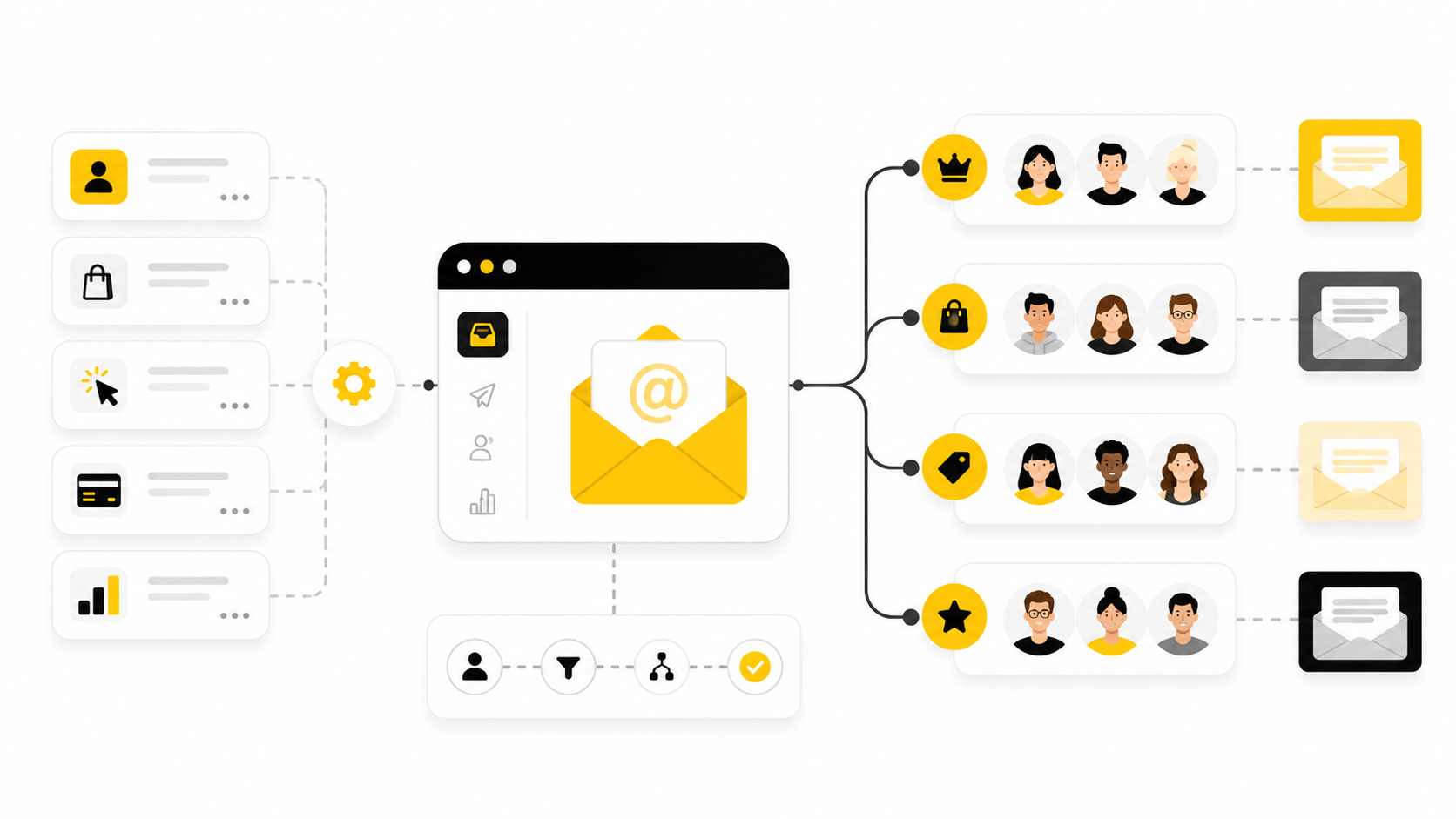
Email segmentation is the process of dividing your email list into smaller, more meaningful groups so each subscriber receives messages that fit their interests, behavior, lifecycle stage, or relationship with your brand.
That sounds simple. But this is where most email marketing gets either powerful or painfully average.
A generic newsletter treats every subscriber like they are in the same place, with the same problem, ready for the same offer. A segmented email program does the opposite. It recognizes that a new lead, a repeat buyer, an inactive subscriber, a high-intent demo requester, and a loyal customer should not all receive the same message.
The reason this matters is not just “personalization” as a buzzword. Smaller, more relevant campaigns tend to perform better because they match context. The GDMA International Email Benchmark 2025 found that smaller campaigns under 5,000 recipients achieved a 37.6% open rate and 4.4% click-through rate, while the largest campaigns over 250,000 recipients achieved a 26.0% open rate and 0.8% click-through rate in its retail benchmark analysis: segmentation pays off when relevance improves.
Email segmentation also protects the long-term health of your list. When subscribers repeatedly receive irrelevant emails, they stop opening, start ignoring, or unsubscribe. Gartner’s personalization research warns that poor personalization can feel irrelevant or intrusive, which is exactly why segmentation needs strategy, restraint, and clean data rather than random slicing for the sake of it: personalized marketing must balance relevance and trust.
Why Email Segmentation Matters
Email segmentation matters because attention is no longer evenly distributed. People do not reward brands for sending more email. They reward brands for sending email that helps them make a decision, solve a problem, remember something useful, or act at the right moment.
That is why segmentation sits between strategy and revenue. It turns a list into a set of meaningful audiences, then turns those audiences into campaigns that feel specific without feeling creepy. McKinsey’s personalization research found that companies that excel at personalization generate 40% more revenue from those activities than average players, which is a strong reminder that relevance is not decoration; it is a growth lever: getting personalization right creates measurable business value.
The practical benefit is focus. Instead of asking, “What should we send this week?” a segmented email system asks better questions. Who needs education? Who needs proof? Who needs urgency? Who needs a win-back sequence? Who should be excluded because they are already converting somewhere else?
The Email Segmentation Framework
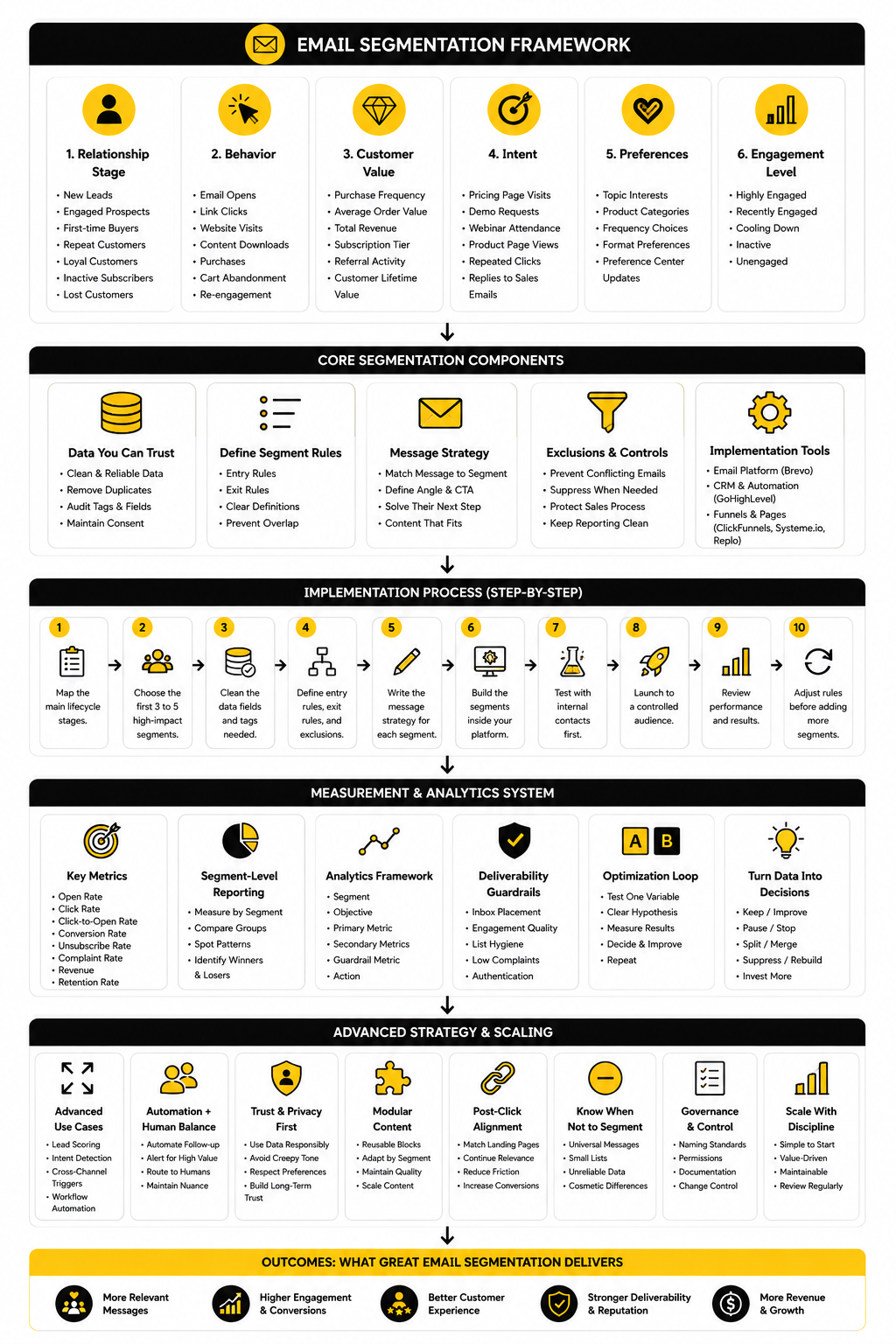
A strong email segmentation framework starts with one simple idea: every segment should have a job. If you cannot explain why a segment exists, what message it should receive, and what business outcome it supports, it is probably clutter. Segmentation is not about creating 47 lists because the software allows it.
At a high level, email segmentation usually combines four layers: subscriber identity, customer behavior, lifecycle stage, and commercial intent. Identity tells you who someone is. Behavior tells you what they do. Lifecycle tells you where they are in the relationship. Intent tells you how close they may be to taking action.
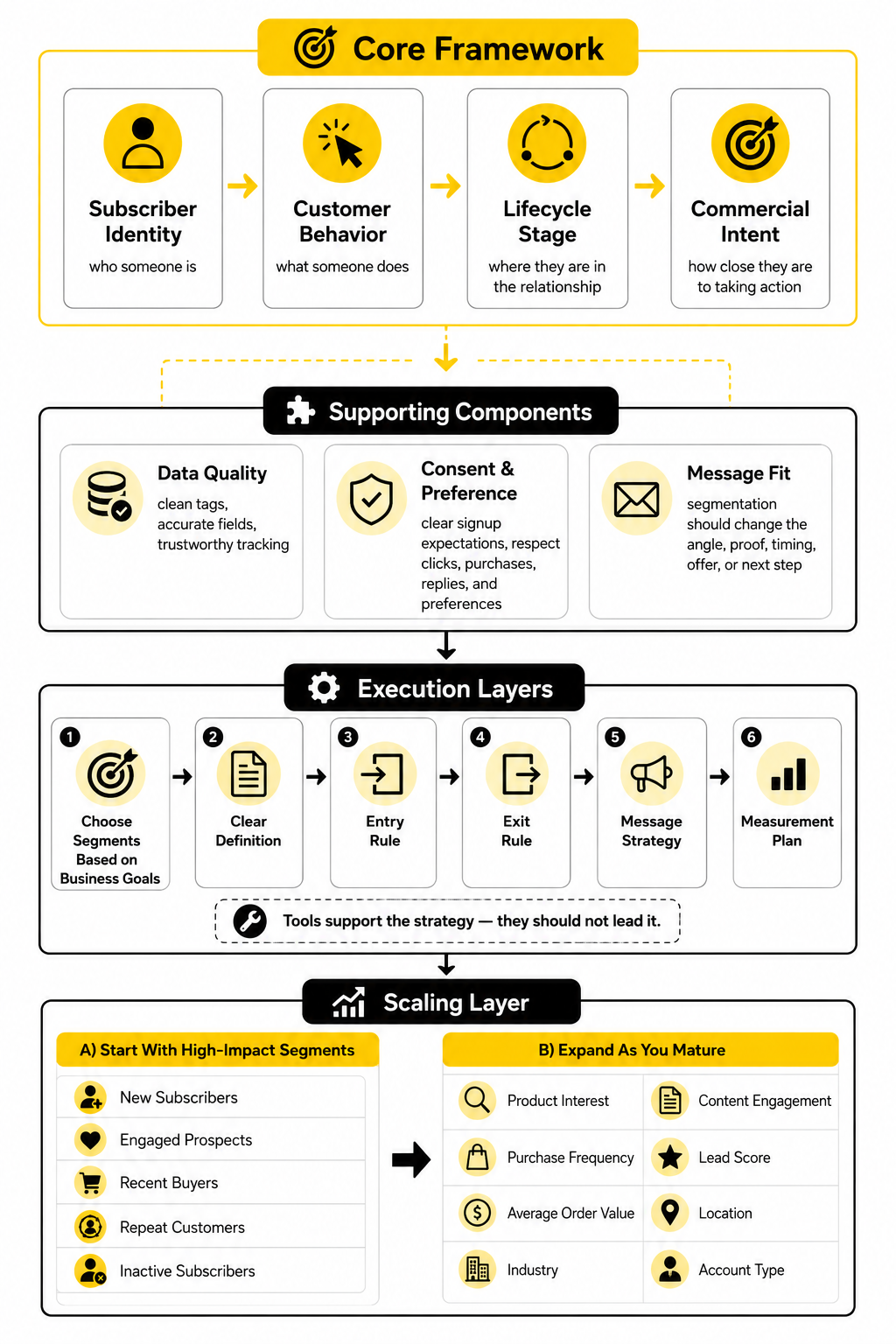
The best framework is flexible, not complicated. A small business can start with a few high-impact segments such as new subscribers, engaged prospects, recent buyers, repeat customers, and inactive subscribers. A more mature team can add product interest, content engagement, purchase frequency, lead score, average order value, location, industry, or account type.
Core Segmentation Components
The first component is data quality. You cannot build useful email segmentation on messy tags, duplicate contacts, outdated form fields, or behavior tracking that nobody trusts. Bad data creates bad personalization, and bad personalization often performs worse than a simple, honest email.
The second component is consent and preference. Subscribers should understand what they are signing up for, and brands should respect the signals people give through clicks, purchases, replies, unsubscribes, and preference center choices. This is especially important as privacy expectations rise and inbox providers become stricter about engagement quality.
The third component is message fit. A segment is only useful if it changes what you send. If five different segments receive the same subject line, same offer, same timing, and same call to action, the segmentation is cosmetic. Real email segmentation changes the angle, proof, timing, offer, or next step.
Professional Implementation
Professional implementation starts by choosing segments that map directly to business goals. For example, an ecommerce brand may prioritize first-purchase conversion, repeat purchase, replenishment, and win-back. A service business may prioritize lead qualification, consultation booking, onboarding, referral, and reactivation.
The tool stack matters, but it should not lead the strategy. Platforms like Brevo can fit teams that want accessible email marketing and automation, while GoHighLevel is more relevant for agencies and service businesses that want CRM, funnels, automations, and client communication in one place. For ecommerce landing pages that need sharper campaign-specific experiences, Replo can support the page side of the journey after the email click.
The professional standard is simple: every important segment should have a clear definition, entry rule, exit rule, message strategy, and measurement plan. Without those pieces, segmentation becomes fragile. With them, it becomes a repeatable system for sending fewer irrelevant emails and more emails that actually deserve attention.
The Email Segmentation Framework
The cleanest way to build email segmentation is to start with the customer journey, not the tool. Most platforms will let you create tags, lists, custom fields, events, scores, and automations, but those features only matter when they reflect how people actually move from stranger to subscriber to customer to repeat buyer. The framework should help you decide who gets what message, when they get it, and why that message makes sense.
A useful framework has four layers: relationship stage, behavior, value, and intent. Relationship stage tells you how familiar someone is with your brand. Behavior tells you what they have done recently. Value tells you how commercially important the contact is. Intent tells you whether they are showing signs that they may be ready to take the next step.
This is where email segmentation becomes more than list management. It becomes a decision system. Instead of blasting every campaign to everyone, you build rules that help the right people receive the right message while the wrong people are quietly excluded.
Segment By Relationship Stage
Relationship stage is usually the best starting point because it is easy to understand and easy to act on. A new subscriber does not need the same email as a long-time customer. A trial user does not need the same message as someone who only downloaded a checklist six months ago.
The most common relationship-based segments are new leads, engaged prospects, first-time buyers, repeat customers, loyal customers, inactive subscribers, and lost customers. These groups are not complicated, but they immediately make your campaigns more relevant. A welcome sequence can educate new subscribers, while a retention sequence can help existing customers get more value from what they already bought.
The important part is that each stage needs a different job. New leads need trust. Prospects need clarity. Buyers need confidence. Repeat customers need expansion or loyalty. Inactive subscribers need a reason to care again, or they need to be removed from regular sending before they hurt engagement.
Segment By Behavior
Behavioral segmentation uses actions instead of assumptions. It looks at what people click, browse, download, purchase, ignore, reply to, abandon, or revisit. This is powerful because behavior usually tells you more than a form field ever will.
For example, someone who clicks three emails about automation is showing a different signal from someone who only reads beginner education content. Someone who visits a pricing page twice in a week is not in the same mental state as someone who opened one newsletter two months ago. These differences should change the follow-up.
Behavioral email segmentation works best when it is recent and specific. A click from yesterday matters more than a click from last year. A product page visit matters more when it happens after several emails about the same topic. The goal is not to track everything forever; the goal is to use meaningful actions while they are still useful.
Segment By Customer Value
Customer value segmentation helps you avoid treating every buyer the same. Some customers buy once and disappear. Others buy repeatedly, refer people, upgrade, leave reviews, or engage with every launch. Those groups deserve different communication.
Value can be based on purchase frequency, average order value, total revenue, subscription tier, contract size, referral activity, or customer lifetime value. For ecommerce, this might mean separating first-time buyers from repeat buyers and VIP customers. For service businesses, it may mean separating small one-off clients from high-value accounts with expansion potential.
This matters because value should influence both message and restraint. Your best customers should not be hammered with irrelevant promotions. They should receive better onboarding, earlier access, more carefully recommendations, and more thoughtful retention campaigns. High-value segments often need fewer emails, not more.
Segment By Intent
Intent-based segmentation is where your emails become sharper. Intent signals show that someone may be closer to taking action, even if they have not directly asked to buy yet. These signals can include pricing page visits, demo requests, cart activity, webinar attendance, comparison page views, repeated product clicks, or replies to sales emails.
Intent is useful because timing matters. A subscriber who is casually reading educational content may need nurturing. A subscriber who clicked a pricing link, opened a case study, and visited a booking page may need a direct next step. Sending both people the same soft newsletter wastes momentum.
The key is to avoid overreacting to one weak signal. One click does not always mean buying intent. A stronger approach is to combine several signals into a practical score or rule, then trigger a relevant follow-up only when the pattern is clear enough.
Segment By Preferences
Preference-based segmentation gives subscribers a voice. It lets them choose the topics, frequency, formats, or product categories they care about. This is one of the simplest ways to make email segmentation feel respectful instead of invasive.
A preference center can ask people what they want to hear about, how often they want updates, or which offers are relevant to them. This is especially useful for brands with multiple product lines, audiences, locations, or content themes. It also reduces guesswork because subscribers directly tell you what they want.
The mistake is asking too much too early. A brand-new subscriber may not know all their preferences yet. Start with one or two useful choices, then update preferences over time based on behavior and explicit feedback.
Segment By Engagement Level
Engagement segmentation protects deliverability and keeps your reporting honest. It separates people who actively open, click, reply, or buy from those who have gone quiet. This helps you decide who should receive regular campaigns, who should receive reactivation emails, and who should be suppressed.
A simple engagement model can include highly engaged, recently engaged, cooling down, inactive, and unengaged contacts. The exact time windows depend on your business and sending frequency. A daily publisher may define inactivity differently from a B2B service company that sends twice per month.
This is not just a cleanup exercise. Sending too much to people who consistently ignore you can weaken performance across the whole list. Strong email segmentation includes knowing who not to email, which is often where better results begin.
Core Segmentation Components
Good email segmentation is built from a few practical components that work together. You need clean data, clear audience rules, useful content angles, automation logic, and a feedback loop that tells you what is actually happening. Miss one of those pieces and the system becomes shaky fast.
This is also where many teams overcomplicate the work. They try to build advanced segments before they have reliable tags, consistent naming, or basic lifecycle rules. Start with the parts that make execution easier, then add complexity only when it improves the message.
Start With The Data You Can Trust
The first step is to separate reliable data from noisy data. Reliable data usually includes purchases, form submissions, email engagement, booked calls, trial signups, account type, location, subscription status, and clear preference center answers. Noisy data includes old quiz answers, vague tags, imported lists with unknown history, and fields nobody has updated in years.
This matters because every segment is only as good as the data behind it. If your CRM says someone is a lead when they became a customer three months ago, your email segmentation will create awkward messages. If your automation keeps promoting a product someone already bought, the subscriber feels like the brand is not paying attention.
A simple audit can fix a lot. Look for duplicate contacts, conflicting lifecycle stages, unused tags, missing consent records, and automations that keep adding labels without removing old ones. The goal is not perfect data; the goal is data clean enough to make confident sending decisions.
Define The Segment Rules Before Building Anything
Before touching the email platform, define each segment in plain language. Write down who belongs in the segment, what qualifies them, what removes them, and what message they should receive. If you cannot explain the rule clearly, the automation will probably become messy.
For example, “engaged prospect” should not mean “someone we feel is warm.” It could mean someone who subscribed in the last 90 days, opened or clicked at least two campaigns, has not purchased, and has shown interest in a specific topic. That definition is much easier to build, test, and improve.
Exit rules are just as important as entry rules. A subscriber should leave a prospect segment when they buy, book a call, unsubscribe, become inactive, or move into a stronger intent segment. Without exit rules, contacts pile up in old segments and start receiving messages that no longer fit.
Build A Simple Implementation Sequence
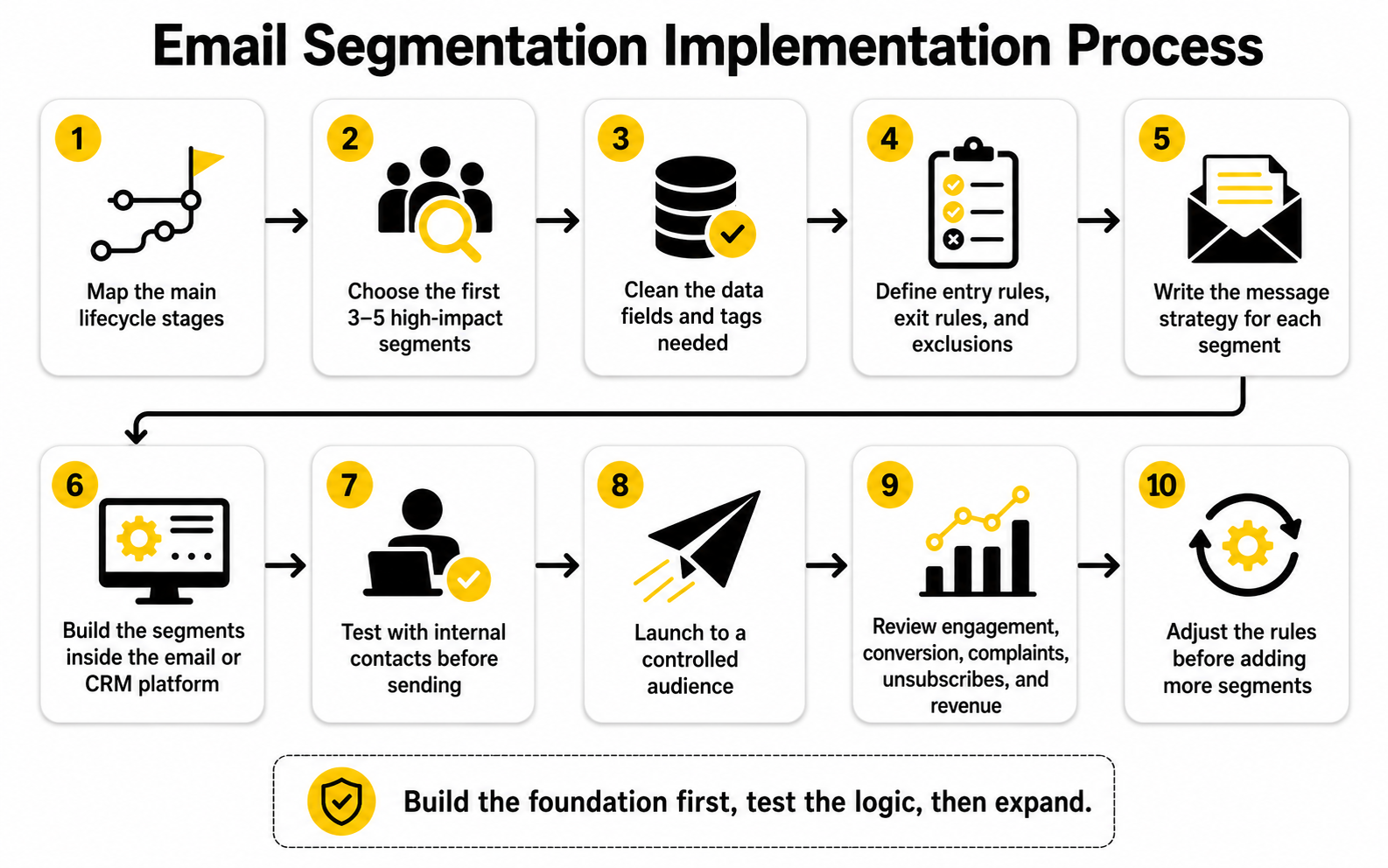
The best execution process is boring in the right way. You build the foundation first, test the logic, then expand. This prevents you from launching a beautiful automation that sends the wrong email to the wrong group at scale.
A practical sequence looks like this:
This sequence keeps email segmentation connected to real execution. It also forces you to think through the handoff between strategy, copy, automation, and reporting. That handoff is where most segmentation projects either become useful or fall apart.
Match Each Segment To A Message Strategy
A segment without a message strategy is just a folder. The real value comes from deciding what each group needs to hear and what action makes sense next. That decision should be based on the subscriber’s context, not your desire to promote the same offer again.
A new subscriber may need a welcome email that explains your point of view and sets expectations. A high-intent prospect may need a comparison, case study, booking prompt, or deadline-based offer. A recent buyer may need onboarding, usage tips, support resources, or a second-step recommendation.
Keep the message strategy specific. Do not write “send value.” Write the actual angle: reduce confusion, prove the product works, remove risk, help them get the first win, invite them to book, or bring them back with a reason. That level of clarity makes the copy better before a single subject line is written.
Create Exclusions So Campaigns Do Not Collide
Exclusions are one of the most underrated parts of email segmentation. They stop people from receiving emails that conflict with their current status. This is especially important when campaigns, launches, automations, and sales follow-ups are all running at the same time.
For example, exclude recent buyers from sales emails for the product they already purchased. Exclude active sales opportunities from broad discount campaigns if the offer would hurt the sales process. Exclude inactive subscribers from high-frequency campaigns until they re-engage.
This is not just cleaner for the subscriber. It also protects your reporting. If the same contact receives three overlapping campaigns, it becomes harder to understand which message influenced the action. Good exclusions keep the experience focused and the data easier to read.
Choose Tools That Fit Your Operating Model
The right tool depends on how your business sells. A newsletter-led brand may need strong list management and simple automations. An ecommerce brand may need product, purchase, and browsing behavior connected to email. A service business or agency may need CRM stages, pipeline triggers, SMS, booking pages, and email automations working together.
For a straightforward email setup, Brevo can be a practical option for campaigns, contact organization, and automation. For agencies, local businesses, consultants, and service providers that want CRM pipelines and follow-up workflows in the same system, GoHighLevel is a stronger fit. If your segmentation strategy sends people into dedicated funnels or campaign pages, ClickFunnels or Systeme.io can help connect the email click to a focused conversion path.
Do not choose software because it has the longest feature list. Choose it because your team can maintain the data, build the automations, understand the reports, and improve the system without needing a rescue project every month. Simple and maintained beats advanced and neglected.
Document The System So It Does Not Break Later
Email segmentation should not live only in someone’s head. Document the segment names, definitions, rules, exclusions, automations, owner, and purpose. This makes the system easier to audit, hand off, and improve.
Use consistent naming from the beginning. A messy account with tags like “Buyer,” “buyers,” “customer-2024,” “Purchased,” and “VIP maybe” becomes painful fast. Clear names save time every time someone builds a campaign or reviews performance.
Documentation also helps you spot unnecessary complexity. If a segment has no owner, no campaign, no automation, and no reporting use, it may not need to exist. The cleaner the structure, the easier it becomes to send emails that feel relevant without turning your CRM into a junk drawer.
Measurement, Optimization, And Automation
Once your email segmentation is live, the job changes. You are no longer asking, “Did this email perform well?” You are asking, “Did this segment receive the right message, at the right time, and move closer to the right outcome?”
That is a much better question because it connects email performance to business behavior. Open rates, clicks, unsubscribes, complaints, conversions, and revenue are not separate numbers floating around in a dashboard. Together, they tell you whether your segmentation is creating relevance or simply adding complexity.
The biggest mistake is judging every segment by the same metric. A reactivation campaign should not be measured the same way as a new-subscriber welcome sequence. A VIP customer campaign should not be judged like a cold prospect nurture email. Each segment needs a performance standard that matches its purpose.
Statistics And Data
Email benchmarks are useful only when they give you context. They should not become excuses, trophies, or panic triggers. A 40% open rate might be excellent in one market and average in another, while a low click rate may be fine if the email is designed to deliver value without requiring a click.
Recent benchmark data shows why context matters. MailerLite’s 2025 benchmark data reported an average open rate of 43.46%, an average click rate of 2.09%, and an average unsubscribe rate of 0.22% across its analyzed campaigns: email benchmark averages vary by industry and audience. Those numbers are helpful as a reference point, but they should not replace your own baseline.
MoEngage’s 2025 benchmark analysis of 17.3 billion emails also reinforces a key point for email segmentation: behavior-based campaigns can dramatically outperform generic sends when the message responds to what a customer has actually done: behavior-based email performance depends on timing and relevance. The takeaway is not “personalize everything.” The takeaway is that meaningful behavior should change the next message.
The Metrics That Actually Matter
Open rate is still useful, but it is no longer the clean signal many marketers wish it were. Privacy features, image loading behavior, inbox client differences, and bot activity can distort opens. Use open rate as a directional signal, not as the final verdict.
Click rate tells you whether the email created enough motivation to act. Click-to-open rate can help you understand whether the content inside the email matched the promise of the subject line. Conversion rate tells you whether the click led to the intended outcome, which is where segmentation starts proving its commercial value.
Unsubscribe rate and complaint rate are warning lights. A few unsubscribes are normal because not every subscriber will stay forever. But if a segment consistently unsubscribes at a higher rate, the offer, frequency, promise, or targeting needs a serious review.
Segment-Level Reporting
You should measure performance at the segment level, not just the campaign level. A campaign sent to five different segments can look average overall while one segment performed brilliantly and another clearly rejected the message. Looking only at the blended result hides the truth.
Segment-level reporting helps you see patterns. New subscribers may click educational links but ignore direct offers. Repeat buyers may respond to early access but not basic product education. Inactive subscribers may open curiosity-driven subject lines but avoid promotional calls to action.
This is where email segmentation becomes more intelligent over time. You are not just collecting numbers. You are learning which message types fit each audience, then using that evidence to tighten future campaigns.
Build A Simple Analytics System
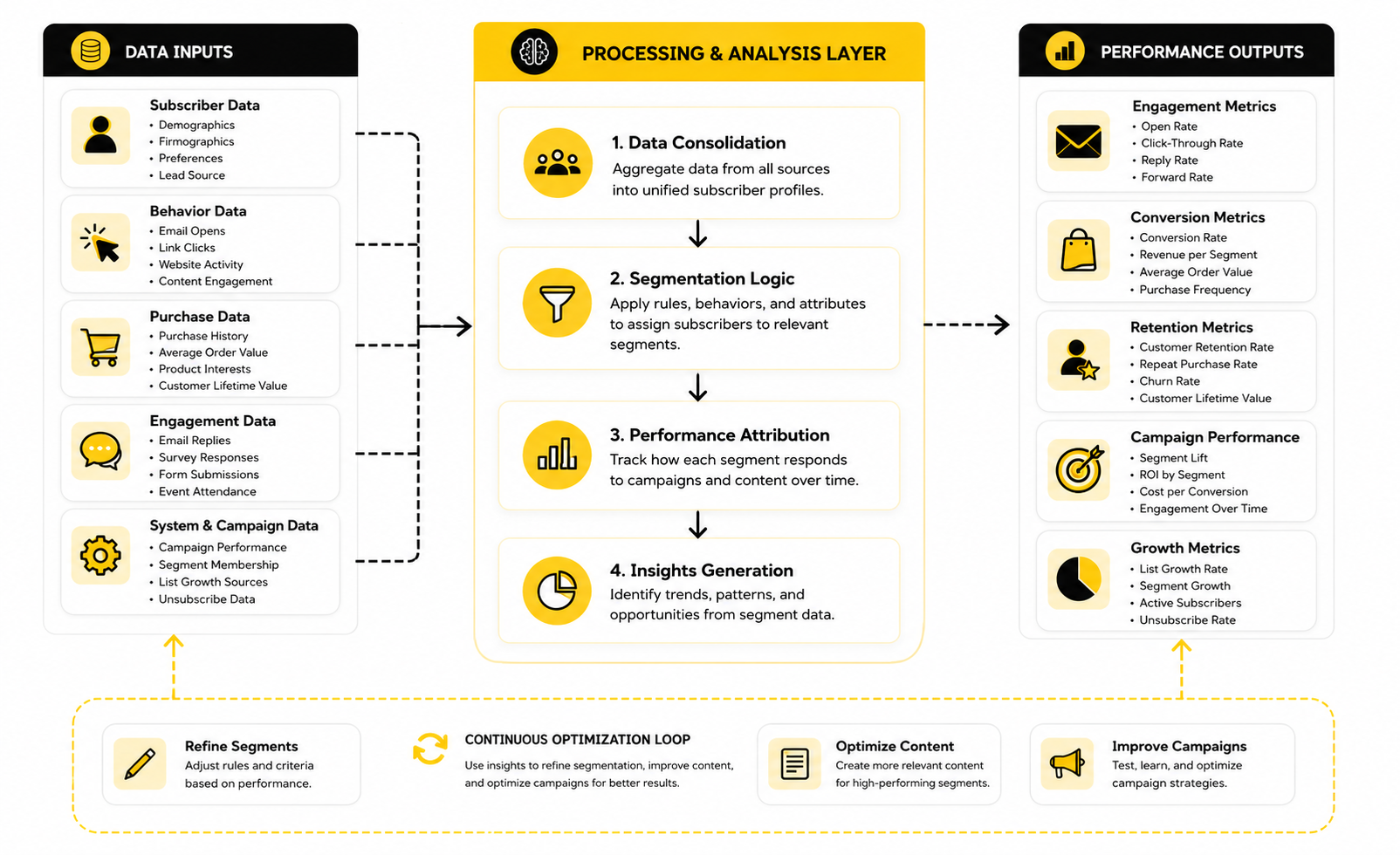
A useful analytics system does not need to be complicated. It needs to connect each segment to its objective, primary metric, secondary metrics, and decision rule. This keeps reporting practical instead of turning every campaign review into a vague dashboard tour.
Use a simple structure like this:
For example, a welcome segment may use first-click rate or first-purchase rate as the primary metric, with unsubscribes as a guardrail. A win-back segment may use reactivation rate as the primary metric, with spam complaints as the guardrail. A high-intent sales segment may use booked calls, trial starts, or checkout completions as the primary metric.
Benchmarks Should Guide, Not Control
Benchmarks are helpful because they show whether your numbers are wildly outside the normal range. They can reveal that your click rate is unusually weak, your unsubscribe rate is climbing, or your deliverability may need attention. But they cannot tell you whether your audience, offer, or sales cycle is healthy by themselves.
A B2B consulting email may have fewer clicks but higher downstream value. An ecommerce campaign may need stronger click and conversion rates because the buying path is shorter. A content newsletter may build trust and future demand even when immediate revenue attribution looks modest.
Use benchmarks as a sanity check, then compare segments against themselves. If your engaged prospect segment usually clicks at 3% and suddenly drops to 1%, that matters. If your repeat customer segment converts at twice the rate of first-time buyers, that tells you where to invest more creative energy.
What Performance Signals Mean
A high open rate with a low click rate usually means the subject line created interest, but the email body did not create action. The promise may have been too broad, the offer may have been weak, or the call to action may not have matched the segment’s intent. This is a message-fit problem, not always a segmentation problem.
A low open rate with a strong click-to-open rate usually means the people who opened cared, but not enough people opened. That points to subject line, sender name, timing, list fatigue, or deliverability. In this case, the content may be solid while the entry point needs work.
A decent click rate with poor conversion usually means the email did its job, but the destination did not. The landing page may not continue the same promise, the offer may be unclear, the form may be too long, or the checkout path may create friction. Email segmentation cannot fix a broken post-click experience by itself.
Watch Deliverability Before You Scale
Deliverability is the quiet constraint behind every email program. If your emails do not reach the inbox, your segmentation strategy does not matter. This is why engagement, complaint rates, list hygiene, and sending patterns need regular attention.
Validity’s 2025 deliverability benchmark research reported that global inbox placement declined in 2024, which means senders have less room for sloppy list practices: inbox placement remains a core performance issue. That should push marketers toward cleaner segmentation, better suppression rules, and more disciplined re-engagement campaigns.
Do not keep sending every campaign to inactive subscribers just because the list size looks impressive. A smaller engaged segment often creates better results than a bloated list full of people who no longer care. In email, reach is only valuable when it still has permission and attention behind it.
Use Testing To Improve One Variable At A Time
Testing works best when it answers a specific question. Are buyers more responsive to product education or customer proof? Do inactive subscribers respond better to a direct “still interested?” email or a useful resource? Does a high-intent segment need urgency or reassurance?
Do not test five things at once and pretend the result is clear. If you change the segment, subject line, offer, layout, timing, and landing page, you will not know what caused the lift or drop. Keep tests clean enough that the result can guide the next decision.
A practical testing rhythm is simple. Choose one important segment, identify one weak metric, create one hypothesis, test one meaningful change, and decide what to do next. That is how email segmentation improves without becoming a guessing game.
Turn Reports Into Decisions
Reports are only useful if they change behavior. If every campaign review ends with “interesting,” nothing is being managed. Each review should produce a decision: keep, improve, pause, split, merge, suppress, or rebuild.
If a segment consistently performs well, give it better creative, better offers, and more strategic attention. If a segment performs poorly but still has business value, improve the message and check whether the data rules are accurate. If a segment performs poorly and has no clear purpose, remove it.
This is the professional standard. Email segmentation is not successful because the account has lots of segments. It is successful when those segments make decisions easier, messages sharper, and performance more predictable.
Advanced Use Cases, Tools, And Scaling Decisions
As your email segmentation becomes more mature, the work shifts from “Can we segment this?” to “Should we segment this?” That difference matters. Advanced segmentation can create sharper campaigns, but it can also create more moving parts, more content demands, more reporting complexity, and more ways for contacts to receive the wrong thing.
The goal is not to build the most complex email system possible. The goal is to build the most useful system your business can maintain. If a segment improves timing, relevance, conversion, retention, or customer experience, it earns its place. If it only makes the account look sophisticated, cut it.
Avoid Segment Sprawl
Segment sprawl happens when every campaign, idea, lead magnet, webinar, product, and promotion creates another permanent group. At first, it feels organized. Six months later, nobody knows which tags still matter, which segments are active, or which automations are quietly fighting each other.
This is one of the biggest risks in email segmentation because complexity hides inside the platform. You may not notice the problem until a customer receives a beginner sequence after buying, a discount after paying full price, or a win-back email while they are actively talking to sales. That is when the system stops feeling personalized and starts feeling broken.
The fix is a segment review process. Every quarter, look at which segments are being used, which ones drive decisions, which ones overlap, and which ones have no clear purpose. A segment that does not change messaging, reporting, or automation should usually be merged, archived, or deleted.
Use Lead Scoring Carefully
Lead scoring can be useful, but it becomes dangerous when teams treat it like truth. A score is only a model. It is a shorthand for behavior, fit, and intent, not a guaranteed measure of buying readiness.
A better approach is to separate fit from activity. Fit might include company size, role, industry, budget, location, or use case. Activity might include pricing page visits, email clicks, webinar attendance, form submissions, or repeat site visits. Someone with high activity but poor fit may not be a good sales opportunity, while someone with strong fit and moderate activity may deserve careful nurturing.
Keep the scoring model simple at first. Give more weight to actions that show real intent and less weight to soft engagement. A pricing page visit, demo request, checkout start, or reply should usually mean more than opening a newsletter.
Balance Automation With Human Judgment
Automation is excellent for speed, consistency, and follow-up. It is not excellent at understanding nuance unless you design the system carefully. This is why advanced email segmentation should leave room for human review when the stakes are high.
For example, a service business may automate nurture emails for most leads but notify the sales team when a high-value account revisits a proposal page or replies to a campaign. An ecommerce brand may automate replenishment reminders but manually review VIP customer issues before sending promotional messages. A software company may automate onboarding tips but route enterprise trial users into a more personal sequence.
This balance matters because people can feel when communication is too mechanical. Automated emails should still sound like they were written by someone who understands the customer’s situation. The better your segmentation, the easier that becomes.
Protect Trust When Personalizing
Email segmentation should feel helpful, not invasive. There is a line between “this brand understands what I need” and “this brand is watching me too closely.” Cross that line and performance may rise briefly while trust drops quietly.
Use behavioral data to improve relevance, but avoid wording that exposes tracking in a creepy way. “Here are resources that may help with your setup” feels better than “We saw you visited this page three times last night.” The action can be based on behavior without making the subscriber feel monitored.
Preference data should be handled with the same restraint. If someone chooses fewer emails, respect it. If someone says they only want product updates, do not push them into a daily promotion stream. Long-term email performance depends on trust, not just clicks.
Scale With Modular Content
As segmentation grows, content production becomes the bottleneck. You may have the data to create ten variations, but that does not mean your team can write, design, approve, and measure ten versions every week. This is where modular content helps.
Modular content means building reusable pieces that can be adapted by segment. The opening might change by lifecycle stage, the proof section might change by industry, and the call to action might change by intent level. The whole email does not need to be rebuilt from scratch every time.
This keeps quality high without overwhelming the team. It also creates consistency across campaigns because the core message stays aligned while the most relevant parts adjust. Advanced email segmentation works best when the content system can actually support it.
Connect Email Segments To The Post-Click Journey
A segmented email can only do so much if the landing page is generic. If the email speaks to a specific pain point but the page sends everyone to the same broad offer, relevance breaks at the click. That gap is one of the easiest places to lose conversions.
For campaign-specific pages, tools like Replo can help ecommerce teams create landing pages that match the segment and offer. For funnel-based businesses, ClickFunnels or Systeme.io can be useful when each audience needs a focused path from email to conversion. For service businesses that need the email, CRM, booking, pipeline, and follow-up connected, GoHighLevel can make the whole journey easier to manage.
The strategic point is simple. Segmentation should continue after the click. The ad, email, landing page, form, sales follow-up, onboarding, and retention experience should feel like one coherent journey.
Know When Not To Segment
Not every campaign needs deep segmentation. Sometimes one clear message to a broad engaged audience is better than five weaker versions sent to smaller groups. Over-segmentation can slow execution, dilute creative quality, and make analysis harder than it needs to be.
Do not segment when the message is genuinely universal, the list is too small for meaningful measurement, the data is unreliable, or the content difference would be cosmetic. A company announcement, important policy update, major product release, or simple newsletter may not need heavy audience splitting. Forcing segmentation in those cases can create work without improving the subscriber experience.
The professional move is restraint. Use email segmentation when it changes the message in a meaningful way. Skip it when it only creates more admin.
Build Governance Before The System Gets Big
Governance sounds boring, but it saves serious pain. As more people touch the email platform, you need rules for naming, tagging, segment creation, suppression, approval, testing, and reporting. Without those rules, the system slowly becomes fragile.
At minimum, define who can create new segments, who can edit automations, who approves suppression rules, and how changes are documented. Keep a shared segmentation map that shows lifecycle stages, major segments, active automations, and exclusions. This becomes especially important when sales, marketing, customer success, and operations all use the same contact database.
Good governance does not slow the team down. It prevents expensive mistakes. The bigger your list, the more important this becomes, because a small logic error can affect thousands of subscribers in minutes.
What is email segmentation?
Email segmentation is the practice of dividing your email list into smaller groups based on useful differences such as behavior, lifecycle stage, interests, purchase history, engagement, or intent. The point is not to make your email platform look more advanced. The point is to send messages that feel relevant to the person receiving them.
A simple segment might be “new subscribers who joined in the last 14 days.” A more advanced segment might be “repeat customers who bought twice in the last 90 days, clicked a product education email, and have not purchased the newest offer.” Both can be useful if they change what you send and why you send it.
Why is email segmentation important?
Email segmentation is important because relevance drives better decisions. When people receive emails that match their situation, they are more likely to read, click, buy, reply, or stay subscribed. When they receive generic emails too often, they tune out.
It also helps the business make cleaner choices. Instead of asking what to send to the entire list, you can ask what each group needs next. That makes campaigns more focused and usually makes performance easier to understand.
What are the main types of email segmentation?
The most useful types are lifecycle segmentation, behavioral segmentation, engagement segmentation, value-based segmentation, preference-based segmentation, and intent-based segmentation. Each type answers a different question about the subscriber. Together, they give you a clearer picture of who should receive which message.
Lifecycle segmentation tells you where someone is in the relationship. Behavioral segmentation tells you what they have done. Engagement segmentation tells you whether they still pay attention. Value-based segmentation tells you how commercially important they are. Preference and intent segmentation help you respect what they want while responding to signs that they may be ready to act.
What is the easiest way to start email segmentation?
Start with three simple groups: new subscribers, engaged non-buyers, and customers. These are easy to understand, easy to build, and easy to write for. They also create an immediate improvement because each group needs a different message.
Once those are working, add inactive subscribers, repeat customers, and high-intent prospects. Do not start with 20 segments. Start with the few segments that clearly change your emails and your business decisions.
How many email segments should a business have?
There is no perfect number. A small business may only need five to eight active segments. A larger ecommerce, SaaS, or agency business may need dozens, but only if those segments are actively used and maintained.
The better question is whether each segment has a job. If a segment changes the message, timing, offer, automation, suppression rule, or report, it may be worth keeping. If it does none of those things, it is probably just clutter.
What data should I use for email segmentation?
Use data you can trust. Strong sources include form submissions, purchase history, product interest, email clicks, website behavior, booking activity, subscription status, customer type, location, and direct preference center responses. These signals are usually more useful than vague tags or old imported fields.
Be careful with stale data. A subscriber’s interest from two years ago may not reflect what they care about now. Recent behavior usually deserves more weight than old assumptions.
What is the difference between email segmentation and personalization?
Email segmentation groups people based on shared traits or behaviors. Personalization adjusts the message for the individual or the group. They work together, but they are not the same thing.
For example, sending one campaign to recent buyers is segmentation. Mentioning the product category they purchased or recommending the next logical resource is personalization. Segmentation decides who receives the message; personalization helps shape what that message says.
Can email segmentation improve deliverability?
Yes, but only when it is used with discipline. Sending more relevant emails to engaged people can improve positive engagement signals. Suppressing inactive subscribers and using reactivation campaigns carefully can also reduce the risk of poor engagement dragging down the list.
That does not mean segmentation magically fixes deliverability. You still need proper consent, authentication, clean sending practices, low complaint rates, and list hygiene. Segmentation helps because it gives you more control over who receives what and when.
How should inactive subscribers be handled?
Inactive subscribers should not be ignored forever, but they should not receive every campaign either. Create a reactivation segment and send a short sequence that gives them a clear reason to stay. If they do not engage, reduce frequency or suppress them from regular promotional campaigns.
This protects your list and your reputation. It also keeps your reporting honest. A list full of inactive contacts may look impressive, but it does not help if those people no longer want to hear from you.
What are common email segmentation mistakes?
The biggest mistake is creating segments that do not change the message. If every segment receives the same campaign, the segmentation is mostly cosmetic. Another common mistake is forgetting exit rules, which causes subscribers to stay in segments long after they no longer belong there.
Messy data is another serious problem. Duplicate tags, unclear lifecycle stages, and outdated fields can turn a smart strategy into a confusing customer experience. Keep the system simple enough that your team can actually maintain it.
What should every segment include?
Every serious segment should have a definition, entry rule, exit rule, purpose, message strategy, exclusion logic, and primary metric. This sounds like extra work, but it prevents confusion later. It also makes the segment easier to improve.
For example, a high-intent prospect segment should define what counts as high intent, when someone enters, when they leave, what emails they receive, who should be excluded, and which conversion matters most. Without that clarity, the segment can become a dumping ground.
How often should email segments be reviewed?
Review major segments at least quarterly. High-volume businesses may need monthly reviews, especially if campaigns, products, automations, and customer behavior change quickly. The more complex the system, the more often it needs maintenance.
During the review, check whether each segment is still active, accurate, and useful. Look for overlap, stale rules, unused tags, broken automations, and segments that no longer affect decisions. This keeps email segmentation from becoming technical debt.
What tools are useful for email segmentation?
The right tool depends on the business model. For email campaigns and automation, Brevo can be a practical fit for teams that want a straightforward marketing platform. For agencies and service businesses that need CRM stages, pipelines, email, SMS, booking, and automation together, GoHighLevel can make more sense.
For funnel-led businesses, ClickFunnels and Systeme.io can help connect segmented email traffic to focused conversion paths. For ecommerce landing pages that need to match specific campaigns, Replo can support a more relevant post-click experience. The tool should support the strategy, not become the strategy.
How do you know if email segmentation is working?
You know it is working when your segments make decisions easier and your performance becomes more predictable. You should see clearer differences between audience groups, stronger message fit, cleaner reporting, and fewer irrelevant sends. The system should also help you decide what not to send.
Look at segment-level performance instead of only campaign averages. Track the objective, primary metric, secondary signals, and guardrails for each major segment. If the numbers guide real decisions, your segmentation is becoming useful.
Should small businesses use email segmentation?
Yes, but they should keep it simple. A small business does not need enterprise-level complexity to benefit from email segmentation. Even separating new leads, active prospects, customers, and inactive subscribers can make a noticeable difference.
The danger for small teams is building more than they can maintain. Start with segments that directly support sales, retention, or trust. Add more only when the extra precision is worth the extra work.
What is the final takeaway on email segmentation?
Email segmentation works when it makes communication more relevant and operations more disciplined. It is not about sending endless variations or pretending every subscriber needs a custom campaign. It is about using the right signals to send better emails to the right people.
Keep the system clean, practical, and tied to business outcomes. Use behavior, lifecycle stage, value, preferences, and intent with restraint. The best email segmentation feels obvious to the subscriber because the message simply makes sense.
Build a stronger local presence with BAAM AI
Turn your website, Google profile, social channels, and AI visibility into one growth engine
Most businesses do not need more random marketing activity. They need a consistent presence system that helps the right people find them, trust them, and take action. BAAM AI brings strategy, local SEO, website updates, Google Maps visibility, social content, AI-search readiness, media production, and reporting into one practical monthly engine.
If you want your marketing to keep working after the campaign ends, start with a free BAAM AI presence audit. See how your business shows up today and where the fastest visibility wins are at BAAM AI.