
BAAM AI Blog
Email Segmentation Strategy: A Practical Framework For Better Targeting, Stronger Engagement, And Cleaner Growth
Most email lists are not really one audience. They are a mix of new leads, first-time buyers, loyal customers, inactive subscribers, price-sensitive shoppers, decision-makers, researchers, and people who joined for...

Most email lists are not really one audience. They are a mix of new leads, first-time buyers, loyal customers, inactive subscribers, price-sensitive shoppers, decision-makers, researchers, and people who joined for one specific reason months ago. Treating all of them the same is the fastest way to make email feel generic.
A strong email segmentation strategy fixes that by turning a list into useful groups based on behavior, intent, lifecycle stage, preferences, and value. The goal is not to create dozens of clever segments for the sake of it. The goal is to send fewer irrelevant emails and more messages that match what people actually need next.
This matters because email still works best when it feels timely, specific, and earned. Segmentation gives your campaigns context, and context is what separates a helpful email from another broadcast people ignore. Done properly, it becomes the operating system behind better newsletters, launch sequences, nurture flows, sales follow-ups, retention campaigns, and win-back emails.
this guide is structured as a six-part guide so each section can build on the last. We will start with the strategic reason segmentation matters, then move into the framework, the core components, and the practical implementation steps. By the end, the goal is to have a clear system you can use without turning your email program into a messy spreadsheet project.
Why Email Segmentation Strategy Matters
Email segmentation matters because attention is no longer won by showing up often. It is won by showing up with the right message at the right point in the relationship. When every subscriber receives the same promotion, the brand is asking the audience to do the work of deciding whether the message is relevant.
A practical email segmentation strategy moves that work back to the business. It helps you decide who should receive a message, who should be excluded, what angle should be used, and what action makes sense next. That alone can improve the quality of your campaigns because you stop thinking in terms of “send to list” and start thinking in terms of “send to context.”
It also protects the long-term value of the list. If subscribers keep receiving emails that do not match their interests, purchase stage, or level of intent, they disengage before they ever become customers. Segmentation gives you a way to respect that relationship while still selling confidently.
The Framework Overview
A useful segmentation framework starts with one simple question: what do we know about this person that should change the email they receive? That answer usually comes from five areas: who they are, what they have done, what they care about, where they are in the customer journey, and how valuable or risky the relationship is. Those areas create the foundation for segments that are practical instead of theoretical.
The mistake many teams make is starting with too many segments too early. They build complex audience groups before they have clear offers, clean data, or enough campaign volume to use those groups consistently. A better approach is to begin with a small number of high-impact segments, prove that they change messaging decisions, and then expand only when the added complexity earns its place.
This framework will be used throughout the rest of the article. Each later section will make the system more specific, moving from broad strategy into segment types, data rules, automation logic, campaign planning, measurement, and governance. The point is not to make segmentation look sophisticated; the point is to make it useful.
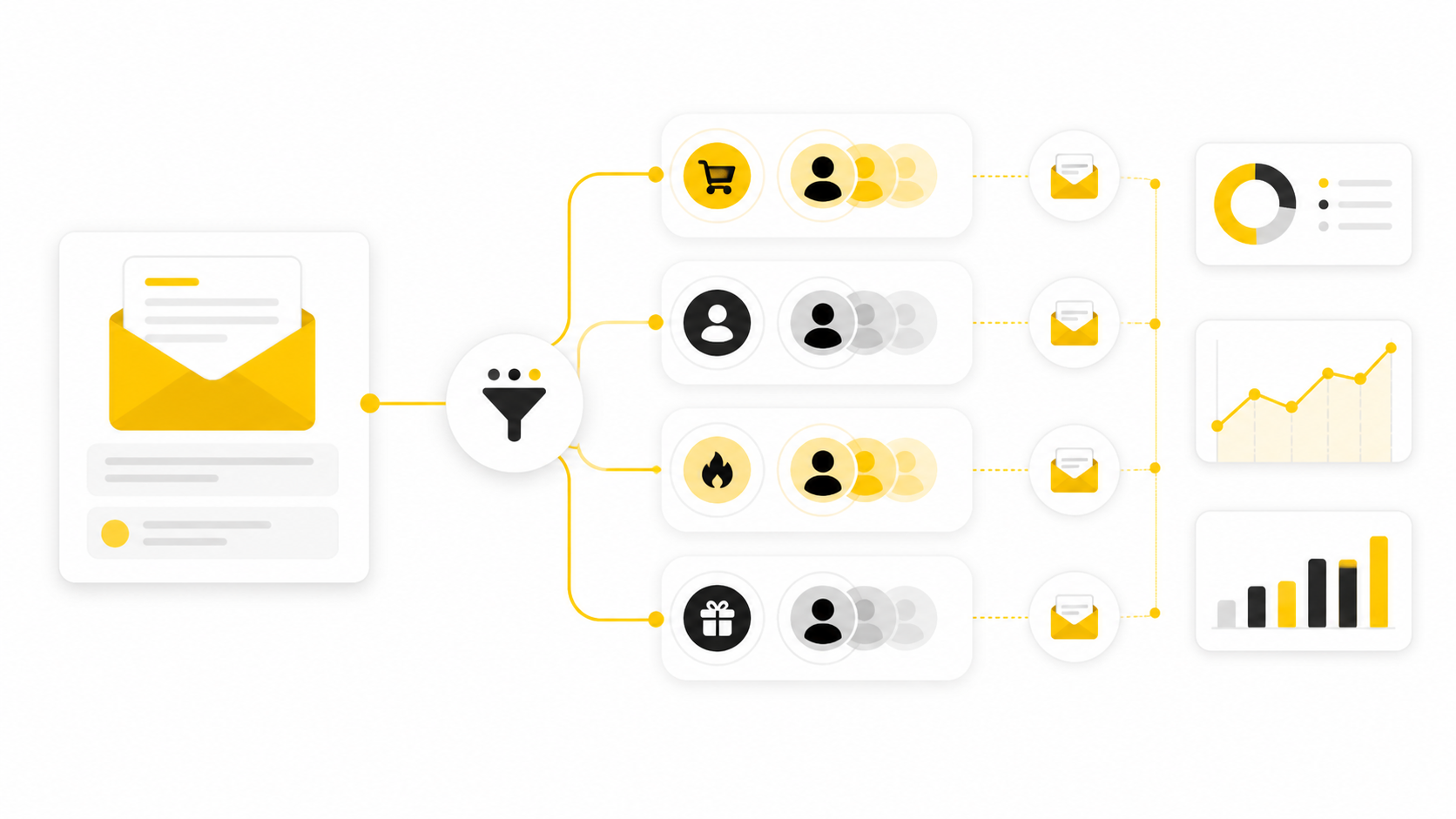
The Email Segmentation Strategy Framework
A good email segmentation strategy is not built by asking, “How many groups can we create?” It is built by asking, “What decisions should change because this subscriber is different?” That shift matters because segmentation only has value when it changes the message, the offer, the timing, the channel, or the follow-up.
The framework should be simple enough for a real team to use every week. If it requires ten hidden spreadsheets, constant manual cleanup, and campaign logic nobody understands, it will eventually break. The best systems are clear, documented, and tied directly to business outcomes.
At a strategic level, the framework has four layers: audience signals, segment rules, message strategy, and performance feedback. Audience signals tell you what you know. Segment rules turn that information into usable groups. Message strategy decides what each group should receive. Performance feedback shows whether the segment is actually useful or just decorative.
Start With The Business Goal
Segmentation should begin with a clear commercial goal. You may want more first purchases, higher repeat purchase rates, better onboarding, stronger demo attendance, more renewals, fewer unsubscribes, or cleaner reactivation. Each goal requires a different segmentation logic, so starting with the goal keeps the strategy grounded.
For example, a business trying to convert new leads should care about source, intent, content consumed, and signup recency. A business trying to increase retention should care more about purchase frequency, product usage, satisfaction signals, and time since last engagement. These are different problems, so they should not be solved with the same segment map.
This is where many email programs get messy. Teams create segments because the data is available, not because the segment supports a decision. A practical email segmentation strategy only keeps segments that help the business act with more precision.
Define The Audience Signals
Audience signals are the pieces of information that reveal something useful about a subscriber. They can come from signup forms, purchase history, website behavior, email engagement, CRM data, product usage, event attendance, survey answers, or support conversations. The more reliable the signal, the more confidently you can use it.
Not all signals deserve the same weight. A recent purchase is usually stronger than a one-time page visit. A direct product preference is usually stronger than a vague demographic assumption. A repeated behavior is usually stronger than a single click.
The goal is to separate strong signals from noisy ones. Strong signals should influence automation, offers, and lifecycle messaging. Weak signals can still be useful, but they should rarely drive major decisions on their own.
Turn Signals Into Segment Rules
Segment rules translate raw information into usable audience groups. A rule might identify new subscribers from the last 14 days, customers who bought once but not again, leads who viewed a pricing page, subscribers who clicked product education content, or inactive contacts who have not engaged for several months. The rule should be specific enough that another person on the team can understand it without guessing.
Good segment rules have clear inclusion and exclusion criteria. Inclusion tells you who belongs in the segment. Exclusion tells you who should not receive the message, even if they match part of the rule.
That exclusion logic is important. Without it, subscribers can fall into overlapping campaigns that create a bad experience. Someone who just purchased should not immediately receive the same hard-sell email as someone who has never bought.
Match Each Segment To A Message Job
Every segment needs a message job. That job explains what the email is supposed to help the subscriber do next. Without that, segmentation becomes organization instead of strategy.
A welcome segment may need trust-building and expectation-setting. A high-intent lead may need proof, comparison support, or a clear next step. A repeat customer may need education, cross-sell guidance, or loyalty reinforcement. An inactive subscriber may need a reason to come back or a respectful sunset path.
This is also where tone changes. A new subscriber should not be treated like a loyal customer. A loyal customer should not be spoken to like a cold lead. The segment gives you the context, but the message has to carry that context in a human way.
Keep The Framework Small Enough To Manage
The strongest starting point is usually a small set of core segments. Most businesses can begin with lifecycle stage, engagement level, purchase status, interest category, and intent level. That gives enough targeting power without creating a system nobody can maintain.
A bloated segmentation model creates hidden costs. Campaign planning takes longer, automation becomes harder to audit, reporting gets fragmented, and small segments may not produce enough data to learn from. More segments do not automatically mean better marketing.
The better move is to expand gradually. Add a new segment only when it creates a different message, improves a workflow, or reveals a useful performance pattern. If a segment does not change action, it probably does not belong in the operating system.
Build Around Lifecycle Stages
Lifecycle segmentation is the backbone of most strong email programs. It groups people based on where they are in the relationship with the business, not just what they clicked yesterday. That makes it easier to send emails that feel aligned with the subscriber’s current reality.
Common lifecycle stages include new subscriber, engaged lead, sales-qualified lead, first-time customer, repeat customer, loyal customer, inactive customer, and churn-risk contact. The exact names can change by business model, but the principle stays the same. Each stage should represent a meaningful shift in what the person needs from you.
Lifecycle stages also prevent over-selling. A subscriber who just entered your world may need orientation before a strong offer. A customer who already trusts you may be ready for a deeper recommendation. That difference is exactly why segmentation exists.
Add Behavior And Intent Layers
Lifecycle tells you where someone is. Behavior and intent tell you what they are doing right now. Combining both gives your email segmentation strategy much more precision.
Behavioral segments can include email clicks, product views, cart activity, content downloads, webinar attendance, trial usage, form submissions, or repeat visits to important pages. Intent segments focus on actions that suggest a subscriber is closer to making a decision. Pricing page visits, comparison content, abandoned checkout activity, and repeated engagement with offer-related emails can all be useful signals.
This layer should be handled carefully. One action does not always prove intent. But repeated behavior over a short window can give your email program a much clearer sense of timing.
Use Preferences To Reduce Friction
Preference data gives subscribers a say in what they receive. This can include content topics, product categories, email frequency, location, role, budget range, or communication interests. It is especially useful because it comes directly from the subscriber instead of being inferred from behavior.
The key is to ask for preference data when it feels natural. A short preference question during signup can work. A preference center can work for larger lists. A simple one-click topic choice inside an email can also work when you want less friction.
Preference data should not sit unused. If someone tells you they care about one topic, your email program should respect that signal. Nothing damages trust faster than asking for preferences and then ignoring them.
Make Data Hygiene Part Of The Strategy
Segmentation depends on clean data. If tags are inconsistent, fields are outdated, forms are unclear, and integrations pass messy values into the CRM, your segments will eventually become unreliable. That is not a technical detail; it is a strategy problem.
Every important segment should have a clear source of truth. The team should know where the data comes from, how it gets updated, and what happens when two systems disagree. This prevents the classic situation where marketing thinks one thing, sales sees another, and automation sends a third message.
Tools can help, but they do not replace rules. Platforms like Brevo, Moosend, and GoHighLevel can support segmentation workflows, but the logic still needs to be designed by someone who understands the customer journey.
Create A Feedback Loop
A segment is only useful if it improves performance or insight. That means every major segment should be reviewed through engagement, conversion, unsubscribe behavior, revenue contribution, and downstream customer quality. Looking only at opens is not enough, especially when inbox privacy changes can make open data less reliable.
The feedback loop should answer practical questions. Did this segment respond differently? Did the tailored message create a better outcome? Did the segment reveal a new opportunity or expose a weak assumption?
This is where segmentation becomes a learning system. You are not just dividing the list. You are using customer behavior to make the next campaign sharper, the next automation cleaner, and the next offer more relevant.
Core Segmentation Models That Actually Matter
Once the framework is clear, the next step is choosing the segmentation models that deserve a place in the system. This is where discipline matters. A business can segment by hundreds of variables, but only a handful will consistently improve campaign decisions.
The best models are not fancy. They are useful. They help you decide who gets welcomed, who gets educated, who gets a sales push, who gets a retention message, who gets left alone, and who needs to be removed from regular campaigns before list quality suffers.
A strong email segmentation strategy usually starts with five practical models: lifecycle, behavior, value, preference, and engagement. Each one answers a different question about the subscriber. Together, they create enough context to make email feel specific without making the whole program impossible to manage.
Lifecycle Segmentation
Lifecycle segmentation groups people by their current relationship with the business. It is one of the most reliable models because the message someone needs changes dramatically as they move from stranger to subscriber, from subscriber to buyer, and from buyer to repeat customer. When the lifecycle stage is wrong, the email almost always feels wrong.
A new lead may need orientation, proof, and a reason to trust you. A first-time customer may need onboarding, product education, and reassurance that they made a good decision. A loyal customer may need early access, more carefully recommendations, or a reason to deepen the relationship.
This model works because it mirrors the way people actually make decisions. They do not go from zero awareness to perfect loyalty in one step. Your email program should respect that journey and guide people through it with the right level of pressure at the right time.
Behavioral Segmentation
Behavioral segmentation uses actions as signals. These actions can include page visits, email clicks, purchases, downloads, cart activity, form submissions, event registrations, product usage, or repeated engagement with a specific topic. Behavior is powerful because it shows what someone is doing, not just what they said they might care about.
The key is to avoid overreacting to one small action. A single click can be curiosity. Repeated behavior is more useful because it suggests a pattern. Someone who clicks three emails about the same product category is sending a clearer signal than someone who clicked once by accident.
Behavioral segmentation becomes especially useful when it changes timing. If a lead visits a pricing page, abandons a checkout, or returns to a comparison page, the next email should not be a generic newsletter. It should help them make the next decision.
Value-Based Segmentation
Value-based segmentation groups subscribers by their commercial importance to the business. This can include total spend, average order value, purchase frequency, subscription plan, renewal potential, account size, or predicted lifetime value. It helps you decide where extra effort is justified.
High-value customers may deserve more personal communication, earlier access, better education, or stronger retention campaigns. Low-value customers should not be ignored, but they may need more scalable automation. The point is not to treat people poorly based on value; the point is to allocate attention intelligently.
This model is especially important when customer acquisition is expensive. If your best customers share certain patterns, segmentation helps you recognize those patterns earlier. That can improve not only email campaigns, but also lead scoring, offer design, and sales follow-up.
Preference Segmentation
Preference segmentation uses information subscribers intentionally give you. This might include content topics, product categories, frequency preferences, business type, location, language, role, or desired outcomes. It is one of the cleanest ways to make email feel more relevant because the subscriber has already told you what they want.
The mistake is asking for too much too soon. Long forms create friction, and most people will not complete a detailed profile before they trust the brand. Start with one or two useful preference questions, then collect more data gradually through clicks, surveys, forms, or preference updates.
Preference segmentation also creates accountability. If someone chooses a topic, your campaigns should respect that choice. Asking for preferences and then sending the same generic broadcast to everyone is worse than not asking at all.
Engagement Segmentation
Engagement segmentation groups subscribers based on how actively they interact with your emails and brand. This usually includes recent clicks, recent opens where reliable, site visits, purchase recency, reply behavior, form activity, and other meaningful actions. It helps protect deliverability and keeps campaigns focused on people who are still paying attention.
Engaged subscribers can usually receive more frequent campaigns because they are showing interest. Lightly engaged subscribers may need stronger hooks, better topic matching, or a lower frequency. Inactive subscribers should move into reactivation or sunset logic instead of staying in every regular send.
This is not just about performance reporting. It is about list health. If your email program keeps sending to people who have stopped responding, the list may look bigger on paper while becoming weaker in practice.
Turning Segments Into An Execution Process
Segmentation only becomes valuable when it turns into repeatable execution. The process should be simple enough that a campaign can move from idea to audience to message to measurement without confusion. If every send requires rebuilding logic from scratch, the strategy is not operational yet.
A practical process gives the team a shared workflow. It makes clear which segments exist, when they should be used, how they are prioritized, and what happens when subscribers qualify for multiple groups. This is where the email segmentation strategy becomes tangible.
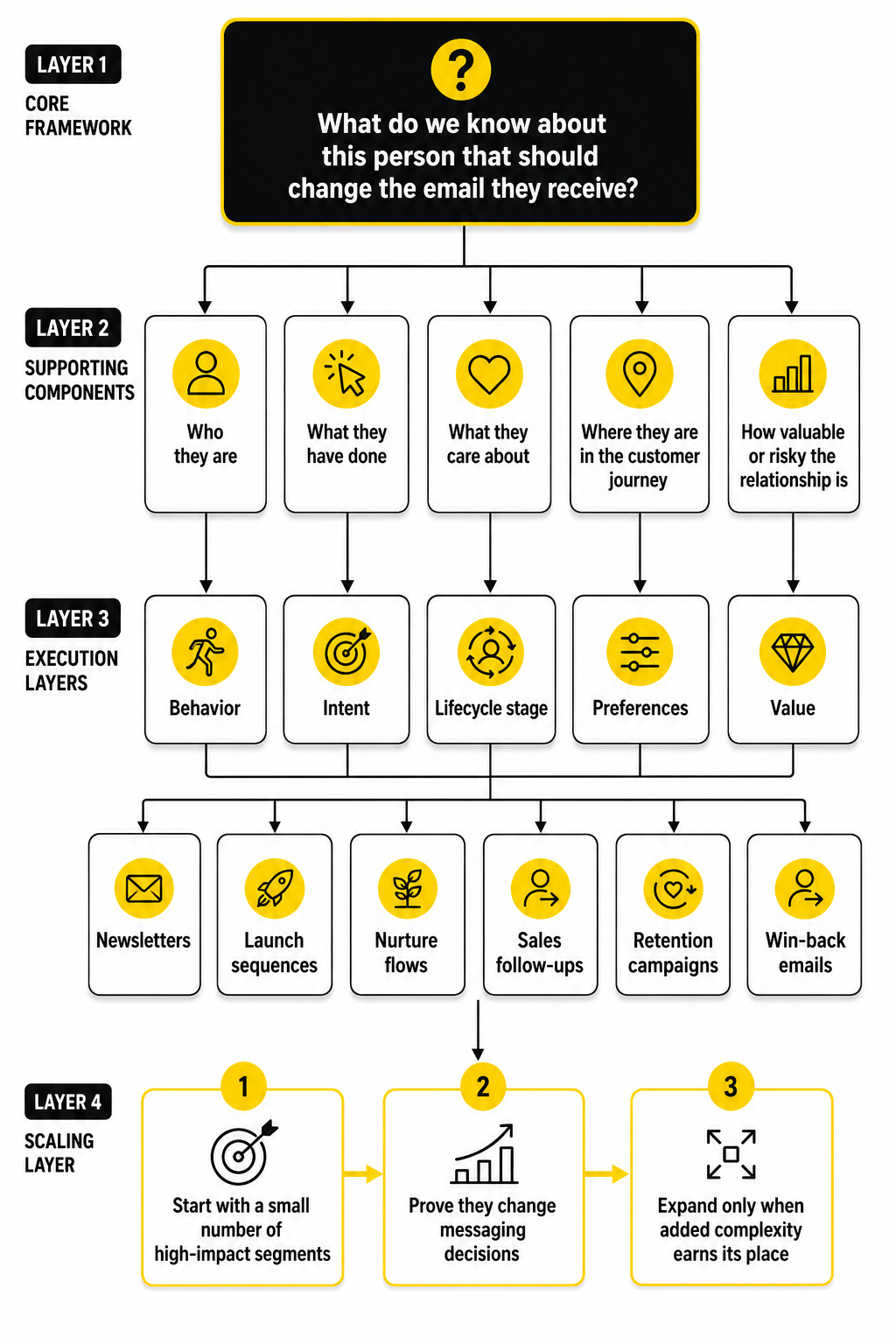
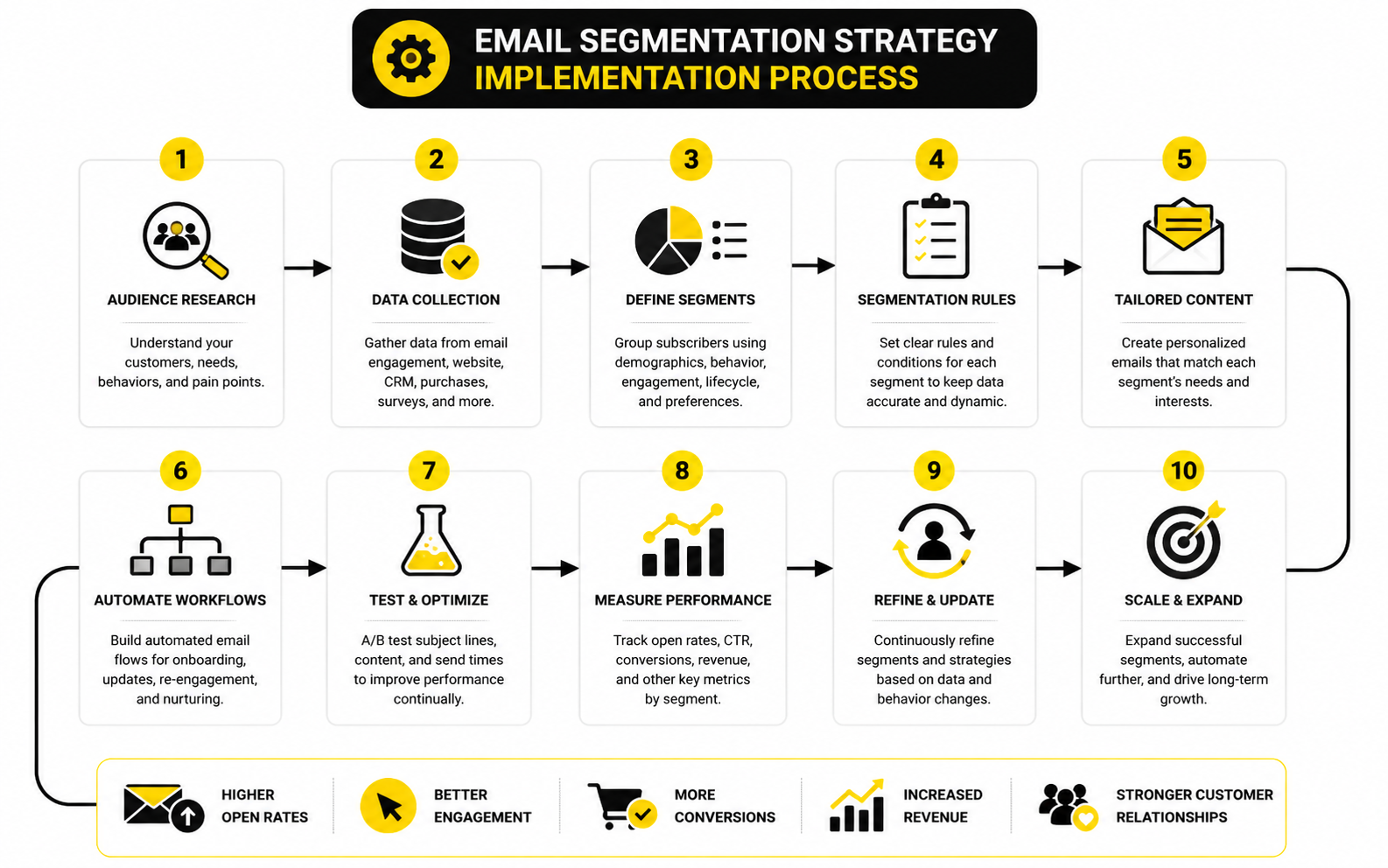
The execution process should move in this order:
This sequence prevents the most common mistake: writing the email first and figuring out the audience later. When the audience is defined before the message, the copy becomes sharper. The offer becomes cleaner. The campaign has a reason to exist.
Step 1: Define The Campaign Objective
Every segmented campaign should begin with one objective. Not three. Not a vague hope that the email will “drive engagement.” One clear job makes the rest of the decisions easier.
A campaign might be designed to convert new leads, recover abandoned carts, increase repeat purchases, invite high-intent prospects to a demo, reactivate inactive subscribers, or move trial users toward paid plans. Each objective points to a different audience and a different message. Without that clarity, segmentation turns into guesswork.
The objective also decides what success looks like. A reactivation campaign should not be judged the same way as a launch email. A retention sequence should not be judged the same way as a cold nurture email. The segment and the goal have to match.
Step 2: Choose The Primary Segment
The primary segment is the group the campaign is really for. This should be the audience most likely to care about the message, benefit from the offer, or take the next step. It is the core targeting decision.
For example, a product education email might target first-time buyers who purchased within the last 30 days. A buying guide might target leads who engaged with comparison content but have not purchased. A loyalty offer might target repeat customers with recent activity and a strong purchase history.
The primary segment should be specific, but not so narrow that it becomes useless. If the segment is too broad, the message becomes generic. If it is too tiny, the campaign may not create enough impact or learning.
Step 3: Add Exclusion Rules
Exclusions are just as important as inclusions. They prevent subscribers from receiving messages that are irrelevant, badly timed, or commercially awkward. This is one of the simplest ways to make email feel more professional.
Common exclusions include recent purchasers, current customers, unsubscribed contacts, people already in a sales conversation, contacts inside another active automation, or subscribers who recently received a similar offer. Exclusions also help protect people from receiving too many emails in a short period.
This step is where teams often find hidden problems. If your platform cannot easily exclude the right people, your data model needs work. Do not ignore that. Bad exclusions create bad customer experiences.
Step 4: Match The Message To The Segment
Once the audience is clear, the email should be written for that group specifically. The subject line, opening, proof, offer, objection handling, and call to action should all reflect what the segment already knows and what they need next. This is where segmentation becomes visible to the reader.
A high-intent prospect does not need the same education as a brand-new subscriber. A recent buyer does not need the same urgency as someone who abandoned checkout. A loyal customer does not need to be convinced that the brand is credible; they need a reason to take the next valuable step.
This does not mean every segment needs a completely different campaign from scratch. Sometimes a shared email can use different openings, product blocks, proof points, or calls to action. The key is that the subscriber should feel the email was meant for their situation.
Step 5: Build The Automation Logic
Automation should support the segmentation strategy, not complicate it. Start with the core flows that clearly match lifecycle moments: welcome, nurture, abandoned cart or form, post-purchase, renewal, reactivation, and sunset. These flows usually produce more value than random one-off automations.
Each automation should have a clear entry rule, exit rule, goal, timing, and suppression logic. If someone purchases, they should exit the sales nurture. If someone becomes inactive, they should not keep receiving high-frequency promotional sends. If someone enters a reactivation sequence, regular campaign pressure may need to decrease.
Platforms such as GoHighLevel, Brevo, and Moosend can help manage these workflows, but the real leverage comes from clean rules. The software can execute the logic. It cannot decide the strategy for you.
Step 6: Test With A Small Operating System First
Do not launch with 40 segments, 20 automations, and a dashboard nobody understands. Start with a small operating system that can be checked and improved. That usually means a few lifecycle segments, a few behavior triggers, a simple engagement model, and clear exclusions.
This first version should answer the most important business questions. Who is new? Who is engaged? Who is ready for a stronger offer? Who already bought? Who is drifting away? Those questions are enough to build a serious email program.
Once the system works, you can add more detail. You might separate customers by product category, lead source, account value, or content interest. But earn that complexity. Complexity is only useful when it improves action.
Statistics And Data
Measurement is where an email segmentation strategy proves whether it is useful. The goal is not to collect impressive-looking numbers. The goal is to understand which segments are responding, which messages are working, which audiences are becoming more valuable, and which parts of the system need to be fixed.
Benchmarks can help, but they should not become the boss. A reported average click rate may tell you whether your campaigns are roughly in range, but it will not tell you whether your new-buyer segment needs better onboarding or whether your high-intent leads need stronger proof. Your own segment-level data matters more than generic averages because it reflects your audience, your offer, your list quality, and your timing.
This is why measurement should be built into the segmentation process from the beginning. If you cannot compare how different segments behave, you do not really have a segmentation strategy yet. You just have labels.
Start With The Metrics That Reflect Real Action
The most useful email metrics are the ones connected to real subscriber behavior. Clicks, conversions, purchases, replies, booked calls, trial activations, repeat orders, renewals, and revenue per recipient usually tell you more than opens alone. Opens can still provide directional context, but they should not be treated as the main signal of success.
That matters because open tracking is less reliable than it used to be. Mailchimp explains that Apple Mail Privacy Protection can preload tracking pixels, which can make emails appear opened even when the contact has not actually read them. That means open rates can be inflated, especially for lists with a large Apple Mail audience.
So use opens carefully. They can help spot obvious subject line or deliverability problems, but they should not decide whether a segment is valuable. A smaller segment with modest opens but strong conversions may be far more valuable than a large segment with beautiful open rates and weak buying behavior.
Use Benchmarks As A Range, Not A Verdict
Benchmarks are useful when they give you a reality check. For example, MailerLite’s 2025 data shows an average open rate of 43.46%, an average click rate of 2.09%, and an average unsubscribe rate of 0.22%. Brevo’s 2025 benchmark data reports a 21% open rate, 3.96% click-through rate, and 0.16% unsubscribe rate across its dataset.
Those differences are the point. Benchmarks vary by platform, region, list type, consent quality, industry, and how each provider calculates performance. If one report says a metric is “good” and another gives a very different average, that does not mean one is useless. It means you should treat benchmarks as a range, then compare your segments against your own baseline.
A practical email segmentation strategy uses benchmarks to ask better questions. If one segment performs below your list average, ask whether the audience is wrong, the message is weak, the offer is mismatched, or the timing is off. If one segment performs far above average, ask whether it should receive more dedicated campaigns, stronger automation, or a more specific offer.
Measure Segments Against Each Other
The most important comparison is not always campaign versus benchmark. It is segment versus segment. When the same campaign performs differently across audience groups, the data is showing you where relevance is strongest and where your assumptions may be wrong.
For example, a campaign sent to new subscribers, recent purchasers, inactive leads, and repeat customers should not be judged only by its total performance. The total can hide the truth. One segment may be carrying the campaign while another is dragging down engagement or creating unsubscribes.
Segment-level reporting should answer simple questions:
These answers make the next send more carefully. That is the whole point.
Build A Practical Analytics System
Your analytics system does not need to be complicated, but it does need to be consistent. Every meaningful campaign should be measured by audience, message, offer, timing, and outcome. Without that structure, you will end up with disconnected reports that show activity but not learning.
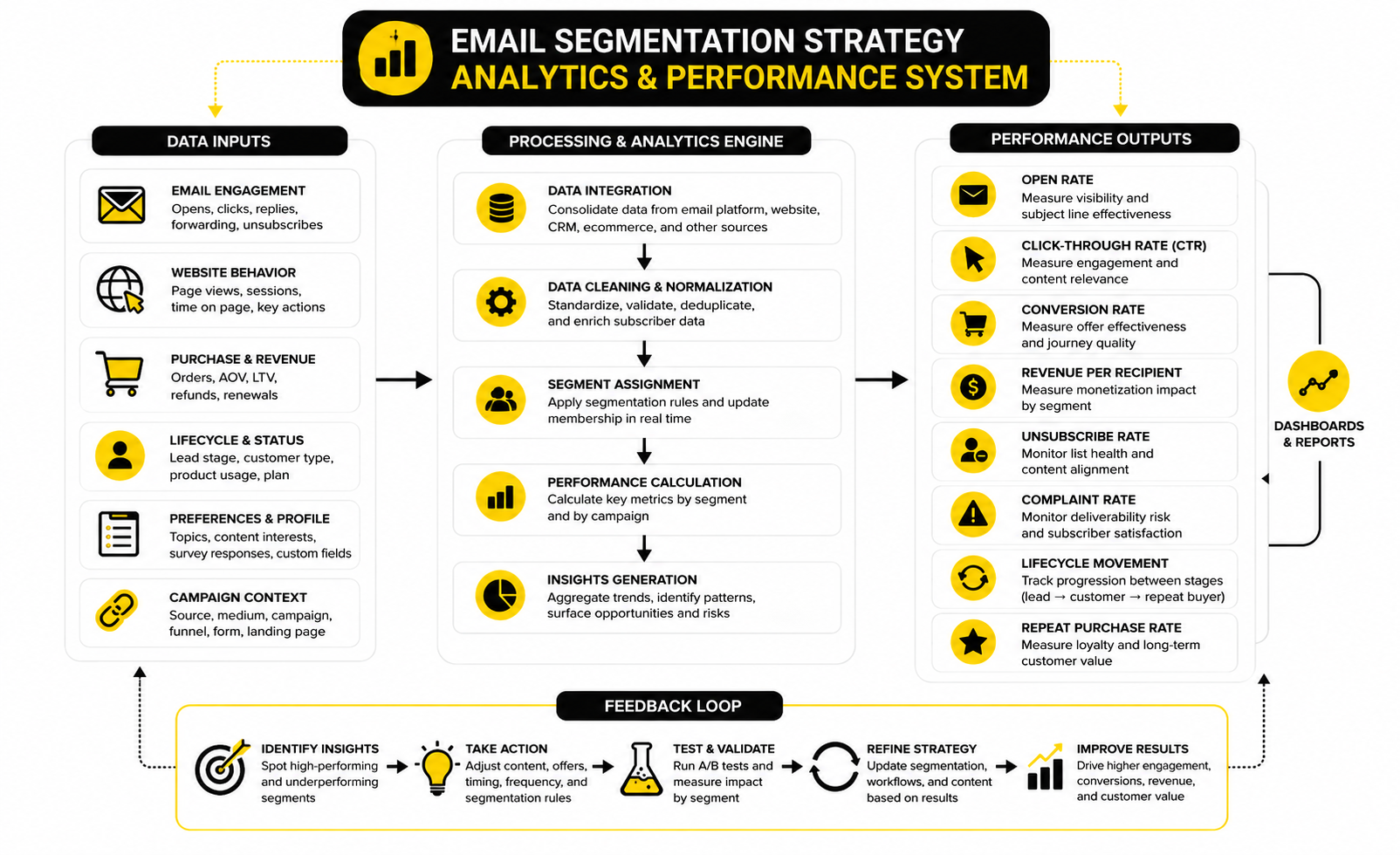
A useful analytics system has four layers. The first layer tracks delivery and list health, including bounces, spam complaints, unsubscribes, and deliverability warnings. The second layer tracks engagement, including clicks, replies, site visits, and meaningful content interactions. The third layer tracks conversion, including purchases, booked calls, signups, upgrades, renewals, and form completions. The fourth layer tracks business value, including revenue per recipient, customer lifetime value, repeat purchase behavior, retention, and pipeline quality.
This layered view prevents bad decisions. If a segment has strong clicks but weak conversions, the problem may be the landing page, offer, or buying friction. If a segment has weak clicks but strong revenue from the people who do click, the audience may be smaller but valuable. If unsubscribes rise after a segmented campaign, the message may have been too aggressive or the exclusion rules may have failed.
Track Revenue Per Recipient
Revenue per recipient is one of the cleanest metrics for email segmentation. It tells you how much revenue a campaign generated relative to the number of people who received it. That makes it easier to compare a small high-value segment against a larger lower-intent audience.
This metric matters because click rate alone can be misleading. A broad educational email may earn many clicks but little immediate revenue. A smaller campaign to high-intent prospects may earn fewer clicks but produce more money per subscriber. Both can be useful, but they should not be interpreted the same way.
Revenue per recipient also helps you protect quality. If a segment generates revenue while keeping unsubscribes and complaints low, it may deserve more attention. If revenue only increases because you are pushing too hard and burning the list, the short-term gain is hiding long-term damage.
Watch Unsubscribes And Complaints Closely
Unsubscribes are not always bad. Sometimes they remove people who were never a fit, and that can improve list quality. But when unsubscribes spike in a specific segment, it is a signal that something is off.
ActiveCampaign’s benchmark guidance treats unsubscribe rates below 0.5% as generally healthy and below 0.2% as especially strong. MailerLite’s 2025 benchmark puts the average unsubscribe rate at 0.22%, while Brevo’s 2025 benchmark reports 0.16%. These numbers are not universal rules, but they give you a useful warning zone.
Complaints are more serious than unsubscribes. A subscriber who unsubscribes is giving you a clean exit. A subscriber who marks the email as spam is sending a negative signal to mailbox providers. If complaints increase after targeting a segment, pause and review consent, frequency, message relevance, and whether the audience expected that type of email.
Separate Campaign Metrics From Automation Metrics
Campaigns and automations should not be measured the same way. A campaign is usually a one-time or scheduled send. An automation responds to a behavior, stage, or trigger. Because automations are more context-driven, they often deserve different expectations.
For example, a post-purchase sequence should be judged by product adoption, repeat purchase behavior, review generation, support reduction, or retention. A welcome sequence should be judged by first meaningful action, topic preference collection, click behavior, and early conversion. A reactivation sequence should be judged by who comes back, who should be suppressed, and how many inactive contacts can be removed safely.
This distinction is important because a strong email segmentation strategy usually depends on both. Campaigns help you communicate timely messages. Automations help you respond to subscriber context. Measuring them together can blur the truth.
Read Low Performance Diagnostically
Low performance is not automatically failure. It is information. The job is to diagnose what the number is trying to tell you.
If a segment has low clicks, the problem may be message relevance, subject line quality, poor timing, weak offer fit, or subscriber fatigue. If clicks are healthy but conversions are weak, the problem may be the landing page, pricing, proof, checkout flow, or sales follow-up. If conversions are strong but unsubscribe rates are high, the campaign may be profitable but too aggressive.
The best teams do not panic over one metric. They look for patterns across segments and campaigns. One weak send can happen. Repeated weakness in the same segment means the strategy needs to change.
Use Data To Decide The Next Action
Measurement should end with a decision. Keep the segment, refine it, merge it, suppress it, split it, change the message, adjust timing, improve the offer, or clean the data. If the report does not lead to action, it is just decoration.
This is especially important as the segmentation system grows. Every new segment adds complexity, so each segment has to earn its place. If a segment does not behave differently, convert differently, or teach you something useful, it may not need to exist as a separate audience.
The cleanest rule is simple: data should make the next email easier to write and easier to target. When your analytics can do that, your email segmentation strategy is no longer based on assumptions. It becomes a practical feedback loop that improves with every send.
Professional Implementation And Optimization
At this stage, the email segmentation strategy is no longer just a marketing idea. It is an operating system. That means the next challenge is not “Can we create segments?” but “Can we keep this system accurate, useful, compliant, and profitable as the business grows?”
This is where more advanced teams separate themselves. They do not just build segments once and hope the logic keeps working. They create rules for ownership, naming, testing, suppression, automation priority, data quality, and long-term maintenance.
The truth is simple: segmentation gets more powerful as it scales, but it also gets easier to break. More tags, more forms, more funnels, more products, more automations, and more data sources can create a system that looks sophisticated while quietly becoming unreliable. Professional implementation is about getting the upside without letting complexity eat the strategy.
Decide Who Owns The Segmentation System
Someone needs to own the segmentation system. Not casually. Not “the marketing team” in general. One person or one clearly defined team should be responsible for how segments are created, named, updated, used, and retired.
Without ownership, every campaign becomes an opportunity to create more clutter. Sales adds fields. Marketing adds tags. Automations add behavior labels. Forms collect inconsistent answers. Six months later, nobody knows which segment is current and which one was built for a campaign that ended last quarter.
Ownership does not mean one person does all the work. It means one person protects the logic. They make sure the email segmentation strategy stays usable instead of becoming a graveyard of half-used tags and forgotten workflows.
Create A Naming System Before You Need One
Naming sounds boring until the system gets messy. Then it becomes painfully important. Segment names, tags, custom fields, automations, campaigns, and exclusions should follow a clear naming convention from the start.
A useful naming system should show what the segment is, where it belongs, and what it is used for. For example, lifecycle segments should be named differently from behavior triggers, purchase segments, preference groups, and suppression lists. That way, anyone opening the email platform can understand the system without needing a private explanation.
This is not about being neat for the sake of being neat. Clean naming reduces mistakes. It helps teams avoid sending the wrong offer, suppressing the wrong audience, or editing an automation they do not fully understand.
Use Segment Priority Rules
As segmentation becomes more advanced, subscribers will qualify for multiple groups at once. A person might be a recent buyer, a high-value customer, a webinar attendee, a pricing-page visitor, and a lightly engaged email subscriber. If your system does not know which status matters most, campaigns can collide.
Priority rules solve that problem. They define which segments override others when there is overlap. For example, current customers may be excluded from lead-generation offers, people in an active sales opportunity may be excluded from broad promotional sequences, and recent purchasers may temporarily stop receiving hard-sell campaigns.
This matters because segmentation should improve the customer experience, not create chaos. The subscriber does not care that your internal logic is complicated. They only notice when the wrong email arrives at the wrong time.
Balance Personalization With Simplicity
Personalization is useful when it makes the email more relevant. It becomes a liability when it feels forced, creepy, or operationally fragile. The best email segmentation strategy uses personalization to clarify the message, not to show off how much data the business has collected.
A simple segment-based message often works better than an overly customized email full of fragile dynamic fields. For example, changing the offer based on lifecycle stage may be more useful than inserting five pieces of personal data into the copy. Relevance matters more than theatrics.
The tradeoff is important. Every personalization rule adds another place where the system can fail. If the data is incomplete, outdated, or wrong, the email can feel less personal, not more.
Know When To Split A Segment
A segment should be split when one group inside it behaves differently enough to deserve a different message. That is the real test. Do not split a segment just because the data allows it.
For example, “customers” may be too broad if first-time buyers, repeat buyers, and VIP buyers all respond differently. “Leads” may be too broad if some joined from educational content while others requested pricing information. “Inactive subscribers” may be too broad if some were once strong buyers and others never engaged at all.
A split is worth making when it changes the campaign decision. If the message, offer, timing, or suppression logic stays the same, the split probably adds complexity without adding value.
Know When To Merge A Segment
Merging segments is just as important as creating them. If two segments consistently receive the same campaigns, perform similarly, and require the same follow-up, they may not need to exist separately. Keeping them separate only makes reporting and planning harder.
This is especially common in older email systems. A team creates segments for a launch, a seasonal campaign, a product test, a webinar, or a lead magnet. Later, those segments remain in the platform even though they no longer support a clear decision.
A professional segmentation system has pruning built in. Segments should be reviewed regularly and removed when they no longer help the business act more intelligently. Clean systems scale better.
Protect Deliverability As You Scale
Deliverability is not only a technical issue. It is strongly connected to segmentation. When you send more relevant emails to the right people, engagement usually improves. When you blast uninterested subscribers too often, list quality weakens.
Scaling email without segmentation often creates hidden risk. The list grows, the send volume grows, and campaign pressure increases, but relevance does not improve. That can lead to lower engagement, more unsubscribes, more complaints, and weaker inbox placement over time.
A mature email segmentation strategy protects deliverability by controlling frequency, suppressing inactive subscribers, respecting consent, and separating high-engagement audiences from risky sends. That is not conservative marketing. That is smart growth.
Build Suppression Logic Into Every Campaign
Suppression logic decides who should not receive a campaign. It is one of the least glamorous parts of email strategy, but it prevents many of the worst mistakes. A well-targeted campaign can still fail if the exclusions are careless.
Every campaign should check for people who recently purchased, people already in a related automation, people in a sales process, people who opted out of that topic, and people who are not engaged enough to justify the send. The exact exclusions depend on the business model, but the habit should be consistent.
This is where a platform with strong workflow and CRM visibility can help. Tools such as GoHighLevel, Brevo, and Moosend can support cleaner campaign logic when the underlying rules are designed properly.
Avoid Segmenting On Sensitive Assumptions
Advanced segmentation should never become reckless. Just because a business can infer something about a subscriber does not mean it should use that assumption in messaging. Sensitive, intrusive, or poorly supported inferences can damage trust fast.
This matters especially when using behavioral data. A subscriber visiting a page, clicking a topic, or browsing a product may reveal interest, but it does not always reveal identity, need, budget, or intent. Good segmentation leaves room for uncertainty.
The safer approach is to segment around actions, preferences, lifecycle stages, and clear commercial context. Keep the message helpful. Do not make the subscriber feel watched.
Keep Consent And Expectations Aligned
Consent is not just a legal checkbox. It is also an expectation. People should receive the kind of email they reasonably expected when they subscribed, purchased, registered, or requested information.
If someone signed up for educational content, immediately pushing unrelated offers can feel like a bait-and-switch. If someone opted into product updates, sending broad promotional campaigns may feel off. If someone requested one resource, adding them to every possible campaign is a short-term move with long-term consequences.
A strong email segmentation strategy respects the original context of the relationship. That context should influence onboarding, frequency, topic selection, and promotional pressure. Trust is easier to keep than rebuild.
Use Progressive Profiling Instead Of Long Forms
You do not need to collect every data point on day one. In most cases, it is better to gather information gradually. Progressive profiling lets you learn more over time through small questions, behavior, preference updates, forms, surveys, and purchase patterns.
This approach reduces friction. A short signup form gets more people through the door, while later interactions can collect more specific data when the relationship is warmer. The subscriber is more likely to answer when the question feels relevant.
The key is to ask for information you will actually use. Do not collect fields because they might be useful someday. Data without a purpose becomes clutter.
Connect Email Segmentation To The Funnel
Email segmentation should not live in isolation. It should connect to landing pages, funnels, forms, CRM stages, sales follow-up, customer support, and product experience. Otherwise, the email can be targeted while the rest of the journey stays generic.
For example, a high-intent email segment should probably land on a page that matches that intent. A post-purchase education segment should connect to onboarding assets. A sales-qualified segment should pass clean context into the CRM so follow-up feels informed.
This is where funnel tools can matter. If the business is building offer pages, opt-in flows, or sales journeys, platforms like ClickFunnels or systeme.io can support the front end of the journey, while the email strategy handles follow-up and lifecycle movement.
Plan For Cross-Channel Segmentation
Email is often the core channel, but it should not be the only place segmentation matters. The same audience logic can support SMS, retargeting, messenger flows, sales calls, customer success, and content distribution. The key is to avoid treating every channel like a separate universe.
Cross-channel segmentation helps keep the customer experience consistent. If someone becomes a customer, that status should influence more than email. If someone opts out of one type of communication, that preference should be respected wherever possible.
Tools such as ManyChat can support conversational follow-up when it fits the customer journey. The important part is not adding channels for novelty. It is making sure each channel has a clear role.
Prepare For AI-Assisted Segmentation Carefully
AI can help with segmentation, but it should not replace strategy. It can identify patterns, suggest audience clusters, summarize behavior, help draft message variations, and support predictive scoring. That is useful, especially when a list becomes too large for purely manual analysis.
But AI-assisted segmentation needs guardrails. The team should understand which data is being used, what the model is optimizing for, and whether the recommendations make practical sense. A segment that looks mathematically interesting is not always commercially useful.
Use AI to speed up analysis, not to remove judgment. The best results still come from combining data, customer understanding, offer strategy, and disciplined testing. That combination is hard to fake.
Document The System So It Can Survive Growth
A segmentation system should be documented clearly enough that a new team member can understand it. That documentation should explain the major segments, data sources, entry rules, exit rules, exclusions, automation priorities, naming conventions, and reporting logic.
This does not need to be a massive manual. It needs to be useful. A clear operating document can prevent repeated mistakes, reduce onboarding time, and make campaign planning much faster.
Documentation also protects the business when people change roles. If the segmentation logic only lives in one person’s head, the system is fragile. If it is documented, it can improve over time instead of restarting every time the team changes.
Treat Segmentation As A Living System
The biggest strategic mistake is treating segmentation as a one-time setup. Markets change. Offers change. Customer behavior changes. Products change. List quality changes. The segmentation system has to evolve with all of it.
A good review rhythm keeps the system healthy. Monthly reviews can focus on campaign performance and obvious issues. Quarterly reviews can look at segment value, automation logic, list health, and whether any segments should be merged, split, or retired. Larger annual reviews can revisit the full customer journey.
This is the professional mindset: segmentation is never truly finished. It becomes sharper as the business learns. The goal is not perfection. The goal is a system that keeps getting more relevant, more profitable, and easier to trust.
Measurement, Governance, And Long-Term Control
The final layer of an email segmentation strategy is control. Not control in a rigid, over-engineered way, but control over quality, expectations, and decision-making. A segmentation system should help the business grow without making the customer experience feel fragmented.
That means the system needs governance. Someone has to decide which segments matter, which automations take priority, how often rules are reviewed, and when old logic should be removed. Without that discipline, segmentation slowly turns from a performance advantage into operational clutter.
The best long-term systems are easy to understand, easy to audit, and hard to misuse. They connect the customer journey, the email platform, the CRM, the funnel, the analytics layer, and the team’s campaign rhythm into one practical ecosystem.
Create A Segment Review Rhythm
Segments should be reviewed on a schedule. Monthly reviews can catch obvious issues like low engagement, broken automation logic, or segments that are growing faster than expected. Quarterly reviews can go deeper into profitability, lifecycle movement, suppression rules, and whether the current segment map still matches the business model.
This review process should not be treated as admin work. It is where you decide whether your email segmentation strategy is still aligned with reality. If the product changed, the customer journey changed, or the list composition changed, the segmentation system should change too.
The review should end with clear decisions. Keep the segment, merge it, split it, pause it, clean it, or retire it. If a segment no longer changes action, it does not deserve space in the system.
Build A Simple Governance Checklist
Governance works best when it is practical. A simple checklist before every major campaign can prevent most segmentation mistakes. It keeps the team focused on relevance, consent, timing, and customer context.
Before launching a segmented campaign, check:
This checklist does not slow down good marketing. It speeds up decision-making because the team is no longer relying on memory, assumptions, or last-minute fixes.
Keep The Customer Experience Coherent
As the system grows, coherence becomes the real challenge. A subscriber may interact with ads, landing pages, emails, sales calls, support conversations, product onboarding, and renewal campaigns. If each part of the business uses different audience logic, the experience starts to feel disconnected.
A strong email segmentation strategy keeps the message consistent across the journey. If someone is a customer, they should not be treated like a cold lead. If someone has already declined an offer, they should not be pushed into the same angle repeatedly. If someone has shown a clear preference, the system should respect it.
This is where segmentation becomes more than email. It becomes a shared understanding of the customer. That is the level where the strategy starts compounding.
What Is An Email Segmentation Strategy?
An email segmentation strategy is a structured way to divide your email audience into useful groups so each group receives more relevant messages. The groups can be based on lifecycle stage, behavior, purchase history, preferences, engagement, value, or intent. The strategy matters because the segment should change what you send, when you send it, and what action you ask for next.
Why Is Email Segmentation Important?
Email segmentation is important because different subscribers need different messages. A new lead, a first-time customer, a loyal buyer, and an inactive subscriber should not all receive the same email with the same urgency. Segmentation helps you protect attention, improve relevance, and make better use of every campaign.
What Are The Best Ways To Segment An Email List?
The best starting points are lifecycle stage, engagement level, customer status, behavior, preferences, and purchase history. These categories are practical because they connect directly to messaging decisions. Once those are working, you can add more advanced layers like customer value, product interest, lead source, or churn risk.
How Many Email Segments Should A Business Have?
A business should have only as many segments as it can actually use and maintain. For many teams, five to ten core segments are enough to create much better campaigns without creating unnecessary complexity. More segments only make sense when they lead to different messages, offers, timing, or follow-up logic.
What Is The Difference Between Segmentation And Personalization?
Segmentation groups subscribers based on shared traits or behaviors. Personalization changes the message or experience for a specific person using available data. Segmentation is usually the foundation, while personalization is the layer that makes the email feel more specific.
What Data Should Be Used For Email Segmentation?
Use data that is reliable, relevant, and connected to a decision. Good data sources include signup context, purchase history, email clicks, website behavior, CRM stage, product usage, topic preferences, form responses, and customer value. Avoid building important segments on weak assumptions or incomplete data.
How Often Should Email Segments Be Updated?
Some segments should update in real time, especially behavior-based and lifecycle-based segments. Others can be reviewed weekly, monthly, or quarterly depending on how quickly the business changes. The important thing is to avoid stale segments that keep sending people messages based on outdated information.
What Metrics Matter Most For Segmented Email Campaigns?
Clicks, conversions, revenue per recipient, unsubscribe rate, complaint rate, repeat purchase behavior, booked calls, renewals, and lifecycle movement usually matter more than opens alone. Opens can still be useful as a directional signal, but privacy changes have made them less reliable as the main performance metric. The best measurement approach compares segments against each other and against your own baseline.
Can Small Businesses Use Email Segmentation?
Yes, and small businesses should use it early. Segmentation does not require a massive list or enterprise software. A small business can start with simple groups like new subscribers, active leads, customers, repeat buyers, and inactive contacts.
What Is The Biggest Email Segmentation Mistake?
The biggest mistake is creating segments that do not change the campaign decision. If a segment receives the same email, same offer, same timing, and same follow-up as everyone else, it is not really strategic. It is just a label.
How Does Segmentation Improve Deliverability?
Segmentation can improve deliverability by helping you send more relevant emails to people who are more likely to engage. It also helps you reduce unnecessary sends to inactive subscribers, suppress poor-fit audiences, and control frequency. Better relevance usually supports better list health over time.
Should Inactive Subscribers Be Removed?
Inactive subscribers should not automatically be removed without a process. A reactivation sequence can give them a final chance to show interest. If they still do not engage, suppressing or removing them from regular campaigns can protect list quality and reporting accuracy.
How Do Automations Fit Into An Email Segmentation Strategy?
Automations use segmentation rules to respond to subscriber behavior and lifecycle stage. A welcome sequence, post-purchase sequence, abandoned cart flow, renewal flow, or reactivation flow all depend on clear entry and exit rules. Automation works best when it feels like a timely response, not a random sequence.
What Tools Help With Email Segmentation?
Most email marketing and CRM platforms can support basic segmentation, but the quality depends on how well the system is designed. Tools like GoHighLevel, Brevo, and Moosend can help manage lists, tags, automations, and performance data. The tool matters, but the strategy matters more.
How Do You Know If A Segment Is Worth Keeping?
A segment is worth keeping when it changes what you do. It should improve targeting, reveal useful behavior, support better automation, increase conversion quality, reduce unnecessary sends, or protect the customer experience. If it does none of those things, merge it, retire it, or redesign it.
Build a stronger local presence with BAAM AI
Turn your website, Google profile, social channels, and AI visibility into one growth engine
Most businesses do not need more random marketing activity. They need a consistent presence system that helps the right people find them, trust them, and take action. BAAM AI brings strategy, local SEO, website updates, Google Maps visibility, social content, AI-search readiness, media production, and reporting into one practical monthly engine.
If you want your marketing to keep working after the campaign ends, start with a free BAAM AI presence audit. See how your business shows up today and where the fastest visibility wins are at BAAM AI.