
BAAM AI Blog
Email Marketing Tools In Digital Marketing
are no longer just newsletter senders. They sit between your traffic, your CRM, your offers, your automation, and your revenue reporting. That is why choosing one badly creates problems that do not show up on day one...
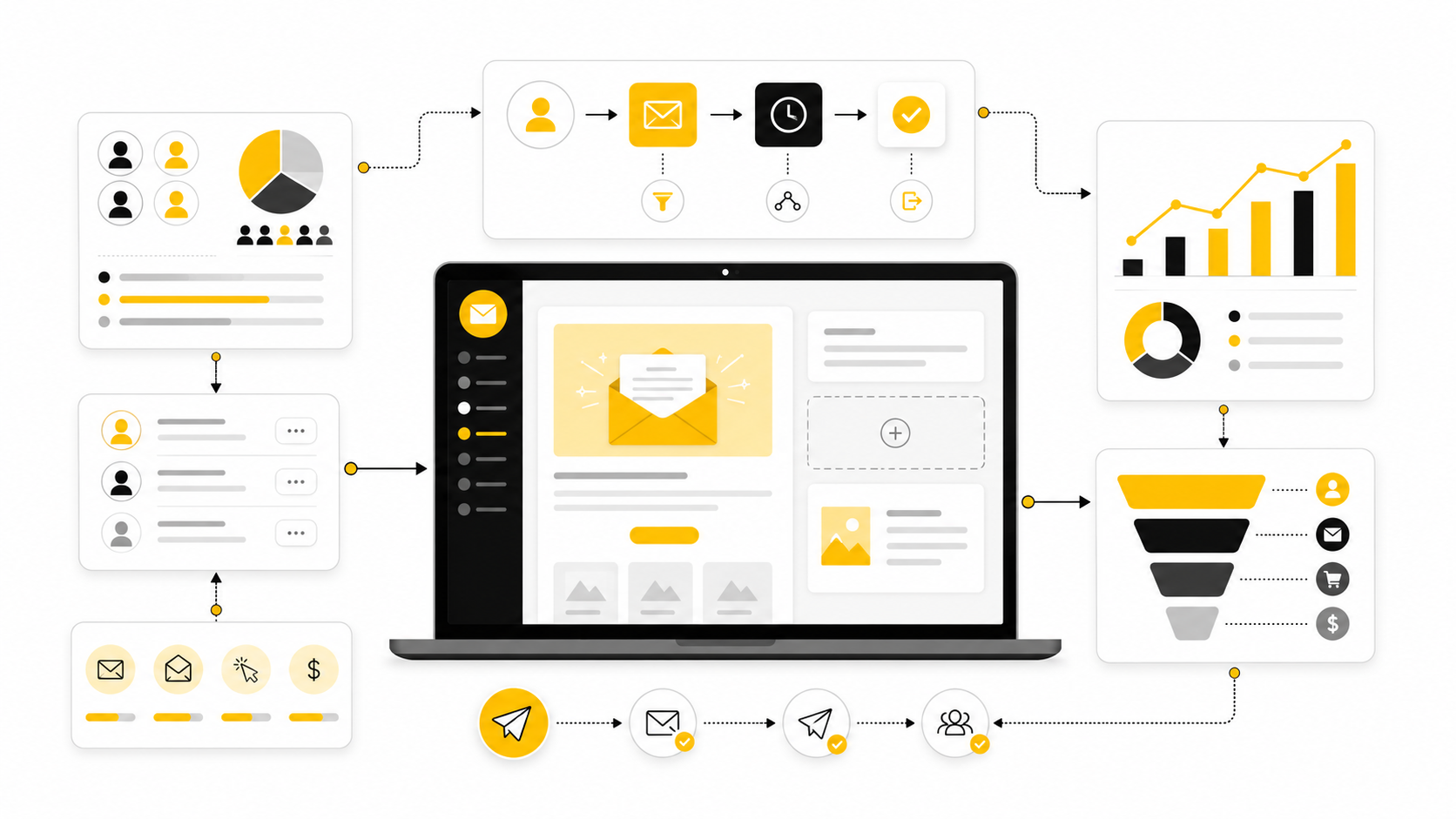
Email marketing tools in digital marketing are no longer just newsletter senders. They sit between your traffic, your CRM, your offers, your automation, and your revenue reporting. That is why choosing one badly creates problems that do not show up on day one but absolutely show up when your list grows, your campaigns become more complex, or your deliverability starts slipping.
Email still matters because it gives businesses something most platforms do not: a direct, owned communication channel. Social reach can drop overnight, ad costs can rise without warning, and search traffic can shift after an algorithm update. Email is different because the list is an asset you can segment, automate, measure, and improve over time.
That does not mean every business needs the same platform. A solo creator, ecommerce store, agency, SaaS company, coach, and local service business all have different needs. The best email marketing tool is not the one with the longest feature list; it is the one that fits your funnel, your customer journey, your budget, and your team’s ability to execute consistently.
Why Email Marketing Tools Still Matter In Digital Marketing
Email remains one of the most durable channels in digital marketing because it connects attention to action without depending entirely on rented platforms. Global research from DataReportal shows that email is still used by 75% of online adults at least monthly, which means it is still part of normal digital behavior rather than an outdated business habit. That matters because marketing tools should be built around where customers already pay attention, not just where marketers are currently excited.
The strongest reason email marketing tools matter is control. A good platform lets you collect subscribers, tag behavior, trigger automations, personalize messages, test offers, and track revenue in one connected system. Without that structure, email becomes random broadcasting, and random broadcasting is not a strategy.
The second reason is compounding value. Paid ads stop when the budget stops, but a healthy email list can keep producing sales, booked calls, repeat purchases, referrals, and content engagement for months or years. This is why businesses often use tools like Brevo, Moosend, or GoHighLevel not just to send emails, but to build a measurable follow-up system around leads and customers.
The Email Marketing Tool Framework
A practical framework for evaluating email marketing tools starts with one question: what job should the tool perform in your marketing system? Some platforms are built mainly for newsletters, some are built for ecommerce retention, some are built for agencies, and some are built for full CRM-driven automation. Once you understand the job, the feature comparison becomes much easier.
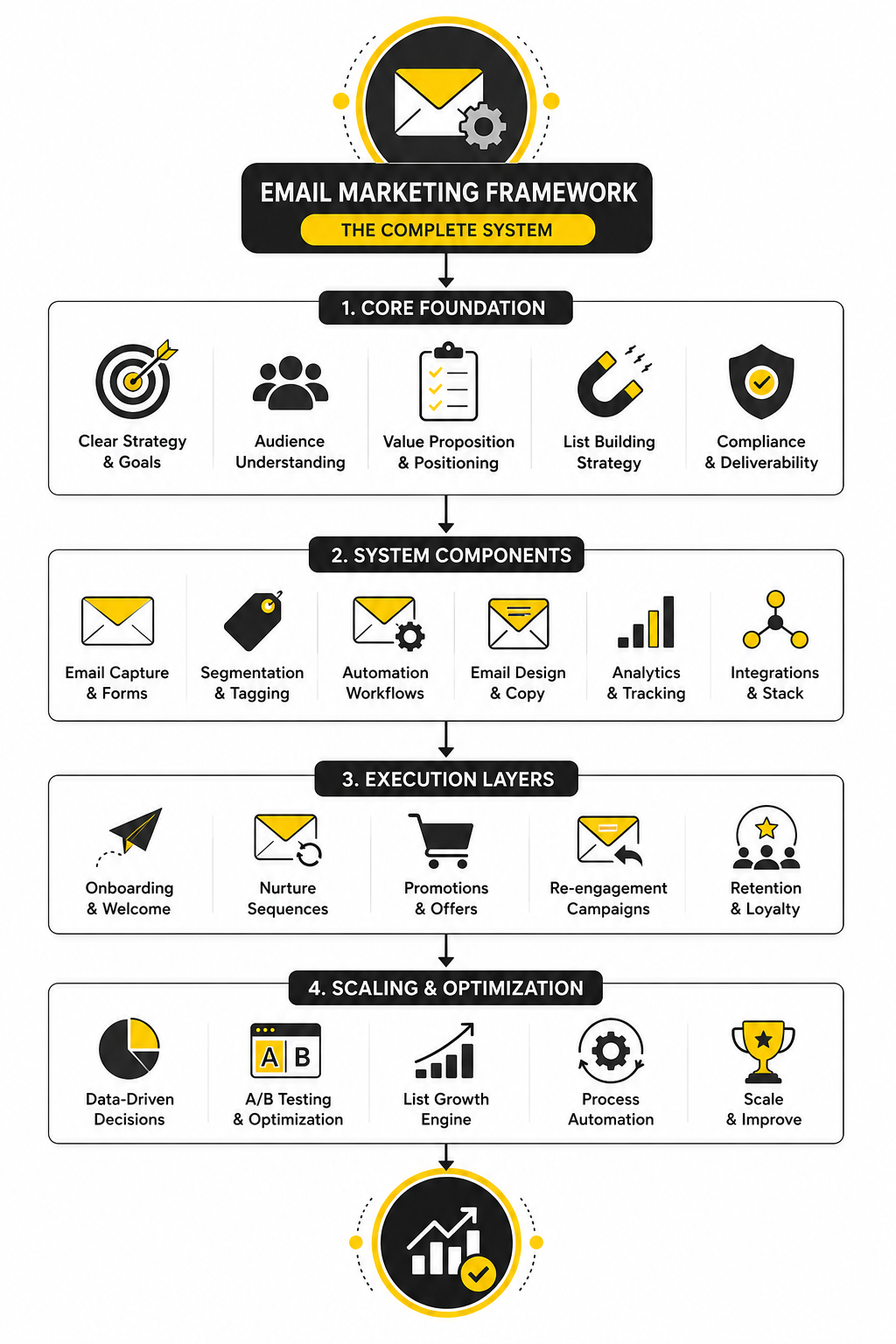
The framework has four layers: capture, organize, communicate, and optimize. Capture covers forms, landing pages, popups, checkout opt-ins, lead magnets, and integrations. Organize covers tags, lists, segments, custom fields, consent records, and CRM activity.
Communicate is where campaigns, newsletters, automations, transactional messages, and behavior-based follow-ups happen. Optimize is where reporting, testing, deliverability, attribution, AI support, and revenue measurement come in. Strong email marketing tools in digital marketing do not treat these as separate islands; they connect them so each subscriber gets a more relevant journey.
Core Components Every Email Marketing Platform Should Have
The first core component is reliable contact management. You need more than a place to store email addresses. You need clean segmentation, easy tagging, consent tracking, suppression controls, import hygiene, and the ability to understand where each subscriber came from.
The second component is automation. Basic autoresponders are useful, but modern email marketing depends on behavior-based workflows that react to signups, clicks, purchases, abandoned carts, lead score changes, form submissions, booking activity, or inactivity. This is where tools such as ManyChat can also support the broader journey when email is paired with chat or social messaging.
The third component is reporting that helps you make decisions. Open rates are less reliable than they used to be because privacy changes can distort them, so a serious platform should also help you track clicks, conversions, revenue, replies, unsubscribes, spam complaints, deliverability signals, and subscriber lifetime value. Sinch Mailgun’s 2026 email research found that fewer than half of organizations can reliably track email ROI, which is exactly why measurement should be treated as a platform requirement rather than a nice extra.
Professional Implementation Starts Before The First Campaign
Professional implementation begins with strategy, not software setup. Before choosing a platform, you should know your main offer, your lead source, your audience segments, your follow-up logic, and the business outcome you want email to drive. Otherwise, you risk buying a powerful tool and using it like a basic newsletter app.
The cleanest setup usually starts with a small number of high-value automations. A welcome sequence, lead nurture sequence, abandoned checkout flow, re-engagement campaign, customer onboarding flow, and post-purchase follow-up can often create more impact than sending random one-off campaigns every week. The goal is not to automate everything; the goal is to automate the moments where timing and relevance matter most.
Deliverability also belongs in the setup phase. Sender authentication, list quality, permission-based opt-ins, clear unsubscribe options, and consistent engagement all affect whether campaigns reach the inbox. Sinch Mailgun’s deliverability research found that DMARC adoption increased but many senders still do not use it or are unsure whether they do, which shows how easily technical basics can become revenue problems when they are ignored.
Statistics And Data
Email analytics should tell you what to do next, not just make a dashboard look busy. The mistake is treating benchmarks like a scoreboard instead of a diagnostic tool. A 40% open rate can be excellent for one list, weak for another, and almost meaningless if those opens do not turn into clicks, replies, booked calls, purchases, or retained customers.
The right way to read data is to connect each metric to a decision. Opens can help you judge subject lines and audience familiarity, but they are not reliable enough to carry the whole analysis. Clicks show message and offer interest, conversions show business impact, unsubscribes show audience-fit tension, and spam complaints show trust problems that can damage deliverability.
This is why email marketing tools in digital marketing should be judged partly by their reporting layer. A good tool does not just show campaign averages. It helps you understand performance by segment, source, workflow, offer, lifecycle stage, device, and revenue outcome.
The Metrics That Actually Matter
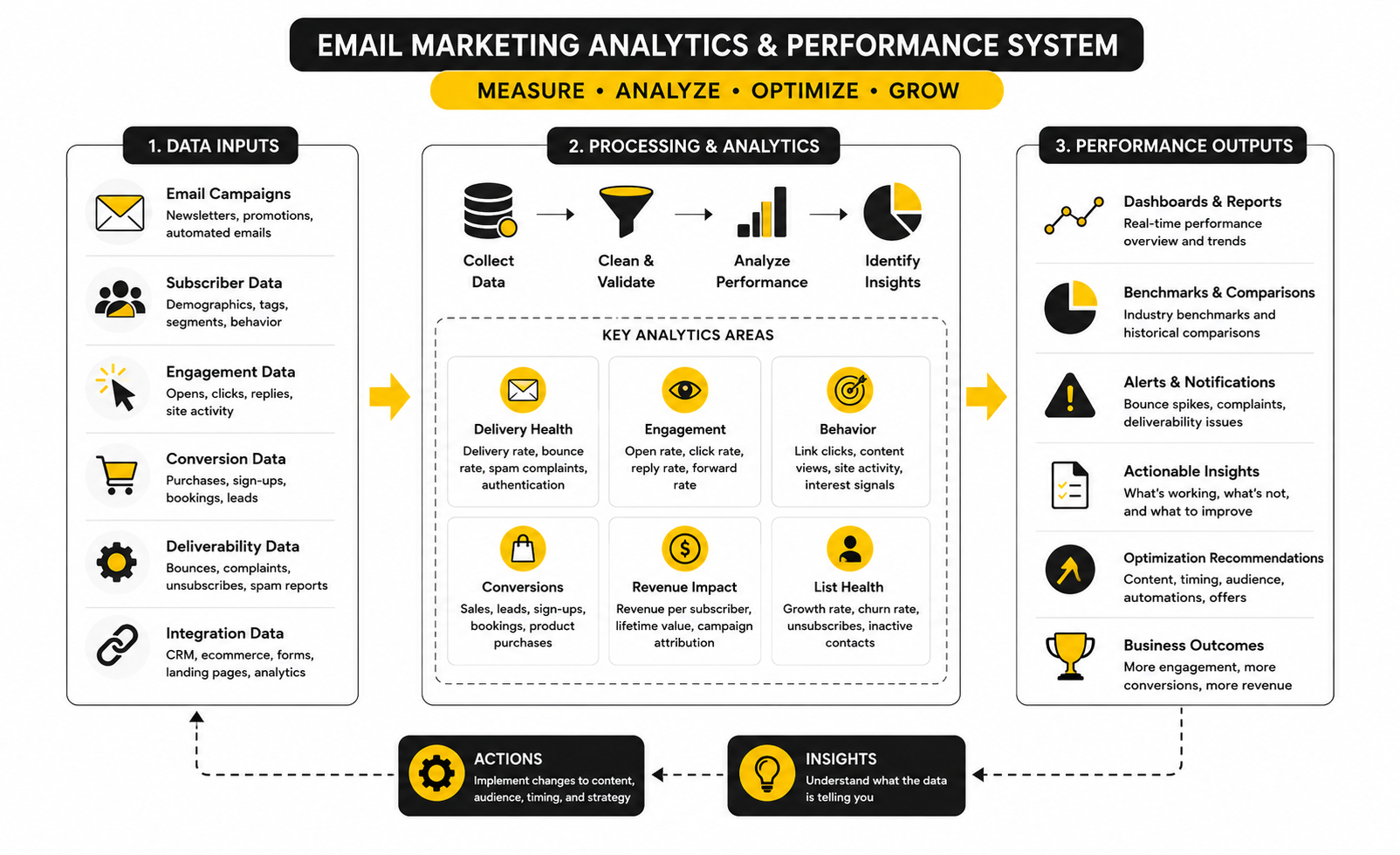
The most useful email metrics sit in three groups: delivery health, engagement quality, and business outcome. Delivery health includes bounce rate, spam complaints, unsubscribe rate, inbox placement, authentication status, and sender reputation. These numbers tell you whether your emails have a fair chance of being seen in the first place.
Engagement quality includes opens, clicks, click-to-open rate, replies, forwards, page visits, and meaningful behavior after the click. These metrics help you understand whether people are paying attention and whether the message matches their intent. But they need context, because a high open rate with weak clicks often means curiosity without enough motivation.
Business outcome is the most important group. This includes revenue, booked calls, trial signups, demo requests, orders, repeat purchases, upgrades, renewals, churn reduction, and revenue per subscriber. If an email platform cannot help you connect campaigns to these outcomes, you are only seeing the top half of the story.
Benchmarks Are Useful, But They Are Not The Goal
Benchmarks help you spot whether something is obviously broken. MailerLite’s 2026 benchmark analysis found that the average email open rate in 2025 was 43.46%, while the average click rate was 2.09%. Those numbers are useful as a rough reference, but they should not become the standard for every business.
Your own baseline matters more than the industry average. A small list of buyers may have lower open volume but higher revenue per send. A large educational list may generate strong engagement but weaker direct conversions because many subscribers are earlier in the journey.
Use benchmarks to ask better questions. If clicks are low, the issue may be weak offer alignment, unclear calls to action, poor segmentation, or a message that gives away the whole value without creating a next step. If unsubscribes rise, the issue may be frequency, relevance, expectation-setting, or a list source that attracted the wrong people.
Deliverability Data Is A Warning System
Deliverability metrics are the early-warning system for email performance. A campaign can have strong copy and a good offer, but it will underperform if mailbox providers stop trusting the sender. That is why spam complaints, bounces, blocklist issues, authentication, and inbox placement should be reviewed before blaming the creative.
Google’s bulk sender guidance says senders should keep spam rates below 0.1% and prevent them from reaching 0.3% or higher. That is a tiny margin. If your list is poorly sourced, over-mailed, or confused about why it is receiving your emails, a few complaint spikes can create real problems.
Validity’s 2025 deliverability benchmark reported that Europe had an inbox placement rate of 89.1%, which also means a meaningful share of legitimate email can still land somewhere other than the inbox. This is why serious teams monitor deliverability instead of assuming sent equals delivered. Sent is not the same as seen.
Open Rates Need Careful Interpretation
Open rates are still useful, but they are not as clean as they used to be. Privacy protections, image-loading behavior, bot activity, and mailbox filtering can make opens look higher or lower than real human attention. Treat them as directional signals, not final proof.
A high open rate with low clicks usually means the subject line created interest but the email did not create enough action. A low open rate with strong conversions may mean the campaign reached a smaller but highly qualified audience. A falling open trend over several campaigns may point to subject fatigue, weak segmentation, inconsistent sending, or declining inbox placement.
The action is simple: never analyze open rates alone. Compare opens with clicks, conversions, replies, unsubscribes, and complaint rates. That combination tells a more honest story than any single metric can.
Clicks Show Intent More Clearly Than Opens
Clicks are closer to intent because they require the subscriber to take a visible action. If people click a pricing page, product page, booking link, case study, or checkout link, they are signaling interest beyond passive reading. That makes click behavior one of the most useful triggers for segmentation and follow-up.
But clicks still need interpretation. A high click rate on an educational resource may not mean buyer readiness. A low click rate on a direct sales email may not mean the offer is bad if the audience was too cold for that ask.
The better question is what happened after the click. Did the person book, buy, reply, start checkout, visit more pages, or disappear? Email marketing tools in digital marketing become much more valuable when they help connect click behavior to the next step in the funnel.
Conversion Tracking Turns Email Into A Business Channel
Conversion tracking is where email stops being “content distribution” and becomes a measurable growth channel. If a campaign drives revenue, you should know which segment bought, which message influenced the action, and which automation assisted the sale. If a campaign drives leads, you should know how many became qualified opportunities, not just how many clicked.
This is why UTM structure, CRM integration, checkout tracking, and clean attribution rules matter. They are not just analytics chores. They help you decide which campaigns deserve more attention and which ones should be cut.
The businesses that win with email usually do not make every decision from one campaign. They look at patterns across segments, sources, offers, workflows, and time. One send can be noisy, but a consistent pattern is useful.
List Quality Data Protects Long-Term Performance
List size is overrated when the list is unhealthy. A smaller list of people who know you, trust you, and engage with your content is more valuable than a large list full of cold, stale, or poorly sourced contacts. Bigger is only better when quality stays intact.
Watch inactive subscribers, hard bounces, complaint rates, unsubscribe trends, and engagement decay by source. If one lead source produces weak engagement and high complaints, the problem may not be the email tool. The problem may be the promise, targeting, opt-in process, or lead quality.
Recent academic research on lead marketing found serious privacy and spam risks in some lead-generation ecosystems, including sensitive data being shared with many third parties and high-frequency downstream outreach after form submission. The practical lesson is direct: permission quality matters. If subscribers do not clearly understand what they opted into, your email performance will eventually pay the price.
Reporting Cadence Keeps The System Honest
Email reporting should happen at three levels: campaign review, automation review, and strategic review. Campaign review looks at individual sends within the first few days. Automation review looks at workflow performance over enough volume to see meaningful patterns.
Strategic review happens monthly or quarterly. This is where you compare channels, segments, offers, list growth, list decay, revenue, and customer movement through the funnel. It is also where you decide whether to create a new workflow, retire a weak sequence, adjust frequency, or change lead sources.
A simple reporting rhythm is better than a complicated dashboard nobody uses. Track the few numbers that drive decisions, review them consistently, and improve one part of the system at a time. That is how measurement becomes useful instead of decorative.
Build a stronger local presence with BAAM AI
Turn your website, Google profile, social channels, and AI visibility into one growth engine
Most businesses do not need more random marketing activity. They need a consistent presence system that helps the right people find them, trust them, and take action. BAAM AI brings strategy, local SEO, website updates, Google Maps visibility, social content, AI-search readiness, media production, and reporting into one practical monthly engine.
If you want your marketing to keep working after the campaign ends, start with a free BAAM AI presence audit. See how your business shows up today and where the fastest visibility wins are at BAAM AI.