
BAAM AI Blog
Email Marketing Tactics That Still Work When Inboxes Are Overloaded
Email marketing tactics are not about sending more emails. They are about earning more attention from the right people, at the right moment, with a message that feels useful enough to open, click, reply to, or buy...
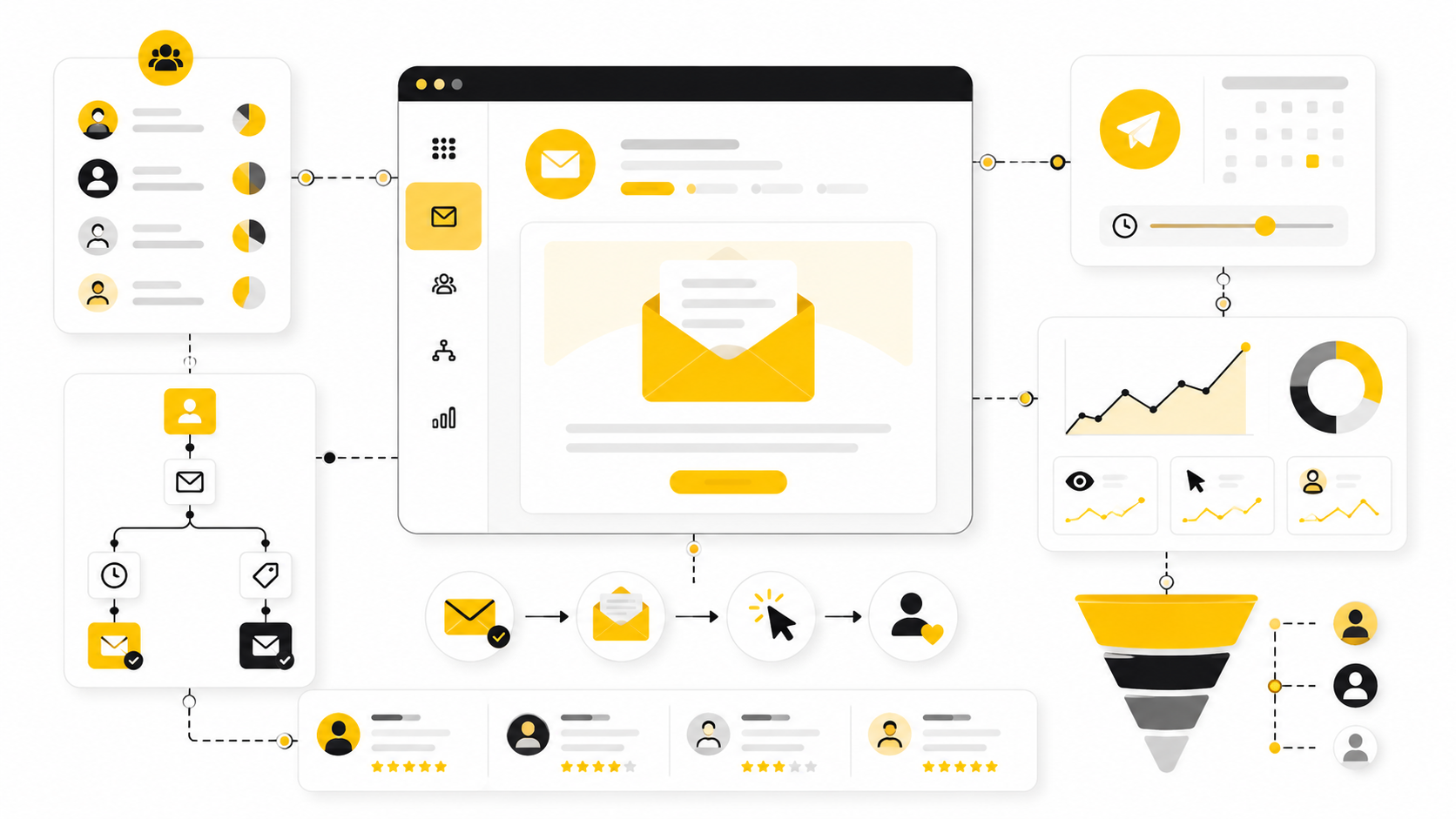
Email marketing tactics are not about sending more emails. They are about earning more attention from the right people, at the right moment, with a message that feels useful enough to open, click, reply to, or buy from. That difference matters because email is still one of the few marketing channels where you can build a direct relationship with your audience instead of renting attention from an algorithm.
But the inbox has changed. Gmail, Yahoo, Microsoft, and other mailbox providers are now stricter about authentication, spam complaints, and unsubscribe friction, which means sloppy email marketing is not just annoying anymore; it can quietly destroy deliverability. Google’s sender rules tell bulk senders to keep spam rates below 0.1% and avoid ever reaching 0.3%, which is a clear sign that relevance is now a technical requirement, not just a copywriting preference: Google’s email sender guidelines explain the spam-rate threshold clearly.
At the same time, email still has serious upside when it is handled properly. The UK Data & Marketing Association’s 2025 benchmark report showed delivery rates rising to 98%, open rates reaching 35.9%, and unique click rates reaching 2.3%, which proves the channel is not dead; weak strategy is the problem: the DMA Email Benchmarking Report 2025 highlights those performance benchmarks. Other benchmark data points in the same direction: generic broadcast emails usually perform worse than behavior-based and journey-based campaigns, while personalized and targeted emails tend to produce stronger engagement: MoEngage’s 2025 benchmark analysis reviewed 17.3 billion B2C emails.
this guide is built for practical operators: founders, marketers, ecommerce teams, creators, agencies, SaaS teams, and service businesses that want email to produce revenue without burning the list. We are not going to treat email like a random newsletter calendar. We are going to build it like a system: clear positioning, clean list growth, useful segmentation, stronger campaigns, automated flows, deliverability discipline, and measurement that connects email to business outcomes.
This guide is split into six parts so each section can go deep without turning into a messy checklist. The structure starts with strategy, then moves into execution, optimization, automation, and measurement. Each part builds on the previous one, so the full article reads like one practical operating system for better email marketing.
Why Email Marketing Tactics Still Matter
Email matters because it sits closer to the sale than most channels. A social post can create awareness, a search result can capture intent, and an ad can interrupt the right audience, but email can continue the relationship after the first click. That makes it especially valuable for businesses where trust, timing, education, and repeat purchases influence revenue.
The mistake is thinking that “email marketing” means sending promotions until the list gets tired. Good email marketing tactics create a rhythm: welcome people properly, learn what they care about, send useful messages, make relevant offers, and remove friction when they are ready to act. Bad tactics treat every subscriber the same and then blame the subject line when performance drops.
This is also why deliverability and strategy now belong in the same conversation. A better subject line cannot fix a bad list, weak consent, poor segmentation, or a sender reputation damaged by irrelevant blasts. If your emails are unwanted, mailbox providers will notice before your dashboard gives you a clean explanation.
Framework Overview
The simplest way to think about email marketing is as a loop, not a calendar. You attract the right subscribers, capture meaningful data, send relevant messages, measure behavior, and use what you learn to improve the next send. The loop becomes stronger when every tactic has a job instead of existing because “we should email the list.”
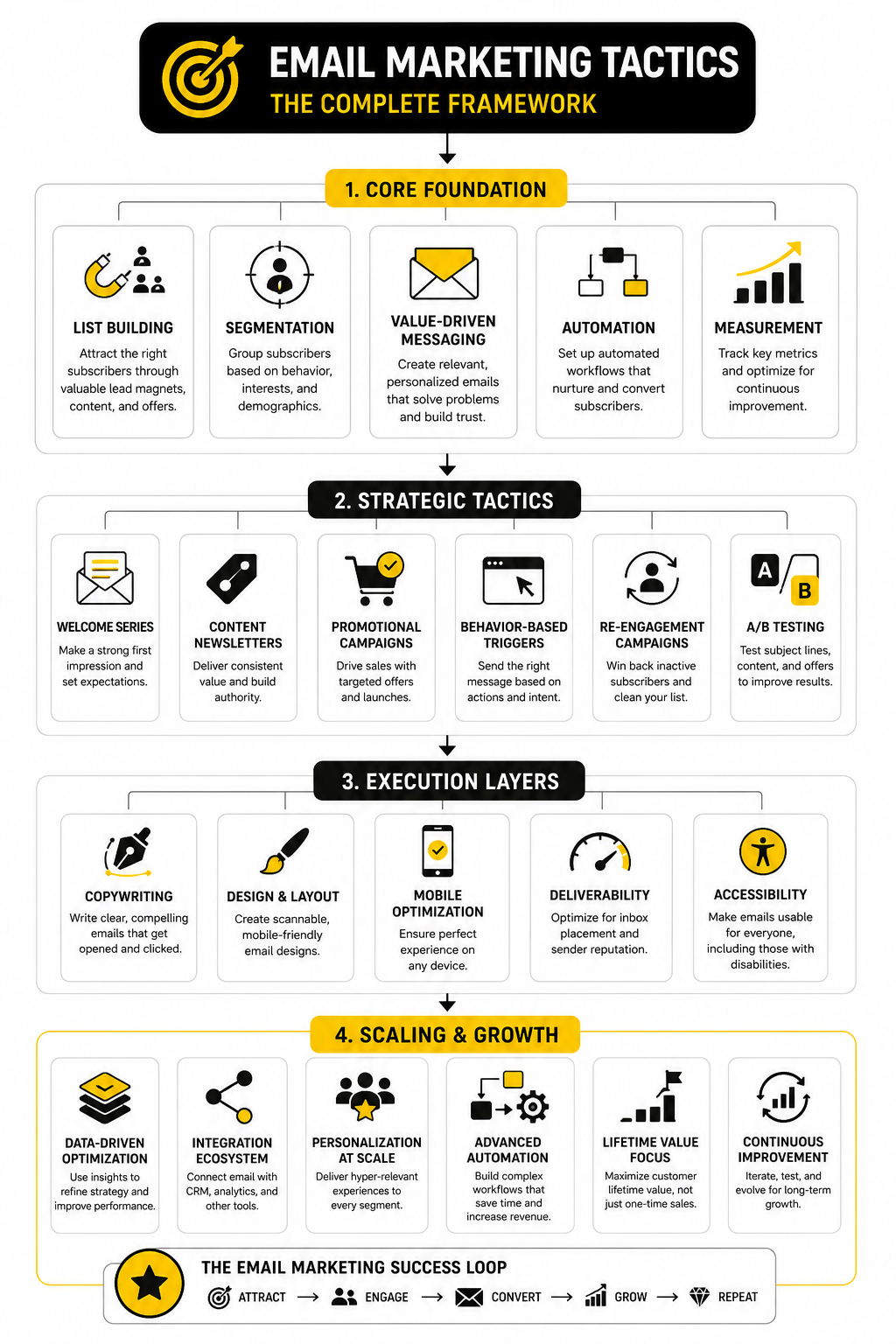
A strong email system has four layers. The first layer is audience quality, because a smaller list of people who actually want your emails beats a large list of passive contacts. The second layer is message relevance, because people respond when the email connects to their problem, purchase intent, lifecycle stage, or recent behavior.
The third layer is conversion design, which means the email has one clear next step instead of five competing calls to action. The fourth layer is deliverability and measurement, because even great emails fail if they do not reach the inbox or if nobody can connect the send to revenue. When these layers work together, email stops feeling like a content chore and starts acting like a predictable growth asset.
Core Components of Effective Email Marketing
The first core component is list growth with clear intent. A subscriber who joins for a specific promise is easier to serve than someone collected through a vague discount popup. That promise could be a useful guide, a product launch waitlist, a quiz result, a webinar, a free consultation, or a practical newsletter with a clear point of view.
The second component is segmentation. Segmentation does not have to mean building 47 complicated audience groups on day one. It usually starts with simple splits like new subscribers, engaged buyers, inactive contacts, leads by interest, customers by product category, or prospects by stage of awareness.
The third component is the offer. Every email does not need to sell, but every email should move the relationship somewhere useful. That might mean helping the reader understand a problem, compare options, see proof, take a small action, or confidently make a purchase.
The fourth component is timing. A welcome email sent immediately after signup has a different job than a reactivation email sent after 90 days of silence. Good email marketing tactics respect where the reader is in the relationship instead of forcing every message into the same promotional template.
Professional Implementation Starts With Restraint
Professional email marketing is not about adding every tool, automation, and AI feature at once. It starts with restraint: fewer messages, clearer goals, cleaner data, and stronger reasons to send. The brands that win are usually not the ones sending the most; they are the ones sending messages that feel expected, useful, and easy to act on.
That said, tools matter when they remove friction from the system. A business that needs CRM, funnels, automation, pipeline tracking, and campaign management in one place may look at GoHighLevel, while a creator or small business that wants a simpler funnel and email setup may prefer Systeme.io. Ecommerce and campaign-heavy teams may also consider email platforms such as Brevo or Moosend when the priority is campaign execution and marketing automation.
The point is not to pick software before strategy. The point is to choose a platform that supports the way your business actually sells, follows up, segments, and measures results. A messy email strategy inside an expensive tool is still a messy email strategy.
What This Guide Will Help You Build
By the end of this guide, you should have a practical email marketing system instead of a folder full of disconnected tactics. You will know how to think about list quality, campaign planning, segmentation, automation, deliverability, testing, and revenue tracking in the right order. That order matters because most email problems are not isolated; they are symptoms of a weak system.
You will also see where simple beats clever. A clear welcome sequence beats a complicated automation nobody maintains. A relevant offer beats a flashy template. A clean list beats a bloated list. A consistent measurement habit beats guessing from open rates alone.
Most importantly, you will be able to make better decisions before you press send. That is where email marketing tactics become valuable. Not when they make the campaign look busier, but when they make the message more relevant, the next step clearer, and the result easier to measure.
Build the Foundation Before You Send More Emails
Before you test subject lines, write clever campaigns, or build advanced automations, you need the foundation right. Most weak email programs do not fail because the brand forgot one magic tactic. They fail because the list is messy, the offer is vague, the audience is poorly understood, and the sending rhythm has no real strategy behind it.
This is where email marketing tactics become useful instead of random. A tactic only works when it supports a clear business goal. Sending a welcome sequence, segmenting buyers, writing a launch campaign, or cleaning inactive subscribers should all connect to the same question: what does the reader need next, and what action should the business reasonably ask for?
The foundation is not glamorous, but it protects everything that comes later. If the wrong people are on your list, even great copy will struggle. If your positioning is unclear, automation will only help you send confusion faster. If your data is unreliable, personalization becomes decoration instead of relevance.
Define the Job of Your Email Program
Your email program needs a job before it needs more campaigns. For some businesses, email is mainly a sales channel that turns leads into booked calls or purchases. For others, it is a retention channel that keeps customers engaged, educated, and ready to buy again.
The job can also change by segment. A new subscriber may need trust and orientation. A product viewer may need comparison help. A recent buyer may need onboarding, usage tips, and reasons to come back. Treating all of those people the same is one of the fastest ways to make email feel generic.
Start by choosing one primary role for email in your business right now. That role might be lead nurturing, ecommerce revenue, event attendance, customer education, review generation, referral growth, or reactivation. Once the role is clear, your email marketing tactics become easier to prioritize because you can separate what looks interesting from what actually moves the business.
Clean Up the List Before Scaling Campaigns
A bigger list is not always a better list. A list full of inactive, uninterested, or poorly sourced contacts can hurt performance because mailbox providers pay attention to how people respond. Low engagement, spam complaints, hard bounces, and ignored emails all create signals that make future campaigns harder to place well.
List quality starts with permission. People should know why they are joining, what kind of emails they will receive, and what value they can expect. That does not mean your signup form needs to be long, but it does mean the promise should be specific enough to attract the right people.
You also need a simple process for handling inactive subscribers. Do not panic and delete everyone who misses a few emails, but do not keep sending forever to people who never open, click, buy, reply, or visit. A re-engagement sequence can give them one clear chance to stay, and then you can suppress people who still show no sign of interest.
Make the Signup Promise Specific
The signup promise shapes everything that follows. If someone joins because they were promised weekly ecommerce growth tips, your first emails should not suddenly become random company updates. If someone joins for a discount, you need to move them from price-based interest into product value before every future email becomes a coupon negotiation.
Specific promises also help with segmentation from the start. A quiz, checklist, webinar, buying guide, waitlist, or comparison page tells you something about the subscriber’s intent. That first signal can guide the welcome sequence, the offer, and the next campaign they receive.
A vague signup promise attracts vague attention. A strong signup promise attracts people with a reason to care. That difference matters because the first few emails after signup are where you train the reader to either pay attention or ignore you.
Map the Customer Journey Before Writing Campaigns
Email becomes easier when you stop thinking only in campaigns and start thinking in stages. A subscriber does not move from stranger to customer in one emotional leap. They usually pass through awareness, interest, evaluation, decision, onboarding, retention, and sometimes reactivation.
Each stage needs a different kind of message. Awareness-stage emails should clarify the problem and make the reader feel understood. Evaluation-stage emails should reduce uncertainty, explain tradeoffs, and show why your offer makes sense. Post-purchase emails should help the customer succeed, because a confused buyer is less likely to buy again.
This map does not need to be complicated. Write down the main stages your audience passes through, then list the questions they ask at each stage. Those questions become campaign ideas, automation topics, and segmentation triggers without forcing you to invent content from scratch.
Collect Only the Data You Will Actually Use
More data is not always better. Many businesses collect fields they never use, then complain that personalization feels difficult. Good email data is not about knowing everything; it is about knowing enough to send a more relevant message.
Start with practical data points. That might include source of signup, product interest, purchase history, lead stage, location, company type, content preference, or last engagement date. Each field should have a purpose, and you should be able to explain how it changes the email someone receives.
This is also where your tools need to support your process instead of adding noise. A business that needs funnels, CRM stages, follow-up automation, and sales pipeline visibility may want an all-in-one setup like GoHighLevel. A leaner business that wants landing pages, email sequences, and simple funnel infrastructure may find Systeme.io easier to manage.
Build a Simple Segmentation System
Segmentation does not need to be intimidating. In the beginning, you only need a few useful groups that change what people receive. The goal is not to create complexity; the goal is to avoid sending the same message to people with completely different needs.
A practical starting structure can include:
These groups help you write with more context. A first-time customer does not need the same message as a cold subscriber. A repeat buyer does not need the same proof as someone who has never purchased. The more your emails reflect that reality, the less your campaigns feel like blasts.
Set a Sending Rhythm You Can Sustain
Consistency matters, but only when the emails are worth receiving. Sending once a week with useful, relevant content is usually better than sending five times in a burst and then disappearing for a month. The reader should feel that your emails have a recognizable rhythm and a clear reason to exist.
Your rhythm should match your business model. A daily deals brand can email more often than a high-ticket consulting firm. A newsletter-led creator business may need a dependable publishing schedule, while a SaaS company may rely more on lifecycle triggers and product education.
The key is to avoid making frequency decisions from panic. Do not email more just because revenue is slow. Do not disappear because one campaign underperformed. Build a rhythm you can maintain, then use engagement and revenue data to adjust it with discipline.
Prepare the Core Email Types First
Before chasing advanced tactics, build the essential email types every serious program needs. These are the emails that protect the relationship, explain the offer, and turn moments of intent into action. Once these are working, more advanced campaigns have something solid to build on.
The core email types usually include:
Each one has a different job. The welcome sequence sets expectations. The nurture sequence builds trust. The offer campaign asks for action. The post-purchase sequence improves the customer experience. The re-engagement sequence protects list quality before disengagement becomes a deliverability problem.
Match the Platform to the Business Model
The best platform is the one that fits how your business sells. Ecommerce teams often need strong product, customer, and purchase behavior data. Agencies and service businesses may care more about CRM stages, appointment booking, pipeline automation, and follow-up workflows.
For campaign-heavy teams that want dedicated email and automation features, tools like Brevo or Moosend can make sense. For businesses that use landing pages and funnels as the center of their email strategy, ClickFunnels may fit better when the priority is turning traffic into leads and buyers through structured funnel flows.
Do not choose based only on feature lists. Choose based on the daily workflow your team will actually use. A simpler tool used consistently will beat an advanced tool that nobody maintains.
Create Your First Email Strategy Document
A basic strategy document can prevent months of scattered execution. It does not need to be long. It just needs to define who the list is for, what the business wants email to accomplish, what segments matter, what offers will be promoted, and how performance will be reviewed.
Include the essentials:
This document gives your email marketing tactics a home. When someone suggests a new campaign, automation, or promotion, you can compare it against the strategy instead of making every decision from scratch. That is how email becomes calmer, cleaner, and much more profitable over time.
Create Campaigns People Actually Want to Open
Once the foundation is in place, the next job is execution. This is where email marketing tactics move from strategy documents into actual campaigns people receive in their inbox. The goal is not to make every email dramatic, clever, or loud. The goal is to make every email feel worth opening because the reader trusts that you usually send something relevant.
That starts with the campaign idea, not the subject line. A weak idea with a clever subject line may earn curiosity once, but it damages trust if the email itself does not deliver. A strong idea can be simple: solve one problem, explain one decision, share one useful insight, make one relevant offer, or help the reader take one next step.
Campaign execution works best when you treat attention like a relationship, not a trick. The subject line earns the open, the first few lines prove the email is worth reading, the body makes the point useful, and the call to action gives the reader a clear next move. When any part of that chain is weak, the campaign leaks.
Start With One Clear Campaign Goal
Every campaign should have one primary goal. Not three goals. Not a vague goal like “engagement.” One clear goal that tells you what the email is supposed to do and how you will judge whether it worked.
That goal could be a click, a reply, a purchase, a booked call, a form submission, a product view, a webinar registration, a review, or a reactivation signal. The goal affects the entire email. A campaign built to drive replies should sound more personal and ask a low-friction question, while a campaign built to sell should make the offer clear and remove buying hesitation.
This is where many teams overcomplicate email. They try to educate, entertain, announce, sell, cross-sell, ask for feedback, and drive social follows in one message. That creates a crowded email with no obvious priority, and crowded emails usually create passive readers.
Choose the Campaign Type Before Writing
A campaign type gives the email a shape before you start writing. Without that shape, you end up staring at a blank page or writing a generic newsletter that says a little bit of everything. The right format makes the message easier to produce and easier for the reader to understand.
Useful campaign types include:
Each type has a different reader expectation. An educational email should teach something useful before asking for action. A comparison email should help the reader make a decision without pretending every option is identical. A re-engagement email should be direct, respectful, and easy to respond to.
Build the Email Around the Reader’s Moment
The same message can feel helpful or annoying depending on timing. A discount might feel useful to someone comparing options, but lazy to someone who just joined your list for education. A detailed product walkthrough might help a serious prospect, but overwhelm someone who still barely understands the problem.
Before writing, define the reader’s moment. Are they new? Curious? Comparing? Hesitant? Already a customer? Inactive? Ready to buy but stuck on one objection? That one decision will make your email sharper than another round of generic personalization.
Good email marketing tactics come from matching the message to the moment. If the reader is early, help them understand the problem. If they are evaluating, help them compare and reduce risk. If they have already bought, help them get value faster so the relationship becomes stronger after the transaction.
Use a Practical Campaign-Building Process
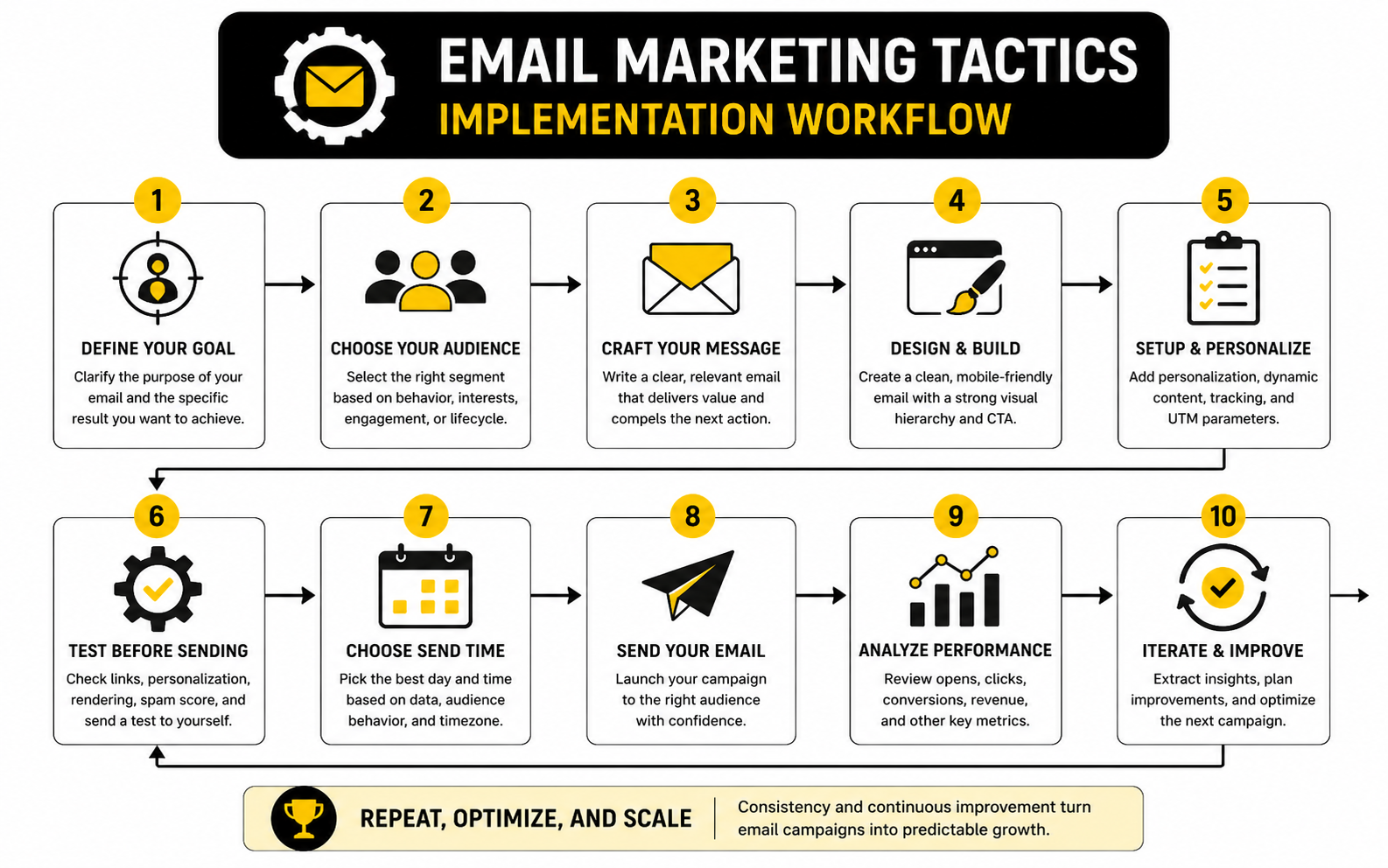
A repeatable process keeps email execution from becoming chaotic. You do not need a 40-step workflow, but you do need enough structure to avoid rushed campaigns, unclear offers, and last-minute mistakes. The more often you send, the more this matters.
A simple process looks like this:
This process works because it forces decisions in the right order. You choose the audience before the message. You choose the campaign type before the copy. You choose the call to action before decorating the email with extra links.
Write Subject Lines That Match the Email
Subject lines should create honest curiosity. They should make the right person want to open without misleading them about what is inside. That balance is important because an exaggerated subject line may win one open and lose future trust.
Strong subject lines are usually specific, useful, timely, or emotionally clear. They do not need to be complicated. A straightforward subject line often beats a vague clever one because the reader instantly understands why the email matters.
Preview text also deserves attention. Many teams treat it like an afterthought, but it often appears beside the subject line and helps the reader decide whether to open. Use it to add context, strengthen the promise, or clarify the benefit instead of wasting it on repeated text or technical filler.
Make the Opening Earn the Next Line
The opening lines decide whether the reader keeps going. This is not the place for long greetings, vague updates, or corporate warm-up. Start with the reader’s problem, desire, timing, or context so they immediately feel the email is for them.
A strong opening can name a frustration, point out a mistake, frame a useful idea, or connect to the reason they subscribed. It should make the reader think, “Yes, this is relevant.” Once that happens, the rest of the email has permission to explain, teach, or sell.
Keep the opening tight. You are not writing a landing page. You are earning one more scroll, one more sentence, and eventually one clear action.
Keep the Body Focused on One Main Idea
Most campaign emails get weaker when they try to do too much. The body should develop one main idea with enough context to make the call to action feel natural. If you need to explain three separate things, you probably need three separate emails.
The body can use short paragraphs, bullets, or a simple numbered flow, but structure is not the same as clarity. Clarity comes from knowing what the reader needs to believe, understand, or feel before taking action. Every sentence should support that movement.
This matters even more now because inbox competition is intense. The DMA’s 2025 benchmark data showed unique click rates reaching 2.3%, which means clicks are valuable and not automatic even when delivery and opens are strong: the DMA Email Benchmarking Report 2025 shows how engagement benchmarks are moving. The email body has to make the click feel like the obvious next step.
Make the Call to Action Obvious
A good call to action does not make the reader work. It tells them what to do next and why that action makes sense now. That does not mean every CTA needs to be aggressive, but it does need to be clear.
For sales emails, the CTA might point to a product page, checkout, demo request, or booking page. For educational emails, it might lead to a guide, video, checklist, or deeper article. For relationship-building emails, it might invite a reply with a simple question.
Avoid stacking too many competing CTAs in one email. When you ask the reader to read the blog, follow on social, book a call, watch a video, buy the product, and forward the email, you are not giving options; you are creating hesitation. One primary action is cleaner.
Design for Fast Reading
Email design should support the message, not compete with it. Many effective emails are simple because they load quickly, scan easily, and work well on mobile. The reader should be able to understand the point even if they only skim the first screen.
Use spacing, short paragraphs, clear links, and readable formatting. Make buttons or text links easy to identify, and avoid burying the main action under too much visual noise. If the email needs product visuals, use them to clarify the offer, not to decorate the campaign.
Mobile matters because many readers will see the email on a small screen first. A beautiful desktop layout that becomes cramped on mobile is not professional; it is friction. Test the email where your audience actually reads.
Build Campaigns From Reusable Blocks
A strong email program gets easier when you create reusable campaign blocks. These are not lazy templates. They are proven structures that help you write faster while keeping the message consistent.
Reusable blocks can include:
These blocks make your campaigns easier to produce without making them feel identical. The trick is to reuse the structure while changing the insight, offer, audience, and timing. That keeps execution efficient without turning the list into a template graveyard.
Use Campaign Calendars Without Becoming Robotic
A campaign calendar helps you plan ahead, but it should not trap you into sending emails just because a slot exists. The calendar should create rhythm, not force irrelevant messages. If there is no useful reason to send, fix the idea before you force the campaign.
A practical calendar includes the send date, audience segment, campaign type, goal, offer, owner, status, and post-send notes. It should also show major launches, seasonal moments, content themes, and customer lifecycle needs. That way you can balance sales, education, retention, and reactivation instead of overloading the list with one kind of message.
Tools can help here when the process has multiple moving parts. Teams that plan email alongside social content may find Buffer useful for keeping broader marketing output organized, while teams that use forms, surveys, or lead capture logic can connect campaign planning to cleaner inputs through Fillout. The point is not to add tools for the sake of it; it is to reduce avoidable execution friction.
Review Every Campaign Before Sending
A pre-send review is not optional if email drives revenue. Small mistakes can be expensive: broken links, wrong segments, missing tracking, poor mobile rendering, incorrect pricing, outdated offers, or confusing unsubscribe placement. The bigger the list, the more discipline this requires.
Review the campaign from the reader’s perspective first. Is the promise clear? Is the opening relevant? Is the CTA obvious? Is there any reason the reader might feel misled by the subject line?
Then review the campaign from the operator’s perspective. Confirm the segment, suppression rules, send time, UTM tracking, links, product availability, landing page match, and mobile layout. This is not glamorous work, but it is the kind of work that separates professional email execution from random sending.
Statistics and Data
Email data is only useful when it changes what you do next. A dashboard full of open rates, clicks, conversions, unsubscribes, spam complaints, and revenue numbers can look impressive, but it does not automatically create better decisions. The point of measurement is to separate signal from noise so your email marketing tactics improve over time instead of drifting from campaign to campaign.
Benchmarks can help, but they should not become your strategy. A benchmark tells you what is normal in a wider market, not what your list, offer, audience, and buying cycle should produce. Use benchmarks as a reference point, then judge performance against your own baseline, your own segments, and your own business goals.
This matters because different metrics answer different questions. Open rate tells you something about attention and inbox visibility, but it does not prove revenue. Click rate tells you whether the message and offer created enough intent to move forward, but it does not prove the landing page converted. Revenue per recipient tells you much more about business impact, but it can hide early-stage relationship building if you only judge every send by immediate sales.
Track the Metrics That Match the Campaign Goal
The campaign goal should decide the metric that matters most. If the goal is to sell, revenue, conversion rate, average order value, and revenue per recipient matter more than open rate. If the goal is to educate, clicks, scroll behavior on the linked page, replies, saves, or later-stage conversion might matter more.
This is where many email reports go wrong. They treat every campaign like it should be judged by the same scoreboard. A re-engagement email, a launch email, a product education email, and a post-purchase onboarding email do not have the same job, so they should not be reviewed as if they do.
A simple reporting rule works well: pick one primary metric and two supporting metrics before the campaign is sent. That keeps the review honest. You are less likely to cherry-pick a vanity metric afterward if you already defined success before hitting send.
Understand What Opens Can and Cannot Tell You
Open rate is still useful, but it needs context. Apple’s Mail Privacy Protection changed how opens are measured because it can preload email content through proxy servers, which makes opens less precise than they used to be. That does not make opens worthless, but it does mean they should not be treated as the final proof of campaign performance.
The DMA’s 2025 email benchmarking report showed delivery rates rising to 98%, open rates reaching 35.9%, and unique click rates reaching 2.3%, which gives marketers a useful market reference without pretending every brand should match the same numbers: the DMA Email Benchmarking Report 2025 breaks down those engagement benchmarks. The practical takeaway is simple: if delivery and opens are healthy but clicks are weak, the issue is probably not only the subject line. The body, offer, segment, or call to action may be the real problem.
Open rate should mainly help you spot patterns. If opens suddenly drop across multiple sends, check deliverability, list quality, sender reputation, and subject-line relevance. If one campaign has high opens but poor clicks, the subject line may have created curiosity that the email failed to satisfy.
Clicks Show Intent More Clearly
Clicks are usually stronger engagement signals than opens because they require action. A subscriber who clicks is showing some level of intent, interest, or curiosity beyond passive inbox behavior. That makes click data especially useful for segmentation, follow-up, and offer planning.
But click rate still needs interpretation. A high click rate on a free guide does not mean the same thing as a high click rate on a paid offer. A low click rate on a relationship-building email may be acceptable if the goal was replies or trust, while a low click rate on a sales campaign should trigger a deeper review.
Look at click distribution, not just total clicks. If most clicks go to the first link, your main CTA is probably clear. If clicks scatter across several links, your email may be too unfocused. If one segment clicks heavily while another ignores the campaign, the answer is not “send better emails” in general; it is “send more relevant emails to each group.”
Conversions Connect Email to Business Outcomes
Conversions are where email starts proving business value. A conversion might be a purchase, booked call, demo request, webinar registration, trial start, subscription upgrade, review submission, or account activation. The right conversion depends on the job of the campaign.
The important part is to avoid measuring email only inside the email platform. Email platforms can show opens and clicks, but the real business outcome often happens on the website, checkout page, booking page, CRM, or product dashboard. That means your tracking needs to connect email behavior to the next system in the journey.
Use consistent UTM parameters, dedicated landing pages when needed, and clean CRM or ecommerce attribution. Tools like GoHighLevel can help service businesses connect email follow-up to pipeline movement, while funnel-focused teams using ClickFunnels can connect email campaigns to funnel steps and offer performance. The tool is not the strategy, but clean tracking makes the strategy visible.
Build a Simple Analytics System
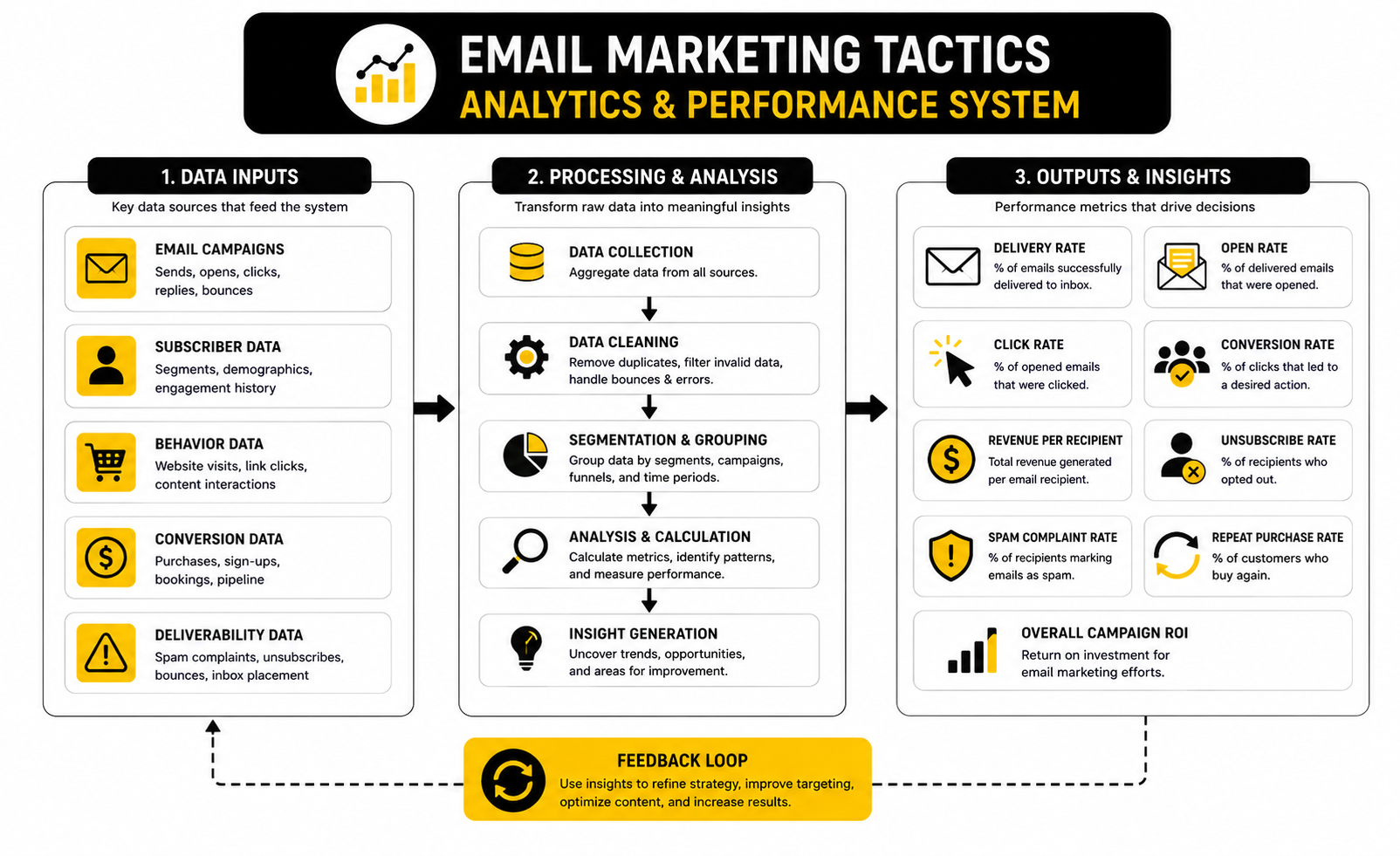
A useful analytics system does not need to be complicated. It needs to answer the same core questions after every meaningful campaign: who received the email, who engaged, who acted, who bought, who complained, and what should change next time. If your reporting cannot answer those questions, it is probably too shallow or too scattered.
A simple system can track:
The final two fields matter more than most teams think. “Main lesson” turns data into learning. “Next action” turns learning into a change in the next campaign. Without those two fields, reporting becomes a screenshot habit instead of an improvement process.
Watch Deliverability Signals Before They Become Revenue Problems
Deliverability problems usually show up in the numbers before they show up in a clear crisis. A slow decline in opens, rising bounces, falling clicks, higher unsubscribes, or complaint spikes can all indicate that your list quality, relevance, or sending behavior needs attention. Waiting until revenue drops is too late.
Google’s sender guidance tells bulk senders to keep reported spam rates below 0.1% and prevent them from reaching 0.3% or higher: Google’s sender guideline FAQ explains the spam-rate thresholds. Yahoo also tells senders to support one-click unsubscribe for marketing and subscribed messages: Yahoo’s sender best practices explain the unsubscribe requirement. These are not abstract compliance details; they affect whether future emails keep reaching the inbox.
Spam complaints are especially serious because they are negative intent signals. A few unsubscribes are normal and often healthy because they remove people who no longer want your messages. Complaints are different. They tell mailbox providers that people feel your email should not have been there in the first place.
Read Unsubscribes Correctly
Unsubscribes are not automatically bad. If someone is no longer interested, letting them leave easily is better than forcing them to mark the email as spam. A clear unsubscribe process protects trust, keeps the list cleaner, and supports better deliverability over time.
The question is why people are unsubscribing. If unsubscribes rise after a sales push, the issue may be frequency, offer mismatch, weak segmentation, or a list that was never properly warmed up. If unsubscribes rise after a topic shift, the message may have broken the original signup promise.
Do not treat every unsubscribe as a failure. Treat patterns as feedback. A small number of uninterested people leaving the list is normal; a sudden spike from an important segment deserves investigation.
Use Benchmarks Without Copying Them Blindly
Benchmarks are useful when they help you ask better questions. They are dangerous when they make you chase someone else’s numbers without understanding the context. A B2B consulting list, an ecommerce flash-sale list, and a creator newsletter can all have different healthy performance ranges.
Recent benchmark sources do not always agree because their datasets, industries, regions, and definitions differ. For example, MailerLite’s 2025 benchmark data reported an average open rate of 43.46% and average click rate of 2.09%, while DMA’s 2025 report showed open rates at 35.9% and unique click rates at 2.3%: MailerLite’s 2025 benchmark report shows its dataset’s averages and the DMA report gives a separate benchmark view. That difference does not mean one number is automatically right and the other is wrong. It means you need to compare your email program against sources that resemble your own audience and business model.
The best benchmark is your own trend line. Are your engaged segments improving? Are inactive segments shrinking? Are revenue-driving campaigns getting sharper? Are complaints staying low while clicks and conversions improve? Those questions matter more than bragging about a single open rate.
Separate Campaign Metrics From Lifecycle Metrics
Campaign metrics show how one send performed. Lifecycle metrics show whether your email system is becoming healthier over time. You need both because a single campaign can look good while the overall program gets weaker.
Campaign metrics include opens, clicks, conversions, revenue, unsubscribes, complaints, and replies for a specific send. Lifecycle metrics include subscriber growth quality, active list percentage, repeat purchase rate, customer lifetime value, lead-to-customer conversion, time to first purchase, reactivation rate, and revenue per subscriber. The second group tells you whether email is improving the business, not just producing isolated wins.
This is especially important for automated flows. A welcome sequence may not create huge revenue on day one, but it can improve first-purchase conversion over time. A post-purchase sequence may not look like a sales campaign, but it can reduce confusion, increase product usage, and support repeat buying.
Turn Data Into Decisions
The best reporting ends with a decision. If the data does not create a decision, you are probably collecting too much or reviewing it too passively. Every campaign review should lead to one clear improvement, even if the improvement is small.
For example, if open rate is weak but clicks among openers are strong, test stronger positioning in the subject line and preview text. If opens are strong but clicks are weak, tighten the offer, CTA, or email body. If clicks are strong but conversions are weak, review the landing page, checkout flow, pricing clarity, or sales page match.
This is the real value of email marketing tactics. The tactics are not magic tricks. They are controlled adjustments based on evidence. Measure the right signal, understand what it means, make one improvement, and repeat until the system gets stronger.
Improve Deliverability, Testing, and Revenue Tracking
At this stage, the email program is no longer just about writing better campaigns. It is about making sure the system can scale without quietly breaking. More subscribers, more segments, more automations, more offers, and more sends create more opportunity, but they also create more risk.
That is why advanced email marketing tactics need a different mindset. Beginners usually ask, “What should we send?” Strong operators ask, “What should we send, to whom, why now, what could go wrong, and how will we know?” That second question is less exciting, but it is where better email programs are built.
The goal is not to make email complicated. The goal is to make it controlled. When deliverability, testing, attribution, compliance, and team workflows are handled properly, you can move faster without gambling with your list.
Treat Deliverability as an Operating Discipline
Deliverability is not something you fix once. It is an ongoing operating discipline that touches list acquisition, authentication, segmentation, engagement, frequency, content quality, and complaint management. If you only think about deliverability after performance drops, you are already late.
Mailbox providers look at patterns. They care whether people open, ignore, delete, unsubscribe, complain, or engage with your messages over time. That means every campaign either protects or weakens your future ability to reach the inbox.
Technical setup matters too. Google’s sender guidance recommends aligned authentication across SPF, DKIM, and DMARC, and it also requires bulk senders to support easy unsubscribe flows for marketing messages: Google’s sender guideline FAQ explains authentication and unsubscribe expectations. Yahoo’s sender best practices also emphasize authentication, low complaint rates, and one-click unsubscribe for subscribed mail: Yahoo’s sender best practices explain the same sender expectations.
Audit Authentication Before You Scale
Email authentication proves that your emails are allowed to come from your domain. It does not guarantee inbox placement by itself, but weak authentication can create avoidable trust problems. At minimum, serious senders should understand SPF, DKIM, and DMARC well enough to know whether their setup is working.
SPF helps specify which servers can send on behalf of your domain. DKIM adds a cryptographic signature that helps verify the message was not altered. DMARC tells receiving servers what to do when authentication fails and gives domain owners better visibility into misuse.
Do not treat this as a technical box to tick once and forget. A 2025 large-scale study of 12 million domains found that while SPF adoption had grown, 2.9% of SPF records contained errors or ineffective rules and 34.7% of domains allowed emails from more than 100,000 IP addresses, creating unnecessary forgery risk: the 2025 SPF configuration study shows why loose authentication can become a real weakness. The practical move is simple: audit your records, remove old senders, and keep your authentication setup as clean as your marketing stack changes.
Manage Frequency Before It Becomes Fatigue
Frequency is one of the hardest scaling decisions because there is no universal number that works for every list. Send too little, and people forget why they joined. Send too much, and even interested subscribers can start ignoring you.
The right frequency depends on expectation, offer type, urgency, lifecycle stage, and engagement. A subscriber in a launch window may tolerate more frequent emails than a cold lead who joined six months ago. A customer waiting for product education may want helpful follow-up, while a dormant subscriber may need fewer messages or a reactivation path.
The mistake is setting one global frequency rule and pretending all subscribers are the same. Use engagement tiers instead. Your most engaged audience can usually receive more relevant messages, while low-engagement segments should receive fewer, sharper campaigns until they show renewed interest.
Use Suppression Strategically
Suppression is not the same as deletion. Suppression means you intentionally stop sending certain messages to certain contacts because continuing would create more risk than upside. This is one of the most underrated email marketing tactics because it protects the list from unnecessary damage.
Suppress people who are not eligible for an offer, who recently purchased, who are already in a more important automation, or who have shown long-term disengagement. Suppress customers from lead-nurture messages that no longer fit their stage. Suppress unengaged contacts from high-frequency promotional pushes unless the campaign is specifically designed to reactivate them.
Good suppression makes your emails feel more carefully. It prevents awkward messaging, reduces complaint risk, and keeps your data cleaner. More importantly, it shows respect for the subscriber’s context.
Test One Variable at a Time
Testing can become fake science very quickly. If you change the subject line, offer, segment, design, send time, and landing page in the same test, you have no clean lesson. You may get a winner, but you will not know why it won.
A useful test isolates one meaningful variable. That variable might be the subject-line angle, offer framing, CTA language, email length, plain-text style versus designed layout, proof placement, urgency level, or landing page match. The point is not to test everything; the point is to learn something you can reuse.
Also, do not overreact to small samples. A tiny list can produce noisy results that look dramatic but mean very little. When volume is limited, treat tests as directional signals and combine them with qualitative feedback such as replies, sales calls, customer questions, and support conversations.
Balance Automation With Human Relevance
Automation is powerful because it sends the right message without manual work every time. But automation becomes dangerous when it is treated like a set-and-forget machine. Old offers, broken links, outdated positioning, irrelevant timing, and stale assumptions can keep running quietly in the background.
Review automations on a schedule. Check whether the trigger still makes sense, whether the content still matches the offer, whether the timing still fits the buying journey, and whether the sequence is creating the behavior you want. A welcome sequence written two years ago may no longer represent the business accurately.
For teams building more advanced follow-up across CRM, pipelines, appointments, and email, GoHighLevel can be useful because the automation can connect to the sales process rather than sitting in a separate email silo. For leaner funnel-first businesses, Systeme.io can support simpler sequences without forcing unnecessary complexity.
Avoid Personalization That Feels Fake
Personalization should make an email more useful, not just more decorated. Adding a first name to a weak campaign does not make it relevant. Mentioning the wrong product, location, or behavior can make the email feel worse than if it had never been personalized at all.
Use personalization where the data is reliable and the message genuinely changes. Product interest, lifecycle stage, purchase history, content preference, lead source, or appointment status can all help shape better email content. But if the data is incomplete, outdated, or inconsistently collected, keep the copy more general instead of pretending you know more than you do.
The safest advanced move is behavior-based relevance. If someone clicked a pricing page, abandoned a checkout, registered for a webinar, or bought a specific product, that behavior gives you a real reason to follow up. That kind of relevance is stronger than shallow personalization because it is based on intent.
Protect Trust During Promotions
Promotions are where many email programs damage trust. The pressure to hit a revenue target can lead to inflated urgency, exaggerated claims, excessive sends, and discounts that train the list to wait instead of buy. Short-term revenue can hide long-term erosion.
A strong promotion has a real reason to exist. That reason might be a launch, seasonal window, limited bonus, price change, enrollment deadline, inventory limit, or relevant customer moment. If the urgency is manufactured, readers eventually learn to ignore it.
Promotional sequences should still provide value. Answer objections, explain use cases, compare options, clarify fit, and help the reader decide. The more expensive or complex the offer, the more the promotion needs education rather than just repetition.
Build Attribution That Does Not Lie to You
Email attribution is useful, but it can be misleading if you treat it as perfect. A subscriber may discover you through search, follow you on social, read three emails, click an ad, and finally buy from a direct visit. Email may deserve some credit, but not necessarily all of it.
Last-click attribution often undervalues nurture emails because they may influence the decision before the final click happens. First-click attribution may overvalue the original lead source and ignore the emails that moved the person toward buying. Platform-reported revenue can also conflict across tools when multiple channels claim the same sale.
The solution is not to chase perfect attribution. The solution is to use a reasonable model consistently and pair it with business judgment. Track revenue per recipient, assisted conversions, repeat purchase behavior, pipeline movement, and campaign-level lifts instead of relying on one number to explain the whole buyer journey.
Plan for Team and Workflow Complexity
As email grows, the work stops being just writing. Someone has to manage strategy, segmentation, copy, design, approvals, deliverability, QA, analytics, legal review, offer coordination, and landing page alignment. Without clear ownership, campaigns become slower and mistakes become more likely.
Create a simple workflow that defines who owns each stage. Strategy decides why the email should exist. Copy turns the idea into a message. Design supports clarity. Operations handles setup, QA, segmentation, and scheduling. Analytics reviews performance and feeds lessons back into the next campaign.
This does not require a large team. Even a solo operator can use the same workflow as a checklist. The point is to avoid blending every responsibility into one rushed send button.
Know When Not to Send
The most advanced move is sometimes restraint. Do not send just because the calendar says you should. Do not send because revenue is slow and the list feels like the easiest lever to pull. Do not send when the offer is unclear, the segment is wrong, or the landing page is not ready.
Every unnecessary email spends a little bit of attention. Sometimes that spend is worth it because the message helps the reader or creates revenue. Sometimes it is just noise.
Strong email programs protect attention like an asset. They know when to sell, when to educate, when to follow up, when to suppress, and when to pause. That discipline is what allows your email marketing tactics to keep working as the list, business, and market get more complex.
Turn Email Into a Repeatable Growth System
The final step is to stop treating email as a collection of one-off sends. A mature email program has a rhythm, a feedback loop, and a clear role in the wider business. It supports acquisition, conversion, onboarding, retention, referrals, and reactivation without forcing every campaign to carry the whole revenue target by itself.
This is where email marketing tactics become a system. The list is not just a list; it is an owned audience with different levels of trust, intent, and readiness. The campaigns are not random promotions; they are planned touchpoints that help people move through a relationship with the business.
The best version of this system is calm. You know who is joining, what they receive first, how they are segmented, when they see offers, how they are protected from irrelevant sends, and how results feed back into future decisions. That is what makes email scalable.
Build the Email Ecosystem Around the Customer
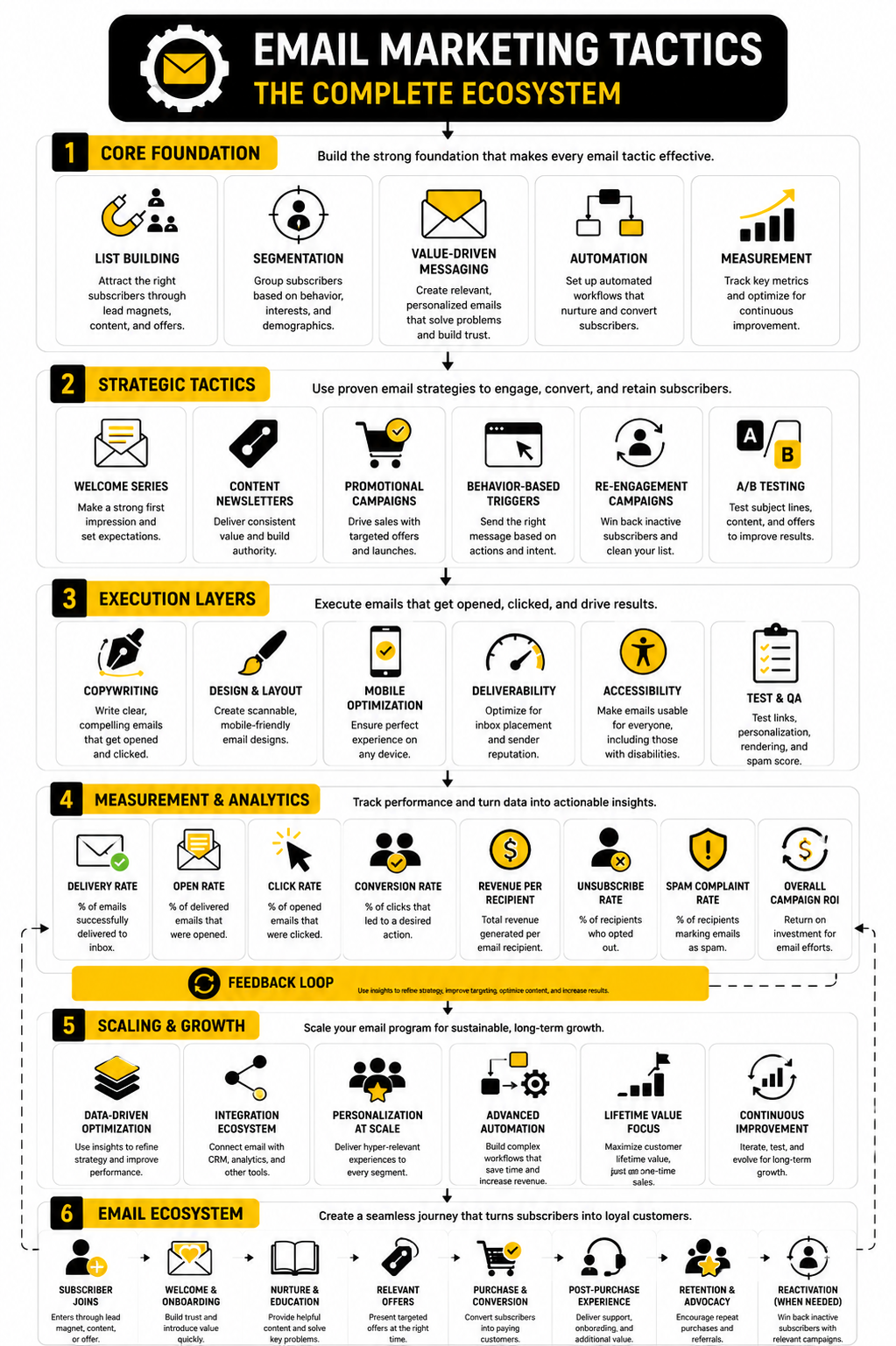
A strong email ecosystem connects every major customer moment. Someone joins the list, receives a clear welcome, gets useful education, sees relevant offers, buys with confidence, gets supported after purchase, and receives future messages that match their behavior. Nothing feels random because every message has a reason to exist.
This does not mean every subscriber receives a perfectly customized experience from day one. It means the business has a clear structure for handling the major paths people take. New leads, warm prospects, first-time buyers, repeat customers, dormant contacts, and high-value customers should not all move through the same generic email stream.
The ecosystem view also helps you avoid over-relying on campaigns. Campaigns create timely pushes, but lifecycle emails create consistent movement. When both work together, your email program becomes less reactive and more predictable.
Create a Practical Email Operating System
An email operating system is just a repeatable way to plan, send, measure, and improve. It gives your team a shared process so email does not depend on last-minute inspiration. It also makes it easier to train people, delegate work, and avoid mistakes as the program grows.
A practical operating system includes:
This sounds like a lot, but it becomes simple when each piece has a job. The list growth plan brings in the right people. Segmentation makes the messages relevant. Reporting turns performance into learning. The review cadence keeps the system alive instead of letting old assumptions run forever.
Choose the Right Level of Automation
Automation should remove repetitive work, not remove judgment. The more complex your business becomes, the more tempting it is to automate everything. That is dangerous if the automation is built on weak data, unclear triggers, or outdated messaging.
Start with automations that clearly match customer behavior. A welcome sequence after signup, an abandoned checkout flow, a post-purchase onboarding sequence, a review request, a lead follow-up sequence, and a reactivation flow are usually safer than hyper-complex branching logic. Once the basics are performing, you can add more advanced paths with confidence.
For teams that need CRM, pipeline, calendar, and follow-up automation in one place, GoHighLevel can support a more connected system. For businesses that want simpler funnels and email sequences without heavy setup, Systeme.io can be a cleaner starting point. The best choice is the one your team will actually maintain.
Keep the System Human
Email works because it can feel direct. That is easy to forget when dashboards, automations, tags, and flows start taking over the conversation. The reader does not care how advanced your backend is; they care whether the message feels relevant, useful, and worth their time.
Human does not mean sloppy. It means the message respects the reader’s context. It means you do not fake urgency, over-personalize with unreliable data, or keep sending to people who clearly stopped caring.
This is the balance that makes advanced email marketing tactics work. Use the system to understand behavior, but use judgment to decide what the behavior means. Use automation to deliver timely messages, but use clear writing to make those messages feel like they came from a real business with a real point of view.
What are email marketing tactics?
Email marketing tactics are practical actions used to grow, engage, convert, and retain an email audience. They include list building, segmentation, welcome sequences, subject line testing, automation, promotional campaigns, re-engagement flows, deliverability management, and revenue tracking. The best tactics are not random tricks; they support a clear strategy and help the reader take a useful next step.
Why do email marketing tactics still matter?
They matter because email is still one of the few channels where a business can communicate directly with its audience. Social platforms can change reach overnight, ad costs can rise, and search visibility can shift, but an engaged email list remains an owned relationship. The tactic matters when it helps protect that relationship and turn attention into action.
What is the most important email marketing tactic for beginners?
The most important beginner tactic is building a clear welcome sequence. A welcome sequence sets expectations, explains the value of staying subscribed, and introduces the offer without overwhelming the reader. It also trains subscribers to recognize and engage with your emails early, which can support better long-term performance.
How often should a business send marketing emails?
The right frequency depends on the audience, offer, business model, and subscriber expectation. A daily deals brand can send more often than a high-ticket service business, while a newsletter-led creator may need a consistent weekly rhythm. The safest approach is to start with a sustainable schedule, monitor engagement and complaints, then adjust based on behavior instead of guessing.
What email metrics should I track first?
Start with delivery rate, open rate, click rate, conversion rate, unsubscribe rate, spam complaints, and revenue per recipient. Each metric answers a different question, so do not judge every campaign by the same number. A sales campaign should be reviewed differently from an onboarding email, a reactivation email, or a trust-building newsletter.
Are open rates still reliable?
Open rates are useful as directional signals, but they are not perfect. Privacy changes from major email clients can make opens less precise, so they should not be treated as the only measure of success. Clicks, conversions, replies, revenue, and complaint patterns usually give a stronger view of whether the campaign actually worked.
What is a good click rate for email marketing?
A good click rate depends on the industry, list quality, offer, and campaign type. Benchmark reports can give context, but your own trend line matters more than someone else’s average. If clicks improve among the right segment and lead to meaningful actions, your email program is moving in the right direction.
How do I improve email deliverability?
Start with permission-based list growth, clean authentication, low complaint rates, clear unsubscribe options, and relevant sending. Google tells senders to keep spam rates below 0.1% and avoid reaching 0.3%, which makes complaint control a serious operational priority: Google’s sender guideline FAQ explains the threshold. Yahoo also expects marketing and subscribed messages to support one-click unsubscribe, which reinforces the same point: Yahoo’s sender best practices explain the unsubscribe requirement.
Should I remove inactive subscribers?
You should not delete inactive subscribers blindly, but you should manage them intentionally. A re-engagement sequence can give people a chance to stay before you suppress them from regular campaigns. Keeping permanently inactive contacts on every send can weaken engagement signals and make your performance harder to interpret.
What is the difference between segmentation and personalization?
Segmentation groups subscribers by meaningful characteristics or behavior, such as lifecycle stage, purchase history, interest, or engagement level. Personalization changes the message based on what you know about the individual or segment. Segmentation is the structure; personalization is how that structure changes the email experience.
What email automations should I build first?
Build the automations that match obvious customer moments. Start with a welcome sequence, lead nurture sequence, abandoned checkout or abandoned inquiry flow, post-purchase sequence, review request, and re-engagement sequence. These flows usually create more value than complicated automation maps that nobody maintains.
How do I know if my email marketing tactics are working?
Your tactics are working when the right people are engaging, the list remains healthy, complaints stay low, and email contributes to measurable business outcomes. That could mean more purchases, more booked calls, higher repeat purchase rates, better activation, stronger retention, or cleaner pipeline movement. The goal is not just better email metrics; the goal is better business behavior driven by email.
What is the biggest email marketing mistake?
The biggest mistake is sending without a clear reason. Many businesses email because the calendar says so, because revenue feels slow, or because they want to stay visible. Strong email programs send because the message is relevant, the audience is defined, the next step is clear, and the business can learn something from the result.
Can small businesses use advanced email marketing tactics?
Yes, but they should not start with unnecessary complexity. A small business can use segmentation, automation, testing, and lifecycle campaigns without building a massive enterprise system. The smart move is to make the basics reliable first, then add advanced tactics only when they solve a real problem.
Build a stronger local presence with BAAM AI
Turn your website, Google profile, social channels, and AI visibility into one growth engine
Most businesses do not need more random marketing activity. They need a consistent presence system that helps the right people find them, trust them, and take action. BAAM AI brings strategy, local SEO, website updates, Google Maps visibility, social content, AI-search readiness, media production, and reporting into one practical monthly engine.
If you want your marketing to keep working after the campaign ends, start with a free BAAM AI presence audit. See how your business shows up today and where the fastest visibility wins are at BAAM AI.