
BAAM AI Blog
Email Marketing Practices: What Works Today and Why It Matters
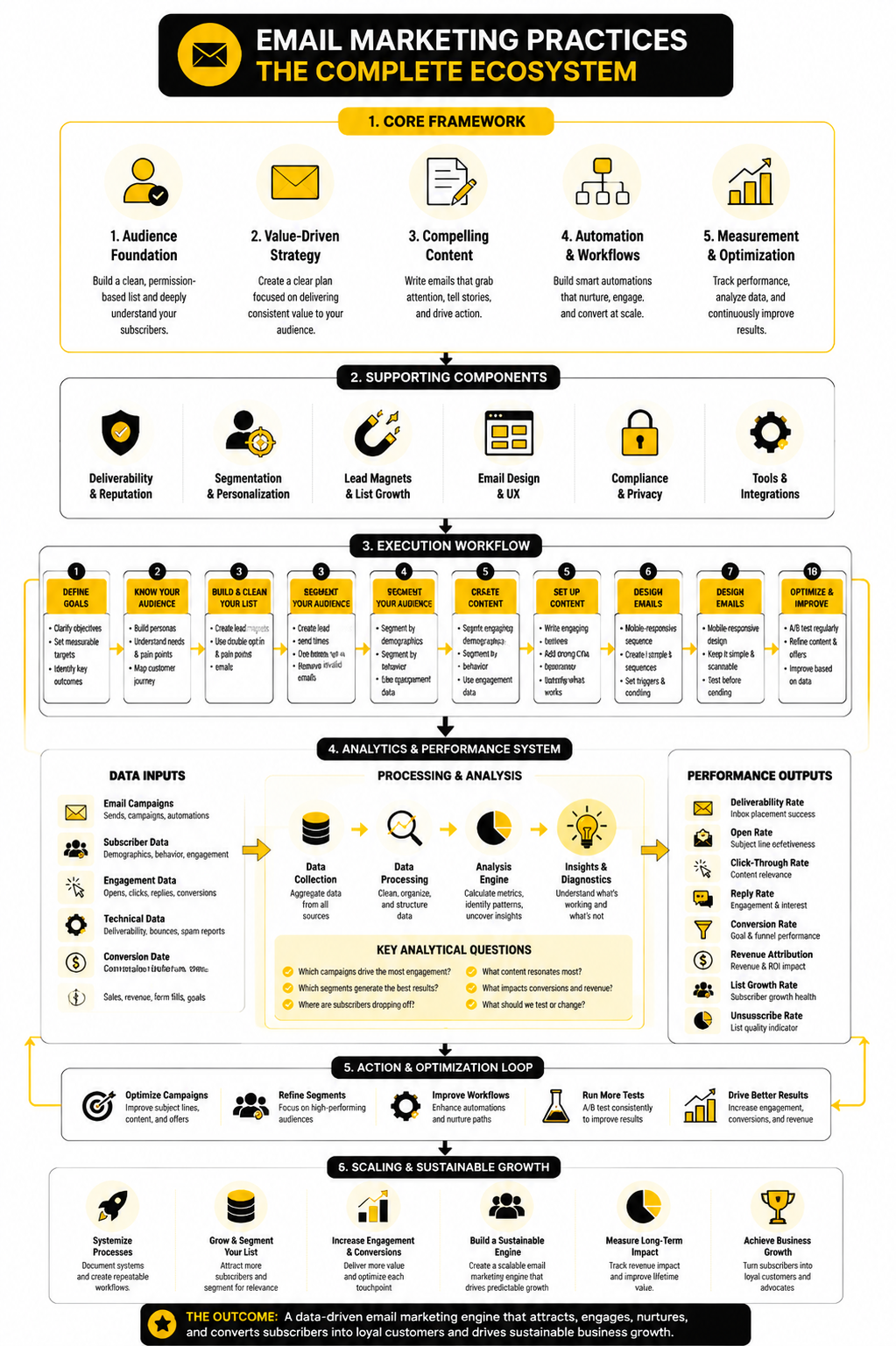
Below is how this guide will be organized to give you a complete, structured view of email marketing practices that drive measurable business results:
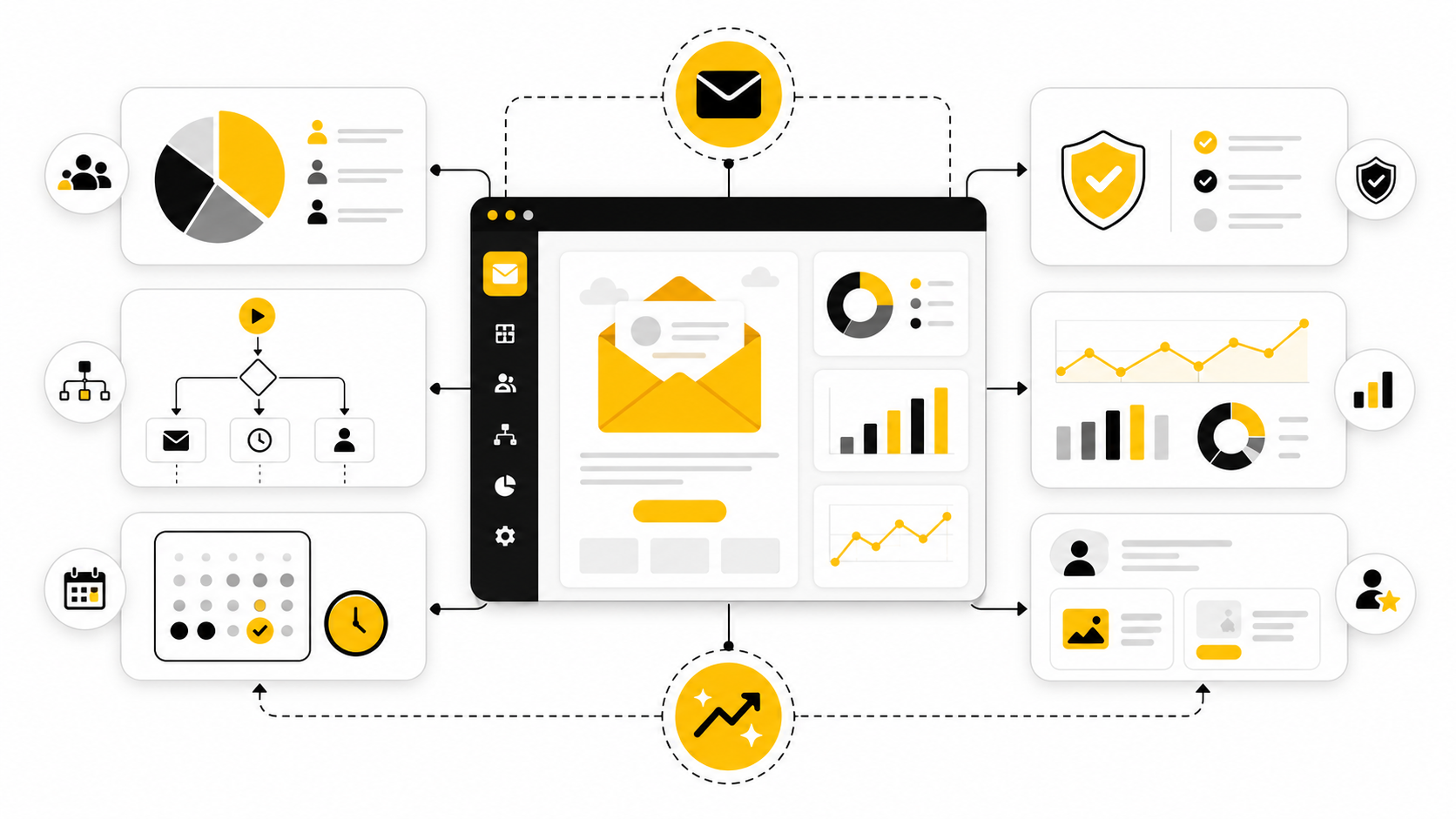
Below is how this guide will be organized to give you a complete, structured view of email marketing practices that drive measurable business results:
The structure above forms the backbone of this guide series and each section builds on the last.
Email marketing isn't some dusty relic in the digital marketing toolkit - it’s one of the most dependable channels for engagement and revenue. With an average return of $36–42 for every $1 spent, it continues to outperform most other marketing channels by a wide margin, making it a cornerstone for both small and large-scale businesses.
At the same time, the landscape is shifting: AI is transforming how messages are generated and filtered, and inbox providers are redefining what counts as a meaningful interaction. Marketers who rely solely on traditional benchmarks like “open rates” without adjusting to current realities risk missing out on actual engagement and revenue opportunities.
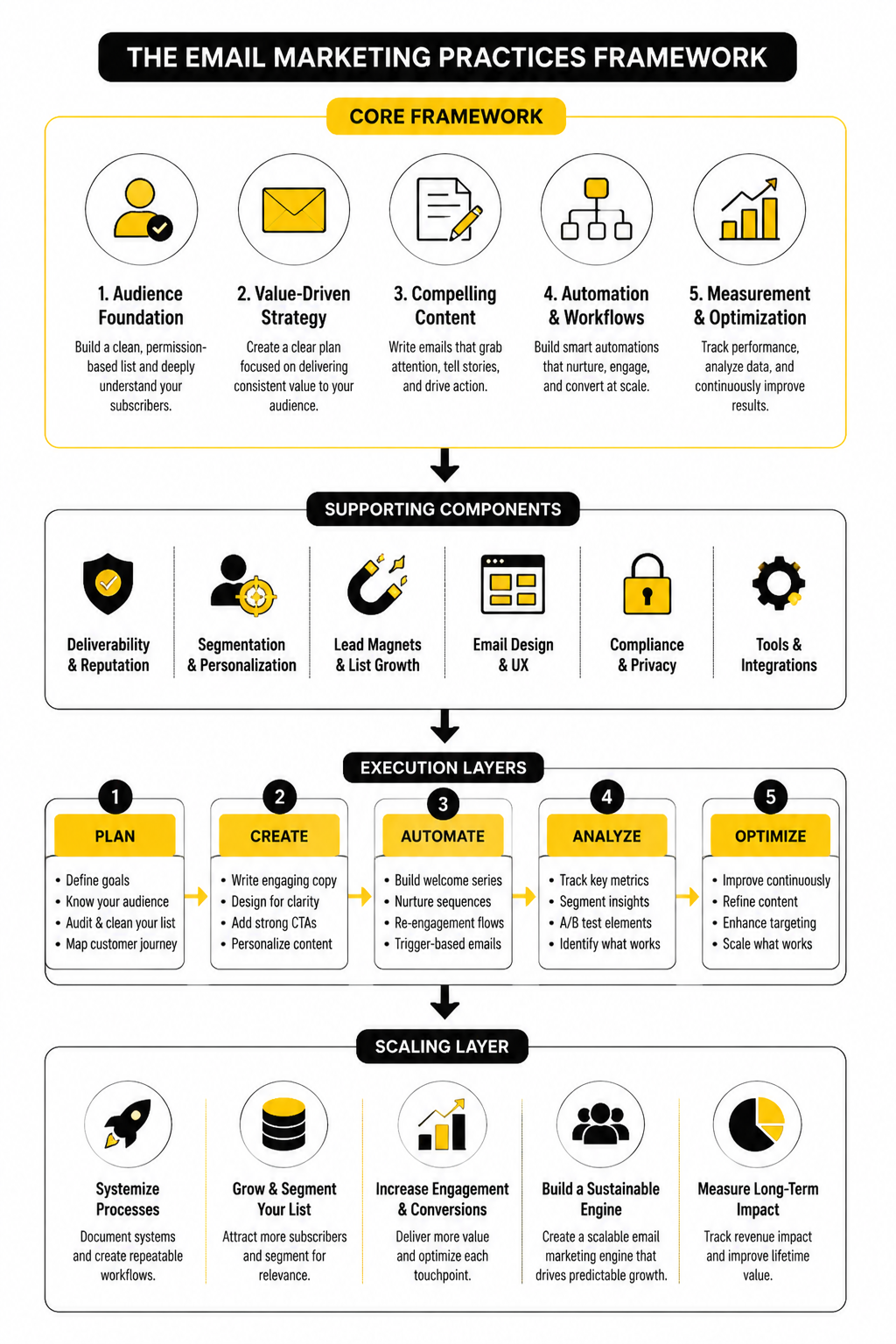
In the sections that follow we’ll break this topic down into logical components - starting with why email still matters in 2026, moving into a framework you can apply, and then drilling into the core elements and professional implementation strategies that separate effective campaigns from mediocre ones.
this guide series is for practitioners who want both the high‑level perspective and actionable practices grounded in recent benchmarks and trends - not outdated rules of thumb.
Email Marketing Framework Overview
To make email marketing practices work consistently in 2026, you need a framework that supports both strategic thinking and operational execution. Modern inboxs and privacy shifts - like Apple’s Mail Privacy changes - have weakened some traditional metrics like open rates, so an intentional structure matters more than ever.
Email marketing is fundamentally a system with two halves: strategy and mechanics. The strategy side answers “Who am I sending to?” and “What outcome do I want?” while operations answer “How do I make sure this message arrives and matters?” and “What do we learn from it?”.
This framework keeps you from chasing superficial metrics and instead aligns every email with real business impact.
Core Components of Successful Email Programs
A successful email strategy depends on components that work together like parts of a performance engine - if one is missing or weak, your results will lag even with strong content or offers.
Clear Goals and KPIs
An email campaign without measurable goals is like a ship without a rudder. Rather than tracking open rates alone, focus on outcomes that matter to your business, such as click‑throughs, revenue influenced, or qualified leads generated. Clarity here keeps your team aligned and informs every tactical choice.
Segmentation and Targeting
Generic, one‑size‑fits‑all emails are losing effectiveness. Segmenting your list based on behavior, demographic traits, or buying stage allows you to tailor messages that feel personal. In fact, research shows that 74 % of consumers expect personalized experiences from brands today.
Personalization That Goes Beyond Names
Simply putting a first name in the subject line isn’t enough anymore. Use dynamic content based on past interactions - like prior purchases or pages viewed - to make each message feel uniquely relevant. Personalization of this kind doesn’t just improve engagement; it signals to inbox providers that your emails are wanted, which supports deliverability.
Deliverability and List Quality
If your emails don’t reach the inbox, none of the above matters. Regularly maintain list hygiene by removing invalid addresses and managing unsubscribes. Authentication standards - SPF, DKIM, and DMARC - also help ensure inbox placement rather than landing in spam.
Automation and Triggered Flows
Automated emails triggered by specific subscriber actions (like welcome sequences, abandoned cart reminders, or win‑back campaigns) consistently outperform generic broadcasts because they’re timely and relevant. This kind of behavioral automation creates ongoing engagement with minimal manual work.
A/B Testing and Optimization
Variable testing - split testing subject lines, send times, or call‑to‑action buttons - gives you data to refine your approach over time. Systematic experimentation helps you learn what resonates with your audience rather than assuming a tactic will work because it sounds good.
Content That Focuses on Value
Every email should offer something useful - whether that’s insight, discount, update, or actionable tip. Emails framed around a benefit for the reader perform better than those primarily centered on self‑promotion.
Mobile‑First Design and Accessibility
Most email opens occur on mobile devices today, so design matters. Emails should be easy to scan, buttons should be tappable, and alt text should describe images for accessibility. This simple shift helps maximize engagement across devices.
Measurement and Reporting
Regular reporting lets you understand what’s working and where adjustments are needed. Track meaningful metrics - like click‑through rates, conversion outcomes, and revenue influenced - not just opens. This ensures you’re optimizing for impact rather than vanity.
Compliance and Consent
Respecting privacy and consent regulations (like GDPR or CAN‑SPAM) isn’t optional. Obtaining proper opt‑ins and honoring unsubscribe requests protects your brand reputation and avoids legal risk, which is essential for trustworthy email marketing.
Why These Components Matter Together
Each of these components on its own can offer incremental benefit, but when combined into a cohesive email strategy, they create a system that drives predictable outcomes. Instead of reacting to spikes or dips in open rates, you build a machine that consistently delivers relevant messages to receptive audiences, learns from each send, and adapts over time - and that’s how email marketing turns from a gamble into a reliable revenue driver.
Implementing Email Marketing Like a Pro
The core components we covered earlier only matter when you can execute them consistently across your campaigns and automations. Execution is where strategy becomes revenue, and it’s both a mindset and a process - not a bunch of random sends.
Implementation starts with planning and ends with measurement, but every good execution process has repeatable steps that ensure quality and consistency. These steps help teams of any size move from ideas to results without unnecessary guesswork.
Plan Before You Build
Before you write a single email, define:
This planning phase sets expectations and ensures that everyone involved knows the why before the what and how.
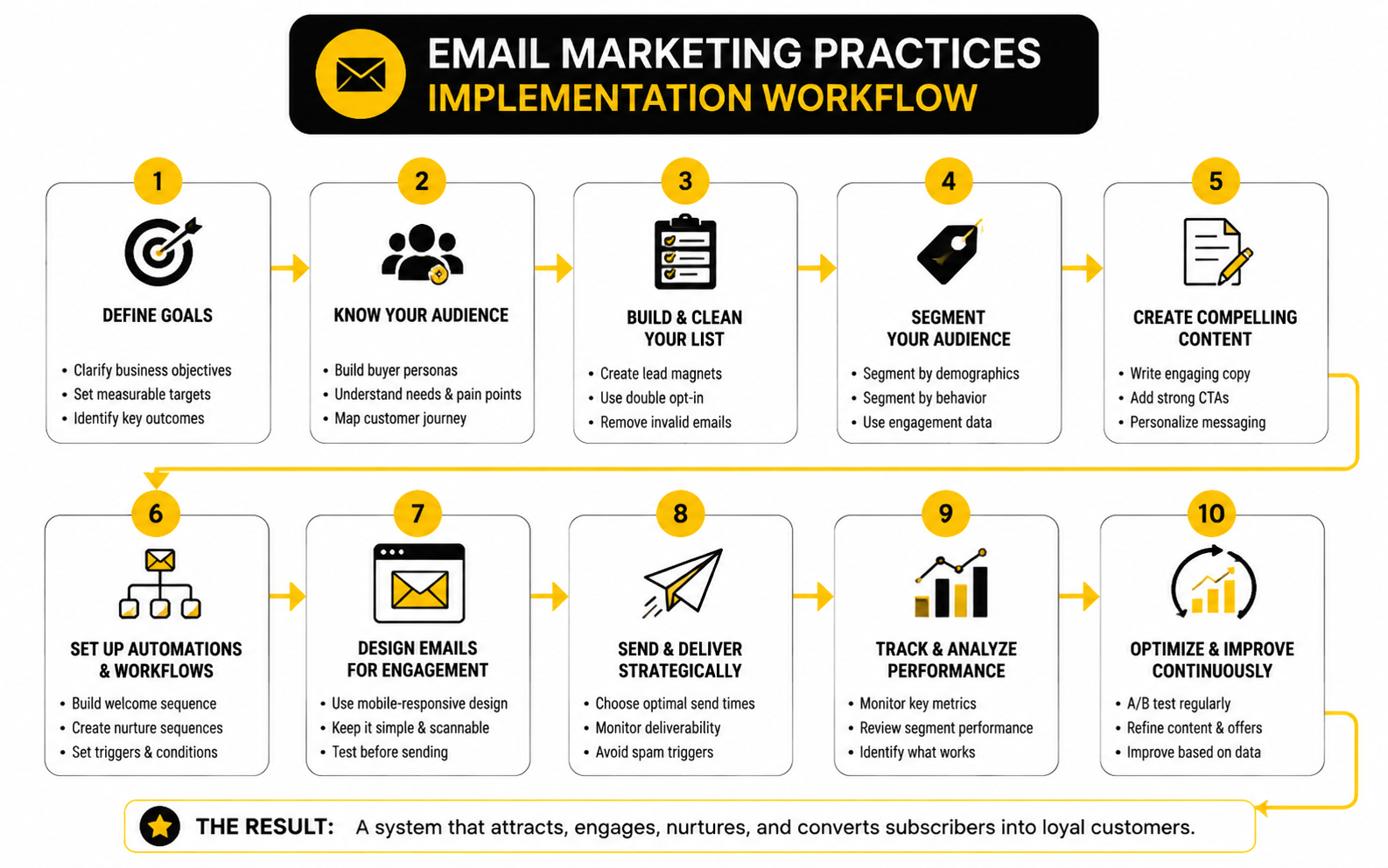
Step‑by‑Step Execution Process
Once goals are clear and your list is segmented, follow a practical sequence like the one below for consistent campaign execution:
Use forms, landing pages, events, or lead magnets to collect permission‑based emails. Clean your list to remove hard bounces, spam traps, and stale contacts. A healthy list improves deliverability and engagement.
Choose whether you’re launching:
Start with your highest‑priority flows and perfect them before adding complexity.
Write effective subject lines, concise body copy, and a clear call to action. Personalize beyond first names - reference behavior or recent actions to increase relevance. Keep copy value‑rich rather than purely promotional.
Use your email service platform to assemble templates, insert dynamic content, and set links. Preview and test for mobile responsiveness and accessibility. Ensure authentication standards (SPF, DKIM, DMARC) are configured so your emails land in inboxes.
For automations, define the trigger (e.g., sign‑up, purchase, inactivity) and timing between emails. For campaigns, pick optimal send days and times based on what your audience responds to - even though averages like mid‑week for business emails often serve as a helpful starting point.
Always send test emails to yourself and key stakeholders. Confirm that personalized elements render correctly, links work, and tracking is in place. Testing protects deliverability and credibility.
Once live, watch key engagement indicators like click‑through rates and early conversions. This early view tells you whether the subject line, offer, or targeting needs refinement in future sends.
Post‑send, review the full performance: revenue influenced, list growth or churn, engagement changes across segments. Use these insights to improve future sends or refine automations. Avoid judging campaigns on opens alone - track meaningful outcomes.(turn0news25)
Practical Tips for Momentum
Execution isn’t just about following a checklist; it’s about building rhythm and discipline so your email marketing practices grow more predictable and profitable over time. When executed well, the process becomes a competitive edge rather than a daily scramble.
Measurement, Analytics, and What the Data Really Means
Understanding email marketing practices isn’t just about sending messages - it’s about interpreting performance data, knowing which metrics signal real engagement, and using that information to improve future campaigns. In 2026, the analytics landscape has shifted due to privacy features in inboxes and a stronger emphasis on meaningful outcomes, not vanity numbers.
Which Metrics Matter Most - and Why
When you look at benchmark data, it’s easy to get confused if you don’t know what each metric actually signals about your audience and your campaign performance. The context between these numbers and what you should do with them is what separates informed email marketers from those chasing bad targets.
Email Engagement Benchmarks
Broad industry data gives you a starting point for comparison, but always interpret these with your audience and campaign type in mind:
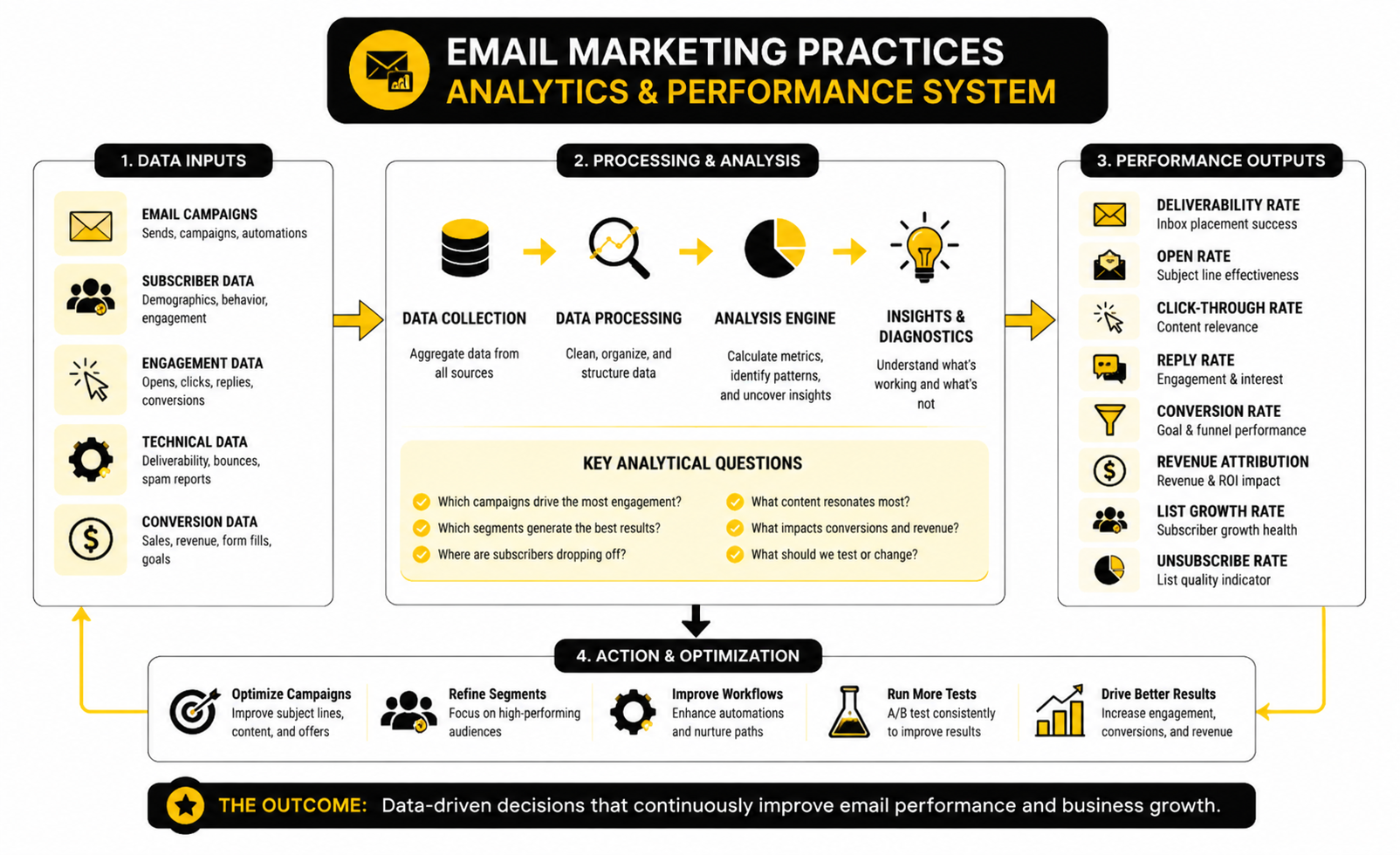
Why These Numbers Matter
Knowing how your performance stacks up against benchmarks is only the first step. What really matters is why certain patterns show up and what action they drive:
Benchmarks Should Inform, Not Dictate
Use industry benchmarks like a compass, not a map. They provide a directional indication of what’s possible in your niche - for example, segments like nonprofit and government emails often see higher engagement than retail or ecommerce - but they don’t replace the need for your own performance context. Your audience size, offer type, sending frequency, and list freshness all influence what “good” looks like for you specifically.
What Actions the Data Should Drive
Interpreting analytics correctly - understanding not just what the numbers are but why they are what they are and what you should do next - is the final piece that turns good email marketing practices into high‑impact results.
Advanced Considerations for Scaling and Expert Email Marketing Practices
As you move beyond the fundamentals into strategic maturity, email marketing becomes less about tactics and more about balancing growth with reputation management, technical safeguards, and long‑term audience trust. Advanced email marketing practices require thinking ahead about risks, tradeoffs, and scaling complexities that often trip up even experienced teams.
Deliverability as a Strategic Priority
Deliverability isn’t just a technical checkbox - it’s a growth enabler. At higher volume or complexity, small issues with authentication, sending patterns, or audience engagement can have outsized effects. Mailbox providers now consider engagement signals, complaint rates, and authentication posture when deciding whether your messages land in the primary inbox or get filtered. Weak deliverability doesn’t just lower opens - it undermines every downstream metric and can erode your brand’s digital reputation.(,)
Experienced teams treat deliverability as a continuous optimization discipline rather than a one‑time setup. That means:
These practices preserve trust with mailbox providers and protect your ability to grow without hitting invisible ceilings.
Scaling Without Hurting Reputation
Rapid increases in sending volume are deceptively risky. When you scale too quickly - especially from a new domain or inbox - mailbox providers can interpret the sudden surge as spam‑like behavior. This triggers filtering and damages sender reputation, which takes much longer to recover than it took to lose.(,)
A disciplined scaling strategy includes:
This approach gives you visibility before performance deteriorates, preserving long‑term inbox access as your program grows.
Advanced Personalization and Strategic Tradeoffs
Personalization remains one of the most potent drivers of engagement, but advanced personalization isn’t just dynamic first‑name inserts. It involves using meaningful user data (behavioral intent, purchase history, persona triggers) to craft messages that feel uniquely relevant. Research suggests that deep personalization - especially when powered by algorithms or predictive tools - can strengthen relationships and drive conversions more effectively than generic sends.
At the same time, personalization must be balanced with data quality and consent. Over‑personalizing based on inaccurate or stale data erodes trust and can even decrease performance. Effective personalization requires:
In other words, personalization should be intentional and tested, not aspirational.
Systems Thinking Over Campaigns
When email marketing grows in scale or strategic importance, treat it as a system, not a series of disconnected campaigns. Advanced practitioners separate email streams into different logical buckets:
This segmentation allows teams to adjust volume and messaging contextually without exposing the entire program to risk if one stream underperforms. By isolating experimental content from core engagement flows, you preserve strong sender reputation and reduce collateral damage when tests fail.
Risk Management and Measurement Discipline
As email programs mature, you’ll face strategic tradeoffs between aggressive growth and sustainable performance. Some risks include:
Advanced practices embed risk management into everyday workflows: automated alerts for spikes in bounce or complaint rates, regular reviews of inbox placement metrics, and cross‑functional alignment with CRM, sales, and product teams on email timing and relevance.
Long‑Term Scaling Mindset
Ultimately, the highest‑performing email programs don’t just send more - they learn better. That means embedding experimentation into your culture, using data to refine personalization without eroding list health, and treating deliverability as a strategic loyalty asset rather than a chore. When you adopt this systems perspective - where growth is measured in long‑term engagement and trust, not just volume - your email marketing practices become a durable competitive advantage.
What is the most important part of effective email marketing practices?
Effective email marketing practices hinge on relevance to the recipient. That means sending content that aligns with their interests, behaviors, or lifecycle stage rather than generic blasts that ignore who they are.
How often should businesses send marketing emails?
There’s no universal cadence, but too‑frequent sends can increase unsubscribes while too‑infrequent contact can weaken engagement. A good rule is to start with a consistent schedule that matches your audience’s expectations and adjust based on engagement trends and feedback.
Are open rates still useful metrics today?
Open rates provide directional insight but are less reliable because privacy features pre‑load tracking. They should be viewed in context with other engagement signals like clicks, conversions, and revenue influenced rather than as a stand‑alone measure.
What should I do if click‑through rates are low?
Low click‑through rates often signal that the content or offer isn’t resonating. Test different calls to action, refine your value proposition, and segment your list more granularly to deliver more personalized content.
How does list segmentation improve performance?
Segmentation increases relevance by grouping subscribers with shared attributes or behaviors. This helps tailor messaging, boost engagement, and reduce fatigue because each segment receives emails suited to their interests.
Is personalization worth the effort?
Yes, but only when it’s meaningful. Personalization based on behavior or purchase history often drives better engagement than superficial personalization like a first name alone. Done right, it strengthens connection and performance.
What is a good way to measure ROI from email campaigns?
Track revenue influenced or generated, cost per acquisition from email traffic, and lifetime value uplift from email subscribers. These outcome‑focused metrics tie email performance directly to business results.
How should I handle unsubscribes?
Unsubscribes are normal and even healthy if they remove disengaged contacts. Make opting out easy and use unsubscribe data to refine your segmentation and frequency strategy.
Can automation replace manual campaigns?
Automation handles repetitive, behavior‑based sequences effectively, but manual campaigns still play a role for announcements, curated content, and time‑sensitive offers. The balance depends on strategy and resources.
What’s the biggest risk in scaling an email program?
Growing volume too fast without maintaining deliverability health can degrade inbox placement. A disciplined approach to authentication, engagement monitoring, and gradual scale protects long‑term performance.
Build a stronger local presence with BAAM AI
Turn your website, Google profile, social channels, and AI visibility into one growth engine
Most businesses do not need more random marketing activity. They need a consistent presence system that helps the right people find them, trust them, and take action. BAAM AI brings strategy, local SEO, website updates, Google Maps visibility, social content, AI-search readiness, media production, and reporting into one practical monthly engine.
If you want your marketing to keep working after the campaign ends, start with a free BAAM AI presence audit. See how your business shows up today and where the fastest visibility wins are at BAAM AI.