
BAAM AI Blog
Email Marketing Podcast: How to Turn Listener Attention Into Owned Audience Growth
An email marketing podcast sits in a useful middle ground. A podcast earns attention because people choose to listen for longer than they usually read, while email turns that attention into a direct relationship you...
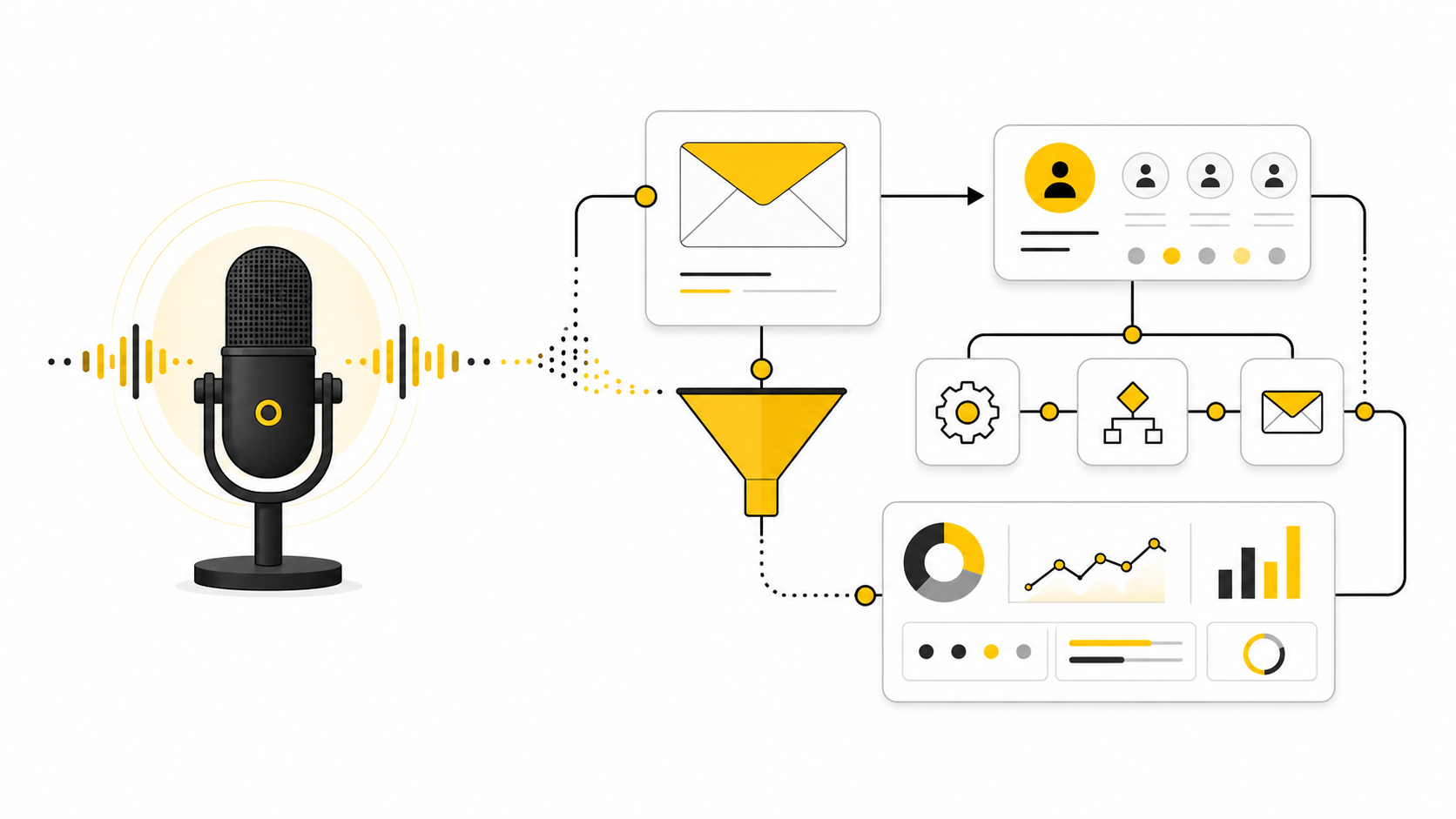
An email marketing podcast sits in a useful middle ground. A podcast earns attention because people choose to listen for longer than they usually read, while email turns that attention into a direct relationship you can keep nurturing without depending on platform algorithms.
That combination matters more now because both channels are still strong, but they solve different problems. Podcast listening keeps growing, with Edison Research reporting that podcast consumption reached a record high in The Infinite Dial 2025. Email remains one of the few channels where marketers can build a repeatable owned-audience system, and Litmus reports that 35% of companies see email ROI of 36:1 or more.
The mistake is treating the podcast and the email list like separate assets. The better move is to make the podcast the trust engine and the email list the conversion engine. When the two work together, every episode can create a reason to subscribe, every subscriber can receive deeper context, and every launch can start with people who already know your voice.
Why an Email Marketing Podcast Matters Now
An email marketing podcast matters because attention is getting harder to borrow and more valuable to own. Social platforms can still create reach, but they rarely give you a stable relationship with the same audience over time. A podcast gives people a reason to spend time with your ideas, and email gives you a way to continue the conversation after the episode ends.
The strength of podcasting is depth. A listener who spends 20, 30, or 45 minutes with an episode is giving you a different kind of attention than someone scrolling past a post. That does not automatically create revenue, but it does create familiarity, and familiarity is what makes email opt-ins, replies, clicks, and offers feel less cold.
The strength of email is control. You can segment subscribers, send follow-ups, test offers, and build sequences that match the listener’s stage of awareness. Benchmarks from platforms like Mailchimp and Klaviyo show why teams still watch email metrics closely: open rates, click rates, conversion rates, and revenue per recipient give you practical feedback that podcast downloads alone cannot provide.
The opportunity is not “start a podcast and hope people subscribe.” That is too vague. The opportunity is to design a clear listener journey where each episode moves someone from passive attention to active relationship.
The Podcast-to-Email Growth Framework
A useful email marketing podcast needs a simple framework behind it. The framework should answer four questions: who is listening, why they should subscribe, what they receive after subscribing, and how the business follows up without becoming annoying. Without those answers, the podcast becomes content for content’s sake.
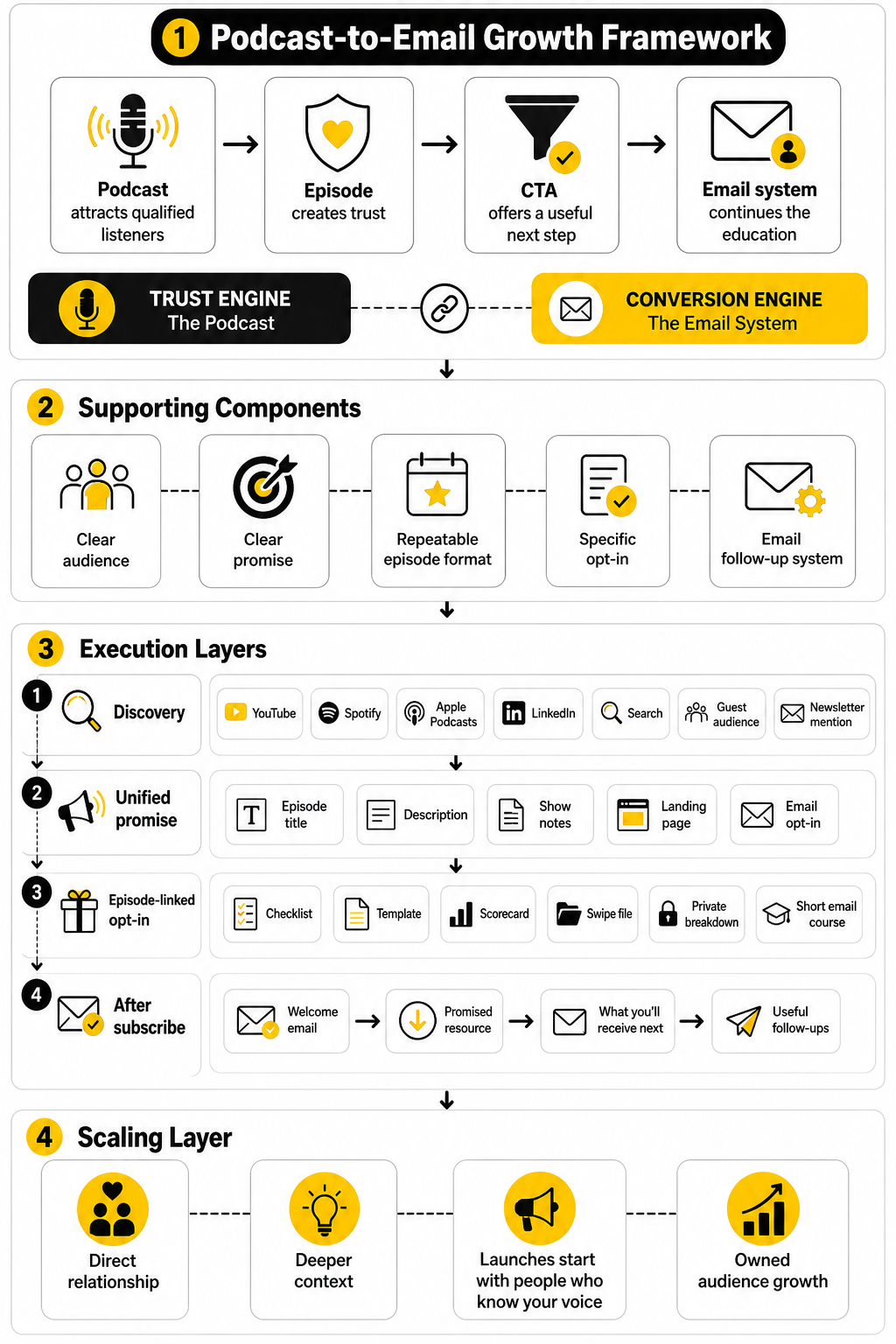
The basic flow is straightforward. The podcast attracts qualified listeners, the episode creates trust, the call to action offers a useful next step, and the email system continues the education. That email system can include welcome sequences, episode recaps, resource delivery, product education, event invitations, or sales follow-up depending on the business model.
This is where many creators get stuck. They mention “join my newsletter” at the end of every episode, but they do not give the listener a strong reason to act now. A better approach is to connect the opt-in to the episode itself, such as a checklist, template, scorecard, swipe file, private breakdown, or short email course that helps the listener apply what they just learned.
Core Components of a Strong Email Marketing Podcast
A strong email marketing podcast is built from a few core components that work together. The show needs a clear audience, a clear promise, a repeatable episode format, a specific opt-in, and an email follow-up system that matches the topic. Each part should feel natural, not like a funnel forced onto an audio show.
The audience comes first because broad podcasts are hard to grow and even harder to monetize. “Marketing tips” is too generic. “Email growth for ecommerce brands,” “newsletter strategy for consultants,” or “retention email systems for SaaS teams” gives the listener a reason to care and gives the host a sharper editorial lane.
The promise should make the show easy to understand in one sentence. For example, the podcast might help founders turn content into email subscribers, help agencies improve lifecycle campaigns, or help creators build newsletter revenue. The more specific the promise, the easier it becomes to choose guests, write episode titles, create lead magnets, and build email sequences around the show.
The opt-in is the bridge between listening and subscribing. It should not be a random newsletter plug. It should be an asset that makes the episode more useful, because that is when the listener has the strongest reason to take action.
Professional Implementation Starts With the Listener Journey
Professional implementation means building the system before chasing volume. You do not need a huge audience to make an email marketing podcast work, but you do need a clear path from discovery to subscription to follow-up. Otherwise, every episode leaks attention.
The listener journey usually begins before the audio player. Someone may discover the show through YouTube, Spotify, Apple Podcasts, LinkedIn, search, a guest’s audience, or a newsletter mention. That means the episode title, description, show notes, landing page, and email opt-in all need to point toward the same promise.
Once someone subscribes, the email experience should feel like a continuation of the podcast rather than a hard pivot into promotion. A simple setup might include a welcome email, the promised resource, a short explanation of what the subscriber will receive next, and a few useful follow-ups tied to the show’s main topic. Tools such as Brevo, Moosend, or GoHighLevel can support that workflow when the list needs tagging, automation, forms, and campaign tracking.
Part 1 sets the foundation: the podcast creates trust, email captures and compounds that trust, and the framework connects both channels into one growth system. The next part will go deeper into why this matters now and how to choose the right strategic angle before recording episodes.
Why an Email Marketing Podcast Matters Now
An email marketing podcast works because it connects two behaviors that already fit together: people listen when they want depth, and they subscribe when they want continuity. That is the real advantage. You are not just publishing episodes; you are creating a repeatable path from attention to trust to owned audience growth.
Podcasting is no longer a side channel for niche creators. Edison Research found that podcast consumption reached an all-time high in The Infinite Dial 2025, and the same report estimated that weekly podcast listening in the U.S. reached record levels. That matters because a podcast gives you more time with a prospect than most short-form content ever will.
Email still matters because it gives that attention somewhere to go. Litmus reported that marketers see email returns ranging from 10:1 to 36:1, which is exactly why serious teams still invest in list growth, segmentation, and lifecycle campaigns. A podcast can create demand, but email is where you can organize that demand and turn it into action.
The Problem With Attention-Only Marketing
Attention-only marketing feels good because the numbers are visible. Downloads, views, likes, shares, and comments can make a show look successful from the outside. The problem is that none of those numbers automatically gives you a direct relationship with the listener.
This is where many podcast strategies break down. A host publishes consistently, promotes episodes on social media, gets some traction, and still has no reliable way to follow up with listeners. The audience exists, but the business cannot reach them when it matters.
That is risky because rented attention can disappear quickly. Search rankings move, social reach changes, podcast apps adjust discovery surfaces, and guest promotion dries up after launch week. An email list gives the podcast a second layer of value because the relationship does not end when the episode stops playing.
The Better Goal Is Owned Audience Growth
The goal of an email marketing podcast is not simply to “get more subscribers.” That is too shallow. The better goal is to build an owned audience of people who understand your point of view, trust your expertise, and expect useful follow-up from you.
Owned audience growth changes the way you evaluate each episode. Instead of asking only whether an episode got downloads, you also ask whether it moved the right people closer to the list. That makes the podcast more strategic because every topic, guest, title, and call to action has a job.
This does not mean every episode needs a hard pitch. In fact, that usually weakens the show. The more carefully move is to make the email opt-in feel like the natural next step for someone who enjoyed the episode and wants to apply the idea.
Why Podcasts Build Trust Differently
Podcasts build trust because listeners hear how you think. They hear your tone, pacing, questions, judgment, and confidence. That creates a level of familiarity that is hard to replicate with a static blog post or a short social caption.
That trust has practical value. When someone joins your list after listening to your podcast, they are not arriving cold. They already have context, which means your welcome sequence does not need to work as hard to explain who you are or why your ideas matter.
This is especially useful for consultants, agencies, SaaS brands, coaches, creators, and B2B companies. These businesses often sell expertise, transformation, implementation, or trust-heavy products. A podcast lets the audience experience the thinking before they ever book a call, start a trial, or click an offer.
Why Email Makes the Podcast More Valuable
Email makes the podcast more valuable because it turns one-time attention into a structured follow-up system. A listener might enjoy an episode and forget about it the next day. A subscriber can receive the checklist, recap, framework, or next step while the idea is still fresh.
This is where the compounding effect starts. One episode can become a newsletter, a lead magnet, a short email sequence, a sales enablement asset, and a reason to re-engage older subscribers. The podcast gives you the raw material, and email gives you the distribution system.
The reverse is also true. Your email list can make the podcast stronger by sending listeners back to important episodes, asking for questions, testing topic demand, and promoting guest appearances. When the loop works, the podcast feeds the list and the list feeds the podcast.
Why This Channel Pairing Fits the Current Market
The current market rewards useful, specific, trust-building content. Generic content is everywhere, and people can feel it immediately. A good email marketing podcast gives you space to be more useful than a short post and more personal than a landing page.
At the same time, marketers are under pressure to prove what content actually does. Podcast downloads alone can be frustrating because they show consumption, not necessarily pipeline, revenue, or subscriber growth. Email gives you more measurable steps: opt-ins, replies, clicks, conversions, purchases, bookings, and retention signals.
That is why the pairing is so practical. The podcast creates belief and demand, while email captures, segments, and nurtures that demand. You do not need to choose between brand and performance; you need a system that lets both support each other.
The Strategic Shift: From Episodes to Journeys
The biggest shift is moving from episode thinking to journey thinking. Episode thinking asks, “What should we publish this week?” Journey thinking asks, “What should the right listener understand, believe, and do next?”
That shift immediately improves the show. You stop choosing topics only because they sound interesting and start choosing topics because they help the audience move through a decision. You also stop using generic calls to action and start offering resources that match the listener’s current problem.
This is where an email marketing podcast becomes a growth asset instead of a content habit. Each episode has a purpose, each opt-in has a reason to exist, and each email sequence continues the conversation with intention. That is the foundation for the framework that comes next.
The Podcast-to-Email Growth Framework
The podcast-to-email growth framework turns the show into a working acquisition system instead of a loose content channel. It gives every episode a role, every opt-in a reason to exist, and every email sequence a purpose after the listener subscribes. That is what separates a professional email marketing podcast from a show that simply publishes and hopes.
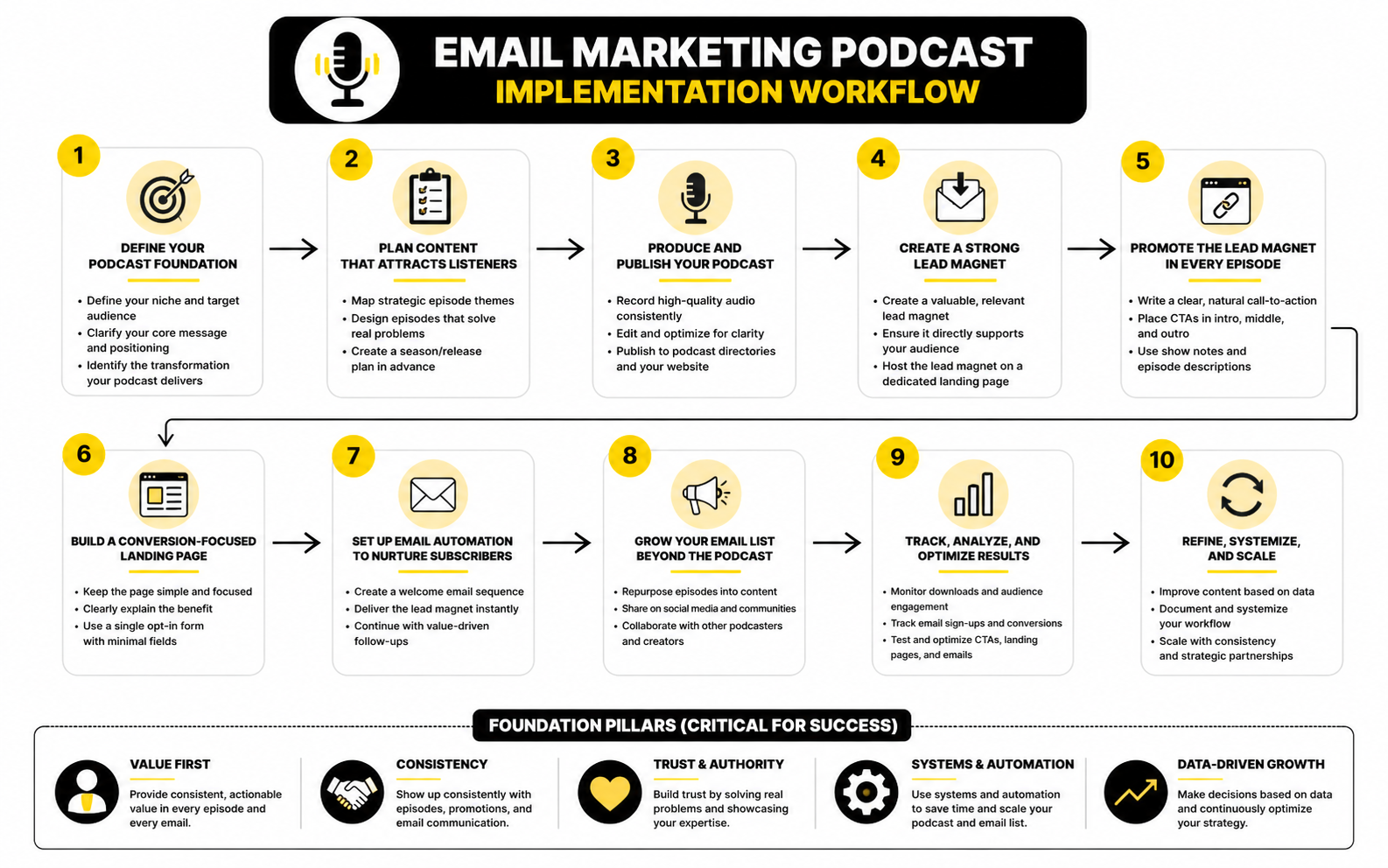
The framework has five practical stages: attract, engage, capture, nurture, and convert. Attract means the topic and positioning bring the right listener in. Engage means the episode delivers enough value that the listener trusts the host. Capture means the listener has a clear reason to join the list. Nurture means the email sequence continues the topic with useful context. Convert means the subscriber gets a relevant next step when timing and intent are right.
This framework also protects the listener experience. It avoids the lazy version of podcast monetization where every episode ends with a generic pitch. Instead, the podcast stays useful, and the email list becomes the place where listeners get tools, frameworks, summaries, templates, or deeper breakdowns that help them act on what they heard.
Step 1: Define the Listener Segment
Start by choosing the listener segment with enough precision that the show can make strong editorial decisions. A useful segment is not just a demographic. It is a group of people with a shared business problem, a shared level of sophistication, and a shared reason to care about email.
For example, a podcast for ecommerce founders should not sound the same as a podcast for B2B consultants. The ecommerce listener may care about flows, retention, deliverability, product launches, and repeat purchase behavior. The consultant may care more about authority, referral loops, lead nurturing, booking calls, and staying top of mind with prospects.
This decision affects everything that follows. It shapes the show promise, episode categories, guest selection, lead magnets, email cadence, and sales path. If the listener segment is fuzzy, the rest of the system becomes fuzzy too.
Step 2: Build the Episode Around One Useful Job
Every episode should do one clear job for the listener. That job might be helping them understand a trend, diagnose a problem, compare options, avoid a mistake, or implement a process. When an episode tries to cover everything, it usually becomes forgettable.
This is especially important for an email marketing podcast because the audience is often looking for practical guidance. They do not just want opinions about email. They want to know what to send, when to send it, how to structure a campaign, how to improve engagement, and how to make the channel produce results without burning trust.
The cleanest way to plan an episode is to write one sentence before recording: “After listening, the audience should be able to…” That sentence keeps the conversation focused. It also makes the follow-up email and opt-in offer much easier to create.
Step 3: Match the Opt-In to the Episode
The opt-in should feel like a natural continuation of the episode, not a random newsletter plug. If the episode explains how to plan a welcome sequence, the opt-in could be a welcome sequence checklist. If the episode breaks down podcast promotion, the opt-in could be a repurposing workflow. If the episode compares tools, the opt-in could be a decision matrix.
This matters because timing is everything. A listener is most likely to subscribe when the episode has created a specific desire to solve a specific problem. A generic “join the newsletter” call to action wastes that moment because it asks for trust without giving enough immediate reason.
The best opt-ins are simple, useful, and directly connected to the topic. They do not need to be huge. In many cases, a one-page checklist, short template, or practical swipe file will convert better than a bloated ebook because it promises a faster win.
Step 4: Create a Dedicated Landing Page for the Show
A dedicated landing page gives the podcast-to-email system a home. It should explain who the show is for, what listeners get from the podcast, and why joining the email list makes the show more useful. The page should also make the opt-in obvious without turning the whole experience into a hard-sell funnel.
The page does not need to be complicated. It needs a clear headline, short supporting copy, a simple form, proof where available, and links to listen on major platforms. If the podcast has multiple lead magnets, the page can also route listeners to the right resource based on the episode or topic.
For teams that want a fast funnel setup, tools like ClickFunnels, Systeme.io, or Replo can make sense when the goal is to publish a clean opt-in page quickly. The tool matters less than the structure, though. A simple page with a strong promise beats a beautiful page with a vague offer.
Step 5: Write the Welcome Sequence Before Launching the CTA
Do not wait until subscribers start coming in to write the welcome sequence. That is backwards. The sequence should be ready before the podcast call to action goes live because the first few emails shape how subscribers understand the relationship.
A practical welcome sequence can be short. The first email delivers the promised resource and sets expectations. The second email expands on the podcast’s core idea. The third email points subscribers to the most useful episodes or resources. The fourth email introduces the next logical action, such as replying with a question, booking a call, joining a workshop, starting a trial, or reading a deeper guide.
The goal is not to overwhelm people. The goal is to make the list feel immediately useful. When the first experience after subscribing is clear and valuable, future emails have a better chance of being opened, clicked, and trusted.
Step 6: Add Segmentation Without Overcomplicating It
Segmentation makes the podcast email system more carefully, but it does not need to become complex on day one. Start with simple tags based on what someone requested, which episode they came from, or what problem they selected on a form. That gives you enough context to send more relevant follow-up later.
For example, someone who downloads a deliverability checklist should not receive the exact same next email as someone who downloads a launch planning template. Their intent is different. The follow-up should respect that difference.
This is where email platforms with automation and tagging become useful. Brevo, Moosend, and GoHighLevel are all relevant when you need forms, automation, lists, tags, and campaign follow-up in one workflow.
Step 7: Turn Each Episode Into an Email Asset
Every episode should create at least one email asset. That could be an episode recap, a practical checklist, a short opinion piece, a “three things we covered” email, or a resource email that links back to the episode. This keeps the podcast from being a one-time content event.
The email version should not just summarize the transcript. Nobody needs a lazy recap. The stronger approach is to extract the most useful idea from the episode and turn it into a clear, skimmable email that gives the subscriber a reason to listen or take action.
This also helps with consistency. If every episode creates an email asset, your newsletter no longer depends on random inspiration. The podcast becomes the engine for useful email content, and the email list becomes the distribution layer that keeps the show alive after publication day.
Step 8: Build a Simple Promotion Loop
A podcast episode should not rely on one launch announcement. It needs a simple promotion loop that sends people from different channels into the same listener journey. That loop can include email, social posts, short clips, guest promotion, show notes, internal links, and newsletter mentions.
The key is to make the call to action consistent. If the episode is about improving email onboarding, the social clips, email recap, and landing page should all point toward the same useful next step. Consistency makes the campaign easier for the audience to understand and easier for the team to execute.
Tools like Buffer can help schedule social distribution, while Fillout can be useful for listener surveys, guest applications, or topic request forms. These tools should support the system, not distract from it. The real asset is still the journey from listener to subscriber to engaged contact.
Step 9: Review the System After Every Publishing Cycle
Implementation does not end when the episode goes live. After each publishing cycle, review what happened across the full path. Look at downloads, landing page visits, opt-ins, email engagement, replies, clicks, and any downstream actions that matter to the business.
This review should be practical, not obsessive. You are looking for signals. Did one topic attract more subscribers than others? Did one call to action perform better? Did subscribers from a certain episode reply more often or click deeper into the sequence?
Those answers should shape future episodes. A professional email marketing podcast gets sharper over time because the email data tells you what listeners actually care about. That feedback loop is where the system starts to compound.
Statistics and Data
Measurement is where an email marketing podcast becomes easier to improve. Without data, you are guessing which episodes matter, which calls to action work, and which subscribers are actually moving closer to revenue. With the right data, you can see where attention turns into trust, where trust turns into opt-ins, and where opt-ins turn into business outcomes.
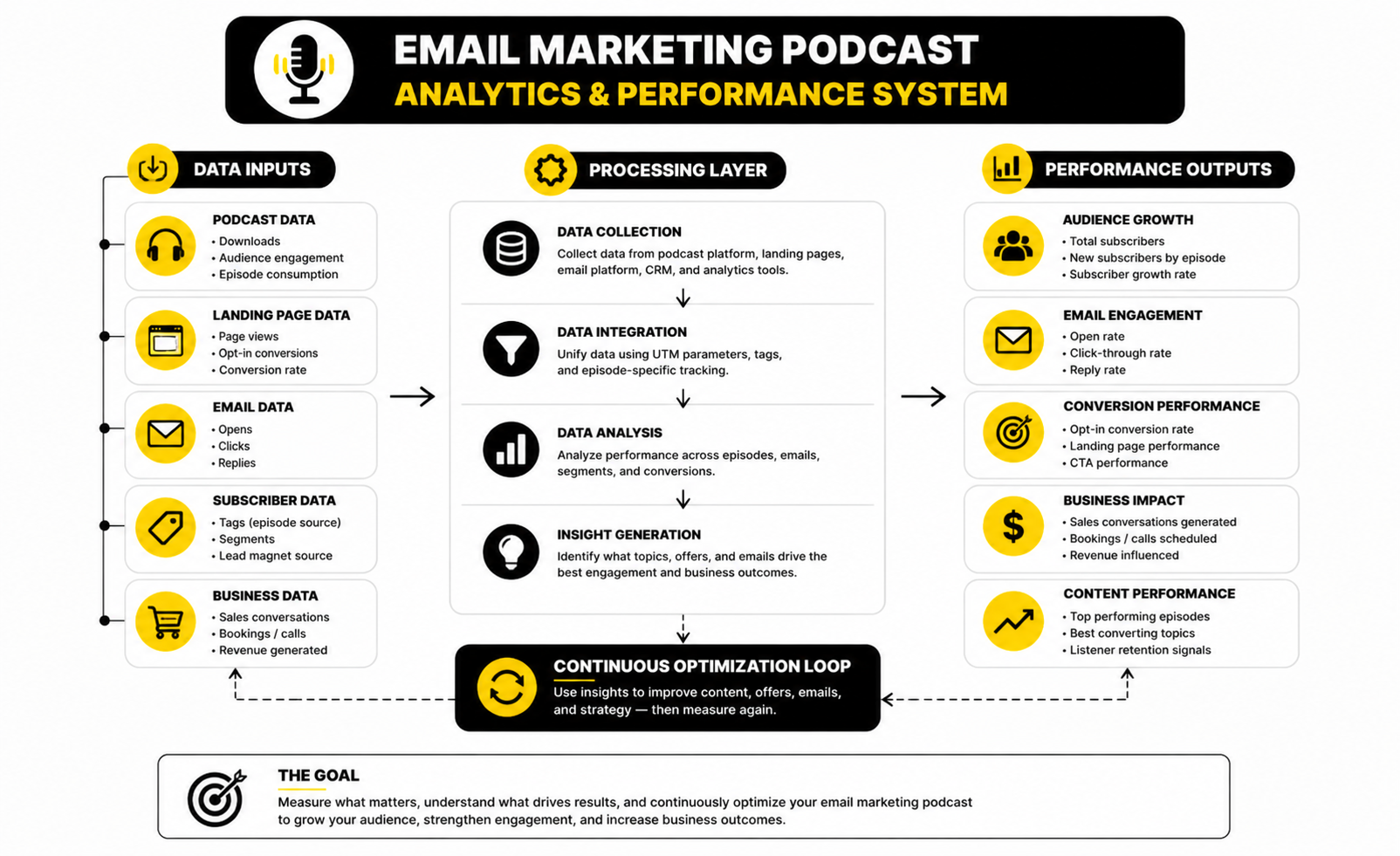
The mistake is looking at podcast numbers and email numbers in isolation. Downloads might show reach, but they do not prove that the show is creating owned audience growth. Open rates might show inbox engagement, but they do not prove that the podcast is attracting the right listeners. The useful view is the full path from listener attention to email behavior to the next business action.
That means the analytics system should answer a simple question: what happens after someone hears the show? If the answer is unclear, the system is not measurable enough yet. You do not need a complex dashboard on day one, but you do need clean links, consistent tracking, and a few metrics that actually influence decisions.
The Metrics That Actually Matter
The first metric is qualified reach. Podcast downloads, plays, and unique listeners help you understand whether the show is getting discovered, but they are only the top of the system. The IAB Tech Lab’s Podcast Measurement Technical Guidelines exist because podcast measurement needs consistent definitions around downloads, audience, and ad delivery, so treat your host’s analytics as directional unless you know exactly how they filter and define activity.
The second metric is listener-to-subscriber conversion. This tells you whether the podcast is doing more than creating passive attention. If an episode gets strong downloads but almost no opt-ins, the topic may be interesting but the next step may be weak, unclear, or mismatched.
The third metric is subscriber quality. This is where email data becomes more useful than podcast data alone. Look at welcome email engagement, resource clicks, replies, segment selection, booked calls, trial starts, purchases, or any meaningful next step connected to the business.
How to Interpret Podcast Downloads
Podcast downloads are useful, but they are not the final score. A download can mean someone’s app fetched the episode, but it does not always mean the person listened deeply, understood the message, or cared enough to act. That is why downloads should be read as reach, not proof of impact.
A growing download trend usually tells you that discovery and distribution are improving. A flat download trend does not automatically mean the show is failing, especially if the listeners you do attract are becoming subscribers, replying to emails, or converting later. For an email marketing podcast, a smaller but more relevant audience can be more valuable than a broad audience with no intent.
The better question is not “Did downloads go up?” The better question is “Which episodes created the best downstream behavior?” If a lower-download episode produces more opt-ins, replies, or sales conversations, that topic deserves more attention.
How to Read Email Benchmarks Without Getting Distracted
Email benchmarks are useful only when they give you context, not when they become excuses. Mailchimp’s benchmark guidance frames open rates, click-through rates, and conversion-related KPIs as a way to compare performance and identify areas for improvement in context by industry and campaign type through its email marketing benchmarks. That is helpful, but your own trend line matters more than chasing somebody else’s average.
Open rate is a health signal, not a revenue metric. It can suggest that subscribers recognize your name, care about the topic, and trust the promise in the subject line. But open tracking has become less precise because of privacy and inbox changes, so it should never be the only metric guiding the strategy.
Click rate and reply rate usually tell you more. Clicks show whether the email created enough interest for the subscriber to take the next step. Replies show whether the podcast and email together are creating real conversation, which is especially valuable for service businesses, consultants, agencies, and B2B offers.
The Podcast-to-Email Analytics Stack
The cleanest analytics stack starts with consistent tracking links. Every podcast call to action should use a memorable URL or trackable link that identifies the episode, campaign, and offer. If you promote the same lead magnet across several episodes, use different tracking links so you can see which topic actually drove the opt-in.
The next layer is your landing page data. Look at visits, conversion rate, source, device, and form completion. If people visit but do not subscribe, the issue may be the offer, headline, page clarity, or form friction. If people do not visit at all, the problem is likely inside the episode CTA, show notes, or promotion strategy.
The final layer is email and CRM behavior. This includes welcome sequence opens, clicks, replies, tags, booked calls, product trials, purchases, or lifecycle movement. Tools such as GoHighLevel, Brevo, and Moosend can help connect forms, automations, tags, and follow-up campaigns when the podcast becomes part of a larger funnel.
What Strong Performance Signals Look Like
A strong signal is not always a huge spike. Sometimes the best signal is a pattern that keeps repeating. If episodes about deliverability keep generating opt-ins and replies, that tells you the audience has a real pain around inbox placement and sender reputation.
Another strong signal is subscriber intent. A listener who downloads a checklist, clicks a related email, and replies with a specific problem is showing more value than a listener who only counted as one download. That person has moved from attention to action.
A third signal is topic-to-offer alignment. If an episode about lifecycle strategy leads to more booked calls than an episode about general newsletter tips, that tells you where the commercial intent lives. Use that insight to plan more episodes, better opt-ins, and sharper email sequences.
What Weak Performance Signals Usually Mean
Weak performance does not always mean the show is bad. It usually means one part of the path is unclear. Low downloads may point to weak positioning, poor titles, limited distribution, or topics that are too broad.
Low landing page visits usually mean the CTA is not strong enough or not repeated clearly enough. A listener may enjoy the episode and still forget the next step if the CTA is buried, vague, or disconnected from the topic. The fix is not shouting harder; it is making the next step more specific and more useful.
Low email engagement after opt-in often means the promise and follow-up are misaligned. If someone subscribes for a tactical resource and then receives broad promotional emails, trust drops quickly. The first few emails should continue the same problem, same language, and same level of usefulness that got the listener to subscribe.
Benchmarks Should Drive Decisions, Not Ego
Benchmarks are there to help you ask better questions. Litmus reports that 35% of companies see email ROI of 36:1 or more, which confirms why email still deserves serious measurement. But that number does not mean much unless you know how your own podcast subscribers behave after they join the list.
Podcast market growth also gives useful context. The Infinite Dial 2025 coverage from National Public Media noted that 55% of Americans consume a podcast monthly and 40% consume one weekly, which shows the channel has mainstream reach. Still, mainstream reach is not the same as business impact.
This is the key point: data should change what you do next. If a topic gets subscribers, make more content around it. If a lead magnet converts poorly, rewrite the promise or replace it. If subscribers click but do not convert, improve the offer bridge. If people reply with the same question again and again, turn that question into the next episode.
A Simple Weekly Reporting Rhythm
The reporting rhythm should be simple enough that you actually use it. Once a week, review the latest episode’s downloads, landing page visits, opt-ins, email engagement, and meaningful follow-up actions. Then write one sentence explaining what the numbers suggest.
That sentence matters more than a bloated dashboard. “The guest episode brought reach but weak opt-ins” is useful. “The checklist CTA converted better than the newsletter CTA” is useful. “Subscribers from the deliverability episode clicked the audit offer twice as often as average” is extremely useful.
Over time, these observations become your editorial strategy. You stop guessing what the audience wants and start seeing what they respond to. That is when the email marketing podcast becomes a measurable growth channel instead of a content project with nice-looking numbers.
Professional Implementation and Automation
At this stage, the strategy has to become operational. A good email marketing podcast cannot depend on memory, inspiration, or last-minute publishing chaos. It needs a clear production system that protects quality while making each episode easier to turn into subscribers, emails, and revenue opportunities.
The goal is not to automate the personality out of the show. The goal is to automate the repeatable parts so the human parts get better. Research, guest preparation, recording, editing, publishing, email creation, tagging, follow-up, and reporting should not be reinvented every week.
This is where advanced implementation starts. You move from “we have a podcast and a newsletter” to “we have a connected content and lifecycle system.” That shift sounds small, but it changes how the whole channel performs.
Build the Operating System Before You Scale
Scaling too early is one of the easiest ways to break an email marketing podcast. More episodes, more guests, more clips, and more emails can create more surface area, but they can also create more noise. If the system is weak, scale only makes the weakness louder.
The operating system should define who owns each step, what assets are created from each episode, which email sequence receives new subscribers, and how performance gets reviewed. This does not need to be corporate or slow. A simple checklist can outperform a complicated strategy doc if the team actually uses it.
A practical operating system should include:
The point is consistency. When every episode follows the same operational path, you can compare results more fairly. You also reduce the chance that a strong episode fails just because nobody created the opt-in, tagged the subscribers, or sent the follow-up email.
Protect Deliverability Before Growth Gets Serious
Deliverability becomes more important as the podcast starts driving real list growth. Early on, a few messy habits might not hurt much. As volume grows, weak authentication, unclear consent, poor list hygiene, and irrelevant follow-up can damage the channel fast.
Google’s sender guidance recommends setting up SPF, DKIM, and DMARC, and Yahoo’s sender resources explain how promotional senders should handle authentication, complaint rates, and one-click unsubscribe expectations. This is not technical decoration. It is the infrastructure that helps your emails actually reach people after the podcast gets them to subscribe.
The strategic lesson is simple: do not treat deliverability as a cleanup task. Treat it as part of the growth system. If your podcast is working but your emails land poorly, you are paying to create demand and then wasting it at the inbox.
Keep Consent Clear and Specific
A podcast can create warm intent, but it does not remove the need for clear consent. People should understand what they are subscribing to, why they are receiving emails, and how to leave. That is not just a compliance issue; it is a trust issue.
The best opt-ins are explicit. If someone downloads an episode checklist, the form should make it clear whether they will also receive future emails. If they are joining a newsletter, say what kind of emails they can expect. Vague consent may grow the list faster in the short term, but it often creates weaker engagement and higher complaints later.
This matters even more when the show has guests, sponsors, partners, or co-marketing campaigns. A guest’s audience may trust the guest, not you yet. The opt-in page has to earn that trust directly instead of assuming it transfers automatically.
Avoid Automation That Feels Like a Trap
Automation should make the experience more relevant, not more mechanical. The danger is building a funnel that treats every podcast subscriber like the same person with the same intent. That might look efficient, but it quickly feels lazy from the subscriber’s side.
A stronger automation setup changes based on context. Someone who subscribes from an episode about deliverability should receive a different first follow-up than someone who subscribes from an episode about podcast promotion. Someone who clicks a booking link has shown different intent than someone who only downloads a template.
This does not require a giant automation map. Start with a few meaningful branches. Tag the episode source, tag the lead magnet, and tag high-intent actions. Platforms such as GoHighLevel, Brevo, and Moosend are useful when you need forms, segmentation, and follow-up logic to work without duct tape.
Decide When to Use Guests Strategically
Guest episodes can grow reach, but they are not automatically better than solo episodes. A guest can bring credibility, distribution, and fresh perspective. A guest can also dilute the show if the conversation drifts away from the audience’s main problem.
Use guests when they strengthen the promise of the show. That might mean interviewing operators who have built strong email systems, founders with real retention lessons, deliverability experts, newsletter creators, or marketers with direct campaign experience. Avoid guests who are only there because they have an audience.
The best guest strategy also includes promotion expectations before recording. Decide whether the guest will share the episode, contribute a resource, answer follow-up questions, or help create a useful subscriber asset. If there is no shared promotion plan, the guest episode may still be valuable, but you should not assume it will drive list growth.
Balance Evergreen and Timely Topics
Evergreen episodes are the backbone of the show because they can keep attracting listeners and subscribers over time. Topics like welcome sequences, segmentation, deliverability, list growth, newsletter positioning, and lifecycle strategy stay useful. These episodes can become long-term assets that deserve stronger show notes, better internal links, and dedicated opt-ins.
Timely episodes can still be powerful. They help the show feel current and give subscribers a reason to pay attention now. Changes in sender requirements, privacy shifts, platform behavior, AI workflows, and buyer behavior can all create useful timely angles.
The tradeoff is shelf life. Timely episodes often need faster production and clearer dates so the audience understands the context. Evergreen episodes deserve more polish because they can keep working long after publication week.
Use AI Carefully in the Production Workflow
AI can make podcast production faster, but it can also make the show sound generic if you let it control the thinking. Use it for support work: transcript cleanup, outline extraction, clip ideas, draft summaries, title variations, and internal research organization. Do not use it as a replacement for judgment.
This matters because trust is the point of an email marketing podcast. If the show starts sounding like every other marketing summary on the internet, the audience has no reason to stay. The host’s perspective, examples, questions, and taste are the moat.
AI-assisted workflows are strongest when paired with clear editorial standards. You can use tools to speed up production, but every public asset still needs a human pass for accuracy, tone, specificity, and usefulness. Fast content that weakens trust is not leverage. It is debt.
Watch for Attribution Blind Spots
Attribution gets messy when podcasting and email work together. A listener may hear three episodes, visit the site later, subscribe from a different device, click an email two weeks later, and book a call after seeing a LinkedIn post. A simple last-click report will not capture that journey well.
This does not mean measurement is pointless. It means you need to combine hard data with directional evidence. Ask new leads how they found you, use episode-specific links, review subscriber source tags, and watch which topics create better downstream conversations.
Do not overreact to incomplete attribution. If multiple high-quality prospects mention the podcast, if subscribers from certain episodes engage deeply, and if the list is producing better sales conversations, the channel is doing work even when the dashboard cannot prove every step perfectly.
Build Sponsor and Partner Offers Carefully
Sponsorship can be tempting once the show has traction, but it can also weaken the listener relationship if handled badly. The audience came for useful insight, not random ads. Any sponsor or partner offer should fit the audience’s real needs and the show’s editorial promise.
This is especially important for an email marketing podcast because listeners may act on tool recommendations. If you mention a platform, explain the use case clearly. For funnel-heavy teams, ClickFunnels may fit landing pages and offer flows. For leaner creators who want a simple all-in-one setup, Systeme.io may be relevant. For agencies that need CRM, automation, and client pipelines, GoHighLevel is often the more natural category fit.
The rule is straightforward: recommend tools in context, not as decoration. A relevant recommendation can help the reader move faster. A random recommendation damages credibility.
Know When to Add More Shows, Segments, or Formats
Once the first system works, it is tempting to add more formats. Video episodes, short clips, private subscriber episodes, guest panels, live workshops, and newsletter-only breakdowns can all make sense. The question is whether the core system is already stable.
A new format should solve a real constraint. Add video if discovery or trust would improve. Add private episodes if the email list needs a stronger retention asset. Add live workshops if subscribers are asking implementation questions that deserve more depth.
Do not add formats just because other shows are doing it. Every new format adds production cost, quality control, and measurement complexity. Scale the parts that already show traction before building new machinery.
The Expert-Level Move Is Restraint
The mature version of an email marketing podcast is not bigger for the sake of bigger. It is sharper. Sharper audience, sharper promise, sharper opt-ins, sharper follow-up, sharper measurement, and sharper editorial judgment.
That takes restraint. You say no to broad topics, weak guests, generic CTAs, bloated automations, and data points that do not change decisions. You also protect the listener experience even when the business wants faster results.
That is the long-term advantage. A show that respects the listener earns more trust. An email system that respects the subscriber keeps more attention. When both work together, the channel becomes harder to copy because the value is not just in the episodes or the emails. It is in the relationship between them.
Measurement, Optimization, and FAQ
The final system is simple to describe but powerful when it is built properly. The podcast attracts the right people, the episode earns attention, the opt-in captures intent, the email sequence continues the conversation, and the analytics loop tells you what to improve next. That is the ecosystem you are building.
A strong email marketing podcast should not feel like a content machine bolted onto an email funnel. It should feel like one connected experience. The listener hears an idea, gets a useful next step, joins the list, receives relevant follow-up, and moves closer to solving the problem that brought them to the show in the first place.
This is why the best systems are both strategic and restrained. You do not need 20 lead magnets, 50 automations, and a dashboard nobody reads. You need a clear show promise, a relevant subscriber path, strong email execution, and enough measurement to keep making better decisions.
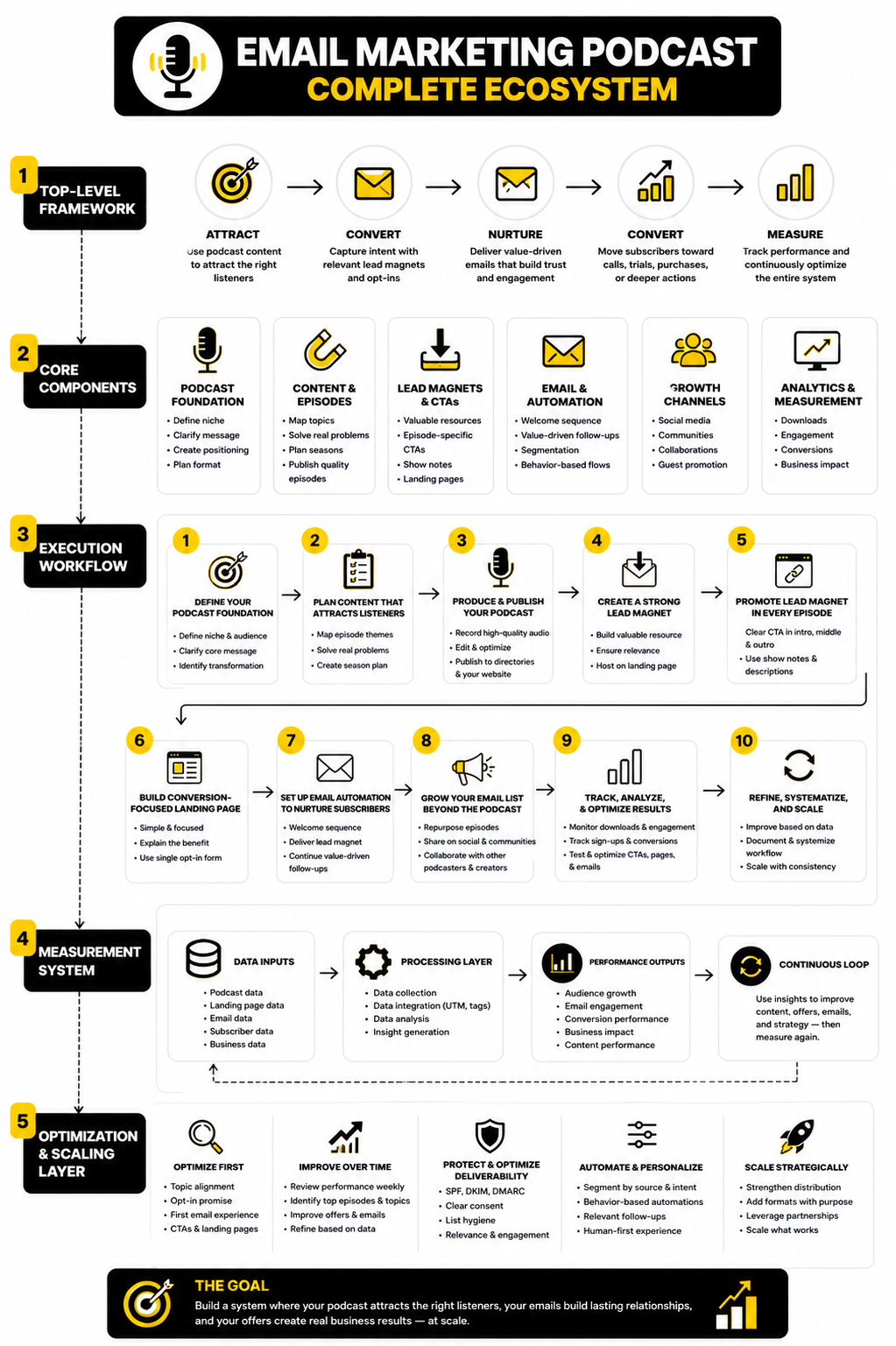
What to Optimize First
Optimize the listener journey before you optimize tiny email details. A subject line test matters, but it will not fix a weak episode promise or a vague call to action. Start with the parts of the system that shape intent.
The first priority is topic alignment. If the episode attracts people who are not likely to care about your offer, the rest of the funnel has to fight uphill. The best topics sit at the intersection of audience pain, host expertise, and commercial relevance.
The second priority is the opt-in promise. A podcast listener needs a clear reason to stop listening, open a browser, and subscribe. Make the promise specific, useful, and connected to the episode they just heard.
The third priority is the first email experience. The welcome email should deliver what was promised, reinforce the value of staying subscribed, and make the next step obvious. If the first email feels generic, you waste the trust the podcast just created.
How to Improve the System Over Time
Optimization should follow evidence, not guesses. Review which episodes bring the right subscribers, which resources convert, which emails get clicks, and which topics lead to real conversations. Then make one focused improvement at a time.
A useful monthly review can look at:
This process keeps the podcast honest. It stops you from chasing vanity metrics and forces you to pay attention to audience behavior. Over time, the show becomes more focused because the best topics, formats, and offers reveal themselves through action.
When the System Is Ready to Scale
Scale only when the core journey works. If listeners are subscribing, subscribers are engaging, and the email follow-up is creating meaningful next steps, then it makes sense to add more distribution. If the journey is broken, more traffic just creates more waste.
Scaling can mean publishing more consistently, adding video, improving guest promotion, running paid traffic to high-performing episodes, building stronger landing pages, or creating segmented email paths. The right move depends on where the bottleneck is. A show with strong conversion but weak discovery needs distribution; a show with strong downloads but weak opt-ins needs a better offer.
This is also where tool selection becomes more important. If the system is small, simple tools are fine. If the podcast becomes a serious acquisition channel, platforms that handle CRM, tagging, forms, email automation, and pipeline movement become more valuable.
The Final Strategic Filter
Before adding anything new, ask one question: does this make the listener-to-subscriber journey clearer, faster, or more valuable? If the answer is no, it is probably a distraction. More content is not always better. More clarity almost always is.
A podcast is intimate because people let you into their routine. Email is personal because people let you into their inbox. Treat both with respect and the combination becomes difficult to copy.
That is the real advantage of an email marketing podcast. The asset is not just the audio. It is the trust system around the audio.
What is an email marketing podcast?
An email marketing podcast is a show that uses podcast content to teach, build trust, and grow an email audience. The podcast creates attention through useful episodes, while the email list captures that attention and turns it into a direct relationship. The best version connects every episode to a clear next step, such as a checklist, guide, newsletter, workshop, or email sequence.
Is an email marketing podcast only for email experts?
No, but the show needs a clear angle. A founder, agency, creator, consultant, SaaS team, or ecommerce operator can run one if they have useful experience around audience growth, lifecycle marketing, retention, newsletters, deliverability, or customer communication. The important part is that the show gives listeners practical value instead of vague marketing commentary.
How does a podcast help grow an email list?
A podcast helps grow an email list by creating trust before asking for the opt-in. Listeners hear your ideas, understand your point of view, and decide whether your advice is worth following. When the episode offers a relevant resource, the email signup feels like the next logical step instead of a cold request.
What should the podcast call to action be?
The call to action should match the episode topic. If the episode is about welcome sequences, offer a welcome sequence checklist. If the episode is about deliverability, offer a sender reputation checklist or audit worksheet. A specific resource usually works better than a generic “join my newsletter” message.
How often should you publish episodes?
Publish at a pace you can sustain without lowering quality. Weekly works well for many teams, but a strong biweekly show is better than a rushed weekly show that creates weak episodes and weak follow-up emails. Consistency matters because listeners and subscribers need to know what to expect.
Should every episode have its own lead magnet?
Not always. Every episode should have a clear next step, but that does not mean you need a brand-new lead magnet every time. You can reuse strong resources across related episodes as long as the CTA still feels relevant and specific.
What email sequence should new podcast subscribers receive?
New subscribers should receive a short sequence that delivers the promised resource, explains what they can expect next, and gives them more useful context connected to the episode topic. After that, you can direct them toward related episodes, deeper resources, replies, calls, trials, or offers. The sequence should feel like a continuation of the podcast, not a sudden sales blast.
What metrics matter most for an email marketing podcast?
The most useful metrics are listener-to-subscriber conversion, landing page conversion rate, welcome email engagement, click rate, reply rate, and downstream business actions. Podcast downloads matter, but they are only the top of the system. The stronger question is whether the right listeners are taking the next step.
What is a good podcast download number?
There is no universal “good” number because the value depends on audience quality and business model. A niche B2B podcast with a small but highly relevant audience can outperform a broader show with more downloads and weaker intent. For this strategy, downloads are useful only when you connect them to subscriber growth and business outcomes.
How do you track podcast subscribers accurately?
Use episode-specific links, dedicated landing pages, UTM parameters, form tags, and email platform segmentation. This will not create perfect attribution, because podcast journeys are messy. It will give you enough signal to see which episodes, topics, and CTAs are creating the best subscribers.
Should an email marketing podcast include guests?
Guests can help when they bring expertise, credibility, or access to a relevant audience. They are less useful when they only add noise or pull the show away from its core promise. The best guest episodes still connect to a clear listener problem and a useful email follow-up.
Should the podcast be audio-only or video too?
Audio-only can work, but video gives you more repurposing options and more discovery surfaces. The decision should depend on your resources, audience behavior, and production quality. Do not add video if it slows the show down so much that publishing becomes inconsistent.
What tools do you need to run the system?
At minimum, you need podcast hosting, a landing page, an email platform, forms, tracking links, and a simple reporting process. As the system grows, tools like GoHighLevel, Brevo, Moosend, ClickFunnels, or Systeme.io can help depending on whether you need automation, funnels, CRM, or campaign management.
How do you keep the podcast from becoming too sales-focused?
Keep the episode useful first. The podcast should teach, clarify, challenge, or guide before it asks for anything. The email CTA should feel like a helpful next step, not a forced pitch.
Can a small podcast still drive revenue?
Yes, especially in high-trust or high-ticket markets. A small email marketing podcast can work well if it attracts the right listeners and moves them into a thoughtful email journey. Relevance beats raw reach when the business model depends on expertise, trust, or considered decisions.
What is the biggest mistake to avoid?
The biggest mistake is treating the podcast and email list as separate channels. If the podcast has no clear opt-in path, it leaks attention. If the email list does not continue the podcast’s promise, it wastes trust.
Build a stronger local presence with BAAM AI
Turn your website, Google profile, social channels, and AI visibility into one growth engine
Most businesses do not need more random marketing activity. They need a consistent presence system that helps the right people find them, trust them, and take action. BAAM AI brings strategy, local SEO, website updates, Google Maps visibility, social content, AI-search readiness, media production, and reporting into one practical monthly engine.
If you want your marketing to keep working after the campaign ends, start with a free BAAM AI presence audit. See how your business shows up today and where the fastest visibility wins are at BAAM AI.