
BAAM AI Blog
Email Marketing Online Course: The Practical Framework For Learning Email That Actually Sells
An email marketing online course should not just teach you how to send newsletters. That is the shallow version of the skill, and it is where a lot of beginners get stuck. The real value is learning how to turn...
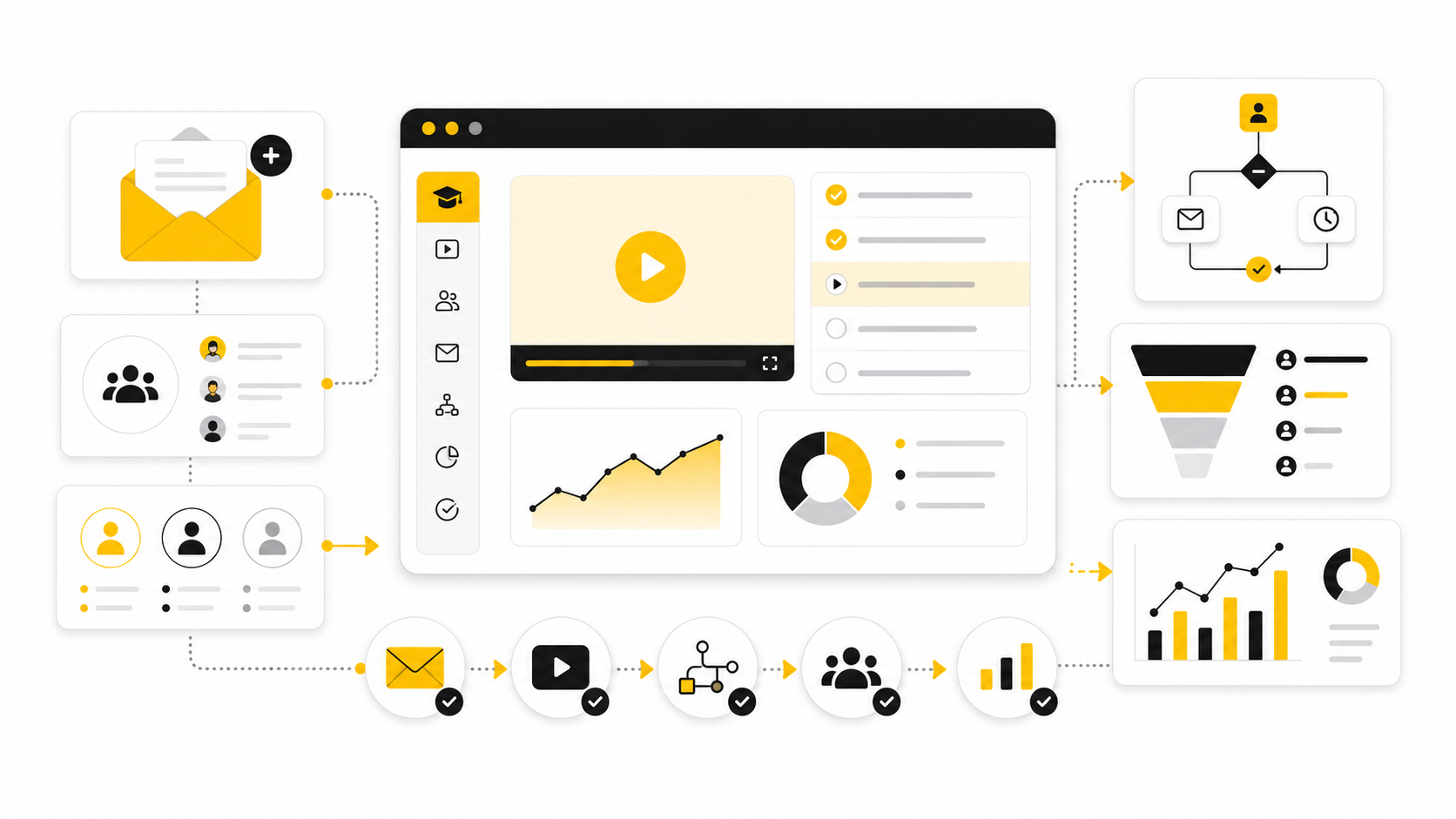
An email marketing online course should not just teach you how to send newsletters. That is the shallow version of the skill, and it is where a lot of beginners get stuck. The real value is learning how to turn attention, trust, segmentation, automation, copywriting, and measurement into a system that can keep producing revenue after the campaign is sent.
Email still matters because it sits closer to the customer relationship than most rented channels. Social platforms can change reach overnight, ad costs can move fast, and search traffic is becoming harder to predict, but a well-built email list gives a business a direct line to people who asked to hear from it. That is why email remains a serious business channel, with DataReportal showing that email is still used monthly by more than 70% of people across age groups.
The mistake is treating email as a tool instead of a discipline. A strong course should teach the full operating system: how to attract the right subscribers, earn permission, write messages people actually want, build automated journeys, protect deliverability, and measure what changes behavior. That is the difference between “I know how to use an email platform” and “I know how to build an email marketing asset.”
this guide is structured as a six-part guide so each section can build on the last without jumping around. Part 1 sets the foundation and defines the learning framework for choosing or building around an email marketing online course. The remaining parts move from strategy into execution, tools, optimization, and decision-making.
Why an Email Marketing Online Course Still Matters
Email marketing is not dead, but lazy email marketing is definitely struggling. Inboxes are more crowded, privacy changes have made basic metrics less reliable, and subscribers have less patience for generic promotions. That is exactly why structured learning matters: the channel rewards people who understand strategy, not just software buttons.
The numbers still justify the effort when email is handled properly. The 2026 Email Impact Report from Sinch Mailgun, based on more than 400 billion emails sent in 2025 and a survey of more than 1,200 senders, found that 60% of companies measuring email ROI report returns above $10 for every $1 spent. The same research also found that fewer than half of organizations can confidently measure email ROI, which is the real warning sign.
That gap is where a good email marketing online course becomes useful. It should not promise magic templates or instant passive income. It should help you understand the mechanics behind performance, so you know why a campaign worked, why it failed, and what to test next.
The Email Marketing Skill Framework
A useful framework starts with one simple idea: email is a relationship channel before it is a sales channel. People open, click, reply, ignore, unsubscribe, or buy based on the relevance and trust built before the offer appears. That means the course should connect list growth, positioning, segmentation, copywriting, automation, compliance, deliverability, and analytics into one system.
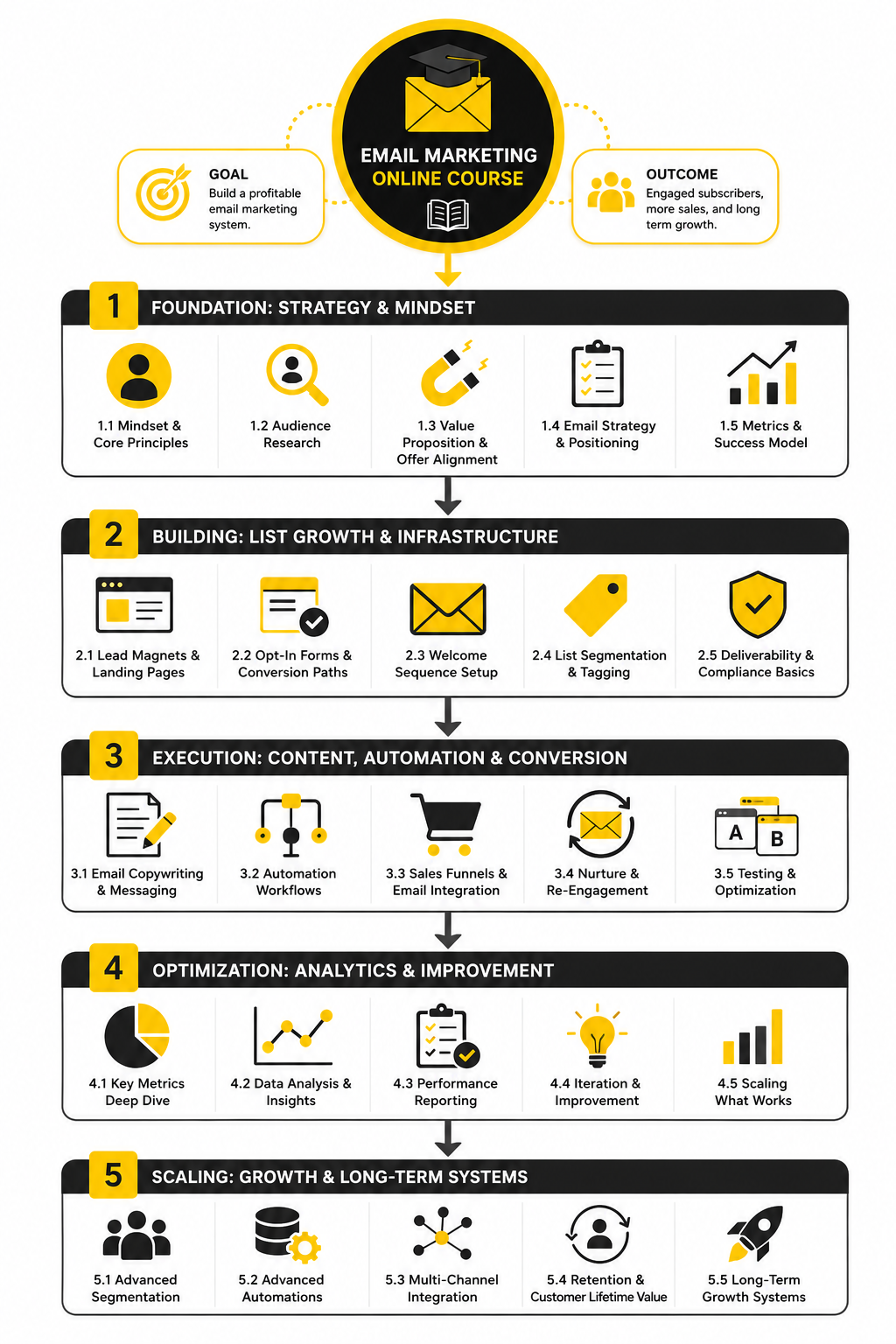
The first layer is strategy, because email without strategy turns into random sending. You need to know who the list is for, what problem the emails solve, what the business wants from the channel, and how subscribers move from awareness to purchase or retention. Without that map, even good-looking campaigns become noise.
The second layer is execution. This includes subject lines, email structure, calls to action, landing pages, forms, tags, automations, and campaign calendars. Execution is where most people want to start, but it works best after the strategy is clear.
The third layer is optimization. Email platforms can show opens, clicks, conversions, revenue, unsubscribes, spam complaints, and deliverability signals, but those numbers only matter when they lead to better decisions. A strong course should teach you how to read performance patterns, not just stare at dashboards.
Core Components Every Course Should Teach
A strong email marketing online course should start with permission, because permission is what separates a real list from a pile of contacts. People need to understand why someone joins, what they expect to receive, and what would make them stay subscribed after the first few emails. This is not just a compliance issue; it is the foundation for trust, engagement, and long-term revenue.
The course should also teach the difference between an audience and a segment. An audience is the broad group you can contact, while a segment is a smaller group defined by behavior, interest, source, stage, or buying intent. That distinction matters because the same message will not feel relevant to a cold lead, a first-time buyer, a repeat customer, and a silent subscriber who has not clicked in months.
List growth needs to be covered as a system, not as a collection of hacks. A good course should show how lead magnets, landing pages, opt-in forms, quizzes, checkout offers, webinars, and content upgrades fit into the customer journey. Tools like ClickFunnels, systeme.io, and Replo can support that part of the workflow, but the tool is not the strategy.
List Building And Permission
The first skill is earning the opt-in. A subscriber should know what they are signing up for, why it is useful, and what kind of emails they can expect. When the promise is vague, the list may grow faster, but engagement usually becomes weaker because the relationship started with confusion.
A proper course should teach the mechanics of opt-in placement, form copy, consent language, and incentive design. It should also explain why a smaller list of people who actually want your emails is more valuable than a large list that ignores you. This sounds basic, but it is one of the places where beginners burn the most money.
The practical goal is simple: build a list that can be mailed consistently without damaging trust. That means no scraped contacts, no unclear giveaways, and no bait-and-switch promises. Email works best when the subscriber feels like joining was their idea, not a trick.
Segmentation And Personalization
Segmentation is where email starts becoming useful instead of noisy. A good email marketing online course should teach you how to group subscribers by what they have done, what they care about, and where they are in the buying journey. Demographics can help, but behavior usually tells you more.
Modern benchmarks make this hard to ignore. Brevo’s 2025 benchmark data, based on more than 44 billion emails, shows an overall click-through rate of 3.64% across industries, which means most subscribers will not click most campaigns. Better segmentation does not guarantee a click, but it gives every email a fairer chance because the message is tied to a real reason for sending.
Personalization should go beyond using someone’s first name. A useful course should cover purchase history, viewed pages, lead magnet topic, quiz answers, lifecycle stage, location, and engagement level. Platforms like Brevo and Moosend can help manage those segments, but the course should teach why each segment exists before it teaches which button to click.
Copywriting And Campaign Structure
Email copywriting is not about sounding clever. It is about making the next step obvious, relevant, and worth taking. A course that skips copywriting is incomplete because the platform only delivers the message; the message still has to do the selling.
The structure should be taught from the subscriber’s point of view. The subject line earns the open, the first line confirms the email is worth reading, the body builds context, and the call to action makes one clear request. When every email tries to do five things, the reader usually does none of them.
Campaign structure matters just as much as individual emails. A launch sequence, onboarding flow, abandoned cart flow, reactivation campaign, and weekly newsletter all have different jobs. The course should help you understand those jobs clearly, because copying a template without knowing the purpose behind it is how email starts sounding generic.
Automation And Customer Journeys
Automation is one of the biggest reasons to learn email properly. It lets a business respond to subscriber behavior without manually writing every message in real time. That does not mean automation should feel robotic; it means the right message should arrive when it makes sense.
A useful course should teach welcome sequences, nurture sequences, sales sequences, post-purchase flows, abandoned cart emails, lead scoring, reactivation campaigns, and handoffs to sales. For service businesses and agencies, GoHighLevel can be useful because it connects email with CRM, pipelines, forms, calendars, and follow-up workflows. For ecommerce and creator funnels, the structure may look different, but the principle stays the same: automate moments where timing and relevance matter.
The danger is over-automation. When every behavior triggers another message, subscribers can feel watched instead of helped. A strong course should teach restraint, because good automation feels timely, not aggressive.
Deliverability And List Health
Deliverability is the part beginners often ignore until something breaks. If emails do not reach the inbox, the offer, copy, design, and automation barely matter. That is why an email marketing online course should treat deliverability as a core skill, not a technical footnote.
This includes sender authentication, domain reputation, spam complaints, bounce rates, unsubscribe handling, list cleaning, and engagement quality. Gmail and Yahoo’s sender requirements pushed authentication and one-click unsubscribe into the mainstream, while deliverability guidance from providers such as Mailgun emphasizes SPF, DKIM, and DMARC as table stakes for serious senders. In plain English: inbox providers are rewarding responsible senders and filtering careless ones.
List health is also a business habit. You need to remove or suppress people who consistently do not engage, avoid misleading subject lines, and make unsubscribing easy. That may feel counterintuitive at first, but keeping uninterested people on the list only makes the channel weaker over time.
Analytics And Decision-Making
Analytics should be taught as decision support, not dashboard decoration. Opens, clicks, conversions, revenue, unsubscribes, replies, spam complaints, and deliverability all say something different. The skill is knowing which metric answers which question.
Open rates are useful, but they are no longer clean enough to be treated as the whole truth. Apple Mail Privacy Protection and bot activity can distort engagement signals, which is why Brevo recommends adjusting segmentation and automation logic around more reliable behaviors like purchases, replies, form submissions, and page views. A course that still teaches open rate as the main success metric is behind the market.
The better question is always: what decision will this metric change? If a welcome email gets clicks but no conversions, the offer or landing page may be the problem. If a campaign gets strong revenue but high unsubscribes, the promotion may be effective but too aggressive for that segment. Good analytics training helps you diagnose the system instead of guessing.
Professional Implementation: From Strategy To Send
Once the core skills are clear, implementation becomes the real test. This is where an email marketing online course should move from concepts into process, because knowing what email can do is not the same as knowing what to build on Monday morning. The goal is to create a repeatable workflow that takes a campaign from business objective to inbox to performance review.
Professional implementation starts with a campaign brief. Before writing anything, you need to define the audience, the offer, the reason for sending, the desired action, the timing, and the metric that will decide whether the email worked. That one step prevents most of the messy campaigns that happen when teams start with “we need to send something this week.”
The process should also connect email to the rest of the customer journey. A subscriber may click from an email to a landing page, book a call, reply to a sales rep, watch a demo, or buy through a checkout page. If those pieces are disconnected, email gets blamed for problems that actually happen after the click.
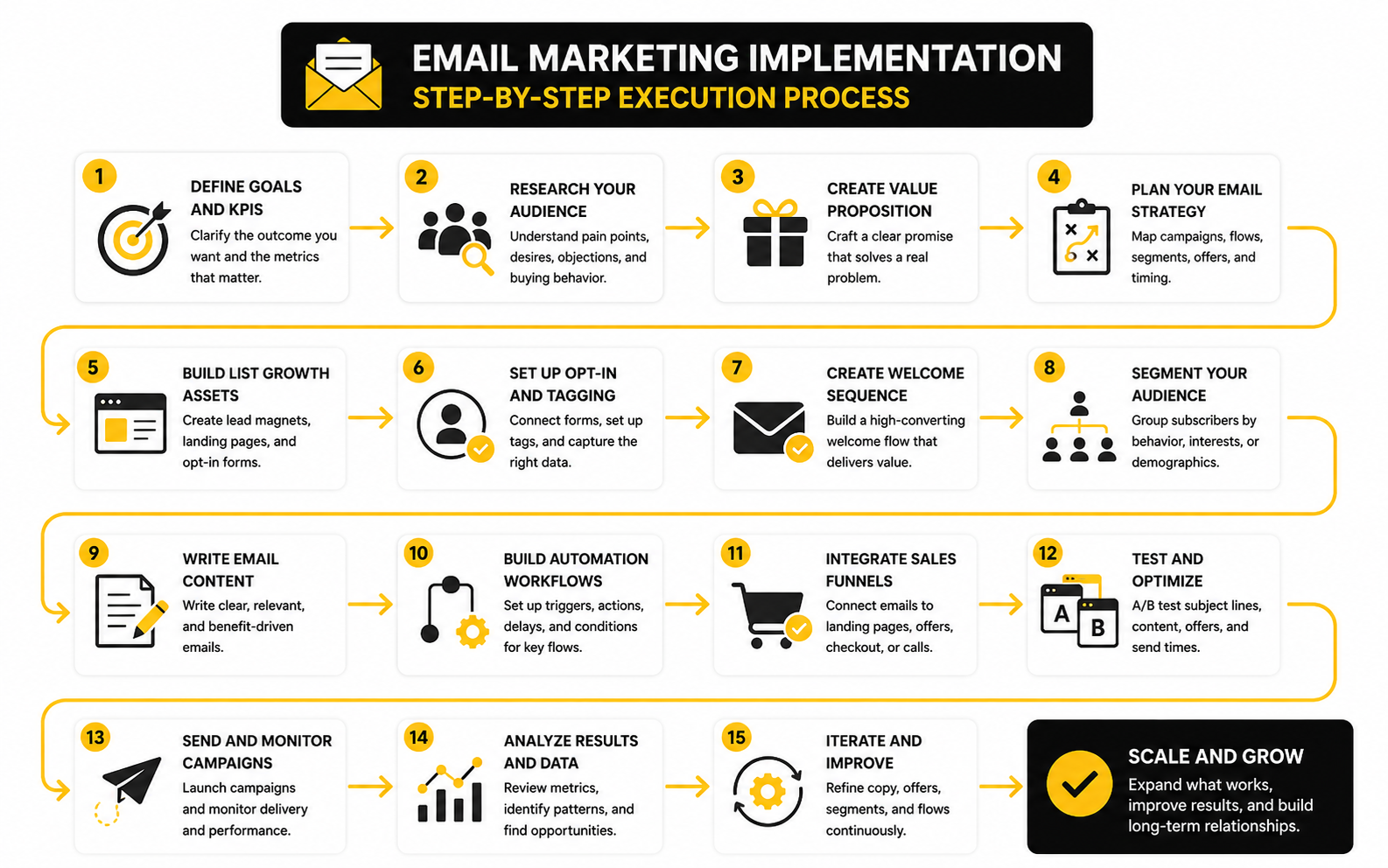
Step 1: Define The Business Goal
Every email needs a job. Sometimes the job is direct revenue, but not always. A welcome email may need to build trust, a newsletter may need to increase repeat engagement, and a reactivation campaign may need to identify who still wants to hear from you.
The course should teach you how to turn vague goals into specific outcomes. “Get more sales” is not specific enough. “Move trial users who activated one feature into a demo request” is much better because it tells you who the email is for, what action matters, and how the campaign should be judged.
This matters because email performance is easy to misread. A campaign can have a high click rate and still fail if the wrong people clicked for the wrong reason. A professional workflow starts by making the business goal measurable before the email is written.
Step 2: Map The Subscriber Segment
The next step is choosing who should receive the message. This is where the work from segmentation becomes practical. Instead of sending the same email to everyone, you match the message to a subscriber group with a clear reason to care.
A strong course should teach you to build segments from behavior, not just labels. That might include people who downloaded a specific guide, visited a pricing page, abandoned checkout, bought once but not again, attended a webinar, or ignored the last several campaigns. The more precise the segment, the easier it becomes to write an email that feels relevant.
Segmentation also protects the list. Sending fewer emails to better-matched people is usually more carefully than blasting every contact just because the platform allows it. This is the discipline that separates email operators from button-clickers.
Step 3: Choose The Right Email Type
Different email types solve different problems. A broadcast campaign works when the timing is shared, such as a sale, announcement, content drop, or event reminder. An automated flow works better when timing depends on subscriber behavior, such as a signup, purchase, abandoned cart, or inactivity trigger.
This is where a course should help you think structurally. You do not need an automation for every idea, and you do not need a broadcast for every update. You need the format that matches the moment.
For ecommerce brands, behavioral automations can become especially powerful because they respond when intent is fresh. Klaviyo’s ecommerce benchmark research frames performance around segmentation and automation across 1.5 billion emails, which reinforces the practical point: timing and relevance are not minor details. They are the engine.
Step 4: Write The Message Around One Clear Action
Good email copy narrows attention. It does not try to educate, entertain, sell, survey, and announce everything at once. The reader should understand why they received the email and what to do next without working for it.
A practical course should teach a simple copy flow: context, problem, value, proof, action. That does not mean every email needs to be long. It means the message should move in a logical order instead of dumping information into a template.
The call to action deserves special attention. One email can include the same call to action more than once, but it should not ask for several unrelated actions. When the next step is clear, the reader has less friction and the campaign is easier to measure.
Step 5: Build The Destination Before You Send
The email is only one part of the conversion path. If the landing page is slow, confusing, inconsistent, or disconnected from the promise in the email, performance drops after the click. That is why implementation training should include the destination, not just the message.
For simple funnels and lead capture paths, tools such as ClickFunnels and systeme.io can help turn campaigns into complete paths instead of isolated emails. For ecommerce landing pages, Replo can support more tailored product and campaign pages when the store experience needs more control.
The important thing is message match. The headline, offer, visuals, pricing, form, and checkout should feel like a natural continuation of the email. When the page feels like a different conversation, trust leaks out of the funnel.
Step 6: Check Deliverability Before Launch
A professional send process includes a preflight check. This means confirming the right segment, suppression rules, sender address, authentication, links, tracking, mobile layout, unsubscribe link, and plain-text version. It is not glamorous, but it prevents expensive mistakes.
Sender requirements are stricter than they used to be. Gmail requires bulk senders to authenticate outgoing mail, support easy unsubscribe, and keep spam rates low, while Yahoo’s sender guidance also emphasizes authentication, DMARC alignment, and easy unsubscribe. That makes deliverability part of execution, not a separate technical project.
A good course should make these checks feel normal. Before every serious campaign, you should know who is receiving it, why they are receiving it, whether the email can pass basic inbox expectations, and what happens after they click. That is professional email marketing.
Step 7: Schedule, Monitor, And Learn
Sending is not the finish line. After launch, the work shifts to monitoring delivery, early engagement, link performance, conversions, replies, complaints, unsubscribes, and revenue. The point is not to panic over every small movement; the point is to learn what the market is telling you.
The course should teach a simple post-send review. What happened, what was expected, what changed, and what should be tested next? This keeps optimization grounded instead of turning every campaign into random guessing.
Over time, this creates a feedback loop. The business goal informs the segment, the segment informs the message, the message informs the destination, and the results inform the next campaign. That loop is the process an email marketing online course should leave you with.
Statistics And Data
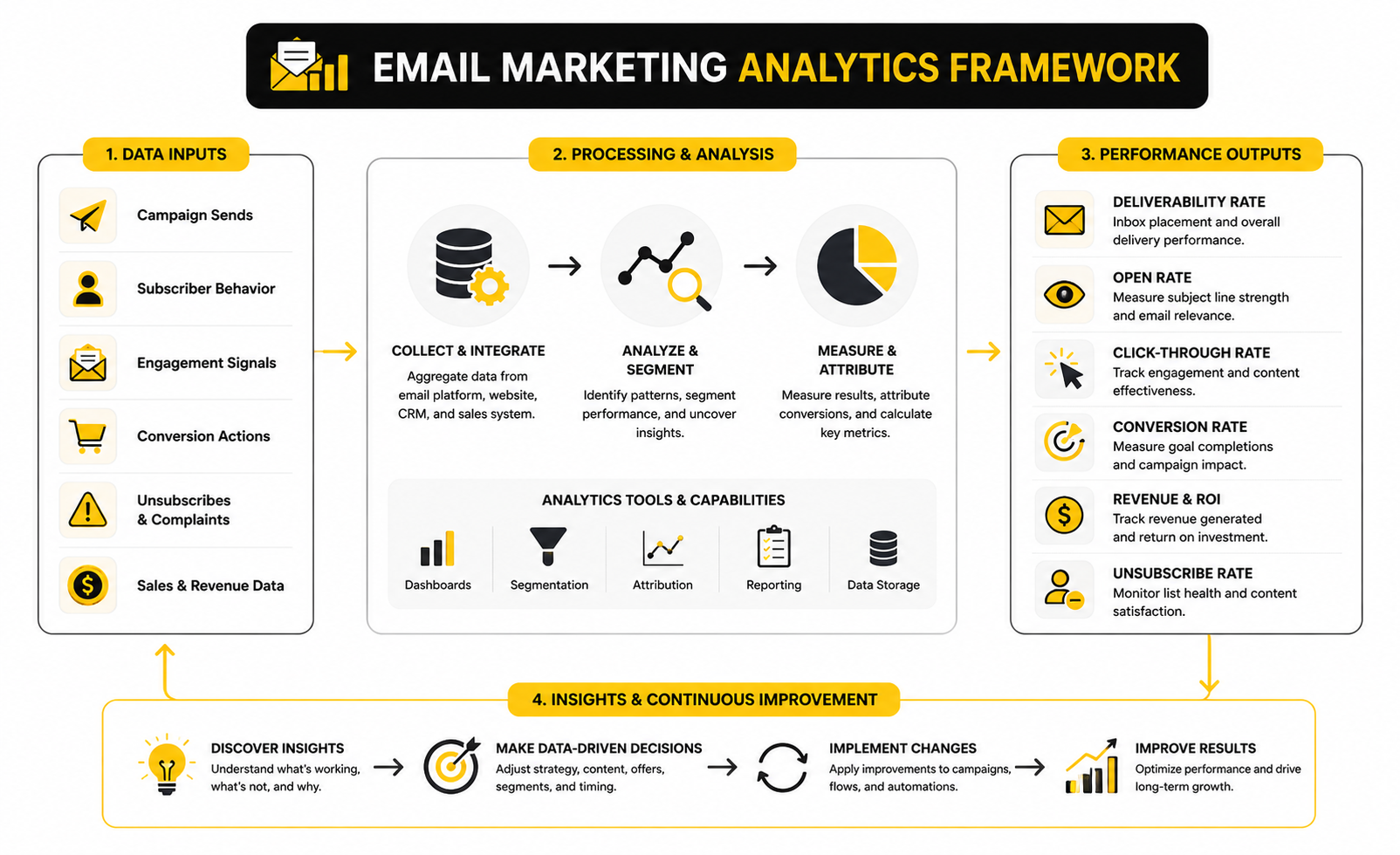
Email marketing data is useful only when it changes how you act. A benchmark can tell you whether a campaign is unusually weak, healthy, or strong, but it cannot tell you what your audience wants by itself. That is why a good email marketing online course should teach measurement as a diagnosis system, not as a scoreboard.
The biggest mistake is treating every number as equally important. Open rate, click rate, conversion rate, revenue per recipient, unsubscribe rate, spam complaint rate, bounce rate, and inbox placement all answer different questions. When those numbers are mixed together without context, marketers start optimizing the wrong thing.
The better approach is to read email performance in layers. First, did the email reach people? Second, did the right people engage? Third, did the campaign produce the business outcome? That order matters because a weak conversion rate means something very different if delivery was poor, the offer was unclear, or the landing page broke after the click.
Delivery Metrics Show Whether The Message Had A Chance
Delivery is the first measurement layer because no email can perform if it never reaches the subscriber. Delivered rate tells you whether the message was accepted by receiving servers, but inbox placement tells you whether it likely landed somewhere visible. Those are not the same thing, and a serious course should make that distinction clear.
Sinch Mailgun’s benchmark analysis reviewed more than 400 billion emails across major industries and reported a 99.25% delivered rate, which sounds excellent on the surface. The action point is not “delivery is solved.” The action point is to check what happens after acceptance, because inbox placement, spam filtering, and tab placement can still limit visibility.
Complaint rate is one of the most important warning signals. Gmail’s bulk sender guidance requires senders to keep spam rates below 0.3% in Postmaster Tools, and that threshold should shape how marketers think about list quality. If complaints rise, the fix is rarely just a better subject line; it usually means the audience, promise, frequency, or relevance is off.
Engagement Metrics Show Whether The Message Matched Intent
Engagement tells you whether the email felt relevant enough to earn action. Opens can help with directional testing, but they are not clean enough to carry the whole analysis anymore. Privacy changes, image loading behavior, bots, and mailbox filtering all make open rate easier to misread than many beginners realize.
Clicks are more useful because they show active interest. Klaviyo’s 2026 benchmark data reports an average campaign click rate of 1.69% across industries, while automated flows average 5.58%. That gap matters because it shows why timing and behavior-based relevance often beat one-off promotional sending.
A course should teach students to ask why the click happened, not just whether it happened. A high click rate on a vague curiosity subject line may produce poor buyers. A lower click rate from a highly qualified segment may produce better revenue because the intent is stronger.
Conversion Metrics Show Whether The Campaign Created Business Value
Conversion metrics connect email to the outcome the business actually wanted. That could be a purchase, booked call, demo request, application, reply, trial activation, renewal, donation, or content consumption goal. The key is choosing the conversion before the campaign is sent.
Revenue per recipient is one of the cleanest ecommerce metrics because it balances audience size and buying behavior. A campaign sent to a smaller segment can look less impressive in total revenue but stronger in revenue per recipient. That is why broad campaign totals can mislead teams into sending too often to too many people.
For service businesses, the conversion path may be less direct. A subscriber might click an email, visit a page, book a call later, and close after a sales conversation. In that case, tools like GoHighLevel can help connect email activity with pipelines and appointments, but the measurement logic still has to be designed intentionally.
ROI Metrics Show Whether Email Deserves More Investment
ROI is where email becomes a boardroom conversation instead of a marketing activity. If a business can tie email to revenue, retention, or cost savings, it can make more carefully decisions about software, creative, list growth, and staffing. If it cannot, the team is mostly guessing.
The measurement gap is real. Sinch Mailgun’s 2026 Email Impact Report found that fewer than half of organizations can confidently measure email ROI, even though 60% of companies that do measure it report returns above $10 for every $1 spent. That should change how an email marketing online course teaches analytics: ROI tracking is not advanced; it is foundational.
The practical action is to define attribution rules early. You need to know what counts as email revenue, what attribution window is reasonable, how assisted conversions are handled, and whether lifecycle emails are measured separately from campaigns. Without those rules, ROI debates become opinion fights.
Benchmark Data Should Guide Questions, Not Replace Judgment
Benchmarks are useful, but they are not commandments. A finance newsletter, a beauty ecommerce brand, a local service business, and a B2B SaaS company should not expect the same click rates or conversion patterns. The benchmark gives context, but your own audience gives the truth.
Industry data can still help you spot problems faster. If your click rate is far below the average for similar campaigns, the issue may be relevance, offer strength, creative clarity, or list quality. If clicks are strong but conversions are weak, the problem may be the landing page, pricing, product-market fit, or checkout experience.
The course should teach benchmarking as a starting point for investigation. The wrong question is “Is this number good?” The better question is “What does this number suggest we should inspect next?”
The Metrics That Matter Most By Campaign Type
Different campaigns deserve different scorecards. A welcome sequence should not be judged the same way as a flash sale, and a reactivation campaign should not be judged the same way as a weekly newsletter. When the scorecard matches the campaign type, performance becomes much easier to interpret.
A practical measurement system can start with these priorities:
This is where analytics becomes practical. You stop looking for one magic number and start using the right number for the right job. That is how measurement turns into better email decisions.
Clean Data Creates Better Decisions
Bad data creates confident mistakes. If tracking links break, UTM parameters are inconsistent, segments overlap, or revenue attribution is unclear, the report may look official while still being wrong. A serious email marketing online course should teach the boring setup work because that is what makes optimization possible.
Clean measurement starts with naming conventions. Campaigns, flows, segments, links, offers, and landing pages should be named in a way that another person can understand six months later. This is not busywork; it prevents confusion when performance needs to be compared over time.
The final habit is a post-campaign review. Write down what was sent, who received it, what happened, what likely caused the result, and what should change next. Over months, that record becomes more valuable than any single benchmark report because it shows how your own market responds.
Tools, Automation, And List Growth Systems
At this stage, the question is not whether email marketing works. The question is whether your system can keep working as the list grows, the offers expand, and the business gets more complex. This is where an email marketing online course should get more advanced, because scaling email is less about sending more and more about making more carefully tradeoffs.
The first tradeoff is simplicity versus control. Simple tools help you launch faster, but they can become restrictive when you need deeper segmentation, stronger automation logic, better reporting, or tighter CRM integration. Advanced tools give you more control, but they also create more ways to overbuild the system before the business actually needs it.
The second tradeoff is speed versus accuracy. A fast campaign can capture a timely opportunity, but rushed sending can create broken links, poor targeting, deliverability issues, or confusing offers. A professional email marketer learns when speed matters and when a slower, cleaner setup will protect revenue.
Choosing The Right Platform For The Business Model
The best email platform depends on the business model, not on whichever tool has the loudest marketing. Ecommerce brands usually need strong product data, abandoned cart flows, purchase-based segmentation, and revenue reporting. Service businesses often need CRM visibility, appointment booking, lead scoring, pipeline stages, and sales follow-up.
That is why the course should teach tool selection by workflow. A local agency or coaching business may care more about pipelines, calendars, forms, and automated follow-up, which makes GoHighLevel a practical fit. A funnel-focused creator or digital product seller may care more about opt-in pages, sales pages, checkout flows, and upsells, where ClickFunnels or systeme.io can make sense.
The mistake is choosing software before defining the customer journey. If the workflow is unclear, every platform will feel either too limited or too complicated. A good course should help you map the journey first, then choose the tool that supports it with the least friction.
Building A List Growth Engine
List growth should not depend on one random lead magnet sitting on a homepage. A durable system uses multiple entry points that match different levels of awareness. Someone reading a beginner guide, comparing tools, attending a webinar, and viewing a pricing page should not always receive the same opt-in offer.
A more advanced course should teach you to build acquisition paths around intent. Educational content can lead to checklists, templates, calculators, short email lessons, or webinars. Product and service pages can lead to demos, audits, comparison guides, quizzes, or consultation forms.
The key is to connect the source of the subscriber to the follow-up. A person who joins from a tactical checklist probably needs education before a sales push. A person who joins from a pricing-page form may be ready for a faster sales conversation, and tools like Fillout can help capture richer intent data before the first email is even sent.
Automation Depth Versus Human Touch
Automation should remove repetitive work, not remove judgment. The more a business grows, the more tempting it becomes to automate every interaction. That sounds efficient, but it can quietly damage trust when subscribers feel like they are trapped inside a machine.
The more carefully approach is to automate predictable moments and keep human involvement for high-intent or high-value moments. A welcome sequence, abandoned cart reminder, onboarding flow, and reactivation path can run automatically. A qualified enterprise lead, strong reply, or high-ticket booking request may deserve a human response.
This is especially important for service businesses. If an email sequence creates interest but the sales process ignores context, the automation has done its job and the handoff has failed. A course should teach the full handoff, including when to notify a team member, when to create a task, and when to stop automated follow-up.
Managing Frequency Without Burning The List
More sending can create more revenue in the short term, but it can also train people to ignore the brand. This is one of the hardest scaling issues because the numbers can look good right before the list starts getting weaker. You may see revenue today while quietly increasing unsubscribes, complaints, and disengagement tomorrow.
The answer is not a universal sending frequency. The answer is frequency control by segment, intent, and relationship stage. A recent buyer, a cold subscriber, a webinar registrant, and a VIP customer should not automatically receive the same volume of email.
An advanced course should teach pressure management. That means suppression rules, engagement-based sending, campaign calendars, exclusion logic, and clear rules for promotional periods. The goal is not to send less for the sake of being polite; the goal is to send with enough discipline that people still want to hear from you next month.
Using AI Without Losing The Brand Voice
AI can speed up research, drafting, testing ideas, and repurposing content, but it should not become the voice of the brand. Generic AI email copy is easy to spot because it often sounds polished without sounding specific. In email, specificity is what earns attention.
A serious email marketing online course should teach AI as an assistant, not a replacement for strategy. AI can help generate subject line angles, summarize customer research, turn product notes into draft emails, or create testing variations. The marketer still has to decide what is true, what matters, what the subscriber needs, and what the offer should be.
This is where prompts are less important than inputs. Customer reviews, survey responses, sales call notes, support tickets, product positioning, and real objections give AI something useful to work with. Without those inputs, AI usually produces clean but forgettable emails.
Protecting Compliance And Trust
Compliance is not the exciting part of email, but it is the part that keeps the channel safe. Marketers need to understand consent, unsubscribe handling, sender identification, data storage, and privacy expectations. A course does not need to turn you into a lawyer, but it should make you aware of the rules that affect your campaigns.
This matters more as lists scale across regions. Requirements can differ between the United States, the European Union, the United Kingdom, Canada, and other markets, especially around consent and data processing. If a business collects subscribers globally, it should not treat every email address as if the same rules apply.
Trust is the practical version of compliance. Even when something is technically allowed, it may still feel wrong to the subscriber. The strongest email programs protect trust before they are forced to protect it.
Creating A Scalable Operating Rhythm
Scaling email requires rhythm. Without a rhythm, campaigns become reactive, automations become outdated, and reporting gets ignored until something breaks. A professional operating system creates space for planning, production, quality control, sending, and review.
A simple weekly rhythm can include campaign planning, segment checks, copywriting, build review, QA, send approval, and performance review. A monthly rhythm can include flow audits, list health checks, offer analysis, deliverability review, and calendar planning. A quarterly rhythm can include deeper strategy work, lifecycle mapping, tool cleanup, and revenue attribution.
This is the boring part that makes the exciting part work. Great email marketing is not just creative; it is operational. When the process is consistent, the team can improve the system instead of constantly rebuilding it from scratch.
Knowing When To Upgrade The System
Not every business needs advanced software on day one. Upgrading too early can create cost and complexity without improving results. Upgrading too late can limit segmentation, automation, attribution, and team collaboration.
The signs are usually clear. You may need a stronger system when you cannot see which emails create revenue, when manual follow-up is slipping through the cracks, when segments are hard to manage, when sales and marketing data live in separate places, or when automations are becoming too complex for the current platform. That is the point where better infrastructure can actually pay for itself.
The right course should help you avoid both extremes. Do not stay on a basic setup just because it is familiar. Do not buy an advanced platform just because it looks impressive. Build the system that matches the stage of the business, then upgrade when the constraint becomes real.
Measurement, Optimization, Course Selection, And FAQ
The final piece is putting everything together into one operating system. At this point, an email marketing online course should help you understand the full ecosystem: audience growth, permission, segmentation, content, automation, deliverability, analytics, tools, and commercial outcomes. None of those parts should live in isolation.
The best email marketers do not just ask, “Did this campaign perform?” They ask, “What did this campaign reveal about the audience, the offer, the timing, the funnel, and the next decision?” That mindset is what turns email from a task into a growth asset.
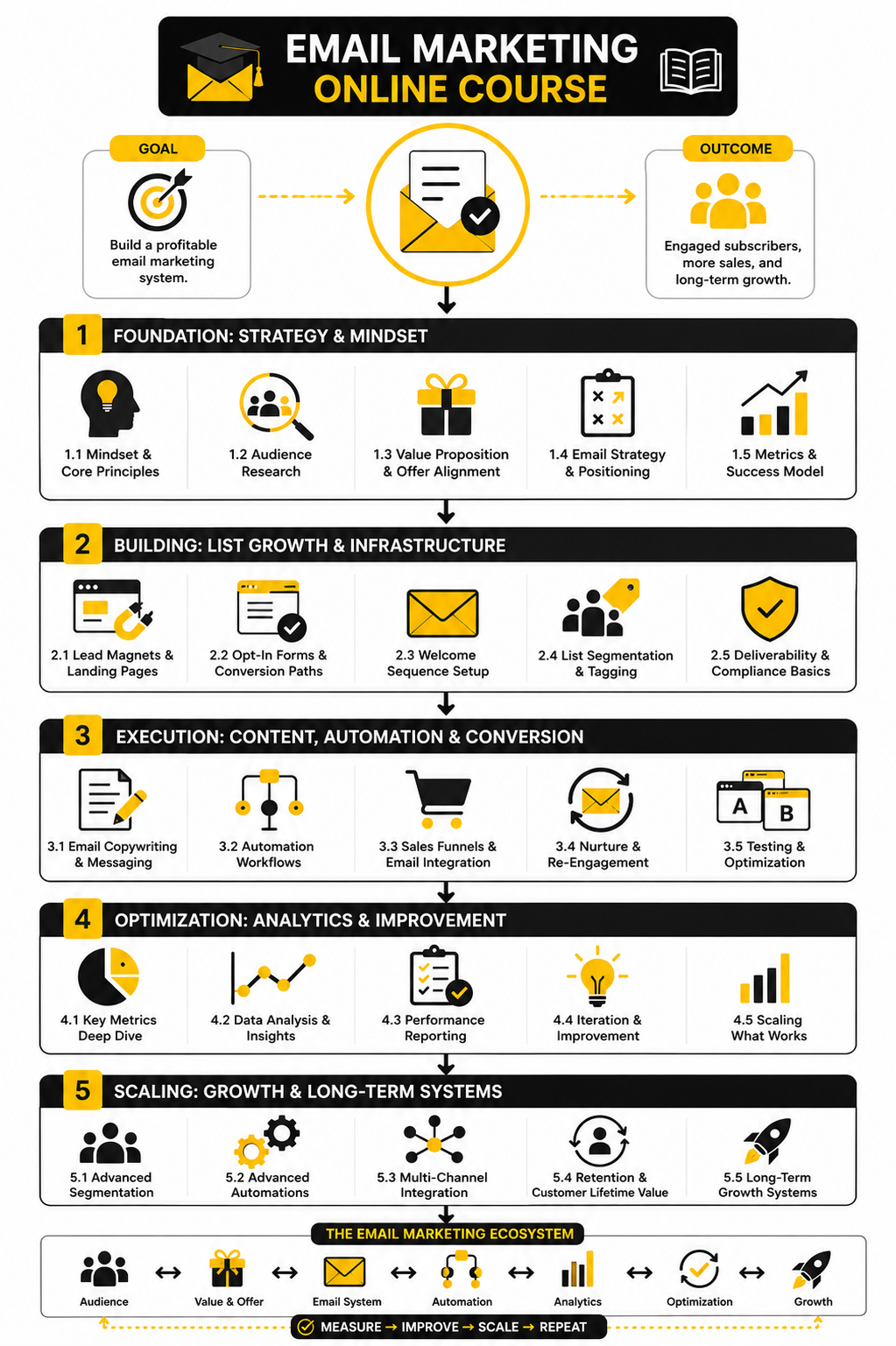
How To Choose The Right Email Marketing Online Course
A good course should teach principles before tools. Software changes constantly, but permission, relevance, timing, positioning, deliverability, and measurement stay important across platforms. If a course is mostly screenshots of one dashboard, it may help you click around, but it will not make you a stronger email marketer.
Look for a curriculum that includes strategy, list growth, segmentation, copywriting, automation, deliverability, compliance basics, analytics, and real implementation workflows. It should also explain tradeoffs, not just best practices. Email marketing is full of “it depends” moments, and a serious course should teach you how to think through them.
The course should also match your business model. A freelancer serving local businesses needs different workflows than an ecommerce retention marketer, a SaaS growth operator, or a creator selling digital products. The right course helps you build the email system your market actually needs.
What To Avoid When Comparing Courses
Avoid courses that promise effortless income from email without explaining the underlying system. Email can produce strong returns, but only when the list, offer, message, timing, and measurement are aligned. Anyone selling email as a shortcut is probably skipping the hard parts that make it work.
Be careful with courses that over-focus on templates. Templates can speed up execution, but they cannot replace audience research, offer clarity, or strategic judgment. A copied sequence without context often sounds like every other brand in the inbox.
Also avoid courses that ignore deliverability and list quality. That is a major red flag. If a course teaches aggressive sending without covering consent, complaints, authentication, suppression, and unsubscribes, it is not preparing you for professional email marketing.
The Practical Learning Path
Start with fundamentals before trying to build complex automations. Learn why people subscribe, how to write a useful welcome sequence, how to segment based on behavior, and how to measure one clear outcome. That foundation will make every advanced tactic easier later.
Then build one complete email system at a time. For example, create a lead capture path, write the welcome sequence, connect the landing page, tag the subscriber source, and measure the first conversion event. Once that works, add more advanced flows and campaigns.
Finally, review performance consistently. The real learning happens after the send, when the market responds. The best course will help you build that feedback loop instead of leaving you with a pile of lessons and no operating rhythm.
What Is An Email Marketing Online Course?
An email marketing online course is structured training that teaches you how to use email to grow, nurture, convert, and retain an audience. A strong course covers more than newsletters and templates. It should teach strategy, segmentation, copywriting, automation, deliverability, analytics, and how email fits into the wider customer journey.
Is Email Marketing Still Worth Learning?
Yes, email marketing is still worth learning because it remains one of the most direct ways to communicate with people who have already shown interest. Unlike social reach or paid ads, email gives a business more control over the customer relationship. The channel is not easy, but it is still extremely valuable when handled with discipline.
Who Should Take An Email Marketing Online Course?
A course makes sense for freelancers, agency owners, ecommerce marketers, founders, creators, consultants, and anyone responsible for customer communication. It is especially useful if you need to build campaigns, automations, lead magnets, newsletters, or sales sequences. The skill is broad enough to apply across many business models.
What Should A Beginner Learn First?
A beginner should start with permission, audience understanding, and basic campaign structure. Before building advanced automations, you need to know why someone joins a list, what they expect, and what action each email should drive. Once that is clear, copywriting, segmentation, and automation become much easier.
How Long Does It Take To Learn Email Marketing?
You can learn the basics in a few weeks, but becoming good takes real sending, testing, and reviewing. Email marketing is practical, so progress depends on how quickly you apply the lessons to actual campaigns. A course can shorten the learning curve, but experience still matters.
Do I Need Expensive Software To Start?
No, you do not need expensive software to start. A simple platform is enough if you are learning the fundamentals of list growth, campaign writing, and basic automation. More advanced tools become useful when you need deeper segmentation, CRM integration, stronger reporting, or more complex customer journeys.
What Is The Most Important Email Marketing Metric?
There is no single metric that matters in every situation. For some campaigns, revenue per recipient is the key number; for others, replies, clicks, booked calls, repeat purchases, or reactivation rate matter more. The important skill is matching the metric to the purpose of the email.
Are Email Templates Useful?
Templates are useful when they speed up structure without replacing thinking. A good template can help you organize a welcome email, sales sequence, newsletter, or reactivation campaign. But if you rely on templates without adapting them to the audience and offer, the emails will feel generic.
What Is The Difference Between Campaigns And Automations?
Campaigns are usually one-time sends to a defined audience at a chosen time. Automations are triggered by behavior or lifecycle events, such as subscribing, abandoning a cart, buying a product, booking a call, or becoming inactive. Both matter, but they solve different problems.
How Important Is Deliverability?
Deliverability is critical because every other email skill depends on reaching the inbox. If your emails are blocked, filtered, or ignored because of poor sender reputation, the copy and offer cannot do their job. A serious course should teach authentication, list hygiene, spam complaints, bounce management, and unsubscribe handling.
Can AI Write Email Campaigns For Me?
AI can help draft, brainstorm, summarize research, and create variations, but it should not own the strategy. Good email still depends on customer insight, offer clarity, timing, brand voice, and accurate claims. Use AI to move faster, not to avoid thinking.
How Do I Know If A Course Is Good?
A good course teaches a complete system, not just isolated tactics. It should explain how to grow a list, segment subscribers, write campaigns, build automations, protect deliverability, measure results, and improve over time. It should also help you understand why each decision matters.
Should Freelancers Learn Email Marketing?
Yes, freelancers can benefit a lot from learning email marketing because businesses need people who can turn lists into revenue and relationships. The skill is practical, measurable, and valuable across industries. If you can plan, write, build, and optimize email systems, you become more useful than someone who only writes copy or only uses software.
What Tools Should I Learn First?
Start with one email platform, one landing page or funnel tool, and one basic analytics workflow. For service businesses, GoHighLevel can make sense because it connects email with CRM and follow-up. For funnels, ClickFunnels or systeme.io can be useful, while Brevo and Moosend can support broader email marketing workflows.
What Is The Biggest Mistake Beginners Make?
The biggest mistake is sending before thinking. Beginners often write emails without defining the audience, the offer, the reason for sending, and the success metric. That creates campaigns that may look finished but do not have a clear job.
Build a stronger local presence with BAAM AI
Turn your website, Google profile, social channels, and AI visibility into one growth engine
Most businesses do not need more random marketing activity. They need a consistent presence system that helps the right people find them, trust them, and take action. BAAM AI brings strategy, local SEO, website updates, Google Maps visibility, social content, AI-search readiness, media production, and reporting into one practical monthly engine.
If you want your marketing to keep working after the campaign ends, start with a free BAAM AI presence audit. See how your business shows up today and where the fastest visibility wins are at BAAM AI.