
BAAM AI Blog
Email Marketing Manager Jobs: What the Role Really Requires Now
Email marketing manager jobs are no longer just “write the newsletter, schedule the blast, check the open rate.” That version of the job is too small for where email sits now. Modern email managers own revenue...
Email marketing manager jobs are no longer just “write the newsletter, schedule the blast, check the open rate.” That version of the job is too small for where email sits now. Modern email managers own revenue, retention, lifecycle strategy, segmentation, automation, deliverability, testing, customer data, and the boring-but-critical details that decide whether campaigns actually make money.
That is why this role keeps showing up under different titles: email marketing manager, lifecycle marketing manager, CRM marketing manager, retention marketing manager, marketing automation manager, and sometimes growth marketing manager. The title changes by company, but the core job is the same. You are responsible for turning a permission-based audience into a measurable business asset.
The market backs this up. The broader marketing manager category has a median annual wage of $161,030 in the United States, with employment projected to grow 6% from 2024 to 2034 and about 36,400 openings projected each year. Email also remains commercially attractive because many companies still see meaningful return from the channel; Litmus found that 35% of companies report $10 to $36 back for every $1 spent. That combination makes email marketing manager jobs interesting for both job seekers and hiring teams: the role is practical, measurable, and close to revenue.
this guide is split into six parts so each section can go deep without turning into a generic job-description page. We will start with the market and role definition, then move into skills, hiring signals, salary factors, tools, applications, interviews, and long-term career growth. The section names below are the real structure the rest of the article will continue using.
Why Email Marketing Manager Jobs Matter
Email is one of the few marketing channels where a company can speak directly to an audience it has already earned. Paid ads depend on rising auction costs, social reach can disappear overnight, and search traffic can shift after one algorithm update. Email is not immune to privacy changes or inbox competition, but it gives companies a controlled channel for nurturing leads, recovering abandoned carts, onboarding customers, and driving repeat purchases.
That is why strong email managers are judged less by how many campaigns they send and more by how well they manage customer movement. A good manager can take someone from first signup to first purchase, then from first purchase to repeat purchase, then from repeat purchase to loyalty. The work is part strategy, part writing, part analytics, part operations, and part coordination with sales, product, creative, and customer success.
The role also matters because the channel has become more technical. O*NET describes marketing managers as people who develop and evaluate strategy, coordinate marketing activities, and assess financial factors such as budgets, expenditures, and return on investment. For email specifically, that means employers increasingly want someone who can connect campaign ideas to business outcomes instead of treating email as a content calendar.
The Email Marketing Manager Framework
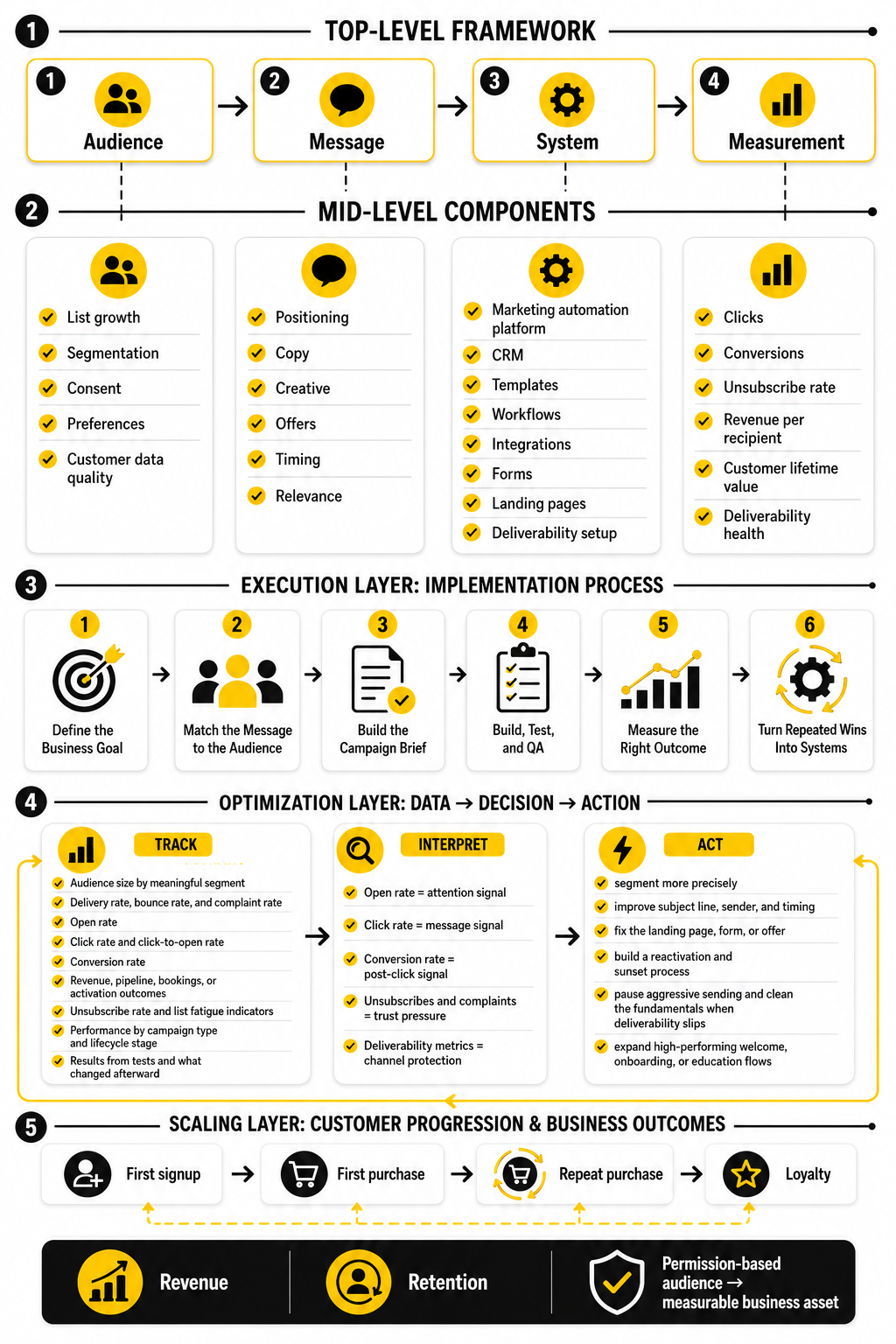
The simplest way to understand email marketing manager jobs is to think in four layers: audience, message, system, and measurement. Audience means list growth, segmentation, consent, preferences, and customer data quality. Message means positioning, copy, creative, offers, timing, and relevance.
System means the marketing automation platform, CRM, templates, workflows, integrations, forms, landing pages, and deliverability setup that make the program run. For example, a company using Brevo will care about benchmarks, segmentation, automation, and multichannel performance, while a company using a broader CRM stack may expect the email manager to work closely with lifecycle, sales, and revenue operations. Measurement means knowing what to track beyond vanity metrics, especially clicks, conversions, unsubscribe rate, revenue per recipient, customer lifetime value, and deliverability health.
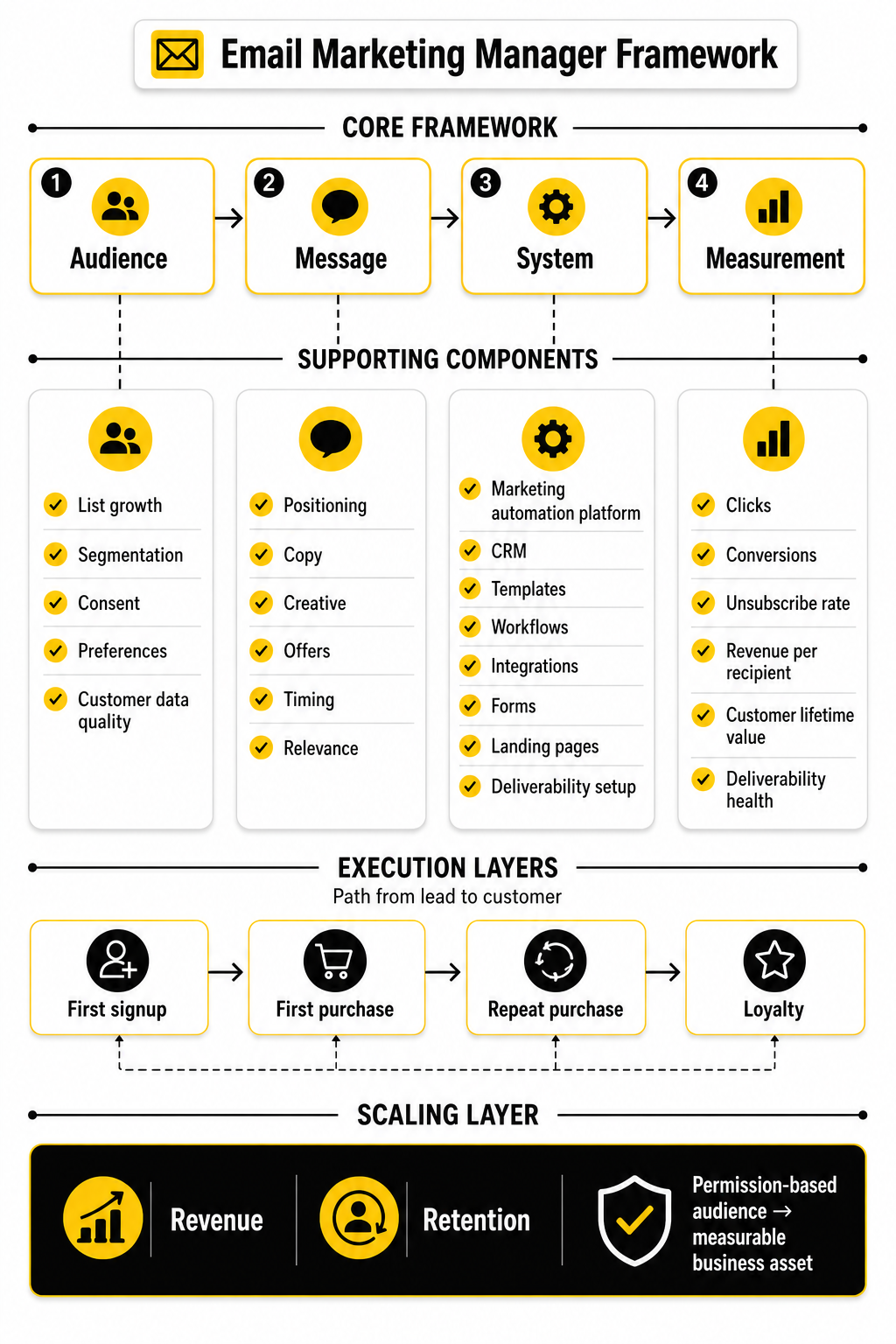
This framework is useful because it separates real email marketing management from surface-level campaign work. A junior person may be able to build and schedule campaigns, but a manager is expected to improve the whole system. That is the difference between “I sent three emails this week” and “I improved the path from lead to customer.”
What Email Marketing Managers Actually Do
The day-to-day work behind email marketing manager jobs is more operational than most people expect. Yes, writing matters. But the real role is about building a reliable system that moves people through the customer journey without burning trust, annoying subscribers, or creating messy performance data.
A strong email marketing manager usually owns campaign planning, lifecycle flows, segmentation, testing, reporting, and cross-functional coordination. The role often overlaps with CRM, growth, product marketing, ecommerce, sales enablement, and customer success because email touches nearly every stage of the business. That is why job descriptions increasingly mention activation, retention, product adoption, and revenue growth instead of only newsletters and promotions.
The clearest way to judge the role is by outcomes. If email is helping more leads become customers, more customers return, and more inactive contacts re-engage, the manager is doing meaningful work. If the team is simply sending more campaigns without improving performance, the role has become activity management instead of marketing management.
Campaign Strategy and Calendar Planning
Campaign planning is the visible part of the job. The email marketing manager decides what campaigns should go out, who should receive them, what the message should say, when they should be sent, and how success will be measured. This includes launches, promotions, product updates, newsletters, educational sequences, seasonal campaigns, win-back emails, and customer announcements.
The hard part is not filling a calendar. Anyone can put emails on a schedule. The hard part is deciding what deserves inbox space and what should be cut, delayed, segmented, or turned into an automated journey instead.
Good managers protect the audience from lazy sending. They think about fatigue, relevance, business priority, and customer intent before approving another campaign. That matters because trust is the asset behind the list, and once subscribers stop paying attention, every future email has to work harder.
Lifecycle and Automation Management
Lifecycle work is where many email marketing manager jobs become genuinely strategic. Instead of relying only on one-off campaigns, the manager builds automated journeys triggered by customer behavior. These can include welcome flows, abandoned cart flows, lead nurture sequences, trial onboarding, post-purchase education, renewal reminders, reactivation flows, and loyalty campaigns.
This is one reason employers often group email with CRM or lifecycle marketing. Current lifecycle marketing job descriptions commonly emphasize segmentation, personalization, retention, activation, and data-driven engagement across the customer journey. That matches the broader marketing manager expectation that the person can develop, coordinate, and evaluate strategy based on business objectives, market conditions, and return on investment, not just execute tasks.
Automation also creates leverage. A well-built onboarding flow can keep working every day while the team focuses on launches, experiments, and deeper customer insights. But automation only helps when it is maintained, tested, and updated; otherwise, it becomes a quiet source of outdated messaging, broken links, and poor customer experience.
Segmentation and Personalization
Segmentation is one of the biggest differences between basic email execution and real email management. A manager should know how to group people by lifecycle stage, source, behavior, purchase history, engagement level, product interest, geography, customer value, or sales-readiness. The goal is simple: send fewer irrelevant messages and more useful ones.
Personalization does not have to mean complex AI-generated copy for every user. Often, it starts with practical decisions: new subscribers should not get the same message as long-time customers, inactive contacts should not be treated like loyal buyers, and high-intent leads should not be buried in a generic newsletter flow. This is basic, but it is also where many programs break.
The best managers use segmentation to make the customer experience feel more coherent. They do not personalize just because a tool allows it. They personalize when the data is reliable, the message changes meaningfully, and the business case is strong enough to justify the extra complexity.
Testing, Reporting, and Optimization
Testing is not just changing a subject line and hoping for a better open rate. A good email marketing manager defines a clear hypothesis, chooses the right segment, tracks the right metric, and avoids drawing big conclusions from weak data. Testing can cover subject lines, offers, creative formats, calls to action, send timing, segmentation logic, landing pages, onboarding steps, and automation rules.
Reporting is just as important because email can look successful while underperforming where it matters. Opens are useful for diagnosing attention, but privacy changes and inbox behavior make them weaker as a decision metric than they used to be. Clicks, conversions, revenue, pipeline influence, unsubscribe rate, complaint rate, deliverability health, and long-term customer behavior usually tell a better story.
The manager’s job is to turn reporting into action. If a welcome flow has high clicks but weak conversion, the problem may be the offer, landing page, audience expectation, or sales handoff. If a promotional campaign drives revenue but also spikes unsubscribes, the short-term win may be hiding a long-term list-quality problem.
Core Skills Employers Look For
Most email marketing manager jobs require a mix of creative, analytical, and technical skills. That is why the role can be hard to hire for. A pure copywriter may not understand deliverability or segmentation, while a pure analyst may struggle to shape persuasive messaging that people actually want to read.
The strongest candidates are usually T-shaped. They have broad marketing judgment across the customer journey, plus deeper strength in email strategy, automation, and performance measurement. They can talk to designers, sales leaders, executives, developers, data teams, and customer-facing teams without losing the thread.
This is also why “years of experience” can be misleading. Someone who has owned a full lifecycle program for two years may be stronger than someone who has sent newsletters for five. Employers should look for proof of ownership, not just familiarity with email tools.
Copywriting and Messaging Judgment
Email copywriting is not about sounding clever. It is about making the right person understand the right thing at the right moment and take the next logical step. That requires clarity, restraint, customer awareness, and a strong sense of what the reader already knows.
A manager does not always write every email personally, especially on larger teams. But they still need messaging judgment because they approve briefs, guide creative direction, edit drafts, and protect consistency across campaigns and automations. Poor messaging creates confusion, and confused subscribers do not click, buy, book, upgrade, or stay engaged.
The best email managers also understand that different emails have different jobs. A product launch email should not sound like a support update. A trial onboarding email should not read like a discount blast. A retention email should not pretend the customer is still in the awareness stage.
Analytical Thinking
Email gives marketers a lot of data, but not all data is equally useful. A strong manager knows which numbers matter for the business model and which ones are just dashboard decoration. Ecommerce teams may care heavily about revenue per recipient and repeat purchase behavior, while B2B teams may care more about demo requests, pipeline influence, lead quality, and sales follow-up.
Analytical thinking also means knowing when not to overreact. One weak campaign does not prove the whole strategy is broken. One strong subject line test does not mean the same pattern will work forever.
Good managers look for patterns across campaigns, segments, automations, and customer stages. They connect performance to context: audience quality, offer strength, timing, product demand, creative angle, and landing-page experience. That is the difference between reading numbers and making decisions.
Technical Confidence
Email marketing managers do not need to be full-stack developers, but they do need technical confidence. They should understand how email service providers work, how forms and lists connect, how tags or properties are applied, how automations trigger, how UTM tracking works, and how to troubleshoot common campaign issues. They should also be comfortable working around templates, QA checklists, mobile rendering, and basic HTML constraints.
Deliverability is part of this technical layer. Managers need to understand sender reputation, authentication, consent, engagement quality, bounce management, spam complaints, and list hygiene. You do not need to be a deliverability engineer to manage email well, but you cannot ignore the inbox and expect results.
Tool fluency matters too. Many teams use platforms like Brevo, Moosend, or GoHighLevel to manage email, automation, CRM workflows, and customer communication. The exact platform matters less than the ability to understand the system, spot problems, and build workflows that match the business.
Project Management and Collaboration
Email is rarely a solo channel. A campaign may need input from product, design, sales, legal, support, analytics, leadership, and sometimes outside partners. The manager has to turn that messy input into a clear brief, a realistic timeline, and an email that makes sense to the customer.
This is where many technically skilled marketers struggle. They know the platform, but they cannot manage approvals, deadlines, dependencies, or competing priorities. In real companies, that becomes a serious problem because email often sits close to revenue moments such as launches, renewals, promotions, onboarding, and customer recovery.
A strong manager creates process without making the team slower. They build calendars, QA checklists, naming conventions, testing plans, and reporting habits that reduce chaos. That operational discipline is not glamorous, but it is one of the reasons senior email marketers get trusted with bigger lifecycle and growth responsibilities.
Tools, Platforms, and Technical Requirements
The tools behind email marketing manager jobs matter because the role is no longer limited to writing campaigns inside one email platform. Most companies now expect the email manager to understand how the email tool connects with the CRM, website forms, ecommerce store, analytics setup, sales pipeline, landing pages, and customer data. You do not need to be an engineer, but you do need to know how the system behaves when real people move through it.
This is where the role becomes more valuable. A weak email manager waits for someone else to explain why leads are missing, why a segment looks wrong, or why a workflow fired at the wrong time. A strong email manager can investigate the logic, identify the likely failure point, and bring the right person into the fix with a clear explanation.
That technical confidence is also what separates serious candidates from people who only know how to send newsletters. When employers review candidates for email marketing manager jobs, they usually want proof that the person can manage the machinery behind the message. The message gets attention, but the system creates the result.
Email Service Providers and Automation Platforms
Most email managers will work inside an email service provider or marketing automation platform every day. The specific platform can vary, but the core responsibilities stay similar: building campaigns, managing lists, creating segments, setting up automations, testing templates, checking performance, and keeping contact data clean. A candidate who understands one serious platform can usually learn another, as long as they understand the logic underneath.
For small businesses and lean marketing teams, platforms like Brevo, Moosend, and Systeme.io can cover a lot of ground without requiring a giant tech stack. For agencies, local service businesses, and funnel-heavy teams, GoHighLevel is often used because it combines CRM, email, automation, forms, pipelines, and follow-up workflows in one place. For businesses that build sales funnels around lead magnets, webinars, offers, and nurture sequences, ClickFunnels may also sit close to the email program.
The tool is not the strategy, though. This matters. A good email marketing manager can use the platform to support a customer journey, but they do not let the platform decide the journey for them.
CRM and Customer Data
Email performance depends heavily on data quality. If the CRM is messy, the email program becomes messy too. Bad data creates wrong segments, duplicate contacts, irrelevant campaigns, broken personalization, and reporting that nobody fully trusts.
That is why email managers often need to understand fields, tags, lifecycle stages, purchase data, lead sources, consent status, and engagement history. They should know where important data comes from, when it updates, and what happens if it is missing. They should also know when not to use a data point because unreliable personalization is worse than no personalization at all.
For teams where sales and marketing work closely together, CRM fluency becomes even more important. A lead nurture sequence should not fight with a sales follow-up. A customer onboarding flow should not ignore account status. A reactivation campaign should not treat a closed-lost lead the same way as a loyal customer who has gone quiet.
Landing Pages, Forms, and Conversion Paths
Email does not convert in isolation. Most campaigns push people somewhere: a product page, checkout page, booking page, webinar registration, lead magnet, demo request, survey, or onboarding step. If that destination is weak, the email manager may get blamed for a problem that actually lives on the landing page.
That is why the best email managers understand conversion paths. They look at the full movement from subject line to email body, from email click to landing page, and from landing page to final action. They do not stop at the click.
Tools like Replo can be useful when ecommerce teams need flexible landing pages for campaigns, while Fillout can help teams build forms, surveys, and intake flows that feed cleaner data into the marketing system. Those details sound small until you realize how often email strategy fails because the post-click experience is unclear.
Deliverability and Inbox Health
Deliverability is not optional. If the emails do not reach the inbox, the campaign strategy does not matter. Email marketing manager jobs increasingly require at least a working understanding of sender reputation, authentication, bounce management, complaint rates, engagement signals, list hygiene, and consent practices.
The manager does not need to personally configure every technical record, but they should know what SPF, DKIM, and DMARC are for and when to involve technical support. They should also understand the practical side of deliverability: do not buy lists, do not overmail cold contacts, do not ignore complaints, and do not keep inactive subscribers forever just because the list number looks impressive.
This is one of those areas where discipline beats hacks. A cleaner list with real engagement is usually more valuable than a bloated database that damages sender reputation. Smart managers protect the channel because they understand that inbox trust is built slowly and lost quickly.
Professional Implementation: How to Build the Email Process
A serious email program needs a process. Without one, the team ends up reacting to random requests, rushing campaigns, skipping QA, and making decisions based on whoever shouted loudest that week. That is not management; that is inbox chaos.
The implementation process should make email easier to plan, easier to execute, and easier to measure. It should also make the email manager less dependent on memory. When the process is clear, the team knows how campaigns move from idea to brief, from brief to build, from build to QA, from QA to send, and from send to learning.
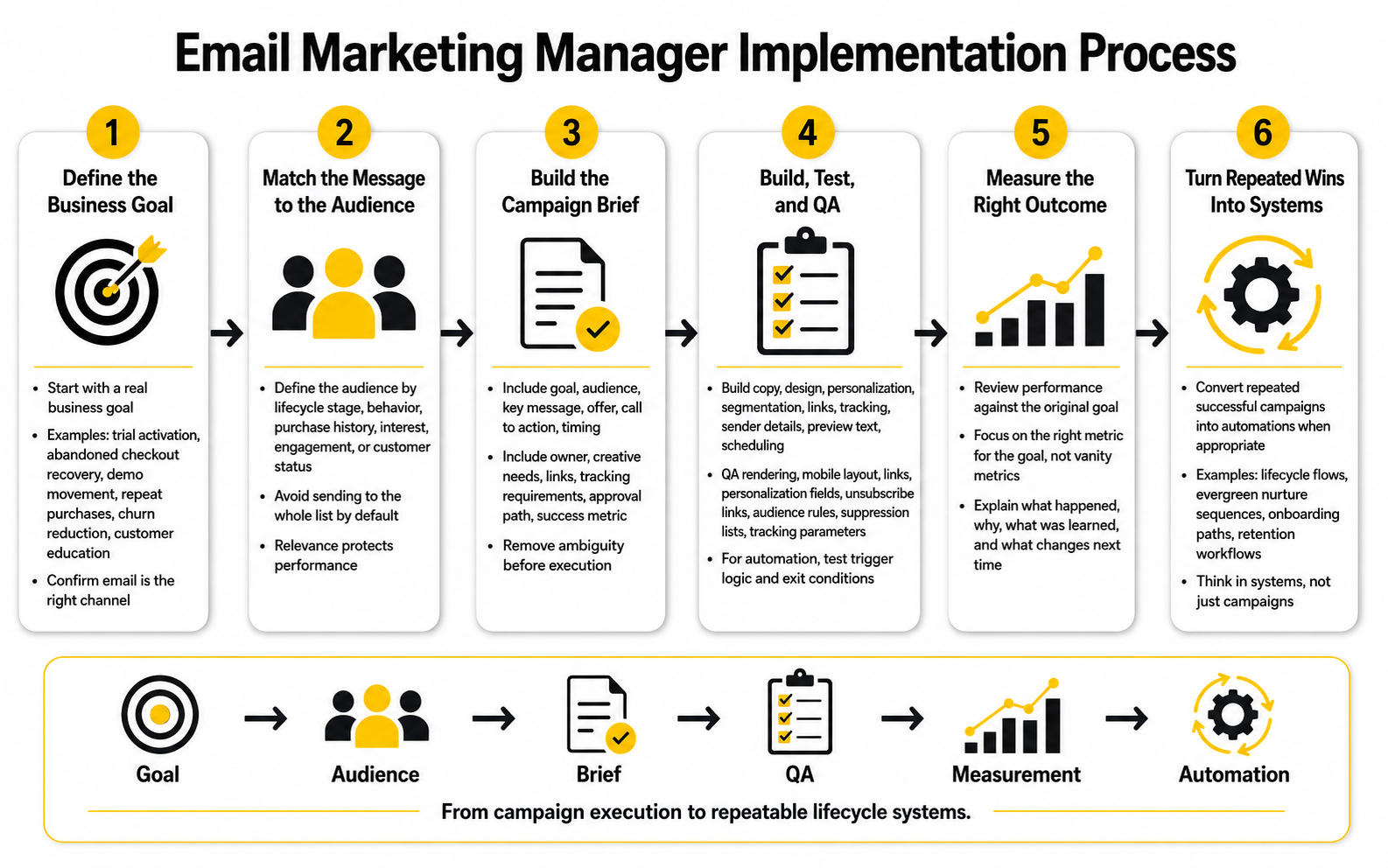
The goal is not to create bureaucracy. The goal is to make good execution repeatable. A practical email process gives the team speed without sacrificing quality.
Step 1: Define the Business Goal
Every campaign or automation should start with a business goal. Not a vague goal like “send an update.” A real goal, such as increasing trial activation, recovering abandoned checkouts, moving leads toward a demo, driving repeat purchases, reducing churn risk, or educating new customers.
This step forces the team to decide whether email is the right channel for the job. Sometimes it is. Sometimes the better move is an in-app message, a sales call, a retargeting campaign, a help-center update, or a product change.
For email marketing manager jobs, this is an important leadership skill. The manager should not blindly accept every email request. They should ask what outcome the business wants and whether the proposed email is the best way to get there.
Step 2: Match the Message to the Audience
Once the goal is clear, the next question is who should receive the message. This sounds obvious, but it is where many campaigns go wrong. Teams often start with what they want to announce instead of who actually needs to hear it.
The email manager should define the audience based on lifecycle stage, behavior, purchase history, interest, engagement, or customer status. If the message is only relevant to one segment, it should not be sent to the whole list. If the audience is too broad, the campaign will usually become weaker because the copy has to speak to everyone and ends up persuading no one.
This step also protects performance. Smaller, sharper sends can outperform bigger blasts because the message has a clearer job. Relevance is not a decoration; it is the entire point.
Step 3: Build the Campaign Brief
A campaign brief is where the idea becomes executable. It should explain the goal, audience, key message, offer, call to action, timing, owner, creative needs, links, tracking requirements, approval path, and success metric. This does not need to be a 10-page document, but it does need to remove ambiguity.
A good brief also prevents last-minute chaos. Designers know what assets are needed. Copywriters know the angle. Managers know what has to be approved. Analysts know what should be measured.
This is especially useful when the company sends frequent campaigns. Without a brief, every campaign becomes a custom emergency. With a brief, the team can move faster because the important decisions are already written down.
Step 4: Build, Test, and QA
The build stage is where the email is created inside the platform. This includes copy, design, personalization, segmentation, links, tracking, fallback text, sender details, preview text, and scheduling. It is also where small mistakes can create very public problems.
QA should be non-negotiable. The email manager should check rendering, mobile layout, links, personalization fields, unsubscribe links, audience rules, suppression lists, tracking parameters, spelling, offer details, and the final destination page. If the email is part of an automation, the trigger logic and exit conditions should also be tested.
This is not about perfectionism. It is about protecting trust. A broken link, wrong name field, expired offer, or incorrect segment can make a brand look careless in seconds.
Step 5: Measure the Right Outcome
After the send, the manager should review performance against the original goal. If the campaign was meant to drive purchases, revenue and conversion matter more than opens. If the goal was onboarding, activation behavior matters more than superficial engagement. If the goal was reactivation, the team should look at whether dormant contacts actually came back.
The report should be useful, not decorative. A good post-send review explains what happened, why it may have happened, what the team learned, and what should change next time. That final part is critical because reporting without decisions is just documentation.
This is where email managers become more strategic over time. Each campaign teaches something about the audience, offer, timing, positioning, and funnel. The manager’s job is to capture that learning and compound it.
Step 6: Turn Repeated Wins Into Systems
When a campaign works repeatedly, the next question is whether it should become automated. This is how email programs mature. Instead of manually recreating the same successful idea again and again, the manager turns it into a lifecycle flow, evergreen nurture sequence, onboarding path, or retention workflow.
This does not mean everything should be automated. Some emails depend on timing, context, urgency, or news value. But if the same customer moment happens repeatedly, automation can usually make the experience more consistent.
This is also where the role becomes more senior. The manager stops thinking only in campaigns and starts thinking in systems. That is exactly what better companies want when they hire for email marketing manager jobs.
Statistics and Data
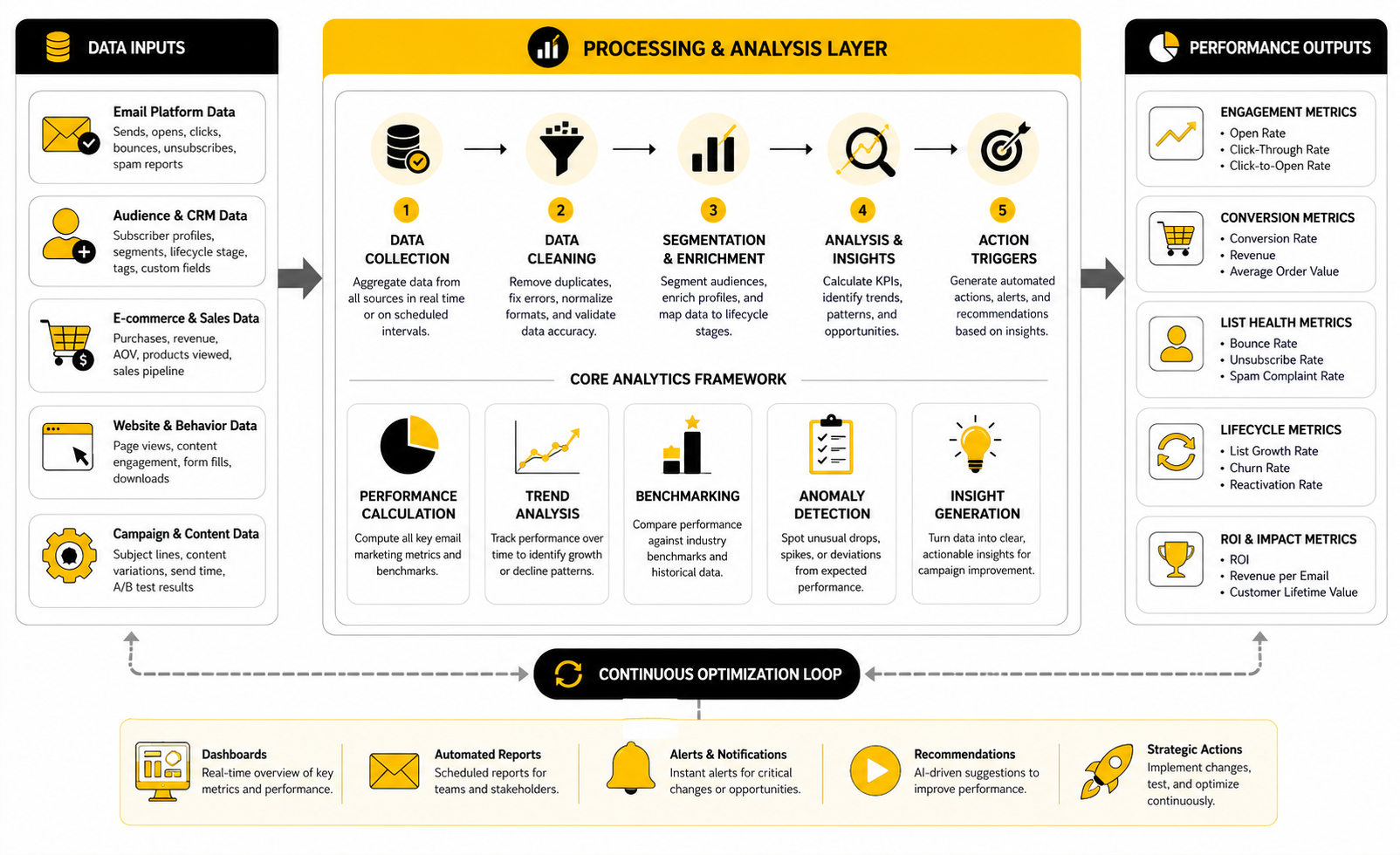
Numbers are useful in email marketing only when they change a decision. A benchmark should not become a scoreboard that makes every team chase the same average. It should help an email marketing manager understand whether a campaign is healthy, whether the audience is responding, and where the next improvement should happen.
This matters for email marketing manager jobs because hiring teams want people who can explain performance, not just report it. A dashboard full of opens, clicks, bounces, unsubscribes, and revenue numbers means nothing if nobody knows what action to take next. The job is not to collect metrics; the job is to interpret them and improve the system.
The mistake is treating every number equally. Open rate can help diagnose attention, click rate can show message strength, conversion rate can reveal offer and landing-page quality, and unsubscribe rate can warn you about relevance or fatigue. Each metric answers a different question, so the manager has to read them in context.
Benchmarks Are Starting Points, Not Targets
Email benchmarks are helpful because they give you a rough sense of what “normal” might look like in your market. For example, Brevo’s 2025 email benchmark data shows that performance varies heavily by industry, with some sectors seeing much stronger engagement because the messages are more urgent, trusted, or directly useful. That is a big reminder: a nonprofit update, a government notice, a software onboarding email, and a fashion discount email should not be judged by the same expectations.
Benchmarks become dangerous when teams use them as excuses or fake goals. If your click rate is below an industry average, that does not automatically mean your copy is bad. It could mean the audience is too broad, the list source is weak, the offer is unclear, the landing page is broken, or the send frequency has trained people to ignore you.
The practical move is to compare against three things: external benchmarks, your own historical performance, and the business outcome. External benchmarks give you context. Historical performance shows whether you are improving. Business outcomes tell you whether the email actually mattered.
Open Rate Shows Attention, Not Revenue
Open rate is still useful, but it has to be handled carefully. Privacy changes, image loading behavior, inbox filtering, and device settings can all affect how opens are recorded. That does not make open rate worthless, but it does mean a serious email manager should avoid treating it as the final truth.
Use open rate to diagnose whether the sender name, subject line, preview text, timing, and audience relationship are strong enough to earn attention. If open rates fall across many campaigns, the issue may be list quality, inbox placement, or declining relevance. If one campaign has weak opens but strong conversion among the people who clicked, the campaign may have had a narrow but high-intent audience.
For email marketing manager jobs, this distinction matters because weaker candidates often over-celebrate opens. Stronger candidates know that a campaign can have a beautiful open rate and still fail commercially. Attention is only the first door; it is not the sale.
Click Rate Shows Message and Offer Strength
Click rate tells you whether the email created enough interest for someone to take action. It is usually more useful than open rate because it reflects active intent. If people click, something in the message, offer, product, or timing gave them a reason to move forward.
A low click rate can point to several problems. The call to action may be weak, the offer may not be relevant, the copy may be too vague, the audience may be wrong, or the email may be trying to do too many things at once. The answer is not always “write a better button.”
A good email marketing manager looks at click behavior by segment, campaign type, device, and customer stage. A customer education email may need a different click expectation than a flash-sale campaign. A B2B nurture email may produce fewer clicks than ecommerce, but those clicks may be far more valuable if they lead to qualified pipeline.
Conversion Rate Connects Email to the Business
Conversion rate is where email performance becomes more serious. A click means someone was interested, but a conversion means the journey kept working after the click. This could mean a purchase, demo request, signup, booking, renewal, download, activation event, or another meaningful business action.
If clicks are strong but conversions are weak, the email is not always the problem. The landing page may not match the promise. The offer may be confusing. The checkout may have friction. The form may ask for too much information. This is why strong email managers think beyond the inbox.
For teams using funnel tools such as ClickFunnels, all-in-one systems like GoHighLevel, or form builders like Fillout, the email manager should care about the full path from email to final action. The campaign does not end at the click. It ends when the customer completes the intended step.
Revenue Per Recipient Reveals Real Efficiency
Revenue per recipient is one of the most useful metrics for ecommerce and direct-response email programs. It shows how much money a campaign produced relative to the number of people who received it. This helps stop teams from celebrating big sends that produce weak results.
A smaller campaign to a better segment can beat a larger campaign to a general list. That is why revenue per recipient is useful: it rewards relevance, not just volume. It also helps managers compare campaigns with different list sizes more fairly.
The same logic can work outside ecommerce, but the metric may need to change. In B2B, you might look at pipeline created per recipient, demo requests per segment, or qualified opportunities influenced by email. The point is the same: measure the value created against the audience used.
Unsubscribes and Complaints Show Trust Pressure
Unsubscribes are not always bad. Some people should leave the list because they are no longer interested, and keeping them can hurt engagement quality. But a sudden increase in unsubscribes after a campaign is a warning that the message, frequency, audience, or expectation may have been wrong.
Spam complaints are more serious. They tell inbox providers that people did not just ignore the email; they actively rejected it. If complaint rates rise, the manager needs to review consent sources, send frequency, list hygiene, subject-line expectations, and whether the content matches what subscribers signed up to receive.
This is why list growth should never be judged by size alone. A bigger list with weak engagement and rising complaints is not an asset. It is a liability wearing a vanity-metric costume.
Deliverability Metrics Protect the Whole Channel
Deliverability is the quiet foundation of email performance. If messages are blocked, filtered, delayed, or pushed into spam, every visible metric becomes distorted. A campaign may look weak because the audience rejected it, or it may look weak because the audience barely saw it.
Managers should watch bounce rate, spam complaints, sender reputation signals, engagement trends, domain authentication, suppression rules, and inactive subscriber volume. Gmail and Yahoo sender requirements have made authentication and complaint control even more important for bulk senders, so this is no longer a technical side issue that marketers can ignore. It is part of the job.
For email marketing manager jobs, this creates a clear hiring signal. A candidate who can talk about deliverability in practical terms is usually more prepared than someone who only talks about subject lines and templates. Deliverability is not glamorous, but it protects every campaign that comes after it.
ROI Is Useful Only When Attribution Is Honest
Email ROI can be impressive, but it is easy to overstate if attribution is lazy. Litmus reports that 35% of companies see email ROI of 36:1 or higher, which explains why companies keep investing in the channel. But a manager still has to ask how that ROI is being measured, which attribution window is being used, and whether email is getting credit for revenue that another channel created.
Honest attribution does not make email look weaker. It makes decisions better. If email is driving repeat purchases, reactivating dormant customers, increasing trial activation, or improving sales follow-up, the value should be visible in the data.
The best email managers do not hide behind inflated numbers. They explain what can be confidently attributed, what is directional, and what needs cleaner tracking. That level of honesty builds trust with leadership.
Salary and Demand Data Need Context
Salary data for email marketing manager jobs depends on industry, location, company size, seniority, ownership level, and whether the role is closer to campaign execution, lifecycle strategy, or revenue leadership. Broader marketing manager wage data gives useful context, with the U.S. Bureau of Labor Statistics showing a mean annual wage of $178,140 for marketing managers in May 2024. That number should not be treated as the default salary for every email role, but it shows why marketing management can become financially attractive as responsibility increases.
Demand also depends on how the company sees email. A company that treats email as a newsletter channel may pay for execution. A company that treats email as lifecycle revenue infrastructure may pay for strategy, analytics, automation, and ownership.
That is why job seekers should read postings carefully. The title “email marketing manager” can mean very different things. Look for clues in the responsibilities: ownership of revenue, lifecycle journeys, CRM strategy, segmentation, testing, deliverability, and cross-functional leadership usually points to a stronger role.
The Data System a Manager Should Build
A practical measurement system should connect campaign activity to business outcomes. It does not need to be complicated at first. It needs to be consistent, trusted, and useful.
A good email measurement system usually tracks:
The real value comes from reviewing these numbers together. A high click rate with low conversion points to a post-click problem. A low open rate with strong click-to-open may point to subject-line or inbox-placement issues. A strong revenue result with high unsubscribes may mean the campaign worked financially but damaged future list quality.
What the Numbers Should Make You Do
Data should create decisions. If inactive subscribers are dragging down engagement, build a reactivation and sunset process. If welcome emails convert well, improve list capture and onboarding. If product education emails drive activation, expand them into a stronger lifecycle flow.
If campaign performance varies heavily by segment, stop sending broad campaigns by default. If landing-page conversion is the bottleneck, fix the page before rewriting the next email. If deliverability is slipping, pause aggressive sending and clean up the fundamentals before pushing harder.
This is the mindset employers actually need. The best candidates for email marketing manager jobs do not just say, “I improved open rates.” They can explain what they measured, what they changed, why it worked, and what they would test next. That is the difference between reporting numbers and managing performance.
How to Find the Right Email Marketing Manager Jobs
Not every role with “email marketing manager” in the title is the same job. Some companies want a campaign executor who can build newsletters and manage a send calendar. Others want a lifecycle strategist who can improve activation, retention, revenue, deliverability, and customer movement across the full funnel.
That difference matters because the wrong job can trap you in low-leverage execution. You may spend your week collecting copy requests, resizing banners, chasing approvals, and reporting open rates to people who do not understand the channel. The right role gives you ownership over strategy, systems, testing, and measurable business outcomes.
When you evaluate email marketing manager jobs, read the posting like a business diagnosis. The title tells you almost nothing. The responsibilities, reporting line, tools, metrics, and decision-making authority tell you what the job really is.
Look for Ownership, Not Just Activity
A strong job description should mention ownership of a channel, lifecycle stage, customer segment, or revenue outcome. Words like “own,” “lead,” “optimize,” “develop,” “analyze,” and “improve” usually signal a better role than descriptions that only say “schedule,” “send,” “coordinate,” or “support.” Execution matters, but management means you should be trusted to make decisions.
Be careful with roles that list every marketing task under the sun. If the job expects email, paid ads, social media, SEO, design, copywriting, CRM admin, analytics, webinars, and sales enablement from one person, the company may not understand the workload. That does not automatically make it a bad opportunity, but it means you need to ask sharper questions before accepting.
The best email marketing manager jobs usually connect your work to a clear business model. Ecommerce roles may focus on purchase frequency, revenue per recipient, customer lifetime value, and retention. B2B roles may focus on lead nurture, demo requests, pipeline influence, onboarding, renewal support, and expansion opportunities.
Read the Metrics Between the Lines
Good companies tell you how success will be measured. They may mention revenue, retention, activation, conversion, customer engagement, pipeline, deliverability, list health, or lifecycle performance. Those are useful signals because they show the company expects the email manager to influence real outcomes.
Weak postings often talk about “increasing engagement” without saying what engagement means. That phrase can hide a lot of confusion. Engagement might mean clicks, replies, bookings, purchases, product usage, or simply a higher open rate.
Before you take the role seriously, translate the metrics into questions. What number is broken now? What has the team already tried? Who owns the landing page, offer, CRM data, and post-click experience? If email is expected to improve revenue but the manager cannot influence the customer path, the role may come with responsibility but not enough control.
Check the Tech Stack Before You Commit
The tools in a job posting can reveal how mature the company is. A clean stack with a serious CRM, email platform, analytics process, and clear ownership usually means the manager can move faster. A messy stack is not always bad, but it changes the job from campaign management into system repair.
If a company uses an all-in-one platform such as GoHighLevel, the email manager may be close to CRM workflows, pipelines, forms, SMS, and follow-up automation. If a company uses Brevo or Moosend, the role may lean more toward email automation, newsletters, segmentation, and campaign optimization. If the company uses funnel tools like ClickFunnels, ask how email connects to opt-ins, offers, upsells, and post-purchase flows.
Do not judge the role only by whether you already know the platform. Strong managers can learn tools. What matters more is whether the system has clean data, documented processes, reliable tracking, and leadership support for fixing problems.
How to Stand Out When Applying
Most applicants for email marketing manager jobs make the same mistake: they describe tasks. They say they created campaigns, managed newsletters, wrote copy, built automations, and reported performance. That is fine, but it sounds like everyone else.
To stand out, show business impact. Employers want to know what changed because you were in the seat. Did onboarding improve? Did retention increase? Did email revenue grow? Did deliverability recover? Did you reduce manual work by turning repeated campaigns into automated flows?
You do not need to expose private company data. You can use ranges, percentages, context, or anonymized examples if exact numbers are confidential. The point is to prove that you understand cause and effect, not just platform buttons.
Build a Results-First Resume
Your resume should make the role easy to understand in seconds. Start each bullet with the business outcome or ownership area, then explain the action behind it. Avoid vague lines like “responsible for email campaigns” unless you want to sound replaceable.
Stronger resume bullets usually follow this structure:
This style works because it shows judgment. Hiring managers can see that you did not just send emails. You diagnosed a problem, made a change, and measured the result.
Create a Portfolio That Shows Thinking
A portfolio for email marketing manager jobs does not need to be a gallery of pretty emails. Design helps, but strategy matters more. A good portfolio shows how you think through audience, goal, message, system, and measurement.
You can include anonymized campaign breakdowns, lifecycle maps, before-and-after flow diagrams, testing plans, segmentation logic, reporting examples, and campaign briefs. If you are early in your career, create sample work based on realistic public scenarios, but clearly label it as sample work. Do not pretend fake client work is real.
A strong portfolio answers the questions a resume cannot. Why did you choose that segment? Why did the flow have those steps? What metric mattered most? What did you learn after launch? That is the kind of thinking companies want when they are hiring someone to own the channel.
Make Your Cover Letter Specific
A generic cover letter hurts you more than no cover letter. If you write the same “I am passionate about email marketing” message to every company, it adds no value. The hiring team already assumes you are interested because you applied.
A better cover letter connects your experience to the company’s business model. If the company is SaaS, talk about lifecycle, activation, onboarding, product adoption, or renewal communication. If it is ecommerce, talk about segmentation, purchase behavior, retention, win-back flows, and revenue per recipient.
Keep it direct. Mention one or two things you noticed about the company’s customer journey, then explain how your background could help. The goal is not to write a long essay; the goal is to prove you understand the business behind the inbox.
Interview Questions and Portfolio Proof
Interviews for email marketing manager jobs are usually designed to test judgment. The company wants to know whether you can think beyond campaigns, handle messy inputs, communicate clearly, and connect email work to business results. They also want to know whether you can operate without needing every decision handed to you.
Expect questions about strategy, execution, analytics, tools, deliverability, collaboration, and prioritization. The best answers are specific but not overcomplicated. Explain the situation, your reasoning, the action you took, and what happened next.
Do not memorize robotic answers. Hiring managers can hear that immediately. Prepare clear stories from your real experience, then adapt them to the question.
Questions You Should Be Ready to Answer
You should be able to answer practical questions without drifting into theory. The interviewer may not use the exact wording below, but the themes come up often. Your answers should show that you understand both the marketing side and the operational side.
Common questions include:
The trick is to avoid giving one-size-fits-all answers. A good manager always asks what the business goal is, who the audience is, what data is available, and what constraint matters most. That shows maturity.
How to Talk About Deliverability Without Overdoing It
Deliverability questions can make candidates nervous because the topic feels technical. You do not need to pretend to be a specialist if you are not one. You do need to show that you know enough to prevent obvious damage and involve technical help at the right time.
A strong answer might cover authentication, list consent, spam complaints, bounce management, engagement quality, and sending behavior. Gmail’s sender guidance now puts clear pressure on bulk senders to meet authentication requirements and avoid complaint problems, especially for brands sending large volumes. That means deliverability belongs in the email manager’s risk model, not buried as an IT detail.
Keep the explanation practical. Say how you would monitor the issue, what signals would concern you, what you would stop doing, and who you would involve. That is much more credible than throwing around acronyms without explaining the business impact.
Show How You Prioritize
Prioritization is one of the clearest seniority signals. A junior candidate may say yes to every campaign request. A stronger manager can explain what should happen first, what should wait, and what should not happen at all.
A useful interview answer separates urgency from importance. A product launch may be urgent because the date is fixed. A broken onboarding flow may be important because it affects every new customer. A one-off executive request may feel loud but create little value.
This is where you can stand out. Explain how you weigh revenue potential, customer impact, effort, risk, available data, and timing. Companies do not just need someone who can execute; they need someone who can protect focus.
Advanced Tradeoffs in Email Marketing Management
Once the basics are working, email management becomes a game of tradeoffs. More email can create more short-term revenue but also more fatigue. More segmentation can improve relevance but add operational complexity. More automation can create leverage but also make the customer journey harder to audit.
This is the level where better email marketing manager jobs become interesting. You are no longer asking, “Can we send this?” You are asking, “Should we send this, to whom, at what cost, and what does it do to the long-term relationship?”
That is where expertise shows up. Not in sending more. In knowing what to protect.
Growth Versus List Quality
List growth is important, but low-quality growth can poison the program. A big list built from weak offers, unclear consent, giveaways, or poorly matched lead magnets may look impressive in a report but perform badly in the inbox. It can also make segmentation, reporting, and deliverability harder.
A better strategy focuses on the source and intent behind the subscriber. Someone who joined for a relevant guide, product update, webinar, or purchase-related benefit is usually more valuable than someone who joined only to win a random prize. The manager should care about how people got onto the list because acquisition context affects future engagement.
This does not mean you should make signup difficult. It means list growth should be tied to fit, expectation, and follow-up quality. More subscribers only help when they are the right subscribers.
Automation Versus Human Timing
Automation is powerful, but it is not magic. A welcome flow, trial sequence, abandoned cart reminder, or reactivation campaign can create consistent performance at scale. But automated emails can also become stale, tone-deaf, or disconnected from current offers if nobody maintains them.
Human timing still matters. A campaign tied to a product update, seasonal moment, customer insight, or market shift may need judgment that automation cannot provide. Some messages should be triggered by behavior, while others should be shaped by context.
The best programs use both. Automations handle recurring customer moments. Campaigns handle timely communication. The manager’s job is to decide which is which and review the system regularly.
Personalization Versus Privacy
Personalization can improve relevance, but it can also become creepy or wrong. The difference usually comes down to data quality and customer expectation. If a subscriber expects product recommendations based on what they viewed or bought, that can feel useful. If a message reveals data in a way that feels surprising, invasive, or inaccurate, it can damage trust.
This is why email managers need restraint. Just because a platform can insert a field, trigger a message, or build a micro-segment does not mean the team should use it. Personalization should make the message more helpful, not just more technically impressive.
Privacy expectations and regulatory pressure also make this more important. A manager should work with legal or compliance teams when consent, tracking, data storage, or sensitive customer categories are involved. Trust is not a soft concept here; it is part of channel performance.
Speed Versus Quality Control
Fast teams can win, but rushed email is risky. One wrong segment, broken merge tag, expired coupon, incorrect claim, or bad link can turn a simple campaign into a public mistake. The bigger the list, the bigger the blast radius.
The answer is not to slow everything down. The answer is to build a process that protects quality while keeping momentum. Templates, approval rules, QA checklists, naming conventions, and test sends all help reduce avoidable errors.
This is why operational maturity matters in senior email marketing manager jobs. A manager who can create a faster, safer system becomes valuable beyond the email channel. They help the whole marketing team execute with less chaos.
Common Mistakes to Avoid
Many email programs do not fail because the team lacks ideas. They fail because the fundamentals get ignored while everyone chases new tactics. The manager’s job is to keep the system honest.
The most common mistakes are not dramatic. They are small repeated decisions that slowly weaken list quality, customer trust, and reporting accuracy. That is what makes them dangerous.
Avoiding these mistakes will not make you look flashy. It will make you effective.
Sending to Everyone by Default
Sending every campaign to the full list is usually a sign that segmentation is weak or the team is under pressure. It may create short-term reach, but it trains subscribers to ignore messages that do not apply to them. Over time, that hurts engagement and makes every future campaign harder.
A better default is to ask who genuinely needs the message. Some campaigns should go broad, especially major product announcements or brand-wide updates. But many campaigns perform better when they are narrower and more relevant.
This is not about being timid. It is about respecting attention. The inbox is not free just because sending another email costs almost nothing.
Measuring Activity Instead of Impact
A team can send more emails and still create less value. That is why volume is a weak success metric by itself. More campaigns, more subject-line tests, more flows, and more reports do not automatically mean the program is healthier.
Impact needs to be tied to the business. Did the work improve conversion, retention, activation, revenue, pipeline, customer education, or operational efficiency? If not, the team may be busy without being effective.
This mistake is especially common when leadership does not understand email. A strong manager has to educate the team on what good performance actually looks like. That is part of the job.
Ignoring the Post-Click Experience
Email managers often get judged on campaign results, but many conversion problems happen after the click. If the landing page is confusing, the offer does not match the email, the form is too long, or the checkout has friction, email performance will suffer. The campaign may have done its job by creating intent, but the funnel failed to capture it.
This is where tools like Replo, ClickFunnels, and Fillout can matter when they help teams improve the page, form, or funnel connected to the email. The important part is not the tool itself. The important part is whether the customer path makes sense.
A serious email manager should review the destination before sending the campaign. If the page cannot convert, the email is being set up to take the blame.
Treating AI as a Replacement for Strategy
AI can help with drafts, variations, summaries, research organization, QA support, and faster ideation. It can be useful. But it does not replace positioning, audience judgment, compliance awareness, deliverability discipline, or business strategy.
This is an important point for anyone applying to email marketing manager jobs now. Companies may expect candidates to use AI tools, but the advantage is not “I can generate 20 subject lines.” The advantage is “I can use automation and AI to move faster while still making better decisions.”
Do not let AI turn your email program generic. If every brand uses the same prompts, the inbox gets flooded with the same polished-but-empty language. Human judgment is the filter that keeps the work sharp.
Letting Old Automations Rot
Automations are easy to forget because they run quietly. That is exactly why they need scheduled reviews. A flow that was accurate six months ago may now contain outdated product details, old offers, broken links, irrelevant segmentation, or messaging that no longer matches the brand.
A smart manager audits key flows regularly. Welcome sequences, abandoned cart emails, onboarding flows, renewal reminders, and reactivation campaigns should not be treated as permanent assets. They are living parts of the customer experience.
This is also a good place for candidates to show seniority. If you can explain how you maintain automations after launch, you sound like someone who understands the full lifecycle of the work. That is much stronger than saying you “built flows” and stopping there.
Salary, Demand, and Career Paths
Email marketing manager jobs sit in a practical part of the marketing career ladder. The role is close enough to execution that you can prove value quickly, but strategic enough that strong performers can move into lifecycle marketing, CRM leadership, retention, growth, ecommerce, demand generation, or marketing operations. That makes it a useful career path for people who like both creative work and measurable business impact.
The demand side is also healthy because companies keep needing owned-channel revenue. Paid acquisition is expensive, organic reach is unstable, and customer retention has become more important as many businesses try to do more with the audiences they already have. Broader marketing manager employment is projected to grow 6% from 2024 to 2034, with about 36,400 openings projected each year, which gives the role a strong category-level backdrop.
Salary depends on responsibility, not just title. The same “email marketing manager” label can describe a person who schedules newsletters for a small business or someone who owns lifecycle revenue for a seven-figure ecommerce brand. The stronger the connection to revenue, retention, automation, analytics, and cross-functional leadership, the stronger the earning potential usually becomes.
Entry-Level Path Into Email Marketing
Most people do not start as email marketing managers. They usually begin as marketing coordinators, email marketing specialists, CRM assistants, content marketers, ecommerce assistants, marketing operations coordinators, or agency account team members. These roles teach the mechanics: building campaigns, editing copy, setting up templates, segmenting lists, checking links, and reading basic performance reports.
The fastest path is to get hands-on with the full campaign cycle. Do not only write subject lines. Learn how the audience is selected, how the email is built, how tracking is added, how QA is done, how the send is approved, and how results are interpreted afterward.
Early-career candidates should focus on proof. Even if you have not owned a full program, you can show that you understand the system. A small portfolio with a sample welcome flow, campaign brief, segmentation plan, and performance analysis can make you look much more serious than someone who only lists “email marketing” as a skill.
Mid-Level Growth and Specialization
At the mid-level, the role becomes less about completing tasks and more about improving outcomes. You may own a channel calendar, manage automated journeys, run tests, present reports, coordinate with designers, and recommend changes based on performance. This is where many marketers either become stronger strategists or stay stuck as campaign operators.
Specialization can help. Some marketers go deeper into ecommerce retention, where the work centers on repeat purchases, product recommendations, abandoned carts, win-back flows, and revenue per recipient. Others move into B2B lifecycle marketing, where the work may focus on lead nurture, activation, sales handoff, product adoption, renewals, and pipeline influence.
This is also the stage where tool knowledge becomes more valuable. You do not need to know every platform, but you should understand how automation, CRM data, forms, funnels, and analytics connect. A marketer who can build workflows in GoHighLevel, manage campaigns in Brevo, or connect email to funnel pages in ClickFunnels has more practical leverage than someone who only understands campaign copy.
Senior Roles and Leadership Options
Senior email marketers are usually expected to own strategy, not just execution. They may lead lifecycle planning, manage a small team, set testing priorities, guide segmentation strategy, improve deliverability practices, forecast email revenue, and work with leadership on customer growth. At this level, the job becomes more about judgment than button-clicking.
The career path can move in several directions. You can become a senior email marketing manager, lifecycle marketing manager, CRM manager, retention marketing manager, marketing automation manager, growth marketing manager, ecommerce marketing lead, or head of lifecycle. Some people also move into consulting because many companies need email systems fixed but do not need a full-time senior hire.
The best long-term move is to become known for a business outcome. “I send good emails” is too weak. “I improve activation,” “I grow retention revenue,” “I fix lifecycle systems,” or “I turn messy CRM data into profitable customer journeys” is much stronger.
What do email marketing manager jobs usually involve?
Email marketing manager jobs usually involve planning campaigns, building automated flows, managing segmentation, improving deliverability, analyzing performance, and coordinating with other teams. The role can include copywriting, but it is not only a writing job. A serious email manager is responsible for making the email channel contribute to business outcomes.
The exact work depends on the company. Ecommerce roles often focus on revenue, retention, abandoned carts, promotions, and repeat purchases. B2B roles often focus on lead nurture, activation, sales enablement, onboarding, and pipeline support.
What skills do you need to become an email marketing manager?
You need a mix of copywriting, analytics, customer journey thinking, platform knowledge, project management, and technical confidence. You should understand how campaigns are planned, how segments are created, how automations work, and how performance is measured. You should also be able to explain results in plain business language.
The best candidates are not just creative or technical. They can connect message, audience, system, and outcome. That combination is what makes the role valuable.
Are email marketing manager jobs still in demand?
Yes, email marketing manager jobs remain relevant because companies still need owned channels that can drive retention, revenue, activation, and customer communication. Broader marketing manager employment is projected to grow 6% from 2024 to 2034, which supports the wider category. Email remains especially useful because it is tied to first-party audiences and direct customer relationships.
Demand is strongest when the role goes beyond newsletters. Companies are more likely to invest in email talent when the person can manage lifecycle flows, CRM data, automation, testing, and revenue reporting.
How much do email marketing managers make?
Pay varies by location, industry, company size, seniority, and ownership level. Broader U.S. marketing manager data shows a median annual wage of $161,030 in May 2024, but not every email-specific role will match that number. A junior email role, a small-business role, and a senior lifecycle ownership role can have very different compensation.
The strongest salaries usually appear when the role is tied to measurable business outcomes. If you own revenue, retention, customer lifecycle performance, automation, and cross-functional strategy, you can usually command more than someone who only executes campaigns.
Is email marketing manager a remote-friendly role?
Yes, it can be very remote-friendly because most of the work happens in digital tools. Campaign planning, copy review, automation building, reporting, QA, and meetings can all be done remotely if the company has good processes. That is one reason remote email marketing manager jobs are attractive to marketers who want flexibility.
Remote work does require stronger communication. You need clear briefs, clean documentation, reliable deadlines, and a shared process for approvals. Without that, remote email work can become messy fast.
Do you need coding skills for email marketing manager jobs?
You usually do not need advanced coding skills, but basic technical comfort helps a lot. You should understand email templates, mobile rendering, links, UTMs, merge fields, tracking, form connections, and common QA issues. Basic HTML knowledge can also help when troubleshooting templates.
You do not need to be a developer to be effective. But you should be able to identify a technical issue clearly enough to work with developers, operations teams, or platform support.
Which tools should an email marketing manager know?
The exact tools depend on the company, but the categories matter more than the brand names. You should understand email service providers, marketing automation platforms, CRMs, landing-page tools, form builders, analytics tools, and project management systems. Platforms like Brevo, Moosend, GoHighLevel, and Systeme.io are examples of tools that may support different email workflows.
Do not panic if a job uses a platform you have not used before. If you understand segmentation, automation logic, data quality, deliverability, and reporting, you can usually learn the interface quickly.
What should be in an email marketing portfolio?
A strong portfolio should show your thinking, not just screenshots of emails. Include campaign briefs, lifecycle flow maps, segmentation logic, test plans, reporting examples, and anonymized performance improvements where possible. If you include sample work, label it honestly as sample work.
Hiring managers want to see how you define the goal, choose the audience, shape the message, set up the system, and measure results. A beautiful email is nice. A clear strategic explanation is better.
What interview questions should candidates expect?
Candidates should expect questions about campaign strategy, segmentation, lifecycle flows, analytics, deliverability, testing, prioritization, and collaboration. A company may ask how you would improve a weak welcome flow, diagnose falling engagement, reduce unsubscribes, or decide which campaign request should come first. These questions are designed to reveal judgment.
Answer with context, not slogans. Explain what you would check, what data you would need, what you would change, and how you would measure success. That shows you can manage the channel instead of guessing.
How can beginners get experience with email marketing?
Beginners can start by learning the full campaign process and building small projects. Create a sample welcome sequence, write a campaign brief, map a lifecycle flow, build a simple segmentation plan, and explain the metrics you would track. This gives you proof even before you have a formal manager title.
You can also get experience through internships, freelance projects, small-business work, agency support roles, or marketing coordinator positions. The key is to move beyond “I wrote emails” and show that you understand audience, automation, measurement, and business goals.
What is the biggest mistake email marketing managers make?
The biggest mistake is treating email as a sending channel instead of a customer journey system. When teams only focus on sending more campaigns, they often ignore segmentation, list health, deliverability, conversion paths, and customer experience. That creates short-term activity but weak long-term performance.
A better approach is to ask what the customer needs next and what business outcome the email should support. That simple shift changes the work from broadcasting to managing lifecycle growth.
What separates a good email marketing manager from a great one?
A good email manager can plan campaigns, build automations, and report results. A great one can diagnose the system, prioritize the highest-impact work, protect list quality, explain performance clearly, and improve revenue or retention over time. Great managers think beyond the email itself.
They understand that email is connected to the offer, audience, product, CRM, landing page, sales process, and customer experience. That wider view is what makes them harder to replace.
Build a stronger local presence with BAAM AI
Turn your website, Google profile, social channels, and AI visibility into one growth engine
Most businesses do not need more random marketing activity. They need a consistent presence system that helps the right people find them, trust them, and take action. BAAM AI brings strategy, local SEO, website updates, Google Maps visibility, social content, AI-search readiness, media production, and reporting into one practical monthly engine.
If you want your marketing to keep working after the campaign ends, start with a free BAAM AI presence audit. See how your business shows up today and where the fastest visibility wins are at BAAM AI.