
BAAM AI Blog
Email Marketing For Startups: A Practical Growth System For Building Trust, Converting Leads, And Keeping Customers
Most startups treat email marketing like a newsletter problem. They collect a few addresses, send updates when there is time, and hope something turns into revenue. That is not really email marketing for startups...
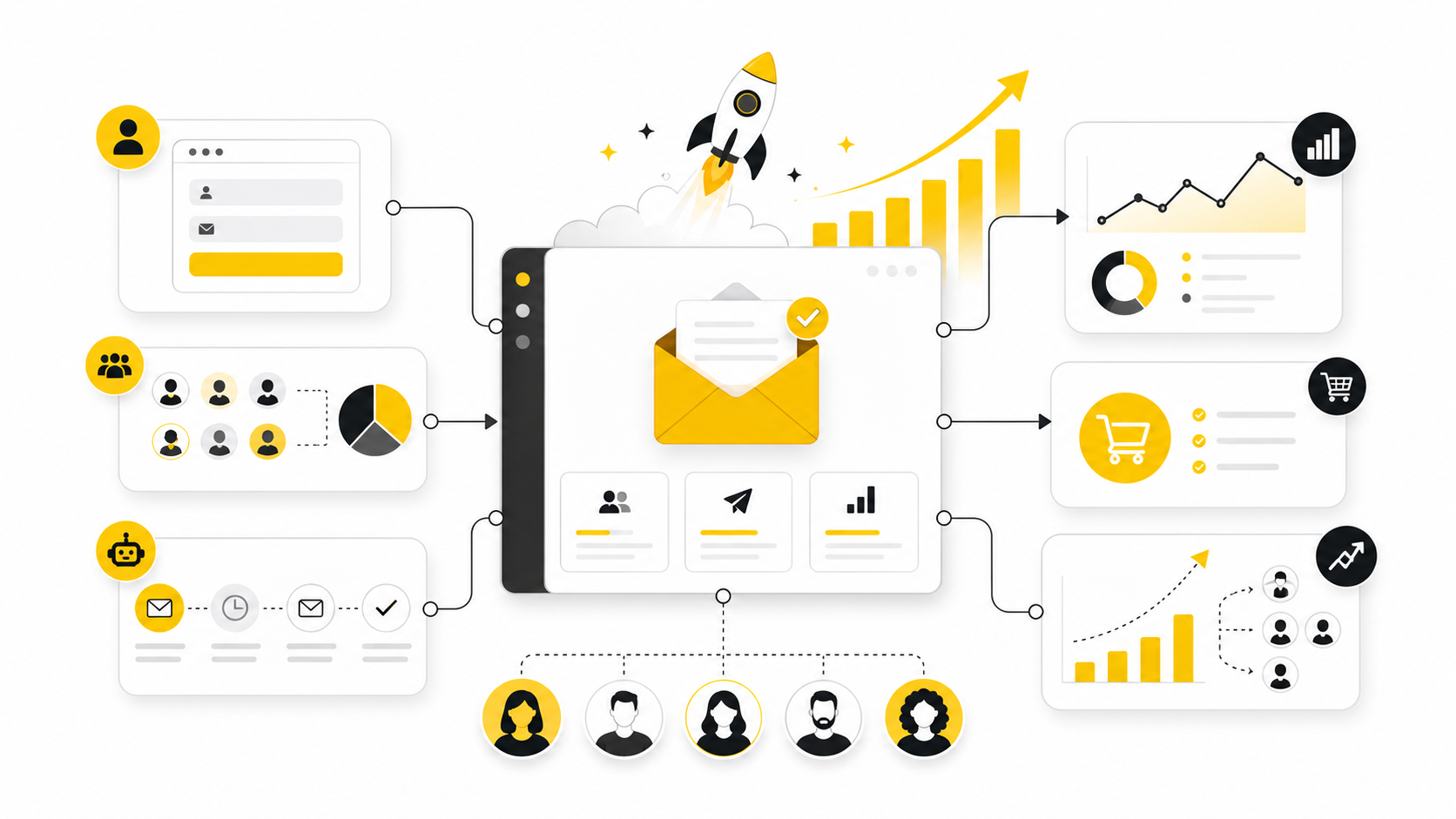
Most startups treat email marketing like a newsletter problem. They collect a few addresses, send updates when there is time, and hope something turns into revenue. That is not really email marketing for startups. That is just broadcasting.
Real email marketing for startups is a simple growth system. It helps you turn attention into subscribers, subscribers into qualified leads, leads into customers, and customers into repeat buyers or advocates. The important part is not sending more emails. The important part is sending the right email at the right moment, with a clear reason for the reader to care.
That matters because startups usually do not have unlimited paid ad budgets, huge sales teams, or years of brand trust. Email gives you a channel you can build once and improve over time. The channel is still strong too: Litmus reports that 35% of companies see email ROI of 36:1 or more, while its latest research also shows that lifecycle marketing is a major focus for teams using email to support retention and engagement (Litmus State of Email Reports).
There is also a less exciting reason this matters: startup growth gets messy fast. Leads come from ads, referrals, content, webinars, communities, product signups, waitlists, and abandoned checkouts. Without a clear email system, those people fall through the cracks. With one, every new subscriber has a path.
This guide will break email marketing for startups into a practical six-part system. The goal is not to make you “do email” as another random marketing task. The goal is to help you build a channel that supports acquisition, activation, conversion, retention, and learning.
The full article will continue using these sections:
Why Email Marketing Matters For Startups
Email marketing matters for startups because it gives you a direct line to people who have already shown intent. They may not be ready to buy today, but they have raised their hand in some way. That is valuable, especially when your product is new and your market still needs education.
Paid acquisition can get expensive quickly, and social platforms can change reach overnight. Email is not completely immune to platform rules, but it gives you more control than rented attention. You can segment your list, test your positioning, build trust over time, and create revenue moments without paying for every single impression again.
The biggest mistake is thinking email only becomes useful after you have thousands of subscribers. For startups, a small list of the right people is often more valuable than a large list of random people. A waitlist of 300 qualified prospects, a demo list of 80 active buyers, or a customer list of 150 early adopters can teach you more than a broad audience that never replies, clicks, or buys.
Email also creates a feedback loop. When people open, click, ignore, unsubscribe, reply, or convert, they show you what your market actually responds to. That is useful for copy, offers, onboarding, product education, sales follow-up, and retention. In the early stages, those signals are not just marketing metrics. They are market research.
The Startup Email Marketing Framework
A good startup email system has four jobs. It captures demand, nurtures intent, converts attention, and keeps customers engaged after the first purchase or signup. If one of those jobs is missing, the whole system becomes weaker.
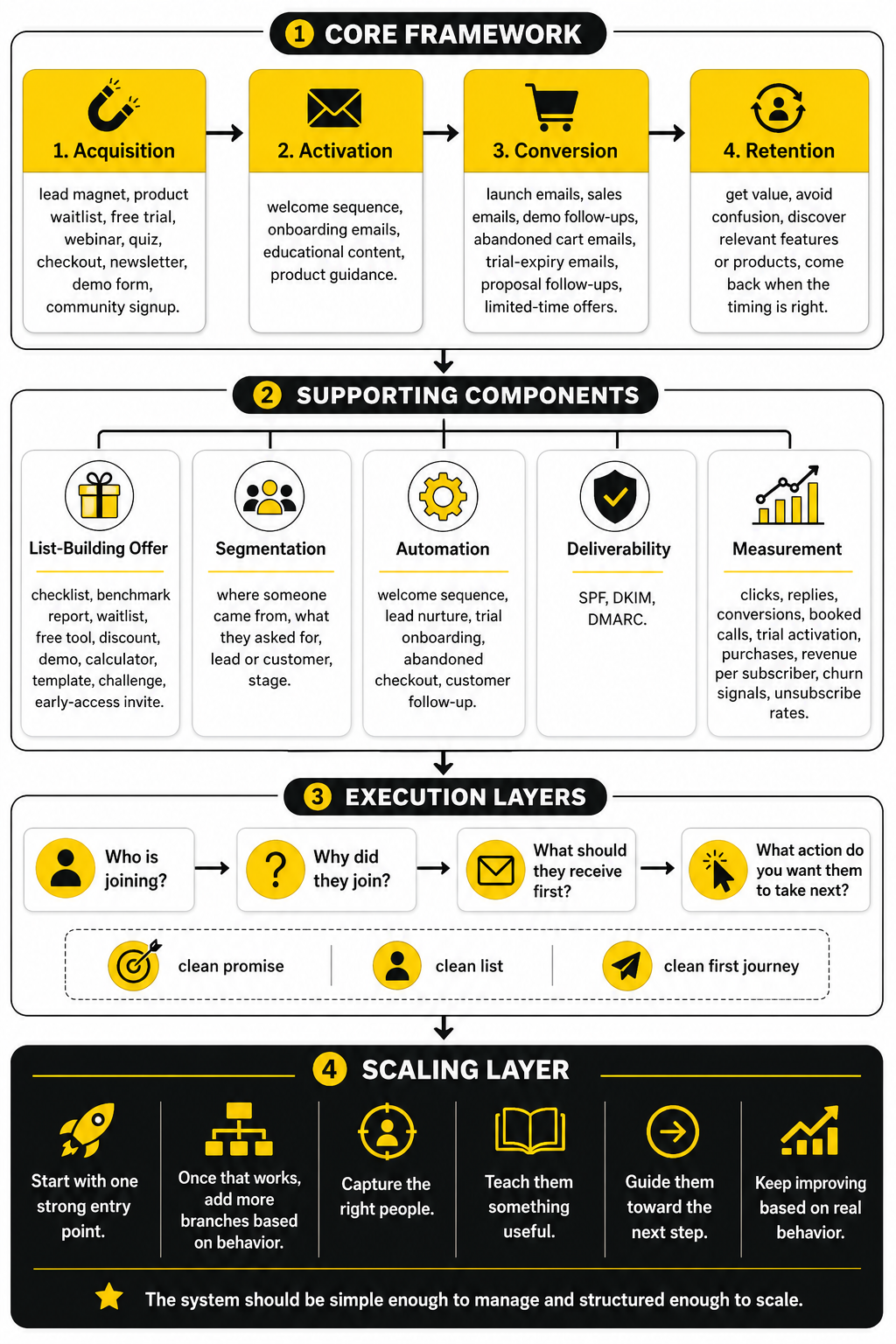
The framework starts with acquisition. This is where someone joins your list through a lead magnet, product waitlist, free trial, webinar, quiz, checkout, newsletter, demo form, or community signup. The signup source matters because it tells you what the person likely wants next.
Then comes activation. This is where your welcome sequence, onboarding emails, educational content, and product guidance help the person understand why your startup matters. For SaaS, this may mean getting the user to a first meaningful action. For ecommerce, it may mean helping the shopper choose the right product. For service startups, it may mean clarifying the problem and building trust before a call.
Conversion is the next layer. This includes launch emails, sales emails, demo follow-ups, abandoned cart emails, trial-expiry emails, proposal follow-ups, and limited-time offers. The point is not to pressure people randomly. The point is to connect the reader’s current intent with a clear next step.
Retention is the part many startups ignore too long. Once someone becomes a customer, email should help them get value, avoid confusion, discover relevant features or products, and come back when the timing is right. Lifecycle email is especially important here because retention usually depends on timely messages, not one-off campaigns.
Core Components Of Startup Email Marketing
The first core component is your list-building offer. People do not join email lists because a form exists. They join because the offer solves a small, specific problem or gives them access to something they want. For startups, this could be a checklist, benchmark report, waitlist, free tool, discount, demo, calculator, template, challenge, or early-access invite.
The second component is segmentation. At a basic level, you should know where someone came from, what they asked for, whether they are a lead or customer, and what stage they are in. You do not need complicated personalization from day one, but you do need enough context to avoid sending the same message to everyone forever.
The third component is automation. This is where email becomes useful even when your team is small. A simple welcome sequence, lead nurture sequence, trial onboarding sequence, abandoned checkout sequence, and customer follow-up sequence can cover a lot of ground. Tools like Brevo, Moosend, Systeme.io, and GoHighLevel can all fit different startup needs depending on whether you care more about email, funnels, CRM, or all-in-one automation.
The fourth component is deliverability. This is not glamorous, but it is non-negotiable. Google’s sender guidelines recommend setting up SPF, DKIM, and DMARC for sending domains, and bulk senders face stricter authentication and unsubscribe expectations (Google email sender guidelines). If your emails do not reach the inbox, your strategy does not matter.
The fifth component is measurement. Opens are useful, but they are not enough. Startups should track clicks, replies, conversions, booked calls, trial activation, purchases, revenue per subscriber, churn signals, and unsubscribe rates. Brevo’s 2025 benchmark data also shows that email performance varies widely by industry, which is why comparing your numbers against your own stage, audience, and offer is more useful than chasing one universal benchmark (Brevo email marketing benchmarks).
Professional Implementation Starts Simple
Professional email marketing for startups does not start with a giant automation map. It starts with a clean promise, a clean list, and a clean first journey. You need to know who is joining, why they joined, what they should receive first, and what action you want them to take next.
That usually means building one strong entry point before building ten weak ones. For example, a startup can begin with a lead magnet and a five-email nurture sequence, or a free trial and a product activation sequence. Once that works, you can add more branches based on behavior.
The best startup email systems are simple enough to manage but structured enough to scale. They do not depend on random inspiration every week. They depend on a framework: capture the right people, teach them something useful, guide them toward the next step, and keep improving based on real behavior.
Building The Foundation
Before you write a single campaign, get the foundation right. This is where most startup email programs either become an asset or turn into a messy list of disconnected forms, tags, and half-finished automations. Email marketing for startups works best when the basics are boring, clear, and easy to maintain.
The foundation has four parts: your audience, your offer, your data, and your first journey. You do not need a massive tech stack to begin. You need a system that tells you who joined, why they joined, what they should receive next, and what business outcome the email journey is meant to support.
This is also where you decide what email is supposed to do for the startup right now. A pre-launch startup may need waitlist activation. A SaaS startup may need trial onboarding. An ecommerce startup may need first-purchase conversion and repeat purchase flows. A service startup may need lead qualification and booked calls.
Define The Audience Before The Automation
Automation is useful only when it is built around a real audience. If you do not know who the subscriber is, the best software in the world will still send generic messages. That is why the first question is not “What tool should we use?” The first question is “Who are we trying to move, and what are they trying to solve?”
For a startup, this should be practical, not theoretical. You can begin with three simple groups: people who are curious, people who are considering, and people who are ready to act. Those groups may map to newsletter subscribers, lead magnet downloads, product trial users, demo requests, abandoned checkouts, or customers.
The key is to avoid treating all of them the same. A founder who downloaded a pricing checklist does not need the same email as someone who started a free trial yesterday. A customer who bought once does not need the same message as someone who has never purchased. The more clearly you define the audience stage, the easier it becomes to write emails that feel relevant instead of random.
Build One Strong Signup Path
A startup does not need ten lead magnets on day one. It needs one strong signup path that attracts the right people and gives them a clear reason to subscribe. This could be a waitlist, a free audit, a calculator, a template, a checklist, a demo request, a webinar, a discount, or early access to the product.
The best signup offer connects directly to the next business step. If you sell software, the offer should help people understand the problem your product solves. If you sell a service, the offer should help prospects diagnose their situation and see why expert help matters. If you sell physical products, the offer should reduce buying friction and help the customer choose confidently.
Your signup page should be simple. Make the promise obvious, explain what the person gets, remove unnecessary form fields, and tell them what happens after they subscribe. If the signup path needs a landing page, tools like Systeme.io, ClickFunnels, and Replo can make sense depending on whether you are building a funnel, a simple lead capture page, or a sharper ecommerce landing experience.
Collect The Right Data From The Start
Do not collect data just because you can. Collect data that helps you send better emails or make better decisions. For most startups, that means capturing the signup source, customer status, product interest, industry, lifecycle stage, and key behavior such as demo requested, trial started, checkout abandoned, or purchase completed.
This data does not need to be complicated. A few clean fields are better than twenty messy ones that nobody trusts. The goal is to make future emails more useful, not to build a database that looks impressive but never gets used.
Good data also protects you from one of the most common startup email mistakes: sending every campaign to everyone. When you know who joined through which offer, you can match the message to the context. That alone makes your email marketing feel more professional because the reader can tell you are paying attention.
Choose A Tool That Matches Your Stage
The right email platform depends on the startup’s stage and sales motion. A simple newsletter tool may be enough for a founder-led startup that only needs broadcasts and a welcome sequence. A more advanced CRM or marketing automation platform makes sense when you need pipelines, sales follow-up, appointment booking, multi-step workflows, or client management.
For lean email and marketing automation, Brevo and Moosend are practical options for startups that want campaigns, automations, and list management without overbuilding. For startups that need funnels, CRM, pipelines, bookings, and follow-up in one place, GoHighLevel is usually a better fit. For productized services or funnel-driven offers, ClickFunnels can work when the funnel itself is central to the sales process.
Do not choose a tool because it has the longest feature list. Choose the tool your team can actually use every week. A basic system that gets maintained will beat an advanced platform that nobody opens after setup.
Create The First Customer Journey
Once the signup path and tool are clear, build the first journey. This is the first automated experience someone receives after joining your list. It should make the subscriber feel oriented, not overwhelmed.
A strong first journey usually answers five questions:
This journey does not have to be long. A five-email sequence can be enough for many startups. The first email delivers the promised asset or confirms the signup. The second clarifies the problem. The third explains the cost of doing nothing. The fourth introduces the product, service, or offer. The fifth gives the reader a clear action.
Keep The Welcome Sequence Human
The welcome sequence is where the relationship starts. Do not waste it with a cold, corporate paragraph about how excited your company is to have them on the list. Tell the reader what they will get, why it matters, and what they should do next.
This matters because early subscribers are often still forming an opinion. They may have found you through an ad, a search result, a referral, a product page, or a social post. The welcome sequence should connect that first moment of interest to a bigger reason to trust you.
The tone should sound like a person who understands the reader’s problem. Keep the emails focused. Use plain language. Make one clear point per email. Ask for replies when it makes sense, especially in the early stage, because real responses can reveal objections, use cases, and language your landing pages may be missing.
Set Up Deliverability Before Scaling
Deliverability should not be treated as a technical chore you fix later. If your emails land in spam, the rest of the strategy becomes irrelevant. Startups need to set up authentication, use a real sending domain, avoid sudden volume spikes, and make unsubscribing easy.
This is especially important when a startup begins sending more frequently. A small list can hide sloppy habits for a while, but scale exposes everything. Bad list sources, unclear consent, spammy subject lines, weak authentication, and low engagement can all hurt inbox placement.
The safest approach is simple. Send to people who asked to hear from you. Make the content relevant to the reason they subscribed. Clean inactive contacts over time. Avoid buying lists. Respect unsubscribes immediately. This is not just compliance. It is basic trust.
Build The Minimum Viable Email System
The minimum viable email system is not a newsletter calendar. It is a compact set of flows that support the startup’s current growth model. For many startups, that means one acquisition path, one welcome sequence, one conversion sequence, and one customer follow-up sequence.
A simple version could look like this:
That is enough to start learning. Once those pieces work, you can add more segments, more triggers, more offers, and more personalization. But do not skip the minimum viable system. It gives your startup a stable base before you try to scale.
Creating High-Converting Email Sequences
Once the foundation is in place, the next step is building sequences that actually move people forward. This is where email marketing for startups becomes practical. You are no longer thinking in vague campaigns; you are designing a path from interest to action.
A high-converting sequence is not just a string of promotional emails. It is a guided conversation. Each message should answer one question, reduce one point of friction, or make one next step feel easier. If an email does not help the reader make progress, it probably does not belong in the sequence.
The goal is not to trick people into clicking. The goal is to match their current level of intent. Someone who just joined your list needs context. Someone who started a trial needs help getting value. Someone who abandoned checkout needs reassurance. Someone who booked a demo needs preparation, not another generic pitch.
Start With The Conversion Moment
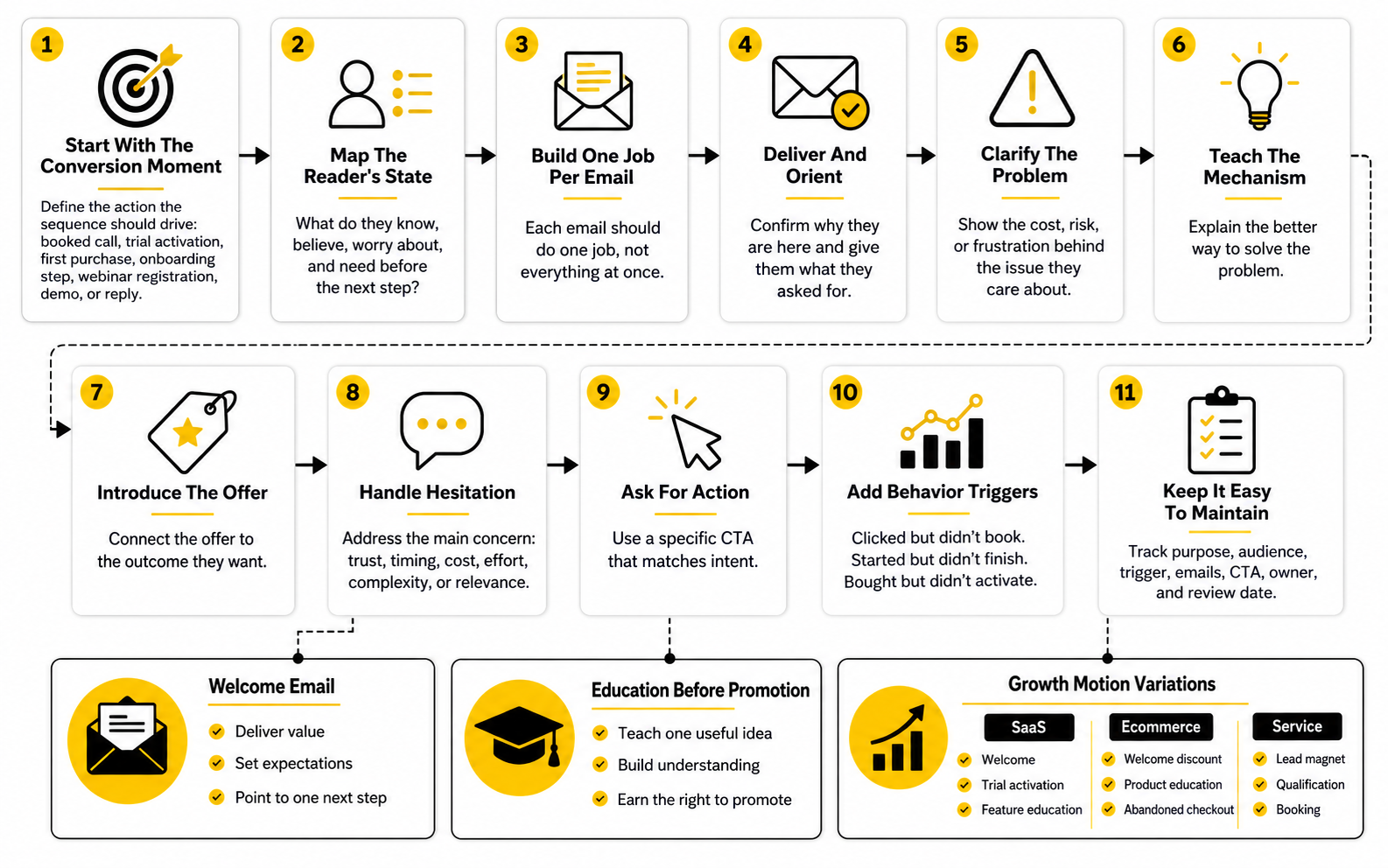
Before writing the sequence, define the conversion moment. This is the action the sequence is built to support. It could be a booked call, a free trial activation, a first purchase, a completed onboarding step, a webinar registration, a product demo, or a reply from a qualified lead.
This matters because every sequence needs a clear destination. Without one, the emails drift. You end up sending tips, updates, and reminders without knowing what they are supposed to produce.
For a startup, the conversion moment should connect to the current growth priority. If the biggest bottleneck is turning trial users into active users, focus on activation. If the bottleneck is getting qualified leads to sales calls, focus on education and booking intent. If the bottleneck is first purchase, focus on product clarity, objections, and buying confidence.
Map The Reader’s State Before Writing
Good email sequences start with the reader’s state, not the company’s announcement. Ask what the subscriber knows, what they believe, what they are worried about, and what they need before taking the next step. That gives you the emotional and practical context for the sequence.
A new subscriber may understand the problem but not trust your solution yet. A trial user may like the idea but feel stuck inside the product. A buyer may need help getting the first result so they do not regret the purchase. Each situation requires a different message.
This is where many startups go wrong. They write from their own perspective: our feature, our offer, our update, our launch. The reader is thinking about their own problem. Your sequence should meet them there first, then guide them toward your product or offer.
Build The Sequence Around One Job Per Email
Each email should have one job. That does not mean every email must be short, but it does mean every email should be focused. When one email tries to educate, pitch, overcome every objection, introduce three features, and push five links, the reader does nothing.
A simple startup sequence can follow this structure:
This structure works because it respects how people make decisions. Most subscribers are not waiting for a pitch on day one. They need a reason to keep paying attention before they need a reason to buy.
Write The Welcome Email Like A Human
The welcome email has one of the most important jobs in the whole system. It confirms the relationship. It tells the subscriber they made the right decision by joining. It also sets expectations for what happens next.
Keep this email direct. Remind them what they signed up for, deliver the promised resource or access, and point them to one useful next step. Do not use this moment to dump your entire company story into their inbox.
The best welcome emails feel personal without pretending to be something they are not. You can say why the resource exists, who it is for, and what result it should help them get. You can also ask a simple question if replies would help your startup learn from the audience. Early-stage startups should not waste that opportunity.
Use Education Before Promotion
Education is what earns the right to promote. This is especially true when your startup is selling something new, unfamiliar, expensive, or behavior-changing. People need to understand the problem before they care about the solution.
A strong educational email does not lecture. It makes one useful idea clear. It might explain a common mistake, show a better decision framework, compare two approaches, or reveal why the old way creates friction.
For email marketing for startups, education also helps with positioning. You are not just telling people your product exists. You are shaping how they think about the category. That is powerful because startups often win by helping people see an old problem in a sharper way.
Introduce The Offer At The Right Time
The offer should appear when the reader has enough context to understand why it matters. If you pitch too early, it feels rushed. If you wait too long, interested people may lose momentum.
A good offer email connects three things: the reader’s problem, the desired outcome, and the specific next step. This could be starting a trial, booking a call, buying a product, joining a workshop, or replying with details. The email should make the action feel natural, not forced.
This is where the tool or funnel setup matters. If your startup needs a clear sales path, a simple funnel builder like ClickFunnels can help connect the email click to a focused landing page. If you need CRM follow-up, pipeline tracking, and automation in one place, GoHighLevel is more aligned with a sales-led process. If you need a lean all-in-one setup for pages, emails, and basic automation, Systeme.io can be enough to get moving without overcomplicating the stack.
Handle Objections Without Sounding Defensive
Every conversion sequence should address hesitation. Not aggressively. Not with fake urgency. Just honestly.
Most objections fall into a few buckets: trust, timing, cost, effort, complexity, and relevance. A startup should know which one matters most for its audience. If people believe the product is useful but not urgent, talk about timing and cost of delay. If they worry it will be hard to implement, show the first simple step. If they do not trust the category yet, explain the process more clearly.
The mistake is trying to handle every objection in one email. That creates a wall of copy that feels like pressure. Pick the most important concern and deal with it cleanly. One email, one hesitation, one next step.
Make The Call To Action Specific
A weak call to action kills otherwise good email copy. “Learn more” is usually too vague. “Check it out” is not much better. The reader should know exactly what happens after the click.
Use calls to action that match intent. For a demo sequence, “Book a 20-minute demo” is clearer than “Get started.” For a product sequence, “Choose your plan” may be better than “Explore.” For a trial sequence, “Complete your first setup step” is more useful than “Log in.”
The CTA should also match the email’s promise. If the email teaches the reader how to identify a problem, the next step might be a checklist or audit. If the email introduces an offer, the next step can be a sales page. If the email handles objections, the next step should reduce risk or answer the final question.
Create Sequences For Different Growth Motions
Not every startup needs the same sequence. A SaaS startup, ecommerce startup, marketplace, agency, coaching business, local service, and AI tool all have different buying journeys. The sequence should reflect how the customer actually decides.
A SaaS startup may need:
An ecommerce startup may need:
A service startup may need:
The point is not to build all of these immediately. The point is to choose the one sequence that supports the biggest bottleneck right now. Build that first, improve it, then move to the next.
Use Behavior To Trigger Better Emails
The more your list grows, the less useful one-size-fits-all email becomes. Behavior tells you what someone is actually doing. That behavior should shape what they receive next.
A subscriber who clicks a pricing link is showing stronger intent than someone who only opens a newsletter. A trial user who completes setup needs a different message from someone who never logs in. A customer who buys one product may need education before a second purchase, while a repeat customer may be ready for a loyalty or referral prompt.
You do not need advanced personalization to start. Basic behavior triggers are enough. Clicked but did not book. Started but did not finish. Bought but did not activate. Opened several emails but never clicked. These signals help you send emails that feel timely instead of random.
Keep The Sequence Easy To Maintain
A sequence that nobody can maintain will eventually break. Startups change offers, pricing, product features, positioning, and audience segments often. Your email system needs to survive those changes.
Keep a simple record of each sequence: purpose, audience, trigger, emails, CTA, owner, and last review date. This prevents the classic startup problem where nobody remembers why an email exists or whether it still matches the current offer.
Review sequences regularly, especially after major changes to the product, pricing, onboarding, or sales process. Do not rewrite everything every week. Just make sure the promise, links, timing, and next steps are still accurate. Clean systems scale. Messy systems leak revenue.
Statistics And Data
Data is where email marketing for startups gets honest. It tells you whether people care, whether the message is clear, whether the offer is strong, and whether the list is healthy. The numbers are not there to make a dashboard look busy. They are there to tell you what to fix next.
The mistake is treating benchmarks like grades. A startup sees an open rate, click rate, or unsubscribe rate from an industry report and immediately decides the campaign is good or bad. That is too shallow. Benchmarks are useful context, but your real goal is to understand how your own audience behaves across each stage of the journey.
A 42% open rate can be meaningless if nobody clicks or buys. A 2% click rate can be strong if the offer is high-ticket and the leads are qualified. A campaign with fewer clicks can still produce more revenue if the clicks come from the right people. That is why measurement needs to connect email behavior to business outcomes.
What Benchmarks Can And Cannot Tell You
Benchmarks are helpful because they show what normal performance can look like across industries, list sizes, and campaign types. They stop you from guessing in a vacuum. For example, MailerLite’s 2025 benchmark report is based on over 3.6 million campaigns sent from 181,000 approved accounts, which makes it useful for understanding broad open, click, click-to-open, and unsubscribe patterns across markets (MailerLite email marketing benchmarks).
But benchmarks cannot tell you whether your startup’s email strategy is working. They do not know your offer, your price point, your sales cycle, your customer awareness level, or your lead quality. A startup selling a $29 product and a startup selling a $12,000 annual contract should not judge performance the same way.
Use benchmarks as a reality check, not as the final answer. If your numbers are far below the range for your category, investigate. If your numbers are above average but revenue is weak, investigate even harder. High engagement without business impact usually means people like the content but are not moving toward the action that matters.
The Metrics That Actually Matter
Open rate is useful, but it should not run the whole show. Privacy changes, inbox behavior, and automatic image loading can make opens less precise than they used to be. Opens still help you understand subject lines, sender trust, and list fatigue, but they are only the first signal.
Click rate is more useful because it shows active intent. Someone clicked because the message created enough interest for them to leave the inbox. That does not always mean they are ready to buy, but it does mean the topic, offer, or CTA created movement.
Conversion rate is where the strategy becomes real. This could mean booked calls, free trial activations, purchases, completed onboarding steps, replies, upgrades, or retained customers. For startups, this is the metric that separates “people read our emails” from “email is helping the business grow.”
Revenue per subscriber is also worth tracking when your model supports it. It tells you whether list growth is producing value or just vanity. A smaller list with higher revenue per subscriber is usually healthier than a large list that never converts.
Build A Simple Email Analytics System
Your analytics system should follow the customer journey, not just the campaign calendar. Start with the source of the subscriber, then track what they receive, what they click, what they do next, and whether that action creates business value. This gives you a clean path from signup to outcome.
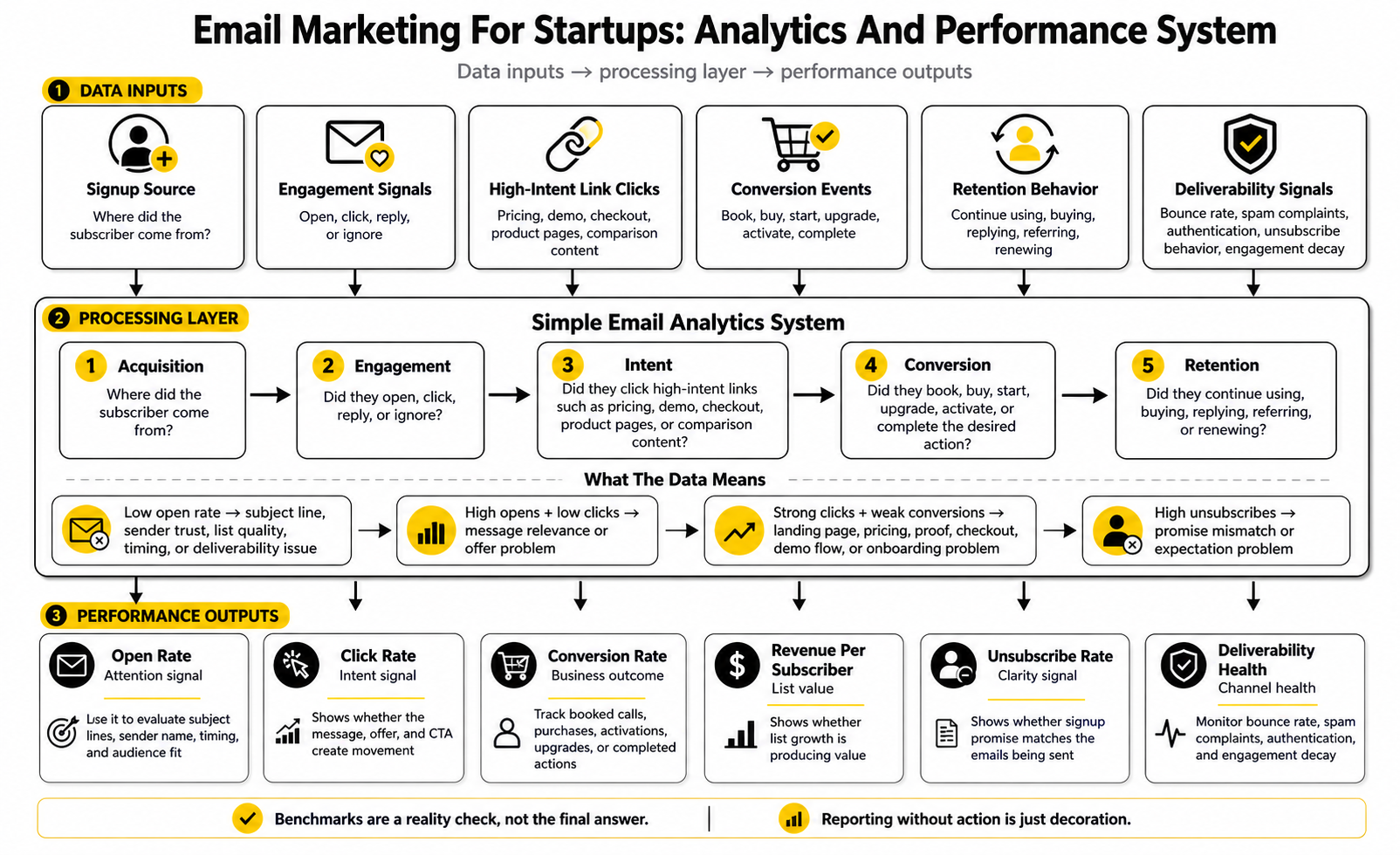
The simplest version has five layers:
This structure keeps you from overreacting to isolated numbers. A weak open rate may be a subject line problem. A strong open rate with weak clicks may be a message or offer problem. Strong clicks with weak conversions may be a landing page, pricing, trust, or product-market fit problem.
Read Open Rates As Attention Signals
Open rates mostly tell you whether people noticed and trusted the email enough to check it. That makes them useful for testing subject lines, sender names, send timing, and audience fit. They are not useless, but they are not the final measure of success.
A low open rate can mean the subject line is unclear, the sender name is unfamiliar, the list is cold, the audience is too broad, or the email frequency is wrong. It can also mean the signup source created weak intent. If people joined only for a one-time discount or a generic giveaway, they may not care about future emails.
A high open rate is not automatically a win. If people open but do not click, reply, or convert, the email may be interesting but not effective. The action is to compare open rate with click rate, not celebrate it alone.
Read Click Rates As Intent Signals
Click rate shows whether the email created enough interest for the reader to take action. That makes it one of the most important performance signals in email marketing for startups. It tells you whether the message, offer, and CTA are aligned.
If clicks are low, look at the offer before blaming the button. The reader may not understand the value, the CTA may be too vague, or the email may be trying to move them too fast. A new subscriber may need education before a sales page. A trial user may need help before an upgrade pitch.
Click-to-open rate can also be useful because it shows how persuasive the email was after people opened it. HubSpot’s benchmark collection shows that click-through and click-to-open rates vary heavily by industry and email type, which is why startups should compare performance by segment instead of relying on one broad average (HubSpot email marketing benchmarks). A welcome email, abandoned checkout email, product education email, and investor update should not be judged by the same expectation.
Read Unsubscribes As Clarity Signals
Unsubscribes are not always bad. Sometimes they mean the wrong people are leaving, which can improve list quality. The problem starts when unsubscribes rise because the promise at signup does not match the emails people receive.
If someone joins for a practical checklist and then receives five aggressive sales emails, the unsubscribe is not surprising. If someone signs up for product updates and only receives generic thought leadership, the mismatch is obvious. The email did not fail at copy. It failed at expectation management.
Track unsubscribe rate by source and sequence. If one lead magnet produces many unsubscribes, the offer may be attracting low-intent subscribers. If one automation step causes a spike, that specific email may be too pushy, irrelevant, or poorly timed.
Track Deliverability Like A Growth Metric
Deliverability is not a technical side issue. It directly affects revenue because it controls whether your emails are seen at all. If inbox placement drops, every downstream metric gets distorted.
Startups should watch bounce rate, spam complaints, domain authentication, unsubscribe behavior, and engagement decay. Google’s bulk sender guidance makes this especially clear, with sender requirements around authentication and spam-rate expectations, including a user-reported spam-rate threshold where senders above 0.3% can lose mitigation eligibility (Google email sender guidelines FAQ). That number is not just a compliance detail. It is a reminder that sloppy sending can create real deliverability risk.
The action is simple: send to people who asked to hear from you, make unsubscribing easy, avoid purchased lists, clean inactive contacts, and keep your promises. This protects the channel before you try to scale it. A list that trusts you is worth more than a list that merely exists.
Connect Email Metrics To Revenue
The most useful email dashboard shows how email contributes to the business. That means connecting campaigns and automations to sales, pipeline, activations, upgrades, retained customers, or repeat purchases. Without this connection, email becomes a content activity instead of a growth channel.
For a SaaS startup, revenue tracking may include trial-to-paid conversion, activation rate, upgrade rate, and churn risk. For ecommerce, it may include first purchase, repeat purchase, average order value, abandoned checkout recovery, and revenue per recipient. For service startups, it may include qualified replies, booked calls, show-up rate, proposals sent, and closed deals.
This is where tools with CRM and automation depth can be useful. A startup that needs pipeline visibility may prefer GoHighLevel because the email activity can sit closer to sales follow-up. A startup focused on email campaigns and list performance may be fine with a more email-first platform like Brevo or Moosend. The tool matters less than the discipline of connecting email behavior to commercial outcomes.
Know What To Fix First
When performance drops, do not rewrite everything. Diagnose the bottleneck. The numbers will usually tell you where to look.
If signups are low, the problem is probably the offer, traffic source, landing page, or form friction. If opens are low, check audience quality, subject lines, sender trust, and deliverability. If clicks are low, check message relevance, CTA clarity, and whether the email is asking for the right action. If conversions are low after clicks, the issue may be the landing page, pricing, proof, checkout process, demo flow, or product onboarding.
This order matters. Many startups change email copy when the real issue is the page after the click. Others redesign landing pages when the real issue is poor lead quality. Data keeps you from guessing, and guessing is expensive.
Use Testing To Learn, Not To Feel Busy
Testing is valuable only when it answers a real question. Do not run random A/B tests just because the platform makes it easy. Test the things that could actually change behavior.
Useful tests include subject line angle, offer framing, CTA wording, sequence timing, audience segment, landing page destination, and email length. Weak tests include tiny punctuation changes, button color debates, or testing ten things at once with too little traffic to learn anything. Startups need clarity more than statistical theater.
Before each test, write the decision it will influence. For example, “If the demo-focused CTA beats the free-guide CTA, we will move high-intent subscribers faster into booking.” That kind of test produces a decision. That is the point.
Turn Reporting Into A Weekly Habit
Email analytics should become a weekly operating habit, not a quarterly panic session. A simple weekly review can show what is working, what is slipping, and what needs attention before it becomes a larger problem. This does not need to be complicated.
Review the key flows first because automations run every day and quietly shape revenue. Then review recent campaigns, list growth, unsubscribe patterns, click behavior, and conversion outcomes. Finally, choose one improvement for the next week.
That last part is important. Reporting without action is just decoration. The best startup email programs improve because the team keeps making small, focused upgrades: a clearer welcome email, a stronger CTA, a cleaner segment, a better offer, a fixed broken link, a faster follow-up. Small improvements compound when the system runs every day.
Turning Email Into A Repeatable Growth Channel
At this stage, email stops being a set of campaigns and becomes part of the startup’s operating system. That is the shift. You are no longer asking, “What should we send this week?” You are asking, “How does email help the business acquire, activate, convert, retain, and learn?”
This is where email marketing for startups becomes more strategic. The early work gave you the foundation, sequences, and measurement system. Now the job is to scale without breaking trust, overcomplicating the stack, or turning every subscriber into a target for more automation.
The biggest risk is adding complexity too early. More segments, more flows, more personalization, more tools, and more campaigns can sound advanced, but they can also create confusion. A repeatable growth channel is not the one with the most moving parts. It is the one where the right message consistently reaches the right person and creates a measurable next step.
Scale Segmentation Carefully
Segmentation is powerful, but only when it makes the email more relevant. Startups often jump from one general list to dozens of tiny segments before they have enough data to support that level of detail. That creates extra work without much improvement.
A better approach is to segment by intent first. Separate people by where they came from, what they requested, whether they are leads or customers, and which action they have taken. These signals are usually more useful than vague demographic assumptions.
As the list grows, you can add deeper segmentation. For example, a SaaS startup might separate free trial users by activation stage. An ecommerce startup might separate first-time buyers from repeat buyers. A service startup might separate content subscribers from people who have requested a consultation. Each segment should change what you send, not just make the dashboard look more sophisticated.
Personalization Needs Context, Not Gimmicks
Personalization does not mean dropping someone’s first name into the subject line and calling it strategy. Real personalization uses context to make the message more useful. The email should feel like it understands why the person joined, what they are trying to do, and what step makes sense next.
This matters because customer expectations have changed. McKinsey’s personalization research found that 71% of consumers expect personalized interactions and 76% feel frustrated when they do not get them (McKinsey personalization research). For startups, that does not mean building enterprise-level personalization from day one. It means avoiding lazy, irrelevant messaging.
The simplest version is behavior-based personalization. If someone clicks pricing, send them decision support. If someone starts but does not finish setup, send them help. If someone buys, stop treating them like a prospect. That is basic, but it is also where many startups still fail.
Balance Automation With Human Touch
Automation helps startups move faster, but it should not remove the human layer completely. Some moments deserve a personal reply, a sales follow-up, a customer success check-in, or a founder note. The more valuable the lead or customer, the more carefully you should decide where automation ends and a human takes over.
This is especially important for B2B, high-ticket services, complex SaaS, and relationship-driven sales. A fully automated nurture sequence can educate the lead, but a well-timed personal message can create trust that automation cannot. The goal is not to choose between automation and human follow-up. The goal is to let each do what it does best.
A practical rule is simple: automate repeatable education, reminders, routing, and follow-up prompts. Keep human interaction for qualification, objection handling, strategic conversations, enterprise deals, customer recovery, and moments where a real reply can change the outcome.
Avoid Over-Sending As You Grow
As startups grow, more teams want access to the list. Marketing wants launches. Sales wants follow-ups. Product wants updates. Customer success wants onboarding messages. Founders want announcements. Suddenly the subscriber receives too much, and performance starts to slip.
This is where email governance matters. Someone needs to own the overall subscriber experience. Not just individual campaigns. The whole inbox relationship.
Create a simple sending calendar and check for overlap before adding new emails. Make sure lifecycle emails, product emails, promotional emails, and newsletters do not collide in a way that feels chaotic. More email is not always more revenue. Sometimes it is just more noise.
Protect The List Like An Asset
Your email list is not just a database. It is accumulated trust. Every signup represents someone who gave you permission to show up in a personal space, and that permission can disappear quickly if you abuse it.
That is why list quality matters more than list size. Purchased lists, scraped contacts, unclear opt-ins, and generic giveaways may inflate the database, but they often weaken engagement and damage deliverability. A smaller list of people who actually want the emails is stronger than a large list that ignores or reports them.
This is also a compliance issue. Regulations and sender requirements keep pushing marketers toward clearer consent, easier unsubscribes, and better authentication. Google’s sender requirements for bulk senders include authentication, easy unsubscribe, and spam-rate expectations, which makes list quality a growth issue as much as a legal or technical one (Google email sender guidelines).
Use AI For Speed, Not Strategy
AI can make email production faster. It can help draft subject lines, summarize customer research, generate testing ideas, rewrite segments, or turn product notes into usable campaign copy. That is useful, especially for a small startup team.
But AI should not decide your positioning, customer insight, or offer strategy without human judgment. The model does not know your market the way your customers do. It can produce confident copy that sounds fine but misses the real objection, the real buying trigger, or the real reason people churn.
Use AI to accelerate the work around the strategy. Feed it customer language, sales call notes, support tickets, survey responses, product updates, and campaign performance insights. Then edit like a human who understands the audience. Tools like GoHighLevel AI can be useful when you want AI inside a broader CRM and automation system, but the thinking still has to come from the business.
Connect Email With The Rest Of The Funnel
Email does not work in isolation. The email can create the click, but the landing page, sales page, product experience, checkout, demo process, and customer support determine what happens next. If those parts are weak, email performance will look worse than it really is.
This is why startups should review the full path, not just the email. Look at the promise in the email, the headline on the landing page, the friction in the form, the speed of follow-up, and the clarity of the offer. A campaign may have strong clicks and weak conversions because the page after the click creates doubt.
For funnel-heavy startups, the email and page should be built together. A focused page in ClickFunnels, a lean funnel in Systeme.io, or a more polished ecommerce landing page in Replo can make a major difference when the post-click experience is the bottleneck.
Use Email To Learn From Customers
Email is not only a sales channel. It is one of the fastest ways to learn from the market. Replies, clicks, unsubscribes, survey answers, and support responses can show you what people care about before the data becomes obvious elsewhere.
Startups should actively invite feedback at key moments. Ask new subscribers what they are trying to solve. Ask trial users what almost stopped them from activating. Ask buyers what made them trust the offer. Ask churned customers what changed.
This feedback can improve more than the email program. It can sharpen positioning, product onboarding, pricing pages, sales scripts, feature prioritization, and content strategy. The best email systems do not just push messages out. They pull insight back in.
Know When To Add More Channels
Email is strong, but it should not carry every job alone. Some startups need SMS, chat, retargeting, sales calls, webinars, communities, or direct outreach layered around email. The key is to add channels based on customer behavior, not because everyone else is doing it.
For example, a high-intent demo request may deserve an email, calendar reminder, and sales follow-up. A shopper who abandoned checkout may respond better to email plus SMS if they clearly opted in. A lead who asks a question on social may need a direct message before being moved into a longer nurture flow.
The tradeoff is attention. Every added channel increases complexity and the risk of annoying people. Use additional channels when they make the customer experience smoother, faster, or more helpful. Do not use them just to chase people harder.
Decide Who Owns Email Internally
Email gets messy when nobody owns it. In early-stage startups, the founder often writes the first emails. Later, marketing, sales, customer success, product, and operations all touch the channel. Without ownership, the list becomes a shared resource with no clear standards.
Someone should own the subscriber experience, the sending calendar, the performance review, the automation map, and the quality bar. That person does not need to write every email, but they should protect consistency. They should know what is being sent, to whom, why, and how it connects to the business.
This becomes more important as the company grows. A startup can survive messy email when the list is tiny. It cannot scale a messy system without leaking trust, confusing customers, and losing revenue opportunities.
Build For The Next Stage, Not The Fantasy Stage
The best email system is the one that fits the startup’s current stage while leaving room to grow. Do not build an enterprise lifecycle machine when you have 400 subscribers and no proven offer. Do not stay on a basic newsletter setup when you have multiple customer segments, sales motions, and revenue-critical automations.
Think in stages. First, build the foundation. Then create the core sequences. Then connect analytics. Then improve segmentation and automation. Then layer in advanced personalization, CRM logic, multi-channel follow-up, and deeper lifecycle programs.
That is how email marketing for startups becomes durable. You do not win by sending random campaigns forever. You win by building a system that gets clearer, more carefully, and more valuable every month.
Measuring, Improving, And Scaling Your Email Program
A startup email program should improve like a product. You launch the smallest useful version, watch what people do, remove friction, sharpen the promise, and keep upgrading the experience. That is the mindset that turns email from a marketing task into a repeatable growth system.
The final layer is not about adding more dashboards or writing longer reports. It is about building a loop. You send, measure, learn, improve, and then send better. That loop is where email marketing for startups becomes compounding.
The best teams do not wait for a massive campaign review to make changes. They look at the system every week and ask one practical question: what is the highest-leverage improvement we can make next? Sometimes that is a clearer subject line. Sometimes it is a better landing page. Sometimes it is cutting an email that no longer earns its place.
Build The Improvement Loop
The improvement loop starts with one clear business goal. If the goal is more demos, the email program should be measured against demo intent and booked calls. If the goal is trial activation, the email program should be measured against product actions. If the goal is repeat purchases, the emails should be measured against returning customer behavior.
Once the goal is clear, review the journey in order. Look at signup source, welcome sequence, engagement, clicks, conversion, and retention. Do not jump straight to rewriting copy before you know where the drop-off happens.
A useful loop looks like this:
This keeps the team focused. It also prevents the classic startup mistake of changing five things at once and learning nothing.
Prioritize The Highest-Leverage Fixes
Not every email deserves equal attention. Some emails sit at critical moments in the customer journey, while others are nice-to-have updates. Fix the emails closest to revenue, activation, or retention first.
For example, a weak trial onboarding email may cost more than a weak monthly newsletter because it affects people who are already close to value. A confusing abandoned checkout email may matter more than a general brand campaign because the buyer has already shown purchase intent. A poor post-purchase email may create support tickets, refund requests, or churn risk.
High-leverage fixes usually sit in these places:
These emails are not always glamorous, but they carry weight. Improve them before obsessing over secondary campaigns.
Use Customer Language To Improve Copy
The strongest email copy usually comes from the customer, not the marketing team. Pay attention to replies, sales calls, support tickets, reviews, surveys, cancellation reasons, and live chat transcripts. That is where the real language is.
Startups often describe the product in internal language. Customers describe the problem in practical language. The email should bridge those two worlds. If the customer says they are overwhelmed, stuck, wasting time, losing leads, missing follow-ups, or unsure what to do next, use that clarity.
This is especially useful for subject lines, opening lines, objections, and calls to action. A subject line based on a real customer frustration will often beat a clever one. A CTA based on the next obvious step will usually beat a vague “learn more.”
Scale Without Losing Trust
Scaling email is not just about sending more. It is about sending better to more people without damaging the relationship. That is where many startups get reckless.
A growing list creates temptation. More launches. More promotions. More reminders. More cross-sells. More automation. But every send either strengthens trust or spends it. You need to know which one is happening.
The way to scale safely is to separate high-intent messages from general communication. Someone who clicked pricing can receive a more direct conversion email. Someone who only reads educational content may need a slower nurture path. Someone who just became a customer should not be pushed back into prospect campaigns. Relevance protects trust.
Keep Your Email Ecosystem Connected
The final email system should feel connected from the inside. The signup path should match the welcome sequence. The welcome sequence should match the offer. The offer should match the landing page. The landing page should match the follow-up. The follow-up should match the customer experience.
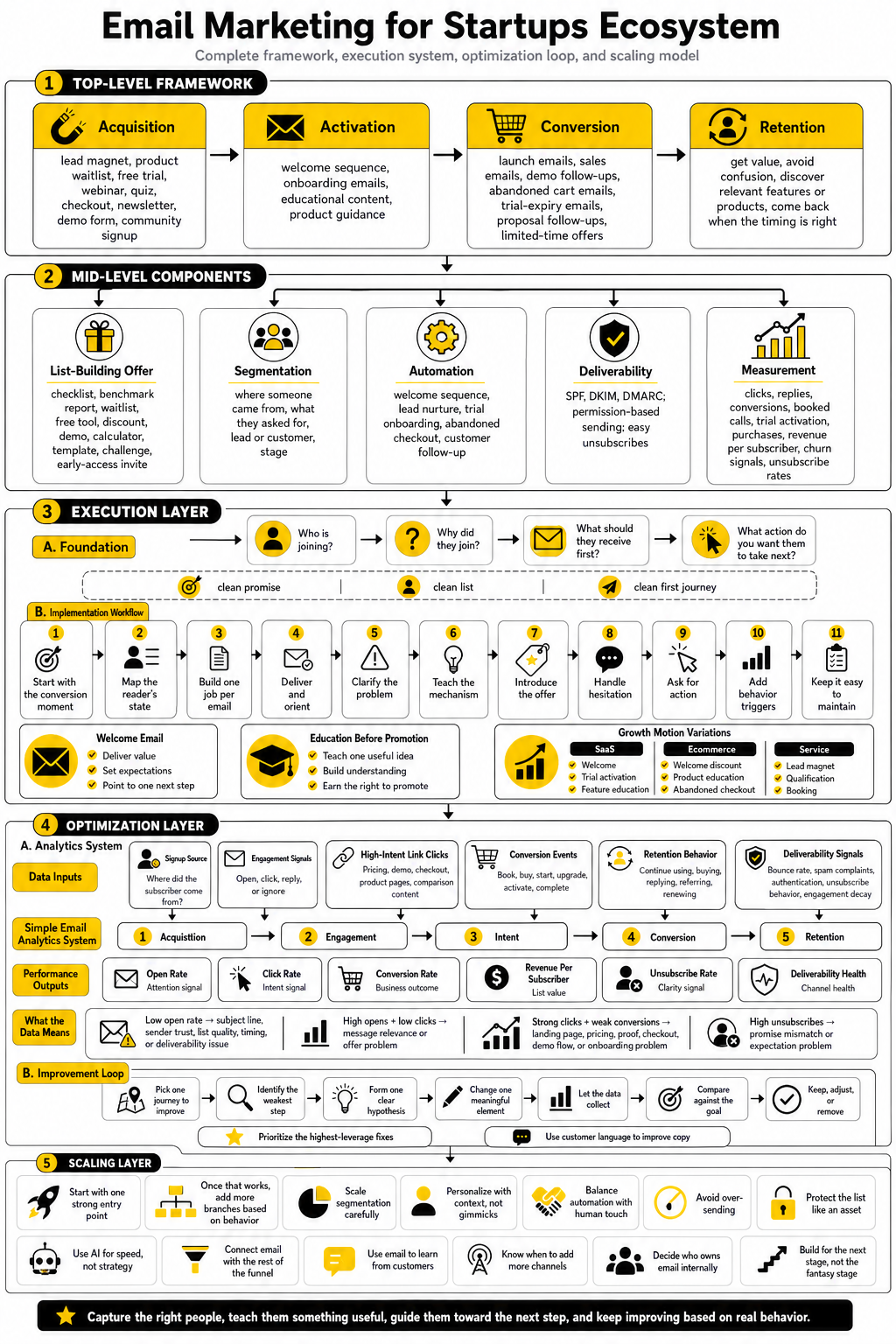
This is the ecosystem view. Email is one part of the growth machine, but it touches nearly every part. When it works well, it makes the rest of the funnel more efficient.
That is the real opportunity. Email can help a startup learn faster, sell more cleanly, onboard better, retain customers longer, and build a direct relationship with the market. Not because email is magic. Because a well-built email system keeps the conversation moving.
What is email marketing for startups?
Email marketing for startups is the process of using email to turn subscribers, leads, trial users, buyers, and customers into the next logical step in the business. That could mean booking a demo, activating a product account, completing a purchase, upgrading, renewing, or referring someone else. It is not just sending newsletters.
For startups, email works best when it is connected to the full customer journey. The goal is to guide people based on where they are and what they need next. That makes it more useful than random campaigns sent whenever the team has time.
Why is email marketing important for startups?
Email gives startups a direct channel to people who have already shown interest. That matters because early-stage companies usually need trust, education, and follow-up before people are ready to buy. A single visit to a website is often not enough.
It also helps startups reduce dependence on paid ads and social platforms. You still need traffic, but email lets you keep building the relationship after the first click. That makes it one of the most practical channels for long-term growth.
When should a startup start email marketing?
A startup should start email marketing as soon as it has a clear audience and a reason for people to subscribe. That can happen before launch through a waitlist, early access page, lead magnet, webinar, or product update list. Waiting until everything is perfect usually means missing valuable learning.
The early list does not need to be huge. A small group of qualified subscribers can help you test positioning, understand objections, and validate demand. The earlier you build the feedback loop, the faster you learn.
What emails should a startup send first?
Most startups should begin with a welcome sequence. This is the first automated journey someone receives after joining the list. It should confirm why they subscribed, deliver what was promised, explain the problem clearly, introduce the offer, and guide the next step.
After that, build the sequence closest to the main business bottleneck. If leads are not booking calls, build a booking nurture sequence. If trial users are not activating, build onboarding emails. If shoppers abandon checkout, build recovery emails.
How long should a startup email sequence be?
A startup email sequence should be long enough to move the reader to the next step without dragging the journey out. For many startups, five to seven emails is a strong starting point. That gives enough space to orient, educate, introduce the offer, handle hesitation, and ask for action.
The right length depends on the sales cycle. A low-cost product may need a shorter sequence. A high-ticket service or complex SaaS product may need more education and follow-up. The key is to make every email earn its place.
What is a good email open rate for startups?
A good open rate depends on the audience, industry, list source, and email type. Benchmark reports like MailerLite’s 2025 email marketing benchmarks can give useful context, but they should not be treated as universal targets. A welcome email, sales email, newsletter, and re-engagement email will naturally perform differently.
For startups, open rate is best treated as an attention signal. If people are not opening, check the sender name, subject line, list quality, timing, and deliverability. If they are opening but not clicking or converting, the problem is probably deeper in the message or offer.
What is a good email click rate for startups?
A good click rate is one that shows the email is creating meaningful action from the right audience. Broad benchmarks can help, but context matters more. A startup selling a high-ticket B2B product may have fewer clicks but higher-value outcomes than a low-cost ecommerce brand.
The better question is whether clicks are connected to the business goal. Are people clicking pricing, booking, checkout, onboarding, or product pages? If yes, the email is creating intent. If clicks are weak, review the offer, CTA, and whether the reader is ready for that action.
How often should startups send marketing emails?
Startups should send often enough to stay useful and memorable, but not so often that subscribers feel chased. Weekly can work for educational newsletters. Automated sequences may send more frequently when someone has just subscribed, started a trial, or abandoned checkout.
The right frequency depends on intent. A high-intent lead can tolerate more timely follow-up than a casual subscriber. A new customer may need several onboarding emails close together. A cold subscriber may need fewer, better emails instead of constant reminders.
Should startups use email automation?
Yes, startups should use automation when the message is repeatable and tied to a clear customer journey. Welcome emails, onboarding emails, checkout recovery, demo follow-up, trial reminders, and customer check-ins are all strong automation candidates. Automation helps a small team stay consistent.
But automation should not replace judgment. High-value leads, complex objections, customer recovery, and strategic sales conversations often need a human touch. The best system uses automation to handle predictable moments and people to handle important conversations.
What is the best email marketing tool for startups?
The best tool depends on the startup’s stage and sales motion. If you mainly need email campaigns and simple automation, Brevo or Moosend can be practical. If you need funnels, pipelines, sales follow-up, appointments, and CRM workflows, GoHighLevel may fit better.
If your startup is funnel-led, ClickFunnels can make sense for building focused sales paths. If you want a lean all-in-one setup, Systeme.io can be enough to launch. The best platform is the one your team can maintain consistently.
How can startups improve email deliverability?
Start with permission-based sending. Do not buy lists, scrape contacts, or email people who did not clearly ask to hear from you. That protects trust and reduces deliverability risk.
Then handle the technical basics. Set up SPF, DKIM, and DMARC, use a real sending domain, keep unsubscribe links easy to find, and monitor spam complaints. Google’s sender guidance explains why authentication, low spam rates, and easy unsubscribes matter for getting delivered to Gmail users (Google email sender guidelines).
How should startups measure email ROI?
Startups should measure email ROI by connecting emails to real business outcomes. That could include revenue, booked calls, trial activations, upgrades, renewals, retained customers, or qualified replies. Opens and clicks help diagnose performance, but they are not the final result.
The cleanest approach is to track the journey from signup source to conversion. Look at which forms, segments, sequences, and offers create value. Then invest more in the parts that move qualified people forward.
What are the biggest email marketing mistakes startups make?
The biggest mistake is sending generic emails to everyone. That usually happens when the startup has no segmentation, no clear journey, and no idea what action each email is supposed to drive. The result is a list that slowly disengages.
Other common mistakes include overbuilding automation too early, choosing tools before strategy, ignoring deliverability, sending too many promotions, and failing to connect email metrics to revenue. Most of these are fixable. Start with one clear journey, improve it, and scale from there.
How does email marketing support product-led growth?
Email supports product-led growth by helping users reach value faster. It can guide setup, explain key features, remind inactive users, highlight next steps, and reduce confusion during onboarding. This is especially important when the product has multiple features or a learning curve.
The best product-led emails are behavior-based. A user who has completed setup needs a different message from someone who never started. A user who engaged with one feature may need education about the next logical feature. The more closely the email matches product behavior, the more useful it becomes.
Can startups use AI for email marketing?
Yes, but AI should support the strategy, not replace it. AI can help draft subject lines, summarize customer research, generate email variations, outline sequences, and speed up production. That can save time for small teams.
The risk is publishing polished copy that does not reflect real customer insight. Startups should feed AI with customer language, objections, product notes, and performance data, then edit carefully. Human judgment still matters, especially for positioning, trust, and offer clarity.
Build a stronger local presence with BAAM AI
Turn your website, Google profile, social channels, and AI visibility into one growth engine
Most businesses do not need more random marketing activity. They need a consistent presence system that helps the right people find them, trust them, and take action. BAAM AI brings strategy, local SEO, website updates, Google Maps visibility, social content, AI-search readiness, media production, and reporting into one practical monthly engine.
If you want your marketing to keep working after the campaign ends, start with a free BAAM AI presence audit. See how your business shows up today and where the fastest visibility wins are at BAAM AI.