
BAAM AI Blog
Email Marketing For Small Business Owners: The Practical Growth System That Still Works
Email marketing for small business owners is not about blasting discounts to a random list and hoping someone buys. It is about building a simple owned audience, earning trust over time, and turning everyday customer...
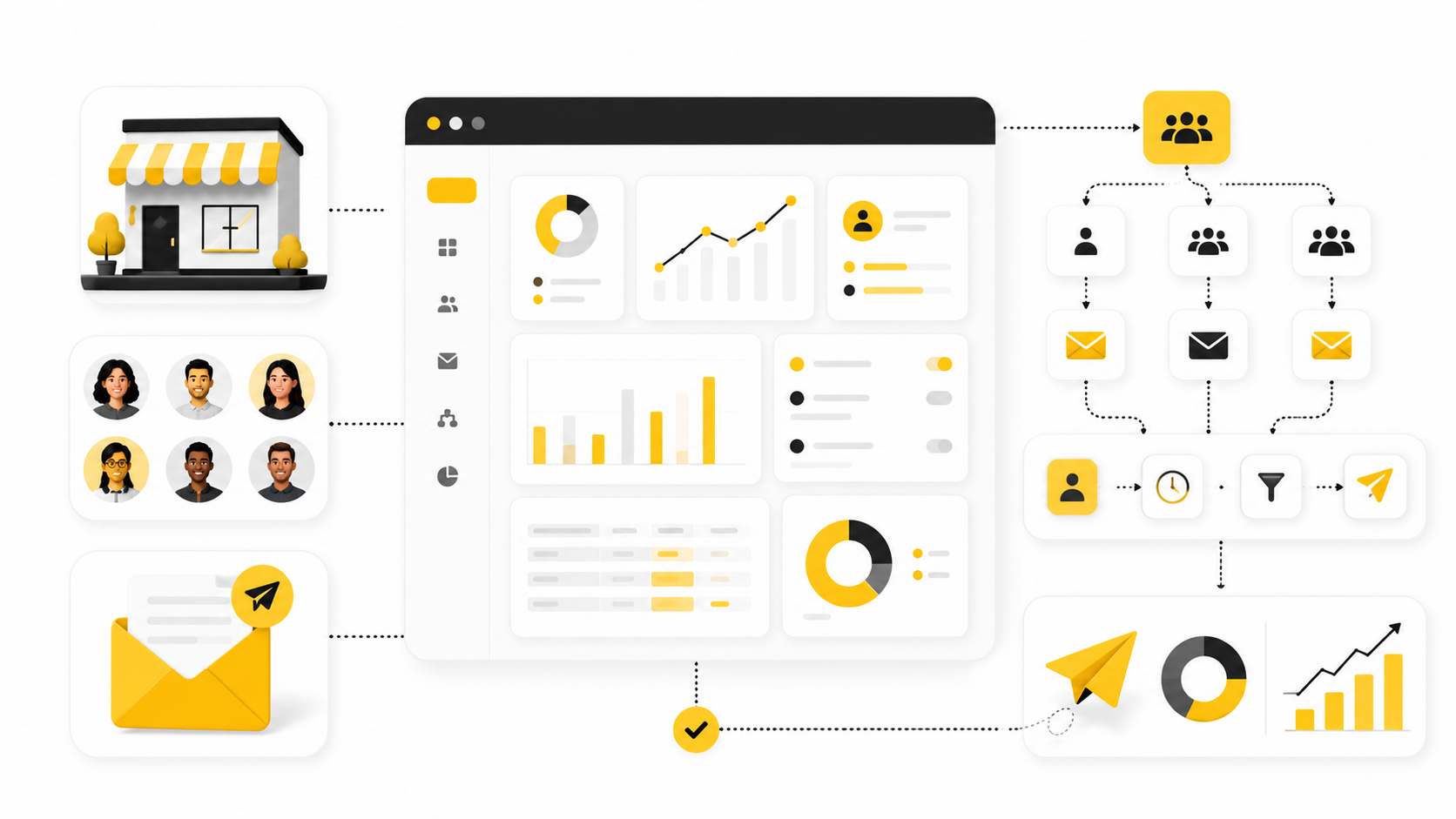
Email marketing for small business owners is not about blasting discounts to a random list and hoping someone buys. It is about building a simple owned audience, earning trust over time, and turning everyday customer interest into repeatable revenue. For a small business, that matters because attention rented from social platforms can disappear fast, but a permission-based email list stays much closer to the business.
The reason email keeps showing up in serious marketing conversations is simple: it is measurable, controllable, and practical. Small businesses do not need a massive team to send useful emails, segment customers, follow up with leads, or recover missed sales. They need a clear system, a consistent message, and the discipline to avoid turning every email into a hard sell.
Recent small business data backs this up. In Constant Contact’s 2025 Small Business Now research, 44% of small businesses named email as their most effective marketing channel, up sharply from the previous year in its published summary on small business marketing confidence and channel performance. That does not mean email is magic. It means owners are still seeing results when the channel is used with intent.
this guide breaks email marketing into a practical six-part system. Each part builds on the last, so by the end, you are not just thinking about newsletters. You are looking at email as a customer journey that can help a small business attract leads, educate buyers, follow up automatically, and keep customers coming back.
Why Email Marketing Still Matters For Small Business Owners
Small businesses usually have one serious constraint: limited attention. The owner is often handling sales, operations, customer service, content, hiring, and sometimes delivery too. Email works well in that environment because one useful message can reach many people without needing the owner to be online all day.
Email also gives small businesses more control than social media. A social post may or may not reach followers, depending on platform changes, timing, and engagement signals. An email still has to earn the open and the click, but the business owns the list relationship in a much more direct way.
That control becomes especially important when customer decisions take time. A person may visit a website, check prices, read reviews, and then leave without buying. With a good email system, that interest does not have to disappear forever.
The Bigger Shift: From Random Campaigns To Owned Follow-Up
For years, many small businesses treated email like a monthly announcement board. They sent updates when they remembered, promoted offers when sales were slow, and ignored the list when business got busy. That approach usually creates weak results because the audience never learns what to expect.
A stronger approach treats email as owned follow-up. Someone joins the list because they want a discount, a guide, a quote, a booking reminder, a product update, or a useful answer. The business then follows up with relevant messages that help the person move one step closer to buying or returning.
This is why email marketing for small business owners should not start with “What newsletter should I send?” It should start with “What customer moments need better follow-up?” That one shift makes the channel more useful immediately.
Framework Overview
A small business email system does not need to be complicated. It needs to connect four things: the right audience, the right message, the right timing, and the right next step. When one of those pieces is missing, email starts to feel like noise.
The framework for this guide is built around those four pieces. First, you need a list-building reason that makes sense to the customer. Second, you need email content that is useful enough to keep trust. Third, you need automation so follow-up happens even when the owner is busy. Fourth, you need measurement so decisions are based on behavior, not guesses.
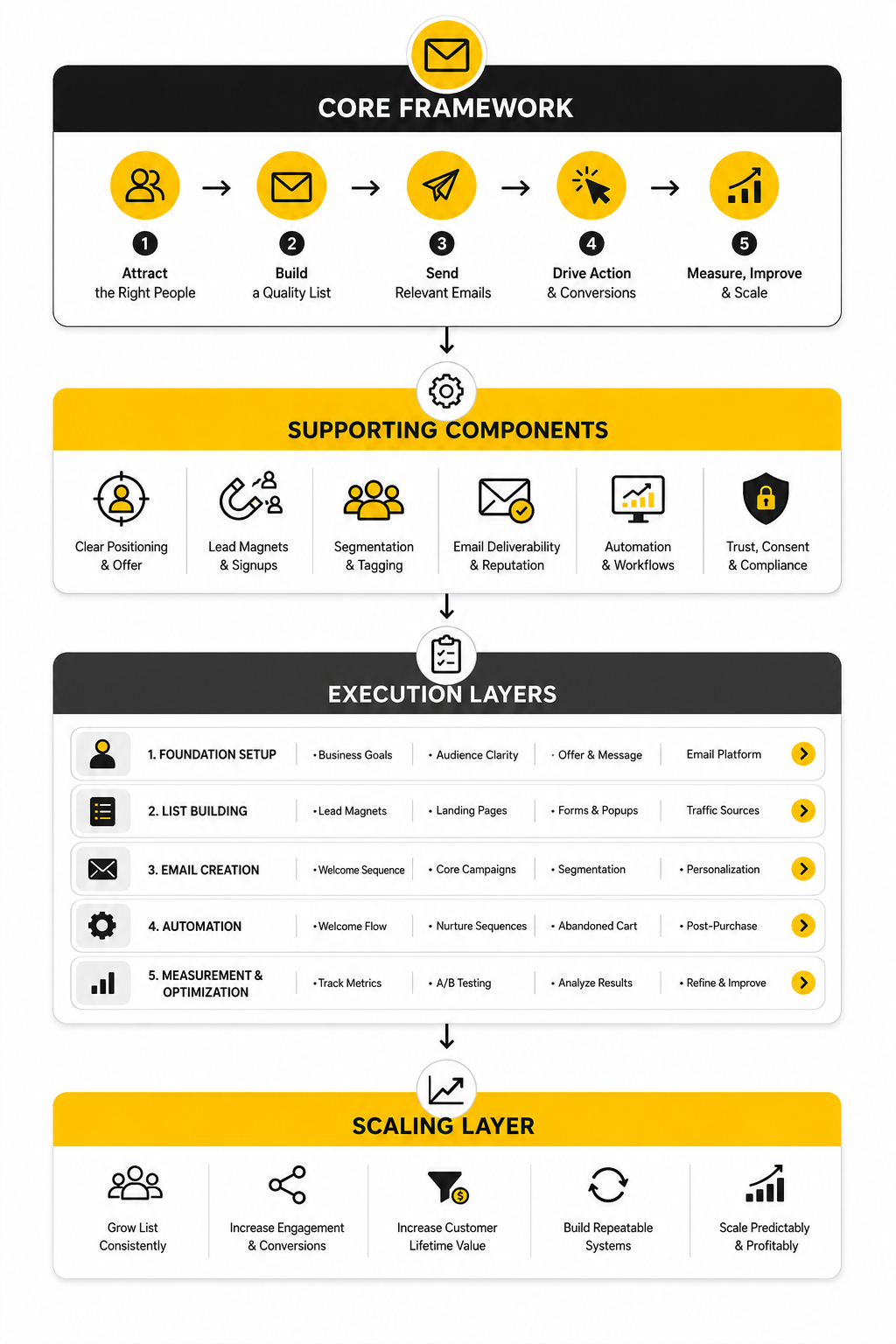
This framework also protects small businesses from a common trap: buying tools before defining the system. A platform can help send emails, manage contacts, and run automations, but it cannot fix a vague offer or a weak customer journey. Tools matter most after the strategy is clear.
Core Components Of A Small Business Email System
The first component is the list. A good list is not just a collection of email addresses. It is a group of people who gave permission because they expected something useful from the business.
The second component is the offer that gets people onto the list. This could be a first-order incentive, a checklist, a consultation request, a waitlist, a booking form, a local event update, or a product guide. The best offer depends on what the customer is already trying to do.
The third component is the email sequence. A welcome email, a short educational sequence, a sales follow-up, a post-purchase message, and a re-engagement campaign can all serve different moments. Small businesses do not need all of them on day one, but they should understand what each one is for.
The fourth component is the sending platform. For many small businesses, a practical tool like Brevo or Moosend can cover newsletters, basic automation, and contact management. For businesses that want email tied more closely to pipelines, SMS, booking, and CRM workflows, GoHighLevel may fit better.
Professional Implementation Starts With The Customer Journey
Professional email marketing does not mean making every email look expensive. It means every email has a job. A welcome email should orient the subscriber, a nurture email should reduce doubt, a promotional email should make the offer clear, and a follow-up email should remove friction.
The customer journey should decide what gets built first. A local service business may need quote follow-up and appointment reminders before it needs a weekly newsletter. An ecommerce brand may need abandoned cart emails, post-purchase education, and repeat purchase campaigns before it needs a complex content calendar.
This is where small businesses can move faster than larger companies. There are fewer departments, fewer approval layers, and closer contact with customers. When the owner knows the objections customers repeat every week, those objections can become useful emails almost immediately.
What this guide Will Help You Build
By the end of the full article, the goal is not to make email feel bigger than it needs to be. The goal is to make it clearer, simpler, and easier to use consistently. Small business owners do not need another marketing channel that creates guilt.
They need a system that captures interest, follows up with people at the right time, and gives customers a reason to trust the business before and after they buy. That is the real value of email marketing for small business owners. It turns scattered attention into a relationship the business can keep developing.
The Email Marketing Framework Small Businesses Should Use
The easiest way to make email marketing feel complicated is to start with tactics. Subject lines, templates, discounts, emojis, send times, AI prompts, and automation recipes all have their place. But none of them matter much if the business does not know who it is emailing, why those people joined, and what action the next message should help them take.
A better framework starts with the customer journey. Every subscriber is somewhere in a relationship with the business. Some are curious, some are comparing options, some are ready to buy, some already bought once, and some have gone quiet. Email works best when the message matches that stage instead of treating every contact the same.
This is where email marketing for small business owners becomes more practical. You are not trying to build a giant media company. You are building a reliable follow-up system that helps real customers make better decisions.
Start With The One Customer Moment That Matters Most
Before choosing software or writing campaigns, identify the customer moment that is currently leaking revenue. This could be website visitors who never book, quote requests that do not convert, first-time buyers who never return, abandoned carts, inactive customers, or leads who ask questions but do not take the next step. The right starting point is usually the place where interest already exists but follow-up is weak.
This matters because small businesses do not have unlimited time. Constant Contact’s 2025 small business research found that many owners have very little daily time for marketing, with 42% of SMBs globally reporting less than one hour per day in its summary on small business marketing effort and confidence. That makes focus non-negotiable.
Do not build ten automations because a software dashboard makes it possible. Build the one follow-up path that solves the biggest bottleneck first. Once that works, the next path becomes easier to design.
Match Email Types To Business Goals
Different emails do different jobs. A welcome email should confirm the relationship and set expectations. A nurture email should educate, answer objections, and make the business easier to trust. A promotional email should make the offer clear without sounding desperate.
For small business owners, the most useful email types usually fall into a few practical categories:
The goal is not to send more email for the sake of it. The goal is to make sure the right message appears when the customer needs it. That is what separates useful email marketing from inbox clutter.
Build Around Permission, Relevance, And Timing
A strong email system starts with permission. People should know why they are joining the list and what kind of messages they can expect. When that promise is clear, opens, clicks, and replies become more meaningful because the subscriber understood the relationship from the start.
Relevance comes next. A new lead who downloaded a buyer’s guide should not receive the exact same emails as a customer who bought yesterday. Even basic segmentation by source, interest, purchase status, or location can make emails feel more personal without making the system overly complex.
Timing is the third piece. Some emails should go out immediately, like a welcome message or booking confirmation. Others need breathing room, especially educational emails that build trust before asking for action. Good timing makes email feel helpful instead of pushy.
Use Automation Where Manual Follow-Up Breaks Down
Automation is not there to replace the owner’s voice. It is there to protect important follow-up from being forgotten. When a lead submits a form, buys a product, books a call, or clicks a key link, the business should not depend on someone remembering to send the next email manually.
This is especially useful for service businesses. A prospect may request pricing, get distracted, and never reply. A simple follow-up sequence can remind them what they asked for, answer common concerns, and invite them to take the next step without the owner chasing every lead one by one.
For businesses that want email tied into a broader CRM and pipeline system, GoHighLevel can be a practical fit because it connects email with lead capture, SMS, calendars, pipelines, and automated follow-up. For simpler newsletter and email automation needs, Brevo and Moosend are easier places to start. The right choice depends on whether the business mainly needs campaigns or a full follow-up machine.
Keep The Framework Simple Enough To Use
A framework only works if the owner can actually maintain it. A complicated setup with dozens of tags, branches, and conditions may look impressive, but it can become fragile fast. Small businesses usually win with simple systems that are easy to understand, easy to improve, and hard to forget.
A practical first version could look like this:
That is enough to start. Not perfect. Not advanced. Enough.
Decide What The Subscriber Should Do Next
Every email should have a next step, even if that step is soft. Sometimes the next step is reading a guide, replying with a question, booking a call, using a coupon, watching a demo, or checking a product page. Without a clear next step, even a well-written email can become a dead end.
This does not mean every email needs a hard CTA. In fact, forcing a sale too early can damage trust. But the reader should never feel confused about what the email is helping them do.
For email marketing for small business owners, clarity beats cleverness. A simple email that solves one customer concern and points to one logical action will usually outperform a polished email that tries to do everything at once.
Connect Email To The Rest Of The Business
Email should not live in a separate marketing box. It should support the way the business already gets leads, serves customers, and makes sales. If most leads come from Google, the email system should follow up on search intent. If most leads come from Instagram, email should continue the conversation after social attention fades.
This is where funnels, forms, calendars, and landing pages become useful. A tool like ClickFunnels can help when the business needs a dedicated sales path before the email sequence begins. A simpler all-in-one setup like Systeme.io can also make sense when the priority is getting pages, email, and basic automation running without stitching too many tools together.
The point is not to collect software. The point is to connect the customer journey. When the landing page, form, email sequence, calendar, and offer all say the same thing, the business feels more trustworthy and the customer has less friction.
Build The Framework Before Scaling The List
Many small business owners want more subscribers before fixing the experience subscribers already get. That is backwards. A bigger list will not help much if new people receive weak follow-up, unclear offers, or inconsistent messaging.
Build the framework first. Make sure the welcome message is useful, the first few emails answer real questions, and the next step is obvious. Then list growth becomes more valuable because every new subscriber enters a system that can actually convert attention into revenue.
That is the foundation for the next part of the article. Once the framework is clear, the next question becomes simple: how do you build a list people actually want to join?
Building A List People Actually Want To Join
A small email list with real intent is better than a large list full of people who do not care. That sounds obvious, but it is where many small businesses go wrong. They chase subscriber count before they have a clear reason for someone to subscribe in the first place.
The list-building question is not “How do we collect more emails?” It is “What would make the right person gladly give us permission to follow up?” That is the difference between a list that becomes an asset and a list that slowly turns into dead weight.
For email marketing for small business owners, list growth should feel connected to the buying journey. A subscriber should join because the business offers something useful, timely, or relevant to the decision they are already trying to make.
Create A Practical Reason To Subscribe
People do not join lists because a form says “Subscribe to our newsletter.” They join when there is a clear benefit. That benefit can be simple, but it has to be specific enough to feel worth the exchange.
A local service business might offer a quote checklist, maintenance reminder, seasonal guide, appointment reminder, or limited-time consultation slot. An ecommerce business might offer first access to new products, a first-order incentive, care instructions, style guidance, or a restock alert. A coach, consultant, or agency might offer a diagnostic, template, mini-training, or useful breakdown of a problem the audience already feels.
The mistake is offering something generic. “Get updates” is weak because it makes the subscriber do all the work to understand the value. “Get the 7-point checklist before hiring a contractor” is stronger because it connects directly to a real decision.
Put Signup Points Where Intent Already Exists
The best signup forms are placed where customer intent is already active. A form buried in the footer can still collect emails, but it rarely captures the full opportunity. Stronger signup points appear near products, service pages, booking pages, blog content, checkout flows, and contact forms.
This does not mean every page needs a pop-up. It means the business should look at the moments where people hesitate, compare, or need more information. Those moments are ideal places to offer a useful next step by email.
A small business can start with a few high-intent placements:
The goal is not to interrupt people everywhere. The goal is to make joining the list feel like the natural next step when the visitor is already interested.
Build The First Signup Flow
The first signup flow should be simple enough to launch quickly and clear enough to improve later. You need a signup promise, a form, a confirmation message, a welcome email, and one logical next step. That is the base version.
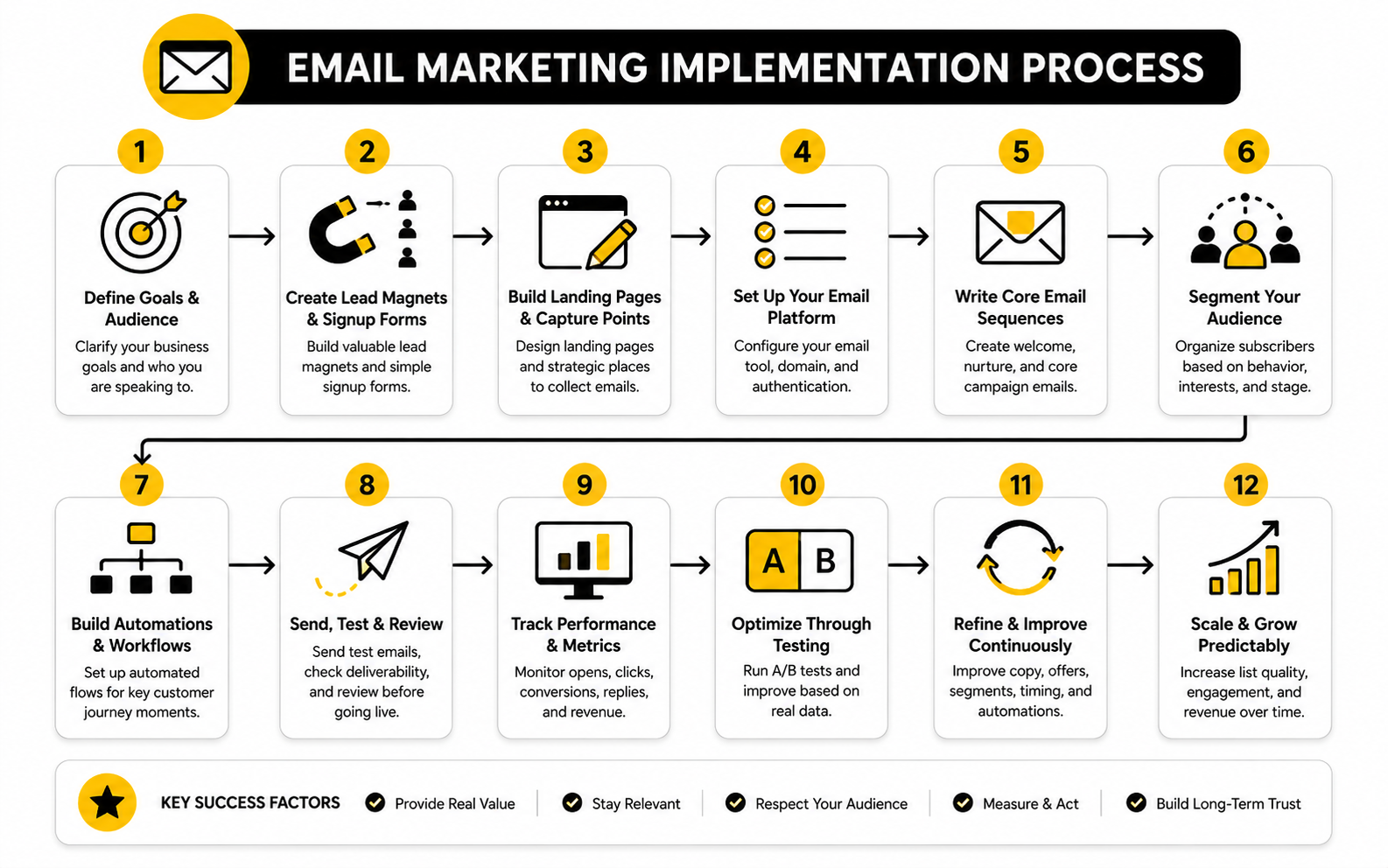
A practical first flow looks like this:
This is where many owners overthink it. You do not need a perfect lead magnet, a 15-email sequence, or a complex tagging system to start. You need a clean promise and a follow-up path that respects the subscriber’s attention.
Write The Signup Promise Clearly
The signup promise is the small piece of copy that tells people why they should join. It should be direct, specific, and honest. If the emails are promotional, say so. If subscribers will get tips, reminders, product updates, or booking help, make that clear.
A good signup promise answers three questions quickly: what the person gets, why it matters, and what happens next. For example, a service business could say that subscribers will receive a short guide before booking, then a few follow-up emails with practical advice. An ecommerce business could say that subscribers will get first access to new drops and useful product care tips.
Avoid inflated promises. Small businesses do not need to sound like giant brands. Clear, useful, and believable is better than dramatic and vague.
Use Forms That Reduce Friction
A signup form should ask for only what the business needs at that stage. In many cases, an email address is enough. If personalization matters, adding a first name can be useful, but every extra field adds friction.
For service businesses, it may make sense to ask one qualifying question, such as the service type, timeline, or location. For ecommerce, it may make sense to ask about product interest or preference. The key is to collect data that will actually improve the follow-up, not data that sits unused.
Tools like Fillout can help when the signup process needs more than a basic form, especially for quizzes, quote requests, applications, or segmented intake forms. For simple email capture and newsletter growth, platforms like Brevo and Moosend can handle forms, contacts, and basic automation without making the setup heavy.
Connect The Form To The Right Follow-Up
The form is only the front door. What happens after signup is what determines whether the list becomes valuable. The first email should arrive quickly, confirm what the person requested, and make the next step obvious.
If someone joins for a guide, send the guide and explain how to use it. If someone joins for a discount, deliver the discount and remove uncertainty around buying. If someone joins for a consultation or quote, confirm the request and explain what information they may need next.
This is where automation becomes practical instead of abstract. The subscriber takes an action, and the business responds in a way that feels timely and useful. That simple experience builds more trust than a polished brand email that arrives three weeks later.
Segment From The Beginning, But Keep It Light
Segmentation does not need to be complicated at the start. A small business can begin by separating leads from customers, local prospects from online buyers, or product interest from service interest. Even one useful segment can make emails more relevant.
The danger is building too many segments before there is enough data to justify them. If the owner cannot explain what different message each segment should receive, the segment probably does not need to exist yet. Complexity should be earned.
Start with the few differences that change the follow-up. A first-time lead needs reassurance and education. A recent buyer needs support and confidence. A repeat customer may need loyalty, timing, or a relevant next offer. Those differences are enough to make the email system more carefully without turning it into a mess.
Use Lead Sources That Fit The Business
List building should match how the business already attracts attention. A local restaurant might grow its list through reservations, QR codes, events, loyalty offers, and seasonal menus. A home service business might use estimate forms, maintenance reminders, and neighborhood-specific offers. An online store might use product pages, checkout flows, post-purchase opt-ins, and social traffic.
Social media can also support list growth, but it should not be the final destination. A useful post can lead to a form, a guide, a waitlist, or a product recommendation. That way, the business turns borrowed attention into a direct relationship.
For small businesses that already use social content to drive interest, scheduling tools like Buffer can help keep the top of the funnel consistent. If the business uses messaging channels heavily, ManyChat can help move social conversations toward more structured follow-up. The important part is making sure those channels feed the email system instead of replacing it.
Make Compliance Part Of The Process
Permission matters. Every signup should make it clear that the person is joining an email list, and every marketing email should include an easy way to unsubscribe. This is not just about rules; it is about trust.
Small businesses should also avoid buying lists. Bought lists usually create poor engagement, higher complaints, and weaker deliverability. More importantly, they start the relationship in the wrong place because the recipient did not ask to hear from the business.
A clean list grows slower at first, but it performs better over time. People who choose to hear from the business are more likely to open, click, reply, book, and buy. That is the list worth building.
Improve The Signup Flow Before Adding More Traffic
Once the first flow is live, the next move is not automatically more ads, more posts, or more pop-ups. The next move is checking whether the flow is doing its job. Are people subscribing? Are they opening the welcome email? Are they clicking the next step? Are they replying with questions?
If the answer is weak, fix the promise, placement, form, or first email before driving more traffic. More visitors will only expose a broken flow faster. Better conversion comes from making each step clearer.
This is the practical rhythm of email marketing for small business owners. Build one useful path, watch how people move through it, and improve the weakest step. Then repeat.
Measuring Email Performance Without Getting Lost In The Numbers
Once the list is growing and the first follow-up flow is running, the next job is measurement. This is where a lot of small business owners either ignore the numbers completely or obsess over the wrong ones. Neither approach helps.
Email marketing for small business owners should be measured like a business system, not a popularity contest. An open rate can tell you whether people are noticing the email. A click rate can tell you whether the message created enough interest to act. A sale, booking, reply, or repeat purchase tells you whether the email actually supported the business.
The point is not to collect dashboards. The point is to see where the customer journey is working, where people are dropping off, and what should be improved next.
Statistics And Data That Actually Matter
Benchmarks are useful, but only when they are treated as reference points. They should not become a scoreboard that makes every small business feel behind. A local service business, an ecommerce store, a B2B consultant, and a restaurant can all have very different email behavior because the audience, offer, buying cycle, and frequency are different.
Recent benchmark data shows why interpretation matters. MailerLite’s 2025 benchmark summary reported an average open rate of 43.46%, an average click rate of 2.09%, and an average unsubscribe rate of 0.22% across its analyzed campaigns in its report on email marketing benchmarks by industry and region. Those numbers are helpful, but they are not the full story.
An email with a lower open rate can still generate more revenue if it reaches buyers with stronger intent. A campaign with a high open rate can still fail if the email does not lead to clicks, replies, bookings, or purchases. Benchmarks help you notice whether something is unusual, but your own business goals decide whether the campaign worked.
Open Rate Shows Attention, Not Success
Open rate is usually the first number owners check because it feels simple. If more people opened the email, the email must be better. That can be true, but it is not always true.
Open rate is affected by subject line, sender name, list quality, timing, inbox placement, and audience expectation. It can also be distorted by privacy features and automated email scanning. That means it is useful as a directional signal, but it should not be treated as a perfect measurement of human attention.
Use open rate to answer practical questions. Did this subject line create enough curiosity? Does this audience still recognize the business? Are certain segments more responsive than others? If opens are consistently weak, improve the sender name, subject lines, list quality, and signup promise before blaming the offer.
Click Rate Shows Intent
Click rate is usually more useful than open rate because it shows that someone did something. They moved from the inbox to a page, product, booking link, guide, or offer. That action is closer to business value.
A low click rate can mean the email was too vague, the offer was weak, the call to action was buried, or the audience was not ready. It can also mean the email gave value but did not make the next step clear enough. That is why click rate should be read together with the email content, not in isolation.
For small businesses, the fix is often simple. Use one primary call to action, make the reason to click clear, and remove competing links. If the email is educational, the next step should feel like a natural continuation of the lesson, not a sudden sales pitch.
Conversion Rate Shows Business Impact
Conversion rate is where email becomes real. A conversion might be a purchase, booking, quote request, consultation call, review, renewal, referral, or form submission. The right conversion depends on what the email was supposed to do.
This matters because email marketing for small business owners should connect to revenue and customer movement. A campaign that gets clicks but no conversions may have a landing page problem. A campaign that gets opens but no clicks may have a messaging problem. A campaign that gets conversions from a small audience may be more valuable than a larger campaign with shallow engagement.
Track the action that actually matters. If the goal is appointments, measure bookings. If the goal is repeat sales, measure orders. If the goal is lead quality, measure qualified replies or completed forms. Do not let easy metrics replace useful ones.
The Simple Analytics System
A small business does not need a complicated reporting department. It needs a simple way to connect email activity to customer action. The analytics system should show what happened, where people dropped off, and what to improve next.
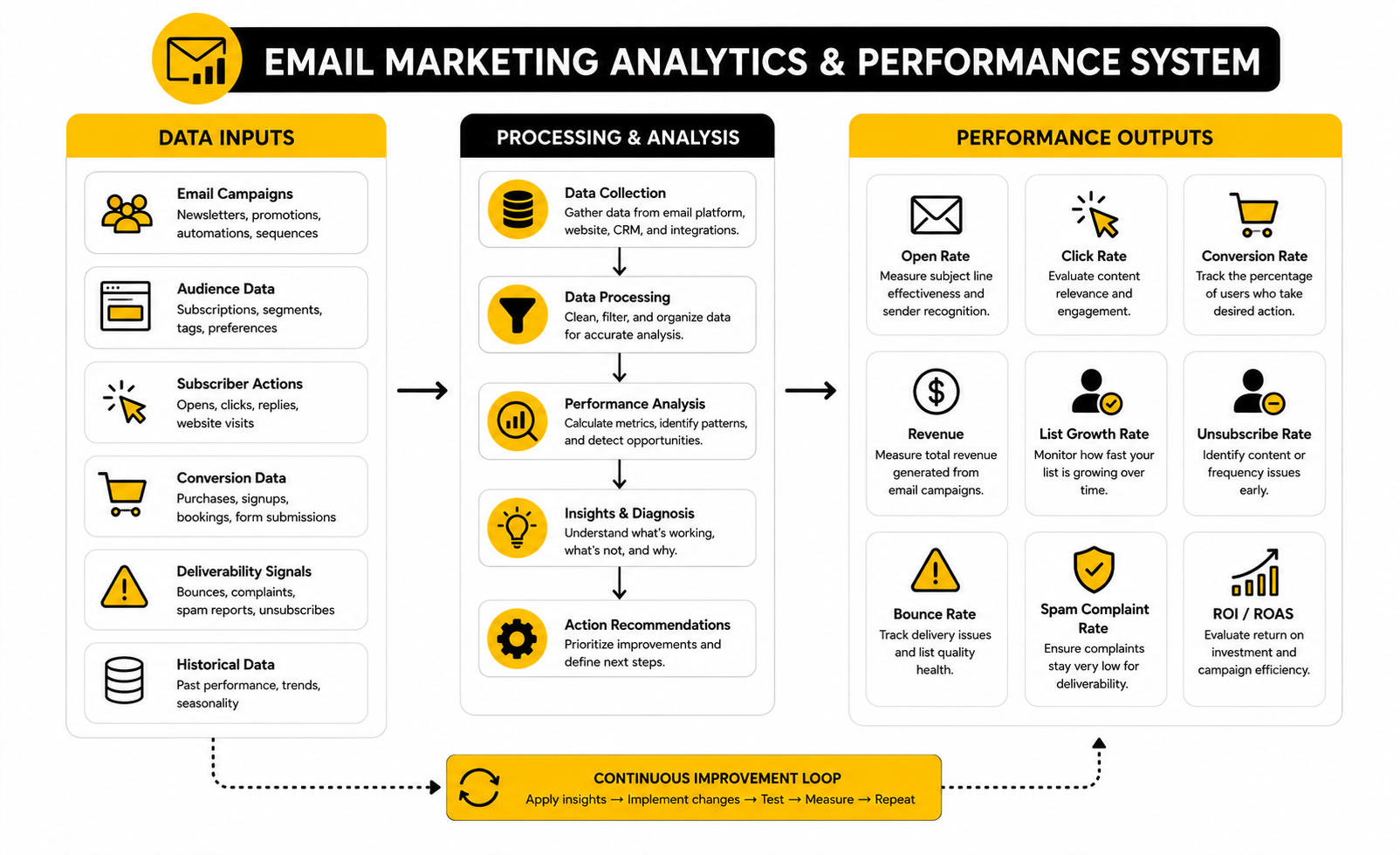
A practical email analytics review can follow this order:
This order matters. If delivery is broken, open rate is not the real problem. If clicks are strong but conversions are weak, rewriting the email may not fix the landing page. If conversions are strong but unsubscribes spike, the offer may be profitable but too aggressive for the list.
Watch Deliverability Before Everything Else
Deliverability is the hidden layer under every email metric. If emails do not reach the inbox, every other number becomes weaker. Small businesses often ignore this because deliverability feels technical, but the basics are practical.
Keep the list clean, avoid bought contacts, make unsubscribing easy, send from a recognizable domain, and remove people who never engage over time. Authentication also matters because mailbox providers increasingly expect proper sender setup. If this part is ignored, even good emails can quietly underperform.
Spam complaints deserve special attention. They are not just a vanity metric; they are a trust signal. If people mark emails as spam, the business should review signup expectations, sending frequency, content relevance, and whether subscribers clearly asked to receive those emails.
Unsubscribes Are Feedback, Not Always Failure
Some unsubscribes are healthy. If someone is not interested anymore, letting them leave cleanly protects list quality and reduces future complaints. A small number of unsubscribes after a clear promotional email does not automatically mean something went wrong.
The problem starts when unsubscribes spike unexpectedly. That can mean the list was not expecting the message, the frequency changed too quickly, the offer was irrelevant, or the email felt misleading. In that case, the unsubscribe rate is not just a number; it is a signal that the relationship promise needs repair.
Do not hide the unsubscribe link or make leaving difficult. That is short-term thinking. A smaller list of people who want to hear from the business is better than a larger list that ignores, deletes, or complains.
Segment-Level Data Beats Average Data
Average campaign numbers can hide the truth. A campaign might look average overall while one segment performs extremely well and another segment ignores it completely. That is why segment-level reporting is so useful.
Look at performance by source, customer type, product interest, location, purchase status, or signup offer. A lead from a service-page form may behave differently from someone who joined through a giveaway. A recent customer may respond differently from a cold subscriber who has not clicked in months.
This is where measurement turns into better marketing. If one segment clicks but does not buy, improve the offer or landing page. If another segment opens but never clicks, improve relevance. If a customer segment buys repeatedly, build more emails around that behavior.
Measure Each Email By Its Job
Not every email should be judged by the same number. A welcome email should be judged by early engagement and whether the subscriber takes the first useful step. A nurture email should be judged by clicks, replies, and movement toward a decision. A promotional email should be judged by conversions, revenue, and unsubscribes.
This sounds basic, but it prevents bad decisions. If an educational email gets fewer sales but more replies and future bookings, it may be doing its job. If a flash-sale email creates revenue but burns trust, the short-term win may not be worth repeating too often.
Before sending an email, decide what job it has. After sending it, judge it against that job. That one habit makes reporting much cleaner.
Turn Data Into Better Decisions
Data only matters if it changes what the business does next. If open rates are low, test clearer subject lines and a more recognizable sender name. If clicks are low, simplify the email and make the next step more compelling. If conversions are low, review the landing page, offer, checkout, booking page, or sales process.
A good reporting rhythm for a small business is simple. Review campaigns weekly or biweekly, look for the weakest step, make one improvement, and keep notes. Over time, those notes become more valuable than generic best practices because they show what this specific audience responds to.
This is the practical advantage of email. Every send teaches something. The owner does not have to guess forever.
Use Tools That Make Reporting Easier
The best email platform is not always the one with the most reports. It is the one that shows the numbers the business will actually use. For a small business, that usually means campaign performance, automation performance, contact behavior, conversions, and basic revenue or pipeline visibility.
For straightforward campaigns, tools like Brevo and Moosend can make performance easier to track without overwhelming the owner. For businesses that need email tied to CRM stages, booked appointments, sales conversations, and pipeline reporting, GoHighLevel can make the measurement process more connected.
The tool should reduce confusion, not add another dashboard nobody checks. If the owner cannot quickly see what happened and what to improve, the reporting setup is too complicated.
The Numbers Should Lead To Better Emails
Measurement is not separate from writing. The data tells you what customers notice, what they ignore, where they hesitate, and what gives them enough confidence to act. That should feed directly into the next emails.
If people click educational content but avoid sales pages, the offer may need more trust-building. If people click pricing but do not book, the business may need clearer proof, guarantees, FAQs, or follow-up. If people reply with the same question repeatedly, that question should become part of the next email sequence.
This is how email marketing for small business owners improves without guessing. Send useful emails, measure the right signals, fix the weakest step, and repeat. Over time, the emails become clearer because the audience keeps showing you what matters.
Automations, Segmentation, And Professional Implementation
By this point, the foundation is clear: build the list with permission, follow up with relevance, measure the right signals, and improve the weakest step. The next layer is where email becomes more powerful, but also easier to mess up. Automation, segmentation, and scaling can help a small business grow faster, but only if they are built with discipline.
This is the part where email marketing for small business owners stops being “send a campaign when we remember” and becomes a real operating system. The business starts thinking in flows, triggers, customer stages, and behavior. Done well, this creates a smoother customer experience and saves time. Done badly, it creates confusing messages, duplicate emails, and unsubscribes from people who used to trust the brand.
The goal is not to become more technical for the sake of it. The goal is to make the system more useful without making it harder to manage.
Use Automation To Support Human Follow-Up
Automation should handle the predictable parts of the customer journey. That includes welcome emails, quote follow-ups, abandoned checkout reminders, appointment reminders, review requests, post-purchase education, and reactivation campaigns. These are moments where speed and consistency matter.
Human follow-up should handle the moments that need judgment. A high-value lead asking a detailed question should not be treated like a generic subscriber. A frustrated customer should not be pushed into a promotional sequence before their issue is solved. Automation is powerful, but it should never remove common sense.
This is the tradeoff small businesses need to understand. Automation saves time, but it can also scale bad timing. Before turning on any automated flow, ask whether the message would feel helpful if it landed in your own inbox at that exact moment.
Build Customer Stages Before Building Complex Segments
Segmentation gets messy when it starts with random tags. “Clicked link,” “interested,” “VIP,” “hot lead,” and “newsletter” might all sound useful, but they can quickly overlap until nobody knows what anything means. A better approach starts with clear customer stages.
Most small businesses can begin with a simple stage model:
These stages are easier to understand than a pile of disconnected tags. They also help the owner decide what the person should receive next. A new subscriber needs orientation, an active lead needs confidence, a customer needs support, and an inactive contact needs a reason to re-engage or be removed.
Avoid The Over-Personalization Trap
Personalization can improve relevance, but it can also feel strange when it is forced. Using someone’s first name in every subject line is not a strategy. Neither is pretending the business knows more about the subscriber than it really does.
Good personalization is based on useful context. If someone looked at a specific service, send follow-up related to that service. If someone bought a product, send care instructions, usage tips, or a relevant next purchase path. If someone booked a consultation, send reminders and preparation details.
Bad personalization feels like surveillance. It references behavior too aggressively, makes assumptions too quickly, or turns every click into a sales push. Small businesses should use customer data to be more helpful, not more invasive.
Protect Deliverability As The List Grows
Scaling email is not just about sending more messages. It is about maintaining trust with subscribers and mailbox providers. Gmail’s sender guidelines now emphasize authentication, low complaint rates, easy unsubscribing, and relevant sending practices in its official email sender guidelines. Yahoo’s sender best practices also tell senders to authenticate mail and keep spam complaint rates below 0.3% in its email sender requirements.
That number matters because complaints are not just customer feedback. They can affect whether future emails land in the inbox. A small business might think it is only sending to its own list, but mailbox providers still look at signals like complaints, engagement, authentication, and sending behavior.
The practical takeaway is simple. Do not buy lists, do not hide the unsubscribe link, do not suddenly increase sending volume without a reason, and do not keep emailing people who never engage. Growth is not worth much if deliverability collapses.
Decide When To Clean The List
List cleaning feels uncomfortable because it makes the audience number smaller. But a smaller engaged list is usually more valuable than a larger list full of people who never open, click, buy, or reply. Dead weight can distort performance and make it harder to understand what is really working.
A simple re-engagement process can help before removing people. Send a clear email asking whether they still want to receive messages. Give them a reason to stay, such as a useful update, preference option, or reminder of the value they originally signed up for. If they still do not engage after a fair sequence, suppressing or removing them is often the right move.
This is not about punishing subscribers. It is about respecting attention. If someone no longer wants the emails, the business should let the relationship end cleanly.
Scale Frequency Carefully
Sending more often can increase revenue, but it can also increase fatigue. The right frequency depends on the business model, customer expectation, seasonality, and the value of each message. A daily email can work for some audiences, while a weekly email may already be too much for others.
Small businesses should scale frequency based on engagement, not pressure. If subscribers are opening, clicking, replying, and buying without complaint spikes, the business may have room to send more. If unsubscribes rise, clicks fall, or replies turn negative, frequency may be outrunning trust.
The key is expectation. If people joined for weekly practical tips, do not suddenly send daily promotions without resetting the relationship. If people joined for product drops, sales updates may feel normal. Frequency is not just a number; it is part of the promise.
Use AI Carefully, Not Lazily
AI can help small businesses move faster with subject line drafts, email outlines, segmentation ideas, customer research summaries, and first-pass copy. That can be valuable when the owner is short on time. But AI should not replace the business’s real voice, customer understanding, or judgment.
The risk is sameness. If everyone uses the same generic prompts, emails start to sound polished but empty. That is bad for trust because customers can feel when a message says all the right words without saying anything specific.
Use AI for speed, not as a substitute for experience. Feed it real customer questions, actual objections, product details, service context, and brand voice rules. Then edit hard. The final email should sound like the business, not like a template pretending to care.
Connect Email With Sales And Customer Service
Advanced email marketing is not just about marketing. It should connect with sales and customer service so the business sees the full customer relationship. If a lead replies to an automated email, someone should know. If a customer complains, they should not keep receiving aggressive sales messages. If a hot prospect clicks a pricing link three times, that may be useful for sales follow-up.
This is where CRM-connected systems become more valuable. A platform like GoHighLevel can help connect email behavior with pipelines, booked appointments, SMS follow-up, and lead status. For small teams that manage leads manually, this can reduce missed opportunities.
But again, the system has to match the business. A simple shop may not need a full pipeline. A service business with high-ticket leads probably does. The right setup is the one that helps the team act faster and serve customers better.
Know When A Funnel Makes Sense
Not every small business needs a complex funnel. Some only need a strong website, a useful signup offer, and a simple email sequence. Others need a more structured path because the buying decision requires education, proof, and multiple steps.
A funnel makes sense when the business has one clear offer and wants to guide people through a specific decision. That could be a consultation, webinar, product bundle, application, quote request, or limited-time promotion. In those cases, a dedicated tool like ClickFunnels can help organize the page, offer, and follow-up path.
A funnel does not make sense when it adds steps the customer does not need. Do not build a complicated funnel because it looks advanced. Build one when the customer needs a guided path and the business can clearly measure the result.
Create Operating Rules Before Scaling
The more email becomes part of the business, the more important operating rules become. Without rules, campaigns overlap, segments conflict, and subscribers receive too many messages too close together. That is how a useful channel turns into noise.
Small businesses should define basic rules early:
These rules do not need to be complicated. They just need to exist. A clear operating system makes email easier to scale because the business is not reinventing decisions every week.
Balance Short-Term Revenue With Long-Term Trust
Email can drive fast sales. That is one reason business owners like it. But if every message is urgent, discounted, and sales-heavy, subscribers eventually stop believing the urgency.
The stronger long-term play is balance. Mix helpful education, proof, customer support, product guidance, personal perspective, and clear offers. Let the list see that the business is useful even when it is not asking for money.
This matters even more for small businesses because trust is often the advantage. A big brand can sometimes recover from noisy marketing because it has scale. A small business usually cannot afford to burn goodwill with the people most likely to buy, refer, and return.
Prepare For Part Six: Improving The System Over Time
At this stage, the system has moved from basic email sending to real implementation. The business has list growth, follow-up, measurement, automation, segmentation, deliverability habits, and operating rules. That is enough to build something serious without making it bloated.
The final part brings the system together. It will cover how to improve performance over time, what small business owners should prioritize first, and the common questions that come up when email becomes a regular part of growth.
Improving The System Over Time
A strong email system is never really finished. Customer behavior changes, offers change, inbox rules change, and the business gets more carefully with every campaign. That is why the final stage is not “set it and forget it.” It is “build, learn, refine, and keep the system useful.”
Email marketing for small business owners works best when improvement becomes part of the routine. The owner does not need to rebuild everything every month. They need to watch the right signals, listen to customer behavior, and make small upgrades that compound over time.
This is also where the whole system comes together. List growth, email copy, automation, segmentation, deliverability, analytics, and sales follow-up should not feel like separate projects. They should work like one connected customer ecosystem.
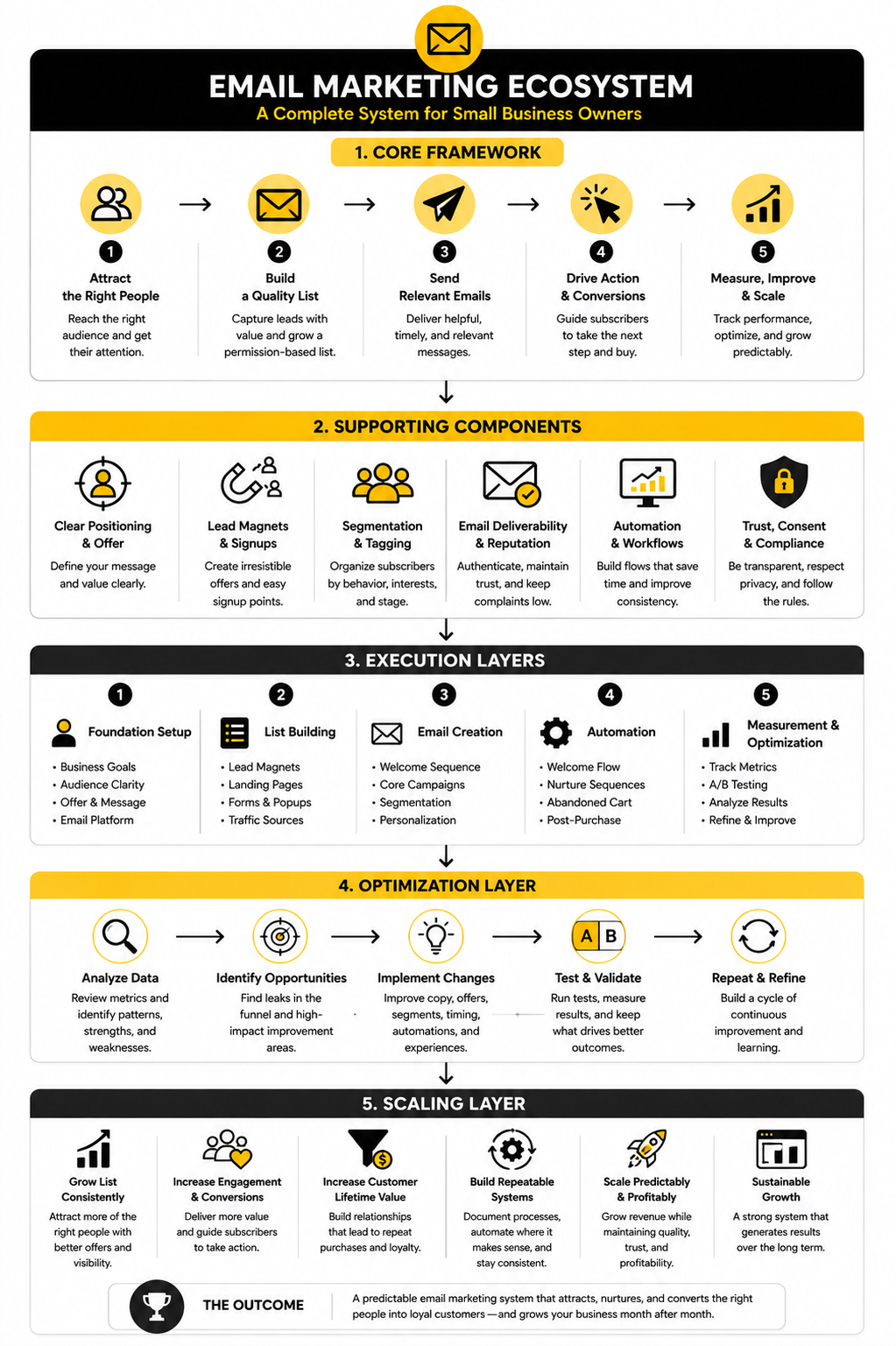
The Final Email Marketing System
The final system starts when someone first notices the business. That attention might come from search, social media, referral, paid ads, local visibility, an event, or a product page. Email becomes valuable when that attention is captured with permission and followed up with relevance.
From there, the system should move people through clear stages. A new subscriber receives context. A lead receives help with the decision. A customer receives support after buying. A repeat customer receives reasons to stay connected. An inactive contact receives one honest chance to re-engage before the business stops chasing them.
That is the complete picture. The business is not just sending emails. It is managing relationships at scale without losing the human touch that makes small businesses worth choosing.
Prioritize The Highest-Leverage Improvements
When a business wants better email results, the temptation is to change everything at once. That makes it hard to know what actually worked. A better approach is to improve one high-leverage area at a time.
Start with the part of the system closest to the biggest leak. If people are not subscribing, improve the offer and signup placement. If people subscribe but do not click, improve the first emails. If people click but do not buy, improve the landing page, offer, checkout, or sales follow-up. If people buy once but never return, improve post-purchase education and repeat-purchase timing.
This is how small businesses avoid random marketing. Every improvement should be tied to a specific customer behavior. Fix the weakest step, then move to the next one.
Keep Testing Practical
Testing does not need to become a scientific lab project. A small business can test subject lines, calls to action, offer positioning, signup forms, send frequency, content angles, and automation timing. The key is to test changes that could actually affect customer behavior.
Do not waste time testing tiny details while the main offer is unclear. A button color test will not save a weak message. A subject line test will not fix a list that joined for the wrong reason. Practical testing starts with the biggest uncertainty.
A simple testing rhythm works well:
That last step matters more than most owners think. Notes turn one-off experiments into business knowledge.
Know When To Bring In Help
Some businesses can manage email internally for a long time. Others reach a point where the owner is too busy, the list is too valuable, or the system is too connected to leave it half-managed. That is when professional help starts to make sense.
A specialist can help with strategy, automation mapping, deliverability, copywriting, segmentation, CRM setup, analytics, and conversion improvements. The value is not just writing prettier emails. The value is building a system that supports revenue without creating chaos behind the scenes.
Hiring help makes the most sense when the business already has customer demand, a clear offer, and enough traffic or leads to benefit from better follow-up. If those pieces exist, better email implementation can quickly become one of the highest-return marketing improvements.
Is email marketing still worth it for small business owners?
Yes, email marketing is still worth it when the business uses it as a follow-up and relationship system, not just a newsletter tool. Constant Contact’s 2025 small business research found that 44% of small businesses named email as their most effective marketing channel in its report on small business marketing performance. That matters because email gives small businesses a direct way to keep talking to leads and customers after the first moment of attention.
The real value is control. Social platforms can change reach, ad costs can rise, and website visitors can disappear without taking action. An email list gives the business a way to continue the conversation with people who gave permission.
How often should a small business send marketing emails?
The right frequency depends on the relationship, the offer, and the value of each message. A small business that sends useful tips, timely reminders, or product updates may be able to email weekly. A business that only sends promotions may need to be more careful because subscribers can burn out faster.
Start with a frequency the business can maintain. Weekly, biweekly, or twice monthly can all work if the emails are relevant. Watch opens, clicks, replies, unsubscribes, complaints, bookings, and sales before deciding whether to send more often.
What should the first email say after someone subscribes?
The first email should confirm why the person subscribed, deliver anything promised, and set expectations for what comes next. It should feel immediate, useful, and easy to understand. Do not waste the first email with generic brand fluff.
A good welcome email usually includes a short greeting, the promised resource or offer, one helpful explanation, and one clear next step. The next step could be reading a guide, booking a call, browsing products, replying with a question, or saving the sender address.
What is a good open rate for small business email marketing?
A good open rate depends on the audience and email type, but benchmarks can give useful context. MailerLite’s 2025 benchmark data reported an average open rate of 43.46% in its email marketing benchmark report. That number is helpful, but it should not become the only measure of success.
Open rate shows attention, not revenue. A smaller campaign with fewer opens can still be more profitable if the right people clicked and bought. Use open rate to improve subject lines, sender recognition, and list quality, then judge the campaign by the action it was meant to drive.
What is a good click rate for email marketing?
MailerLite’s 2025 benchmark data reported an average email click rate of 2.09% in its industry benchmark summary. That gives a rough reference point, but a “good” click rate depends heavily on the offer, segment, industry, and email purpose.
A click rate is useful because it shows intent. If people open but do not click, the email may need a clearer offer, stronger relevance, fewer distractions, or a better call to action. If people click but do not convert, the problem may be the landing page or buying process instead of the email.
What email automations should a small business create first?
The best first automation is the one tied to the biggest revenue leak. For many businesses, that is a welcome sequence, lead follow-up sequence, abandoned checkout sequence, appointment reminder, review request, or post-purchase education flow. The right choice depends on where customers currently drop off.
Do not build automation just because a tool offers it. Build it because a real customer moment needs faster, more consistent follow-up. One useful automation that improves bookings or sales is better than ten complicated flows nobody understands.
Should small businesses use AI for email marketing?
Yes, but carefully. AI can help with outlines, subject line ideas, first drafts, segmentation logic, and turning customer questions into useful email topics. It can save time, especially for owners who struggle to write consistently.
The risk is generic messaging. AI should be guided by real customer questions, brand voice, product details, objections, and business context. The final email still needs human editing so it sounds specific, trustworthy, and aligned with the business.
What is the biggest mistake small businesses make with email marketing?
The biggest mistake is treating email like a random broadcast channel instead of a customer journey. Many businesses send only when they need sales, then wonder why engagement is weak. Subscribers can feel when every message is just a push for money.
The better approach is to build trust before asking for action. Send useful guidance, answer real questions, support customers after purchase, and make offers when they make sense. Email works better when the reader sees consistent value.
Is it okay to buy an email list?
No, buying an email list is a bad idea for most small businesses. The people on that list did not ask to hear from the business, so engagement is usually weak and complaints are more likely. That can damage sender reputation and make future emails harder to deliver.
A permission-based list grows more slowly, but it is much healthier. People who choose to join are more likely to open, click, reply, book, and buy. That is the kind of list worth building.
How can a small business improve email deliverability?
Deliverability improves when the business sends wanted email to people who gave permission. That means using clear signup forms, authenticating the sending domain, keeping complaints low, removing dead contacts, and making unsubscribing easy. Google’s sender guidance says senders should keep spam rates below 0.1% and avoid reaching 0.3% or higher in its email sender guideline FAQ.
This matters because deliverability problems can quietly weaken every campaign. If emails are not reaching inboxes, better copy will not fully solve the problem. Protecting sender reputation is part of professional email marketing.
Which email marketing tool is best for small business owners?
The best tool depends on the business model. For simple newsletters, forms, and basic automation, Brevo or Moosend can be practical choices. For businesses that need email connected with CRM, pipelines, calendars, SMS, and lead follow-up, GoHighLevel can make more sense.
The tool should match the system, not the other way around. A small business does not need the most advanced platform if the follow-up strategy is still unclear. Choose software that helps capture leads, send relevant messages, track action, and improve without overwhelming the team.
How long should an email sequence be?
An email sequence should be long enough to help the customer take the next logical step. A simple lead magnet may only need three to five emails. A higher-ticket service, consultation, or considered purchase may need a longer nurture path.
Length matters less than purpose. Each email should answer a real question, reduce friction, or move the person closer to a decision. If an email exists only to fill space, remove it.
How do small businesses know if email marketing is working?
Email is working when it helps the business create measurable customer movement. That could mean more bookings, repeat purchases, quote requests, consultation calls, reviews, referrals, or sales. Opens and clicks are useful signals, but they are not the final goal.
A practical review looks at the full path. Did people subscribe? Did they open? Did they click? Did they convert? Did they stay engaged afterward? If each step is improving, the email system is doing its job.
Build a stronger local presence with BAAM AI
Turn your website, Google profile, social channels, and AI visibility into one growth engine
Most businesses do not need more random marketing activity. They need a consistent presence system that helps the right people find them, trust them, and take action. BAAM AI brings strategy, local SEO, website updates, Google Maps visibility, social content, AI-search readiness, media production, and reporting into one practical monthly engine.
If you want your marketing to keep working after the campaign ends, start with a free BAAM AI presence audit. See how your business shows up today and where the fastest visibility wins are at BAAM AI.