
BAAM AI Blog
Email Marketing For Musicians: A Practical System For Turning Listeners Into Fans You Can Actually Reach
Email marketing for musicians is not about sending random newsletters whenever you remember you have a list. It is about building a direct communication channel with people who already care enough to hear from you...
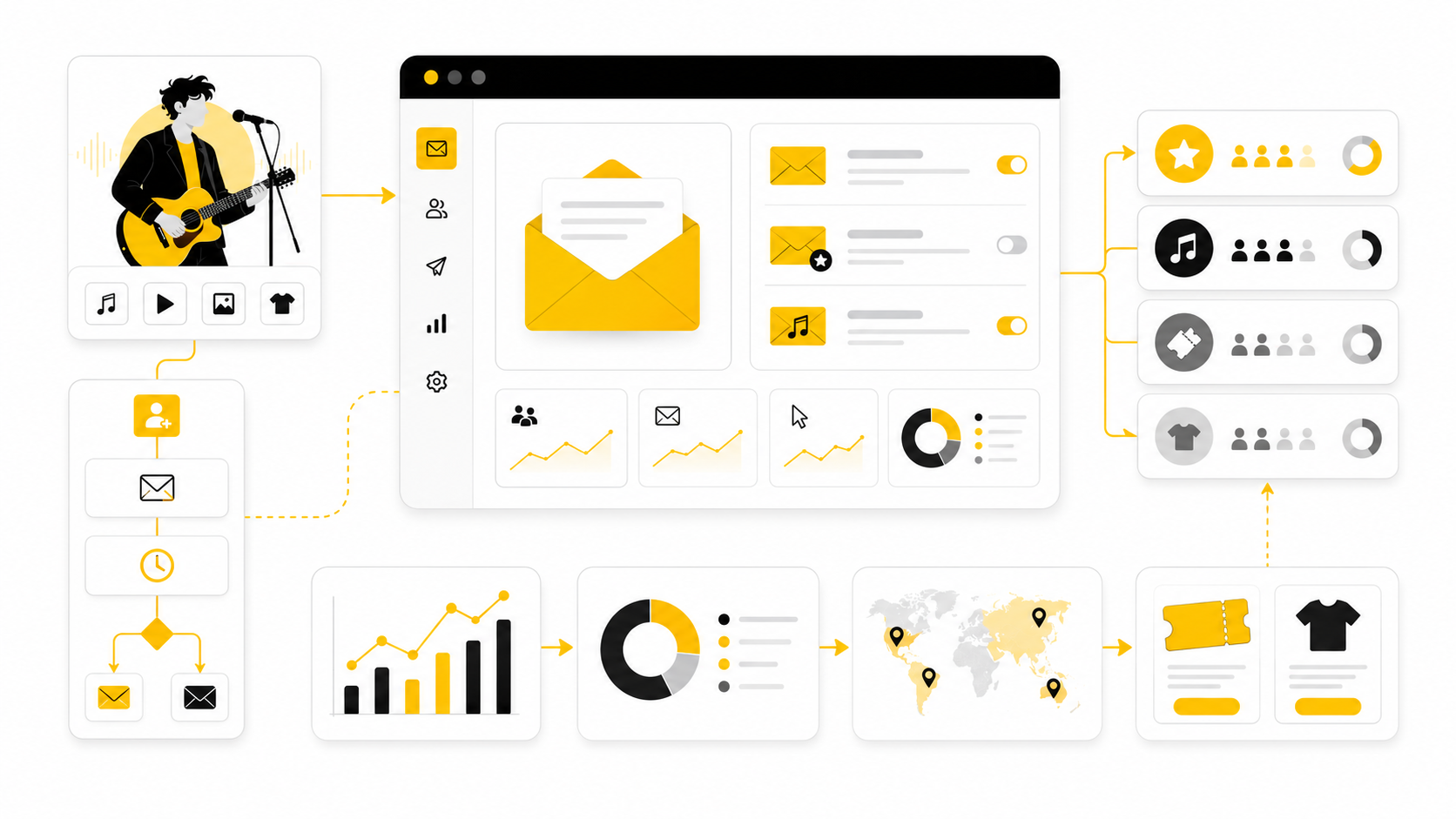
Email marketing for musicians is not about sending random newsletters whenever you remember you have a list. It is about building a direct communication channel with people who already care enough to hear from you, then using that channel to deepen the relationship before the next release, show, merch drop, crowdfunding push, or membership offer.
That matters because music discovery is noisy. Social platforms can introduce people to your songs, but they do not reliably give you access to the same people again. Email gives you a owned layer underneath the chaos: a place where casual listeners can become repeat listeners, repeat listeners can become buyers, and buyers can become the fans who show up without needing to be chased.
The opportunity is especially strong now because the music business is growing, but attention is more fragmented than ever. Global recorded music revenues reached $31.7 billion in 2025, while streaming made up most of the market and paid subscription streaming kept rising. That is good news for the industry, but it does not automatically solve the artist’s problem: you still need a practical way to identify your most valuable fans and communicate with them directly.
Why Email Marketing Still Matters For Musicians
The biggest mistake musicians make with email is treating it like a boring business tool instead of a fan relationship tool. A good email list is not just a database. It is a group of people who gave you permission to contact them away from the feed, away from the algorithm, and away from the endless swipe.
That permission has real value because fan attention is becoming harder to hold. Luminate’s 2025 music reporting describes a fan engagement funnel where 20% of U.S. music listeners qualify as superfans, meaning they engage with artists and music in five or more ways. For musicians, the point is not to blast everyone with the same message; it is to recognize who is leaning in and give them more reasons to stay close.
Email also works because it is flexible. You can use it to announce a show, explain the story behind a song, offer early access to merch, invite fans to a private listening session, or simply keep people emotionally connected between releases. That makes it one of the few channels that can support both the creative side and the business side of an artist career.
The Framework Overview
A strong email marketing system for musicians has four moving parts: capture, nurture, activate, and learn. Capture means giving people a clear reason to join your list. Nurture means sending messages that build trust and context. Activate means making timely offers when there is a real reason to buy, stream, attend, share, or support. Learn means tracking what people do so your next email is sharper than the last one.
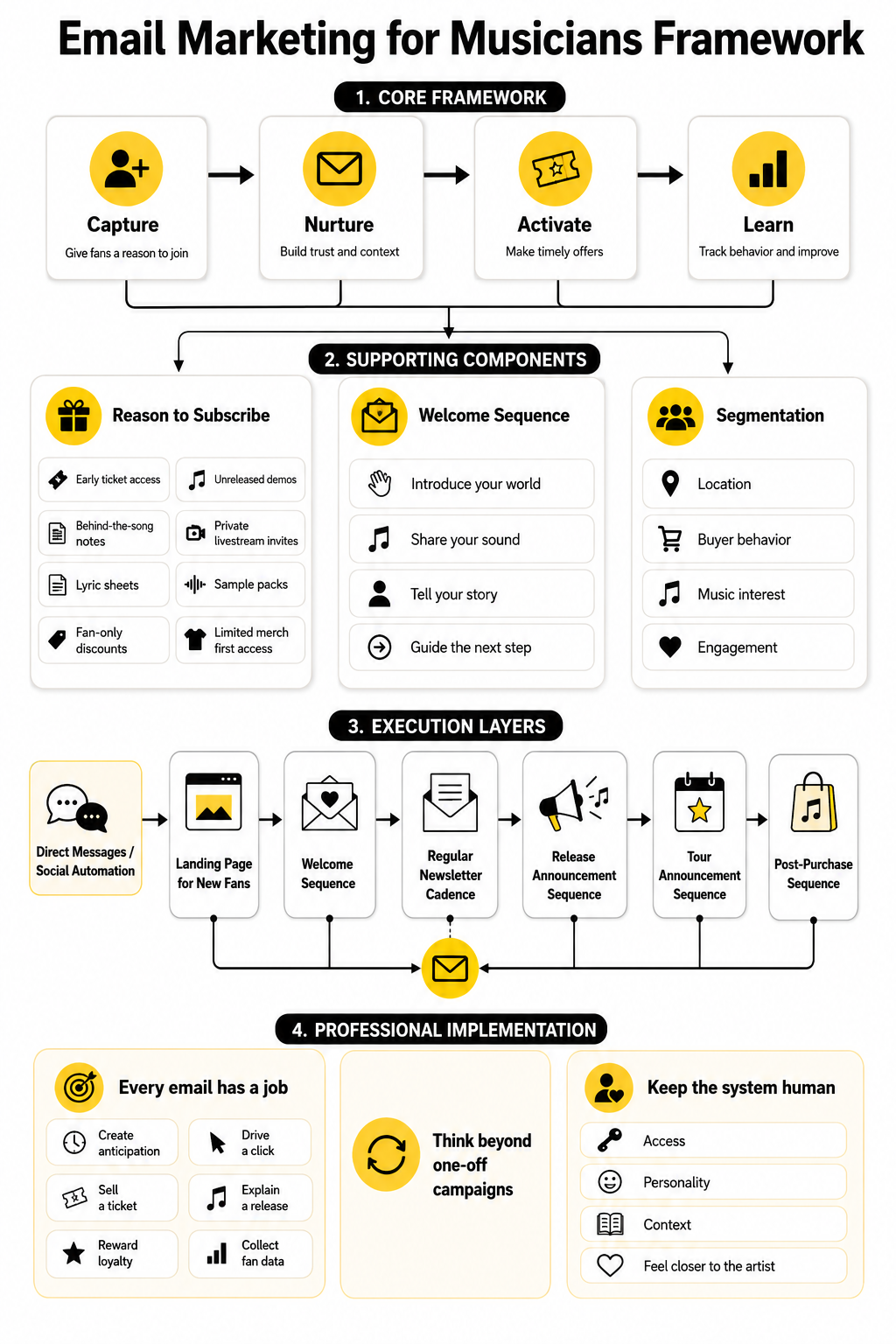
This framework matters because random emailing creates random results. When you only email fans on release day, ticket-sale day, or “please buy my merch” day, the relationship feels transactional. When you build a simple rhythm before the ask, the ask becomes much easier because fans already understand the story, the stakes, and the reason to care.
The tools do not need to be complicated at the beginning. A musician can start with a simple signup page, a welcome sequence, and a regular newsletter cadence using platforms like Brevo or Moosend. The key is not choosing the fanciest software. The key is building a system you can actually maintain while making music, rehearsing, releasing, touring, and doing the hundred other things artists have to do.
Core Components Of A Musician’s Email System
The first component is a reason to subscribe. “Join my newsletter” is weak because it focuses on the format, not the benefit. Better offers are specific: early ticket access, unreleased demos, behind-the-song notes, private livestream invites, lyric sheets, sample packs, fan-only discounts, or first access to limited merch.
The second component is a welcome sequence. This is where many artists leave money and connection on the table. When someone joins your list, they are paying attention right now, so the first few emails should introduce your world, your sound, your story, and the best next step for that fan.
The third component is segmentation. You do not need advanced data science to do this well. At a basic level, you can separate fans by location, buyer behavior, music interest, and engagement, which helps you avoid sending a London show announcement to someone in Los Angeles or a vinyl discount to someone who only joined for production tips.
Professional Implementation
Professional email marketing for musicians is not about sounding corporate. It is about being intentional. Every email should have a job, whether that job is to create anticipation, drive a click, sell a ticket, explain a release, reward loyalty, or collect useful fan data.
This is where musicians should think beyond one-off campaigns. A proper setup might include a landing page for new fans, a welcome sequence, a release announcement sequence, a tour announcement sequence, and a post-purchase sequence for people who buy merch or tickets. Artists who also use direct messages or social automation can connect those channels with email through tools like ManyChat, especially when they are moving fans from Instagram engagement into a more reliable list.
The important thing is to keep the system human. Fans do not want to feel like they have been dropped into a cold sales funnel. They want access, personality, context, and a reason to feel closer to the artist than they did before they opened the email.
Building A Fan Email List Without Feeling Pushy
The best way to build an email list as a musician is not to beg strangers for their address. It is to give interested people a simple, relevant reason to stay connected after they discover you. That difference matters because fans can feel when an artist is collecting emails for a real relationship versus grabbing contacts for future promotion.
Think of your email list as the next step after attention. Someone hears your song, watches your reel, attends your show, visits your website, scans your merch table QR code, or clicks your link in bio. Your job is to make the next step obvious before that moment disappears.
This is where email marketing for musicians becomes practical. You are not trying to convert every casual listener into a buyer today. You are creating a clean path for the right people to raise their hand, stay close, and hear from you again when there is something worth sharing.
Start With A Fan Promise
A fan promise is the reason someone joins your list. It should answer one simple question: “What do I get by being here?” If the answer is only “updates,” the offer is too weak because every artist already gives updates on social media.
A stronger fan promise is specific and emotionally connected to your world. You might offer first access to tickets, unreleased voice notes, early demos, behind-the-song breakdowns, private livestream invites, lyrics, tour diaries, or limited merch alerts. The point is not to bribe people with random freebies; the point is to make the email list feel like the closest public layer of your artist universe.
Keep the promise realistic. If you cannot send a deep behind-the-scenes email every week, do not promise one. A small, consistent promise beats a dramatic promise you abandon after three emails.
Put Signup Points Where Fan Intent Already Exists
You do not need to plaster signup forms everywhere. You need to place them where people are already showing interest. The easiest places are your link in bio, artist website, merch table, show posters, pre-save pages, ticket confirmation pages, and post-show follow-up pages.
Live shows are especially valuable because the emotional temperature is high. If someone just watched your set, sang along, bought a shirt, or asked when you are coming back, that is the moment to invite them closer. A simple QR code that says “Get the next show announcement first” is more natural than a generic “subscribe to my newsletter” pitch.
Your website should also have a clear signup path above the fold and near the places where fans make decisions. If you sell merch, announce shows, or host your music on your own site, make the email signup part of that flow. Tools like Systeme.io or ClickFunnels can help when you want a simple landing page, offer page, or funnel without building everything from scratch.
Use Lead Magnets That Fit The Music
A lead magnet for musicians should feel like part of the fan experience. It should not feel like a marketing PDF from a software company. Fans are not joining your list because they want “ten tips”; they are joining because they want access, story, identity, and proximity.
Good lead magnets can be simple. A private acoustic version, a demo download, an unreleased chorus, a sample pack, a lyric sheet, a setlist, a digital poster, or a fan-only discount can all work when they match your audience. Producers, DJs, and music educators can go more practical with presets, templates, stems, checklists, or mini-lessons because their fans may also be creators.
Do not overcomplicate delivery. If the offer is digital, the first email should deliver it immediately and set expectations for what comes next. A form tool like Fillout can work well for collecting fan preferences, while an email platform like Brevo can handle the follow-up email and basic automation.
Make Social Media Feed The List
Social media is not the enemy of email. It is one of the best discovery engines you have. The problem starts when musicians treat social followers as if they already own that audience.
A follower is not the same as a reachable fan. A social platform can show your post to a small slice of your audience, change the rules, bury your link, or push attention toward whatever format it wants that month. Email gives you a direct channel that you can use alongside social instead of being fully dependent on it.
The practical move is to create regular bridges from social to email. Mention your fan list in release-week posts, pin the signup link in your bio, use stories to offer early access, and invite engaged commenters into a more direct channel. If you use Instagram DMs heavily, ManyChat can help move interested fans from comments or messages into a signup flow without making the experience feel manual or clunky.
Collect The Right Information Early
At the beginning, you only need the fan’s email address and maybe their first name. Asking for too much too soon can hurt signups because every extra field creates friction. The goal is to make joining easy, then learn more over time through clicks, purchases, surveys, and preferences.
Location is the first extra data point worth collecting for most musicians. If you tour or play local shows, knowing a fan’s city is extremely useful. It helps you send relevant show announcements, avoid annoying people with events they cannot attend, and understand where real demand is forming.
Music preference can also be useful if your audience has different interests. For example, a producer-artist might have listeners who want songs, other producers who want sounds, and artists who want collaboration updates. Those groups should not always receive the same emails because they do not all care about the same next step.
Make Consent Clear And Simple
A healthy email list is built on permission. Do not upload random contacts, scrape emails from social profiles, or add people because they once messaged you. That might make your list look bigger, but it damages trust and can hurt deliverability.
The signup form should clearly say what people are joining. You do not need legal language in every sentence, but people should understand that they are subscribing to receive emails from you. When the expectation is clear, unsubscribes go down and engagement becomes more meaningful.
This is also a brand decision. Artists who respect the inbox feel more professional. Fans notice when the communication is clean, relevant, and easy to leave if it is no longer for them.
Build Slowly, But Build Every Week
A small engaged list is more valuable than a large cold list. One hundred people who open, click, reply, buy tickets, and share your music are better than ten thousand contacts who barely remember signing up. Early list building should focus on quality, not vanity metrics.
Make list growth a weekly habit. Add the signup link to every release campaign, every show promo, every merch push, every useful social post, and every fan interaction where it naturally fits. This is not aggressive when the offer is relevant.
The real win is consistency. You do not need a massive campaign to start email marketing for musicians the right way. You need a clear fan promise, a few smart signup points, a simple welcome flow, and the discipline to keep inviting the right people closer.
Creating Emails Fans Actually Want To Open
Once someone joins your list, the work changes. You are no longer trying to earn permission; you are trying to keep it. That means every email should feel like it belongs in the fan relationship, not like a random promotional interruption.
The easiest way to write better emails is to stop asking, “What do I need to announce?” and start asking, “What would make this fan feel closer to the music?” Sometimes the answer is a release link. Sometimes it is the story behind a lyric, a rehearsal clip, a tour note, a personal reflection, or a direct invitation to take part in something.
This is where email marketing for musicians becomes a creative discipline, not just a business task. You are building anticipation, context, and momentum around your work. Done well, the inbox becomes part of the fan experience.
Decide The Job Of Each Email Before You Write
Every email needs one clear job. If you try to announce a single, sell merch, promote a show, ask for playlist saves, explain your creative process, and share a life update in the same message, the fan has too much to process. Confused emails get ignored because the reader cannot tell what matters most.
A good email usually fits one of a few jobs. It can build connection, drive a specific click, sell something, teach something, gather a reply, or reward fans with early access. Once you know the job, the subject line, body, link, and call to action become much easier to write.
This does not mean every email has to be short. A story-based email can be longer if the story is genuinely worth reading. The rule is simple: one email, one main purpose, one obvious next step.
Use A Simple Writing Structure
Musicians often overthink email because they imagine it has to sound polished, branded, or “marketing professional.” That is usually the wrong direction. Fans signed up to hear from you, so the email should sound like a clear version of your voice, not a press release.
A reliable structure is opening, context, payoff, and action. The opening gives fans a reason to keep reading. The context explains why this message matters now. The payoff gives them the song, story, lesson, link, invitation, or access they came for. The action tells them what to do next.
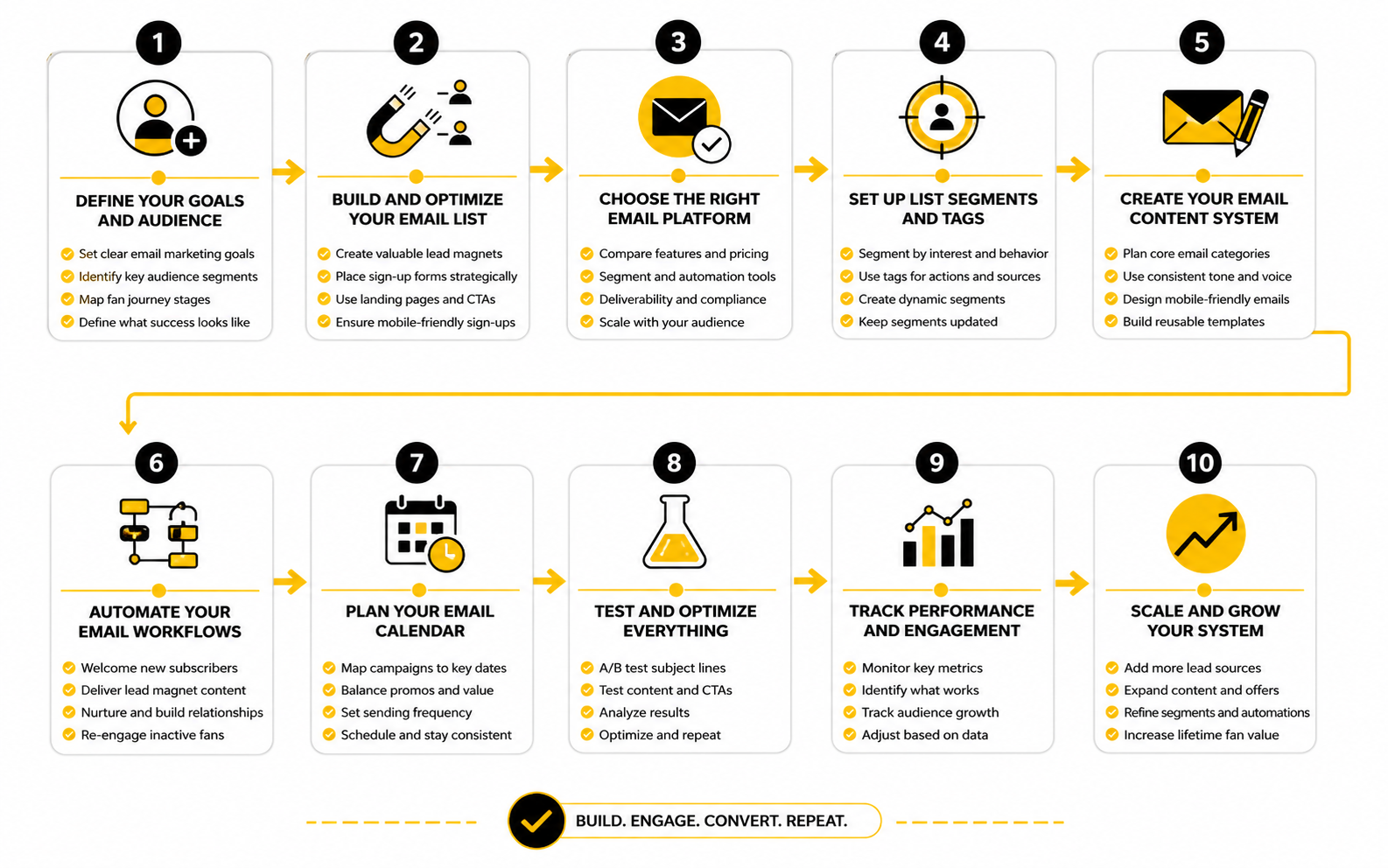
Use this process before sending any campaign:
This looks basic, but basic wins because it is repeatable. Most bad artist emails are not bad because the artist lacks talent. They are bad because the message has no clear job and too many competing ideas.
Write Subject Lines Like A Human
The subject line should create curiosity without tricking people. Fans do not need corporate hype, fake urgency, or all-caps pressure. They need a clear signal that the email contains something worth opening.
Strong subject lines usually point to a real moment. “The demo before the final version,” “I almost cut this lyric,” “London gets first access tomorrow,” or “A small thank-you before release day” all feel more natural than “NEW RELEASE OUT NOW!!!” The goal is not to scream louder; it is to make the email feel personal and timely.
You can still be direct when the message is direct. If tickets go on sale Friday, say that. If a limited vinyl run is nearly gone, say that clearly. Just do not manufacture urgency when there is none, because fans remember when an artist treats attention cheaply.
Make The First Lines Do Real Work
The first lines of the email matter because they set the tone immediately. If the opening feels generic, the rest of the email has to work harder. If the opening feels specific, fans are more likely to stay with you.
A strong opening can start with a real moment from the creative process. It can explain why this release feels different, why this city matters, why a song took longer than expected, or why fans are hearing something before the public does. The point is to give the email a reason to exist beyond “I have something to promote.”
Avoid long warm-ups. You do not need three paragraphs before you say why you are writing. Respect the fan’s time, then reward their attention with something that feels honest, useful, or exclusive.
Balance Story And Action
Story gives fans a reason to care. Action gives them a way to respond. You need both, but not always in equal amounts.
For a release email, the story might explain what inspired the song, while the action is to listen, save, buy, or share. For a tour email, the story might describe why you are excited to return to a city, while the action is to get tickets. For a merch email, the story might explain the design or limited run, while the action is to buy before it sells out.
The mistake is making the story so long that the action disappears. The other mistake is making the action so aggressive that the story feels fake. The best emails make the next step feel like a natural continuation of the relationship.
Create A Repeatable Email Calendar
You do not need to email fans every day. You do need a rhythm. A list that hears from you only when you want money will eventually feel cold, even if those fans once cared deeply.
A practical email calendar for musicians can follow your creative cycle. Between releases, send connection emails, studio notes, recommendations, personal updates, or behind-the-scenes messages. During release season, increase the cadence with pre-release context, launch-day emails, follow-up reminders, and fan thank-yous. Around shows, send city-specific ticket emails, set-time reminders, merch previews, and post-show follow-ups.
A tool like Buffer can help keep your social posts aligned with your email calendar, especially when a release or tour campaign has multiple moving parts. The goal is not to make every channel say the exact same thing. The goal is to make the campaign feel coordinated instead of chaotic.
Send Emails That Invite Replies
Replies are underrated. A fan who replies is giving you more than a click; they are giving you a signal. They are telling you what they care about, what moved them, what they want next, or where they feel connected.
You can invite replies in simple ways. Ask which city fans want you to play next. Ask which version of a demo they prefer. Ask what lyric hit them hardest. Ask what kind of merch they would actually wear. These questions work best when you genuinely care about the answer.
Do not turn every email into a survey. That gets tiring fast. But occasional reply-driven emails can make the list feel alive, and they can give you better fan insight than guessing from social likes alone.
Keep Design Clean And Mobile-Friendly
Most musician emails do not need heavy design. In fact, overdesigned emails can feel less personal and more like advertising. A clean layout with readable text, one strong image when needed, and one clear button or link is usually enough.
Mobile readability is non-negotiable. Short paragraphs, obvious links, and clear spacing make the email easier to read quickly. If the email looks cramped on your phone, fix it before sending.
Platforms like Moosend and Brevo can handle templates, scheduling, and basic testing, but the software cannot fix a weak message. Keep the design simple, then make the writing sharper.
Build Trust With Consistency
Trust is built by doing what you said you would do. If fans joined for early access, give them early access. If they joined for behind-the-scenes updates, do not send only sales emails. If they joined because they saw you live, make the next message feel connected to that show.
Consistency does not mean being predictable in a boring way. It means fans understand the relationship. They know why you are in their inbox, what kind of value you bring, and when an ask is worth paying attention to.
That is the practical core of writing better emails. Respect the inbox, write with a clear purpose, and make every message feel like it came from an artist who actually understands the fan on the other side.
Automations, Segments, And Fan Journeys
The next layer is where the system becomes more useful than a simple newsletter. Once fans are joining from different places, clicking different links, buying different things, and living in different cities, your emails should stop treating everyone the same. This is where automation and segmentation turn email marketing for musicians into a real fan journey.
Automation does not mean removing the human feeling. It means sending the right message at the right time without manually rebuilding the same email every week. A fan who joins after a show should not receive the same first message as someone who downloaded a sample pack, clicked a vinyl link, or joined from a tour announcement.
Segmentation is simply the way you organize those differences. You are not trying to create a complicated spreadsheet monster. You are trying to understand who is new, who is active, who buys, who attends, who clicks, and who may need a different kind of message before they take the next step.
Statistics And Data That Actually Matter
Email benchmarks are useful only when they help you make better decisions. They are not there to make you feel good or bad about one campaign. They are there to show whether your list is healthy, whether your message is relevant, and whether fans are taking the action you wanted them to take.
Recent benchmark data shows why context matters. MailerLite’s 2026 benchmark report puts the average 2025 email open rate at 43.46% and the average click rate at 2.09%, while Brevo’s 2025 benchmark report shows a different overall picture with a 21% open rate and 3.96% click-through rate. Those numbers are not contradictions you should obsess over; they are reminders that platform, audience, industry, list age, and tracking methods all affect the results.
For musicians, the better question is not “Am I above the average?” The better question is “Did this email move the right fans toward the right action?” A small list selling tickets from a 3% click rate can be healthier than a huge list with high opens and no real movement.
What Open Rates Can And Cannot Tell You
Open rate is useful, but it is not the truth by itself. Privacy changes, inbox behavior, image loading, and platform differences can make opens less precise than they look. That means you should treat open rate as a directional signal, not as the final score.
A falling open rate can mean your subject lines are weak, your send frequency is off, your list has gone cold, or your messages are no longer matching what people expected when they subscribed. A high open rate can mean the subject line worked, but it does not prove fans listened, clicked, bought, replied, or shared. That is why open rate should start the diagnosis, not end it.
Use open rates to compare similar emails to similar segments. Compare release announcement to release announcement, city show email to city show email, and welcome email to welcome email. Do not compare a personal story email to a last-call ticket email and pretend the numbers mean the same thing.
Clicks Show Real Fan Intent
Clicks are usually more useful than opens because they show action. When someone clicks a song, ticket link, merch drop, survey, preorder, or behind-the-scenes page, they are telling you what they are interested in. That is valuable because fan behavior is more reliable than fan theory.
A low click rate does not automatically mean fans dislike you. It may mean the email had too many links, the offer was unclear, the call to action was buried, or the segment was wrong. If you send a vinyl preorder to fans who joined for production tips, the issue is not the fan base; the issue is targeting.
Track clicks by category, not just by campaign. Separate music clicks, ticket clicks, merch clicks, reply clicks, and content clicks. Over time, this shows what your audience actually responds to, which is far more useful than guessing from social media likes.
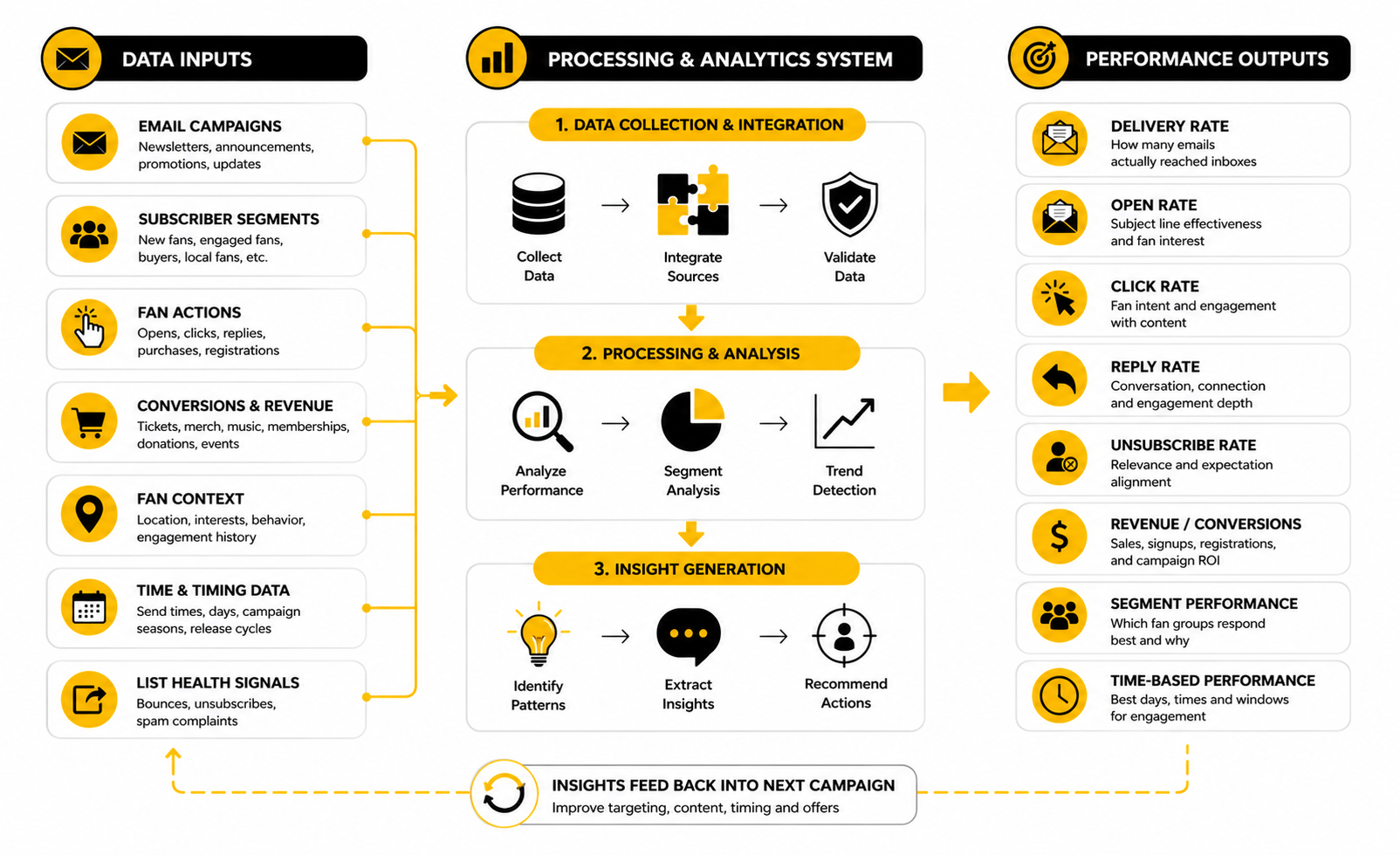
Build A Simple Measurement System
A useful analytics system does not need to be complex. It needs to be consistent. If you track the same core signals after every campaign, you will quickly see what is improving, what is stuck, and what needs to be fixed.
Track these signals after every important email:
The point is not to track everything forever. The point is to make your next decision easier. If show emails perform well by city but badly to the full list, you know to localize harder. If behind-the-scenes emails get replies but few clicks, you know they are relationship builders, not direct sales emails.
Read Unsubscribes Without Panicking
Unsubscribes are not always bad. Some people should leave your list because they are no longer interested, joined for the wrong reason, or only wanted a one-time download. A clean list usually performs better than a bloated list full of people who never engage.
What matters is the pattern. MailerLite’s benchmark data shows an average 2025 unsubscribe rate of 0.22%, which gives you a rough reference point. If your unsubscribe rate spikes after a specific type of email, that message probably broke expectations or went to the wrong segment.
Do not soften every email just to avoid unsubscribes. That creates boring emails. Instead, make sure the right people receive the right message, the subject line reflects the content, and the call to action matches why they joined.
Measure Revenue Without Killing The Relationship
Revenue matters. Tickets, merch, vinyl, digital products, memberships, crowdfunding, and private events can all be supported by email. But if every email is judged only by immediate sales, you will start writing like a desperate store instead of an artist building long-term demand.
Separate relationship emails from conversion emails. A studio note may not sell anything today, but it can make the next release email perform better. A fan survey may not create revenue immediately, but it can help you plan cities, merch sizes, content ideas, and offer timing.
When you do measure sales, look beyond total revenue. Track revenue per recipient, revenue per buyer, conversion rate by segment, and repeat purchase behavior. A smaller segment of active buyers can be more valuable than a large general list that clicks but never buys.
Use Segments To Understand Fan Depth
Not all subscribers are at the same stage. Some just discovered you yesterday. Some have streamed for months. Some have seen you live. Some have bought three shirts and will show up whenever you announce something in their city.
A practical fan-depth model can be simple:
Each group needs a different next move. New fans need orientation. Engaged fans need more meaningful access. Local fans need location-specific announcements. Buyers need recognition and smart follow-up. Cold subscribers need a re-engagement attempt or eventual cleanup.
Connect Campaign Data To Creative Decisions
Email analytics should not only shape marketing. They can shape the way you understand your audience. If fans repeatedly click acoustic versions, lyric breakdowns, tour diaries, or production notes, they are showing you which parts of your world they want more of.
That does not mean data should control your art. Absolutely not. It means data can help you package, explain, and distribute the work in a way that meets real fan interest. The song still comes from you, but the campaign around it can become more carefully.
This is where the system starts compounding. Your emails teach you what fans care about. Your segments make future emails more relevant. Your campaigns become less random. And your list becomes more than a broadcast channel; it becomes a feedback loop between your creative world and the people who care enough to stay in it.
Selling Tickets, Merch, Music, And Memberships Through Email
At some point, your email list has to support the business side of your music. That does not mean every message becomes a sales pitch. It means you build enough trust, context, and timing that commercial emails feel like a natural part of the relationship.
This is where many artists get nervous. They do the creative emails, the behind-the-scenes updates, and the “thank you for being here” messages, but when it is time to sell tickets or merch, they suddenly become vague. Do not do that. Fans cannot support what they do not clearly understand.
Selling through email works best when the offer is specific, the timing is honest, and the reason to act is real. A tour date, limited merch run, vinyl preorder, private event, paid community, sample pack, or crowdfunding campaign should not be buried at the bottom of a soft update. If there is a real offer, make it clear.
Start With The Offer, Not The Tool
The tool does not create demand. The offer does. Before you build a funnel, automation, landing page, or checkout flow, get painfully clear on what the fan is being invited to do and why it matters now.
For tickets, the offer might be early access, better seats, a local fan presale, or a small VIP experience. For merch, the offer might be a limited run, a design tied to a release, or a bundle that makes emotional sense. For memberships, the offer might be ongoing access, unreleased material, private livestreams, or a closer community around your work.
This is why email marketing for musicians should connect directly to the artist’s calendar. The best offers usually come from real moments: a release, a show, an anniversary, a studio milestone, a tour announcement, or a fan-requested drop. When the offer is tied to something real, you do not need to fake urgency.
Build Campaigns Around Moments
A single sales email can work, but a short campaign usually works better. Fans need context before the ask, a clear invitation during the ask, and a reminder before the window closes. That does not mean spamming people. It means guiding them through the moment.
For a ticket campaign, you might send a city-specific announcement, a story-driven email about the show, a practical reminder with date and venue details, and a final call before prices rise or the show sells out. For a merch campaign, you might reveal the design, explain the concept, open the drop, then send a last reminder before the limited run closes. For a music release, you might move from teaser to story to launch to fan thank-you.
The tradeoff is frequency. More emails can drive more action, but only when each message adds a reason to care. If every email says the same thing with a different subject line, fans will tune out fast.
Use Landing Pages When The Decision Needs Focus
Sometimes a simple link is enough. If you are sending fans to a ticketing page, streaming platform, or merch store, the destination may already do the job. But when the offer needs explanation, a dedicated landing page can make the decision cleaner.
A good landing page removes distractions. It explains what the offer is, who it is for, what the fan gets, why now matters, and what to do next. That is especially useful for bundles, VIP packages, memberships, crowdfunding campaigns, workshops, or any offer that needs more context than a one-line email can carry.
For musicians who want a simple campaign page, tools like ClickFunnels or Systeme.io can help build the page, collect leads, and connect the sales flow. If the offer needs a more polished ecommerce-style page, Replo can make sense for artists with more serious merch, physical product, or brand-collab ambitions.
Protect The Fan Relationship While Selling
The biggest risk is not selling. The biggest risk is selling in a way that trains fans to ignore you. If your list only hears from you when you need money, the relationship becomes thin.
A healthy sales rhythm includes value before, during, and after the campaign. Before the sale, give context. During the sale, make the offer clear. After the sale, thank people, show what happened, and continue the relationship. This matters because a fan who buys once should feel more connected afterward, not like the transaction ended the conversation.
Post-purchase emails are underrated. A ticket buyer can receive set-time reminders, travel details, merch previews, or a post-show thank-you. A merch buyer can receive care instructions, shipping updates, a story about the design, or early access to the next drop. A member can receive onboarding, community expectations, and a clear sense of what happens next.
Avoid Discount Addiction
Discounts can work, but they can also weaken your brand if they become the only reason people buy. Music is emotional. Merch, vinyl, tickets, and memberships are often identity purchases, not just price decisions. If every campaign leans on price cuts, you train fans to wait.
Use discounts carefully. A small thank-you for early supporters can feel generous. A limited bundle can increase order value without cheapening the work. A local fan presale can reward the people most likely to show up. But constant “20% off” emails can make the whole artist brand feel like clearance inventory.
Better levers include access, scarcity, timing, personalization, and meaning. First access to tickets is stronger than a random discount. A limited tour-only shirt is stronger than a generic sale. A signed item tied to a specific release moment is stronger than a coupon with no story.
Scale Without Losing The Human Voice
As the list grows, the system needs more structure. You may need cleaner segments, better automations, stronger deliverability practices, a CRM, and a clearer campaign calendar. The danger is that the operation becomes more advanced while the emails become less human.
Keep the human voice at the center. Automation should handle timing, tagging, delivery, reminders, and follow-up. The message itself should still sound like it came from an artist with a real point of view. That is the balance.
A broader platform like GoHighLevel can make sense when an artist, manager, label services team, or agency needs CRM, pipelines, SMS, automations, landing pages, and follow-up in one place. That is not necessary for every musician. But once campaigns involve multiple offers, team members, cities, buyers, and follow-up paths, a more complete system can save a lot of manual work.
Watch The Deliverability Risks
Deliverability is boring until it breaks. Then it becomes urgent. If your emails start landing in spam, your best campaign can fail before fans even see it.
The basics matter: use a real sending domain, authenticate your email, avoid scraped lists, clean cold subscribers, make unsubscribing easy, and do not send sudden massive blasts to people who have not heard from you in months. Google’s sender rules for high-volume senders include requirements around authentication, low spam rates, and easy unsubscribe, with stronger enforcement continuing into November 2025 and beyond. Even if you are not sending at that scale yet, those rules point in the direction every serious sender should follow.
List quality is part of deliverability. Buying or importing questionable emails might look like growth, but it usually creates weaker engagement and more complaints. A smaller permission-based list is safer, stronger, and more profitable than a big list full of people who never asked to hear from you.
Treat Superfans Differently
Your most engaged fans should not feel like everyone else. They are the people clicking early, replying often, buying repeatedly, sharing your work, and showing up when you announce something. They deserve a different level of attention.
That does not mean you need a complicated VIP program on day one. Start with simple signals. Tag fans who buy, reply, attend, join multiple campaigns, or click high-intent links. Then give them early access, personal thank-yous, first looks, private invites, or better context before the public announcement.
The strategic tradeoff is fairness versus intimacy. You do not want casual fans to feel excluded from everything, but you also do not want your strongest supporters treated like anonymous contacts. The answer is layered access: public updates for everyone, deeper access for subscribers, and special moments for the fans who consistently lean in.
Know When Not To Send
Advanced email marketing is not only about sending better emails. It is also about knowing when to hold back. Not every thought needs an email, and not every campaign needs one more reminder.
Do not send if the message has no clear purpose. Do not send if the segment is wrong. Do not send if the offer is not ready. Do not send if the email exists only because you feel guilty for being quiet. Silence is better than noise.
But do not use perfectionism as an excuse either. The goal is not to wait until every campaign is flawless. The goal is to send useful, timely, honest emails that help fans take the next step. That is the difference between a list that gets milked and a fan base that grows stronger with every campaign.
Bringing The Whole System Together
By this point, the system should feel less like “sending emails” and more like building a direct fan engine. You attract the right people, give them a reason to subscribe, welcome them properly, send useful messages, segment based on behavior, measure what matters, and sell only when the timing makes sense. That is the difference between a list that sits there and a list that becomes part of the artist’s actual business.
The final step is connecting the pieces so they work together. Your signup forms should feed your email platform. Your email platform should tag fans based on interest and behavior. Your campaigns should connect to landing pages, ticket pages, merch offers, membership pages, and follow-up sequences without forcing you to rebuild the same workflow every time.
This is also where you choose how simple or advanced your stack needs to be. A solo artist might only need Brevo, Moosend, and a clean link-in-bio flow. A manager, label services team, or music marketing agency may prefer a broader platform like GoHighLevel when they need CRM, pipelines, automations, landing pages, and follow-up under one roof.
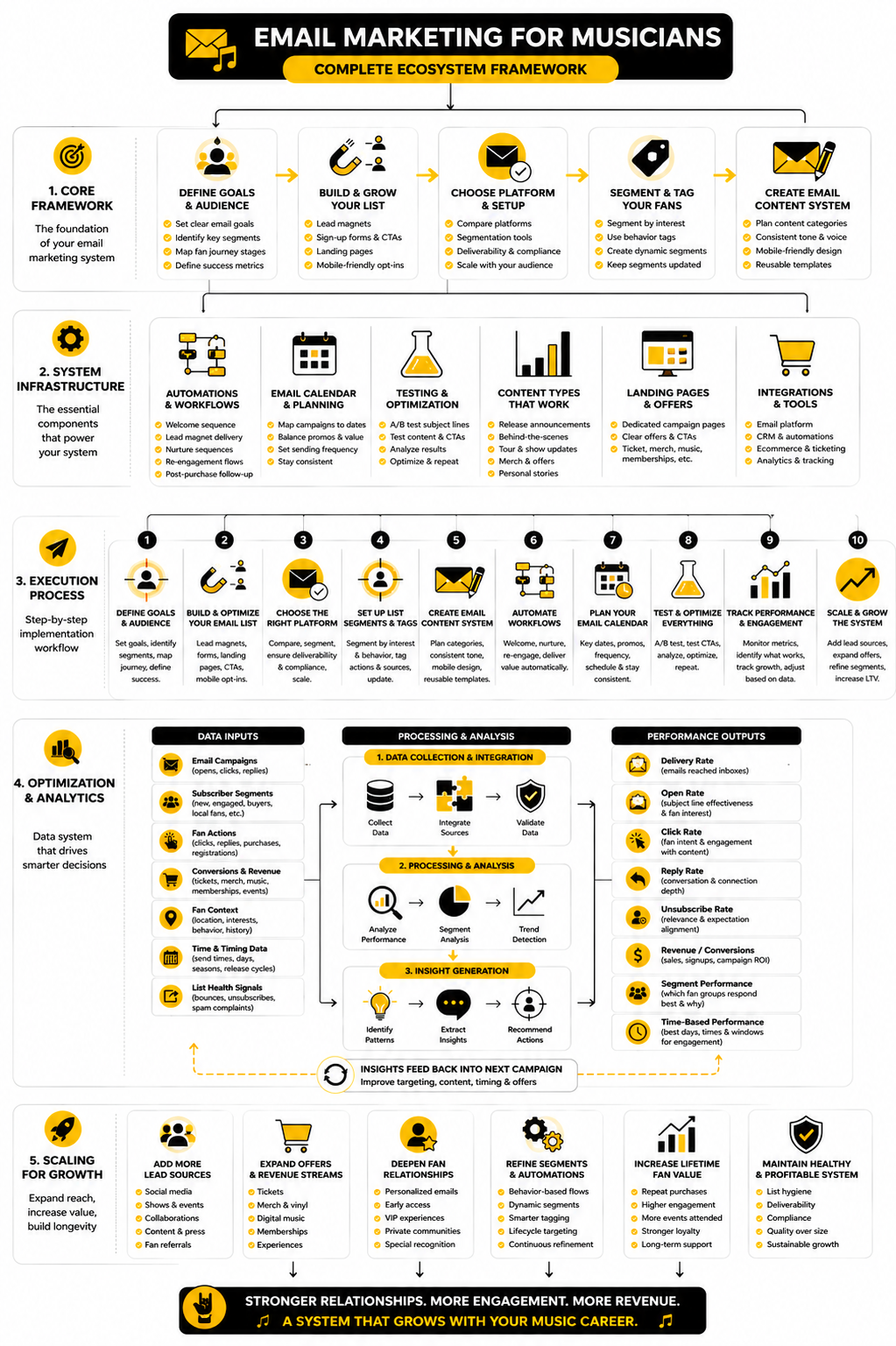
The Final Email Marketing System For Musicians
A complete email marketing system for musicians has five layers. The first layer is discovery, where fans find you through social media, streaming, shows, collaborations, content, press, or word of mouth. The second layer is capture, where those fans get a clear reason to join your list instead of disappearing back into the feed.
The third layer is nurture, where your emails build context, trust, and emotional connection. The fourth layer is activation, where you invite fans to stream, buy, attend, join, reply, share, or support something specific. The fifth layer is learning, where your results shape the next campaign instead of leaving you guessing.
Keep the system simple enough to use consistently. A complicated setup that you avoid is worthless. A clear setup that you actually use every week can become one of the strongest assets in your career.
Common Mistakes To Avoid
The first mistake is waiting until a release is ready before building the list. By then, you are trying to create attention and convert attention at the same time. Start earlier so fans have context before the important moment arrives.
The second mistake is copying ecommerce email tactics without adjusting them for music. Fans are not just buying products; they are buying identity, connection, experience, and belonging. Your emails should still sell clearly, but they should never sound like a faceless store.
The third mistake is measuring only the obvious numbers. Opens and clicks matter, but replies, repeat buyers, city-level interest, merch preferences, and fan depth can tell you more about the real health of your audience. The deeper your understanding, the less random your campaigns become.
What is email marketing for musicians?
Email marketing for musicians is the process of using email to build direct relationships with fans, share music-related updates, and drive meaningful action. That action can include listening to a new release, buying tickets, purchasing merch, joining a membership, replying to a question, or attending a private event. The goal is not to replace social media, but to create a reliable channel that you control.
Why should musicians use email when social media already exists?
Social media is great for discovery, but it is not a dependable way to reach the same fans repeatedly. Algorithms change, organic reach moves up and down, and posts disappear quickly. Email gives you a more direct path to fans who have already chosen to hear from you.
How often should musicians email their fans?
Most musicians should start with a realistic rhythm they can maintain. For many artists, one or two emails per month is enough between campaigns, while release weeks, tour announcements, and merch drops may need a tighter sequence. The better question is not only frequency, but whether each email has a clear reason to exist.
What should a musician send in the first welcome email?
The first welcome email should confirm the fan made the right decision by joining. It should deliver whatever was promised, introduce the artist’s world, and set expectations for what kind of emails will follow. It can also point fans toward one strong next step, such as listening to a key song, replying with their city, or checking upcoming shows.
What is the best lead magnet for a musician?
The best lead magnet depends on the artist and the audience. A singer-songwriter might offer an acoustic demo, lyric sheet, or early access to tickets, while a producer might offer presets, stems, or a sample pack. The strongest lead magnet feels connected to the music instead of feeling like a random marketing giveaway.
Should musicians use email automation?
Yes, but only when automation improves the fan experience. A welcome sequence, post-purchase follow-up, show reminder, release sequence, or re-engagement email can save time and make communication more consistent. Automation should handle the timing and routing, while the message should still feel personal and human.
What email platform should musicians use?
The best platform depends on the artist’s stage and needs. A simple artist setup can work well with Brevo or Moosend, while more advanced teams may want GoHighLevel for a broader CRM and automation setup. Choose the tool that matches your workflow, not the tool with the longest feature list.
How can musicians grow an email list from Instagram or TikTok?
The easiest way is to turn social attention into a clear invitation. Put the signup link in your bio, mention the fan list in relevant posts, use stories to promote early access, and give fans a reason to join beyond generic updates. If you use Instagram comments or DMs heavily, ManyChat can help move interested people into a more structured signup flow.
How do musicians sell merch through email without annoying fans?
The key is to make the merch feel connected to a real moment. Explain the design, the release, the limited run, the tour connection, or the reason the item exists. Then make the offer clear, send reminders only when they add useful context, and follow up after the purchase so the buyer feels appreciated.
How can musicians use email to sell more tickets?
Segment by location first. Fans care much more about shows they can actually attend, so city-specific emails usually feel more relevant than broad tour blasts. A good ticket sequence can include early access, a show announcement, a reminder with practical details, and a final call when there is a real deadline.
What should musicians track in email marketing?
Track delivery, opens, clicks, replies, unsubscribes, conversions, revenue, and performance by segment. Do not treat one number as the whole truth. The real value comes from understanding which fans respond to which offers, which cities show demand, and which messages create action.
When should a musician clean their email list?
Clean the list when a segment has gone cold for a long time and does not respond to re-engagement attempts. Before removing people, send a clear email asking if they still want to hear from you. If they do not open, click, or respond after a reasonable re-engagement sequence, removing them can protect deliverability and make your data cleaner.
Can email marketing work for new musicians with a small audience?
Yes, and small lists are often easier to learn from. A new musician can build strong habits early by collecting emails at shows, through social content, on a website, and around each release. Even a small list can sell tickets, create replies, validate merch ideas, and help an artist understand who is actually leaning in.
Should musicians combine email with SMS or DMs?
Yes, but carefully. Email is better for stories, context, longer updates, and campaign sequences, while SMS and DMs are better for short, timely messages. The best setup uses each channel for the right job instead of blasting the same message everywhere.
What is the biggest email marketing mistake musicians make?
The biggest mistake is treating the list like a last-minute promotional tool instead of a long-term fan relationship. If you only show up when you want streams, sales, or ticket purchases, fans will feel it. Build trust before the ask, make the ask clear when it matters, and keep the relationship alive afterward.
Build a stronger local presence with BAAM AI
Turn your website, Google profile, social channels, and AI visibility into one growth engine
Most businesses do not need more random marketing activity. They need a consistent presence system that helps the right people find them, trust them, and take action. BAAM AI brings strategy, local SEO, website updates, Google Maps visibility, social content, AI-search readiness, media production, and reporting into one practical monthly engine.
If you want your marketing to keep working after the campaign ends, start with a free BAAM AI presence audit. See how your business shows up today and where the fastest visibility wins are at BAAM AI.