
BAAM AI Blog
Email Marketing Drip Campaigns: The Practical Framework For Turning Subscribers Into Customers
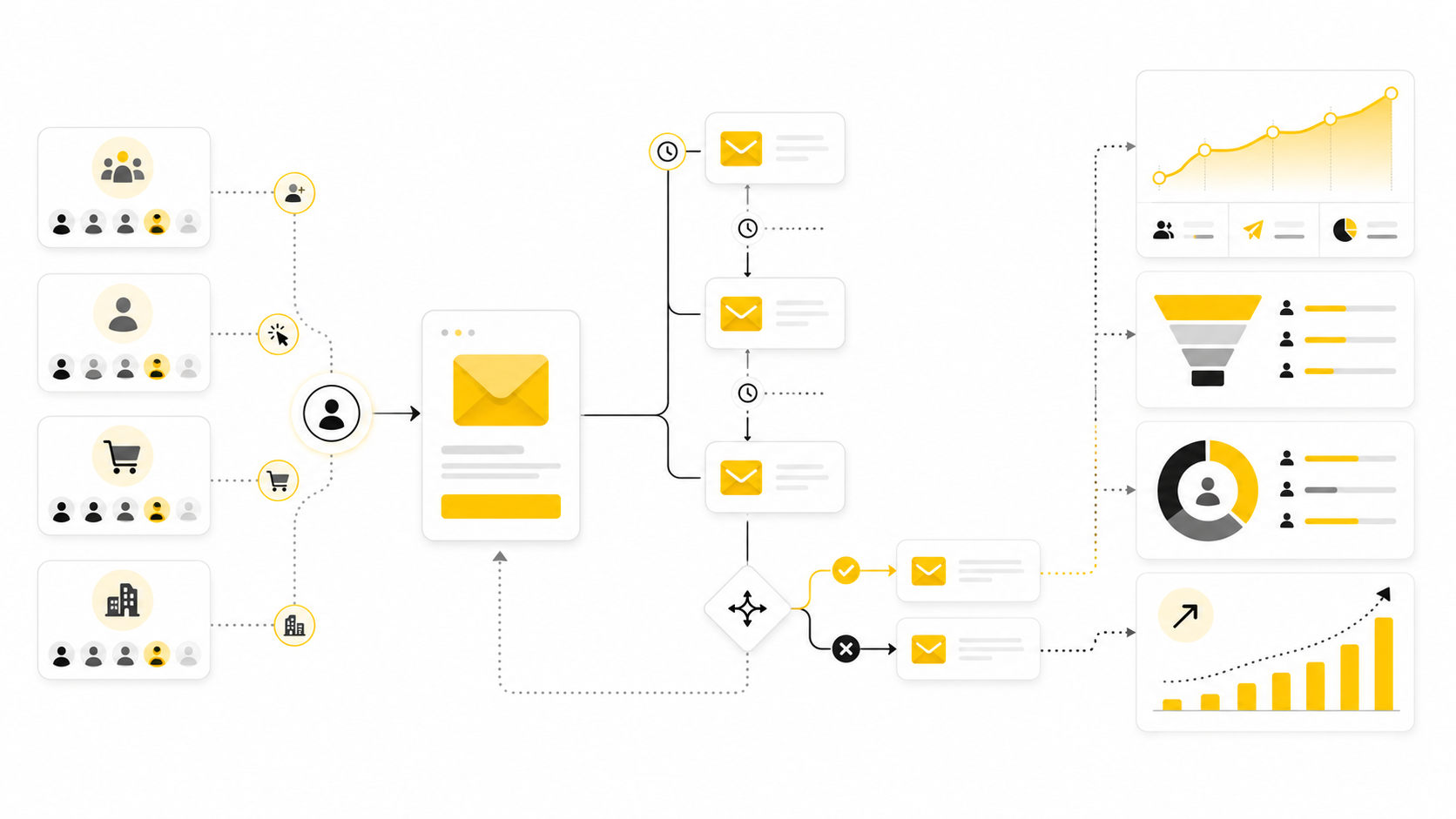
Email marketing drip campaigns are automated email sequences that send the right message to the right person based on timing, behavior, or stage in the customer journey. Instead of blasting the same newsletter to...
Affiliate disclosure: this article may include compensated links. Recommendations should still be evaluated against your use case, budget, and current provider terms.
Should you choose Drip?
Drip is worth considering when the use case, budget, and implementation effort match what you actually need to do next.
teams that want a practical tool decision without reading another generic feature list
Check DripEmail marketing drip campaigns are automated email sequences that send the right message to the right person based on timing, behavior, or stage in the customer journey. Instead of blasting the same newsletter to everyone, a drip campaign moves people through a planned path: welcome, educate, build trust, handle objections, invite action, and follow up.
That matters because most people do not buy the first time they hear from you. They join your list, browse, compare, hesitate, forget, come back, and then maybe buy when the timing finally makes sense. A strong drip campaign gives that journey structure without forcing you to manually chase every lead.
The mistake is thinking a drip campaign is just “five emails in a row.” It is not. Good email marketing drip campaigns combine segmentation, triggers, timing, messaging, offers, deliverability, and measurement into one system. That is why automated messages can outperform one-off sends so dramatically; Omnisend’s 2025 ecommerce analysis found that automated emails drove 37% of email sales from just 2% of email volume, which tells you exactly where the leverage is.
this guide will break the topic into six connected parts so you can build campaigns that are useful, measurable, and profitable instead of annoying. We will start with the strategy, then move into the mechanics, implementation, optimization, and examples. By the end, you should be able to map your own drip system with a clear purpose behind every email.
Why Email Marketing Drip Campaigns Still Matter
Email is still one of the few channels where you can build a direct relationship with your audience without renting attention from an algorithm. Social reach can change overnight, paid ad costs can climb, and search traffic can fluctuate, but an engaged email list remains an owned asset. That is why drip campaigns are so useful: they turn that asset into a repeatable customer journey.
The real benefit is not just automation. The real benefit is relevance at scale. When someone downloads a guide, abandons a cart, books a call, starts a trial, or clicks a specific product category, their next email should reflect that context. A drip campaign lets you respond to intent while it is still fresh.
This is also where many brands quietly lose money. They collect leads, send a generic welcome email, then drop everyone into the same broadcast list. Meanwhile, better-run companies use welcome sequences, abandoned cart flows, post-purchase education, reactivation campaigns, and sales nurture sequences to keep momentum alive.
Email marketing drip campaigns are especially powerful because they help with timing. A person who is curious today may be ready in three days, three weeks, or three months. The campaign keeps the conversation moving without pressuring them too early or disappearing when they still need guidance.
The Drip Campaign Framework
A strong drip campaign starts with one question: what decision does this person need help making next? That question keeps the campaign focused on the reader instead of the sender. When you build around the reader’s decision, your emails stop feeling random and start feeling useful.
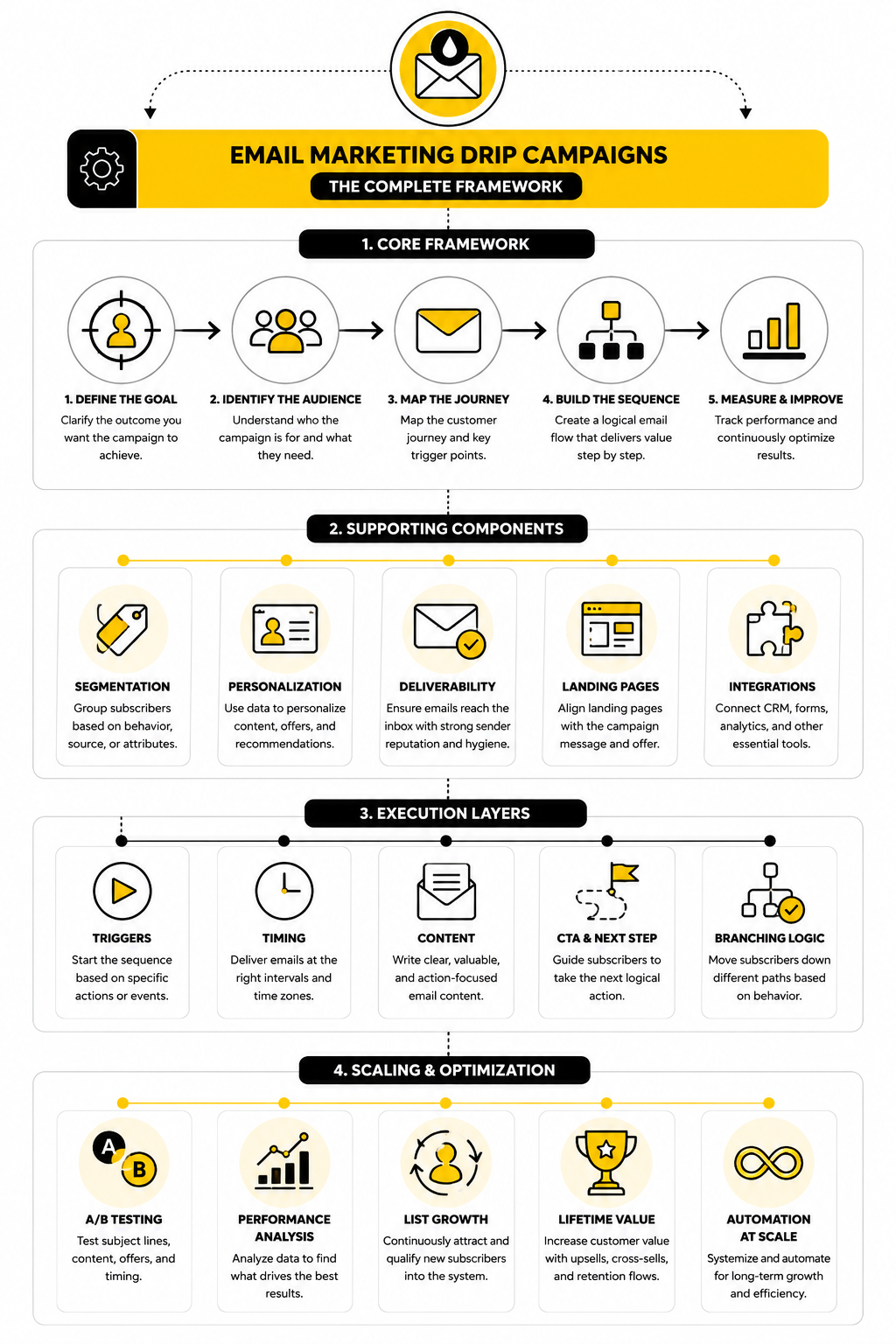
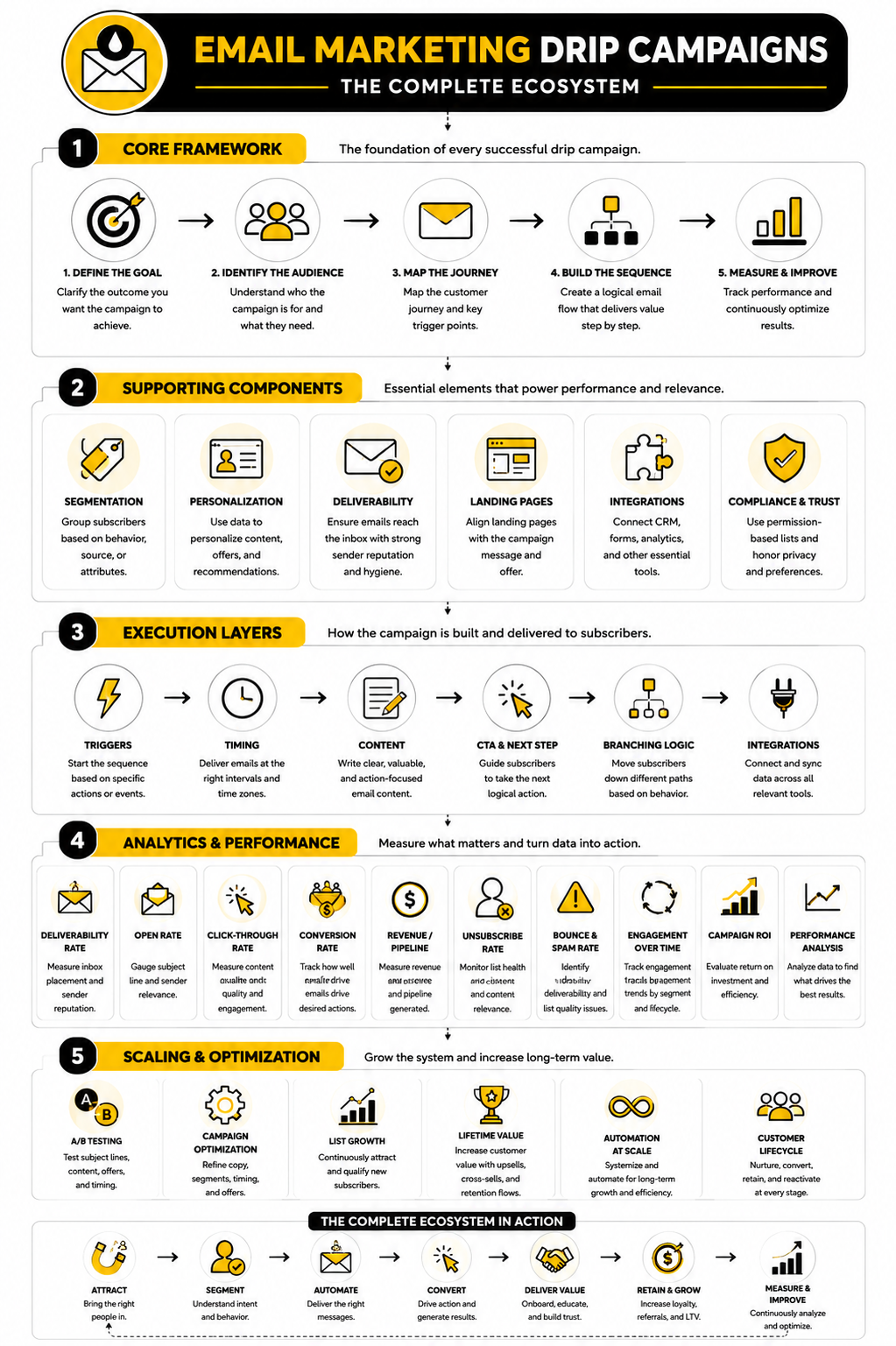
The basic framework has five layers: audience, trigger, promise, sequence, and conversion path. The audience defines who enters the campaign. The trigger defines when they enter. The promise defines why they should keep reading. The sequence defines the order of ideas. The conversion path defines what action you want them to take when trust is high enough.
This framework works for simple campaigns and advanced ones. A welcome sequence for a newsletter can use it. A SaaS onboarding flow can use it. An ecommerce abandoned cart series can use it. A service business using GoHighLevel for CRM, pipeline tracking, and automated follow-up can use the same structure to move leads from opt-in to booked call.
The point is to avoid building emails in isolation. Each email should have a job, but the campaign should have one shared direction. When the sequence feels like a guided path, subscribers are more likely to keep engaging because every message answers the next natural question in their mind.
Core Components Of A High-Converting Drip Campaign
Once the strategy is clear, the campaign needs structure. This is where most email marketing drip campaigns either become assets or become noise. The difference usually comes down to whether each component has a specific job or whether the sequence was built because someone felt they “should send more emails.”
A good drip campaign is not complicated for the sake of it. It is built from a few practical pieces that work together: a clear entry point, meaningful segmentation, a focused message arc, behavior-based timing, and a conversion goal that matches the subscriber’s level of intent. When those pieces are aligned, the campaign feels natural instead of forced.
The best way to think about it is simple: every email should either increase trust, reduce friction, create clarity, or invite action. If an email does none of those things, it probably does not belong in the sequence. Strong automation is not about sending more; it is about sending better.
The Entry Point
The entry point is the moment someone qualifies for the drip campaign. That could be a newsletter signup, lead magnet download, webinar registration, product page visit, abandoned cart, booked call, trial signup, or purchase. This moment matters because it tells you what the person likely wants next.
Someone who downloads a beginner guide should not receive the same sequence as someone who abandons a checkout page. The first person may need education and trust. The second person may need reassurance, urgency, social proof, or a clearer reason to finish the purchase.
This is why trigger quality matters so much. A vague trigger creates a vague campaign. A specific trigger gives you context, and context is what makes email marketing drip campaigns feel personal without pretending to be one-to-one manual outreach.
Audience Segmentation
Segmentation is where you stop treating your list like one giant crowd. You can segment by source, interest, lifecycle stage, product category, lead score, purchase history, location, engagement, or the specific action that started the campaign. The point is not to create a thousand segments; the point is to separate people when their needs are meaningfully different.
For example, a founder researching software needs a different sequence than a local service lead who wants an appointment. An ecommerce buyer who purchased once needs a different follow-up than someone who has purchased five times. A cold subscriber who has not clicked in months should not receive the same message rhythm as someone who clicked a pricing link yesterday.
This is also where your tool choice starts to matter. A lightweight email platform can handle basic lists and sequences, but a more advanced CRM like GoHighLevel makes more sense when you need pipelines, lead scoring, appointment booking, SMS follow-up, and sales automation connected in one place. The more complex the buyer journey, the more important your segmentation logic becomes.
The Message Arc
The message arc is the order of ideas across the sequence. This is different from writing individual emails. You are not just asking, “What should this email say?” You are asking, “What does the subscriber need to understand before the next email makes sense?”
A simple message arc might start with the promised resource, then explain the problem, then show the cost of inaction, then introduce the method, then handle objections, then make a focused offer. For a product trial, the arc might start with activation, then guide the user toward one quick win, then introduce deeper features, then show proof, then push toward upgrade or booking a call.
This structure keeps the campaign from jumping around. It also prevents the classic mistake of pitching too early. If the subscriber does not yet believe the problem matters, understand the solution, or trust the sender, the call to action will feel premature.
Timing And Cadence
Timing controls how the campaign feels. Too fast, and the sequence feels aggressive. Too slow, and the subscriber forgets why they signed up in the first place. The right cadence depends on the campaign type, the buying cycle, and how urgent the original trigger was.
A welcome campaign can usually move faster because the subscriber just raised their hand. An abandoned cart sequence may need to move even faster because purchase intent is already active. A B2B nurture campaign often needs more space because the decision is slower, more expensive, and usually involves more than one person.
The main rule is to match the rhythm to intent. High-intent actions deserve quicker follow-up. Lower-intent actions need more education and breathing room. This is one of the quiet details that separates amateur email marketing drip campaigns from campaigns that actually convert.
Personalization That Actually Helps
Personalization does not mean stuffing someone’s first name into every subject line. Real personalization means the content reflects what the person did, wanted, viewed, bought, requested, or ignored. It should make the email more relevant, not just more decorated.
Useful personalization might reference the lead magnet someone downloaded, the product category they browsed, the service they asked about, or the stage they are in. For ecommerce, platforms like Moosend and Brevo can support behavior-based automation without making the setup feel overly technical.
The danger is over-personalizing in a way that feels creepy or unnecessary. You do not need to prove how much data you have. You need to use the right data to make the next email more useful.
The Conversion Goal
Every drip campaign needs one primary conversion goal. That goal could be a purchase, booked call, demo request, trial activation, webinar attendance, reply, survey completion, upgrade, repeat purchase, or reactivation. Without a clear goal, the campaign becomes a pile of messages instead of a guided path.
The conversion goal should match the subscriber’s stage. A new subscriber may not be ready for a high-ticket offer, but they may be ready to consume a guide, watch a short training, or answer one qualifying question. A returning lead who has viewed a pricing page three times may be ready for a stronger call to action.
This is where funnels and email automation fit together. A tool like ClickFunnels can handle the landing page and offer flow, while the drip campaign keeps the relationship moving before and after the opt-in. The funnel captures the moment of intent; the email sequence turns that moment into momentum.
Professional Implementation And Tool Setup
Once the components are clear, implementation becomes a process instead of a guessing game. This is the point where email marketing drip campaigns move from strategy into actual workflows, tags, forms, triggers, emails, and reporting. The goal is not to build the most complex automation possible; the goal is to build a system you can trust.
Start simple, then add complexity only when the data justifies it. A welcome sequence, a lead nurture sequence, an abandoned cart flow, and a post-purchase sequence can cover a huge amount of the customer journey. Once those campaigns are working, you can layer in lead scoring, conditional branches, SMS, retargeting audiences, sales tasks, and more advanced personalization.
The cleanest implementation happens when the campaign is mapped before anything is built inside the software. Do not open your email platform and start clicking around randomly. Write the journey first, define the trigger, decide the goal, outline the emails, then build the automation around that plan.
Map The Customer Journey First
Before building the sequence, define where the subscriber is starting and where you want them to go. A person joining from a free checklist is not in the same mindset as a person requesting a quote. A person who just purchased needs support and reassurance, while a person who has gone inactive needs a reason to care again.
This step forces you to think in stages. For a service business, the journey might move from lead magnet to consultation to proposal to follow-up. For ecommerce, it might move from signup to first purchase to repeat purchase to loyalty. For SaaS, it might move from trial signup to activation to feature adoption to upgrade.
Write the journey in plain language before turning it into automation logic. That keeps the campaign human. If the journey sounds awkward on paper, it will feel awkward in the inbox too.
Build The Campaign Workflow
The workflow is the operational version of the journey. It defines what starts the campaign, what happens after each delay, what conditions change the path, and what removes someone from the sequence. This is where the execution becomes tangible.
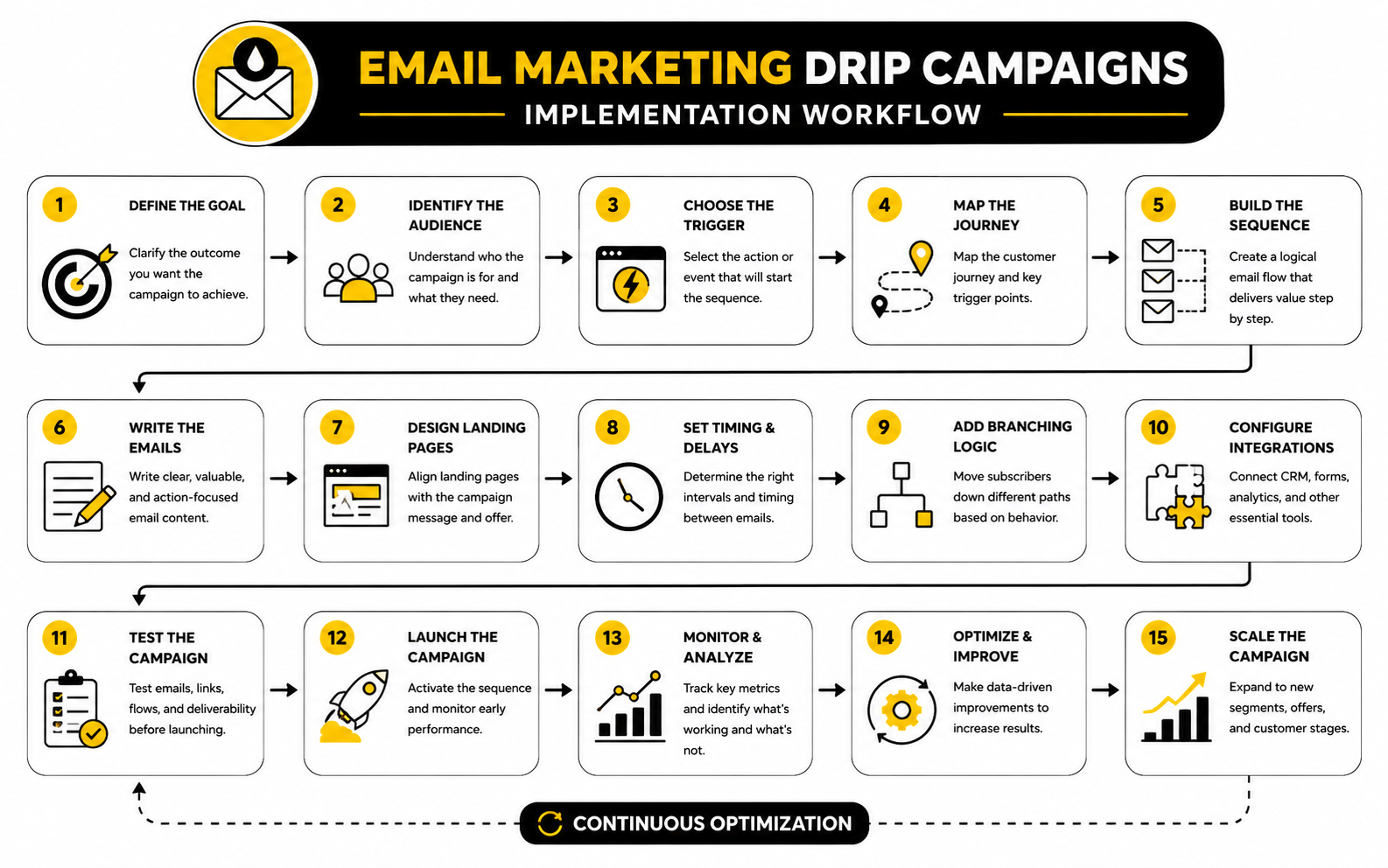
A practical workflow usually follows this order:
Exit conditions are especially important. If someone buys, books a call, upgrades, or replies, they should not keep receiving emails that act as if they have not taken action. Nothing breaks trust faster than an automation that ignores what the subscriber just did.
Choose The Right Platform Stack
The right platform depends on the business model. A creator selling a simple digital product does not need the same setup as an agency managing client pipelines. An ecommerce brand does not need the same automation stack as a consultant selling high-ticket strategy calls.
For service businesses, agencies, coaches, and local businesses, GoHighLevel is a strong fit because it combines CRM, email, SMS, pipelines, calendars, forms, funnels, and automation in one place. That matters when the campaign does not end at a click. If the goal is a booked appointment, a sales conversation, or a pipeline movement, the CRM side becomes just as important as the email side.
For funnel-heavy businesses, ClickFunnels makes sense when the landing page, offer page, order form, upsell, and follow-up sequence need to work together tightly. For leaner creators and small businesses that want an all-in-one setup without overcomplicating the tech, Systeme.io can be a practical starting point.
For ecommerce brands, the priority is different. You want product data, customer behavior, order history, segments, and automations that connect naturally to the store. Tools like Moosend and Brevo are worth considering when you need email automation, segmentation, and campaign management without building everything from scratch.
Write The Emails Around One Job Each
Each email should do one main job. One email welcomes. One educates. One handles a common objection. One shows proof. One explains the offer. One asks for the action. When every email tries to do everything, the whole sequence becomes heavy.
This is where clarity beats cleverness. The subject line should earn the open, the first sentence should connect to the subscriber’s situation, and the body should move one idea forward. The call to action should feel like the natural next step, not a random button dropped at the end.
Keep the language direct. People do not need a dramatic essay every time they hear from you. They need relevance, usefulness, and a clear reason to keep going.
Connect Forms, Tags, And Triggers Properly
The boring technical details matter. Forms need to apply the correct tag. Tags need to trigger the correct automation. Automations need to stop when the goal is completed. If this foundation is messy, the campaign will eventually send the wrong emails to the wrong people.
Use naming conventions from the beginning. For example, separate tags by purpose: source tags, interest tags, lifecycle tags, and behavior tags. That makes the system easier to manage when you have more campaigns running later.
A simple naming structure also helps when something breaks. If you see a tag called “Lead Magnet - Pricing Guide” or “Behavior - Viewed Checkout,” you know what it means. If everything is named “New Campaign 7,” you are building future chaos.
Test Before Launch
Testing is not optional. You need to subscribe through the form, confirm the right tag is applied, check every delay, open every email, click every link, and complete the conversion action. Then you need to confirm that the automation stops, branches, or updates the contact record correctly.
This is especially important when your sequence connects multiple tools. A landing page built in ClickFunnels, a CRM workflow in GoHighLevel, and a booking step through Cal.com can work beautifully together, but only if the handoffs are clean. One broken redirect or missing tag can quietly kill the entire flow.
Send test emails to different inbox providers if possible. Check mobile formatting, link tracking, unsubscribe visibility, sender name, reply-to address, and plain-text readability. Small details affect trust, and trust affects conversions.
Protect Deliverability From Day One
Deliverability is the part many people ignore until results drop. You can write a brilliant sequence, but it does not matter if your emails land in spam or promotions because your sending setup is weak. Professional implementation means treating deliverability as part of the campaign, not as an afterthought.
At minimum, use a real sending domain, authenticate properly, avoid spammy formatting, keep your list clean, make unsubscribing easy, and stop mailing people who never engage. Do not buy lists. Do not scrape contacts. Do not push aggressive daily sequences to people who barely know you.
This is also why your promise at opt-in matters. If someone signs up for one thing and receives something completely different, they are more likely to ignore, unsubscribe, or complain. Good email marketing drip campaigns protect the relationship before they try to monetize it.
Statistics And Data
Measurement is where email marketing drip campaigns stop being “content” and start being a revenue system. You are not tracking numbers just to make a dashboard look busy. You are looking for signals that tell you where people are paying attention, where they are losing interest, and where the sequence is either creating momentum or leaking it.
The key is to separate vanity metrics from decision metrics. Open rate can help you spot subject line and deliverability issues, but privacy changes have made it less reliable as a pure engagement signal. Clicks, conversions, replies, booked calls, purchases, revenue per recipient, and unsubscribe patterns usually tell you more about whether the campaign is actually working.
This matters because automation can quietly become one of the highest-leverage parts of the business. Omnisend’s 2025 ecommerce report found that automated emails generated 37% of email-driven sales from only 2% of email volume. That number is not just impressive; it explains why drip campaigns deserve proper measurement instead of being treated like a set-it-and-forget-it afterthought.
The Metrics That Actually Matter
Start with deliverability because nothing else matters if the email never reaches the inbox. Track bounce rate, spam complaint rate, unsubscribe rate, and inbox placement where your platform supports it. A campaign with great copy and poor deliverability is not a marketing asset; it is a hidden bottleneck.
Then look at engagement. Opens can show early interest, but clicks show intentional action. Click-to-open rate can help you judge whether the email content matched the promise of the subject line, while click-through rate shows how many total recipients took action.
Finally, measure business outcomes. For ecommerce, that means revenue, orders, conversion rate, average order value, and revenue per recipient. For service businesses, that means booked calls, qualified replies, show-up rate, pipeline value, closed deals, and time from opt-in to conversion.
A Practical Analytics System
Your analytics system should connect four layers: delivery, engagement, conversion, and revenue. Delivery tells you whether the message arrived. Engagement tells you whether people cared enough to interact. Conversion tells you whether the campaign moved them forward. Revenue tells you whether the whole thing was worth the effort.
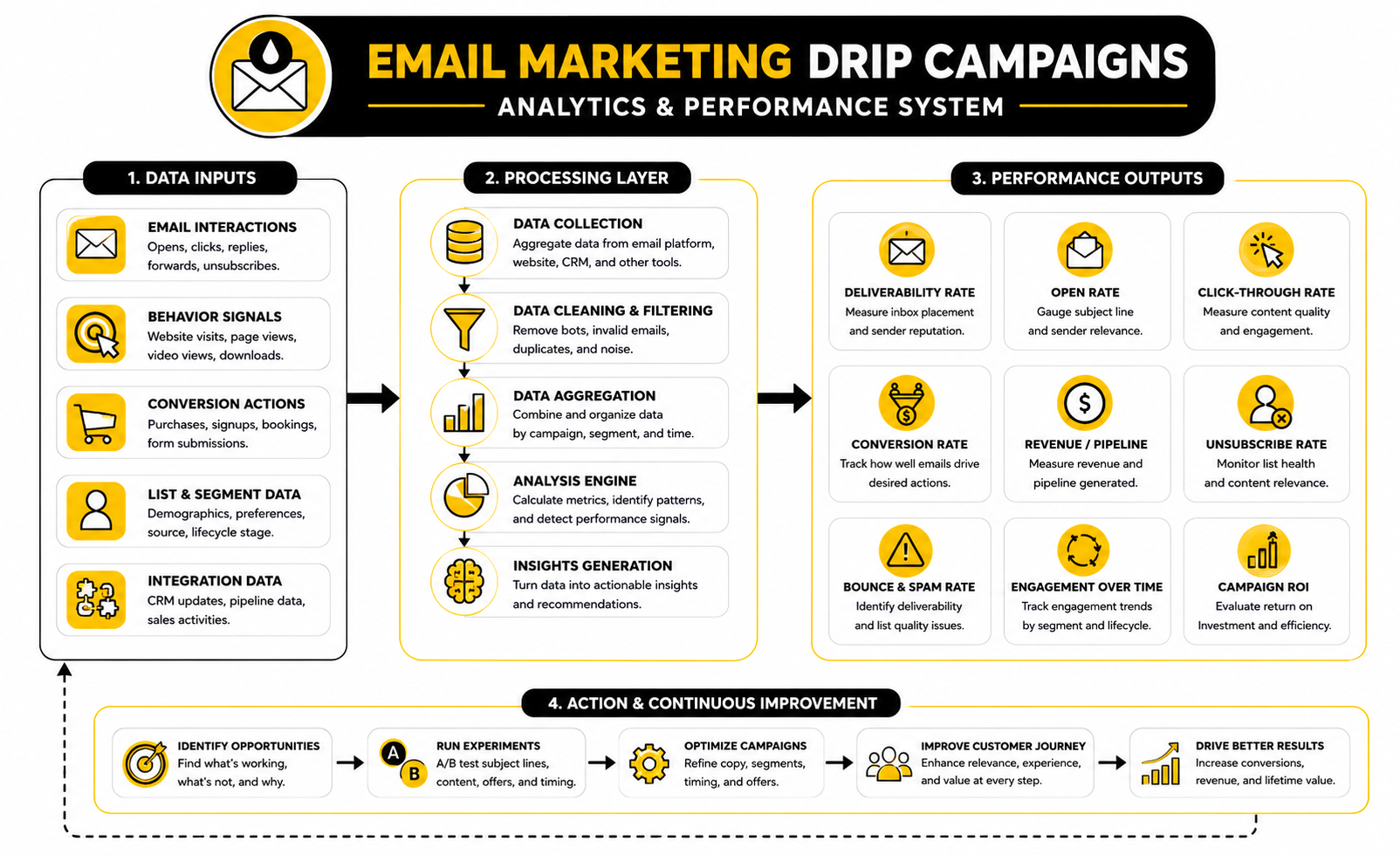
This is why the same campaign can look good in one report and weak in another. A welcome sequence may have high opens but low clicks, which means the subject lines are doing their job but the content or call to action needs work. An abandoned cart flow may have lower opens but strong revenue per recipient, which means the audience is smaller but much more commercially valuable.
Do not judge every campaign by the same metric. A nurture campaign should build qualified intent over time. A cart recovery campaign should recover purchases quickly. A reactivation campaign should identify who still wants to hear from you and clean out people who do not.
Benchmarks Need Context
Benchmarks are useful, but they are not commandments. A broad 2025 benchmark roundup placed the average open rate across industries around 42.35%, but that does not mean your campaign is broken if it sits below that number. Industry, list source, audience temperature, sender reputation, offer type, and campaign goal all change what “good” looks like.
A B2B sales nurture sequence will not behave like a flash-sale ecommerce flow. A post-purchase onboarding sequence will not behave like a cold reactivation campaign. Comparing them without context leads to bad decisions.
Use benchmarks as a starting point, then build your own baseline. After 30 to 90 days, your historical data becomes more useful than generic averages. The question is not just “Are we above the industry benchmark?” The better question is “Are we improving the right metric for this campaign’s job?”
How To Read Performance Signals
If open rates are low across the whole sequence, check sender reputation, list quality, subject lines, and whether people actually expected the emails. If open rates drop sharply after email one, your first message may be failing to create anticipation for the rest of the campaign. That is a positioning problem, not just a subject line problem.
If clicks are low but opens are healthy, the issue is usually inside the email. The content may be too broad, the call to action may be weak, or the email may not create enough reason to move forward. In that case, rewriting the body copy and tightening the offer usually matters more than changing the send time.
If clicks are strong but conversions are weak, look beyond the email. The landing page may not match the email promise, the offer may be unclear, the checkout may create friction, or the booking page may ask for too much too soon. This is where connecting your sequence to a proper funnel or CRM matters, because the email is only one part of the conversion path.
Revenue Per Recipient Is The Cleanest Signal
Revenue per recipient is one of the most useful metrics for ecommerce drip campaigns because it combines list size, engagement, conversion, and order value into one number. It tells you how much money each person in the campaign is worth on average. That is more useful than celebrating a high open rate on a campaign that does not sell.
For service businesses, the equivalent is pipeline value or booked-call value per recipient. If 1,000 leads enter a sequence and 25 book calls, you can measure the sequence by show-up rate, close rate, average deal size, and total pipeline created. That gives you a much clearer view than simply saying the campaign had a 38% open rate.
This is where a CRM-based setup like GoHighLevel can be useful. When email actions, pipeline stages, appointment bookings, and deal outcomes live in one system, you can see whether the drip campaign is creating real opportunities instead of just generating clicks.
What The Data Should Make You Do
Data should lead to action. If the first email gets strong engagement and the second one drops hard, improve the transition between them. If people click but do not buy, improve the landing page, offer clarity, proof, or checkout experience. If unsubscribes spike on a specific email, check whether the message is too aggressive, too irrelevant, or too disconnected from the original opt-in.
Only change one major variable at a time. If you rewrite the subject line, change the offer, move the CTA, shorten the email, and adjust the send time all at once, you will not know what caused the improvement. Clean testing is boring, but it works.
The goal is not to optimize forever. The goal is to find the few changes that produce the biggest lift. In most email marketing drip campaigns, that usually means improving the trigger, tightening the message arc, fixing weak calls to action, and removing friction after the click.
Track ROI Without Lying To Yourself
ROI tracking gets messy when attribution is weak. Someone may read three emails, click a retargeting ad, visit the site directly, and then buy two days later. That does not mean email had no impact; it means your reporting needs to account for assisted conversions and not just last-click sales.
Still, you need a practical model. Use UTM parameters, campaign-specific links, CRM source tracking, ecommerce attribution windows, and clear conversion events. For call-based businesses, track which sequence generated the booked call and whether that call became revenue.
The bigger issue is that many teams do not track ROI reliably at all. A 2026 report summarized by TechRadar noted that fewer than half of organizations could reliably track email ROI, even though companies that do measure it often report strong returns. That is the gap to avoid: sending more email while staying unclear on what it actually produces.
Build A Simple Reporting Rhythm
Review drip campaign performance weekly when the campaign is new, then monthly once it stabilizes. Weekly reviews help catch broken links, bad triggers, sudden deliverability issues, and obvious drop-offs. Monthly reviews give you enough data to spot patterns without overreacting to small sample sizes.
Your report does not need to be complicated. Track the campaign goal, entry volume, open rate, click rate, conversion rate, unsubscribe rate, revenue or pipeline created, and the weakest step in the journey. Then choose one improvement for the next cycle.
That rhythm keeps the campaign alive. Email marketing drip campaigns are not finished when they launch. They become valuable when they are measured, interpreted, and improved with discipline.
Advanced Use Cases, Common Mistakes, And FAQ
Once the foundation is working, email marketing drip campaigns become more than welcome emails and cart reminders. They become a way to manage different levels of intent across the full customer journey. This is where strategy gets more interesting, because the question is no longer “Can we automate this?” The question becomes “Should we automate this, and how much control should we keep?”
Advanced campaigns are powerful because they respond to behavior instead of relying only on fixed timing. A subscriber who clicks a pricing link is showing a different level of intent than someone who opens an educational email and does nothing else. A customer who buys once needs a different path than someone who buys repeatedly. When your system can recognize those differences, the campaign becomes sharper.
But advanced does not mean messy. The best systems are usually simple on the surface and disciplined underneath. They use clear segments, clean triggers, strong copy, and a few meaningful branches instead of turning the automation builder into a maze.
Lead Scoring And Intent-Based Follow-Up
Lead scoring helps you prioritize people based on behavior. A lead might gain points for opening emails, clicking offer links, visiting a booking page, watching a training, replying, or filling out a form. They might lose points when they ignore multiple emails, unsubscribe from a category, or stay inactive for a long period.
The danger is treating lead scoring like magic. A score is only useful if it triggers a more carefully next step. If someone reaches a high-intent threshold, the system might send a direct booking invitation, create a sales task, move the contact to a pipeline stage, or notify the team to follow up personally.
This is where a CRM-first platform like GoHighLevel fits naturally. Email behavior can connect to pipeline movement, appointments, tasks, and deal tracking. That makes the score operational instead of decorative.
Branching Logic Without Overcomplicating The Campaign
Branching lets you change the campaign path based on what someone does. If they click a product link, they can receive product-specific follow-up. If they do not click, they can receive more education. If they buy, they can exit the sales sequence and enter onboarding.
That said, branching can become a trap. Too many branches make the campaign hard to test, hard to troubleshoot, and hard to improve. When every tiny behavior creates a new path, you end up with a system that looks impressive but becomes fragile.
Use branches only when the next message should genuinely change. A pricing-page click, product-category interest, purchase, reply, booked call, or trial activation is meaningful. A single open is usually not enough to justify a totally different journey.
Multi-Channel Drip Campaigns
Email does not have to work alone. In some businesses, the strongest follow-up combines email with SMS, voicemail drops, retargeting, chat, calendar reminders, and sales tasks. The point is not to chase people everywhere; the point is to use the right channel for the right moment.
For example, email is great for education, proof, objection handling, and longer explanations. SMS can work for reminders, confirmations, and time-sensitive updates when the subscriber has clearly opted in. Chat automation through tools like ManyChat can support conversations that start on social platforms and then move into email or booking flows.
The tradeoff is complexity and consent. Every extra channel creates more moving parts, more compliance responsibility, and more chances to annoy people. Multi-channel follow-up works best when each channel has a clear role and the subscriber understands what they signed up for.
Sales Team Handoffs
Not every conversion should be fully automated. If the product is expensive, consultative, or customized, the drip campaign should warm up the lead and then hand the conversation to a human at the right moment. Automation should create context, not replace judgment.
A good handoff includes the lead source, emails clicked, pages visited, form answers, objections raised, and the action that triggered the handoff. That gives the salesperson a real reason to reach out. Instead of saying, “Just checking in,” they can respond to the person’s actual behavior.
This is why disconnected tools create problems. If the email platform knows one thing, the booking tool knows another, and the CRM knows almost nothing, the handoff becomes weak. A connected setup prevents that gap and helps the sales conversation feel timely instead of random.
Lifecycle Campaigns
The most profitable drip campaigns are often not the ones that chase brand-new leads. They are the ones that improve the customer lifecycle after someone already trusts you. Post-purchase education, onboarding, replenishment, renewal, upsell, cross-sell, referral, and win-back campaigns can all create revenue from existing relationships.
This matters because the first purchase is rarely the full value of the customer. A buyer who gets a helpful onboarding sequence is more likely to use the product properly, avoid confusion, and come back when they need more. A client who receives thoughtful follow-up after a project is more likely to refer, renew, or buy the next offer.
Lifecycle campaigns should feel supportive, not extractive. The first goal is to help the customer get the result they paid for. The next offer should come only when it naturally supports that result.
Offer Sequencing
Offer sequencing is the order in which you present calls to action. A weak sequence asks for too much too early or keeps asking for tiny actions when the subscriber is already ready to buy. A strong sequence matches the offer to the level of trust and intent.
For a cold subscriber, the first offer may be a guide, checklist, workshop, or short consultation. For a warmer lead, it may be a comparison page, demo, audit, or trial. For a buyer, it may be an upgrade, bundle, refill, implementation service, or complementary product.
The key is to avoid treating every email like a final sales pitch. Some emails should move the person closer without asking for the main purchase yet. That patience often makes the eventual sales email perform better because it arrives after context has been built.
Frequency And Fatigue
More automation does not automatically mean more revenue. If subscribers receive too many campaigns at once, they stop paying attention. Worse, they may unsubscribe, complain, or mentally downgrade your brand because every message feels like another push.
Frequency management becomes more important as you scale. A person might be eligible for a welcome campaign, a product campaign, a newsletter, a webinar reminder, and a promotional sequence at the same time. Without suppression rules, that person can get overwhelmed quickly.
Use campaign priority rules. Sales-critical flows may take priority over general newsletters. Post-purchase onboarding should usually pause aggressive prospecting emails. Reactivation campaigns should avoid colliding with fresh purchase behavior.
Suppression Rules
Suppression rules decide who should not receive a campaign. This is one of the least exciting parts of email automation, but it is also one of the most important. A good campaign is not only defined by who enters; it is also defined by who is excluded.
Common suppressions include recent buyers, active sales opportunities, current clients, unsubscribed categories, unengaged contacts, bounced addresses, and people already inside another high-priority sequence. These rules protect the subscriber experience and keep your reporting cleaner.
Suppression is especially important for promotions. If someone just paid full price, immediately sending them a discount campaign can create frustration. If someone is already talking to sales, dropping them into a generic nurture sequence can make your process feel sloppy.
AI-Assisted Campaign Building
AI can help with email marketing drip campaigns, but it should not replace strategy. It can draft subject lines, summarize objections, create first-pass email copy, generate segmentation ideas, and help repurpose long-form content into sequence drafts. That saves time, especially when you already know the campaign goal.
The risk is generic output. If you give an AI tool a vague prompt, it will usually produce vague emails that sound like every other marketing sequence online. The input needs real context: audience, offer, pain points, objections, proof, trigger, campaign goal, and brand voice.
Tools like GoHighLevel AI can be useful when AI support is tied to the actual marketing and sales workflow. Still, the final judgment should stay human. Automation can scale your thinking, but it should not flatten your voice.
Compliance And Trust
Compliance is not just a legal checkbox. It is part of trust. People should know why they are receiving your emails, how to unsubscribe, and what kind of communication to expect after they opt in.
This means using permission-based lists, honoring unsubscribe requests, avoiding misleading subject lines, and being careful with sensitive personal data. If your campaign crosses regions, you also need to understand the rules that apply to your audience. The more channels and data points you use, the more seriously you need to take consent.
Trust also affects performance. People engage with brands that respect the inbox. If your emails are clear, relevant, and easy to leave, subscribers are less likely to complain and more likely to stay engaged.
Scaling Without Breaking The System
Scaling email marketing drip campaigns does not mean adding endless sequences. It means improving the few sequences that control the most revenue, then expanding carefully. Most businesses should optimize the core campaigns before building advanced branches.
A simple scaling path looks like this:
This order keeps the system stable. It also prevents the common mistake of building advanced automation on top of weak fundamentals. If the welcome campaign is unclear, the offer is weak, and tracking is messy, more complexity will not fix the problem.
The Tradeoff Between Control And Automation
Automation gives you leverage, but it also creates distance. The more you automate, the more you need to make sure the system still reflects real customer behavior. If the campaign keeps sending irrelevant messages because nobody reviewed the logic, automation becomes a liability.
Control matters most at high-value moments. A reply, demo request, quote request, failed payment, complaint, refund request, or enterprise lead may deserve human attention. The campaign should recognize those moments and slow down or stop instead of pushing ahead blindly.
The best systems combine automation with judgment. Let the software handle timing, routing, reminders, and repetitive follow-up. Keep humans involved where empathy, negotiation, diagnosis, or strategic selling matters.
When To Rebuild Instead Of Optimize
Sometimes a campaign does not need another subject line test. It needs to be rebuilt. If the audience is wrong, the trigger is too broad, the offer is unclear, or the sequence is built around assumptions that no longer match the business, small tweaks will not solve the problem.
Rebuild when the campaign has a structural issue. That could mean the lead magnet attracts the wrong people, the email promise does not match the landing page, the CTA is too advanced for the subscriber’s stage, or the sequence ignores what buyers actually care about. Optimization works when the foundation is sound. Rebuilding is more carefully when the foundation is the problem.
This is a big one. Do not keep polishing a broken journey just because it already exists. If the campaign is confusing, irrelevant, or disconnected from the real buying process, rebuild it cleanly and use the old data to avoid repeating the same mistakes.
Bringing The System Together
At this stage, email marketing drip campaigns should no longer feel like a pile of automated messages. They should feel like a connected system that moves people from interest to trust, from trust to action, and from action to long-term value. That is the real job.
The full system has five moving parts: acquisition, segmentation, automation, conversion, and retention. Acquisition brings the right people into the list. Segmentation keeps the message relevant. Automation delivers the right sequence at the right moment. Conversion connects the email journey to the next business outcome. Retention keeps the relationship alive after the first win.
This is why the best campaigns are built around customer movement, not email volume. More emails are not automatically better. Better timing, cleaner logic, clearer offers, and stronger follow-up are what make the system work.
What are email marketing drip campaigns?
Email marketing drip campaigns are automated email sequences that send messages based on timing, behavior, or customer stage. Instead of manually sending every follow-up, you build a sequence once and let the system deliver each message when the subscriber qualifies for it. The goal is to guide people toward a useful next step without treating every contact the same.
How many emails should a drip campaign include?
Most drip campaigns work best with 3 to 7 emails, but the right length depends on the goal. A cart recovery sequence may only need 2 or 3 emails because the intent is already high. A B2B nurture campaign may need more emails because the decision is slower, more expensive, and usually requires more trust.
How often should drip emails be sent?
The cadence should match the subscriber’s intent. A welcome sequence can usually send messages closer together because the person just opted in. A longer nurture sequence often needs more space between emails so the campaign does not feel pushy or repetitive.
What is the difference between a drip campaign and a newsletter?
A drip campaign is automated and usually triggered by a specific action, such as a signup, download, purchase, or abandoned cart. A newsletter is usually sent manually or on a recurring schedule to a broader audience. Both can be useful, but drip campaigns are better for predictable customer journeys while newsletters are better for ongoing relationship building.
What is the best trigger for a drip campaign?
The best trigger is a meaningful action that reveals intent. A lead magnet download, pricing page visit, trial signup, product purchase, abandoned checkout, or booked call can all be strong triggers. Weak triggers create vague campaigns, while specific triggers make the follow-up more relevant.
What metrics should I track first?
Start with deliverability, click rate, conversion rate, unsubscribe rate, and revenue or pipeline created. Opens can still be useful, but they should not be the only metric because inbox privacy features can make open data less reliable. The best metric is the one tied to the campaign’s actual goal.
Do drip campaigns work for service businesses?
Yes, drip campaigns can work extremely well for service businesses when they are connected to a clear sales process. A sequence can educate leads, answer objections, share proof, invite a consultation, and remind people to book. For appointment-based businesses, a CRM and automation setup like GoHighLevel can help connect email follow-up with pipelines, calendars, and sales tasks.
Do drip campaigns work for ecommerce?
Yes, ecommerce brands can use drip campaigns for welcome flows, abandoned cart recovery, post-purchase education, replenishment reminders, win-back campaigns, and loyalty sequences. These campaigns work because they respond to customer behavior instead of relying only on broad promotional blasts. Omnisend’s 2026 coverage of 2025 ecommerce activity reported that automated emails represented only 2% of sends but generated 30% of email-attributed revenue, which shows why behavior-based automation deserves attention.
Should every drip campaign include a sales offer?
No, not every campaign needs to sell immediately. Some campaigns should educate, onboard, activate, qualify, or retain before asking for a purchase. The offer should match the subscriber’s stage, because asking too early can hurt trust while asking too late can waste intent.
How do I avoid annoying subscribers?
Set clear expectations at opt-in, send relevant messages, use suppression rules, and stop campaigns when the subscriber takes the desired action. Do not place people into too many sequences at once. The easiest way to reduce fatigue is to make sure every email has a reason to exist from the reader’s point of view.
What is the biggest mistake with email marketing drip campaigns?
The biggest mistake is building the automation before understanding the journey. If the trigger, audience, offer, and conversion goal are unclear, the sequence will feel random no matter how good the software is. Strategy comes first, then copy, then automation.
What tools are best for building drip campaigns?
The best tool depends on your business model. GoHighLevel fits service businesses and agencies that need CRM, email, SMS, calendars, and pipelines together. ClickFunnels fits funnel-based offers, while Systeme.io can be a leaner all-in-one option for creators and small businesses.
How do I know when a drip campaign needs to be rebuilt?
Rebuild the campaign when the foundation is wrong. That usually means the audience is poorly defined, the trigger is too broad, the offer does not match the subscriber’s intent, or the sequence no longer reflects the real buying process. Small tests help when the structure is sound, but a broken journey needs a cleaner rebuild.
Build a stronger local presence with BAAM AI
Turn your website, Google profile, social channels, and AI visibility into one growth engine
Most businesses do not need more random marketing activity. They need a consistent presence system that helps the right people find them, trust them, and take action. BAAM AI brings strategy, local SEO, website updates, Google Maps visibility, social content, AI-search readiness, media production, and reporting into one practical monthly engine.
If you want your marketing to keep working after the campaign ends, start with a free BAAM AI presence audit. See how your business shows up today and where the fastest visibility wins are at BAAM AI.