
BAAM AI Blog
Email Marketing Content: A Practical Framework For Messages People Actually Want To Read
Email marketing content is the substance of every message you send to subscribers, leads, customers, and past buyers. It includes the subject line, preview text, offer, story, product education, call to action...
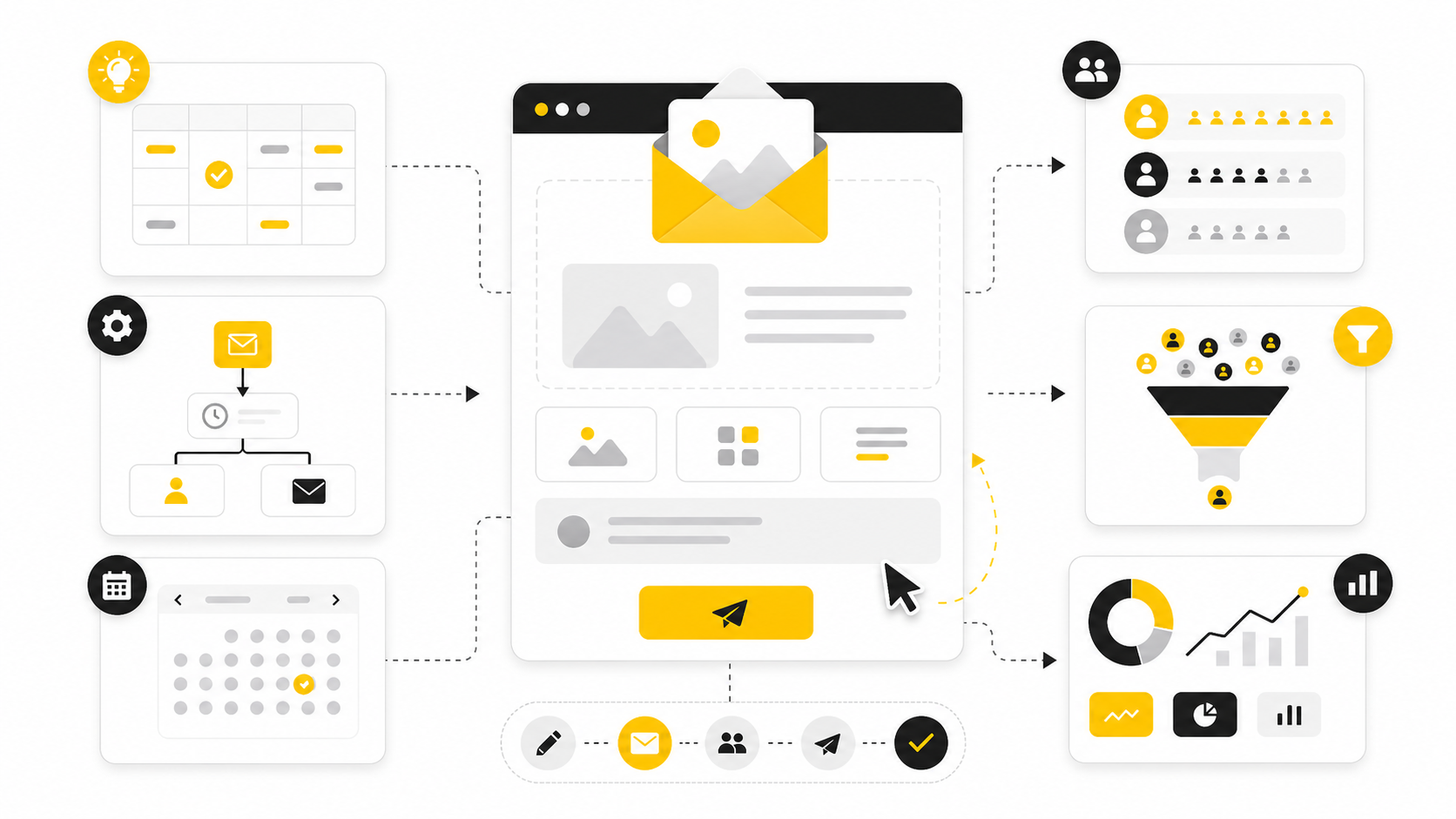
Email marketing content is the substance of every message you send to subscribers, leads, customers, and past buyers. It includes the subject line, preview text, offer, story, product education, call to action, segmentation logic, timing, and follow-up sequence behind the email. Good email marketing content does not feel like a random broadcast; it feels like the next useful step in a relationship.
That matters because inboxes are crowded, but email is still one of the few channels where you can build an owned audience instead of renting attention from an algorithm. The brands that win with email are not simply “sending newsletters.” They are designing content systems that turn attention into trust, trust into action, and action into repeat revenue.
The bar is higher now. Brevo’s 2025 benchmark analysis of more than 44 billion emails shows how much performance varies by region, industry, mailbox provider, and engagement quality, which means generic advice is not enough. You need a structure that helps you decide what to send, who should receive it, why they should care, and what should happen after they click.
Why Email Marketing Content Matters
Email marketing content matters because attention is no longer the hard part by itself. A subscriber may open your email, but that does not mean they are ready to click, buy, reply, book, or share. The content has to connect their current problem with a clear next step, and it has to do that quickly without sounding desperate.
The biggest mistake is treating email as a place to push announcements. Announcements are useful only when the reader already understands the value. Strong email marketing content creates that understanding before asking for action, which is why education, timing, proof, and offer clarity matter as much as the email design.
This is also why email should not be isolated from the rest of the customer journey. A welcome email, abandoned cart email, product launch email, and reactivation email all need different jobs, even if they come from the same brand. When the content matches the subscriber’s stage, email becomes a growth system instead of another task on the marketing calendar.
The Email Marketing Content Framework
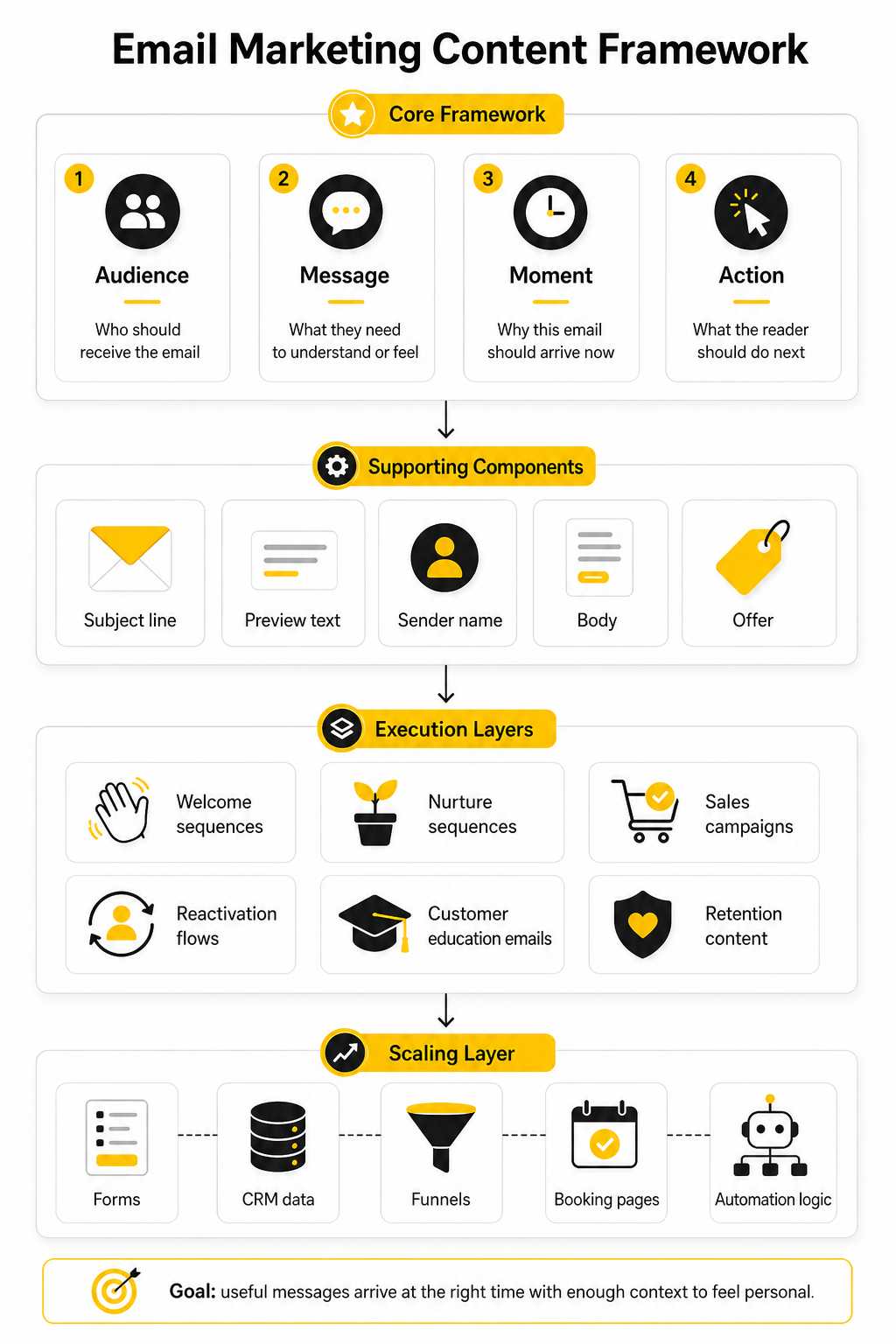
The simplest way to think about email marketing content is as a four-part system: audience, message, moment, and action. The audience determines who should receive the email. The message determines what they need to understand or feel before they move forward.
The moment determines why this email should arrive now instead of next week, next month, or never. The action determines what the reader should do after reading, whether that is clicking a product page, booking a call, replying with a question, watching a demo, or simply staying engaged for the next email. When one of these four pieces is weak, the email usually feels either irrelevant, vague, badly timed, or pointless.
This framework also protects you from writing content only because you “need to send something.” Every email should earn its place in the inbox. If you cannot define the audience, message, moment, and action, the email probably needs more thinking before it needs more copywriting.
Core Components Of High-Performing Email Content
High-performing email content usually starts before the body copy. The subject line creates the first reason to pay attention, while the preview text either strengthens that reason or wastes valuable space. The sender name also matters because people are more likely to engage when the email feels familiar, expected, and relevant.
The body of the email has a different job. It needs to create momentum from the first line to the call to action without burying the reader in filler. Clear email marketing content usually makes one main point, supports that point with useful context, and gives the reader one obvious next step.
The offer is the part many marketers underwrite. A weak offer cannot be saved by a clever subject line or a prettier template. If the reader does not understand what they get, why it matters, and why now is the right time to act, the email will struggle even if the list is healthy.
Professional Implementation Starts With A System
Professional email marketing content is not written one campaign at a time forever. It is built from repeatable assets: welcome sequences, nurture sequences, sales campaigns, reactivation flows, customer education emails, and retention content. This is where tools can help, especially when they connect email with forms, CRM data, funnels, booking pages, and automation logic.
For example, an agency or service business may want an all-in-one system like GoHighLevel because the email content can sit closer to pipelines, appointments, workflows, and lead follow-up. A creator or small business that wants a simpler email platform may prefer something like Moosend or Brevo when the priority is campaign sending, automation, and audience management without overcomplicating the stack. The tool matters, but only after the strategy is clear.
The goal is not to automate bad content faster. The goal is to make useful messages arrive at the right time with enough context to feel personal. That is the difference between email marketing that burns a list and email marketing that compounds.
The Email Marketing Content Framework
The framework from Part 1 is simple on purpose: audience, message, moment, and action. You do not need a complicated model to write better emails. You need a practical way to stop guessing and start making sharper decisions before the email is written.
Most weak email marketing content fails because one of those four parts is missing. The audience is too broad, the message is too vague, the timing feels random, or the call to action asks for too much too soon. When all four parts work together, the email feels useful instead of interruptive.
This also gives you a clean way to review drafts. Before sending, ask whether the email is clear about who it is for, what it helps them understand, why they are receiving it now, and what they should do next. If the answer is fuzzy, the copy is not ready.
Audience
Audience is not just your list size. It is the specific group of people who should receive a specific message because they share a need, behavior, interest, stage, or intent. A 50,000-person list can perform badly if every subscriber receives the same generic email, while a smaller segment can drive stronger results because the content feels more relevant.
Start with the subscriber’s relationship to your business. New subscribers need orientation and trust. Warm leads need clarity and proof. Buyers need onboarding, usage help, and reasons to come back. Inactive subscribers need a reason to care again, not another standard promotion.
This is where segmentation becomes practical rather than technical. You can segment by source, product interest, purchase history, engagement, lifecycle stage, or sales readiness. The point is not to create endless micro-segments. The point is to make sure each email marketing content decision starts with a real reader, not a faceless database.
Message
The message is the core idea the reader should take away. Not the topic, not the product, and not the discount. The message is the useful conclusion you want the reader to reach after opening the email.
For example, “we launched a new feature” is not a strong message by itself. “You can now save two hours on the weekly reporting task you already hate” is much stronger because it translates the feature into a reader-level benefit. That shift matters because subscribers do not wake up hoping to read product updates; they care about outcomes, friction, risk, speed, status, savings, and relief.
Good email marketing content usually has one main message. If you try to explain five ideas, promote three offers, and link to seven pages, you make the reader do the prioritization work. That is lazy marketing. Pick the main point, support it well, and remove anything that weakens the path to action.
Moment
Moment is the reason the email belongs in the inbox now. Sometimes the moment is obvious, like a cart abandonment, webinar reminder, renewal notice, price change, or product launch. Other times, the moment is created by context, such as a seasonal problem, a recent behavior, a milestone, or a known objection in the buying process.
This is where automation becomes powerful. A welcome sequence can respond to signup intent. A post-purchase sequence can help a customer get value before they forget why they bought. A reactivation sequence can test whether a subscriber still wants to hear from you before your deliverability suffers.
Timing also has a compliance and trust angle now. Google’s sender guidelines and Yahoo’s sender best practices both push senders toward authentication, easy unsubscribe, and lower complaint rates, which means careless sending is not just a branding problem. It can become an inbox placement problem. The better your timing and relevance, the less you have to rely on volume to get results.
Action
Action is the next step you want the reader to take. It should be specific, logical, and proportionate to the reader’s stage. Asking a brand-new subscriber to buy a high-ticket offer immediately can work in some funnels, but in many cases the better action is to read a guide, answer a question, watch a short demo, or choose a preference.
The call to action should match the promise of the email. If the email educates the reader about a problem, the CTA should help them solve or diagnose that problem. If the email introduces an offer, the CTA should take them to a page that continues the same argument instead of forcing them to start over.
This is why email and landing pages have to be planned together. A strong email can still fail when the click leads to a confusing page, a slow form, or an offer that does not match the email’s language. If you are building campaign pages alongside your email marketing content, tools like ClickFunnels, Systeme.io, or Replo can make sense when they help you keep the email, page, and conversion path aligned.
How The Framework Changes The Way You Plan Emails
Once you use the framework, planning becomes faster because you stop starting with a blank page. You can define the audience, message, moment, and action first, then write the subject line and body copy around that decision. This gives the email a job before you start polishing sentences.
It also helps teams avoid subjective feedback loops. Instead of arguing whether a subject line “sounds good,” you can ask whether it creates the right expectation for the right audience. Instead of debating whether the email is too long, you can ask whether every section helps the reader take the intended action.
That discipline becomes more important as reporting gets less straightforward. Apple Mail Privacy Protection has made open rates less reliable for many marketers because opens and open-related signals can be inflated or obscured, while click behavior remains more useful for understanding actual engagement in many campaigns, as explained in Mailchimp’s Apple privacy guidance. In plain English: do not build your entire content strategy around opens. Build it around meaningful behavior.
Use The Framework Before Writing The First Draft
Before writing, fill in four short answers. Who is this email for? What should they understand? Why should they receive it now? What should they do next? These answers do not need to be fancy, but they do need to be clear.
A practical planning note might look like this:
That gives the writer direction. It also keeps the email from drifting into unrelated product education, generic encouragement, or a premature sales pitch. The content can now focus on helping the reader make progress.
Use The Framework To Cut Weak Copy
Editing is where the framework really pays off. Every sentence should support the audience, message, moment, or action. If a sentence does not help with one of those, it is probably there because the writer liked it, not because the reader needs it.
This is especially important for promotional email marketing content. Promotional emails often get bloated with brand language, extra claims, secondary offers, and unnecessary urgency. The reader does not need all of that. They need a clear reason to care, enough confidence to click, and a next step that feels worth taking.
Cutting weak copy does not mean making every email short. Some emails need detail because the decision is complex or the reader needs more reassurance. The real goal is not short copy. The goal is useful copy with no dead weight.
Use The Framework To Keep Automation Human
Automation should make your emails more timely, not more robotic. A sequence can be technically perfect and still feel cold if the content does not reflect what the subscriber is experiencing. The framework forces each automated email to earn its place in the journey.
For example, a welcome sequence should not be a random pile of brand facts. It should move the subscriber from curiosity to clarity. A post-purchase sequence should not immediately chase the next sale. It should help the customer get value, reduce regret, and understand what to do next.
This is where platforms like GoHighLevel, Brevo, and Moosend are most useful when the automation supports a clear content strategy. The software can trigger the message, personalize fields, and route people through workflows. It cannot decide what your audience needs to hear unless you do that thinking first.
Core Components Of High-Performing Email Content
High-performing email marketing content is not one magic subject line or one clever call to action. It is the combination of small decisions that make the message easier to open, easier to understand, and easier to act on. When those decisions work together, the email feels intentional from the inbox preview all the way to the landing page.
The core components are simple: the promise, the hook, the body, the proof, the call to action, and the follow-up path. Each one has a job. If one part is weak, the whole email becomes harder to trust.
This is why professional email content should be built like a system, not improvised every time. You can still sound human, conversational, and fresh. But underneath that voice, there should be a repeatable process that keeps every message focused.
The Promise
The promise is the reason the reader should give the email attention. It starts in the subject line, continues in the preview text, and must be fulfilled quickly in the opening lines. If the promise is unclear, the reader has no reason to keep going.
A strong promise is specific without being clickbait. It gives the reader a reason to care, but it does not trick them into opening. That distinction matters because misleading email marketing content may earn a short-term open, but it damages trust and makes future emails easier to ignore.
The best promises usually connect to a real desire, problem, question, or moment. They can be practical, emotional, urgent, educational, or curiosity-driven. What they cannot be is empty.
The Hook
The hook is the first turn inside the email. It confirms that the reader made the right decision by opening. This is where many emails lose people because the subject line creates interest, but the opening paragraph drifts into generic brand talk.
A good hook gets to the point without feeling abrupt. It can name the problem, challenge a belief, summarize the opportunity, or make the offer immediately relevant. The goal is not to be dramatic for the sake of drama. The goal is to make the reader feel, “Yes, this is for me.”
Avoid starting every email with the same soft opener. Lines like “Hope you’re doing well” are fine in personal communication, but they usually waste space in marketing emails. Your first few lines should move the reader closer to the main idea.
The Body
The body is where the email earns the click. It explains the idea, builds desire, reduces friction, and gives the reader enough context to make a decision. This does not always require a long email, but it does require a clear structure.
Most body copy works better when it follows a simple progression. Start with the reader’s situation, explain why it matters, introduce the useful idea or offer, and then guide them toward the next step. That structure keeps the content from becoming a random pile of benefits.
Strong email marketing content also respects attention. Short paragraphs help, but clarity matters more than formatting tricks. If the reader has to work too hard to understand what you mean, they will not reward you for being clever.
The Proof
Proof gives the reader confidence that your message is not just a claim. It can come from customer results, product screenshots, testimonials, data, use cases, guarantees, demonstrations, or clear explanations of how something works. The key is that the proof must support the specific promise of the email.
Do not overload every email with proof just because proof is useful. A welcome email may need credibility and orientation. A sales email may need stronger reassurance. A customer education email may need practical demonstration more than social proof.
The proof should feel natural inside the email, not bolted on at the end. If you are writing about a feature, show why it matters. If you are promoting a service, explain the mechanism. If you are asking for a bigger commitment, give the reader enough confidence to move forward without feeling pushed.
The Call To Action
The call to action should make the next step obvious. It should not feel like a sudden demand after a vague email. By the time the reader reaches the CTA, the action should feel like the natural continuation of the message.
One email can include more than one link, but it should usually have one main action. Multiple competing CTAs create decision friction. If you want the reader to book a call, do not also ask them to read three blog posts, follow you on social media, and browse a product catalog in the same message.
The CTA language should be clear, not overly cute. “See the workflow,” “Start your setup,” “Book the demo,” and “Get the checklist” usually work better than vague commands like “Learn more” when the reader needs certainty. The more specific the action, the easier it is to click.
How To Build Campaigns, Sequences, And Segments
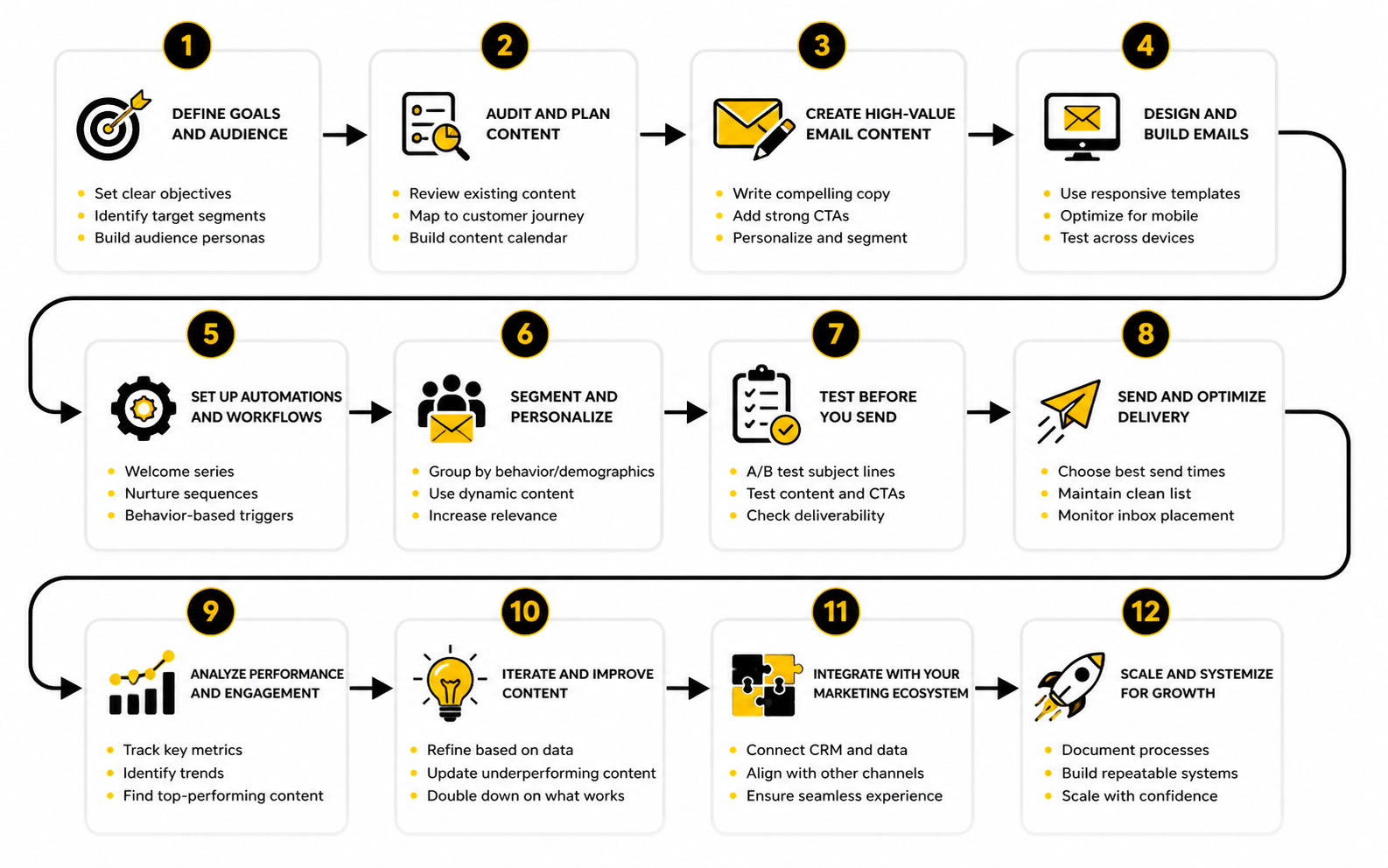
Once the core components are clear, implementation becomes much easier. You are no longer writing isolated emails. You are building campaigns and sequences that move different types of readers through different stages of awareness, trust, and action.
A campaign is usually tied to a specific business goal, such as launching an offer, promoting a webinar, driving product adoption, or reactivating inactive subscribers. A sequence is a planned series of emails that responds to a subscriber’s stage or behavior. A segment is the group of people who should receive that content because it is relevant to them.
This is where the process becomes tangible. The job is to map the journey before you write the copy. When you do that, every email has a role instead of fighting for attention on its own.
Step 1: Define The Business Goal
Start with the business goal, not the email idea. Do you want more trial activations, more sales calls, more repeat purchases, more event registrations, or more product usage? The answer changes the kind of email marketing content you need to create.
A goal like “send a newsletter” is not specific enough. A stronger goal would be “move new subscribers from first download to product demo” or “help recent buyers use the product before asking for an upsell.” That kind of goal gives the content direction.
The goal also determines what you should measure. A sales campaign may care about revenue, booked calls, or checkout starts. An onboarding sequence may care more about activation, feature usage, replies, or retention signals.
Step 2: Map The Reader’s Stage
Next, define where the reader is in the relationship. Are they new, curious, problem-aware, comparing options, ready to buy, already a customer, or drifting away? Each stage needs a different kind of message.
New subscribers usually need context and trust before they need a hard pitch. Warm leads may need proof, urgency, and a clear reason to act now. Customers often need education, support, and confidence that they made the right decision.
This step prevents one of the most common content mistakes: sending the right message to the wrong stage. A discount can feel helpful to someone ready to buy, but premature to someone who still does not understand the problem. Good email marketing content meets the reader where they are.
Step 3: Choose The Email Type
After the stage is clear, choose the type of email that fits the job. Not every email should sell. Some emails should welcome, teach, diagnose, compare, remind, invite, onboard, recover, or retain.
Common email types include:
Choosing the type first makes the copy sharper. A nurture email should not read like a desperate promotion. A promotional email should not hide the offer under five paragraphs of vague education.
Step 4: Build The Content Brief
A content brief keeps the email focused before writing starts. It does not need to be long. It just needs to capture the decisions that matter.
A useful email brief should define:
This is where teams save a lot of time. The writer does not have to guess the strategy, and the reviewer does not have to judge the email purely by taste. Everyone can compare the draft against the same brief.
Step 5: Write The Email Around One Main Job
Once the brief is clear, write the email around one main job. If the goal is to get a demo booking, every section should make that booking feel relevant and valuable. If the goal is to help a customer complete setup, every section should reduce confusion and make progress feel achievable.
This is also where you decide how much copy the email needs. A simple reminder may need only a few lines. A complex offer may need more explanation, proof, and objection handling.
Do not confuse length with quality. A short email can be weak if it is vague. A longer email can work well if every sentence helps the reader make a better decision.
Step 6: Connect The Email To The Next Step
The email is only one part of the path. The landing page, form, booking flow, checkout, or reply process has to continue the same message. If the email creates one expectation and the next page creates another, conversions leak.
This is especially important for campaign builds. If your email promises a practical demo, the page should make that demo easy to understand and book. If your email promotes a limited offer, the page should reinforce the offer clearly instead of making the reader hunt for details.
For funnel-heavy campaigns, ClickFunnels, Systeme.io, and Replo can help when the priority is turning email clicks into structured conversion paths. For service businesses and agencies that need email, CRM, pipelines, appointments, and automation in one place, GoHighLevel can make the implementation cleaner. The right tool is the one that reduces friction between the message and the action.
Step 7: Review Before Sending
The final review should be practical, not cosmetic. Check whether the subject line matches the email. Check whether the opening pays off the promise. Check whether the CTA is obvious and whether the email is going to the right segment.
You should also check the basics: links, personalization fields, mobile readability, unsubscribe visibility, sender details, and tracking. These details are not glamorous, but they protect the campaign. A strong email with a broken link is still a failed send.
Reviewing also means asking whether the email should be sent at all. If the message is weak, the segment is wrong, or the timing feels forced, pause. Protecting the list is part of professional email marketing content, not a separate deliverability chore.
Statistics And Data
Email marketing data is useful only when it changes what you do next. Random benchmark numbers do not make your email marketing content better. They become valuable when they help you diagnose whether the problem is attention, relevance, deliverability, offer strength, or the post-click experience.
The first rule is simple: never judge an email from one metric alone. A high open rate with weak clicks can mean the subject line worked, but the message or offer did not. A low open rate with strong revenue can mean the segment was small, specific, and valuable. A strong click rate with poor sales can mean the email did its job, but the landing page, checkout, demo flow, or offer needs work.
Benchmarks should be treated as context, not commandments. Brevo’s 2025 benchmark analysis of more than 44 billion emails shows major differences across regions and industries, with North America, EMEA, APAC, and LATAM all showing different average open rates, click-through rates, unsubscribe rates, and bounce rates. That is the point: your numbers need to be compared against your audience, your industry, your list quality, and your campaign goal.
The Metrics That Actually Matter
The most useful metrics sit in layers. Delivery and bounce rate tell you whether the email reached mailboxes. Open rate gives a rough signal of inbox visibility and subject-line pull, but it is no longer clean enough to be treated as truth by itself. Click rate, conversion rate, revenue, replies, unsubscribes, complaints, and retention signals tell you much more about whether the content created useful action.
Open rate still has a place, but it needs caution. Apple Mail Privacy Protection changed how open tracking works because emails can be preloaded through Apple systems, which means opens can be inflated or disconnected from real human engagement. Mailchimp’s Apple privacy guidance explains why marketers should be careful when using opens to measure engagement, trigger automations, or clean lists.
Clicks are usually more useful because they show active intent. Even then, a click is not the finish line. If people click but do not convert, the next thing to inspect is the offer, page, form, checkout, booking process, or expectation match between the email and the destination.
How To Read Benchmarks Without Fooling Yourself
Benchmarks are helpful when you use them to ask better questions. If your click-through rate is far below your industry average, the first question is not “How do we make the button bigger?” The better question is whether the email marketing content gave readers a strong enough reason to click.
If unsubscribes rise after a campaign, do not panic immediately. Some unsubscribes are healthy because they remove people who no longer want your emails. But if unsubscribes rise while clicks and conversions stay weak, that is a warning sign that the content, frequency, targeting, or offer is misaligned.
Bounce rate is different because it is more operational. High hard bounces usually point to list quality, acquisition sources, old data, or poor hygiene. Soft bounces can reflect temporary mailbox or server issues, but repeated soft bounce problems still deserve attention because deliverability is part of performance, not a separate technical side quest.
Build A Measurement System, Not A Reporting Ritual
A reporting ritual tells you what happened. A measurement system tells you what to change. That difference matters because many teams collect email data every week and still make the same content mistakes every month.
Your measurement system should connect each metric to a decision. Open rate should influence subject line testing, sender expectations, and deliverability checks. Click rate should influence message clarity, offer framing, CTA strength, and segmentation. Conversion rate should influence landing page alignment, sales process, pricing, proof, and friction after the click.
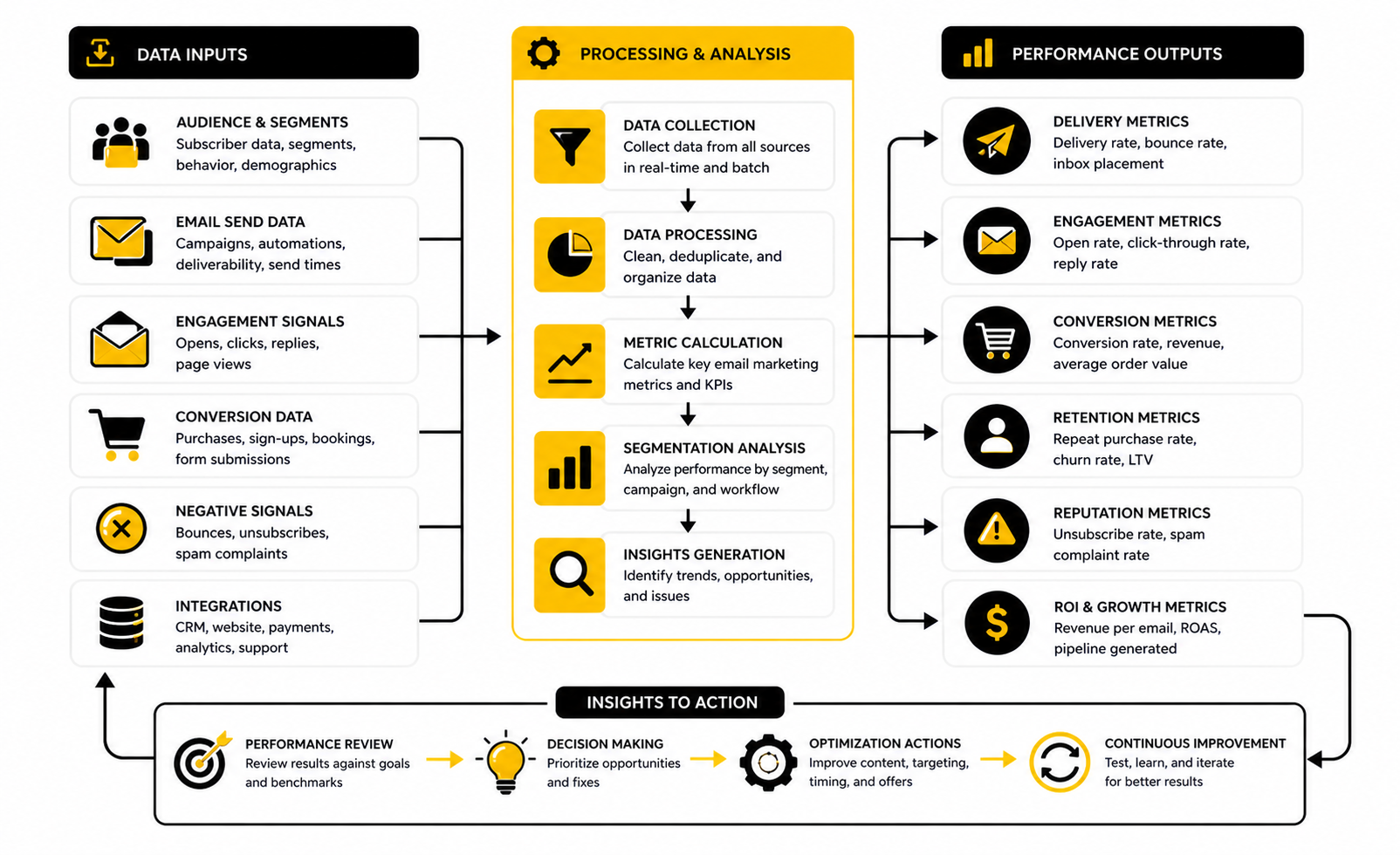
A practical dashboard does not need fifty numbers. It needs the right numbers grouped by job. Track list health, engagement, conversion, revenue, and retention separately so you can find the actual bottleneck instead of blaming the entire campaign.
List Health Metrics
List health tells you whether your email program is becoming stronger or weaker over time. The core signals are subscriber growth, active subscriber percentage, bounce rate, unsubscribe rate, spam complaint rate, and engagement by segment. These numbers tell you whether your audience still wants what you send.
Spam complaints deserve special attention because mailbox providers treat them seriously. Gmail’s sender rules require bulk senders to keep reported spam rates low, avoid impersonation, authenticate sending domains, and provide easy unsubscribe options. Google’s sender guidelines make it clear that authentication, relevance, and complaint control are now baseline requirements for serious senders.
Do not wait until deliverability collapses to care about list health. If your inactive segment keeps growing, your acquisition sources may be attracting the wrong people, your onboarding may be weak, or your content may not be matching subscriber intent. The earlier you see that pattern, the easier it is to fix.
Engagement Metrics
Engagement metrics show whether people are interacting with your emails. Click rate, click-to-open rate, replies, forwards, saves, and product actions after the click can all reveal whether the content is creating momentum. These signals are more useful when reviewed by segment rather than averaged across the entire list.
Averages can hide the truth. One segment may love your educational content while another only responds to product updates. One acquisition source may produce subscribers who click for months, while another source produces people who disappear after the lead magnet.
That is why email marketing content should be reviewed by audience source and lifecycle stage. If webinar leads behave differently from paid ad leads, they should not always receive the same sequence. The numbers should help you write more relevant content, not just decorate a monthly report.
Conversion Metrics
Conversion metrics show whether the email created business value. Depending on the campaign, that may mean purchases, booked calls, trial activations, demo requests, webinar registrations, upgrades, renewals, or completed onboarding steps. The key is to define the conversion before writing the email.
A common mistake is measuring every campaign by immediate sales. That works for some promotions, but it is too narrow for nurture, onboarding, retention, and education. A customer education email may be successful if it increases product usage or reduces support friction, even if it does not create a purchase that day.
This is where your email platform and your CRM need to work together. If you cannot connect emails to pipeline, revenue, or customer behavior, your reporting will stay shallow. For businesses that want email automation connected to contacts, pipelines, appointments, and follow-up workflows, GoHighLevel can be useful because the measurement can sit closer to the sales process.
Revenue Metrics
Revenue is the cleanest metric when the buying path is trackable. Look at revenue per recipient, revenue per email, revenue per campaign, average order value, conversion rate, and customer lifetime value where possible. These numbers show whether your email marketing content is attracting low-quality clicks or profitable customers.
Return on investment still matters, but it needs accurate tracking. Litmus reported in 2025 that many companies see email ROI between 10:1 and 36:1, while newer industry coverage of Sinch Mailgun’s 2026 Email Impact findings highlights that many businesses still struggle to reliably track email ROI even when returns are strong for companies that do measure it. The lesson is not “email always prints money.” The lesson is that email can be highly profitable when tracking, attribution, deliverability, and content strategy are handled properly.
Revenue metrics should also be read over time. A campaign that generates quick sales but increases complaints, refunds, or churn may not be healthy. Strong email programs protect the future value of the list while generating current revenue.
Retention Metrics
Retention metrics show whether email keeps customers engaged after the first conversion. This includes repeat purchase rate, renewal rate, product usage, churn, review generation, referral activity, and customer support behavior. These numbers are especially important because email is not only an acquisition channel.
Retention content is often where brands leave easy money on the table. They send aggressive promotions to non-buyers, then send weak onboarding to people who already paid. That is backwards. Customers need content that helps them use, enjoy, trust, and expand the thing they bought.
Good retention email marketing content reduces regret and increases confidence. It reminds customers why they bought, helps them get value faster, and introduces the next logical step only when it makes sense. That is how email becomes a customer experience channel, not just a promotional one.
Turning Data Into Better Email Marketing Content
Data should lead to specific content decisions. If opens are weak, test the sender name, subject line, preview text, timing, and deliverability. If clicks are weak, improve the promise, hook, offer framing, and CTA clarity. If conversions are weak, inspect the post-click path before rewriting every email.
You should also review qualitative signals. Replies, support tickets, sales objections, cancellation reasons, reviews, and chat conversations often explain what the dashboard cannot. Numbers show where the problem is. Customer language often tells you why it exists.
The best teams combine both. They use metrics to find patterns, then use real customer language to sharpen the message. That is how email marketing content gets more relevant without becoming mechanical.
What To Test First
Testing should follow the biggest suspected bottleneck. If nobody opens, test the inbox-level elements. If people open but do not click, test the email’s main promise, structure, proof, and CTA. If people click but do not convert, test the page, offer, friction, or follow-up.
Do not test tiny details before the big ones. Button color, punctuation, or a single word in the footer rarely matters as much as audience fit, offer strength, timing, and message clarity. Small tests are fine once the fundamentals are working, but they are a poor substitute for strategic thinking.
A simple testing order works well:
This keeps the testing practical. You are not chasing random lifts. You are learning which part of the system needs improvement.
How Often To Review Performance
Review campaign performance soon after sending, but do not overreact too quickly. Some emails generate most clicks early. Others, especially B2B or considered-purchase emails, may create delayed responses, forwarded conversations, or later pipeline movement.
Weekly review is useful for active campaigns and automation health. Monthly review is better for trends across segments, content types, and lifecycle stages. Quarterly review should focus on bigger questions like list quality, sequence performance, attribution, deliverability, and revenue contribution.
Do not make every decision from one send. A single campaign can be affected by timing, seasonality, list mix, offer fatigue, or external events. Patterns matter more than isolated spikes.
The Data Should Make Your Content More Human
The point of analytics is not to turn your emails into sterile performance assets. The point is to understand what people respond to, what they ignore, what they need more clarity on, and where they lose confidence. Used properly, data makes email more human because it forces you to listen.
If a segment keeps clicking beginner content, stop sending them advanced sales messages too early. If customers keep opening onboarding emails but still fail to activate, the content may be interesting but not useful enough. If a reactivation campaign gets replies from frustrated subscribers, read those replies carefully before writing the next campaign.
Numbers do not replace judgment. They sharpen it. The best email marketing content comes from combining strategy, customer understanding, and performance data into one feedback loop.
Professional Implementation And Optimization
Once the basics are working, the next challenge is not writing more emails. The next challenge is scaling email marketing content without turning the inbox into a dumping ground. More campaigns, more segments, more automations, and more tools can create growth, but they can also create noise if nobody owns the strategy.
This is where experienced marketers separate activity from leverage. Activity is sending because the calendar has a gap. Leverage is sending because the message supports a clear customer journey, protects deliverability, and moves a meaningful metric. That difference sounds simple, but it becomes harder as the email program grows.
Optimization is not just testing subject lines. It is deciding which messages deserve automation, which campaigns deserve promotion, which segments deserve different treatment, and which emails should be removed completely. Sometimes the best improvement is not adding another email. Sometimes it is deleting the weak one that keeps annoying the list.
Scaling Without Losing Relevance
Scale creates a relevance problem. When the list is small, you can often get away with broader messages because the audience is more familiar, engaged, or personally connected to the brand. As the list grows, the audience becomes more mixed, and generic email marketing content starts to break down.
The fix is not to create hundreds of tiny segments nobody can manage. The fix is to build practical segmentation around meaningful differences in intent, behavior, and lifecycle stage. A subscriber who downloaded a beginner guide should not always receive the same email as a customer who has bought three times. A lead who clicked a pricing page yesterday deserves a different message than someone who has not opened or clicked in months.
Behavior-based content matters because it responds to what people actually do. MoEngage’s 2025 benchmark analysis found that behavior-based email performance can significantly outperform non-personalized sending, which reinforces a practical point: relevance usually beats volume. Do not send more just because you can. Send better because the subscriber gave you a reason.
The Tradeoff Between Automation And Control
Automation is powerful because it makes timing more precise. A welcome email can arrive right after signup. A cart reminder can respond to purchase intent. A post-purchase sequence can help a customer succeed while the purchase is still fresh.
The tradeoff is control. Once automations multiply, subscribers can accidentally receive too many messages, receive conflicting offers, or move through outdated content nobody has reviewed in six months. That is how a sophisticated system starts feeling careless.
Every automation should have an owner, a purpose, and a review schedule. Review the trigger, segment rules, suppression rules, content, links, offer, and performance. If a workflow no longer supports the current customer journey, pause it, rebuild it, or retire it.
Frequency Is A Strategy Decision
Frequency is not about finding one magic number for every list. A daily email can work when the audience expects it and the content is consistently valuable. A monthly email can fail if it arrives with no relevance, no relationship, and no clear reason to act.
The right frequency depends on expectations, category, buying cycle, content quality, and subscriber behavior. Ecommerce brands may send more often during promotional periods. B2B companies may need slower nurture with stronger education and proof. Creators may build daily or weekly habits if the audience opted in for that rhythm.
The danger is letting internal pressure set the cadence. Revenue targets, launch deadlines, and campaign calendars can push teams to over-send. The inbox does not care about your internal pressure. Subscribers judge each email by whether it was worth receiving.
Deliverability Is A Content Problem Too
Deliverability is often treated like a technical issue, but content has a direct impact on it. People complain, ignore, delete, unsubscribe, or stop engaging when emails feel irrelevant or excessive. Those behaviors send signals that mailbox providers use to decide where future emails should land.
Authentication, domain setup, and compliance still matter. Gmail’s sender rules include authentication, one-click unsubscribe for marketing messages, honoring unsubscribe requests quickly, and keeping spam rates below 0.3%. Google’s sender guideline FAQ makes the risk clear: missing DMARC, poor formatting, missing one-click unsubscribe, slow unsubscribe handling, or complaint rates above the threshold can create delivery problems.
Yahoo has similar expectations. Yahoo’s sender best practices require senders to authenticate mail, keep spam complaints low, and make unsubscribing easy. In practical terms, your content strategy, list hygiene, and compliance setup now sit in the same room. You cannot separate them.
Protecting The List From Offer Fatigue
Offer fatigue happens when subscribers see too many promotions with too little value between them. At first, performance drops quietly. Then clicks soften, unsubscribes rise, complaints appear, and the same offer needs bigger discounts to get the same response.
The solution is not to stop selling. The solution is to make sales messages more intentional and support them with content that builds context. Teach the problem before presenting the offer. Show use cases before pushing urgency. Help customers succeed before asking for expansion.
A healthy email calendar usually has a mix of content types. You need promotional emails, but you also need education, onboarding, customer stories, product guidance, preference collection, and retention messages. That mix keeps the list warm without training people to only respond when you discount.
Using AI Without Making The Emails Sound Disposable
AI can help with drafts, variations, research summaries, segmentation ideas, and workflow planning. Used well, it speeds up production and helps teams explore more angles before choosing the strongest message. Used lazily, it creates bland email marketing content that sounds like every other brand in the inbox.
The risk is not that AI writes emails. The risk is that nobody adds judgment after the draft. AI can generate a subject line, but it does not know the emotional history of your audience, the real objections from sales calls, the subtle reasons customers hesitate, or the promises your brand should avoid making.
Use AI for acceleration, not abdication. Feed it customer language, campaign strategy, product context, objections, proof points, and brand constraints. Then edit like a human who cares about the reader. That last step is not optional.
Personalization Needs Boundaries
Personalization works when it makes the email more useful. It fails when it becomes creepy, inaccurate, or purely decorative. Adding a first name is not strategy. Referencing behavior, stage, interest, or context can be powerful when it helps the reader make progress.
The best personalization usually feels invisible. The subscriber receives the right content because of what they did, what they bought, what they requested, or where they are in the journey. They do not need to see every data point you used.
Be careful with sensitive assumptions. Do not imply you know more than the subscriber knowingly gave you. Do not over-personalize based on weak signals. Trust is hard to win and easy to lose, especially when email content starts feeling like surveillance instead of service.
Governance Keeps The Program From Becoming A Mess
As email programs grow, governance becomes essential. Someone needs to decide who can send, what gets approved, how segments are defined, how often automations are reviewed, and which claims are allowed. Without that, the email program becomes a pile of disconnected campaigns.
Governance does not have to slow everything down. In fact, good governance speeds up execution because the rules are clear. Writers know the voice. Marketers know the segmentation logic. Operators know the QA checklist. Leadership knows how email performance will be judged.
A simple governance system should cover:
This is not bureaucracy for the sake of it. It is how you protect a channel that can produce meaningful revenue for years.
Choosing Tools For The Stage You Are In
The right email stack depends on the business model and maturity of the program. A beginner does not need enterprise complexity. A scaling agency, ecommerce brand, creator business, or SaaS company may need more automation, better segmentation, cleaner analytics, and stronger workflow control.
For simple campaigns and automation, platforms like Brevo or Moosend can be enough. For service businesses, agencies, and local businesses that want CRM, pipelines, appointments, workflows, and email in one system, GoHighLevel is often a more connected option. For businesses where email drives people into dedicated funnels or campaign pages, ClickFunnels, Systeme.io, or Replo can help tighten the path from click to conversion.
Do not choose tools because they look impressive in a feature comparison. Choose tools based on the bottleneck. If your bottleneck is weak strategy, a bigger platform will not save you. If your bottleneck is disconnected data, manual follow-up, or messy campaign execution, the right platform can remove serious friction.
Advanced Optimization Is About Sequencing Decisions
At a higher level, optimization becomes less about individual emails and more about sequencing decisions. What should the subscriber learn first? When should they see proof? When should the offer appear? When should urgency enter? When should you stop sending and let behavior decide the next step?
This is especially important for longer buying cycles. If you push too soon, you create resistance. If you educate forever without a clear offer, you create passive readers who never act. Strong email marketing content manages that tension deliberately.
The best sequence usually does not feel like a sequence to the reader. It feels like a series of useful messages arriving at the right moments. Behind the scenes, though, each email has a specific role: orient, educate, challenge, prove, invite, remind, recover, or retain.
Risk Management Matters More As Email Grows
The larger the list, the more expensive mistakes become. A broken link, wrong segment, inaccurate claim, expired offer, or poorly configured automation can affect thousands of people in minutes. That does not mean you should become slow and fearful. It means your process needs guardrails.
Before major sends, check the segment, suppression rules, personalization fields, links, tracking, mobile layout, legal footer, unsubscribe path, offer accuracy, and landing page alignment. For automated flows, test the trigger logic and exit conditions. For high-volume sends, monitor deliverability and complaints after the campaign goes live.
Expert-level email marketing is not reckless. It is confident because it is controlled. The more important the channel becomes, the more disciplined the process needs to be.
Preparing The System For Long-Term Growth
Long-term growth comes from treating email as an asset. Your list, deliverability, customer data, messaging insights, tested offers, and automated journeys all become more valuable when managed properly. They become weaker when every send is treated as a one-off push.
A strong system gets more carefully over time. It learns which segments respond, which objections block sales, which offers create quality customers, which content reduces churn, and which messages deserve automation. That learning compounds if the team documents it.
The final stage is not perfection. It is consistency. Keep the strategy clear, the content useful, the measurement honest, and the list protected. That is how email marketing content becomes a durable growth channel instead of another campaign treadmill.
The Final Email Marketing Content System
At this stage, the goal is to bring everything together into one operating system. Strategy, content, automation, analytics, deliverability, and optimization should not live in separate boxes. They should work together so every email has a purpose, every sequence has a role, and every result teaches you something useful.
That is the real advantage of a mature email program. You are not just writing campaigns. You are building a system that collects attention, earns trust, creates action, measures behavior, and improves over time.
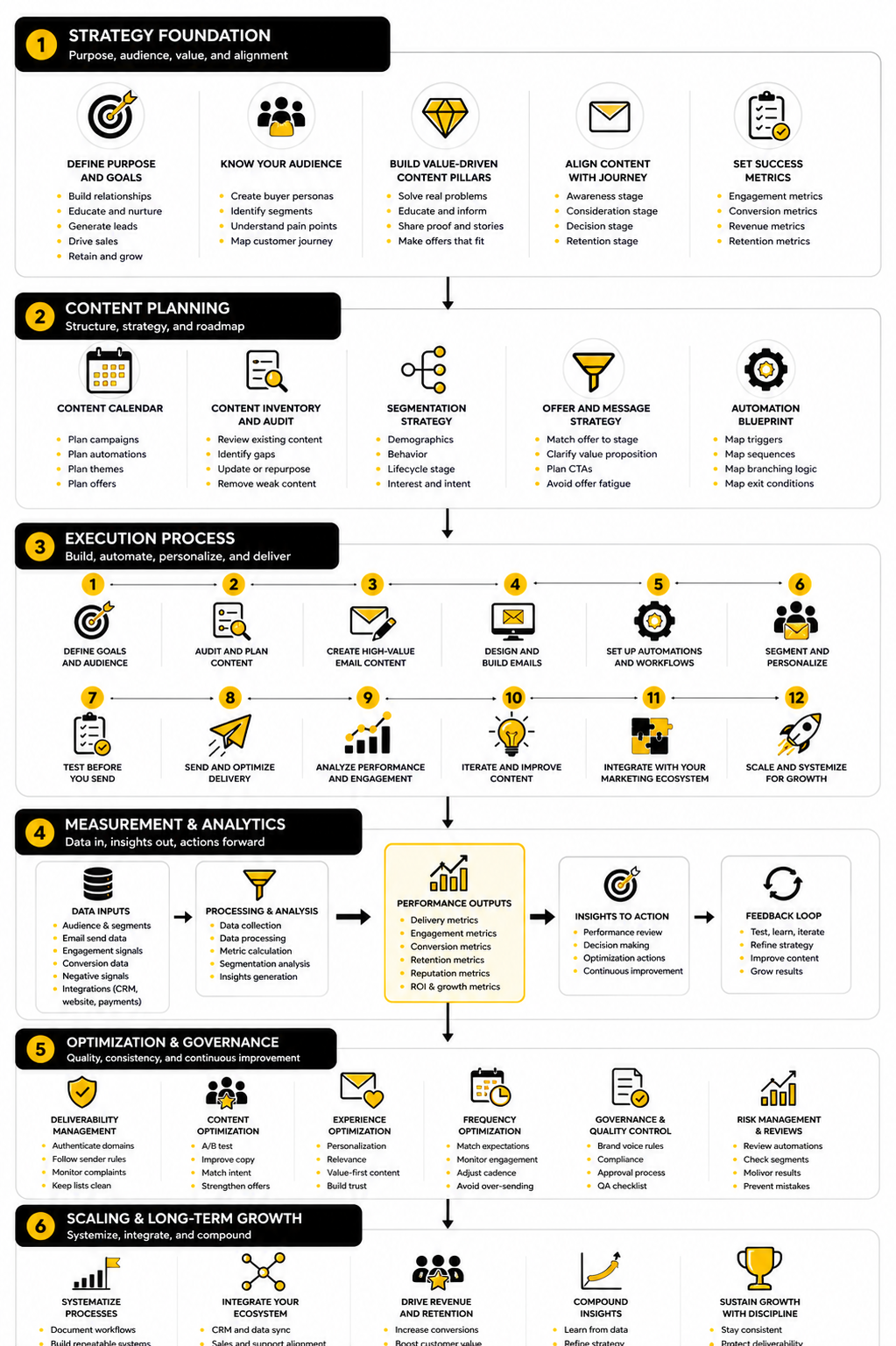
The system starts with a clear audience and a useful promise. It continues through segmentation, content planning, workflow setup, testing, measurement, and review. Then it loops back into better decisions for the next campaign, the next automation, and the next offer.
This is where email marketing content becomes more than copy. It becomes a business asset. Your best emails reveal what people care about, what they resist, what they want next, and what makes them ready to act.
What is email marketing content?
Email marketing content is everything inside and around the emails you send to subscribers, leads, customers, and past buyers. It includes subject lines, preview text, body copy, offers, calls to action, personalization, segmentation logic, and follow-up messages. In simple terms, it is the message system that turns an email list into a relationship and a revenue channel.
Why is email marketing content important?
Email marketing content is important because people do not respond to emails just because they arrive in the inbox. They respond when the message is relevant, timely, clear, and useful. Strong content helps subscribers understand why they should care, what they should do next, and why the offer or information is worth their attention.
What makes email marketing content effective?
Effective email marketing content has a clear audience, a focused message, a reason for being sent now, and one logical next step. It does not try to say everything at once. It gives the reader enough context to move forward without forcing them to decode the point of the email.
How often should I send marketing emails?
There is no universal sending frequency that works for every brand. The right cadence depends on audience expectations, buying cycle, content quality, offer frequency, and engagement behavior. A daily email can work when readers expect consistent value, while a monthly email can still fail if it feels random or irrelevant.
What metrics should I track for email marketing content?
Track delivery, bounce rate, open rate, click rate, conversion rate, unsubscribe rate, complaint rate, revenue, replies, and retention behavior. Do not judge performance from one number alone. A good measurement system shows where the bottleneck is, whether that is the inbox, the message, the offer, or the post-click experience.
Are open rates still reliable?
Open rates are less reliable than they used to be because privacy changes can affect how opens are recorded. They can still provide directional insight, especially when reviewed over time, but they should not be the only signal used to judge email marketing content. Clicks, conversions, replies, and customer behavior usually tell you more about real engagement.
How do I write better subject lines?
Better subject lines come from understanding the reader’s problem, desire, curiosity, or current moment. A strong subject line creates a clear reason to open without misleading the subscriber. The best approach is to match the subject line to the actual promise of the email so the opening feels like a payoff, not a trick.
Should every email include a sales offer?
No, every email should not include a sales offer. Some emails should sell, but others should educate, onboard, remind, re-engage, support, or build trust. If every message pushes a sale, subscribers can become numb to your offers and less likely to engage when the offer really matters.
How long should marketing emails be?
A marketing email should be as long as it needs to be and no longer. Simple reminders, announcements, or transactional follow-ups may only need a few lines. Complex offers, high-ticket decisions, and educational sequences often need more explanation, proof, and objection handling.
What is the biggest mistake in email marketing content?
The biggest mistake is sending emails without a clear job. Many campaigns fail because the audience is too broad, the message is vague, the timing is random, or the CTA is disconnected from the reader’s stage. Before writing, define who the email is for, what it needs to communicate, why it should be sent now, and what action should happen next.
How do I avoid sounding spammy?
Avoid sounding spammy by writing like a real person with a clear reason for being in the inbox. Do not rely on fake urgency, exaggerated claims, misleading subject lines, or endless hype. Specific benefits, honest proof, plain language, and a useful next step will usually outperform noisy copy.
How should I use AI for email marketing content?
Use AI to speed up research, outline campaigns, generate draft angles, create variations, and organize ideas. Do not let AI replace customer understanding or strategic judgment. The strongest AI-assisted emails still need human editing, real audience insight, accurate claims, and a voice that sounds like the brand.
What is the best email marketing tool?
The best tool depends on the business model and the stage of the email program. A simple sender may need clean campaigns and basic automation, while an agency or service business may need CRM, appointments, pipelines, and follow-up workflows in one system. Tools like Brevo, Moosend, GoHighLevel, ClickFunnels, Systeme.io, and Replo can all make sense when matched to the right use case.
How do I know if my email content is working?
Your email content is working when it creates the behavior it was designed to create. That may be a click, reply, purchase, booking, activation, renewal, referral, or reduced churn. The key is to define the goal before sending, then judge the email against that goal instead of chasing vanity metrics.
How do I improve an underperforming email sequence?
Start by finding the weakest point in the sequence. If people do not open, review the promise, sender expectation, subject line, and deliverability. If they open but do not click, improve the message, offer framing, proof, and CTA. If they click but do not convert, review the landing page, form, checkout, booking flow, or sales follow-up before blaming the email.
Build a stronger local presence with BAAM AI
Turn your website, Google profile, social channels, and AI visibility into one growth engine
Most businesses do not need more random marketing activity. They need a consistent presence system that helps the right people find them, trust them, and take action. BAAM AI brings strategy, local SEO, website updates, Google Maps visibility, social content, AI-search readiness, media production, and reporting into one practical monthly engine.
If you want your marketing to keep working after the campaign ends, start with a free BAAM AI presence audit. See how your business shows up today and where the fastest visibility wins are at BAAM AI.