
BAAM AI Blog
Email Marketing Campaign Services: A Practical Guide To Strategy, Systems, And Execution
Email marketing is not dead. Bad email marketing is dead.
Email marketing is not dead. Bad email marketing is dead.
That distinction matters because most businesses do not need “more newsletters.” They need a sharper system for turning attention into leads, leads into buyers, and buyers into repeat customers without burning their list or guessing what to send next. That is where email marketing campaign services become valuable: not as a random outsourced task, but as a structured growth function that connects strategy, copy, segmentation, automation, analytics, and deliverability.
The channel still has serious commercial weight. The 2026 Email Impact Report from Sinch Mailgun found that email remains a high-performing business channel, while its related release noted that the research used more than 400 billion emails sent in 2025 and feedback from over 1,200 senders. The uncomfortable part is that performance is not automatic. Poor deliverability alone can quietly erase a meaningful share of potential revenue before a campaign even reaches the inbox.
For ecommerce, the gap between basic sending and professional implementation is even clearer. Omnisend’s 2025 ecommerce marketing research found that automated emails produced 37% of email sales from just 2% of email volume, which shows why the real money is often in lifecycle flows, not one-off blasts. A campaign service that understands this does not just “send emails.” It builds the commercial logic behind what gets sent, to whom, when, and why.
this guide breaks down how email marketing campaign services actually work, when they are worth paying for, what should be included, and how to choose a provider without getting distracted by vanity metrics. The goal is simple: help you understand the service well enough to buy it, manage it, or build it with confidence.
Why Email Marketing Campaign Services Matter
Email is one of the few marketing channels where a business can build a direct audience it does not have to rent every day from an ad platform. Search algorithms change, social reach fluctuates, and paid media costs can rise fast, but an engaged email list remains an owned asset. That does not mean email is free money, though, because inbox access has to be earned through relevance, consistency, and technical discipline.
A professional service matters because campaign quality is no longer just about writing a catchy subject line. The work now includes segmentation, behavioral triggers, first-party data, compliance, deliverability monitoring, testing, creative direction, and revenue attribution. When these pieces are handled separately or casually, the campaign might look active on the surface while quietly underperforming underneath.
This is especially important for businesses that already have traffic, leads, or customers but are not converting them well after the first interaction. A service provider can turn abandoned carts, inquiry forms, lead magnets, webinars, product views, repeat purchases, and inactive subscribers into structured communication paths. That is the difference between “we send emails sometimes” and “email supports the full customer journey.”
The Framework Behind High-Performing Email Campaigns
Strong email marketing campaign services usually follow a simple framework: audience, offer, message, timing, delivery, and measurement. Audience defines who should receive the campaign. Offer defines what action the email is trying to create. Message turns the offer into a reason to care. Timing decides when the email should arrive. Delivery protects inbox placement. Measurement shows what worked and what should change next.
The mistake many businesses make is starting with the email itself. They open a blank editor, write a promotion, send it to everyone, and then judge success by opens or clicks. That approach skips the strategic questions that determine whether the campaign had a real chance before it was ever scheduled.
A better framework starts with business intent. Are you trying to recover abandoned carts, book consultations, activate free trial users, drive repeat purchases, promote an event, nurture cold leads, or increase customer lifetime value? Each goal needs a different sequence, different segmentation, different proof points, and different success metrics.
Core Components Of A Professional Email Marketing Campaign
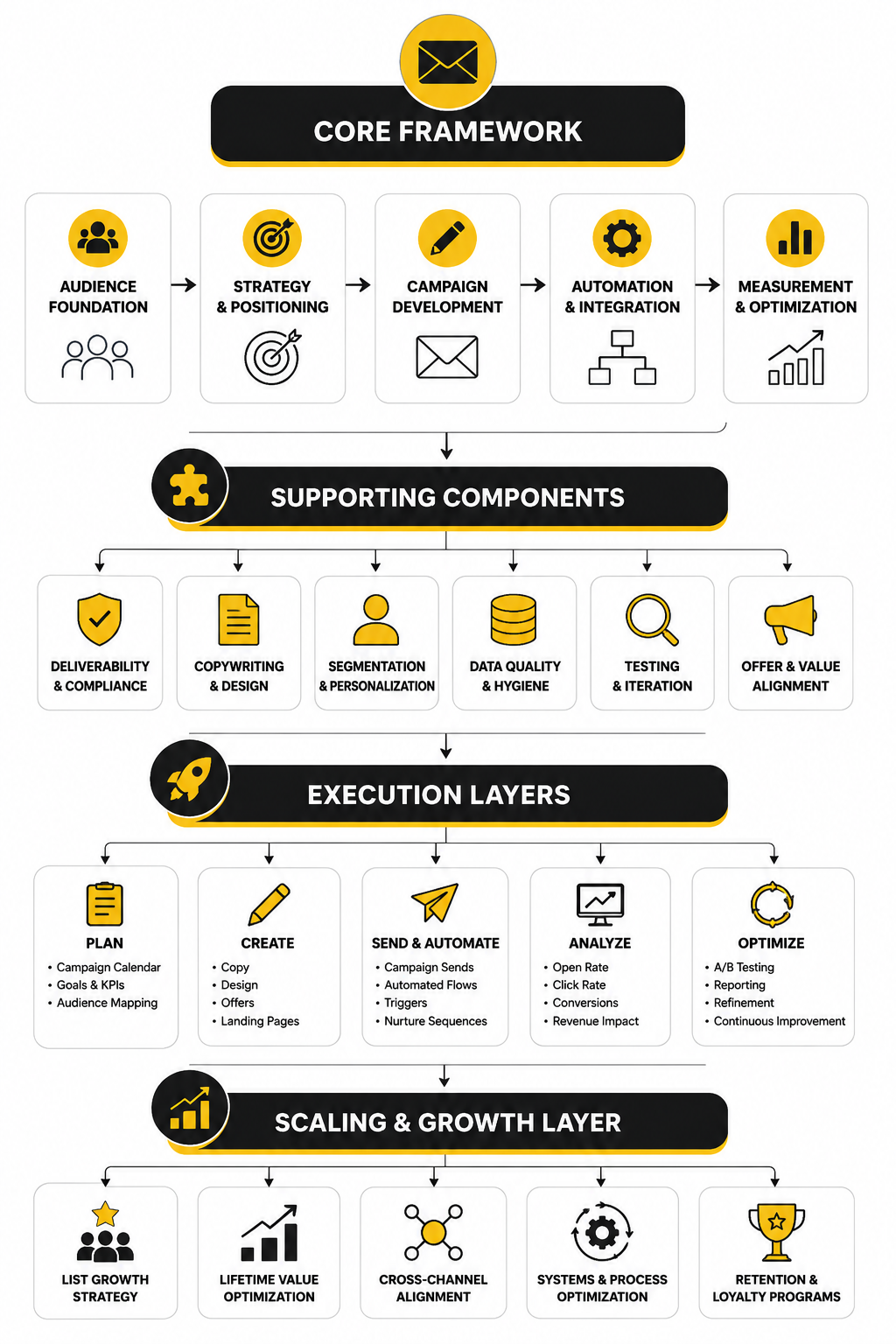
A complete campaign service normally includes strategy, list planning, copywriting, design, setup, automation, testing, reporting, and optimization. The provider should understand how these pieces connect because weak execution in one area can damage the whole campaign. Great copy will not save poor segmentation, and beautiful design will not matter if the email lands in spam.
The strategy layer defines the campaign goal, audience segments, positioning, offer, send cadence, and conversion path. This is where the provider should ask practical questions about margins, buying cycles, customer objections, lead quality, sales process, and previous campaign performance. Without that context, they are just decorating messages instead of building a revenue system.
The execution layer turns the strategy into assets and workflows. That may include broadcast campaigns, automated welcome sequences, abandoned cart flows, post-purchase sequences, reactivation campaigns, newsletter systems, lead nurturing, sales follow-ups, and CRM-triggered messaging. Tools like Brevo, ManyChat, and GoHighLevel can support different parts of that system, but the tool is only useful when the campaign logic is clear.
Professional Implementation Starts Before The First Send
Professional implementation begins with the current state of the account. A good provider should look at list health, opt-in sources, sending history, domain authentication, engagement trends, unsubscribe patterns, spam complaints, revenue attribution, and the role email currently plays in the customer journey. This audit prevents the common mistake of launching new campaigns on top of a weak foundation.
The next step is prioritization. Not every business needs a complex automation map on day one. Some need a clean welcome sequence first. Others need abandoned cart recovery, better lead nurture, a sales appointment follow-up system, or a reactivation campaign for dormant subscribers. The right service should focus on the highest-leverage gaps instead of selling complexity for its own sake.
This is where email marketing campaign services become a practical operating system rather than a creative add-on. The service should help decide what to send, who should receive it, how it should be built, how performance will be measured, and what gets improved after the data comes in. That is the foundation the rest of this guide will build on.
The Framework Behind High-Performing Email Campaigns
A strong email program is built around decisions, not decoration. Before a provider writes a subject line or designs a template, they should know what the campaign is supposed to change in the business. More qualified sales calls, more trial activations, more first purchases, more repeat orders, and more recovered carts are all different goals, so they need different campaign structures.
This is why professional email marketing campaign services usually begin with a framework instead of a blank email editor. The framework keeps the campaign grounded in customer behavior, business economics, and inbox reality. Without it, the campaign becomes a guessing game where the team sends more often, changes creative randomly, and hopes the numbers improve.
The practical framework has six parts:
Each part affects the others. A great offer sent to the wrong audience will underperform. A well-timed email with weak deliverability may never be seen. A persuasive message without measurement may generate sales, but the team will not know why it worked or how to repeat it.
Audience
Audience selection is where the campaign either becomes relevant or becomes noise. A new subscriber, a cold lead, a recent buyer, a loyal customer, and an inactive contact should not all receive the same message. They are in different emotional states, and they need different reasons to take the next step.
A professional service should segment by behavior, not only by demographics. Useful segments often include signup source, product interest, purchase history, engagement level, lifecycle stage, lead score, cart activity, website behavior, and sales pipeline status. This matters because email performance usually improves when the message reflects what the person has actually done.
For ecommerce brands, behavioral automation is especially powerful. Omnisend’s 2025 ecommerce research found that automated emails generated 37% of email sales from only 2% of email volume, which is exactly why serious campaign work goes beyond standard newsletters. When the audience signal is strong, the email does not have to work as hard.
Offer
The offer is the reason someone should act now. It can be a discount, consultation, demo, webinar, product launch, free trial, lead magnet, bundle, reminder, loyalty perk, or simple next step. What matters is not whether the offer sounds exciting inside the business; what matters is whether the recipient sees a clear benefit.
Weak campaigns often hide the offer behind vague language. They say things like “check out our latest update” or “learn more” without giving the reader a sharp reason to care. Strong campaigns make the value obvious, reduce friction, and connect the offer to the audience’s current problem or desire.
A service provider should also understand offer economics. A discount campaign may drive fast revenue but weaken margins or train subscribers to wait. A demo campaign may produce fewer clicks but higher-value opportunities. A welcome offer may look small on the first sale but pay off if it increases customer lifetime value.
Message
The message turns the offer into a believable decision. This includes the subject line, preview text, opening angle, body copy, proof, objection handling, call to action, and the tone of the email. It is not just “copywriting” in the narrow sense; it is the bridge between the reader’s situation and the action you want them to take.
Good messaging is specific. It speaks to a real problem, uses the reader’s language, and avoids inflated claims. If the campaign is for a service business, the message may need to reduce risk and build trust. If it is for ecommerce, it may need to clarify fit, show use cases, answer objections, or create urgency without sounding desperate.
This is also where brand voice matters. A luxury brand, SaaS company, local service provider, creator business, and B2B agency should not sound the same. Professional email marketing campaign services should protect the brand while still writing emails that are clear, direct, and conversion-focused.
Timing
Timing is not only about the day and hour an email is sent. It is about matching the message to the moment. A cart abandonment email works because the buying intent is recent. A reactivation email works because the relationship has cooled down and needs a different angle. A post-purchase email works because the customer has already crossed the trust barrier.
Campaign timing should be based on behavior wherever possible. That means triggers like joining a list, downloading a resource, viewing a product, starting checkout, booking a call, attending a webinar, completing a purchase, or going inactive. The more the timing reflects the customer journey, the less the email feels like an interruption.
Scheduled campaigns still matter, but they should not carry the whole program. A healthy email system usually blends one-off campaigns with automated lifecycle flows. For simple campaigns, tools like Brevo can handle newsletters, automation, and transactional messaging in one place; for agencies and service businesses that need CRM, pipelines, and follow-up automation together, GoHighLevel can fit the workflow better.
Delivery
Delivery is the unglamorous part that decides whether the campaign gets a fair chance. A business can have strong strategy, sharp copy, and a clean design, but if mailbox providers do not trust the sender, performance will suffer before readers even see the email. That is why deliverability belongs inside the campaign framework, not in a separate technical corner.
Modern bulk sending requires proper authentication, list hygiene, complaint control, and unsubscribe handling. Gmail and Yahoo’s bulk sender rules made authentication and one-click unsubscribe more important for high-volume senders, and Microsoft also began enforcing sender requirements for large-volume mail to its consumer inboxes in 2025. The direction is clear: mailbox providers are rewarding trustworthy senders and punishing sloppy ones.
A professional provider should check SPF, DKIM, DMARC, bounce handling, spam complaint patterns, suppression logic, domain reputation, and engagement trends. They should also be careful with sudden volume spikes, old lists, purchased contacts, and aggressive reactivation campaigns. Deliverability is not a hack; it is the result of sending wanted email consistently.
Measurement
Measurement is where the campaign becomes a learning system. Opens can still provide directional context, but they are not enough on their own. Clicks, conversions, booked calls, revenue, reply rate, unsubscribe rate, spam complaints, deliverability, list growth, customer lifetime value, and attribution quality usually tell a more useful story.
The key is matching metrics to the campaign goal. A sales nurture sequence should not be judged only by click rate if the real goal is booked meetings. An abandoned cart flow should be tied to recovered revenue. A newsletter might be judged by engaged subscribers, content clicks, assisted conversions, and long-term retention instead of immediate sales alone.
This is where many businesses leave money on the table. The 2026 Sinch Mailgun research reported that fewer than half of organizations can reliably track email ROI, even though many businesses still plan to maintain or increase email investment. That gap is exactly why measurement has to be built into the service from the start, not added after the campaign is already live.
How The Framework Changes By Business Type
The same framework applies across industries, but the emphasis changes depending on the business model. A B2B company usually needs trust, education, sales alignment, and lead progression. An ecommerce brand usually needs segmentation, product relevance, lifecycle automation, and purchase timing. A local service business usually needs fast follow-up, appointment reminders, reputation building, and simple conversion paths.
This is why copying another company’s email sequence rarely works. The visible email is only the surface. Underneath it are different margins, decision cycles, customer objections, sales processes, fulfillment realities, and brand expectations. A campaign that works beautifully for a skincare brand may be completely wrong for a SaaS demo funnel.
Good email marketing campaign services adapt the structure without losing the fundamentals. They still define the audience, clarify the offer, shape the message, time the send, protect delivery, and measure outcomes. They just adjust the depth and priority of each part based on what the business actually needs.
B2B And Service Businesses
For B2B and service businesses, email often supports a longer decision process. The reader may need to understand the problem, trust the company, compare alternatives, involve other stakeholders, and justify the investment. That means the campaign should not push every contact straight into a hard sales pitch.
Useful campaigns include lead magnet follow-up, webinar sequences, consultation booking flows, proposal follow-ups, cold lead reactivation, onboarding emails, and sales pipeline nurture. The message should be practical and proof-driven. The goal is usually to move the prospect one step closer, not force the entire decision in one email.
This is where CRM-connected email becomes important. If email, pipeline stages, forms, calendars, and sales follow-up are disconnected, leads slip through the cracks. A system like GoHighLevel can be useful when the campaign needs to connect email with appointment booking, SMS, pipeline automation, and sales workflows.
Ecommerce Brands
For ecommerce, the campaign framework is more behavior-heavy. The business can often see product views, cart activity, purchase history, category interest, order frequency, and discount sensitivity. That data should shape what the customer receives next.
Core campaigns usually include welcome flows, abandoned cart emails, browse abandonment, post-purchase education, replenishment reminders, cross-sells, winback campaigns, VIP campaigns, and launch emails. The best campaigns do not just promote products; they help the customer make a confident choice. That might mean explaining fit, comparing options, showing reviews, answering objections, or reminding the customer why they were interested in the first place.
The danger in ecommerce is overusing promotions because they are easy to send and easy to measure. Discounts can be useful, but they should not become the whole strategy. A professional service should help the brand balance conversion, margin, retention, and long-term list quality.
Creator, Coaching, And Education Businesses
Creator-led, coaching, and education businesses usually depend heavily on trust. The audience often buys because they believe in the person, the method, the promise, or the transformation. That makes email especially powerful, but also easy to misuse.
The campaigns need to combine authority, clarity, and personal connection. Strong sequences often include welcome emails, belief-building emails, webinar reminders, launch sequences, testimonial-driven emails, application follow-ups, and post-purchase onboarding. The goal is to make the reader feel understood before asking them to commit.
Tools like ClickFunnels or Systeme.io can make sense when the email campaign is closely tied to funnels, landing pages, offers, and checkout flows. The service still has to bring the strategy, though. Software can publish the funnel, but it cannot decide the positioning for you.
Professional Implementation: Strategy, Tools, And Workflow
Professional implementation is where the strategy stops being theoretical. This is the part where the service provider takes the business goal, the audience segments, the offer, the copy, the tools, and the tracking plan, then turns them into a working campaign system. If this part is messy, the campaign may still launch, but it will be harder to manage, harder to measure, and harder to improve.
Good email marketing campaign services do not treat implementation as “upload contacts and hit send.” They build the campaign in a way that can survive real business conditions: new leads coming in, subscribers behaving differently, sales teams needing context, customers asking questions, and mailbox providers filtering aggressively. The implementation process should create clarity, not more moving parts.
The best providers also think beyond the first campaign. They build naming conventions, tags, segments, workflows, reports, and reusable templates so the business is not starting from zero every time. That is what separates a one-off email project from a reliable email marketing system.
Step 1: Audit The Current Email Setup
The first implementation step is a practical audit. Before anyone writes a new campaign, the provider should understand what already exists inside the email platform, CRM, analytics tools, landing pages, forms, and checkout flow. This avoids duplication, broken triggers, conflicting tags, and campaigns that accidentally overlap with old automations.
The audit should include the list source, consent status, engagement history, unsubscribe rate, bounce rate, spam complaints, sender authentication, existing automations, template quality, conversion tracking, and revenue attribution. This is not busywork. It tells the provider whether the account is ready to scale or whether it needs cleanup first.
A clean audit also protects the business from bad assumptions. A list of 80,000 subscribers might look strong until half of it has not opened, clicked, bought, or replied in years. A campaign with a high open rate might still be weak if clicks, sales, and booked calls are low. The audit forces the work to start with reality.
Step 2: Define The Campaign Objective
Once the current setup is clear, the campaign needs one primary objective. Not five. One. A campaign can support secondary goals, but it should be built around a main business outcome so the strategy does not become diluted.
For example, a welcome sequence might aim to convert new subscribers into first-time buyers. A sales nurture sequence might aim to move qualified leads toward a consultation. A winback campaign might aim to reactivate dormant customers without damaging sender reputation. Each goal changes the segmentation, copy angle, timing, call to action, and success metrics.
This is where weak services often lose focus. They try to create a “nice email campaign” instead of a business tool. A professional provider should be able to say exactly what the campaign is meant to do and how success will be judged after launch.
Step 3: Map The Customer Journey
The customer journey map shows where the email campaign fits into the bigger path from attention to conversion. A subscriber may come from an ad, blog post, webinar, quiz, product page, checkout page, referral, lead magnet, or direct sales conversation. Each entry point creates different expectations.
Mapping the journey helps the provider decide what the customer already knows, what they still need to believe, and what friction might stop them from acting. A person who downloaded a basic checklist probably needs education and trust. A person who abandoned checkout likely needs reassurance, urgency, or a reason to complete the purchase. A person who booked a consultation needs confirmation, preparation, and follow-up.
This step is also where the campaign becomes more useful to the rest of the business. Sales teams can see which emails a lead received. Support teams can understand what promise was made. Leadership can see where email contributes to pipeline, revenue, or retention instead of treating it as a separate marketing activity.
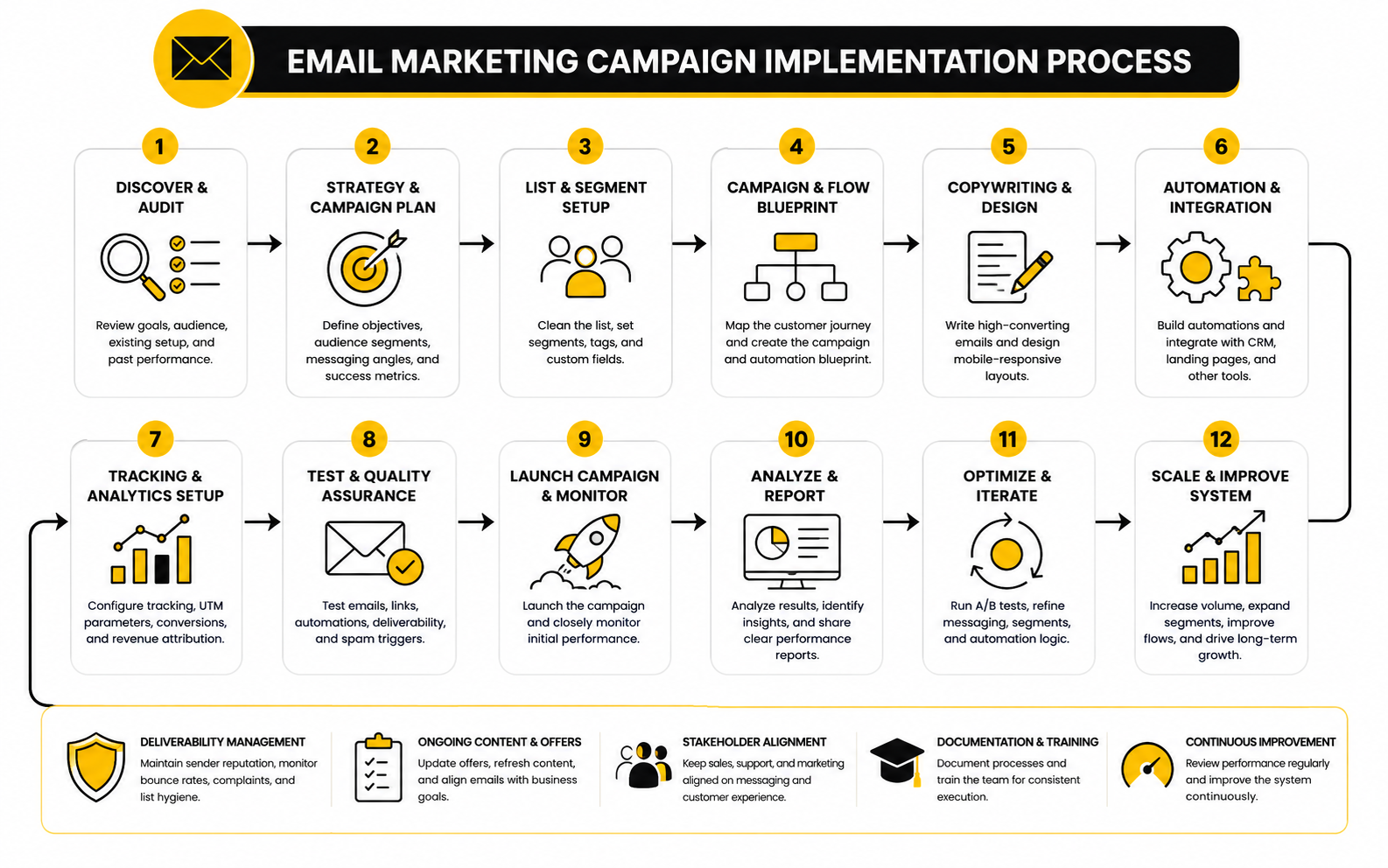
Step 4: Build The Segmentation Logic
Segmentation turns the customer journey into usable groups. This is where tags, lists, properties, events, custom fields, and behavioral rules are defined. The goal is to make sure each contact receives messages that fit their stage, interest, and relationship with the business.
Basic segmentation might separate leads, customers, active subscribers, inactive subscribers, and recent buyers. More advanced segmentation might use product category interest, average order value, lead score, purchase frequency, deal stage, webinar attendance, or form responses. The right level depends on the business model and the quality of the available data.
The important thing is not to overcomplicate this too early. A provider should build enough segmentation to make the campaign relevant, but not so much that the system becomes fragile. Simple and accurate beats complex and unreliable.
Step 5: Write The Campaign Assets
Copywriting comes after the strategy, not before it. At this stage, the provider should already know who the email is for, what the reader needs to believe, what action the campaign should create, and what objections need to be handled. That context makes the copy sharper and more useful.
A campaign asset may include subject lines, preview text, body copy, calls to action, fallback copy for different segments, SMS copy, landing page notes, sales handoff notes, and internal campaign documentation. The best copy is clear, specific, and easy to act on. It does not need to sound clever if clarity would convert better.
This is also where the provider should protect the brand voice. Email should feel like it came from the business, not from a generic template library. Strong email marketing campaign services can make the message more persuasive without making the brand sound fake.
Step 6: Design The Email Experience
Email design should support the message, not compete with it. A clean layout, readable typography, strong visual hierarchy, mobile-friendly spacing, and obvious calls to action usually matter more than heavy graphics. Many subscribers will skim first, so the email has to communicate quickly.
Design decisions should also consider deliverability and accessibility. Overly image-heavy emails can create problems when images are blocked, when mobile loading is slow, or when the message depends on text embedded inside graphics. A professional implementation keeps the key message readable even if images do not load.
For product-heavy campaigns, design can still be visual and conversion-focused. The difference is discipline. Product blocks, testimonials, comparison sections, offer summaries, and buttons should help the reader decide faster, not distract them from the main action.
Step 7: Set Up Automation And Triggers
Automation setup is where the campaign becomes operational. The provider builds the workflow, defines entry rules, creates wait steps, applies tags, adds conditions, sets exit criteria, and connects the campaign to forms, checkout events, CRM stages, or other tools. This is the part where precision matters.
A welcome flow might trigger when someone joins through a specific form. An abandoned cart flow might trigger after checkout begins but stop if a purchase happens. A sales nurture flow might change direction when a lead books a call. A customer onboarding sequence might branch based on the product purchased.
Tools should match the workflow. Brevo can work well for businesses that need email campaigns, automation, and transactional messaging in one practical platform. GoHighLevel can make more sense when email needs to connect with pipelines, appointment booking, SMS, reputation management, and agency-style client accounts. For funnel-driven offers, ClickFunnels or Systeme.io may fit better when the email campaign is tied closely to landing pages, checkout, and offer delivery.
Step 8: Connect Tracking And Attribution
Tracking has to be built before launch. If the campaign is sent first and measurement is added later, the business loses the cleanest data from the most important moment. That is a common mistake, and it makes optimization slower.
A proper setup should define UTM parameters, conversion events, revenue tracking, form tracking, booking tracking, CRM stage changes, and reporting views. For ecommerce, the provider should connect email activity to purchases, average order value, recovered revenue, and repeat buying behavior. For service businesses, the campaign should connect to booked calls, qualified leads, pipeline value, proposals, and closed deals.
The goal is not perfect attribution because perfect attribution is rare. The goal is decision-grade tracking. The business should be able to see whether the campaign is moving the right numbers and where the next improvement should happen.
Step 9: Test Before Launch
Testing is where preventable mistakes get caught. The provider should test links, buttons, personalization fields, dynamic content, mobile rendering, desktop rendering, dark mode, subject lines, preview text, sender name, reply-to address, unsubscribe link, suppression rules, and automation paths. This sounds basic, but it is where a lot of campaigns fail quietly.
Testing should include both the email content and the workflow logic. A broken link is obvious once someone clicks it, but a broken exit rule may keep sending abandoned cart emails to customers who already purchased. That kind of mistake damages trust because it feels careless from the customer’s side.
A good provider will also test the experience from the subscriber’s perspective. They will ask what the reader sees, what they are expected to do next, and whether the next step feels natural. Campaigns should not only function technically; they should feel smooth to the person receiving them.
Step 10: Launch, Monitor, And Improve
Launch is not the finish line. It is the point where the campaign starts producing real behavior. The provider should monitor early signals such as bounces, complaints, unsubscribes, deliverability warnings, clicks, replies, conversions, and any unusual drop-offs in the automation.
Early monitoring is especially important when the list is large, the sender reputation is uncertain, or the campaign includes inactive contacts. A careful provider may roll out in stages instead of sending aggressively to everyone at once. That protects deliverability and gives the team a chance to catch issues before they scale.
After launch, optimization should be based on evidence. That might mean changing the offer, adjusting timing, rewriting weak emails, improving the landing page, tightening segments, adding proof, removing unnecessary steps, or splitting a campaign by intent. This is where email marketing campaign services become more valuable over time because the system gets sharper with every round of data.
What A Professional Workflow Should Include
A reliable workflow makes the campaign easier to manage and easier to improve. Without it, everything depends on memory, scattered notes, and last-minute decisions. That creates mistakes, especially when more than one person is involved.
A professional workflow should include:
Each item exists for a reason. The brief keeps strategy clear. The sequence map keeps timing clear. The QA checklist prevents avoidable mistakes. The reporting dashboard turns performance into decisions instead of screenshots.
The Campaign Brief
The campaign brief is the single source of truth. It should explain the goal, audience, offer, key message, desired action, timing, assets needed, approval process, and performance metrics. If the campaign brief is vague, the final campaign will usually be vague too.
This document does not need to be long. In fact, shorter is often better if it forces clarity. A strong brief should make it obvious why the campaign exists and what the reader is supposed to do after receiving it.
For service providers, the brief also protects the relationship with the client. It reduces subjective feedback because everyone agreed on the campaign direction before the copy and design work started. That makes the whole process faster and cleaner.
The Sequence Map
The sequence map shows the campaign visually or structurally before it is built inside the platform. It explains what happens after someone enters the flow, how long the delays are, what conditions change the path, and when someone exits. This prevents messy automation logic.
For example, a lead nurture sequence might start after a guide download, send three educational emails, branch based on link clicks, and stop when the lead books a call. An ecommerce flow might send a reminder after cart abandonment, wait, offer reassurance, wait again, and exit immediately if the person purchases. The map makes these decisions visible before they become automation rules.
This step is especially useful when multiple channels are involved. If the campaign includes email, SMS, chat automation, forms, and sales follow-up, the sequence map prevents overlap. Tools like ManyChat can support chat-based follow-up, but the journey still needs to be planned carefully so the customer does not feel chased across every channel.
The QA Checklist
The QA checklist is boring until it saves a campaign. Every provider should have one. It catches broken links, incorrect segments, missing suppression rules, spelling issues, personalization errors, wrong dates, wrong discounts, broken forms, and mismatched landing pages.
A serious checklist should include technical, creative, compliance, and conversion checks. Technical checks confirm that the automation works. Creative checks confirm that the message is clear. Compliance checks confirm that unsubscribe and consent requirements are respected. Conversion checks confirm that the next step actually works.
This is one of the easiest ways to judge whether a service is professional. If the provider has no documented QA process, you are relying on luck. And luck is not a strategy.
Statistics And Data
Data is useful only when it changes what you do next. Random benchmarks can make a campaign look good or bad without explaining whether it is actually helping the business. Professional email marketing campaign services should use numbers to diagnose the system, not decorate a report.
The right question is not “What is a good open rate?” The better question is “What does this metric tell us about audience quality, offer strength, message clarity, timing, deliverability, and revenue?” When you look at the data that way, analytics becomes a decision tool instead of a monthly screenshot.
Email still earns its place in the marketing mix because the economics are strong when campaigns are measured properly. The 2026 Sinch Mailgun research found that 60% of companies that measure email ROI report returns above $10 for every $1 spent, while more than 1 in 10 report returns as high as 40:1. That does not mean every campaign will perform that well. It means the channel can produce serious returns when the strategy, delivery, tracking, and follow-up are handled with discipline.
Benchmarks Are Context, Not Targets
Benchmarks help you understand whether your numbers are broadly normal, but they should not become the goal by themselves. A campaign with a lower open rate can still make more money if it reaches a more qualified segment with a stronger offer. A campaign with a high open rate can still fail if the subject line attracts curiosity but the email does not drive action.
Recent benchmark data shows why context matters. The UK DMA’s 2025 Email Benchmarking Report reported that delivery rates reached 98% in 2024, open rates climbed to 35.9%, and unique click rates rose to 2.3%. MailerLite’s 2026 benchmark analysis of 2025 campaigns reported an average open rate of 43.46%, average click rate of 2.09%, and average unsubscribe rate of 0.22%. Those numbers give you a reference point, but they do not replace your own business model.
A B2B sales sequence, ecommerce abandoned cart flow, creator launch campaign, and local service follow-up email should not be judged with the same expectations. The offer, list temperature, purchase cycle, and conversion path are different. Good analytics starts by comparing each campaign against the right job.
The Metrics That Actually Matter
The most useful metrics depend on the campaign objective. For awareness and content emails, engagement signals matter. For sales campaigns, revenue and conversion signals matter. For deliverability, negative signals matter. The problem comes when every campaign is forced into the same shallow dashboard.
A professional campaign dashboard should usually track:
The point is not to stare at every number every day. The point is to know which signal answers which question. Delivery and bounce data tell you whether the campaign reached people. Click and conversion data tell you whether the message and offer moved people. Revenue and pipeline data tell you whether the campaign mattered commercially.
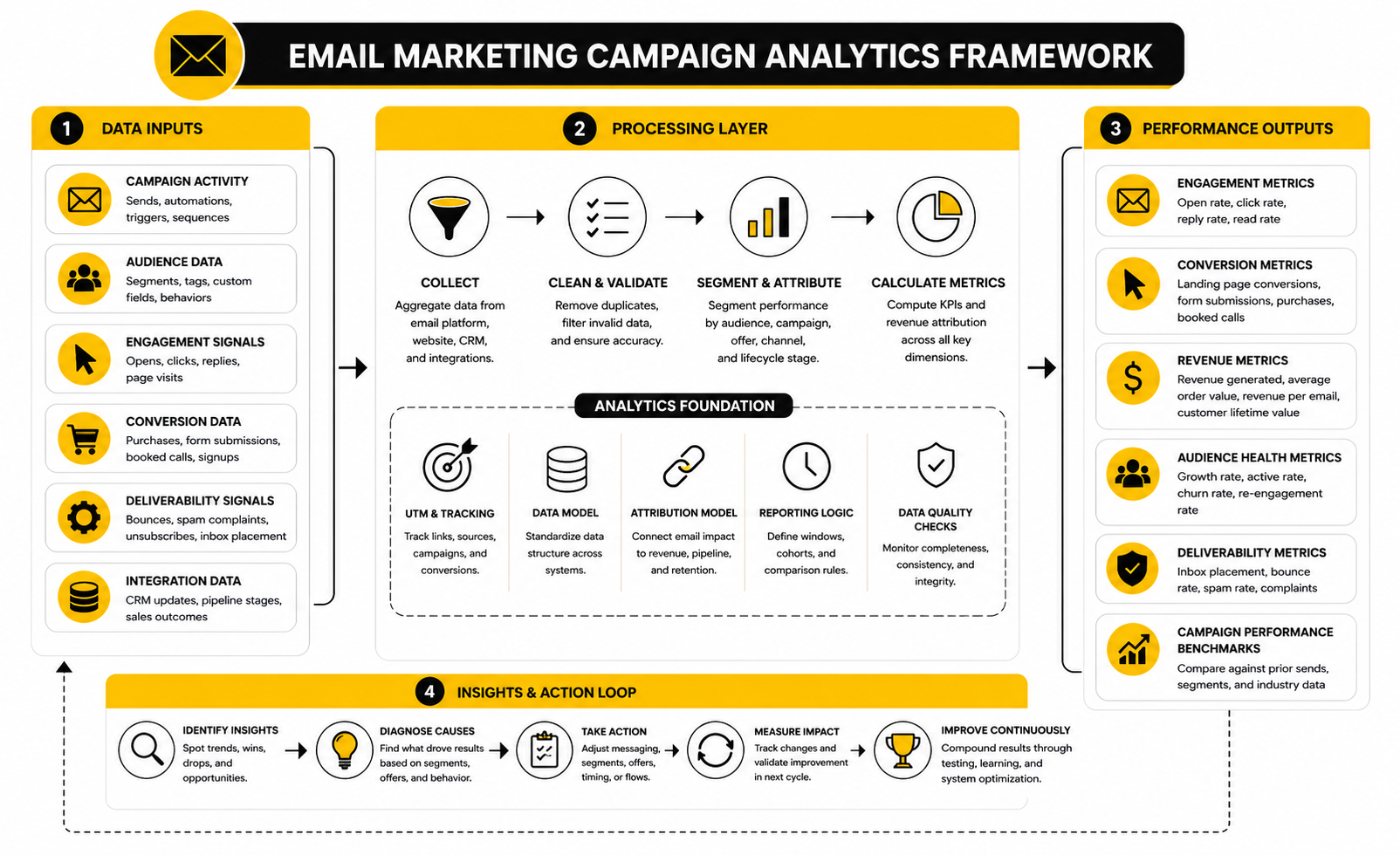
Opens Show Attention, But Not The Whole Truth
Open rates can still be useful, but they are less reliable than they used to be. Apple’s Mail Privacy Protection changed how opens are reported by preloading email content in ways that can inflate or distort open tracking. That means opens should be treated as a directional signal, not a clean measure of human attention.
This matters because many businesses still celebrate open rates while ignoring what happens next. A 45% open rate sounds great until the click rate, reply rate, bookings, or purchases are weak. On the other side, a lower open rate from a tighter segment may be perfectly acceptable if the campaign produces meaningful revenue.
The practical move is simple: use opens to diagnose subject line strength, sender recognition, and list engagement, but do not make them the final score. If a provider only reports opens and clicks, the reporting is incomplete. Email marketing campaign services should connect attention to action.
Clicks Show Interest, But They Need Interpretation
Clicks are usually more useful than opens because they show active behavior. Someone saw the email, found something relevant enough, and chose to take the next step. That makes click rate and click-to-open rate helpful for judging message clarity and offer appeal.
Still, clicks are not automatically success. If people click but do not convert, the issue may be the landing page, price, checkout flow, calendar page, product fit, form friction, or mismatch between the email promise and the next page. The email may have done its job, but the conversion path failed after the click.
That is why a professional provider should inspect the full path. If click rate is low, improve the audience, angle, offer, creative hierarchy, or call to action. If clicks are strong but conversions are weak, inspect the destination. The metric should tell you where to look next.
Conversion Data Shows Whether The Campaign Worked
Conversions are where campaign performance becomes real. For ecommerce, that may mean purchases, recovered carts, repeat orders, subscription starts, or average order value. For service businesses, it may mean booked calls, qualified applications, proposals requested, or closed deals. For SaaS, it may mean trial starts, activations, upgrades, or retention actions.
The mistake is treating conversion rate as one universal number. A cold lead nurture email and a checkout recovery email should not convert at the same rate. A low-ticket impulse purchase and a high-ticket consulting offer have different levels of friction. The campaign should be judged against the intent level of the audience and the difficulty of the action.
This is where automation often outperforms broad campaigns because the timing is tied to behavior. Omnisend’s 2025 ecommerce data found that automated emails produced 37% of email sales from just 2% of email volume. The lesson is not “send fewer emails.” The lesson is that triggered emails can be disproportionately valuable when they respond to real buying signals.
Revenue Metrics Keep The Team Honest
Revenue metrics prevent the campaign from becoming a vanity exercise. Open rates and click rates are useful, but they do not pay the bills. A campaign that drives fewer clicks but higher-value customers may be more valuable than a campaign that generates lots of casual traffic.
For ecommerce, the cleanest metrics often include revenue per email sent, revenue per recipient, recovered revenue, average order value, repeat purchase rate, and contribution to customer lifetime value. For B2B and service businesses, the better numbers are booked calls, qualified opportunities, pipeline value, close rate, and revenue influenced by email. These are harder to track than opens, but they are much more useful.
This is also why attribution needs to be practical. Email may not always be the final click before purchase, especially in longer customer journeys. A good reporting setup should separate direct revenue from assisted influence so the business does not undervalue campaigns that warm up leads before sales conversations.
Deliverability Metrics Protect Future Revenue
Deliverability metrics are not just technical health checks. They protect future revenue. If a campaign damages sender reputation, future emails may reach fewer inboxes, which means even strong campaigns can underperform later.
Important deliverability signals include delivery rate, bounce rate, spam complaint rate, unsubscribe rate, blocklist issues, authentication status, domain reputation, engagement decay, and inbox placement where available. If these numbers move in the wrong direction, the provider should slow down and investigate before pushing harder. Sending more email into a damaged reputation problem usually makes it worse.
This is especially important when reactivating old subscribers. A dormant list can look like hidden revenue, but it can also create bounces, complaints, and weak engagement. A professional provider should segment inactive contacts carefully, use controlled send volumes, and remove people who do not respond.
List Growth Means Nothing Without List Quality
List growth is easy to celebrate, but it can be misleading. A list that grows quickly through weak giveaways, unclear opt-ins, or low-intent lead magnets may create more cost than value. More subscribers are not automatically better subscribers.
Quality shows up in engagement, conversion, retention, and complaint behavior. If new subscribers do not open, click, buy, book, reply, or stay subscribed, the acquisition source needs to be questioned. The campaign may not be the real problem; the list-building strategy may be attracting the wrong people.
This is why email marketing campaign services should care about acquisition sources. Forms, quizzes, ads, webinars, landing pages, checkout opt-ins, chat funnels, and referral campaigns all shape list quality. A tool like Fillout can help collect cleaner lead data when forms need more structure, while ManyChat can support conversational capture when the audience is more active in chat-based journeys.
Reporting Should Lead To Decisions
A report is only valuable if it makes the next move clearer. Too many campaign reports are just numbers with no interpretation. They show what happened, but they do not explain why it happened or what should change.
A useful report should answer five questions:
This keeps analytics practical. If unsubscribes increased, the action may be to review frequency, targeting, promise mismatch, or list source. If clicks improved but sales did not, the action may be to review the landing page or checkout. If revenue increased but complaints rose, the action may be to protect deliverability before scaling.
The Best Data Is Segment-Level Data
Overall campaign averages can hide the truth. One segment may be carrying the revenue while another segment is dragging down engagement. If you only look at the blended number, you may improve the wrong thing.
Segment-level reporting can show performance by lead source, customer type, product interest, purchase history, lifecycle stage, geography, engagement level, or sales pipeline stage. This is where email becomes more precise. Instead of asking whether the campaign worked, you ask who it worked for and why.
That insight should drive future campaigns. High-performing segments may deserve more tailored offers. Weak segments may need different education, different timing, or removal from the campaign. The goal is not to squeeze the same email harder; it is to make the system more carefully.
Testing Should Be Built Around Real Leverage
Testing is useful only when the result can change a meaningful decision. Testing button colors or tiny wording changes rarely matters if the audience, offer, or conversion path is wrong. Bigger tests usually create clearer learning.
High-leverage tests include offer angle, audience segment, subject line promise, send timing, first-email positioning, proof type, landing page match, call-to-action framing, and sequence length. These tests connect to the actual reasons people act or ignore the campaign. They are more useful than cosmetic experiments.
A good provider should also avoid testing too many things at once. If the subject line, offer, segment, design, and landing page all change together, the result becomes hard to interpret. Clean testing creates learning that can be reused.
What Good Performance Looks Like In Practice
Good performance is not one magic number. It is a pattern. The campaign reaches the inbox, gets attention from the right people, earns clicks or replies, creates the intended conversion, avoids excessive unsubscribes or complaints, and produces commercial value that justifies the effort.
A campaign can be considered healthy when the data supports the business goal and does not damage the list. For a newsletter, that may mean consistent engagement and useful assisted conversions. For a sales sequence, it may mean qualified calls and pipeline movement. For ecommerce automation, it may mean profitable recovered revenue with low complaint rates.
This is the standard worth using when evaluating email marketing campaign services. Do they report numbers, or do they explain performance? Do they chase vanity metrics, or do they connect email to business outcomes? The answer tells you whether they are managing campaigns or simply sending messages.
How To Choose The Right Email Marketing Campaign Service
Choosing a provider is not about finding the agency with the prettiest portfolio or the freelancer with the loudest promise. It is about finding the person or team that can connect email to your actual business model. That means they need to understand your audience, your offer, your data, your sales process, your margins, and the operational limits around your campaigns.
The right email marketing campaign services should make your system clearer, not more confusing. You should come away with better segmentation, cleaner workflows, stronger reporting, and a sharper sense of what email is responsible for inside the business. If the provider only talks about templates, subject lines, and sending frequency, they are probably not thinking deeply enough.
The buying decision should come down to fit. A local service business, ecommerce store, SaaS company, creator offer, and B2B consultancy need different campaign logic. A serious provider will adapt the strategy instead of forcing every client into the same newsletter calendar.
Match The Service To The Business Model
A provider that is excellent for ecommerce may not be the right fit for a high-ticket consulting business. Ecommerce campaigns often depend on product data, cart behavior, replenishment timing, purchase history, and margin-aware promotions. Service businesses usually need lead qualification, trust building, appointment follow-up, and sales pipeline visibility.
For ecommerce, you want a provider who understands lifecycle automation, product segmentation, retention, discounts, merchandising, and post-purchase communication. For B2B or services, you want someone who understands lead nurture, CRM stages, sales handoff, objections, and longer buying cycles. For creator-led offers, you want someone who understands launches, belief-building, story-driven email, and audience trust.
This is also why tool selection should follow the business model. A simple ecommerce newsletter setup is different from a CRM-connected lead nurture system. GoHighLevel can fit service businesses and agencies that need pipelines, automations, calendars, and follow-up in one place, while Brevo can suit teams that want practical email campaigns, automation, and transactional messaging without overbuilding the stack.
Look For Strategic Diagnosis Before Execution
A strong provider should diagnose before they build. They should ask about list sources, customer journey, previous campaigns, deliverability, conversion paths, sales process, attribution, and business goals. If they jump straight into “we can send four emails per month,” that is a red flag.
Strategic diagnosis matters because the visible campaign is rarely the whole problem. Sometimes the real issue is weak lead quality. Sometimes the offer is unclear. Sometimes the landing page does not match the email. Sometimes sender reputation is holding everything back. A provider who only touches the email editor may miss the actual constraint.
This is where advanced campaign work becomes valuable. The provider should be able to say, “This is not an email volume problem; this is a segmentation problem,” or “This sequence is getting clicks, but the booking page is leaking conversions.” That kind of diagnosis saves time and prevents random testing.
Avoid Providers Who Sell Volume As The Strategy
More email is not automatically better email. Sending more can help when the list is engaged, the value is real, and the campaign calendar is intentional. But if the list is cold, the offer is weak, or complaints are rising, more volume can damage performance.
This is especially true under modern sender requirements. Yahoo’s sender guidance tells senders to keep spam complaint rates below 0.3%, and Microsoft began enforcing new bulk sender requirements for Outlook, Hotmail, and Live.com accounts in 2025. That means aggressive sending is not just annoying; it can create deliverability risk.
A good provider will scale carefully. They will increase volume when engagement supports it, clean up inactive segments, monitor complaint behavior, and protect the sender domain. If someone treats your full list like a cash machine that can be blasted whenever revenue is needed, walk away.
Understand The Tradeoff Between Speed And System Quality
Fast launches can be useful. Sometimes you need a product launch sequence, event reminder, seasonal promotion, or urgent lead follow-up campaign built quickly. Speed has value when the opportunity is real and the team already has the raw materials.
But speed becomes dangerous when it replaces structure. If there is no campaign brief, no segmentation logic, no QA checklist, no tracking plan, and no deliverability review, you are not moving fast; you are gambling. The campaign may go out on time and still create avoidable problems.
The better approach is to separate urgent campaigns from foundational work. A provider can launch a simple short-term campaign while building the deeper system behind it. That way you capture the opportunity now without letting every future campaign depend on last-minute execution.
Decide What Should Be Done For You And What Should Be Built With You
Not every business needs the same level of support. Some teams want a provider to handle everything from strategy to reporting. Others need help building the system, then want their internal team to run future campaigns. Both models can work if expectations are clear.
A done-for-you service is useful when the business lacks email expertise, internal bandwidth, or platform knowledge. A done-with-you model works better when the team has marketers in place but needs strategy, structure, templates, QA, and training. The wrong model creates frustration because the provider and client expect different levels of ownership.
This should be clarified early. Who owns copy approval? Who updates offers? Who checks product availability? Who reviews analytics? Who handles replies? Who updates automations when the sales process changes? Professional email marketing campaign services should define responsibilities before the campaign goes live.
Watch The Hidden Risks In Scaling
Scaling email is not just sending to more people. It usually means more segments, more campaigns, more automations, more data, more approvals, and more chances for conflicts. Without structure, growth turns the email account into a maze.
Common scaling risks include:
These issues do not usually appear when the list is small and campaigns are simple. They appear when the business grows and the email system has to handle more complexity. A strong provider should design for the next stage, not only the next send.
Be Careful With AI-Generated Email At Scale
AI can make email production faster, but faster production is not the same as better marketing. The 2026 Sinch Mailgun report found that 41% of teams use AI to generate email content, while 23% say AI has not improved their email programs. That gap says a lot.
AI is useful for drafting, brainstorming angles, summarizing customer research, creating variations, and speeding up repetitive work. It is risky when it replaces positioning, customer insight, offer strategy, compliance judgment, or brand voice. If every email starts sounding like generic internet copy, the list will feel it.
A professional provider should use AI with human direction. The strongest workflow is not “let AI write everything.” It is research, strategy, human judgment, AI-assisted production, editing, QA, and performance review. That keeps speed without sacrificing trust.
Treat Compliance As Part Of The Service
Compliance is not the exciting part of email marketing, but it matters. Commercial campaigns need accurate sender information, honest subject lines, clear identification where required, a valid physical mailing address, and a working opt-out process. The FTC’s business guidance for the CAN-SPAM Act states that commercial email must avoid deceptive header information and subject lines, include a valid postal address, and honor opt-out requests promptly through a clear unsubscribe mechanism.
For businesses operating across regions, compliance can get more complex. Consent expectations, privacy rules, tracking practices, data storage, and unsubscribe requirements may vary by market. A provider does not need to replace legal counsel, but they should understand the operational basics and know when legal review is needed.
This is another reason to avoid sloppy providers. Purchased lists, unclear consent, hidden unsubscribe links, misleading subject lines, and aggressive cold campaigns may look like growth shortcuts. In reality, they can create legal risk, deliverability damage, and brand distrust.
Choose Reporting That Helps You Make Decisions
Reporting should not feel like a pile of metrics with no point. A provider should explain what happened, why it probably happened, what changed since the last campaign, and what they recommend next. That recommendation is the real value.
For example, if a welcome sequence drives opens but not purchases, the next action might be offer testing, objection handling, product education, or landing page improvement. If a reactivation campaign creates complaints, the next action might be tighter segmentation and list cleanup. If a nurture sequence creates replies but few booked calls, the next action might be stronger qualification or a better scheduling path.
This is also where dashboards should match the business. A service business may need pipeline and booking visibility more than ecommerce revenue per recipient. An ecommerce store may need flow revenue, product clicks, and repeat purchase behavior. A good provider builds reporting around the decisions the business actually needs to make.
Ask Better Questions Before Hiring
The questions you ask before hiring will reveal how the provider thinks. Generic questions get generic answers. Better questions force the provider to explain process, priorities, tradeoffs, and judgment.
Useful questions include:
The answers should feel specific. If the provider cannot explain their process clearly, they probably cannot execute it clearly either. Good service providers make the work easier to understand, not harder.
Know When A Service Is Worth The Cost
Email marketing campaign services are worth paying for when the business has enough audience, traffic, leads, customers, or sales potential for better email to matter. If there is no list, no offer, no traffic, and no clear customer journey, email may still help, but it will not fix the whole business. In that case, the first priority may be acquisition, positioning, or offer development.
The service becomes more valuable when there is already momentum that email can capture. A store with abandoned carts, a consultant with inbound leads, a SaaS company with trial users, or a creator with a warm audience can often benefit quickly from better sequences and follow-up. The more missed opportunities already exist in the system, the more leverage email has.
Cost should be judged against the value of the outcomes, not just the number of emails delivered. A provider who builds one flow that recovers consistent revenue may be more valuable than someone who sends a dozen low-impact newsletters. Pay for thinking, structure, and measurable improvement, not just activity.
Build A Stack That Can Grow Without Becoming Messy
The tool stack should be powerful enough for the campaign strategy but simple enough for the team to operate. Overbuilt stacks create friction. Underbuilt stacks create limits. The goal is not to collect tools; the goal is to create a clean operating system for customer communication.
A lean stack might include an email platform, forms, landing pages, analytics, and a CRM. A more advanced stack may include chat automation, sales pipeline automation, scheduling, enrichment, customer support, and reporting. The key is making sure each tool has a clear role and that data moves reliably between them.
For lean funnel systems, Systeme.io can be useful when pages, email, and selling need to stay simple. For landing page-heavy ecommerce campaigns, Replo can support higher-quality Shopify page experiences. For scheduling-driven sales funnels, Cal.com can help turn campaign interest into booked calls when the handoff from email to calendar matters.
The Real Expert Move Is Restraint
Advanced email marketing is not about making the system as complex as possible. It is about knowing what not to send, who not to include, which automations not to build yet, and which metrics not to obsess over. Restraint is a competitive advantage because it protects attention and trust.
The best providers are not just campaign builders. They are editors of the customer journey. They remove unnecessary steps, tighten segments, simplify offers, reduce noise, and focus the campaign on the next meaningful action.
That is the expert-level shift. Email marketing campaign services are not valuable because they help you send more messages. They are valuable because they help you send the right messages with enough clarity, timing, and measurement to make email a dependable growth channel.
Common Mistakes, FAQs, And Next Steps
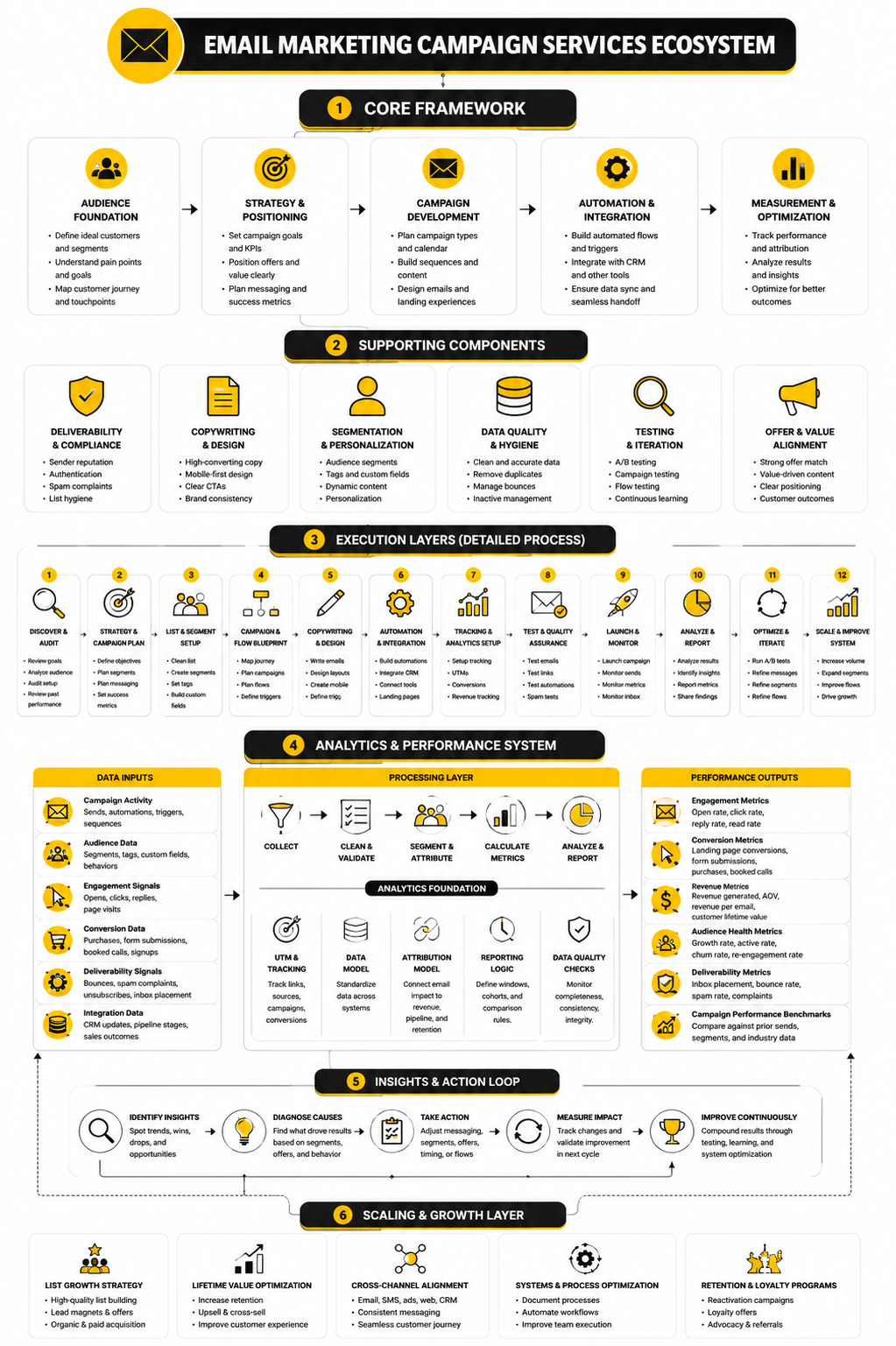
The final layer is the ecosystem around the campaign. Email does not work in isolation. It depends on the offer, the list source, the CRM, the landing page, the sales process, the checkout flow, the customer experience, and the reporting system that tells you what happened after the send.
That is why the best email marketing campaign services think in systems. They are not just asking, “What should this email say?” They are asking, “Where does this email fit, what should it trigger, what should it prevent, and what should the business learn from it?” That is the level of thinking that turns email from a task into a growth asset.
Most underperforming campaigns are not ruined by one dramatic mistake. They slowly weaken because the list quality slips, the message gets generic, the reporting stays shallow, the automations overlap, or the team keeps sending without listening to the data. The fix is not more noise. The fix is a cleaner system.
The Most Common Mistakes To Avoid
The first mistake is treating email like a broadcast channel only. Newsletters and promotions can work, but they should not be the entire strategy. If the business is not using behavior-based flows, lifecycle sequences, and segmented campaigns, it is probably leaving money in the gap between interest and action.
The second mistake is confusing activity with progress. Sending four campaigns per month sounds productive, but it means very little if those campaigns are not tied to revenue, pipeline, retention, or customer behavior. The campaign calendar should serve the business model, not exist just to prove that marketing is busy.
The third mistake is ignoring deliverability until performance drops. Authentication, complaint rates, bounces, inactive contacts, and list hygiene are not technical details to postpone. They decide whether future campaigns get a fair chance, especially as major inbox providers continue tightening sender expectations.
What To Do Before Hiring A Provider
Before hiring a provider, gather the basics. You should know where your leads come from, what you sell, who your best customers are, which emails already exist, what your main conversion goal is, and where people currently drop off. You do not need a perfect system, but you do need enough clarity for the provider to diagnose the real opportunity.
It also helps to collect recent campaign data, automation screenshots, landing page links, CRM stages, sales notes, customer objections, and any reporting you already use. This gives the provider a faster path to useful decisions. The more context they have, the less they have to guess.
Finally, decide what kind of relationship you want. Some businesses need full execution. Others need strategy, system cleanup, and training. The clearer you are about ownership, approvals, timelines, and internal support, the smoother the work will be.
What are email marketing campaign services?
Email marketing campaign services help businesses plan, build, send, automate, measure, and improve email campaigns. The service can include strategy, copywriting, design, segmentation, automation setup, deliverability support, reporting, and optimization. The real value is not just getting emails sent; it is building a system that moves subscribers toward a clear business outcome.
Are email marketing campaign services worth it?
They are worth it when the business already has leads, customers, subscribers, traffic, or sales opportunities that are not being followed up properly. If email can recover carts, book calls, increase repeat purchases, activate trial users, or nurture leads into sales conversations, the upside can be meaningful. The service is less useful when there is no clear offer, no audience, and no customer journey to improve.
How much do email marketing campaign services cost?
Pricing varies based on the scope, platform, list size, strategy depth, number of emails, automation complexity, and reporting requirements. A simple campaign project may cost far less than a full lifecycle email system with segmentation, CRM integration, deliverability cleanup, and monthly optimization. The more carefully way to judge cost is by the value of the business outcome, not just the number of emails delivered.
What should be included in a professional email campaign service?
A professional service should include discovery, account audit, campaign strategy, audience segmentation, offer planning, copywriting, design direction, platform setup, automation logic, tracking, quality assurance, launch monitoring, and reporting. For more advanced accounts, it may also include deliverability management, CRM integration, lifecycle mapping, A/B testing, and revenue attribution. If a provider only offers “email copy and design” without strategy or measurement, the service may be too shallow.
What is the difference between newsletters and email campaigns?
A newsletter usually focuses on regular communication, updates, education, or content distribution. An email campaign is usually built around a specific goal, such as launching an offer, recovering abandoned carts, booking calls, onboarding customers, or reactivating inactive subscribers. Both can be useful, but they should not be treated as the same thing.
What is the difference between email campaigns and email automation?
Email campaigns are often planned sends or sequences created for a specific objective. Email automation uses triggers and rules to send messages based on behavior, timing, or customer data. A strong email program usually uses both: scheduled campaigns for timely communication and automated flows for lifecycle moments that happen every day.
Which businesses benefit most from email marketing campaign services?
Businesses with existing demand usually benefit fastest. Ecommerce stores, SaaS companies, service businesses, agencies, coaches, consultants, creators, course sellers, and local businesses can all use email to improve follow-up and conversion. The common factor is not the industry; it is whether the business has people entering a journey who need better communication before they buy, book, return, or upgrade.
How long should an email campaign be?
The right length depends on the goal and the customer journey. A simple promotion may need one to three emails, while a welcome sequence may need five to seven. A B2B nurture campaign or launch sequence may need more because the decision requires more education, proof, and objection handling. The campaign should be long enough to help the reader make a decision, but not so long that it becomes noise.
How often should a business send marketing emails?
Frequency should depend on list engagement, business model, campaign value, and customer expectations. Some brands can send several times per week because subscribers expect product drops, deals, or content. Others should send less often because the buying cycle is slower and the audience needs higher-value communication. The best frequency is the one that maintains engagement, supports revenue, and keeps unsubscribes and complaints under control.
What metrics should I use to judge an email campaign?
Use metrics that match the campaign goal. Opens can show attention, clicks can show interest, conversions show action, and revenue or pipeline shows business impact. You should also watch bounce rate, unsubscribe rate, spam complaints, deliverability, reply rate, booked calls, recovered revenue, repeat purchases, and segment-level performance where relevant.
Why do email campaigns fail?
Email campaigns usually fail because the audience is wrong, the offer is weak, the message is unclear, the timing is off, the list quality is poor, or the conversion path after the click is broken. Sometimes the email itself is fine, but the landing page, checkout, calendar, or sales follow-up fails. That is why serious campaign work looks at the whole system, not only the email body.
Should I use AI for email marketing campaigns?
AI can help with brainstorming, drafting, variations, research summaries, and production speed. It should not replace customer insight, positioning, offer strategy, compliance judgment, or final editing. The best use of AI is as a production assistant inside a human-led strategy, not as a replacement for the thinking that makes campaigns work.
What tools are best for email marketing campaign services?
The best tool depends on the business model. Brevo can work well for practical email campaigns, automation, and transactional messaging. GoHighLevel can suit agencies and service businesses that need CRM, calendars, pipelines, SMS, and follow-up automation together. Systeme.io and ClickFunnels can be useful when the email campaign is tightly connected to funnels, landing pages, and checkout flows.
Do email marketing campaign services handle deliverability?
Good providers should at least understand deliverability basics and know how to check obvious risks. This includes authentication, bounce rates, complaint rates, inactive contacts, unsubscribe handling, sender reputation, and list quality. Some providers offer deeper deliverability support, while others may bring in a specialist for complex inbox placement problems.
Can email marketing campaign services help with cold email?
Some providers handle cold outreach, but it should be treated differently from permission-based email marketing. Cold email has different compliance, deliverability, targeting, and messaging challenges. If your goal is cold prospecting, make sure the provider understands outreach strategy, list quality, domain protection, and legal requirements instead of applying newsletter tactics to a cold audience.
What should I ask before hiring an email marketing provider?
Ask how they diagnose campaign problems, what they check before launching, how they handle segmentation, how they protect deliverability, what metrics they report, and what their QA process includes. Also ask how they document automations, how they use AI, and what they need from your team. Specific answers are a good sign; vague answers usually mean vague execution.
How do I know if my current email strategy needs professional help?
You probably need help if campaigns are inconsistent, automations are missing, reporting is unclear, deliverability is unstable, or email is not connected to revenue, sales calls, retention, or customer behavior. You may also need help if your team is sending emails but cannot explain what is working and why. The biggest warning sign is when email activity is happening, but nobody can confidently connect it to business outcomes.
Build a stronger local presence with BAAM AI
Turn your website, Google profile, social channels, and AI visibility into one growth engine
Most businesses do not need more random marketing activity. They need a consistent presence system that helps the right people find them, trust them, and take action. BAAM AI brings strategy, local SEO, website updates, Google Maps visibility, social content, AI-search readiness, media production, and reporting into one practical monthly engine.
If you want your marketing to keep working after the campaign ends, start with a free BAAM AI presence audit. See how your business shows up today and where the fastest visibility wins are at BAAM AI.