
BAAM AI Blog
Email Marketing Campaign Ideas That Actually Drive Revenue
Most businesses do not need more random email marketing campaign ideas. They need better reasons to send, sharper timing, clearer offers, and a system that turns ideas into measurable revenue instead of inbox noise.
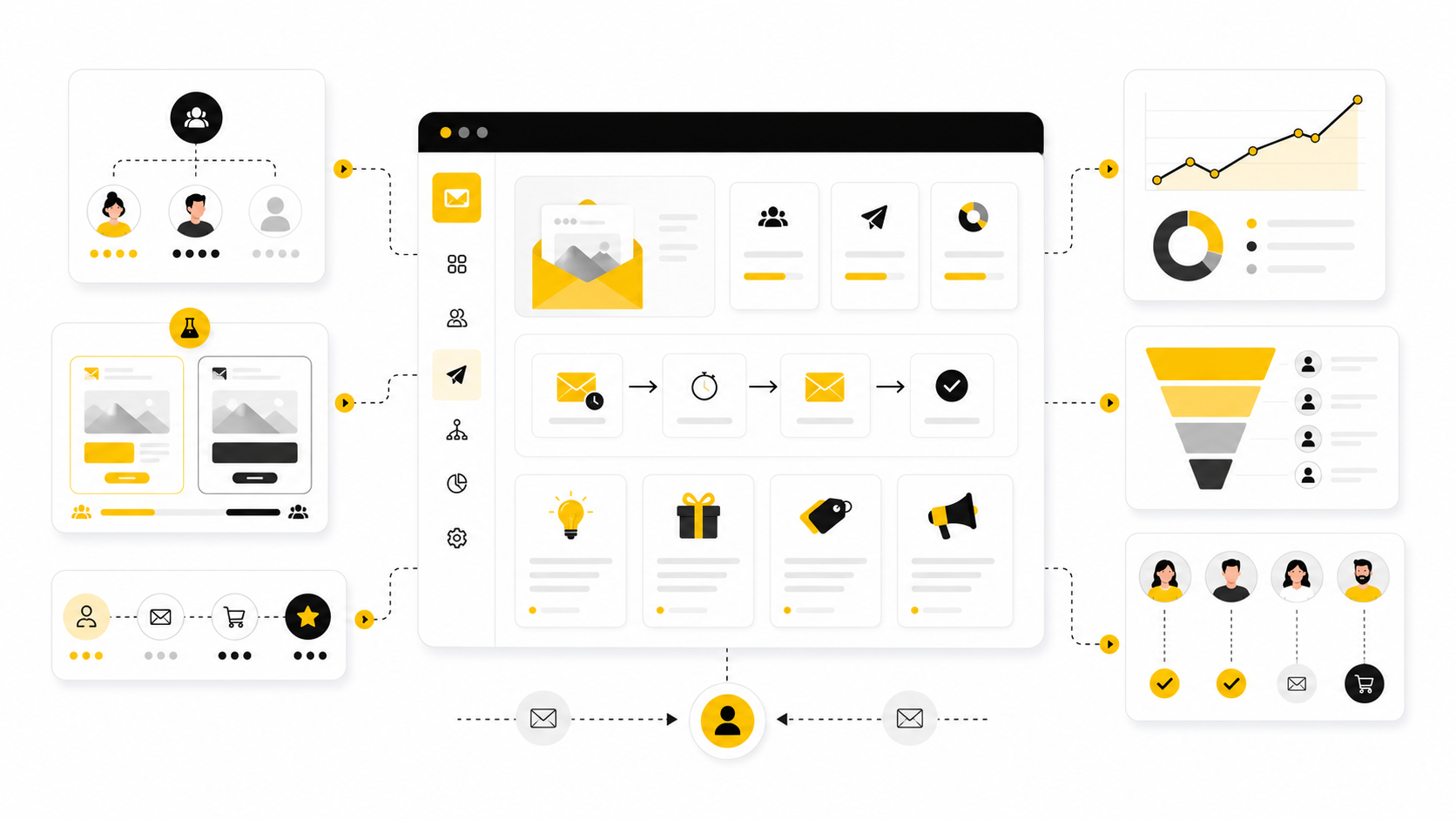
Most businesses do not need more random email marketing campaign ideas. They need better reasons to send, sharper timing, clearer offers, and a system that turns ideas into measurable revenue instead of inbox noise.
That matters because email is still one of the few channels where you can build an owned audience, segment by behavior, and follow up without paying for every impression again. Recent email research shows the upside is still strong: Litmus reports that many companies see $10 to $36 back for every $1 spent on email, while Sinch Mailgun’s 2026 Email Impact Report found that more than half of measured senders see at least $10 returned for every $1 invested.
The problem is not that email stopped working. The problem is that many campaigns are built around a blank calendar, a discount panic, or a vague newsletter habit. Strong email marketing campaign ideas start with the customer journey, then match the right message to the right moment: welcome, educate, recover, convert, retain, reactivate, and refer.
this guide breaks email campaign ideas into a practical framework you can actually use. Instead of giving you a disconnected list of prompts, it shows how to think through campaign purpose, audience intent, offer fit, automation, creative angles, and implementation. That way, every idea has a job.
This six-part article is built to move from strategy to execution. The order matters because email ideas only become useful when they connect to a campaign system, a customer segment, and a measurable business outcome. Use this outline as the map for the full article.
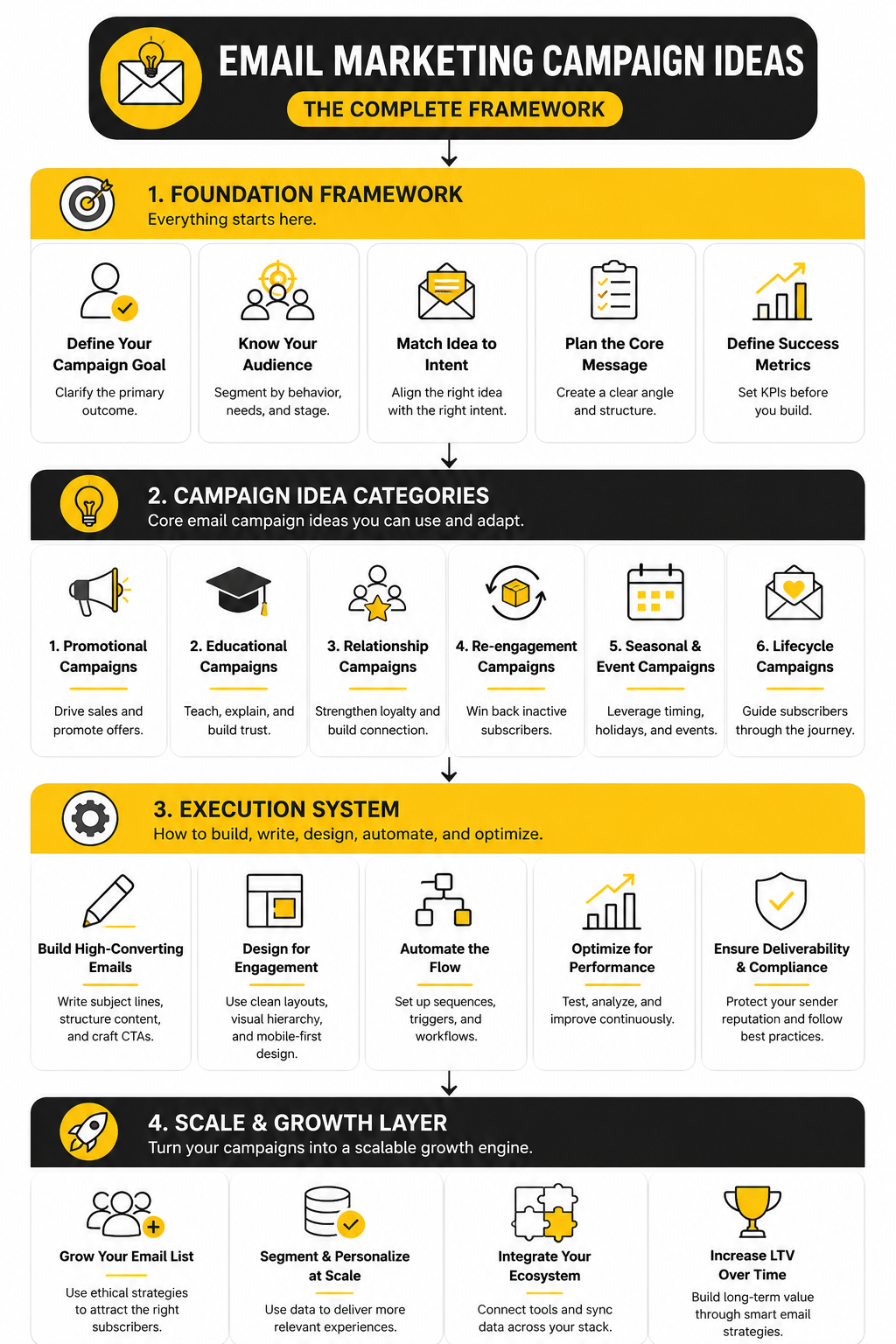
Part 2 will start with the bigger reason email still deserves serious attention: control. Paid social platforms can raise costs, search visibility can shift, and algorithms can change without warning, but an engaged email list gives you a direct line to people who already showed intent. That direct line is only valuable when your campaigns respect attention and give subscribers a reason to keep opening.
Part 3 will turn the topic into a framework. The goal is to make campaign planning easier, not more complicated. You will see how to sort ideas by lifecycle stage, buying intent, message type, offer strength, and automation potential.
Part 4 will cover the pieces that make an idea work in practice. That includes audience segmentation, subject lines, timing, creative direction, landing page fit, deliverability, and conversion tracking. These are the parts most “email ideas” lists skip, even though they often decide whether the campaign makes money.
Part 5 will give you the actual campaign ideas. They will be grouped by goal so you can quickly find ideas for lead nurturing, ecommerce sales, abandoned carts, launches, retention, referrals, win-backs, events, and content promotion. Each idea will be written as something you can adapt, not copy blindly.
Part 6 will bring the article back to implementation. It will cover how to prioritize campaigns, build a simple testing rhythm, avoid over-sending, measure what matters, and answer the most common questions about email marketing campaign ideas. The goal is not just to leave with inspiration; it is to leave with a system you can run.
Why Email Marketing Campaign Ideas Matter More Than Ever
Good email marketing campaign ideas matter because attention is more expensive now. Paid ads can still work, but costs, competition, attribution gaps, and platform changes make it harder to rely on one traffic source. Email gives you a controlled channel where you can keep building trust after the first click, form submission, purchase, webinar registration, or abandoned checkout.
That does not mean email is automatically profitable. A weak campaign sent to the wrong segment is still a weak campaign. The point is that email gives you more chances to match the message to the moment, and that is where the money usually comes from.
A strong campaign idea answers one simple question: what does this subscriber need to hear next? Sometimes the answer is education. Sometimes it is proof. Sometimes it is a reminder, a deadline, a product comparison, a replenishment nudge, or a reason to come back. When you build around that question, email stops being “something we send” and becomes part of the customer journey.
Email Is an Owned Channel in a Rented-Attention World
Most marketing channels are rented. You can build a following on social media, but the platform controls reach. You can rank in search, but rankings move. You can buy traffic, but the price changes the second competition increases.
Email is different because the subscriber relationship belongs more directly to you. You still have to respect inbox rules, deliverability, consent, and relevance, but you are not waiting for an algorithm to decide whether your audience can see your message. That alone makes email one of the most practical assets a business can build.
This is why email marketing campaign ideas should not be treated like last-minute promotional fillers. They are a way to keep the conversation going after someone has already shown interest. A visitor may not buy on the first visit, but a good welcome sequence, product education campaign, or objection-handling series can keep moving them toward a decision.
The Inbox Rewards Relevance
People do not hate email. They hate irrelevant email. That distinction matters because it changes how you plan campaigns.
A subscriber who just downloaded a guide should not receive the same message as someone who abandoned a cart five minutes ago. A loyal customer should not be treated like a cold lead. A buyer who purchased once but has not returned in six months needs a different reason to engage than someone who clicks every campaign.
This is where segmentation turns ordinary ideas into useful campaigns. Industry benchmark data from Brevo’s email marketing benchmarks shows how open rates, click rates, unsubscribe rates, and deliverability can vary by region and industry, which is exactly why copying generic campaigns is risky. Your best email marketing campaign ideas should come from subscriber behavior, not from a random swipe file.
Campaign Ideas Help You Avoid Discount Addiction
One of the biggest mistakes businesses make with email is using it only when they want a quick sale. The list gets trained to wait for coupons. Margins get thinner. The brand becomes predictable in the worst possible way.
Better campaign planning gives you more tools than discounts. You can send buying guides, comparison emails, customer education, founder notes, product usage tips, seasonal planning, limited bundles, loyalty perks, surveys, referral prompts, and reactivation campaigns. Some of those campaigns sell directly, while others build the confidence that makes the next sales email perform better.
This is especially important for brands that care about long-term revenue. If every campaign screams “buy now,” subscribers eventually tune out. If your emails consistently help them make better decisions, they have a reason to stay subscribed even when they are not ready to purchase today.
Automation Makes Good Ideas More Valuable
Manual campaigns are useful, but automation is where email starts compounding. A campaign that only gets sent once has a short shelf life. A well-built automated flow can keep working every day for new subscribers, new leads, new customers, and returning buyers.
This is why email marketing campaign ideas should be sorted into two groups: broadcast ideas and lifecycle ideas. Broadcasts are timely messages, such as launches, announcements, seasonal campaigns, and content promotions. Lifecycle campaigns are triggered by behavior, such as welcome sequences, abandoned carts, post-purchase education, renewal reminders, and win-back flows.
For service businesses, agencies, and local businesses that need CRM, funnels, SMS, booking, and automated follow-up in one place, GoHighLevel can fit naturally into this kind of system. For leaner creators and small businesses that want simple funnels and email automation without stacking too many tools, Systeme.io can be a practical starting point. The tool matters, but the strategy matters more: send the right message because something meaningful happened.
Email Supports Every Stage of the Customer Journey
The best email campaigns do not all try to close the sale immediately. Some campaigns are designed to earn attention. Some build belief. Some remove hesitation. Some increase repeat purchases. Some bring old subscribers back before they disappear completely.
That is why a useful email strategy needs more than one type of campaign idea. A welcome campaign introduces the brand. A nurture campaign explains the problem and solution. A promotional campaign creates action. A post-purchase campaign reduces regret and improves product usage. A loyalty campaign increases repeat buying and referrals.
Once you see email this way, your campaign calendar becomes easier to plan. You are no longer asking, “What should we send this week?” You are asking, “Which part of the customer journey needs support right now?” That is a much better question.
Strong Campaign Ideas Make Measurement Cleaner
Random emails are hard to measure because they do not have a clear job. One campaign tries to educate, sell, announce, entertain, and re-engage all at once. Then the results come in, and nobody knows what actually worked.
A focused campaign is easier to judge. If the goal is to recover abandoned carts, measure recovered revenue and conversion rate. If the goal is to qualify leads, measure clicks, replies, bookings, or form completions. If the goal is retention, measure repeat purchases, renewal activity, and churn reduction.
This is also why each campaign should have one primary call to action. You can include supporting context, but the reader should know what to do next. Confused subscribers rarely convert, and clever email ideas will not save a messy offer.
The Real Advantage Is Consistency
One strong email can create a spike. A strong email system creates predictable movement. That is the real advantage.
Campaign ideas give you the raw material, but consistency turns them into revenue. You need a repeatable way to capture leads, welcome them, segment them, follow up, sell, educate customers, and bring people back. Once that system exists, every new idea has a place to go.
That is the bridge into the next section. Before listing individual email marketing campaign ideas, it is worth building the framework that keeps them organized. Without a framework, ideas stay random. With one, they become campaigns you can plan, launch, test, and improve.
The Email Campaign Framework Overview
Before you collect more email marketing campaign ideas, build a framework for choosing the right ones. This is where most teams make the mistake. They jump straight into subject lines, promos, and send dates before they know what the campaign is supposed to achieve.
A simple framework keeps the work grounded. It helps you decide whether an email should educate, sell, remind, recover, onboard, retain, or reactivate. Once the campaign has a clear job, the creative gets easier because every message has a purpose.
The framework is built around five questions:
These questions look basic, but they stop vague campaigns before they happen. If you cannot answer them, the campaign is not ready. Do not write the email yet.
Start With the Subscriber Segment
Every campaign starts with the audience. A new subscriber, a warm lead, a first-time buyer, a repeat customer, and an inactive subscriber should not all receive the same message. They have different levels of trust, different objections, and different reasons to care.
Segmentation can be simple at first. You can group people by signup source, product interest, purchase history, engagement level, location, or lifecycle stage. The point is not to create a complicated database; the point is to avoid sending one generic message to everyone.
This matters because benchmark numbers can hide huge differences between audiences. Brevo’s 2025 benchmark data shows meaningful variation across industries, regions, open rates, click rates, and unsubscribe rates, which is a useful reminder that your list is not “the average.” Your campaign should be built for your audience, your offer, and your timing.
Match the Campaign to the Customer Moment
After the segment, define the moment. This is the difference between a helpful email and an annoying one. A discount sent to someone who just bought can feel careless, while a setup guide sent right after purchase can feel perfectly timed.
The customer moment tells you what kind of campaign belongs there. A subscriber who just joined may need a welcome sequence. A lead who clicked a pricing page may need proof, comparison, or objection handling. A customer who has not opened in months may need a reactivation campaign, not another standard newsletter.
This is where good email marketing campaign ideas become more strategic. You are no longer asking, “What can we send?” You are asking, “What is the next logical message for this person based on what they just did or did not do?”
Choose One Primary Campaign Goal
Every campaign needs one main goal. Not three. Not five. One.
That goal might be a click, a reply, a purchase, a booked call, a completed form, a product setup step, or a repeat order. The goal should be specific enough that you can look at the results and know whether the campaign did its job. If the campaign has no measurable next step, it is probably just content without direction.
This does not mean every email has to be aggressive. Educational emails can have goals too. A nurture email might aim to get the reader to view a comparison page, watch a demo, read a guide, or answer a question. The goal gives the email structure without making it feel pushy.
Build the Campaign Around a Clear Reason to Act
People need a reason to click now instead of later. That reason does not always have to be urgency. It can be relevance, curiosity, usefulness, timing, risk reduction, proof, convenience, or a better understanding of the outcome.
For example, a launch campaign might use a deadline because the offer is genuinely time-sensitive. A product education campaign might use clarity because the reader needs to understand which option fits them. A retention campaign might use progress because the customer has already started but needs help reaching the result.
This is where many campaigns fall flat. They include a call to action, but no strong reason to take it. If the reader thinks, “I’ll do this later,” you have not made the next step feel important enough.
Turn the Framework Into a Repeatable Process
A framework only helps if it becomes part of your execution process. You do not want to rebuild the strategy from scratch every time you send a campaign. You want a simple workflow that turns an idea into a campaign without losing the reason behind it.
Use this process before writing any email:
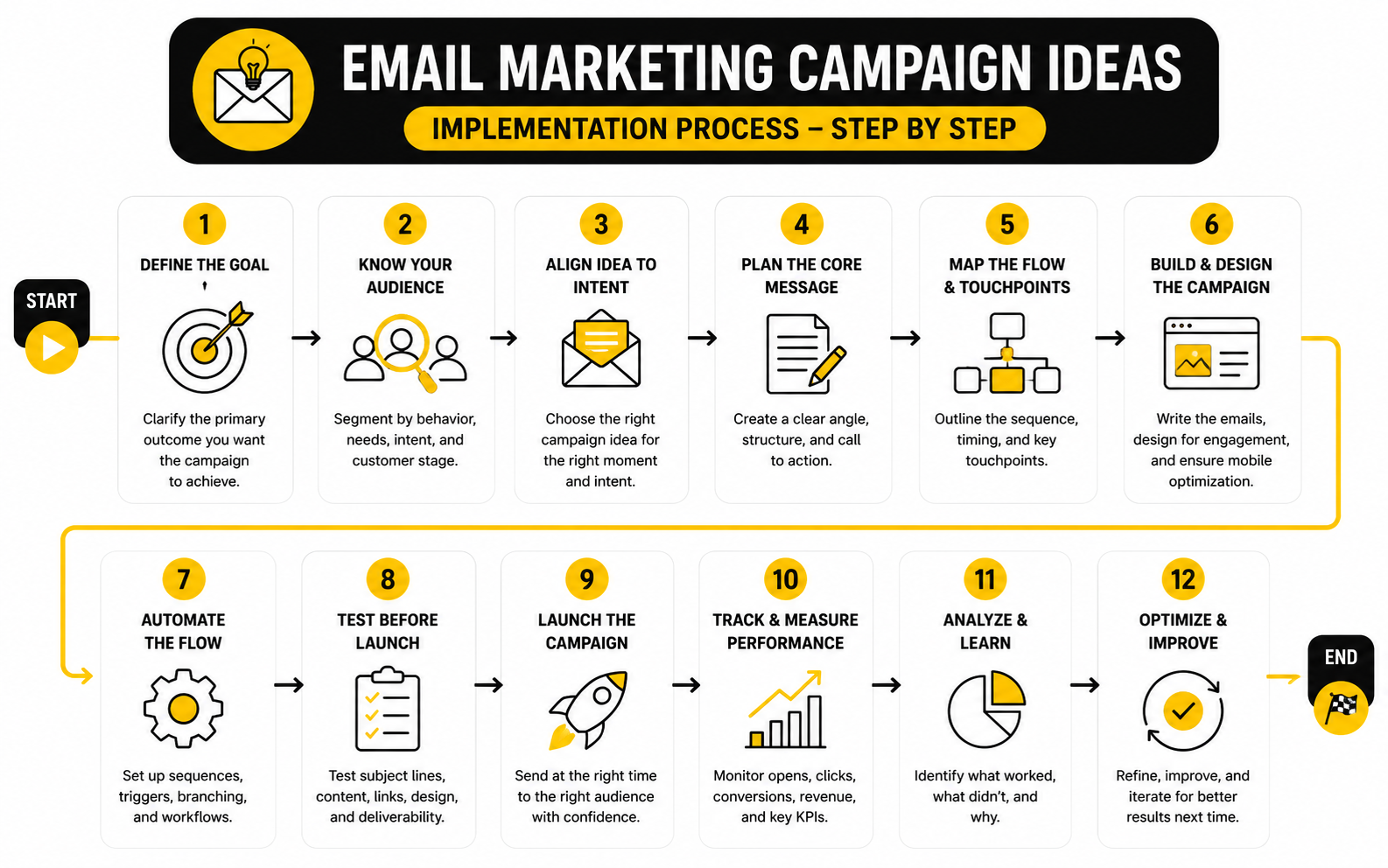
This process makes execution tangible. It also keeps the team honest. If the campaign has no segment, no customer moment, no next step, or no tracking, it is not ready to launch.
Decide Whether the Campaign Should Be Manual or Automated
Some campaigns belong on a calendar. Others belong inside an automation. Knowing the difference prevents you from doing extra work and missing easy wins.
Manual campaigns are best for timely messages. Product launches, seasonal promotions, company updates, content drops, event reminders, and market-specific commentary usually need human timing. These campaigns work because they feel current and relevant to what is happening now.
Automated campaigns are best for repeatable moments. Welcome sequences, lead nurture flows, abandoned checkout emails, post-purchase onboarding, review requests, renewal reminders, and win-back campaigns should not depend on someone remembering to send them. They should trigger when the subscriber’s behavior says the timing is right.
Connect Email to the Page After the Click
An email campaign does not end at the click. The landing page, checkout page, booking page, form, or product page has to continue the same promise. If the email creates one expectation and the page delivers another, conversions suffer.
This is why campaign planning should include the destination before the email is written. For ecommerce and direct-response pages, tools like Replo can help teams build focused landing pages without waiting on a full development cycle. For creators and businesses building simple funnels around an email offer, ClickFunnels can fit when the campaign needs a clear opt-in, sales page, upsell, or checkout path.
The key is message match. The subject line, email body, call to action, and destination page should all feel like one continuous path. If the subscriber has to re-orient after clicking, you are adding friction at the worst possible moment.
Track the Metrics That Match the Goal
Do not measure every campaign the same way. A reactivation campaign, abandoned cart flow, newsletter, product launch, and referral campaign do not have the same job. They should not be judged by the same single metric.
For engagement campaigns, opens and clicks can show whether the message created interest, but they are not the whole story. For revenue campaigns, track conversion rate, revenue per recipient, average order value, and recovered revenue. For lead generation campaigns, track booked calls, form completions, replies, and qualified opportunities.
Deliverability also belongs in the measurement conversation. Validity’s 2025 deliverability research highlights how inbox placement remains a major constraint on email performance, which means a campaign can underperform before the copy even gets a chance. If your emails are not reaching the inbox, better campaign ideas will not fix the core problem.
Build a Campaign Library Instead of Starting From Zero
Once you have a repeatable process, start building a campaign library. Save the campaign goal, audience, timing, angle, subject line, call to action, offer, destination page, and result. This turns every send into an asset.
Over time, your library becomes more useful than a generic list of email marketing campaign ideas. You will know which types of campaigns work for your audience, which offers create movement, and which segments need more nurturing before they buy. That is how email gets sharper instead of noisier.
The next part will go deeper into the core components that make these campaigns perform. The framework tells you what to build. The components show you how to make each campaign strong enough to earn the click, conversion, reply, booking, or repeat purchase.
Statistics and Data
Data should make your email marketing campaign ideas sharper, not noisier. The goal is not to collect impressive numbers and paste them into a report. The goal is to understand what the numbers say about attention, intent, trust, timing, and revenue.
A campaign can have a strong open rate and still fail commercially. Another campaign can have a modest open rate but generate serious revenue because it reached the right segment with the right offer. That is why email measurement needs context.
The cleanest way to read email data is to separate performance signals into four layers: deliverability, engagement, conversion, and business impact. Each layer answers a different question. When you read them together, you stop guessing and start improving the actual system.
Start With Deliverability Before You Judge the Campaign
Deliverability is the first measurement layer because it decides whether your campaign even gets a fair shot. If your emails land in spam, get blocked, or reach the promotions tab with weak engagement history, the creative cannot do its job properly. This is why deliverability problems often get mistaken for copywriting problems.
Inbox placement is not the same as delivery rate. Delivery rate usually tells you whether the email was accepted by the receiving server. Inbox placement tells you whether it actually reached the inbox experience where subscribers are likely to see it.
That difference matters. Validity’s 2025 deliverability benchmark report highlights how inbox placement remains a major pressure point for senders, and that should change how you read campaign performance. If a campaign underperforms, check deliverability before rewriting the entire strategy.
Use Opens Carefully
Open rates are useful, but they are not as clean as they used to be. Privacy features, image loading, bot activity, and mailbox behavior can distort the number. That does not make open rates useless, but it does mean you should treat them as a directional signal rather than a perfect measure of human attention.
Open rate is most helpful when you compare similar campaigns to similar audiences over time. If your weekly newsletter usually lands around one range and suddenly drops hard, something changed. It could be the subject line, sender name, timing, deliverability, list quality, or audience fatigue.
Do not optimize only for opens. A curiosity-heavy subject line can lift opens and still disappoint readers if the email does not deliver. That may help one campaign while hurting trust across the next ten.
Clicks Show Intent More Clearly Than Opens
Clicks are usually a stronger signal than opens because they show active interest. Someone did not just notice the email. They cared enough to move forward.
This is why click-through rate and click-to-open rate should be reviewed together. Click-through rate tells you how many delivered recipients clicked. Click-to-open rate shows how persuasive the email was among people who opened it. If opens are strong but clicks are weak, the subject line may be doing more work than the message.
The action is simple: use click data to diagnose message match. If subscribers open but do not click, improve the offer, body copy, call to action, or destination promise. If they click but do not convert, the problem may be after the email.
Benchmarks Are Reference Points, Not Targets
Benchmarks help you avoid flying blind, but they should not become the goal. Your list quality, acquisition source, product price, sales cycle, industry, region, and sending frequency all shape the numbers. A high-performing B2B nurture sequence and a flash-sale ecommerce campaign should not be judged by the same expectations.
Still, benchmarks can keep your instincts grounded. The DMA’s 2025 Email Benchmarking Report reported a 98% delivery rate, a 35.9% open rate, and a 2.3% unique click rate across its benchmarked email activity. Those numbers are not commandments, but they are useful reference points when your own data is missing or messy.
The real value is in the gap between benchmark and context. If your clicks are below the benchmark but your conversions are strong, you may have a smaller but more motivated audience. If your opens are above benchmark but revenue is weak, your email marketing campaign ideas may be attracting attention without creating action.
Build a Simple Analytics System
Your measurement system does not need to be complicated. It needs to be consistent. Every campaign should be reviewed through the same basic structure so you can compare results without reinventing the dashboard each time.
Track these five layers:
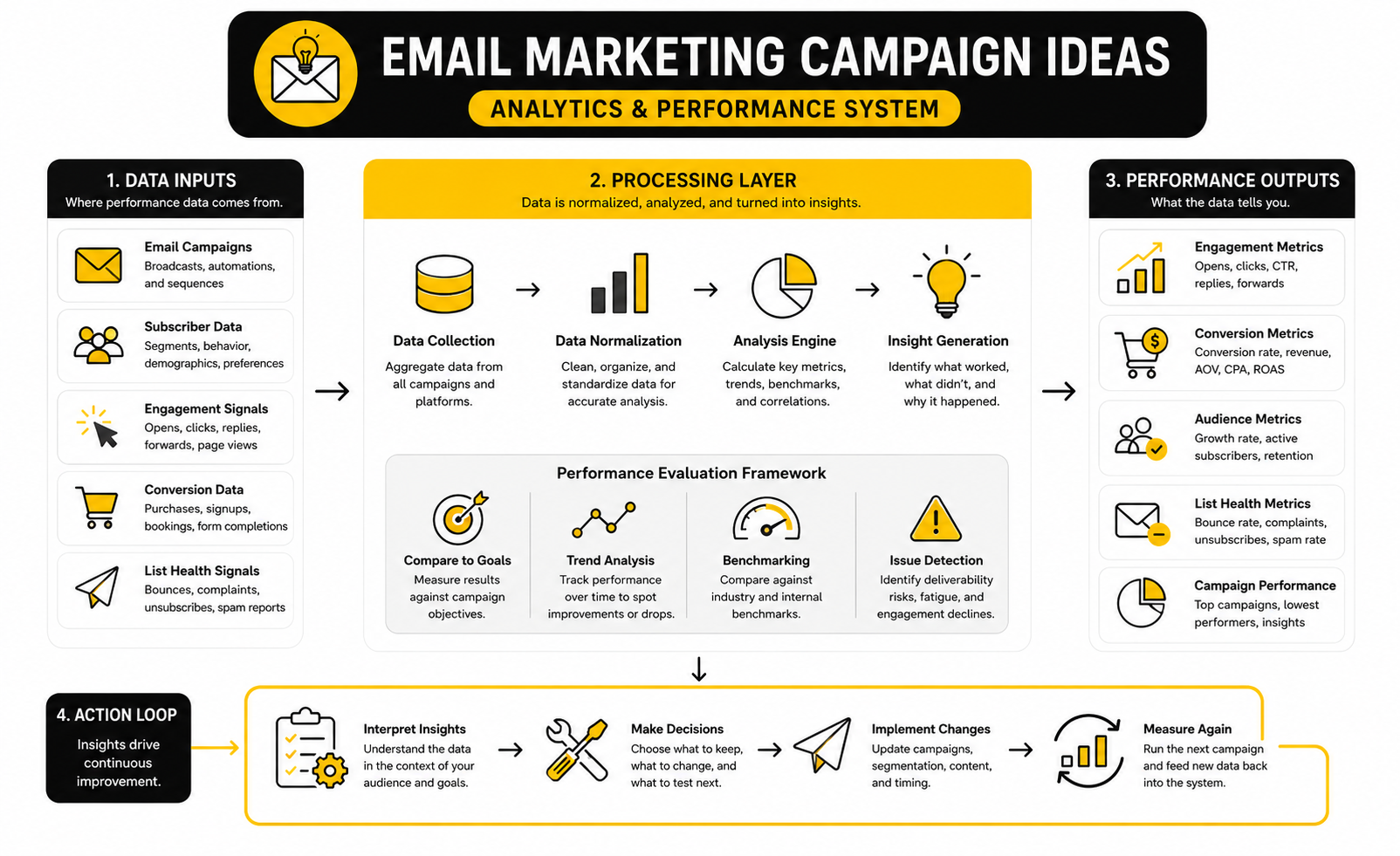
This system keeps your analysis practical. You are not just asking whether the email “performed well.” You are asking where the campaign created movement, where it leaked attention, and where the next improvement should happen.
Revenue Per Recipient Makes Campaigns Easier to Compare
Revenue per recipient is one of the most useful metrics for ecommerce and direct-response campaigns. It shows how much revenue a campaign generated for each person who received it. That makes it easier to compare campaigns with different list sizes.
For example, one campaign might generate more total revenue because it was sent to a huge segment. Another campaign might generate less total revenue but produce much higher revenue per recipient because it reached a more qualified audience. The second campaign may be more valuable as a model.
Automated flows often look especially strong through this lens because they reach people at high-intent moments. Klaviyo’s abandoned cart benchmark data shows abandoned cart flows producing higher average revenue per recipient and placed order rates than other common flows, which is exactly what you would expect from a behavior-triggered campaign. The lesson is not “send more cart emails forever.” The lesson is that timing and intent can beat volume.
Unsubscribes Are Feedback, Not Failure
Unsubscribes are not automatically bad. A small number of unsubscribes can mean your list is self-cleaning. People who are no longer interested leave, and your engagement quality can improve.
The problem starts when unsubscribes spike after specific campaign types. That is a signal that the message, frequency, offer, or targeting missed the mark. Instead of panicking, inspect the pattern.
Ask what changed. Was the email sent to too broad a segment? Was the promise too aggressive? Did the frequency increase suddenly? Was the campaign useful to the reader, or only useful to the business?
Complaints Matter More Than Unsubscribes
Spam complaints are more serious than unsubscribes because they can hurt sender reputation. A reader who unsubscribes is using the normal exit path. A reader who marks spam is telling the mailbox provider that your email did not belong there.
This is why clean consent and clear expectations matter. People should know what they signed up for, how often they might hear from you, and why the emails are relevant. Hiding the unsubscribe link or making it hard to leave is a bad move because it can push annoyed subscribers toward the spam button.
If complaints rise, slow down and fix the root cause. Review acquisition sources, opt-in language, list imports, send frequency, and campaign relevance. More email is not the solution when trust is already weakening.
Conversion Data Tells You Where the Real Bottleneck Is
Email metrics can only explain part of the journey. If people click but do not buy, book, or submit the form, the issue may not be the email. It may be the page, offer, checkout, pricing, product positioning, or follow-up process.
This is why your analytics should connect email behavior to the destination after the click. A strong campaign needs alignment between subject line, message, call to action, landing page, and final conversion step. Break that chain, and the numbers will show friction.
For lead generation campaigns, tools like Fillout can help keep forms focused and easy to complete. For booking-driven campaigns, Cal.com can reduce friction when the campaign goal is a scheduled call. The email creates intent, but the next step has to make that intent easy to act on.
Compare Campaign Types Separately
Do not compare every email against one blended average. That hides the truth. A newsletter, launch email, cart recovery message, onboarding email, referral request, and win-back campaign are doing different jobs.
Create separate performance baselines for each campaign type. Track welcome sequences against other welcome sequences. Compare promotional broadcasts against similar promotions. Review abandoned cart emails against other cart recovery emails.
This makes your email marketing campaign ideas more useful over time. You will see which ideas create attention, which create clicks, which create sales, and which only look good on the surface. That is how the campaign library from the previous section becomes more carefully with every send.
Know What Action Each Metric Should Drive
Metrics are only useful when they lead to decisions. If a number does not change what you do next, it is probably dashboard decoration. Keep the reporting tight.
Use the data this way:
This is the practical side of analytics. Numbers should create a next step. If they do not, they are not being used properly.
Let Data Improve Ideas, Not Kill Creativity
The best campaigns combine creative angles with disciplined measurement. Data tells you what happened. It does not always tell you the full reason why. That is where judgment still matters.
A campaign can underperform because the idea was weak, but it can also underperform because the segment was wrong, the timing was off, the landing page was slow, or the list was tired. Do not kill a good idea after one bad send without understanding the context. Improve the system first.
The next part can now move into the actual campaign ideas with a stronger foundation. You will not just see what to send. You will know which goal each idea supports, what signal to watch, and how to decide whether it deserves a second version.
Email Marketing Campaign Ideas by Goal and Customer Stage
At this point, the strategy is clear: do not treat email marketing campaign ideas like random inspiration. Treat them as tools for moving people through a journey. The right idea depends on what the subscriber already knows, what they need next, and what action would create value for both sides.
This part goes deeper into the strategic decisions behind the ideas. Some campaigns are built for trust. Some are built for speed. Some are built for recovery, retention, or expansion. The advanced work is knowing which one to prioritize, when to automate, and when to leave subscribers alone.
The biggest mistake is trying to scale every campaign at once. That creates too many messages, too many overlapping offers, and too little clarity. Start with the highest-leverage customer moments, then expand carefully.
Lead Capture Campaigns Need a Stronger Promise Than “Join Our Newsletter”
A lead capture campaign starts before the first email is sent. The opt-in promise sets the expectation for the whole relationship. If the signup form is vague, the welcome email has to work harder because the subscriber does not have a clear reason to care.
A strong lead capture idea gives people a specific reason to join. That might be a checklist, product finder, calculator, short course, buyer guide, waitlist, early access list, event registration, or private discount. The format matters less than the promise.
This is where low-intent subscribers and high-intent subscribers should be separated early. Someone who downloads a beginner guide may need education. Someone who requests a demo, starts checkout, or asks for pricing is much closer to action. Put them into different follow-up paths instead of forcing one sequence to do every job.
Welcome Campaigns Should Build Trust Before They Push Too Hard
The welcome campaign is one of the most important lifecycle campaigns because it shapes the first impression. A new subscriber is paying attention now. That window is valuable, but it is easy to waste with a generic “thanks for joining” email.
A stronger welcome sequence explains what the subscriber will get, why the brand is credible, and what the next useful step should be. It can introduce your best content, clarify your offer, show proof, invite a reply, or direct people toward the most relevant product or service path. The goal is not to overload them; the goal is to help them orient quickly.
For service businesses and agencies, the welcome flow can also qualify leads. A simple question, booking link, or intake form can reveal who needs fast follow-up. For ecommerce brands, it can guide first-time visitors toward bestsellers, product education, or a first-purchase incentive without making every message feel like a coupon.
Nurture Campaigns Should Remove Friction One Objection at a Time
A nurture campaign is not just a string of educational emails. It is a guided path from awareness to confidence. Each email should answer a real question that prevents the subscriber from moving forward.
Common nurture angles include problem education, cost of inaction, product comparison, customer proof, buying criteria, behind-the-scenes process, mistakes to avoid, and how to choose the right solution. These are not filler topics. They are the pieces people need before they feel safe enough to act.
The advanced move is to build nurture campaigns around friction points, not content categories. If people hesitate because they do not understand the process, explain the process. If they doubt the outcome, show proof. If they are overwhelmed by options, give them a decision guide.
Promotional Campaigns Need Offer Discipline
Promotional campaigns can work extremely well, but they can also train your list to ignore full-price offers. This is the tradeoff. Short-term revenue is useful, but repeated discounting can weaken positioning if there is no strategy behind it.
A better promotional campaign has a clear reason for the offer. Seasonal timing, product launch, bundle, inventory shift, event, loyalty perk, waitlist access, or deadline can all make sense. “We need sales this week” is not a subscriber-facing reason.
Use promotion carefully in your email marketing campaign ideas. Discounts are not the only lever. You can promote bonuses, bundles, limited access, free shipping, priority booking, extended support, faster implementation, or exclusive content. The best offer is the one that increases action without damaging trust.
Abandoned Cart and Checkout Campaigns Should Reduce Doubt
Abandoned cart campaigns are powerful because they happen at a high-intent moment. The person already showed interest. Your job is not to restart the entire sales conversation; your job is to remove the specific friction that stopped the purchase.
That friction could be price, shipping, timing, confusion, trust, comparison shopping, or simple distraction. A strong cart recovery sequence can remind, clarify, answer objections, reinforce benefits, and make returning to checkout easy. It does not need to beg.
Data from Klaviyo’s small business automation guide points to abandoned cart flows as one of the strongest revenue-per-recipient opportunities in ecommerce automation. The action is straightforward: build this flow early, keep it clean, and avoid turning every abandoned cart into a discount race.
Post-Purchase Campaigns Are Where Retention Starts
A lot of businesses celebrate the purchase and then go quiet. That is a mistake. The post-purchase window is where you reduce regret, improve product usage, set expectations, and prepare the customer for the next relationship step.
Post-purchase email marketing campaign ideas can include order confirmation improvements, setup guidance, delivery expectations, usage tips, care instructions, onboarding checklists, replenishment reminders, review requests, and cross-sell education. The key is sequencing. Do not ask for a review before the customer has had enough time to experience the result.
This is also where customer experience and email strategy meet. If customers repeatedly ask the same support question, turn the answer into a post-purchase email. If people fail to use the product properly, send better onboarding. If repeat purchases depend on timing, build a replenishment or renewal reminder before the customer has to remember on their own.
Reactivation Campaigns Should Respect the Silence
Inactive subscribers are not all the same. Some stopped opening because they lost interest. Some changed inboxes. Some only needed your offer once. Some still care but have not seen anything relevant recently.
A reactivation campaign should not be desperate. It should acknowledge the gap, offer a clear reason to stay, and make it easy to choose what happens next. That might mean updating preferences, choosing a topic, claiming a relevant offer, or confirming they still want emails.
This is also a list-health decision. If subscribers ignore the reactivation sequence, remove or suppress them from regular campaigns. Keeping dead weight on the list can hurt engagement signals and make future sends less effective.
Referral Campaigns Work Best After a Clear Win
Referral campaigns often fail because they are sent too early. A customer who has not experienced value yet has no strong reason to recommend you. Timing matters more than the cleverness of the referral email.
The best referral moment usually comes after a positive outcome. That could be a repeat purchase, successful onboarding, high product usage, a positive review, a support win, or a strong satisfaction signal. The campaign should make the referral feel simple and natural, not like unpaid labor.
Keep the ask specific. Instead of a vague “share with a friend,” explain who the product or service is best for and what the friend will receive. A clear referral offer removes social friction and makes the customer more confident about passing it along.
Event and Launch Campaigns Need a Real Narrative
Launches and events need more than reminders. They need a narrative arc. People should understand what is happening, why it matters, why now is the right time, and what they will miss if they ignore it.
A strong launch sequence can include anticipation, problem framing, behind-the-scenes context, proof, feature explanation, objection handling, deadline reminders, and final-call emails. Each message should add something new. Repeating “doors close soon” five times is not a strategy.
For webinars, workshops, and sales events, reminders should also increase attendance quality. Send the agenda, who it is for, what to prepare, and what attendees will be able to do afterward. If the event leads to a sales offer, the pre-event emails should warm up the problem and make the solution easier to understand.
AI Can Help Scale Execution, but It Should Not Own the Strategy
AI can speed up brainstorming, drafting, subject line variations, summaries, segmentation ideas, and testing plans. That is useful. But AI should not be the strategist unless you feed it real audience data, campaign history, offer context, and business constraints.
The risk is obvious: more email, faster, with less judgment. That is not a win. A tool can produce twenty campaign angles in seconds, but it cannot automatically know which one protects trust, supports positioning, or matches the customer moment.
Use AI where it reduces production friction. For example, GoHighLevel AI can fit teams that want AI-assisted follow-up inside a broader CRM and automation workflow. For email writing and voice input, Wispr Flow can help capture rough campaign ideas faster, but the final decision still needs a marketer’s judgment.
Scaling Email Means Managing Frequency, Not Just Volume
As your campaign library grows, the risk shifts from “we do not send enough” to “we send too much to the same people.” This is where a good email program needs governance. Without it, welcome sequences, promos, launches, newsletters, cart emails, and reactivation campaigns can collide.
Frequency management is not just about sending fewer emails. It is about prioritizing the most relevant message when multiple campaigns could apply. A subscriber in a checkout recovery flow probably should not receive every broad promo at the same time. A new customer in onboarding may need product support before another sales push.
Create suppression rules, priority rules, and quiet periods. Decide which flows override broadcasts. Decide how many promotional emails a subscriber can receive in a short window. This is the unsexy work that protects the list.
Advanced Segmentation Should Stay Useful, Not Complicated
Segmentation can become a trap when teams create too many tiny audiences they cannot actually serve well. More segments do not automatically mean better marketing. Better segments are the ones that change the message in a meaningful way.
Use advanced segmentation when it changes the campaign decision. Segment by lifecycle stage, product interest, purchase value, engagement recency, location, lead source, content topic, or sales readiness. Do not segment just because the data exists.
A practical rule is simple: if the segment does not change the offer, angle, timing, or call to action, it may not need its own campaign. Complexity should earn its place. Otherwise, you create more work without improving the subscriber experience.
The Best Campaign Ideas Protect Long-Term Trust
Every email makes a small deposit or withdrawal from trust. Helpful emails, relevant offers, clear expectations, and respectful timing build the relationship. Misleading subject lines, constant urgency, irrelevant promos, and messy follow-up drain it.
This is why the best email marketing campaign ideas are not just clever. They are responsible. They sell when selling makes sense, educate when the reader needs clarity, and pause when another email would only create fatigue.
The final part will bring this into professional implementation. That means prioritizing what to build first, creating a simple operating rhythm, choosing tools without overcomplicating the stack, and answering the questions that usually come up when a business turns campaign ideas into a working email system.
Professional Implementation, Measurement, and FAQ
The final step is turning email marketing campaign ideas into a working operating system. Not a folder of drafts. Not a calendar full of random sends. A real system that captures demand, follows up intelligently, measures performance, and improves with every campaign.
The best email programs are not built by sending more emails. They are built by making better decisions before each email goes out. That means choosing the right campaign priority, keeping the technical foundation clean, and reviewing results in a way that changes what happens next.
This is where execution becomes the advantage. Plenty of businesses can brainstorm ideas. Fewer can turn those ideas into repeatable campaigns that protect trust, support sales, and keep improving without becoming chaotic.
Prioritize Campaigns by Revenue, Risk, and Effort
Start with the campaigns closest to money and customer experience. For most businesses, that means welcome, abandoned checkout, lead nurture, post-purchase, reactivation, and key promotional campaigns. These are the places where timing, intent, and follow-up usually matter most.
Do not build twenty campaigns before the first five are working. That creates complexity without learning. Build the highest-leverage flows first, measure them, improve them, and only then expand into more advanced lifecycle campaigns.
A simple prioritization filter works well:
This filter keeps you practical. It also stops the common mistake of chasing clever email marketing campaign ideas while ignoring obvious money leaks.
Build the Final Email Ecosystem
A mature email system has several connected parts. Lead capture brings people in. Segmentation decides what they need. Automations handle predictable moments. Broadcasts handle timely opportunities. Analytics shows where the system is working or leaking.
The ecosystem should feel simple from the outside and organized on the inside. Subscribers should not feel like they are being pushed through a machine. They should feel like the timing makes sense, the messages are relevant, and the next step is clear.
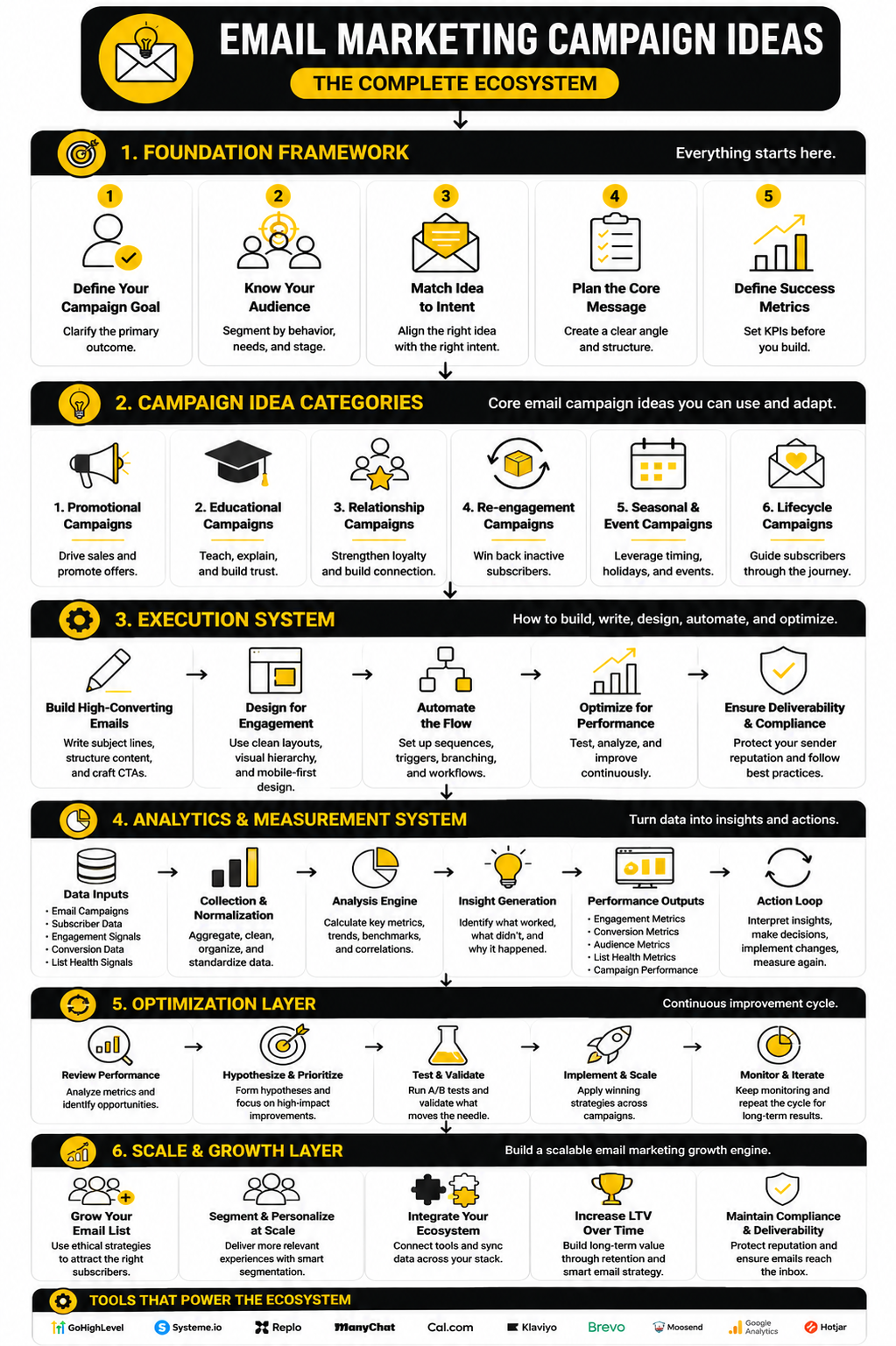
This is also where your tool stack needs to match your business model. A local service business may need CRM, SMS, booking, pipeline tracking, and email automation in one place, which makes GoHighLevel a natural fit. A creator or solo operator may prefer a lighter funnel-and-email setup like Systeme.io, while ecommerce teams may need landing pages, forms, and lifecycle flows connected to their store.
Keep Compliance and Deliverability Built Into the Process
Email growth without compliance is fragile. You need clear consent, honest expectations, easy unsubscribes, accurate sender information, and clean list practices. This is not just legal housekeeping; it directly affects whether your campaigns keep reaching people.
The rules have become stricter for a reason. Gmail and Yahoo bulk sender requirements pushed authentication, easy unsubscribe, and low complaint rates into the center of email operations. If your campaigns create complaints or hide the exit, your deliverability can suffer before your strategy gets a fair test.
Make compliance part of the workflow instead of a last-minute check. Confirm opt-in source, segment relevance, suppression rules, sender authentication, unsubscribe visibility, and message accuracy before each major campaign. Boring? Maybe. Important? Absolutely.
Create a Weekly Email Operating Rhythm
The best email teams have a rhythm. They do not start from zero every Monday. They review performance, choose priorities, build campaigns, and improve the system in a predictable cycle.
A practical weekly rhythm can look like this:
This rhythm turns email into a compound asset. Each week teaches you something. Each campaign adds to the library. Each improvement makes the next email easier to plan.
Choose Tools After You Know the Workflow
Tools should support the workflow, not define it. A powerful platform will not fix unclear offers, weak segmentation, or random sending habits. Start with the process, then choose the stack that removes friction.
For ecommerce landing pages and campaign-specific pages, Replo can help teams move faster without waiting on developers. For booking-driven campaigns, Cal.com can keep the conversion step clean. For conversational lead capture and follow-up across chat channels, ManyChat can fit when your audience engages outside the inbox too.
The point is not to collect tools. The point is to make the customer journey smoother. If a tool does not improve capture, segmentation, execution, conversion, measurement, or retention, it probably does not belong in the stack yet.
What are the best email marketing campaign ideas for beginners?
The best beginner campaign ideas are the ones tied to obvious customer moments. Start with a welcome sequence, a simple nurture sequence, an abandoned checkout or inquiry follow-up, a post-purchase email, and one monthly value-driven broadcast. These campaigns give you useful data without overwhelming your list or your team.
Do not begin with complicated segmentation or advanced personalization. Begin with clear messages that help people take the next logical step. Once those campaigns work, you can build more specific versions for different audience groups.
How many emails should be in a campaign?
The right number depends on the goal and the customer moment. A simple announcement may need one email, while a launch, onboarding sequence, or nurture campaign may need three to seven emails. The correct number is the number required to create clarity without creating fatigue.
Each email should have a reason to exist. If the second, third, or fourth email does not add a new angle, proof point, reminder, objection answer, or next step, it may not be needed. More emails are only useful when they improve the subscriber’s decision.
How often should a business send marketing emails?
Most businesses should send often enough to stay remembered but not so often that subscribers stop trusting the inbox relationship. For many lists, one useful broadcast per week is a reasonable starting point, with automated lifecycle emails running separately based on behavior. The right cadence depends on industry, audience expectations, offer type, and engagement quality.
The better question is not “how often can we send?” It is “how often can we send something relevant?” If relevance drops, frequency becomes a problem fast.
What is the difference between a newsletter and an email campaign?
A newsletter is usually a recurring content email sent to a broad audience. An email campaign is built around a specific goal, audience, moment, and action. A newsletter can be part of your email strategy, but it should not be the whole strategy.
Campaigns are more intentional. They can welcome, educate, sell, recover, retain, reactivate, or drive referrals. Newsletters are useful when they build trust and keep the audience engaged, but they still need a clear purpose.
Which email campaigns should ecommerce brands build first?
Ecommerce brands should usually start with welcome, abandoned cart, post-purchase, product education, review request, replenishment, win-back, and promotional campaigns. These cover the most important revenue and retention moments. They also give the brand a foundation before adding more advanced segmentation.
The first priority should be high-intent behavior. If someone joins the list, views products, starts checkout, buys, or goes inactive, the email system should respond intelligently. That is where automation usually creates the fastest improvement.
Which email campaigns should service businesses build first?
Service businesses should start with lead capture, welcome, qualification, booking follow-up, objection handling, testimonial or proof campaigns, no-show follow-up, and reactivation. The goal is usually not just a purchase. It is often a booked call, consultation, proposal request, or signed contract.
The campaign should reduce uncertainty. Prospects want to know what happens next, whether the business understands their problem, and why it is worth taking the call. Good email marketing campaign ideas for service businesses make that decision feel easier.
How do I know if an email campaign is working?
Start by comparing the campaign result to its goal. If the goal was revenue, look at revenue per recipient, conversions, average order value, and total sales. If the goal was lead generation, look at replies, booked calls, form completions, and qualified opportunities.
Do not judge every campaign by opens alone. Opens can be useful, but clicks, conversions, complaints, unsubscribes, and revenue usually tell a more complete story. A campaign is working when it moves the right audience toward the right action without damaging trust.
Should every email campaign include a discount?
No. Discounts can work, but they should not become the only reason subscribers pay attention. Overusing discounts can train the list to wait, reduce margin, and weaken the perceived value of the offer.
Use other reasons to act. You can offer education, bonuses, bundles, early access, limited availability, helpful comparisons, better support, exclusive content, or a clearer path to the outcome. A strong campaign does not always need a lower price.
How do I avoid sending too many emails?
Use suppression rules, campaign priorities, and lifecycle logic. A subscriber in a checkout recovery flow may not need every newsletter at the same time. A new customer in onboarding may need support before another promotion.
You should also watch behavior. Rising unsubscribes, lower clicks, lower engagement, and more complaints can signal fatigue. The fix is not always fewer emails; sometimes it is better targeting, clearer expectations, and stronger message relevance.
What should I test first in an email campaign?
Test the biggest lever first. In most campaigns, that means the audience segment, offer, subject line, call to action, or destination page. Tiny design changes usually matter less than whether the right person receives the right message at the right time.
Do not test too many things at once. If everything changes, you will not know what caused the result. Make one meaningful change, compare performance, and document what you learned.
Are automated email campaigns better than broadcasts?
Automated campaigns are better for repeatable customer moments. Broadcasts are better for timely messages. You need both.
Automations handle predictable behavior like signups, abandoned carts, purchases, renewals, and inactivity. Broadcasts handle launches, announcements, seasonal campaigns, new content, and market-specific opportunities. The strongest email systems use both without letting them collide.
How should AI be used for email marketing campaign ideas?
AI is useful for brainstorming angles, drafting variations, summarizing research, creating testing plans, and speeding up production. It should not replace strategy. The campaign still needs real audience insight, offer context, and human judgment.
Use AI as a production assistant, not the decision-maker. Feed it customer objections, campaign goals, product details, past performance, and brand voice. Then edit aggressively so the final email sounds like a real business talking to a real person.
What is the biggest mistake businesses make with email marketing campaigns?
The biggest mistake is sending without a clear customer moment. Businesses ask, “What should we send?” when they should ask, “What does this subscriber need next?” That small shift changes everything.
When campaigns are built around the customer journey, the emails become more relevant. The list stays healthier. The data becomes easier to interpret. And the campaign ideas stop feeling random because each one has a clear job.
Build a stronger local presence with BAAM AI
Turn your website, Google profile, social channels, and AI visibility into one growth engine
Most businesses do not need more random marketing activity. They need a consistent presence system that helps the right people find them, trust them, and take action. BAAM AI brings strategy, local SEO, website updates, Google Maps visibility, social content, AI-search readiness, media production, and reporting into one practical monthly engine.
If you want your marketing to keep working after the campaign ends, start with a free BAAM AI presence audit. See how your business shows up today and where the fastest visibility wins are at BAAM AI.