
BAAM AI Blog
Email Marketing Basics
are not about blasting a list, writing clever subject lines, or copying whatever worked for someone else last week. They are about building a reliable system for turning attention into trust, trust into action, and...
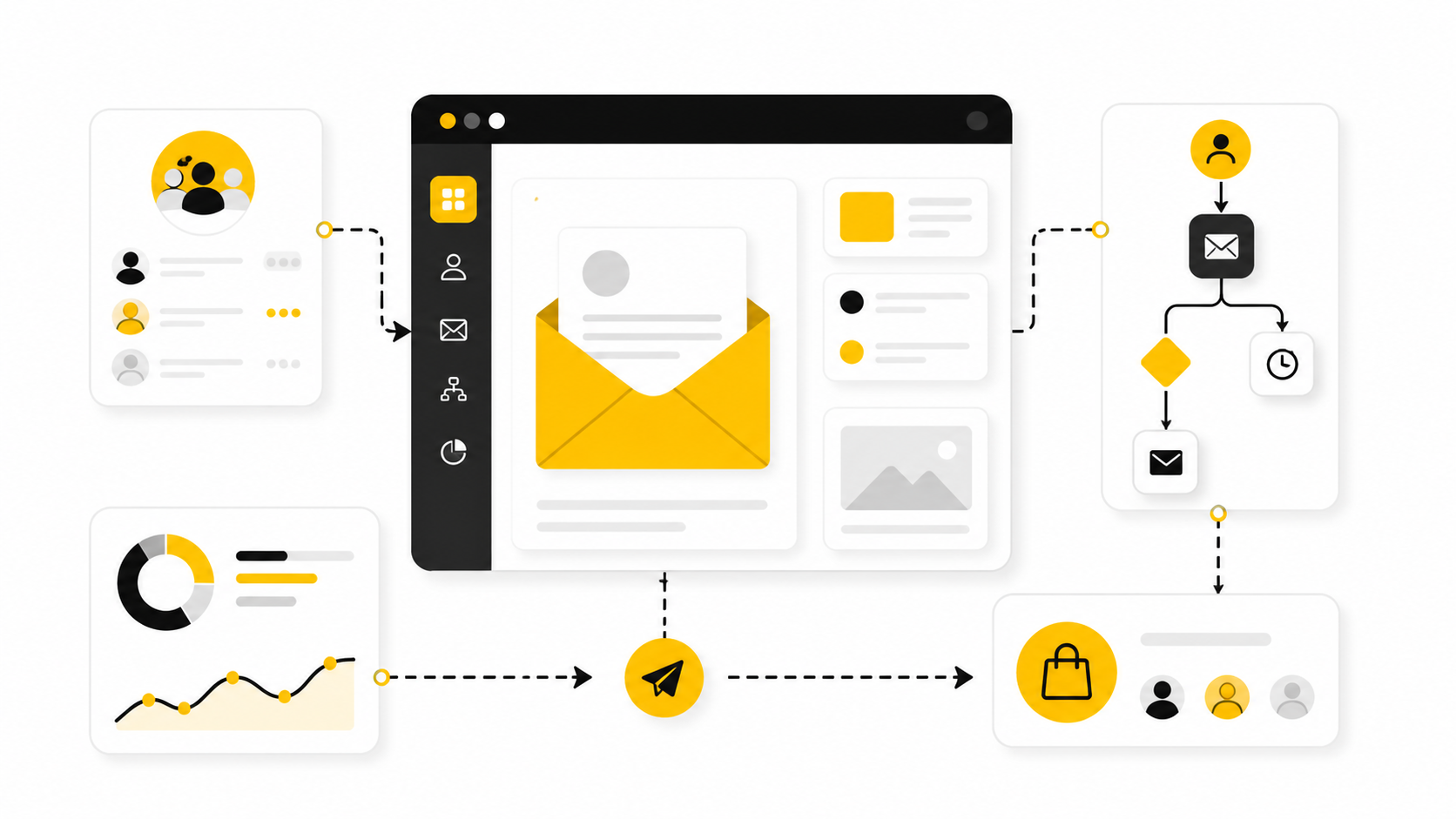
Email marketing basics are not about blasting a list, writing clever subject lines, or copying whatever worked for someone else last week. They are about building a reliable system for turning attention into trust, trust into action, and action into repeatable business results. When email is done well, it becomes one of the few marketing channels you actually own.
That matters because the inbox is still massive, crowded, and commercially important. The global email audience is measured in billions, and recent market estimates put worldwide daily email volume in the hundreds of billions, which is exactly why beginners need structure instead of random tactics. Email can produce strong returns, but only when the fundamentals are handled properly: permission, relevance, deliverability, segmentation, useful content, and measurement.
The goal of this guide is simple: give you a practical foundation for email marketing basics without turning it into a technical maze. You will learn what email marketing is, why it still works, how the core framework fits together, and what a professional implementation looks like before you ever obsess over advanced automation. Start here, and the rest of your email strategy becomes much easier to build.
Email Marketing Basics and the Big Picture
Email marketing is the practice of using email to communicate with people who have given you permission to contact them. That communication can educate, sell, onboard, retain, reactivate, or support customers depending on where they are in the relationship. The basic idea is simple, but the difference between amateur email and professional email is the system behind it.
A beginner often sees email as a newsletter or a promotion. A professional sees email as a lifecycle channel that supports the entire customer journey. That means the same channel can welcome a new subscriber, explain a product, recover an abandoned checkout, announce a launch, request feedback, and bring a dormant customer back.
The reason email marketing basics deserve their own foundation is that every advanced tactic depends on them. Automation will not fix a weak offer. Personalization will not save irrelevant messaging. A beautiful template will not matter if the email never reaches the inbox or goes to people who never wanted it in the first place.
Why Email Marketing Still Matters
Email still matters because it gives businesses a direct line to an audience they can keep communicating with over time. Social platforms can change their algorithms, paid ads can become more expensive, and search rankings can move overnight. Your email list is not immune to change, but it is far more controllable than most rented attention channels.
The business case is also strong. Litmus reports that many companies see email ROI between 10:1 and 36:1, with some reaching higher ranges when the channel is managed well through testing, personalization, and lifecycle campaigns: email ROI benchmarks. The point is not that every beginner should expect those numbers immediately; the point is that email has enough upside to justify learning it properly.
Email also works because it supports intent at different levels. A subscriber may not be ready to buy today, but they may be ready to learn, compare, save an offer, or return later. Good email marketing respects that timing instead of treating every message like a final sales push.
The Framework Overview
A practical email marketing framework starts with four questions: who is receiving the message, why are they receiving it, what should they do next, and how will you measure whether it worked. Those questions keep the strategy grounded. Without them, email becomes noise.
The framework has six connected layers: audience, permission, message, timing, delivery, and measurement. Audience defines who you are talking to. Permission defines whether you have the right to contact them. Message defines the value you send. Timing defines when it should arrive. Delivery defines whether it reaches the inbox. Measurement defines what you improve next.
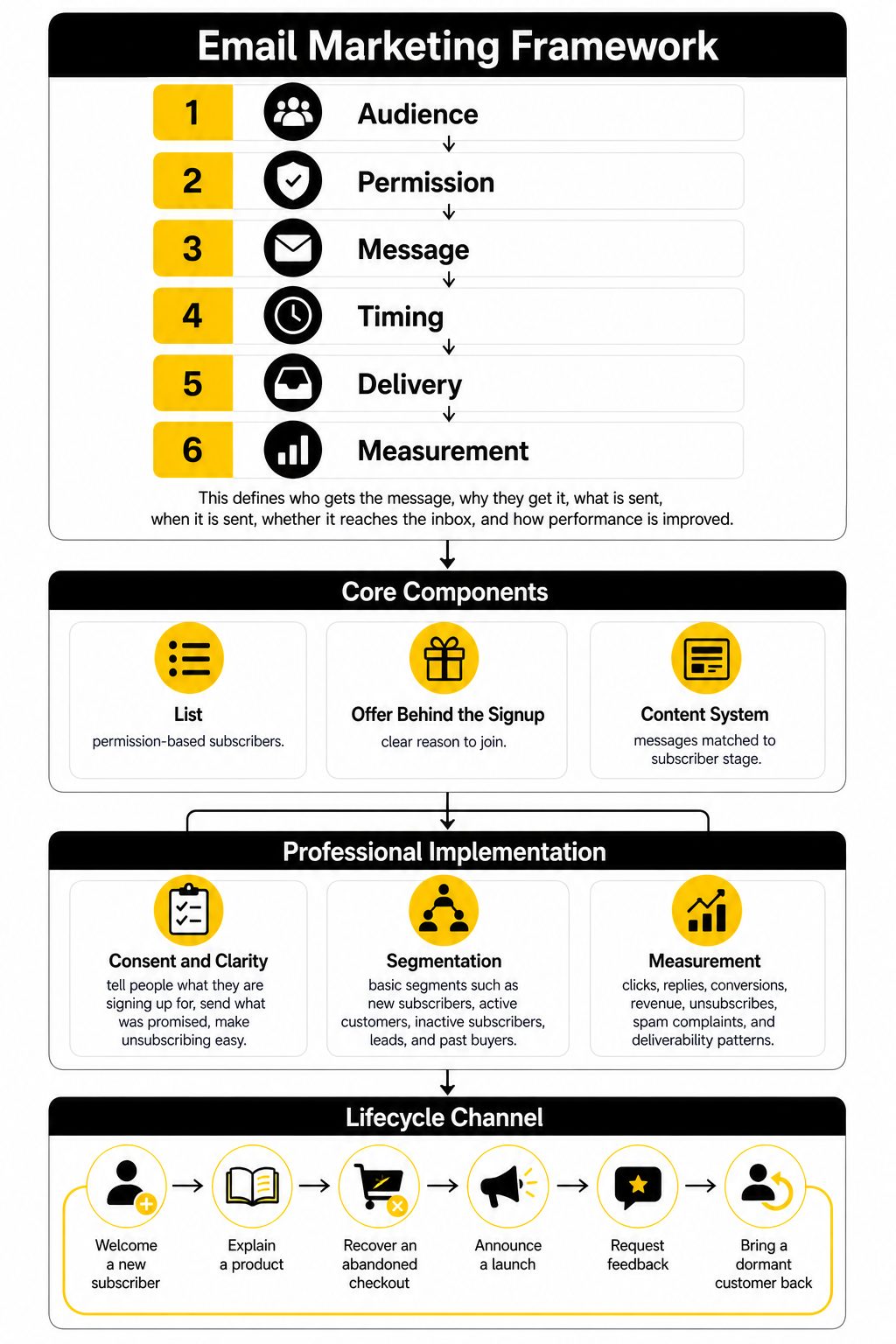
This framework is useful because it prevents beginners from jumping straight into tools. Tools matter, and platforms like Brevo or Moosend can help you build campaigns, automations, forms, and reports. But the tool is only useful when the underlying strategy is clear.
Core Components of Email Marketing
The first core component is the list. A strong list is built from people who knowingly subscribed, requested something, bought something, or otherwise gave you a clear reason to contact them. Buying lists or scraping contacts may look like a shortcut, but it usually damages trust, engagement, and deliverability.
The second component is the offer behind the signup. People rarely join an email list because a form says “subscribe.” They join because they expect value, such as a useful guide, a discount, a product update, early access, a course, a checklist, or ongoing insight they actually want.
The third component is the content system. Email content should not be random; it should match the subscriber’s stage, interest, and likely next step. A welcome email has a different job than a launch email, and a customer education email has a different job than a reactivation email.
Professional Implementation
Professional email marketing starts with consent and clarity. Tell people what they are signing up for, send what you promised, and make it easy to unsubscribe. This is not just about compliance; it is about protecting the long-term health of the channel.
The next step is segmentation. Even basic segments, such as new subscribers, active customers, inactive subscribers, leads, and past buyers, can make campaigns more relevant. HubSpot’s recent marketing statistics continue to place email among the strongest channels for segmentation and personalization use cases: email personalization and segmentation data.
Finally, professional implementation means measuring the right things. Opens can be useful, but they are not enough on their own because privacy changes and inbox behavior can distort them. Clicks, replies, conversions, revenue, unsubscribes, spam complaints, and deliverability patterns give a clearer picture of whether your email marketing is actually working.
Why Email Still Earns a Place in the Marketing Mix
Email earns its place because it sits closer to the customer relationship than most other channels. A social post can disappear in a feed within minutes, and an ad stops working the moment the budget stops. Email gives you a way to keep showing up after someone has already raised their hand.
That does not mean email is automatically effective. Bad email is ignored, deleted, unsubscribed from, or filtered before anyone sees it. But when the basics are handled well, email becomes a practical bridge between attention and revenue.
This is why email marketing basics matter so much for beginners. You are not just learning how to send campaigns. You are learning how to build a communication asset that can support launches, sales, education, retention, and customer experience over time.
Email Is an Owned Relationship Channel
The biggest advantage of email is ownership. You do not fully own your reach on social media platforms, search engines, marketplaces, or ad networks. Those channels can still be powerful, but they are controlled by someone else’s rules, pricing, ranking systems, and platform priorities.
An email list is different because the relationship is more direct. You still need an email service provider, and you still need to follow inbox rules, privacy laws, and deliverability standards. But you are not depending on an algorithm to decide whether every subscriber gets a chance to hear from you.
That direct relationship changes the way you should think about email. The goal is not to squeeze as many promotions as possible out of a list. The goal is to become a useful, trusted sender people recognize and keep opening because your emails consistently help them make better decisions.
Email Supports the Full Customer Journey
Email is not only a sales channel. It can help someone understand a problem, compare options, overcome hesitation, use a product more successfully, and come back when they are ready for more. That makes it one of the most flexible channels in a marketing system.
A new subscriber might need orientation before they are ready to buy. A new customer might need onboarding before they see the value of what they purchased. A past customer might need a reminder, a relevant offer, or a useful update before they come back.
This is where beginners often miss the bigger picture. They treat every email like a one-time announcement, then wonder why results are inconsistent. Strong email programs are built around the journey, not just the next campaign.
Email Compounds Over Time
Email has a compounding effect because every subscriber, segment, automation, and learning can make the next campaign more carefully. When you send regularly and measure properly, you start seeing patterns. You learn what people click, what they ignore, what they reply to, and where they lose interest.
That learning is valuable because it improves more than email. It can shape landing pages, offers, product positioning, content ideas, sales scripts, and customer education. The inbox becomes a feedback loop, not just a distribution channel.
This is also why consistency matters more than occasional intensity. Sending only when you need revenue trains your audience to see you as purely promotional. Sending useful emails between promotions builds familiarity, which makes the promotional moments feel more natural.
Email Makes Segmentation Practical
Segmentation is one of the most important email marketing basics because not every subscriber needs the same message. A person who just joined your list should not always receive the same email as a loyal customer. Someone who clicked a product link may need different follow-up than someone who has not engaged in months.
Even simple segmentation can make your emails feel more relevant. You can separate prospects from customers, active readers from inactive subscribers, or people interested in one product category from people interested in another. The point is not to make the system complicated; the point is to stop treating everyone the same.
Many email platforms make this easier than beginners expect. For example, tools like Brevo, Moosend, and GoHighLevel can help organize contacts, trigger automations, and track behavior. The tool does not replace strategy, but it can make a clear strategy much easier to execute.
Email Reduces Dependence on Paid Traffic
Paid traffic is useful, but it is risky when it becomes the whole business model. Costs can rise, targeting can change, accounts can get restricted, and campaign performance can swing quickly. Email gives you a way to keep communicating with people after the first click, lead, or purchase.
This matters because most people do not buy the first time they see an offer. They may need context, proof, timing, comparison, reassurance, or simply a better reason to act. Email gives you room to continue that conversation without paying for every single touchpoint again.
For funnel-heavy businesses, this is especially important. A landing page or funnel can capture demand, but email is often what nurtures the lead after the opt-in. Platforms like ClickFunnels or Systeme.io can help create that front-end funnel, while the email follow-up turns the initial interest into a more complete customer journey.
Email Builds Trust Through Repetition
Trust rarely comes from one message. It comes from repeated useful interactions that prove you understand the reader’s problem and can help them move forward. Email is good at this because it allows you to show up with helpful, specific communication over time.
That does not mean sending more emails is always better. Frequency only works when the content has a clear reason to exist. If every email feels like a pushy sales message, the relationship gets weaker instead of stronger.
A strong email program balances education, proof, product context, and timely offers. The reader should feel like there is a reason to stay subscribed even when they are not ready to buy today. That is the mindset shift that separates basic email sending from real email marketing.
The Email Marketing Framework
Once you understand why email matters, the next step is turning it into a repeatable process. Email marketing basics become much easier when you stop thinking in isolated campaigns and start thinking in systems. A good system tells you who you are emailing, what they need, when they need it, and what action should happen next.
The framework is not complicated. You need a clear audience, a clear reason for someone to subscribe, a useful first sequence, a consistent sending rhythm, and a way to measure what happens. That is the foundation before you worry about advanced personalization, AI copy, or complex branching automations.
The reason this matters is simple: email gets messy fast without structure. Lists grow unevenly, automations overlap, campaigns get rushed, and reporting becomes confusing. A framework keeps the channel clean enough to improve.
Start With the Audience
The first implementation step is deciding exactly who the email program is for. Not in a vague “business owners” or “people interested in fitness” way, but in a practical way that helps you write useful emails. The clearer the audience, the easier it becomes to create offers, subject lines, segments, and follow-up sequences that feel relevant.
A strong audience definition includes the person’s current situation, the problem they want solved, and the next step they are likely ready to take. Someone who just wants a beginner guide should not be treated the same as someone comparing pricing pages. Someone who already bought should not keep receiving the same entry-level pitch.
This is where many beginners make their first big mistake. They collect emails first and think about audience logic later. It is better to define the audience before building forms, lead magnets, campaigns, or automations because the whole system depends on that choice.
Create a Permission-Based Signup Path
Email marketing starts properly when someone clearly agrees to hear from you. That permission can come through a newsletter form, checkout checkbox, lead magnet, webinar registration, waitlist, consultation request, or account signup. What matters is that the person understands what they are signing up for and why they should care.
A good signup path has three parts: a clear promise, a simple form, and an immediate next step. The promise explains what the subscriber gets. The form collects only what you actually need. The next step confirms the signup and starts the relationship while interest is still fresh.
This is also where compliance and deliverability begin. Google’s sender guidance makes authentication, low spam rates, and easy unsubscribing part of modern email sending standards for reaching Gmail users at scale through its email sender guidelines. Beginners do not need to become deliverability engineers on day one, but they do need to treat permission and sender reputation as part of the basics.
Build the First Email Sequence
The first sequence is usually more important than the first newsletter. A newsletter depends on ongoing content, but a sequence gives every new subscriber a consistent starting experience. That is how you avoid leaving new leads sitting silently on a list after they opt in.
A basic welcome sequence can be simple. The first email delivers what was promised, sets expectations, and gives the reader one useful next step. The next emails can explain the problem, introduce your point of view, answer common objections, show relevant proof, and guide the reader toward a product, booking, demo, or deeper piece of content.
The key is not to overload the sequence. Each email should have one main job. If you try to educate, sell, prove, onboard, and survey the reader all in one message, the email becomes heavy and the action becomes unclear.
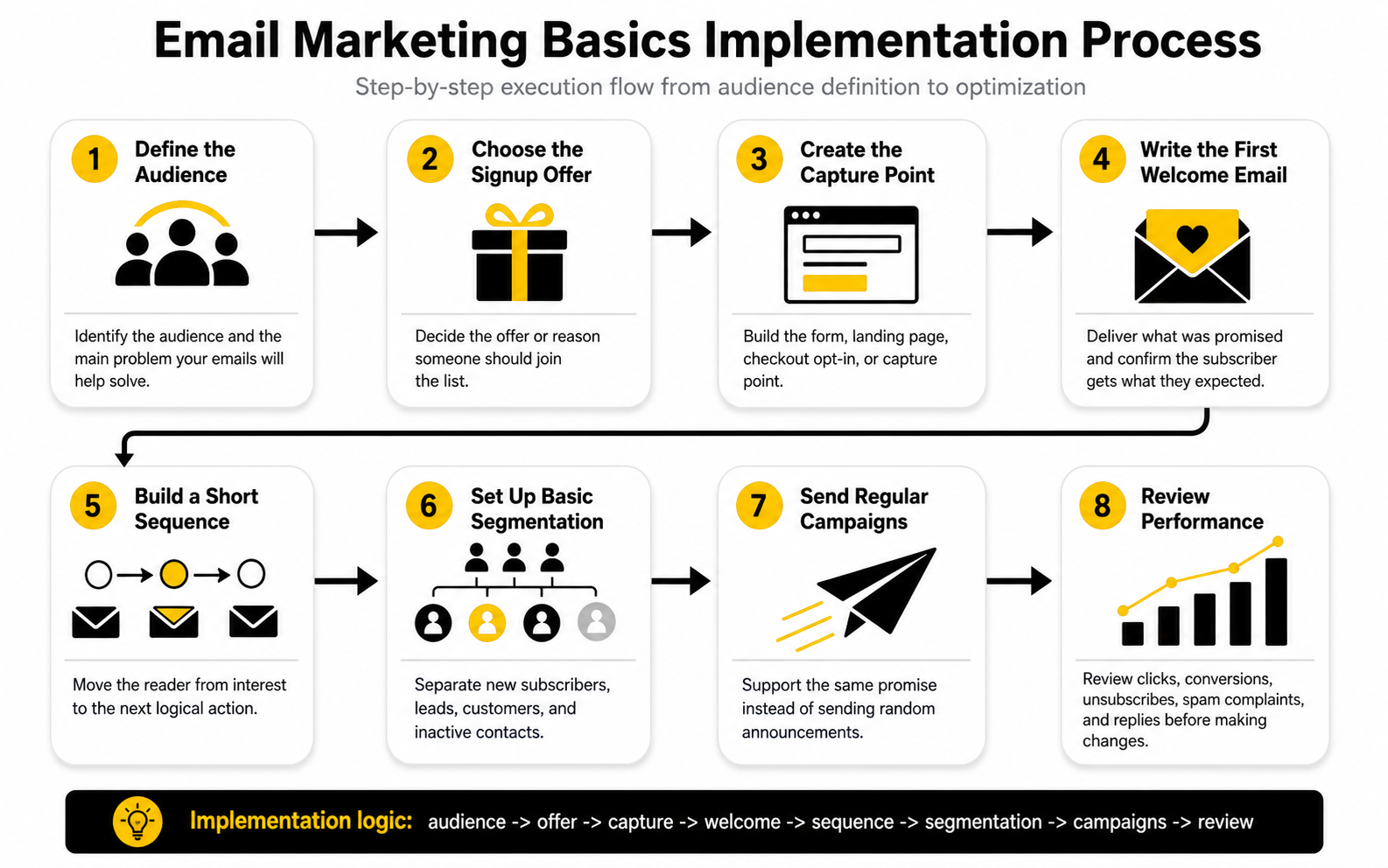
A Simple Step-by-Step Implementation Process
A practical implementation process keeps the moving parts in order. You do not need to build everything at once. You need to build the minimum reliable system first, then improve it based on behavior.
This process keeps email marketing basics grounded in execution. It also prevents tool overload because each step has a purpose. You are not adding automation because it looks impressive; you are adding it because it helps the right person get the right message at the right time.
Choose the Right Platform for the Stage You Are In
The best email platform depends on what you are actually trying to build. A solo creator, ecommerce store, agency, SaaS company, and local service business may all need different workflows. The wrong choice usually happens when beginners pick a tool based on feature lists instead of the operating reality of the business.
For simple email campaigns and automations, tools like Brevo or Moosend can be enough to start. For businesses that want email tied closely to pipelines, calendars, SMS, funnels, and client management, GoHighLevel may fit better. For funnel-first businesses, ClickFunnels or Systeme.io can make sense when the front-end offer and follow-up need to work together.
The important thing is to avoid buying complexity before you have a strategy. A beginner with a clear list, useful offer, and simple welcome sequence will usually beat someone with an expensive platform and no message discipline. Tools should support the process, not become the process.
Set Up Tracking Before You Scale
Tracking should be installed before campaigns become frequent. If you wait until later, you will not know which emails created progress and which ones only created activity. That makes optimization feel like guessing.
The basic metrics are clicks, conversions, unsubscribes, spam complaints, bounce rates, replies, and revenue where attribution is possible. Open rates can still offer directional clues, but they should not be treated as the only measure of success. Privacy changes and inbox behavior can make opens less reliable than actions people actually take.
Recent benchmark reports continue to show that email performance varies heavily by industry, campaign type, and list quality, which is why broad averages should be used carefully rather than blindly copied from a benchmark report. Your goal is not to chase someone else’s open rate. Your goal is to build a baseline, improve relevance, and make each email earn its place.
Keep the System Clean
A clean email system is easier to grow than a messy one. That means naming campaigns clearly, separating automations from broadcasts, documenting triggers, and avoiding unnecessary overlap. It also means removing or re-engaging inactive contacts before they drag down the health of the list.
List hygiene is not glamorous, but it matters. People change addresses, lose interest, switch roles, or stop engaging for reasons that have nothing to do with your brand. Keeping inactive subscribers forever may make the list look bigger, but it can make performance weaker.
This is where disciplined marketers pull ahead. They do not treat every subscriber as equally valuable forever. They pay attention to engagement, protect deliverability, and keep the system focused on people who still want the relationship.
Statistics and Data
Data matters in email marketing because it tells you whether the relationship is getting stronger or weaker. The mistake beginners make is treating every number like a scoreboard instead of a diagnostic signal. Email marketing basics become much more useful when you know what each metric is actually trying to tell you.
A high open rate can mean the subject line created curiosity, but it does not prove the email made money. A low click rate can mean the offer was weak, the call to action was unclear, or the wrong segment received the message. A high unsubscribe rate can be painful, but it can also reveal that your promise, frequency, or targeting needs to be tightened.
Benchmarks are useful, but they are not the boss. Industry averages can help you spot obvious problems, yet your own baseline is more important than someone else’s dashboard. The goal is not to copy a generic benchmark; the goal is to understand what good performance looks like for your audience, your offer, and your business model.
The Metrics That Actually Matter
The first metric to watch is deliverability because nothing else matters if your emails do not reach the inbox. Deliverability is influenced by sender reputation, authentication, spam complaints, engagement, bounce rates, list quality, and sending behavior. Gmail’s bulk sender rules made authentication, easy unsubscribing, and low spam rates especially important for senders reaching large numbers of Gmail users through its email sender guidelines.
The second metric is click behavior because clicks show active interest. Opens can be useful for direction, but clicks show that someone moved from passive attention to active intent. If people open but do not click, the email may have created curiosity without giving a strong enough reason to act.
The third metric is conversion. A conversion might be a purchase, demo booking, consultation request, webinar registration, form submission, reply, or product activation. This is where email stops being “content” and starts becoming a measurable business channel.
How to Read Open Rates Without Overreacting
Open rates are still worth watching, but they need context. Privacy features, image loading behavior, inbox previews, and automated scanning can all distort open tracking. That means an open rate is best treated as a directional engagement signal, not an exact count of real human attention.
If open rates drop suddenly across the whole list, look at deliverability, subject lines, sender name, frequency, and list fatigue. If open rates only drop for one segment, the issue may be relevance rather than technical performance. If opens are strong but clicks are weak, the subject line may be doing its job while the email body is not.
This is where discipline matters. Do not change your entire strategy because one campaign underperformed. Look for patterns across multiple sends, segments, and campaign types before making big decisions.
Clicks Show Intent More Clearly
Clicks are stronger than opens because they show that the reader saw enough value to take another step. That step might be small, but it is still meaningful. A click tells you the topic, offer, angle, or promise created enough interest to move someone out of the inbox.
Click-through rate should be interpreted alongside the email’s purpose. A newsletter with several helpful links may naturally produce different behavior than a focused sales email with one call to action. A product launch email may need fewer total clicks but higher buying intent from the people who do click.
If clicks are low, the fix is not always “write better copy.” The problem may be audience mismatch, weak segmentation, unclear offer positioning, poor mobile formatting, too many links, or a call to action that does not match the reader’s stage. Good measurement helps you diagnose the real issue instead of guessing.
Conversions Turn Email Into a Business Channel
Conversions are the metric that connect email to actual outcomes. If you only measure opens and clicks, you may optimize for attention while missing revenue, retention, or pipeline impact. A campaign can look average in email analytics and still perform well if the clicks it does generate are high intent.
Conversion tracking requires clean links, clear goals, and consistent attribution. Use UTM parameters where appropriate, connect your email platform to your CRM or checkout, and make sure the destination page matches the email promise. If the email says one thing and the landing page says another, the campaign may fail after the click even if the email did its job.
Recent reporting from Sinch Mailgun found that many organizations still struggle to reliably track email ROI, even while a large share of those that do measure it report positive returns in the Email Impact Report coverage. That gap matters because email cannot be improved properly when the business outcome is invisible. If you want professional email marketing, track the action that actually pays the business.
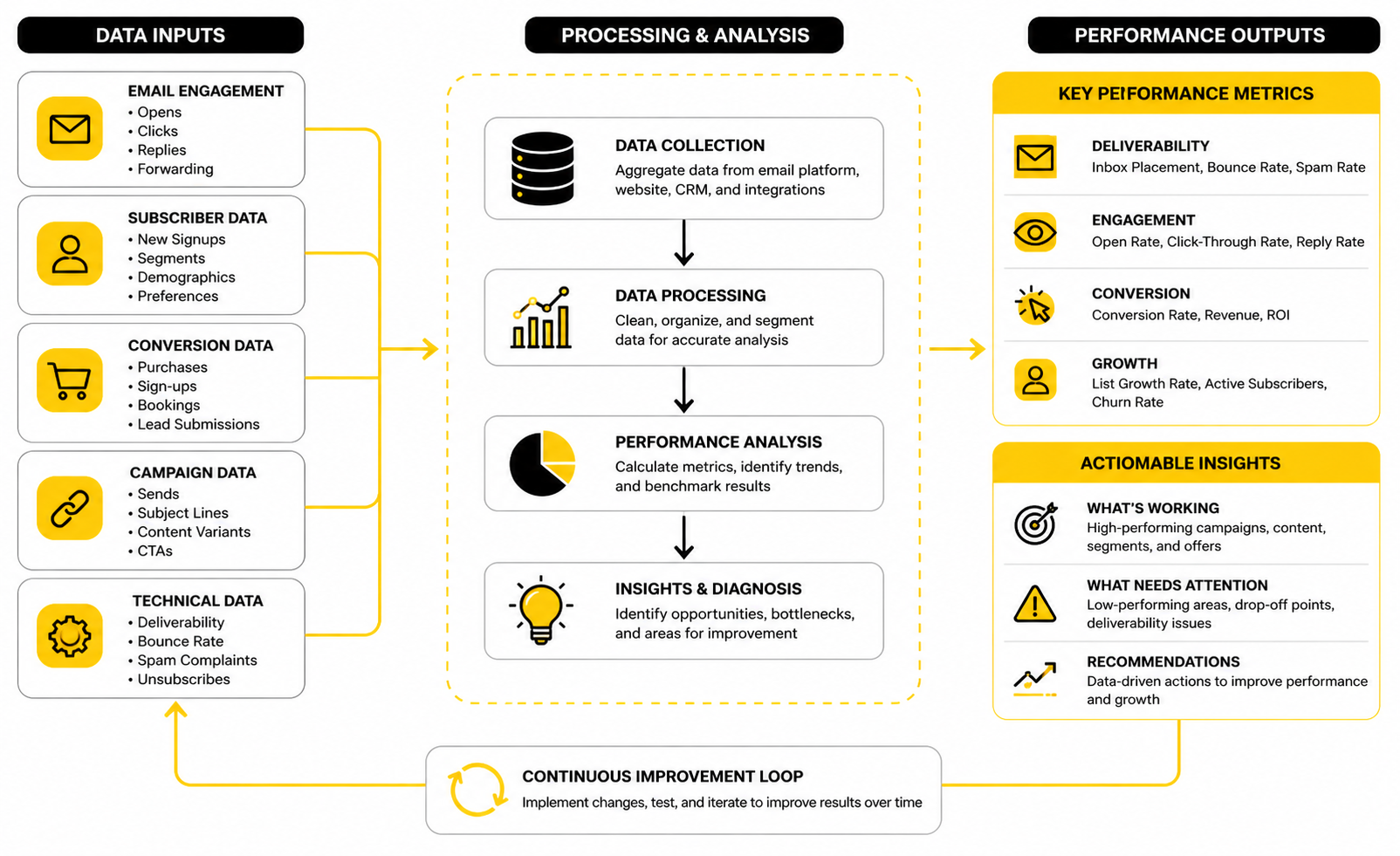
A Practical Analytics System
A simple analytics system should connect four layers: delivery, engagement, action, and business result. Delivery tells you whether the email reached people. Engagement tells you whether they paid attention. Action tells you whether they clicked, replied, booked, registered, or bought. Business result tells you whether the campaign created revenue, retention, pipeline, or another meaningful outcome.
This system keeps the numbers in the right order. If deliverability is weak, do not obsess over subject lines first. If clicks are strong but conversions are weak, do not rewrite every email before checking the offer, landing page, checkout, or follow-up process.
A beginner-friendly dashboard can be very simple:
The point is not to track everything forever. The point is to track enough to know where the system is healthy, where it is leaking, and what should be improved next.
Benchmarks Are Starting Points, Not Targets
Benchmarks help when you need context, but they can also mislead beginners. Email performance varies by industry, list source, audience quality, offer type, send frequency, geography, and how aggressively a brand cleans its list. A cold list, a buyer list, and a highly engaged newsletter list should not be judged by the same standard.
Recent benchmark resources from platforms and research firms show wide differences between industries and campaign types, which is why broad averages should be handled carefully in any email benchmark report. A nonprofit education email, a SaaS product update, and an ecommerce flash sale can all have different healthy performance patterns. One number cannot explain all three.
Use benchmarks to ask better questions, not to panic. If your unsubscribe rate is unusually high, inspect expectations and frequency. If your click rate is far below comparable campaigns, inspect the offer and call to action. If your bounce rate is rising, inspect acquisition quality and list hygiene before sending more.
Deliverability Signals You Should Not Ignore
Deliverability problems usually show up before revenue problems become obvious. A rising bounce rate means your list quality may be slipping. A rising spam complaint rate means people either did not expect your emails, do not value them, or find the unsubscribe path harder than the spam button.
The most important deliverability signals are complaints, bounces, sudden open drops, domain reputation issues, and engagement decline among normally active subscribers. Email providers are watching how recipients react to your messages. If too many people ignore, delete, complain, or bounce, the inbox may start trusting you less.
This is why list growth should never be separated from list quality. A smaller list of people who want your emails is usually more valuable than a bigger list full of weak intent. More contacts do not automatically mean more revenue if the list damages your sender reputation.
What Unsubscribes Really Mean
Unsubscribes are not always bad. Some people should leave your list because they are no longer interested, no longer relevant, or never a good fit in the first place. A clean unsubscribe is healthier than a spam complaint.
What matters is the pattern. If unsubscribes spike after one specific campaign, inspect the promise, tone, frequency, and offer fit. If unsubscribes stay high over time, the gap may be deeper: your signup promise might not match your actual email content.
Do not hide the unsubscribe link or make people work to leave. That is short-term thinking. A clear unsubscribe process protects trust, reduces complaints, and keeps the remaining list healthier.
Turning Data Into Action
The best use of email data is deciding what to change next. If deliverability is weak, clean the list, authenticate properly, reduce risky sends, and improve permission quality. If engagement is weak, improve segmentation, subject lines, sender identity, and content relevance.
If clicks are weak, sharpen the offer and simplify the call to action. If conversions are weak, inspect the landing page, checkout, form, sales process, and follow-up. If revenue is weak despite good engagement, the issue may be positioning, pricing, timing, or audience fit rather than email copy alone.
This is the practical way to use email marketing basics. Do not stare at dashboards for entertainment. Use the numbers to find the bottleneck, make one clear improvement, send again, and compare the result against your own baseline.
Professional Implementation and Tools
At this stage, email marketing basics stop being theory and start becoming operating discipline. You already have the audience, signup path, sequence, tracking, and performance signals. Now the question is how to run the system without letting it become messy, risky, or impossible to scale.
Professional implementation is not about using the most expensive platform or building the most complex automation map. It is about making good decisions consistently. That means choosing the right level of automation, protecting deliverability, keeping compliance clean, and making sure every tool supports the customer journey instead of adding noise.
The tradeoff is simple. More power gives you more leverage, but it also gives you more ways to break things. A simple system you understand is usually stronger than a complicated system nobody wants to touch.
Automation Should Follow Behavior, Not Ego
Automation is useful when it helps the reader receive the right message at the right moment. It becomes a problem when it exists only because the marketer wanted to build something impressive. A long automation sequence with weak logic can create more confusion than a short sequence with a clear purpose.
The best automations are usually triggered by meaningful behavior. A subscriber downloads a guide, visits a pricing page, starts checkout, books a call, buys a product, stops engaging, or reaches a milestone. Those actions tell you something about intent, and the follow-up should reflect that intent.
This is where tools matter, but only after the logic is clear. A platform like GoHighLevel can be useful when email needs to connect with pipelines, forms, calendars, SMS, and client follow-up. A simpler email platform like Brevo or Moosend can be enough when the main job is campaigns, segments, and straightforward automations.
Segmentation Has a Cost
Segmentation improves relevance, but every segment creates more management work. More segments means more copy, more testing, more reporting, more edge cases, and more chances to send the wrong message. That does not mean you should avoid segmentation; it means you should earn it.
Start with segments that clearly change the message. Prospects and customers should usually be separated. Active subscribers and inactive subscribers often need different treatment. Leads interested in one product category may need different follow-up from leads interested in another.
Where people go wrong is creating tiny segments before they have enough volume or a clear reason. If a segment does not change the offer, timing, message, or next step, it may not need to exist yet. Clean segmentation beats clever segmentation.
Deliverability Becomes a Strategic Asset
Deliverability is not a technical afterthought. It is the infrastructure that lets your email marketing work at all. Google’s current sender guidance expects senders to use authentication, support easy unsubscribing, and keep user-reported spam rates low through its bulk sender requirements.
That changes the mindset. You cannot treat the list like an unlimited traffic source and then blame the email platform when performance drops. Sender reputation is shaped by the way people react to your messages, and those reactions are influenced by permission quality, relevance, frequency, and trust.
A professional email program protects deliverability on purpose. It avoids scraped lists, cleans obvious dead weight, watches complaints, warms new domains carefully, and does not suddenly blast cold or inactive contacts without a plan. This is boring work until it saves the channel.
Compliance Is Part of Trust
Compliance is not just a legal box to tick. It is a trust signal. If people cannot tell who emailed them, why they received the email, or how to unsubscribe, the brand already feels careless.
Commercial email rules vary by country and situation, so you should treat legal review seriously when it matters. In the United States, the FTC’s CAN-SPAM guidance emphasizes accurate header information, non-deceptive subject lines, clear identification where required, a valid physical mailing address, and a working unsubscribe process in its commercial email compliance guide. In privacy-heavy environments, consent, lawful basis, data handling, and preference management may require even more care.
The practical takeaway is straightforward. Say what people are signing up for, send what you promised, honor unsubscribes quickly, and avoid tricks. The more aggressively you push the line, the more fragile the relationship becomes.
Frequency Is a Strategic Decision
There is no universal perfect sending frequency. Daily emails can work for some audiences when the expectation is clear and the content is valuable. Monthly emails can fail if they are irrelevant, forgettable, or only appear when the business wants money.
Frequency should be based on subscriber expectation, content quality, buying cycle, offer urgency, and engagement. If people joined for daily tips, daily sending may feel normal. If they joined for occasional product updates, daily promotion may feel like a bait-and-switch.
A useful rule is to increase frequency only when you can maintain relevance. If engagement weakens, complaints rise, or unsubscribes spike, the issue may not be frequency alone. It may be that the value is too thin for the pace you are trying to maintain.
Scaling Requires Better Operations
Scaling email is not just sending more campaigns to more people. It requires cleaner operations. As the list grows, small mistakes become more expensive because more subscribers see them and more systems depend on them.
You need naming conventions, campaign calendars, approval steps, QA checks, ownership, and documentation. You need to know which automations are live, what triggers them, who receives them, and what happens when someone qualifies for multiple flows. Without this, the email program becomes a pile of disconnected messages.
This is especially important when email connects to funnels, sales teams, or customer support. A lead should not get a hard sales pitch after booking a call. A customer should not receive a “buy now” sequence for something they already purchased. These are simple mistakes, but they damage trust quickly.
AI Can Help, but It Cannot Own the Strategy
AI can speed up email production, but it should not replace the thinking. It can help draft subject lines, summarize customer research, outline sequences, generate variations, or repurpose content. The danger is using AI to create more email without improving the reason the email exists.
The strategy still needs human judgment. You need to understand the audience, the offer, the promise, the timing, and the emotional context of the reader. AI can produce words quickly, but speed is not the same as relevance.
Use AI where it reduces friction, not where it removes responsibility. A tool like GoHighLevel AI can help teams move faster inside a broader marketing system, but the quality still depends on the operator. Bad strategy at higher speed is still bad strategy.
Tool Stack Decisions Should Stay Practical
The right stack depends on how your business actually sells. If your main need is sending newsletters and simple automations, do not overbuild. If your business depends on calls, pipelines, SMS follow-up, client management, and local lead nurturing, an all-in-one system may be more practical.
For funnel-first businesses, the stack often needs a strong capture and conversion layer. ClickFunnels and Systeme.io can make sense when opt-ins, offers, checkout, and follow-up need to move together. For teams that want forms, surveys, and lead capture to feed email workflows cleanly, Fillout can fit into the front end of the system.
Do not choose tools only because they are popular. Choose tools because they reduce friction, protect data quality, and make the next action easier for the subscriber and the business. That is the practical standard.
The Biggest Risks to Avoid
The biggest email risks are usually self-inflicted. A business buys or imports weak contacts, sends too much too fast, ignores complaints, mixes customers with cold leads, and then wonders why the channel gets weaker. That is not an email problem; that is an operating problem.
Another common risk is over-automation. When too many workflows overlap, subscribers receive conflicting messages, outdated offers, or irrelevant follow-ups. The more advanced the system becomes, the more important it is to review it regularly.
The final risk is chasing tactics instead of fixing fundamentals. Better subject lines will not rescue a weak offer. More automation will not fix unclear positioning. A new platform will not solve a trust problem with the audience.
Expert-Level Email Marketing Is Mostly Discipline
The advanced version of email marketing basics is not a secret hack. It is discipline applied over time. Clear consent, useful segmentation, strong offers, reliable deliverability, clean data, and honest measurement beat random tactics again and again.
The experts are not guessing less because they have magic templates. They are guessing less because their systems create better feedback. They know what the audience did, what changed, what improved, and what should be tested next.
That is the level to aim for. Keep the system understandable, protect the relationship, and make every improvement based on what the data and the customer behavior are actually telling you.
Measurement, Optimization, and FAQ
By now, the full email marketing system should be clear. You attract the right people, earn permission, deliver useful emails, guide subscribers toward the next step, measure what happens, and improve the system over time. That is the practical version of email marketing basics: not a pile of tactics, but a repeatable business asset.
The final layer is optimization. This is where you stop asking, “Did the email perform well?” and start asking better questions. Did the right people receive it? Did the promise match the landing page? Did the call to action fit the reader’s stage? Did the campaign create a business outcome worth repeating?
That mindset is what keeps email useful as the program grows. You do not need to reinvent the system every month. You need to keep the foundation strong, remove friction, and improve the parts that actually affect trust, action, and revenue.
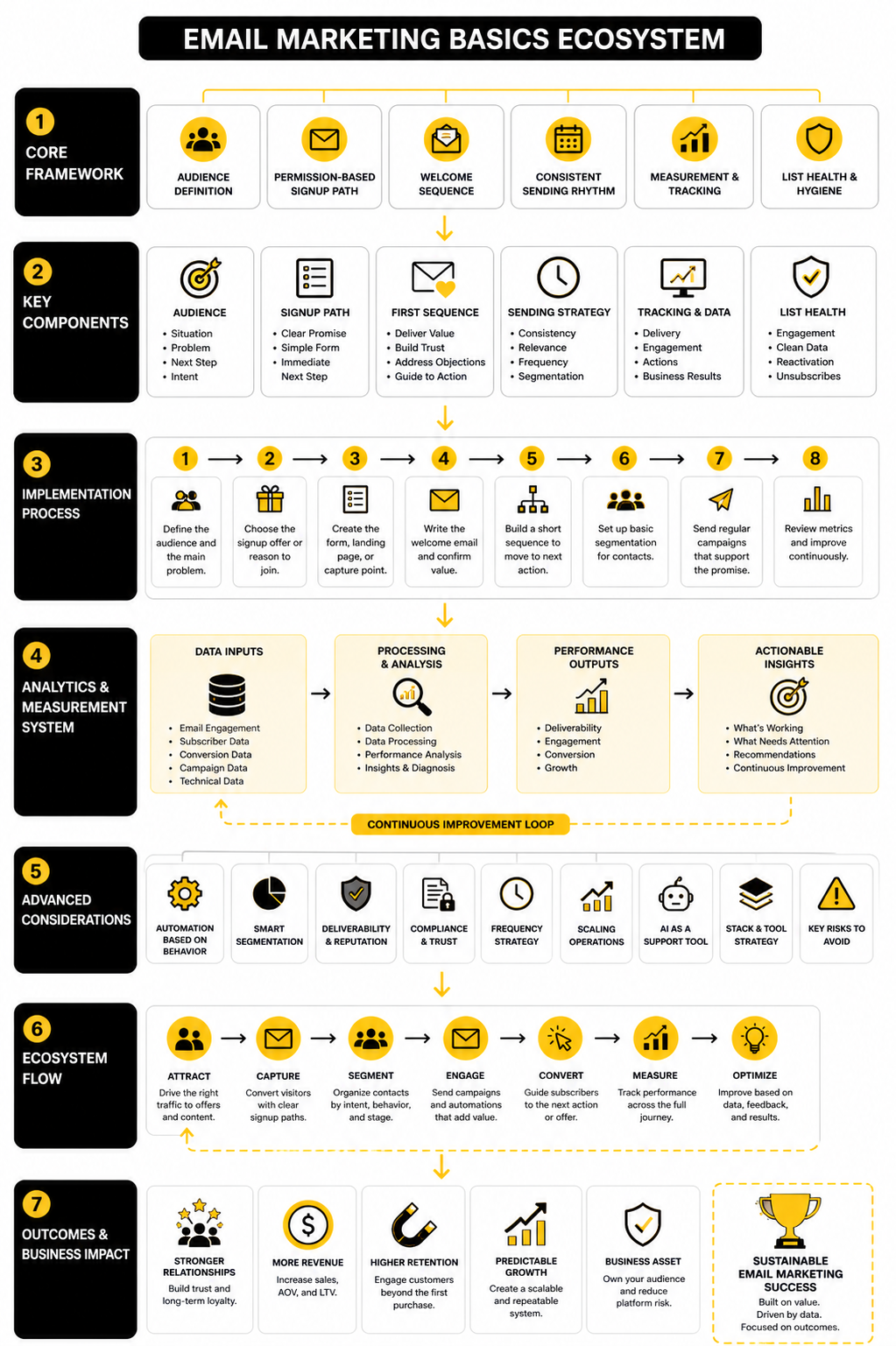
The Final Email Marketing System
A mature email program works like an ecosystem. Traffic feeds signup points. Signup points feed segments. Segments feed campaigns and automations. Campaigns and automations create behavior. Behavior feeds reporting. Reporting feeds better decisions.
That loop is the whole game. When the loop is healthy, every send teaches you something. When the loop is broken, you keep sending more emails without learning much from them.
The best email systems stay simple enough to manage and strong enough to scale. They do not depend on one viral campaign, one clever subject line, or one automation trick. They depend on consistent relevance, clean execution, and a real understanding of what the audience needs next.
What to Optimize First
Start with the part of the system closest to the bottleneck. If people are not subscribing, improve the signup offer, form, and page. If people subscribe but do not click, improve the welcome sequence, segmentation, and call to action.
If people click but do not convert, the issue may be outside the inbox. The landing page, offer, checkout, sales page, booking flow, or product positioning may need work. This is why email should never be judged in isolation.
Optimization works best when you change one meaningful variable at a time. Test the offer, message angle, audience segment, call to action, timing, or destination page with a clear reason. Random testing creates random learning.
When to Bring in More Tools
More tools make sense when the current system is creating friction. If you cannot segment properly, automate key follow-ups, track conversions, manage leads, or connect email to sales activity, the stack may need to mature. But adding tools before the process is clear usually creates more work, not more revenue.
A platform like GoHighLevel can make sense when email is part of a bigger client acquisition or lead management system. Tools like Brevo and Moosend can fit when you need straightforward campaign sending and automation. Funnel tools like ClickFunnels and Systeme.io can help when your list growth depends heavily on opt-in pages, offers, and checkout flows.
The smart move is to match the tool to the job. Do not buy complexity to feel advanced. Buy capability when the business has outgrown the manual version.
What is email marketing?
Email marketing is the use of email to communicate with people who have given you permission to hear from a business, creator, or organization. It can be used to educate prospects, promote offers, onboard customers, increase retention, and bring people back when they become inactive. The strongest email marketing programs are built around relevance, timing, and trust.
What are the most important email marketing basics?
The most important email marketing basics are permission, list quality, segmentation, useful content, deliverability, clear calls to action, and measurement. These fundamentals matter more than advanced tactics because they determine whether people want your emails and whether your emails create action. Without the basics, automation and personalization usually just make a weak system move faster.
Is email marketing still effective?
Yes, email marketing is still effective when it is built around real permission and useful communication. It remains valuable because it gives businesses a direct way to communicate with subscribers, customers, and leads without depending entirely on rented platforms. The channel works best when it is connected to a clear offer, a clean customer journey, and measurable business goals.
How do beginners start email marketing?
Beginners should start by defining the audience, creating a clear reason to subscribe, choosing an email platform, building a signup form, and writing a short welcome sequence. After that, they should send useful campaigns consistently and measure clicks, conversions, unsubscribes, replies, and spam complaints. The goal is to build a small reliable system before adding complex automation.
How often should I send marketing emails?
The right frequency depends on subscriber expectations, content quality, buying cycle, and engagement. Some audiences want frequent emails because they signed up for regular tips, deals, or updates. Others expect occasional messages and may disengage if the brand suddenly sends too often.
What is a good email open rate?
A good open rate depends on the industry, audience, list source, and type of campaign. Open rates are also less precise than many beginners think because privacy features and inbox behavior can distort tracking. Use open rates as a directional signal, but make decisions based on stronger actions like clicks, replies, bookings, purchases, and conversions.
What is a good click-through rate?
A good click-through rate depends on the purpose of the email. A focused sales email, a content newsletter, a webinar invitation, and an onboarding email can all have different healthy click patterns. Instead of chasing a generic number, compare each email against your own baseline and ask whether the click shows real movement toward the next step.
What should I put in a welcome email?
A welcome email should confirm the subscriber made the right decision. It should deliver what was promised, set expectations, introduce the sender, and give one clear next step. Keep it focused because the first email shapes how the subscriber sees the relationship.
What is email segmentation?
Email segmentation means dividing your list into useful groups so people receive more relevant messages. Common segments include new subscribers, customers, leads, inactive contacts, product interests, location, behavior, or purchase history. The goal is not to create endless tiny groups; the goal is to send emails that better match what each subscriber actually needs.
What is email automation?
Email automation is a system that sends emails based on triggers, timing, or behavior. Examples include welcome sequences, abandoned checkout follow-ups, lead nurture campaigns, onboarding emails, reactivation emails, and post-purchase education. Automation is most useful when it improves timing and relevance, not when it simply sends more messages.
What is the difference between a newsletter and an email campaign?
A newsletter is usually a recurring email sent to maintain a relationship with the audience. An email campaign is usually built around a specific goal, such as a launch, promotion, registration, announcement, or reactivation push. Both can work well, but they need different expectations and success metrics.
How do I avoid spam folders?
Start with permission-based list growth, authenticated sending, clean data, relevant content, and easy unsubscribing. Avoid scraped lists, misleading subject lines, sudden high-volume blasts, and sending to people who have not engaged in a long time. Deliverability is not one trick; it is the result of trustworthy sending behavior over time.
Should I use AI for email marketing?
AI can help with outlines, drafts, subject line variations, segmentation ideas, and content repurposing. It should not replace strategy, customer understanding, offer clarity, or compliance judgment. Use AI to speed up thoughtful work, not to flood subscribers with generic messages.
What is the biggest email marketing mistake?
The biggest mistake is treating the list like a traffic source instead of a relationship. When businesses only email when they want sales, subscribers learn to ignore them. Strong email marketing earns attention before it asks for action.
How long should marketing emails be?
Marketing emails should be as long as they need to be and no longer. A short email can work when the reader already understands the offer. A longer email can work when the decision needs education, context, proof, or objection handling.
What should I measure in email marketing?
Measure delivery, bounces, spam complaints, unsubscribes, clicks, replies, conversions, revenue, and retention where relevant. Opens can still provide directional insight, but they should not be the main success metric. The best measurement system connects email behavior to real business outcomes.
Build a stronger local presence with BAAM AI
Turn your website, Google profile, social channels, and AI visibility into one growth engine
Most businesses do not need more random marketing activity. They need a consistent presence system that helps the right people find them, trust them, and take action. BAAM AI brings strategy, local SEO, website updates, Google Maps visibility, social content, AI-search readiness, media production, and reporting into one practical monthly engine.
If you want your marketing to keep working after the campaign ends, start with a free BAAM AI presence audit. See how your business shows up today and where the fastest visibility wins are at BAAM AI.