
BAAM AI Blog
Email Copywriting Course Free: A Practical Guide To Writing Emails That Actually Get Clicked
A good email copywriting course free of fluff should teach one thing clearly: how to turn attention into action without sounding pushy, fake, or desperate. That matters because email is still one of the few marketing...
A good email copywriting course free of fluff should teach one thing clearly: how to turn attention into action without sounding pushy, fake, or desperate. That matters because email is still one of the few marketing channels where you can build a direct relationship with your audience instead of renting attention from an algorithm.
Email is not dead. Not even close. Global research from DataReportal shows that email remains a mainstream digital behavior, with 75% of online adults using email at least monthly, and Litmus reports that 35% of companies see email ROI of 36:1 or more. The opportunity is still there, but the bar is higher because inboxes are crowded, AI-generated content is everywhere, and readers can smell lazy copy fast.
That is why learning email copywriting for free can be useful, but only if you learn the right way. You do not need another vague list of “write catchy subject lines” tips. You need a practical structure for understanding the reader, shaping the offer, writing the email, improving the call to action, and measuring what happens after you hit send.
Why Email Copywriting Still Matters
Email copywriting matters because it sits close to the sale, the reply, the booking, the referral, or the renewal. A social post might create awareness, a landing page might explain the offer, but the email often does the personal follow-up that moves someone from “maybe later” to “I should click this now.” That is why even a simple free email copywriting course can have a serious impact if it teaches decision-making, not just word tricks.
The mistake beginners make is thinking email copywriting is about clever lines. It is not. The job is to understand what the reader already wants, what they are worried about, what they need to believe, and what action feels reasonable for them today.
This is also why free training can be both helpful and dangerous. Free resources from places like HubSpot Academy and Copyblogger can teach useful fundamentals, but random advice without a system can make your emails inconsistent. One day you write a long story email, the next day you copy a promo template, and the next day you send a discount blast because you have no better plan.
The Free Email Copywriting Learning Framework
A useful email copywriting course should not start with subject lines. Subject lines matter, but they come after strategy. Before you write the hook, you need to know who the email is for, what they already believe, what promise you are making, and what single action the email should drive.
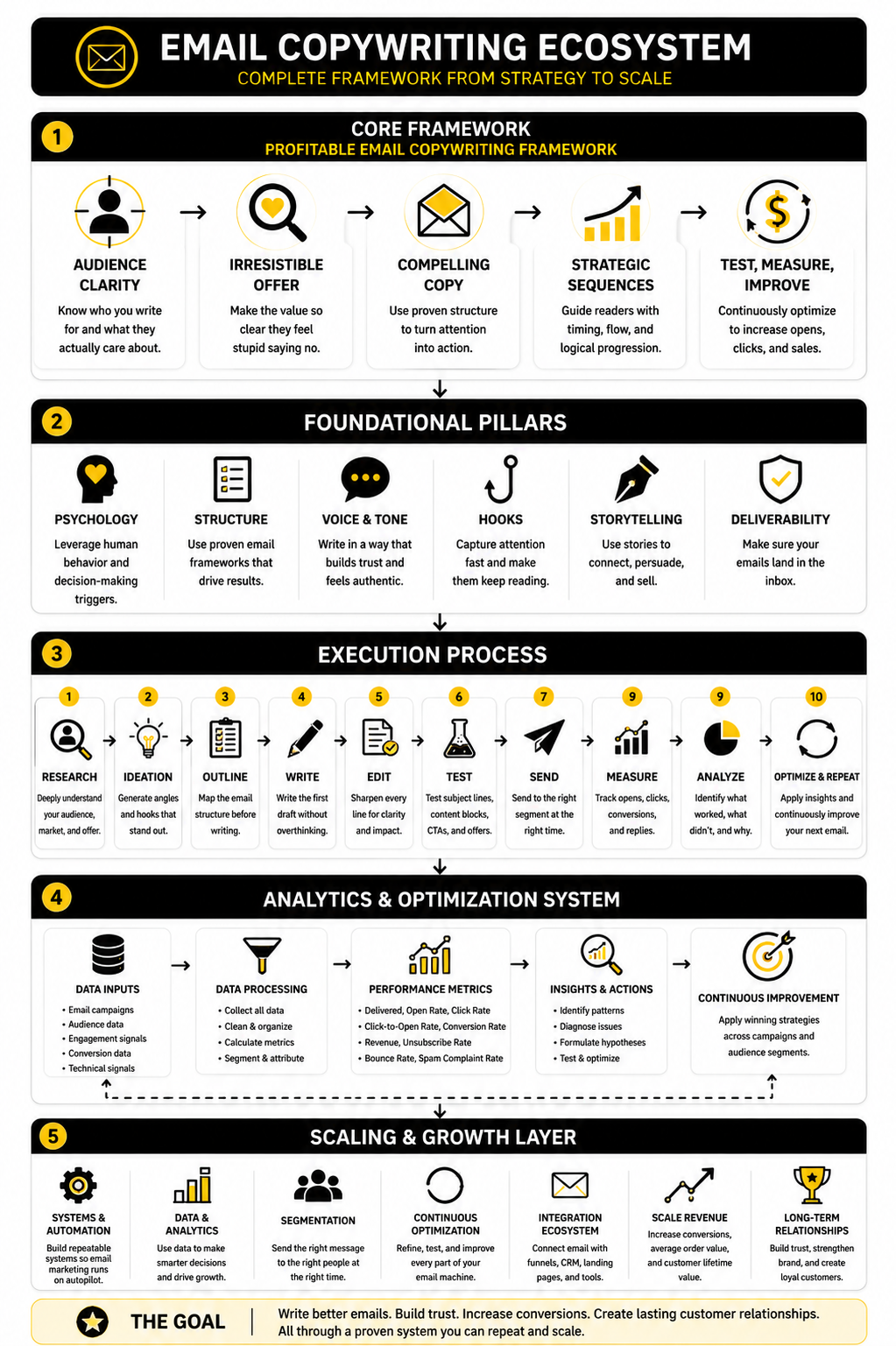
The framework here is built around six practical questions. Who is the reader? What problem is active in their mind? What offer or idea are you moving them toward? What proof makes the message believable? What objection could stop the click? What action should they take next?
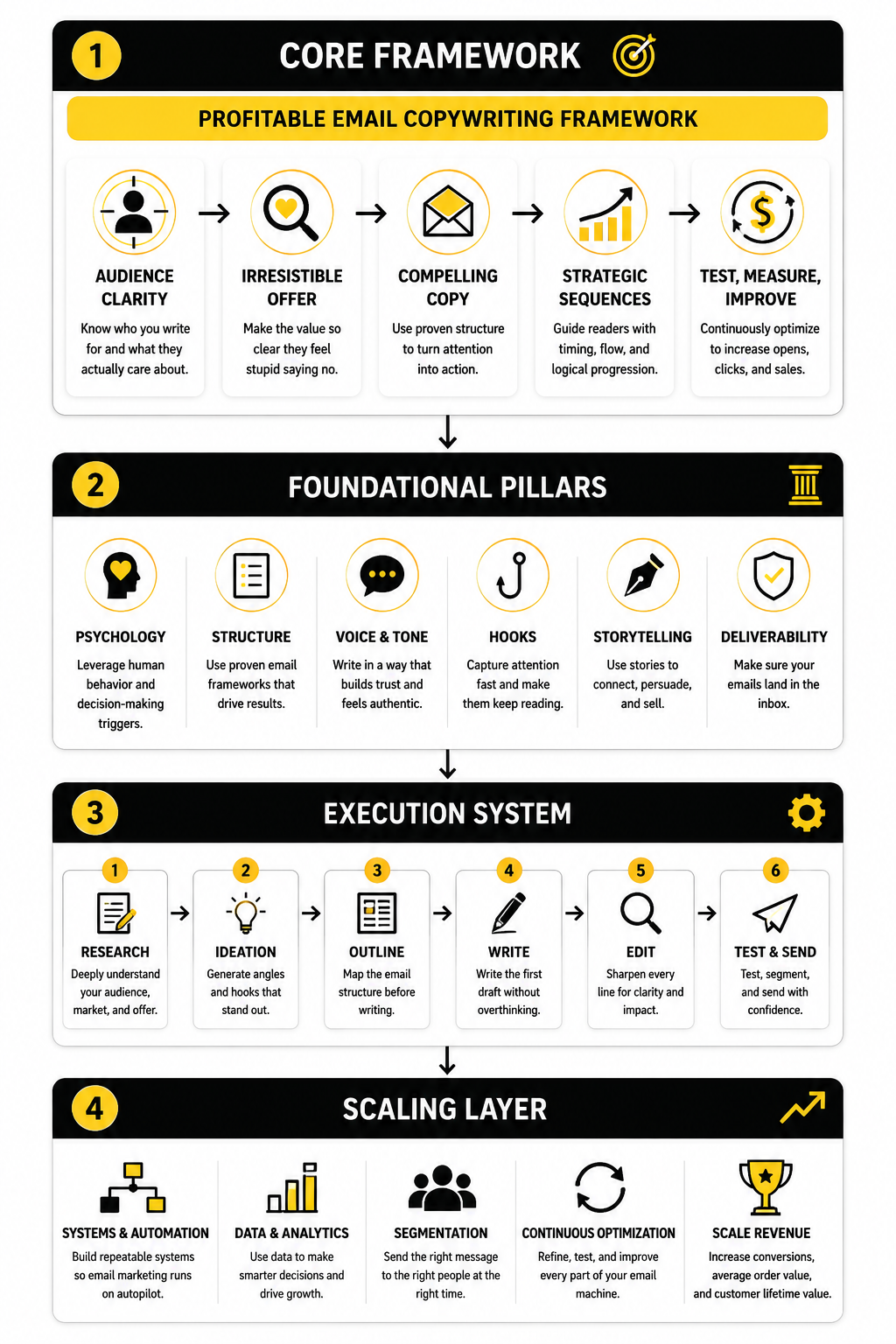
This structure keeps email copy from becoming random. It also makes practice easier because you can diagnose weak emails instead of just saying, “This does not feel good.” If an email fails, you can check whether the problem is the audience, the angle, the proof, the offer, the CTA, or the follow-up sequence.
What This Guide Will Help You Build
By the end of the full article, you will have a practical way to learn email copywriting without paying for a course upfront. You will know what to study, what to ignore, how to practice, and how to connect email copy to real business goals. The point is not to collect templates; the point is to build judgment.
You will also see how email copy fits into a larger marketing system. For example, tools like Brevo, Moosend, and GoHighLevel can help send, automate, and track campaigns, but software will not fix unclear messaging. Better tools amplify good copy; they do not rescue bad strategy.
The next section starts with the reason email copywriting still deserves your attention. Not because it is trendy. Because when you learn how to write emails that feel specific, useful, and easy to act on, you build a marketing asset that can keep working long after the first send.
Why Email Copywriting Still Matters
The reason email copywriting still matters is simple: people may ignore a lot of marketing, but they still check their inbox. Email remains one of the most durable digital habits, with global research showing that 75% of online adults use email at least once per month. That gives marketers, creators, freelancers, and business owners a direct channel that does not depend entirely on social reach, paid ads, or platform mood swings.
But access is not the same as attention. The inbox is private, crowded, and ruthless. If your email feels generic, overlong, self-absorbed, or irrelevant, the reader does not need to debate it; they just delete it, archive it, or stop opening you altogether.
That is why an email copywriting course free of hype should teach restraint as much as persuasion. Good email copy is not about squeezing every trick into one message. It is about making the next step feel obvious, useful, and worth the reader’s time.
Email Is A Relationship Channel, Not Just A Sales Channel
A weak email treats the list like a traffic source. A strong email treats the list like a group of real people with context, problems, preferences, and memory. That difference changes everything about how you write.
When you see email as a relationship channel, you stop blasting disconnected promotions and start building a rhythm. Some emails educate, some clarify, some invite, some sell, and some simply keep trust warm. The sale becomes easier because the reader has already been trained to expect something useful from you.
This matters even more now because people are drowning in generic AI-assisted content. AI can help draft, summarize, and brainstorm, but it cannot replace taste, positioning, or reader empathy. The more average content gets produced, the more specific, human, well-timed emails stand out.
Metrics Only Matter When You Know What They Mean
Email platforms give you numbers, but numbers do not automatically tell you what to write next. Open rates can show whether the subject line and sender relationship are working, but privacy changes have made opens less clean than they used to be. Clicks, replies, conversions, unsubscribes, and revenue tell a more complete story.
Benchmarks can still be useful because they stop you from judging your campaigns in a vacuum. Mailchimp’s benchmark data helps marketers compare open rates, click-through rates, bounce rates, and industry performance, which is helpful when you are trying to understand whether your results are truly weak or just normal for your category. The key is to use benchmarks as context, not as an excuse.
A practical email copywriting course free of vanity metrics should teach you to connect each number to a writing decision. Low opens may point to weak positioning, boring subject lines, poor list quality, or inconsistent sending. Low clicks may mean the email built interest but failed to create enough urgency, clarity, or confidence around the next step.
Copywriting Improves The Economics Of Every Email
Email has strong upside because one improved message can affect the performance of an entire funnel. A clearer welcome email can improve activation. A sharper promo email can lift sales. A better re-engagement email can recover subscribers who would otherwise disappear.
That is why email ROI remains attractive for many companies, with Litmus reporting that email marketing ROI often falls between 10:1 and 36:1 for most companies. The important point is not that every business will hit the same return. The important point is that email performance compounds when the list, offer, segmentation, copy, and follow-up are all working together.
This is where beginners often get distracted. They look for the perfect subject line formula before fixing the offer. They obsess over send time before clarifying the reason to click. They switch tools before learning how to write a message that makes one reader think, “This is for me.”
The Free Email Copywriting Learning Framework
The best way to learn email copywriting for free is to follow a framework instead of collecting random tips. Random tips create random emails. A framework gives you a repeatable way to plan, write, review, and improve every message you send.
The framework is simple: reader, problem, promise, proof, objection, and action. These six pieces help you move from “I need to write an email” to “I know exactly what this email needs to do.” Once you understand them, templates become useful instead of dangerous.
This also makes learning faster because you can review your work with a clear checklist. You are not asking whether the email sounds nice. You are asking whether it understands the reader, names the real problem, makes a believable promise, handles friction, and points to one clear next step.
Start With The Reader
Every strong email starts before the first sentence. You need to know who is reading and what situation they are in when the email lands. A founder reading at 7:30 a.m. before meetings is not in the same mindset as a consumer browsing deals at night.
This does not mean you need a 20-page persona document. You need practical reader awareness. What do they already know? What are they skeptical about? What pressure are they under? What have they tried before?
When you skip this step, your email becomes generic fast. You write about your features, your launch, your newsletter, your discount, and your company news. The reader is silently asking a different question: “Why should I care right now?”
Define The Problem Before The Promise
A promise only works when the reader recognizes the problem. If the problem is vague, the offer feels optional. If the problem is specific, the email has energy because the reader can feel the cost of doing nothing.
For example, “improve your marketing” is too broad to carry a strong email. “Stop sending weekly emails that get opens but no clicks” is sharper because it points to a frustrating, recognizable situation. The more concrete the problem, the easier it is to write copy that feels relevant without becoming aggressive.
This is also where free email copywriting training often falls short. It may give you formulas like problem-agitate-solution, but it does not teach you how to choose the right problem. The right problem is not always the biggest one; it is the one the reader already feels and is ready to act on.
Make One Clear Promise
One email should not try to do five jobs. If you want the reader to book a call, make the email about why the call is worth booking. If you want them to read a guide, make the email about the value of the guide. If you want them to buy, make the buying decision easier.
This is especially important when you are using automation tools. Platforms like Brevo and Moosend can help you create flows, segment lists, and send campaigns, but the software cannot decide the promise for you. That is still a copywriting decision.
A clear promise gives the email direction. It tells you what to include, what to cut, and what the call to action should say. Without it, you end up with an email that sounds busy but does not move the reader anywhere.
Add Proof Without Overloading The Email
Proof is what makes the promise believable. It can come from data, customer results, product details, founder experience, screenshots, testimonials, recognizable clients, or a clear explanation of how something works. The right proof depends on the reader’s level of skepticism.
You do not need to bury the reader in evidence. In many emails, one strong proof point is better than five weak ones. The goal is to reduce doubt enough for the next action, not to win a courtroom argument.
This is where many beginner emails feel thin. They make claims like “save time,” “grow faster,” or “get better results,” but they never show why the reader should believe it. If the claim matters, support it. If you cannot support it, rewrite it into something more honest.
Handle The Objection That Could Stop The Click
Every email has friction. The reader may think it is too expensive, too complicated, too early, too risky, too time-consuming, or not relevant enough. If you ignore that friction, the email may sound positive but still fail.
Good copy anticipates the most likely objection and handles it naturally. You might clarify that the resource is free, explain that setup takes minutes, show that the method works for beginners, or point out that the reader can start with a small step. The objection does not need a dramatic rebuttal; it needs a believable answer.
This is one of the highest-leverage skills in email copywriting. When you learn to spot the real objection, your emails become more useful and less pushy. You are no longer forcing urgency; you are removing the reason the reader would delay.
End With One Action
The call to action is not just a button or a link. It is the moment where the email either becomes useful or falls apart. If the CTA is vague, hidden, or competing with three other links, the reader has to do extra work.
One email should usually have one main action. Read the guide. Book the demo. Reply with a word. Start the trial. Watch the training. The cleaner the action, the easier the decision.
If your business already uses a CRM or funnel platform, this is where tools like GoHighLevel can connect email copy to pipelines, booking pages, automations, and follow-up. But again, the tool is the delivery system. The copy still has to make the next step feel worth taking.
The Core Components Of High-Converting Emails
Once the strategy is clear, the writing gets much easier. You are no longer staring at a blank page trying to sound clever. You are assembling the right pieces in the right order so the reader can understand the point, believe the message, and take the next step.
A good email copywriting course free of hype should teach these components before it teaches hacks. Subject lines, hooks, body copy, proof, calls to action, and follow-up logic all matter, but they do not work as isolated tricks. They work when each piece supports the same reader, problem, promise, and action.
The easiest way to improve is to treat every email like a small conversion path. The reader sees the sender name, notices the subject line, opens the email, reads the first few lines, decides whether the message feels relevant, scans for value, checks whether the next step makes sense, and either clicks or leaves. Your job is to remove friction at each point.
The Sender Name Sets The First Expectation
Before the subject line does anything, the sender name has already started the decision. If the reader recognizes and trusts the sender, the email has a better chance. If the sender looks unfamiliar, vague, or overly corporate, the subject line has to work much harder.
This is why consistency matters. Switching between a company name, founder name, sales team name, and random campaign sender can weaken recognition over time. People do not open emails only because the line is interesting; they open because they believe the sender is worth listening to.
For a personal brand, a real name often works well because the relationship feels human. For a company, the best sender depends on the relationship the subscriber expects. The key is to make the inbox feel familiar, not confusing.
The Subject Line Should Create Relevant Curiosity
A subject line has one job: earn the open from the right person. Not everyone. The right person. That distinction matters because a clickbait subject line can increase opens while hurting trust, clicks, and long-term engagement.
Strong subject lines usually connect to a specific pain, desired outcome, timely idea, surprising contrast, or useful resource. They do not need to be dramatic. Often, the best subject line is simply clear enough to make the reader think, “That is relevant to me.”
This is also where many beginners overcomplicate things. They try to sound clever before they sound useful. If your subject line would not make sense to the exact reader you are targeting, simplify it until it does.
The Opening Line Must Prove The Email Is Worth Reading
The opening line is where the reader confirms whether the subject line was worth trusting. If the first sentence feels generic, the email loses momentum fast. If it immediately connects to the reader’s situation, the email earns a few more seconds.
A useful opening does not need a long warm-up. It can name the problem, challenge a common assumption, point to a missed opportunity, or frame the reason for the message. The best openings feel like the email has started in the middle of a real conversation.
This is why “I hope you are well” is usually weak in marketing emails. It is not offensive, but it wastes the most valuable space in the message. The first line should make the reader feel that the email has a point.
The Body Copy Should Build One Argument
The body of the email should not be a pile of benefits, features, and random persuasion angles. It should build one argument from start to finish. The reader should understand why the message matters, why now is a good time to care, and why the proposed action is reasonable.
Good body copy usually moves through a simple rhythm. Name the situation, explain the consequence, introduce the useful idea or offer, support it with proof, handle the likely hesitation, and point to the next step. That rhythm works because it follows how people make decisions.
This does not mean every email must be long. Some emails can do this in five sentences. Others need more space because the offer is expensive, unfamiliar, technical, or high-commitment.
The Call To Action Should Feel Like The Natural Next Step
The call to action should not appear out of nowhere. By the time the reader reaches it, the click should feel like the obvious continuation of the message. If the email has done its job, the CTA does not need to shout.
A good CTA is specific. “Get the checklist,” “Book the audit,” “Start the free trial,” and “See the examples” are stronger than vague lines like “Learn more” when the reader needs clarity. Specific action language reduces hesitation because the reader knows what happens next.
If you are sending people into a funnel, the destination page needs to match the email promise. Tools like ClickFunnels, systeme.io, and GoHighLevel can help build landing pages and follow-up flows, but the transition still has to feel clean. If the email says one thing and the page says another, you create doubt right when the reader is ready to act.
Proof Makes The Message Believable
Proof is the difference between a claim and a believable reason to continue. It can be a result, a process, a demonstration, a customer quote, a relevant statistic, a recognizable brand, or a clear explanation of how the offer works. The format matters less than the credibility.
The proof should match the size of the ask. A low-friction newsletter click may only need a strong reason to read. A paid offer, consultation, or software trial needs more confidence because the reader is giving up money, time, or personal information.
This is where email copywriting becomes more than writing. You need to understand the offer well enough to know what evidence matters. If the reader is worried about time, proof should reduce time risk. If they are worried about trust, proof should reduce credibility risk.
Segmentation Makes Copy Feel More Personal
Personalization is not just putting someone’s first name in the subject line. Real personalization means the message reflects what the reader cares about, where they are in the buying journey, and what they have already done. A new subscriber, warm lead, past customer, and inactive contact should not always receive the same email.
Research from email platforms consistently shows that performance varies by audience, industry, and campaign type, which is why benchmark pages from Mailchimp and Salesforce are useful as reference points rather than universal rules. The practical takeaway is simple: better targeting gives your copy a better chance. When the segment is tighter, the message can become sharper.
Segmentation can be based on behavior, interest, source, purchase history, lifecycle stage, or engagement level. Even a simple split between new leads and existing customers can improve the quality of your writing. You stop trying to make one email speak to everyone.
Timing Changes The Way Copy Is Received
The same email can perform differently depending on when it arrives. A welcome email sent immediately after someone signs up has different energy than a newsletter sent weeks later. A cart recovery email has a different job than a monthly educational email.
Timing matters because attention has context. When someone just downloaded a resource, they are more open to related help. When someone has ignored ten emails, they may need a re-engagement angle instead of another standard promotion.
This is where automation becomes useful, but only if the copy matches the moment. An automated sequence should not feel robotic. It should feel like a thoughtful follow-up that arrives because of what the reader did or needs next.
How To Turn The Components Into A Writing Process
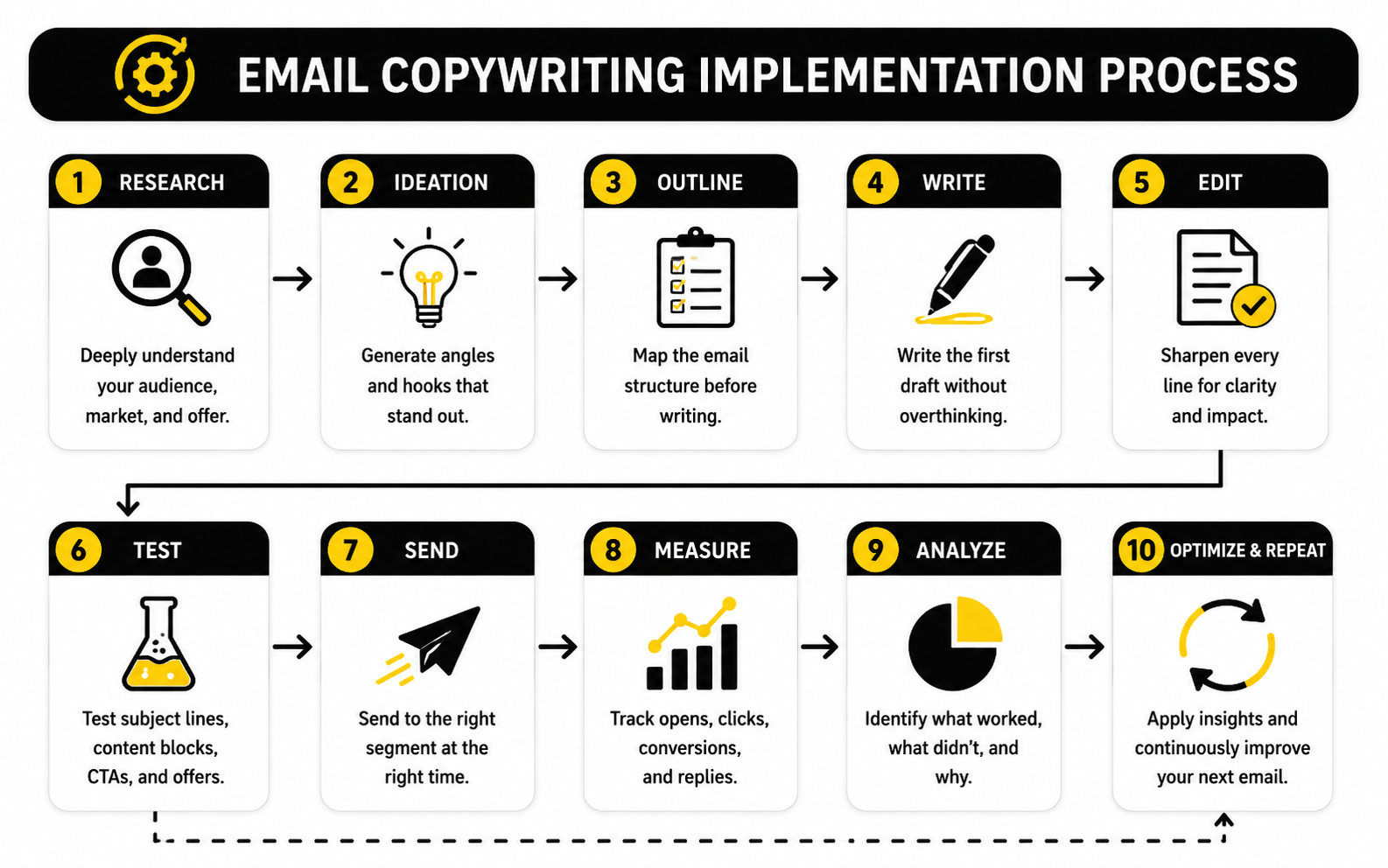
Knowing the components is useful, but process is what makes them repeatable. You need a way to go from blank page to finished email without guessing every time. This is where implementation becomes practical.
Start with the goal, not the sentence. Decide what the email should accomplish, who it is for, and what action counts as success. Then write the message around that decision instead of trying to add the goal after the draft is already messy.
A simple process also makes editing less emotional. You are not asking whether you “like” the email. You are checking whether each part performs its job.
Step 1: Choose The One Goal
Before writing, decide the one thing the email needs to do. It might drive a click, book a call, get a reply, complete a purchase, attend a webinar, or read a guide. If you cannot name the goal clearly, the email will probably wander.
One goal does not mean one sentence. It means one conversion path. Every paragraph should support the same outcome, even if the email uses education, proof, or objection handling along the way.
This step is especially important for promotional emails. Beginners often try to announce the offer, explain the brand, share a story, mention a discount, add testimonials, link to three pages, and ask for a reply in the same message. That is not persuasive; it is confusing.
Step 2: Write The Reader Snapshot
A reader snapshot is a short description of the person receiving the email at that moment. It should include what they want, what they are struggling with, what they already know, and what might stop them from acting. This keeps the copy grounded.
For example, a cold subscriber who downloaded a checklist needs a different email than a returning customer who has bought twice before. The first may need trust and context. The second may need relevance and a stronger reason to act now.
This snapshot does not have to be complicated. Three or four plain sentences are enough. The point is to write for a real situation instead of writing for a vague “audience.”
Step 3: Draft The Email In Order
Once the goal and reader snapshot are clear, draft the email in order: subject line, opening, body, proof, objection handling, and CTA. You can revise later, but writing in order helps you see whether the logic flows naturally. If the email jumps around, the reader will feel it.
Do not polish too early. The first draft should focus on meaning, structure, and momentum. Pretty sentences are useless if the argument is weak.
After the draft is done, read it like a skeptical subscriber. Ask whether the email respects the reader’s time, gives them a real reason to care, and makes the next step obvious. If not, fix the structure before touching the wording.
Step 4: Edit For Clarity And Friction
Editing is where average email copy becomes usable. Cut the throat-clearing, remove repeated ideas, replace vague claims, and make every paragraph earn its place. The goal is not to make the email shorter at all costs; the goal is to make it easier to act on.
Look for friction words and unclear promises. If the reader has to decode what you mean, they will not work hard. If the CTA sounds like a generic button, make it more specific.
This is also where you check whether the email sounds like a human wrote it. Professional does not mean stiff. Confident does not mean loud. The best email copy feels clear, useful, and easy to trust.
Statistics And Data
Data is where email copywriting gets honest. You can like an email, your team can approve it, and the copy can sound polished, but the numbers show whether readers actually moved. That is why a serious email copywriting course free of empty theory should teach measurement as part of the writing process, not as an afterthought.
The goal is not to dump random email marketing statistics into a dashboard. The goal is to understand what each number is trying to tell you. If you know how to read the signals, you can improve the copy, the offer, the audience, and the follow-up instead of guessing.
Benchmarks are useful, but they are not commandments. Mailchimp frames benchmarks as a way to compare open rates, click-through rates, and conversions against industry averages so businesses can identify strengths and weaknesses in their campaigns. That is the right mindset: use benchmarks as a compass, then diagnose your own list with your own context.
Open Rate Shows Attention, Not Success
Open rate is usually the first number people look at because it feels easy to understand. If more people open, the subject line must be working. If fewer people open, something must be wrong.
That is partly true, but it is incomplete. Open rate is influenced by sender reputation, list quality, deliverability, timing, inbox placement, sender name, subject line, preview text, and the reader’s past experience with your emails. It is a useful signal, but it is not the final score.
Open tracking has also become less reliable because privacy features can affect how opens are counted. So use open rate to spot patterns, not to declare victory. If opens fall over multiple sends, investigate the sender relationship, list fatigue, subject line relevance, and deliverability before rewriting everything.
Click Rate Shows Whether The Message Created Action
Click-through rate is closer to the truth because it shows whether people did something after opening. If the open rate is healthy but the click rate is weak, the subject line may have created curiosity that the email did not fulfill. That is usually a copy, offer, or CTA problem.
A low click rate can mean several things. The email may not make the value clear. The proof may be too weak. The CTA may be buried. The landing page promise may not match the email. Or the audience may simply not care about that offer.
This is why click data should push you back into the message. Do not just ask, “How do we get more clicks?” Ask, “Where did the reader lose the reason to click?” That question leads to better writing decisions.
Click-To-Open Rate Helps Separate The Hook From The Body
Click-to-open rate compares clicks to opens, which makes it useful for diagnosing the body of the email. If people open but do not click, the problem is probably not just the subject line. The email may have earned attention but failed to convert that attention into action.
This metric is especially useful when testing different email angles. Two subject lines may produce similar opens, but one email may produce a stronger click-to-open rate because the body copy creates a clearer reason to act. That tells you something important about the message, not just the packaging.
Do not obsess over one campaign. Look for patterns across similar sends. If your educational emails get strong opens but weak clicks, maybe the content is useful but the next step is not compelling enough. If your promotional emails get lower opens but stronger click-to-open rates, your warmest readers may be responding even when the broader list is less interested.
Conversion Rate Connects Email Copy To Business Outcomes
Conversion rate is where email stops being a writing exercise and becomes a business asset. A click is useful, but the real question is what happens after the click. Did the reader buy, book, reply, register, download, upgrade, or complete the intended action?
This matters because a high-click email can still fail commercially. If the copy creates curiosity but sends people to a mismatched offer, you may get traffic without revenue. If the email attracts the wrong people, the numbers can look good at the top and fall apart at the bottom.
Conversion tracking also protects you from optimizing the wrong thing. A calmer email with fewer clicks can outperform a hype-driven email if the people who click are more qualified. That is why advanced marketers look beyond surface engagement and connect email performance to pipeline, revenue, retention, and customer quality.
The Simple Analytics System To Use
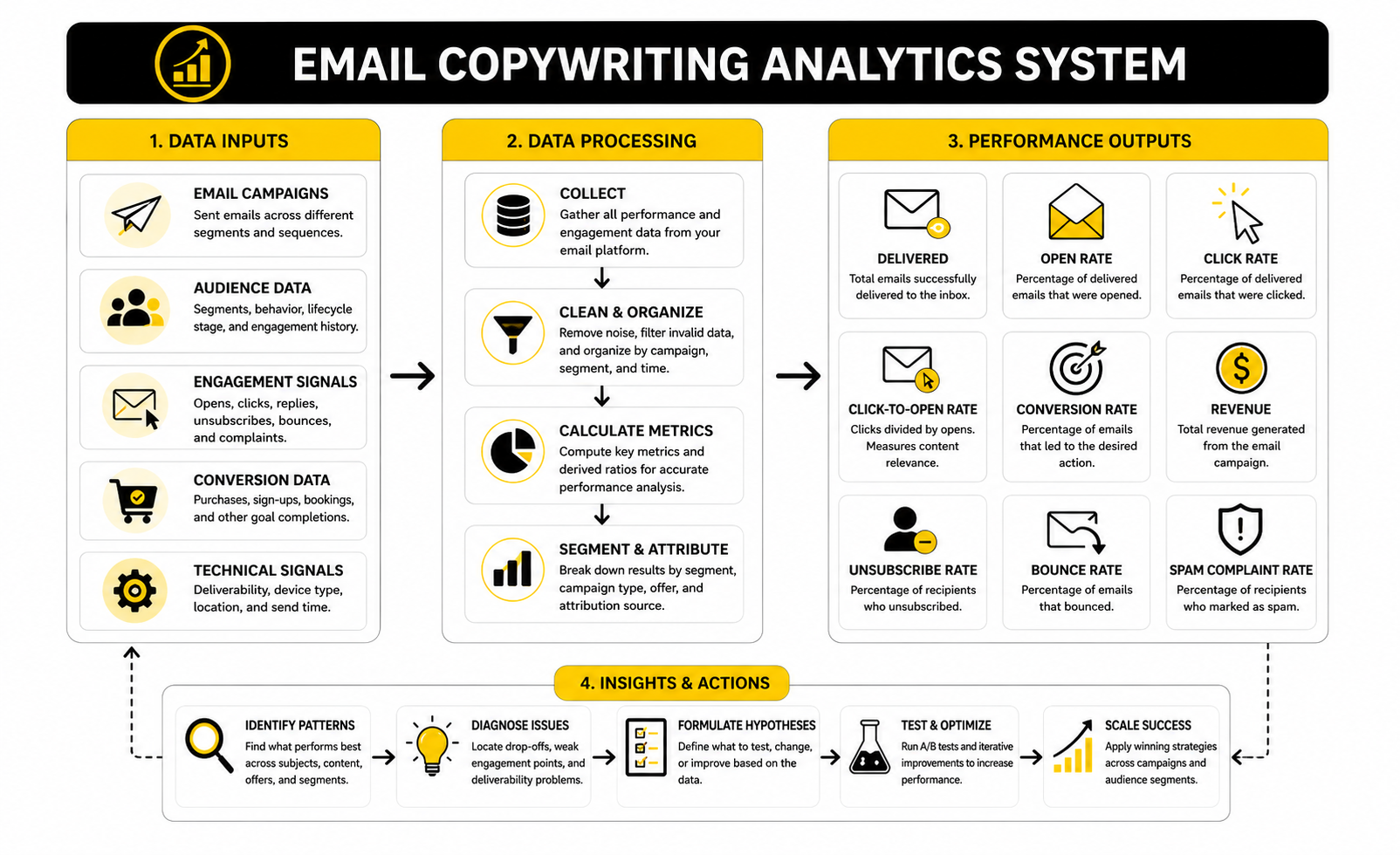
The cleanest way to measure email copy is to track the full path from inbox to outcome. You do not need a complicated dashboard to start. You need a consistent way to see where the reader drops off.
Use this basic sequence:
This sequence prevents lazy diagnosis. If delivered emails are low, copy is not the first issue. If opens are strong but clicks are weak, the email body needs work. If clicks are strong but conversions are weak, the problem may be the offer, page, price, timing, or audience fit.
Benchmarks Help You Ask Better Questions
Email benchmarks are helpful because they give you a baseline, especially when you are new and have no internal history. MailerLite’s 2025 benchmark report covers open rate, click rate, click-to-open rate, and unsubscribe rate across millions of campaigns and dozens of industries. Brevo’s benchmark reporting also shows that email performance can vary widely by industry, which is why comparing a local service business to an ecommerce brand can lead to bad decisions.
The action is not to chase someone else’s average. The action is to understand whether your results are unusually weak, unusually strong, or simply normal for your category. From there, you can decide what to test next.
For example, if your open rate is far below your industry range, start with sender trust, list source, subject line relevance, and deliverability. If your open rate is normal but clicks lag, work on the email’s promise, structure, proof, and CTA. If clicks are fine but revenue is weak, the problem may be after the email.
Unsubscribes Are Not Always Bad
Unsubscribes feel personal, but they are not always a negative signal. A healthy list will lose people who no longer care, no longer fit, or never should have subscribed in the first place. That is normal.
The problem is not one unsubscribe. The problem is a pattern. If unsubscribes spike after a specific campaign, you need to inspect the frequency, promise, targeting, tone, and offer relevance. Something in that send may have violated the reader’s expectation.
A small number of unsubscribes can even improve list quality over time. You want people who want to hear from you. Keeping uninterested subscribers may make your list look bigger, but it can hurt engagement and make your copy decisions less clear.
Bounce Rate And Deliverability Come Before Copy
If your email does not reach the inbox, the copy never gets a chance. Bounce rate, spam complaints, domain reputation, authentication, and inbox placement are not glamorous, but they affect everything. A brilliant email in the spam folder is still a failed email.
Deliverability has become more demanding as mailbox providers tighten standards and users become less tolerant of irrelevant messages. Validity’s 2025 deliverability benchmark report highlights major pressures around privacy, AI, personalization, mobile-first design, and accessibility, all of which affect how senders need to operate. The practical takeaway is clear: list quality and sending behavior are part of performance.
This is why buying lists is a bad learning shortcut. It gives you noisy data, weak engagement, and deliverability risk. If you want to learn email copywriting properly, write to people who gave you permission and have a real reason to care.
Revenue Per Email Keeps You Focused
Revenue per email is one of the most useful metrics when money is the goal. It helps you compare campaigns with different list sizes, open rates, and click rates. Instead of asking which email looked better, you ask which one created more value per send.
This is especially useful for ecommerce, creators, course sellers, agencies, SaaS companies, and service businesses with clear conversion events. A campaign with lower open volume can still win if it produces better revenue per recipient. That is the kind of metric that forces you to care about quality, not just attention.
For service businesses, the equivalent might be replies per email, qualified calls booked, pipeline created, or closed revenue from a sequence. The exact metric depends on the business model. The principle stays the same: measure the action that actually matters.
What To Test First
Testing only works when you test the right thing. Beginners often test tiny wording changes before fixing the main message. That is backwards.
Start with high-impact variables:
Do not test everything at once. Change one meaningful variable and compare it against a clear outcome. If you change the audience, subject line, CTA, and offer in the same test, you may get a winner but you will not know why it won.
How To Use Tools Without Letting Tools Think For You
Email platforms make measurement easier, but they do not replace judgment. A dashboard can show opens, clicks, unsubscribes, and conversions. It cannot automatically tell you whether the reader misunderstood the promise, distrusted the proof, or felt the offer was not urgent enough.
Tools like Brevo, Moosend, and GoHighLevel can help track campaigns, build automations, and connect emails to customer journeys. That is useful. But the copywriter still has to interpret the behavior behind the numbers.
This is the mindset to keep: data tells you where to look, not what to blindly do. If you treat metrics as instructions, you will chase noise. If you treat them as evidence, you will improve faster than people who only write from opinion.
Professional Implementation For Real Campaigns
This is where email copywriting becomes more than writing nice emails. Real campaigns have constraints. You need to protect deliverability, respect the reader, work with automation, support sales goals, and keep improving without burning out your list.
A free email copywriting course can teach the basics, but professional implementation is where the tradeoffs show up. You might write a stronger sales email that gets more clicks but also increases unsubscribes. You might personalize more deeply but add complexity to your workflow. You might send more often and make more money this month while weakening engagement over the next quarter.
That is why the best email marketers think like operators, not just writers. They care about the copy, but they also care about segmentation, list hygiene, campaign cadence, attribution, compliance, and the quality of the customer journey after the click.
Strategy Comes Before Frequency
Sending more emails is not automatically good or bad. It depends on the relationship, the offer, the list source, the reader’s expectations, and the value of each message. A daily newsletter can work if people signed up for daily insight, but a daily sales blast to a cold list can destroy trust quickly.
The real question is not “How often should I email?” The better question is “What rhythm can we sustain while staying useful?” That shift matters because frequency without relevance creates fatigue.
A practical cadence usually mixes different email types. Educational emails build trust, promotional emails drive action, lifecycle emails support the customer journey, and re-engagement emails clean up weak segments. When those roles are clear, you can send more confidently without treating every email like a desperate pitch.
Segmentation Creates Better Tradeoffs
The larger your list gets, the more dangerous one-size-fits-all email becomes. A message that is perfect for a new lead may be irrelevant to a loyal customer. A discount that motivates a hesitant buyer may annoy someone who already paid full price yesterday.
Segmentation lets you make more carefully tradeoffs. You can send sales-focused messages to people showing buying intent while sending educational content to people who need more trust. You can reward engaged readers without dragging inactive subscribers through every campaign.
This is where many businesses underuse their email tools. MoEngage’s 2025 benchmark report found that a large share of campaigns still rely on minimal personalization, with many brands stopping at basic name-level personalization instead of using behavior and lifecycle context. That is a missed opportunity because better segmentation usually makes the copy more specific, and specific copy is easier to trust.
AI Should Support Judgment, Not Replace It
AI can help with email copywriting, but it should not become the strategist. It can generate subject line variations, summarize customer research, rewrite drafts, create testing ideas, and help repurpose long-form content into email angles. Used well, it speeds up the mechanical parts of writing.
The risk is that AI also makes it extremely easy to publish average copy at scale. If the prompt is weak, the offer is unclear, and the reader insight is shallow, the output will usually sound smooth but forgettable. That kind of email may look professional while doing nothing.
Use AI as a production assistant, not as the final authority. Feed it real context, customer language, offer details, objections, and performance data. Then apply human judgment before sending, because the reader does not care whether the draft was fast; they care whether it feels relevant.
Deliverability Is A Strategic Constraint
Deliverability is not a technical side issue. It is part of the campaign strategy. If your emails do not reach the inbox, your subject line, hook, CTA, and offer never get tested properly.
Sender requirements have become stricter, especially around authentication, spam complaints, and unsubscribe standards. Google and Yahoo’s sender changes pushed bulk senders toward stronger authentication practices, clearer unsubscribe handling, and better complaint monitoring, which makes sloppy list management more expensive than it used to be. Even smaller senders should treat those standards seriously because inbox providers reward trust and punish bad behavior.
This changes how you should learn email copywriting. Do not practice by scraping contacts or blasting people who never asked to hear from you. Practice with permission-based lists, clean opt-ins, clear expectations, and useful follow-up. That gives you cleaner data and fewer deliverability problems.
Compliance Shapes The Copy
Email copy also has legal and trust constraints. You need accurate sender information, honest subject lines, a clear way to unsubscribe, and respect for consent rules that apply to your audience. This is not just legal housekeeping; it affects how readers feel about your brand.
When copy overpromises, hides the commercial intent, or makes unsubscribing difficult, it may create short-term gains and long-term damage. The reader might click once, but they are less likely to trust the next message. That is a bad trade.
Strong copy does not need deception. It can be persuasive and honest at the same time. In fact, clear honest copy often performs better over time because it attracts people who actually fit the offer.
Scaling Requires Message Architecture
When you send one email, you can rely on instinct. When you run campaigns across multiple segments, products, launches, and automations, instinct is not enough. You need message architecture.
Message architecture means the big ideas are defined before individual emails are written. You know the core promise, main objections, proof points, audience segments, offer positioning, and lifecycle stages. Then each email has a clear role inside the larger system.
This prevents the classic scaling problem: every email sounds like it came from a different business. One message is casual, the next is corporate, the next is aggressive, and the next is vague. A clear message architecture keeps the voice consistent while still allowing different campaign types.
Automation Should Feel Timely, Not Robotic
Automation is powerful because it lets you respond to behavior. Someone downloads a lead magnet, abandons a checkout, books a call, misses a webinar, becomes inactive, or buys a product. Each action can trigger a relevant follow-up.
But automation fails when it feels mechanical. A sequence should not read like a conveyor belt of generic nudges. It should feel like the next helpful message based on what the person just did.
Tools like GoHighLevel, Brevo, and Moosend can help build those flows, but the logic still matters. The best automation starts with the customer journey, not the software menu. Decide what the reader needs next, then build the workflow around that.
Landing Pages Must Match The Email
A strong email can still lose the conversion if the landing page breaks the promise. If the email says “get the checklist,” the page should make the checklist obvious. If the email sells a specific outcome, the page should continue that outcome instead of suddenly shifting into a generic product pitch.
This match is especially important when the reader is coming from a focused campaign. The email has created a narrow expectation. The landing page needs to continue that expectation with the same language, angle, and next step.
For funnel-heavy campaigns, platforms like ClickFunnels and systeme.io can be useful because they make it easier to connect email traffic to dedicated pages. Just do not let the template decide the message. The funnel should support the copy, not overwrite it.
Sales Emails Need A Different Standard Than Content Emails
Not every email should be judged the same way. A content email may aim to build trust, start a conversation, or keep the reader engaged. A sales email has a more direct commercial job and needs a stronger reason to act.
That does not mean sales emails should be louder. It means they need clearer positioning, sharper proof, stronger objection handling, and a more precise CTA. The reader must understand why the offer matters now and why it is worth the cost, time, or risk.
This is why copying newsletter style into a sales campaign often underperforms. A good newsletter can be relaxed and exploratory. A good sales email needs direction. Friendly is fine, but the purpose cannot be blurry.
Free Training Works Best With Real Practice
A free email copywriting course can give you principles, examples, and structure. It cannot build skill for you. Skill comes from writing real emails, reviewing the data, and improving based on what happened.
The most useful practice is not writing random sample emails for imaginary brands. It is improving real messages with real constraints. Rewrite a welcome email. Create a re-engagement email. Draft a launch sequence. Improve a CTA. Compare the results.
If you do not have a list yet, practice by deconstructing public emails from brands in your niche. Identify the reader, promise, proof, objection, CTA, and likely goal. Then rewrite the email for a different segment or offer. That kind of practice builds judgment faster than collecting more templates.
The Biggest Risk Is Optimizing Too Early
Beginners often want advanced tactics before they have a clear message. They want split tests, automation, personalization, AI prompts, templates, and deliverability hacks. Those things can help, but only after the fundamentals are working.
If the offer is weak, testing subject lines will not save it. If the audience is wrong, better CTA wording will not fix the campaign. If the email makes a vague promise, automation will only send vague messages faster.
So the sequence matters. First, understand the reader. Then clarify the offer. Then write the message. Then measure behavior. Then optimize. Skipping that order creates noise, not progress.
How To Choose What To Learn Next
Once you understand the fundamentals, the next step depends on your goal. A freelancer needs different skills than an ecommerce marketer. A SaaS founder needs different emails than a creator selling a course. A local agency needs different follow-up than a newsletter operator.
If you are new, focus on writing single emails well before building complex sequences. Learn welcome emails, promotional emails, nurture emails, re-engagement emails, and simple follow-ups. Those formats appear everywhere, and improving them gives you practical range.
If you already write emails, go deeper into research, positioning, segmentation, and analytics. That is where stronger results usually come from. At the professional level, the winners are not just better sentence writers; they are better decision-makers.
Learn Research Before Templates
Templates are useful only when you understand why they work. Without research, templates become costumes. The email looks like a proven format, but it does not carry the insight that made the original effective.
Start by collecting customer language. Look at reviews, support tickets, sales calls, survey responses, testimonials, objections, and competitor comments. Pay attention to the exact words people use when describing the problem.
Then write from that language. This makes the copy feel natural because it reflects the reader’s reality. You are not forcing persuasion onto the message; you are translating what the market already cares about.
Build A Swipe File With Discipline
A swipe file is not a folder of emails to copy. It is a library of patterns to study. You collect subject lines, openings, CTAs, offer angles, proof formats, and sequence structures so you can understand why they work.
The discipline is to annotate each example. What is the audience? What is the promise? What objection does it handle? What makes the CTA specific? What would you change for a colder audience or higher-ticket offer?
That analysis is where the learning happens. Saving emails without studying them is just hoarding. A smaller annotated swipe file is more useful than a giant folder you never open.
Keep The Reader’s Trust As The Main Asset
Email can sell, but trust is the asset that makes selling easier over time. Every campaign either strengthens or weakens that trust. There is no neutral send.
This is the professional standard: send emails that make people glad they stayed subscribed, even when they do not buy. That does not mean every email has to be educational. It means every email should be relevant, honest, and worth the interruption.
When you treat trust as the main asset, your decisions get cleaner. You avoid lazy urgency, fake scarcity, inflated claims, and irrelevant blasts. You still sell confidently, but you do it in a way that protects the relationship you will need for the next campaign.
Free Email Copywriting Course FAQ And Next Steps
At this point, the goal is not to learn every email tactic on the internet. The goal is to build a system you can actually use. If you understand the reader, write around one clear promise, measure the right signals, and protect trust, you are already ahead of most people sending random campaigns.
The best next step is to turn this guide into a simple practice plan. Pick one email type, write it using the framework, send it to the right segment, review the results, and improve the next version. That is how a free email copywriting course becomes a real skill instead of another saved bookmark.
What Is The Best Free Email Copywriting Course?
The best free email copywriting course is the one that teaches strategy, structure, writing, and measurement together. A course that only gives templates can help you move faster, but it will not teach you why an email works. Look for training that explains reader intent, offer positioning, proof, objections, calls to action, and performance review.
Can I Learn Email Copywriting For Free?
Yes, you can learn email copywriting for free if you practice with discipline. Free resources from reputable marketing education platforms, brand blogs, newsletters, and email examples can teach the core principles. The real progress comes from writing, editing, sending, and reviewing actual performance instead of just watching lessons.
How Long Does It Take To Get Good At Email Copywriting?
You can understand the basics in a few days, but getting good usually takes repeated practice. The hard part is not learning that emails need a subject line, hook, body, and CTA. The hard part is learning how to choose the right angle for the right reader at the right moment.
Is Email Copywriting Different From General Copywriting?
Email copywriting is a specific form of direct response copywriting. It has to work inside the inbox, where attention is limited and trust is fragile. Unlike a full landing page, an email usually has to create interest quickly, deliver value fast, and move the reader toward one clear next step.
Do I Need An Email Marketing Tool To Practice?
You do not need a paid email tool to practice writing, but you do need a tool if you want to send, automate, and measure campaigns properly. Platforms like Brevo, Moosend, and GoHighLevel can help you manage lists, campaigns, automations, and reporting. Just remember that tools support the system; they do not replace clear copy.
What Should A Beginner Practice First?
A beginner should start with welcome emails, simple promotional emails, newsletter intros, re-engagement emails, and short follow-up emails. These formats teach the most important skills: relevance, clarity, proof, timing, and calls to action. Do not start with complicated launch sequences before you can write one strong email.
Are Email Templates Worth Using?
Email templates are worth using when you understand the thinking behind them. They can save time, give structure, and help you avoid blank-page stress. But if you copy templates without adapting them to your reader, offer, and market, the email will usually feel generic.
What Metrics Should I Track First?
Start with delivered emails, open rate, click rate, click-to-open rate, conversions, unsubscribes, and replies when relevant. Each metric answers a different question, so do not judge the whole campaign from one number. The strongest marketers use metrics to diagnose where the message broke down, not to chase vanity wins.
Is AI Useful For Email Copywriting?
AI is useful for brainstorming angles, rewriting drafts, creating subject line variations, summarizing customer research, and building testing ideas. It becomes risky when people use it to replace strategy and send generic emails faster. The best approach is to use AI for speed while keeping human judgment in charge of the message.
How Do I Make Email Copy Sound Less Salesy?
Make the email more specific, more useful, and more honest. Salesy copy usually happens when the writer pushes too hard without enough relevance, proof, or reader empathy. If the email clearly explains the problem, supports the promise, and offers a reasonable next step, it can sell confidently without feeling desperate.
How Often Should I Send Marketing Emails?
There is no universal perfect sending frequency. The right cadence depends on what subscribers expected when they joined, how useful your emails are, how often you have something relevant to say, and how your engagement data responds. A smaller number of useful emails will beat a higher number of forgettable emails over time.
What Is The Biggest Email Copywriting Mistake?
The biggest mistake is writing before thinking. Many weak emails fail because the writer never clarified the reader, problem, promise, proof, objection, and action. When those pieces are unclear, the email may still sound polished, but it will not create enough reason to click.
Can Email Copywriting Help Freelancers Get Clients?
Yes, email copywriting is one of the most useful skills for freelancers because it helps with outreach, follow-up, proposals, newsletters, and client retention. A freelancer who can write clear emails can create more opportunities without relying only on job boards or referrals. The skill also becomes easier to sell because businesses already understand that email affects leads, sales, and customer relationships.
Should I Focus On Cold Email Or Newsletter Copy First?
It depends on your goal. If you want clients, partnerships, or sales conversations, cold email and follow-up copy may be more useful first. If you want to build an audience, sell products, or nurture leads over time, newsletter and lifecycle email copy should become a priority.
What Makes An Email Copywriting Course Actually Useful?
A useful course teaches you how to think, not just what to write. It should explain how to research the reader, position the offer, structure the message, support claims, handle hesitation, and measure results. If it only gives swipe files and subject line formulas, it may help with ideas, but it will not build deep skill.
Build a stronger local presence with BAAM AI
Turn your website, Google profile, social channels, and AI visibility into one growth engine
Most businesses do not need more random marketing activity. They need a consistent presence system that helps the right people find them, trust them, and take action. BAAM AI brings strategy, local SEO, website updates, Google Maps visibility, social content, AI-search readiness, media production, and reporting into one practical monthly engine.
If you want your marketing to keep working after the campaign ends, start with a free BAAM AI presence audit. See how your business shows up today and where the fastest visibility wins are at BAAM AI.