
BAAM AI Blog
Email Campaigns Best Practices: A Practical Framework for Campaigns That People Actually Want to Open
Email campaigns still work, but only when they are treated like a customer experience instead of a broadcast button. The brands that win with email are not simply sending more messages. They are sending clearer...
Email campaigns still work, but only when they are treated like a customer experience instead of a broadcast button. The brands that win with email are not simply sending more messages. They are sending clearer offers, better-timed sequences, cleaner segmentation, and more useful follow-ups.
That matters because inboxes are more filtered, more crowded, and less forgiving than they used to be. A weak campaign does not just underperform for one send. It can hurt deliverability, train subscribers to ignore you, and make future campaigns harder to recover.
This guide breaks down email campaigns best practices in a practical way, from strategy and structure to copy, automation, testing, deliverability, and measurement. The goal is not to make email complicated. The goal is to help you build campaigns that are simple enough to execute and strong enough to compound over time.
this guide is split into six parts so each stage of campaign planning gets enough attention. The order matters because strong email performance starts before the first subject line is written. You need the strategy, audience, offer, message, technical setup, and follow-up system working together.
Why Email Campaigns Still Matter
Email remains one of the few channels where you can speak directly to people who have already shown interest in your business. Social reach can change overnight, ad costs can swing without warning, and search traffic can disappear after an algorithm update. Email gives you a more stable way to nurture leads, educate buyers, recover missed opportunities, and drive repeat purchases.
The problem is that many teams still treat email like a last-minute promotional channel. They write a message, pick a list, send it to everyone, and then judge the whole campaign by opens or clicks. That approach misses the real job of email, which is to move the right person to the next logical step in their journey.
Good email campaigns are built around intent. A new subscriber needs trust and orientation, not a hard pitch on day one. A warm lead needs proof, clarity, and a reason to act. A past customer needs relevance, timing, and a reason to come back.
The Framework Behind Strong Email Campaigns
A strong campaign has four layers: the audience, the offer, the message, and the system. The audience decides who should receive the campaign and who should not. The offer gives the email a reason to exist beyond “we wanted to send something.”
The message turns that offer into a clear argument people can understand quickly. It includes the subject line, preview text, body copy, design, CTA, and follow-up logic. The system makes sure the campaign is sent to the right segment, at the right time, with proper tracking, deliverability safeguards, and a clear way to measure results.
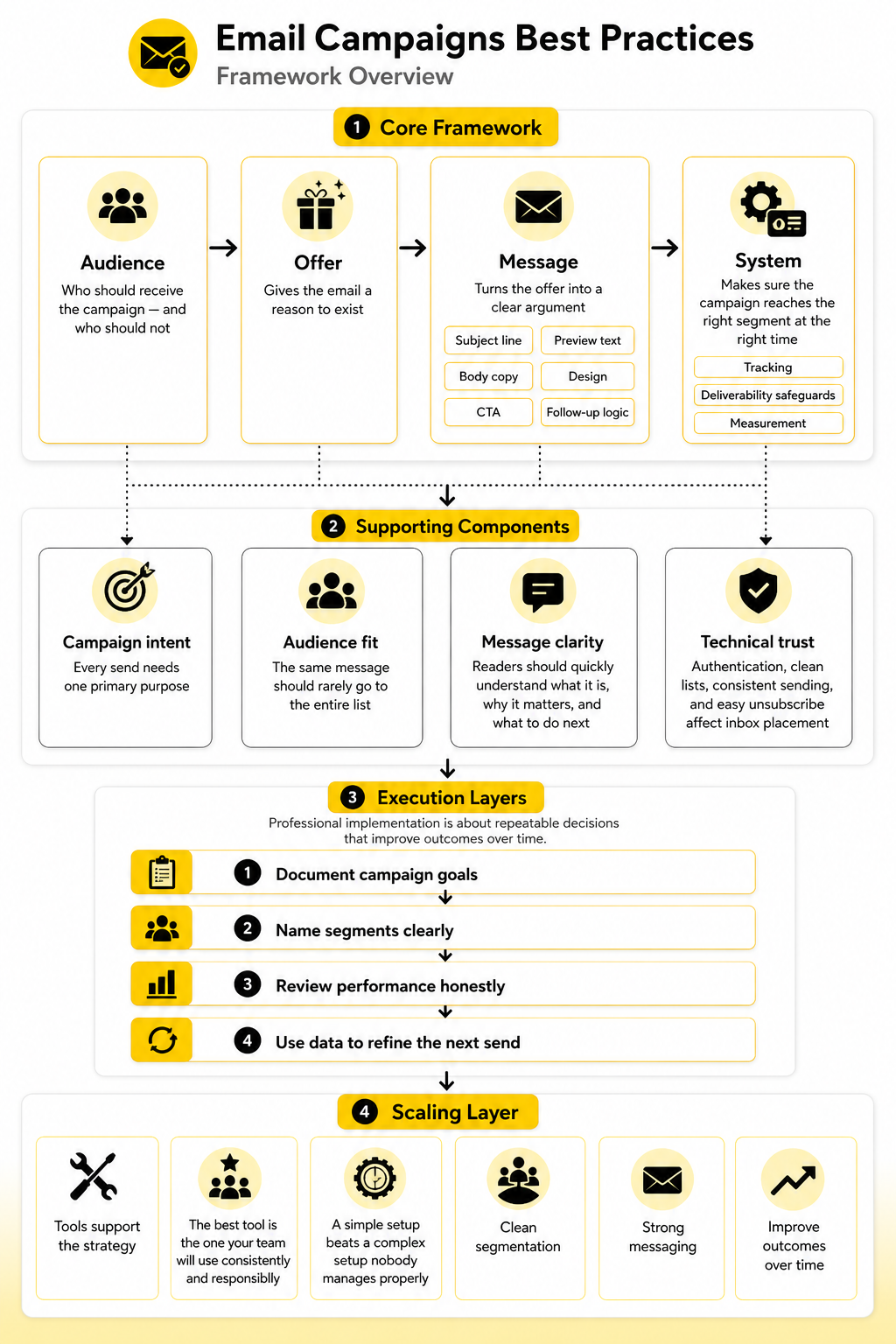
This framework keeps teams from obsessing over small tactics while ignoring the bigger issue. A clever subject line cannot fix a weak offer. A beautiful template cannot fix poor segmentation. A powerful automation tool cannot save a campaign that sends the wrong message to the wrong person.
Core Components of Email Campaigns Best Practices
The first component is campaign intent. Every send should have one primary purpose, whether that is onboarding, education, conversion, retention, reactivation, or referral. When a campaign tries to do too many things at once, the reader feels the confusion immediately.
The second component is audience fit. The same message should rarely go to the entire list. Segments based on behavior, lifecycle stage, purchase history, engagement, or expressed interest usually create a better experience than broad list blasts.
The third component is message clarity. Readers should understand what the email is about, why it matters, and what to do next without working hard. That sounds basic, but it is where many campaigns fail because the copy is either too vague, too crowded, or too focused on the company instead of the reader.
The fourth component is technical trust. Authentication, clean lists, unsubscribe visibility, consistent sending patterns, and engagement monitoring all affect whether campaigns reach the inbox. Deliverability is not a technical side quest. It is part of the campaign strategy.
Professional Implementation Starts With Discipline
Professional email marketing is not about sending fancy emails. It is about making repeatable decisions that improve outcomes over time. That means documenting campaign goals, naming segments clearly, reviewing performance honestly, and using data to refine the next send.
Tools can help, but they should support the strategy rather than replace it. A platform like Brevo can make campaign sending, automation, and contact management easier for small teams. A broader CRM and automation setup like GoHighLevel can make sense when email needs to connect with pipelines, SMS, booking, lead capture, and client follow-up.
The best tool is the one your team will use consistently and responsibly. A simple setup with clean segmentation and strong messaging will usually beat a complex setup nobody manages properly. In the next part, we will build the strategy layer first, because that is where strong campaigns are really won.
Building the Campaign Strategy Before You Write the Email
Most weak campaigns fail before the copy is written. Not because the subject line is bad, not because the button color is wrong, and not because the send time is slightly off. They fail because the campaign never had a clear job in the first place.
Before you write a single email, define what the campaign is supposed to move. Are you trying to turn new subscribers into engaged readers, leads into booked calls, trial users into customers, customers into repeat buyers, or inactive contacts into active contacts again? That one decision changes the offer, the segment, the timing, the CTA, and the follow-up.
This is where email campaigns best practices become practical instead of theoretical. A campaign is not just a message. It is a small system designed to create one specific movement in the customer journey.
Start With One Campaign Goal
Every email campaign should have one primary goal. Not three. Not “drive awareness, clicks, sales, replies, webinar registrations, and social engagement.” One goal keeps the campaign sharp enough for the reader to understand what matters.
A good goal is specific enough to guide decisions. “Promote our new product” is vague. “Get existing customers who bought product A to view the upgrade page for product B” is much stronger because it defines the audience, the offer, and the next action.
The goal should also connect to a business outcome, not just an email metric. Opens can show whether the subject line and sender relationship are working, but they do not prove the campaign made money. Clicks are useful, but they only matter if the destination and offer are aligned with the campaign’s purpose.
Match the Campaign Type to the Customer Journey
Different campaign types solve different problems. A welcome sequence helps people understand who you are and what they should do next. A nurture campaign builds trust before someone is ready to buy. A promotional campaign creates urgency around a specific offer.
A reactivation campaign has a completely different job. It should not speak to inactive subscribers the same way you speak to your most engaged buyers. These people have already drifted away, so the message needs to be simpler, more direct, and easier to act on.
The best campaign type is the one that matches the reader’s current stage. That is why customer journey mapping matters. If the person is new, reduce confusion. If they are evaluating, reduce risk. If they are ready, reduce friction.
Define the Audience Before the Offer
The audience comes before the offer because relevance is not created inside the email. It starts with who receives it. A strong offer sent to the wrong segment still feels like noise.
At minimum, separate subscribers by lifecycle stage, recent engagement, purchase behavior, and stated interest. A new lead, an active customer, a dormant subscriber, and a high-value buyer should not automatically receive the same campaign. They have different context, different objections, and different reasons to care.
This matters even more as inbox providers reward wanted email and punish unwanted behavior. Gmail’s sender guidance makes it clear that bulk senders need to authenticate email, avoid unwanted messages, and make unsubscribing easy through Gmail’s bulk sender requirements. Strategy and deliverability are connected because irrelevant campaigns create low engagement and higher complaint risk.
Choose an Offer That Fits the Reader’s Level of Awareness
Your offer should match what the reader already understands. A cold subscriber may need a useful guide, comparison, checklist, webinar, or low-friction next step. A warm lead may be ready for a demo, consultation, trial, or direct product page.
The more commitment you ask for, the more trust the campaign has to build first. Asking someone to book a call too early can create resistance. Giving someone another generic educational email when they are ready to buy can slow momentum.
This is why campaign planning should include the reader’s awareness level. Do they know they have the problem? Do they understand the cost of doing nothing? Do they know your solution exists? Do they believe your solution is credible? Each answer changes the angle of the email.
Build the Campaign Around One Clear CTA
A campaign can include multiple emails, but each email should have a clear main action. That action might be reading a guide, visiting a landing page, booking a call, completing checkout, replying with a preference, or choosing a product category. The reader should never have to decode what you want them to do.
This does not mean every email needs a hard-sell button. Sometimes the best CTA is a soft step that moves the relationship forward. For example, a nurture email may invite the reader to read a comparison page, while a later email asks them to start a trial or book a demo.
If your CTA needs a landing page, make sure the page continues the same argument as the email. For funnel-based campaigns, a tool like ClickFunnels can be useful when the email needs to send readers into a focused sales path instead of a busy website. For simpler all-in-one setups, Systeme.io can fit campaigns that need email, pages, and basic automation in one place.
Plan the Sequence, Not Just the First Send
A single email rarely carries the whole campaign. People miss messages, hesitate, get distracted, or need more context before they act. That is why the sequence matters.
A good sequence has a logical progression. The first email can frame the problem or opportunity. The next can handle the most common objection. Another can show proof, clarify the offer, or add urgency if the timing is real.
Do not confuse sequence planning with sending endless follow-ups. More emails are not automatically better. The point is to design a campaign that gives the reader enough context to make a decision without feeling chased.
Decide What Happens After the Click
Many teams stop planning at the click, but that is where the campaign experience often breaks. If someone clicks, what happens next? Do they land on a page that matches the email promise? Do they receive a follow-up based on that behavior? Are they removed from the wrong sequence once they convert?
This is one of the most overlooked email campaigns best practices because it sits between marketing, sales, and operations. The email may do its job perfectly, but if the landing page is confusing or the sales follow-up is slow, the campaign still loses money. The campaign should be mapped all the way from send to next action to post-conversion follow-up.
For service businesses, agencies, and local businesses, GoHighLevel can make this easier because email can connect with forms, calendars, pipelines, SMS, and lead follow-up. For ecommerce or content-led campaigns, the same principle applies even if the stack is different. The click is not the finish line.
Set Success Metrics Before Launch
Decide what success means before the campaign goes live. Otherwise, you will end up cherry-picking whichever metric looks best afterward. That is how teams convince themselves a campaign worked when it only generated surface-level engagement.
Use metrics that match the campaign goal. A welcome campaign might track activation, first click, reply rate, or first purchase. A promotional campaign might track revenue, conversion rate, average order value, and unsubscribe impact. A reactivation campaign might track recovered engagement and list cleanup, not just clicks.
Industry benchmarks can provide context, but they should not become the strategy. Recent benchmark reports from platforms like MailerLite and MoEngage show that performance varies heavily by industry, audience, and campaign type. Your own trend line is usually more useful than obsessing over someone else’s average.
Write the Campaign Brief
Before writing copy, create a simple campaign brief. This does not need to be a corporate document. It just needs to force clear thinking before the team starts building.
A practical campaign brief should include:
This brief becomes the filter for every decision. If a sentence, section, design element, or CTA does not support the campaign goal, cut it. Clarity is not a style preference. It is what makes the campaign easier to read, easier to act on, and easier to improve later.
Segmentation, Personalization, and List Quality
Once the campaign strategy is clear, the next job is implementation. This is where email stops being a broad announcement and becomes a relevant message for a specific group of people. The difference is not small.
Segmentation, personalization, and list quality decide whether your campaign feels useful or random. They also affect deliverability because inbox providers pay attention to engagement, complaints, unsubscribes, and unwanted sending behavior. If you want email campaigns best practices to actually translate into better performance, this is the part you cannot skip.
Clean Data Comes Before Clever Personalization
Personalization only works when the data behind it is accurate. Using someone’s first name is not enough, especially if the rest of the message ignores their behavior, interest, or relationship with your business. Bad personalization is worse than no personalization because it makes the campaign feel automated in the wrong way.
Start with the data you can trust. That usually includes signup source, purchase history, product interest, form answers, engagement level, location when relevant, lifecycle stage, and recent behavior. If a field is incomplete, outdated, or unreliable, do not build an important campaign around it.
This is especially important because many teams overestimate how personalized their campaigns really are. The 2025 MoEngage benchmark report found that 87% of analyzed emails were only minimally personalized, which usually means the message used basic fields but did not adapt meaningfully to the customer journey. Real personalization is not decoration. It changes what the reader receives and why.
Segment by Intent, Not Just Demographics
Demographics can be useful, but intent is usually more valuable. Someone’s job title, company size, or location may help shape the message, but behavior often tells you more about what they need next. A person who clicked a pricing page is in a different place than someone who downloaded a beginner checklist.
Intent-based segments can come from actions like product page visits, abandoned carts, demo requests, webinar attendance, email clicks, lead magnet downloads, survey answers, or repeated engagement with a topic. These signals help you send campaigns that match what the reader has already shown interest in. That is much stronger than guessing based on broad profile data.
The practical move is to create segments that affect the campaign decision. If a segment does not change the offer, angle, timing, CTA, or follow-up, it may not need to exist. Segmentation is not about building a complicated database. It is about making more carefully campaign choices.
Separate New, Active, Dormant, and Customer Audiences
A new subscriber needs a different experience than someone who has been reading for months. An active lead needs a different message than a dormant contact who has ignored the last ten emails. A customer deserves different context than someone who has never bought.
At minimum, build separate groups for new contacts, engaged subscribers, inactive subscribers, leads, first-time customers, repeat customers, and high-value customers. These groups do not need to be perfect from day one. They just need to stop the most obvious mistake: treating everyone like they are at the same stage.
This is also where suppression rules become powerful. If someone already purchased, stop sending them the same conversion campaign. If someone has not opened or clicked in a long time, reduce frequency or send a reactivation sequence before including them in major campaigns. Respecting context improves the reader experience and protects the health of the list.
Turn Segmentation Into a Practical Workflow
The implementation process should be simple enough to repeat. If segmentation only lives in someone’s head, it will break as soon as campaigns get busy. You need a workflow that makes audience selection clear before every send.
A useful process looks like this:
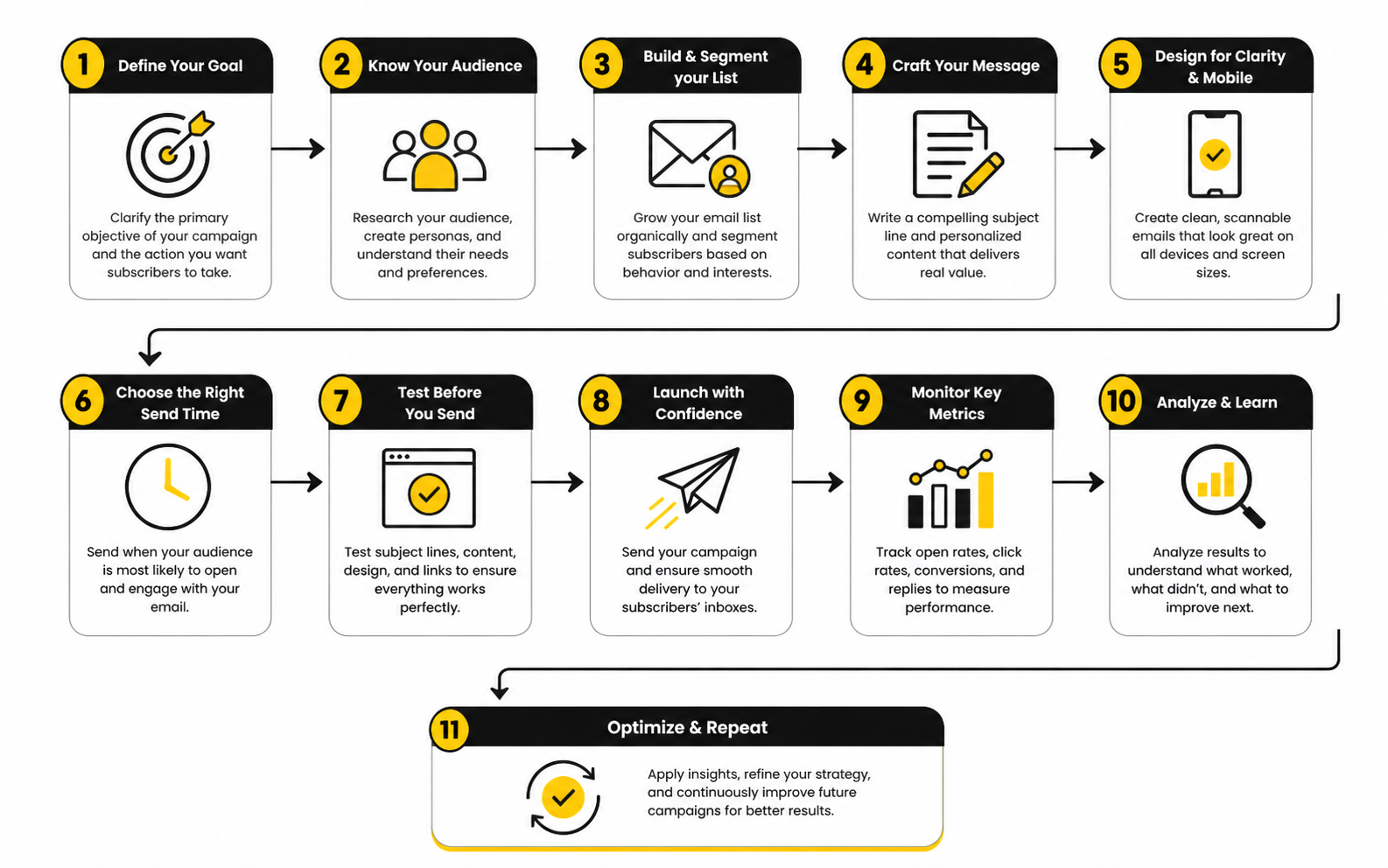
This process makes execution tangible because it forces decisions in the right order. You are not starting with copy and then trying to find an audience. You are starting with the audience and building the campaign around what they need next.
Use Personalization to Remove Friction
Good personalization should make the email easier to understand, easier to trust, or easier to act on. That could mean referencing the product category someone viewed, showing a relevant use case, sending a local event reminder, or changing the CTA based on whether the person is a lead or customer. The goal is usefulness, not novelty.
Avoid personalization that feels invasive. Just because you can use a data point does not mean you should make it obvious in the copy. A campaign can be personalized through the offer, timing, and content without saying, “We saw you clicked this page yesterday.”
The safest test is simple: would the reader feel helped or watched? Helped is good. Watched is bad. Strong email campaigns best practices always protect trust because trust is what makes the next campaign easier to send.
Keep List Quality High
List quality is not just about removing invalid addresses. It is about maintaining a list of people who actually want to hear from you. A smaller engaged list usually beats a larger cold list because the engaged list gives you cleaner signals and fewer deliverability problems.
Remove hard bounces quickly, monitor repeated non-engagement, and make unsubscribing easy. Gmail’s guidance for bulk senders emphasizes authentication, low spam complaints, and easy unsubscribe options through its sender requirements. These are not just compliance details. They are basic trust signals.
Do not buy lists. Do not scrape contacts. Do not keep hammering people who have shown no interest for months. It may feel like you are preserving reach, but you are often damaging the channel you are trying to grow.
Build Preference Signals Into the Campaign
One of the easiest ways to improve segmentation is to ask people what they want. Preference centers, survey questions, onboarding forms, and simple “choose your interest” links can all create useful first-party signals. This gives readers control and gives you better data.
The key is to ask for information you will actually use. If you ask people what topics they care about, send different campaigns based on those choices. If you ask how often they want to hear from you, respect that preference.
A tool like Fillout can work well when you need clean forms for preference capture, lead qualification, or campaign intake. For teams that want email and CRM activity tied together, Copper can help when sales context needs to inform follow-up. The point is not to collect more data for fun. The point is to collect the few signals that make the next email more relevant.
Personalize the Follow-Up, Not Just the First Email
Many campaigns personalize the first send and then fall back into generic follow-ups. That is a missed opportunity. The follow-up should respond to what the reader did or did not do.
If someone clicked but did not convert, the next email can reduce friction, answer an objection, or point to a more specific resource. If someone ignored the first email, the next message may need a different angle rather than the same pitch repeated louder. If someone converted, they should move into a post-conversion experience instead of continuing to receive the same campaign.
This is where implementation starts to feel more professional. You are not sending a static sequence to everyone. You are building a responsive path that changes based on the reader’s behavior.
Document Your Segments Before Scaling
As campaigns multiply, segment names can become messy fast. One person creates “Hot Leads.” Another creates “Engaged Leads.” Someone else creates “Active Prospects 30 Days.” Soon nobody knows which segment should be used.
Create a simple naming system and document what each segment means. Include the rules, purpose, exclusions, owner, and last review date. This sounds boring, but it prevents expensive mistakes later.
Good documentation also makes testing easier. When you know exactly who received a campaign, you can compare results honestly. Without that clarity, performance analysis becomes guesswork, and guesswork is not a strategy.
Statistics and Data
Measurement is where email marketing gets honest. A campaign can look polished, sound persuasive, and still fail if the data shows that the wrong people ignored it, clicked without converting, or unsubscribed after receiving it. The point of analytics is not to decorate a report. The point is to decide what to fix next.
This is why benchmarks should be treated as context, not commandments. A nonprofit newsletter, a SaaS trial sequence, a local service follow-up, and an ecommerce promotion will not behave the same way. Good email campaigns best practices use external benchmarks to spot obvious problems, then rely on your own list history to make real decisions.
Recent benchmark data from MailerLite is useful because it covers over 3.6 million campaigns from 181,000 approved accounts. That kind of scale can help you understand whether your numbers are wildly outside the normal range. But it still cannot tell you whether your offer was strong, your segment was correct, or your landing page converted.
Open Rate Shows Attention, Not Success
Open rate is still useful, but it is no longer clean enough to treat as the main success metric. Apple Mail Privacy Protection, image caching, bot activity, and inbox proxy behavior can distort opens. That means a rising open rate does not always mean more real people are reading.
Open rate is best used as a directional signal. If opens drop sharply across multiple sends, you may have a subject line problem, sender reputation issue, list fatigue, or a mismatch between expectation and content. If opens rise but clicks and conversions stay flat, the campaign may have earned curiosity without creating action.
The practical move is simple. Use opens to diagnose attention, but do not let them decide whether the campaign worked. Campaign Monitor’s guidance around Apple Mail Privacy Protection shows why marketers need to separate privacy-protected opens from more reliable engagement signals through Apple Mail Privacy Protection reporting.
Click Rate Shows Relevance and Intent
Click rate is usually more useful than open rate because it measures action. When someone clicks, they are showing interest beyond the subject line. That does not mean they are ready to buy, but it does mean the email gave them a reason to move.
A low click rate can point to several problems. The offer may not be relevant, the copy may not build enough desire, the CTA may be unclear, or the audience may not be ready for that step. This is why you should never analyze click rate alone without looking at the segment and the destination.
Click-to-open rate can also help, but only when you understand its limits. It tells you how persuasive the email was among people recorded as openers, but if open tracking is inflated, the ratio can become messy. Use it as a copy and content signal, not as the final verdict.
Conversion Rate Tells You Whether the Campaign Created Business Value
Conversion rate is where the campaign meets reality. A click is interest. A conversion is movement. Depending on the campaign, that conversion might be a purchase, booked call, trial signup, demo request, reply, event registration, completed form, or retained subscription.
This is where many teams get uncomfortable because the email alone is no longer the only variable. The landing page, checkout flow, calendar page, offer clarity, pricing, speed, and sales follow-up all affect conversion. That is exactly why conversion rate matters.
If clicks are strong but conversions are weak, do not rewrite the email first. Inspect the next step. The promise in the email may not match the page, the page may be too broad, the form may ask for too much, or the offer may need stronger proof before people act.
The Analytics System That Actually Helps
A useful measurement system connects the campaign goal to the reader’s journey. It does not stop at opens. It tracks what happened from send to delivery, from open to click, from click to conversion, and from conversion to revenue or retention.
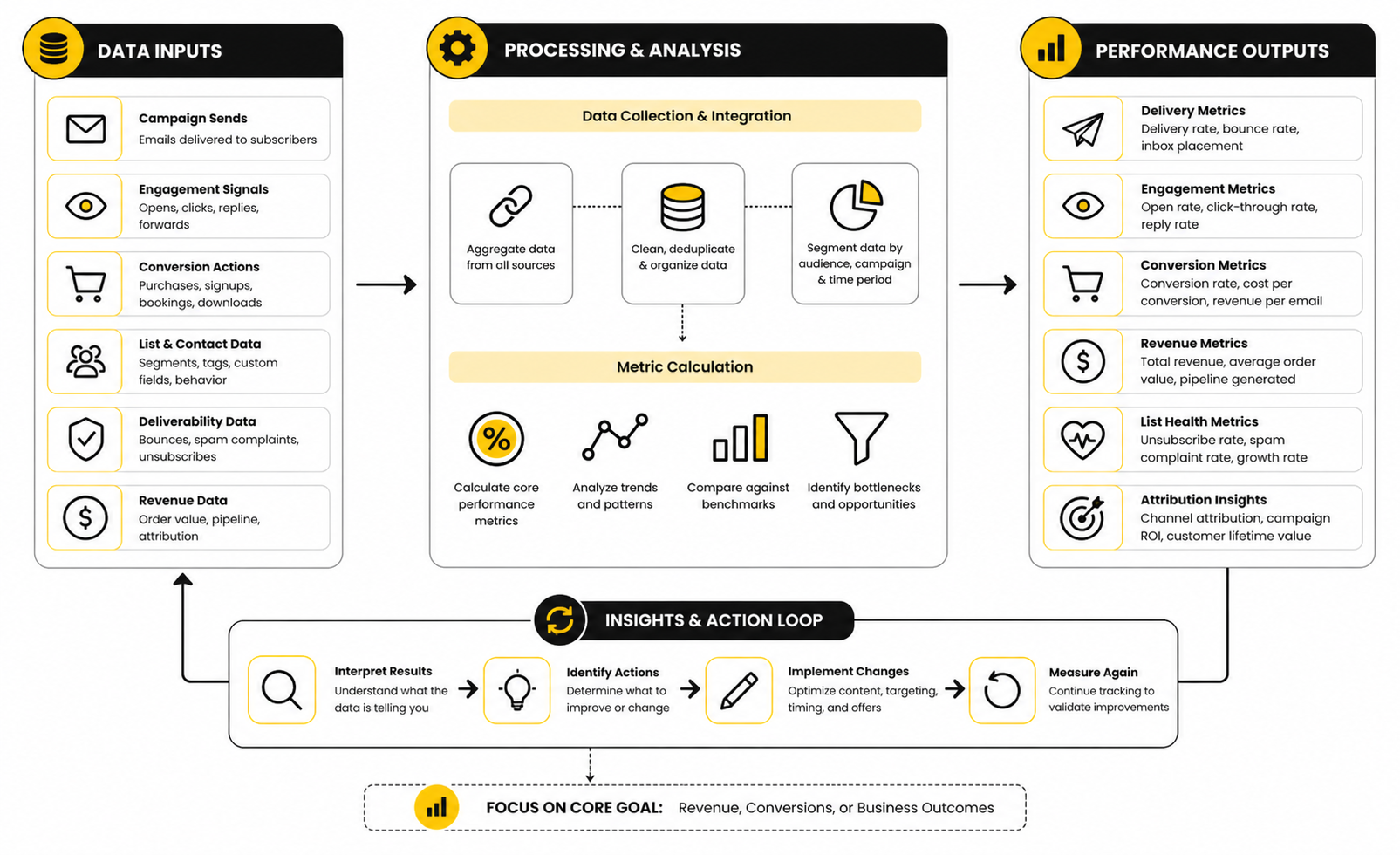
The cleanest way to review a campaign is to move through the funnel in order. First, check whether the email reached people. Then check whether people paid attention. Then check whether they acted. Then check whether that action produced the outcome you wanted.
A practical campaign dashboard should include:
This gives you a map instead of a pile of numbers. If delivery is weak, fix list quality and authentication. If opens are weak, review subject line, sender trust, timing, and list fatigue. If clicks are weak, review relevance, offer, message clarity, and CTA strength. If conversions are weak, review the landing page, sales path, and offer-market fit.
Deliverability Metrics Protect the Channel
Deliverability metrics are not vanity metrics. They show whether your email program is earning enough trust to keep reaching the inbox. If you ignore them, performance can decline slowly and then suddenly.
Spam complaint rate deserves special attention. Gmail’s bulk sender guidance says senders should keep spam rates below 0.1% and avoid reaching 0.3% or higher through its email sender guidelines FAQ. That is a tiny margin, which means irrelevant campaigns can create real damage fast.
Bounce rate matters too because repeated sending to invalid addresses signals poor list hygiene. Unsubscribe rate matters because it tells you when the campaign created enough mismatch that people chose to leave. None of these numbers should be viewed in isolation, but together they show whether your list still wants what you are sending.
Benchmarks Should Trigger Questions, Not Panic
Benchmarks are most useful when they help you ask better questions. If your open rate is far below your industry range, ask whether the list is cold, the sender name is trusted, the promise is clear, or deliverability is slipping. If your click rate is low while opens are normal, the issue is probably inside the email or offer.
If your unsubscribe rate spikes, do not immediately assume the campaign failed. A small spike can happen when you send a clearer offer to a broader segment. But if unsubscribes rise and conversions do not, the message likely missed the audience.
The best benchmark is your own prior performance under similar conditions. Compare welcome campaigns to welcome campaigns, sales campaigns to sales campaigns, and reactivation campaigns to reactivation campaigns. Comparing a Black Friday promotion to a quiet nurture email will only confuse the analysis.
Segment-Level Reporting Beats Average Reporting
Average campaign performance hides the truth. One segment may love the email while another ignores it. If you only look at the blended result, you may kill a campaign that worked well for the right audience.
Review results by segment, lifecycle stage, source, engagement level, and customer status. New subscribers may respond differently than long-term subscribers. Customers may click different CTAs than non-customers. Leads from a webinar may behave differently than leads from a cold lead magnet.
This is where analytics becomes actionable. Instead of saying “the campaign underperformed,” you can say “the campaign worked for engaged leads but failed for dormant subscribers.” That gives you a fix.
Revenue Is Important, But Attribution Needs Discipline
Revenue is the metric everyone wants, but attribution can get messy. Email often supports a sale before the final click happens somewhere else. A subscriber may read three emails, search your brand later, visit the site directly, and then buy.
That does not mean revenue tracking is useless. It means you should define attribution rules before the campaign launches. Decide whether you are using last-click revenue, assisted conversions, coupon usage, CRM pipeline, booked calls, or direct replies as the main business signal.
For sales-led campaigns, a CRM matters because the email may create a conversation rather than an instant purchase. For funnel-led campaigns, tools like ClickFunnels can help connect campaign traffic to a focused conversion path. For broader email and automation reporting, Brevo can make it easier to review campaign activity, automation performance, and contact behavior in one place.
Turn Data Into the Next Test
Data only matters if it changes what you do next. After each campaign, identify the weakest point in the journey and create one focused test. Do not test everything at once because then you will not know what caused the change.
If opens are weak, test the promise, sender name, subject line angle, or send timing. If clicks are weak, test the offer, CTA, email length, proof, or message structure. If conversions are weak, test the landing page headline, form length, pricing presentation, guarantee, proof, or checkout experience.
This is the part that separates professional email marketing from random sending. Each campaign teaches you something. Each test improves one part of the system. Over time, those small improvements compound into a channel you can actually rely on.
Automation, Deliverability, Testing, and Optimization
At this stage, the campaign is no longer just a message. It is a system with rules, triggers, exclusions, timing, and consequences. That is where advanced email campaigns best practices become important because small mistakes can scale very quickly.
Automation can make email more relevant, but it can also make bad decisions faster. If the logic is unclear, the wrong person gets the wrong message at the wrong time. If the list is dirty, automation keeps feeding the problem. If the offer is weak, automation only makes the weak offer more persistent.
The goal is not to automate everything. The goal is to automate the parts of the campaign where timing, behavior, and context genuinely improve the customer experience.
Use Automation Where Timing Matters
Automation is strongest when the reader’s behavior creates a clear next step. A welcome sequence after signup makes sense because the contact is new and needs orientation. An abandoned checkout email makes sense because the person showed purchase intent but did not finish. A post-purchase sequence makes sense because the customer needs confirmation, onboarding, support, or a reason to return.
Automation becomes weaker when it is used as a substitute for strategy. If every contact gets pushed into the same long sequence regardless of context, the campaign becomes a disguised blast. That is not more carefully marketing. It is just more complicated sending.
A good automation rule should answer three questions. What did the person do? What does that behavior likely mean? What is the most helpful next message? If you cannot answer those clearly, the automation probably needs more thinking before it goes live.
Build Automation With Exit Rules
One of the biggest scaling mistakes is forgetting exit rules. Someone joins a sequence, takes the desired action, and still keeps receiving the same persuasion emails. That feels lazy, and worse, it tells the customer your system is not paying attention.
Every automation should include rules for what happens when the person converts, becomes inactive, unsubscribes, changes preferences, enters a higher-priority campaign, or becomes a customer. These rules protect the reader experience. They also protect your data because you are not measuring follow-up emails that should never have been sent.
Exit rules are especially important for sales campaigns. If someone books a call, buys, replies, or moves into an active sales conversation, remove them from the generic conversion path. The better the campaign gets at recognizing progress, the less it feels like automation.
Treat Deliverability as a Strategic Risk
Deliverability is not something you fix only after emails land in spam. By then, you may already be dealing with reputation damage, weaker engagement, and lower revenue from campaigns that used to work. Prevention is much easier than recovery.
Modern inbox providers look for signals that your email is wanted, authenticated, and easy to opt out of. Gmail’s sender rules emphasize authentication, low spam complaints, and easy unsubscribe options in its bulk sender requirements. Yahoo’s sender guidance also treats authentication and unsubscribe handling as serious requirements through its Sender Hub FAQ.
This means deliverability belongs in campaign planning, not just technical setup. Your content, frequency, targeting, list source, unsubscribe process, and complaint rate all affect whether future campaigns get a fair chance. If a campaign creates short-term revenue but damages sender reputation, it may be expensive in a way the dashboard does not show immediately.
Protect Your Sender Reputation Before You Scale
Scaling email volume is not just a question of list size. It is a reputation question. A sudden jump in volume, a cold list import, or a broad campaign to low-engagement contacts can create warning signals for mailbox providers.
Warm volume carefully when a domain, IP, or sending pattern is new. Send first to the people most likely to engage, then expand gradually. This helps inbox providers see positive signals before you ask them to accept more volume.
Do not treat inactive contacts as free reach. They are often the riskiest part of the list because they are less likely to engage and more likely to ignore, unsubscribe, or complain if the message feels irrelevant. A strong list-cleaning process is not conservative. It is how you keep the channel usable.
Use Frequency Caps to Avoid Campaign Collisions
As email programs grow, the problem is rarely one campaign. The problem is too many campaigns overlapping. A lead can be in a newsletter list, a nurture sequence, a sales promotion, a webinar reminder, and a product announcement all at once.
Frequency caps prevent that experience from becoming chaotic. They help you decide how many marketing emails a person can receive in a day, week, or campaign window. They also force prioritization, which is healthy because not every campaign deserves the same access to the inbox.
The tradeoff is real. A strict cap may reduce short-term sends, but it can improve long-term engagement. When people receive fewer irrelevant emails, the emails they do receive have a better chance of being read.
Test One Meaningful Variable at a Time
Testing only works when the result teaches you something. If you change the subject line, offer, segment, design, CTA, and send time all at once, you may get a better result without knowing why. That feels exciting, but it is not learning.
Start with the bottleneck you already identified from the data. If opens are weak, test the promise or subject line angle. If clicks are weak, test the offer framing or CTA. If conversions are weak, test the landing page, proof, form friction, or follow-up path.
Keep tests connected to the campaign goal. A subject line that improves opens but attracts the wrong clicks is not a win. A shorter email that gets more clicks but fewer qualified conversions may only be moving curiosity, not intent.
Do Not Let AI Remove the Human Judgment
AI can help with draft variations, subject line angles, segmentation ideas, content repurposing, and faster QA. Used well, it saves time and gives marketers more options. Used badly, it creates generic campaigns that sound polished but say nothing useful.
The risk is scale without taste. If AI helps you produce more emails than your team can review properly, quality will drop. If every competitor is using similar prompts, the inbox gets filled with messages that feel strangely identical.
Use AI as a production assistant, not the strategist. The human job is still to understand the customer, choose the angle, protect the brand voice, verify claims, and decide what not to send. That last part matters more than most teams admit.
Balance Personalization With Privacy and Consent
Advanced personalization can improve relevance, but it also creates responsibility. You need to understand what data you have, where it came from, why you are using it, and whether the customer would reasonably expect that use. Relevance should never feel like surveillance.
Privacy rules vary by market, but the direction is clear. Businesses need cleaner consent, clearer unsubscribe handling, and better respect for customer preferences. The FTC’s CAN-SPAM guidance still emphasizes truthful headers, clear identification, valid physical addresses, and honoring opt-out requests through its business compliance guide.
This is not just legal hygiene. It is brand trust. If someone feels tricked, trapped, or watched, the damage is bigger than one unsubscribe.
Use Multi-Channel Follow-Up Carefully
Email does not have to carry the full relationship by itself. SMS, WhatsApp, Messenger, retargeting, sales calls, direct mail, and chat can all support the campaign when the context is right. But more channels do not automatically mean a better experience.
The key is to use each channel for the role it plays best. Email is strong for education, explanation, offers, and structured follow-up. SMS is better for urgent, expected, high-intent messages. Chat and messaging can work well when the person has asked for fast interaction or support.
For businesses that want email to connect with pipelines, booking, text follow-up, and client communication, GoHighLevel can be useful because the campaign does not sit in isolation. For brands using conversational marketing around social and messaging flows, ManyChat can fit when the customer journey naturally includes chat-based interaction. The rule is simple: add channels only when they make the next step easier for the customer.
Watch for Scaling Problems in the Team
Email campaigns break at scale because ownership gets blurry. One person owns copy, another owns design, another owns automation, another owns CRM data, and another owns reporting. Without a clear process, mistakes slip through.
Create a campaign review system before volume increases. Someone should check the audience, exclusions, links, UTM tracking, personalization fields, mobile rendering, unsubscribe visibility, automation triggers, conversion destination, and suppression logic. This is not bureaucracy. It is how you avoid sending the wrong campaign to thousands of people.
A simple approval checklist is usually enough. The goal is to prevent preventable errors, not slow the team down. Fast teams still need guardrails.
Know When Not to Send
The most underrated email marketing skill is restraint. Not every announcement deserves a campaign. Not every subscriber should receive every offer. Not every slow week needs another promotional send.
Sometimes the best decision is to wait until the offer is stronger, the segment is cleaner, the landing page is ready, or the follow-up path is fixed. Sending because the calendar says so is not a strategy. It is pressure disguised as planning.
This is where expert teams separate themselves. They understand that email is an asset, and every send either strengthens or weakens that asset. The more disciplined you are about what you send, the more valuable the next campaign becomes.
Final Checklist for Strong Email Campaigns
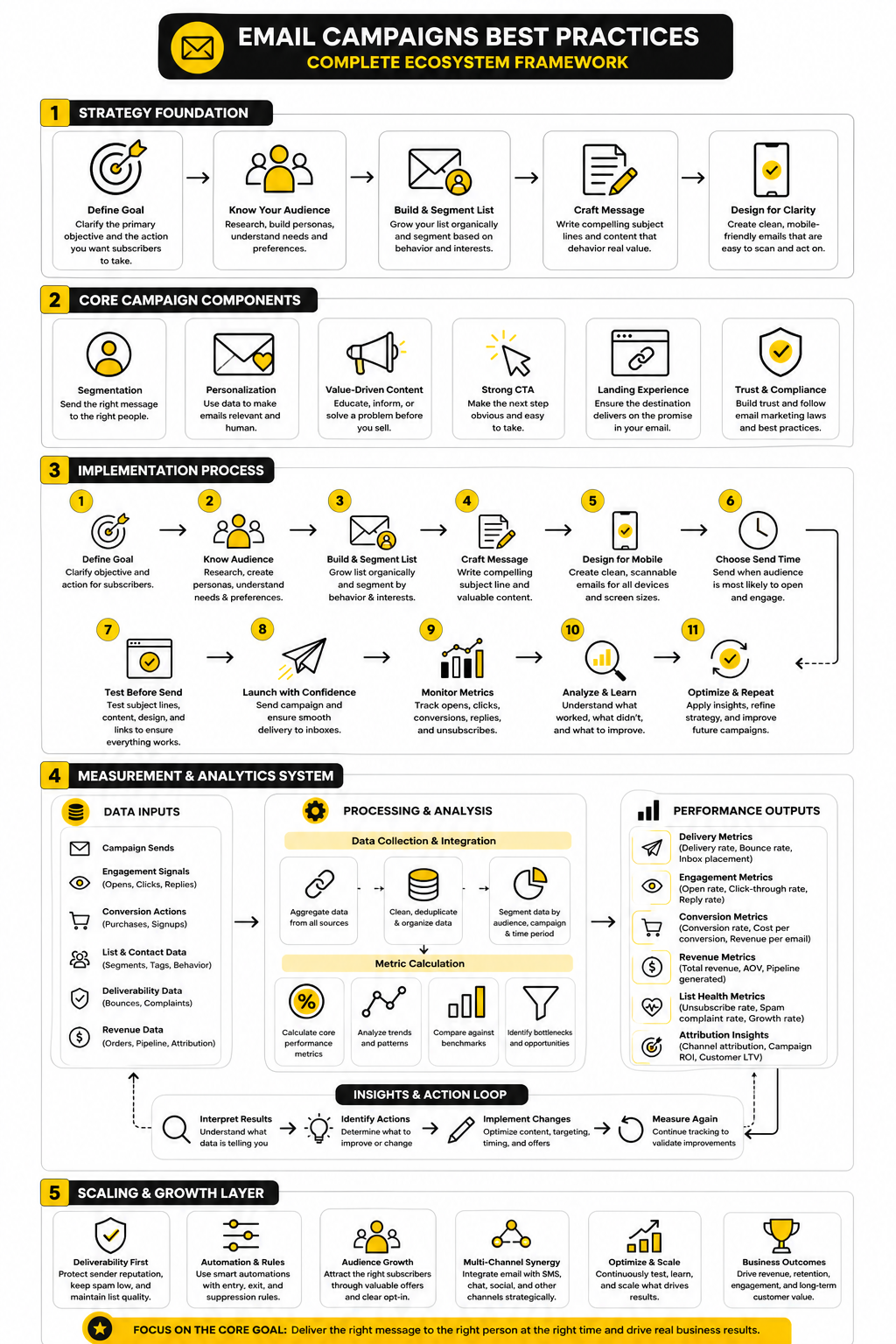
The best email programs are not built from one clever tactic. They are built from a repeatable system that keeps the audience, offer, message, data, automation, and measurement connected. When those pieces work together, email becomes easier to manage and much harder to ignore.
Before launching any campaign, review the whole system instead of obsessing over one email. A great subject line will not fix the wrong segment. A strong landing page will not help if the email never reaches the inbox. A smart automation will still fail if the exit rules are missing.
Use this checklist before every serious campaign:
Choosing the Right Email Campaign Stack
Your tool stack should make good strategy easier to execute. It should help you manage contacts, build segments, send campaigns, trigger automations, measure performance, and connect email activity to the next business action. If the tool creates more confusion than clarity, it is not helping.
For straightforward email marketing and automation, Brevo can work well for teams that want email, contacts, workflows, and reporting in one place. For funnel-heavy campaigns where email sends traffic into focused sales pages, ClickFunnels can fit when the main job is turning attention into a conversion path. For lean creators or small teams that want pages, email, and basic automation under one roof, Systeme.io can be a practical option.
For service businesses, agencies, and local businesses, GoHighLevel makes more sense when email needs to connect with pipelines, forms, calendars, SMS, and sales follow-up. For teams collecting preference data, lead qualification answers, or campaign intake forms, Fillout can support better segmentation before the campaign starts. The right stack depends on the job, but the rule stays the same: tools should support the customer journey, not distract from it.
What are email campaigns best practices?
Email campaigns best practices are the habits and systems that help you send relevant, useful, measurable emails to the right people. They include clear goals, proper segmentation, strong offers, clean copy, reliable data, deliverability safeguards, compliant unsubscribe handling, and performance review. The point is not to follow random rules. The point is to build campaigns that people actually want and that your business can improve over time.
How many emails should be in a campaign?
There is no perfect number because the right length depends on the campaign goal. A simple announcement may need one or two emails, while a welcome sequence, launch campaign, or sales nurture path may need several messages over days or weeks. The better question is whether each email has a clear job. If an email does not add context, answer an objection, create momentum, or help the reader take the next step, it probably does not need to be there.
What is the most important metric for email campaigns?
The most important metric is the one tied to the campaign’s goal. For a sales campaign, that may be purchases, booked calls, revenue, or pipeline created. For a welcome campaign, it may be activation, first click, product usage, or first purchase. Opens and clicks matter, but they are signals, not the final outcome. A campaign can get attention and still fail commercially if it does not create the intended action.
Are open rates still reliable?
Open rates are useful as a directional signal, but they are not fully reliable anymore. Privacy features, image caching, proxy behavior, and bot activity can distort open tracking. Use open rate to spot big changes in attention, sender trust, or subject line performance, but do not judge the whole campaign on opens alone. Clicks, conversions, replies, revenue, unsubscribes, and complaint rates give a more complete picture.
How do I improve email click rates?
Improve click rates by making the email more relevant, more specific, and easier to act on. Start with the segment because the right offer sent to the wrong audience will still underperform. Then review the promise, copy, CTA, design, and destination page. If the reader does not understand what they get by clicking, they will not click. If the click leads to a page that feels disconnected from the email, the campaign will lose momentum.
How often should I email my list?
Email frequency should be based on expectation, value, and engagement. A daily newsletter can work if people signed up for daily value and consistently engage. A promotional email every day can damage trust if the audience did not ask for that level of selling. Watch engagement, unsubscribes, complaint rates, and revenue per send. If performance drops while unsubscribes and complaints rise, frequency may be part of the problem.
Should I remove inactive subscribers?
Yes, but do it thoughtfully. Inactive subscribers can weaken engagement signals and create deliverability risk if you keep sending to them indefinitely. Start with a reactivation campaign that gives them a clear reason to stay. If they still do not engage, reduce frequency or remove them from regular campaigns. A smaller engaged list is usually more valuable than a larger list that ignores you.
What is the difference between segmentation and personalization?
Segmentation decides who receives the campaign. Personalization decides how the message adapts to that person’s context. A segment might include recent buyers, trial users, abandoned checkout visitors, or inactive subscribers. Personalization might change the content, offer, CTA, timing, or follow-up based on what you know about that group or individual. Segmentation is the foundation. Personalization is what makes the message feel more relevant.
What makes an email campaign feel professional?
A professional email campaign feels intentional from start to finish. The reader understands why they received it, what the offer is, why it matters, and what to do next. The campaign also respects preferences, avoids messy automation, uses clear unsubscribe options, and stops sending the wrong message after someone converts. Professional does not mean overdesigned. It means relevant, clear, compliant, and well-managed.
How do I stop email campaigns from going to spam?
Start with the fundamentals. Use proper authentication, keep complaint rates low, make unsubscribing easy, avoid purchased lists, remove invalid addresses, and send content people actually want. Gmail’s sender guidance says bulk senders should keep spam rates below 0.1% and avoid reaching 0.3% or higher through its email sender guidelines, while Yahoo also emphasizes authentication and compliant sending through its sender best practices. Deliverability is not just technical. It is also about relevance, trust, and list quality.
What should I test first in an email campaign?
Test the weakest point in the campaign journey first. If opens are weak, test the subject line, sender name, timing, or promise. If clicks are weak, test the offer, CTA, copy angle, or email structure. If conversions are weak, test the landing page, form, checkout, proof, pricing presentation, or follow-up. Testing random details wastes time. Testing the bottleneck creates learning.
Are AI tools useful for email campaigns?
AI tools can be useful for brainstorming angles, drafting variations, repurposing content, summarizing research, and speeding up production. They should not replace strategy, audience judgment, claim verification, or brand voice. The risk is producing more emails without making them more useful. Use AI to accelerate the work, but keep a human responsible for relevance, accuracy, taste, and restraint.
What legal rules should marketers remember?
Commercial emails need honest sender information, non-deceptive subject lines, a valid physical address, and a clear way to opt out. The FTC’s CAN-SPAM guide explains that recipients have the right to stop receiving commercial emails through its business compliance guide. Other regions may have stricter consent and privacy rules, so legal requirements should be checked based on where your audience lives. Compliance is not optional, and it is not separate from trust.
What is the biggest mistake in email campaign strategy?
The biggest mistake is sending because you can instead of sending because the campaign has a clear purpose. Many teams start with the email, then search for a reason to send it. Strong teams start with the audience, the journey stage, the offer, and the desired action. That shift changes everything. It makes the campaign easier to write, easier to measure, and easier to improve.
Build a stronger local presence with BAAM AI
Turn your website, Google profile, social channels, and AI visibility into one growth engine
Most businesses do not need more random marketing activity. They need a consistent presence system that helps the right people find them, trust them, and take action. BAAM AI brings strategy, local SEO, website updates, Google Maps visibility, social content, AI-search readiness, media production, and reporting into one practical monthly engine.
If you want your marketing to keep working after the campaign ends, start with a free BAAM AI presence audit. See how your business shows up today and where the fastest visibility wins are at BAAM AI.