
BAAM AI Blog
Effective Social Media Strategy: A Proven Roadmap for 2026
In today’s digital landscape, an effective social media strategy isn’t optional - it’s foundational to business growth. With platforms fragmenting and audience expectations evolving, brands struggle when they post...

In today’s digital landscape, an effective social media strategy isn’t optional - it’s foundational to business growth. With platforms fragmenting and audience expectations evolving, brands struggle when they post reactively instead of planning with purpose. A strategic approach ensures your social efforts align with business goals, resonate with your audience, and deliver measurable impact across reach, engagement, conversions, and retention. In fact, marketers agree social media is critical to brand building, yet many still fail to apply it consistently across the full marketing funnel.
Below is the structure we’ll follow across this guide to break down what works, why it matters, and how to implement a social strategy that actually drives results:
Why Social Media Strategy Matters in 2026
Social platforms are no longer just channels for posting content - they are key business drivers that influence awareness, community, loyalty, and revenue. With algorithm changes, a heightened focus on engagement, and audiences expecting genuine interactions, brands without a clear strategy risk producing noise instead of measurable results.
A recent industry report found that while nearly all marketers recognize the importance of social media, fewer than one‑third consistently apply strategic planning across stages like awareness, consideration, conversion, and retention. That gap highlights why social strategy should be deeply tied to business goals rather than treated as a creative afterthought.
Moreover, consumer expectations are shifting. Audiences want human‑generated content and meaningful engagement far more than automated posts or shallow promotional messages. Brands that tailor their strategy to human behaviours and preferences stand to build stronger connection and loyalty.
Framework Overview: Building the Strategy’s Foundation
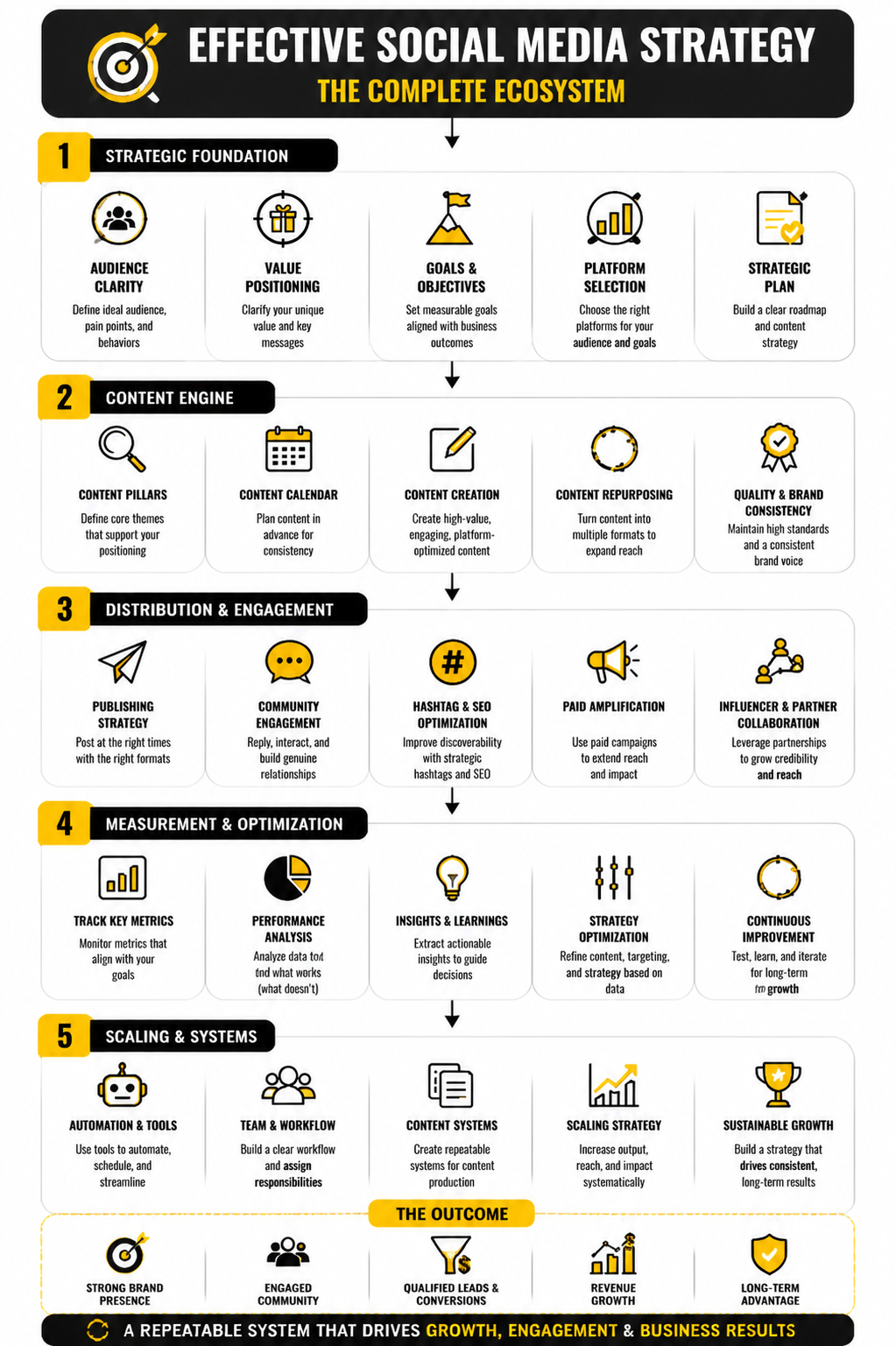
To design an effective social media strategy, it helps to think of it as a layered framework - one that begins with purpose and audience understanding, then builds out content, channels, measurement, and execution. IMAGE 2
A solid strategy does more than just post well. It answers four fundamental questions:
Align social objectives with broader business goals such as brand growth, community engagement, or sales impact.
Deep audience insights - beyond demographics - inform platform choice, tone, and content formats.
Not all platforms are equally valuable for every brand: prioritizing 2–3 core networks often outperforms scattering efforts across every available channel.
Strategy must include clear KPIs and a measurement framework that connects social outcomes to business impact.
This structure keeps social efforts disciplined and ensures every campaign, post, and community interaction has purpose and measurable outcomes.
Core Components of a High‑Performing Strategy
Every effective social media strategy should include several indispensable elements:
These core components create a system where content, distribution, and measurement reinforce each other rather than exist in isolation.
Continue with Parts 2–6 to explore implementation, measurement, tools, and future trends that shape effective social media strategy in 2026 and beyond.
Professional Implementation Best Practices
Transitioning your effective social media strategy from planning into real results requires structured execution, not just good intentions. Too many teams stall here - they have a smart strategy but don’t set up practical systems to make it work consistently. What separates successful implementations is governance: clear roles, workflows, schedules, and a rhythm of review that keeps the strategy alive and adaptable.
First, define ownership and responsibility. Every part of your strategy - planning, content creation, publishing, community engagement, analytics, and experimentation - should have an accountable person or team. Even in small organizations, clarity about who handles what prevents tasks from slipping through gaps. This also shapes your team’s capacity planning, making it clear what’s feasible with your current headcount.
Next, establish a regular operating cadence that ties execution back to strategic goals. A weekly cycle can focus on planning and publishing, a monthly check‑in reviews performance metrics and audience feedback, and a quarterly session revisits objectives, experiments, and pivots. This rhythm ensures your strategy isn’t static - it evolves based on audience behaviour and changing platform dynamics.
Professional implementation also means setting up standard processes for content production and governance. This includes creating clear content briefs, brand style and tone guidelines, approval workflows, and a shared content calendar that everyone on the team can access. By systematizing these elements, you reduce friction and maintain quality, even when multiple stakeholders contribute.
Effective Content Planning and Workflow
At the heart of implementation is consistent content creation that aligns with your strategic pillars. Start by establishing content pillars that reflect business goals and audience needs - for example, educational content, user stories, product highlights, and community engagement posts. Each pillar should serve a purpose, and the mix should support both brand presence and measurable outcomes.
Build a content calendar that outlines what will be published, on which platforms, and when. This isn’t just a schedule; it’s your tactical bridge between strategy and execution. It helps you balance formats (video, text, images), themes, and promotional cycles, and ensures you’re consistently delivering value rather than chasing random trends. A proactive calendar also frees up time for engagement and interaction, which are increasingly rewarded by algorithms when done well.
Use tools that streamline publishing and collaboration. Platforms like Buffer help plan and automate posts across networks, while team communication tools keep everyone aligned on priorities. Automation should never replace real engagement, but it can handle routine tasks so your team spends more time on creative work and audience interaction.
Community Engagement and Brand Voice
A professional implementation strategy treats social media as two‑way communication, not just a broadcast channel. Engagement - responding to comments, questions, and mentions - builds tribe loyalty and trust. That means allocating specific time blocks for community management daily, and defining response guidelines so your brand voice stays consistent, helpful, and on tone.
Authenticity matters more than polished perfection. Audiences reward brands that show human perspectives, admit mistakes, and participate in genuine conversations. For example, brands that incorporate user‑generated content (UGC) often see better community sentiment and organic reach because audiences feel seen and valued.
Learning, Testing, and Optimization
Implementation isn’t a “set it and forget it” process. The social landscape changes constantly, and your strategy should adapt accordingly. Build a habit of testing different formats, posting times, messaging styles, and interactive elements. Track what resonates and adjust based on performance data, not assumptions.
Make optimization part of your workflow by embedding regular review sessions where your team analyzes what’s working, what isn’t, and what you should try next. These sessions should connect back to business goals - not just likes and shares - and ultimately improve audience relevance and impact.
Professionally implementing your social media strategy turns planning into consistency, quality content, and measurable progress. In the next part, we’ll explore how to define and track the metrics that truly matter for long‑term success.
Step-by-Step Implementation Process
Bringing an effective social media strategy to life requires turning your framework and planning into a repeatable, actionable process. This is where strategy becomes tangible - you move from theory to measurable impact. IMAGE 3
1. Audit and Align Existing Assets
Before creating anything new, review your current social presence. Identify which platforms are driving engagement, which content types resonate, and where gaps exist. This ensures your implementation starts with data-backed decisions rather than assumptions. (sproutsocial.com)
Key steps include:
2. Build a Content Production System
Consistency and quality hinge on an organized content creation workflow. Define responsibilities, production timelines, and approval processes. Tools like Buffer or GoHighLevel can centralize scheduling and collaboration.
The production system should cover:
3. Schedule and Publish Strategically
Use your content calendar to publish at optimal times for each platform. Prioritize posts that tie directly to strategic goals like lead generation, brand awareness, or community engagement. Strategic scheduling ensures that your audience sees content when they are most receptive, maximizing reach and interaction. (hootsuite.com)
4. Engage and Moderate
Social media success depends on active community management. Assign team members to monitor comments, messages, and mentions, ensuring timely responses. Establish tone guidelines to maintain a consistent brand voice while encouraging authentic conversations. Brands that actively engage see higher retention and loyalty. (sproutsocial.com)
5. Monitor, Measure, and Iterate
Implementation doesn’t end with posting content. Track KPIs like engagement rates, click-throughs, conversions, and sentiment. Conduct weekly or monthly reviews to identify patterns and adjust strategy. Testing formats, messaging, and timing ensures your approach remains effective as audience behavior and platform algorithms evolve. (sproutsocial.com)
6. Optimize for Efficiency
Refine processes to eliminate bottlenecks. Automate repetitive tasks, repurpose high-performing content, and maintain documentation of best practices. Streamlining workflows frees resources for creative experimentation and deeper audience interaction, which are increasingly rewarded by platform algorithms. (buffer.com)
By following this step-by-step process, brands can move beyond inconsistent posting to a disciplined, results-driven social media execution that scales with their goals. The next section will focus on how to define and track the metrics that prove whether your effective social media strategy is truly working.
Statistics and Data
Measuring the performance of an effective social media strategy is about more than counting likes or shares. It’s about understanding what the numbers reveal about audience behavior, content resonance, and progress toward business objectives. Proper analytics allow teams to make informed decisions, optimize campaigns, and justify investment in social channels. (sproutsocial.com)
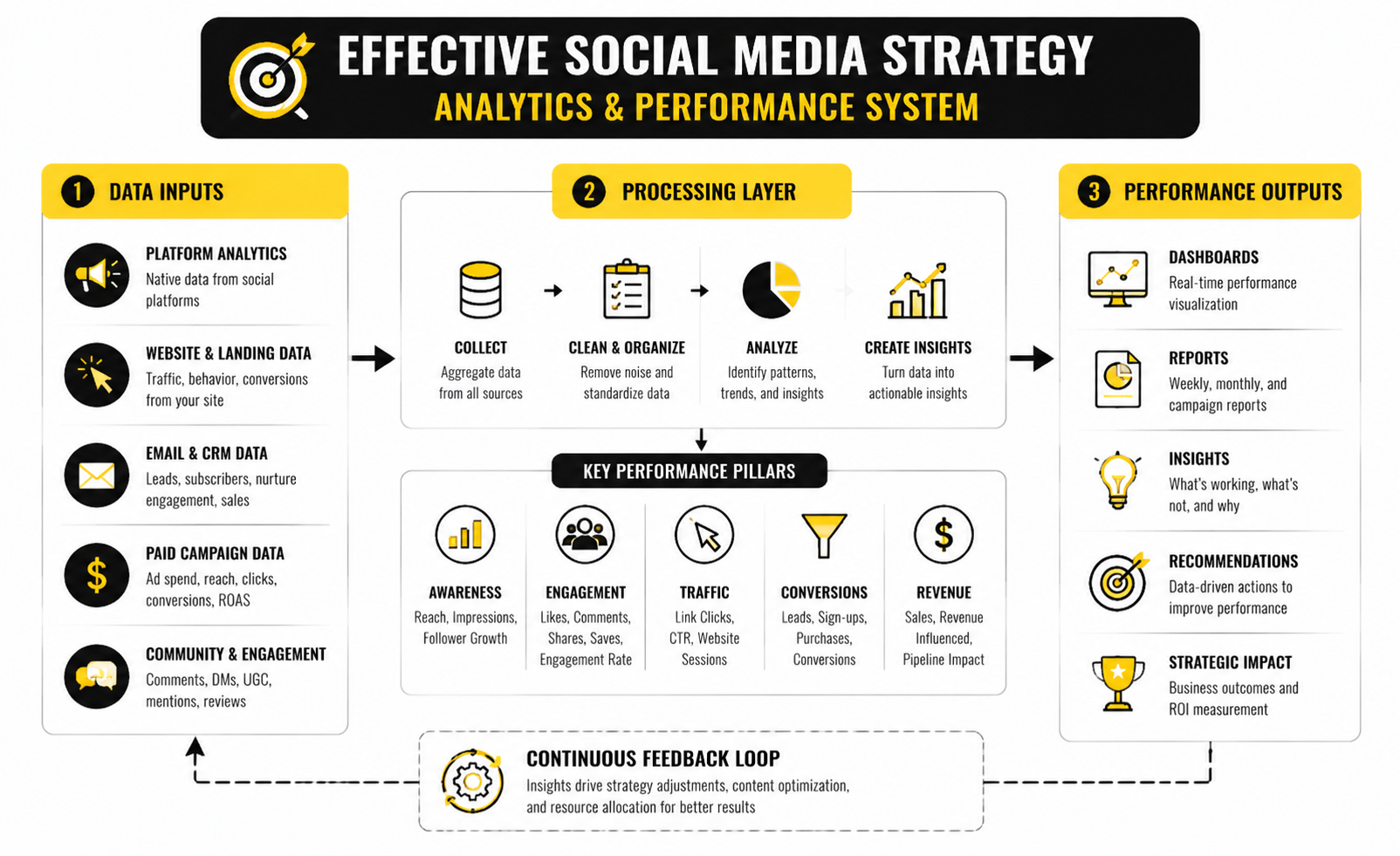
Key Metrics and What They Mean
Interpreting Data for Action
Numbers without context are meaningless. Metrics should always be interpreted against benchmarks - past performance, competitor activity, and industry standards. For example, a 3% engagement rate may be excellent in one sector but underperforming in another. The goal is to convert insights into concrete actions: refining content pillars, adjusting posting schedules, reallocating budget to high-performing platforms, or improving calls-to-action. (buffer.com)
Using dashboards and analytics tools, like GoHighLevel, centralizes data streams across platforms, making it easier to identify patterns, spot anomalies, and optimize campaigns. Regularly reviewing this data keeps your social media strategy dynamic and responsive, rather than reactive.
In short, analytics transform social media from a creative exercise into a data-driven growth engine, ensuring each post contributes meaningfully to broader business goals. The next section will explore emerging trends and how to keep your strategy ahead of the curve.
Future Trends and Strategic Considerations
As social media evolves, an effective social media strategy must account for emerging trends, scaling challenges, and potential risks. Brands that succeed are those that anticipate shifts rather than react, integrating innovation while protecting their core audience and reputation. (sproutsocial.com)
Navigating Platform Shifts
Algorithms, platform features, and user behaviors are constantly changing. What worked last year may underperform today. A strategic approach involves monitoring these shifts, testing new content formats like short-form video or interactive stories, and reallocating resources to channels showing growth. Ignoring platform evolution can result in wasted spend and declining engagement. (buffer.com)
Balancing Automation and Authenticity
Scaling social media often requires automation - scheduling posts, using AI-generated content, or chatbots for customer service. However, over-reliance can damage audience trust. The key is to automate repetitive tasks while maintaining human interaction for community engagement, comment responses, and content that requires nuance. (ManyChat)
Risk Management and Brand Safety
Social media exposes brands to potential reputational risks, from user backlash to misinformation or compliance missteps. A professional strategy integrates monitoring tools, crisis protocols, and governance policies to quickly address issues while preserving brand integrity. Proactive risk management reduces the likelihood of damaging incidents escalating. (sproutsocial.com)
Scaling Content and Teams
As strategies succeed, scaling becomes a major consideration. Larger content volumes require structured workflows, diverse content formats, and possibly external partnerships with agencies or freelance creators. At the same time, teams must avoid diluting brand voice or overcomplicating processes. A scalable strategy balances growth with efficiency and consistency. (GoHighLevel)
Strategic Tradeoffs
Advanced practitioners recognize tradeoffs: chasing every trend may harm consistency, while hyper-focusing on one platform can limit reach. Data-driven decision-making - informed by performance analytics - helps prioritize investments where ROI is highest. It’s better to excel on a few channels than spread resources thin across many. (sproutsocial.com)
By considering these strategic layers, brands can transform a functional social media plan into a resilient, adaptive, and high-performing growth engine. The final part will wrap up with FAQs and actionable tips to maintain momentum for your effective social media strategy.
1. What is an effective social media strategy?
An effective social media strategy is a structured plan that aligns content, platforms, and engagement efforts with business goals. It ensures each post, campaign, and interaction serves a measurable purpose.
2. How often should I review my social media strategy?
Regular reviews are essential. Weekly checks for engagement trends, monthly performance audits, and quarterly strategic evaluations help your strategy stay relevant and data-driven.
3. Which metrics matter most for social media success?
Focus on engagement rates, reach, impressions, click-through rates, conversions, and sentiment analysis. These metrics provide insight into content performance and audience behavior, not just vanity numbers.
4. How do I choose the right platforms for my brand?
Select platforms where your target audience is most active and where your content type thrives. Prioritize depth over breadth; excelling on a few platforms beats spreading resources thin.
5. How can I scale social media content effectively?
Implement structured workflows, content calendars, and team responsibilities. Leverage automation tools like Buffer while maintaining human engagement for comments and interactions.
6. What role does engagement play in strategy?
Engagement fosters community, loyalty, and trust. Active responses, meaningful conversations, and user-generated content amplify reach and reinforce your brand voice.
7. How should I handle negative feedback or crises?
Have a crisis management protocol. Monitor mentions, respond swiftly, and maintain tone consistency. Early intervention prevents escalation and protects brand reputation.
8. Can AI tools replace human social media managers?
AI can automate repetitive tasks and assist with content generation, but human judgment is critical for brand voice, nuanced responses, and relationship-building.
9. How do I measure ROI from social media?
Track conversions tied to business objectives, such as sales, lead generation, or sign-ups. Combine quantitative metrics with qualitative insights like audience sentiment for a holistic view.
10. What are the biggest mistakes brands make in social media strategy?
Common errors include inconsistent posting, ignoring analytics, chasing every trend, neglecting community engagement, and failing to align social efforts with broader business goals.
11. How can small teams manage social media effectively?
Prioritize core platforms, leverage automation, establish clear workflows, and focus on high-impact content. Consistency and strategic alignment matter more than volume.
12. Should content differ across platforms?
Yes, adapt messaging and formats to platform norms and audience expectations. The core message should remain consistent, but presentation can vary to maximize engagement.
Build a stronger local presence with BAAM AI
Turn your website, Google profile, social channels, and AI visibility into one growth engine
Most businesses do not need more random marketing activity. They need a consistent presence system that helps the right people find them, trust them, and take action. BAAM AI brings strategy, local SEO, website updates, Google Maps visibility, social content, AI-search readiness, media production, and reporting into one practical monthly engine.
If you want your marketing to keep working after the campaign ends, start with a free BAAM AI presence audit. See how your business shows up today and where the fastest visibility wins are at BAAM AI.