
BAAM AI Blog
edX Digital Marketing: A Practical Guide to Learning Skills That Actually Transfer to Work
edX digital marketing is not just a course search term. It is usually a signal that someone wants a structured, credible way to learn marketing without piecing together random YouTube videos, outdated blog posts, and...
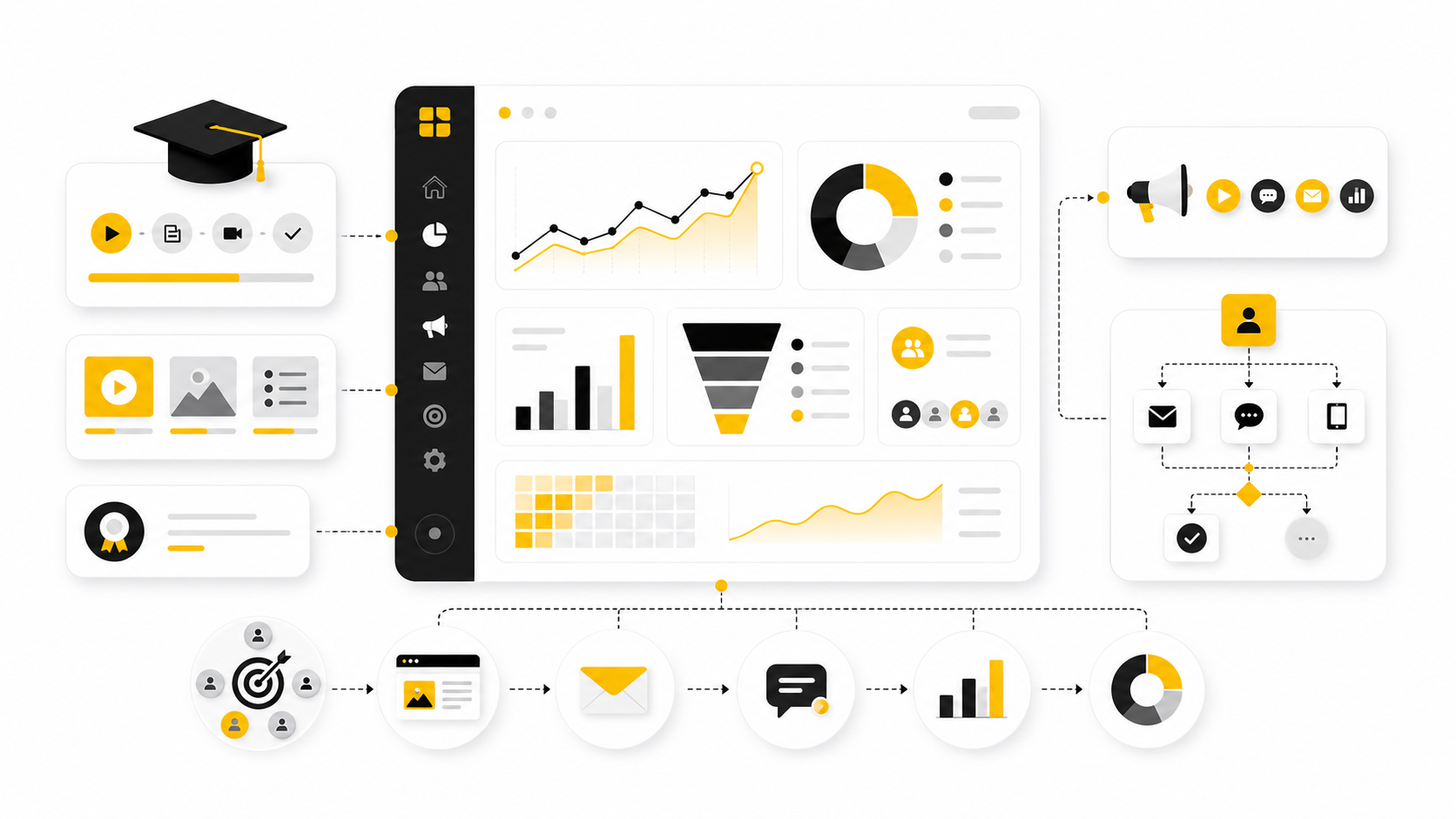
edX digital marketing is not just a course search term. It is usually a signal that someone wants a structured, credible way to learn marketing without piecing together random YouTube videos, outdated blog posts, and platform-specific hacks that expire the moment an ad dashboard changes.
That matters because digital marketing has become broader, more technical, and more accountable. A modern marketer is expected to understand strategy, customer behavior, analytics, paid media, content, automation, experimentation, and increasingly AI-assisted execution. The learning path has to connect those pieces instead of treating them like separate tricks.
edX is useful in this context because it sits closer to formal education than quick creator-led training. The platform was founded by Harvard and MIT educators and now offers online courses, certificates, and programs from universities and industry partners through edX’s global learning platform. For someone comparing an edX digital marketing course with bootcamps, free tutorials, or software vendor training, the real question is not “Is there a certificate?” It is “Will this help me think and execute like a better marketer?”
The Strategic Case for edX Digital Marketing
Digital marketing is no longer a narrow channel job. The U.S. digital advertising market reached nearly $300 billion in 2025, which shows how much budget, competition, and measurement pressure now sits inside digital channels. When money moves at that scale, employers and clients do not just want someone who can “post content” or “run ads.” They want people who can connect audience insight, channel strategy, creative testing, analytics, and business outcomes.
That is where an edX digital marketing path can be valuable. edX lists digital marketing certificates that cover areas such as marketing fundamentals, content and digital strategy, campaign and website optimization, paid advertising, and automation through its digital marketing certificate catalog. The strongest learning path is not the one with the most modules. It is the one that helps you build a working mental model for how digital growth actually happens.
The career angle is just as important. Market research analysts and marketing specialists are projected to grow faster than the average occupation, with the U.S. Bureau of Labor Statistics projecting 7% employment growth from 2024 to 2034. That does not mean every digital marketing certificate guarantees a job, and nobody should pretend it does. It does mean the market rewards people who can interpret customer behavior, evaluate campaigns, and make practical recommendations from data.
The edX Digital Marketing Framework
A useful edX digital marketing framework starts with strategy, not tools. Tools change, dashboards move, and algorithms get updated constantly. The durable skill is understanding who the customer is, what they need, what message should reach them, which channel fits the buying stage, and how success will be measured.
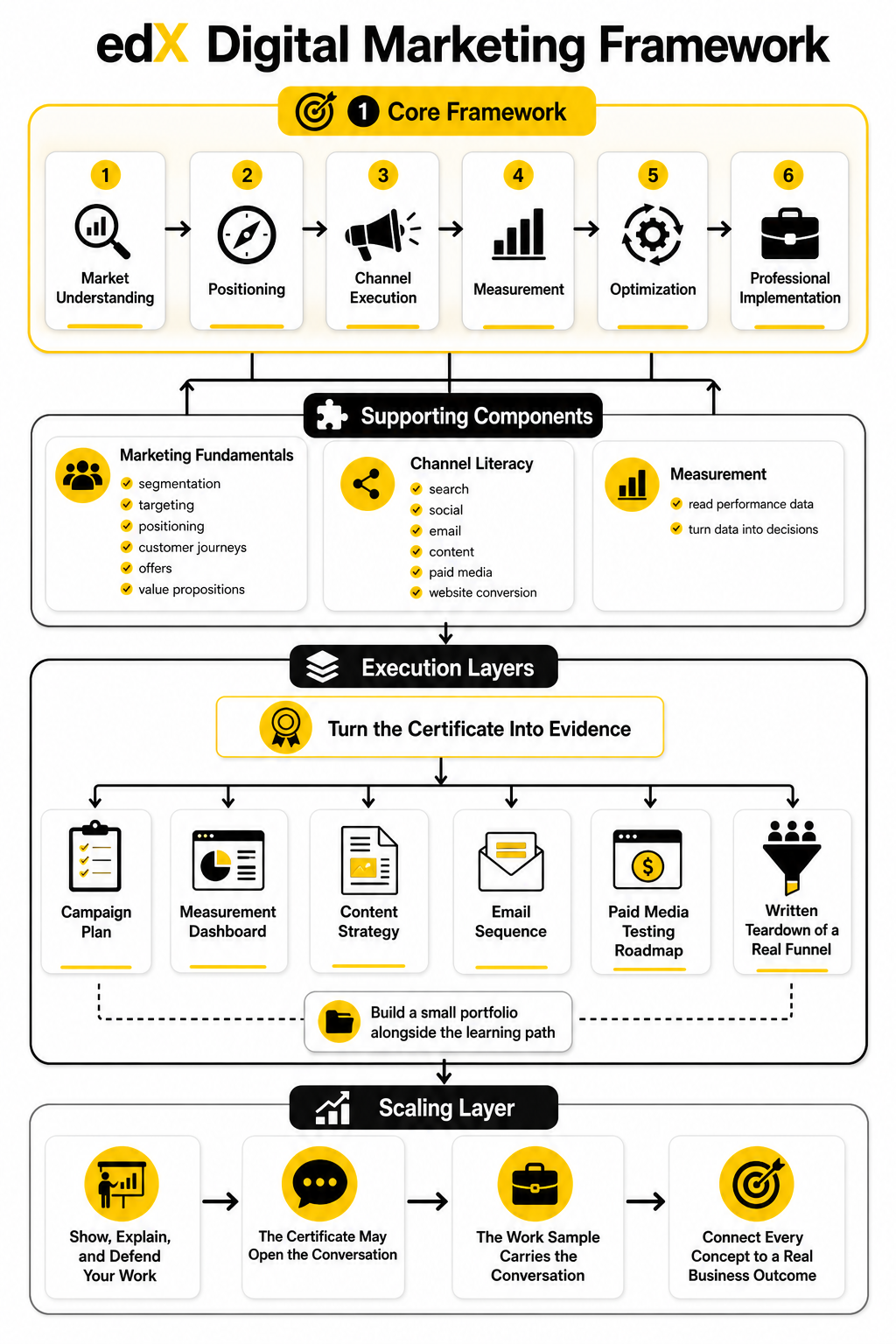
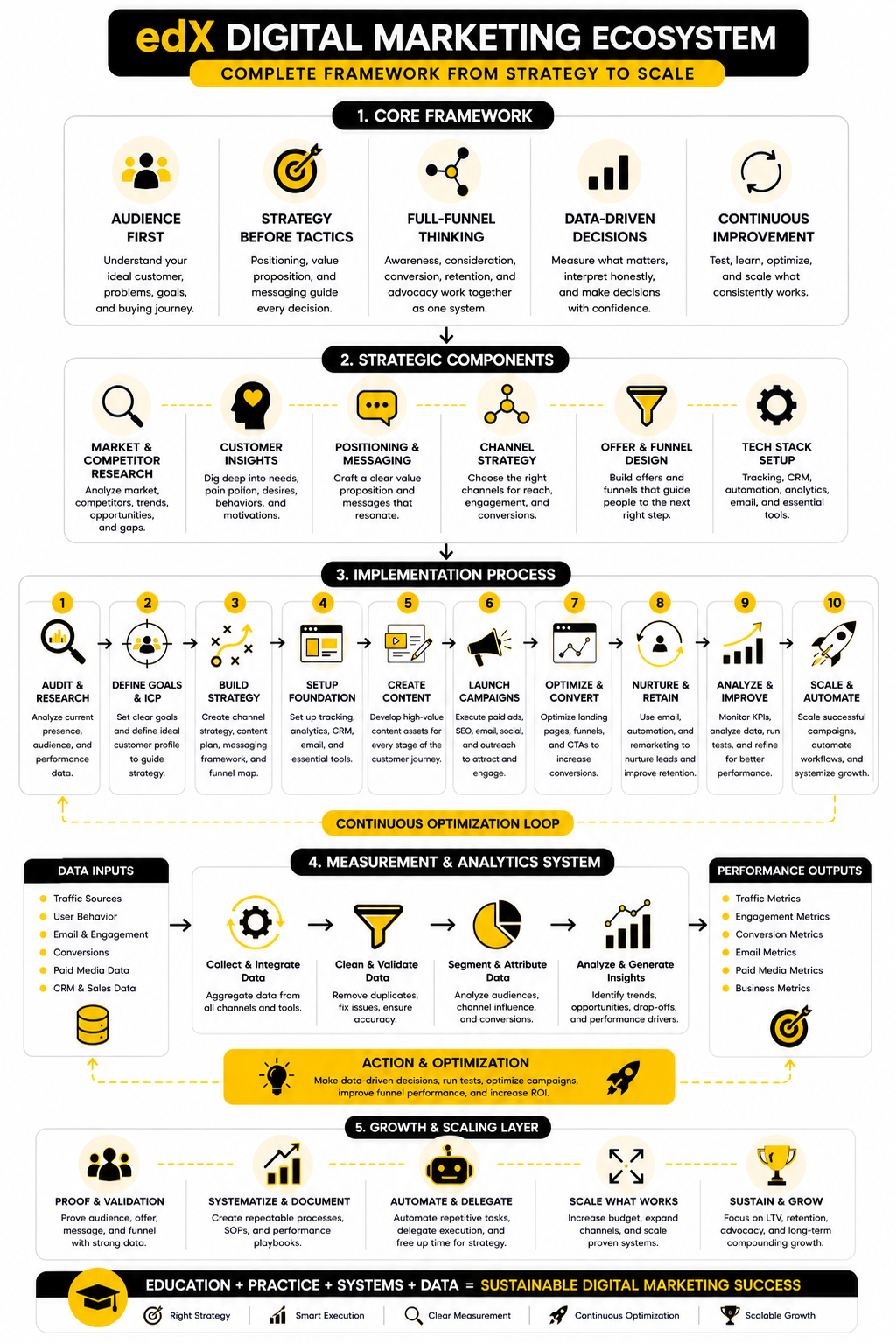
The framework this guide will use is simple: market understanding, positioning, channel execution, measurement, optimization, and professional implementation. That structure matches how digital marketing work tends to happen in real teams. You start with the market, build a campaign logic, choose channels, launch assets, read the data, improve the system, and communicate results clearly.
This is also why the best edX digital marketing choice is rarely based on the certificate name alone. edX shows programs ranging from broad professional certificates to focused courses in analytics, social media, advertising, and digital strategy, including options such as Digital Marketing Analytics: Tools and Techniques. A beginner may need a broad foundation first, while a working marketer may get more value from a focused analytics or strategy course. The smart move is to match the course to the skill gap, not to chase the longest syllabus.
Core Components That Make the Learning Path Work
The first core component is marketing fundamentals. Without fundamentals, digital marketing becomes button-clicking. You need to understand segmentation, targeting, positioning, customer journeys, offers, and value propositions before paid ads, SEO, email, or social media can make sense.
The second component is channel literacy. A marketer should know how search, social, email, content, paid media, and website conversion work together instead of treating each channel as a separate island. The goal is not to become an expert in everything at once. The goal is to understand what each channel is good for, where it fails, and how it supports the customer journey.
The third component is measurement. The American Marketing Association’s 2025 skills research highlights a field being reshaped by AI, changing channels, and rising expectations around practical capability in its marketing skills report. In plain English, marketers who cannot read performance data are easier to replace. Marketers who can turn data into decisions become much harder to ignore.
Professional Implementation Starts Before the Certificate Ends
A certificate is only useful if it becomes evidence. That evidence can be a campaign plan, a measurement dashboard, a content strategy, an email sequence, a paid media testing roadmap, or a written teardown of a real funnel. If the course teaches a concept, the professional move is to turn that concept into something you can show, explain, and defend.
This matters because employers and clients rarely care about coursework in isolation. They care whether you can diagnose a problem, choose a practical approach, and explain what should happen next. The certificate may open the conversation, but the work sample usually carries the conversation.
So the right way to approach edX digital marketing is practical from day one. Do not just complete videos and quizzes. Build a small portfolio alongside the learning path, write down your reasoning, and connect every concept to a real business outcome.
The edX Digital Marketing Framework
The best way to use edX digital marketing training is to treat it like a professional operating system, not a collection of random lessons. A weak learner asks, “Which course gives me a certificate fastest?” A stronger learner asks, “Which course helps me understand the market, build campaigns, measure outcomes, and explain decisions clearly?”
That difference matters because digital marketing work is rarely linear. A campaign can fail because the audience is wrong, the message is unclear, the offer is weak, the landing page is slow, the tracking setup is broken, or the follow-up sequence is lazy. If your learning path only teaches tactics, you will blame the wrong thing when performance drops.
A practical framework keeps you grounded. It gives you a way to diagnose problems instead of guessing. It also helps you choose the right edX digital marketing course based on the skill you actually need next.
Start With Market Understanding
Market understanding comes before content, ads, funnels, automation, and analytics. You need to know who the buyer is, what they already believe, what they are trying to solve, and why they might trust one solution over another. Without that, every channel becomes expensive noise.
This is where formal digital marketing education can help. Many edX programs are built around structured learning from universities and professional partners, which can make the early strategy work more disciplined than jumping straight into tool tutorials. That structure is useful because the first layer of marketing is not software. It is thinking.
The practical output from this stage should be a clear customer profile, not a vague persona. You should be able to explain the customer’s problem, buying trigger, objection, comparison set, and decision criteria in plain language. If you cannot do that, you are not ready to judge channels yet.
Build Positioning Before Promotion
Positioning is the bridge between customer research and marketing execution. It answers a simple question: why should this audience care about this offer now? That question sounds basic, but it is where a lot of campaigns break.
An edX digital marketing learning path should help you understand how value propositions, messaging, differentiation, and customer psychology work together. This is especially important in crowded categories where the product is not obviously unique. If the offer sounds like every competitor, better targeting will not save it.
Good positioning creates cleaner execution later. It makes landing pages easier to write, ads easier to test, emails easier to sequence, and sales conversations easier to support. This is why the framework puts positioning before channel execution.
Choose Channels Based on Intent
Channel choice should not be emotional. You do not choose TikTok because it is popular, LinkedIn because it feels professional, or Google Ads because competitors use it. You choose channels based on where the customer’s intent shows up and what kind of decision you are trying to influence.
Search is often strongest when demand already exists. Social can be powerful when you need education, discovery, proof, or repeated exposure. Email is useful when the relationship needs nurturing, segmentation, and follow-up. The point is not that one channel is better than another. The point is that each channel has a job.
This is one reason edX digital marketing courses can be useful for beginners and career switchers. A structured course can help you understand the role of each channel before you start copying tactics from people in completely different markets. That saves time, budget, and frustration.
Connect Campaigns to Measurement
Measurement is where digital marketing becomes serious. If you cannot define what success looks like, you cannot optimize anything honestly. Clicks, impressions, leads, conversion rates, customer acquisition cost, retention, and revenue all tell different parts of the story.
The digital advertising market keeps getting more performance-driven, with IAB reporting that U.S. internet advertising revenue reached nearly $300 billion in 2025. That level of spend raises expectations. Teams want marketers who can explain what happened, what changed, and what should happen next.
This does not mean every learner needs to become a data scientist. It means you need enough analytical skill to avoid being fooled by surface-level metrics. A campaign that gets cheap leads but no customers is not a win. A campaign with fewer leads but stronger revenue quality might be the better business decision.
Add Optimization as a Habit
Optimization is not something you do once at the end of a campaign. It is a habit built into the way you work. You launch with a hypothesis, measure what happens, learn from the data, and improve the next version.
This is where many self-taught marketers struggle. They collect tactics but do not build a testing rhythm. They change headlines, audiences, budgets, and offers randomly, then wonder why the results are confusing.
A strong edX digital marketing path should push you toward disciplined experimentation. You should learn how to test one meaningful variable at a time, document what changed, and connect performance shifts to business logic. That is how coursework becomes professional judgment.
Turn the Framework Into a Working System
The framework only matters if you use it outside the course. For every major concept you learn, create a small professional asset. That could be a customer research brief, positioning statement, content plan, campaign map, analytics checklist, or optimization log.
This is not busywork. It is how you prove that you can think like a marketer. A certificate says you completed the training, but a portfolio shows how you apply it.
The strongest approach is to build one complete project as you move through the edX digital marketing material. Pick a real business category, study the audience, map the buyer journey, choose channels, define metrics, and explain your decisions. By the end, you should have more than notes. You should have a practical marketing system you can discuss in an interview, client call, or internal strategy meeting.
Core Skills Inside a Strong Digital Marketing Learning Path
A good edX digital marketing path should not leave you with scattered notes and a vague sense that you “understand marketing better now.” It should help you build specific working skills. The difference is important because employers, clients, and teams do not pay for awareness. They pay for execution that improves a real outcome.
The core skills are not complicated, but they do need to be learned in the right order. You need to understand the customer before building campaigns. You need to define the offer before choosing channels. You need to measure performance before claiming that something worked.
Customer Research and Audience Clarity
Customer research is the first implementation skill because every campaign depends on it. Before you write a landing page, launch an ad, or build an email sequence, you need to know what the customer is trying to solve and what would make them pay attention. That means looking beyond surface-level demographics and getting closer to motivation, urgency, objections, and buying triggers.
This is where structured coursework can help because it slows you down in the right places. Many beginners want to jump straight into content calendars, ad platforms, or automation tools, but the better move is to map the customer’s situation first. edX describes digital marketing fundamentals as a way to understand marketing basics, the digital economy, and what someone needs to succeed in the field through online digital marketing courses.
Your output from this stage should be practical. Write a short research brief that explains who the audience is, what problem they are trying to solve, what alternatives they compare, and what objections block action. If you cannot summarize that clearly, do not move into execution yet.
Offer and Message Development
Once the audience is clear, the next skill is turning insight into a message. A strong message does not simply describe the product. It connects the customer’s problem to a specific outcome and explains why this solution makes sense now.
This is where a lot of digital marketing fails quietly. The campaign may look professional, the creative may be polished, and the media spend may be real, but the core message is too generic to move anyone. Better execution starts with sharper positioning.
For an edX digital marketing project, this is where you should create a simple message map. Define the main promise, the supporting proof, the key objections, and the call to action. This gives every later asset a strategic backbone instead of forcing you to invent the message from scratch every time.
Channel Planning and Campaign Design
Channel planning turns strategy into a campaign structure. You decide which channels fit the customer journey, what each channel is supposed to do, and how the pieces connect. This is where the work starts to feel tangible.
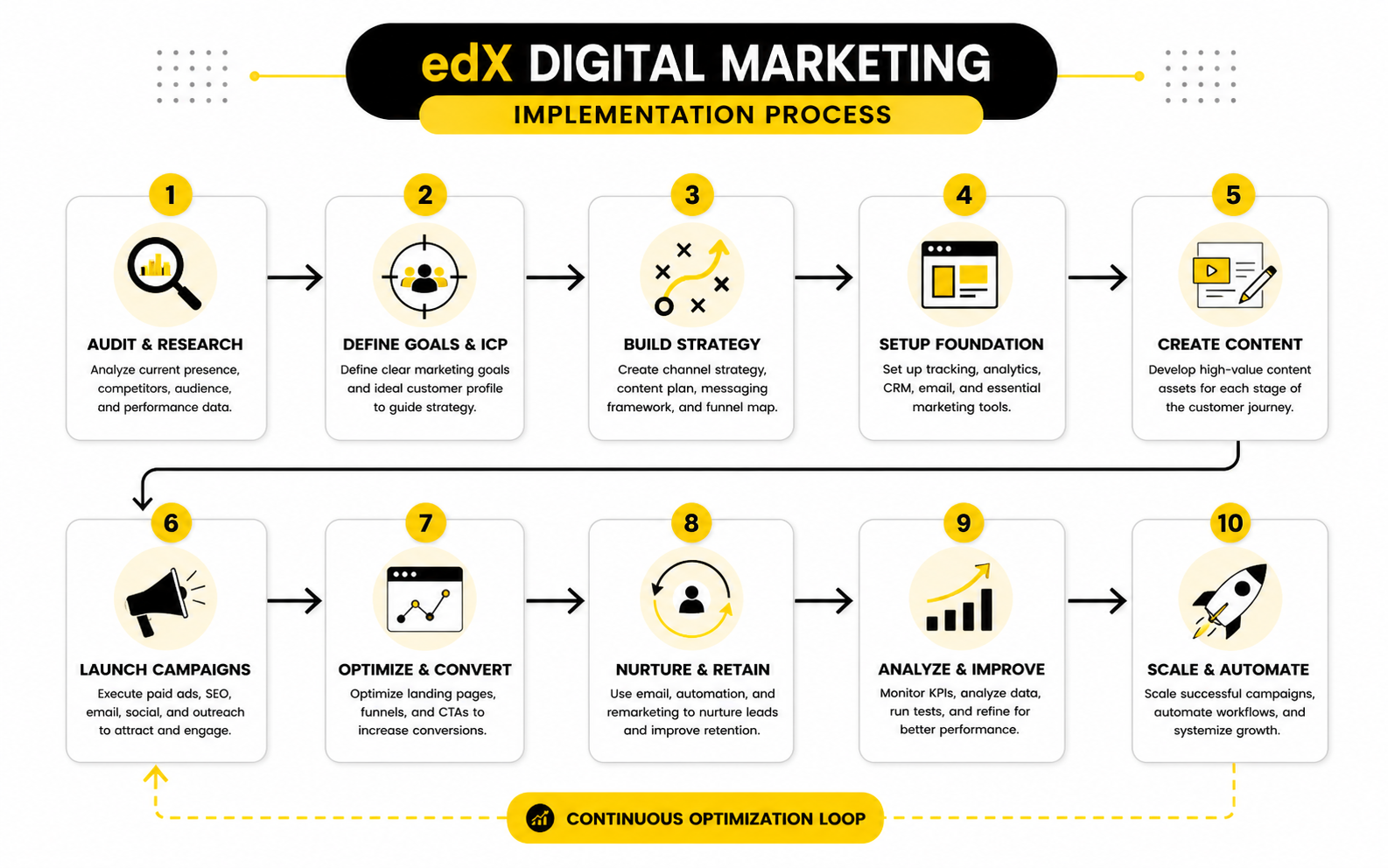
A simple execution process can look like this:
This process is intentionally boring. That is a good thing. Professional marketing is not about chasing a new tactic every week; it is about building a repeatable system that can be improved.
Content, Creative, and Landing Page Execution
Content and creative are where strategy becomes visible. A post, ad, email, video script, or landing page has to carry the positioning clearly enough that the audience understands why it matters. This is not about sounding clever. It is about making the buying decision easier.
Landing pages deserve special attention because they often reveal whether the campaign logic is strong. If the page does not match the ad promise, users feel friction. If the headline is vague, they lose interest. If the proof is weak, they hesitate.
This is also where a learner can begin using real marketing tools thoughtfully. For example, someone building funnel-style campaign assets may test pages with ClickFunnels, while a leaner all-in-one setup might make more sense in Systeme.io. The tool is not the strategy, but using a real tool can turn coursework into something closer to professional practice.
Analytics and Performance Review
Analytics is where you separate confidence from opinion. You look at the numbers, compare them to the goal, and decide what needs to change. This is one of the most valuable parts of digital marketing because it forces honesty.
The American Marketing Association’s 2025 skills research, based on survey data, job postings, and expert interviews, highlights AI transformation, shifting consumer expectations, and changing channels as major pressures on marketers in its marketing skills report. That makes measurement more important, not less. When channels change quickly, marketers need a reliable way to judge what is actually working.
For your edX digital marketing implementation project, build a basic performance review template. Include the campaign goal, key metrics, what improved, what underperformed, what you would test next, and what business decision the data supports. That one habit will make you sound far more professional than someone who only says, “The campaign got engagement.”
Automation and Follow-Up Systems
Digital marketing does not end when someone clicks. In many businesses, the money is made in the follow-up. That follow-up might be email nurturing, SMS reminders, chatbot conversations, retargeting, sales pipeline updates, or customer onboarding.
Automation is useful when it supports a real customer journey. It becomes a problem when it replaces thinking. A lazy automation sequence can make a brand feel robotic, while a thoughtful one can help people get the right message at the right time.
If your implementation project includes lead capture, map the follow-up before you build it. Decide what happens immediately after conversion, what message comes next, and what action should move the person closer to buying. Tools like GoHighLevel, Brevo, and ManyChat can support that kind of workflow when the use case genuinely calls for it.
Turning Skills Into a Portfolio Asset
The smartest way to complete an edX digital marketing course is to build a portfolio asset alongside it. Do not wait until the end. Every module should produce something useful: a customer brief, positioning map, content plan, landing page wireframe, campaign checklist, analytics review, or automation flow.
This portfolio asset does not need to pretend you ran a massive campaign if you did not. Be honest. A well-explained strategy project is better than a fake case study with inflated numbers.
What matters is that the work shows your thinking. Show the problem, the audience, the campaign logic, the channel choices, the measurement plan, and the next optimization step. That is how an edX digital marketing learning path becomes more than education. It becomes proof that you can execute.
Measurement, Benchmarks, and What the Data Actually Means
Numbers are useful only when they change the decision. That is the first rule. If a metric makes you feel busy but does not help you improve targeting, messaging, conversion, retention, or revenue, it is probably not a core performance signal.
This is where edX digital marketing coursework should push you beyond dashboard watching. A dashboard can show traffic, clicks, opens, sessions, conversions, and revenue, but it cannot automatically explain what those numbers mean. You need a measurement system that connects each metric to a real marketing question.
The goal is not to become obsessed with data. The goal is to stop guessing. A marketer who can interpret numbers clearly will always have an advantage over someone who only reports them.
The Measurement System That Actually Works
A practical analytics system starts with the business goal, then works backward into marketing metrics. If the goal is revenue, you need to understand lead quality, conversion rate, average order value, retention, and acquisition cost. If the goal is pipeline, you need to know which channels create qualified opportunities, not just form fills.
Google Analytics 4 treats conversions as important actions created from events, which gives marketers a way to measure behavior that matters across websites, apps, and ad campaigns through GA4 conversion measurement. That detail matters because it forces you to define what a meaningful action is before judging performance. A page view is not the same as a lead. A click is not the same as intent. A download is not always buying interest.
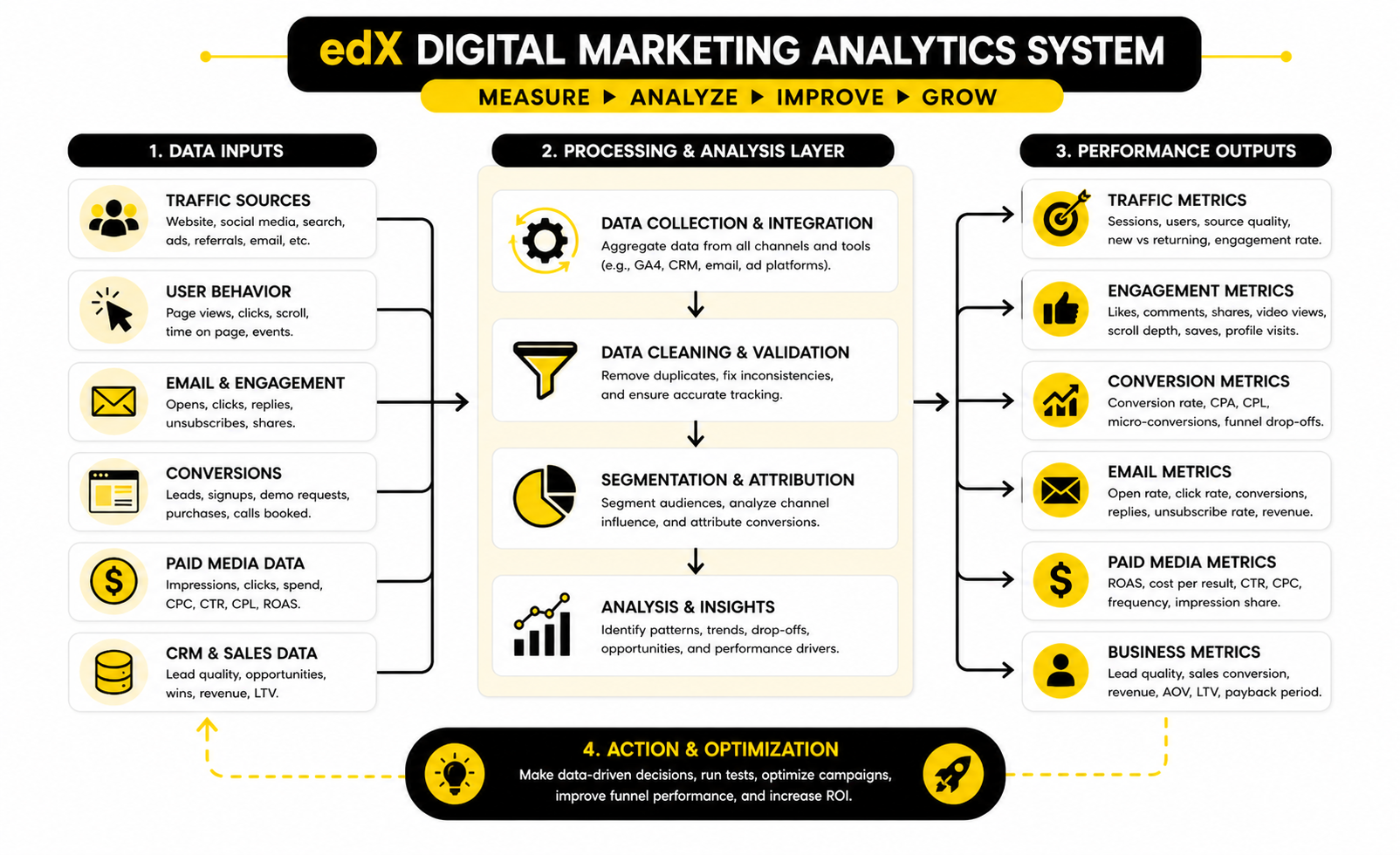
A simple measurement system should answer five questions:
This is the part many beginners skip. They collect metrics because the platform makes metrics easy to collect. Professional marketers choose metrics because those metrics help them decide what to do next.
Traffic Metrics Show Attention, Not Success
Traffic is the easiest number to misunderstand. More visitors can be good, but only if the visitors match the market you want to reach. A campaign that doubles traffic while lowering lead quality may create more work and worse economics.
That is why traffic should be interpreted with context. Look at source, intent, engagement, conversion behavior, and downstream quality. Search traffic from high-intent queries may behave very differently from broad social traffic that discovers the brand casually.
In an edX digital marketing project, traffic metrics should help you answer a specific question. Did the campaign reach the right audience? Did the channel create enough qualified attention to justify more effort? Did traffic move people toward the next action, or did it simply inflate the report?
Engagement Metrics Need a Job
Engagement metrics can be helpful, but they are often treated as proof when they are really signals. Likes, comments, shares, video views, scroll depth, and email opens can show interest, but they do not automatically prove business value. They need to be connected to the next step in the journey.
This is especially true in social and content marketing. A post can get attention because it is entertaining, controversial, or broadly relatable, but that does not mean it attracts buyers. The better question is whether engagement comes from the right audience and whether it leads to useful behavior later.
The action here is simple. Do not report engagement alone. Pair it with a quality signal such as profile visits, email signups, qualified leads, assisted conversions, demo requests, or repeat visits. That makes the metric more honest.
Conversion Metrics Reveal Friction
Conversion metrics show where the system is working or breaking. If traffic is healthy but conversions are weak, the issue may be the offer, page message, form design, proof, pricing clarity, or trust. If conversion rate is strong but volume is low, the issue may be reach or channel fit.
This is why conversion data is so valuable. It does not just tell you whether something worked. It points to the part of the system that deserves attention next.
A practical edX digital marketing implementation project should define one primary conversion and a few supporting micro-conversions. The primary conversion might be a purchase, demo request, booked call, or qualified lead. Micro-conversions might include pricing page visits, email clicks, form starts, product page engagement, or return visits.
Email Metrics Should Move Beyond Opens
Email metrics are a perfect example of why interpretation matters. Open rates can be useful for directional insight, but privacy changes and inbox behavior make them imperfect. Clicks, replies, conversions, unsubscribes, and revenue per recipient usually tell a more useful story.
Recent email benchmark research notes that open and click rates remain common, but they are not the main KPIs for judging campaign success in the 2025 Email Marketing Benchmark Report. That is exactly the mindset a serious marketer needs. Email is not successful because people opened it. Email is successful when it helps the right person take the right next step.
The action is to segment email performance by audience and intent. A welcome sequence, abandoned checkout email, newsletter, reactivation campaign, and product launch email should not be judged the same way. Each has a different job.
Paid Media Data Must Be Read Through Economics
Paid media data gets dangerous when marketers only look at platform-level results. A low cost per click can still be a bad deal if the traffic does not convert. A high cost per lead can still be profitable if the leads buy at a strong rate and generate high lifetime value.
Digital ad spend keeps rising, with the U.S. internet advertising market reaching $294.6 billion in 2025. That level of investment exists because paid channels can scale, but it also means competition is intense. Cheap attention is not the point. Profitable attention is the point.
The cleanest way to read paid media is to connect spend to the full funnel. Track impressions, clicks, landing page conversion, lead quality, sales conversion, revenue, and payback period. Once you see the full chain, you can make better decisions about budget, creative, targeting, and offer quality.
Benchmarks Are Starting Points, Not Targets
Benchmarks can help you spot unusual performance, but they should not become the strategy. Industry averages hide huge differences between product price, brand strength, audience sophistication, funnel type, traffic source, and buying urgency. Copying a benchmark without context is lazy.
Use benchmarks to ask better questions. If your landing page conversion rate is far below what you expected, investigate message match, page speed, proof, offer clarity, and audience intent. If your email clicks are weak, review the promise, segmentation, call to action, and timing.
The most useful benchmark is your own trend line. Compare campaign performance against your previous campaigns, your audience segments, and your business economics. That gives you a cleaner view than chasing a generic average from a different market.
AI and Data Skills Are Becoming Harder to Separate
Marketing measurement is also changing because AI is changing how teams plan, produce, target, and analyze campaigns. The 2025 AMA Marketing Skills Report found that generative AI was the top future skill, with 43% of respondents expecting it to become more important over the next five years. That does not mean marketers should blindly automate everything. It means the ability to combine marketing judgment with technical fluency is becoming more valuable.
For someone studying edX digital marketing, this creates a clear opportunity. Do not only learn channel definitions. Learn how data flows through the marketing system, how campaigns are measured, how AI tools can support analysis, and where human judgment still matters.
The practical action is to build a simple analytics habit. After every campaign or project, write down what happened, why you think it happened, what evidence supports that interpretation, and what you would test next. That habit turns data into skill.
The Metrics That Belong in a Beginner Portfolio
A beginner portfolio does not need enterprise-level dashboards. It needs clear thinking. If you can explain the customer journey, the campaign goal, the metrics selected, and the decision each metric supports, you already look more serious than most beginners.
For an edX digital marketing portfolio project, include a measurement page with these elements:
This shows that you understand marketing as a system. It also makes your work easier to discuss in interviews or client conversations. You are not just saying, “I learned digital marketing.” You are showing how you would measure and improve it.
Choosing the Right edX Digital Marketing Program
The advanced move is not to ask whether edX digital marketing is “worth it” in a generic way. That question is too broad. The better question is whether a specific program matches your current skill gap, your timeline, and the type of marketing work you want to do next.
edX lists professional certificate options that can take around 8 to 12 weeks and cover areas such as AI, SEO, advertising ecosystems, and customer lifetime value through its digital marketing course catalog. That is useful, but it also means you need to choose carefully. A broad certificate can help a beginner build structure, while a focused course may be better for someone who already works in marketing and needs sharper analytics, paid media, or strategy skills.
Do not pick the course that sounds most impressive. Pick the course that closes the most expensive gap in your current ability. If weak analytics is holding you back, a general overview may not be enough. If you do not understand positioning yet, a technical ads course may only help you spend money faster.
The Beginner Tradeoff
Beginners usually need breadth before depth. You need enough exposure to understand the full marketing system before specializing in one channel. That means learning customer research, messaging, content, paid media, analytics, and optimization at a basic but usable level.
The risk is staying too general for too long. A beginner can finish a course, collect a certificate, and still feel unsure because nothing has been applied deeply enough. That is why every broad edX digital marketing path should be paired with one practical project.
The smart beginner path is simple. Build the foundation, choose one project, and make every lesson feed into that project. By the end, you should be able to explain a campaign from customer insight to measurement, not just list topics you studied.
The Specialist Tradeoff
Specialists have a different problem. They usually know one area well, but their blind spots create performance ceilings. A paid ads specialist may not understand lifecycle marketing. A content marketer may avoid analytics. A social media manager may not understand conversion strategy.
This is where targeted edX coursework can be more valuable than another broad certificate. If you already know content, study analytics. If you already know social, study customer lifetime value. If you already know ads, study positioning and funnel economics.
The danger for specialists is tool tunnel vision. You become very good at one platform, but weaker at the business logic behind it. That is risky because platforms change. Strategy transfers.
The AI Tradeoff
AI is now part of the marketing workflow, but it should not become the whole workflow. The strongest marketers will use AI to speed up research, draft variations, analyze patterns, summarize customer feedback, and improve execution. The weakest marketers will use it to produce more average content faster.
Marketing skills research shows AI is not a side topic anymore. Generative AI was identified as the top future skill, with 43% of marketers expecting it to become more important over the next five years. That is a strong signal for anyone choosing an edX digital marketing learning path.
The practical tradeoff is quality control. AI can help you move faster, but it can also make you sound generic, overconfident, and disconnected from real customer insight. Use it as leverage, not as a substitute for judgment.
The Budget and Time Tradeoff
Marketing education has a cost, but so does scattered learning. Free content can be useful, but it often lacks sequence, feedback, and accountability. Paid programs can save time, but only if the structure matches your goal.
This matters more in a market where marketing teams are under pressure to do more with less. Gartner’s 2025 CMO Spend Survey reported that marketing budgets stayed flat at 7.7% of overall company revenue, which means teams are looking for productivity and clearer performance from every channel. Skills that help you make better decisions under budget pressure are valuable.
Do not judge a course only by price. Judge it by the speed and quality of the capability it helps you build. A cheaper course that never turns into usable work is expensive in disguise.
The Platform Risk
Digital marketing changes because platforms change. Search evolves. Social algorithms shift. Ad targeting rules get tighter. Analytics tools change measurement models. Privacy expectations keep rising.
That is why the best edX digital marketing path should teach principles first and tools second. You should learn how to think about customer intent, channel fit, message match, conversion friction, and performance quality. Those ideas survive dashboard changes.
A course that only teaches current button-clicking has a shorter shelf life. It may still be useful for immediate execution, but it should not be the core of your professional education. The core should be durable marketing judgment.
The Privacy and Data Risk
Measurement is becoming more complex because users, regulators, browsers, and platforms are changing how data can be collected and used. Privacy-led marketing research has shown that consumers are more selective about data sharing, with 44% saying transparency is the top driver of trust. That should change how marketers think about tracking, consent, and personalization.
The practical lesson is direct: do not build your marketing skill set around fragile tracking alone. Learn first-party data, consent-aware measurement, email capture, customer interviews, surveys, CRM hygiene, and owned audience development. Those skills become more important as third-party signals get weaker.
This is also where tools should support strategy instead of replacing it. A CRM or automation platform like GoHighLevel can help organize leads, follow-up, and pipeline activity, but it cannot fix unclear positioning or poor consent practices. The system is only as good as the thinking behind it.
The Scaling Risk
Scaling is not just doing more. It is doing more of what already works without breaking the economics. That means you need enough evidence before increasing spend, adding channels, or automating follow-up.
A common mistake is scaling too early. The marketer sees a few promising signals and immediately adds budget, creative volume, email sequences, retargeting, and extra channels. Then performance gets messy, attribution becomes unclear, and nobody knows what actually caused the result.
The better approach is controlled scaling. Prove the audience, message, offer, and measurement first. Then increase one layer at a time so you can see what changes.
Building a Stack Without Getting Distracted
Tools can help you implement what you learn, but they can also become a distraction. A beginner does not need twenty platforms. You need a simple stack that helps you publish, capture leads, measure behavior, and follow up.
For social planning, a scheduling tool like Buffer can support consistency when content is part of the project. For landing pages and funnel testing, ClickFunnels or Systeme.io can make campaign execution more concrete. For email follow-up, Brevo can be useful when the project needs segmentation and lifecycle messaging.
The rule is simple. Choose tools only after you know the process they will support. If you cannot explain the workflow on paper, software will not make it more carefully.
Expert-Level Guidance for Making the Certificate Matter
The certificate should not be the final asset. It should be the signal attached to deeper work. The real value comes from combining structured learning with proof that you can reason through a campaign.
Build a portfolio case that includes strategic choices, not just deliverables. Explain why you chose the audience, why the message fits, why the channel mix makes sense, what metrics matter, and what you would change after reviewing performance. That is what hiring managers and clients actually need to see.
This is the professional standard to aim for: show the thinking, show the system, and show the next decision. If your edX digital marketing work does that, it becomes much more than a completed course. It becomes evidence that you can operate in the real world.
Career Roadmap, Tools, Metrics, and FAQ
By this point, the message should be clear: edX digital marketing works best when you treat it as a structured learning path that feeds a real professional system. The certificate can help, but the system matters more. You want a repeatable way to research customers, shape offers, choose channels, measure outcomes, and improve performance over time.
The career roadmap is not about memorizing every platform. It is about building enough range to understand the full marketing engine, then developing enough depth to become useful in a specific role. That role might be digital marketing specialist, performance marketer, lifecycle marketer, content strategist, marketing analyst, social media manager, or growth marketer.
The strongest learners leave with three things: a credential, a portfolio, and a working point of view. The credential shows commitment. The portfolio shows evidence. The point of view shows that you can think under pressure.
Build a Role-Based Learning Path
Start by choosing the role you want your edX digital marketing work to support. A beginner who wants a generalist role should build a broad foundation first. A marketer aiming for analytics, paid media, SEO, email, or strategy should choose a more focused path and use the coursework to sharpen that edge.
This matters because “digital marketing” is too broad to master all at once. The U.S. Bureau of Labor Statistics projects market research analysts and marketing specialists to grow 7% from 2024 to 2034, but that demand does not remove the need to specialize. Employers still want a clear reason to believe you can solve a specific marketing problem.
A practical roadmap should move from foundation to proof. Learn the system, build a project, choose a specialty, improve your tool fluency, and document measurable thinking. That is how an online course becomes career leverage.
Use Tools to Support the System
Tools should make your marketing work easier to execute, not harder to understand. If you need campaign pages and funnel testing, ClickFunnels can help you build assets around offers and conversion paths. If you want a lean funnel and email setup, Systeme.io can support a simpler implementation.
If your project involves lead management, CRM workflows, and multi-step follow-up, GoHighLevel can help connect pipeline activity with automation. If content scheduling is part of your learning project, Buffer can keep publishing organized. If email and customer communication are central, Brevo can support practical lifecycle marketing.
The key is discipline. Do not collect tools because they sound exciting. Pick the smallest stack that helps you prove the marketing system you are building.
Turn Learning Into Opportunity
A finished course is not the end. It is the beginning of the proof stage. Once you complete an edX digital marketing program or course, your next move should be packaging what you learned into a clean professional narrative.
That narrative should answer five questions. What business problem did you study? Who was the audience? What campaign approach did you recommend? What metrics would you use to judge performance? What would you test next?
This is how you stand out. Most people say they learned digital marketing. Fewer people can show a structured project that explains the strategy, execution, and measurement behind their decisions.
What is edX digital marketing?
edX digital marketing refers to digital marketing courses, certificates, and programs available through edX. These programs can cover topics such as marketing fundamentals, digital strategy, social media, advertising, analytics, SEO, customer behavior, and AI-supported marketing. The value depends on the specific course, the credibility of the provider, and how well you apply the material outside the classroom.
Is edX digital marketing good for beginners?
Yes, edX digital marketing can be a good starting point for beginners because the learning is usually more structured than random free content. edX describes self-paced digital marketing courses as commonly taking 2 to 6 weeks, which can make them manageable for early-career learners. Beginners should still build a project alongside the course so the learning turns into evidence.
Can an edX digital marketing certificate help me get a job?
It can help, but it should not be treated as a job guarantee. A certificate may make your profile more credible, especially when paired with relevant projects, strong communication, and practical tool experience. The strongest signal is not the certificate alone; it is your ability to show how you think through campaigns and performance problems.
Which edX digital marketing course should I choose?
Choose based on your current skill gap. If you are new, start with a broad fundamentals course or professional certificate that covers strategy, channels, and measurement. If you already have experience, choose a focused course in analytics, paid media, customer strategy, AI marketing, or another area that directly improves your next role.
How long does it take to learn digital marketing on edX?
The timeline depends on the course format and your available study time. Some edX digital marketing courses are short and self-paced, while professional certificate programs can take longer and include multiple courses. The better question is how long it takes you to build a usable project from the material, because that is what turns learning into career value.
Is edX better than free digital marketing content?
edX can be better when you need structure, credibility, and a clear learning sequence. Free content can still be useful for platform updates, quick tutorials, and tactical ideas. The problem with relying only on free content is that it can become fragmented, outdated, or too focused on hacks without giving you a full marketing framework.
Do I need marketing experience before taking an edX digital marketing course?
No, you do not always need prior marketing experience. Many courses are designed for beginners or early-career professionals. That said, you will get more from the training if you pick a real project or business category to analyze while you study.
What skills should I expect to learn?
A strong edX digital marketing path should help you understand customer research, positioning, channel strategy, content planning, paid media basics, analytics, optimization, and campaign execution. Some programs may also include SEO, social media, marketing automation, AI, or customer lifetime value. The most useful skills are the ones you can apply to a real campaign plan.
Is digital marketing still a strong career path?
Digital marketing remains relevant because businesses continue shifting budget, attention, and customer communication into digital channels. Market research analysts and marketing specialists are projected to grow faster than the average occupation from 2024 to 2034, which supports the broader demand for marketing and customer insight skills. The opportunity is strongest for marketers who combine strategy, analytics, execution, and communication.
How should I show edX digital marketing on my resume?
Add the certificate or course under education, certifications, or professional development. Then make the impact clear in your experience or project section. Instead of only listing the course name, include a short project summary that shows campaign planning, analytics thinking, content strategy, or funnel design.
What portfolio project should I build while studying?
Build one complete marketing project around a realistic business category. Include audience research, positioning, channel plan, landing page outline, content or ad examples, measurement plan, and optimization recommendations. Keep it honest, structured, and practical.
Do I need paid tools to complete an edX digital marketing course?
Not always. Many concepts can be learned with free or low-cost tools, especially at the strategy and planning stage. Paid tools become useful when you want to build landing pages, automate follow-up, schedule content, manage leads, or test campaign workflows in a more realistic environment.
How does AI change digital marketing education?
AI makes execution faster, but it also raises the standard for judgment. Marketers can use AI for research summaries, content drafts, creative variations, data interpretation, and workflow support. The risk is relying on AI before you understand the customer, offer, channel, and measurement logic behind the work.
What is the biggest mistake learners make with edX digital marketing?
The biggest mistake is finishing the course without building proof. Watching lessons and passing quizzes is not enough. You need to turn the material into a portfolio asset that shows how you would make decisions in a real marketing situation.
What should I do after completing an edX digital marketing program?
After completing the program, refine your portfolio, update your resume, choose a role direction, and start applying your skills to real opportunities. You can also keep learning through focused courses if a specific weakness becomes clear. The goal is not endless education; the goal is better professional execution.
Build a stronger local presence with BAAM AI
Turn your website, Google profile, social channels, and AI visibility into one growth engine
Most businesses do not need more random marketing activity. They need a consistent presence system that helps the right people find them, trust them, and take action. BAAM AI brings strategy, local SEO, website updates, Google Maps visibility, social content, AI-search readiness, media production, and reporting into one practical monthly engine.
If you want your marketing to keep working after the campaign ends, start with a free BAAM AI presence audit. See how your business shows up today and where the fastest visibility wins are at BAAM AI.