
BAAM AI Blog
Ecommerce Email: The Practical Framework For Turning Subscribers Into Repeat Buyers
Ecommerce email is not just “sending newsletters.” Done properly, it is the system that turns anonymous traffic into first-time buyers, first-time buyers into repeat customers, and repeat customers into people who...
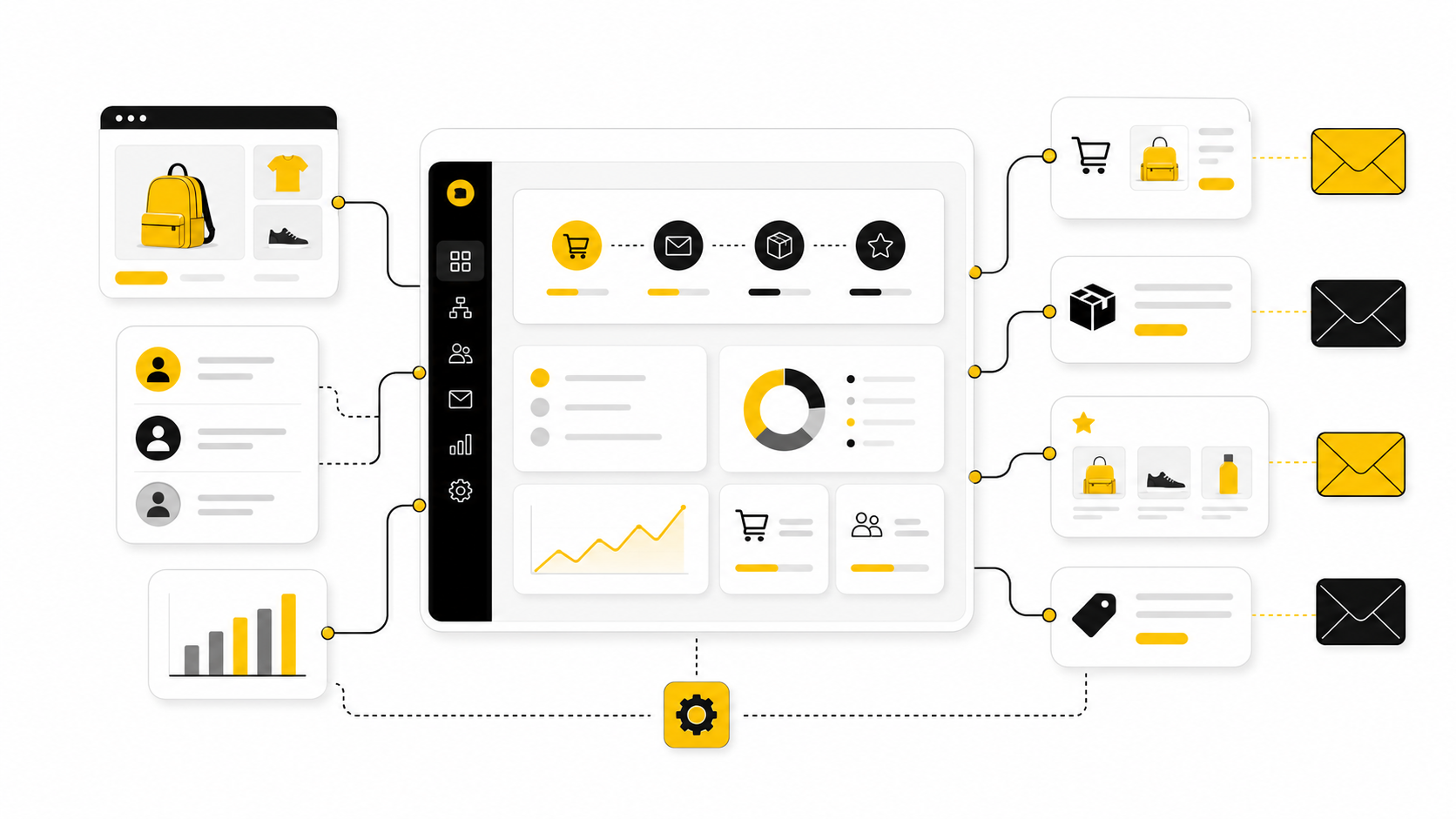
Ecommerce email is not just “sending newsletters.” Done properly, it is the system that turns anonymous traffic into first-time buyers, first-time buyers into repeat customers, and repeat customers into people who actually remember your brand when they are ready to buy again.
That matters because most ecommerce stores are fighting the same expensive battle: rising acquisition costs, distracted shoppers, abandoned carts, discount fatigue, and customers who buy once and disappear. Email gives you a channel you can own, personalize, automate, and improve without paying for every single click again.
The numbers still back this up, but only when ecommerce email is treated like a lifecycle system instead of a random campaign calendar. Automated messages can create outsized revenue because they respond to real behavior; Omnisend’s 2025 ecommerce report found that automated emails drove 37% of email sales from just 2% of email volume, while abandoned cart, welcome, and browse abandonment messages generated most automated orders in its ecommerce marketing data. That is the big shift: the best email programs are not louder. They are more relevant.
Why Ecommerce Email Still Matters
Ecommerce email matters because the buying journey is messy. A shopper may discover a product through an ad, compare options on mobile, leave the cart, come back from a reminder, wait for payday, read reviews, and finally purchase days later. If your store has no email system connecting those moments, you are relying on memory, luck, and paid retargeting to do work email could have handled more efficiently.
Cart abandonment alone shows why this channel cannot be ignored. Baymard’s long-running cart research places the average documented online shopping cart abandonment rate at roughly 70%, based on dozens of studies tracked in its abandonment benchmark. That does not mean every abandoned cart can be recovered, but it does mean a huge part of ecommerce revenue is sitting in the gap between interest and purchase.
Email is also one of the few channels where the customer relationship can get more valuable over time. Paid ads usually restart the cost clock with every click, while a strong email list becomes an asset that can support launches, seasonal campaigns, replenishment reminders, post-purchase education, review requests, referrals, and winback campaigns. Litmus’ 2025 ROI data shows why marketers keep investing: many marketing leaders report meaningful returns from email, with a large share seeing $10 to $50 back for every $1 spent in its email ROI research.
The catch is that email only works when it respects the customer’s context. Sending the same discount blast to everyone is easy, but it teaches people to ignore you. A better ecommerce email strategy starts with the customer’s stage, intent, purchase history, and likely next step.
The Ecommerce Email Framework
A strong ecommerce email system has two jobs: move customers forward and protect the relationship while doing it. That means every email should have a reason to exist beyond “we need to send something this week.” It should answer a real customer question, remove friction, create urgency honestly, recommend something useful, or deepen trust after the purchase.
The simplest framework is to think in lifecycle stages. Before purchase, email should capture attention, build confidence, recover lost intent, and explain why the product is worth buying. After purchase, email should reduce regret, improve product usage, encourage the second order, and gradually build a stronger customer profile.
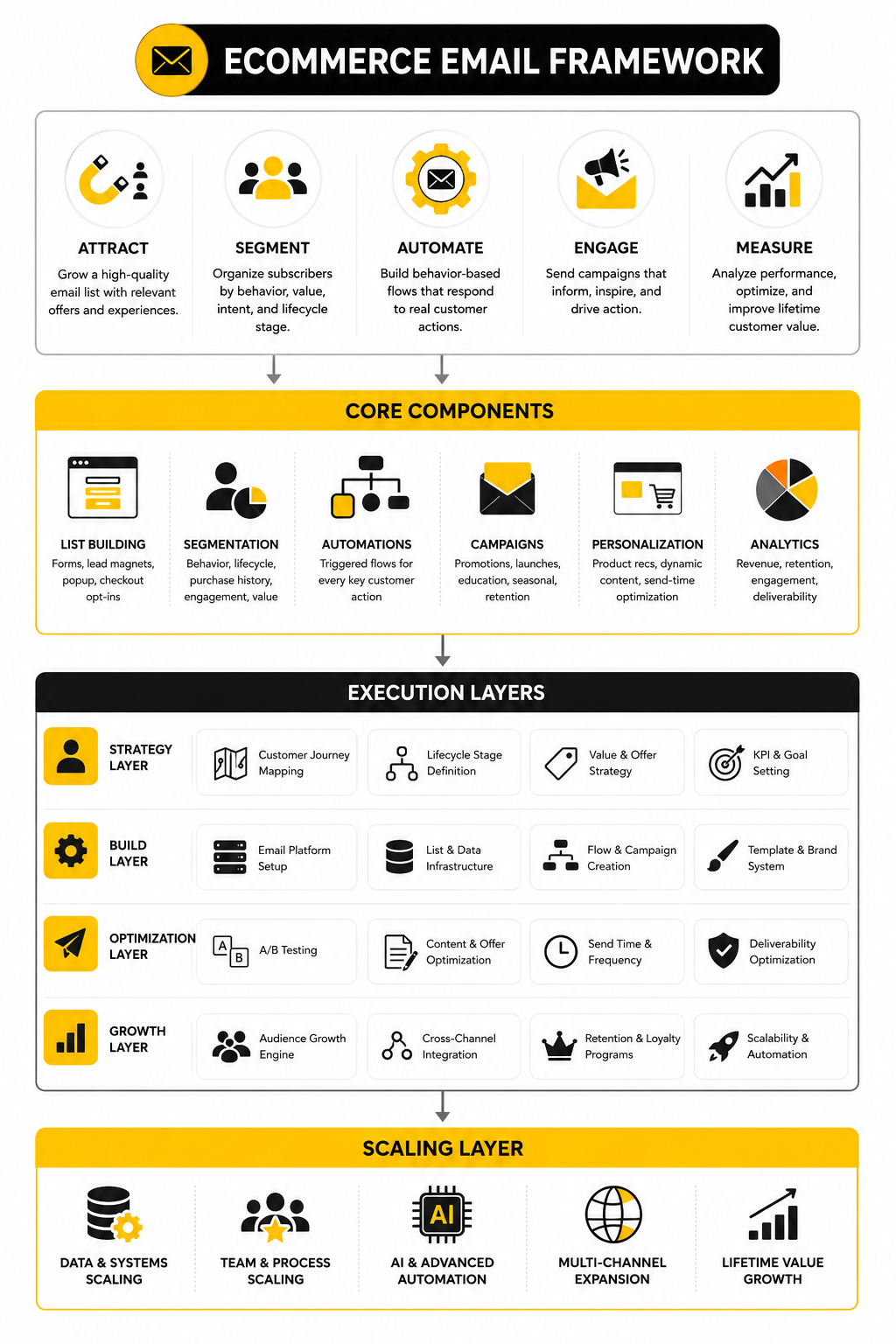
This is where automation and campaigns work together. Automations handle predictable customer moments such as welcome, browse abandonment, cart abandonment, post-purchase, replenishment, review request, and winback. Campaigns handle timely moments such as product launches, seasonal offers, educational drops, brand stories, limited inventory, and customer segments that deserve a specific message right now.
Core Components Of A Revenue-Ready Email System
The first core component is capture. Your store needs clear, ethical ways to turn visitors into subscribers, usually through popups, embedded forms, checkout opt-ins, quizzes, waitlists, or content offers. The goal is not to grab every possible email address; the goal is to attract people who are likely to care about the products, offers, and education your brand will send later.
The second component is segmentation. Klaviyo’s ecommerce benchmark work emphasizes that better email performance comes down heavily to segmentation and automation, because brands perform better when they stop treating the full list as one identical audience in its ecommerce benchmarks. At a basic level, that means separating new subscribers, non-buyers, first-time customers, repeat buyers, VIPs, inactive subscribers, product-category buyers, and high-intent browsers.
The third component is automation. Automated ecommerce email flows should respond to behavior, not guesswork. A cart abandoner needs a different message than a new subscriber, and a recent customer needs a different message than someone who has not opened or clicked in months.
The fourth component is campaign planning. Campaigns are where many stores either print money or burn trust. A good campaign calendar balances selling with education, product storytelling, social proof, objection handling, and customer value instead of relying on constant promotions.
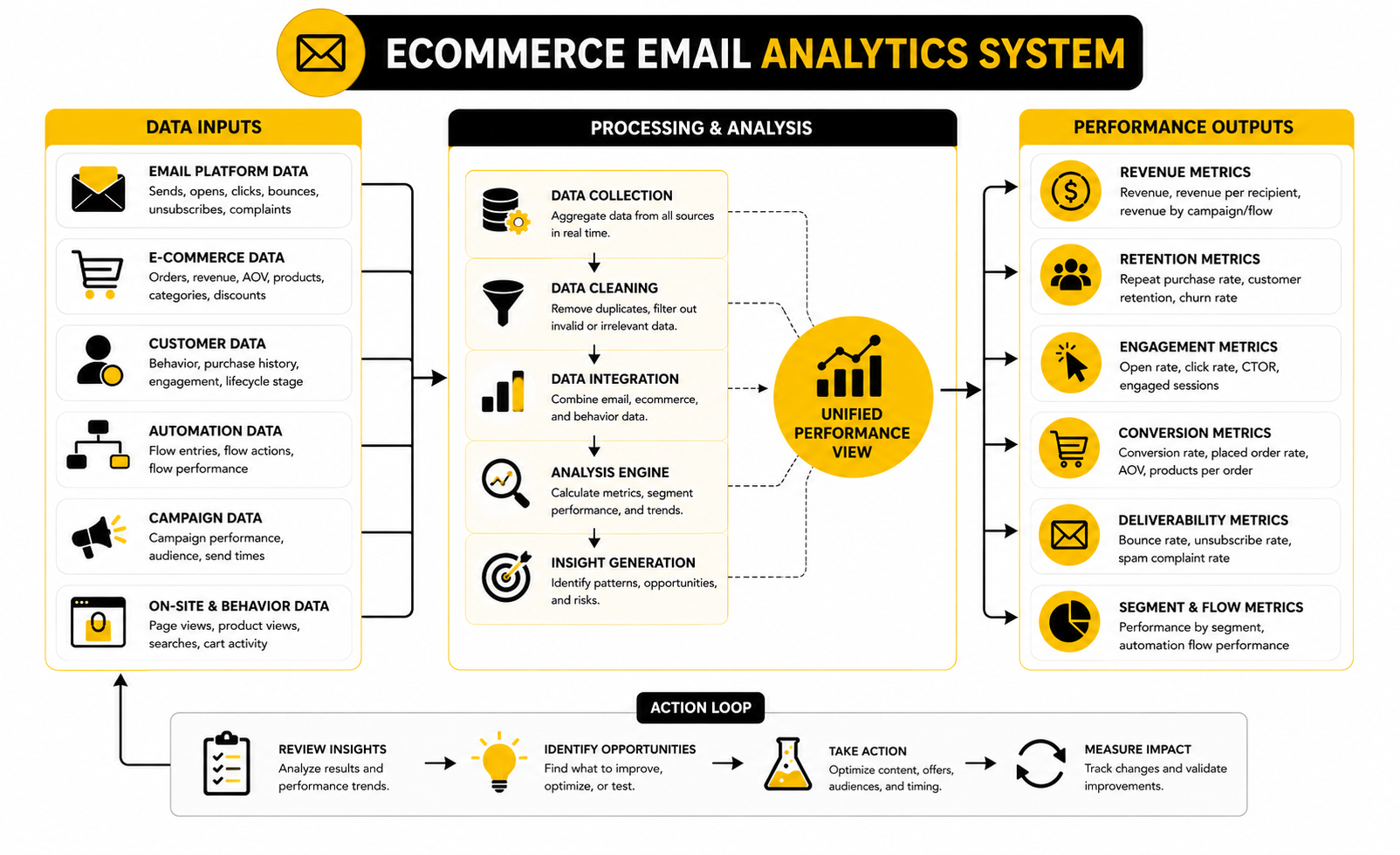
The fifth component is measurement. Open rate can still be directionally useful, but privacy changes have made it less reliable as a core success metric. For ecommerce email, the real scoreboard should include click rate, conversion rate, revenue per recipient, placed order rate, unsubscribe rate, spam complaints, deliverability, repeat purchase rate, and performance by segment.
Professional Implementation
Professional implementation starts by choosing a stack that fits the store’s stage. A small brand may need a simple email platform, reliable forms, clean automations, and basic reporting. A scaling brand may need deeper segmentation, SMS coordination, landing pages, quizzes, CRM workflows, AI-assisted support, and stronger attribution.
For ecommerce brands that want email and SMS automation built around store behavior, Brevo, Moosend, and ManyChat can fit naturally depending on the channel mix. If the bigger issue is converting more email traffic once people click, a landing page builder like Replo can support dedicated product pages, advertorials, and campaign-specific pages instead of sending every click to a generic product page.
The setup order matters. Start with tracking, forms, consent, deliverability basics, and list hygiene before building complicated automations. Then build the highest-impact flows first: welcome, abandoned cart, browse abandonment, post-purchase, review request, and winback.
The professional standard is simple: every flow should have a clear goal, every segment should have a reason to exist, and every campaign should be tied to a customer moment. When ecommerce email is built this way, it stops feeling like a newsletter machine and starts functioning like a revenue system.
The Ecommerce Email Framework
The easiest way to build ecommerce email is to stop thinking in “emails” and start thinking in customer moments. A subscriber does not care that you need a Tuesday campaign. They care about what they were trying to do, what stopped them, what they need to believe, and whether your brand is worth trusting.
That is why the framework should start with intent. Someone who just joined your list is not in the same mental state as someone who viewed the same product three times, added it to cart, bought once, or has not ordered in 120 days. Each of those moments deserves a different message because each person is dealing with a different question.
A clean ecommerce email framework has four layers:
The lifecycle stage tells you where the customer is in the relationship. Customer intent tells you what they are likely trying to solve right now. The message type gives the email a job, and the business goal keeps the system tied to revenue instead of activity.
Lifecycle Stage
Lifecycle stage is the backbone of the entire system. Without it, your email strategy becomes a pile of disconnected campaigns, and disconnected campaigns are hard to optimize. With lifecycle stages, you can see where revenue is being created, where customers are dropping off, and where the next improvement should happen.
Most ecommerce stores can start with five practical stages: visitor, subscriber, first-time buyer, repeat customer, and inactive customer. These stages are simple enough to manage, but still useful enough to guide real decisions. A new subscriber may need education and trust, while a repeat customer may respond better to product discovery, early access, replenishment, or loyalty messaging.
This is also where many stores overcomplicate things too early. You do not need dozens of segments on day one. You need a clear way to separate people based on where they are in the buying journey, because that one decision will make every flow and campaign more relevant.
Customer Intent
Customer intent is what makes ecommerce email feel timely instead of random. A browse abandonment email works because the customer showed interest in a product. A replenishment email works because the customer probably needs to restock. A winback email works because the customer used to care, but the relationship has gone quiet.
Intent can come from behavior, purchase history, product category, engagement, or explicit preferences. A shopper who clicks three emails about skincare has given you a signal. A customer who buys dog food every six weeks has given you a different signal. A subscriber who chooses “women’s running shoes” in a preference form has given you an even cleaner signal because they told you what they want.
The practical move is to rank signals by strength. A purchase is stronger than a click. A cart is stronger than a product view. A stated preference is more reliable than a guess. When the signal is stronger, the email can be more specific.
Message Type
Every ecommerce email should have a clear message type before anyone writes the subject line. This sounds basic, but it prevents a lot of messy campaigns. If the email is trying to educate, sell, recover, reassure, cross-sell, or re-engage, the structure should change.
A recovery email should remove friction and bring the customer back to the product. A post-purchase email should reduce anxiety and help the customer get value from what they bought. A product launch email should create clarity, urgency, and excitement without burying the offer under too much copy.
This is where brands often lose discipline. They try to make one email do five jobs, so the customer does not know what to click or why it matters. One email can have supporting points, but it should still have one primary job.
Business Goal
The business goal keeps the email system honest. It is not enough to say, “We want engagement.” Engagement only matters when it helps move the customer toward a valuable action without damaging trust.
For ecommerce email, the main goals usually include first purchase, recovered revenue, second purchase, repeat purchase, higher average order value, customer retention, review generation, referral, and reactivation. Each goal needs its own measurement. A welcome flow should not be judged the same way as a winback flow, because the customer context is completely different.
This is also why revenue per recipient is so useful. It forces you to compare performance against the size and quality of the audience receiving the email, not just total revenue. A campaign sent to 200,000 people can make more total money than a targeted email, but still be weaker on a per-recipient basis.
Mapping Emails To The Customer Journey
A strong ecommerce email program follows the customer journey from first touch to long-term retention. It does not wait until someone abandons a cart and then panic with a discount. It builds trust earlier, supports the purchase decision, and continues helping after the order is placed.
The journey usually begins with capture. This could be a popup, quiz, waitlist, giveaway, embedded form, checkout opt-in, or lead magnet. The important part is that the capture method should match the store’s economics and customer intent, not just chase the highest possible signup rate.
After capture, the job shifts to conversion. That is where welcome emails, browse recovery, cart recovery, product education, social proof, and objection handling come in. Once the customer buys, the job shifts again toward reassurance, usage, retention, and the second order.
Subscriber To First Purchase
The gap between subscribing and buying is one of the most important moments in ecommerce email. The customer has shown interest, but they have not fully trusted the brand yet. Your job is to make the next step feel obvious, safe, and worthwhile.
A good welcome sequence should not be a single coupon delivery email. It should introduce the brand, explain the product value, highlight bestsellers, answer objections, and create a reason to return. If an incentive is part of the offer, it should support the decision instead of becoming the only reason the customer buys.
This stage also benefits from preference capture. Asking what the subscriber is shopping for can make later emails much stronger. A simple preference form built with a tool like Fillout can help route subscribers into better segments without making the signup process feel heavy.
Product Interest To Cart
Product interest is where ecommerce email becomes more behavior-driven. A customer who views a product, clicks a collection, or returns to the same category is giving you useful information. The mistake is treating that signal like a guaranteed purchase intent signal.
Browse abandonment emails should be lighter than cart abandonment emails. The customer may still be researching, comparing, or casually exploring. A helpful browse email can bring them back with product benefits, reviews, comparison points, or related recommendations instead of immediately pushing a discount.
This stage is especially important for stores with longer consideration cycles. Higher-priced products, gifting products, subscriptions, technical products, and personal-care items often need more context before purchase. Ecommerce email gives you room to provide that context without forcing everything onto the product page.
Cart To Purchase
Cart abandonment is one of the clearest revenue opportunities because the customer has already shown stronger intent. They selected a product, reached the cart, and then stopped. The reason could be price, shipping, timing, distraction, payment friction, trust, or uncertainty.
The first cart email should usually be simple and direct. Remind them what they left behind, make it easy to return, and remove obvious friction. Later messages can add reviews, guarantees, shipping information, urgency, or an incentive if the economics make sense.
This is not a place to get clever at the expense of clarity. The customer already did most of the work. Your email should help them finish, not make them decode a brand story when they just need the cart link.
Purchase To Second Order
The second purchase is where many ecommerce brands quietly win or lose. A customer who buys once has crossed the hardest trust barrier, but that does not mean they will remember you later. If the post-purchase experience is weak, the relationship can disappear as soon as the package arrives.
Post-purchase ecommerce email should reduce buyer’s remorse first. Confirm the order, set expectations, explain what happens next, and help the customer feel confident. Then, once the product is delivered, shift into usage tips, care instructions, complementary products, review requests, and replenishment reminders when relevant.
The second order should feel like a natural next step, not a desperate follow-up. If someone bought a starter product, show them the next product that makes sense. If they bought a consumable, remind them before they run out.
Repeat Customer To Loyal Customer
Repeat customers deserve better than generic blasts. They have already proven that they trust the brand enough to buy more than once. That should change how you talk to them.
This group is often a strong fit for early access, bundles, loyalty offers, referrals, product education, and category expansion. The tone can be warmer and more direct because the relationship already exists. You can also ask for more meaningful feedback because these customers know the product better than a new subscriber.
Retention matters because ecommerce growth becomes much easier when the business is not forced to replace every customer after one order. Shopify’s retention guidance has long emphasized that repeat customers are often more profitable because they already know the brand and require less persuasion than first-time buyers in its customer retention resources. Ecommerce email is one of the most practical ways to keep that relationship active.
Matching Automation And Campaigns
Automations and campaigns should not compete with each other. They should do different jobs inside the same system. Automations respond to behavior, while campaigns create moments.
Automations are always-on. They catch predictable situations such as a new signup, abandoned cart, completed purchase, product view, back-in-stock request, subscription renewal, or inactive customer. Campaigns are planned sends tied to launches, promotions, holidays, editorial themes, customer segments, or business priorities.
The mistake is using campaigns to cover for missing automations. If every week’s email has to recover carts, welcome subscribers, educate new buyers, and reactivate old customers at the same time, the system is broken. Build the automations first, then use campaigns to add momentum.
When To Use Automation
Use automation when the trigger is predictable and the timing matters. A welcome email should not wait until next Tuesday. A cart reminder should not wait until the monthly newsletter. A delivery follow-up should not depend on someone manually remembering to send it.
Automation is also best when the message can be personalized from customer behavior. Product viewed, category interest, purchase date, order value, number of purchases, and last engagement date can all shape what someone receives. That is why ecommerce email automation often outperforms generic campaigns; the timing and context are stronger.
This does not mean every automation needs to be complicated. A simple three-email sequence with clear logic can beat a bloated twelve-email flow if the shorter sequence matches the customer’s decision process. Start with the highest-intent moments and improve from there.
When To Use Campaigns
Use campaigns when the message is tied to a specific business moment. Product drops, seasonal events, limited-time offers, educational themes, founder notes, customer spotlights, and inventory pushes all fit naturally into campaigns. These emails create rhythm and keep the brand present in the inbox.
Campaigns work best when they are segmented. A VIP customer may deserve early access. A non-buyer may need a lower-friction offer. A customer who bought one category may not care about a launch in a completely unrelated category.
This is where a content calendar becomes useful, but only if it stays flexible. The calendar should guide the strategy, not force irrelevant sends. A good ecommerce email calendar gives the team structure while still leaving room for inventory changes, customer behavior, and real business priorities.
How They Work Together
The best systems let automations handle the obvious customer moments while campaigns create bigger brand and revenue moments. A launch campaign can bring people to the site, and browse or cart automations can follow up with the people who showed intent. A seasonal campaign can introduce a collection, and post-purchase flows can help customers get more value after buying.
This creates a cleaner customer experience. Instead of receiving one-size-fits-all emails, subscribers receive messages that match what they did and where they are in the journey. That is the difference between email as noise and email as a useful sales system.
It also makes optimization easier. If cart recovery is weak, improve the cart flow. If campaign revenue is low, review offer strength, segmentation, creative, and landing pages. If repeat purchase is lagging, inspect post-purchase and replenishment emails before blaming the whole channel.
Core Components Of A Revenue-Ready Email System
The framework is only useful when it becomes operational. This is where ecommerce email stops being a strategy document and becomes a working system with forms, segments, flows, campaigns, creative standards, tracking, and a process for improvement. The goal is not to build something complicated; the goal is to build something that is clear enough to run every week and strong enough to keep improving.
The best implementation starts with the customer journey, but it also respects the technical basics. Deliverability, consent, authentication, and clean tracking are not exciting, but they decide whether the work actually reaches the inbox and gets measured properly. Gmail and Yahoo’s sender requirements made this more obvious by pushing bulk senders toward stronger authentication, easier unsubscribes, and better spam complaint control through updated deliverability rules.
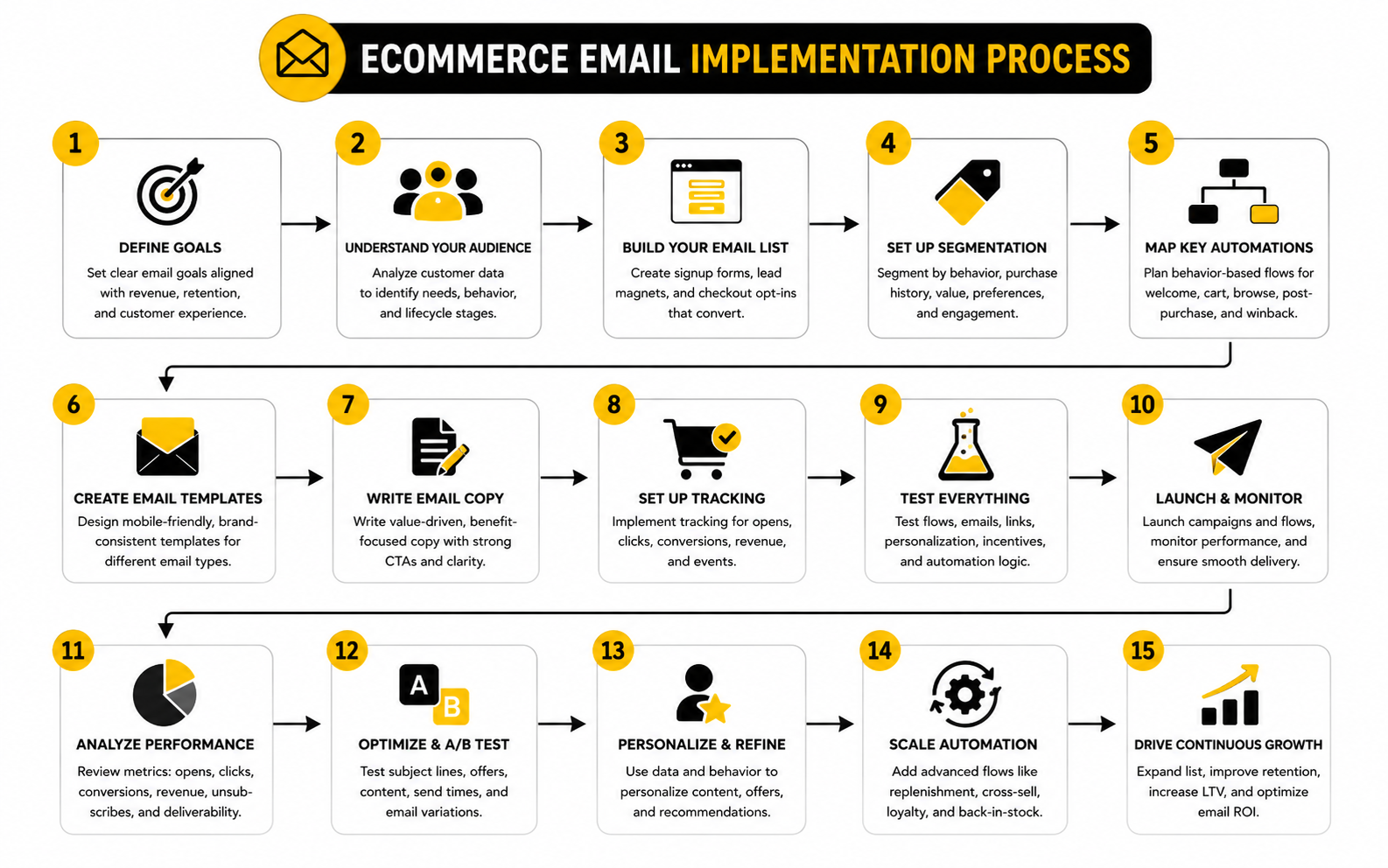
Before writing a single campaign, map the parts of the system that must work together. Your signup forms feed the list. Your segments organize the list. Your automations react to behavior. Your campaigns create timely demand. Your landing pages convert clicks. Your reporting tells you what to fix next.
Step 1: Fix The Foundation
Start with the boring stuff because the boring stuff protects revenue. Set up SPF, DKIM, and DMARC for the sending domain, make sure the sender name is recognizable, and keep unsubscribe access clear. If people cannot trust the sender, or mailbox providers cannot verify the domain, the best copy in the world will not save the program.
Next, confirm that ecommerce tracking is working. You need reliable events for viewed product, added to cart, started checkout, placed order, product category, order value, discount usage, and purchase count. Without those events, segmentation and automation become guesswork.
Then clean up consent. Only send marketing emails to people who gave permission, and keep consent sources organized. This matters legally, but it also matters commercially because low-quality lists create low-quality performance.
Step 2: Build The Capture System
Your capture system should make the value of subscribing obvious. A weak popup that says “Join our newsletter” does not give the shopper a reason to care. A stronger offer connects to the shopping moment, such as early access, a first-order incentive, a size guide, a product quiz, a replenishment reminder, or useful buying education.
Capture should happen in more than one place. A homepage popup can work, but product pages, blog content, checkout, footer forms, quiz results, waitlists, and post-purchase pages can all collect different kinds of intent. The more specific the signup context, the better your ecommerce email segmentation can become later.
This is where form tools can help if they reduce friction instead of adding it. A preference quiz or guided product finder built with Fillout can capture useful data without making the customer feel like they are filling out a survey. The key is to ask only for information you will actually use.
Step 3: Create Practical Segments
Segmentation should make your sending decisions easier. If a segment does not change what someone receives, when they receive it, or how you evaluate them, it probably does not need to exist yet. Start with segments that directly support revenue, retention, or deliverability.
A strong starter segmentation setup includes:
These segments let you stop speaking to everyone the same way. A VIP customer should not get the same introduction as a brand-new lead. An inactive subscriber should not receive the same frequency as someone who clicked last week.
Step 4: Build The First Revenue Flows
Automations should be built in order of impact. Do not spend three weeks designing a complicated birthday flow while the cart abandonment flow is missing. The highest-priority ecommerce email flows are usually welcome, abandoned cart, browse abandonment, post-purchase, review request, replenishment, and winback.
The abandoned cart flow deserves early attention because it sits close to purchase intent. Baymard’s 2025 benchmark places average cart abandonment around 70.22%, which means most carts do not turn into completed orders without friction somewhere in the process in its cart abandonment research. That does not mean email can recover every cart, but it does mean this moment should not be ignored.
The welcome flow is just as important for a different reason. It shapes the first impression after someone gives you their email address. A good welcome flow should deliver the promised offer, explain what makes the brand different, point people toward the right products, and remove the main doubts that stop first purchases.
Step 5: Connect Email Clicks To Better Landing Pages
A lot of ecommerce email underperforms after the click. The email creates interest, but the landing experience does not match the message. That disconnect kills momentum because the customer has to reorient themselves instead of continuing the same buying journey.
If the email promotes a specific product, bundle, quiz result, gift guide, or seasonal offer, the landing page should reflect that exact promise. Sending every campaign to the homepage is lazy. Sending every promotion to a generic collection page is often only slightly better.
For stores that run dedicated launches, advertorials, seasonal offers, or creator-led campaigns, landing page control becomes a serious advantage. A tool like Replo can help ecommerce teams build campaign-specific pages that match the email angle instead of waiting on a full theme rebuild.
Step 6: Set A Campaign Operating Rhythm
Campaigns need a rhythm, but they should not become a treadmill. Sending more email can increase revenue in the short term, but it can also train the list to ignore you if every message feels the same. The operating rhythm should balance sales pressure with value, education, product discovery, and customer relationship-building.
A practical weekly rhythm might include one product-focused email, one educational or story-driven email, and one segmented sales email when the offer is strong enough. For smaller lists, that may be too much. For highly engaged lists with strong segmentation, it may be too little.
The point is to choose a cadence intentionally. Watch clicks, conversions, unsubscribes, spam complaints, and revenue per recipient by segment. If engaged customers keep buying and complaints stay low, the cadence may be healthy; if performance drops while unsubscribes rise, the list is telling you something.
Step 7: Create The Measurement Dashboard
You cannot optimize what you cannot see clearly. A useful ecommerce email dashboard should show both channel-level performance and flow-level performance. It should also separate campaigns from automations because they behave differently.
Track these metrics at minimum:
Open rate can still help with directional testing, but it should not be the main decision-maker. Privacy changes have made opens less reliable, and a campaign with a pretty open rate can still fail to sell. Clicks, purchases, and revenue per recipient are harder to fake.
Professional Implementation: From Setup To Optimization
Professional implementation is not about building the fanciest automation map. It is about getting the fundamentals live, measuring them honestly, and improving the system in a disciplined order. Most brands do not need more random tactics; they need a cleaner process.
The process should move from setup to launch, then from launch to optimization. During setup, the focus is technical accuracy and clear flow structure. During launch, the focus is getting the core system live without breaking anything. During optimization, the focus shifts to testing, segmentation, creative quality, and long-term retention.
A strong ecommerce email implementation usually follows this sequence:
Audit Before You Build
An audit prevents wasted work. It shows whether the list is healthy, whether the flows already running are helping or hurting, and whether the platform is tracking revenue correctly. Skipping the audit is how teams end up redesigning email templates while the real problem is broken attribution or poor deliverability.
The audit should look at list growth, engagement quality, flow performance, campaign performance, unsubscribes, complaints, and revenue by segment. It should also check whether old automations overlap in confusing ways. Customers should not receive three different emails with three different offers because nobody cleaned up the logic.
This is especially important when switching tools. If you move platforms without understanding what is already working, you risk losing the few parts of the system that were actually driving revenue. Migration should improve the system, not just recreate the mess somewhere new.
Launch The Minimum Viable System
The minimum viable system is the smallest email setup that can capture demand, recover intent, support customers after purchase, and create repeat buying opportunities. It is not a half-finished system. It is a focused system with the highest-impact pieces live first.
For many ecommerce brands, that means launching the welcome flow, abandoned cart flow, browse abandonment flow, post-purchase flow, review request flow, and one basic winback flow. It also means having at least a simple campaign calendar and a few useful segments. Once those pieces are live, the brand has a real operating base.
This approach beats waiting months for the perfect setup. Ecommerce email improves faster when real customer behavior is coming through the system. Build the core, launch carefully, then optimize from evidence.
Improve One Constraint At A Time
Optimization gets messy when teams change too many things at once. If you rewrite the offer, subject line, layout, audience, landing page, and send time in the same test, you will not know what actually caused the result. Good optimization isolates the constraint.
Start with the biggest bottleneck. If signup rate is low, improve capture. If cart recovery clicks are strong but purchases are weak, improve the landing experience or offer clarity. If campaigns get clicks but low revenue, review product-market fit, merchandising, audience targeting, and page alignment.
This is the part that separates serious email programs from casual ones. Casual programs send and hope. Serious programs diagnose, test, learn, and apply the lesson to the next send.
Statistics And Data
Ecommerce email data is useful only when it changes what you do next. Random benchmarks can make a weak program look better than it is or make a healthy program look broken because the comparison is wrong. A premium furniture brand, a low-ticket beauty store, and a subscription supplement company should not judge every metric the same way.
The point of analytics is to understand the customer journey more clearly. If subscribers open but do not click, the message may not be strong enough. If they click but do not buy, the offer, product page, price, shipping, or timing may be the problem. If they buy once but never return, the issue is not the subject line; it is likely the post-purchase and retention system.
The healthiest ecommerce email programs look at performance in layers. They do not obsess over one number. They connect deliverability, engagement, conversion, revenue, retention, and customer quality so the team can see what is actually happening.
What Benchmarks Can And Cannot Tell You
Benchmarks are useful for spotting obvious problems, but they should not become the strategy. If your click rate is far below your category average, that is a sign to review audience quality, creative, offer strength, and email relevance. If your revenue per recipient is weak while clicks are healthy, the email may be doing its job but the landing page or offer may not be converting.
Klaviyo’s ecommerce benchmarks show how much performance can vary by industry, with email revenue per recipient ranging widely across categories and flows in its benchmark data. That matters because a single “good email conversion rate” is not very helpful without context. Your benchmark should compare similar customers, similar products, similar flows, and similar buying cycles.
The best way to use benchmarks is as a diagnostic tool. First, compare your store against your own past performance. Then compare by segment and flow type. Only after that should you use industry benchmarks to understand whether the gap looks normal or urgent.
The Metrics That Actually Matter
Open rate is the easiest number to watch, but it is not the most important number. Privacy changes and image-loading behavior have made opens less reliable, so open rate should be treated as a rough signal, not a final verdict. It can still help with subject line direction and list health, but it should not decide whether an ecommerce email program is successful.
Click rate is more useful because it shows whether the email made people take action. A high click rate usually means the audience, message, creative, and call to action are aligned. A low click rate usually means the email did not create enough interest, or the wrong people received it.
Revenue per recipient is one of the cleanest performance metrics for ecommerce email. It shows how much revenue an email generated relative to the number of people who received it. This prevents the common mistake of praising a huge campaign only because it produced more total revenue than a smaller, more targeted send.
Campaign Metrics
Campaigns should be measured differently from automations because campaigns are planned broadcasts. They usually go to larger groups, depend heavily on timing, and often reflect business moments such as launches, seasonal pushes, inventory moves, or promotions. A campaign can be successful even if it does not create immediate sales, but only when it has a clear purpose.
For sales campaigns, focus on revenue per recipient, click rate, conversion rate, placed order rate, average order value, unsubscribe rate, and spam complaint rate. If the campaign is educational, product-discovery focused, or brand-building, clicks and downstream purchase behavior may matter more than same-day revenue. The key is deciding the goal before the campaign goes out.
Do not judge every campaign by the same standard. A clearance campaign should drive immediate action. A product education email may build demand for a later purchase. A customer story may increase trust and clicks without behaving like a discount email.
Automation Metrics
Automations should be measured by flow and by email step. A welcome flow needs to be judged by first-purchase conversion, revenue per recipient, and engagement across the sequence. A cart abandonment flow needs to be judged by recovered revenue, order rate, and how each reminder performs without creating unnecessary discount dependence.
Omnisend’s 2025 ecommerce marketing report found that automated emails produced a large share of email sales from a tiny share of total email volume in its ecommerce marketing analysis. The lesson is not “add more automation for the sake of it.” The lesson is that behavior-triggered messages often win because the timing and context are stronger.
Automation reporting should answer practical questions. Which flow creates the most revenue per recipient? Which email step causes drop-off? Which flow has high clicks but weak conversion? Which automation may be annoying customers because the unsubscribe rate is too high?
Deliverability Signals
Deliverability is the quiet performance multiplier. If your emails do not reach the inbox, everything else gets harder. Strong creative cannot compensate for poor sender reputation, messy lists, unclear consent, or high complaint rates.
Yahoo’s sender guidance tells bulk senders to keep spam complaint rates below 0.3% in its sender best practices. That threshold matters because spam complaints are one of the clearest signs that recipients do not want what you are sending. If complaint rates rise, the answer is not to write punchier subject lines; it is to review consent, targeting, cadence, expectations, and list hygiene.
Bounce rate also deserves attention because it reflects list quality and technical health. Mailgun’s benchmark guidance notes that many strong industries keep bounce rates well under 0.5%, while a bounce rate above 2% is a signal that the list needs attention in its benchmark analysis. A rising bounce rate can point to old addresses, weak capture quality, imported lists, or poor validation.
Engagement Signals
Engagement signals tell you whether people are still paying attention. Clicks, repeat clicks, product views, replies, preference updates, and purchases all give you stronger information than opens alone. The more active the customer, the more confidently you can send relevant email.
Inactive subscribers need a different interpretation. Some people stop opening because they are not interested anymore. Others may still buy through other channels, use a different email client, or ignore promotional emails until they need the product again. That is why inactivity should be measured with both engagement and purchase behavior.
A smart ecommerce email program does not immediately delete every quiet subscriber, but it also does not blast inactive people forever. Use re-engagement campaigns, frequency reduction, and suppression rules to protect deliverability. A smaller responsive list is usually more valuable than a bloated list that damages sender reputation.
Conversion Signals
Conversion signals show whether the email is creating business results. The main conversion metrics are placed order rate, click-to-conversion rate, average order value, revenue per recipient, and repeat purchase rate. These numbers should be reviewed by campaign type, customer segment, and flow.
If click rate is high but conversion is low, the email probably created interest, but something after the click broke the momentum. The landing page may not match the promise. Shipping costs may be too surprising. The offer may be weak, the product may need more proof, or the site may be creating friction.
If click rate is low but conversion among clickers is strong, the issue may be email positioning. The people who click are qualified, but not enough people understand why they should care. In that case, improve the subject line, preview text, hero section, product framing, and call to action before changing the whole funnel.
Retention Signals
Retention is where ecommerce email becomes more than a sales channel. If the same customers keep buying, the list is not just producing transactions; it is supporting customer lifetime value. That is where post-purchase education, replenishment reminders, loyalty messaging, and product recommendations start to matter more.
Repeat purchase rate is one of the most important numbers to watch after the first sale. A low repeat purchase rate may mean customers are not happy, do not understand what to buy next, are not being reminded at the right time, or only purchased because of a one-time discount. Email can help with all of those, but only if the flows are built around the customer’s next logical step.
Time between purchases is just as useful. If customers usually reorder after 45 days, sending a replenishment reminder at day 90 is too late. If customers usually need education for two weeks before buying again, pushing a cross-sell the day after delivery may feel premature.
Revenue Per Recipient
Revenue per recipient is powerful because it connects money to audience size. Total campaign revenue can be misleading because bigger sends naturally have more earning potential. Revenue per recipient makes performance easier to compare across segments, campaigns, and flows.
For example, a campaign to the full list might generate more revenue than a VIP-only campaign, but the VIP campaign may generate far more revenue per recipient. That tells you the smaller audience is more valuable and may deserve different treatment. It also helps you avoid over-emailing lower-intent segments just to chase total revenue.
Use revenue per recipient as a decision-making metric, not a vanity metric. If a segment has strong revenue per recipient, consider giving it early access, better offers, or more tailored product recommendations. If a segment has weak revenue per recipient and rising unsubscribes, reduce frequency or change the message.
Unsubscribes And Complaints
Unsubscribes are not always bad. Sometimes they remove people who were never going to buy, which can improve list quality over time. The problem starts when unsubscribes spike in response to a specific campaign, segment, offer, or sending pattern.
Spam complaints are more serious because they hurt sender reputation and signal broken expectations. People complain when they do not recognize the sender, did not expect the email, feel misled, or think the brand is sending too often. This is why consent, sender identity, and message relevance are not optional.
When unsubscribes or complaints rise, do not treat them as isolated numbers. Review the campaign promise, audience selection, send frequency, subject line, and signup source. The data is telling you where trust started to break.
How To Read Ecommerce Email Data Without Overreacting
One campaign rarely proves anything by itself. A weak send may be caused by timing, inventory, audience fatigue, a poor offer, a bad subject line, or external events. A strong send may be helped by pent-up demand, seasonal timing, or a discount that cannot be repeated profitably.
Look for patterns over multiple sends. If educational emails consistently get clicks but low revenue, they may be better at warming demand than closing sales. If discount emails always sell but hurt full-price conversion later, they may be training the list to wait. If post-purchase emails get strong engagement but low repeat orders, the next-offer strategy may need work.
This is where ecommerce email analytics become useful. The goal is not to stare at dashboards all day. The goal is to make better decisions about audience, message, offer, timing, creative, landing pages, and retention.
Diagnose Before You Optimize
Optimization should start with a diagnosis. If you change everything at once, you learn almost nothing. If you identify the actual constraint, the next test becomes much more useful.
Use a simple diagnostic path:
This sequence matters because it prevents surface-level fixes. A brand with poor deliverability does not need more clever copy first. A brand with strong clicks and weak sales does not need a new subject line first.
Segment The Data Before Making Big Decisions
Averages hide the truth. A campaign can look average overall while performing extremely well for one segment and poorly for another. If you only look at the blended number, you may kill a strategy that should have been segmented instead.
Break performance down by lifecycle stage, engagement level, purchase history, product interest, order value, and source of signup. New subscribers may need more education. VIP customers may respond to exclusivity. Discount-driven buyers may click often but protect margin poorly.
This is especially important when scaling send volume. The more people you include, the more mixed the intent becomes. Segment-level reporting helps you expand carefully without damaging engagement or deliverability.
Watch Margin, Not Just Revenue
Revenue is not the same as profit. An ecommerce email campaign can look impressive in the dashboard while quietly hurting margins through excessive discounts, free shipping, returns, or low-quality orders. That is why performance reporting should connect email revenue to offer economics whenever possible.
If a 25% discount campaign drives a revenue spike but lowers margin and trains customers to wait, the long-term result may be weaker than it looks. If a product education campaign drives fewer orders but more full-price purchases, it may be more valuable than the dashboard suggests. This is where ecommerce email needs commercial judgment, not just software reporting.
The cleanest approach is to review gross margin, discount usage, average order value, repeat purchase behavior, and refund patterns alongside email revenue. That gives you a more honest picture of what the channel is really doing. More revenue is good only when it supports the business model.
Campaigns, Automations, Segmentation, And Measurement
Once the foundation is running, the next challenge is scale. More subscribers, more campaigns, more flows, more products, and more customer data can make ecommerce email more profitable, but they can also make it harder to manage. The system that worked at 5,000 subscribers can become messy at 100,000 if the strategy does not mature with the list.
This is where advanced email work becomes less about writing individual emails and more about managing tradeoffs. You have to balance growth against deliverability, personalization against privacy, automation against over-messaging, discounts against margin, and speed against quality control. None of these decisions are solved by copying a template.
The goal is not to make the email program bigger for the sake of it. The goal is to make it sharper. A mature ecommerce email system sends the right amount of email to the right people, with stronger timing, better segmentation, cleaner reporting, and fewer wasted touches.
Scaling Without Burning The List
Scaling email does not mean sending every campaign to everyone. That is the fastest way to inflate short-term revenue while slowly weakening the list. The real game is increasing relevant sends while reducing unnecessary sends.
As the list grows, frequency should become more segmented. Engaged buyers may tolerate and even welcome more frequent product updates, especially when the products are relevant. Cold subscribers, low-intent leads, and old giveaway signups usually need a lighter touch or a re-engagement path before they receive regular promotional campaigns again.
This is why suppression rules are not just a deliverability tactic. They are a customer experience tactic. If someone has not clicked, purchased, or meaningfully engaged in a long time, continuing to hammer them with campaigns is not confidence; it is laziness.
Personalization Without Being Creepy
Good personalization feels helpful. Bad personalization feels like surveillance. The difference is whether the customer understands why they are receiving the message and whether the recommendation actually makes sense.
A product recommendation based on a recent purchase can be useful when it shows complementary products, care items, refills, or next-step upgrades. A message that overuses browsing behavior or references every tiny action can feel uncomfortable. Ecommerce email should use customer data to reduce friction, not to prove how much the brand knows.
The safest personalization strategy is practical and transparent. Use purchase history, stated preferences, category interest, replenishment timing, loyalty status, and lifecycle stage. Avoid pretending the email is personally written when it is clearly automated, and do not use sensitive assumptions that the customer never gave you permission to make.
AI In Ecommerce Email
AI can help ecommerce email, but it should not replace strategy. The weakest use case is asking AI to produce generic promotional copy faster. The stronger use cases are idea generation, segmentation support, product angle research, subject line variation, testing plans, customer review mining, and faster creative iteration.
Recent research on large-scale marketplace email found that LLM-generated thematic email titles tied to personalized recommendations could improve engagement when used with production controls and testing discipline in a 2025 arXiv study. The important part is not “AI writes better subject lines.” The important part is that AI was connected to personalized content, tested at scale, and managed inside a controlled system.
That is the standard ecommerce brands should aim for. Use AI to support better relevance, not to spray more content into the inbox. If AI makes the team send more low-quality email faster, it is not an upgrade.
Discount Strategy And Margin Control
Discounts are powerful, but they are not free. They can recover hesitant buyers, move inventory, reward loyal customers, and create urgency. They can also train the list to wait, damage brand perception, and reduce profit on orders that might have happened anyway.
The advanced move is to segment discounts by need. A new subscriber who needs a first-purchase nudge may deserve a different offer than a VIP customer who already buys without heavy incentives. A cart abandoner with high intent may not need the same discount as someone who has ignored the brand for months.
Use non-discount incentives where possible. Free shipping, bundles, gifts with purchase, early access, loyalty points, limited editions, or better product education can sometimes move the customer without cutting price. The question is not “Should we discount?” The question is “What is the least expensive incentive that helps this customer make a confident decision?”
Cross-Channel Coordination
Ecommerce email does not operate alone. It works beside SMS, paid ads, organic social, direct mail, loyalty programs, customer support, chat, and onsite merchandising. If those channels are disconnected, the customer gets a noisy and inconsistent experience.
For example, a shopper should not receive a full-price email campaign minutes after clicking a paid ad for a discount offer. A customer should not receive a winback email if they just bought through SMS. A VIP customer should not receive the same urgency message after already purchasing the promoted product.
This is where tools and process matter. Messenger and Instagram automation through ManyChat, CRM and pipeline automation through GoHighLevel, and email platforms like Brevo can all support the system, but only if the customer journey is mapped first. Software should execute the strategy, not become the strategy.
Product Recommendations
Product recommendations should be based on logic, not hope. The easiest recommendations are complementary products, refills, bestsellers by category, products viewed but not purchased, and products commonly bought after the first purchase. The harder recommendations involve predicting taste, price sensitivity, use case, and timing.
Start simple. If someone bought a camera, recommend the accessories that make ownership easier. If someone bought skincare, recommend the next product based on routine order and usage timing. If someone bought kids’ clothing, recommend by size, season, and category instead of blasting every new arrival.
The biggest mistake is recommending products the customer already bought, does not need, or cannot use. That tells the customer the brand is not paying attention. Ecommerce email personalization should make the shopping experience easier, not expose lazy data logic.
List Hygiene At Scale
List hygiene becomes more important as the list gets larger. A small list can hide sloppy practices for a while. A large list cannot, because weak engagement, old addresses, and high complaint risk become more visible to mailbox providers.
Hygiene should include engagement-based suppression, bounce management, consent source review, winback sequences, and periodic cleanup of chronically inactive subscribers. This does not mean deleting valuable customers just because they have not opened recently. It means separating buyers, recent clickers, and true cold contacts so you do not treat them all the same.
The goal is to protect reach. A bigger list is not automatically better if a large part of it damages deliverability. A smaller, more responsive audience can outperform a bloated database because more of the right people actually see the message.
Advanced Testing
Testing should become more sophisticated as volume grows. Early on, simple subject line and offer tests may be enough. Later, the more valuable tests usually involve audience, angle, timing, creative structure, landing page alignment, and incentive strategy.
A useful test starts with a clear hypothesis. For example, “Customers who bought the entry-level product will respond better to education before a cross-sell offer” is testable. “Let’s try a different subject line” is not useless, but it is weaker because it often does not address the real constraint.
Test one meaningful variable at a time when possible. Keep a record of what changed, who received it, what happened, and what decision came from the result. The point of testing is not to produce random winners; it is to build a library of customer insight.
Risk Management
The biggest risks in ecommerce email are not dramatic. They are usually slow and quiet. The list gets less engaged, customers wait for discounts, deliverability weakens, campaigns become repetitive, and reporting gets messy enough that nobody knows what is really working.
There are also compliance risks. Consent rules, unsubscribe requirements, privacy expectations, and sender authentication standards need to be handled seriously. Google’s sender guidance encourages keeping spam rates below 0.1% and preventing them from reaching 0.3% or higher in its sender FAQ. That is not just a technical detail; it is a reminder that mailbox providers are watching recipient response closely.
Risk management should be part of the weekly operating rhythm. Review complaint rates, unsubscribes, bounce patterns, suppressed contacts, overlapping flows, and any campaign that caused unusual negative signals. Fix small issues before they become channel-level problems.
Team Workflow And Ownership
As email grows, ownership gets blurry unless the process is defined. Someone needs to own strategy, someone needs to own copy, someone needs to own design, someone needs to own segmentation, someone needs to own QA, and someone needs to own reporting. In a small business, one person may cover several of these roles, but the responsibilities still need to exist.
A clean workflow prevents expensive mistakes. Every campaign should go through audience review, offer review, link testing, mobile preview, product availability check, discount code testing, and send-time confirmation. Every automation change should be tested before it goes live.
This may sound basic, but basic mistakes are still common. Broken links, expired codes, wrong segments, duplicate sends, missing exclusions, and mismatched landing pages can cost more than a weak subject line ever will. Professional ecommerce email work is partly creative, partly analytical, and partly operational discipline.
When To Add More Tools
Adding tools too early creates complexity. Adding tools too late creates bottlenecks. The right time to add a tool is when the business has a clear use case, a measurable constraint, and enough process to use the tool properly.
For example, a landing page builder makes sense when email traffic needs dedicated campaign pages and the current site cannot support them quickly. A form or quiz tool makes sense when preference data would improve segmentation. A CRM or automation platform makes sense when email is part of a larger sales, service, or agency workflow.
Avoid buying software because the dashboard looks impressive. The tool should help you capture better data, send more relevant messages, convert more clicks, or understand performance more clearly. If it does not do one of those things, it is probably just another subscription.
The Expert-Level Shift
The expert-level shift is moving from channel management to customer relationship management. Beginners ask, “What email should we send this week?” Strong operators ask, “Which customer segment needs which next step, and what is the most profitable way to deliver it?”
That shift changes everything. Campaigns become more intentional. Automations become cleaner. Segments become more useful. Reporting becomes tied to customer behavior instead of vanity metrics.
Ecommerce email is not a magic revenue button. It is a system for understanding customers, responding to their behavior, and making the next purchase easier. When that system is built carefully, it becomes one of the most dependable assets in the business.
FAQs And Final Ecommerce Email Checklist
At this point, ecommerce email should feel less like a collection of tactics and more like a complete operating system. The list brings people in. The segments organize intent. The flows respond to behavior. The campaigns create timely momentum. The reporting shows what to improve next.
That final system is the real advantage. A brand with a clear email ecosystem can keep learning from customer behavior instead of guessing every week. It can use campaigns, automations, landing pages, SMS, chat, and customer support as connected parts of the same buying journey.
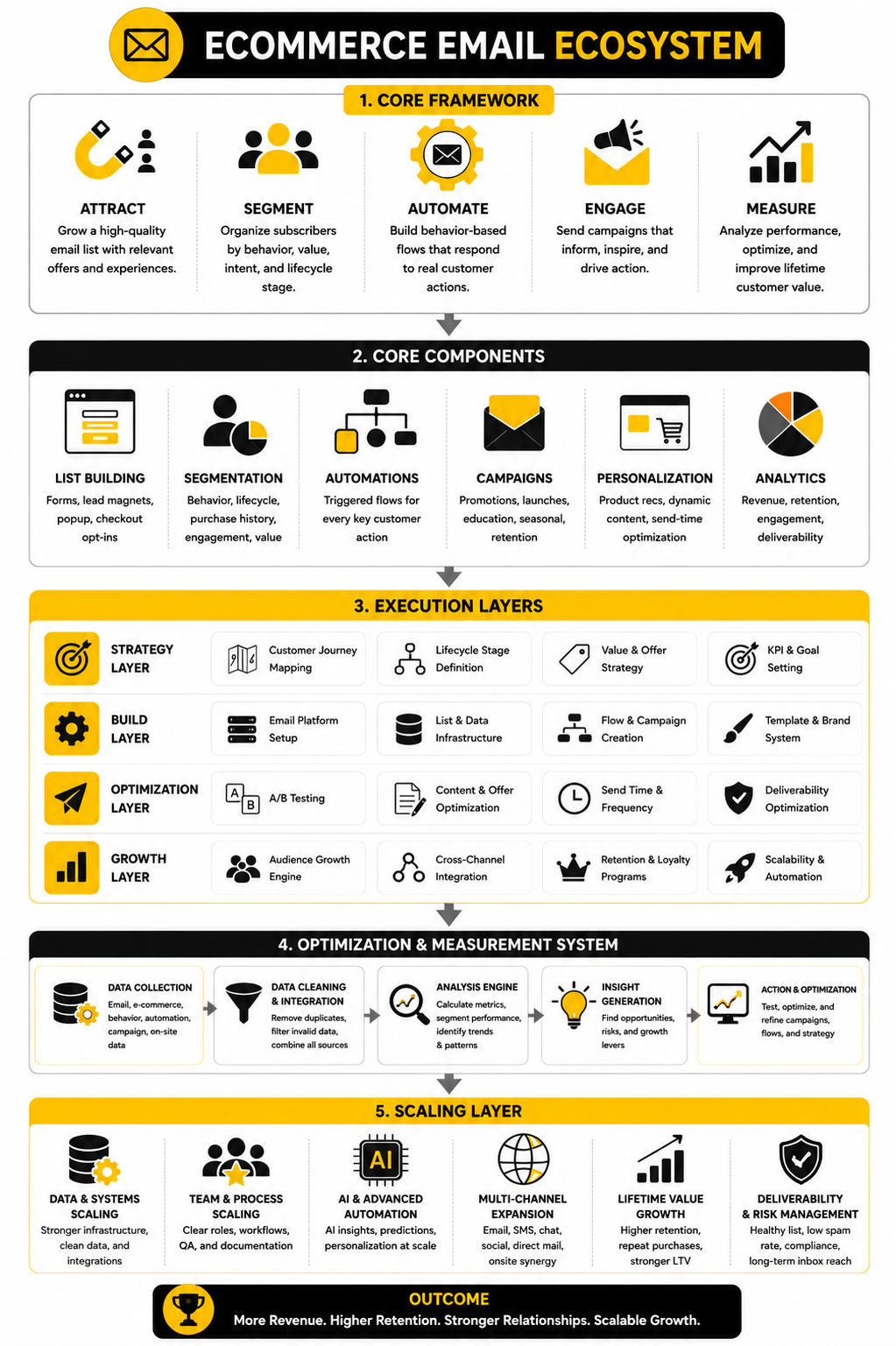
The final checklist is simple, but do not confuse simple with shallow. A strong ecommerce email program needs clear ownership, clean tracking, relevant segmentation, healthy deliverability, useful creative, and honest measurement. Miss one of those pieces and the system can still work, but it will leak revenue somewhere.
Before calling the system complete, review these essentials:
What is ecommerce email?
Ecommerce email is the use of email to turn store visitors, subscribers, and customers into buyers and repeat buyers. It includes campaigns, automations, segmentation, product recommendations, cart recovery, post-purchase education, review requests, winback emails, and retention messaging. The goal is not just to send promotions; the goal is to guide people through the customer journey with relevant messages.
Why is ecommerce email important?
Ecommerce email is important because it gives the store a direct channel to people who have already shown interest. Paid ads can bring traffic, but email helps convert that traffic after the first visit and keeps the relationship alive after purchase. That matters because most ecommerce growth gets easier when the business is not starting from zero with every customer.
What ecommerce email flows should I build first?
Start with the flows closest to revenue and customer experience. The first set should usually include a welcome flow, abandoned cart flow, browse abandonment flow, post-purchase flow, review request flow, and winback flow. After those are working, add replenishment, cross-sell, VIP, back-in-stock, sunset, and loyalty flows where they match the business model.
How often should an ecommerce store send emails?
There is no universal perfect frequency. A small store with a cold list may send once or twice per week, while a highly engaged brand with strong segmentation may send more often without hurting performance. The real answer is to watch clicks, revenue per recipient, unsubscribes, complaints, purchase behavior, and segment-level engagement instead of copying someone else’s cadence.
What is the difference between ecommerce campaigns and automations?
Campaigns are planned sends tied to a specific moment, such as a launch, promotion, seasonal event, product education email, or customer segment push. Automations are triggered by customer behavior, such as signup, product view, cart abandonment, purchase, delivery, replenishment timing, or inactivity. A strong ecommerce email system needs both because campaigns create momentum while automations respond to intent.
What metrics should ecommerce email teams track?
The most useful metrics are click rate, conversion rate, placed order rate, revenue per recipient, average order value, unsubscribe rate, spam complaint rate, bounce rate, repeat purchase rate, and performance by segment. Open rate can still provide directional information, but it should not be the main success metric. The best reporting connects engagement, revenue, retention, deliverability, and margin.
Should ecommerce emails include discounts?
Discounts can work, but they should be used carefully. They are useful for first-purchase incentives, cart recovery, inventory movement, seasonal campaigns, and reactivation when the economics make sense. The risk is that customers learn to wait for discounts, so brands should also test bundles, gifts with purchase, free shipping, early access, loyalty perks, and stronger product education.
How do I improve ecommerce email deliverability?
Start with authentication, clean consent, list hygiene, and relevant sending. Your domain should be properly authenticated, your unsubscribe process should be easy, and your campaigns should avoid repeatedly sending to people who never engage. Deliverability usually improves when the brand sends wanted email to the right people instead of trying to force more volume through a tired list.
How can ecommerce email increase repeat purchases?
Repeat purchases improve when post-purchase emails help customers use the product, understand what to buy next, and return at the right time. That may mean care instructions, setup tips, replenishment reminders, product pairings, loyalty messaging, or personalized recommendations. The second order should feel like a natural continuation of the customer’s first purchase, not a random sales push.
What makes a good ecommerce email subject line?
A good subject line creates clear curiosity, relevance, or urgency without misleading the reader. It should match the email content, fit the customer’s stage, and make the next step feel worth opening. Clever subject lines can work, but clarity usually wins when the customer is close to buying.
Should ecommerce email use AI?
AI can help with ecommerce email when it supports strategy, testing, and personalization. It can help create subject line variations, summarize customer reviews, generate product angles, draft campaign ideas, and speed up segmentation work. It should not be used as a replacement for customer insight, offer strategy, brand voice, QA, or performance review.
What is the biggest ecommerce email mistake?
The biggest mistake is treating the entire list like one audience. New subscribers, first-time buyers, repeat customers, VIPs, cart abandoners, and inactive contacts do not need the same message. Once the brand starts matching email to lifecycle stage and intent, the whole channel becomes more useful and less annoying.
How long should an ecommerce email be?
An ecommerce email should be as long as needed to make the next action clear. A cart reminder may need only a short message and a strong button, while a product education email may need more explanation, proof, and context. The rule is simple: remove anything that does not help the customer understand, trust, or act.
What tools are useful for ecommerce email?
The right tools depend on the store’s stage and channel mix. An email platform such as Brevo or Moosend can support campaigns and automation, while ManyChat can support chat and social messaging. For campaign-specific landing pages, Replo can help align the page with the email promise.
When should I clean my email list?
Clean the list when inactive subscribers are hurting engagement, deliverability, or reporting quality. Start with re-engagement campaigns and frequency reduction before removing valuable customers too aggressively. The goal is not to make the list smaller for no reason; the goal is to protect inbox placement and focus attention on people who still want to hear from the brand.
How do I know if my ecommerce email system is working?
The system is working when it produces revenue without damaging trust. You should see healthy engagement, stable deliverability, meaningful flow revenue, useful campaign performance, repeat purchase movement, and clear learnings from testing. If revenue is up but complaints, unsubscribes, discount dependence, or inactivity are also rising, the system needs attention.
Build a stronger local presence with BAAM AI
Turn your website, Google profile, social channels, and AI visibility into one growth engine
Most businesses do not need more random marketing activity. They need a consistent presence system that helps the right people find them, trust them, and take action. BAAM AI brings strategy, local SEO, website updates, Google Maps visibility, social content, AI-search readiness, media production, and reporting into one practical monthly engine.
If you want your marketing to keep working after the campaign ends, start with a free BAAM AI presence audit. See how your business shows up today and where the fastest visibility wins are at BAAM AI.