
BAAM AI Blog
Ecommerce Copywriting Services: The Practical Guide to Turning Store Traffic Into Buyers
Ecommerce copywriting services are not just “better words for your product pages.” Done properly, they connect customer research, offer strategy, product positioning, conversion psychology, email flows, landing...
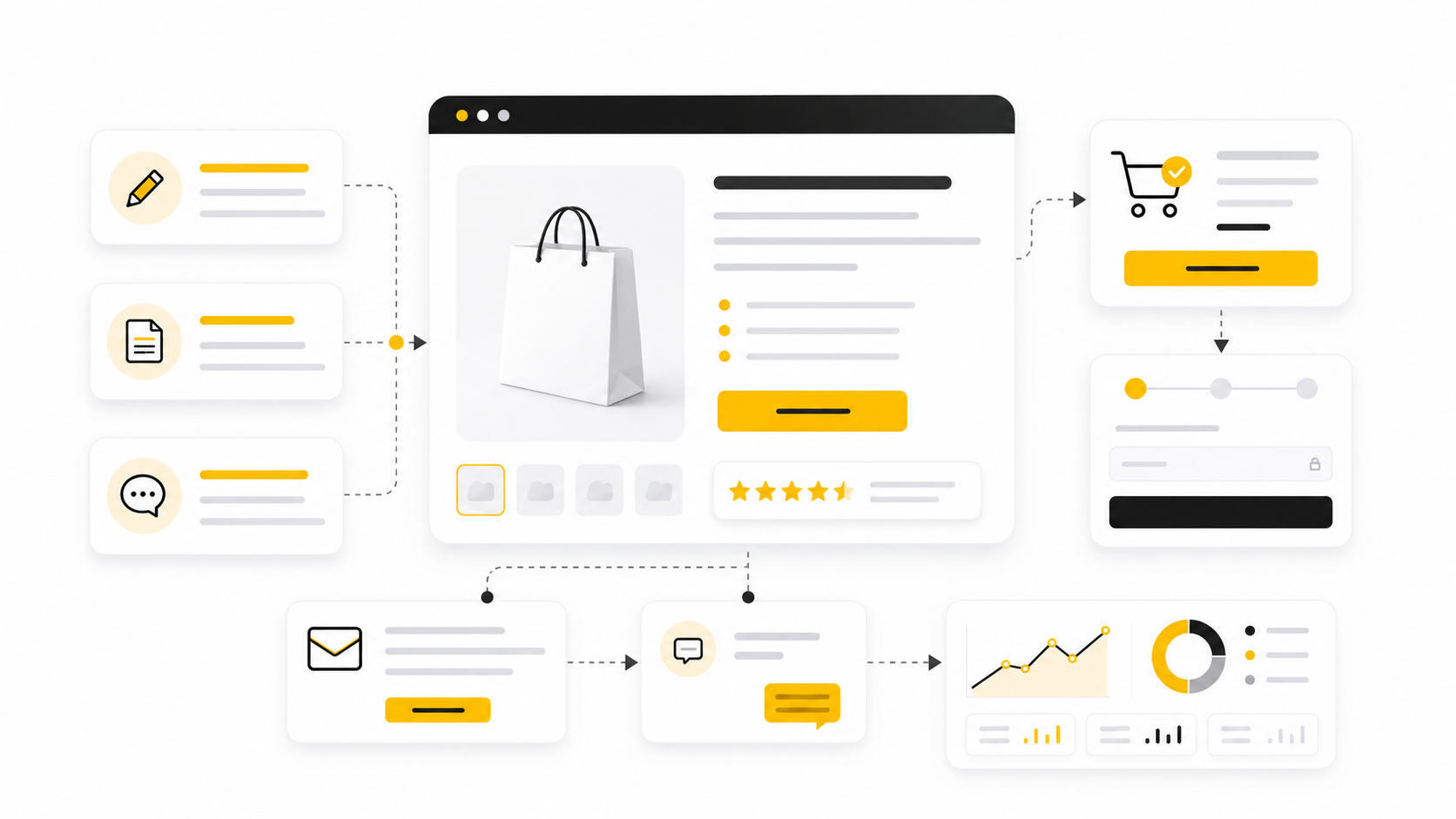
Ecommerce copywriting services are not just “better words for your product pages.” Done properly, they connect customer research, offer strategy, product positioning, conversion psychology, email flows, landing pages, ads, and retention messaging into one commercial system.
That matters because ecommerce customers rarely leave because the copy is ugly. They leave because something feels unclear, risky, generic, hard to compare, or not worth acting on right now. Baymard’s long-running checkout research shows an average cart abandonment rate of about 70% across ecommerce studies, which means a store can have plenty of buyer intent and still lose the sale before payment.
Good copy does not magically fix a weak product, broken pricing, slow shipping, or poor UX. But it can make the value obvious, remove hesitation, answer the questions shoppers are already asking, and help the store feel more trustworthy at each step. That is the real job of ecommerce copywriting services: not sounding clever, but making the buying decision easier.
This guide breaks the topic into six connected parts. Each part builds on the last, so by the end, you will know what ecommerce copywriting services include, when they are worth paying for, how to judge quality, and how to implement copy across your store without turning it into a pile of disconnected slogans.
Why Ecommerce Copywriting Services Matter
Most ecommerce stores do not have a traffic problem first. They have a clarity problem, a trust problem, an offer problem, or a sequencing problem. More traffic only makes those problems more expensive because every click lands on the same unclear product page, weak collection page, thin offer, or generic email flow.
This is why ecommerce copywriting services should be judged by how well they improve decision-making, not by how polished the words sound. A shopper wants to know what the product does, who it is for, why it is different, what could go wrong, what proof exists, and whether buying now is worth it. If the copy does not answer those questions quickly, the shopper has to do extra work.
That extra work is where sales leak. Nielsen Norman Group’s ecommerce UX research emphasizes that effective product pages need text and supporting media that communicate product details, availability, price, reviews, and a clear path to purchase in a way shoppers can understand quickly. In plain English: product copy is part of the buying interface, not decoration.
What Ecommerce Copywriting Services Usually Include
Ecommerce copywriting services can cover one page, one funnel, or the full customer journey. The scope depends on the store’s stage, traffic volume, product complexity, and current conversion bottlenecks. A small store may need better product descriptions and email flows, while a scaling brand may need a complete messaging system across ads, landing pages, bundles, subscriptions, quizzes, and post-purchase campaigns.
The most common deliverables include product page copy, collection page copy, homepage messaging, landing pages, cart and checkout microcopy, email flows, SMS copy, ad copy, quiz copy, upsell copy, and retention campaigns. Some providers also handle customer research, competitor analysis, offer development, A/B test planning, and conversion audits. The stronger services usually start with research before they write anything.
That research-first approach matters because ecommerce copy has to reflect how real customers think. Shopify’s own guidance on conversion copywriting describes the work as clarifying the value proposition, addressing customer pain points, and guiding people toward action through focused messaging. That is the difference between copy that fills a page and copy that helps sell.
The Framework Behind Effective Ecommerce Copy
A useful ecommerce copywriting framework starts with the customer, not the product. The copy needs to understand the buyer’s trigger, desired outcome, objections, alternatives, risk tolerance, proof needs, and buying context. Without that, the store ends up talking about features while the customer is still trying to decide whether the product fits their life.
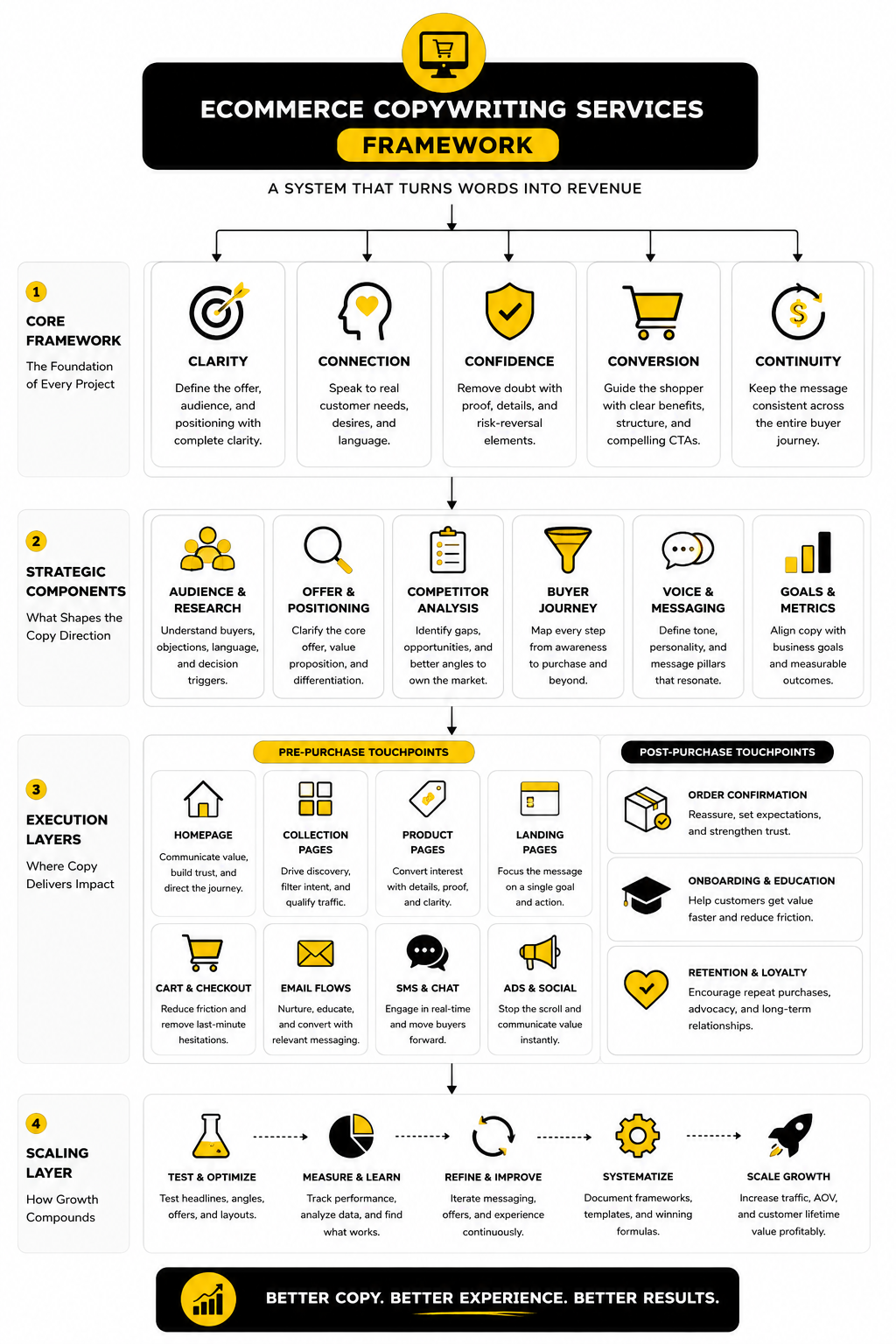
The framework used throughout this guide is simple: research the customer, clarify the offer, map the buying journey, write each asset for its job, and improve based on performance data. Product pages should not do the same job as ads. Welcome emails should not do the same job as abandoned cart emails. Collection pages should not read like mini homepages if shoppers are already comparing options.
This is where professional ecommerce copywriting services can create leverage. A good copywriter does not just write prettier descriptions. They help the store decide what needs to be said, where it needs to be said, what proof should support it, and what action should come next.
Core Components of Ecommerce Copywriting
The first core component is positioning. Shoppers need to understand what the product is, who it is for, why it exists, and why it is meaningfully different from the alternatives. If the positioning is weak, every page becomes harder to write because the store has no clear angle.
The second component is conversion messaging. This includes headlines, benefit statements, objection handling, proof points, guarantees, calls to action, urgency, product education, comparison copy, and checkout reassurance. These elements work together to reduce friction and move the shopper from interest to decision.
The third component is journey consistency. A customer may discover a brand through an ad, land on a product page, read reviews, join an email list, abandon a cart, come back through a retargeting campaign, and finally buy after a post-purchase incentive or limited-time offer. If every touchpoint sounds like it came from a different company, trust drops.
Where Professional Implementation Makes the Difference
Professional implementation is where strategy becomes revenue-facing copy. It is one thing to say the brand needs clearer messaging. It is another thing to rewrite the hero section, product page hierarchy, comparison table, guarantee block, FAQ, abandoned cart email, and post-purchase upsell so they all work together.
This is also where tools can help, as long as they do not replace thinking. A landing page builder like Replo can make it easier to launch ecommerce landing pages without waiting on a full development cycle. A messaging automation tool like ManyChat can support conversational flows for lead capture, product discovery, and follow-up when it fits the store’s funnel.
But the tool is never the strategy. The copy still has to carry the argument. The strongest ecommerce copywriting services help decide what the page should say before anyone starts building the page, automating the flow, or sending traffic to it.
The Ecommerce Copywriting Framework
The easiest way to waste money on ecommerce copywriting services is to treat copy as a finishing touch. That usually means the product, offer, page layout, funnel, and customer objections are already locked in, and the copywriter is asked to “make it sound better.” That is backwards.
A better framework starts before the writing. It asks what the customer already believes, what they need to understand, what they are comparing you against, what risk they feel, and what proof would make the next step feel safe. When ecommerce copy is built this way, the words do not sit on top of the store; they guide the store.
The framework has five practical stages:
Each stage solves a different problem. Skip one, and the copy usually becomes either too vague, too aggressive, too clever, or too disconnected from how people actually buy.
Start With Customer Research
Customer research is the foundation because customers already have the language you need. Reviews, support tickets, post-purchase surveys, sales calls, chat transcripts, Reddit threads, competitor reviews, and product questions all reveal what people care about before they buy. The goal is not to copy random phrases blindly, but to understand the repeated patterns behind them.
This matters because ecommerce shoppers are rarely evaluating only the product. They are evaluating fit, trust, timing, effort, price, and risk at the same time. Nielsen Norman Group’s ecommerce UX research notes that strong product pages combine text and supporting media to communicate product details, availability, pricing, reviews, and a clear path to purchase in a way shoppers can actually use.
Good ecommerce copywriting services should therefore begin by finding the real buying questions. What does the shopper need to believe before adding to cart? What makes them hesitate? What words do they use when they describe the problem? Those answers shape the page far more than a generic list of benefits ever will.
Clarify the Offer Before Writing the Page
Offer clarity comes next because even great copy cannot rescue a confusing offer. If the bundle is hard to understand, the guarantee is buried, the discount logic feels messy, or the product positioning is unclear, the copy has to compensate for problems that should have been fixed earlier. That creates bloated pages with too many claims and not enough direction.
A clear offer answers five questions quickly. What is included? Who is it for? What outcome does it help create? Why is it worth the price? Why should the shopper act now instead of later? If those answers are fuzzy internally, they will be even fuzzier on the page.
This is where ecommerce copywriting services often overlap with conversion strategy. The copywriter may recommend changing the order of information, simplifying bundles, renaming an offer, tightening guarantees, or separating audiences into different landing pages. That is not overstepping. That is what happens when copy is treated as selling architecture, not just wording.
Map the Buying Journey
The customer journey is not one page. A shopper might see a social ad, visit a product page, compare reviews, leave, receive an abandoned cart email, return through a retargeting ad, read a shipping policy, and then buy. If the messaging does not connect across those steps, the store feels fragmented.
Journey mapping gives every asset a job. Ads create the click. Landing pages develop the argument. Product pages help the shopper evaluate the item. Cart and checkout copy reduce anxiety. Email and SMS flows recover attention, answer objections, and bring people back when timing improves.
Baymard’s checkout research has found for years that checkout flow and design can be direct causes of abandonment when users become frustrated or unsure how to proceed during the purchase process. Copy is part of that experience. Small phrases around shipping, payment security, returns, delivery timing, and form fields can either reduce doubt or create more of it.
Write Each Asset for Its Specific Job
One of the biggest mistakes in ecommerce copy is making every asset say the same thing. A homepage should not read like a product description. A product page should not read like a brand manifesto. An abandoned cart email should not repeat the full landing page argument from scratch.
Each asset needs a specific role. A collection page helps shoppers narrow options. A product page helps them evaluate one item. A comparison section helps them choose between alternatives. A post-purchase email helps them use what they bought and become more likely to buy again. When the role is clear, the copy gets sharper.
This is why professional ecommerce copywriting services should not deliver isolated snippets with no context. The best work considers where the copy appears, what the shopper already knows, what action comes next, and what friction might stop that action. That is how the message becomes useful instead of just polished.
Build the Product Page Argument
The product page is usually the most important copy asset because it sits closest to the purchase. It has to explain the product clearly, make the outcome desirable, handle objections, provide proof, and support the call to action without overwhelming the shopper. That is a lot of work for one page.
A strong product page usually follows a logical argument. It starts with the main promise, explains the product in plain language, translates features into practical benefits, shows proof, answers objections, clarifies logistics, and reinforces the buying decision near the call to action. The exact order can change, but the logic should not feel random.
Baymard’s product page UX research covers thousands of usability scores across product page topics and points to a simple reality: shoppers need enough relevant information to evaluate the product confidently before they commit. Copy helps structure that confidence. It should not hide important details behind vague lifestyle language.
Connect Copy to Email and SMS Flows
The framework should not stop at the website. Email and SMS flows are where many ecommerce brands turn missed intent into recovered revenue. Welcome flows, abandoned cart flows, browse abandonment flows, post-purchase flows, replenishment flows, and win-back campaigns all need different messages because the customer’s context is different in each one.
Klaviyo’s flow benchmark data shows why this matters commercially, with abandoned cart, welcome, and post-purchase flows tracked by revenue per recipient across store sizes and average order values in its benchmark reference. The useful takeaway is not that every brand should copy the same flow. It is that lifecycle copy has measurable business impact when it matches intent.
For many stores, this is where ecommerce copywriting services create fast leverage. The traffic already exists. The subscribers already exist. The carts already exist. Better flow copy can improve what happens after the first visit, instead of relying only on more paid traffic.
Use Tools Without Letting Tools Lead
Tools can make implementation faster, but they do not create the strategy for you. A page builder can help launch landing pages. An email platform can automate flows. A chatbot can collect leads or guide shoppers toward the right product. None of that matters if the message is weak.
For ecommerce landing pages, Replo can be useful when a team wants to build and test pages without waiting on a long development cycle. For automated conversations, ManyChat can support product discovery, lead capture, and follow-up when conversational selling fits the funnel.
But again, the copy comes first. The tool should execute the argument, not invent it. If the offer is unclear, the research is thin, or the buying journey is messy, automation only helps you deliver weak messaging faster.
Improve the Copy With Performance Data
The final stage is improvement. Ecommerce copy should not be treated as a one-time creative deliverable that stays untouched for years. Once the copy is live, the store can use conversion data, heatmaps, scroll depth, search queries, reviews, support tickets, email metrics, and customer feedback to find what still needs work.
This does not mean changing headlines every three days because one metric moved. It means looking for patterns. Are shoppers dropping before they see the guarantee? Are people clicking size guides but not buying? Are abandoned cart emails getting opens but weak click-through? Are reviews answering objections that the page copy ignores?
That is the difference between writing and optimization. Ecommerce copywriting services are most valuable when they create a system that can keep improving. The first version should be strong, but the best version usually comes after the market shows you what it still does not believe.
Core Copy Assets Every Store Needs
Once the framework is clear, the next question is simple: what actually needs to be written? Ecommerce copywriting services can sound vague until you break the work into specific assets. Each asset should support a specific part of the buying journey, otherwise the store ends up with disconnected copy that looks busy but does not help the shopper move forward.
The core assets usually fall into four groups: store pages, product and collection pages, conversion flows, and retention messaging. A store does not always need all of them rewritten at once. The smart move is to prioritize the assets closest to revenue first, then expand outward once the main buying path is stronger.
This is also where implementation becomes practical. You are no longer talking about “brand voice” in the abstract. You are deciding what the homepage says, how product pages are structured, what abandoned cart emails need to answer, and where reassurance belongs before checkout.
Homepage Copy
The homepage is not always the highest-converting page, but it does set the tone for the brand. It needs to explain what the store sells, who it is for, why people should care, and where they should go next. If a shopper lands there and still has to work out the category, value proposition, or next step, the copy is not doing its job.
Good homepage copy usually starts with a clear promise, then supports it with product categories, proof, benefits, and strong navigation paths. The goal is not to tell the entire brand story above the fold. The goal is to orient the shopper quickly enough that they can continue with confidence.
This is where many ecommerce brands overcomplicate things. They use vague lines like “designed for modern living” or “crafted for your lifestyle” when the shopper needs something more concrete. Ecommerce copywriting services should sharpen that first impression so the homepage becomes a useful starting point, not a decorative billboard.
Collection Page Copy
Collection pages are decision pages. Shoppers use them to compare options, narrow choices, and decide which product is worth opening next. That means the copy should help people understand the category, choose the right path, and feel confident that they are looking in the right place.
A strong collection page does not need a giant block of text at the top. It needs useful guidance. That could include a short category intro, buying criteria, filters that make sense, comparison language, material explanations, sizing notes, use-case groupings, or short benefit-driven product cards.
This matters because collection pages often attract shoppers who are interested but undecided. They may know they want skincare, coffee gear, supplements, bedding, or apparel, but they do not yet know which item fits them. The copy should reduce comparison friction instead of forcing every shopper to click through multiple product pages blindly.
Product Page Copy
Product pages carry the heaviest commercial load. They have to turn interest into action while answering practical questions about fit, quality, use, ingredients, sizing, compatibility, delivery, returns, and trust. Baymard’s product page research is built around tens of thousands of usability scores and highlights how much product page performance depends on helping users evaluate products confidently before they buy.
The product page should be structured like a sales conversation. Start with the main promise, make the product easy to understand, translate features into buyer-relevant benefits, show proof, address objections, and make the buying step feel safe. The copy should not hide essential information behind hype.
For ecommerce copywriting services, this is often the first place to focus because product page improvements affect paid traffic, organic traffic, email traffic, and returning shoppers at the same time. If the product page is unclear, every acquisition channel becomes less efficient. If it is strong, the entire funnel gets more room to work.
Cart and Checkout Microcopy
Cart and checkout copy is small, but it can have an outsized effect on confidence. This is where shoppers start looking for delivery timing, payment security, return details, discount clarity, taxes, shipping costs, and anything that might change the final decision. A single unclear phrase can create hesitation at the worst possible moment.
Baymard’s checkout UX research includes more than 41,000 manually reviewed checkout performance scores and shows that checkout usability remains a major source of friction across ecommerce sites even among large retailers. Copy is not the only factor, but it is part of how shoppers understand what is happening. Labels, helper text, reassurance notes, shipping explanations, and error messages all shape the experience.
The mistake is thinking checkout copy needs to be persuasive in a loud way. It usually needs to be calm, clear, and specific. At this stage, the shopper is already close to buying, so the copy should reduce uncertainty rather than introduce new claims.
Landing Page Copy
Landing pages are useful when the store needs a focused argument for a campaign, product launch, bundle, quiz, advertorial, seasonal offer, or specific audience. Unlike a homepage, a landing page does not need to serve every visitor. It can speak directly to one intent and guide that person toward one action.
A strong ecommerce landing page usually includes a sharp hook, product explanation, benefits, proof, objection handling, offer details, FAQs, and a clear call to action. It should match the promise that brought the visitor there. If the ad says one thing and the landing page says something else, trust drops quickly.
This is where a tool like Replo can help teams launch dedicated ecommerce pages faster. But speed only helps when the copy has a clear job. A fast-built page with weak messaging is still weak.
Email Flow Copy
Email flows are where ecommerce copy continues the conversation after the first visit. Welcome flows introduce the brand and guide new subscribers. Abandoned cart flows recover shoppers who showed intent. Post-purchase flows reduce buyer’s remorse, improve product usage, and create the next buying opportunity.
Klaviyo’s flow benchmark reference tracks abandoned cart, welcome, and post-purchase performance by revenue per recipient, which is useful because it treats lifecycle copy as a revenue asset rather than just a communication channel inside the ecommerce journey. The point is not to copy benchmark numbers blindly. The point is to measure whether each flow is doing its job.
Ecommerce copywriting services should build these flows around timing and intent. A welcome email can educate. An abandoned cart email should reduce hesitation. A post-purchase email should help the customer succeed with the product. Different moment, different message.
SMS and Conversational Copy
SMS and chat-based flows need a different style from email. They are shorter, more immediate, and easier to overdo. The copy has to respect attention because a message that feels helpful can create revenue, while a message that feels pushy can damage trust fast.
Conversational copy works best when it helps the shopper make progress. That could mean answering product questions, recommending the right item, recovering a cart, confirming delivery details, or collecting preferences for a better offer later. The message should feel useful, not like a broadcast squeezed into a smaller box.
For stores that use chat and social messaging, ManyChat can support lead capture, product discovery, and follow-up flows. The important part is to script those flows around real customer decisions. Automation should make the buying path easier, not noisier.
Ad Copy and Message Testing
Ad copy is often the fastest way to test messaging angles. Different hooks can reveal whether shoppers respond more to a problem, outcome, product mechanism, offer, comparison, or social proof. That makes ad copy useful even before a full page rewrite.
But ads should not live in a separate universe from the store. If the ad promises a specific outcome, the landing page needs to continue that argument. If the ad focuses on a pain point, the product page should show how the product solves it. Consistency matters because the shopper notices when the message suddenly changes.
This is why ecommerce copywriting services should connect paid messaging with onsite copy. The best ad angle is not just the one with the cheapest click. It is the one that attracts the right shopper and gives the website a clear argument to continue.
How the Copywriting Process Works
The process should feel organized, not mysterious. A professional ecommerce copy project usually moves from audit to research, then messaging strategy, then asset writing, then implementation support, then performance review. That sequence prevents the copy from becoming a random set of rewritten pages.
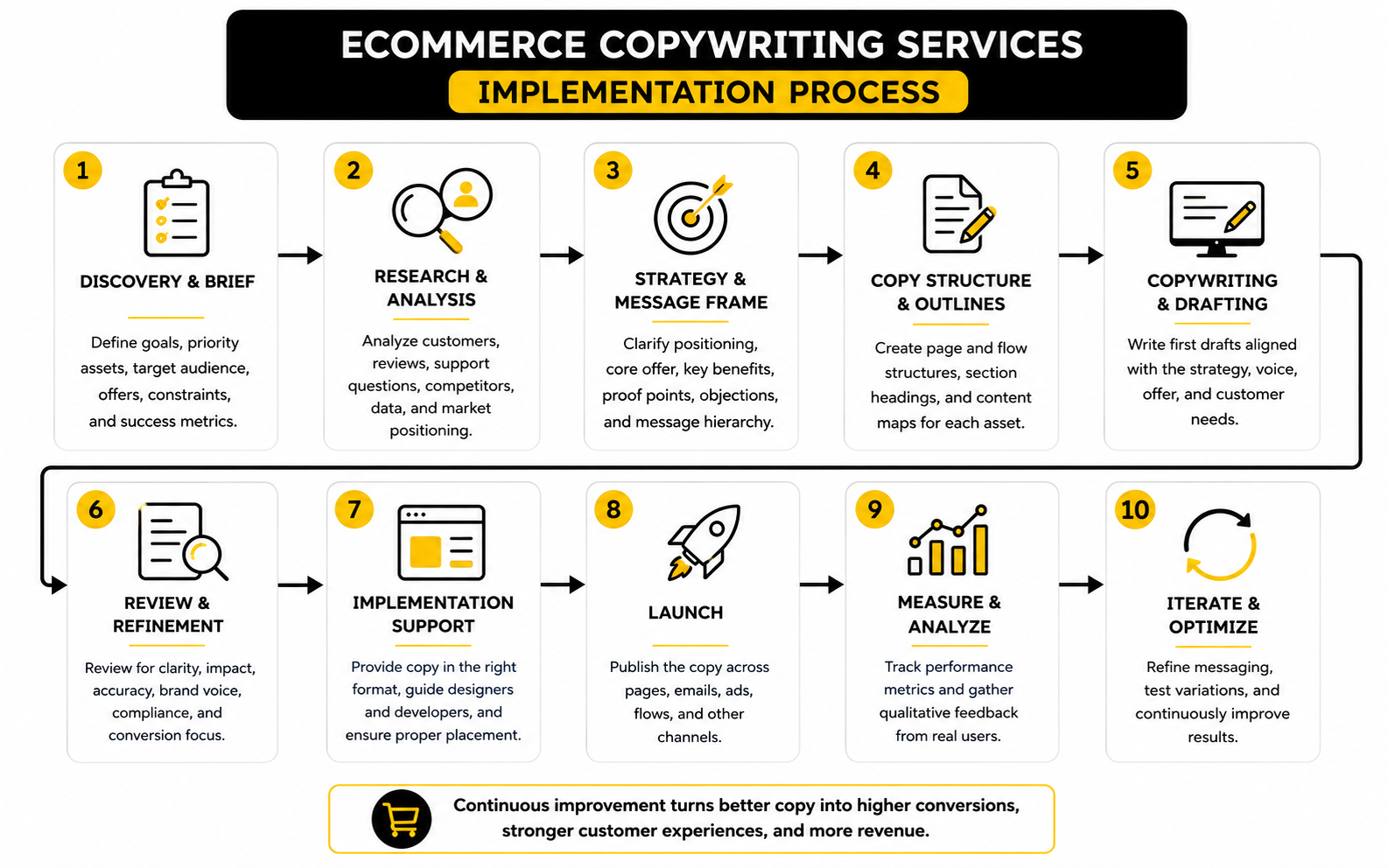
The process does not need to be bloated. But it does need enough structure to protect the quality of the work. When a copywriter jumps straight into headlines without understanding the customer, product, funnel, and offer, the result might sound good for a moment but usually lacks selling power.
A practical process also makes collaboration easier. The brand knows what inputs are needed. The copywriter knows what decisions must be made. Designers, developers, media buyers, and email marketers can then execute from the same message instead of guessing.
Step 1: Audit the Current Store
The audit identifies where the current copy is helping and where it is creating friction. This includes homepage messaging, product page structure, collection page clarity, checkout reassurance, email flows, landing pages, and ad-to-page consistency. The goal is to find the highest-leverage problems, not nitpick every sentence.
A useful audit looks at both content and behavior. Analytics can show where shoppers drop off, while the copy explains why they might be hesitating. Search terms, support questions, review themes, return reasons, and chat logs can all reveal gaps the page currently fails to answer.
This is where ecommerce copywriting services should be practical. The output should not be a vague “your copy needs to be more benefit-driven” comment. It should identify specific pages, specific friction points, and specific opportunities to improve the buying path.
Step 2: Gather Customer and Product Inputs
After the audit, the copywriter needs raw material. That includes customer reviews, competitor reviews, product details, founder notes, support tickets, survey responses, returns data, frequently asked questions, and performance data from existing campaigns. The more specific the input, the stronger the copy can become.
This step is not just about collecting nice phrases. It is about finding patterns. If customers repeatedly mention sizing uncertainty, shipping expectations, ingredient concerns, durability, setup difficulty, or comparison anxiety, those themes need to appear in the copy where they matter.
DHL’s 2025 ecommerce research found that delivery expectations can directly affect buying behavior, with shoppers abandoning carts when preferred delivery options are missing across global markets. That is a copy issue as much as a logistics issue. If delivery and returns matter to the buyer, the store has to communicate them clearly.
Step 3: Build the Messaging Strategy
Messaging strategy turns research into decisions. This is where the brand defines the core promise, audience segments, key benefits, proof points, objections, tone, product hierarchy, and calls to action. Without this step, every page becomes its own separate debate.
A clear strategy keeps the copy consistent across assets. The homepage, product pages, landing pages, emails, and ads may each have different roles, but they should still feel like they belong to the same brand. That consistency makes the store easier to trust.
This step also prevents overstuffed copy. When the main argument is clear, the page does not need to say everything at once. It can prioritize the right message in the right place, which is exactly what shoppers need when they are deciding quickly.
Step 4: Write and Structure the Assets
Writing is where the research and strategy become customer-facing copy. This includes headlines, section copy, product descriptions, bullets, calls to action, proof sections, comparison blocks, email sequences, SMS flows, and microcopy. The best version is usually clear before it is clever.
Structure matters just as much as wording. A product page with strong sentences in the wrong order can still underperform because the shopper receives the right information too late. A landing page with proof before the problem is clear may feel disconnected. A checkout note that appears after the shopper hesitates may not help.
This is why ecommerce copywriting services should deliver copy in a format that is easy to implement. Page sections should be labeled. Email flows should include timing and purpose. Calls to action should be tied to the asset’s role. The output should help the team build, not just admire the writing.
Step 5: Implement, QA, and Improve
Implementation is where many copy projects fall apart. The copy may be strong in a document, but it can lose impact when placed into a cramped template, broken across mobile screens, hidden below important visuals, or edited casually during upload. The final live experience is what matters.
Quality assurance should check whether the copy reads well on desktop and mobile, whether calls to action are visible, whether product details are easy to scan, and whether reassurance appears before shoppers need it. Shopify’s product page guidance highlights practical trust elements like delivery windows, return policy summaries, payment methods, certifications, and contact options as part of a stronger product page experience. Those details need to be placed where they help.
After launch, the copy should be reviewed against performance. Not every change needs a formal A/B test, but the store should watch conversion rate, add-to-cart rate, checkout completion, email revenue, click-through, support questions, and return-related feedback. That is how ecommerce copy becomes a working growth asset instead of a one-time writing project.
Statistics and Data
Data should make ecommerce copywriting services sharper, not noisier. The goal is not to collect random benchmarks and pretend they apply equally to every store. The goal is to understand where shoppers hesitate, which messages create movement, and which copy assets deserve attention first.
Benchmarks are useful only when they create perspective. If your store converts below an industry average, that does not automatically mean the copy is bad. Traffic quality, product price, device mix, brand awareness, offer strength, seasonality, and page speed all affect the number. But when the same friction appears across analytics, customer feedback, and page behavior, the copy is usually part of the fix.
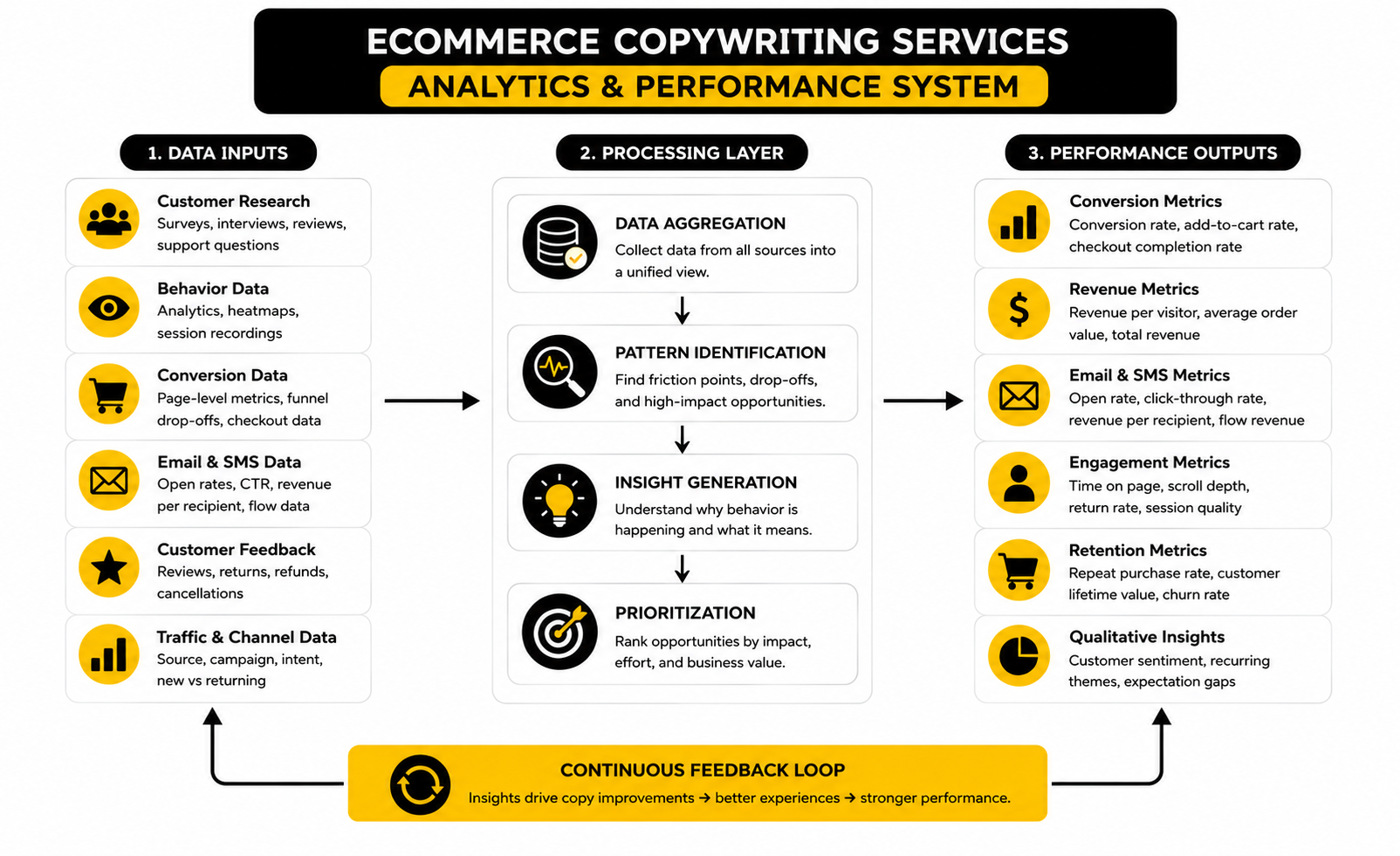
A practical measurement system looks at the buying journey in layers. You measure what happens before the product page, on the product page, during checkout, inside email and SMS flows, and after purchase. Each layer gives you a different signal, and together they show whether the copy is helping people move forward or leaving them stuck.
Conversion Rate Shows the Big Picture
Conversion rate is the obvious starting point, but it is not the whole truth. Shopify’s conversion rate guidance places the average ecommerce conversion rate roughly between 2.5% and 3%, which can be useful as a broad reference point. But a store selling low-cost impulse products should not interpret that number the same way as a brand selling expensive furniture, supplements, luxury goods, or technical equipment.
The real question is not just “What is our conversion rate?” The better question is “What type of visitor is converting, from which channel, on which device, after seeing which message?” A blended conversion rate can hide the fact that organic visitors trust the page, paid social visitors bounce quickly, and returning email visitors convert well.
For ecommerce copywriting services, conversion rate is a directional metric. If copy changes improve clarity, strengthen the offer, and reduce hesitation, conversion rate may improve. But you still need supporting signals to understand why it moved and what to improve next.
Add-to-Cart Rate Reveals Product Page Persuasion
Add-to-cart rate is one of the cleanest signals for product page copy. If enough qualified visitors reach the product page but few add to cart, the page may not be making the product feel clear, valuable, trustworthy, or urgent enough. This is where headlines, product descriptions, benefit bullets, proof, sizing guidance, comparison sections, and guarantee copy matter.
A weak add-to-cart rate does not always mean the product is bad. It might mean the page explains features without translating them into outcomes. It might mean important details are buried. It might mean the shopper likes the product but does not understand sizing, delivery, ingredients, compatibility, or what makes this option better than alternatives.
This metric should drive product page diagnosis. Look at scroll behavior, review themes, product questions, and on-page clicks. If shoppers keep opening the same accordion or searching for the same detail, the copy should bring that information forward instead of hiding it.
Cart Abandonment Points to Risk and Friction
Cart abandonment is where intent becomes fragile. Baymard’s long-running cart abandonment dataset places the average abandonment rate around 70% across ecommerce studies, which means most shoppers who add something to cart still do not complete the purchase. That number is not a reason to panic. It is a reminder that the cart is a decision point, not a formality.
The causes of abandonment are not all copy-related. Shipping costs, delivery timing, account creation, payment issues, taxes, checkout complexity, and trust concerns all play a role. But copy affects how those issues are understood. If shipping is explained late, returns are unclear, discounts feel confusing, or the checkout gives no reassurance, the shopper has more reasons to pause.
This is why ecommerce copywriting services should review cart and checkout microcopy, not just product pages. The closer the shopper gets to payment, the more precise the copy needs to become. This is not the place for clever language. It is the place for clarity.
Checkout Completion Shows Whether Confidence Holds
Checkout completion tells you whether shoppers who begin checkout feel safe enough to finish. Baymard’s checkout usability research shows that ecommerce sites still lose sales because users run into friction during checkout after already showing buying intent. That makes checkout a copy and UX problem together.
If checkout completion is weak, the first job is to identify where people exit. Do they leave when shipping costs appear? Do they stop at account creation? Do they hesitate at payment? Do error messages create confusion? Each exit point suggests a different copy problem.
The action here is usually small but important. Clarify delivery expectations. Explain payment security. Make returns easy to find. Improve form labels. Rewrite error messages so shoppers know exactly what to fix. Good checkout copy does not sell harder; it removes the last reasons not to buy.
Bounce Rate and Scroll Depth Show Message Fit
Bounce rate and scroll depth help diagnose whether the page matches the visitor’s expectation. Contentsquare’s 2025 benchmark research reported that brands are paying more to acquire online visitors while frustrating digital experiences are associated with a 6.1% drop in conversions. That matters because paid traffic does not fix a weak first impression.
If a landing page has high bounce and low scroll, the opening message may not match the ad, keyword, or audience intent. The visitor expected one argument and got another. This is common when brands send all traffic to a generic product page instead of creating a page for the specific campaign promise.
The fix is not always “write a better headline.” Sometimes the page needs a different angle, a clearer offer, faster proof, or a stronger above-the-fold structure. For ecommerce copywriting services, these metrics show whether the page earns enough attention for the rest of the copy to matter.
Email Metrics Show Whether the Follow-Up Works
Email metrics show how well the copy continues the sales conversation after the visitor leaves. Open rate can indicate subject line and audience fit, but click-through rate and revenue per recipient are usually more useful for judging commercial performance. If people open but do not click, the email may be interesting but not persuasive enough.
Klaviyo’s ecommerce benchmark resources show that abandoned cart emails can produce meaningful revenue per recipient, with the highest revenue per recipient in its benchmark reference coming from abandoned cart emails for stores with average order values above $200 at $14.14. The useful lesson is not that every store should expect the same number. The useful lesson is that high-intent flows deserve serious copy, segmentation, and testing.
Each email flow should be judged by its job. A welcome flow should turn attention into trust and first purchase intent. An abandoned cart flow should recover hesitation. A post-purchase flow should reduce regret, improve product usage, and create the next step. If every flow uses the same message, the data will usually show it.
Revenue Per Visitor Connects Copy to Business Impact
Revenue per visitor is often more useful than conversion rate alone because it combines conversion rate and average order value. A copy change might slightly lower conversion rate while increasing order value through better bundles, subscriptions, or product education. Another change might increase conversion rate but attract lower-value orders that do not help profitability.
This matters when evaluating ecommerce copywriting services because the real outcome is not prettier pages. The outcome is better commercial performance. A strong copy project should consider conversion rate, average order value, repeat purchase behavior, and margin reality together.
For example, stronger bundle copy may help shoppers choose a higher-value offer. Better comparison copy may reduce decision paralysis. Clearer subscription messaging may increase recurring revenue without pushing the wrong customers into a plan they will cancel immediately. The data has to be read in context.
Customer Feedback Explains What Numbers Cannot
Analytics tell you what happened. Customer feedback helps explain why. Reviews, support tickets, live chat transcripts, returns data, cancellation reasons, post-purchase surveys, and onsite search queries often reveal the copy gaps that dashboards cannot explain on their own.
If shoppers keep asking whether a product works for a specific use case, the page probably needs clearer use-case copy. If reviews praise a benefit that the page barely mentions, that benefit may deserve more attention. If returns mention expectation mismatch, the copy may be overselling, under-explaining, or failing to set realistic context.
This is where good ecommerce copywriting services become more grounded than generic CRO advice. The copy should reflect what real customers care about, not just what the brand wishes they cared about. When the same theme appears in both data and customer language, that is a strong signal to act.
What to Measure Before Hiring a Copywriter
Before hiring a copywriter, collect enough data to make the project focused. You do not need a perfect analytics setup, but you do need a clear picture of where the buying journey is leaking. That helps the copywriter prioritize the work instead of rewriting everything equally.
Useful inputs include:
This list keeps the project practical. Instead of asking for “better copy,” you can ask for clearer product pages, stronger abandoned cart recovery, better campaign landing pages, or a sharper product positioning system. Specific problems produce better work.
How to Interpret Benchmarks Without Fooling Yourself
Benchmarks are helpful, but they can also make teams lazy. A store can be above the average and still leave a lot of money on the table. Another store can be below the average because it sells a high-consideration product with longer buying cycles, not because the copy is broken.
The smart way to use benchmarks is to compare them against your own trend line. Are you improving month over month? Do product page changes lift add-to-cart quality? Do email tests improve revenue per recipient without increasing unsubscribes? Are checkout changes reducing drop-off in the exact step you targeted?
That is how data should guide ecommerce copywriting services. Not by chasing random numbers, but by identifying friction, making a focused copy change, and checking whether buyer behavior improves. Good measurement turns copy from opinion into a repeatable improvement process.
How to Choose the Right Ecommerce Copywriting Service
Choosing between ecommerce copywriting services is not just about finding someone who can write nice product descriptions. You are choosing someone who may influence how customers understand your offer, how campaigns convert, how email flows recover revenue, and how your brand sounds across the buying journey. That is not a tiny decision.
The right provider should understand copy, ecommerce behavior, customer research, offer structure, and implementation constraints. They do not need to be a designer, developer, media buyer, and retention strategist all at once. But they do need to know how their copy will actually live inside a store, campaign, or flow.
The biggest mistake is hiring only by portfolio polish. A beautiful sample can still be strategically thin. You want to know how the work was researched, what problem it solved, how the page or flow was used, and what the writer would do differently with more data.
Look for Research Before Wordsmithing
A serious copywriter should ask about customers before they ask about adjectives. They should want to see reviews, support questions, competitor pages, sales data, returns feedback, email performance, ad angles, and current page analytics. If their process starts and ends with a brand voice questionnaire, that is a warning sign.
This matters because ecommerce buyers are specific. They care about sizing, ingredients, shipping speed, compatibility, taste, durability, materials, return rules, subscription flexibility, and whether the product fits their actual situation. Generic benefit copy misses those details.
Strong ecommerce copywriting services use research to decide what to emphasize. They may still write with personality, but the personality sits on top of evidence. That is how you get copy that sounds human without drifting away from what customers need to know.
Prioritize Commercial Thinking Over Clever Lines
Clever copy can be useful, but only when it makes the buying decision easier. If a headline sounds witty but does not communicate the product or promise, it is probably decoration. Ecommerce copy needs to be clear first, persuasive second, and clever only when it helps.
A commercially minded copywriter thinks in terms of friction, intent, and action. They ask what the shopper already knows, what they need next, and what might stop them. They understand that a product page, collection page, checkout message, abandoned cart email, and post-purchase email all have different jobs.
This is especially important as acquisition gets more expensive. A store cannot afford copy that wins compliments but loses buyers. The more you spend on traffic, the more every unclear page, weak offer, and generic email flow costs you.
Match the Service to Your Stage
Not every store needs the same level of copy support. A new store may need foundational positioning, product page structure, and a welcome flow. A scaling brand may need landing pages, testing strategy, retention copy, segmentation, and cross-channel message consistency.
Early-stage brands should be careful about overbuying. A massive messaging project may not make sense if the product, pricing, or audience is still changing weekly. In that case, a focused copy audit, product page rewrite, or launch page may create more value than a full brand messaging system.
More mature brands usually need deeper strategic work. They may have enough traffic to diagnose specific conversion issues, enough customer feedback to find patterns, and enough revenue at stake to justify a more complete rewrite. At that stage, ecommerce copywriting services should connect copy with analytics, testing, and operational rollout.
Understand the Tradeoff Between Specialists and Generalists
A generalist can be useful when the store needs broad support across multiple assets. They may help with product pages, emails, ads, landing pages, and basic content without needing five separate hires. This can work well for smaller brands that need momentum more than specialization.
A specialist is usually better when the problem is narrow and high-value. If the store has strong traffic but weak product page conversion, hire someone who understands product page strategy. If lifecycle revenue is underdeveloped, hire someone with deep email and SMS experience. If paid traffic needs dedicated landing pages, hire someone who knows campaign-page alignment.
There is no universal best option. The right choice depends on the bottleneck. The only wrong move is hiring a generalist for a specialist problem, or hiring a specialist before you know which problem actually matters.
Check Whether They Understand Compliance and Trust
Ecommerce copy cannot promise whatever sounds persuasive. Claims need to be supportable, reviews need to be used honestly, and endorsements need proper disclosure. This is especially important for health, beauty, supplements, finance-adjacent products, children’s products, and anything with performance claims.
The FTC’s endorsement guidance makes clear that brands should have processes to ensure reviews reflect genuine customer feedback and that material connections are disclosed clearly when endorsements are used in advertising. That matters because copy that overclaims may create short-term lift and long-term risk.
A good ecommerce copywriter will not push fake urgency, unsupported claims, misleading testimonials, or manipulated review language. They should be able to make the product compelling without making the brand reckless. Trust is not soft. Trust is commercial.
Ask Better Questions Before Hiring
Most brands ask for samples and pricing. That is fine, but it is not enough. Better questions reveal how the copywriter thinks, what they need from you, and whether they understand ecommerce beyond writing.
Useful questions include:
The answers should be practical. You are not looking for someone who hides behind jargon. You are looking for someone who can explain the work clearly, challenge weak assumptions, and connect copy decisions to buyer behavior.
Watch for Red Flags
Some red flags are obvious. If a provider guarantees a specific conversion lift without seeing your store, traffic, product, margins, analytics, or offer, be careful. Copy can influence conversion, but no honest provider controls every variable.
Another red flag is a copywriter who focuses only on tone and ignores structure. Tone matters, but it will not fix a page that answers objections too late or hides the offer behind vague lifestyle language. Structure is part of persuasion.
Also be cautious with providers who rely entirely on AI-generated copy without research, editing, strategy, or quality control. AI can help with drafts, variations, summarization, and workflow speed, but it does not automatically understand your customers. Used lazily, it creates copy that sounds acceptable and says very little.
Use AI Carefully, Not Blindly
AI has changed ecommerce copy production, but it has not removed the need for judgment. McKinsey has described AI-driven personalization as a way for marketers to move beyond mass promotions toward more targeted offers and experiences based on customer behavior and preferences. That is useful, but only if the inputs and strategy are strong.
AI can help ecommerce teams summarize reviews, generate headline variations, draft email alternatives, cluster objections, and speed up repetitive copy tasks. It can also create generic pages, invented claims, and bland benefit lists if nobody controls the process. The tool amplifies the operator.
For ecommerce copywriting services, the best use of AI is usually behind the scenes. It can support research organization and iteration, but the final message still needs human strategy, customer understanding, legal caution, and brand judgment. That is where the value is.
Plan for Scaling Across More Products
Copy that works for five products may break when the catalog grows to fifty or five hundred. At scale, the challenge is not just writing more descriptions. The challenge is maintaining consistency, avoiding duplicate language, keeping product distinctions clear, and making sure shoppers can compare items without confusion.
This is where copy systems matter. A brand may need product description templates, benefit hierarchy rules, naming conventions, proof libraries, objection banks, comparison frameworks, and reusable messaging blocks. That keeps the copy consistent without making every product sound identical.
Scaling also creates operational risk. Product teams, agencies, freelancers, AI tools, and internal marketers may all touch the copy. Without guidelines, the brand voice drifts, claims become inconsistent, and important details disappear. A strong copy system prevents that.
Balance Brand Voice With Conversion Clarity
Brand voice matters because ecommerce is crowded. A distinctive voice can make a store more memorable, more trustworthy, and more emotionally resonant. But voice becomes a problem when it gets in the way of comprehension.
The shopper should never have to decode your personality before understanding the product. If the copy is funny but unclear, premium but vague, minimalist but incomplete, or bold but unsupported, it is not doing its job. Style should sharpen the message, not hide it.
The best ecommerce copywriting services protect both sides. They keep the brand recognizable while making the buying path easier. That balance is where strong ecommerce copy lives.
Decide What Success Looks Like Before the Project Starts
Before hiring, define what success means. A copy project can aim to improve product page clarity, increase add-to-cart rate, strengthen landing page conversion, recover more carts, raise email revenue, reduce support questions, improve subscription understanding, or make the brand easier to position. These are different goals.
If the goal is unclear, the feedback will be messy. One stakeholder may judge the copy by brand feel. Another may judge it by conversion metrics. Another may care about SEO. Another may want shorter pages. The project needs a shared definition of success before writing begins.
This also protects the copywriter. Clear goals make it easier to make smart tradeoffs. Sometimes the right copy is longer because the product needs explanation. Sometimes it is shorter because the customer already understands the category. The goal decides the shape.
Build a Long-Term Copy Advantage
The best brands do not treat copy as a one-off project. They keep learning from customer language, product feedback, campaign results, reviews, returns, and support questions. Over time, that creates a sharper message than competitors can easily copy.
This is where ecommerce copywriting services can become more than outsourced writing. A good partner can help build a messaging library, improve testing discipline, document claims, organize proof, and keep customer language close to the brand’s marketing. That creates compounding value.
You do not need endless copy projects. You need a better system for understanding what customers need to hear and making sure they hear it at the right moment. That is the strategic advantage.
Costs, Tools, Mistakes, and FAQs
By this point, the pattern should be clear. Ecommerce copywriting services are not valuable because they produce more words. They are valuable when they help the store make better commercial decisions, explain products clearly, reduce hesitation, and keep the buying journey consistent from first click to repeat purchase.
The final layer is the ecosystem around the copy. Pricing, tools, testing, compliance, implementation, and ongoing updates all affect whether the work actually performs. A strong copy project can still underdeliver if the store chooses the wrong scope, ignores the data, buries the copy in a bad layout, or treats the first draft as the final system.
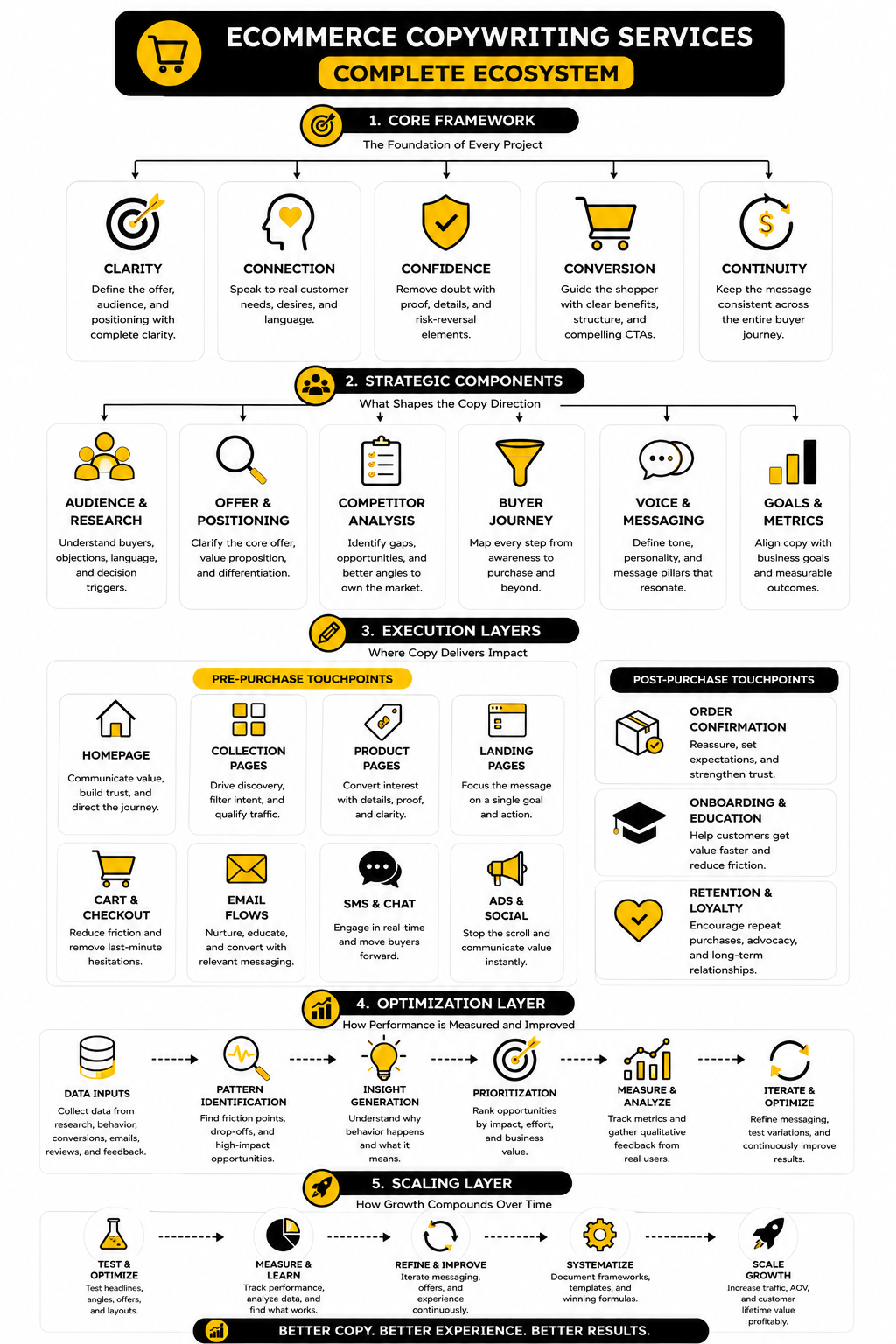
What Ecommerce Copywriting Services Usually Cost
Pricing varies because the scope varies. A single product page rewrite is not the same as a complete messaging strategy, homepage rewrite, landing page system, email flow buildout, and post-launch optimization plan. The more research, strategy, implementation support, and testing guidance involved, the more expensive the project usually becomes.
A small project might cover one page or one email flow. A larger project might include customer research, competitor analysis, offer refinement, product page templates, landing pages, email flows, SMS scripts, and a copy system the team can reuse. The important thing is to compare scope, not just price.
Cheap copy becomes expensive when it misses the actual bottleneck. If the store needs offer clarity but only buys prettier product descriptions, the project will feel disappointing even if the writing is fine. Better ecommerce copywriting services help define the right scope before selling you a deliverable.
Tools That Support Better Ecommerce Copy
Tools should make execution faster and measurement easier. They should not replace customer understanding. A landing page builder, email platform, chatbot, survey tool, CRM, analytics setup, or AI assistant can support the copy system, but none of them will fix unclear positioning by themselves.
For dedicated ecommerce landing pages, Replo can help teams move faster from copy concept to live page. For conversational lead capture and product guidance, ManyChat can be useful when the store has a clear reason to use chat or social messaging. For broader marketing automation and pipeline management, GoHighLevel can fit teams that want funnels, CRM, automation, and follow-up workflows in one place.
The decision should be practical. Pick tools based on the bottleneck, not the feature list. If the problem is weak product page clarity, a new automation platform is not the first fix. If the problem is poor lifecycle follow-up, better emails and a stronger automation setup may matter more than another homepage rewrite.
Common Mistakes to Avoid
The first mistake is writing before researching. Without customer language, real objections, review patterns, support questions, and product context, the copy usually becomes generic. It might sound clean, but it will not feel specific enough to create trust.
The second mistake is optimizing only the top of the page. Above-the-fold copy matters, but shoppers also need proof, details, objections, comparisons, shipping information, return clarity, and reassurance at the right moments. Baymard’s checkout research shows how much friction still appears near the purchase step, with its 2025 benchmark covering more than 41,000 manually reviewed checkout performance scores.
The third mistake is confusing persuasion with pressure. Fake urgency, vague claims, exaggerated benefits, and manipulated social proof may create short-term clicks, but they damage trust. FTC guidance on endorsements and reviews makes clear that review and testimonial use needs to reflect truthful advertising standards, especially when endorsements or material connections are involved in marketing.
When to Update Ecommerce Copy
Copy should be updated when the market changes, the product changes, the audience changes, or the data shows friction. That could happen after a product launch, a pricing change, a new bundle, a new acquisition channel, a wave of support questions, or a drop in conversion quality. You do not need to rewrite everything constantly, but you do need to keep the message current.
Customer feedback is one of the strongest triggers. If reviews keep mentioning a benefit the page does not highlight, update the page. If support keeps answering the same pre-purchase question, move that answer into the copy. If returns show expectation mismatch, make the promise more precise.
Copy should also be reviewed before scaling paid traffic. It is tempting to increase spend when an ad starts working, but weak landing pages and product pages can turn that spend into expensive leakage. Before scaling, make sure the message is clear, the offer is easy to understand, and the checkout path does not create avoidable doubt.
How to Brief a Copywriter Properly
A good brief saves time and improves the work. It should give the copywriter the context they need to make decisions, not just a list of pages to rewrite. The better the inputs, the stronger the output.
A useful brief includes:
The brief does not need to be perfect. But it should be honest. If the offer is still uncertain, say that. If the brand has no customer research yet, say that. A serious copywriter can work with imperfect information, but they cannot help much if the real constraints are hidden.
What are ecommerce copywriting services?
Ecommerce copywriting services help online stores write and structure the words that support buying decisions. This can include product pages, collection pages, landing pages, homepage messaging, cart and checkout microcopy, email flows, SMS scripts, ads, quizzes, and post-purchase campaigns. The goal is not just better wording, but clearer communication that helps shoppers understand the product, trust the store, and take the next step.
Why do ecommerce stores need professional copywriting?
Ecommerce stores need professional copywriting because shoppers make fast decisions with incomplete information. If the product value, proof, shipping details, return policy, sizing, compatibility, or offer logic is unclear, many people will leave instead of working harder. Professional copy helps reduce that friction and makes the buying path feel easier.
What is the difference between ecommerce copywriting and content writing?
Ecommerce copywriting is built to support specific commercial actions, such as clicking a product, adding to cart, completing checkout, joining a list, or returning to a cart. Content writing usually focuses more on education, organic traffic, brand authority, or long-form topics. Both can work together, but ecommerce copywriting sits closer to revenue.
What pages should be rewritten first?
Start with the pages closest to revenue. For most stores, that means product pages, high-traffic landing pages, abandoned cart flows, collection pages, and checkout microcopy. A homepage rewrite can help, but it should not automatically come first if the biggest leak is happening on product pages or email flows.
How do I know if my product page copy is weak?
Weak product page copy usually creates confusion, not just low conversion. Watch for low add-to-cart rate, repeated support questions, poor scroll engagement, high product page exits, unclear review themes, or shoppers asking basic questions that the page should already answer. If buyers need to contact support before they understand whether the product fits them, the copy probably needs work.
Can ecommerce copywriting improve conversion rate?
Yes, ecommerce copywriting can improve conversion rate when the current copy is part of the friction. It can clarify the offer, improve product understanding, handle objections, strengthen proof, and reduce checkout hesitation. But conversion rate also depends on traffic quality, pricing, product-market fit, design, speed, trust, inventory, and offer strength, so copy should be measured in context.
How long does an ecommerce copywriting project take?
The timeline depends on scope and complexity. A focused product page or email flow project can be much faster than a full-store messaging overhaul. Research-heavy projects take longer because the copywriter needs time to review customer feedback, analytics, competitors, product details, and the full buying journey before writing.
Should ecommerce copy be short or long?
Ecommerce copy should be as long as the buying decision requires and no longer. A simple low-risk product may need short, direct copy. A higher-priced, technical, personal, regulated, or unfamiliar product usually needs more explanation, proof, and objection handling. The question is not length. The question is whether the copy gives shoppers what they need to decide.
Are AI tools enough for ecommerce copywriting?
AI tools can help with drafts, variations, research organization, headline ideas, and repetitive copy tasks. They are not enough on their own if the store needs strategy, customer insight, offer clarity, compliance judgment, or conversion-focused structure. AI can speed up production, but someone still needs to decide what the copy should actually say and why.
What should I look for in an ecommerce copywriter?
Look for customer research, commercial thinking, ecommerce experience, clear process, and practical implementation awareness. A good ecommerce copywriter should ask about analytics, reviews, support questions, traffic sources, offers, product details, and business goals. They should be able to explain why each asset needs specific messaging instead of writing everything in the same style.
How should ecommerce copywriting services be measured?
Measure ecommerce copywriting services with metrics tied to the asset. Product page copy can be judged by add-to-cart rate, conversion rate, product questions, and revenue per visitor. Email flows can be judged by click-through rate, revenue per recipient, placed order rate, unsubscribe rate, and flow contribution. Checkout copy can be judged by checkout completion and step-level drop-off.
Is SEO part of ecommerce copywriting?
SEO can be part of ecommerce copywriting, especially for collection pages, product descriptions, category intros, and buying guides. But SEO should not make the copy awkward or keyword-stuffed. The strongest ecommerce copy uses search intent naturally while still helping real shoppers compare, trust, and buy.
How often should ecommerce copy be tested?
Copy should be tested when there is enough traffic to learn something meaningful or when the change affects a high-value part of the buying journey. For lower-traffic stores, qualitative signals like support questions, reviews, heatmaps, and session recordings can guide improvements before formal testing is realistic. The key is to make deliberate changes and watch whether buyer behavior improves.
What is the biggest mistake brands make with ecommerce copywriting?
The biggest mistake is treating copy as decoration instead of decision support. Pretty language does not matter if shoppers still do not understand the product, trust the offer, or know what to do next. Ecommerce copy should make the sale feel clearer, safer, and more compelling.
Build a stronger local presence with BAAM AI
Turn your website, Google profile, social channels, and AI visibility into one growth engine
Most businesses do not need more random marketing activity. They need a consistent presence system that helps the right people find them, trust them, and take action. BAAM AI brings strategy, local SEO, website updates, Google Maps visibility, social content, AI-search readiness, media production, and reporting into one practical monthly engine.
If you want your marketing to keep working after the campaign ends, start with a free BAAM AI presence audit. See how your business shows up today and where the fastest visibility wins are at BAAM AI.