
BAAM AI Blog
Ecommerce Copywriter: A Practical Guide To Copy That Turns Shoppers Into Buyers
An ecommerce copywriter does more than write clever product descriptions. The real job is to turn customer hesitation into confident buying action across product pages, collection pages, landing pages, email flows...
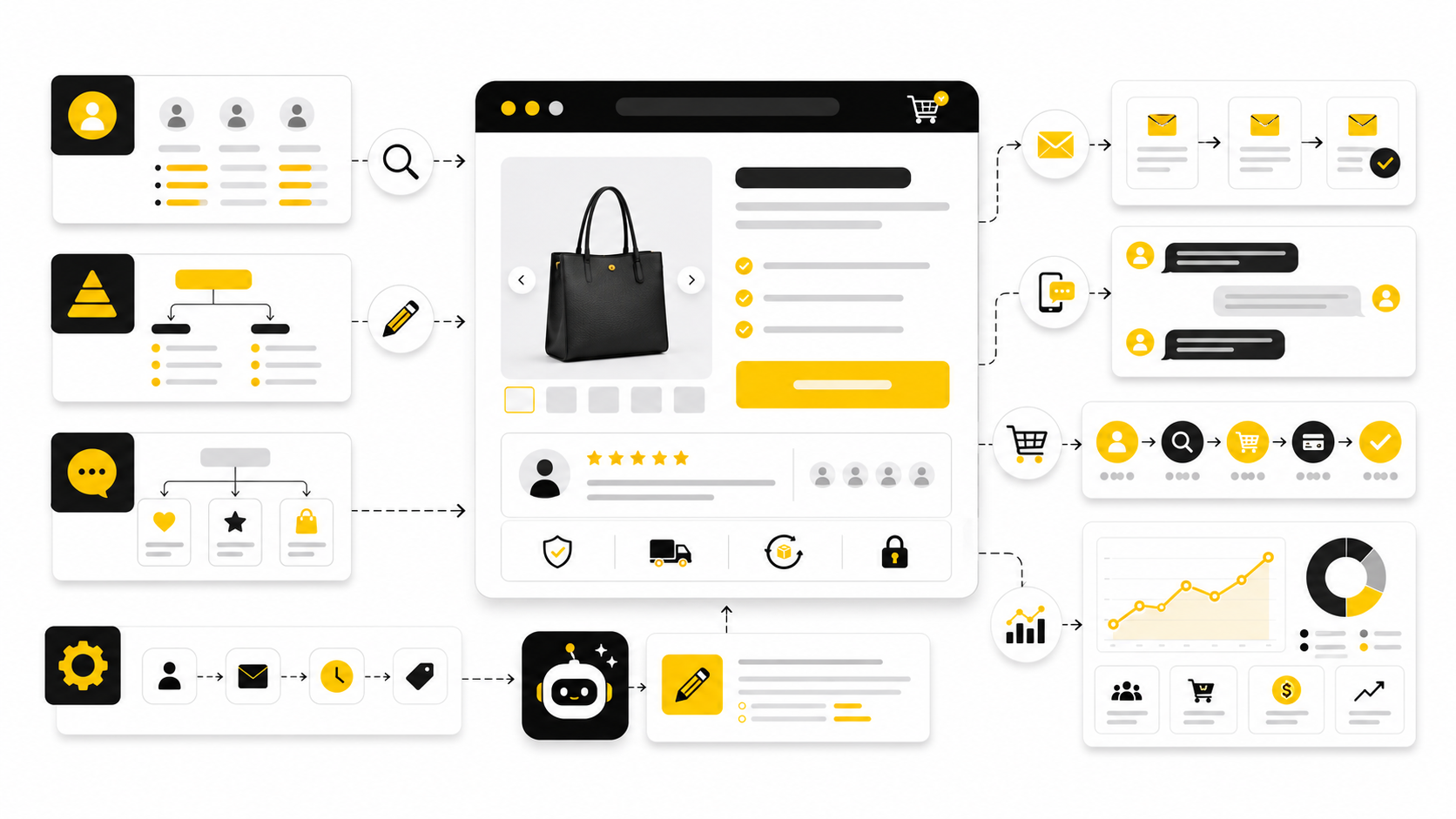
An ecommerce copywriter does more than write clever product descriptions. The real job is to turn customer hesitation into confident buying action across product pages, collection pages, landing pages, email flows, SMS, ads, checkout messages, and post-purchase communication. Good ecommerce copy makes the store easier to understand, easier to trust, and easier to buy from.
That matters because ecommerce is not short on traffic. It is short on clear decisions. Shoppers compare products quickly, skim aggressively, abandon carts often, and expect brands to understand what they want before they have to work too hard for it.
The copy has to carry more weight now. Cart abandonment still sits around 70% across documented ecommerce studies, which means the sale is often lost after interest already exists: Baymard’s cart abandonment research. At the same time, 71% of consumers expect personalized interactions, and frustration rises when brands fail to deliver relevance: McKinsey’s personalization research. An ecommerce copywriter works inside that gap between attention and action.
this guide is structured as one guide split into six parts. Each part builds on the previous one, so the strategy moves from the role of ecommerce copywriting into research, page-level execution, lifecycle copy, and professional implementation. The goal is not to make copy sound “better” in isolation, but to show how copy supports the full buying journey.
Why Ecommerce Copywriting Matters Now
Ecommerce copywriting matters because shoppers do not buy from pages they cannot quickly understand. They need to know what the product is, who it is for, why it is different, what risk they are taking, and what happens after they click. If the copy leaves those questions unanswered, the design can look beautiful and the offer can still leak revenue.
The modern ecommerce copywriter sits between brand, performance marketing, UX, and customer research. That means the work is not only about headlines and product descriptions. It includes the words that shape category navigation, benefit hierarchy, objection handling, trust signals, calls to action, checkout confidence, abandoned cart recovery, and retention messaging.
This is also why ecommerce copywriting has become more strategic. AI can produce drafts quickly, and platforms can generate product copy at scale, but speed does not solve positioning. The value of a strong ecommerce copywriter is judgment: knowing what to say, what to remove, what to emphasize, and where the shopper needs reassurance instead of another claim.
The Ecommerce Copywriter’s Real Job
The real job of an ecommerce copywriter is to make the buying decision feel clear. That starts before the shopper reaches the product page and continues after the purchase. A customer may first see a paid ad, click into a landing page, browse a collection, read reviews, compare variants, join an email list, abandon a cart, return through SMS, and then finally buy.
Every one of those moments has copy. Some of it is obvious, like product headlines and email subject lines. Some of it is quieter, like size guidance, shipping notes, guarantee language, filter labels, review prompts, and microcopy near the checkout button.
The best ecommerce copy does not shout at the customer. It reduces uncertainty. It tells the shopper what matters, in the order they need to hear it, using language that feels close to how they already think about the problem.
The Framework Overview
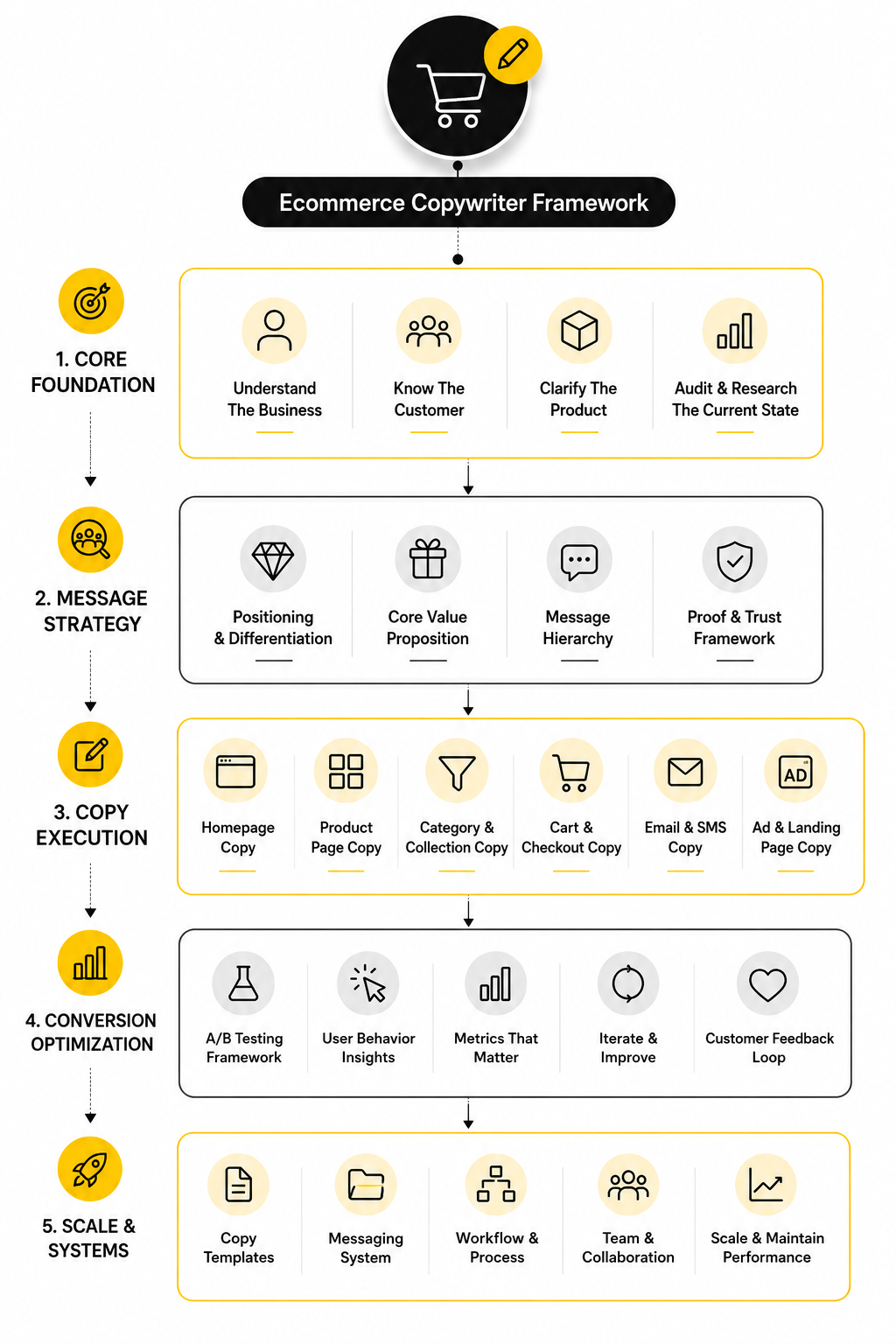
A practical ecommerce copywriting framework starts with four questions. First, what does the customer already believe before they land on the page? Second, what does the product help them achieve or avoid? Third, what proof would make the claim credible? Fourth, what friction could stop the purchase even if they want the product?
Those questions create the backbone of the copy. The customer belief shapes the opening angle. The desired outcome shapes the benefits. The proof shapes the trust layer. The friction shapes the objections, guarantees, FAQs, comparison copy, and checkout reassurance.
This framework keeps the writing grounded. Instead of decorating a product with generic adjectives, the ecommerce copywriter builds a path from interest to clarity to confidence. That is the difference between copy that sounds nice and copy that helps a store sell.
What This Guide Will Build Toward
The rest of this guide will break the work into practical layers. Part 2 will define the full ecommerce copywriting framework in more detail, including how to connect customer awareness, product positioning, proof, and conversion friction. Part 3 will move into research, because strong ecommerce copy usually comes from better listening before better writing.
Part 4 will focus on product pages, where copy has to balance skimmability with enough depth to support the sale. Part 5 will expand into email, SMS, ads, and lifecycle messaging, because ecommerce revenue rarely comes from one page alone. Part 6 will cover professional implementation, measurement, and the FAQ, so the strategy can be turned into repeatable work rather than one-off rewrites.
A good ecommerce copywriter is not just a word person. They are a buying-journey person. The better they understand how shoppers move, hesitate, compare, and decide, the more useful every line of copy becomes.
The Ecommerce Copywriting Framework
The ecommerce copywriter needs a framework because random copy improvements rarely create a reliable lift. A stronger headline can help, but only if the headline solves the right problem. A better product description can help, but only if it gives the shopper the information they need before doubt takes over.
The framework is simple: match the customer’s stage of awareness, clarify the product’s value, prove the promise, remove friction, and guide the next action. That sounds basic, but most ecommerce pages skip at least one of those steps. They either push the offer too early, bury the benefit, make claims without proof, or leave practical buying questions unanswered.
This is where ecommerce copywriting becomes a conversion system instead of a writing task. The words have to work with the page layout, product photography, reviews, offer structure, email flows, and checkout experience. When those pieces support each other, the shopper does not have to “figure out” why they should buy.
Start With Customer Awareness
Customer awareness is the first filter. A shopper who already knows the product category needs different copy than someone who is still trying to understand the problem. A shopper comparing three similar products needs sharper differentiation than someone who already trusts the brand and only needs the right size, bundle, or shipping details.
A useful way to think about awareness is to ask what the customer already believes when they arrive. They may believe the product is too expensive, too complicated, too risky, too similar to everything else, or not meant for someone like them. The copy should meet that belief directly instead of pretending every visitor arrives ready to buy.
This matters because ecommerce shoppers skim under pressure. They are comparing tabs, reading reviews, checking prices, and looking for reasons to leave. A strong ecommerce copywriter does not start by asking, “What can we say about this product?” The better question is, “What does this customer need to believe before the next click feels obvious?”
Clarify The Product’s Value
Clear value is not the same as a long list of features. Features describe what the product has. Value explains why those features matter to the customer. If a product page only says “premium fabric,” “advanced formula,” or “ergonomic design,” the shopper still has to translate those claims into a reason to care.
The copy should connect product details to outcomes. That could mean comfort, speed, durability, confidence, convenience, better fit, easier maintenance, lower waste, or a better-looking result. The exact outcome depends on the product, but the principle stays the same: the shopper should not have to work hard to understand the payoff.
Good ecommerce copy also avoids overexplaining what the customer already understands. If the product is simple, the copy should be clean and decisive. If the product is technical, the copy should organize information so the shopper can move from simple benefits into deeper details without getting overwhelmed.
Prove The Promise
Every ecommerce brand makes claims. The problem is that shoppers have learned to distrust generic ones. “High quality,” “best-in-class,” “important,” and “customer favorite” do not mean much unless the page gives people a reason to believe them.
Proof can come from reviews, ratings, user-generated content, guarantees, certifications, press mentions, ingredient details, material specs, comparison tables, founder expertise, or transparent policies. The right proof depends on the product and the risk the customer feels. A skincare buyer may want clinical context and ingredient clarity, while a furniture buyer may care more about dimensions, delivery, returns, and real customer photos.
The proof layer should sit close to the claim it supports. If the copy says a product is easy to install, the page should quickly show why that is believable. If the copy says the product lasts longer, the page should explain the material, testing, warranty, or customer evidence behind that claim.
Remove Buying Friction
Friction is anything that makes the shopper pause for the wrong reason. Some friction is emotional, like doubt about whether the product will work. Some is practical, like unclear shipping costs, confusing sizing, weak return information, or uncertainty about what happens after purchase.
Checkout and policy clarity matter because shoppers often abandon purchases when costs, delivery expectations, or return conditions feel unclear. Baymard’s ecommerce research continues to show that shipping, returns, and checkout usability are not minor details; they are major decision points in the buying journey: Baymard checkout UX research. That means the ecommerce copywriter should treat these moments as conversion copy, not admin text.
Friction removal is not about making the page longer. It is about placing the right reassurance where hesitation naturally appears. A size guide belongs near size selection. Shipping clarity belongs near the buying decision. Return reassurance belongs before the shopper has to hunt for it in the footer.
Guide The Next Action
A call to action is not just a button label. It is the point where the page asks the shopper to make a decision. If the copy before the button has done its job, the CTA feels like the natural next step instead of a demand.
For simple purchases, the next action may be “Add to cart.” For higher-consideration products, it may be choosing a bundle, checking compatibility, taking a quiz, reading reviews, or comparing options. The ecommerce copywriter should understand the decision path before writing the CTA, because the wrong action at the wrong moment creates resistance.
This is especially important when stores use landing pages, funnels, quizzes, or guided selling flows. A landing page builder like Replo can help ecommerce teams create more focused campaign pages, but the page still needs a clear decision path. Tools can support the structure. The copy has to make the next step feel worth taking.
Match The Message To The Page Type
Not every ecommerce page should say the same thing. A homepage needs to orient people quickly. A collection page needs to help them choose. A product page needs to make the specific item feel like the right decision. A checkout page needs to reduce anxiety and keep momentum.
This is where many brands get lazy. They reuse the same brand lines everywhere and expect the customer to connect the dots. But each page has a job, and the copy should respect that job.
A practical page-level framework looks like this:
Each page should feel connected, but not identical. The shopper is moving through a sequence, so the message should evolve with them. That sequence is what turns ecommerce copy from isolated text blocks into a buying journey.
Build Around The Offer
The offer is the center of the copy. If the offer is weak or confusing, better writing can only do so much. The ecommerce copywriter should understand the product, price, bundle, guarantee, bonus, subscription option, shipping threshold, and urgency before writing a single line.
This does not mean every store needs discounts. In fact, overusing discounts can train customers to wait. A stronger offer may come from a clearer bundle, better comparison, stronger guarantee, faster delivery promise, more useful bonus, or a more compelling reason to choose this product now.
The copy should make the offer easy to process. If there are three bundles, explain who each one is for. If there is a subscription option, explain the control the customer has. If there is a limited promotion, make the terms clear instead of dressing vague urgency as strategy.
Keep The Voice Human
Ecommerce copy should sound like a helpful person who understands the product and respects the customer’s time. It should not sound like a keyword tool, a legal notice, or a hype machine. The best copy feels specific without being stiff and confident without being pushy.
That balance matters because customers can sense when a page is trying too hard. Inflated claims make people skeptical. Vague adjectives make the product feel generic. Overly polished brand language can create distance when the shopper simply wants useful information.
A strong ecommerce copywriter writes with enough personality to make the brand memorable, but not so much personality that the product becomes harder to understand. Clear beats clever most of the time. And when clever does work, it works because the message is already clear underneath.
Customer Research And Message Strategy
The framework only works when it is built on real customer research. Without that, an ecommerce copywriter is mostly guessing. The copy may sound polished, but it will miss the exact fears, desires, comparisons, and buying triggers that shape the customer’s decision.
Research is not about collecting random quotes and pasting them into a product page. It is about finding the pattern behind what customers say, what they ask, what they compare, and what stops them from buying. Once those patterns are clear, the message strategy becomes much easier to build.
This is where the work becomes practical. The ecommerce copywriter is not trying to write from personal taste. They are trying to translate customer language into a clear sales argument that fits the page, the product, the offer, and the stage of the buying journey.
Start With The Voice Of The Customer
Voice-of-customer research gives copy its raw material. Reviews, support tickets, live chat transcripts, surveys, return reasons, social comments, competitor reviews, Reddit threads, and sales calls can all reveal what shoppers actually care about. The useful phrases are often not the polished ones; they are the blunt sentences customers use when they are frustrated, excited, skeptical, or relieved.
The point is not to copy every phrase word for word. The point is to understand the language customers already use to describe the problem and the result they want. If customers keep mentioning fit, texture, setup time, battery life, scent strength, delivery anxiety, or confusion about sizing, the copy should not hide those issues under vague brand language.
This matters because review behavior is still a major part of digital trust. Recent consumer research shows that customer testimonials and peer reviews influence trust during social shopping, especially when shoppers are evaluating whether a brand feels credible enough to buy from: Bazaarvoice’s 2025 shopper trust research. For the ecommerce copywriter, that means reviews are not just proof assets. They are research assets.
Map The Buying Questions
Every product creates questions. Some questions are obvious, like price, size, shipping, returns, and compatibility. Others are more emotional, like whether the product will work for someone like the shopper, whether it will feel worth the money, or whether the brand will make things difficult if something goes wrong.
A strong message strategy maps those questions before writing. The ecommerce copywriter should list what the customer needs to know at each step of the journey, then decide where each answer belongs. Some answers belong in the hero section. Some belong near the product options. Some belong in comparison copy, review highlights, FAQs, email flows, or checkout reassurance.
This process prevents two common mistakes. The first is overloading the top of the page with too much information. The second is hiding important reassurance too low on the page, where the shopper may never see it. Good copy sequencing answers questions when they become relevant.
Build The Message Hierarchy
A message hierarchy decides what the shopper should understand first, second, and third. This is one of the most important skills an ecommerce copywriter can bring to a brand. Without hierarchy, every claim fights for attention and the page feels noisy.
The strongest message usually sits at the intersection of customer desire, product strength, and market difference. It should be specific enough to matter and simple enough to process quickly. Once that top message is clear, the supporting copy can explain benefits, proof, technical details, use cases, objections, and next steps in a logical order.
The hierarchy should also reflect the product’s complexity. A low-consideration product may need a simple benefit, a few trust signals, and fast checkout clarity. A higher-consideration product may need education, comparisons, detailed proof, use-case sections, and stronger post-purchase reassurance.
Turn Research Into Copy Blocks
Research becomes useful when it turns into specific copy decisions. The ecommerce copywriter should not end research with a messy document full of quotes. They should turn the findings into page-ready building blocks that can guide execution.
Those blocks might include:
Each block should have a job. The value proposition creates immediate relevance. The benefits create desire. The objections reduce hesitation. The proof builds belief. The CTA moves the shopper forward.
A Practical Ecommerce Copywriting Process
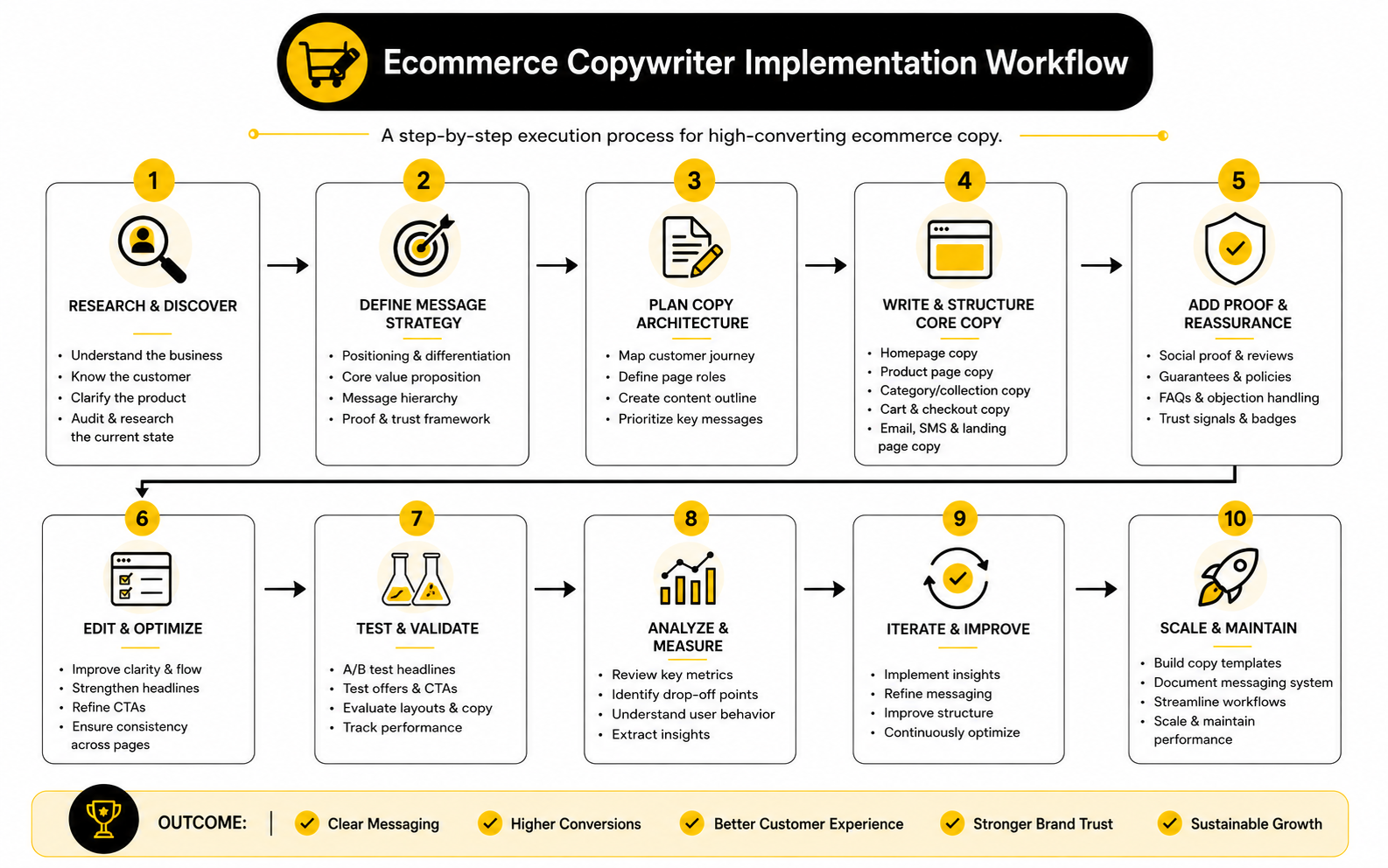
A useful process keeps the work from becoming scattered. It also makes collaboration easier, especially when the ecommerce copywriter is working with designers, founders, marketers, product teams, or developers. The process does not need to be complicated, but it does need to be repeatable.
A practical workflow looks like this:
This process keeps the work focused. It also avoids the trap of treating copy as something that happens at the end after the page is already designed. In ecommerce, copy and structure should shape each other.
Use Data Without Letting It Flatten The Message
Data helps, but it should not make the copy lifeless. Analytics can show where people drop off, what pages convert, what emails get clicked, and where mobile users struggle. Heatmaps, session recordings, surveys, A/B tests, and customer support trends can all point toward better copy decisions.
The mistake is treating data as a replacement for judgment. A low click rate might mean the CTA is weak, but it could also mean the offer is unclear, the section appears too late, the audience is wrong, or the page fails to build enough trust before asking for action. The ecommerce copywriter has to interpret the signal, not just react to the number.
UX research continues to show that ecommerce problems are often structural, not just verbal. Baymard’s product list benchmark found that many ecommerce sites still have weak product list and filtering experiences, including 58% of desktop sites and 78% of mobile sites performing “mediocre” or worse: Baymard’s product list UX research. Copy cannot fix broken navigation by itself, but it can make choices, filters, labels, and product comparisons much easier to understand.
Write For The Customer’s Decision, Not The Brand’s Ego
Brands often want to say everything. Customers usually want the few things that help them decide. That tension is where a lot of ecommerce copy gets bloated.
The ecommerce copywriter needs to protect the customer’s attention. That means cutting claims that do not support the buying decision, simplifying language that feels internally impressive but externally vague, and moving secondary details to the right place. More copy is not always more persuasive. Better order is usually more persuasive.
A practical test is simple: does this line help the shopper understand, believe, compare, choose, or act? If not, it probably needs to be cut, moved, or rewritten. The best ecommerce copy feels useful because every section earns its place.
Connect Research To The Offer
Research should influence the offer, not just the wording around it. If customers repeatedly hesitate because they fear choosing the wrong size, the answer might be better size guidance, clearer returns, or a fit quiz. If they hesitate because the product feels expensive, the answer might be comparison copy, bundle framing, financing clarity, or stronger proof of durability.
This is where ecommerce copywriting connects with merchandising and conversion strategy. The copywriter may not control pricing or operations, but they can show where the message is being forced to cover for an offer problem. That is valuable. Sometimes the best copy recommendation is not a new headline; it is a clearer guarantee, a better bundle, or a more useful comparison.
Tools can help teams turn these ideas into faster tests. For stores building focused campaign pages, Replo can support landing page execution. For brands that rely heavily on conversational flows, ManyChat can help structure automated messaging around questions, reminders, and follow-ups. The tool is not the strategy, though. The strategy is knowing what the customer needs to hear next.
Statistics And Data That Actually Matter
Measurement matters because ecommerce copywriting should not be judged by personal preference. A founder may like one headline, a designer may prefer a cleaner section, and a marketer may want stronger urgency. None of that means much unless the copy helps shoppers understand, trust, choose, and buy.
The ecommerce copywriter should care about numbers, but not in a shallow way. A benchmark can show whether something looks unusually weak, but it cannot explain the full story by itself. The real skill is reading the number, finding the likely cause, and deciding what copy or page change should happen next.
That means the goal is not to dump analytics into a report. The goal is to connect performance signals to customer behavior. If conversion rate drops, the question is not only “What changed?” It is “Where did the shopper lose confidence?”
Start With The Right Metrics
Not every metric deserves the same attention. Pageviews, impressions, and clicks can be useful, but they are not the same as buying intent. A product page can get a lot of traffic and still fail because the copy does not explain the product clearly enough, handle objections, or make the offer feel worth it.
For ecommerce copywriting, the most useful metrics usually sit close to the buying journey. That includes product page conversion rate, add-to-cart rate, checkout start rate, checkout completion rate, cart abandonment, revenue per visitor, average order value, email click rate, flow revenue, refund rate, and customer support questions. These metrics reveal where the words may be creating clarity or confusion.
The ecommerce copywriter should also separate traffic quality from page performance. Cold paid traffic, returning email subscribers, organic search visitors, and existing customers behave differently. If all traffic sources are blended together, the data can make good copy look weak or weak copy look better than it really is.
Read Benchmarks Carefully
Benchmarks are useful when they create context, not when they become excuses. A store converting below the market average may have a copy problem, but it may also have weak traffic, pricing friction, poor product-market fit, slow pages, low trust, or a confusing checkout. The benchmark points to the conversation. It does not finish the diagnosis.
The broad ecommerce conversion range is often lower than beginners expect, with many current benchmark summaries placing average ecommerce conversion around the low single digits, often near 2% to 3% depending on category, device, source, and store maturity: ecommerce benchmark data. That matters because a tiny movement in conversion rate can produce meaningful revenue when traffic volume is high. But it also means copy should be evaluated against the right segment, not against a generic internet average.
Cart abandonment is another benchmark that gets thrown around too loosely. The widely cited global average sits around 70%, based on long-running aggregated research from Baymard: cart abandonment research. The action is not “write a stronger abandoned cart email” by default. The first action is to understand why people abandon: surprise costs, unclear delivery, forced account creation, lack of payment options, weak trust, or simply normal comparison behavior.
Build A Measurement System Around The Buying Journey
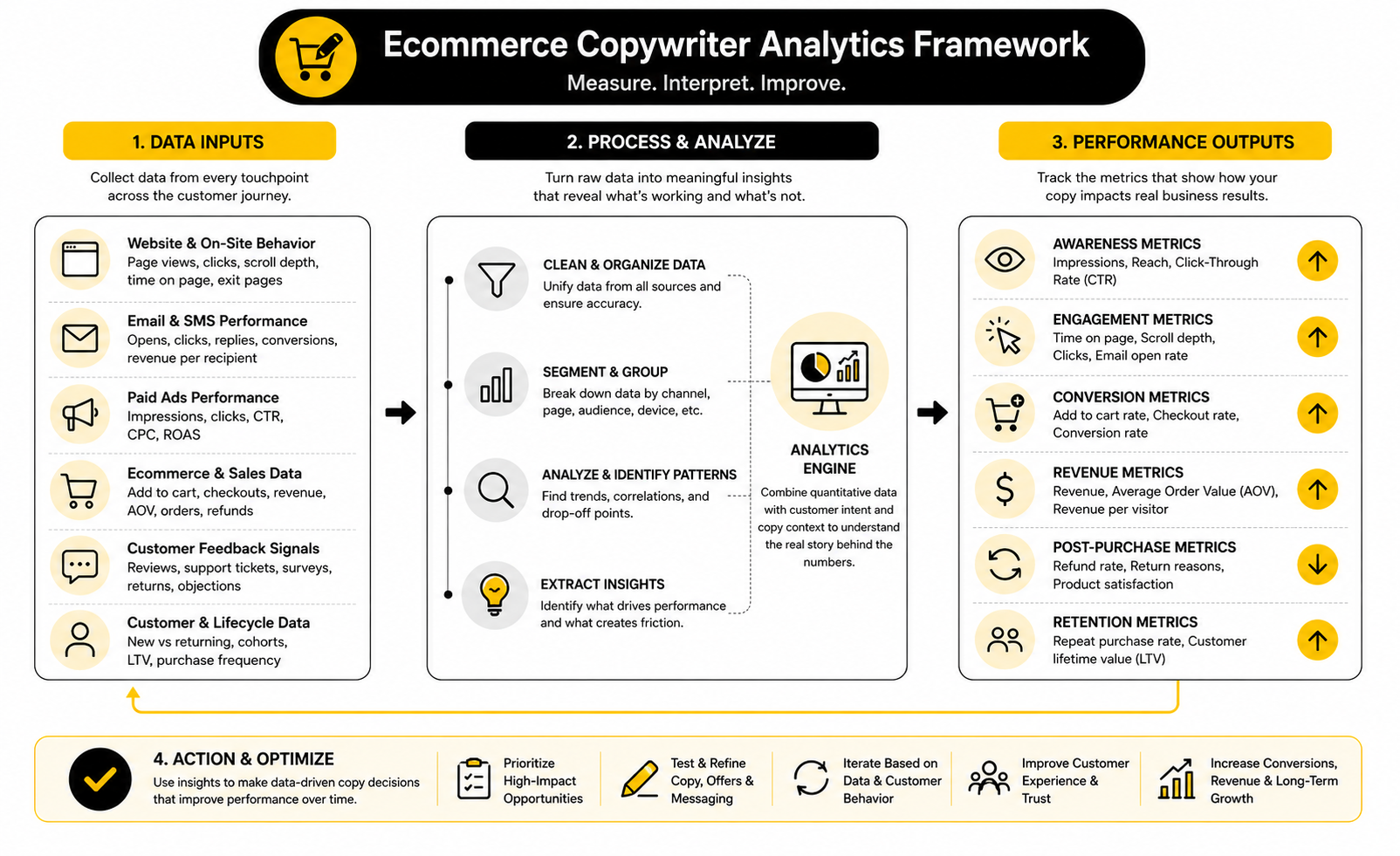
A clean measurement system follows the customer’s path from attention to purchase. It should show where people arrive, where they engage, where they hesitate, and where they leave. That lets the ecommerce copywriter make specific improvements instead of rewriting everything and hoping for the best.
A practical analytics system can be organized like this:
This structure gives the numbers a job. If add-to-cart is weak, the product page may not be building enough desire or confidence. If checkout starts are strong but completion is weak, the issue may be cost clarity, trust, shipping, payment, or checkout usability. If customers buy once but do not return, the gap may be expectation-setting, onboarding, product usage, or lifecycle messaging.
Translate Metrics Into Copy Decisions
The best ecommerce copywriter does not treat analytics as a scoreboard. They treat it as a map. Each metric should suggest a possible customer question that has not been answered well enough.
If product page views are healthy but add-to-cart rate is weak, the page may not make the product’s value obvious fast enough. The copy may need a stronger above-the-fold promise, clearer benefit hierarchy, sharper comparison, better review placement, or more specific product details. The action should match the likely hesitation.
If add-to-cart is healthy but checkout completion is weak, rewriting the product description is probably the wrong move. The customer already showed purchase intent. The copy should move closer to the friction: shipping clarity, return reassurance, payment trust, delivery expectations, discount code messaging, or cart summary language.
If email clicks are strong but purchase rate is weak, the email may be doing its job while the landing page breaks the promise. The ecommerce copywriter should compare the email angle against the page headline, offer, product selection, and CTA. Message mismatch is expensive because it creates momentum and then wastes it.
Measure Copy Across The Whole Funnel
Product page conversion matters, but it is not the whole picture. Ecommerce copy lives across ads, landing pages, collection pages, product pages, carts, emails, SMS, post-purchase messages, and support touchpoints. A single page can look fine while the overall journey feels inconsistent.
This is why lifecycle data matters. Email and SMS benchmarks often show that triggered flows outperform broad campaign blasts because they respond to actual customer behavior. Klaviyo’s ecommerce benchmark material emphasizes segmentation and automation as major performance drivers for email and SMS programs: email and SMS benchmark research. For the ecommerce copywriter, the lesson is simple: timing changes the meaning of the message.
An abandoned cart email should not sound like a generic newsletter. A post-purchase email should not immediately feel like another sales pitch. A replenishment reminder should not explain the brand from scratch. Each message should respect what the customer has already done.
Watch For False Wins
Not every improvement is a real win. A more aggressive headline may increase clicks but reduce qualified purchases. A discount-heavy email may lift short-term revenue while training customers to wait. A louder CTA may improve add-to-cart rate while increasing refunds because expectations were unclear.
That is why copy performance should be checked against downstream metrics. Conversion rate, average order value, refund rate, unsubscribe rate, support volume, repeat purchase, and review sentiment should be read together. If one number improves while another gets worse, the copy may be creating the wrong kind of momentum.
This is especially important with A/B testing. A test can show which version won in a specific context, but it does not automatically explain why. The ecommerce copywriter still has to interpret the result and decide whether the learning is strong enough to apply elsewhere.
Use Qualitative Data To Explain Quantitative Data
Analytics shows what happened. Customer language helps explain why it happened. You need both.
If a size guide gets heavy clicks but conversion stays weak, shoppers may still feel uncertain. If reviews get a lot of interaction, the page may need stronger proof earlier. If support tickets keep asking the same question, the copy has failed to answer something important at the right moment.
Qualitative data can come from surveys, review mining, post-purchase questions, live chat, support tickets, user testing, and session recordings. The ecommerce copywriter should look for repeated friction, not one-off opinions. One complaint may be noise. Twenty similar complaints are strategy.
Set Better Copy KPIs
A good copy KPI is tied to a specific behavior. “Improve the product page” is vague. “Increase add-to-cart rate from mobile product page visitors” is clearer. “Reduce pre-purchase support questions about sizing” is even more useful when sizing confusion is the actual problem.
The right KPI depends on the page or flow being improved. A homepage rewrite may be measured by navigation quality, collection clicks, email signups, or revenue per visitor. A product page rewrite may focus on add-to-cart rate, product conversion rate, comparison engagement, or refund rate. An abandoned cart sequence may focus on recovered revenue, placed order rate, unsubscribes, and margin impact.
This keeps measurement honest. The ecommerce copywriter is not trying to make every number move at once. They are choosing the signal that best reflects the copy’s job in that part of the journey.
Turn Measurement Into A Review Rhythm
Measurement should become a habit, not a one-time report after a launch. The cleanest rhythm is to review copy performance after enough traffic has passed through the page or flow to make the signal useful. Small stores may need more time. Larger stores can often spot directional patterns faster.
A practical review should ask three questions. What changed in customer behavior? What part of the buying journey does that behavior point to? What copy or structure change is most likely to reduce the friction? That is enough to keep the work moving without drowning in dashboards.
The ecommerce copywriter becomes more valuable when they can connect language to commercial outcomes. Not by pretending copy controls everything, because it does not. But by knowing which words, sections, proof points, and messages are most likely to move the next meaningful action.
Email, SMS, Ads, And Lifecycle Copy
Once the core page copy is clear, the next challenge is consistency across the full customer journey. An ecommerce copywriter cannot treat email, SMS, ads, and landing pages as separate islands. The customer does not experience them separately. They experience one brand, one offer, and one sequence of decisions.
This is where the work gets more advanced. The copy has to adjust to timing, intent, channel, and relationship stage without sounding like a completely different business every time. A cold ad can introduce the problem. A landing page can make the offer specific. An abandoned cart email can address hesitation. A post-purchase message can protect trust after the sale.
The mistake is writing every channel with the same level of urgency. Not every message should push for an immediate purchase. Some messages need to educate, some need to reassure, some need to remind, and some need to help the customer get more value from what they already bought.
Write For The Relationship Stage
A first-time visitor needs clarity. A returning shopper needs relevance. A customer who just bought needs confirmation that they made a good decision. A loyal customer needs recognition, useful recommendations, and reasons to stay engaged without feeling squeezed.
This is why lifecycle copy should be mapped around customer behavior. A welcome flow should not sound like a discount vending machine. It should introduce the brand, help the shopper choose, build trust, and make the first purchase easier. An abandoned cart flow should not repeat the same message three times. It should move from reminder to reassurance to offer clarity, depending on the brand’s strategy.
Lifecycle performance often comes from timing and context, not from louder copy. Omnisend’s 2025 ecommerce marketing report found that automated emails generated 37% of email sales from only 2% of email volume, and that abandoned cart, welcome, and browse abandonment messages drove most automated orders: 2025 ecommerce marketing report. The point is not that every brand should copy the same flows. The point is that behavior-triggered copy usually has more intent to work with.
Keep Ads And Landing Pages Aligned
Ad copy creates a promise. The landing page either keeps that promise or breaks it. If the ad sells speed, the page should quickly explain the fast result. If the ad sells quality, the page should prove quality with specifics. If the ad sells a bundle, the page should not drop shoppers into a generic product grid and make them hunt.
Message mismatch is one of the easiest ways to waste paid traffic. The shopper clicks because one angle made sense, then lands on a page that talks about something else. That creates friction before the product even has a fair chance.
A strong ecommerce copywriter checks the chain from ad to page to checkout. The headline, hero section, offer, proof, product selection, and CTA should all feel connected. That does not mean every phrase must repeat. It means the shopper should feel like the click led exactly where they expected to go.
Use SMS With Restraint
SMS can be powerful because it feels immediate. That is also what makes it risky. A weak email can be ignored. A weak SMS feels intrusive.
Good SMS copy is short, useful, and respectful of attention. It should have a clear reason to exist: a cart reminder, delivery update, time-sensitive drop, back-in-stock alert, replenishment reminder, or genuinely relevant offer. If the message exists only because the brand wants another revenue touchpoint, the customer will feel it.
The ecommerce copywriter should write SMS with tighter standards than email. The message needs one idea, one action, and a clear benefit. Anything that requires long explanation usually belongs on the landing page, not inside the text message.
Personalization Has To Feel Helpful
Personalization is not magic. Done well, it makes the buying journey feel easier. Done badly, it feels creepy, lazy, or irrelevant.
Useful personalization usually responds to what the customer has shown through behavior. Browse history, product category interest, previous purchases, size preference, replenishment timing, and location-based shipping expectations can all shape better copy. But the message still has to sound human. “Because you viewed this exact product six times” is technically personalized, but it may not feel good.
Consumer expectations are rising, but shoppers still care about the basics. DHL’s 2025 ecommerce trends report highlights how delivery options, transparency, returns, sustainability, and convenience continue to influence online buying behavior across markets: DHL ecommerce trends report. For copy, that means personalization should not distract from practical clarity. A relevant product recommendation is useful. A clear delivery promise may be even more useful.
Avoid Over-Automation
Automation scales communication, but it can also scale bad judgment. If every customer receives too many flows, too many reminders, and too many overlapping offers, the brand starts to feel needy. That damages trust.
The ecommerce copywriter should look for collisions across flows. A customer should not receive a welcome discount, abandoned cart reminder, browse abandonment email, campaign blast, and SMS push in a way that feels chaotic. The copy may be individually fine and still create a poor experience as a sequence.
This is one reason lifecycle planning matters. Tools such as Brevo, Moosend, and GoHighLevel can help teams build campaigns and automations, but the strategy still needs discipline. More messages are not automatically better. Better-timed messages are.
Scale Copy Without Losing Quality
Scaling ecommerce copy is harder than it looks. A store with ten products can manage careful copy by hand. A store with hundreds or thousands of SKUs needs systems, templates, naming rules, product data, and clear brand standards.
The risk is sameness. When every product description follows the same pattern too closely, the copy becomes technically organized but emotionally flat. Shoppers can feel when a page was filled out instead of written with a specific decision in mind.
A better approach is to create modular copy systems. The ecommerce copywriter can define reusable structures for product benefits, specs, comparison points, proof, care instructions, sizing guidance, and objections. Then each product still gets enough specificity to feel useful. Templates should speed up thinking, not replace it.
Use AI As A Drafting Tool, Not A Strategy
AI can help ecommerce teams move faster. It can summarize reviews, generate draft variations, create product description starting points, cluster objections, and repurpose copy across channels. That is useful, especially for large catalogs and fast-moving campaigns.
But AI should not decide the strategy without human review. It can confidently produce generic claims, flatten brand voice, miss legal nuance, invent unsupported benefits, or overstate what the product can do. In ecommerce, those mistakes are not harmless. They can create refunds, complaints, compliance issues, and trust problems.
Recent coverage of AI shopping assistants shows the same tension at a broader level: retailers are investing heavily, but accuracy, usefulness, and customer trust remain unresolved challenges in many shopping contexts: AI shopping assistant coverage. The takeaway for an ecommerce copywriter is clear. Use AI to accelerate the process, but keep human judgment in charge of claims, positioning, proof, and tone.
Protect Margin While Writing To Convert
Conversion is not the only business goal. A copy change that lifts orders but lowers margin, increases returns, or trains customers to wait for discounts may be a bad trade. This is where copywriting needs commercial maturity.
Discount-led copy is the obvious example. It can work, especially for acquisition, clearance, bundles, or seasonal urgency. But if every message relies on price cuts, customers learn the brand’s real value is the next promotion. That makes full-price selling harder.
A stronger ecommerce copywriter looks for value-based persuasion before discount-based persuasion. Better comparison copy, clearer bundle framing, stronger guarantee language, more specific benefits, and better proof can often reduce the need for constant markdowns. The goal is not to avoid offers. The goal is to avoid making discounts the only reason people buy.
Reduce Returns Before They Happen
Returns are not only an operations issue. They are also a copy issue. If the page creates the wrong expectation, the customer may buy quickly and regret it later.
This is especially important in categories where fit, color, size, compatibility, texture, scent, or performance expectations matter. Clear product details may reduce hype, but they also protect trust. The ecommerce copywriter should help the customer choose correctly, not just choose quickly.
Returns are a serious margin problem in ecommerce, with the NRF estimating that 19.3% of online sales would be returned in 2025 and that free returns remain a major consideration for shoppers: 2025 retail returns landscape. That number should change how copy is written. Honest expectation-setting is not boring. It is profitable.
Know When Copy Is Not The Main Problem
This part matters. Sometimes the copy is not the bottleneck.
If the product is poorly positioned, the traffic is wrong, the offer is weak, the site is slow, the photography is misleading, the checkout is broken, or the shipping policy is uncompetitive, copy can only do so much. A good ecommerce copywriter should be honest about that. Pretending every problem is a headline problem is amateur.
The more advanced move is to identify what copy can fix and what needs a broader business decision. Copy can clarify value, reduce uncertainty, structure proof, improve flow, and guide action. It cannot make a bad product good, make expensive shipping feel invisible, or force trust where the customer experience does not support it.
Build A Copy System The Team Can Use
Professional ecommerce copywriting should leave behind more than finished pages. It should create a system the team can reuse. That system may include messaging pillars, product description formulas, CTA standards, proof guidelines, email flow logic, brand voice rules, objection libraries, and testing priorities.
This is what allows a brand to grow without rewriting from scratch every time. New products can launch faster. Campaigns can stay on-message. Customer support can echo the same clarity used on the product page. Paid ads can pull from proven angles instead of inventing new ones every week.
The ecommerce copywriter becomes most valuable when their work compounds. Not just one better product page. Not just one stronger email. A clearer way for the whole brand to explain, sell, support, and retain customers.
Professional Implementation And Final System
At this stage, ecommerce copywriting is not a set of isolated tactics. It is a system that helps the brand communicate clearly from the first touchpoint to the repeat purchase. The ecommerce copywriter’s job is to keep that system useful, consistent, and tied to real customer behavior.
That system should include customer research, message hierarchy, page-level copy, lifecycle messaging, analytics, testing priorities, and brand voice standards. Each piece supports the others. If the product page says one thing, the ad says another, and the email flow introduces a third angle, the customer feels the disconnect even if they cannot explain it.
The final goal is simple: make the buying journey easier to trust. A strong ecommerce copywriter helps the brand sound sharper, but more importantly, they help the customer move with less confusion. That is what good copy really does.
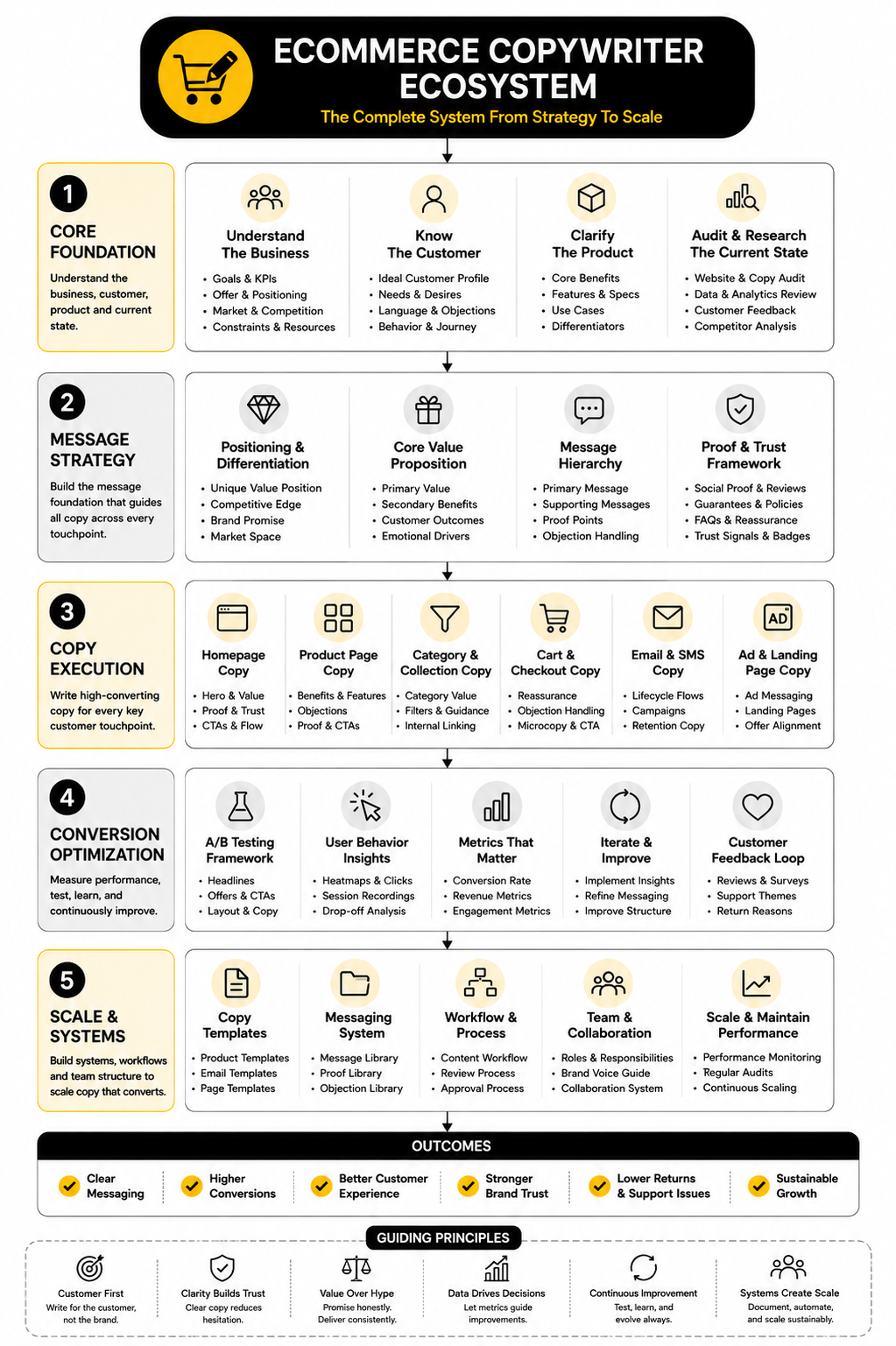
What A Complete Ecommerce Copy System Includes
A complete ecommerce copy system gives the team a shared way to write, review, test, and improve customer-facing messages. It should not live only inside one person’s head. If the strategy depends on memory, it will break as soon as the catalog grows, the team changes, or the campaign pace increases.
The core system should include:
This is the difference between writing copy once and building an asset. A one-time rewrite can improve a page. A copy system improves how the brand communicates every time it launches, tests, promotes, or fixes something.
How To Hire Or Work With An Ecommerce Copywriter
Hiring an ecommerce copywriter should not start with “Can you write product descriptions?” That is too narrow. A better question is whether they can understand the buying journey, diagnose friction, use customer research, and turn strategy into clear copy across pages and flows.
A strong ecommerce copywriter should ask about the product, audience, offer, traffic sources, current metrics, reviews, support questions, and business goals. If they only ask for a word count, they are probably thinking like a content vendor, not a conversion partner. That may be fine for simple catalog work, but it is not enough for strategic ecommerce copywriting.
When reviewing a portfolio, look for thinking, not just polished sentences. The best samples usually show how the copy solved a specific problem: clearer positioning, stronger product education, better objection handling, improved email flow logic, or more consistent messaging across a campaign.
What To Prepare Before A Copy Project
A good copy project gets much easier when the raw materials are ready. The ecommerce copywriter should not have to guess what customers care about, what the product does, or what the brand can legally claim. The more accurate the input, the stronger the output.
Before starting, collect:
This does not need to be perfect. It just needs to be real. Strong copy comes from strong inputs, and messy inputs usually create vague messaging.
Common Mistakes To Avoid
The most common mistake is treating ecommerce copy as decoration. Brands rewrite sentences to sound nicer while leaving the buying logic untouched. That rarely fixes the real problem.
Another mistake is writing only for the brand’s preferred narrative. Customers may care about different things than the internal team expects. If the brand wants to talk about innovation but customers keep asking about fit, delivery, setup, or durability, the copy needs to respect the customer’s priorities.
The third mistake is over-optimizing for short-term clicks. Aggressive urgency, vague discounts, exaggerated claims, and manipulative scarcity can lift immediate action while damaging trust. Ecommerce grows faster when the copy helps the right customer buy with accurate expectations.
What does an ecommerce copywriter do?
An ecommerce copywriter writes and improves the words that help online shoppers understand products, trust the brand, and take action. That includes product pages, collection pages, landing pages, ads, emails, SMS, checkout copy, post-purchase messages, and sometimes customer research. The job is not just to make copy sound better, but to make the buying journey clearer.
How is ecommerce copywriting different from general copywriting?
Ecommerce copywriting is tied closely to product decisions, online buying behavior, and conversion points. General copywriting may focus on awareness, brand messaging, or broader persuasion, while ecommerce copy has to support specific actions like viewing a product, choosing a variant, adding to cart, completing checkout, or buying again. The copy has to be persuasive, but it also has to be practical.
Does every online store need an ecommerce copywriter?
Every store needs strong ecommerce copy, but not every store needs a full-time ecommerce copywriter. Small stores may start with a focused product page rewrite, a welcome email flow, or a clearer homepage message. Larger stores usually need a repeatable copy system because there are more products, campaigns, customer segments, and lifecycle messages to manage.
What should an ecommerce copywriter improve first?
Start where the buying decision is most fragile. For many stores, that means product pages, cart messaging, checkout reassurance, abandoned cart flows, or high-traffic landing pages. The best starting point depends on the data, so review where shoppers arrive, where they hesitate, and where they leave.
How long should ecommerce product descriptions be?
A product description should be long enough to answer the buying questions and short enough to stay useful. Simple products may need a concise description, clear bullets, and a few reassurance points. Technical, premium, or high-consideration products often need more detail, including benefits, specs, proof, comparisons, usage guidance, and objection handling.
Should ecommerce copy focus more on benefits or features?
It needs both. Benefits explain why the product matters, while features prove what the product actually includes. Weak copy lists features without meaning, but overhyped copy talks about benefits without enough detail. The strongest version connects each important feature to a clear customer outcome.
How does SEO fit into ecommerce copywriting?
SEO helps shoppers find the store, but conversion copy helps them decide once they arrive. The ecommerce copywriter should use search language naturally in titles, headings, category copy, product descriptions, and supporting content without making the page feel robotic. Search visibility matters, but the copy still has to serve the shopper first.
Can AI replace an ecommerce copywriter?
AI can help with drafts, variations, summaries, review mining, and content scaling. It should not replace strategy, customer understanding, claim verification, brand judgment, or final editing. Ecommerce copy affects trust, refunds, support volume, compliance, and revenue, so human review still matters.
What makes ecommerce copy convert better?
Better ecommerce copy usually does four things well. It makes the value clear, proves the promise, answers objections, and guides the next action. The exact wording depends on the product, but the principle is consistent: the shopper should feel more confident after reading, not more confused.
How often should ecommerce copy be updated?
Copy should be reviewed whenever customer behavior, product details, offers, positioning, or performance changes. For active stores, a quarterly review is a practical rhythm, with faster updates for major launches, seasonal campaigns, new objections, or underperforming pages. Copy is not something you set once and forget.
What metrics show whether ecommerce copy is working?
Useful metrics include add-to-cart rate, product page conversion rate, checkout completion rate, revenue per visitor, email click rate, placed order rate, refund rate, support ticket themes, review sentiment, and repeat purchase behavior. No single metric tells the whole story. The ecommerce copywriter should interpret the numbers based on the page or flow being improved.
What should a brand give an ecommerce copywriter before a project starts?
Give them product details, customer reviews, analytics, support questions, return reasons, offer details, competitor context, brand voice notes, and any claim restrictions. The better the inputs, the stronger the copy. A copywriter can still help organize messy information, but they should not have to invent the strategy from nothing.
Is ecommerce copywriting only for product pages?
No. Product pages are important, but ecommerce copywriting also includes ads, landing pages, collection pages, quiz flows, cart copy, checkout microcopy, email sequences, SMS, post-purchase messaging, and retention campaigns. The strongest results usually come when the full journey feels connected.
What is the biggest sign that ecommerce copy needs work?
The biggest sign is customer confusion. If shoppers keep asking questions the page should answer, abandon carts after showing intent, return products because expectations were wrong, or click emails that lead to weak purchase behavior, the copy may not be doing its job. Confusion is expensive.
Build a stronger local presence with BAAM AI
Turn your website, Google profile, social channels, and AI visibility into one growth engine
Most businesses do not need more random marketing activity. They need a consistent presence system that helps the right people find them, trust them, and take action. BAAM AI brings strategy, local SEO, website updates, Google Maps visibility, social content, AI-search readiness, media production, and reporting into one practical monthly engine.
If you want your marketing to keep working after the campaign ends, start with a free BAAM AI presence audit. See how your business shows up today and where the fastest visibility wins are at BAAM AI.