
BAAM AI Blog
Direct Response Copywriting: A Practical Framework For Copy That Gets A Reply, Click, Lead, Or Sale
Direct response copywriting is copy written for a measurable action. Not “brand awareness.” Not vague engagement. A direct response message asks the reader to do something specific now: click, book, subscribe, reply...
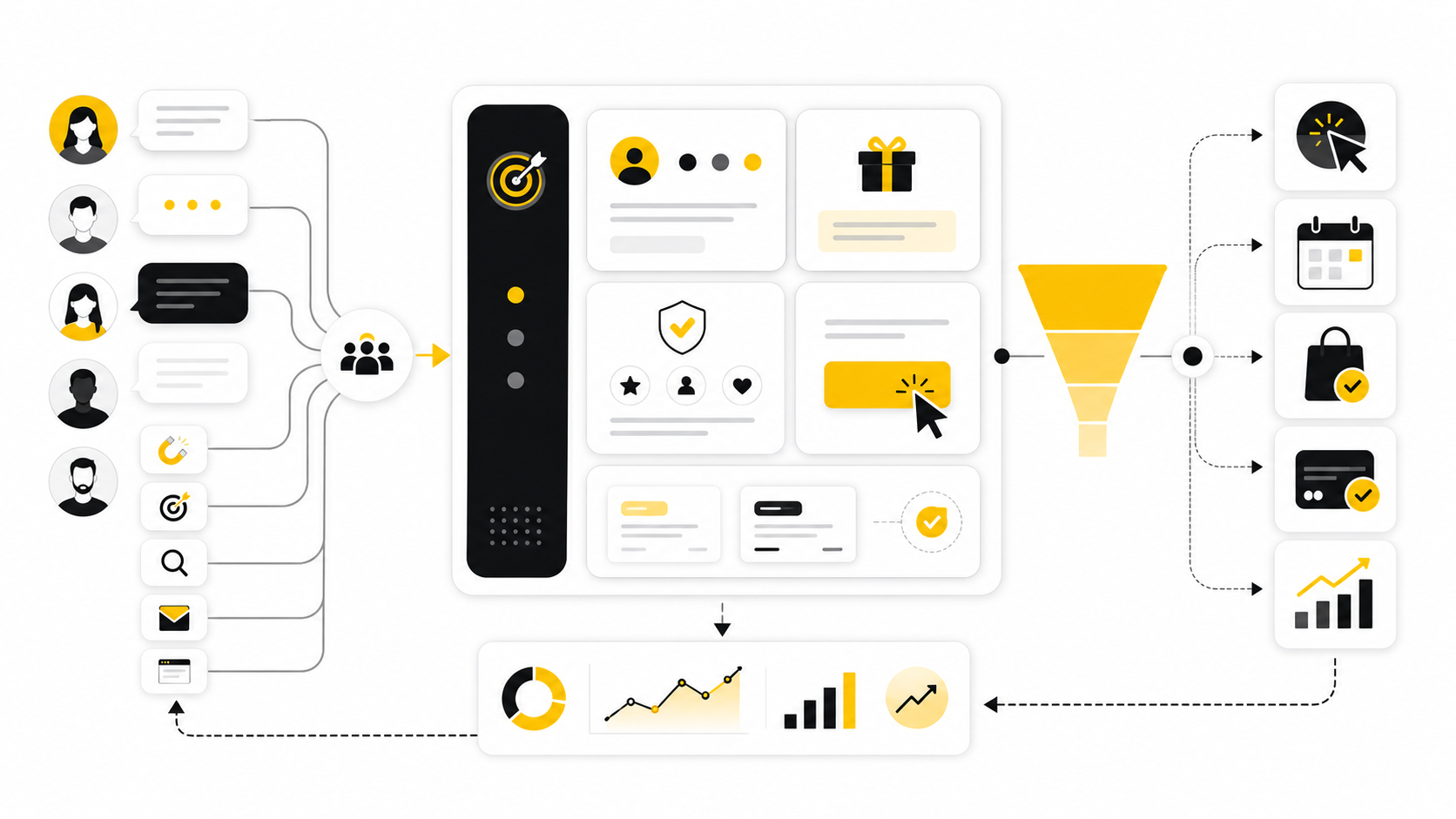
Direct response copywriting is copy written for a measurable action. Not “brand awareness.” Not vague engagement. A direct response message asks the reader to do something specific now: click, book, subscribe, reply, start a trial, request a quote, or buy.
That sounds simple, but the discipline is easy to underestimate. The best direct response copywriting does not rely on hype, pressure, or clever wording. It works because the message matches the reader’s problem, makes the offer clear, removes friction, proves the promise, and gives the next step a reason to happen today.
Modern buyers are not patiently reading every line you write. Web usability research has shown for decades that people scan pages more than they read them word for word, and concise, scannable, objective writing produced a major usability lift in Nielsen Norman Group testing on how people read on the web. That matters because direct response copy has to survive the first few seconds before it can persuade anyone.
The stakes are also higher because audiences now expect relevance. McKinsey’s personalization research found that 76% of consumers said personalized communications were a key factor in considering a brand, which means generic copy is not just boring. It is expensive.
Why Direct Response Copywriting Matters Now
Direct response copywriting matters because most marketing does not fail from a lack of words. It fails from a lack of intent. A landing page can be beautiful, an email can be well designed, and an ad can look polished, but if the reader cannot quickly understand why the offer matters and what to do next, the copy is not doing its job.
This is especially important in crowded markets where buyers compare options fast. Baymard’s ecommerce UX research library is built from more than 200,000 hours of large-scale ecommerce UX research, and one clear theme across conversion work is that user decisions are shaped by clarity, trust, friction, and relevance. Direct response copy sits right in the middle of those factors because it explains the offer, reduces uncertainty, and makes the next step feel safe.
The point is not to manipulate people into action. The point is to help qualified readers make a decision without making them work too hard. Strong direct response copy respects the reader’s attention, speaks to a real need, and removes the vague language that usually hides weak positioning.
The Direct Response Copywriting Framework
The easiest way to understand direct response copywriting is to see it as a chain. Each link has a job. If one link breaks, the reader drops off before taking action.
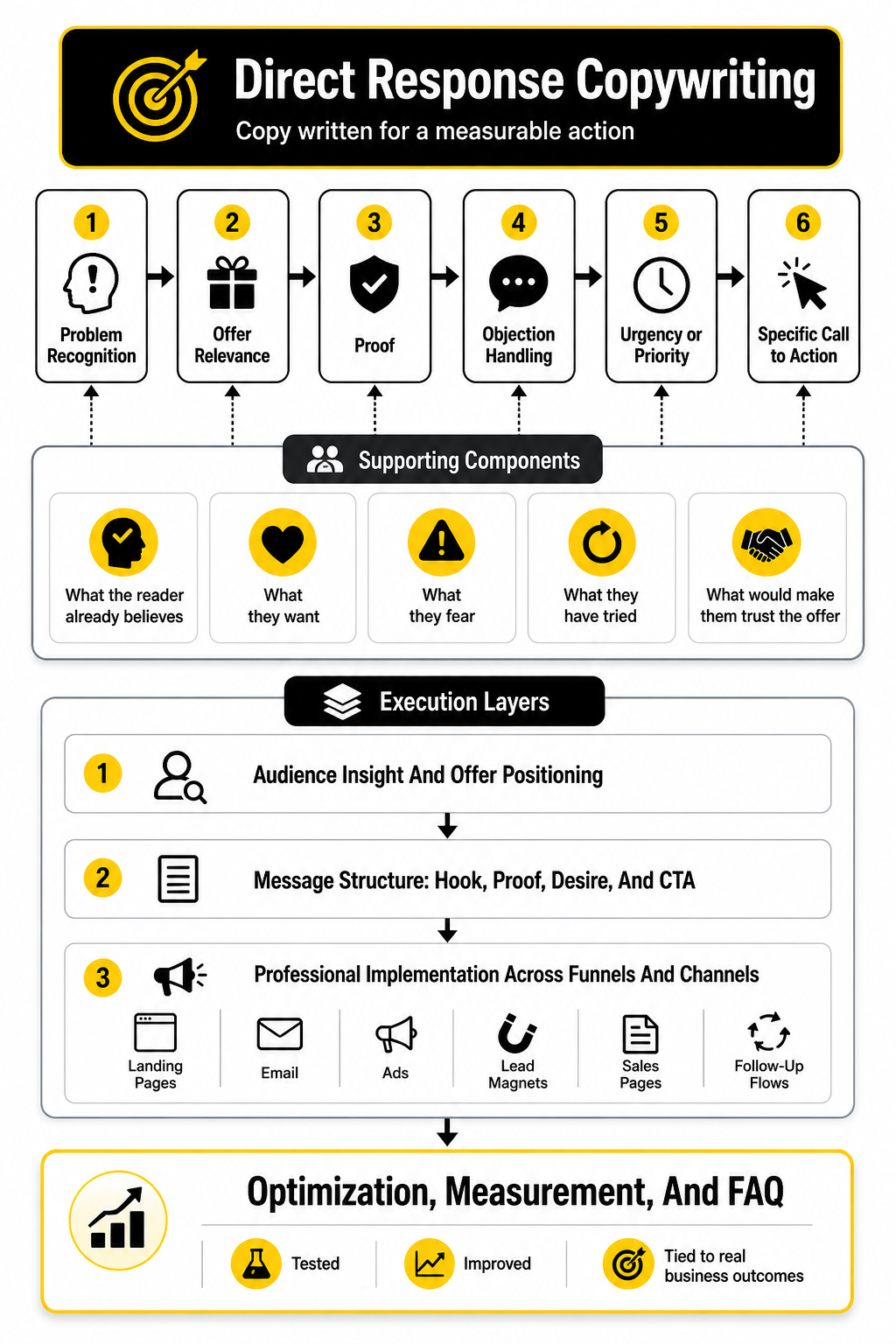
The framework starts with the audience, not the headline. You need to know what the reader already believes, what they want, what they fear, what they have tried, and what would make them trust the offer. Without that, the copy becomes a guessing game dressed up as strategy.
Then the copy has to move through a clear sequence: problem recognition, offer relevance, proof, objection handling, urgency or priority, and a specific call to action. This does not mean every asset needs to be long. It means every asset needs to be complete enough for the decision it is asking the reader to make.
How this guide Will Use The Framework
The rest of this guide will build the framework step by step instead of dumping random copywriting tips into a list. That matters because isolated tactics can be misleading. A stronger headline will not save a weak offer, and a sharper CTA will not fix copy that never created desire in the first place.
Part 2 will map the full direct response copywriting framework so you can see the moving parts before writing. Part 3 will go deeper into audience insight and offer positioning, because that is where most copy either becomes persuasive or becomes generic. Part 4 will cover the message structure itself: hooks, proof, desire, objections, and calls to action.
Part 5 will show how professional implementation changes across landing pages, email, ads, lead magnets, sales pages, and follow-up flows. Part 6 will cover optimization, measurement, and the FAQ, because direct response copywriting is not finished when the first draft is published. It becomes valuable when it is tested, improved, and tied to real business outcomes.
The Direct Response Copywriting Framework
A useful direct response copywriting framework is not a formula you blindly paste into every page. It is a decision path. The reader arrives with a problem, a level of awareness, a degree of skepticism, and a competing list of things they could do instead.
Your job is to guide that person from “this might be relevant” to “this is the next step I should take.” That does not happen because one sentence is clever. It happens because every part of the copy answers the next question forming in the reader’s mind.
The framework has six core stages:
Each stage has a different role. If you skip one, the copy may still sound polished, but it will usually leak conversions somewhere. That is why direct response copywriting is less about writing more and more about removing the exact reasons someone hesitates.
Audience Reality
Audience reality means understanding what the reader actually thinks before your copy gets involved. Not what you wish they thought. Not what your positioning deck says they think. The real starting point is the language, urgency, frustration, and desire already living in the market.
This is where weak copy usually exposes itself. It talks about features before the reader feels understood. It makes claims before the reader believes the brand has diagnosed the right problem.
A practical way to find audience reality is to study customer conversations, sales calls, reviews, support tickets, surveys, search queries, competitor pages, and comment sections. You are not looking for random inspiration. You are looking for repeated language patterns that show what buyers care about, what they misunderstand, and what they are afraid of losing.
Problem Clarity
Problem clarity is the moment the reader sees that your message is about them. This does not mean exaggerating pain. It means naming the problem in a way that feels specific, recognizable, and useful.
Bad direct response copy often starts too broadly. It says things like “grow your business faster” or “save time with automation,” which could apply to almost anything. Stronger copy narrows the problem until the reader can say, “Yes, that is exactly what is happening.”
The goal is not to make the reader feel worse. The goal is to make the issue easier to understand. When the problem becomes clear, the offer has somewhere meaningful to land.
Offer Positioning
Offer positioning explains why this solution is the right path compared with doing nothing, doing it manually, hiring someone, buying another tool, or choosing a competitor. This is where direct response copywriting becomes strategic. The copy has to translate the offer into a business case the reader can quickly understand.
A strong offer position usually answers four questions. What does the reader get? Why does it matter now? Why is this different from the alternatives? What makes the next step feel worth taking?
This is also where specificity matters. “Improve your marketing” is weak because it gives the reader nothing solid to evaluate. “Turn missed Instagram DMs into booked sales calls with automated follow-up” is stronger because the mechanism, channel, and outcome are easier to picture.
Proof And Belief
Proof is not decoration. It is the bridge between desire and trust. A reader can want the outcome and still refuse to act if the claim feels too big, too vague, or too disconnected from their situation.
Proof can come from customer results, product screenshots, demos, testimonials, third-party research, founder experience, transparent process breakdowns, guarantees, comparisons, or visible product logic. The best proof depends on the risk level of the action you are asking for. A newsletter signup needs less proof than a high-ticket consultation or annual software commitment.
The mistake is thinking proof only belongs near the bottom of a page. In direct response copywriting, belief should be built throughout the message. Each claim should either be obviously true, clearly explained, or supported by something the reader can evaluate.
Objection Removal
Every serious buyer has objections. They may not say them out loud, but they are there. “Will this work for my situation?” “Is this worth the price?” “Will it take too long?” “Can I trust this brand?” “What happens if I make the wrong choice?”
Good copy does not avoid those questions. It handles them before they become exit points. That is why objection removal should be built into the structure instead of left for a tiny FAQ at the end.
The key is to separate real objections from excuses. A real objection is a legitimate barrier to action, such as implementation time, integration risk, unclear pricing, missing proof, or uncertainty about fit. When your copy handles those directly, the call to action feels more reasonable because the reader has fewer unresolved doubts.
Action Prompt
The action prompt is where the copy asks for the next step. This is not just a button label. It is the final moment of alignment between the reader’s motivation and your desired conversion.
A weak CTA asks too much too soon or uses vague language. “Submit” is rarely persuasive because it says nothing about the value of the action. A stronger CTA makes the next step feel concrete, low-friction, and connected to the outcome the reader already wants.
The best action prompt depends on the offer. For a lead magnet, the CTA might focus on getting the guide. For a demo, it might focus on seeing how the system works. For a product trial, it might focus on starting without risk or setup friction.
How The Framework Fits Together
The framework works because each stage earns the right to move to the next one. Audience reality earns attention. Problem clarity earns relevance. Offer positioning earns interest. Proof earns belief. Objection removal earns confidence. The action prompt earns the click, reply, booking, signup, or purchase.
This is why direct response copywriting should not start with “write me a headline.” A headline is only effective when it comes from the right strategic foundation. Otherwise, you are polishing the first sentence while the rest of the argument is still unstable.
A better process is to diagnose the conversion path first. What does the reader need to believe before acting? What do they already know? What are they skeptical about? What would make the offer feel urgent, useful, and safe?
The Reader Awareness Ladder
Not every reader needs the same copy. Someone who already knows the product and wants pricing does not need a long explanation of the problem. Someone who does not yet understand the cost of the problem needs more education before the offer can make sense.
This is where the reader awareness ladder becomes useful. At the lowest level, the reader is unaware of the problem. Then they become problem-aware, solution-aware, product-aware, and finally most-aware. Each stage needs a different message.
For unaware or problem-aware readers, your copy should spend more time naming symptoms, explaining consequences, and making the problem visible. For solution-aware readers, the copy should compare approaches and explain why your mechanism is different. For product-aware and most-aware readers, the copy should reduce friction, prove value, and make the action easy.
Matching Copy Length To Buying Friction
Copy should be as long as the decision requires, not as long as the writer feels like writing. Low-friction actions can often use short copy because the reader is not risking much. High-friction actions need more explanation because the reader has more to evaluate.
A free checklist may only need a sharp promise, a few bullets, and a clear form. A complex B2B service, premium course, or software platform usually needs more context, more proof, and more objection handling. The length is not the issue. The unresolved friction is the issue.
This is an important distinction because many people argue about short copy versus long copy as if one is always better. That is the wrong debate. The better question is whether the copy gives the reader enough confidence to take the specific action being requested.
What Makes The Framework Practical
The framework is practical because you can use it to diagnose almost any marketing asset. If an ad gets attention but does not convert, the problem may be offer positioning or audience mismatch. If a landing page gets visits but few form submissions, the issue may be proof, friction, or an unclear action prompt.
You can also use it before writing. Instead of opening a blank document and hoping the words show up, you map the persuasion path first. That makes the writing faster because every section has a job.
This is the real value of direct response copywriting. It gives structure to persuasion without turning the message into a robotic script. You still need voice, judgment, and taste, but the copy is no longer floating around without a conversion purpose.
Audience Insight And Offer Positioning
Before you write the copy, you need to understand the market well enough to stop guessing. Direct response copywriting gets weaker when it starts with wordplay and stronger when it starts with evidence. The best copy usually sounds obvious after you read it because the writer found the truth the market already cared about.
Audience insight is not the same as building a fluffy persona. A persona might say your buyer is a 34-year-old founder who likes productivity tools. Useful audience insight tells you what that founder is trying to fix this quarter, what they have already tried, why those attempts failed, and what would make them believe your offer is worth attention.
This is where the copy starts becoming commercial. You are not collecting research to sound smart. You are collecting it so the final message can meet the reader at the exact point where motivation, frustration, and timing overlap.
Start With The Conversion Goal
Every direct response project should begin with one clear conversion goal. Not five goals. Not “drive engagement.” One primary action the copy is supposed to produce.
That goal changes the entire writing process. A page built to book a sales call needs different proof, pacing, and friction removal than a page built to collect email subscribers. An email written to warm up a lead needs a different ask than an email written to close a discount deadline.
Write the conversion goal in plain language before anything else:
The goal should be measurable because direct response copywriting is accountable. If the action cannot be tracked, you are not really writing direct response copy. You are writing marketing content and hoping something useful happens.
Define The Reader’s Current State
Once the conversion goal is clear, define where the reader is before they see the message. This is the part most people rush, and it costs them. If you misread the reader’s current state, the copy will either explain too much, assume too much, or push too hard.
The reader’s current state includes awareness, urgency, trust, and intent. Someone searching for “best landing page builder for Shopify” is in a different mindset from someone seeing a cold social ad about conversion problems. One is already solution-aware. The other may need help understanding why the problem is worth solving now.
Ask practical questions before writing:
These questions protect you from writing copy that sounds good to the business but misses the reader. That is the hidden trap. A company usually knows too much about its own offer, while the reader is still trying to decide whether the offer matters at all.
The Direct Response Copywriting Process
A strong process keeps direct response copywriting from turning into random drafting. You want a repeatable path from research to published asset. That does not make the writing boring. It makes the writing sharper because every step has a purpose.
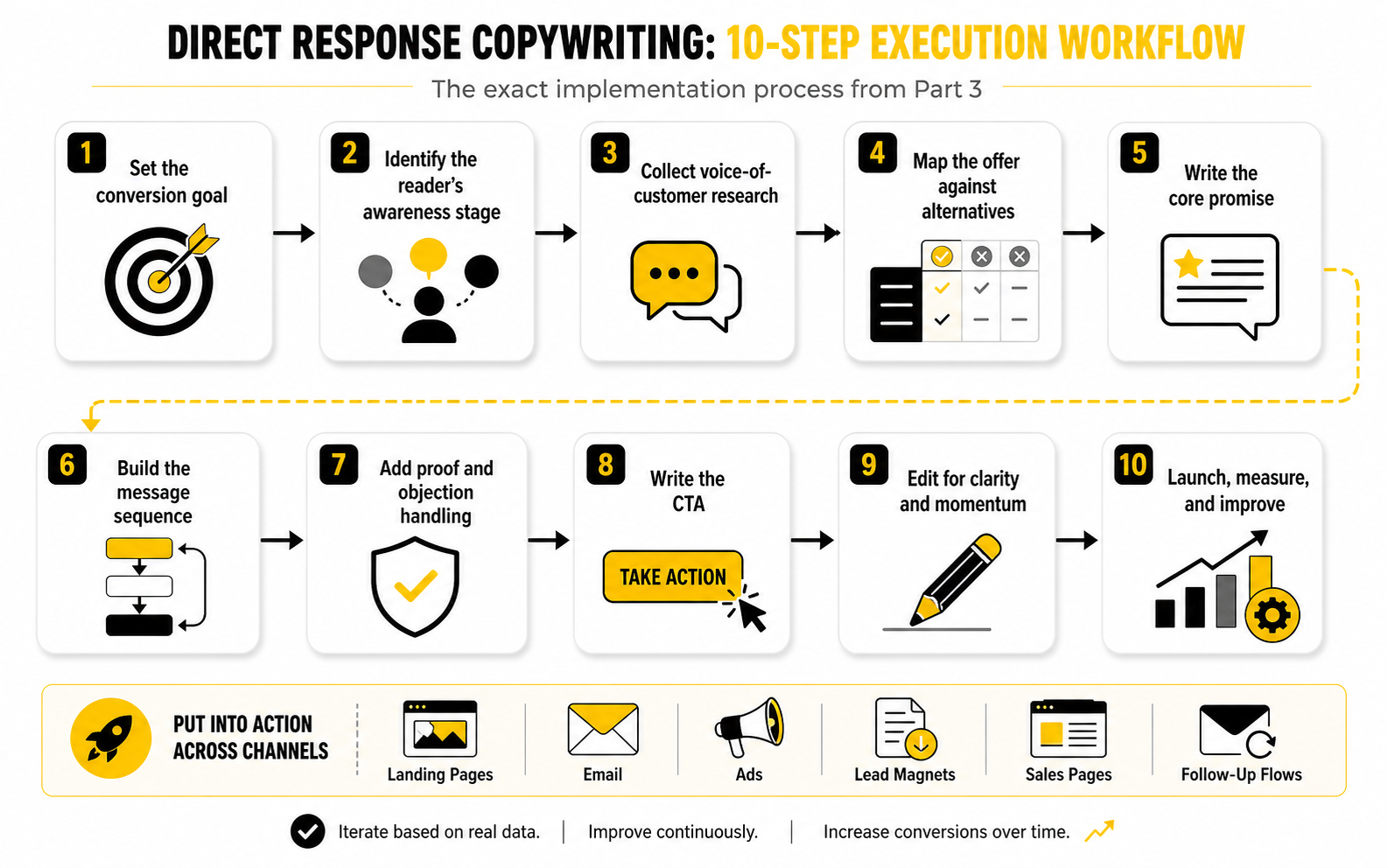
The process should move from diagnosis to execution. First, you identify the conversion goal and the reader’s current state. Then you research the market, position the offer, map the persuasion path, write the asset, edit for clarity, and test the result.
A practical workflow looks like this:
This sequence matters because it prevents the most common mistake: writing before the strategy is clear. If you start drafting too early, you often end up trying to fix positioning problems with better sentences. That rarely works.
Collect Voice-Of-Customer Research
Voice-of-customer research gives you the raw material for copy that sounds human. You are looking for the exact phrases people use when they describe the problem, the desired outcome, the failed alternatives, and the moment they finally decide to act. This is the difference between copy that feels written at the reader and copy that feels pulled from the reader’s own head.
Good sources include sales call transcripts, support tickets, product reviews, customer interviews, cancellation feedback, onboarding surveys, live chat logs, and social comments. For lead generation funnels, tools like Fillout can help collect structured survey answers before a sales call or after a lead magnet download. For conversational funnels, ManyChat can be useful when the buyer journey starts through Instagram, Messenger, or automated chat sequences.
The goal is not to copy and paste customer language blindly. You still need strategy and judgment. But when the same phrases appear repeatedly, they usually point to emotional triggers, buying criteria, and objections that should show up in the final copy.
Map The Offer Against Alternatives
Readers do not evaluate your offer in isolation. They compare it with doing nothing, solving the problem manually, hiring a freelancer, choosing another product, or delaying the decision. Your copy needs to understand those alternatives because that is where hesitation comes from.
Offer mapping forces you to clarify why your path is worth choosing. If you are selling a funnel builder, the alternative might be piecing together landing pages, checkout tools, email software, and analytics manually. In that context, a platform like ClickFunnels fits naturally when the message is about getting a sales funnel live without stitching together too many moving parts.
For agencies and service businesses, the alternative is often operational chaos rather than another single tool. A platform like GoHighLevel fits copy that focuses on lead capture, follow-up, pipeline visibility, and client communication in one system. The copy should not just say the tool has many features. It should explain why that consolidation matters to the reader’s daily work.
Write The Core Promise
The core promise is the simplest version of why the offer matters. It should connect a specific audience to a specific outcome through a believable mechanism. If the core promise is weak, every headline, bullet, and CTA downstream becomes harder to write.
A strong promise usually includes three parts. It names the result, clarifies who it is for, and hints at how the result happens. It does not need to reveal every detail, but it should give the reader enough substance to understand the value.
Weak promise: “Grow your business with more carefully marketing.”
Stronger promise: “Turn missed leads into booked appointments with automated follow-up across SMS, email, and chat.”
The second version is better because the reader can picture the problem and the mechanism. It also creates room for proof, objections, and implementation details. That is what you want from a core promise: clarity that can carry the rest of the message.
Build The Message Sequence
Once the core promise is clear, build the message sequence around the reader’s decision path. This sequence should not feel like a rigid template, but it should answer questions in the right order. A reader usually needs relevance before detail, proof before commitment, and clarity before action.
A simple sequence can work well:
For landing pages, this sequence may become multiple sections. For email, it may become a tighter narrative. For ads, it may become a few sharp lines that lead into a page where the rest of the persuasion happens.
Match The Asset To The Channel
Direct response copywriting changes by channel because the reader’s context changes. A person reading a long sales page has more attention available than someone scrolling through a feed. A person opening a follow-up email already has some relationship with the brand, while cold traffic usually needs more context.
For landing pages, the copy needs to create clarity fast and then support the decision with proof, benefits, and objection handling. Tools like Replo can make sense when the implementation depends on building high-converting ecommerce pages without waiting on a full development cycle. The copy still has to do the persuasion, but the page structure and speed of iteration matter.
For email and automation, the message needs to continue the conversation instead of restarting from zero. Platforms like Brevo or Moosend fit when the copy strategy includes nurture sequences, behavior-based follow-up, and campaign testing. The key is to make each email earn the next click rather than trying to close everything in one message.
Turn Research Into Copy Blocks
A copy block is a reusable piece of persuasion. It might be a headline angle, a pain-point section, a proof paragraph, a product mechanism, a comparison, an objection answer, or a CTA. Building copy blocks makes implementation faster because you are not reinventing the argument for every asset.
For example, a landing page might use a full proof section, while an email might use one condensed proof paragraph. A retargeting ad might use only the objection answer. The core idea stays consistent, but the format changes based on the channel.
This is how direct response copywriting becomes scalable. You create a central message system, then adapt it across ads, pages, emails, chat flows, and sales follow-up. The brand sounds consistent because the argument is consistent, not because every sentence is identical.
The First Draft Should Be Functional
The first draft does not need to be beautiful. It needs to be functional. Its job is to get the argument onto the page in the right order so you can see what is missing, bloated, weak, or unclear.
Do not edit too early. If you start polishing the first paragraph before the full message exists, you may waste time improving copy that later gets deleted. Get the structure down first, then tighten the language.
A functional draft should answer these questions:
If the answer is no, the issue is not style yet. The issue is strategy, structure, or missing information. Fix that before worrying about rhythm.
Editing For Clarity And Momentum
Editing direct response copy is not about making the copy sound more “writerly.” It is about making the decision easier. Every sentence should either create relevance, build desire, increase belief, reduce friction, or move the reader toward action.
Start by cutting vague claims. Then remove repeated ideas, soften exaggerated language, and replace internal company jargon with words the buyer would actually use. The copy should feel confident, but it should not feel inflated.
Momentum matters too. If a section takes too long to make its point, the reader feels the drag. Strong direct response copy moves with purpose, gives the reader enough to continue, and avoids making them fight through paragraphs that exist only because the writer wanted to sound thorough.
Statistics And Data
Direct response copywriting should be measured by behavior, not taste. A headline can sound strong in a meeting and still fail in the market. A CTA can feel clear to the team and still confuse the person who has to click it.
The point of measurement is not to collect dashboards for the sake of looking analytical. The point is to find where the reader loses momentum. If the data shows strong attention but weak action, you probably have a belief, offer, or friction problem rather than a traffic problem.
Good data turns copywriting from opinion into diagnosis. It helps you see whether the promise is attracting the right people, whether the page is carrying them forward, and whether the final ask feels worth it. That is where direct response copywriting becomes a performance system instead of a writing exercise.
Benchmarks Are Context, Not Targets
Benchmarks are useful only when they help you ask better questions. They are dangerous when they become lazy goals. If someone says “a good conversion rate is 3%,” the right response is: for what offer, what audience, what traffic source, what stage of awareness, and what level of buying friction?
That is why broad conversion benchmarks should be treated as context, not commandments. The Unbounce conversion benchmark report analyzes more than 57 million conversions across over 41,000 landing pages, which makes it useful for seeing how different industries behave. But even then, the real lesson is not “copy this average.” The lesson is that performance depends heavily on category, intent, offer type, and conversion event.
Email benchmarks work the same way. MailerLite’s benchmark data shows open rates varying widely by industry, from travel and transportation around 30.1% to religion around 55.71%. That spread matters because a “low” open rate in one market may be normal in another, while a “high” open rate may still be useless if the email produces no meaningful clicks, replies, or sales.
What You Should Measure First
The first metric is the action the copy was written to create. For a landing page, that might be form submissions, purchases, demo bookings, or trial starts. For an email, it might be clicks, replies, booked calls, purchases, or activation events after the click.
Do not start by measuring everything equally. That creates noise. Start with the primary conversion event, then work backward through the path to understand what influenced it.
A simple measurement stack looks like this:
These numbers tell a story only when they are read together. A page with a high opt-in rate and poor lead quality may be overpromising. A page with strong scroll depth and weak conversions may have an unclear CTA or too much friction at the form. A page with poor scroll depth may have a weak hook, mismatched traffic, or a first screen that fails to communicate value.
Build An Analytics System Around The Reader Journey
Your analytics system should mirror the reader’s journey. That means measuring each major transition from attention to action. The goal is to spot the exact point where interest turns into hesitation.
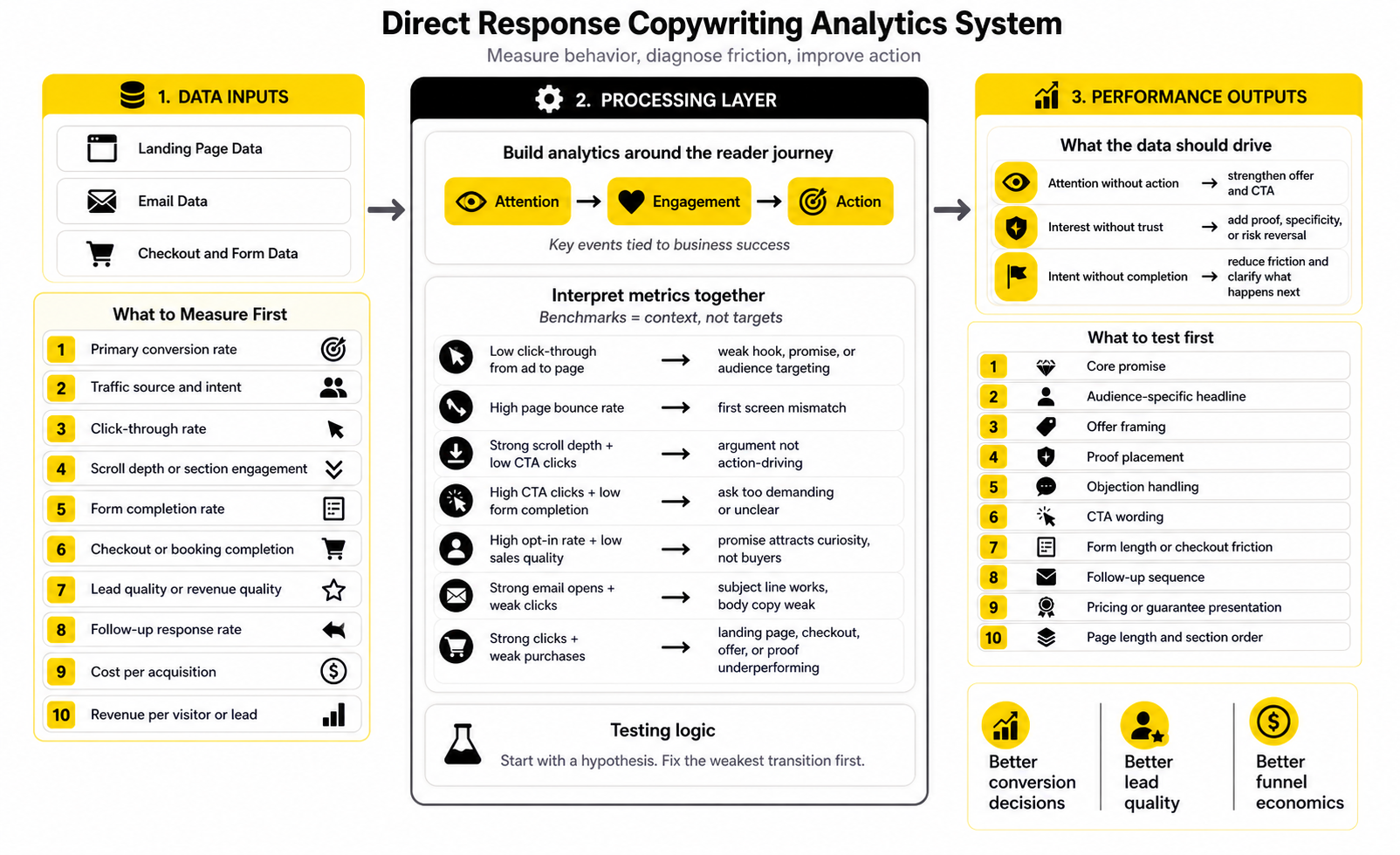
At the top of the journey, you measure whether the message earns attention. In the middle, you measure whether readers engage with the argument and move toward the offer. At the bottom, you measure whether the final step is clear, credible, and low-friction enough to complete.
This is where platforms and tracking discipline matter. Google Analytics explains that key events should represent actions that are important to business success, such as events tied to search, email, and social campaigns in GA4 conversion measurement. That principle is simple but important: do not treat every click like a conversion just because it is easy to track.
How To Read Landing Page Data
Landing page data should be interpreted by section and decision point. If visitors leave immediately, the first screen probably failed to establish relevance. If they read the page but do not click, the offer may be interesting but not compelling enough to act on.
Look at the relationship between traffic source and page behavior. Cold traffic may need more context and trust-building than branded search traffic. Retargeting traffic may need a stronger objection answer rather than a longer explanation of the problem.
The strongest landing page analysis usually asks these questions:
The answers tell you where the copy needs work. If the CTA gets clicks but the form is abandoned, the issue may be friction after the copy. If the CTA gets ignored, the issue is likely value, belief, or action clarity before the click.
How To Read Email Data
Email data can be misleading if you obsess over open rates. Opens are useful as a directional signal, but they do not prove that the message persuaded anyone. Privacy changes, inbox behavior, and image loading can all distort what an open really means.
Clicks, replies, conversions, and revenue usually tell you more about the quality of the direct response copywriting. Mailchimp’s benchmark guidance frames email benchmarks as a way to compare KPIs like open rates, click-through rates, and conversion rates against industry averages so teams can identify strengths and weaknesses in campaigns through email marketing benchmark analysis. The important move is to connect the metric to the decision the reader had to make.
If opens are low, the issue may be sender trust, subject line relevance, list quality, or timing. If opens are solid but clicks are weak, the body copy may not connect the subject line to a compelling next step. If clicks are strong but conversions are weak, the email may be doing its job while the landing page or offer is failing after the click.
How To Read Checkout And Form Data
Checkout and form data matters because this is where motivated people often disappear. They already showed intent, so abandonment at this stage is expensive. The copy may have created desire, but the final experience may still introduce uncertainty.
Baymard’s cart abandonment research compiles 50 different cart abandonment rate statistics, which is useful because abandonment is not one simple problem. It can come from unexpected costs, forced account creation, delivery concerns, payment friction, weak trust signals, or unclear returns. For direct response copywriting, that means the persuasive job is not finished when the reader clicks “add to cart” or “book a call.”
Forms have the same issue. If the reader wants the result but hesitates at the form, the friction may be too much information requested too early. The fix might be shorter fields, clearer privacy reassurance, better button copy, or a stronger explanation of what happens after submission.
The Metrics That Actually Diagnose Copy Problems
Not every metric tells you what to rewrite. Some metrics diagnose traffic quality. Some diagnose product-market fit. Some diagnose page experience. The useful ones connect behavior to a specific part of the copy.
Use metrics this way:
This is why direct response copywriting should be evaluated as a system. You do not rewrite everything just because one number looks bad. You identify the weakest transition and fix that first.
What Good Testing Looks Like
Testing is not randomly changing button colors and hoping revenue appears. Good testing starts with a hypothesis. You decide what you believe is limiting performance, why it matters, and what change should improve the result.
A useful test hypothesis sounds like this: “If we make the hero promise more specific to agency owners with missed leads, more qualified visitors will click the consultation CTA because the outcome will feel more relevant.” That is a real copy test because it connects audience, message, behavior, and expected result. It is much stronger than “let’s try a punchier headline.”
Testing also needs enough traffic and patience to mean something. A small sample can make normal variation look like a breakthrough. If you do not have enough traffic for clean A/B testing, use directional methods instead: sales call feedback, heatmaps, session recordings, customer interviews, and before-and-after performance trends.
What To Test First
Test the parts of the copy that carry the most decision weight. The hero section is usually high priority because it frames the entire page. The offer explanation, proof section, pricing presentation, objection handling, and CTA are also worth testing because they directly affect belief and action.
Do not start with tiny cosmetic changes unless you already know the message is working. A different button label can help, but it will not rescue a vague promise. A shorter paragraph can improve flow, but it will not fix an offer that the reader does not want.
A practical testing order looks like this:
This order keeps the focus on meaningful persuasion. You test the argument before you test the decoration. That is how you get learning that can be reused across ads, emails, landing pages, and sales flows.
Turning Data Into Better Copy
Data does not write the copy for you. It tells you where to look. The writer still has to interpret the behavior, understand the reader, and decide what message would remove the next barrier.
If the data shows attention without action, strengthen the offer and CTA. If it shows interest without trust, add proof, specificity, or risk reversal. If it shows intent without completion, reduce friction and clarify what happens next.
This is the loop that makes direct response copywriting powerful. Research gives you the first version. Measurement shows how the market responds. Then you refine the message until the copy is not just clearer, but commercially sharper.
Professional Implementation Across Funnels And Channels
At this stage, the work shifts from writing a strong asset to building a stronger system. Direct response copywriting is rarely just one landing page, one email, or one ad. The real performance usually comes from how those pieces connect.
A reader might see an ad, click a landing page, skim the offer, leave, get retargeted, open an email, read a comparison, and come back later through branded search. If each message feels disconnected, you lose trust and momentum. If each message builds on the last one, the conversion path becomes much easier to follow.
This is where advanced copy strategy matters. The question is no longer “What should this page say?” The better question is “What does this reader need to believe at this stage of the journey, and what message should move them to the next step?”
Match The Message To The Funnel Stage
Top-of-funnel copy should not behave like bottom-of-funnel copy. A cold reader often needs problem clarity, curiosity, and a reason to care. A warm reader usually needs proof, differentiation, and a reason to choose your offer over the alternatives.
Middle-of-funnel copy has a different job. This is where comparisons, objections, case logic, product education, and authority building become more important. The reader is interested, but not convinced enough to act.
Bottom-of-funnel copy should reduce friction and make action feel safe. That means clear pricing context, direct CTAs, guarantees when appropriate, implementation expectations, testimonials, demo access, checkout reassurance, and follow-up clarity. If the bottom of the funnel still sounds vague, the buyer may delay even when they like the offer.
Keep One Core Promise Across The Journey
The fastest way to weaken a funnel is to change the promise too often. If the ad promises speed, the landing page promises quality, the email promises affordability, and the checkout page talks about convenience, the reader has to rebuild their understanding at every step. That creates doubt.
One core promise should carry the journey. The supporting angles can change, but the main value should stay recognizable. This is how direct response copywriting keeps the conversion path coherent.
For example, if the core promise is “book more qualified consultations from missed leads,” the ad might focus on the pain of slow follow-up. The landing page might explain the system. The email sequence might show proof and objections. The CTA might focus on seeing the follow-up workflow in action.
Build Channel-Specific Copy Without Losing Strategy
Each channel has its own constraints. Paid ads need fast relevance. Landing pages need structured persuasion. Emails need continuity. Chat flows need speed and responsiveness. Sales pages need depth. Retargeting needs precision.
The mistake is treating every channel like a separate campaign. That leads to scattered messaging and bloated execution. Instead, build one strategic message system and adapt it to the channel.
A practical message system includes:
Once those elements are clear, each channel becomes easier to write. You are not inventing from scratch. You are translating the same persuasive argument into the format where the reader encounters it.
Use Automation Carefully
Automation can make direct response copywriting more powerful, but it can also make weak messaging scale faster. If the offer is unclear, automation will not fix it. It will just deliver unclear copy to more people.
Use automation when the next message depends on behavior. A person who clicked pricing should not receive the same follow-up as someone who only downloaded a beginner guide. A lead who replied with a question should not be treated like someone who ignored every message.
This is where platforms like GoHighLevel, Brevo, Moosend, and ManyChat can support the process. The tool does not replace strategy. It gives the strategy more ways to respond to the buyer’s behavior.
Personalization Should Be Useful, Not Creepy
Personalization works when it makes the message more relevant. It fails when it feels forced, invasive, or fake. Dropping a first name into a subject line is not strategy if the rest of the message is generic.
Strong personalization usually comes from context. What did the person download? What page did they visit? What role are they in? What problem did they mention? What stage of the buying journey are they in?
The best personalized copy feels helpful because it reduces unnecessary explanation. A beginner gets education. A comparison-stage buyer gets differentiation. A returning visitor gets reassurance and a clearer next step. That is personalization with a purpose.
Balance Conversion Pressure With Brand Trust
Direct response copywriting has a reputation problem because some people use it badly. They rely on fake scarcity, exaggerated claims, emotional pressure, and manipulative urgency. That may produce short-term clicks, but it damages trust and often attracts the wrong buyers.
The better approach is firm, clear, and honest. You can still use urgency when there is a real deadline. You can still use scarcity when capacity is genuinely limited. You can still push for action when the reader has enough information to make a decision.
The line is simple. Strong copy helps the reader decide. Manipulative copy tries to corner them. If you need to distort the truth to make the offer compelling, the offer or positioning needs work.
Avoid Over-Optimizing For The Wrong Conversion
A high conversion rate is not automatically good. If the copy attracts unqualified leads, low-intent subscribers, refund-prone buyers, or people who will never become profitable customers, the campaign is not winning. It is just creating a bigger downstream mess.
This is especially important for lead generation. A form can convert well because it is easy, vague, and curiosity-driven. But if sales calls are filled with poor-fit prospects, the copy has optimized for volume instead of quality.
The fix is not always to make the copy more aggressive. Sometimes the fix is to make the copy more specific. Clearer qualification language can lower raw conversion rate while improving pipeline quality, close rate, and revenue per lead.
Scale Requires Message Governance
As a funnel grows, more people touch the copy. Ads teams write hooks. Email teams write sequences. Sales teams write follow-ups. Founders edit landing pages. Agencies build campaigns. Without message governance, the brand slowly becomes inconsistent.
Message governance means documenting the decisions that matter. What claims are approved? What proof can be used? What objections should be handled? What words should be avoided? What is the offer’s real mechanism? What is the tone?
This does not need to become a bloated brand book. A simple copy strategy document can save hours of rework and prevent conflicting messages from going live. It also helps new team members write faster because they are not guessing what the business wants to say.
Know When To Segment
Segmentation helps when different groups need different messages to make the same decision. It becomes a problem when you create so many variations that the team cannot maintain quality. More segments do not automatically mean better performance.
Segment when the buyer’s problem, awareness level, buying criteria, or objections are meaningfully different. Do not segment just because you can. Complexity should earn its place.
For example, an agency owner and an ecommerce operator may both want better lead conversion, but the language, proof, and workflow may differ. In that case, separate pages or sequences can make sense. But if two segments respond to the same promise and objections, one strong message may outperform five thin variations.
Use AI As A Drafting Assistant, Not The Strategist
AI can speed up research organization, angle generation, outline creation, and draft variation. That is useful. But direct response copywriting still needs human judgment because the hard part is not producing words.
The hard part is knowing what is true, what is persuasive, what is differentiated, what the reader already believes, and what the business can responsibly claim. Nielsen Norman Group’s guidance on AI in research analysis emphasizes keeping human interpretation in charge while using AI as a thought partner through responsible AI-assisted analysis. That principle applies cleanly to copywriting too.
Use AI to explore options, not to avoid thinking. Feed it research, constraints, claims, objections, and voice-of-customer data. Then edit like a strategist, because the final copy still has to match the market, the offer, and the buyer’s decision path.
Protect Deliverability And Platform Fit
Copy does not operate in a vacuum. Email copy can be hurt by poor deliverability. Ad copy can be limited by platform policies. Landing page copy can be undermined by slow load times or confusing design. Checkout copy can fail because the payment experience creates doubt.
This means implementation needs collaboration. The copywriter should understand enough about channel mechanics to avoid writing messages that cannot perform in the real environment. The designer, media buyer, automation specialist, and sales team should also understand the copy strategy so they do not accidentally weaken it.
A strong direct response system is not just persuasive language. It is persuasive language delivered through a path that actually works. That path includes targeting, page speed, layout, tracking, inbox placement, follow-up timing, and sales handoff.
Build For Learning, Not Just Launching
Most teams treat launch day like the finish line. It is not. Launch day is when the market starts giving feedback.
Build every campaign so it can teach you something. Tag the traffic sources. Track the main conversion events. Keep version history. Save the winning and losing angles. Review customer responses. Document what changed and why.
This makes every campaign more valuable, even when it underperforms. A failed test with a clear hypothesis still gives you useful learning. A random campaign with no measurement gives you almost nothing.
The Advanced Standard
At an advanced level, direct response copywriting is not about squeezing more urgency into a CTA. It is about aligning the whole buyer journey around a clear commercial argument. The copy should attract the right people, filter poor-fit prospects, build belief, reduce friction, and create action without damaging trust.
That standard is harder than writing a punchy headline. It requires research, positioning, measurement, channel awareness, and restraint. But it is also where the real leverage is.
When the message system is strong, every asset gets easier to create. Ads become sharper. Pages become clearer. Emails become more relevant. Sales conversations become warmer. And the business stops treating copy as a last-minute task and starts using it as a growth asset.
Optimization, Measurement, And Complete System Review
Direct response copywriting becomes more valuable when it turns into a system the business can keep improving. The earlier parts covered the framework, audience research, implementation process, measurement, and advanced execution. Now the final step is to connect everything into one operating model.
A complete direct response system has five moving parts: research, message strategy, asset creation, channel implementation, and performance review. If one part is missing, the copy may still look finished, but the system is weaker than it should be. The goal is to make the copy easier to improve over time, not just easier to publish once.
This matters because buyer behavior changes, channels change, competitors change, and offers change. The message that worked six months ago may still be useful, but it should not be treated like a permanent script. Strong direct response copywriting stays anchored in the same fundamentals while evolving with the market.
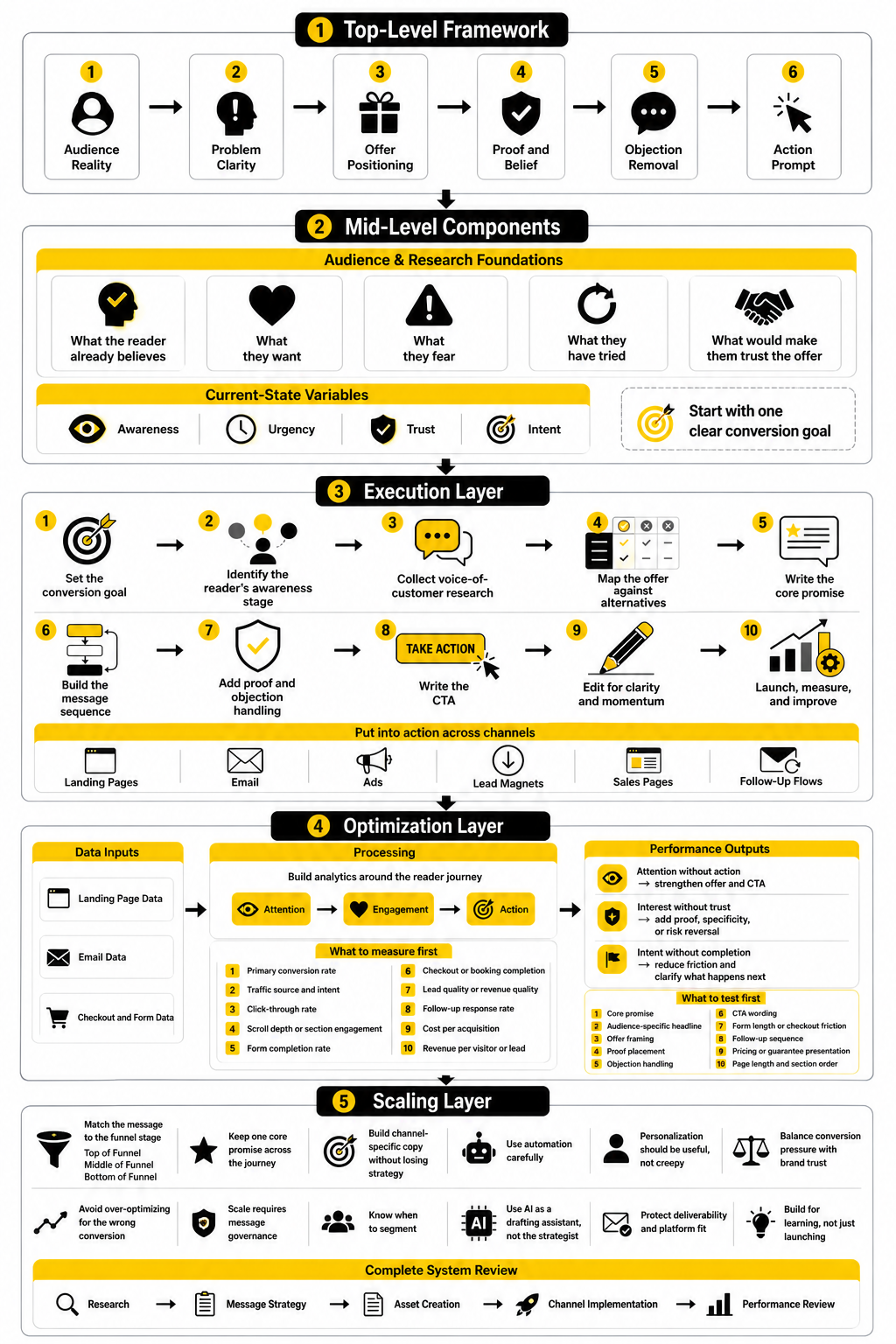
The Complete Direct Response Copywriting System
The full system starts with evidence. You study the audience, define the conversion goal, clarify the offer, and collect proof before writing. This prevents the copy from drifting into vague claims, clever lines, or internal language that buyers do not care about.
Then you build the message around the reader’s decision path. The copy should earn attention, create relevance, make the offer concrete, build belief, answer objections, and make the next step obvious. That sequence can show up as a landing page, email flow, ad sequence, webinar page, sales page, chatbot path, or follow-up script.
Finally, you measure what happened and decide what to improve. Benchmarks from sources like Baymard’s cart abandonment research, MailerLite’s email benchmarks, and Unbounce’s conversion benchmark report can give context, but your own funnel data is what matters most. The best copy teams use outside data to ask better questions, then use internal results to make better decisions.
What To Review Before Publishing
Before publishing any serious direct response asset, review it like a buyer. Do not just proofread. Walk through the decision the reader has to make.
Start with the first screen or first few lines. The reader should quickly understand who the message is for, what problem it addresses, what outcome is being offered, and why they should continue. If the opening is vague, the rest of the copy has to work too hard.
Then check the middle of the message. The offer should become more believable as the reader continues, not just louder. Proof, mechanism, specificity, and objection handling should all support the same core promise instead of adding disconnected claims.
The Final Copy Review Checklist
A simple checklist can protect the copy from avoidable mistakes. It also helps teams review work consistently without turning every draft into a subjective debate. The point is not to make the copy stiff. The point is to make sure the persuasive foundation is solid.
Use this checklist before launch:
This review should happen before design polish becomes the main conversation. Beautiful design can strengthen good copy, but it cannot save an unclear argument. Fix the persuasion first, then make the experience feel smooth.
What Is Direct Response Copywriting?
Direct response copywriting is writing designed to produce a specific measurable action. That action could be a click, reply, purchase, booking, signup, download, or completed form. The key difference is accountability: the copy is judged by what the reader does next, not by whether the team likes how it sounds.
It is used across landing pages, ads, emails, sales pages, product pages, lead magnets, chat flows, checkout pages, and follow-up sequences. The format can change, but the purpose stays the same. The copy should move the right reader toward the right action.
Good direct response copywriting is not about pressure or hype. It is about relevance, clarity, proof, and timing. When done well, it helps people make better decisions faster.
How Is Direct Response Copywriting Different From Brand Copywriting?
Brand copywriting shapes perception over time. It defines voice, positioning, personality, values, and emotional association. Direct response copywriting focuses more tightly on measurable action.
The two should not fight each other. Strong direct response copy should still sound like the brand, and strong brand copy should still support commercial goals. The problem happens when brand copy is too vague to convert or direct response copy is too aggressive to trust.
The best businesses use both. Brand builds familiarity and preference. Direct response turns that attention into leads, sales, bookings, and customer actions.
What Makes Direct Response Copywriting Effective?
Effective direct response copywriting starts with a clear reader, a clear problem, and a clear offer. If those three pieces are fuzzy, the writing will usually feel fuzzy too. Better wording cannot fully compensate for weak positioning.
The copy also needs proof. Readers are skeptical, especially when the promise involves money, time, health, status, or business results. Specific details, transparent explanations, testimonials, demos, and credible evidence help make the claim believable.
Finally, the CTA has to feel natural. The reader should understand what happens next and why it is worth doing. If the next step feels risky, confusing, or too demanding, the copy will lose people near the finish line.
How Long Should Direct Response Copy Be?
Direct response copy should be as long as the decision requires. A simple newsletter signup may need only a short section. A high-ticket service, software platform, or complex purchase may need much more explanation.
The real issue is not length. The real issue is unresolved friction. If the reader still has important questions, the copy may be too short. If the copy repeats itself or adds filler after the decision is already clear, it is too long.
A good rule is simple: keep every sentence that helps the reader decide, and cut every sentence that exists only to sound impressive. That keeps the copy focused without making it thin.
What Metrics Should I Track For Direct Response Copywriting?
Start with the primary conversion event. That might be purchases, demo bookings, sales calls, email signups, trial starts, replies, or form completions. This is the metric the copy was actually written to influence.
Then track the supporting signals that explain the result. For a landing page, that may include traffic source, scroll depth, CTA clicks, form starts, form completions, checkout abandonment, and lead quality. For email, it may include opens, clicks, replies, unsubscribes, conversions, and revenue after the click.
The mistake is tracking everything without knowing what each number means. Metrics should diagnose the journey. They should help you see where attention, belief, friction, or offer fit is breaking down.
Are Conversion Rate Benchmarks Useful?
Conversion rate benchmarks are useful for context, but they should not become universal targets. A “good” conversion rate depends on the industry, channel, offer, traffic intent, price point, and conversion action. Comparing a cold traffic lead magnet to a warm branded search demo page makes no sense.
Benchmarks are best used to spot possible problems. If your page is far below similar offers in similar conditions, it may deserve a closer review. But the benchmark itself does not tell you exactly what to rewrite.
Your own data is more important over time. Once you have enough traffic and conversion history, your previous performance becomes the most useful comparison. The goal is not to beat a random industry average. The goal is to improve the economics of your own funnel.
What Is The Biggest Mistake In Direct Response Copywriting?
The biggest mistake is writing before the strategy is clear. Many teams start with headlines, button text, or clever angles before they understand the reader, the offer, the objections, and the conversion goal. That creates copy that sounds active but does not persuade.
Another common mistake is using vague benefits. Phrases like “save time,” “grow faster,” and “get better results” are usually too broad unless they are supported by specifics. Readers need to understand what changes, how it changes, and why it matters.
The third mistake is ignoring the follow-up experience. If the ad is strong but the landing page is confusing, the funnel leaks. If the landing page is strong but the email follow-up is generic, the opportunity weakens. Direct response copywriting works best when the whole path is aligned.
Can AI Write Direct Response Copy?
AI can help with research organization, outline development, angle exploration, draft variations, and repurposing. It can speed up the work when you already have strong inputs. It is especially useful for turning voice-of-customer research into draft options that a skilled marketer can review.
But AI should not be treated as the strategist. It does not automatically know what your market believes, what your offer can honestly claim, what proof is strongest, or what your buyers are most skeptical about. Those decisions need human judgment.
The best workflow is to use AI for leverage, then edit with a sharp commercial eye. Feed it real research, real constraints, real proof, and real positioning. Then remove anything generic, unsupported, exaggerated, or off-brand.
How Do I Improve A Landing Page That Is Not Converting?
Start by identifying where the page is failing. If visitors leave quickly, the first screen may not match the traffic source or may not communicate value fast enough. If visitors scroll but do not click, the offer may not feel compelling or the CTA may not feel worth it.
If people click the CTA but abandon the form or checkout, the friction may be after the copy. The form may ask for too much, the checkout may create doubt, or the next step may feel unclear. In that case, rewriting the headline may not solve the real problem.
Review the full path before making changes. Match the traffic promise to the page promise, clarify the offer, strengthen proof, answer objections, and reduce unnecessary friction. Then test one meaningful change at a time.
What Should I Test First In Direct Response Copy?
Test the message elements that carry the most decision weight. Start with the core promise, audience-specific headline, offer framing, proof placement, objection handling, and CTA. These changes can teach you something meaningful about what the market responds to.
Do not start with tiny cosmetic changes unless the major message is already working. A button color test might be easy, but it usually teaches less than a stronger promise or clearer offer explanation. Start where the buyer’s decision is most affected.
Write a hypothesis before testing. State what you are changing, why you believe it matters, and what behavior should improve. That turns testing into learning instead of guessing.
How Do I Make Direct Response Copywriting Sound Less Salesy?
Make it more specific, more honest, and more useful. Copy often sounds salesy when it leans on exaggeration instead of clarity. If the claim is real, you usually do not need to shout it.
Use plain language. Explain the mechanism. Show proof. Admit who the offer is not for when appropriate. Real confidence feels different from pressure.
A strong CTA can still be direct. The difference is that it should feel earned by the message before it. When the copy has already created relevance, belief, and clarity, the ask does not need to feel forced.
Where Should Direct Response Copywriting Be Used?
Use direct response copywriting anywhere a specific action matters. That includes paid ads, landing pages, product pages, email campaigns, lead magnets, sales pages, checkout pages, retargeting ads, webinar pages, booking pages, and sales follow-up messages.
It is especially important when the business needs measurable pipeline or revenue. If the copy is connected to acquisition, activation, conversion, retention, or upsell, direct response principles apply. The format may be short or long, but the message still needs to guide action.
It also works for organic content when the post has a clear next step. Not every piece of content needs to sell immediately, but when action matters, the principles help. Clarity, relevance, proof, and a specific CTA make almost any marketing asset stronger.
How Do I Choose A Direct Response Copywriter?
Choose someone who asks about the business model before they ask about word count. A strong direct response copywriter wants to understand the offer, audience, funnel, traffic source, proof, objections, and conversion goal. If they only talk about style, they may miss the commercial work.
Look for strategic thinking, not just polished writing. The best copywriters can explain why a message should be structured a certain way. They can diagnose weak offers, unclear promises, missing proof, and friction in the conversion path.
Also look for measurement discipline. Direct response copywriting should be connected to outcomes. A good copywriter understands that the goal is not to deliver pretty sentences. The goal is to help the business make the next action easier for the right buyer.
Build a stronger local presence with BAAM AI
Turn your website, Google profile, social channels, and AI visibility into one growth engine
Most businesses do not need more random marketing activity. They need a consistent presence system that helps the right people find them, trust them, and take action. BAAM AI brings strategy, local SEO, website updates, Google Maps visibility, social content, AI-search readiness, media production, and reporting into one practical monthly engine.
If you want your marketing to keep working after the campaign ends, start with a free BAAM AI presence audit. See how your business shows up today and where the fastest visibility wins are at BAAM AI.