
BAAM AI Blog
Direct Response Advertising: A Practical Framework For Measurable Growth
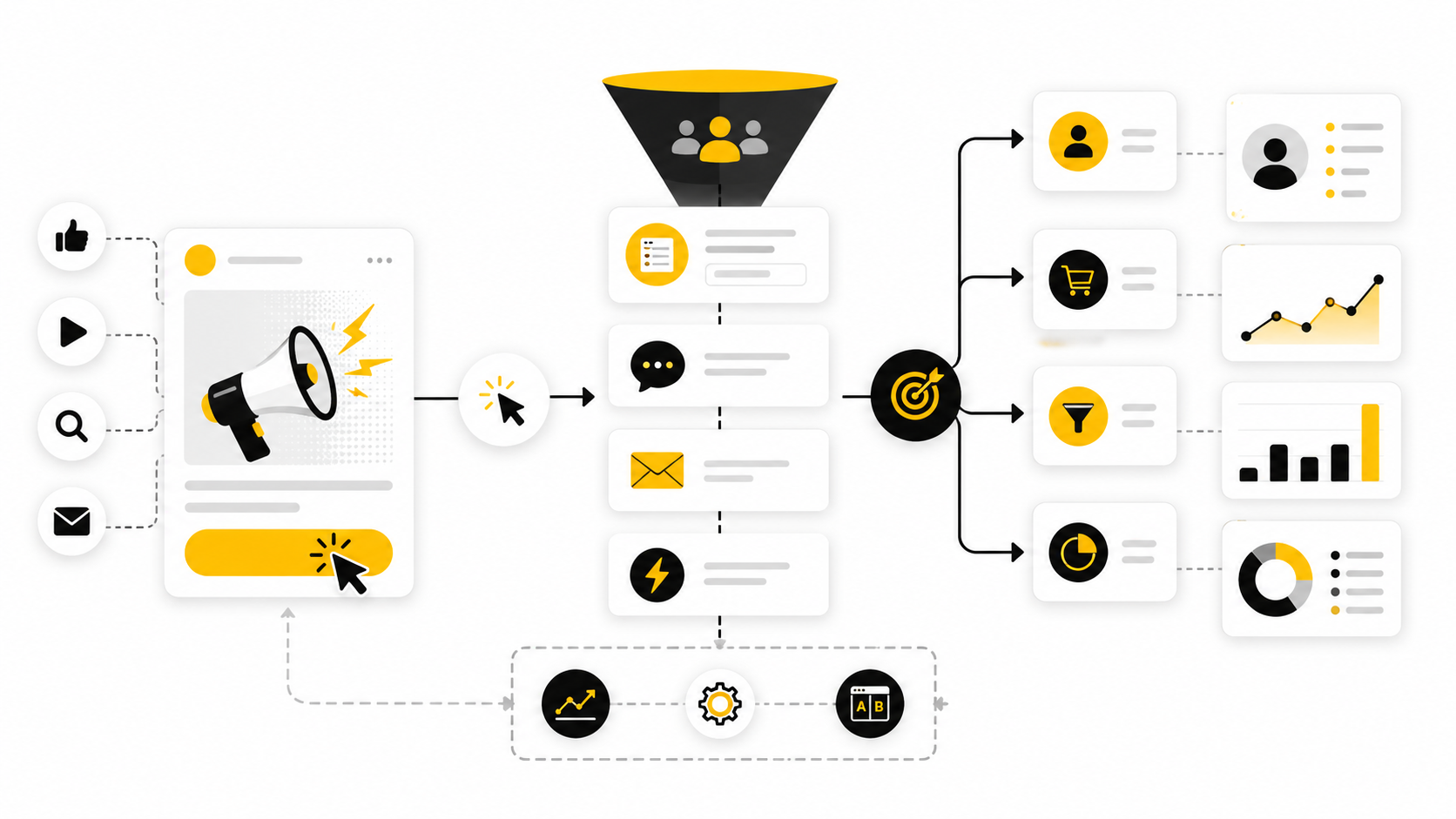
Direct response advertising is advertising built to get a specific action now, not someday. That action might be a purchase, booked call, form submission, app install, product demo request, webinar registration...
Affiliate disclosure: this article may include compensated links. Recommendations should still be evaluated against your use case, budget, and current provider terms.
Should you choose this tool?
this tool is worth considering when the use case, budget, and implementation effort match what you actually need to do next.
teams that want a practical tool decision without reading another generic feature list
Check this toolDirect response advertising is advertising built to get a specific action now, not someday. That action might be a purchase, booked call, form submission, app install, product demo request, webinar registration, phone call, text opt-in, or email signup. The point is simple: every campaign needs a clear offer, a clear audience, a clear call to action, and a way to measure whether the ad actually moved someone closer to revenue.
That makes direct response advertising different from broad awareness campaigns. Brand advertising can be valuable, but it often plays a longer game: memory, preference, category association, and trust. Direct response still benefits from brand trust, but it puts pressure on the campaign to prove itself through visible numbers: conversion rate, cost per lead, cost per acquisition, average order value, payback period, pipeline created, or return on ad spend.
This matters more now because advertising has become both more powerful and less forgiving. The U.S. digital ad market reached nearly $300 billion in 2025, while privacy changes, AI bidding, retail media, creator-led ads, and fragmented customer journeys have made lazy measurement much harder to defend. If a business is spending serious money on paid traffic, direct response discipline is no longer a niche copywriting skill. It is the operating system for profitable acquisition.
this guide breaks direct response advertising into a practical framework you can actually use. Not theory for theory’s sake. Not old-school hype. The goal is to show how modern campaigns work when strategy, offer, creative, landing pages, follow-up, tracking, and optimization are treated as one connected system.
Direct Response Advertising in Plain English
Direct response advertising is any ad designed to trigger a measurable response from a defined audience. The response needs to be specific enough that the business can connect the ad to an outcome, whether that outcome happens online, on a call, in a CRM, or later in the sales pipeline. That is why a direct response campaign usually includes a visible action path: click here, claim this, book this, download this, start this, call now, compare plans, or request access.
The best definition is not complicated. Direct marketing is built around direct contact and measurable response, and direct response advertising is the ad format that pushes that measurable response into motion. Britannica describes direct marketing as direct contact where the seller can generally measure response to an offer, which is the exact logic behind modern direct response advertising.
The modern version is broader than mailers, coupons, and infomercials. A Google Search ad for “emergency plumber near me,” a Meta lead ad for a local clinic, a YouTube ad sending viewers to a webinar, a TikTok Shop ad driving product sales, a LinkedIn ad promoting a demo, and a retargeting ad offering a free trial can all be direct response campaigns. Different channels, same job: create action that can be tracked.
Why Direct Response Advertising Matters Now
Direct response advertising matters because attention is expensive, and vague marketing is easy to waste. When platforms automate targeting and bidding, the business still needs to control the fundamentals: the promise, the offer, the economics, the landing experience, and the follow-up. You can let an algorithm find pockets of demand, but you cannot outsource the reason someone should care.
The pressure for better measurement is also rising. Google’s enhanced conversions are designed to improve conversion measurement by using hashed first-party data in a privacy-safe way, which shows how much performance advertising now depends on better signal quality rather than simple pixel tracking alone. Google’s own documentation says enhanced conversions can improve measurement accuracy and support stronger bidding by supplementing existing conversion tags with hashed first-party conversion data.
There is also a compliance side that smart advertisers cannot ignore. Direct response advertising often uses stronger claims, urgency, testimonials, guarantees, bonuses, free trials, and subscription offers, which means the campaign has to stay truthful and clear. The FTC’s advertising guidance is blunt about the standard: businesses need solid proof for advertising claims, and endorsement rules still apply when creators, affiliates, customers, or influencers are part of the campaign.
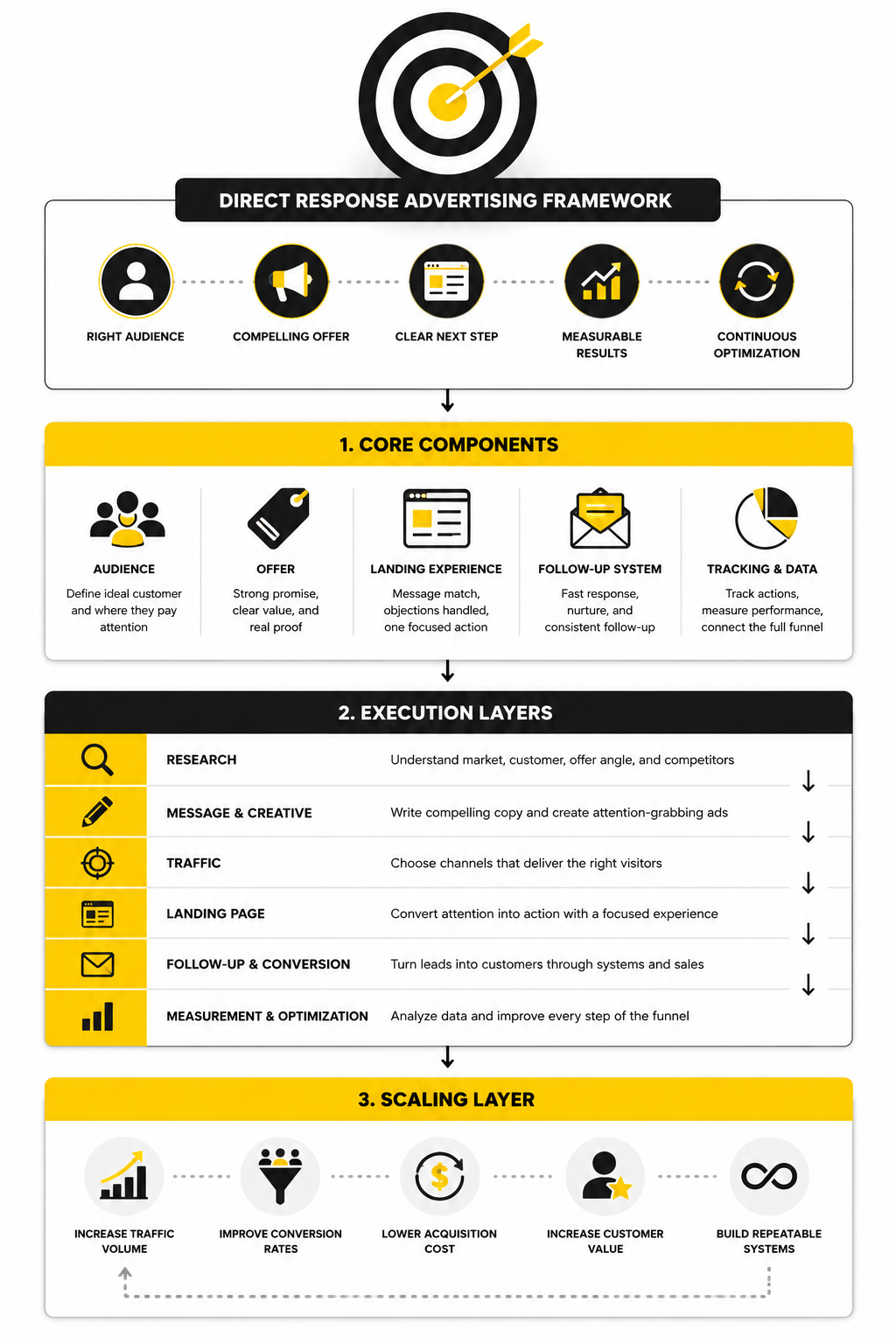
The Direct Response Advertising Framework
A strong direct response campaign has four connected layers: market, message, mechanism, and measurement. The market defines who the campaign is for and what problem is urgent enough to act on. The message turns that problem into a clear promise, then supports the promise with proof, specificity, and a call to action.
The mechanism is the path from ad to conversion. That includes the creative format, landing page, lead form, checkout, booking calendar, email sequence, SMS follow-up, sales call, CRM workflow, and retargeting loop. This is where many campaigns fail, because the ad gets attention but the next step creates confusion, friction, or doubt.
Measurement is the feedback system. It tells you whether the campaign is attracting the right people, whether they understand the offer, whether they believe the promise, whether they move through the funnel, and whether the economics work after the first conversion. Without measurement, direct response advertising becomes guesswork with a media budget.
Core Components That Make Campaigns Convert
Every direct response campaign needs a real offer. A discount can be an offer, but it is not the only option. A strong offer can also be a diagnostic call, comparison guide, free trial, limited bundle, calculator, audit, sample, workshop, webinar, quote request, product quiz, or fast-start package.
The offer then needs a message that makes the next step feel logical. People do not click because a business wants leads. They click because the ad makes a relevant outcome feel closer, easier, faster, safer, cheaper, or more certain than what they are doing now.
The final component is follow-up. Most direct response campaigns do not win only inside the ad platform. They win because the business captures demand, responds quickly, segments intent, answers objections, and keeps moving prospects toward the next decision.
Why Direct Response Advertising Matters Now
Direct response advertising matters because the easy version of online advertising is mostly gone. For years, many advertisers could get away with loose targeting, weak tracking, generic creative, and still find profitable pockets because platform costs were lower and privacy rules were less complex. That is not the market anymore.
Digital advertising is now massive, automated, and crowded. The U.S. digital ad industry reached nearly $300 billion in revenue in 2025, which means more brands are fighting for the same attention, the same auctions, and the same high-intent buyers. When competition rises, the businesses with clearer offers, sharper creative, stronger landing pages, and better follow-up usually win.
The practical takeaway is simple: direct response advertising gives your marketing a scoreboard. It forces every campaign to answer the questions that matter. Who are we trying to reach? What do we want them to do? Why should they act now? What happens after they click? How do we know whether the campaign made money?
Performance Pressure Has Changed The Game
Performance pressure is not just a media buying problem. It is a business model problem. If customer acquisition costs rise while conversion rates stay flat, the company either needs a stronger offer, better retention, higher average order value, faster sales follow-up, or a cleaner funnel.
This is why direct response advertising is not only for ecommerce brands. It applies to agencies, SaaS companies, local service businesses, coaches, clinics, creators, B2B firms, franchises, and professional services. Any business that needs predictable demand can use direct response principles to turn attention into pipeline, sales, or booked appointments.
The mistake is thinking performance marketing means “run ads and optimize the dashboard.” That is too narrow. Real performance comes from the whole system: the ad, the audience, the promise, the landing page, the CRM, the sales process, the email or SMS sequence, and the economics behind the offer.
Privacy Has Made First-Party Data More Valuable
Privacy changes have made lazy tracking weaker, but they have also made disciplined advertisers stronger. When third-party signals become less reliable, businesses need cleaner first-party data, better consent flows, stronger CRM hygiene, and conversion events that actually match the buyer journey. That is not glamorous work, but it directly affects campaign performance.
Google’s enhanced conversions are a good example of where the market has moved. The product is built to improve conversion measurement by using hashed first-party data in a privacy-conscious way, which helps advertisers recover signal that traditional tracking can miss. For lead-generation campaigns, Google also positions enhanced conversions for leads as a more durable version of offline conversion importing, with support for cross-device and engaged-view conversions.
That matters because direct response advertising depends on feedback. If your ad platform only sees the form fill but never sees which leads became qualified opportunities, booked calls, customers, or repeat buyers, it can optimize toward the wrong thing. The business starts buying cheap leads instead of valuable customers, and the campaign looks healthy right until the revenue report proves otherwise.
Automation Rewards Better Inputs
Ad platforms are increasingly automated. Meta, Google, TikTok, Amazon, and other platforms now push advertisers toward broader audiences, machine-learning bidding, automated placements, and creative variations. That can work, but only when the inputs are strong.
Meta’s Advantage+ shopping campaign documentation says the format uses automation and AI to help advertisers deliver campaigns at scale, improve efficiency, and support sustained performance. That does not mean the platform magically fixes a weak offer or unclear message. It means the system has more control over delivery, so the advertiser has to be even more careful with positioning, creative quality, conversion tracking, and post-click experience.
This is the part many people miss. Automation does not remove strategy. It raises the price of bad strategy. If you feed an algorithm vague creative, messy conversion data, and a landing page that does not answer buyer objections, you are simply helping it spend your money faster.
Buyers Expect Relevance
Buyers are not offended by all advertising. They are offended by irrelevant, manipulative, badly timed, or confusing advertising. Direct response advertising works best when the message feels specific to the person’s problem and useful enough to deserve the click.
Personalization plays a real role here, but it should not become creepy or overcomplicated. McKinsey has reported that 71% of consumers expect personalized interactions, while 76% get frustrated when that does not happen. The point is not to stuff someone’s name into a headline. The point is to show that you understand their situation, their desired outcome, and the friction stopping them from acting.
For direct response campaigns, relevance usually comes from practical segmentation. A first-time visitor needs a different message than a returning cart abandoner. A cold B2B prospect needs a different promise than someone who already downloaded a comparison guide. A homeowner searching for emergency repair help needs a different path than someone researching a planned renovation.
The Funnel Is Part Of The Ad
A direct response ad does not end at the click. The click is just the handoff. If the next page is slow, vague, cluttered, or disconnected from the ad promise, the campaign leaks money before the sales team ever gets a chance.
This is why landing pages matter so much. The ad creates the expectation, and the landing page either confirms or breaks it. A campaign promising a fast quote should not send people to a generic homepage. A webinar ad should not bury the registration form under six unrelated sections. A product ad should not make the buyer hunt for pricing, shipping, reviews, or guarantees.
For teams building dedicated conversion pages, tools like Replo, ClickFunnels, and Systeme.io can be useful when the goal is to move faster without waiting on a full development cycle. The tool is not the strategy, though. The page still needs a clear promise, believable proof, low-friction action, and a next step that matches the buyer’s intent.
Follow-Up Is Where A Lot Of Profit Is Hiding
Many direct response campaigns do not fail because the ad is terrible. They fail because the business does not follow up well. Leads sit too long, calls are missed, email sequences are generic, SMS is underused or abused, and sales teams do not know which campaign created which conversation.
That is expensive. A lead who requested a quote, demo, or consultation is showing intent in a specific window. If the business responds slowly or sends a bland automated message, the buyer keeps comparing options and the campaign gets blamed for what is really an operational problem.
This is where CRM and automation platforms can support direct response advertising when they are set up properly. A system like GoHighLevel can help agencies and service businesses connect lead capture, pipelines, appointment booking, SMS, email, and follow-up workflows in one place. For chat-based conversion paths, ManyChat can also make sense when the campaign naturally moves through Instagram, Messenger, or WhatsApp.
Compliance Is Not Optional
Direct response advertising often uses urgency, guarantees, testimonials, bonuses, pricing claims, comparison claims, and outcome-focused messaging. That is exactly why compliance matters. The stronger the claim, the more careful the advertiser needs to be.
The FTC’s endorsement guidance makes clear that testimonials and endorsements must not mislead people, especially when results are not typical or when there is a material connection between the endorser and the brand. Its advertising substantiation policy also makes the core standard clear: advertisers need a reasonable basis for objective claims before they make them, not after the campaign gets challenged.
This is not just legal housekeeping. It protects conversion quality. If your campaign attracts people with exaggerated promises, refunds, complaints, chargebacks, bad reviews, and poor retention usually follow. Clean claims may feel less flashy, but they build a business that can keep scaling without constantly cleaning up the mess.
The Direct Response Advertising Framework
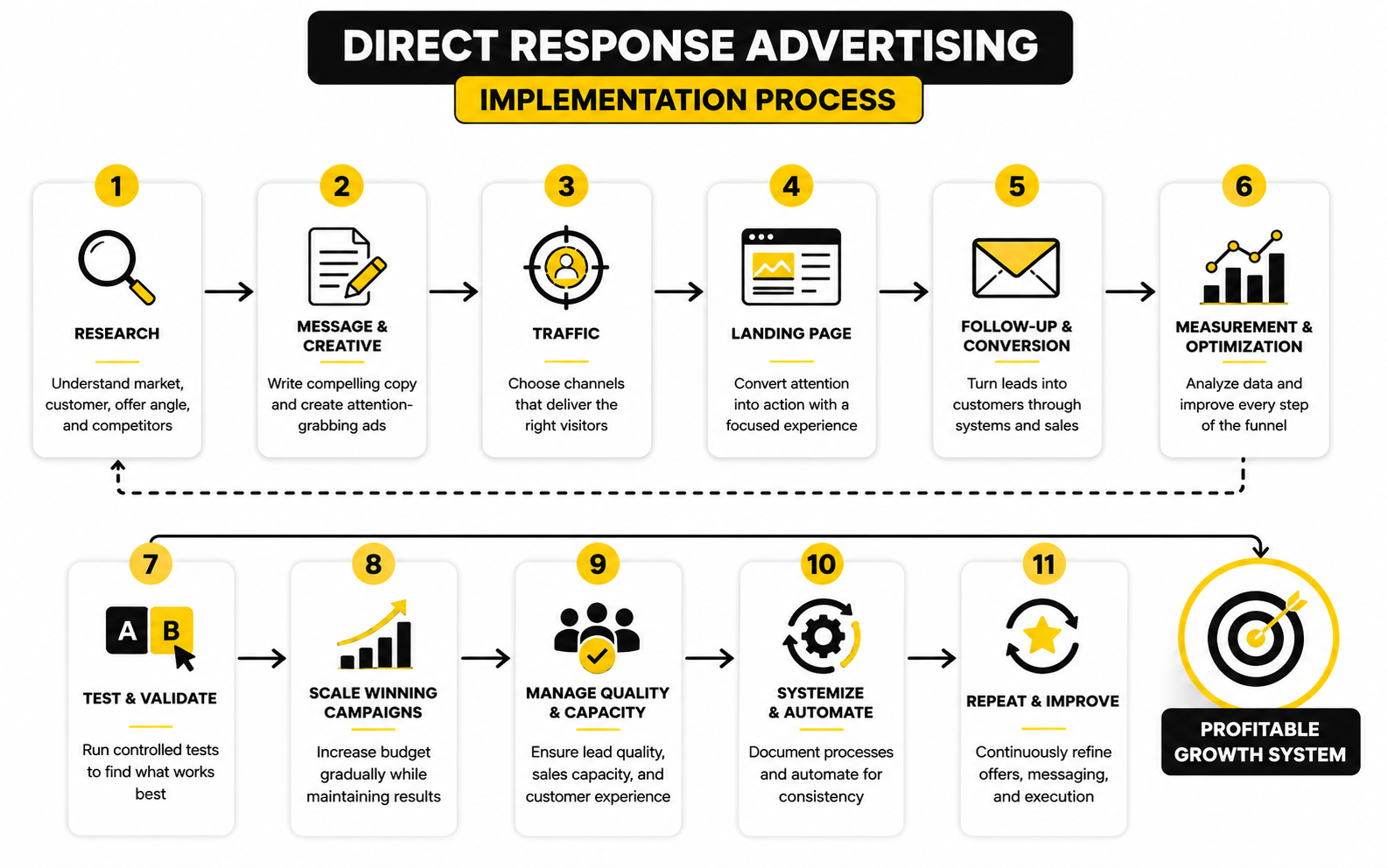
A direct response advertising campaign should never start with “let’s make an ad.” That is backwards. The ad is only one piece of a larger conversion system, and the system has to be designed before the creative goes live.
The cleaner starting point is to define the business outcome first. Are you trying to sell a product, generate qualified leads, book appointments, start trials, fill a webinar, recover abandoned carts, or reactivate old customers? Once the outcome is clear, the rest of the campaign can be built around one direct path instead of scattered ideas.
A useful framework has six stages: goal, audience, offer, message, conversion path, and measurement. Each stage answers a different question. Together, they keep direct response advertising from turning into random creative testing with no real strategy behind it.
Start With The Commercial Goal
The campaign goal has to be more specific than “get more sales” or “generate leads.” That kind of goal sounds useful, but it is too vague to guide decisions. A better goal defines the action, the value of that action, and the economics that make the campaign worth running.
For ecommerce, that might mean acquiring first-time customers at a cost that still leaves room for gross margin, shipping, returns, and future retention. For a service business, it might mean generating booked appointments at a cost that makes sense based on show rate, close rate, and average deal value. For SaaS, it might mean trial signups that activate, engage, and convert to paid accounts instead of low-quality users who disappear after one login.
This is where many campaigns quietly break. The ad account may show leads or purchases, but the business does not know the real acceptable cost per acquisition. Direct response advertising only works properly when the campaign is connected to the actual unit economics of the business.
Define The Audience By Intent, Not Just Demographics
Demographics can help, but intent usually matters more. A 38-year-old business owner is not automatically a good prospect. A 38-year-old business owner actively comparing CRM tools, requesting pricing, or looking for a faster way to follow up with leads is much more useful.
Good audience definition looks at the situation the person is in. What triggered the search? What problem are they trying to solve? What have they already tried? What would make them act now instead of waiting another month? Those answers shape stronger ads than surface-level targeting ever will.
This is especially important as platforms rely more on automation. Meta’s Advantage+ products are built around AI-powered campaign automation and optimization, while Google’s automated bidding systems depend heavily on conversion signals and goal quality. The advertiser’s job is to give these systems better inputs: clearer conversion events, stronger creative angles, cleaner audience signals, and landing pages that match the buyer’s intent.
Build The Offer Before Writing The Ad
The offer is the heart of direct response advertising. Weak offers make good copy work too hard. Strong offers make the next step feel obvious.
An offer is not just the product. It is the product plus the reason to act, the perceived value, the risk reversal, the urgency, the delivery method, the bonus, the guarantee, the proof, or the first step. A “free consultation” is generic. A “15-minute growth audit showing the three biggest leaks in your appointment funnel” is more specific, more tangible, and easier to understand.
The best offer depends on the buying stage. Cold audiences may need education, comparison, a quiz, a guide, a calculator, or a low-friction diagnostic. Warm audiences may respond better to a trial, demo, discount, bundle, limited bonus, or direct booking path. Hot audiences usually need reduced friction, fast answers, trust signals, and a clear call to action.
Turn The Offer Into A Message
The message translates the offer into something the buyer immediately understands. It should make the problem feel recognized, the outcome feel desirable, and the next step feel safe. That does not mean making wild promises. It means being specific enough that the right person can tell the ad is for them.
A strong message usually contains four pieces: the pain or desire, the promised outcome, the mechanism, and the call to action. The pain gives the ad relevance. The outcome gives it direction. The mechanism explains why this solution is different. The call to action tells the person exactly what to do next.
This is also where compliance needs to be built in early. If the campaign uses testimonials, earnings claims, health claims, savings claims, comparisons, or “typical result” language, the advertiser needs evidence before launch. The FTC’s endorsement guidance makes it clear that testimonials can be misleading when they imply results people should not generally expect, and its broader advertising guidance emphasizes that objective claims need proper support.
Design The Conversion Path
Once the message is clear, the conversion path needs to make that message easy to act on. This is where direct response advertising becomes tangible. The person sees the ad, clicks, lands somewhere, understands the offer, takes action, and receives follow-up that moves them to the next step.
The path should be simple enough to explain in one sentence. For example: the ad sends homeowners to a quote page, the form captures the job details, the CRM creates a lead, the team receives an alert, the homeowner gets an immediate confirmation, and the sales team follows up within minutes. If the path takes five minutes to explain, it is probably too messy.
Landing pages matter because they carry the promise from the ad into the decision moment. A page built with ClickFunnels, Systeme.io, or Replo can move fast, but speed only helps when the page is focused. The page still needs message match, proof, a clear call to action, and as little unnecessary friction as possible.
Map The Follow-Up Before Launch
Follow-up should be planned before the first dollar is spent. This is not something to “figure out later.” If the campaign creates demand and the business responds slowly, inconsistently, or with generic automation, performance drops even when the ads are doing their job.
The follow-up path depends on the offer. A booked-call campaign needs reminders, confirmations, rescheduling options, no-show recovery, and sales notes. A lead magnet needs segmentation, education, intent scoring, and a bridge to the next offer. A cart recovery campaign needs timing, objection handling, proof, and possibly an incentive that does not train every buyer to wait for a discount.
For service businesses and agencies, GoHighLevel can be useful because it connects forms, calendars, pipelines, email, SMS, and automation in one operating system. For ecommerce and newsletter-style nurturing, tools like Brevo or Moosend can support email sequences, segmentation, and campaign follow-up. The tool choice matters less than the discipline: every lead should know what happens next.
Set Up Measurement Around Quality
Measurement should not stop at the first conversion. A form fill is not the same as a qualified lead. A booked call is not the same as a closed deal. A first purchase is not the same as a profitable customer.
This is why the campaign needs quality signals. Google’s enhanced conversions use hashed first-party customer data to improve conversion measurement, and enhanced conversions for leads can help advertisers connect offline outcomes back to ad interactions. That kind of setup is valuable because it helps the platform learn from deeper events instead of optimizing only for cheap surface-level actions.
The same principle applies outside Google. If a campaign is judged only by cost per lead, it may drift toward people who fill out forms easily but never buy. If it is judged by qualified opportunities, booked appointments, revenue, or contribution margin, the advertiser gets a clearer view of what is actually working.
Launch With A Testing Plan
A direct response advertising campaign should launch with a testing plan, not a pile of random variations. Testing only works when each test is tied to a real hypothesis. Otherwise, you end up changing headlines, images, audiences, and landing pages without knowing what caused the result.
The first tests should usually focus on the biggest levers. That means offer angle, audience intent, creative concept, landing page promise, call to action, and follow-up speed. Button colors and tiny copy tweaks can wait until the main conversion path is already working.
A simple testing plan might compare three offer angles against the same audience, or one offer across three audience segments, or two landing page structures for the same ad concept. The point is control. You want to learn why something worked, not just notice that one version happened to win.
Read The Data Like A Funnel, Not A Dashboard
Dashboards are useful, but they can create a false sense of control. A campaign can have a low cost per click and still fail because visitors do not convert. It can have a strong conversion rate and still fail because the leads are unqualified. It can generate sales and still fail because fulfillment costs, refunds, or churn destroy the margin.
Read the campaign as a funnel instead. Look at the movement from impression to click, click to conversion, conversion to qualified action, qualified action to sale, and sale to profit. Each step reveals a different problem.
Low click-through rate usually points to weak creative, weak relevance, or unclear promise. Low landing page conversion usually points to message mismatch, friction, lack of proof, or a weak offer. Low close rate usually points to lead quality, sales process, pricing mismatch, or poor follow-up. This is how direct response advertising becomes a system you can improve instead of a campaign you simply hope will work.
Statistics and Data
Data should make direct response advertising easier to manage, not harder to understand. The goal is not to collect every possible metric or stare at dashboards until something looks interesting. The goal is to know which numbers explain attention, intent, conversion quality, sales efficiency, and profit.
Benchmarks can help, but they are not commandments. A search campaign for emergency services, a Meta campaign for a low-ticket impulse product, and a LinkedIn campaign for enterprise software will never behave the same way. The right way to use benchmarks is to spot obvious problems, set realistic expectations, and decide where the next improvement should happen.
The market context matters too. Digital advertising is now a nearly $300 billion U.S. market, and that growth is happening alongside more automation, more creative volume, and more competition for high-quality attention. When the auction gets more crowded, the advertiser who understands the numbers behind the funnel has a major advantage.
Start With The Five Numbers That Actually Matter
Most direct response advertising campaigns can be understood through five core numbers: click-through rate, cost per click, conversion rate, cost per acquisition, and customer value. These metrics are not equal, and they should not be treated like separate dashboard tiles. They are connected parts of one acquisition equation.
Click-through rate tells you whether the ad is earning attention from the people seeing it. Cost per click tells you how expensive that attention is in the auction. Conversion rate tells you whether the post-click experience turns interest into action. Cost per acquisition tells you whether the action is affordable. Customer value tells you whether the whole thing is worth scaling.
The danger is optimizing one number in isolation. A cheap click is useless if it comes from the wrong person. A high conversion rate can still be bad if the form attracts low-quality leads. A low cost per acquisition can still be dangerous if refunds, churn, fulfillment costs, or sales labor erase the margin.
Read Benchmarks As Diagnostic Tools
Search advertising benchmarks are useful because they show how different industries behave under real auction pressure. In 2025, the average search advertising cost per click across industries was reported at $5.26, while Google Ads cost-per-lead benchmarks were reported around $70.11. Those numbers are not targets. They are context.
If your campaign is paying much more than the market for clicks, the problem could be competition, low Quality Score, weak relevance, poor account structure, or bidding against terms with the wrong commercial intent. If your cost per click is normal but your cost per lead is high, the issue is probably not the auction. It is more likely the offer, landing page, form, page speed, trust, or message match.
This is where direct response advertising becomes practical. You do not look at a high cost per lead and panic. You break the funnel apart, find the bottleneck, and fix the specific stage that is underperforming.
Separate Platform Metrics From Business Metrics
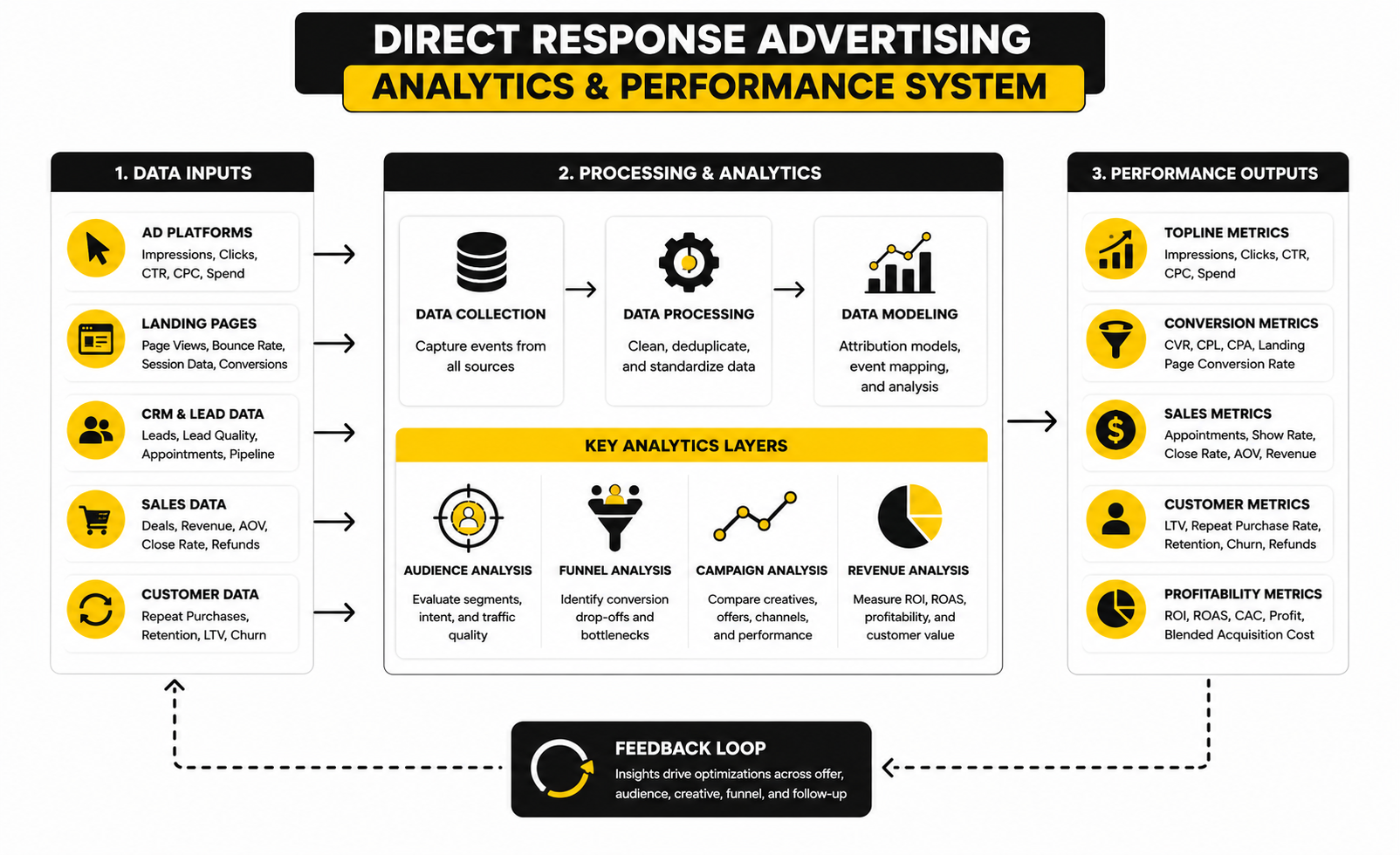
Ad platforms are good at reporting platform events. They can tell you impressions, clicks, click-through rate, conversions, cost per conversion, and sometimes revenue. That does not always mean they are showing the true business outcome.
A lead form submission is a platform conversion. A qualified booked appointment is a business signal. A purchase is a stronger signal, but even a purchase does not always mean profit if margins are thin or return rates are high. This distinction matters because direct response advertising can look successful inside the ad account while failing inside the business.
The cleanest setup connects ad data to CRM, sales, and revenue data. For service businesses, that might mean tracking lead source, appointment booked, appointment shown, estimate sent, deal closed, and revenue collected. For ecommerce, it might mean tracking first purchase, average order value, contribution margin, repeat purchase rate, refund rate, and lifetime value.
Build A Measurement System, Not Just A Dashboard
A measurement system starts before launch. Every campaign should have a defined conversion event, a source of truth, UTM structure, CRM fields, offline conversion process, and reporting rhythm. Without that foundation, teams end up arguing about numbers instead of improving the campaign.
For Google campaigns, enhanced conversions can help improve measurement by using hashed first-party data alongside existing conversion tags. For lead generation, enhanced conversions for leads can connect offline outcomes back to ad interactions, which helps advertisers optimize beyond the initial form submission. That is important because cheap leads and valuable leads are rarely the same thing.
For local service, agency, and appointment-based businesses, a platform like GoHighLevel can help connect forms, calls, calendars, pipelines, SMS, email, and campaign attribution in one place. For landing-page-led campaigns, tools like ClickFunnels, Systeme.io, and Replo can support cleaner funnel tracking when each campaign has a dedicated destination instead of dumping traffic on a generic homepage.
Understand What Each Metric Is Trying To Tell You
Click-through rate is a relevance signal, but it is not a revenue signal. A high click-through rate usually means the creative is getting attention, but attention can come from curiosity, controversy, broad appeal, or misleading framing. The next question is whether those clicks turn into qualified action.
Conversion rate shows whether the visitor believes the offer enough to act. If conversion rate is weak, look for friction before blaming the channel. The page may not match the ad, the form may ask too much too soon, the proof may be thin, the call to action may be unclear, or the offer may not feel worth the effort.
Cost per acquisition is where media efficiency starts to meet business reality. But even CPA needs context. A $150 CPA might be terrible for a $49 product with no repeat purchase, but excellent for a $2,500 service with strong close rates and healthy margins.
Do Not Confuse Leads With Demand
A direct response advertising campaign can generate leads without generating real demand. This happens when the offer attracts people who want the free thing but not the paid solution. It also happens when the targeting is too broad, the promise is too vague, or the form is too easy for low-intent prospects to complete.
That does not mean lead magnets are bad. It means the lead magnet has to be connected to the buying journey. A checklist, webinar, audit, quiz, calculator, or guide should reveal intent, qualify the person, and create a logical next step.
This is why lead quality needs its own reporting. Track qualified rate, contact rate, appointment rate, show rate, close rate, deal size, and sales-cycle length by campaign. Once you see those numbers, you can stop treating all leads as equal.
Use Channel Benchmarks Carefully
Meta benchmarks can be useful for understanding creative and audience response, but they need careful interpretation. WordStream’s 2025 Facebook Ads benchmark data reports major category differences, with some industries showing much higher conversion rates than others. That gap is a reminder that “average performance” is a weak planning tool when industry, offer, funnel type, and conversion definition vary so much.
Search benchmarks are different because search often captures existing intent. Someone searching for a solution is already moving toward a decision, so higher CPCs can still make sense when the buyer intent is strong. Paid social often creates or redirects demand, which means the creative, offer, and follow-up have to do more of the persuasion work.
The practical move is to compare each channel against its job. Search should often be judged by intent capture and profitable conversion. Social should often be judged by creative efficiency, demand creation, retargeting movement, and blended acquisition cost. Email and SMS should often be judged by conversion lift, repeat purchase, appointment recovery, and revenue from owned audiences.
Watch For The Hidden Signals
Some of the most useful signals are not the headline metrics. Time to lead response, call answer rate, booked-call show rate, checkout abandonment, email reply rate, SMS opt-out rate, demo attendance, and sales notes can reveal problems the ad account will never explain. These numbers are not always pretty, but they are brutally useful.
For example, if lead cost is acceptable but close rate is poor, the campaign may be attracting the wrong intent or the sales process may be misaligned with the promise. If close rate is strong but volume is low, the offer might work but the creative or targeting needs more reach. If clicks are expensive but conversion quality is excellent, the campaign may still be worth scaling because the economics work downstream.
This is why direct response advertising should be reviewed with both marketing and sales data in the same conversation. The ad buyer, copywriter, landing page builder, CRM owner, and sales team should not be operating from separate versions of reality.
Know When A Campaign Is Ready To Scale
A campaign is not ready to scale just because it got a few conversions. It is ready to scale when the signal is stable enough, the economics are clear enough, and the business can handle more volume without breaking the customer experience. Scaling too early is one of the fastest ways to turn a promising campaign into an expensive lesson.
Before increasing budget, check whether the campaign has enough conversion volume, whether the lead or order quality is holding, whether the landing page can support more traffic, and whether follow-up capacity is ready. Also check whether the result depends on a tiny audience pocket that may disappear as spend increases. What works at $50 per day may not behave the same at $500 per day.
Scaling should usually happen in controlled steps. Increase budget gradually, expand winning creative angles, test adjacent audiences, improve conversion paths, and feed better downstream data back into the platform. The goal is not just to spend more. The goal is to buy more of the right outcomes without destroying the economics that made the campaign worth scaling in the first place.
Professional Implementation Across Channels
Direct response advertising gets harder as soon as it moves from a single campaign to a real acquisition system. At small spend, one strong offer and one decent landing page can create useful momentum. At higher spend, the business has to manage channel roles, creative fatigue, attribution gaps, sales capacity, compliance risk, and the uncomfortable truth that not every winning campaign can scale forever.
This is where professional implementation matters. The goal is not to run more ads. The goal is to build a system where each channel has a job, each campaign has a measurable purpose, and each next step moves the buyer closer to a decision.
The best teams do not treat direct response advertising as a hack. They treat it as a repeatable operating process. They know what to test, when to cut, when to scale, and when the problem is not the ad at all.
Match The Channel To The Buying Moment
Every channel has a different relationship with buyer intent. Search usually captures demand that already exists. Paid social often creates or redirects demand. Email and SMS convert owned attention. Retargeting helps bring back people who already showed interest. Creator and affiliate campaigns can add trust, but they also need tighter claim control and clearer tracking.
This matters because the same offer will not work the same way everywhere. A direct booking call to action may work well for high-intent search traffic, but cold social traffic may need a softer first step. A product demo may make sense for a B2B retargeting audience, while a practical comparison guide may work better for someone seeing the brand for the first time.
Do not force one funnel onto every channel. Build the path around the buyer’s temperature. Cold traffic needs relevance and trust. Warm traffic needs proof and clarity. Hot traffic needs speed, reduced friction, and a reason to act now.
Protect The Offer From Channel Dilution
As campaigns expand, teams often weaken the offer without realizing it. The original campaign works because the promise, audience, landing page, and call to action are tightly matched. Then the same offer gets pushed into new audiences, new placements, new formats, and new markets until the numbers slowly fall apart.
That does not mean the offer is dead. It may mean the context changed. A discount that works in retargeting can cheapen the brand in cold prospecting. A webinar that works for founders may not work for marketing managers. A lead magnet that performs on LinkedIn may fail on TikTok because the audience is in a different state of mind.
The fix is not to keep rewriting random headlines. Keep the core promise stable, then adapt the entry point. The campaign should still feel like the same business with the same value proposition, but the first step should match how that specific audience discovers, evaluates, and buys.
Watch Creative Fatigue Before It Burns Budget
Creative fatigue is one of the most common scaling problems in direct response advertising. An ad starts strong, spend increases, frequency rises, the same people see the same message too often, and performance begins to decay. The dangerous part is that it usually happens gradually, so teams notice it late.
Meta describes creative fatigue as what happens when an audience has seen the same creative too many times, and its own guidance points advertisers toward identifying and resolving fatigue inside Ads Manager. The practical signals are usually declining click-through rate, rising cost per click, weaker conversion rate, rising frequency, and softer downstream quality. A 2025 research paper on creative fatigue also frames the issue as a finite lifespan of ad effectiveness, with performance degradation creating real opportunity cost when tired creative keeps receiving spend.
The solution is not endless random content. It is a creative pipeline. Build new hooks, angles, formats, proof points, and objections into the testing rhythm before the current winners collapse. This is especially important on paid social, where the creative is often the targeting.
Balance Automation With Human Judgment
Automation is useful, but it needs guardrails. Automated bidding, broad targeting, dynamic creative, and campaign consolidation can help platforms find patterns faster than a human media buyer can manually manage. The problem starts when advertisers confuse platform automation with business strategy.
Google’s enhanced conversions and enhanced conversions for leads show where the market is heading: platforms need better first-party and offline signals to optimize campaigns more accurately. That is good, but the signal still has to represent quality. If the system is fed low-value events, it will learn how to find more low-value events.
Human judgment still matters in offer strategy, claim discipline, creative interpretation, sales feedback, customer economics, and deciding which conversion events deserve optimization weight. Let the platform handle more delivery mechanics when it makes sense. Do not let it decide what your business should value.
Manage Attribution Without Pretending It Is Perfect
Attribution is useful, but it is not truth. It is a model. Different platforms take credit in different ways, customer journeys cross devices and channels, privacy rules limit visibility, and some demand is created long before the final click happens.
This creates a strategic tradeoff. If you rely only on platform-reported conversions, you may over-credit channels that are good at claiming the final action. If you rely only on last-click analytics, you may under-credit campaigns that create demand earlier in the journey. If you ignore attribution completely, you are just guessing.
The practical answer is to use multiple views of performance. Look at platform data, analytics data, CRM data, sales outcomes, blended acquisition cost, and revenue trends together. None of them is perfect alone, but together they give you a much clearer picture of what direct response advertising is actually doing.
Scale The System, Not Just The Budget
Scaling is not simply increasing daily spend. Scaling means increasing the volume of profitable outcomes while keeping the customer experience, lead quality, sales process, fulfillment capacity, and margin under control. That is a much higher standard.
Budget is only one scaling lever. You can also scale by improving conversion rate, increasing average order value, improving close rate, shortening sales cycles, raising retention, adding upsells, expanding creative volume, testing new intent segments, or improving speed to lead. Sometimes the best scaling move is not adding budget. It is fixing the leak that makes every additional dollar less profitable.
This is why direct response advertising should be reviewed with operations, sales, and finance involved. Marketing may be able to generate more leads, but the business has to convert and fulfill them. If the sales team is overloaded, appointment quality drops, response time slows, and the ad account gets blamed for a capacity problem.
Avoid The Most Expensive Direct Response Mistakes
The biggest mistakes usually come from overconfidence. A campaign gets a few good results, the team assumes the system is proven, and spend increases before the funnel has enough data. Then performance weakens, everyone starts changing everything at once, and nobody knows what actually caused the decline.
Another mistake is optimizing too close to the top of the funnel. Cheap leads, cheap clicks, and cheap impressions feel good because they are easy to buy. Profitable customers are harder. If the campaign is not connected to qualified actions, sales, and customer value, the platform may optimize toward people who are easy to convert but unlikely to buy.
A third mistake is making claims the business cannot defend. The FTC’s endorsement guidance warns that unrepresentative testimonials can be misleading when they do not clearly explain what people can generally expect. That matters for any campaign using testimonials, income claims, health outcomes, savings claims, or aggressive “typical result” language. Performance never justifies sloppy compliance.
Build A Practical Tech Stack
A direct response advertising stack should make execution cleaner, not more complicated. You need a way to build conversion pages, capture leads or orders, follow up quickly, track outcomes, and send better data back into your reporting. Anything beyond that should earn its place.
For landing pages and funnels, ClickFunnels, Systeme.io, and Replo can support different campaign types depending on whether the business is selling products, building lead funnels, or moving fast on ecommerce landing pages. For appointment-based and agency workflows, GoHighLevel can centralize CRM, calendars, pipelines, email, SMS, and automation. For conversational campaigns, ManyChat can be useful when the buyer journey naturally starts in messaging channels.
The advanced move is not buying every tool. It is reducing handoff friction. If a lead comes in, the system should know the source, trigger the right follow-up, notify the right person, update the pipeline, and preserve the data needed to judge quality later.
Know When To Stop Optimizing And Reposition
Sometimes the campaign is not the problem. Sometimes the market does not want the offer, the price is misaligned, the proof is too weak, the audience is too broad, or the product does not solve an urgent enough problem. No amount of button testing fixes that.
A campaign that gets clicks but no meaningful conversions may have a post-click issue. A campaign that gets conversions but no buyers may have an intent or sales-quality issue. A campaign that gets buyers but no profit may have an economic issue. Each problem needs a different fix.
This is the expert-level discipline: do not keep optimizing inside a broken frame. Step back and look at the offer, positioning, proof, pricing, and target buyer. Direct response advertising is powerful because it gives fast feedback, but you have to be willing to listen when the market tells you the message is not strong enough.
Measurement, Optimization, Scaling, Tools, and FAQ
Direct response advertising works best when the full system is visible. The ad creates attention, the offer creates motivation, the page or funnel captures action, the follow-up converts that action into revenue, and the reporting shows where the next improvement should happen. When those pieces are disconnected, performance becomes a guessing game.
The final layer is ecosystem thinking. A campaign is not just a set of ads inside one platform. It is a loop of traffic, conversion, qualification, sales, retention, referral, and remarketing. The stronger that loop becomes, the less the business depends on one lucky ad, one cheap audience, or one temporary platform advantage.
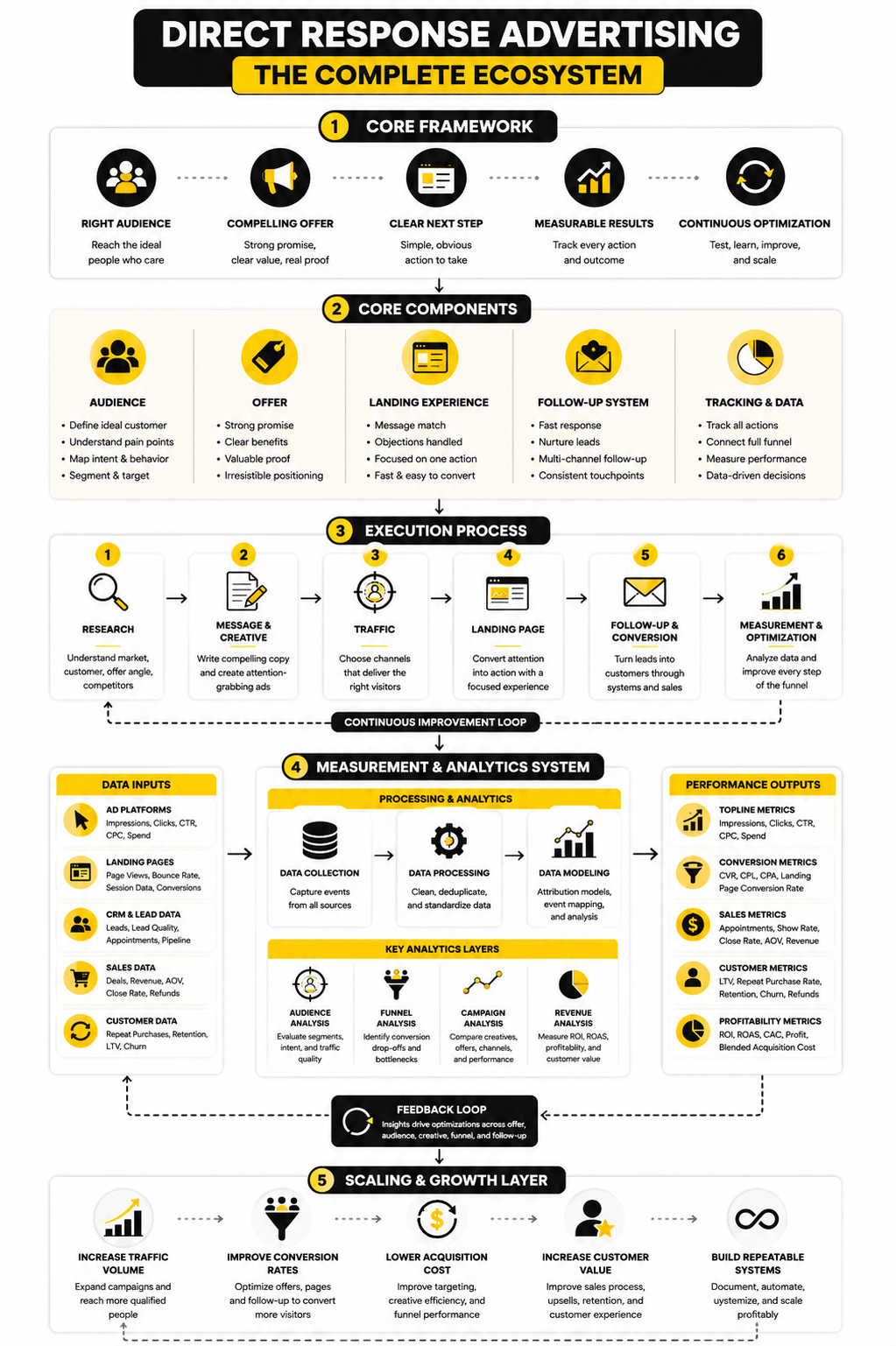
The right system also keeps the team honest. If an ad gets clicks but the page does not convert, the page needs work. If the page converts but the leads do not buy, the offer or qualification process needs work. If leads buy but margin disappears, the economics need work. Good direct response advertising makes problems easier to find, not easier to hide.
Build The Optimization Loop
Optimization should happen in a sequence. First, confirm that the campaign is tracking the right action. Then check whether the offer matches the audience. Then review creative, landing page performance, follow-up speed, and downstream sales quality.
This order matters because many teams optimize the wrong thing first. They change headlines before validating the offer. They test button copy before fixing lead quality. They increase budget before confirming that the business can actually handle the volume.
A practical optimization loop looks like this:
The key phrase is one bottleneck. Direct response advertising improves faster when the team isolates the constraint instead of changing five variables at once.
Use Tools To Remove Friction
Tools should make the system cleaner. A funnel builder should help you launch pages faster. A CRM should help you follow up faster. An email platform should help you nurture better. A chatbot should help you qualify or route conversations. If the tool adds complexity without improving speed, clarity, or measurement, it is not helping.
For funnel and landing page execution, ClickFunnels, Systeme.io, and Replo can all fit different direct response workflows. For appointment funnels, agency operations, pipelines, SMS, and automated follow-up, GoHighLevel can be useful when the business needs one central place to manage leads after the click. For conversational campaigns, ManyChat can support campaigns where the next step happens through messaging.
For email and lifecycle marketing, Brevo and Moosend can help turn first conversions into longer customer journeys. For scheduling and booked-call workflows, Cal.com can reduce friction when the campaign goal is a conversation. The stack should serve the strategy, not become the strategy.
Make Compliance Part Of The Workflow
Compliance should not be a final review after the ads are already written. It should be part of the campaign workflow from the beginning. Direct response advertising often uses strong promises, urgency, testimonials, discounts, guarantees, and comparison claims, so the claims need to be true, supportable, and clear.
The FTC’s endorsement guidance says endorsements must be honest and not misleading, and it warns that unrepresentative testimonials can mislead people when they are not paired with what consumers can generally expect. The FTC also frames advertising substantiation around having a reasonable basis for objective claims before making them. That is not a small detail. It is the difference between confident marketing and risky marketing.
This does not mean campaigns need to sound boring. It means the proof has to match the promise. You can be direct, persuasive, and high-converting without pretending every buyer will get an extraordinary result.
What is direct response advertising?
Direct response advertising is advertising designed to get a specific measurable action from the audience. That action can be a purchase, call, lead form, booking, demo request, free trial, app install, webinar registration, or email signup. The main difference is that the campaign is built around response, tracking, and performance rather than vague exposure.
How is direct response advertising different from brand advertising?
Brand advertising focuses more on awareness, memory, preference, and long-term perception. Direct response advertising focuses on getting people to act now or take a clear next step. The two can support each other, but they are not measured the same way.
What makes a direct response ad effective?
A strong direct response ad has a clear audience, specific promise, believable proof, compelling offer, and obvious call to action. It also sends people to a next step that matches the ad. If the ad says “get a quote,” the landing page should make getting a quote fast and easy.
Which channels work best for direct response advertising?
Search, paid social, email, SMS, YouTube, TikTok, display retargeting, creator campaigns, affiliate campaigns, and direct mail can all work. The better question is which channel matches the buyer’s intent. Search is often strong for existing demand, while paid social is often better for creating demand and testing creative angles.
What metrics should I track first?
Start with click-through rate, cost per click, conversion rate, cost per acquisition, and customer value. Then move deeper into lead quality, booked appointments, show rate, close rate, average order value, margin, refund rate, churn, and lifetime value. The deeper metrics usually explain whether the campaign is actually profitable.
What is a good conversion rate for direct response advertising?
There is no universal good conversion rate because channel, offer, industry, price, and buyer intent all change the answer. A high-intent search page may convert very differently from a cold social landing page. Use benchmarks for context, but judge success by your economics and downstream quality.
Why do direct response campaigns fail?
Most failures come from weak offers, poor message match, unclear landing pages, bad tracking, slow follow-up, low-quality leads, or unrealistic economics. Sometimes the ads are fine and the sales process is the real problem. The only way to know is to inspect the full funnel, not just the ad account.
Should I send direct response traffic to my homepage?
Usually, no. A homepage has too many jobs and too many distractions. A direct response campaign usually performs better when it sends traffic to a dedicated page built around one audience, one promise, one offer, and one call to action.
How much budget do I need to test direct response advertising?
The right budget depends on the cost of traffic, conversion rate, sales cycle, and value of the customer. The campaign needs enough spend to generate meaningful signal, not just a few random clicks. A small budget can test message and offer direction, but scaling requires enough data to judge quality and economics.
How long should I run a test before deciding it failed?
Do not judge a campaign before it has enough data to show a pattern. A campaign with only a few clicks or one conversion has not told you much yet. Look for directional evidence across the funnel: click quality, landing page behavior, conversion rate, lead quality, and downstream sales movement.
Is direct response advertising only for ecommerce?
No. Direct response advertising works for ecommerce, SaaS, agencies, local services, education, healthcare, coaching, financial services, professional services, events, and B2B lead generation. Any business that wants a measurable customer action can use direct response principles.
What is the role of landing pages in direct response advertising?
Landing pages carry the promise from the ad into the decision moment. They should reduce confusion, answer objections, show proof, and make the next step obvious. A strong ad can still lose money if the page creates friction or fails to match the offer.
How do I improve lead quality?
Improve lead quality by tightening the audience, making the offer more specific, adding qualification questions, tracking deeper funnel outcomes, and feeding better conversion data back into the ad platform. Do not optimize only for cheap form fills. Optimize for qualified actions that connect to revenue.
Can AI help with direct response advertising?
AI can help with research, creative variations, audience analysis, reporting, landing page drafts, email sequences, and faster testing. It should not replace strategy, customer understanding, compliance review, or business judgment. AI is useful when it speeds up execution without weakening the thinking behind the campaign.
What is the biggest mistake beginners make?
The biggest beginner mistake is launching ads before the offer and follow-up are ready. Traffic does not fix a weak promise, a confusing page, or a slow sales process. Direct response advertising works when the entire path from first click to final conversion is designed on purpose.
Build a stronger local presence with BAAM AI
Turn your website, Google profile, social channels, and AI visibility into one growth engine
Most businesses do not need more random marketing activity. They need a consistent presence system that helps the right people find them, trust them, and take action. BAAM AI brings strategy, local SEO, website updates, Google Maps visibility, social content, AI-search readiness, media production, and reporting into one practical monthly engine.
If you want your marketing to keep working after the campaign ends, start with a free BAAM AI presence audit. See how your business shows up today and where the fastest visibility wins are at BAAM AI.