
BAAM AI Blog
Direct Response
is marketing built to make the right person take a clear, measurable action now. Not “remember us later.” Not “maybe follow us someday.” The goal is a response you can track: a click, call, form submission, booking...
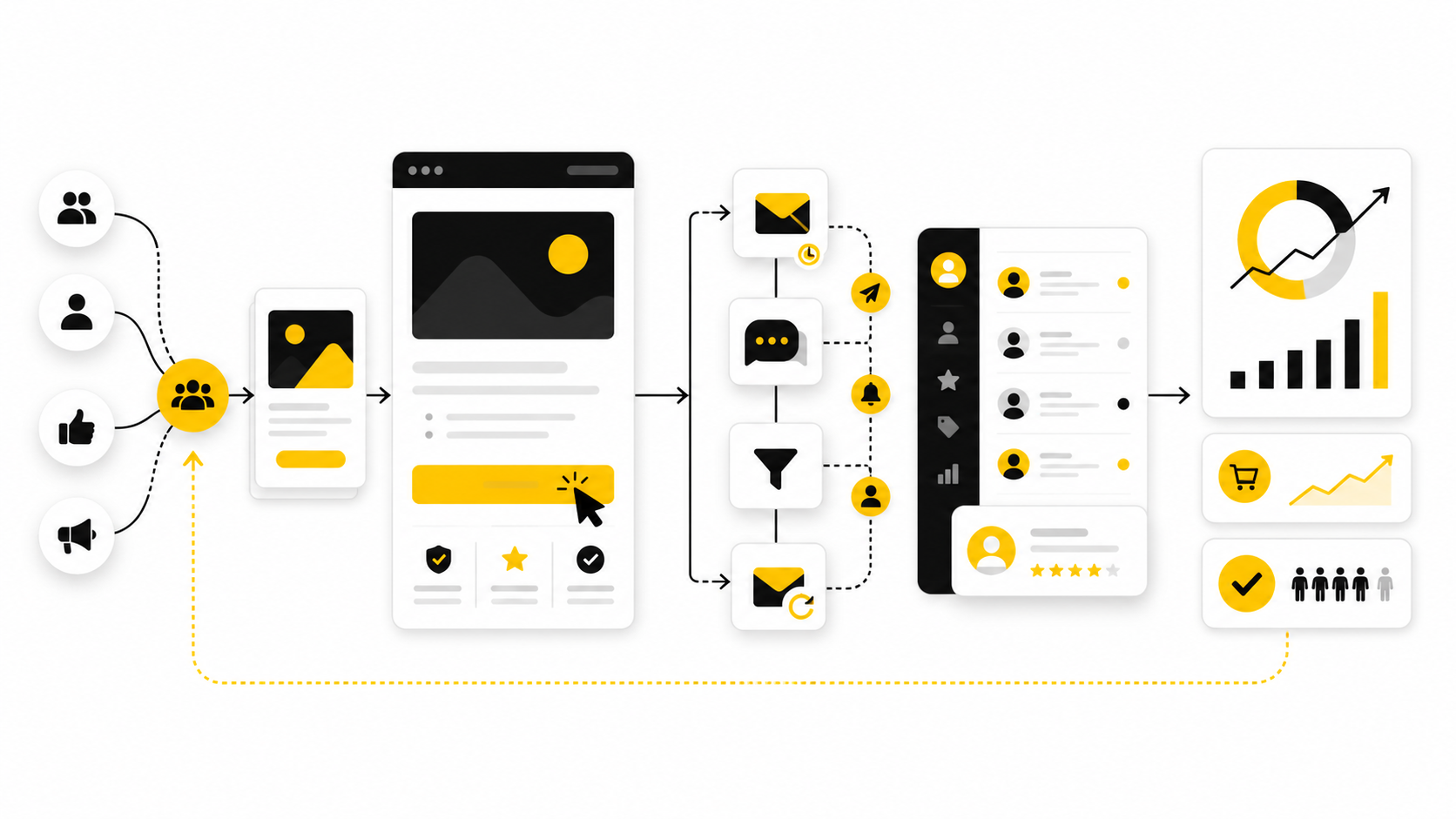
Direct response is marketing built to make the right person take a clear, measurable action now. Not “remember us later.” Not “maybe follow us someday.” The goal is a response you can track: a click, call, form submission, booking, purchase, reply, demo request, trial signup, quote request, or any other action tied directly to revenue or pipeline.
That is why direct response still matters in a noisy market. Digital ad revenue in the U.S. reached $294.6 billion in 2025, and more of that money is being judged by performance, attribution, and measurable business outcomes. When budgets get tighter, vague awareness campaigns become harder to defend. A direct response campaign gives you something better: a message, an offer, a channel, and a result you can improve.
The simplest way to understand direct response is this: it connects a specific audience to a specific promise through a specific call to action. A brand campaign may try to shape perception over time. Direct response asks for movement today. That does not mean it has to feel aggressive, cheap, or spammy. The best direct response feels relevant, useful, and timely because the message matches the buyer’s problem and the next step feels obvious.
this guide will continue across six parts using this structure:
Why Direct Response Still Matters
Direct response matters because attention is expensive and patience is thin. People do not move through clean, predictable funnels anymore. They compare options, ignore weak messages, ask AI tools for shortcuts, check reviews, abandon carts, come back through retargeting, and make decisions across several touchpoints. A strong direct response system gives that messy journey a clear next step.
The practical advantage is measurement. If you run an ad, landing page, email, SMS, chatbot flow, webinar funnel, or direct mail campaign, you can connect the message to the response. That makes direct response especially useful for founders, agencies, creators, ecommerce brands, local businesses, SaaS companies, and service providers that cannot afford to “build awareness” forever without knowing what is working.
This is also why direct response is not limited to old-school sales letters. Email, paid search, social ads, short-form video, creator campaigns, landing pages, sales funnels, chat automation, booking pages, and CRM follow-up can all be direct response when they are designed around a clear action. Tools like GoHighLevel, ClickFunnels, ManyChat, and Systeme.io exist because businesses need more than traffic. They need a response system that turns attention into leads, conversations, and sales.
The Direct Response Framework
Direct response works best when it is treated as a framework, not a one-off tactic. The framework starts with a market problem, turns that problem into a compelling offer, supports the offer with proof, and removes friction from the next step. When any piece is weak, the campaign becomes harder to scale. When all pieces work together, even a simple campaign can outperform a beautiful campaign with no clear action.
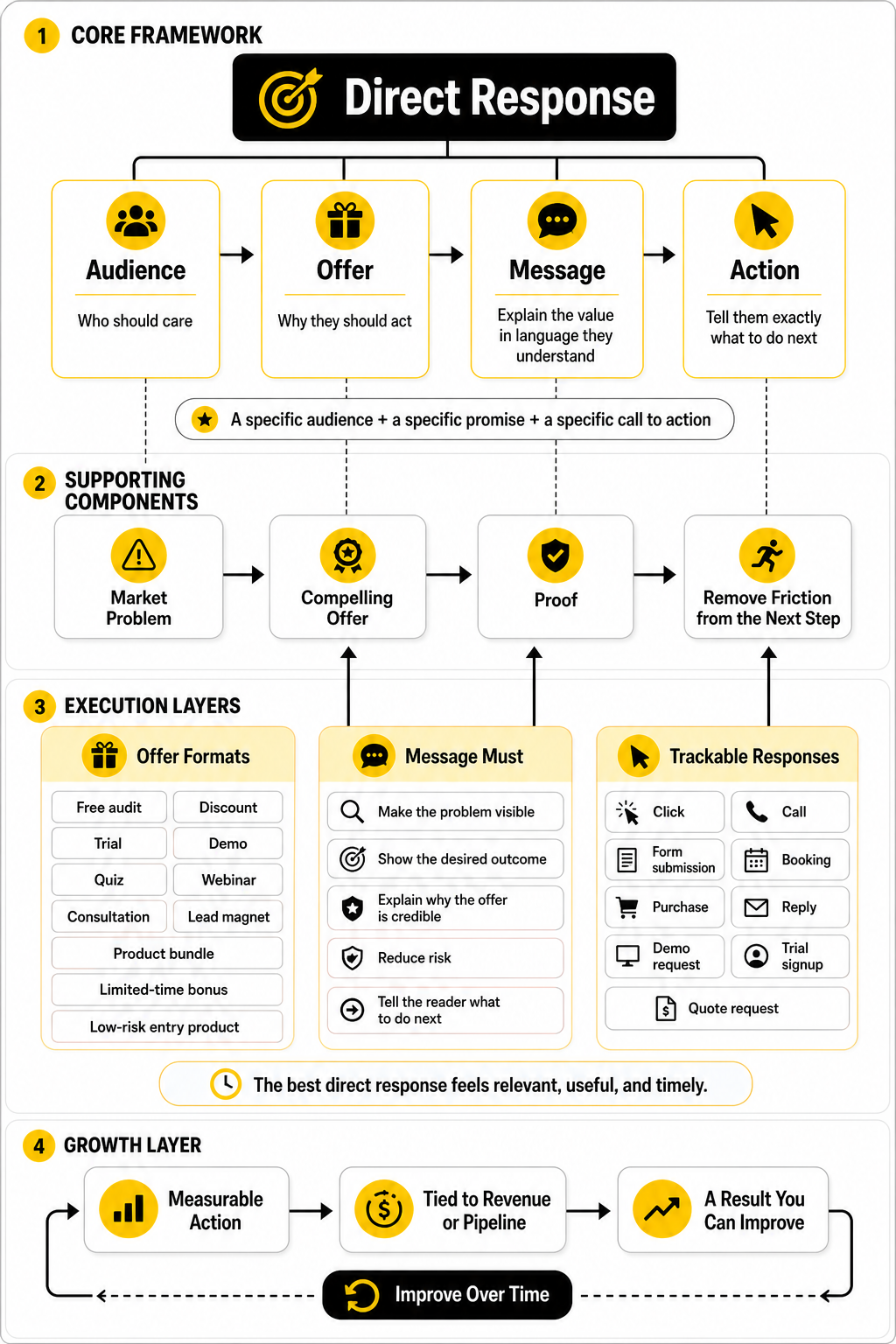
The core framework has four moving parts: audience, offer, message, and action. The audience defines who should care. The offer defines why they should act. The message explains the value in language they understand. The action tells them exactly what to do next.
This is where many campaigns fail. They send traffic to a page before the offer is sharp. They write clever copy before they understand the buyer’s urgency. They ask for a call before trust exists. Direct response forces discipline because every part of the campaign has to answer one question: what would make this person act now?
Audience, Offer, Message, and Action
The audience comes first because direct response is not about reaching everyone. It is about reaching the people most likely to respond to a specific promise. A campaign for cold traffic needs more education and proof. A campaign for warm leads can be more direct. A campaign for existing customers can often move faster because trust already exists.
The offer is the real engine. A weak offer makes the copy work too hard. A strong offer makes the next step feel valuable before the sale even happens. That offer could be a free audit, discount, trial, demo, quiz, webinar, consultation, lead magnet, product bundle, limited-time bonus, or low-risk entry product. The format matters less than the perceived value and relevance.
The message connects the audience to the offer. This is where clarity beats cleverness. A direct response message should make the problem visible, show the desired outcome, explain why the offer is credible, reduce risk, and tell the reader what to do next. The action then turns interest into movement. Without a clear call to action, even interested prospects drift away.
Building a Direct Response Campaign That Can Actually Convert
A direct response campaign starts before the ad, email, landing page, or funnel is created. It starts with the uncomfortable work most people skip: defining who the campaign is for, what problem is urgent enough to act on, and what promise is strong enough to earn the click. Without that foundation, you are not building a campaign. You are guessing in public.
The goal is not to make something loud. The goal is to make something obvious. The reader should understand what you offer, why it matters, why they should trust it, and what they should do next without needing to decode clever copy or vague branding language.
This is where direct response becomes very practical. You are not trying to win an award for the most creative campaign. You are trying to remove hesitation, increase desire, and make the next step feel like the natural move.
Start With Buyer Intent
Buyer intent tells you how ready someone is to act. A person searching for “best CRM for agencies” is in a different mental state than someone casually watching a marketing tips video. Both can become customers, but they need different messages, offers, and levels of education.
Cold audiences usually need problem framing before they care about your solution. Warm audiences usually need proof, differentiation, and a reason to act sooner rather than later. Existing leads and customers often need a sharper trigger, such as a deadline, upgrade path, bonus, reminder, or direct invitation.
This is why a single direct response message rarely works across every channel. The same offer may need one version for paid search, another for email, another for retargeting, and another for chatbot follow-up. Tools like ManyChat can help when the response depends on fast, conversational follow-up after someone comments, clicks, or asks for details.
Turn the Problem Into a Clear Promise
A strong promise makes the campaign easier to understand. It should connect the buyer’s current frustration to a desirable outcome. That does not mean making exaggerated claims. It means translating the offer into a result the buyer already wants.
Weak promises sound like “grow your business” or “save time with automation.” Stronger promises are more specific because they show who the offer is for and what kind of improvement the buyer can expect. For example, an agency does not just want automation. It wants fewer missed leads, faster follow-up, cleaner pipeline visibility, and more booked appointments.
The promise should also match the level of commitment you are asking for. A free checklist can use a lighter promise. A paid subscription, consultation, or high-ticket offer needs a stronger reason to act. The bigger the ask, the more proof and risk reduction you need around it.
Make the Offer Feel Easy to Say Yes To
The offer is not just the product. It is the full deal the prospect sees in front of them. That includes the outcome, price, urgency, guarantee, bonuses, delivery method, onboarding, support, and the amount of effort required from the buyer.
For direct response, the offer should reduce friction wherever possible. If the prospect is unsure, give them a lower-risk first step. If the product is complex, give them a guided demo. If the service is expensive, give them a diagnostic call or audit. If the buyer needs speed, make the timeline and next action clear.
This is why funnels remain useful when they are built properly. A good funnel does not manipulate people through random pages. It sequences the decision so each step answers the next question in the buyer’s mind. Platforms like ClickFunnels, Systeme.io, and GoHighLevel are useful when the campaign needs landing pages, forms, follow-up, and conversion tracking working together instead of scattered across disconnected tools.
Write the Message Around the Buyer’s Decision
Direct response copy should follow the buyer’s decision process, not the company’s internal pitch deck. Most people do not care about your features first. They care about their problem, the cost of ignoring it, the outcome they want, and whether your solution feels credible.
The message should move in a clean sequence. Open with the problem or desired result. Make the offer clear. Show why the offer is different or credible. Handle the main objections. Then make the call to action specific enough that the reader knows exactly what happens next.
This does not mean every page needs to be long. Some direct response messages are short because the buyer is already motivated. Others need more explanation because the offer is expensive, unfamiliar, or aimed at a colder audience. Length is not the strategy. Clarity is.
Use Proof Before the Buyer Asks for It
Proof is what keeps direct response from feeling like hype. It can come from testimonials, reviews, demos, screenshots, third-party validation, customer results, product walkthroughs, guarantees, transparent pricing, comparison tables, or strong before-and-after explanations. The point is simple: do not make the buyer carry all the risk in their head.
Proof should appear close to the claim it supports. If you say your system helps agencies follow up faster, show how the follow-up works. If you say the product is easy to launch, show the setup process. If you say the offer is trusted, show real signals that support that trust.
Be careful with proof that sounds impressive but does not help the decision. Logos without context, vague testimonials, and inflated claims can weaken the campaign because they feel decorative. In direct response, proof should answer a real objection.
Make the Call to Action Specific
A direct response campaign cannot end with a vague “learn more.” That might work for early-stage browsing, but it is weak when the campaign is supposed to create measurable action. The call to action should name the action and imply the value of taking it.
“Book a demo” is clearer than “get started” when the next step is a sales conversation. “Get the free audit” is clearer than “submit” when the form leads to a review. “Start your trial” is clearer than “join now” when the buyer needs to test the product before committing.
The best calls to action also reduce uncertainty. Tell people what happens after they click. Will they choose a time? Get a download? Open a checkout page? Start a guided setup? When the next step feels predictable, more people are willing to take it.
Matching the Campaign to the Buyer Journey
Direct response works best when it respects where the buyer is in the journey. A cold prospect may need education before conversion. A warm lead may need a reason to choose you over competitors. A hot lead may only need a clear offer and a fast path to action.
This matters because many campaigns ask too much too soon. They try to sell a complex product to someone who has not yet admitted the problem is urgent. Or they waste a hot lead’s attention with generic education when that person is ready for pricing, a demo, or a checkout page.
The more carefully move is to match the message to the buying stage. Early-stage campaigns should create interest and capture the lead. Mid-stage campaigns should build trust and preference. Late-stage campaigns should remove friction and ask directly for the sale, booking, or signup.
Cold Traffic Needs Context
Cold traffic does not know you, may not trust you, and may not even understand the problem the way you do. That means your direct response message has to create context quickly. The opening needs to show relevance before the prospect scrolls away.
This is where problem-aware hooks work well. You can lead with a pain point, a mistake, a missed opportunity, a practical checklist, or a useful diagnostic. The purpose is not to scare people. The purpose is to make them feel understood fast enough to continue.
Cold traffic usually performs better with lower-friction offers. A quiz, guide, audit, workshop, calculator, checklist, or short demo can create the first response without asking for too much trust upfront. Once that response happens, follow-up becomes the real asset.
Warm Leads Need Differentiation
Warm leads already have some context. They may know the brand, follow the founder, read previous content, join the email list, attend a webinar, or interact with ads before. At this stage, the direct response job is not just attention. It is preference.
Differentiation should be practical, not fluffy. Show what makes the offer easier, faster, safer, more complete, more specialized, or better suited to the buyer’s situation. Avoid empty claims like “best-in-class” unless there is clear proof behind them.
Warm leads also respond well to comparison and implementation detail. They want to know what they get, how it works, what the tradeoffs are, and why now is a good time to act. This is where case studies, demos, feature breakdowns, and objection-handling emails can do serious work.
Hot Leads Need Less Friction
Hot leads do not need more noise. They need a clean path. If someone is ready to book, buy, subscribe, or request a proposal, the campaign should remove every unnecessary step between interest and action.
That means the page should load quickly, the form should be short, the pricing or next step should be easy to understand, and the confirmation process should be immediate. Booking tools like Cal.com can help when the direct response goal is a scheduled call instead of an instant checkout. Form tools like Fillout can help when the campaign needs cleaner intake before a consultation, quote, or application.
Hot leads are also where follow-up speed matters most. A slow reply can waste the entire campaign. If a person raises their hand today, your system should not treat them like a generic contact three days later.
Channels That Work for Direct Response
The right channel is the one where your buyer already has enough context to respond. That sounds obvious, but it is where a lot of campaigns go wrong. People pick a channel because it is trendy, cheap, or familiar, then wonder why the message does not convert.
A direct response channel should match the buyer’s intent, the complexity of the offer, and the speed of the decision. Search works well when people are actively looking for a solution. Email works well when trust and follow-up matter. Social ads work well when the problem can be made visible quickly. Landing pages work well when the campaign needs one focused action without the distraction of a full website.
The channel is not the strategy. The channel is the delivery system. If the audience, offer, message, and action are weak, no platform will save the campaign.
Paid Search
Paid search is one of the cleanest direct response channels because intent is already visible. Someone typing a problem, product category, comparison, or service request into a search engine is often closer to action than someone passively scrolling social media. That makes the message easier to align because the keyword already tells you what the person wants.
The mistake is sending all paid search traffic to the same generic page. A person searching for pricing needs a different experience than a person searching for alternatives. A person searching for a local service needs fast trust signals, clear location relevance, and an easy way to call or book. A person searching for software may need a comparison, demo, trial, or feature-specific landing page.
For direct response, paid search pages should be focused and specific. Match the headline to the search intent, make the offer obvious above the fold, show proof early, and keep the call to action visible. Do not make the visitor hunt through a full navigation menu just to find the thing they already asked for.
Paid Social
Paid social creates demand more often than it captures it. That means the creative has to do more work. The person was not necessarily looking for your offer, so the opening hook must make the problem or outcome feel relevant within seconds.
This is where direct response creative becomes valuable. Strong paid social ads usually lead with a pain point, useful insight, bold contrast, mistake, demonstration, or clear before-and-after. The creative does not need to explain everything, but it must create enough motivation for the click.
The landing page then has to continue the same conversation. If the ad promises a simple way to fix a specific problem, the page cannot switch into vague corporate language. Message match matters because every mismatch creates doubt, and doubt kills response.
Email is still one of the most useful direct response channels because it lets you follow up without paying for every touchpoint. The key is relevance. A list full of people who do not care will not convert just because you send more messages.
The best direct response emails feel like a continuation of the buyer’s own thinking. They remind the reader of the problem, introduce a useful angle, make an offer, and ask for a specific action. That action could be a reply, a click, a booking, a purchase, or a reactivation.
Email also gives you room to sequence the sale. One email can handle the problem. Another can show proof. Another can answer objections. Another can create urgency. Platforms like Brevo and Moosend can fit well when the campaign needs email automation, segmentation, and practical follow-up without turning the whole operation into a technical project.
Landing Pages and Funnels
A landing page is where direct response becomes concrete. The ad, email, video, or post creates interest, but the page has to convert that interest into action. That means every section needs a job.
A strong direct response landing page usually starts with a clear promise, then supports it with benefits, proof, offer details, objection handling, and a focused call to action. It should not feel like a brochure. It should feel like a guided decision.
Funnels add sequence when one page is not enough. A funnel can capture a lead, qualify the person, present a relevant offer, schedule a call, trigger follow-up, and track the outcome. Builders like ClickFunnels, Systeme.io, and Replo are useful when you want the campaign experience to be more focused than a standard website page.
The Direct Response Implementation Process
Implementation is where direct response stops being theory. You take the audience, offer, message, and channel decisions and turn them into a system that can be launched, measured, and improved. This is also where discipline matters most because every rushed decision creates noise in the results.
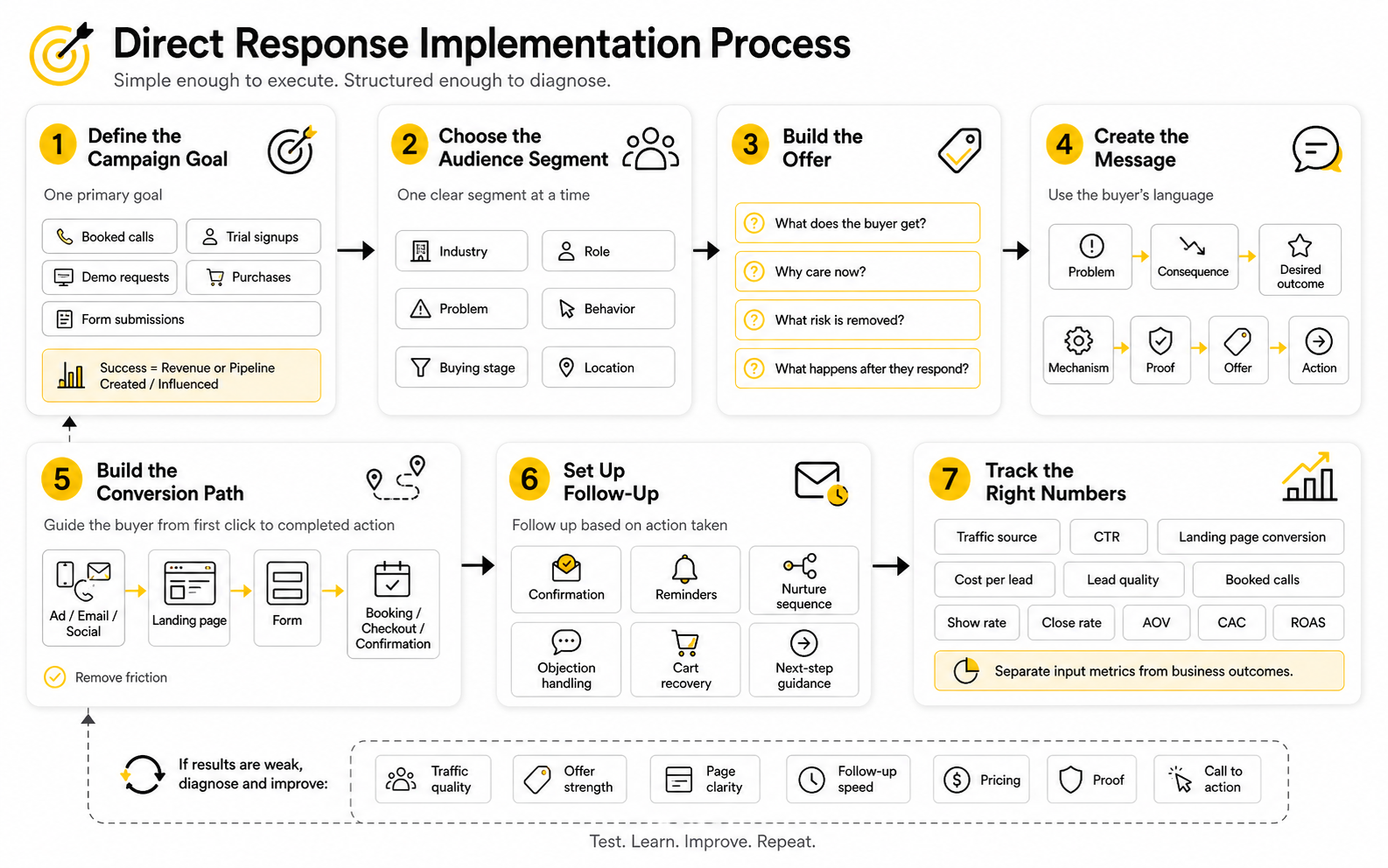
The process should be simple enough to execute and structured enough to diagnose. If the campaign fails, you need to know whether the issue is traffic quality, offer strength, page clarity, follow-up speed, pricing, proof, or the call to action. If everything is mixed together, you cannot learn anything useful.
A clean process also keeps teams from arguing based on opinions. Instead of debating whether a headline “feels strong,” you can look at click-through rate, conversion rate, booked calls, sales rate, cost per acquisition, and revenue per lead. The numbers do not replace judgment, but they make the conversation more honest.
Step 1: Define the Campaign Goal
Start with one primary goal. Not five. One. A direct response campaign should know exactly what response it is trying to create.
The goal might be booked calls, trial signups, demo requests, purchases, webinar registrations, form submissions, quote requests, or replies. Each goal requires a different amount of trust and effort from the buyer. A free download is easy to ask for. A paid annual subscription needs more support.
Once the goal is clear, define the success metric. Cost per lead is not enough if the leads never buy. Conversion rate is not enough if the sales quality is poor. Revenue, pipeline value, qualified conversations, and customer acquisition cost usually tell a better story than surface-level campaign metrics alone.
Step 2: Choose the Audience Segment
The campaign should focus on one clear segment at a time. This does not mean your business only serves one type of buyer. It means each direct response campaign needs enough focus to feel personal and relevant.
A segment can be based on industry, role, problem, behavior, buying stage, location, company size, previous engagement, or product interest. For example, a campaign aimed at agency owners with slow lead follow-up should sound different from one aimed at ecommerce brands trying to improve abandoned cart recovery. The problem, urgency, proof, and offer are not the same.
Segmentation also improves follow-up. If a lead enters through a specific problem, your emails, SMS, CRM notes, sales script, and retargeting should reflect that problem. This is where an all-in-one CRM and automation setup like GoHighLevel can be useful because the response does not end at the form submission.
Step 3: Build the Offer
The offer should be built before the copy is finalized. Copy can make a good offer clearer, but it cannot turn a boring offer into something the market urgently wants. If the offer is weak, fix the offer first.
A practical offer answers four questions. What does the buyer get? Why should they care now? What risk is removed? What happens after they respond? If those answers are vague, the campaign will feel vague too.
You can improve an offer without discounting everything. Add a stronger bonus, simplify onboarding, include a limited diagnostic, reduce commitment, make delivery faster, provide a clearer guarantee, or create a better first step. The goal is not to make the offer cheap. The goal is to make it easy to justify.
Step 4: Create the Message
The message should be built from the buyer’s language, not just the company’s positioning. Look at sales calls, support tickets, reviews, survey responses, chat transcripts, search terms, and competitor objections. The strongest direct response copy often comes from the phrases buyers already use when they describe the problem.
A simple message structure works well: problem, consequence, desired outcome, mechanism, proof, offer, action. You do not need to use that structure mechanically every time, but it keeps the message grounded. The reader should feel like each section answers the next question in their mind.
Avoid writing copy that tries to sound impressive. Clear beats clever. Specific beats broad. Concrete beats abstract. If a sentence does not help the reader understand, believe, desire, or act, it probably does not belong in the campaign.
Step 5: Build the Conversion Path
The conversion path is the journey from first click to completed action. It might be an ad to a landing page to a form to a booking page to a confirmation email. It might be a social comment to a chatbot to a qualification question to a product page. It might be an email to a checkout page to an onboarding sequence.
Every step should have a reason to exist. If a form field is not needed, remove it. If a page does not increase clarity or trust, simplify it. If a redirect creates confusion, fix it. Small points of friction add up fast.
This is also where operational tools matter. Fillout can help with cleaner forms and qualification flows. Cal.com can help when the desired response is a scheduled meeting. Chatbase can help when visitors need answers before they are ready to submit a form or book a call.
Step 6: Set Up Follow-Up
Follow-up is not optional. Many direct response campaigns lose money because they focus on the first conversion and ignore what happens next. A lead who responds but does not receive fast, relevant follow-up is wasted opportunity.
Follow-up should match the action. A demo request needs a confirmation, calendar reminder, pre-call context, and sales preparation. A download needs a nurture sequence that connects the content to the next offer. A cart abandonment flow needs timing, relevance, and a reason to return.
Do not make every follow-up message a hard pitch. Some messages should educate. Some should answer objections. Some should show proof. Some should ask directly for the next step. The sequence should feel like useful guidance, not a desperate chase.
Step 7: Track the Right Numbers
Tracking should be planned before launch. If you only think about measurement after the campaign is live, you will miss important signals. Direct response depends on knowing what happened and where the drop-off occurred.
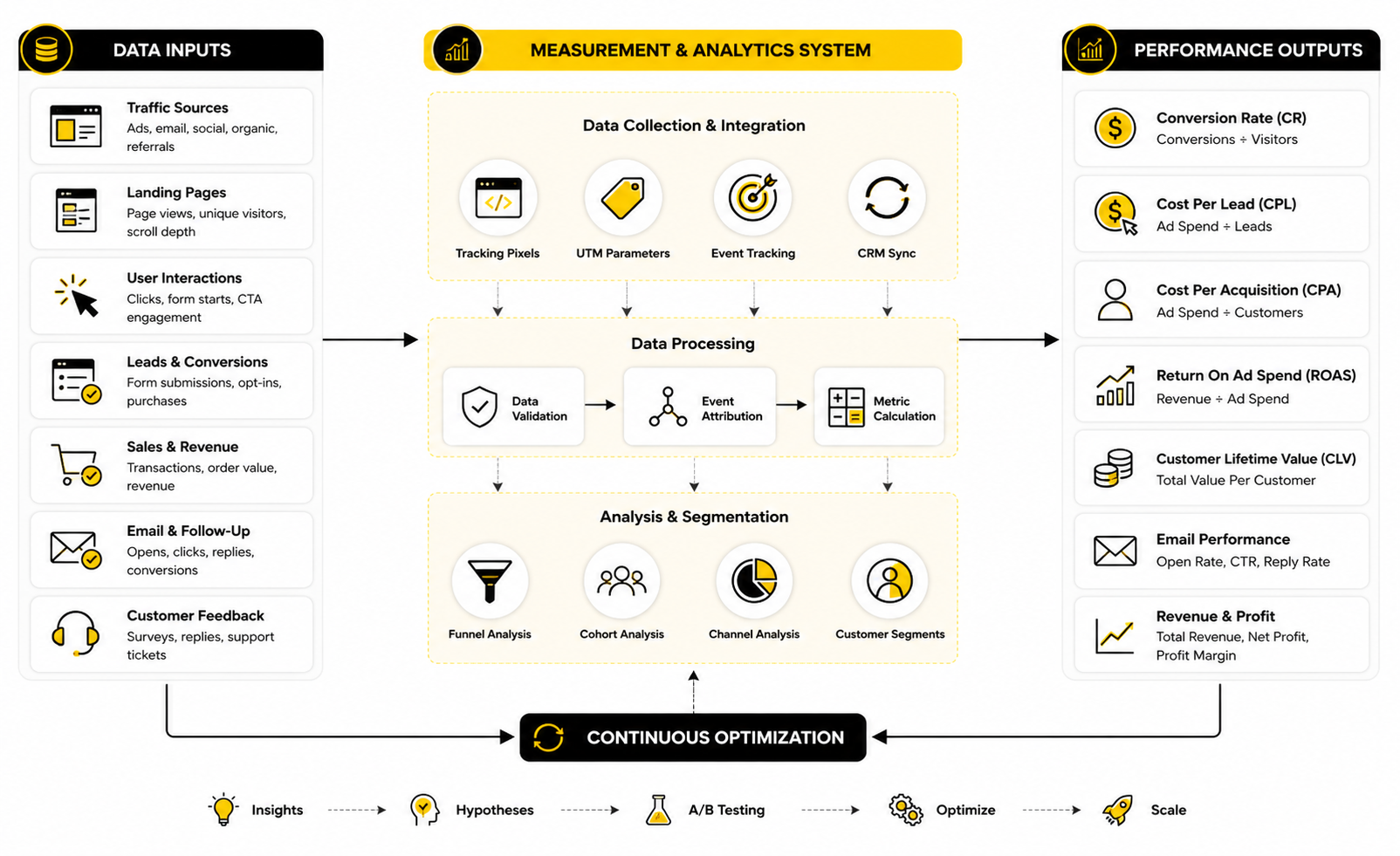
At minimum, track traffic source, click-through rate, landing page conversion rate, cost per lead, lead quality, follow-up completion, booked calls, show rate, close rate, average order value, customer acquisition cost, and return on ad spend when relevant. Not every campaign needs every metric, but every campaign needs enough visibility to make better decisions.
The key is to separate input metrics from business outcomes. Clicks and leads are useful, but they are not the finish line. A campaign that produces fewer leads at higher quality can beat a campaign that produces cheap leads that never buy. That is why direct response should be measured all the way through the revenue path, not just the front-end form.
Statistics and Data That Actually Matter
Direct response measurement is not about collecting as many numbers as possible. It is about knowing which numbers explain behavior and which numbers should trigger action. A dashboard full of clicks, impressions, opens, views, and likes can look impressive while the campaign quietly loses money.
The useful question is simple: where does attention turn into revenue, and where does it leak? If people click but do not convert, the issue may be message match, page clarity, offer strength, trust, or friction. If people convert into leads but do not buy, the issue may be lead quality, follow-up speed, sales process, pricing, or expectation setting.
This is why direct response data has to be read in sequence. You do not judge an ad only by click-through rate. You do not judge a landing page only by conversion rate. You judge the whole path from first touch to qualified response to closed revenue.
Benchmarks Are Useful, but They Are Not the Goal
Benchmarks give you context, not a final answer. A landing page converting below the market average may have a real problem, but it may also be asking for a higher-commitment action than the benchmark sample. A webinar registration page, free checklist, demo request, and paid checkout should not be judged by the same standard.
For example, Unbounce’s landing page benchmark data shows a median conversion rate of about 6.6% across industries, based on a large sample of visits, landing pages, and conversion actions. That number is useful as a sanity check. It is not a magic target for every direct response campaign.
A campaign selling a $29 impulse product may need a much higher front-end conversion rate to work. A campaign generating qualified sales calls for a high-ticket service may work beautifully at a lower conversion rate if the close rate and customer value are strong. The benchmark tells you where to look. Your economics tell you what matters.
The Core Direct Response Metrics
A direct response campaign should be measured from the top of the funnel to the bottom. Each number answers a different question. When you read them together, they show whether the problem is attention, persuasion, trust, friction, or economics.
The most useful metrics are:
These metrics should not be treated equally at every stage. Early in a campaign, you may focus on click-through rate and page conversion because you need to confirm the message and offer. Once volume increases, lead quality and revenue metrics become more important. When scaling, customer acquisition cost and lifetime value become the numbers that decide whether growth is healthy.
What Click Data Tells You
Click data tells you whether the first message creates enough curiosity or intent. If an ad, email, or post gets very low click-through, the audience may not care, the hook may be weak, the offer may be unclear, or the channel may be wrong. Do not immediately blame the landing page if people are not even reaching it.
But a high click-through rate is not automatically good. It can also mean the message is overpromising, too broad, or attracting low-quality curiosity. This is especially common with vague hooks, cheap lead magnets, and dramatic claims that create clicks but not buyers.
The right move is to compare click-through rate with downstream quality. If clicks are high and conversions are low, check message match and page clarity. If clicks and leads are high but sales are weak, check intent and qualification. If clicks are lower but sales quality is strong, the campaign may be more focused than it looks.
What Landing Page Data Tells You
Landing page conversion rate shows whether the page successfully turns interest into action. If traffic is relevant but the page does not convert, the problem is usually one of five things: unclear promise, weak offer, lack of proof, confusing page structure, or too much friction. This is fixable, but only if you diagnose the right issue.
Look at the page in sections. The hero section should make the promise clear. The body should explain the value and support the claim. The proof should reduce doubt. The call to action should be obvious. The form or checkout should feel easy compared with the value being offered.
A direct response landing page should also be judged by the type of action it asks for. A newsletter signup, free template, product checkout, quote request, and consultation application all require different levels of trust. If the ask is big, the page needs more proof, more clarity, and stronger objection handling.
What Cost Per Lead Really Means
Cost per lead is useful, but it can become dangerous when teams optimize for it blindly. Cheap leads feel good in a report. They do not feel good when sales teams waste hours chasing people who were never serious.
WordStream’s 2025 Google Ads benchmark data puts the average Google Ads cost per lead at $70.11 across industries, with major variation by category. That kind of benchmark is helpful because it shows whether your paid acquisition costs are unusually high or low. But the real question is not whether your cost per lead is cheap. The real question is whether your cost per qualified opportunity and customer acquisition cost make sense.
A $20 lead can be expensive if none of those leads buy. A $200 lead can be profitable if it consistently turns into high-value customers. This is why direct response teams should track lead quality, pipeline value, and closed revenue instead of celebrating low costs too early.
What Email Metrics Tell You
Email metrics need to be read carefully because not all engagement signals are equally reliable. Open rates can be distorted by privacy features, inbox behavior, and image loading. Clicks, replies, conversions, and revenue usually tell a more useful story.
MailerLite’s 2025 benchmark data shows an average email open rate of 43.46% and an average click rate of 2.09%. Those numbers can help you spot obvious problems, but they should not become the whole strategy. A smaller list with lower opens but stronger buyer intent can outperform a large list full of passive subscribers.
For direct response, email performance should be tied to the purpose of each message. A nurture email may be judged by clicks and replies. A launch email may be judged by sales. A reactivation email may be judged by booked calls or renewed interest. The metric should match the job of the email.
What Sales Metrics Reveal
Sales metrics show whether the campaign is creating real commercial momentum. If the campaign generates many leads but few qualified conversations, the offer may be attracting the wrong people. If conversations happen but deals do not close, the problem may be positioning, pricing, sales process, or expectation mismatch.
Show rate is especially important for booked-call campaigns. A person who books but does not attend is not the same as a qualified sales opportunity. Low show rates often point to weak confirmation, poor reminder sequences, low perceived value, or leads who were never truly motivated.
Close rate adds another layer. A low close rate does not always mean the salesperson is the problem. It can mean the direct response campaign promised the wrong outcome, underqualified the lead, hid key pricing information, or created curiosity without buying intent. The sales data should feed back into the campaign, not sit in a separate silo.
The Analytics Stack Should Match the Decision
You do not need a complicated analytics stack to run direct response well. You need a stack that answers the decisions you actually have to make. For a simple campaign, that may mean ad platform data, landing page conversions, CRM stages, and payment or booking data. For a more complex campaign, you may need call tracking, attribution, cohort analysis, and customer lifetime value reporting.
The mistake is adding tools before the measurement logic is clear. First define the journey. Then define the events that matter. Then connect the tools. A practical setup might use GoHighLevel for CRM and follow-up, ClickFunnels for funnel pages, Fillout for qualification forms, and Cal.com for booked appointments.
The key is consistency. If one tool counts a lead when a form starts and another counts a lead when a form submits, the numbers will not match. If sales stages are messy, attribution becomes unreliable. Clean tracking is not glamorous, but it is what makes optimization possible.
How to Read Performance Signals
Performance signals should lead to action. If the campaign has low impressions, the problem may be reach, budget, audience size, or campaign setup. If impressions are high but clicks are low, the problem is probably the hook, creative, offer, or targeting. If clicks are strong but conversions are weak, the landing page or offer needs work.
If conversions are strong but sales are weak, look at qualification and expectation setting. If sales are strong but acquisition cost is too high, improve conversion rate, increase average order value, strengthen upsells, or narrow the audience. If customer acquisition cost is healthy but volume is low, you may have a scaling problem rather than a conversion problem.
This is the practical way to use direct response data. Do not ask, “Is this number good?” Ask, “What does this number tell us to fix next?” That shift changes everything.
Testing Without Fooling Yourself
Testing is valuable only when the test is clean enough to teach you something. Changing the headline, offer, audience, image, price, and landing page at the same time may improve results, but you will not know why. That makes the next decision harder.
Start with the biggest likely constraint. If people are not clicking, test hooks and creative. If people click but do not convert, test the offer, headline, proof, and call to action. If leads convert but do not buy, test qualification, follow-up, sales messaging, and pricing clarity.
Do not test tiny details too early. Button color rarely matters when the offer is weak. A slightly different testimonial will not fix unclear positioning. Direct response testing should focus first on the variables that change buyer behavior in a meaningful way.
The Numbers Should Improve the Buyer Experience
Measurement is not only for marketers. It should make the buyer experience better. When the data shows friction, confusion, or hesitation, the fix should help the buyer move with more confidence.
If people abandon the form, shorten it or explain why the information is needed. If people do not show up for calls, improve reminders and pre-call value. If people click but bounce quickly, make the promise clearer and the page faster to understand. If leads ask the same question repeatedly, answer it earlier in the campaign.
That is the best version of direct response optimization. You are not just squeezing more conversions out of traffic. You are making the path from problem to solution cleaner, faster, and easier to trust.
Professional Implementation and Optimization
Once a direct response campaign is live, the work changes. You are no longer asking, “Will this idea work?” You are asking, “What is the market telling us, and how do we respond without breaking what is already working?” That is a different level of thinking.
Early-stage direct response is about finding a signal. Scaling is about protecting that signal while increasing volume. The danger is that teams often scale budget, channels, and complexity before the campaign has stable economics. That is how a campaign that looked promising at small volume becomes expensive and messy fast.
Professional implementation means building a campaign that can survive real-world pressure. More traffic. More objections. More lead variation. More operational strain. More attribution gaps. More competition. If the system only works when everything is perfect, it is not ready to scale.
Scaling Without Diluting the Message
The first scaling mistake is broadening the audience too quickly. A campaign works with one tight segment, so the team assumes it will work with everyone. Then performance drops because the message no longer feels specific.
Direct response scales better when you expand in controlled layers. Start with the audience where the problem is most urgent. Then test adjacent segments with adjusted messaging, proof, and offers. Do not simply copy the same campaign into a wider audience and expect the same result.
This matters because specificity is usually what made the campaign work in the first place. If the original message spoke directly to agency owners, ecommerce operators, coaches, SaaS founders, or local service businesses, widening the campaign should not erase that relevance. Scale should increase reach without turning the offer into generic marketing soup.
Protecting Lead Quality
Lead volume can become addictive. It gives everyone a visible number to celebrate. But in direct response, more leads only matter if the right people are responding.
As campaigns scale, lead quality often changes. Cheaper audiences may produce more form submissions but fewer buyers. Broader creative may increase clicks but attract people with lower intent. A weaker lead magnet may grow the list while quietly lowering the value of every follow-up.
The fix is to define qualification before scale. What makes a lead worth pursuing? What budget, timing, need, role, location, business type, or use case matters? Once that is clear, the campaign can filter better through form questions, page copy, email segmentation, calendar routing, CRM stages, and sales handoff rules.
Building a more carefully Follow-Up System
Follow-up should become more personalized as the campaign grows, not less. This does not mean writing every message manually. It means using the information the buyer already gave you to make the next message more relevant.
A person who downloads a beginner guide should not receive the same follow-up as someone who requests pricing. A person who books a call after watching a webinar should not be treated the same as someone who clicked a cold ad for the first time. Context should shape the sequence.
This is where segmentation, tagging, and automation matter. A system like GoHighLevel can help connect forms, pipelines, reminders, SMS, email, and booked appointments when the campaign depends on fast lead handling. For ecommerce or creator-led campaigns, ManyChat can support quick conversational follow-up from social engagement before interest goes cold.
Managing Attribution Gaps
Attribution will never be perfect. People see an ad on one device, search later on another, ask a friend, click an email, read reviews, and return through a branded search. The campaign still influenced the sale, but the reporting may not show the full path.
Privacy changes, browser restrictions, platform modeling, and AI-driven discovery have made attribution harder to read. IAB’s 2025 State of Data report highlights how AI is becoming more important in media campaigns while measurement, signal quality, and data readiness remain major industry challenges. That matters because direct response teams cannot rely on a single platform dashboard as the full truth.
The practical answer is not to obsess over perfect attribution. Use multiple signals. Compare platform data with CRM data. Watch branded search lift. Track offer-specific URLs where appropriate. Ask buyers how they found you. Look at blended customer acquisition cost. The goal is not perfect certainty. The goal is enough clarity to make better budget decisions.
Balancing Automation and Human Judgment
Automation is powerful, but it can also make bad marketing move faster. If the message is wrong, automation sends the wrong message at scale. If the qualification logic is weak, automation routes the wrong people faster. If the offer is unclear, automation cannot fix the confusion.
Use automation for speed, consistency, and routing. Use human judgment for strategy, positioning, offer design, sales feedback, and interpretation. The best direct response systems combine both. They automate the repeatable parts while keeping strategic decisions close to real customer behavior.
AI can also help with research, drafting, summarizing calls, generating variants, and spotting patterns. But the final decisions still need a marketer who understands the buyer, the economics, and the risk of over-optimizing for shallow metrics. Tools can accelerate the process. They should not replace thinking.
Avoiding Over-Optimization
Over-optimization happens when a campaign gets tuned so aggressively toward one metric that the business outcome gets worse. You optimize for cheaper leads and sales quality drops. You optimize for higher click-through rate and attract curiosity instead of buyers. You optimize for shorter forms and lose the information needed to qualify prospects.
This is common because surface metrics move faster than revenue metrics. You can see clicks today. You may not see customer value for weeks or months. That delay makes teams impatient, and impatience creates bad decisions.
The solution is to set guardrails. Optimize click-through rate only if lead quality holds. Optimize landing page conversion only if sales outcomes hold. Optimize cost per lead only if qualified pipeline and revenue hold. Direct response is not about improving one number in isolation. It is about improving the economics of the whole system.
Handling Compliance and Trust
Direct response does not give you permission to exaggerate. In fact, the more measurable and urgent the campaign is, the more careful you need to be with claims. Strong marketing can be direct without being reckless.
Avoid income claims, health claims, guaranteed outcomes, fake scarcity, fake testimonials, misleading countdowns, and unclear pricing. If you use urgency, make it real. If you use proof, make it verifiable. If you use comparison, make it fair.
Trust is an asset. Burning it for a short-term conversion is a weak move. A campaign that gets clicks by stretching the truth may create refunds, complaints, chargebacks, low-quality customers, and long-term brand damage. Good direct response makes the value clear without making promises the business cannot keep.
Scaling Creative Without Losing Control
Creative fatigue is real. A message that works today may lose performance as the audience sees it repeatedly. Scaling requires new hooks, angles, formats, and proof points without drifting away from the core offer.
The best way to scale creative is to build around tested themes. If one pain point works, create multiple versions of that angle. If one proof point works, turn it into different formats. If one objection keeps showing up, build ads, emails, and page sections around that objection.
Do not confuse creative variety with strategic randomness. Every new asset should connect to a known buyer problem, desire, objection, or trigger. Otherwise, the campaign becomes a pile of disconnected ideas and the data becomes harder to interpret.
Using Content to Support Direct Response
Content can support direct response when it is designed around buyer questions. Not every piece of content needs to ask for a sale immediately, but every serious content asset should help move the buyer closer to a decision. That means answering objections, clarifying tradeoffs, showing process, comparing options, and building trust before the call to action.
This is especially important as buyers do more research before contacting a business. A person may read a comparison, watch a video, check social proof, search the founder, review pricing clues, and then respond to a direct offer days later. The response looks sudden, but the decision was building over time.
Tools like Buffer and Flick Social can help organize content distribution when social touchpoints support the broader campaign. The goal is not to post for the sake of posting. The goal is to create useful buyer touchpoints that make the eventual direct response offer easier to trust.
When to Add More Channels
Adding channels too early creates confusion. If one campaign is not converting clearly, launching five more channels usually multiplies the problem. You now have more data, more assets, more tracking issues, and less clarity.
Add a new channel when the current campaign has a clear signal and the next channel has a defined role. Paid search may capture demand. Paid social may create demand. Email may nurture and convert. Retargeting may recover interest. Partnerships may add trust. Each channel should have a reason beyond “we should be everywhere.”
When you add a channel, adapt the message to the context. A search ad, webinar invitation, cold email, chatbot flow, and retargeting ad should not sound identical. They can share the same offer, but the angle should match the buyer’s mindset in that environment.
Budget Decisions Should Follow Confidence
Budget should move toward evidence, not excitement. If the campaign has strong conversion rates but weak sales quality, do not scale yet. If sales quality is strong but volume is low, increase reach carefully. If acquisition cost is profitable and fulfillment can handle more customers, scaling becomes more reasonable.
The real constraint is not always media spend. Sometimes it is sales capacity. Sometimes it is onboarding. Sometimes it is inventory, fulfillment, support, or cash flow. A direct response campaign can create demand faster than the business can handle it, and that creates a different problem.
Before increasing spend, check the full system. Can the team respond quickly? Can sales handle the extra calls? Can onboarding deliver the promised outcome? Can support manage the new customers? Scaling traffic without operational readiness is not growth. It is stress with a dashboard.
Turning Feedback Into Better Campaigns
The best direct response teams listen to what happens after the conversion. Sales calls reveal objections. Support tickets reveal confusion. Refund requests reveal expectation gaps. Reviews reveal what buyers actually value. These signals should feed directly back into the campaign.
If prospects keep asking the same question, answer it earlier. If buyers mention one feature as the reason they joined, make that benefit more visible. If lost deals mention price, clarify value or improve qualification. If customers love the speed of implementation, turn that into proof.
This is how campaigns mature. They stop being built from assumptions and start being built from market feedback. That is when direct response becomes a serious growth system instead of a collection of tactics.
The Advanced Direct Response Mindset
Advanced direct response is not about being louder. It is about being sharper. Sharper audience selection. Sharper offers. Sharper proof. Sharper measurement. Sharper follow-up. Sharper decisions.
The best campaigns usually feel simple from the outside because the complexity has been resolved behind the scenes. The buyer sees a clear promise, a credible reason to believe, and an easy next step. The business sees a system that tracks the response, qualifies the opportunity, follows up intelligently, and improves over time.
That is the standard. Not more hacks. Not more random tools. Not more noise. A direct response campaign should help the right person make a confident decision faster, while helping the business understand exactly what to improve next.
Direct Response FAQs and Final Strategy
A mature direct response system is not one campaign, one funnel, or one clever hook. It is an ecosystem where traffic, offers, landing pages, follow-up, sales, analytics, and customer feedback all work together. When those pieces connect, every campaign teaches you something useful.
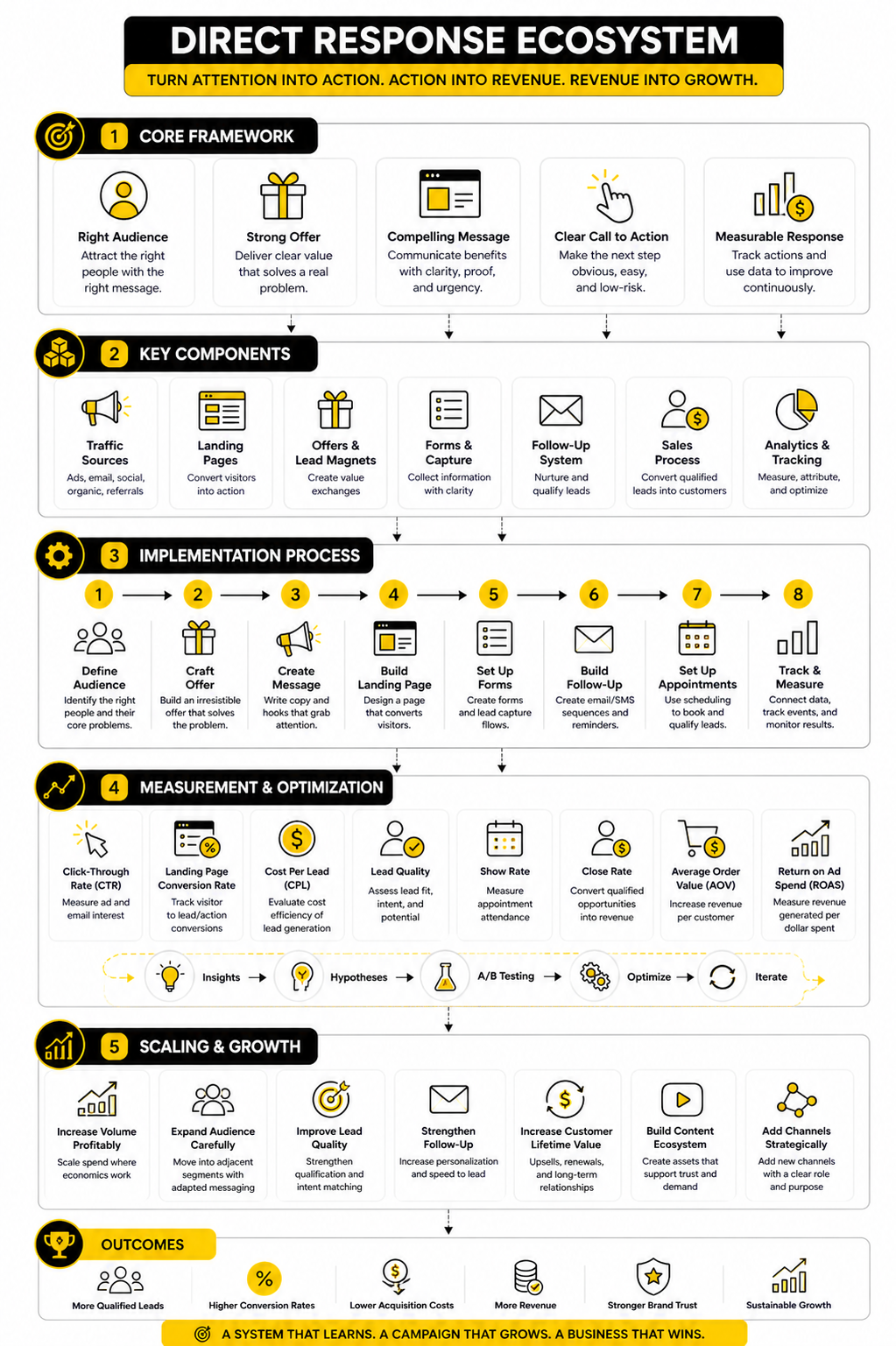
The final strategy is simple, but not easy. Start with a focused buyer. Build an offer that deserves a response. Create a message that makes the next step obvious. Track the full path from click to revenue. Then improve the system based on real behavior, not opinions.
That is the difference between direct response as a tactic and direct response as a growth engine. One tries to squeeze conversions from random traffic. The other builds a repeatable way to turn attention into action, action into revenue, and revenue into better decisions.
What is direct response marketing?
Direct response marketing is marketing designed to create a specific, measurable action. That action might be a purchase, booking, form submission, phone call, reply, trial signup, quote request, or demo request. The important part is that the campaign is built around response, not vague exposure.
Direct response is different from general brand marketing because the result is easier to track. You can see which message produced the click, which page produced the lead, and which follow-up produced the sale. That makes it practical for businesses that need measurable growth instead of only long-term awareness.
Is direct response only for paid ads?
No, direct response is not limited to paid ads. It can happen through email, landing pages, organic social, direct mail, SMS, chatbots, webinars, sales pages, search campaigns, creator partnerships, and retargeting. Any channel can support direct response if it asks for a clear action and measures the result.
The channel matters less than the structure. You need a defined audience, strong offer, clear message, proof, and a call to action. Without those pieces, even a high-budget paid campaign can underperform.
What makes a direct response offer strong?
A strong offer makes the next step feel valuable, relevant, and low-risk. It clearly explains what the buyer gets, why it matters now, and what happens after they respond. It also reduces hesitation by making the outcome, process, and commitment easier to understand.
A weak offer usually forces the copy to work too hard. If people do not see enough value in the action, better wording will only help so much. Fixing the offer is often the highest-leverage move in a direct response campaign.
How long should a direct response landing page be?
A direct response landing page should be as long as the decision requires. A simple free download may only need a short page. A high-ticket service, complex software product, or paid consultation may need more explanation, proof, objection handling, and risk reduction.
Length is not the real issue. Clarity is. If a section helps the buyer understand the value, trust the claim, or take the next step, it earns its place. If it only adds noise, remove it.
What is the most important metric in direct response?
The most important metric depends on the campaign goal, but revenue-connected metrics matter most. Clicks, leads, and conversion rates are useful, but they do not tell the full story. A campaign with fewer leads can outperform a campaign with cheaper leads if those leads are more qualified and more likely to buy.
For most businesses, the real metrics are qualified pipeline, customer acquisition cost, close rate, average order value, lifetime value, and return on ad spend. Front-end metrics help diagnose problems. Revenue metrics decide whether the campaign is actually working.
How do I know if my direct response campaign is failing because of the ad or the landing page?
Look at the sequence. If impressions are strong but clicks are weak, the ad, hook, offer, or targeting probably needs work. If clicks are strong but conversions are weak, the landing page, offer clarity, proof, or form friction is more likely the issue.
If leads come in but sales do not happen, the problem may be qualification, follow-up, pricing, positioning, or expectation mismatch. Do not guess from one number. Read the whole path from first touch to final outcome.
How much proof does a direct response campaign need?
The amount of proof depends on the size of the promise and the level of risk. A small free resource may need light proof. A premium service, subscription, or high-ticket product needs stronger evidence because the buyer is making a bigger commitment.
Proof can include reviews, testimonials, screenshots, demos, case studies, transparent process explanations, guarantees, founder credibility, and third-party validation. The key is to place proof near the claims it supports. Do not make people search for reasons to believe you.
Should I use urgency in direct response marketing?
Yes, but only when the urgency is real. A deadline, limited bonus, enrollment window, seasonal constraint, capacity limit, or expiring discount can help people act when they already want the offer. Fake urgency may create short-term clicks, but it damages trust.
Regulators also care about misleading advertising claims. The FTC’s advertising guidance says businesses need solid proof for claims and should avoid misleading consumers, especially when using endorsements, testimonials, or objective performance claims through truth-in-advertising standards. Direct response should be persuasive, not reckless.
Can direct response work for high-ticket services?
Yes, but the campaign usually needs a different conversion path. High-ticket services rarely sell from one short page to a cold visitor. They usually need qualification, trust-building, proof, sales conversations, and follow-up.
The direct response action may be a diagnostic call, application, audit, webinar registration, or strategy session instead of an instant purchase. That first response starts the sales process. The campaign succeeds when the full path from response to closed deal is profitable.
Can direct response work for ecommerce?
Yes, ecommerce is a natural fit for direct response because purchases, cart actions, email signups, and checkout behavior are measurable. The challenge is that shoppers often abandon the buying process before completing payment. Baymard’s long-running cart research shows an average documented online shopping cart abandonment rate above 70%, which means checkout friction and follow-up can have a serious impact on revenue.
For ecommerce, direct response should focus on product clarity, offer strength, reviews, urgency, checkout simplicity, abandoned cart recovery, and post-purchase upsells. The goal is not only to drive traffic. The goal is to make the buying decision easier from product discovery to completed checkout.
How often should I test direct response campaigns?
Test when you have enough data to learn something meaningful. If traffic is too low, every small change may look important even when it is just noise. If the campaign has consistent volume, testing one major variable at a time can improve the system without confusing the results.
Start with high-impact variables first. Test the offer, headline, audience, creative angle, proof, pricing presentation, and call to action before obsessing over tiny design details. Button color is not the problem when the buyer does not understand the offer.
What tools do I need for direct response?
You need tools that support the campaign journey: traffic, landing pages, forms, follow-up, scheduling, CRM, email, analytics, and sales tracking. The exact stack depends on the business model. A solo consultant does not need the same system as a high-volume ecommerce brand or agency.
For practical setups, GoHighLevel can support CRM, automation, pipelines, and follow-up. ClickFunnels and Systeme.io can help with funnel building. ManyChat can help with conversational response flows. The best tool is the one that makes the buyer path cleaner and the data easier to act on.
What is the biggest mistake in direct response?
The biggest mistake is optimizing tactics before fixing the strategy. People change headlines, buttons, colors, and ad formats while the audience is too broad, the offer is weak, or the follow-up is broken. That creates activity, not progress.
Direct response works when the whole system is aligned. The buyer should feel understood, the offer should feel relevant, the next step should feel safe, and the business should be able to measure what happens after the response. When that alignment is missing, small optimizations cannot save the campaign.
How do brand marketing and direct response work together?
Brand marketing creates familiarity, trust, and preference over time. Direct response turns that trust into measurable action. They are not enemies, and smart companies do not treat them that way.
A strong brand can make direct response cheaper because people already recognize and trust the business. Strong direct response can also strengthen the brand when the message is useful, honest, and well executed. The mistake is thinking every brand touchpoint must sell immediately or every direct response campaign must ignore long-term trust.
When should I scale a direct response campaign?
Scale when the campaign has a clear signal, not just one lucky day of good results. You want stable conversion data, acceptable lead quality, a working follow-up process, and economics that make sense after sales and fulfillment costs. Scaling too early can hide problems until they become expensive.
Increase budget in controlled steps, watch downstream quality, and make sure operations can handle the extra demand. More traffic is only useful if the business can respond, sell, deliver, and support the new customers properly.
Build a stronger local presence with BAAM AI
Turn your website, Google profile, social channels, and AI visibility into one growth engine
Most businesses do not need more random marketing activity. They need a consistent presence system that helps the right people find them, trust them, and take action. BAAM AI brings strategy, local SEO, website updates, Google Maps visibility, social content, AI-search readiness, media production, and reporting into one practical monthly engine.
If you want your marketing to keep working after the campaign ends, start with a free BAAM AI presence audit. See how your business shows up today and where the fastest visibility wins are at BAAM AI.